Advancing Life-Cycle Assessment for Evaluating Sustainable Agrifood Systems


Abstract
1. Introduction
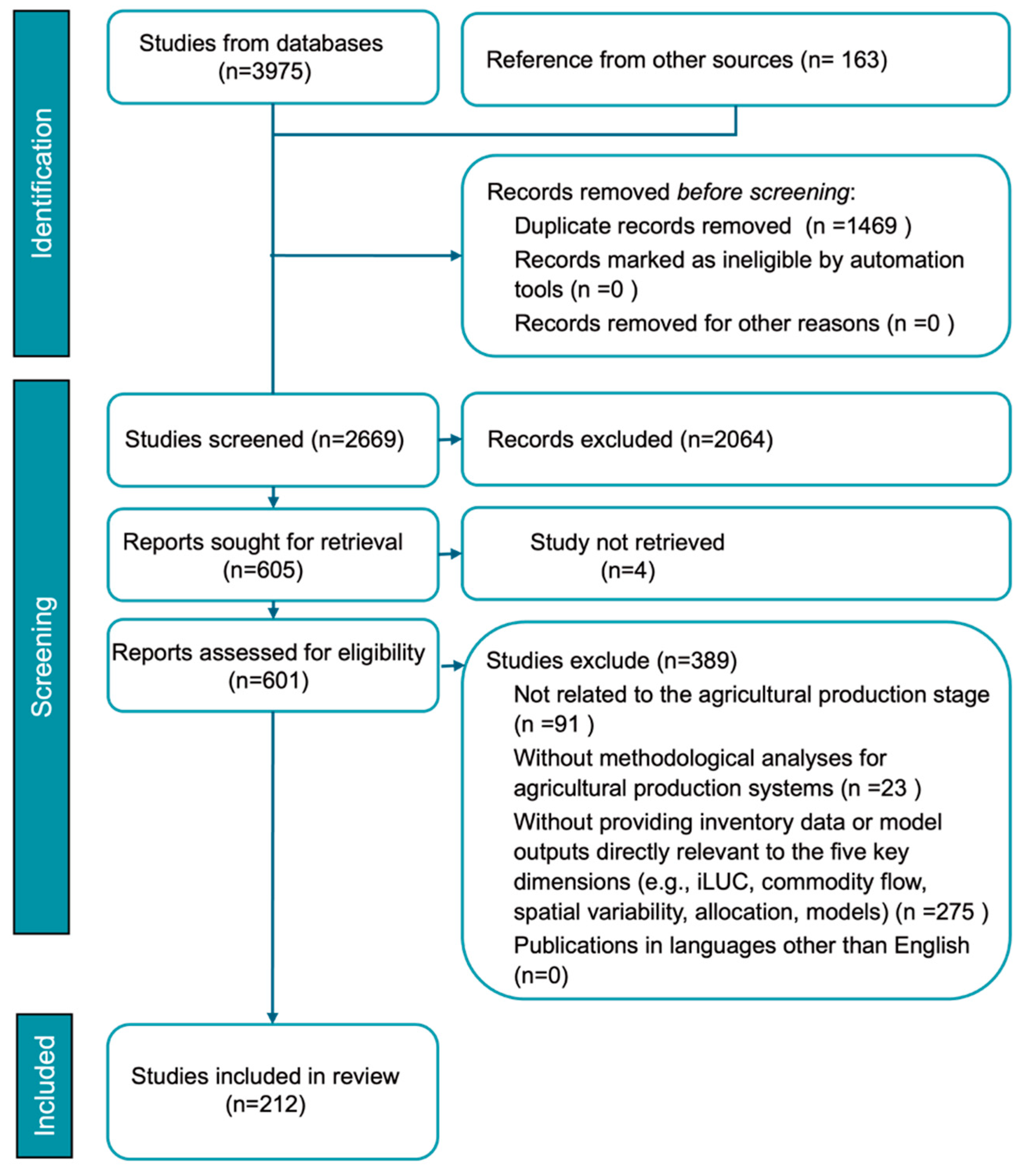
2. Materials and Methods
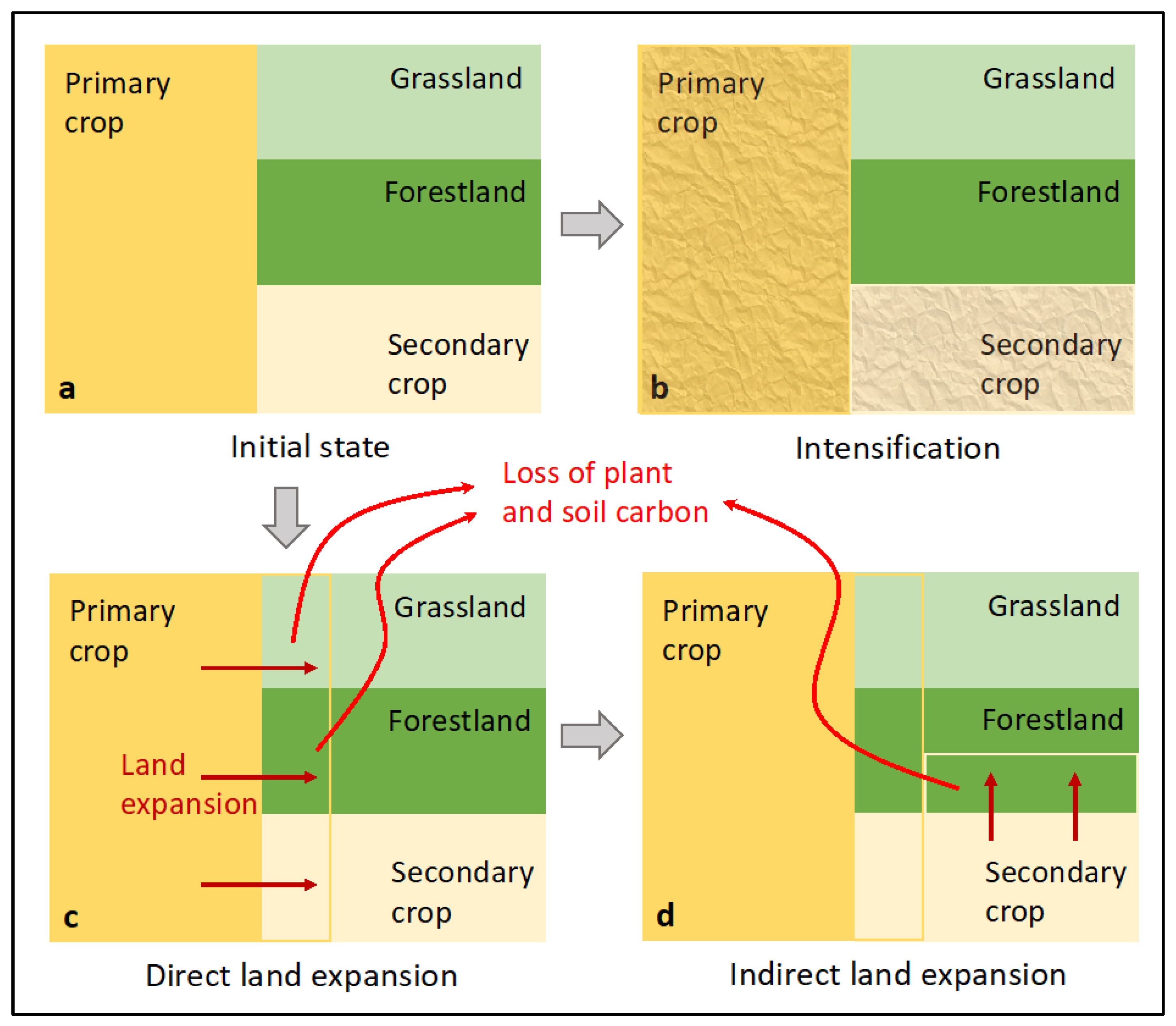
3. Land Constraints and the Pressure on Land Expansion
4. Intensification and Variable Input Structures
- 1.
- Product labeling, benchmarking, and routine supply chain characterization. For these purposes, we recommend using ALCA with representative average data. This approach provides reproducible and comparable metrics for the typical environmental impact of products. It is important to clarify that the use of average data in ALCA does not necessarily imply that the sum of all product LCAs must equal the total environmental impact of the world (the so-called “100% rule”), a point of ongoing methodological discussion [149]. While this approach offers consistency, it is critical to recognize that it does not capture the market-wide consequences of large-scale changes in demand;
- 2.
- Policy appraisal, program evaluation, and assessments of interventions likely to change production or land use. When the analyzed intervention can plausibly alter production volumes, commodity prices, or trade flows (and thus induce indirect effects like iLUC), CLCA using marginal data is essential. However, it is crucial to acknowledge that CLCA results can be highly uncertain due to the need to model complex market mechanisms and future scenarios [150]. Furthermore, a prevalent issue in uncertainty analysis for LCA is the use of independent probability distributions, which can lead to significant mass imbalances and unrealistic product compositions, thus undermining the reliability of the results [151]. Therefore, when applying CLCA, the scope and assumptions of any supporting economic or biophysical models must be thoroughly documented;
- 3.
- Comparative product or substitution decisions at the firm level. If the comparison concerns small operational changes with negligible market impacts, average data with transparent sensitivity analyses may suffice; for larger substitution scenarios with plausible market impacts, consequential approaches are recommended. The choice between ALCA and CLCA is not always a strict dichotomy, and there are studies that creatively combine elements of both approaches to suit the decision context [150].
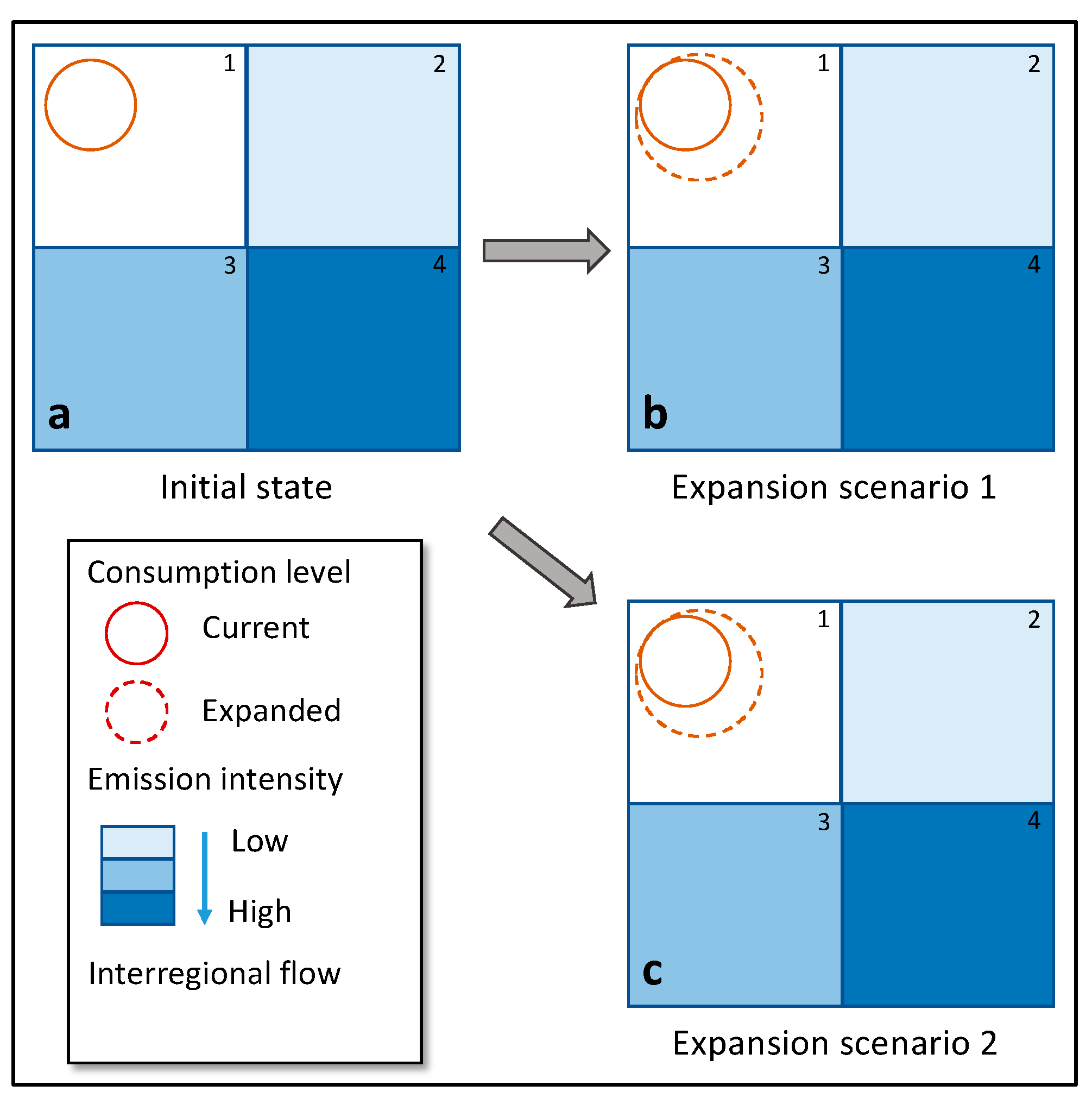
5. Spatial Variability and Interregional Commodity Flows
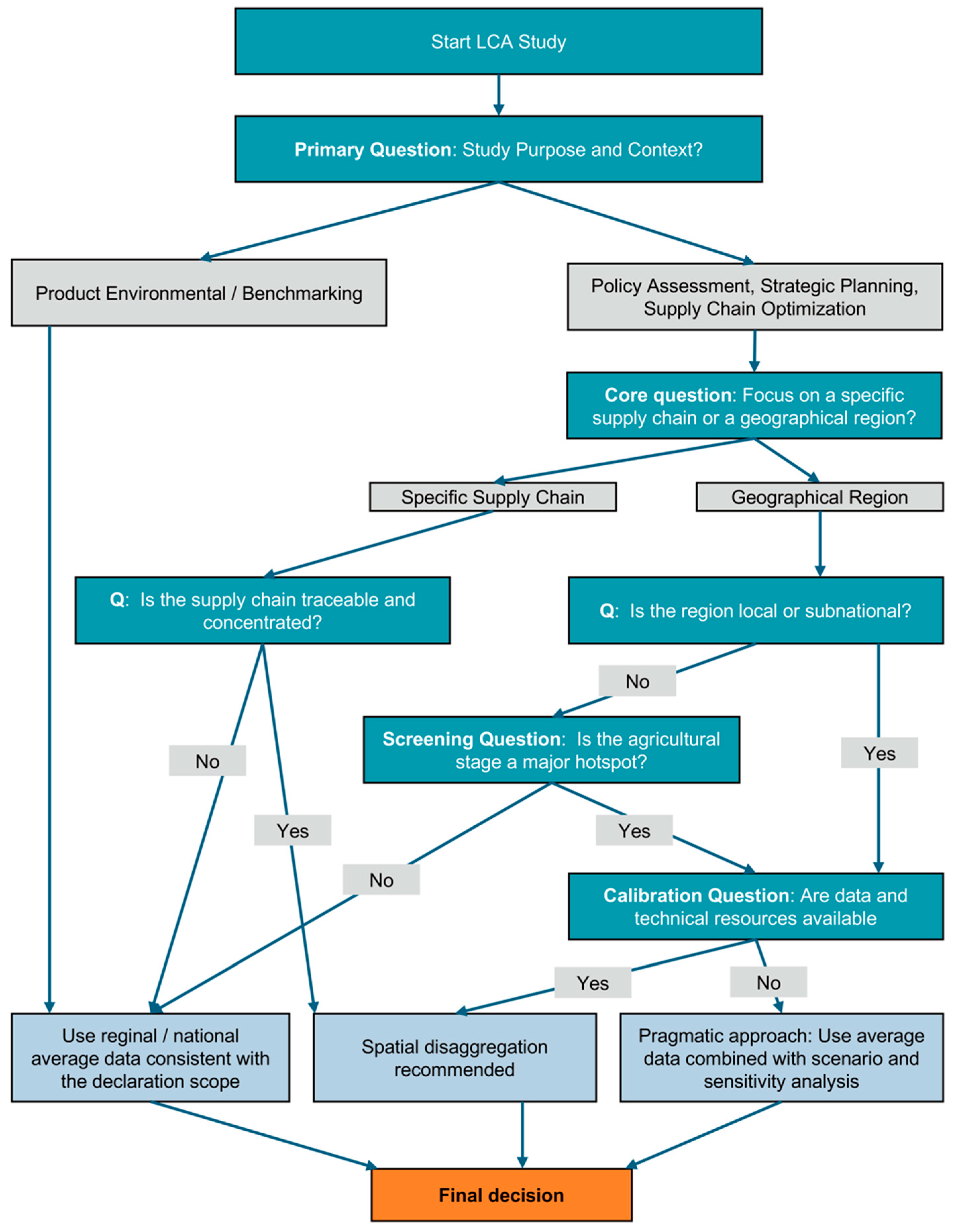
- Goal and Purpose of the Study: The primary driver is the intended application of the results.
- Attributional LCAs for Product Labeling or Benchmarking: For studies aimed at providing a representative, comparable average footprint of a product (e.g., for an environmental product declaration), the use of regional or national average data is often not only sufficient but preferred for ensuring consistency and fairness.
- Consequential LCAs for Policy or Strategic Decision-Making: When the goal is to assess the impact of a new policy, a large-scale expansion of production, or to identify opportunities for supply chain optimization, spatial disaggregation becomes critical [189,190]. It is essential for understanding geographically specific trade-offs, avoiding burden shifting from one region to another, and pinpointing high-leverage intervention points.
- Geographic Scope and Supply Chain Extent: The scale of the analysis dictates the requisite resolution of the data.
- Local/Regional Studies: Assessments focused on a specific watershed, state, or province almost always require spatially explicit data within that region, as averages from a larger area (e.g., national) may mask critical local variability [191].
- National/Global Studies with Diffuse Supply Chains: For commodities sourced from a wide, non-specific geographic area (e.g., a national average food basket), highly aggregated data may be a pragmatic necessity. However, if the supply chain is traceable to specific production regions, a nested approach using regional data for key contributors is highly recommended [192].
- Relative Contribution of Agricultural Production: The importance of spatial detail is proportional to the significance of the agricultural stage.
- If a preliminary screening-level LCA reveals that the agricultural production phase is a minor contributor to the total life cycle impact, refining its spatial resolution is unlikely to change the overall conclusion.
- Availability of Data and Resources: Practical constraints must be acknowledged.
- The decision to pursue spatial disaggregation is also a function of data availability, model capability, and allocated time and budget. When full spatial modeling is infeasible, targeted sensitivity analysis using high and low-impact scenarios can provide valuable insights into the potential influence of spatial variability [195].
6. Methodological Challenges and Outlook
7. Conclusions
Author Contributions
Funding
Institutional Review Board Statement
Informed Consent Statement
Data Availability Statement
Conflicts of Interest
References
- Gallardo, R.K. The environmental impacts of agriculture: A review. Int. Rev. Environ. Resour. Econ. 2024, 18, 165–235. [Google Scholar] [CrossRef] [Scilit]
- Kross, A.; Kaur, G.; Jaeger, J.A.G. A geospatial framework for the assessment and monitoring of environmental impacts of agriculture. Environ. Impact Assess. Rev. 2022, 97, 106851. [Google Scholar] [CrossRef] [Scilit]
- Shukla, P.R.; Skeg, J.; Buendia, E.C.; Masson-Delmotte, V.; Pörtner, H.O.; Roberts, D.C.; Zhai, P.; Slade, R.; Connors, S.; Van Diemen, S.; et al. Climate Change and Land: An IPCC Special Report on Climate Change, Desertification, Land Degradation, Sustainable Land Management, Food Security, and Greenhouse Gas Fluxes in Terrestrial Ecosystems; Intergovernmental Panel on Climate Change (IPCC): Geneva, Switzerland, 2019. [Google Scholar]
- Smith, P.; Bustamante, M.; Ahammad, H.; Clark, H.; Dong, H.; Elsiddig, E.A.; Haberl, H.; Harper, R.; House, J.; Jafari, M.; et al. Agriculture, forestry and other land use (AFOLU). In Climate Change 2014: Mitigation of Climate Change. Contribution of Working Group III to the Fifth Assessment Report of the Intergovernmental Panel on Climate Change; Cambridge University Press: Cambridge, UK, 2014; pp. 811–922. [Google Scholar]
- Forslund, A.; Tibi, A.; Schmitt, B.; Marajo-Petitzon, E.; Debaeke, P.; Durand, J.L.; Faverdin, P.; Guyomard, H. Can healthy diets be achieved worldwide in 2050 without farmland expansion? Glob. Food Secur. 2023, 39, 100711. [Google Scholar] [CrossRef] [Scilit]
- Potapov, P.; Turubanova, S.; Hansen, M.C.; Tyukavina, A.; Zalles, V.; Khan, A.; Song, X.P.; Pickens, A.; Shen, Q.; Cortez, J. Global maps of cropland extent and change show accelerated cropland expansion in the twenty-first century. Nat. Food 2022, 3, 19–28. [Google Scholar] [CrossRef] [Scilit]
- Laurance, W.F.; Sayer, J.; Cassman, K.G. Agricultural expansion and its impacts on tropical nature. Trends Ecol. Evol. 2014, 29, 107–116. [Google Scholar] [CrossRef] [Scilit] [PubMed]
- Isbell, F.; Reich, P.B.; Tilman, D.; Hobbie, S.E.; Polasky, S.; Binder, S. Nutrient enrichment, biodiversity loss, and consequent declines in ecosystem productivity. Proc. Natl. Acad. Sci. USA 2013, 110, 11911–11916. [Google Scholar] [CrossRef] [Scilit] [PubMed]
- Luo, J.; Banerjee, S.; Ma, Q.; Liao, G.; Hu, B.; Zhao, H.; Li, T. Organic fertilization drives shifts in microbiome complexity and keystone taxa increase the resistance of microbial mediated functions to biodiversity loss. Biol. Fertil. Soils 2023, 59, 441–458. [Google Scholar] [CrossRef] [Scilit]
- Schütte, G.; Eckerstorfer, M.; Rastelli, V.; Reichenbecher, W.; Restrepo-Vassalli, S.; Ruohonen-Lehto, M.; Saucy, A.G.W.; Mertens, M. Herbicide resistance and biodiversity: Agronomic and environmental aspects of genetically modified herbicide-resistant plants. Environ. Sci. Eur. 2017, 29, 5. [Google Scholar] [CrossRef] [Scilit]
- Yu, C.; Huang, X.; Chen, H.; Godfray, H.C.J.; Wright, J.S.; Hall, J.W.; Gong, P.; Ni, S.; Qiao, S.; Huang, G.; et al. Managing nitrogen to restore water quality in China. Nature 2019, 567, 516–520. [Google Scholar] [CrossRef] [Scilit]
- Pimentel, D.; Levitan, L. Pesticides: Amounts applied and amounts reaching pests. BioScience 1986, 36, 86–91. [Google Scholar] [CrossRef] [Scilit]
- Carvalho, F.P. Pesticides, environment, and food safety. Food Energy Secur. 2017, 6, 48–60. [Google Scholar] [CrossRef] [Scilit]
- McDermid, S.; Nocco, M.; Lawston-Parker, P.; Keune, J.; Pokhrel, Y.; Jain, M.; Jägermeyr, J.; Brocca, L.; Massari, C.; Jones, A.D.; et al. Irrigation in the Earth system. Nat. Rev. Earth Environ. 2023, 4, 435–453. [Google Scholar] [CrossRef] [Scilit]
- Huang, Z.; Hejazi, M.; Tang, Q.; Vernon, C.R.; Liu, Y.; Chen, M.; Calvin, K. Global agricultural green and blue water consumption under future climate and land use changes. J. Hydrol. 2019, 574, 242–256. [Google Scholar] [CrossRef] [Scilit]
- United Nations Department of Economic and Social Affairs, Population Division. World Population Prospects 2022: Summary of Results; United Nations: New York, NY, USA, 2022; Available online: https://www.un.org/development/desa/pd/sites/www.un.org.development.desa.pd/files/undesa_pd_2022_wpp_key-messages.pdf (accessed on 8 January 2024).
- van Dijk, M.; Morley, T.; Rau, M.L.; Saghai, Y. A meta-analysis of projected global food demand and population at risk of hunger for the period 2010–2050. Nat. Food 2021, 2, 494–501. [Google Scholar] [CrossRef] [Scilit]
- Yang, Y.; Tilman, D.; Jin, Z.; Smith, P.; Barrett, C.B.; Zhu, Y.G.; Burney, J.; D’Odorico, P.; Fantke, P.; Fargione, J.; et al. Climate change exacerbates the environmental impacts of agriculture. Science 2024, 385, eadn3747. [Google Scholar] [CrossRef] [Scilit]
- Yang, Y.; Liu, B.; Wang, P.; Chen, W.Q.; Smith, T.M. Toward sustainable climate change adaptation. J. Ind. Ecol. 2020, 24, 318–330. [Google Scholar] [CrossRef] [Scilit]
- Zhao, C.; Liu, B.; Piao, S.; Wang, X.; Lobell, D.B.; Huang, Y.; Huang, M.; Yao, Y.; Bassu, S.; Ciais, P.; et al. Temperature increase reduces global yields of major crops in four independent estimates. Proc. Natl. Acad. Sci. USA 2017, 114, 9326–9331. [Google Scholar] [CrossRef] [Scilit]
- Galanakis, C.M. The future of food. Foods 2024, 13, 506. [Google Scholar] [CrossRef] [Scilit]
- ISO 14040; Environmental Management-Life Cycle Assessment-Principles and Framework. International Organization for Standardization: Geneva, Switzerland, 2006.
- Brentrup, F.; Küsters, J.; Kuhlmann, H.; Lammel, J. Environmental impact assessment of agricultural production systems using the life cycle assessment methodology: I. Theoretical concept of a LCA method tailored to crop production. Eur. J. Agron. 2004, 20, 247–264. [Google Scholar] [CrossRef] [Scilit]
- Yang, Y.; Bae, J.; Kim, J.; Suh, S. Replacing gasoline with corn ethanol results in significant environmental problem-shifting. Environ. Sci. Technol. 2012, 46, 3671–3678. [Google Scholar] [CrossRef] [Scilit]
- Guinée, J.; Heijungs, R.; Huppes, G.; Zamagni, A.; Masoni, P.; Buonamici, R.; Ekvall, T.; Rydberg, T. Life cycle assessment: Past, present, and future. Environ. Sci. Technol. 2011, 45, 90–96. [Google Scholar] [CrossRef] [Scilit]
- Finkbeiner, M.; Schau, E.M.; Lehmann, A.; Traverso, M. Towards life cycle sustainability assessment. Sustainability 2010, 2, 3309–3322. [Google Scholar] [CrossRef] [Scilit]
- Campos-Guzmán, V.; García-Cáscales, M.S.; Espinosa, N.; Urbina, A. Life cycle analysis with multi-criteria decision making: A review of approaches for the sustainability evaluation of renewable energy technologies. Renew. Sustain. Energy Rev. 2019, 104, 343–366. [Google Scholar] [CrossRef] [Scilit]
- Chai, W.S.; Cheun, J.Y.; Kumar, P.S.; Mubashir, M.; Majeed, Z.; Banat, F.; Ho, S.H.; Show, P.L. A review on conventional and novel materials towards heavy metal adsorption in wastewater treatment application. J. Clean. Prod. 2021, 296, 126589. [Google Scholar] [CrossRef] [Scilit]
- Razman, K.K.; Hanafiah, M.M.; Mohammad, A.W. An overview of LCA applied to various membrane technologies: Progress, challenges, and harmonization. Environ. Technol. Innov. 2022, 27, 102803. [Google Scholar] [CrossRef] [Scilit]
- Goglio, P.; Williams, A.G.; Balta-Ozkan, N.; Harris, N.R.; Williamson, P.; Huisingh, D.; Zhang, Z.; Tavoni, M. Advances and challenges of life cycle assessment (LCA) of greenhouse gas removal technologies to fight climate changes. J. Clean. Prod. 2020, 244, 118896. [Google Scholar] [CrossRef] [Scilit]
- Pelton, R.E.O.; Smith, T.M. Hotspot scenario analysis: Comparative streamlined LCA approaches for green supply chain and procurement decision making. J. Ind. Ecol. 2015, 19, 427–440. [Google Scholar] [CrossRef] [Scilit]
- Byggeth, S.; Hochschorner, E. Handling trade-offs in ecodesign tools for sustainable product development and procurement. J. Clean. Prod. 2006, 14, 1420–1430. [Google Scholar] [CrossRef] [Scilit]
- Zhang, M.; Li, H.; Chen, S.; Liu, Y.; Li, S. Interrogating greenhouse gas emissions of different dietary structures by using a new food equivalent incorporated in life cycle assessment method. Environ. Impact Assess. Rev. 2023, 103, 107212. [Google Scholar] [CrossRef] [Scilit]
- Hallström, E.; Carlsson-Kanyama, A.; Börjesson, P. Environmental impact of dietary change: A systematic review. J. Clean. Prod. 2015, 91, 1–11. [Google Scholar] [CrossRef] [Scilit]
- Detzel, A.; Krüger, M.; Busch, M.; Blanco-Gutiérrez, I.; Varela, C.; Manners, R.; Bez, J.; Zannini, E. Life cycle assessment of animal-based foods and plant-based protein-rich alternatives: An environmental perspective. J. Sci. Food Agric. 2022, 102, 5098–5110. [Google Scholar] [CrossRef] [Scilit]
- Maiolo, S.; Parisi, G.; Biondi, N.; Lunelli, F.; Tibaldi, E.; Pastres, R. Fishmeal partial substitution within aquafeed formulations: Life cycle assessment of four alternative protein sources. Int. J. Life Cycle Assess. 2020, 25, 1455–1471. [Google Scholar] [CrossRef] [Scilit]
- Vandermeersch, T.; Alvarenga, R.A.F.; Ragaert, P.; Dewulf, J. Environmental sustainability assessment of food waste valorization options. Resour. Conserv. Recycl. 2014, 87, 57–64. [Google Scholar] [CrossRef] [Scilit]
- Lam, C.M.; Iris, K.M.; Hsu, S.C.; Tsang, D.C. Life-cycle assessment on food waste valorisation to value-added products. J. Clean. Prod. 2018, 199, 840–848. [Google Scholar] [CrossRef] [Scilit]
- Kurniawan, T.A.; Lo, W.; Othman, M.H.D.; Liang, X.; Goh, H.H.; Chew, K.W. Influence of Fe2O3 and bacterial biofilms on Cu(II) distribution in a simulated aqueous solution: A feasibility study to sediments in the Pearl River Estuary (PR China). J. Environ. Manag. 2023, 329, 117047. [Google Scholar] [CrossRef] [Scilit]
- Gerbrandt, K.; Chu, P.L.; Simmonds, A.; Mullins, K.A.; MacLean, H.L.; Griffin, W.M.; Saville, B.A. Life cycle assessment of lignocellulosic ethanol: A review of key factors and methods affecting calculated GHG emissions and energy use. Curr. Opin. Biotechnol. 2016, 38, 63–70. [Google Scholar] [CrossRef] [Scilit]
- Tu, Q.; Eckelman, M.; Zimmerman, J. Meta-analysis and harmonization of life cycle assessment studies for algae biofuels. Environ. Sci. Technol. 2017, 51, 9419–9432. [Google Scholar] [CrossRef] [Scilit]
- Harun, S.N.; Hanafiah, M.M.; Noor, N.M. Rice straw utilisation for bioenergy production: A brief overview. Energies 2022, 15, 5542. [Google Scholar] [CrossRef] [Scilit]
- Yang, Y.; Tilman, D.; Lehman, C.; Trost, J.J. Sustainable intensification of high-diversity biomass production for optimal biofuel benefits. Nat. Sustain. 2018, 1, 686–692. [Google Scholar] [CrossRef] [Scilit]
- Gelfand, I.; Sahajpal, R.; Zhang, X.; Izaurralde, R.C.; Gross, K.L.; Robertson, G.P. Sustainable bioenergy production from marginal lands in the US Midwest. Nature 2013, 493, 514–517. [Google Scholar] [CrossRef] [Scilit] [PubMed]
- Kim, S.; Dale, B.E.; Martinez-Feria, R.; Basso, B.; Thelen, K.; Maravelias, C.T.; Landis, D.; Lark, T.J.; Robertson, G.P. Global warming intensity of biofuel derived from switchgrass grown on marginal land in Michigan. GCB Bioenergy 2023, 15, 319–331. [Google Scholar] [CrossRef] [Scilit]
- Chi, N.T.L.; Duc, P.A.; Mathimani, T.; Pugazhendhi, A. Evaluating the potential of green alga Chlorella sp. for high biomass and lipid production in biodiesel viewpoint. Biocatal. Agric. Biotechnol. 2019, 17, 184–188. [Google Scholar] [CrossRef] [Scilit]
- Chen, H.P.; Lee, M.; Chiueh, P.T. Creating ecosystem services assessment models incorporating land use impacts based on soil quality. Sci. Total Environ. 2021, 773, 145018. [Google Scholar] [CrossRef] [Scilit] [PubMed]
- Damiani, M.; Sinkko, T.; Caldeira, C.; Tosches, D.; Robuchon, M.; Sala, S. Critical review of methods and models for biodiversity impact assessment and their applicability in the LCA context. Environ. Impact Assess. Rev. 2023, 101, 107134. [Google Scholar] [CrossRef] [Scilit]
- Horton, P.; Long, S.P.; Smith, P.; Banwart, S.A.; Beerling, D.J. Technologies to deliver food and climate security through agriculture. Nat. Plants 2021, 7, 250–255. [Google Scholar] [CrossRef] [Scilit]
- Howden, S.M.; Soussana, J.F.; Tubiello, F.N.; Chhetri, N.; Dunlop, M.; Meinke, H. Adapting agriculture to climate change. Proc. Natl. Acad. Sci. USA 2007, 104, 19691–19696. [Google Scholar] [CrossRef] [Scilit]
- Heijungs, R.; Suh, S. The Computational Structure of Life Cycle Assessment; Springer Science & Business Media: Dordrecht, The Netherlands, 2002; Volume 11. [Google Scholar]
- Plevin, R.J.; Delucchi, M.A.; Creutzig, F. Using attributional life cycle assessment to estimate climate-change mitigation benefits misleads policy makers. J. Ind. Ecol. 2014, 18, 73–83. [Google Scholar] [CrossRef] [Scilit]
- Weidema, B.P. Market Information in Life Cycle Assessment; Danish Environmental Protection Agency (Miljøstyrelsen): Copenhagen, Denmark, 2003; Volume 863, p. 365.
- Ekvall, T.; Tillman, A.M.; Molander, S. Normative ethics and methodology for life cycle assessment. J. Clean. Prod. 2005, 13, 1225–1234. [Google Scholar] [CrossRef] [Scilit]
- Zink, T.; Geyer, R.; Suh, S.; Bergesen, J.D. Formalizing Consequential Inventory Modeling: A Quantitative Framework to Facilitate Consistency Between Studies; Les Diablerets: Ormont-Dessus, Switzerland, 2012. [Google Scholar]
- Arvidsson, R.; Kushnir, D.; Molander, S.; Sandén, B.A. Energy and resource use assessment of graphene as a substitute for indium tin oxide in transparent electrodes. J. Clean. Prod. 2016, 132, 289–297. [Google Scholar] [CrossRef] [Scilit]
- Yang, Y. Two sides of the same coin: Consequential life cycle assessment based on the attributional framework. J. Clean. Prod. 2016, 127, 274–281. [Google Scholar] [CrossRef] [Scilit]
- Yang, Y.; Heijungs, R. On the use of different models for consequential life cycle assessment. Int. J. Life Cycle Assess. 2018, 23, 751–758. [Google Scholar] [CrossRef] [Scilit]
- Cucurachi, S.; Yang, Y.; Bergesen, J.D.; Qin, Y.; Suh, S. Challenges in assessing the environmental consequences of dietary changes. Environ. Syst. Decis. 2016, 36, 217–219. [Google Scholar] [CrossRef] [Scilit]
- Chaplin-Kramer, R.; Sim, S.; Hamel, P.; Bryant, B.; Noe, R.; Mueller, C.; Rigarlsford, G.; Kulak, M.; Kowal, V.; Sharp, R.; et al. Life cycle assessment needs predictive spatial modelling for biodiversity and ecosystem services. Nat. Commun. 2017, 8, 15065. [Google Scholar] [CrossRef] [Scilit]
- McManus, M.C.; Taylor, C.M. The changing nature of life cycle assessment. Biomass Bioenergy 2015, 82, 13–26. [Google Scholar] [CrossRef] [Scilit] [PubMed]
- Miller, R.E.; Blair, P.D. Input–Output Analysis: Foundations and Extensions; Cambridge University Press: Cambridge, UK, 2009. [Google Scholar]
- Solow, R. On the structure of linear models. Econometrica 1952, 20, 29–46. [Google Scholar] [CrossRef] [Scilit]
- West, G.R. Comparison of input–output, input–output+ econometric and computable general equilibrium impact models at the regional level. Econ. Syst. Res. 1995, 7, 209–227. [Google Scholar] [CrossRef] [Scilit]
- Rose, A. Input–output economics and computable general equilibrium models. Struct. Change Econ. Dyn. 1995, 6, 295–304. [Google Scholar] [CrossRef] [Scilit]
- Yang, Y. A unified framework of life cycle assessment. Int. J. Life Cycle Assess. 2019, 24, 620–626. [Google Scholar] [CrossRef] [Scilit]
- Rajagopal, D. Consequential life cycle assessment of policy vulnerability to price effects. J. Ind. Ecol. 2014, 18, 164–175. [Google Scholar] [CrossRef] [Scilit]
- El-Chichakli, B.; von Braun, J.; Lang, C.; Barben, D.; Philp, J. Policy: Five cornerstones of a global bioeconomy. Nature 2016, 535, 221–223. [Google Scholar] [CrossRef] [Scilit]
- FAO. Land Statistics 2001–2022—Global, Regional and Country Trends; FAOSTAT Analytical Briefs, No. 88; FAO: Rome, Italy, 2024. [Google Scholar]
- Winters-Michaud, C.P.; Haro, A.; Callahan, S.; Bigelow, D.P. Major Uses of Land in the United States, 2017 (Report No. EIB-275); U.S. Department of Agriculture, Economic Research Service: Washington, DC, USA, 2024. [CrossRef] [Scilit]
- Ministry of Natural Resources of the People’s Republic of China. Bulletin of Major Data from the Third National Land Survey; Government of China: Beijing, China, 2021.
- FANC. Land Use in Germany in 2014–2016. Available online: https://www.bfn.de/en/service/facts-and-figures/the-utilisation-of-nature/land-use-overview/land-use-in-germany.html (accessed on 21 May 2019).
- Tyszler, H.B.M.; Braconi, M.V.P.N.; van Rijn, N.D.J. Agri-Footprint 6 Methodology Report; Blonk Consultants: Gouda, The Netherlands, 2022. [Google Scholar]
- U.S. Department of Agriculture (USDA). LCA Digital Commons: Data and Community for Life Cycle Assessment. Available online: http://www.lcacommons.gov/ (accessed on 5 January 2025).
- Frederick, J.R.; Camberato, J.J. Water and nitrogen effects on winter wheat in the Southeastern Coastal Plain: I. Grain yield and kernel traits. Agron. J. 1995, 87, 521. [Google Scholar] [CrossRef] [Scilit]
- Fargione, J.; Hill, J.; Tilman, D.; Polasky, S.; Hawthorne, P. Land clearing and the biofuel carbon debt. Science 2008, 319, 1235–1238. [Google Scholar] [CrossRef] [Scilit] [PubMed]
- Austin, K.G.; Jones, J.P.H.; Clark, C.M. A review of domestic land use change attributable to U.S. biofuel policy. Renew. Sustain. Energy Rev. 2022, 159, 112181. [Google Scholar] [CrossRef] [Scilit]
- Lark, T.J.; Salmon, J.M.; Gibbs, H.K. Cropland expansion outpaces agricultural and biofuel policies in the United States. Environ. Res. Lett. 2015, 10, 044003. [Google Scholar] [CrossRef] [Scilit]
- Searchinger, T.; Heimlich, R.; Houghton, R.A.; Dong, F.; Elobeid, A.; Fabiosa, J.; Tokgoz, S.; Hayes, D.; Yu, T.H. Use of U.S. croplands for biofuels increases greenhouse gases through emissions from land-use change. Science 2008, 319, 1238–1240. [Google Scholar] [CrossRef] [Scilit]
- IEA. Renewables 2023; International Energy Agency: Paris, France, 2024; Available online: https://www.iea.org/reports/renewables-2023 (accessed on 5 January 2025).
- Zhang, X.; Lark, T.J.; Clark, C.M.; Yuan, Y.; LeDuc, S.D. Grassland-to-cropland conversion increased soil, nutrient, and carbon losses in the U.S. Midwest between 2008 and 2016. Environ. Res. Lett. 2021, 16, 054018. [Google Scholar] [CrossRef] [Scilit]
- Wang, W.; Khanna, M. Land use effects of biofuel production in the U.S. Environ. Res. Commun. 2023, 5, 055007. [Google Scholar]
- National Supply Company. Acompanhamento da Safra Brasileira de cana-de-açúcar V.8—Safra 2021/22—N.2—Segundo Levantamento|Agosto 2021 (Monitoring the Brazilian Sugarcane Harvest V.8—2021/22 Crop—N.2—Second Survey. August 2021); National Supply Company: Brasília, Brazil, 2021. [Google Scholar]
- MAPA. Projeções do Agronegócio: Brasil 2020/21 a 2030/31—Projeções de longo Prazo (Agribusiness Projections: Brazil 2020/21 to 2030/31—Long Term Projections); MAPA: Brasília, Brazil, 2021. [Google Scholar]
- Dharmawan, A.H.; Fauzi, A.; Putri, E.I.; Pacheco, P.; Dermawan, A.; Nuva, N.; Amalia, R.; Sudaryanti, D.A. Bioenergy policy: The biodiesel sustainability dilemma in Indonesia. Int. J. Sustain. Dev. Plan. 2020, 15, 537–546. [Google Scholar] [CrossRef] [Scilit]
- Farrell, A.E.; Plevin, R.J.; Turner, B.T.; Jones, A.D.; O’Hare, M.; Kammen, D.M. Ethanol can contribute to energy and environmental goals. Science 2006, 311, 506–508. [Google Scholar] [CrossRef] [Scilit]
- Hill, J.; Nelson, E.; Tilman, D.; Polasky, S.; Tiffany, D. Environmental, economic, and energetic costs and benefits of biodiesel and ethanol biofuels. Proc. Natl. Acad. Sci. USA 2006, 103, 11206–11210. [Google Scholar] [CrossRef] [Scilit] [PubMed]
- Wang, M.; Wu, M.; Huo, H. Life-cycle energy and greenhouse gas emission impacts of different corn ethanol plant types. Environ. Res. Lett. 2007, 2, 024001. [Google Scholar] [CrossRef] [Scilit]
- Daioglou, V.; Doelman, J.C.; Stehfest, E.; Müller, C.; Wicke, B.; Faaij, A.; van Vuuren, D.P. Greenhouse gas emission curves for advanced biofuel supply chains. Nat. Clim. Change 2017, 7, 920–924. [Google Scholar] [CrossRef] [Scilit]
- El Takriti, S.; Malins, C.; Searle, S. Understanding options for ILUC mitigation. Int. Counc. Clean Transp. Work. Pap. 2016, 23, 1–14. [Google Scholar]
- Subramaniam, V.; Kuntom, A.; Zainal, H.; Loh, S.K.; Aziz, A.A.; Parveez, G.K.A. Analysis of the uncertainties of the inclusion of indirect land use change into the European Union Renewable Energy Sources Directive II. J. Oil Palm Res. 2019, 31, 480–488. [Google Scholar] [CrossRef] [Scilit]
- Hertel, T.W.; Golub, A.A.; Jones, A.D.; O’Hare, M.; Plevin, R.J.; Kammen, D.M. Effects of US Maize Ethanol on Global Land Use and Greenhouse Gas Emissions: Estimating Market-Mediated Responses. BioScience 2010, 60, 223–231. [Google Scholar] [CrossRef] [Scilit]
- Wang, M.; Elgowainy, A.; Lee, U.; Baek, K.H.; Balchandani, S.; Benavides, P.T.; Burnham, A.; Cai, H.; Chen, P.; Gan, Y.; et al. Greenhouse Gases, Regulated Emissions, and Energy Use in Technologies Model® (2023 Excel); Computer Software; USDOE Office of Energy Efficiency and Renewable Energy (EERE): Washington, DC, USA, 2023. [CrossRef]
- United States Environmental Protection Agency. Renewable Fuel Standard Program (RFS2) Regulatory Impact Analysis; United States Environmental Protection Agency: Washington, DC, USA, 2010.
- Plevin, R.J.; Jones, A.D.; Torn, M.S.; Gibbs, H.K. Greenhouse Gas Emissions from Biofuels’ Indirect Land Use Change Are Uncertain but May Be Much Greater than Previously Estimated. Environ. Sci. Technol. 2010, 44, 8015–8021. [Google Scholar] [CrossRef] [Scilit]
- Tyner, W.E.; Taheripour, F.; Zhuang, Q.; Birur, D.; Baldos, U. Land Use Changes and Consequent CO2 Emissions Due to US Corn Ethanol Production: A Comprehensive Analysis; Department of Agricultural Economics, Purdue University: West Lafayette, IN, USA, 2010; pp. 1–90. [Google Scholar]
- De Rosa, M.; Schmidt, J. Life Cycle Assessment of Palm Oil at United Plantations Berhad 2022, Results for 2004–2021. Summary Report; United Plantations Berhad: Teluk Intan, Malaysia, 2022. [Google Scholar]
- De Rosa, M.; Schmidt, J.; Pasang, H. Industry-Driven Mitigation Measures Can Reduce GHG Emissions of Palm Oil. J. Clean. Prod. 2022, 365, 132565. [Google Scholar] [CrossRef] [Scilit]
- European Commission. Joint Research Centre. Institute for Energy and Transport. Estimates of Indirect Land Use Change from Biofuels Based on Historical Data; Publications Office: Luxembourg, 2015. [Google Scholar]
- Xu, H.; Ou, L.; Li, Y.; Hawkins, T.R.; Wang, M. Life Cycle Greenhouse Gas Emissions of Biodiesel and Renewable Diesel Production in the United States. Environ. Sci. Technol. 2022, 56, 7512–7521. [Google Scholar] [CrossRef] [Scilit]
- Plevin, R.J.; Beckman, J.; Golub, A.A.; Witcover, J.; O’Hare, M. Carbon Accounting and Economic Model Uncertainty of Emissions from Biofuels-Induced Land Use Change. Environ. Sci. Technol. 2015, 49, 2656–2664. [Google Scholar] [CrossRef] [Scilit]
- Garraín, D.; De La Rúa, C.; Lechón, Y. Consequential Effects of Increased Biofuel Demand in Spain: Global Crop Area and CO2 Emissions from Indirect Land Use Change. Biomass Bioenergy 2016, 85, 187–197. [Google Scholar] [CrossRef] [Scilit]
- Nguyen, Q.V.; Wiedemann, S.G.; Simmons, A.; Clarke, S.J. The Environmental Consequences of a Change in Australian Cotton Lint Production. Int. J. Life Cycle Assess. 2021, 26, 2321–2338. [Google Scholar] [CrossRef] [Scilit]
- Taheripour, F.; Mueller, S.; Emery, I.; Karami, O.; Sajedinia, E.; Zhuang, Q.; Wang, M. Biofuels induced land use change emissions: The role of implemented land use emission factors. Sustainability 2024, 16, 2729. [Google Scholar] [CrossRef] [Scilit]
- Heimann, T.; Argueyrolles, R.; Reinhardt, M.; Schuenemann, F.; Söder, M.; Delzeit, R. Phasing out palm and soy oil biodiesel in the EU: What is the benefit? GCB Bioenergy 2024, 16, e13115. [Google Scholar] [CrossRef] [Scilit]
- Corbelle-Rico, E.; Sánchez-Fernández, P.; López-Iglesias, E.; Lago-Peñas, S.; Da-Rocha, J.M. Putting land to work: An evaluation of the economic effects of recultivating abandoned farmland. Land Use Policy 2022, 112, 105808. [Google Scholar] [CrossRef] [Scilit]
- Chen, R.; Qin, Z.; Han, J.; Wang, M.; Taheripour, F.; Tyner, W.; O’Connor, D.; Duffield, J. Life cycle energy and greenhouse gas emission effects of biodiesel in the United States with induced land use change impacts. Bioresour. Technol. 2018, 251, 249–258. [Google Scholar] [CrossRef] [Scilit]
- Ewers, R.M.; Scharlemann, J.P.; Balmford, A.; Green, R.E. Do increases in agricultural yield spare land for nature? Glob. Change Biol. 2009, 15, 1716–1726. [Google Scholar] [CrossRef] [Scilit]
- Field, F.R.; Wallington, T.J.; Everson, M.; Kirchain, R.E. Strategic materials in the automobile: A comprehensive assessment of strategic and minor metals use in passenger cars and light trucks. Environ. Sci. Technol. 2017, 51, 14436–14444. [Google Scholar] [CrossRef] [Scilit]
- McArthur, J.W.; McCord, G.C. Fertilizing growth: Agricultural inputs and their effects in economic development. J. Dev. Econ. 2017, 127, 133–152. [Google Scholar] [CrossRef] [Scilit]
- Dhawan, V. Water and agriculture in India. In Background Paper for the South Asia Expert Panel during the Global Forum for Food and Agriculture; Business Association: New Delhi, India, 2017; Volume 28, pp. 80–85. [Google Scholar]
- Cammarano, D.; Jamshidi, S.; Hoogenboom, G.; Ruane, A.C.; Niyogi, D.; Ronga, D. Processing tomato production is expected to decrease by 2050 due to the projected increase in temperature. Nat. Food 2022, 3, 437–444. [Google Scholar] [CrossRef] [Scilit]
- Rodrigues, L.C.C.; Fortini, R.M.; Neves, M.C.R. Impacts of the use of biological pest control on the technical efficiency of the Brazilian agricultural sector. Int. J. Environ. Sci. Technol. 2023, 20, 1–16. [Google Scholar] [CrossRef] [Scilit] [PubMed]
- Lassaletta, L.; Billen, G.; Grizzetti, B.; Anglade, J.; Garnier, J. Fifty-year trends in nitrogen use efficiency of world cropping systems: The relationship between yield and nitrogen input to cropland. Environ. Res. Lett. 2014, 9, 105011. [Google Scholar] [CrossRef] [Scilit]
- Bodirsky, B.L.; Müller, C. Robust relationship between yields and nitrogen inputs indicates three ways to reduce nitrogen pollution. Environ. Res. Lett. 2014, 9, 111005. [Google Scholar] [CrossRef] [Scilit]
- Pan, W.L.; McClellan Maaz, T.; Hammac, W.A.; McCracken, V.A.; Koenig, R.T. Mitscherlich-modeled, semi-arid canola nitrogen requirements influenced by soil nitrogen and water. Agron. J. 2016, 108, 884–894. [Google Scholar] [CrossRef] [Scilit]
- Searchinger, T.D. Biofuels and the need for additional carbon. Environ. Res. Lett. 2010, 5, 024007. [Google Scholar] [CrossRef] [Scilit]
- Fichtbauer, A.; Temmink, R.J.; La Russa, M. Controlling the nitrogen environment for optimal Rhodomonas salina production. J. Appl. Phycol. 2023, 35, 1565–1574. [Google Scholar] [CrossRef] [Scilit]
- Cai, S.; Zhao, X.; Pittelkow, C.M.; Fan, M.; Zhang, X.; Yan, X. Optimal nitrogen rate strategy for sustainable rice production in China. Nature 2023, 615, 73–79. [Google Scholar] [CrossRef] [Scilit] [PubMed]
- Ruan, L.; Bhardwaj, A.K.; Hamilton, S.K.; Robertson, G.P. Nitrogen fertilization challenges the climate benefit of cellulosic biofuels. Environ. Res. Lett. 2016, 11, 064007. [Google Scholar] [CrossRef] [Scilit]
- Butterbach-Bahl, K.; Baggs, E.M.; Dannenmann, M.; Kiese, R.; Zechmeister-Boltenstern, S. Nitrous oxide emissions from soils: How well do we understand the processes and their controls? Philos. Trans. R. Soc. B Biol. Sci. 2013, 368, 20130122. [Google Scholar] [CrossRef] [Scilit] [PubMed]
- Su, Q.; Cang, B.; Ullah, R.; Song, Z.; Li, Y.; Cui, J.; Wei, X.; Yang, M.; Yang, X.; Wu, Z. Interaction of the coupled effects of irrigation mode and nitrogen fertilizer timing on rice yield in different regions. Irrig. Drain. 2023, 72, 999–1012. [Google Scholar] [CrossRef] [Scilit]
- Wang, X.; Xing, Y. Evaluation of the effects of irrigation and fertilization on tomato fruit yield and quality: A principal component analysis. Sci. Rep. 2017, 7, 350. [Google Scholar] [CrossRef] [Scilit]
- Li, Y.; Huang, G.; Chen, Z.; Xiong, Y.; Huang, Q.; Xu, X.; Huo, Z. Effects of irrigation and fertilization on grain yield, water and nitrogen dynamics and their use efficiency of spring wheat farmland in an arid agricultural watershed of Northwest China. Agric. Water Manag. 2022, 260, 107277. [Google Scholar] [CrossRef] [Scilit]
- Xiao, G.; Zhao, Z.; Liang, L.; Meng, F.; Wu, W.; Guo, Y. Improving nitrogen and water use efficiency in a wheat-maize rotation system in the North China Plain using optimized farming practices. Agric. Water Manag. 2019, 212, 172–180. [Google Scholar] [CrossRef] [Scilit]
- Denbaly, M.; Vroomen, H. Dynamic fertilizer nutrient demands for corn: A cointegrated and error-correcting system. Am. J. Agric. Econ. 1993, 75, 203. [Google Scholar] [CrossRef] [Scilit]
- Chang, Y.; Latham, J.; Licht, M.; Wang, L. A data-driven crop model for maize yield prediction. Commun. Biol. 2023, 6, 439. [Google Scholar] [CrossRef] [Scilit]
- Leng, G.; Hall, J.W. Predicting spatial and temporal variability in crop yields: An inter-comparison of machine learning, regression and process-based models. Environ. Res. Lett. 2020, 15, 044027. [Google Scholar] [CrossRef] [Scilit]
- Jones, J.W.; Antle, J.M.; Basso, B.; Boote, K.J.; Conant, R.T.; Foster, I.; Godfray, H.C.J.; Herrero, M.; Howitt, R.E.; Janssen, S.; et al. Brief history of agricultural systems modeling. Agric. Syst. 2017, 155, 240–254. [Google Scholar] [CrossRef] [Scilit]
- Bryant, K.J.; Benson, V.W.; Kiniry, J.R.; Williams, J.R.; Lacewell, R.D. Simulating corn yield response to irrigation timings: Validation of the EPIC model. J. Prod. Agric. 1992, 5, 237. [Google Scholar] [CrossRef] [Scilit]
- Cerrato, M.E.; Blackmer, A.M. Comparison of models for describing corn yield response to nitrogen fertilizer. Agron. J. 1990, 82, 138. [Google Scholar] [CrossRef] [Scilit]
- Farina, R.; Seddaiu, G.; Orsini, R.; Steglich, E.; Roggero, P.P.; Francaviglia, R. Soil carbon dynamics and crop productivity as influenced by climate change in a rainfed cereal system under contrasting tillage using EPIC. Soil Tillage Res. 2011, 112, 36–46. [Google Scholar] [CrossRef] [Scilit]
- Tonitto, C.; David, M.B.; Li, C.; Drinkwater, L.E. Application of the DNDC model to tile-drained Illinois agroecosystems: Model comparison of conventional and diversified rotations. Nutr. Cycl. Agroecosyst. 2007, 78, 65–81. [Google Scholar] [CrossRef] [Scilit]
- Sourn, T.; Pok, S.; Chou, P.; Nut, N.; Theng, D.; Prasad, P.V. Assessment of land use and land cover changes on soil erosion using remote sensing, GIS and RUSLE model: A case study of Battambang Province, Cambodia. Sustainability 2022, 14, 4066. [Google Scholar] [CrossRef] [Scilit]
- Gupta, D.; Gujre, N.; Singha, S.; Mitra, S. Role of existing and emerging technologies in advancing climate-smart agriculture through modeling: A review. Ecol. Inform. 2022, 71, 101805. [Google Scholar] [CrossRef] [Scilit]
- Hudiburg, T.W.; Wang, W.; Khanna, M.; Long, S.P.; Dwivedi, P.; Parton, W.J.; Hartman, M.; DeLucia, E.H. Impacts of a 32-billion-gallon bioenergy landscape on land and fossil fuel use in the U.S. Nat. Energy 2016, 1, 15005. [Google Scholar] [CrossRef] [Scilit]
- Liska, A.J.; Yang, H.; Milner, M.; Goddard, S.; Blanco-Canqui, H.; Pelton, M.P.; Fang, X.X.; Zhu, H.; Suyker, A.E. Biofuels from crop residue can reduce soil carbon and increase CO2 emissions. Nat. Clim. Change 2014, 4, 398–401. [Google Scholar] [CrossRef] [Scilit]
- Li, Y.; Wang, J.; Chen, R.; Wang, E.; Wang, B.; Yu, Q.; Hu, Q.; Pan, Z.; Pan, X. Climate-smart planting for potato to balance economic return and environmental impact across China. Sci. Total Environ. 2022, 850, 158013. [Google Scholar] [CrossRef] [Scilit] [PubMed]
- Li, J.; Luo, Z.; Wang, Y.; Li, H.; Xing, H.; Wang, L.; Wang, E.; Xu, H.; Gao, C.; Ren, T. Optimizing nitrogen and residue management to reduce GHG emissions while maintaining crop yield: A case study in a mono-cropping system of Northeast China. Sustainability 2019, 11, 5015. [Google Scholar] [CrossRef] [Scilit]
- Cai, Z.; Sawamoto, T.; Li, C.; Kang, G.; Boonjawat, J.; Mosier, A.; Wassmann, R.; Tsuruta, H. Field Validation of the DNDC Model for Greenhouse Gas Emissions in East Asian Cropping Systems. Glob. Biogeochem. Cycles 2003, 17, 1107–1116. [Google Scholar] [CrossRef] [Scilit]
- Gaillard, R.K.; Jones, C.D.; Ingraham, P.; Collier, S.; Izaurralde, R.C.; Jokela, W.; Osterholz, W.; Salas, W.; Vadas, P.; Ruark, M.D. Underestimation of N2O Emissions in a Comparison of the DayCent, DNDC, and EPIC Models. Ecol. Appl. 2018, 28, 694–708. [Google Scholar] [CrossRef] [Scilit]
- Yue, Q.; Cheng, K.; Ogle, S.; Hillier, J.; Smith, P.; Abdalla, M.; Ledo, A.; Sun, J.; Pan, G. Evaluation of Four Modelling Approaches to Estimate Nitrous Oxide Emissions in China’s Cropland. Sci. Total Environ. 2019, 652, 1279–1289. [Google Scholar] [CrossRef] [Scilit]
- Klatt, S.; Kraus, D.; Rahn, K.; Werner, C.; Kiese, R.; Butterbach-Bahl, K.; Haas, E. Parameter-Induced Uncertainty Quantification of Regional N2O Emissions and NO3 Leaching Using the Biogeochemical Model LandscapeDNDC. In Advances in Agricultural Systems Modeling; Del Grosso, S.J., Ahuja, L.R., Parton, W.J., Eds.; Wiley: New York, NY, USA, 2016; Volume 6, pp. 149–171. [Google Scholar] [CrossRef] [Scilit]
- Lamers, M.; Ingwersen, J.; Streck, T. Modelling N2O Emission from a Forest Upland Soil: A Procedure for an Automatic Calibration of the Biogeochemical Model Forest-DNDC. Ecol. Model. 2007, 205, 52–58. [Google Scholar] [CrossRef] [Scilit]
- Perlman, J.; Hijmans, R.J.; Horwath, W.R. Modelling Agricultural Nitrous Oxide Emissions for Large Regions. Environ. Model. Softw. 2013, 48, 183–192. [Google Scholar] [CrossRef] [Scilit]
- Wang, G.; Chen, S. A Review on Parameterization and Uncertainty in Modeling Greenhouse Gas Emissions from Soil. Geoderma 2012, 170, 206–216. [Google Scholar] [CrossRef] [Scilit]
- Babu, Y.J.; Li, C.; Frolking, S.; Nayak, D.R.; Adhya, T.K. Field Validation of DNDC Model for Methane and Nitrous Oxide Emissions from Rice-Based Production Systems of India. Nutr. Cycl. Agroecosyst. 2006, 74, 157–174. [Google Scholar] [CrossRef] [Scilit]
- Zimmermann, J.; Carolan, R.; Forrestal, P.; Harty, M.; Lanigan, G.; Richards, K.G.; Roche, L.; Whitfield, M.G.; Jones, M.B. Assessing the Performance of Three Frequently Used Biogeochemical Models When Simulating N2O Emissions from a Range of Soil Types and Fertiliser Treatments. Geoderma 2018, 331, 53–69. [Google Scholar] [CrossRef] [Scilit]
- Finnveden, G.; Arvidsson, R.; Björklund, A.; Guinée, J.; Heijungs, R.; Martin, M. Six Areas of Methodological Debate on Attributional Life Cycle Assessment. E3S Web Conf. 2022, 349, 03007. [Google Scholar] [CrossRef] [Scilit]
- Suh, S.; Yang, Y. On the Uncanny Capabilities of Consequential LCA. Int. J. Life Cycle Assess. 2014, 19, 1179–1184. [Google Scholar] [CrossRef] [Scilit]
- Marsh, E.; Hattam, L.; Allen, S. Stochastic Error Propagation with Independent Probability Distributions in LCA Does Not Preserve Mass Balances and Leads to Unusable Product Compositions—A First Quantification. Int. J. Life Cycle Assess. 2025, 30, 221–234. [Google Scholar] [CrossRef] [Scilit]
- Lo Piano, S.; Benini, L. A Critical Perspective on Uncertainty Appraisal and Sensitivity Analysis in Life Cycle Assessment. J. Ind. Ecol. 2022, 26, 763–781. [Google Scholar] [CrossRef] [Scilit]
- Lacirignola, M.; Blanc, P.; Girard, R.; Pérez-López, P.; Blanc, I. LCA of Emerging Technologies: Addressing High Uncertainty on Inputs’ Variability When Performing Global Sensitivity Analysis. Sci. Total Environ. 2017, 578, 268–280. [Google Scholar] [CrossRef] [Scilit]
- Miller, S.; Landis, A.; Theis, T. Use of Monte Carlo analysis to characterize nitrogen fluxes in agroecosystems. Environ. Sci. Technol. 2006, 40, 2324–2332. [Google Scholar] [CrossRef] [Scilit]
- Stuart, D.; Schewe, R.L.; McDermott, M. Reducing nitrogen fertilizer application as a climate change mitigation strategy: Understanding farmer decision-making and potential barriers to change in the U.S. Land Use Policy 2014, 36, 210–218. [Google Scholar] [CrossRef] [Scilit]
- Adnan, N.; Nordin, S.M.; Rahman, I.; Noor, A. The effects of knowledge transfer on farmers’ decision making toward sustainable agriculture practices: In view of green fertilizer technology. World J. Sci. Technol. Sustain. Dev. 2018, 15, 98–115. [Google Scholar] [CrossRef] [Scilit]
- MacDonald, J.M.; Ribaudo, M.O.; Livingston, M.J.; Beckman, J.; Huang, W. Manure Use for Fertilizer and for Energy; U.S. Department of Agriculture, Economic Research Service: Washington, DC, USA, 2009.
- Smith, C.M.; David, M.B.; Mitchell, C.A.; Masters, M.D.; Anderson-Teixeira, K.J.; Bernacchi, C.J.; DeLucia, E.H. Reduced nitrogen losses after conversion of row crop agriculture to perennial biofuel crops. J. Environ. Qual. 2013, 42, 219–228. [Google Scholar] [CrossRef] [Scilit]
- Choudhary, M.; Panday, S.C.; Meena, V.S.; Singh, S.; Yadav, R.P.; Mahanta, D.; Mondal, T.; Mishra, P.K.; Bisht, J.K.; Pattanayak, A. Long-term effects of organic manure and inorganic fertilization on sustainability and chemical soil quality indicators of soybean-wheat cropping system in the Indian mid-Himalayas. Agric. Ecosyst. Environ. 2018, 257, 38–46. [Google Scholar] [CrossRef] [Scilit]
- Rashmi, I.; Roy, T.; Kartika, K.S.; Pal, R.; Coumar, V.; Kala, S.; Shinoji, K.C. Organic and inorganic fertilizer contaminants in agriculture: Impact on soil and water resources. In Contaminants in Agriculture: Sources, Impacts and Management; Springer: Berlin/Heidelberg, Germany, 2020; pp. 3–41. [Google Scholar]
- Notarnicola, B.; Sala, S.; Anton, A.; McLaren, S.J.; Saouter, E.; Sonesson, U. The role of life cycle assessment in supporting sustainable agri-food systems: A review of the challenges. J. Clean. Prod. 2017, 140, 399–409. [Google Scholar] [CrossRef] [Scilit]
- USDA. LCA Commons. 2015. Available online: https://data.nal.usda.gov/dataset/lca-commons (accessed on 4 June 2019).
- Chiu, Y.W.; Wu, M. Assessing county-level water footprints of different cellulosic-biofuel feedstock pathways. Environ. Sci. Technol. 2012, 46, 9155–9162. [Google Scholar] [CrossRef] [Scilit]
- Pelton, R. Spatial greenhouse gas emissions from U.S. county corn production. Int. J. Life Cycle Assess. 2019, 24, 12–25. [Google Scholar] [CrossRef] [Scilit]
- Yang, Y.; Tao, M.; Suh, S. Geographic variability of agriculture requires sector-specific uncertainty characterization. Int. J. Life Cycle Assess. 2018, 23, 1581–1589. [Google Scholar] [CrossRef] [Scilit]
- Zhang, D.; Shen, J.; Zhang, F.; Li, Y.; Zhang, W. Carbon footprint of grain production in China. Sci. Rep. 2017, 7, 4126. [Google Scholar] [CrossRef] [Scilit]
- Huang, W.; Wu, F.; Han, W.; Li, Q.; Han, Y.; Wang, G.; Feng, L.; Li, X.; Yang, B.; Lei, Y.; et al. Carbon footprint of cotton production in China: Composition, spatiotemporal changes and driving factors. Sci. Total Environ. 2022, 821, 153407. [Google Scholar] [CrossRef] [Scilit] [PubMed]
- Kashyap, D.; Agarwal, T. Carbon footprint and water footprint of rice and wheat production in Punjab, India. Agric. Syst. 2021, 186, 102959. [Google Scholar] [CrossRef] [Scilit]
- Henryson, K.; Hansson, P.A.; Sundberg, C. Spatially differentiated midpoint indicator for marine eutrophication of waterborne emissions in Sweden. Int. J. Life Cycle Assess. 2018, 23, 70–81. [Google Scholar] [CrossRef] [Scilit]
- Poore, J.; Nemecek, T. Reducing food’s environmental impacts through producers and consumers. Science 2018, 360, 987–992. [Google Scholar] [CrossRef] [Scilit] [PubMed]
- Loiseau, E.; Aissani, L.; Le Féon, S.; Laurent, F.; Cerceau, J.; Sala, S.; Roux, P. Territorial life cycle assessment (LCA): What exactly is it about? A proposal towards using a common terminology and a research agenda. J. Clean. Prod. 2018, 176, 474–485. [Google Scholar] [CrossRef] [Scilit]
- Lulovicova, A.; Bouissou, S. Use of territorial LCA framework for local food systems assessment: Methodological developments and application. Int. J. Life Cycle Assess. 2024, 29, 912–928. [Google Scholar] [CrossRef] [Scilit]
- Ding, T.; Bourrelly, S.; Achten, W.M. Operationalising territorial life cycle inventory through the development of territorial emission factor for European agricultural land use. J. Clean. Prod. 2020, 263, 121565. [Google Scholar] [CrossRef] [Scilit]
- Pradeleix, L.; Roux, P.; Bouarfa, S.; Bellon-Maurel, V. Multilevel environmental assessment of regional farming activities with life cycle assessment: Tackling data scarcity and farm diversity with life cycle inventories based on agrarian system diagnosis. Agric. Syst. 2022, 196, 103328. [Google Scholar] [CrossRef] [Scilit]
- Smith, T.M.; Goodkind, A.L.; Kim, T.; Pelton, R.E.O.; Suh, K.; Schmitt, J. Subnational mobility and consumption-based environmental accounting of U.S. corn in animal protein and ethanol supply chains. Proc. Natl. Acad. Sci. USA 2017, 114, E7891–E7899. [Google Scholar] [CrossRef] [Scilit] [PubMed]
- Yang, Y. Improving Estimates of Subnational Commodity Flows in LCA for Policy Support: A US Case Study. Energy Policy 2018, 118, 312–316. [Google Scholar] [CrossRef] [Scilit]
- U.S. Department of Transportation; Bureau of Transportation Statistics; U.S. Department of Commerce; U.S. Census Bureau. 2017 Commodity Flow Survey Datasets: 2017 CFS Public Use File (PUF). Available online: https://www2.census.gov/programs-surveys/cfs/data/2017/ (accessed on 5 January 2025).
- Zheng, H.; Meng, J.; Mi, Z.; Song, M.; Shan, Y.; Ou, J.; Guan, D. Linking city-level input–output table to urban energy footprint: Construction framework and application. J. Ind. Ecol. 2019, 23, 781–795. [Google Scholar] [CrossRef] [Scilit]
- Boero, R.; Edwards, B.K.; Rivera, M.K. Regional input–output tables and trade flows: An integrated and interregional non-survey approach. Reg. Stud. 2018, 52, 225–238. [Google Scholar] [CrossRef] [Scilit]
- Hewings, G.; Sonis, M.; Boyce, D. (Eds.) Trade, Networks and Hierarchies: Modeling Regional and Interregional Economies; Springer Science & Business Media: Berlin/Heidelberg, Germany, 2002. [Google Scholar]
- Wilson, A.G. Inter-regional commodity flows: Entropy maximizing approaches. Geogr. Anal. 1970, 2, 255–282. [Google Scholar] [CrossRef] [Scilit]
- Zheng, H.; Zhang, Z.; Wei, W.; Song, M.; Dietzenbacher, E.; Wang, X.; Meng, J.; Shan, Y.; Ou, J.; Guan, D. Regional determinants of China’s consumption-based emissions in the economic transition. Environ. Res. Lett. 2020, 15, 074001. [Google Scholar] [CrossRef] [Scilit]
- Z Zheng, H.; Bai, Y.; Wei, W.; Meng, J.; Zhang, Z.; Song, M.; Guan, D. Chinese provincial multi-regional input–output database for 2012, 2015, and 2017. Sci. Data 2021, 8, 244. [Google Scholar] [CrossRef] [Scilit] [PubMed]
- Ye, Q.; Bruckner, M.; Wang, R.; Schyns, J.F.; Zhuo, L.; Yang, L.; Su, H.; Krol, M.S. A hybrid multi-regional input–output model of China: Integrating the physical agricultural biomass and food system into the monetary supply chain. Resour. Conserv. Recycl. 2022, 177, 105981. [Google Scholar] [CrossRef] [Scilit]
- Lin, X.; Ruess, P.; Marston, L.; Konar, M. Food flows between counties in the United States. Environ. Res. Lett. 2019, 14, 074021. [Google Scholar] [CrossRef] [Scilit]
- Karakoc, D.B.; Wang, J.; Konar, M. Food flows between counties in the United States from 2007 to 2017. Environ. Res. Lett. 2022, 17, 034035. [Google Scholar] [CrossRef] [Scilit]
- Venkatramanan, S.; Wu, S.; Shi, B.; Marathe, A.; Marathe, M.; Eubank, S.; Sah, L.P.; Giri, A.P.; Colavito, L.A.; Nitin, K.S.; et al. Towards robust models of food flows and their role in invasive species spread. In Proceedings of the 2017 IEEE International Conference on Big Data (Big Data), Boston, MA, USA, 11–14 December 2017; IEEE: Piscataway, NJ, USA, 2017; pp. 435–444. [Google Scholar] [CrossRef] [Scilit]
- Dall’Erba, S.; Ridley, W.; Zou, J.; Chen, Y. Tracing US County-to-County Domestic Trade Flows in Grains. In Proceedings of the 2024 Annual Meeting, Agricultural and Applied Economics Association, New Orleans, LA, USA, 28–30 July 2024; p. 343526. [Google Scholar]
- Nitschelm, L.; Aubin, J.; Corson, M.S.; Viaud, V.; Walter, C. Spatial Differentiation in Life Cycle Assessment (LCA) Applied to an Agricultural Territory: Current Practices and Method Development. J. Clean. Prod. 2016, 112, 2472–2484. [Google Scholar] [CrossRef] [Scilit]
- McAuliffe, G.A.; Zhang, Y.; Collins, A.L. Assessing Catchment Scale Water Quality of Agri-Food Systems and the Scope for Reducing Unintended Consequences Using Spatial Life Cycle Assessment (LCA). J. Environ. Manag. 2022, 318, 115563. [Google Scholar] [CrossRef] [Scilit] [PubMed]
- Loiseau, E.; Colin, M.; Alaphilippe, A.; Coste, G.; Roux, P. To What Extent Are Short Food Supply Chains (SFSCs) Environmentally Friendly? Application to French Apple Distribution Using Life Cycle Assessment. J. Clean. Prod. 2020, 276, 124166. [Google Scholar] [CrossRef] [Scilit]
- Avadí, A.; Nitschelm, L.; Corson, M.; Vertès, F. Data Strategy for Environmental Assessment of Agricultural Regions via LCA: Case Study of a French Catchment. Int. J. Life Cycle Assess. 2016, 21, 476–491. [Google Scholar] [CrossRef] [Scilit]
- González-García, S.; García-Rey, D.; Hospido, A. Environmental Life Cycle Assessment for Rapeseed-Derived Biodiesel. Int. J. Life Cycle Assess. 2013, 18, 61–76. [Google Scholar] [CrossRef] [Scilit]
- Baydar, G.; Ciliz, N.; Mammadov, A. Life Cycle Assessment of Cotton Textile Products in Turkey. Resour. Conserv. Recycl. 2015, 104, 213–223. [Google Scholar] [CrossRef] [Scilit]
- Groen, E.A.; Bokkers, E.A.M.; Heijungs, R.; De Boer, I.J.M. Methods for Global Sensitivity Analysis in Life Cycle Assessment. Int. J. Life Cycle Assess. 2017, 22, 1125–1137. [Google Scholar] [CrossRef] [Scilit]
- Bamber, N.; Turner, I.; Arulnathan, V.; Li, Y.; Zargar Ershadi, S.; Smart, A.; Pelletier, N. Comparing Sources and Analysis of Uncertainty in Consequential and Attributional Life Cycle Assessment: Review of Current Practice and Recommendations. Int. J. Life Cycle Assess. 2020, 25, 168–180. [Google Scholar] [CrossRef] [Scilit]
- Cottle, D.J.; Cowie, A.L. Allocation of Greenhouse Gas Production between Wool and Meat in the Life Cycle Assessment of Australian Sheep Production. Int. J. Life Cycle Assess. 2016, 21, 820–830. [Google Scholar] [CrossRef] [Scilit]
- Thomassen, M.A.; Dalgaard, R.; Heijungs, R.; De Boer, I. Attributional and Consequential LCA of Milk Production. Int. J. Life Cycle Assess. 2008, 13, 339–349. [Google Scholar] [CrossRef] [Scilit]
- Ekvall, T.; Finnveden, G. Allocation in ISO 14041—A Critical Review. J. Clean. Prod. 2001, 9, 197–208. [Google Scholar] [CrossRef] [Scilit]
- Svanes, E.; Vold, M.; Hanssen, O.J. Effect of Different Allocation Methods on LCA Results of Products from Wild-Caught Fish and on the Use of Such Results. Int. J. Life Cycle Assess. 2011, 16, 512–521. [Google Scholar] [CrossRef] [Scilit]
- Leip, A.; Ledgard, S.; Uwizeye, A.; Palhares, J.C.P.; Aller, M.F.; Amon, B.; Binder, M.; Cordovil, C.M.d.S.; De Camillis, C.; Dong, H.; et al. The Value of Manure—Manure as Co-Product in Life Cycle Assessment. J. Environ. Manag. 2019, 241, 293–304. [Google Scholar] [CrossRef] [Scilit]
- Mackenzie, S.G.; Leinonen, I.; Kyriazakis, I. The Need for Co-Product Allocation in the Life Cycle Assessment of Agricultural Systems—Is “Biophysical” Allocation Progress? Int. J. Life Cycle Assess. 2017, 22, 128–137. [Google Scholar] [CrossRef] [Scilit]
- Dominguez Aldama, D.; Grassauer, F.; Zhu, Y.; Ardestani-Jaafari, A.; Pelletier, N. Allocation Methods in Life Cycle Assessments (LCAs) of Agri-Food Co-Products and Food Waste Valorization Systems: Systematic Review and Recommendations. J. Clean. Prod. 2023, 421, 138488. [Google Scholar] [CrossRef] [Scilit]
- Levasseur, A.; Lesage, P.; Margni, M.; Deschênes, L.; Samson, R. Considering Time in LCA: Dynamic LCA and Its Application to Global Warming Impact Assessments. Environ. Sci. Technol. 2010, 44, 3169–3174. [Google Scholar] [CrossRef] [Scilit] [PubMed]
- Almeida, J.; Degerickx, J.; Achten, W.M.J.; Muys, B. Greenhouse Gas Emission Timing in Life Cycle Assessment and the Global Warming Potential of Perennial Energy Crops. Carbon Manag. 2015, 6, 185–195. [Google Scholar] [CrossRef] [Scilit]
- Romero-Piñeiro, L.; Villanueva-Perales, A.L.; Alonso-Fariñas, B.; Haro, P. Dynamic Life Cycle Assessment of Climate Change Impacts of Hydrogen Production from Energy Crops. Sci. Total Environ. 2025, 1003, 180689. [Google Scholar] [CrossRef] [Scilit] [PubMed]
- Kebede, E.A.; Abou Ali, H.; Clavelle, T.; Froehlich, H.E.; Gephart, J.A.; Hartman, S.; Herrero, M.; Kerner, H.; Mehta, P.; Nakalembe, C.; et al. Assessing and Addressing the Global State of Food Production Data Scarcity. Nat. Rev. Earth Environ. 2024, 5, 295–311. [Google Scholar] [CrossRef] [Scilit]
- Canals, L.M.I.; Azapagic, A.; Doka, G.; Jefferies, D.; King, H.; Mutel, C.; Williams, A. Approaches for Addressing Life Cycle Assessment Data Gaps for Bio-Based Products. J. Ind. Ecol. 2011, 15, 707–725. [Google Scholar] [CrossRef] [Scilit]
- Food and Agriculture Organization. Zimbabwe Mapping Farm Boundaries for Agricultural Policy. Available online: https://www.fao.org/agrifood-economics/news/detail-events/en/c/1716807/ (accessed on 30 November 2025).
- Tigges, J.; Lakes, T. High Resolution Remote Sensing for Reducing Uncertainties in Urban Forest Carbon Offset Life Cycle Assessments. Carbon. Balance Manag. 2017, 12, 17. [Google Scholar] [CrossRef] [Scilit]
- Zhao, B.; Jiang, J.; Xu, M.; Tu, Q. A Data-Centric Investigation on the Challenges of Machine Learning Methods for Bridging Life Cycle Inventory Data Gaps. J. Ind. Ecol. 2025, 29, 955–966. [Google Scholar] [CrossRef] [Scilit]


| Commodity | Region | BaselineGHG | GHGwith iLUC | GHGiLUC | Change% | Unit |
|---|---|---|---|---|---|---|
| Corn ethanol | USA | 60–65 [92] | 92 [92] | 27 [92] | 42% * | g CO2e/MJ |
| USA | 52.29 [93] | 73.54 [94] | 22.2–39.7 [94] | 59% * | ||
| USA | 100.59 | 58 (21–142) [95] | 111% * | |||
| USA | 56.49 | 13.9 [96] | 27% | |||
| Palm oil | Malaysia | 1.6 [97] | 1.86 [97] | 0.3 [97] | 19% | kg Co2e/kg |
| Indonesia | 2.16 [98] | 2.72 [98] | 0.56 [98] | 26% | ||
| Indonesia | 1.84 [98] | 2.25 [98] | 0.41 [98] | 22% | ||
| Palm oil biodiesel | Indonesia | 28.75 [93] | 316.75 | 288 [99] | 1002% | g CO2e/MJ |
| Malaysia | 216.75 | 188 [99] | 654% | |||
| Spanish | 85.38 | 56.53 | 197% | |||
| Soybean biodiesel | Global | 21 [100] | 46.4 | 25.4 [101] | 121% | g CO2e/MJ |
| USA | 26.44 [93] | 39.53 [94] | 20.3~66.2 [94] | 164% * | ||
| Spanish | 40.36 | 13.92 [102] | 53% | |||
| USA | 247.44 | 221 [99] | 836% | |||
| LAC | 253.44 | 227 [99] | 859% | |||
| Sugarcane ethanol | Brazil | 34.95 [93] | 46.95 | 12 [99] | 34% | g CO2e/MJ |
Disclaimer/Publisher’s Note: The statements, opinions and data contained in all publications are solely those of the individual author(s) and contributor(s) and not of MDPI and/or the editor(s). MDPI and/or the editor(s) disclaim responsibility for any injury to people or property resulting from any ideas, methods, instructions or products referred to in the content. |
© 2025 by the authors. Licensee MDPI, Basel, Switzerland. This article is an open access article distributed under the terms and conditions of the Creative Commons Attribution (CC BY) license (https://creativecommons.org/licenses/by/4.0/).
Share and Cite
Xiao, J.; Yang, Y. Advancing Life-Cycle Assessment for Evaluating Sustainable Agrifood Systems. Agriculture 2025, 15, 2561. https://doi.org/10.3390/agriculture15242561
Xiao J, Yang Y. Advancing Life-Cycle Assessment for Evaluating Sustainable Agrifood Systems. Agriculture. 2025; 15(24):2561. https://doi.org/10.3390/agriculture15242561
Chicago/Turabian StyleXiao, Jing, and Yi Yang. 2025. "Advancing Life-Cycle Assessment for Evaluating Sustainable Agrifood Systems" Agriculture 15, no. 24: 2561. https://doi.org/10.3390/agriculture15242561
APA StyleXiao, J., & Yang, Y. (2025). Advancing Life-Cycle Assessment for Evaluating Sustainable Agrifood Systems. Agriculture, 15(24), 2561. https://doi.org/10.3390/agriculture15242561