3.1. Basic Regression
To comprehensively assess the impact of LQ on AER, this paper employs both a two-way fixed effects model and a random effects model that controls for individual and time effects (i.e., FE and RE, respectively) for regression estimation. The regression results of these models are reported in
Table 3.
Firstly, the Hausman test (p-value = 2.293 × 10⁻⁵) significantly rejects the null hypothesis that the random effects model is appropriate relative to the fixed effects model. Therefore, the fixed effects specification better fits the sample characteristics, and the two-way fixed effects model is adopted as the baseline regression model, serving as the foundation for the subsequent empirical analysis.
Second, the overall F-test of the baseline regression is highly significant (
p-value = 6.4027 × 10
−11). The coefficient of LQ in the FE model is 0.0241, significant at the 0.1% level, indicating that LQ exerts a significantly positive effect on AER. This finding is consistent with Chao & Li (2024) [
15], who also document that agricultural production agglomeration enhances AER.
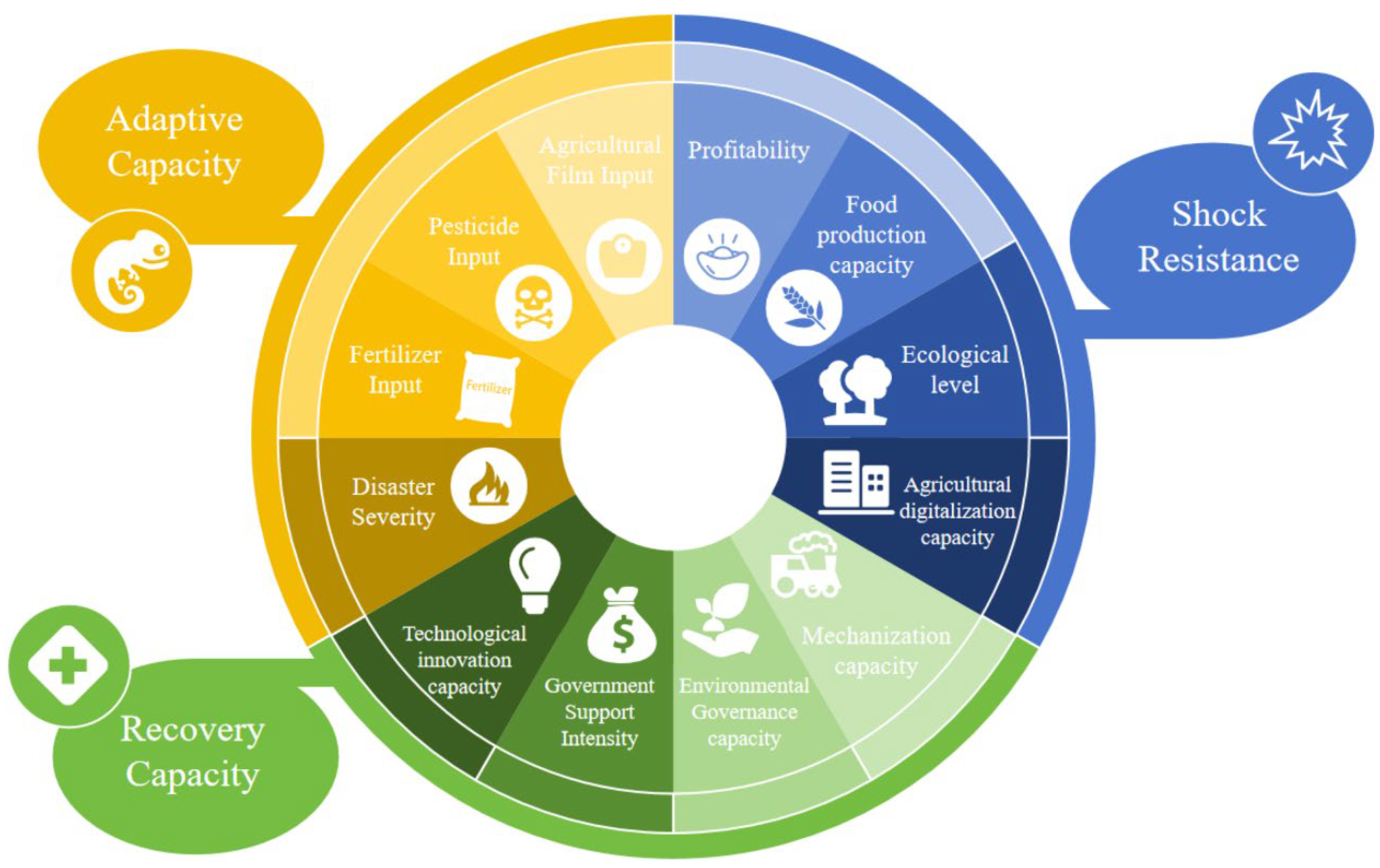
Concerning the control variables, E and ISU have positive and significant effects on AER, indicating that a stronger economic base and ongoing industrial upgrading support system stability. By contrast, Edu is insignificant in the FE model but negative and significant in the RE model, possibly reflecting regional educational structures or the out-migration of agricultural labor. Urban and I are not significant, which may relate to sample size or variable construction. Overall, the signs of most coefficients align with expectations, supporting the reliability of the estimates.
3.2. Robustness Tests
In this part, five sets of regression models are designed to conduct robustness tests, focusing on variable transformation, indicator substitution, dynamic effects, outlier treatment, and excluding observations with forecasted values.
First, in Model 1, we replace LQ with its logarithm, denoted LQ
log, to mitigate the influence of extreme values and to examine whether the elasticity interpretation delivers similar estimates. Second, Following the core-variable substitution approach in Ren (2025) [
25], Model 2 replaces LQ with LQ2 to gauge the sensitivity of our estimates to how the core explanatory variable is constructed. Third, in Model 3, we replace LQ in (2) with its first-order lag term, denoted LQ
lag, to examine the dynamic effect of agricultural agglomeration on AER and to test the stability of the causal relationship over time. Model 4 applies a two-tailed 1% winsorization to the core explanatory variable, denoted LQ
w, to limit the influence of outliers and further assess the robustness of the estimates. Finally, to address potential bias from the interpolated values in 2023, Model 5 re-estimates the baseline regression after excluding all 2023 observations. Model 6 substitutes the dependent variable with the PCA-based resilience index, AER_PCA, while maintaining all other aspects of the specification unchanged. Results are reported in
Table 4.
The robustness tests show that whether the core regressor is log-transformed, replaced by a re-estimated location quotient indicator, lagged by one period, subjected to two-sided 1% winsorization, estimated on the sample excluding 2023 observations, or paired with the alternative PCA-based resilience index AER_PCA as the dependent variable, the signs and significance levels remain highly consistent with those of the baseline model. Except for the specification using LQ2, which is significant at the 10% level, and the model using AER_PCA, which is significant at the 5% level, most estimates are statistically significant at the 0.1% level and exhibit magnitudes close to the baseline estimate. Overall, the consistent direction, statistical significance, and economic magnitude across all six specifications reinforce the robustness and reliability of the core finding that agricultural industrial agglomeration significantly enhances agricultural economic resilience.
3.3. Endogeneity Tests
To further address potential endogeneity arising from reverse causality and omitted variables, we implement an instrumental-variable (IV) strategy in which the 1984 number of landline telephones per 100 people in each provincial administrative region interacted with a continuous year variable (2003–2023) serves as an instrument for agricultural industrial agglomeration. This historical, time-varying IV exploits long-lasting differences in regional telecommunication infrastructure while allowing for temporal variation, in line with economic-history approaches that use historical infrastructure to isolate quasi-exogenous variation in contemporary spatial patterns. Because historical infrastructure may also proxy for persistent provincial institutional capacity that could in principle affect AER directly, the IV regressions include the same rich set of time-varying controls and province and year fixed effects as the baseline model, and the IV coefficients are interpreted as complementary robustness checks rather than as a replacement for the fixed-effects estimates.
Table 5 reports five IV specifications that share the same controls as the baseline model together with region and year fixed effects; standard errors are computed as in the baseline. Column (2) reports two-stage least squares (2SLS) estimation using tele as the IV. Columns (3)–(5) re-estimate Column (2) with alternative estimators: limited-information maximum likelihood (LIML), two-step generalized method of moments (GMM), and continuously updated GMM (CUE), respectively. Because the model is just identified, point estimates are expected to be numerically similar across these estimators; the purpose is to demonstrate estimator insensitivity. Column (6) conducts a placebo test by shuffling the IVs order across observations and re-estimating 2SLS.
Across all IV estimators—2SLS, LIML, GMM, and GMM (CUE)—the coefficient on LQ remains positive and statistically significant under the same set of controls and two-way fixed effects. The first-stage results confirm strong instrument relevance, with Cragg–Donald F approximately equal to 24.54, far exceeding the Stock–Yogo 10% critical value (16.38), indicating that the IV is strong and the identification robust.
Furthermore, the placebo experiment—where the IV is randomly shuffled across provinces and years—yields an insignificant coefficient and a low first-stage F statistic approximately equal to 0.56, as expected. This falsification test confirms that the identification relies on the true historical-temporal structure of the IV rather than spurious correlation.
Taken together, these findings reinforce the robustness of the main conclusion: LQ significantly enhances AER [
7,
26]. Economically, the historical IV reflects pre-reform infrastructure endowments that shaped long-term regional connectivity and economic capacity. When scaled by the continuous year variable, it generates a gradual, exogenous source of variation in agglomeration intensity over time—satisfying both the relevance and exclusion restrictions of a valid instrument.
3.4. Heterogeneity Analysis
The considerable provincial disparities in China regarding natural resource bases, industrial composition, economic development, and policy frameworks posit that the influence of LQ on agricultural system stability and adaptability, together with the operative mechanisms, is not uniform but instead manifests distinct regional heterogeneities. Previous literature has indicated that technological progress, resource limitations, and environmental consequences vary dramatically by region. Zhao et al. (2022) [
27] revealed that the disparities of regional green total factor productivity are mainly driven by the “trans-variation” part which is simultaneously influenced by structural and efficiency differences. The prospect of regional heterogeneity is further corroborated by Yang et al. (2025) [
28], whose analysis reveals a starkly uneven spatial pattern of agricultural resilience at the provincial level in China. Their findings indicate not only a higher overall resilience in eastern coastal areas compared to the underdeveloped west but also significant spatial variations in the elasticity coefficients of the explanatory variables. More generally, regional economic resilience researchers have increasingly adopted multi-scale strategies to explore the diverse driving influences at various spatial scales, including the eastern-central-western pattern, urban agglomerations, and regional typologies hierarchies [
29,
30]. Furthermore, based on a system GMM model, Liang et al. (2025) [
31] empirically tested urban agglomeration structures on different scales and discussed the variation in marginal effect in development stages and city-size groups.
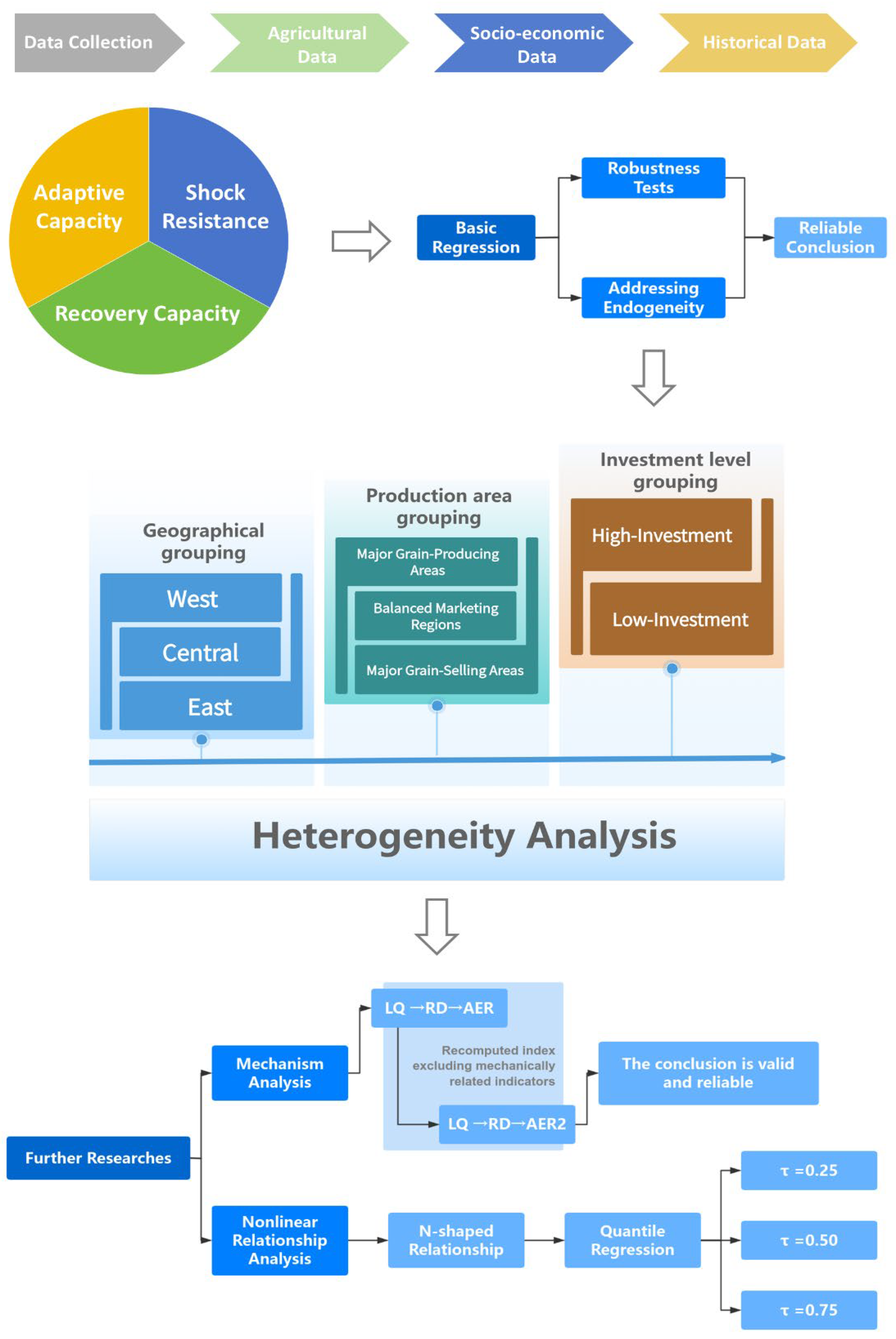
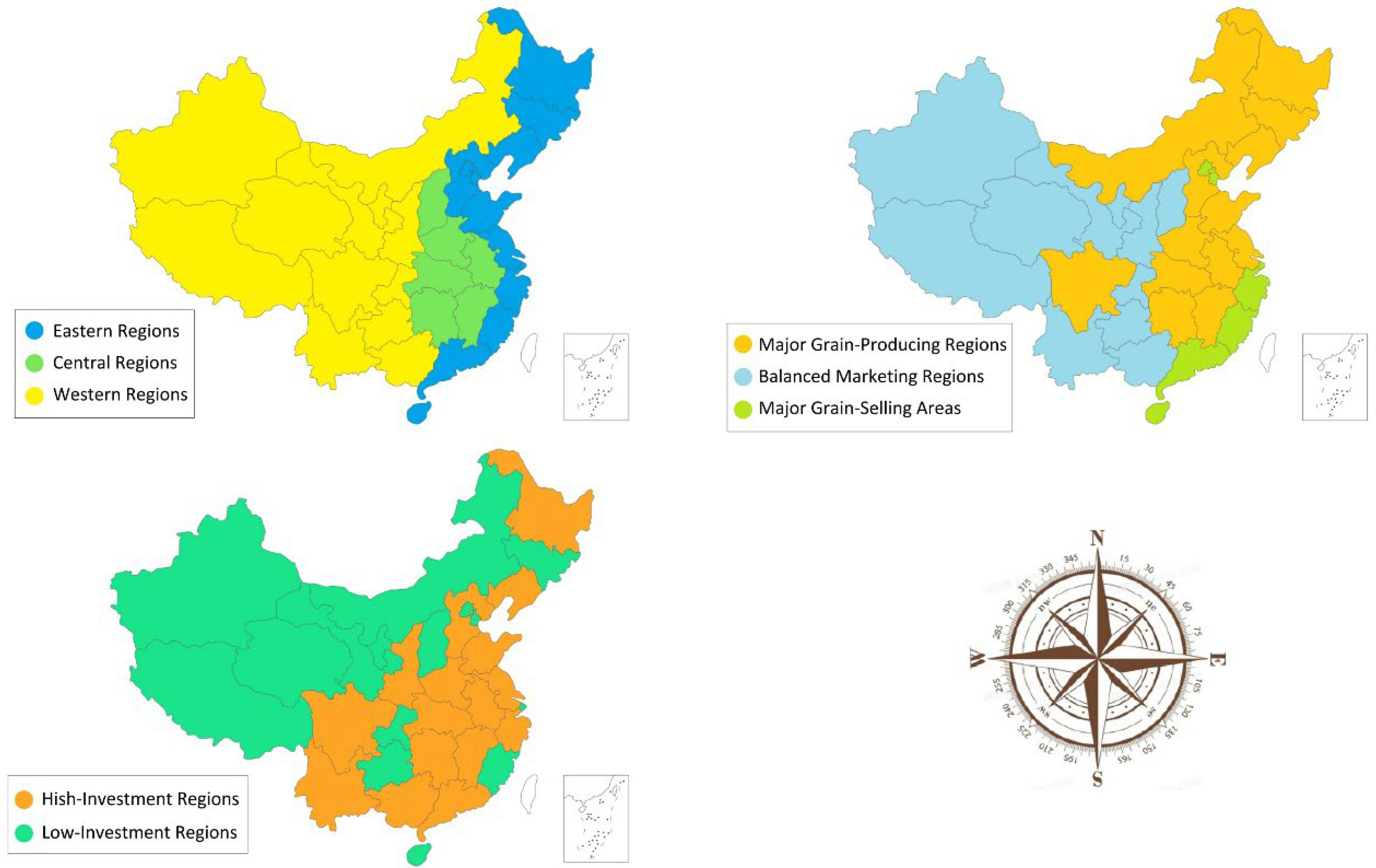
Building on these insights, this paper conducts subgroup regressions across three dimensions: (i) eastern, central, and western regions; (ii) following the State Council’s designation, provinces are grouped into major grain-producing areas (Major), major grain-selling areas (Sell), and production-marketing balance areas (Balanced); and (iii) High vs. low investment, which is defined using the cross-sectional median of province-level full-period averages of total social fixed asset investment, yielding a time-invariant grouping. Such subgroup tests allow for the identification of potential heterogeneity in the effects of LQ.
Figure 3 presents the map-based visualization of heterogeneity groups across Chinese provinces. The corresponding results are reported in
Table 6.
The results of regression demonstrate the positive and significant effect of LQ on AER in the eastern and western regions. This means that the agglomeration effect contributed positively to the stability and adaptability of the system, in either the relatively developed eastern region or the underdeveloped western region. By comparison, the estimated coefficient is positive in the central region but statistically insignificant (the model’s overall F-test is also not significant), suggesting that the gains to agglomeration are not fully realized at the central region. This may be due to lagging industrial adjustment, inefficient distribution of resources, or differences in policy enforcement.
The effect of agricultural agglomeration on resilience is not statistically significant in major grain producing regions. This may be because agricultural production in these areas is more reliant on policy support and institutional arrangements, which could weaken the independent role of agglomeration. In contrast, for grain-selling and producing-selling balanced regions, the agglomeration effect is positive and significant at the 0.1% level, implying that in the case of no or offsetting policy bias, the market externalities and agglomeration-produced economies of scale can be more adequately exploited to enhance the region’s ability to resist external shocks [
28].
Moreover, after considering a split by the level of total social fixed investment, the result further reveals that the positive effect of agglomeration on agricultural resilience is more significant in the “low investment” group. This suggests that in the context of financial constraints, the local economies and agricultural actors were more dependent on the agglomeration externalities (e.g., factor sharing, technology diffusion, and collaborative development) which significantly enhanced the marginal effect of agglomeration on systemic stability. By contrast, capital concentration is not significant in the high total investment sample, suggesting that an abundance of capital and supportive policies may undermine the importance of capital concentration mechanisms.
3.5. Mechanism Analysis
Advances in agricultural technology are generally considered to be important sources for the adaptability and stability of agricultural systems, while the uneven development of such technology is an important factor that determines the effect of industrial agglomeration on the resilience of agricultural economy. Existing studies provide strong evidence for this mechanism. For example, Wan et al. (2024) [
32] revealed that technological innovation in agriculture has a significant positive influence on resilience, but with possible nonlinear and heterogeneous impacts among regions with disparate fiscal support levels. Ren et al. (2025) [
25] also argues that economic and technological development and industrial structure upgrading are pivotal means to enhance AER. Based on these findings, the present study incorporates R&D as the mediating factor to directly capture how research investment impacts resilience. Investment in research and development can contribute to increase flexibility and stability in agricultural systems through the development of innovation in technology and management of production. Therefore, a fixed effects based three-stage regression model of “LQ → R&D→ AER” is developed to empirically test if LQ enhances AER indirectly through R&D.
Specifically, Model 1 presents the baseline regression, testing whether LQ has a significant overall effect on AER, consistent with (2). Model 2 examines whether LQ significantly affects the mediating variable R&D (see (3)). Model 3, with R&D included, investigates its effect on AER and whether the impact of LQ on AER is transmitted via the research investment channel, thereby identifying partial or full mediation of (4). Model 4 replaces R&D with its first-order lag term R&D
lag, which can reduce the synchronicity bias between R&D and contemporaneous measures of AER and to alleviate concerns about reverse causality. Model 5 replaces the core explanatory variable with LQ2, to test the robustness of the mechanism analysis to alternative measurement specifications. Finally, Model 6 replaces AER with AER2—which excludes mechanically related indicators—to mitigate mechanical overlap with R&D. Results are reported in
Table 7.
The results of mediation analysis show that the effect of LQ on AER is not only significantly and positively direct, but the system adaptability and system stability can also be indirectly improved by the R&D channel. In particular, LQ exerts a strong positive effect on the mediator variable—R&D—which indicates that agglomeration leads to more funds devoted to research. With R&D added, it is still significantly positive but the coefficient of LQ decreases, so there is a partial mediating effect. The Sobel and Goodman tests confirm the significance of this indirect path at the 1% significance level, which is also suggested for interpretations of partial mediation. When R&D is replaced with its first-order lag term, the results remain consistent, which further confirms the robustness. Models 4 and 5 represent robustness checks using different specifications, and the results are consistent with the main findings. With AER2 (Model 6), the positive and significant associations of LQ and R&D with resilience persist, indicating that the mediation result is not driven by mechanical overlap and that our conclusions are robust. In short, the study reveals that investment in agricultural science and technology has acted as a key mediator in the way that industrial agglomeration affects the AER. Several studies, such as Wan et al. (2024) [
32], have shown that system resistance and recovery enhancement of agricultural technological innovation. It is also backed up by other research in agglomeration and innovation: Lee (2009) [
33] demonstrates that firms within industrial agglomeration have higher R&D intensity than non-agglomeration firms indicating agglomeration promotes greater research investment; Guo et al. (2023) [
34] also reveal a significantly increasing trend of time pressures on firms in a cluster setting to continually invest in R&D to sustain their competitive advantage over time, thereby securing a continuous supply of technology advancements and inventive capabilities. Agricultural agglomeration fosters R&D investment through several interconnected channels. First, intensified competitive pressure within the cluster compels firms to innovate to maintain their market position. Second, knowledge spillovers and technological diffusion lower both the costs and risks associated with R&D, enhancing its expected returns. Finally, agglomeration facilitates collaborative innovation—easing access to pooled talent and resources—and attracts targeted policy support, such as R&D subsidies and tax incentives, which collectively underpin and encourage research activities.
To conclude, agricultural industrial agglomeration not only directly increases AER but also indirectly enhances system adaptability and recovery by spurring R&D investment, thereby providing solid theoretical and empirical foundations for cluster-based development strategies.
3.6. Nonlinear Relationship Analysis
Evolutionary economics views industrial agglomeration as a process in which the various stages of development are characterized by different forms. Thus, its effect on economic resilience is likely to be non-monotonic and to reflect the attributes of evolution in stages and multiple mechanisms through coevolution. At different phases of development, different degrees of agglomeration may trigger contrasting effects through resource pooling, technological spillovers, or factor misallocation. Such a double-edged sword impact may enhance the system’s resilience or weaken its adaptability. Therefore, empirical relevance should accomplish stage-based identification as well as refined characterization. As a subject of study, nonlinear mechanisms relating agglomeration to regional economic resilience are gaining growing interest among academics. Previous studies generally focused on the interaction between agglomeration and economic growth and revealed that its impacts fluctuated across stages. For instance, Zhang et al. (2023) [
35] argues that agglomeration is diluted when over-concentrated, and the marginal effect of agglomeration on technology advancement is negatively related to the level of agglomeration—showing the nonlinearity of declining returns. Du et al. (2024) [
36] discloses that the effect of manufacturing agglomeration on green total factor productivity demonstrates nonlinear heterogeneity across urban, geographical, and scale features. Wang (2024) [
37] also shows that the relationship between secondary industry agglomeration and ecological/economic resilience: an inverted U-shaped turning point. Chao & Li [
15] also find that agricultural production agglomeration has a nonlinear effect on AER. In general, studies in agricultural economics are still relatively sparse, and there are hardly any systematic examinations of potential multi-stage effect structures. The elements of agricultural systems, such as land and labor, are more foundational and exhibit distinct agglomeration patterns in both organizational and spatial structure compared to manufacturing. To systematically investigate these potential nonlinear effects on AER, this paper incorporates the second- and third-order terms of the agglomeration indices (LQ and LQ2) into the empirical model. This methodological approach seeks to expand the theoretical and empirical understanding of the agglomeration-resilience relationship, as captured by (5) and (6):
As shown in (5), we estimate a cubic polynomial in LQ to allow for potential N-shaped nonlinearity. (6) keeps the same polynomial form and substitutes LQ with LQ2 to probe dimension-specific nonlinearities associated with employment-intensive agglomeration. Throughout,
Cit denotes the set of control variables. We estimate two nonlinear fixed-effects specifications. In (5), the output-based LQ shows the configuration characteristic of an N-shaped relationship, but the quadratic and cubic terms are not statistically significant, so the evidence for nonlinearity is weak. In (6), replacing LQ with the employment-based LQ2 yields the same N-shaped configuration with significant higher-order terms, providing clear evidence of nonlinearity. Following the quantile-regression approach of Ren et al. (2022) [
38], we examine how the nonlinear relationship varies across quantiles. We estimate panel quantile regressions using the Powell (2022) [
39] estimator for panel quantiles with nonadditive fixed effects, keeping the same set of controls and including year fixed effects; results are reported in
Table 8.
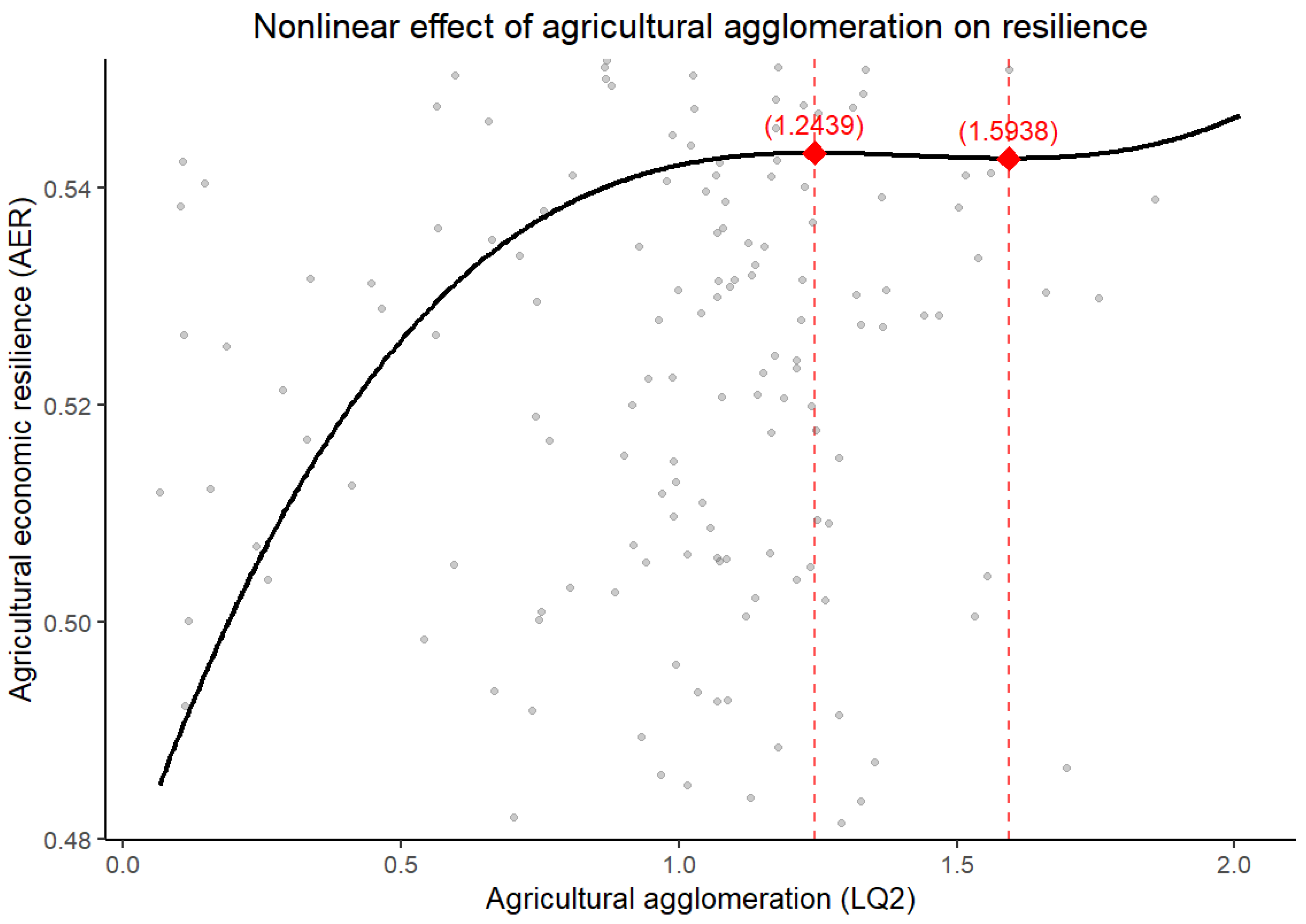
Model 2 employs a nonlinear fixed-effects specification based on the employment-based agglomeration index LQ2, revealing a statistically significant N-shaped relationship: the coefficients of the linear, quadratic, and cubic terms are positive, negative, and positive, respectively, with all terms significant at least at the 5% level. The thresholds—derived from the first derivative of the cubic function with respect to LQ2—indicate that the marginal effect of agglomeration on AER turns negative when LQ2 lies between approximately 1.2439 and 1.5938, while remaining positive outside this range. This finding suggests that agricultural industrial agglomeration initially enhances resilience at low levels, exerts a dampening effect in the intermediate range—consistent with factor misallocation, congestion, or structural rigidities—and subsequently restores its positive influence at higher levels through mechanisms such as specialized division of labor, collaborative networks, and knowledge diffusion. Thus, the cubic specification captures a theoretically grounded PSR dynamic, rather than reflecting a purely data-driven empirical fit.
The panel quantile regression for (6) further uncovers substantial distributional heterogeneity around this N-shaped pattern. At the 0.50 and 0.75 quantiles, the coefficients of LQ2, LQ2
2, and LQ2
3 consistently follow a positive–negative–positive sign pattern, fully aligning with the N-shaped profile identified in Model 2. In contrast, at the lower tail of the distribution (
q = 0.25), the estimates for LQ2, LQ2
2, and LQ2
3 are positive, positive, and negative, respectively—indicating that agglomeration yields net gains in resilience at low-to-moderate levels of industrial concentration, but these benefits diminish and eventually reverse as density increases. This behavior is consistent with congestion effects or capacity constraints commonly observed in low-resilience regions. Provinces at lower resilience quantiles are typically less developed or inland, characterized by limited market access, constrained fiscal and R&D capacity, and sluggish reallocation of labor and capital. While moderate agglomeration can generate efficiency improvements through input sharing and matching, rising industrial density amplifies structural frictions, leading to increased congestion, heightened production pressures, and greater vulnerability to external shocks. By contrast, provinces at the median and upper quantiles generally possess more advanced infrastructure, deeper financial markets, and more integrated agro-industrial value chains. These institutional advantages enhance cross-sectoral flexibility and value-chain adaptability, enabling firms and workers to reconfigure resources efficiently. After a mid-range slowdown in marginal returns, these regions can reactivate specialization economies, collaborative innovation, and knowledge spillovers at higher levels of LQ2, thereby restoring the positive impact on resilience. This differentiated response is supported by a growing body of empirical evidence on agglomeration and economic resilience. A meta-analysis of agglomeration economies in developing countries finds that while the average returns to agglomeration are positive, they exhibit substantial heterogeneity across regions and are highly sensitive to local institutional environments and structural conditions—collectively pointing to inherent nonlinearities and threshold effects in the returns to density [
40]. At the urban level, Jiang et al. (2022) show that population agglomeration in China enhances urban economic resilience and generates spatial spillovers to neighboring cities, with the magnitude of these effects varying significantly according to levels of human capital and labor force composition [
41]. At the regional scale, Zheng et al. (2023) demonstrate that the coupling between industrial agglomeration and regional economic resilience displays pronounced spatiotemporal heterogeneity and is shaped by disparities in development stages and underlying structural foundations [
42]. Taken together, these findings provide a coherent explanation for why provinces at lower resilience quantiles are more prone to entering a “late-stage congestion zone” as density increases, whereas those with stronger socioeconomic and institutional capacities are better equipped to overcome this phase and realize the “third leg” of the N-shaped relationship identified in the median and upper-quantile estimates.
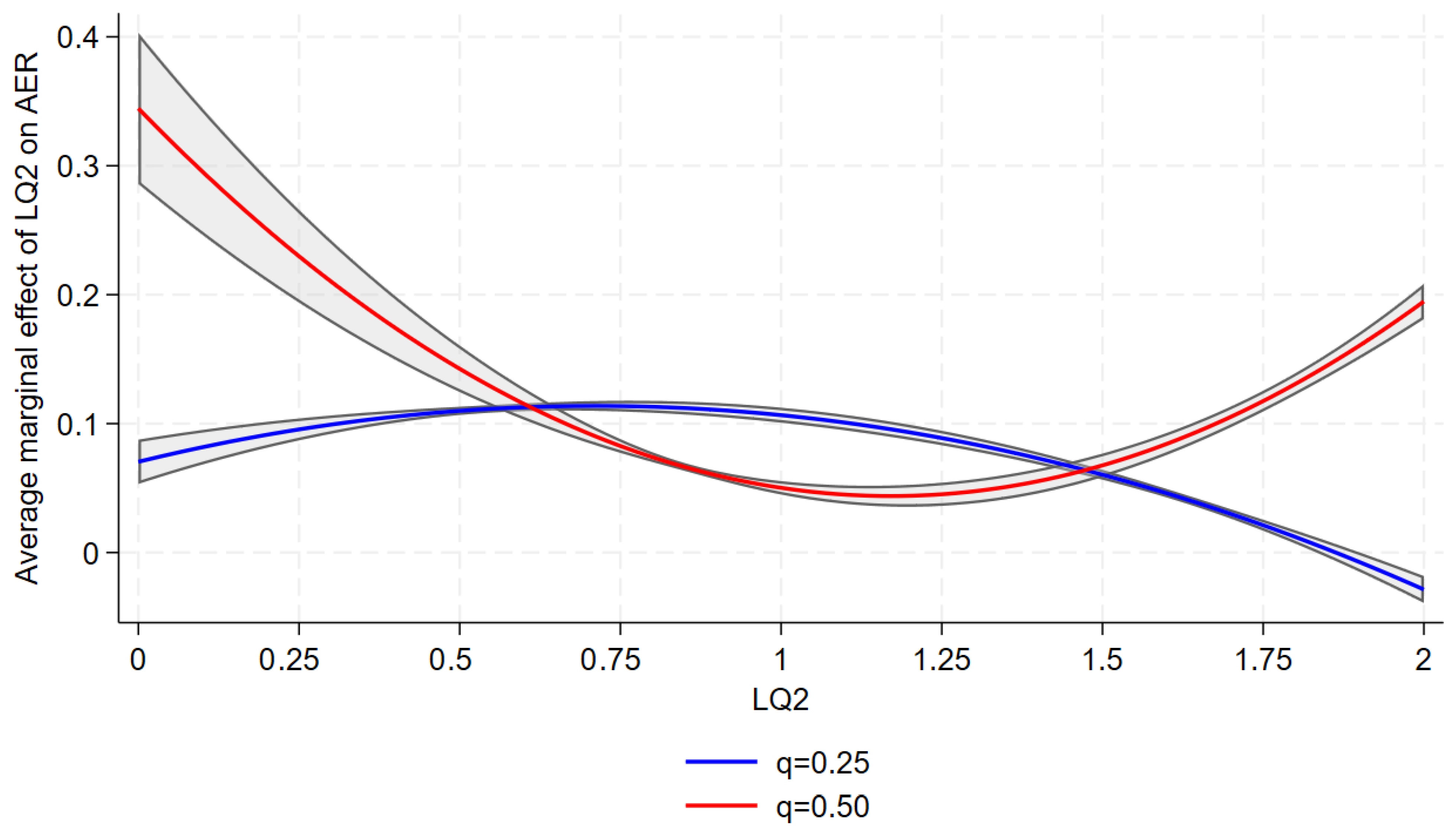
Figure 4 displays the quantile-specific average marginal effects (AME) of LQ2 on AER at
q = 0.25 and
q = 0.50 (the 0.75 quantile curve is omitted as it closely tracks the median within the observed range, to avoid visual clutter). The 0.25 quantile curve rises initially when LQ2 is in the low-to-moderate range and then declines markedly at higher agglomeration levels, exhibiting a hump-shaped pattern consistent with congestion or input mismatch in low-resilience provinces during high-density phases. In contrast, the 0.50 quantile curve follows a U-shaped trajectory: marginal gains weaken in the middle range of LQ2 but rebound significantly at higher levels of agglomeration, indicating that regions with stronger underlying capacities are better able to leverage mechanisms such as specialized division of labor, collaborative innovation, and knowledge diffusion under advanced agglomeration conditions. The shaded bands represent 95% confidence intervals for each estimated curve. Overall, agricultural industrial agglomeration tends to enhance resilience, yet its incremental returns are strongly state-dependent—smallest in the medium agglomeration range and most fragile among provinces with lower resilience.
The comparison across different agglomeration measures shows that, in the linear two-way fixed-effects specifications, the baseline results are broadly consistent whether we use the traditional output-based location quotient or the employment-based. However, once we introduce quadratic and cubic terms, the shape of the nonlinear relationship becomes more sensitive to how agglomeration is measured. When higher-order terms in LQ are added, their coefficients are small and statistically unstable, so that no clear N-shaped profile can be identified. By contrast, LQ2 more accurately captures the intra-industry allocation of agricultural labor and the breadth of the agro-industrial base, and in the nonlinear specifications it delivers a more stable and precisely estimated N-shaped pattern. We therefore rely on LQ2 as the main indicator for tracing nonlinear and distributional effects, while treating the LQ-based estimates as a robustness check on the average impact of agglomeration on resilience.
Figure 5 illustrates the N-shaped effect of LQ2: gray dots represent province-level observations after controlling for other covariates, the black solid line shows the fitted curve from the cubic fixed-effects model, and two vertical dashed lines mark the estimated turning points (
LQ2 ≈ 1.2439 and
LQ2 ≈ 1.5938). The marginal effect is positive at low levels of agglomeration, turns negative in the intermediate range, and becomes positive again at high levels—closely aligning with the “rise–squeeze–reconfiguration” three-stage mechanism proposed earlier. Overall, this N-shaped pattern complements the inverted U-shaped relationship identified by Wang (2024) [
37] in a study of Yangtze River Delta cities using a dynamic spatial Durbin model, collectively demonstrating that the effect of agglomeration on resilience exhibits pronounced nonlinearity and stage-specific dynamics across varying spatial scales and measurement approaches.
In conclusion, this study demonstrates that the impact of agricultural industrial agglomeration on agricultural economic resilience is characterized by pronounced nonlinearity and is sensitive to how agglomeration is measured. In the linear two-way fixed-effects specifications, both the traditional output-based location quotient and the employment-based location quotient yield broadly consistent evidence that moderate agglomeration enhances resilience. However, the employment-based location quotient most clearly captures the N-shaped relationship in the nonlinear and distributional analyses, aligning more closely with theoretical expectations regarding factor allocation dynamics and structural transformation, and exhibiting greater empirical robustness when identifying turning points. Accordingly, we use the employment-based index as the main indicator for tracing stage-specific dynamics, while the output-based location quotient serves both as an important benchmark that ensures comparability with the existing literature and as a supplementary check on the consistency of our results. These findings underscore the importance of deliberate and theoretically informed selection of agglomeration measures in empirical analysis and provide a solid foundation for advancing research on the “phased and conditional” mechanisms underlying the agglomeration–resilience nexus.