Diagnostic, Prognostic, and Predictive Molecular Biomarkers in Head and Neck Squamous Cell Carcinoma: A Comprehensive Review

 ,
,  , , ,
, , ,  , and
, and
Abstract
1. Introduction
2. Methodology
2.1. Planning and Registration for the Review
2.2. Eligibility Criteria
2.3. Inclusion and Exclusion Criteria
2.4. Search Strategy
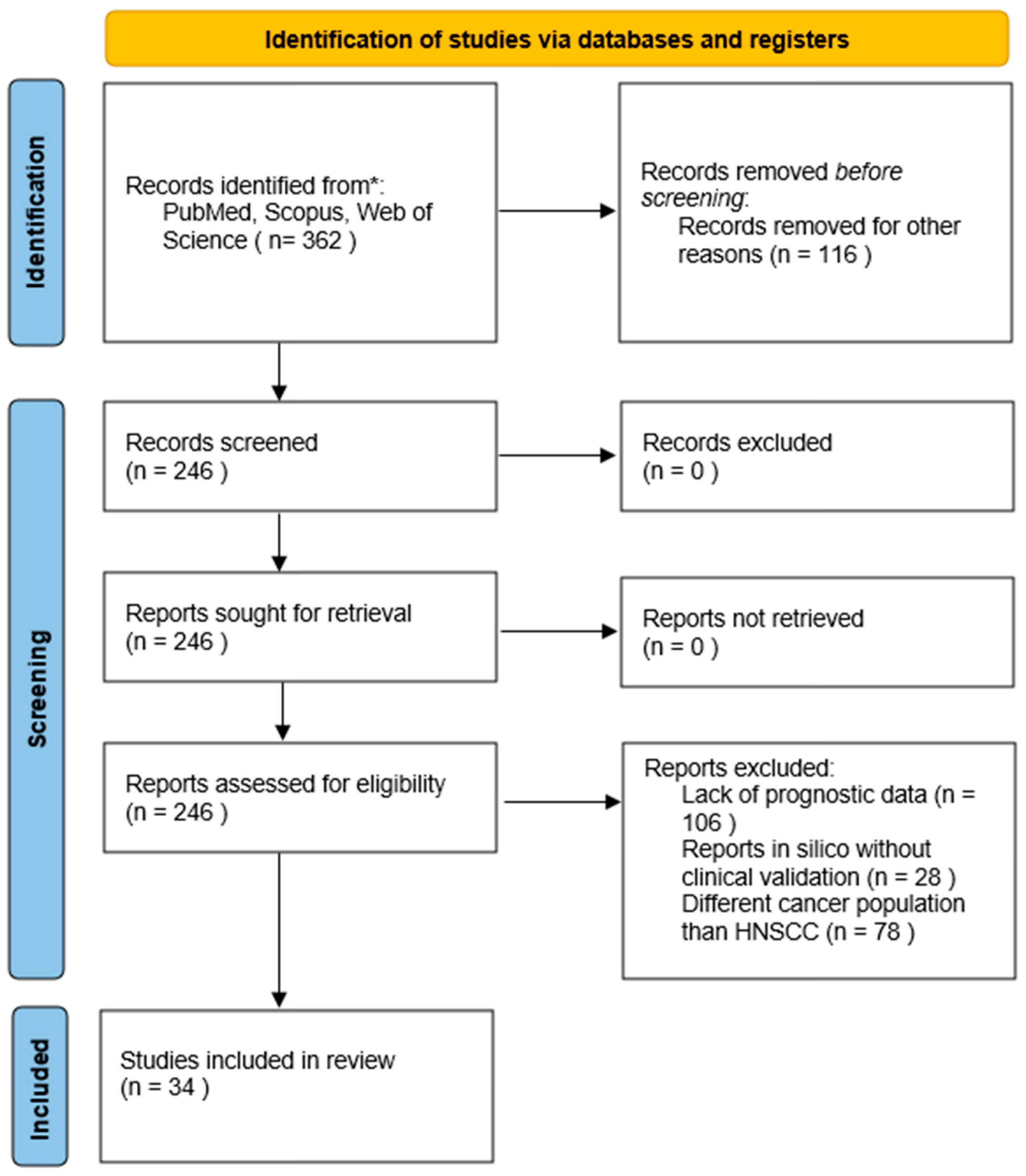
2.5. Selection and Data Processing
2.6. Data Extraction and Synthesis
2.7. Bias Assessment
3. Results
3.1. Study Characteristics
3.2. Main Prognostics and Predictive Results
3.2.1. Markers of Gene Regulation and Epigenetics
3.2.2. Markers of Cellular Response and Microenvironment
3.2.3. Metabolic Markers and Proliferative Pathways
3.3. Comparative Analysis of Biomarker Utility
4. Discussion
4.1. Marker Characterization and Clinical Basis
4.2. Diagnostics and Role of p16/HPV
4.3. HPV-Negative Tumors and Immunotherapy
4.4. Epigenetics and ncRNA
4.5. Metabolic, Proliferative, and Apoptosis Markers
4.6. The Cell Cycle and Suppression
4.7. Heterogeneity and Variability in Biomarker Performance
4.8. Liquid Biopsy: Saliva and Plasma
4.9. Precision Medicine Integration
4.10. Summary and Perspectives
4.11. Limitations
5. Conclusions
Supplementary Materials
Author Contributions
Funding
Institutional Review Board Statement
Informed Consent Statement
Data Availability Statement
Conflicts of Interest
Abbreviations
| TMB | Tumor Mutational Burden |
| MSI-H | Microsatellite Instability-High |
| dMMR | Mismatch Repair Deficient |
| CDK | Cyclin-Dependent Kinase |
| CCND1 | Cyclin D1 |
| CDKN2A | Cyclin-Dependent Kinase Inhibitor 2A (p16) |
| RB1 | Retinoblastoma 1 (Protein) |
| pT356RB1 | Phospho-Tyrosine 356 Retinoblastoma 1 |
| DREAM | DP, RB-like, E2F and MuvB complex |
| ROS | Reactive Oxygen Species |
| ARF | Alternate Reading Frame Protein |
| MDM2 | Mouse Double Minute 2 Homolog |
| AMPK | AMP-activated Protein Kinase |
| COX-2 | Cyclooxygenase-2 |
| GLUT-1 | Glucose Transporter 1 |
| CRP | C-reactive protein |
| CSC | Cancer Stem Cell |
| PFKP | Platelet Phosphofructokinase |
| EREG | Epiregulin |
| ORR | Overall Response Rate |
| ITGB4 | Integrin Beta 4 |
| LAMC2 | Laminin Gamma 2 |
| SFN | Sestrin/Stratifin |
| TCTP | Translationally Controlled Tumor Protein |
| SEMA3F | Semaphorin-3F |
| MTA1 | Metastasis-associated protein 1 |
| OS | Overall Survival |
| DFS | Disease-Free Survival |
| DSS | Disease-Specific Survival |
| CK-8 | Cytokeratin-8 |
References
- Barsouk, A.; Aluru, J.S.; Rawla, P.; Saginala, K.; Barsouk, A. Epidemiology, Risk Factors, and Prevention of Head and Neck Squamous Cell Carcinoma. Med. Sci. 2023, 11, 42. [Google Scholar] [CrossRef] [PubMed]
- Sung, H.; Ferlay, J.; Siegel, R.L.; Laversanne, M.; Soerjomataram, I.; Jemal, A.; Bray, F. Global Cancer Statistics 2020: GLOBOCAN Estimates of Incidence and Mortality Worldwide for 36 Cancers in 185 Countries. CA Cancer J. Clin. 2021, 71, 209–249. [Google Scholar] [CrossRef] [PubMed]
- Markopoulos, A.K. Current Aspects on Oral Squamous Cell Carcinoma. Open Dent. J. 2012, 6, 126–130. [Google Scholar] [CrossRef] [PubMed]
- Johnson, D.E.; Burtness, B.; Leemans, C.R.; Lui, V.W.Y.; Bauman, J.E.; Grandis, J.R. Head and Neck Squamous Cell Carcinoma. Nat. Rev. Dis. Primers 2020, 6, 92. [Google Scholar] [CrossRef] [PubMed]
- Ayala, F.R.R.; Rocha, R.M.; Carvalho, K.C.; Carvalho, A.L.; Da Cunha, I.W.; Lourenço, S.V.; Soares, F.A. Glut1 and Glut3 as Potential Prognostic Markers for Oral Squamous Cell Carcinoma. Molecules 2010, 15, 2374–2387. [Google Scholar] [CrossRef] [PubMed]
- Chi, A.C.; Day, T.A.; Neville, B.W. Oral Cavity and Oropharyngeal Squamous Cell Carcinoma--an Update. CA Cancer J. Clin. 2015, 65, 401–421. [Google Scholar] [CrossRef] [PubMed]
- Mohd Faizal, N.F.; Shai, S.; Savaliya, B.P.; Karen-Ng, L.P.; Kumari, R.; Kumar, R.; Vincent-Chong, V.K. A Narrative Review of Prognostic Gene Signatures in Oral Squamous Cell Carcinoma Using LASSO Cox Regression. Biomedicines 2025, 13, 134. [Google Scholar] [CrossRef] [PubMed]
- Hoene, G.; Moser, N.; Schminke, B.; Wiechens, B.; Leha, A.; Khromov, T.; Schliephake, H.; Brockmeyer, P. Postoperative Facial Appearance of Patients with Extensive Oral Squamous Cell Carcinoma Can Be Adequately Preserved with In-House Virtually Planned Mandibular Reconstruction. Mol. Clin. Oncol. 2023, 19, 97. [Google Scholar] [CrossRef] [PubMed]
- Gontarz, M.; Bargiel, J.; Gąsiorowski, K.; Marecik, T.; Szczurowski, P.; Zapała, J.; Wyszyńska-pawelec, G. Extended, Double-pedicled Facial Artery Musculomucosal (Dpfamm) Flap in Tongue Reconstruction in Edentulous Patients: Preliminary Report and Flap Design. Medicina 2021, 57, 758. [Google Scholar] [CrossRef] [PubMed]
- Dumitru, C.S.; Raica, M. Vascular Endothelial Growth Factor Family and Head and Neck Squamous Cell Carcinoma. Anticancer Res. 2023, 43, 4315–4326. [Google Scholar] [CrossRef] [PubMed]
- Basheeth, N.; Patil, N. Biomarkers in Head and Neck Cancer an Update. Indian J. Otolaryngol. Head Neck Surg. 2019, 71, 1002–1011. [Google Scholar] [CrossRef] [PubMed]
- Almangush, A.; Mäkitie, A.A.; Triantafyllou, A.; de Bree, R.; Strojan, P.; Rinaldo, A.; Hernandez-Prera, J.C.; Suárez, C.; Kowalski, L.P.; Ferlito, A.; et al. Staging and Grading of Oral Squamous Cell Carcinoma: An Update. Oral Oncol. 2020, 107, 104799. [Google Scholar] [CrossRef] [PubMed]
- Harrington, K.J.; Burtness, B.; Greil, R.; Soulières, D.; Tahara, M.; De Castro, G.; Psyrri, A.; Brana, I.; Basté, N.; Neupane, P.; et al. Pembrolizumab with or Without Chemotherapy in Recurrent or Metastatic Head and Neck Squamous Cell Carcinoma. J. Clin. Oncol. 2023, 41, 790–802. [Google Scholar] [CrossRef] [PubMed]
- Banta, K.L.; Xu, X.; Chitre, A.S.; Au-Yeung, A.; Takahashi, C.; O’Gorman, W.E.; Wu, T.D.; Mittman, S.; Cubas, R.; Comps-Agrar, L.; et al. Mechanistic Convergence of the TIGIT and PD-1 Inhibitory Pathways Necessitates Co-Blockade to Optimize Anti-Tumor CD8+ T Cell Responses. Immunity 2022, 55, 512–526.e9. [Google Scholar] [CrossRef] [PubMed]
- Mestiri, S.; El-Ella, D.M.A.; Fernandes, Q.; Bedhiafi, T.; Almoghrabi, S.; Akbar, S.; Inchakalody, V.; Assami, L.; Anwar, S.; Uddin, S.; et al. The Dynamic Role of Immune Checkpoint Molecules in Diagnosis, Prognosis, and Treatment of Head and Neck Cancers. Biomed. Pharmacother. 2024, 171, 116095. [Google Scholar] [CrossRef] [PubMed]
- Jiang, Z.; Sun, H.; Yu, J.; Tian, W.; Song, Y. Targeting CD47 for Cancer Immunotherapy. J. Hematol. Oncol. 2021, 14, 180. [Google Scholar] [CrossRef] [PubMed]
- Gupta, S.; Pandey, P.; Verma, S.; Verma, A. P16, P53 and EGFR Expression in Head and Neck Squamous Cell Carcinoma and Their Correlation with Clinicopathological Parameters. J. Cancer Res. Ther. 2024, 20, 881–887. [Google Scholar] [CrossRef] [PubMed]
- Condurache Hrițcu, O.M.; Ciobanu Apostol, D.G.; Toader, Ș.V.; Solcan, C.; Brănișteanu, D.E.; Toader, M.P.; Costan, V.V. Immunohistochemical Assessment of Maspin, β-Catenin, and MMP-14 in Oral Potentially Malignant Lesions and Oral Squamous Cell Carcinoma: A Retrospective Observational Study. Medicina 2025, 61, 1037. [Google Scholar] [CrossRef] [PubMed]
- Han, Y.; Hu, X.; Xiong, H.; Zeng, L.; Peng, Y.; Su, T. CEP55 as a Prognostic Indicator and a Predictive Marker in Oral Squamous Cell Carcinoma. Int. J. Med. Sci. 2025, 22, 2446–2459. [Google Scholar] [CrossRef] [PubMed]
- Zhou, G.; Liu, Z.; Myers, J.N. TP53 Mutations in Head and Neck Squamous Cell Carcinoma and Their Impact on Disease Progression and Treatment Response. J. Cell Biochem. 2016, 117, 2682–2692. [Google Scholar] [CrossRef] [PubMed]
- Beck, T.N.; Kaczmar, J.; Handorf, E.; Nikonova, A.; Dubyk, C.; Peri, S.; Lango, M.; Ridge, J.A.; Serebriiskii, I.G.; Burtness, B.; et al. Phospho-T356RB1 Predicts Survival in HPV-Negative Squamous Cell Carcinoma of the Head and Neck. Oncotarget 2015, 6, 18863. [Google Scholar] [CrossRef] [PubMed]
- Wang, T.; Xue, L.; Li, Z.; Hong, Z.; Hu, N.; Li, Y.; Yan, B. A Novel Nomogram Model Based on Ki-67 Characteristic Expression to Predict Prognosis in Head and Neck Squamous Cell Carcinoma. Front. Oncol. 2024, 14, 1376498. [Google Scholar] [CrossRef] [PubMed]
- Chen, Q.; Shi, X.; Bao, Y.; Chen, Y. Deciphering Disulfidptosis-Linked LncRNA Patterns as Potential HNSCC Biomarkers. Oral Dis. 2025, 31, 1658–1671. [Google Scholar] [CrossRef] [PubMed]
- Dioguardi, M.; Musella, G.; Bizzoca, M.E.; Sovereto, D.; Guerra, C.; Laterza, P.; Martella, A.; Lo Muzio, L.; Di Domenico, M.; Cantore, S.; et al. The Prognostic Role of MiR-375 in Head and Neck Squamous Cell Carcinoma: A Systematic Review, Meta-Analysis, and Trial Sequential Analysis. Int. J. Mol. Sci. 2025, 26, 2183. [Google Scholar] [CrossRef] [PubMed]
- Wang, Y.; Chang, F.; Li, Z.; Duan, C.; Sun, X.; Wang, S.; Wei, D.; Li, W.; Qian, Y.; Cao, S.; et al. CircTP53 / USP10 / P53 Signaling Axis as a Novel Regulator of Progression and Prognosis of Head and Neck Squamous Cell Carcinoma. Adv. Sci. 2025, 1, e14961. [Google Scholar] [CrossRef] [PubMed]
- Miao, S.; Lin, L.; Long, M.; Fu, Y. H3 Lysine 18 Lactylation-Mediated RRAS2 Facilitates Migration and Invasion of Head and Neck Squamous Cell Carcinoma. Sci. Rep. 2025, 15, 21282. [Google Scholar] [CrossRef] [PubMed]
- Zhou, J.; He, M.; Zhao, Q.; Shi, E.; Wang, H.; Ponkshe, V.; Song, J.; Wu, Z.; Ji, D.; Kranz, G.; et al. EGFR-Mediated Local Invasiveness and Response to Cetuximab in Head and Neck Cancer. Mol. Cancer 2025, 24, 94. [Google Scholar] [CrossRef] [PubMed]
- Harshani, J.M.; Yeluri, S.; Guttikonda, V.R. Glut-1 as a Prognostic Biomarker in Oral Squamous Cell Carcinoma. J. Oral Maxillofac. Pathol. 2014, 18, 372–378. [Google Scholar] [CrossRef] [PubMed]
- Sopo, M.; Anttila, M.; Hämäläinen, K.; Kivelä, A.; Ylä-Herttuala, S.; Kosma, V.M.; Keski-Nisula, L.; Sallinen, H. Expression Profiles of VEGF-A, VEGF-D and VEGFR1 Are Higher in Distant Metastases than in Matched Primary High Grade Epithelial Ovarian Cancer. BMC Cancer 2019, 19, 584. [Google Scholar] [CrossRef] [PubMed]
- Céruse, P.; Rabilloud, M.; Charrié, A.; Dubreuil, C.; Disant, F. Study of Cyfra 21-1, a Tumor Marker, in Head and Neck Squamous Cell Carcinoma. Ann. Otol. Rhinol. Laryngol. 2005, 114, 768–776. [Google Scholar] [CrossRef] [PubMed]
- Zhu, H. Squamous Cell Carcinoma Antigen: Clinical Application and Research Status. Diagnostics 2022, 12, 1065. [Google Scholar] [CrossRef] [PubMed] [PubMed Central]
- Economopoulou, P.; de Bree, R.; Kotsantis, I.; Psyrri, A. Diagnostic Tumor Markers in Head and Neck Squamous Cell Carcinoma (HNSCC) in the Clinical Setting. Front. Oncol. 2019, 9, 827. [Google Scholar] [CrossRef] [PubMed]
- Wasylyk, B.; Abecassis, J.; Jung, A.C. Identification of Clinically Relevant HPV-Related HNSCC: In P16 Should We Trust? Oral Oncol. 2013, 49, e33–e37. [Google Scholar] [CrossRef] [PubMed]
- Holzinger, D.; Flechtenmacher, C.; Henfling, N.; Kaden, I.; Grabe, N.; Lahrmann, B.; Schmitt, M.; Hess, J.; Pawlita, M.; Bosch, F.X. Identification of Oropharyngeal Squamous Cell Carcinomas with Active HPV16 Involvement by Immunohistochemical Analysis of the Retinoblastoma Protein Pathway. Int. J. Cancer 2013, 133, 1389–1399. [Google Scholar] [CrossRef] [PubMed]
- Scheffner, M.; Werness, B.A.; Huibregtse, J.M.; Levine, A.J.; Howley, P.M. The E6 Oncoprotein Encoded by Human Papillomavirus Types 16 and 18 Promotes the Degradation of P53. Cell 1990, 63, 1129–1136. [Google Scholar] [CrossRef] [PubMed]
- Lechner, M.; Chakravarthy, A.R.; Walter, V.; Masterson, L.; Feber, A.; Jay, A.; Weinberger, P.M.; McIndoe, R.A.; Forde, C.T.; Chester, K.; et al. Frequent HPV-Independent P16/INK4A Overexpression in Head and Neck Cancer. Oral Oncol. 2018, 83, 32–37. [Google Scholar] [CrossRef] [PubMed]
- Lukas, J.; Parry, D.; Aagaard, L.; Mann, D.J.; Bartkova, J.; Strauss, M.; Peters, G.; Bartek, J. Retinoblastoma-Protein-Dependent Cell-Cycle Inhibition by the Tumour Suppressor P16. Nature 1995, 375, 503–506. [Google Scholar] [CrossRef] [PubMed]
- Derka, S.; Vairaktaris, E.; Papakosta, V.; Vassiliou, S.; Acil, Y.; Vylliotis, A.; Spyridonidou, S.; Lazaris, A.C.; Mourouzis, C.; Kokkori, A.; et al. Cell Proliferation and Apoptosis Culminate in Early Stages of Oral Oncogenesis. Oral Oncol. 2006, 42, 540–550. [Google Scholar] [CrossRef] [PubMed]
- Takahashi, S.; Yoshida, K.; Paudel, D.; Morikawa, T.; Uehara, O.; Harada, F.; Ariwansa, D.; Giri, S.; Sato, J.; Nagayasu, H.; et al. Epigenetic Agents, Zebularine and Valproic Acid, Inhibit the Growth of the Oral Squamous Cell Carcinoma Cell Line HSC4 in vitro and in vivo. Discov. Oncol. 2025, 16, 1293. [Google Scholar] [CrossRef] [PubMed]
- Thomas, G.R.; Gross, J.H.; Stubbs, V.C. Head and Neck Squamous Cell Carcinoma. In Genomic and Precision Medicine Oncology, 3rd ed.; Academic Press: Cambridge, MA, USA, 2022; Volume 6, pp. 297–318. [Google Scholar] [CrossRef]
- Włoszek, E.; Krupa, K.; Skrok, E.; Budzik, M.P.; Deptała, A.; Badowska-Kozakiewicz, A. HPV and Cervical Cancer—Biology, Prevention, and Treatment Updates. Curr. Oncol. 2025, 32, 122. [Google Scholar] [CrossRef] [PubMed]
- Succaria, F.; Kvistborg, P.; Stein, J.E.; Engle, E.L.; McMiller, T.L.; Rooper, L.M.; Thompson, E.; Berger, A.E.; van den Brekel, M.; Zuur, C.L.; et al. Characterization of the Tumor Immune Microenvironment in Human Papillomavirus-Positive and -Negative Head and Neck Squamous Cell Carcinomas. Cancer Immunol. Immunother. 2021, 70, 1227–1237. [Google Scholar] [CrossRef] [PubMed]
- Deng, X.; Huang, S. Microbiome-Macrophage Crosstalk in the Tumor Microenvironment: Implications for Oral Squamous Cell Carcinoma Progression and Therapy. Front. Immunol. 2025, 16, 1651837. [Google Scholar] [CrossRef] [PubMed]
- Bopp, A.R.; Lamenza, F.F.; Upadhaya, P.; Ryan, N.M.; Kazmierowicz, N.; Jordanides, P.P.; Siddiqui, A.; Pracha, S.H.; Roth, P.; Iwenofu, O.H.; et al. Inhibition of Head and Neck Squamous Cell Carcinoma by Bruton’s Tyrosine Kinase Inhibitor Ibrutinib Is Associated with Reduction of Immunosuppressive T Cells. Cancer Immunol. Immunother. 2025, 74, 227. [Google Scholar] [CrossRef] [PubMed]
- Uppaluri, R.; Campbell, K.M.; Egloff, A.M.; Zolkind, P.; Skidmore, Z.L.; Nussenbaum, B.; Paniello, R.C.; Rich, J.T.; Jackson, R.; Pipkorn, P.; et al. Neoadjuvant and Adjuvant Pembrolizumab in Resectable Locally Advanced, Human Papillomavirus-Unrelated Head and Neck Cancer: A Multicenter, Phase II Trial. Clin. Cancer Res. 2020, 26, 5140–5152, Erratum in: Clin. Cancer Res. 2021, 27, 357. https://doi.org/10.1158/1078-0432.CCR-20-4484. [Google Scholar] [CrossRef] [PubMed] [PubMed Central]
- Wu, L.; Li, L.; Zhu, M.; Zhou, Z.; Su, X.; Jiang, Y.; Kang, M.; Jiang, L. Evaluating H2BC9 as a Potential Diagnostic and Prognostic Biomarker in Head and Neck Squamous Cell Carcinoma. Eur. J. Med. Res. 2025, 30, 54. [Google Scholar] [CrossRef] [PubMed]
- Laimer, K.; Spizzo, G.; Gastl, G.; Obrist, P.; Brunhuber, T.; Fong, D.; Barbieri, V.; Jank, S.; Doppler, W.; Rasse, M.; et al. High EGFR Expression Predicts Poor Prognosis in Patients with Squamous Cell Carcinoma of the Oral Cavity and Oropharynx: A TMA-Based Immunohistochemical Analysis. Oral Oncol. 2007, 43, 193–198. [Google Scholar] [CrossRef] [PubMed]
- Ch’ng, S.; Low, I.; Ng, D.; Brasch, H.; Sullivan, M.; Davis, P.; Tan, S.T. Epidermal Growth Factor Receptor: A Novel Biomarker for Aggressive Head and Neck Cutaneous Squamous Cell Carcinoma. Hum. Pathol. 2008, 39, 344–349. [Google Scholar] [CrossRef] [PubMed]
- Herbst, R.S. Review of Epidermal Growth Factor Receptor Biology. Int. J. Radiat. Oncol. Biol. Phys. 2004, 59, S21–S26. [Google Scholar] [CrossRef] [PubMed]
- Meliante, P.G.; Pizzolante, S.; Perna, L.; Filippi, C.; Bandiera, G.; Barbato, C.; Minni, A.; de Vincentiis, M.; Covelli, E. Molecular Markers of Occult Lymph Node Metastasis in Head and Neck Squamous Cell Carcinoma (HNSCC) Patients. Front. Biosci. 2025, 30, 15–20. [Google Scholar] [CrossRef] [PubMed]
- Gontarz, M.; Wyszyńska-Pawelec, G.; Zapała, J.; Czopek, J.; Lazar, A.; Tomaszewska, R. Immunohistochemical Predictors in Squamous Cell Carcinoma of the Tongue and Floor of the Mouth. Head Neck 2016, 38, E747–E753. [Google Scholar] [CrossRef] [PubMed]
- Liu, L.; Liu, B.; Zhu, L.L.; Li, Y. CYFRA21-1 as a Serum Tumor Marker for Follow-up Patients with Squamous Cell Lung Carcinoma and Oropharynx Squamous Cell Carcinoma. Biomark. Med. 2013, 7, 591–599. [Google Scholar] [CrossRef] [PubMed]
- Li, M.; Sun, D.; Song, N.; Chen, X.; Zhang, X.; Zheng, W.; Yu, Y.; Han, C. Mutant P53 in Head and Neck Squamous Cell Carcinoma: Molecular Mechanism of Gain-of-function and Targeting Therapy (Review). Oncol. Rep. 2023, 50, 162. [Google Scholar] [CrossRef] [PubMed]
- Marioni, G.; Koussis, H.; Gaio, E.; Giacomelli, L.; Bertolin, A.; D’Alessandro, E.; Scola, A.; Ottaviano, G.; De Filippis, C.; Jirillo, A.; et al. MASPIN’s Prognostic Role in Patients with Advanced Head and Neck Carcinoma Treated with Primary Chemotherapy (Carboplatin plus Vinorelbine) and Radiotherapy: Preliminary Evidence. Acta Oto-Laryngol. 2009, 129, 786–792. [Google Scholar] [CrossRef] [PubMed]
- Mihara, K.; Cao, X.R.; Yen, A.; Chandler, S.; Driscoll, B.; Murphree, A.L.; T’Ang, A.; Fung, Y.K.T. Cell Cycle-Dependent Regulation of Phosphorylation of the Human Retinoblastoma Gene Product. Science 1989, 246, 1300–1303. [Google Scholar] [CrossRef] [PubMed]
- Jovanovic, I.P.; Radosavljevic, G.D.; Simovic-Markovic, B.J.; Stojanovic, S.P.; Stefanovic, S.M.; Pejnovic, N.N.; Arsenijevic, N.N. Clinical Significance of Cyclin D1, FGF3 and P21 Protein Expression in Laryngeal Squamous Cell Carcinoma. J. Buon. 2014, 19, 944–952. [Google Scholar] [PubMed]
- Toyoshima, H.; Hunter, T. P27, a Novel Inhibitor of G1 Cyclin-Cdk Protein Kinase Activity, Is Related to P21. Cell 1994, 78, 67–74. [Google Scholar] [CrossRef] [PubMed]
- Shimada, M.; Kitagawa, K.; Dobashi, Y.; Isobe, T.; Hattori, T.; Uchida, C.; Abe, K.; Kotake, Y.; Oda, T.; Suzuki, H.; et al. High Expression of Pirh2, an E3 Ligase for P27, Is Associated with Low Expression of P27 and Poor Prognosis in Head and Neck Cancers. Cancer Sci. 2009, 100, 866–872. [Google Scholar] [CrossRef] [PubMed]
- Fouret, P.; Temam, S.; Charlotte, F.; Lacau-St-Guily, J. Tumour Stage, Node Stage, P53 Gene Status, and Bcl-2 Protein Expression as Predictors of Tumour Response to Platin-Fluorouracil Chemotherapy in Patients with Squamous-Cell Carcinoma of the Head and Neck. Br. J. Cancer 2002, 87, 1390. [Google Scholar] [CrossRef] [PubMed]
- Wilson, G.D.; Grover, R.; I Richman, P.; Daley, F.M.; I Saunders, M.; Dische, S. Bcl-2 Expression Correlates with Favourable Outcome in Head and Neck Cancer Treated by Accelerated Radiotherapy. Anticancer Res. 1996, 16, 2403–2408. [Google Scholar] [PubMed]
- Gontarz, M.; Wyszyńska-Pawelec, G.; Zapała, J.; Czopek, J.; Lazar, A.; Tomaszewska, R. Proliferative Index Activity in Oral Squamous Cell Carcinoma: Indication for Postoperative Radiotherapy? Int. J. Oral Maxillofac. Surg. 2014, 43, 1189–1194. [Google Scholar] [CrossRef] [PubMed]
- Dubey, P.; Gupta, R.; Mishra, A.; Kumar, V.; Bhadauria, S.; Bhatt, M.L.B. Evaluation of Correlation between CD44, Radiotherapy Response, and Survival Rate in Patients with Advanced Stage of Head and Neck Squamous Cell Carcinoma (HNSCC). Cancer Med. 2022, 11, 1937. [Google Scholar] [CrossRef] [PubMed]
- Liu, W.; Ding, Z.; Tao, Y.; Liu, S.; Jiang, M.; Yi, F.; Wang, Z.; Han, Y.; Zong, H.; Li, D.; et al. A Positive Feedback Loop between PFKP and C-Myc Drives Head and Neck Squamous Cell Carcinoma Progression. Mol. Cancer 2024, 23, 141. [Google Scholar] [CrossRef] [PubMed]
- Cyberski, T.F.; Singh, A.; Korzinkin, M.; Mishra, V.; Pun, F.; Shen, L.; Wing, C.; Cheng, X.; Baird, B.; Miao, Y.; et al. Acquired Resistance to Immunotherapy and Chemoradiation in MYC Amplified Head and Neck Cancer. NPJ Precis. Oncol. 2024, 8, 114. [Google Scholar] [CrossRef] [PubMed]
- Pradeep, C.R.; Sunila, E.S.; Kuttan, G. Expression of Vascular Endothelial Growth Factor (VEGF) and VEGF Receptors in Tumor Angiogenesis and Malignancies. Integr. Cancer. Ther. 2005, 4, 315–321. [Google Scholar] [CrossRef] [PubMed]
- Miserocchi, G.; Bassi, M.; De Luca, G.; Calpona, S.; De Rosa, F.; Bongiovanni, A.; Parisi, E.; Di Menna, G.; De Vita, A.; Liverani, C.; et al. High-Grade Transformation of a Polymorphous Adenocarcinoma of the Salivary Gland: A Case Report and Review of the Literature. Front. Oncol. 2023, 13, 1245043. [Google Scholar] [CrossRef] [PubMed]
- Vakili, S.; Behrooz, A.B.; Whichelo, R.; Fernandes, A.; Emwas, A.H.; Jaremko, M.; Markowski, J.; Los, M.J.; Ghavami, S.; Vitorino, R. Progress in Precision Medicine for Head and Neck Cancer. Cancers 2024, 16, 3716. [Google Scholar] [CrossRef] [PubMed]
- Struckmeier, A.K.; Gosau, M.; Smeets, R. Immunotherapeutic Strategies beyond the PD-1/PD-L1 Pathway in Head and Neck Squamous Cell Carcinoma–A Scoping Review on Current Developments in Agents Targeting TIM-3, TIGIT, LAG-3, and VISTA. Oral Oncol. 2025, 161, 107145. [Google Scholar] [CrossRef] [PubMed]
- Khan, R.S.; Khurshid, Z.; Akhbar, S.; Moin, S.F. Advances of Salivary Proteomics in Oral Squamous Cell Carcinoma (OSCC) Detection: An Update. Proteomes 2016, 4, 41. [Google Scholar] [CrossRef] [PubMed]
- Page, M.J.; McKenzie, J.E.; Bossuyt, P.M.; Boutron, I.; Hoffmann, T.C.; Mulrow, C.D.; Shamseer, L.; Tetzlaff, J.M.; Akl, E.A.; Brennan, S.E.; et al. The PRISMA 2020 statement: An updated guideline for reporting systematic reviews. BMJ 2021, 372, n71. [Google Scholar] [CrossRef]


| PICO Diagram | Requirements for Included Research |
|---|---|
| Population (P) | Patients with histologically confirmed HNSCC, including subtypes: oral cancer (OSCC), throat cancer (OPSCC), and laryngeal cancer (LSSQ), regardless of HPV status. |
| Intervention/Markers (I) | Studies assessing novel molecular and cellular markers for prognostic or predictive purposes. This particularly includes: (1) Epigenetic and transcriptional markers (ncRNA, lncRNA, circRNA, histone modifications such as H2AX/γ-H2AX, H3K18la); (2) RNA modification markers (m6A, m1A, m5C, m7G) and their related enzymes; (3) Markers of cellular responses (DDR) and tumor microenvironment (e.g., immune cell infiltration). (4) Genomic alterations (DNA mutations such as PIK3CA, TP53, and polymorphisms, e.g., XRCC1, MTHFR); (5) Proteomic expression patterns (signaling pathway proteins e.g., EGFR, mTOR, E-cadherin, and VEGF). |
| Control/Comparison (C) | Studies involving intergroup comparisons (e.g., high versus low marker levels; response versus no response to therapy). |
| Result (O) | Clinical Assessment: Prognostic Overall Survival (OS), Disease-Free Survival (DFS), and Progression-Free Survival (PFS), with required data such as Hazard Ratio (HR) with 95% Confidence Interval (CI) or predictive response to chemotherapy, radiotherapy, or immunotherapy. Studies that focus solely on diagnostic sensitivity or marker specificity are excluded. |
| Marker Category | Marker/Molecule Type | Medium | Clinical Significance (Diagnostic, Prognostic, Predictive) | Main Source |
|---|---|---|---|---|
| I. TME and Immune Escape | PD-L1 (CPS) (Protein) | Tissue | Predictive (Gold standard for immunotherapy response; correlates with pTR). | Harrington et al., 2022 [13] |
| TIGIT/PVR (Protein) | Tissue | Prognostic (Poor OS; correlates with M2 macrophages). | Banta et al., 2022 [14] | |
| CD47/CD70 (Protein) | Tissue | Predictive (Immune escape markers; worse OS/TILs). | Mestiri et al., 2025 [15] | |
| CD24 (Protein) | Tissue | Prognostic (High expression correlates with worse OS/RFS). | Jiang et al., 2021 [16] | |
| II. Cell Cycle and Suppression | p16 (Protein) | Tissue | Diagnostic (Primary surrogate for HPV status); Prognostic (Favorable OS). | Gupta et al., 2024 [17] |
| Maspin (Protein) | Tissue | Predictive (Predicts high sensitivity to cisplatin-based chemotherapy); Prognostic (Nuclear localization correlates with better OS). | Condurache et al., 2025 [18] | |
| CEP55 (Protein) | Tissue | Diagnostic and Predictive (Strongly correlates with cell cycle markers; suppresses immune infiltration). | Han et al., 2025 [19] | |
| TP53 (DNA/Protein) | Tissue | Predictive (Predicts resistance to radiochemotherapy; worse OS). | Zhou et al., 2016 [20] | |
| pT356RB1 (Protein) | Tissue | Prognostic (Low levels predict longer survival). | Beck et al., 2025 [21] | |
| Ki-67 (Protein) | Tissue | Prognostic (Marker of progression and metastasis). | Wang et al., 2024 [22] | |
| III. Epigenetics and RNA | lncRNA Panel (ncRNA) | Tissue | Prognostic (High-risk signature; risk stratification). | Chen et al., 2025 [23] |
| miR-375 (ncRNA) | Tissue | Prognostic (Identifies high-risk patients). | Dioguardi et al., 2025 [24] | |
| circTP53 (circRNA) | Tissue | Prognostic (Promotes tumor progression). | Wang Y. et al., 2025 [25] | |
| H3K18la (Histone mod.) | Tissue | Predictive (Associated with chemotherapy resistance). | Miao et al., 2025 [26] | |
| IV. Metabolism and Growth | EGFR/p-EGFR (Protein) | Tissue | Predictive (Predicts resistance to therapy and LNM). | Zhou et al., 2025 [27] |
| GLUT-1 (Protein) | Tissue | Prognostic (Metabolic reprogramming and hypoxia). | Harshani et al., 2014 [28] | |
| VEGF (A, C, D) (Protein) | Tissue/Serum | Prognostic (Regulators of angiogenesis/lymphangiogenesis). | Sopo et al., 2019 [29] | |
| V. Diagnostic and Monitoring | CYFRA 21-1 (Protein) | Serum | Diagnostic and Monitoring (Independent prognostic marker; treatment monitoring). | Céruse et al., 2005 [30] |
| SCCA (Protein) | Serum | Diagnostic (Correlates with TNM stage and LNM). | Zhu, 2022 [31] | |
| HPV DNA (DNA) | Plasma/Saliva | Diagnostic (Liquid biopsy for detection, recurrence, and surveillance). | Economopoulou et al., 2019 [32] |
| Marker Category | Marker | Medium of Assessment | Clinical Outcome | Cumulative HR | 95% Confidence Interval (CI) | p-Value |
|---|---|---|---|---|---|---|
| I. Cellular Response and Microenvironment | TIGIT High Expression | Tissue (mRNA) | OS (Overall Survival) | 1.85 | [1.33–2.57] | 0.004 |
| I. Cellular Response and Microenvironment | PD-L1 CPS ≥ 1 | Tissue (IHC) | OS (Prediction in IO Tx) | 0.72 | [0.60–0.85] | 0.002 |
| I. Cellular Response and Microenvironment | p16 Positive (HPV-Related) | Tissue (IHC) | OS | 0.55 | [0.42–0.73] | <0.001 |
| I. Cellular Response and Microenvironment | CD24 High Expression | Tissue (IHC) | OS | 1.45 | [1.10–1.91] | 0.021 |
| II. Metabolic and Proliferative Markers | p53 Missense Mutation | Tissue (Sequencing) | OS | 1.68 | [1.40–2.02] | <0.001 |
| II. Metabolic and Proliferative Markers | EGFR High Expression | Tissue (IHC) | OS | 1.35 | [1.08–1.68] | 0.015 |
| II. Metabolic and Proliferative Markers | PIK3CA Activating Mutation | Tissue (Sequencing) | OS | 1.15 | [0.98–1.34] | 0.080 |
| III. Gene Regulation and Epigenetics | miRNA-21 High Expression | Tissue/Serum (q-PCR) | OS | 1.48 | [1.25–1.74] | <0.001 |
| III. Gene Regulation and Epigenetics | miR-375 Low Expression | Tissue (q-PCR) | OS | 1.62 | [1.30–2.02] | 0.003 |
| III. Gene Regulation and Epigenetics | lncRNA High-Risk Signature | Tissue (RNA-seq) | OS | 2.50 | [1.90–3.30] | <0.001 |
| Feature | Established Biomarkers (e.g., p16, PD-L1, EGFR, TP53) | Emerging Biomarkers (e.g., lncRNA panels, TIGIT, H3K18la, m6A) |
| Primary Utility | Clinical staging and standard therapy selection. | High-resolution risk stratification and resistance prediction. |
| Medium | Mostly Tissue (IHC, Sequencing). | Tissue and Liquid Biopsy (ncRNA, Circulating DNA). |
| Prognostic Power | Moderate (HR 1.15–1.60). | High (HR 1.80–2.50). |
| Validation Level | High (included in clinical guidelines). | Moderate/Low (pre-clinical or early clinical trials). |
| Biological Level | Protein expression and somatic mutations. | Epigenetic, transcriptional, and metabolic regulation. |
Disclaimer/Publisher’s Note: The statements, opinions and data contained in all publications are solely those of the individual author(s) and contributor(s) and not of MDPI and/or the editor(s). MDPI and/or the editor(s) disclaim responsibility for any injury to people or property resulting from any ideas, methods, instructions or products referred to in the content. |
© 2026 by the authors. Licensee MDPI, Basel, Switzerland. This article is an open access article distributed under the terms and conditions of the Creative Commons Attribution (CC BY) license.
Share and Cite
Michcik, A.; Wojciechowska, B.; Tarnawski, J.; Choma, P.; Polcyn, A.; Garbacewicz, Ł.; Sikora, M.; Iacoviello, P.; Wach, T.; Drogoszewska, B. Diagnostic, Prognostic, and Predictive Molecular Biomarkers in Head and Neck Squamous Cell Carcinoma: A Comprehensive Review. J. Clin. Med. 2026, 15, 769. https://doi.org/10.3390/jcm15020769
Michcik A, Wojciechowska B, Tarnawski J, Choma P, Polcyn A, Garbacewicz Ł, Sikora M, Iacoviello P, Wach T, Drogoszewska B. Diagnostic, Prognostic, and Predictive Molecular Biomarkers in Head and Neck Squamous Cell Carcinoma: A Comprehensive Review. Journal of Clinical Medicine. 2026; 15(2):769. https://doi.org/10.3390/jcm15020769
Chicago/Turabian StyleMichcik, Adam, Barbara Wojciechowska, Jakub Tarnawski, Piotr Choma, Adam Polcyn, Łukasz Garbacewicz, Maciej Sikora, Paolo Iacoviello, Tomasz Wach, and Barbara Drogoszewska. 2026. "Diagnostic, Prognostic, and Predictive Molecular Biomarkers in Head and Neck Squamous Cell Carcinoma: A Comprehensive Review" Journal of Clinical Medicine 15, no. 2: 769. https://doi.org/10.3390/jcm15020769
APA StyleMichcik, A., Wojciechowska, B., Tarnawski, J., Choma, P., Polcyn, A., Garbacewicz, Ł., Sikora, M., Iacoviello, P., Wach, T., & Drogoszewska, B. (2026). Diagnostic, Prognostic, and Predictive Molecular Biomarkers in Head and Neck Squamous Cell Carcinoma: A Comprehensive Review. Journal of Clinical Medicine, 15(2), 769. https://doi.org/10.3390/jcm15020769