Current Perspectives on Balloon Pulmonary Angioplasty for Chronic Thromboembolic Pulmonary Hypertension

 , , , , and
Abstract
1. Introduction
2. Pathophysiology of CTEPH
3. Historical Development of BPA
4. Patient Selection and Multidisciplinary Team Evaluation
5. Lesion Classification
6. Multimodality Imaging and Functional Assessment in BPA
7. Procedural Technique of BPA
8. Complications and Their Management
9. Clinical Outcomes: Randomized Trials
10. Clinical Outcomes: Registry and Observational Studies
11. Comparison with Pulmonary Endarterectomy and Medical Therapy
12. Special Populations and Subgroups
13. Guidelines and Consensus Statements (Table 4)

| Guideline/Statement | Recommendation Level | Indications | Notes |
|---|---|---|---|
| ESC/ERS Guidelines 2022 | Class I, Level B | Inoperable CTEPH; persistent PH after PEA | Referral to specialized centers; staged BPA; emphasizes multidisciplinary teams |
| Japanese Circulation Society 2019 | Class I, Level C | Inoperable CTEPH | Use small balloons and low inflation pressures; staged sessions |
| AHA/ACC Scientific Statement 2024 | Scientific statement | Integrate BPA with PEA and medical therapy | Calls for prospective registries and randomized trials |
| ESC Working Group Consensus 2023 | Consensus statement | Symptomatic CTEPH, including patients who declined PEA | Provides practical guidance on patient selection, imaging, procedure and follow-up |
14. Future Directions
15. Conclusions
Author Contributions
Funding
Institutional Review Board Statement
Informed Consent Statement
Data Availability Statement
Acknowledgments
Conflicts of Interest
References
- Kim, N.H.; D’Armini, A.M.; Delcroix, M.; Jais, X.; Jevnikar, M.; Madani, M.M.; Matsubara, H.; Palazzini, M.; Wiedenroth, C.B.; Simonneau, G.; et al. Chronic thromboembolic pulmonary disease. Eur. Respir. J. 2024, 64, 2401294. [Google Scholar] [CrossRef] [PubMed]
- Durrington, C.; Hurdman, J.A.; Elliot, C.A.; Maclean, R.; Van Veen, J.; Saccullo, G.; De-Foneska, D.; Swift, A.J.; Smitha, R.; Hill, C.; et al. Systematic pulmonary embolism follow-up increases diagnostic rates of chronic thromboembolic pulmonary hypertension and identifies less severe disease: Results from the ASPIRE Registry. Eur. Respir. J. 2024, 63, 2300846. [Google Scholar] [CrossRef]
- Leber, L.; Beaudet, A.; Muller, A. Epidemiology of pulmonary arterial hypertension and chronic thromboembolic pulmonary hypertension: Identification of the most accurate estimates from a systematic literature review. Pulm. Circ. 2021, 11, 2045894020977300. [Google Scholar] [CrossRef] [PubMed]
- Pengo, V.; Lensing, A.W.; Prins, M.H.; Marchiori, A.; Davidson, B.L.; Tiozzo, F.; Albanese, P.; Biasiolo, A.; Pegoraro, C.; Iliceto, S.; et al. Incidence of chronic thromboembolic pulmonary hypertension after pulmonary embolism. N. Engl. J. Med. 2004, 350, 2257–2264. [Google Scholar] [CrossRef]
- Pepke-Zaba, J.; Delcroix, M.; Lang, I.; Mayer, E.; Jansa, P.; Ambroz, D.; Treacy, C.; D’Armini, A.M.; Morsolini, M.; Snijder, R.; et al. Chronic thromboembolic pulmonary hypertension (CTEPH): Results from an international prospective registry. Circulation 2011, 124, 1973–1981. [Google Scholar] [CrossRef]
- Freed, D.H.; Thomson, B.M.; Berman, M.; Tsui, S.S.; Dunning, J.; Sheares, K.K.; Pepke-Zaba, J.; Jenkins, D.P. Survival after pulmonary thromboendarterectomy: Effect of residual pulmonary hypertension. J. Thorac. Cardiovasc. Surg. 2011, 141, 383–387. [Google Scholar] [CrossRef] [PubMed]
- Ghofrani, H.A.; Simonneau, G.; D’Armini, A.M.; Fedullo, P.; Howard, L.S.; Jais, X.; Jenkins, D.P.; Jing, Z.C.; Madani, M.M.; Martin, N.; et al. Macitentan for the treatment of inoperable chronic thromboembolic pulmonary hypertension (MERIT-1): Results from the multicentre, phase 2, randomised, double-blind, placebo-controlled study. Lancet Respir. Med. 2024, 12, e21–e30. [Google Scholar] [CrossRef]
- Jais, X.; D’Armini, A.M.; Jansa, P.; Torbicki, A.; Delcroix, M.; Ghofrani, H.A.; Hoeper, M.M.; Lang, I.M.; Mayer, E.; Pepke-Zaba, J.; et al. Bosentan for treatment of inoperable chronic thromboembolic pulmonary hypertension: BENEFiT (Bosentan Effects in iNopErable Forms of chronIc Thromboembolic pulmonary hypertension), a randomized, placebo-controlled trial. J. Am. Coll. Cardiol. 2008, 52, 2127–2134. [Google Scholar] [CrossRef]
- Suntharalingam, J.; Treacy, C.M.; Doughty, N.J.; Goldsmith, K.; Soon, E.; Toshner, M.R.; Sheares, K.K.; Hughes, R.; Morrell, N.W.; Pepke-Zaba, J. Long-term use of sildenafil in inoperable chronic thromboembolic pulmonary hypertension. Chest 2008, 134, 229–236. [Google Scholar] [CrossRef]
- Skoro-Sajer, N.; Bonderman, D.; Wiesbauer, F.; Harja, E.; Jakowitsch, J.; Klepetko, W.; Kneussl, M.P.; Lang, I.M. Treprostinil for severe inoperable chronic thromboembolic pulmonary hypertension. J. Thromb. Haemost. 2007, 5, 483–489. [Google Scholar] [CrossRef]
- Pradhan, A.; Tyagi, R.; Sharma, P.; Bajpai, J.; Kant, S. Shifting Paradigms in the Management of Pulmonary Hypertension. Eur. Cardiol. 2024, 19, e25. [Google Scholar] [CrossRef]
- Ghofrani, H.A.; D’Armini, A.M.; Grimminger, F.; Hoeper, M.M.; Jansa, P.; Kim, N.H.; Mayer, E.; Simonneau, G.; Wilkins, M.R.; Fritsch, A.; et al. Riociguat for the treatment of chronic thromboembolic pulmonary hypertension. N. Engl. J. Med. 2013, 369, 319–329. [Google Scholar] [CrossRef]
- Mahmud, E.; Madani, M.M.; Kim, N.H.; Poch, D.; Ang, L.; Behnamfar, O.; Patel, M.P.; Auger, W.R. Chronic Thromboembolic Pulmonary Hypertension: Evolving Therapeutic Approaches for Operable and Inoperable Disease. J. Am. Coll. Cardiol. 2018, 71, 2468–2486. [Google Scholar] [CrossRef]
- Egermayer, P.; Peacock, A.J. Is pulmonary embolism a common cause of chronic pulmonary hypertension? Limitations of the embolic hypothesis. Eur. Respir. J. 2000, 15, 440–448. [Google Scholar] [CrossRef]
- Simonneau, G.; Torbicki, A.; Dorfmuller, P.; Kim, N. The pathophysiology of chronic thromboembolic pulmonary hypertension. Eur. Respir. Rev. 2017, 26, 160112. [Google Scholar] [CrossRef] [PubMed]
- Kim, N.H.; Delcroix, M.; Jenkins, D.P.; Channick, R.; Dartevelle, P.; Jansa, P.; Lang, I.; Madani, M.M.; Ogino, H.; Pengo, V.; et al. Chronic thromboembolic pulmonary hypertension. J. Am. Coll. Cardiol. 2013, 62, D92–D99. [Google Scholar] [CrossRef] [PubMed]
- Jais, X.; Tapson, V.; Fernandes, T.M.; Fadel, E.; Kligerman, S.; Pepke-Zaba, J.; Kerr, K.M.; Fedullo, P.F.; Yang, J.Z.; Madani, M.M.; et al. Diagnosis of chronic thromboembolic pulmonary hypertension. J. Heart Lung Transplant. 2025, 44, S1–S7. [Google Scholar] [CrossRef]
- Chang, S.A.; Yang, J.H.; Jung, D.S.; Kim, N.H. Recent Advances in Chronic Thromboembolic Pulmonary Hypertension: Expanding the Disease Concept and Treatment Options. Korean Circ. J. 2025, 55, 365–381. [Google Scholar] [CrossRef]
- Humbert, M.; Kovacs, G.; Hoeper, M.M.; Badagliacca, R.; Berger, R.M.F.; Brida, M.; Carlsen, J.; Coats, A.J.S.; Escribano-Subias, P.; Ferrari, P.; et al. 2022 ESC/ERS Guidelines for the diagnosis and treatment of pulmonary hypertension. Eur. Heart J. 2022, 43, 3618–3731. [Google Scholar] [CrossRef] [PubMed]
- Voorburg, J.A.; Cats, V.M.; Buis, B.; Bruschke, A.V. Balloon angioplasty in the treatment of pulmonary hypertension caused by pulmonary embolism. Chest 1988, 94, 1249–1253. [Google Scholar] [CrossRef]
- Feinstein, J.A.; Goldhaber, S.Z.; Lock, J.E.; Ferndandes, S.M.; Landzberg, M.J. Balloon pulmonary angioplasty for treatment of chronic thromboembolic pulmonary hypertension. Circulation 2001, 103, 10–13. [Google Scholar] [CrossRef]
- Mizoguchi, H.; Ogawa, A.; Munemasa, M.; Mikouchi, H.; Ito, H.; Matsubara, H. Refined balloon pulmonary angioplasty for inoperable patients with chronic thromboembolic pulmonary hypertension. Circ. Cardiovasc. Interv. 2012, 5, 748–755. [Google Scholar] [CrossRef]
- Wiedenroth, C.B.; Jenkins, D.; Brenot, P.; Lang, I.M.; Matsubara, H.; Pepke-Zaba, J.; Channick, R.; Jais, X.; Simonneau, G.; Delcroix, M.; et al. Management of chronic thromboembolic pulmonary hypertension. J. Heart Lung Transplant. 2025, 44, S8–S14. [Google Scholar] [CrossRef]
- Wiedenroth, C.B.; Deissner, H.; Adameit, M.S.D.; Kriechbaum, S.D.; Ghofrani, H.A.; Breithecker, A.; Haas, M.; Roller, F.; Rolf, A.; Hamm, C.W.; et al. Complications of balloon pulmonary angioplasty for inoperable chronic thromboembolic pulmonary hypertension: Impact on the outcome. J. Heart Lung Transplant. 2022, 41, 1086–1094. [Google Scholar] [CrossRef]
- Brenot, P.; Jais, X.; Taniguchi, Y.; Garcia Alonso, C.; Gerardin, B.; Mussot, S.; Mercier, O.; Fabre, D.; Parent, F.; Jevnikar, M.; et al. French experience of balloon pulmonary angioplasty for chronic thromboembolic pulmonary hypertension. Eur. Respir. J. 2019, 53, 1802095. [Google Scholar] [CrossRef]
- Yang, B.; Zaki, A.; Oh, N.; Umana-Pizano, J.; Haddadin, I.; Goyanes, A.; Smedira, N.; Elgharably, H.; Zhen-Yu Tong, M.; Heresi, G.A. Role of a multidisciplinary team approach in the management of chronic thromboembolic pulmonary hypertension. JTCVS Open 2025, 24, 147–155. [Google Scholar] [CrossRef]
- Gerges, C.; Pistritto, A.M.; Gerges, M.; Friewald, R.; Hartig, V.; Hofbauer, T.M.; Reil, B.; Engel, L.; Dannenberg, V.; Kastl, S.P.; et al. Left Ventricular Filling Pressure in Chronic Thromboembolic Pulmonary Hypertension. J. Am. Coll. Cardiol. 2023, 81, 653–664. [Google Scholar] [CrossRef] [PubMed]
- Lang, I.M.; Brenot, P.; Bouvaist, H.; Fadel, E.; Jais, X.; Madani, M.M.; Guth, S.; Kurzyna, M.; Simonneau, G.; Wiedenroth, C.B.; et al. Balloon Pulmonary Angioplasty for Chronic Thromboembolic Pulmonary Hypertension: Results of an International Multicenter Prospective Registry. J. Am. Coll. Cardiol. 2025, 85, 2270–2284. [Google Scholar] [CrossRef] [PubMed]
- Lang, I.M.; Andreassen, A.K.; Andersen, A.; Bouvaist, H.; Coghlan, G.; Escribano-Subias, P.; Jansa, P.; Kopec, G.; Kurzyna, M.; Matsubara, H.; et al. Balloon pulmonary angioplasty for chronic thromboembolic pulmonary hypertension: A clinical consensus statement of the ESC working group on pulmonary circulation and right ventricular function. Eur. Heart J. 2023, 44, 2659–2671. [Google Scholar] [CrossRef] [PubMed]
- Koike, H.; Sueyoshi, E.; Sakamoto, I.; Uetani, M.; Nakata, T.; Maemura, K. Quantification of lung perfusion blood volume (lung PBV) by dual-energy CT in patients with chronic thromboembolic pulmonary hypertension (CTEPH) before and after balloon pulmonary angioplasty (BPA): Preliminary results. Eur. J. Radiol. 2016, 85, 1607–1612. [Google Scholar] [CrossRef]
- Wang, L.; Han, X.; Wang, M.; Ma, X.; Zhang, H.; Yan, C.; Fang, W. Ventilation/perfusion imaging predicts response to balloon pulmonary angioplasty in patients with chronic thromboembolic pulmonary hypertension. Ann. Nucl. Med. 2022, 36, 515–522. [Google Scholar] [CrossRef]
- Haramati, A.; Haramati, L.B. Imaging of Chronic Thromboembolic Disease. Lung 2020, 198, 245–255. [Google Scholar] [CrossRef] [PubMed]
- Suchanek, V.; Jakubicek, R.; Hrdlicka, J.; Novak, M.; Miksova, L.; Jansa, P.; Burgetova, A.; Lambert, L. Fully automated Bayesian analysis for quantifying the extent and distribution of pulmonary perfusion changes on CT pulmonary angiography in CTEPH. Eur. Radiol. 2025, 35, 6996–7003. [Google Scholar] [CrossRef]
- Masy, M.; Giordano, J.; Petyt, G.; Hossein-Foucher, C.; Duhamel, A.; Kyheng, M.; De Groote, P.; Fertin, M.; Lamblin, N.; Bervar, J.F.; et al. Dual-energy CT (DECT) lung perfusion in pulmonary hypertension: Concordance rate with V/Q scintigraphy in diagnosing chronic thromboembolic pulmonary hypertension (CTEPH). Eur. Radiol. 2018, 28, 5100–5110. [Google Scholar] [CrossRef]
- Abozeed, M.; Conic, S.; Bullen, J.; Rizk, A.; Saeedan, M.B.; Karim, W.; Heresi, G.A.; Renapurkar, R.D. Dual energy CT based scoring in chronic thromboembolic pulmonary hypertension and correlation with clinical and hemodynamic parameters: A retrospective cross-sectional study. Cardiovasc. Diagn. Ther. 2022, 12, 305–313. [Google Scholar] [CrossRef]
- Takagi, H.; Ota, H.; Sugimura, K.; Otani, K.; Tominaga, J.; Aoki, T.; Tatebe, S.; Miura, M.; Yamamoto, S.; Sato, H.; et al. Dual-energy CT to estimate clinical severity of chronic thromboembolic pulmonary hypertension: Comparison with invasive right heart catheterization. Eur. J. Radiol. 2016, 85, 1574–1580. [Google Scholar] [CrossRef]
- Xi, L.; Wang, J.; Liu, A.; Ni, Y.; Du, J.; Huang, Q.; Li, Y.; Wen, J.; Wang, H.; Zhang, S.; et al. Development of a lung perfusion automated quantitative model based on dual-energy CT pulmonary angiography in patients with chronic pulmonary thromboembolism. Insights Imaging 2025, 16, 182. [Google Scholar] [CrossRef] [PubMed]
- Borhani, A.; Porter, K.K.; Umair, M.; Chu, L.C.; Mathai, S.C.; Kolb, T.M.; Damico, R.L.; Hassoun, P.M.; Kamel, I.R.; Zimmerman, S.L. Quantifying 4D flow cardiovascular magnetic resonance vortices in patients with pulmonary hypertension: A pilot study. Pulm. Circ. 2023, 13, e12298. [Google Scholar] [CrossRef] [PubMed]
- Bartnik, A.; Pepke-Zaba, J.; Bunclark, K.; Ruggiero, A.; Jenkins, D.; Taghavi, J.; Tsui, S.; Screaton, N.; D’Errico, L.; Weir-McCall, J. Cardiac MRI in the assessment of chronic thromboembolic pulmonary hypertension and response to treatment. Thorax 2023, 79, 90–97. [Google Scholar] [CrossRef]
- Ota, H.; Kamada, H.; Higuchi, S.; Takase, K. Clinical Application of 4D Flow MR Imaging to Pulmonary Hypertension. Magn. Reson. Med. Sci. 2022, 21, 309–318. [Google Scholar] [CrossRef]
- Inami, T.; Kataoka, M.; Shimura, N.; Ishiguro, H.; Yanagisawa, R.; Fukuda, K.; Yoshino, H.; Satoh, T. Pressure-wire-guided percutaneous transluminal pulmonary angioplasty: A breakthrough in catheter-interventional therapy for chronic thromboembolic pulmonary hypertension. JACC Cardiovasc. Interv. 2014, 7, 1297–1306. [Google Scholar] [CrossRef]
- Patel, N.; Hyder, S.N.; Michaud, E.; Moles, V.; Agarwal, P.P.; Rosenfield, K.; Abe, K.; Haft, J.; Visovatti, S.H.; Cascino, T.M.; et al. Interventional Imaging Roadmap to Successful Balloon Pulmonary Angioplasty for Chronic Thromboembolic Pulmonary Hypertension. J. Soc. Cardiovasc. Angiogr. Interv. 2022, 1, 100429. [Google Scholar] [CrossRef]
- Lin, Y.; Li, M.; Xie, S. Diagnostic value of fully automated CT pulmonary angiography in patients with chronic thromboembolic pulmonary hypertension and chronic thromboembolic disease. Eur. Radiol. 2025, 35, 6983–6995. [Google Scholar] [CrossRef]
- Daigo, K.; Katsumata, Y.; Esaki, K.; Iwasawa, Y.; Ichihara, G.; Miura, K.; Shirakawa, K.; Sato, Y.; Sato, K.; Fukuda, K. Predictors of Improvement in Exercise Tolerance After Balloon Pulmonary Angioplasty for Chronic Thromboembolic Pulmonary Hypertension. J. Am. Heart Assoc. 2023, 12, e8137. [Google Scholar] [CrossRef]
- Weatherald, J.; Farina, S.; Bruno, N.; Laveneziana, P. Cardiopulmonary Exercise Testing in Pulmonary Hypertension. Ann. Am. Thorac. Soc. 2017, 14, S84–S92. [Google Scholar] [CrossRef]
- Ewert, R.; Ittermann, T.; Schmitt, D.; Pfeuffer-Jovic, E.; Stucke, J.; Tausche, K.; Halank, M.; Winkler, J.; Hoheisel, A.; Stubbe, B.; et al. Prognostic Relevance of Cardiopulmonary Exercise Testing for Patients with Chronic Thromboembolic Pulmonary Hypertension. J. Cardiovasc. Dev. Dis. 2022, 9, 333. [Google Scholar] [CrossRef]
- Held, M.; Kolb, P.; Grun, M.; Jany, B.; Hubner, G.; Grgic, A.; Holl, R.; Schaefers, H.J.; Wilkens, H. Functional Characterization of Patients with Chronic Thromboembolic Disease. Respiration 2016, 91, 503–509. [Google Scholar] [CrossRef]
- Larsen, J.; Lakhter, V.; Nasri, A.; Bashir, R. Evolution and New Perspectives of Balloon Pulmonary Angioplasty in CTEPH. J. Clin. Med. 2025, 14, 699. [Google Scholar] [CrossRef] [PubMed]
- Bashir, R.; Noory, A.; Oliveros, E.; Romero, C.; Maruthi, R.; Mirza, A.; Lakhter, V.; Zhao, H.; Brisco-Bacik, M.; Vaidya, A.; et al. Refined Balloon Pulmonary Angioplasty in Chronic Thromboembolic Pulmonary Hypertension: Initial Results of U.S. Regional Program. JACC Adv. 2023, 2, 100291. [Google Scholar] [CrossRef] [PubMed]
- Ejiri, K.; Ogawa, A.; Fujii, S.; Ito, H.; Matsubara, H. Vascular Injury Is a Major Cause of Lung Injury After Balloon Pulmonary Angioplasty in Patients with Chronic Thromboembolic Pulmonary Hypertension. Circ. Cardiovasc. Interv. 2018, 11, e005884. [Google Scholar] [CrossRef] [PubMed]
- Jais, X.; Brenot, P.; Bouvaist, H.; Jevnikar, M.; Canuet, M.; Chabanne, C.; Chaouat, A.; Cottin, V.; De Groote, P.; Favrolt, N.; et al. Balloon pulmonary angioplasty versus riociguat for the treatment of inoperable chronic thromboembolic pulmonary hypertension (RACE): A multicentre, phase 3, open-label, randomised controlled trial and ancillary follow-up study. Lancet Respir. Med. 2022, 10, 961–971. [Google Scholar] [CrossRef]
- Ejiri, K.; Ogawa, A.; Shimokawahara, H.; Matsubara, H. Treatment of Vascular Injury During Balloon Pulmonary Angioplasty in Patients With Chronic Thromboembolic Pulmonary Hypertension. JACC Asia 2022, 2, 831–842. [Google Scholar] [CrossRef]
- Gerges, C.; Jevnikar, M.; Brenot, P.; Savale, L.; Beurnier, A.; Bouvaist, H.; Sitbon, O.; Fadel, E.; Boucly, A.; Chemla, D.; et al. Effect of Balloon Pulmonary Angioplasty and Riociguat on Right Ventricular Afterload and Function in CTEPH: Insights from the RACE Trial. Circ. Cardiovasc. Interv. 2025, 18, e014785. [Google Scholar] [CrossRef] [PubMed]
- Kawakami, T.; Matsubara, H.; Shinke, T.; Abe, K.; Kohsaka, S.; Hosokawa, K.; Taniguchi, Y.; Shimokawahara, H.; Yamada, Y.; Kataoka, M.; et al. Balloon pulmonary angioplasty versus riociguat in inoperable chronic thromboembolic pulmonary hypertension (MR BPA): An open-label, randomised controlled trial. Lancet Respir. Med. 2022, 10, 949–960. [Google Scholar] [CrossRef]
- Shimokawahara, H.; Nishizaki, M.; Inami, T.; Kubota, K.; Taniguchi, Y.; Miyagi, A.; Kikuchi, H.; Goda, A.; Miyanaga, S.; Hashimoto, H.; et al. Effect of riociguat on exercise following balloon pulmonary angioplasty in patients with inoperable chronic thromboembolic pulmonary hypertension in Japan (THERAPY-HYBRID-BPA): A multicentre, double-blind, randomised, controlled, phase 4 trial. Lancet Respir. Med. 2025, 13, 789–799. [Google Scholar] [CrossRef]
- Delcroix, M.; Pepke-Zaba, J.; D’Armini, A.M.; Fadel, E.; Guth, S.; Hoole, S.P.; Jenkins, D.P.; Kiely, D.G.; Kim, N.H.; Madani, M.M.; et al. Worldwide CTEPH Registry: Long-Term Outcomes With Pulmonary Endarterectomy, Balloon Pulmonary Angioplasty, and Medical Therapy. Circulation 2024, 150, 1354–1365. [Google Scholar] [CrossRef]
- Darocha, S.; Roik, M.; Kopec, G.; Araszkiewicz, A.; Furdal, M.; Lewandowski, M.; Jachec, W.; Grabka, M.; Banaszkiewicz, M.; Pietrasik, A.; et al. Balloon pulmonary angioplasty in chronic thromboembolic pulmonary hypertension: A multicentre registry. EuroIntervention 2022, 17, 1104–1111. [Google Scholar] [CrossRef] [PubMed]
- Masaki, K.; Hosokawa, K.; Funakoshi, K.; Taniguchi, Y.; Adachi, S.; Inami, T.; Yamashita, J.; Ogino, H.; Tsujino, I.; Hatano, M.; et al. Outcomes of Chronic Thromboembolic Pulmonary Hypertension After Balloon Pulmonary Angioplasty and Pulmonary Endarterectomy. JACC Asia 2024, 4, 577–589. [Google Scholar] [CrossRef] [PubMed]
- Wiedenroth, C.B.; Ghofrani, H.A.; Adameit, M.S.D.; Breithecker, A.; Haas, M.; Kriechbaum, S.; Rieth, A.; Hamm, C.W.; Mayer, E.; Guth, S.; et al. Sequential treatment with riociguat and balloon pulmonary angioplasty for patients with inoperable chronic thromboembolic pulmonary hypertension. Pulm. Circ. 2018, 8, 2045894018783996. [Google Scholar] [CrossRef]
- Inami, T.; Kataoka, M.; Kikuchi, H.; Goda, A.; Satoh, T. Balloon pulmonary angioplasty for symptomatic chronic thromboembolic disease without pulmonary hypertension at rest. Int. J. Cardiol. 2019, 289, 116–118. [Google Scholar] [CrossRef]
- Taniguchi, Y.; Miyagawa, K.; Nakayama, K.; Kinutani, H.; Shinke, T.; Okada, K.; Okita, Y.; Hirata, K.I.; Emoto, N. Balloon pulmonary angioplasty: An additional treatment option to improve the prognosis of patients with chronic thromboembolic pulmonary hypertension. EuroIntervention 2014, 10, 518–525. [Google Scholar] [CrossRef]
- Verbelen, T.; Fadel, E.; Wiedenroth, C.B.; Jenkins, D.P.; Madani, M.M. Pulmonary endarterectomy for chronic thromboembolic pulmonary hypertension: Technical challenges and controversies. JHLT Open 2025, 10, 100357. [Google Scholar] [CrossRef]
- Yanaka, K.; Nakayama, K.; Taniguchi, Y.; Onishi, H.; Matsuoka, Y.; Nakai, H.; Okada, K.; Shinke, T.; Emoto, N.; Hirata, K.I. Difference in efficacy between pulmonary endarterectomy and balloon pulmonary angioplasty in chronic thromboembolic pulmonary hypertension. BMC Pulm. Med. 2025, 25, 376. [Google Scholar] [CrossRef]
- de Perrot, M.; McRae, K.; Donahoe, L.; Abdelnour-Berchtold, E.; Thenganatt, J.; Granton, J.; Canadian, C.W.G. Pulmonary endarterectomy in severe chronic thromboembolic pulmonary hypertension: The Toronto experience. Ann. Cardiothorac. Surg. 2022, 11, 133–142. [Google Scholar] [CrossRef]
- Hosokawa, K.; Abe, K. Milestones in therapeutic and antithrombotic strategies for chronic thromboembolic pulmonary hypertension. J. Cardiol. 2025, 86, 127–133. [Google Scholar] [CrossRef] [PubMed]
- Shinya, Y.; Kimura, M.; Momoi, M.; Hiraide, T.; Anzai, A.; Hayashida, K.; Kohno, T.; Ieda, M. Efficacy and Long-term Mortality After Balloon Pulmonary Angioplasty in Older Patients With Chronic Thromboembolic Pulmonary Hypertension. Can. J. Cardiol. 2025, 41, 1469–1476. [Google Scholar] [CrossRef] [PubMed]
- Chan, C.C.; Teixeira, B.L.; Yang, J.Z.; Poch, D.S.; Ang, L.; Bautista, A.; Mahmud, E.; Kim, N.H. Sex Differences Among Patients Treated With Balloon Pulmonary Angioplasty for Chronic Thromboembolic Pulmonary Hypertension. Pulm. Circ. 2025, 15, e70128. [Google Scholar] [CrossRef] [PubMed]
- Jiang, X.; Du, Y.; Cheng, C.Y.; Denas, G.; Zhou, Y.P.; Wu, T.; Zhang, Y.X.; Han, Z.Y.; Pengo, V.; Jing, Z.C. Antiphospholipid Syndrome in Chronic Thromboembolic Pulmonary Hypertension: A Well-Defined Subgroup of Patients. Thromb. Haemost. 2019, 119, 1403–1408. [Google Scholar] [CrossRef]
- Fukuda, K.; Date, H.; Doi, S.; Fukumoto, Y.; Fukushima, N.; Hatano, M.; Ito, H.; Kuwana, M.; Matsubara, H.; Momomura, S.I.; et al. Guidelines for the Treatment of Pulmonary Hypertension (JCS 2017/JPCPHS 2017). Circ. J. 2019, 83, 842–945. [Google Scholar] [CrossRef]
- Aggarwal, V.; Giri, J.; Visovatti, S.H.; Mahmud, E.; Matsubara, H.; Madani, M.; Rogers, F.; Gopalan, D.; Rosenfield, K.; McLaughlin, V.V.; et al. Status and Future Directions for Balloon Pulmonary Angioplasty in Chronic Thromboembolic Pulmonary Disease With and Without Pulmonary Hypertension: A Scientific Statement From the American Heart Association. Circulation 2024, 149, e1090–e1107. [Google Scholar] [CrossRef]
- Takahashi, E.A.; Sista, A.K.; Addison, D.; Bikdeli, B.; Bishay, V.L.; Gu, S.; Hood, M.N.; Litmanovich, D.; Misra, S.; Reddy, G.; et al. Disparities in Current Pulmonary Embolism Management and Outcomes: A Scientific Statement From the American Heart Association. Circulation 2025, 151, e944–e955. [Google Scholar] [CrossRef] [PubMed]


| Modality | Main Information | High-Risk Features Relevant to BPA | Role in Follow-Up |
|---|---|---|---|
| Transthoracic echocardiography | RV size and function, TR velocity, estimated systolic PAP, pericardial effusion | Marked RV dilation; reduced RV longitudinal function (e.g., TAPSE < 17 mm); pericardial effusion; severe TR | Monitoring RV reverse remodeling; detecting recurrent pulmonary hypertension or pericardial effusion |
| V/Q scintigraphy | Extent and distribution of segmental perfusion defects | Large bilateral mismatched defects indicating extensive vascular obstruction | Qualitative assessment of perfusion recovery after BPA and screening for new perfusion defects |
| CT pulmonary angiography/DECT | Morphology of chronic thromboembolic lesions; RV/LV size ratio; lung perfusion blood volume | Extensive webs and bands in multiple lobes; mosaic attenuation; very low lung perfusion blood volume in several territories; type D/E lesions in segmental and subsegmental branches | Objective quantification of perfusion improvement and RV/LV remodeling; detection of new thromboembolic events |
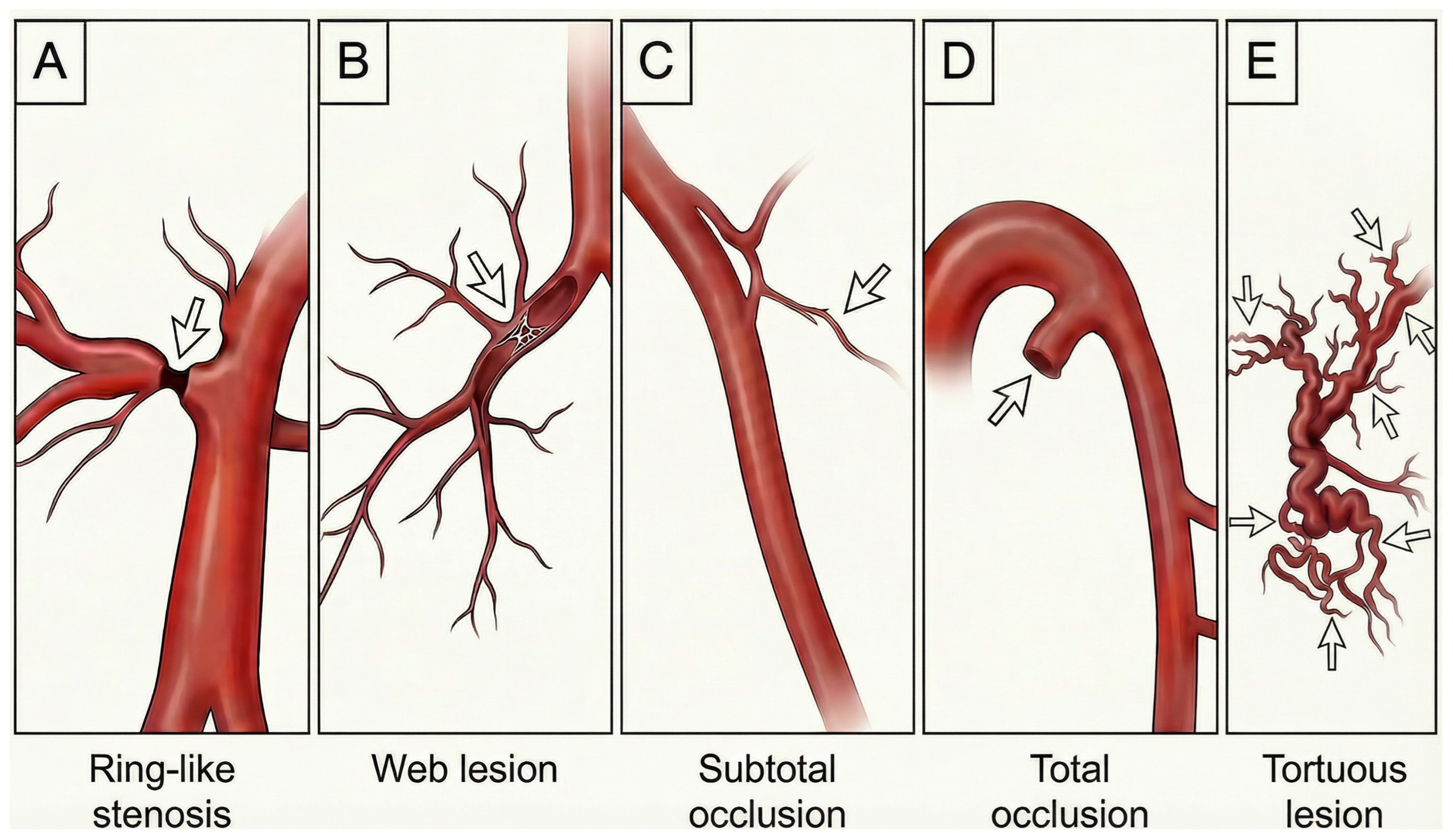
| Selective pulmonary angiography | Detailed lesion type (A–E); segmental anatomy; collateral flow | Predominance of type D/E lesions; long occlusions; severe tortuosity; slow distal flow associated with higher risk of vessel injury and reperfusion edema | Confirmation of lesion response to previous BPA and guidance for repeat interventions |
| Right-heart catheterization | mPAP; PVR; RAP; cardiac output and index; mixed venous oxygen saturation | Markedly elevated PVR (>1000–1200 dyn·s·cm−5); RAP elevation; low cardiac index; low SvO2 | Determining hemodynamic response to staged BPA |
| Cardiopulmonary exercise testing | Mechanism of exercise limitation; ventilatory efficiency; peak VO2 | Very low peak VO2; steep VE/VCO2 slope; evidence of circulatory limitation despite preserved ventilatory mechanics | Objective assessment of functional recovery and prognostication after BPA |
| Trial | Publication Year | Patients | Intervention | mPAP Change | PVR Change | Key Findings |
|---|---|---|---|---|---|---|
| RACE | 2022 | 105 | BPA vs. riociguat | −18.7 mmHg (BPA) | −60.1% (BPA) | BPA superior to riociguat; greater improvement in WHO functional class |
| MR BPA | 2022 | 61 | BPA vs. riociguat | −16.3 mmHg (BPA) | −59.6% (BPA) | BPA superior to riociguat; greater hemodynamic and functional improvement |
| Peak cardiac index change | Adverse events | |||||
| THERAPY-HYBRID-BPA | 2025 | 74 | Riociguat continuation vs. discontinuation after BPA | −0·03 vs. −1.11 L/min per m2 | No significant difference | Riociguat as adjunctive therapy after BPA |
| Study | Publication Year | Patients | mPAP Change | PVR Change | Complication Rate | Key Findings |
|---|---|---|---|---|---|---|
| International BPA registry | 2025 | 484 | −15 mmHg | −57% | 11.3% | Durable hemodynamic improvement; 3-year survival 94.1% |
| Worldwide CTEPH registry | 2024 | 1009 | −18 mmHg | −59% | 12% | 3-year survival: 94% for PEA, 92% for BPA, 71% for medical therapy |
| Polish multicenter registry | 2022 | 236 | −15 mmHg | −50% | 9% | Improved 6MWD and functional class |
| U.S. refined BPA cohort | 2023 | 77 | −6.4 mmHg | −26% | 1.4% of major complications | Favorable factors: pre-BPA riociguat, high number of BPA sessions, and lower baseline PA compliance |
| Japanese nationwide CTEPH registry | 2024 | 369 | −19.9 mmHg | −60% | Not available | Similar mortality between BPA and PEA; renal function improved more with BPA |
Disclaimer/Publisher’s Note: The statements, opinions and data contained in all publications are solely those of the individual author(s) and contributor(s) and not of MDPI and/or the editor(s). MDPI and/or the editor(s) disclaim responsibility for any injury to people or property resulting from any ideas, methods, instructions or products referred to in the content. |
© 2025 by the authors. Licensee MDPI, Basel, Switzerland. This article is an open access article distributed under the terms and conditions of the Creative Commons Attribution (CC BY) license.
Share and Cite
Kook, H.; Kim, W.; Heo, R.; Kim, K.; Yoo, S.-J.; Kim, H.; Park, D.W.; Lim, Y.-H. Current Perspectives on Balloon Pulmonary Angioplasty for Chronic Thromboembolic Pulmonary Hypertension. J. Clin. Med. 2026, 15, 51. https://doi.org/10.3390/jcm15010051
Kook H, Kim W, Heo R, Kim K, Yoo S-J, Kim H, Park DW, Lim Y-H. Current Perspectives on Balloon Pulmonary Angioplasty for Chronic Thromboembolic Pulmonary Hypertension. Journal of Clinical Medicine. 2026; 15(1):51. https://doi.org/10.3390/jcm15010051
Chicago/Turabian StyleKook, Hyungdon, Woohyeun Kim, Ran Heo, Kyunam Kim, Seung-Jin Yoo, Hyunsoo Kim, Dong Won Park, and Young-Hyo Lim. 2026. "Current Perspectives on Balloon Pulmonary Angioplasty for Chronic Thromboembolic Pulmonary Hypertension" Journal of Clinical Medicine 15, no. 1: 51. https://doi.org/10.3390/jcm15010051
APA StyleKook, H., Kim, W., Heo, R., Kim, K., Yoo, S.-J., Kim, H., Park, D. W., & Lim, Y.-H. (2026). Current Perspectives on Balloon Pulmonary Angioplasty for Chronic Thromboembolic Pulmonary Hypertension. Journal of Clinical Medicine, 15(1), 51. https://doi.org/10.3390/jcm15010051