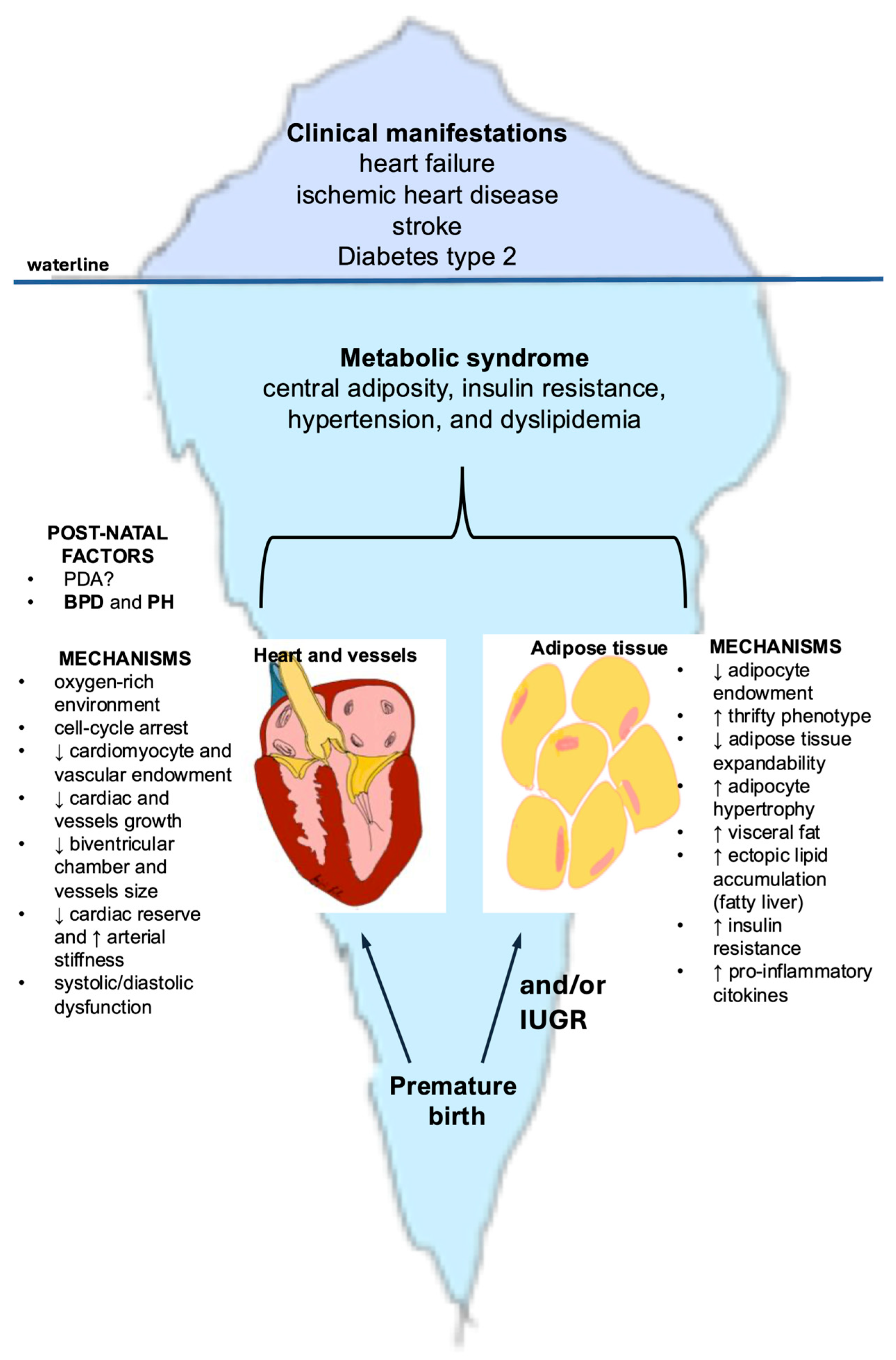
Cardio-Metabolic Risk in Adults Born Preterm: A Narrative Review



Abstract
1. Introduction
2. Adult Born Preterm and Cardiovascular Disease: The Tip of the Iceberg
2.1. Adults Born Preterm and Heart Failure
2.2. Adults Born Preterm and Ischemic Heart Disease
2.3. Adults Born Preterm and Atrial Fibrillation
2.4. Adults Born Preterm and Cerebrovascular Disease
2.5. Adults Born Preterm and Diabetes
3. Adult Born Preterm and Cardiovascular Disease: What’s Below the Waterline?
3.1. Adults Born Preterm and Obesity
- -
- Early-onset overweight/obesity: characterized by high body mass index (BMI) beginning in early childhood, which was maintained throughout childhood.
- -
- Late-onset overweight/obesity: marked by rapid catch-up growth in early infancy, with BMI acceleration starting around age 3 years and progressing to high BMI in later childhood (5–6 years). This trajectory has been closely linked to preterm birth.
- -
- Normal-stable: children maintained a consistently normal BMI throughout the study period.
- -
- Low-stable: children demonstrated a persistently low BMI across childhood [46].
3.2. The Missing Link Between Premature Birth, Obesity, and Metabolic Sequelae
3.3. Cardiac Maldevelopment and Remodeling
3.4. Adults Born Preterm and Hypertension
3.5. Limitations
4. Conclusions
Author Contributions
Funding
Institutional Review Board Statement
Informed Consent Statement
Data Availability Statement
Conflicts of Interest
References
- Group CoPoLBI. New World Health Organization recommendations for care of preterm or low birth weight infants: Health policy. EClinicalMedicine 2023, 63, 102155. [Google Scholar] [CrossRef] [Scilit]
- Lawn, J.E.; Ohuma, E.O.; Bradley, E.; Idueta, L.S.; Hazel, E.; Okwaraji, Y.B.; Erchick, D.J.; Yargawa, J.; Katz, J.; Lee, A.C.C.; et al. Small babies, big risks: Global estimates of prevalence and mortality for vulnerable newborns to accelerate change and improve counting. Lancet 2023, 401, 1707–1719. [Google Scholar] [CrossRef] [Scilit]
- Liang, X.; Lyu, Y.; Li, J.; Li, Y.; Chi, C. Global, regional, and national burden of preterm birth, 1990-2021: A systematic analysis from the global burden of disease study 2021. EClinicalMedicine 2024, 76, 102840. [Google Scholar] [CrossRef] [Scilit]
- Perin, J.; Mulick, A.; Yeung, D.; Villavicencio, F.; Lopez, G.; Strong, K.L.; Prieto-Merino, D.; Cousens, S.; Black, R.E.; Liu, L. Global, regional, and national causes of under-5 mortality in 2000-19: An updated systematic analysis with implications for the Sustainable Development Goals. Lancet Child Adolesc. Health 2022, 6, 106–115. [Google Scholar] [CrossRef] [Scilit]
- Cao, G.; Liu, J.; Liu, M. Global, Regional, and National Incidence and Mortality of Neonatal Preterm Birth, 1990–2019. JAMA Pediatr. 2022, 176, 787–796. [Google Scholar] [CrossRef] [Scilit]
- Venkatesan, T.; Rees, P.; Gardiner, J.; Battersby, C.; Purkayastha, M.; Gale, C.; Sutcliffe, A.G. National Trends in Preterm Infant Mortality in the United States by Race and Socioeconomic Status, 1995–2020. JAMA Pediatr. 2023, 177, 1085–1095. [Google Scholar] [CrossRef] [Scilit] [PubMed]
- Risnes, K.; Bilsteen, J.F.; Brown, P.; Pulakka, A.; Andersen, A.N.; Opdahl, S.; Kajantie, E.; Sandin, S. Mortality Among Young Adults Born Preterm and Early Term in 4 Nordic Nations. JAMA Netw. Open 2021, 4, e2032779. [Google Scholar] [CrossRef] [Scilit]
- Sun, B.; Bertolet, M.; Brooks, M.M.; Hubel, C.A.; Lewis, C.E.; Gunderson, E.P.; Catov, J.M. Life Course Changes in Cardiometabolic Risk Factors Associated With Preterm Delivery: The 30-Year CARDIA Study. J. Am. Heart Assoc. 2020, 9, e015900. [Google Scholar] [CrossRef] [Scilit] [PubMed]
- de Mendonça, E.L.S.S.; de Lima Macêna, M.; Bueno, N.B.; de Oliveira, A.C.M.; Mello, C.S. Premature birth, low birth weight, small for gestational age and chronic non-communicable diseases in adult life: A systematic review with meta-analysis. Early Hum. Dev. 2020, 149, 105154. [Google Scholar] [CrossRef] [Scilit]
- Cheong, J.L.Y.; Haikerwal, A.; Wark, J.D.; Irving, L.; Garland, S.M.; Patton, G.C.; Cheung, M.M.; Doyle, L.W.; Group, V.I.C.S. Cardiovascular Health Profile at Age 25 Years in Adults Born Extremely Preterm or Extremely Low Birthweight. Hypertension 2020, 76, 1838–1846. [Google Scholar] [CrossRef] [Scilit] [PubMed]
- (NCD-RisC), N.R.F.C. Worldwide trends in underweight and obesity from 1990 to 2022: A pooled analysis of 3663 population-representative studies with 222 million children, adolescents, and adults. Lancet 2024, 403, 1027–1050. [Google Scholar] [CrossRef] [Scilit]
- D’Agata, A.L.; Green, C.E.; Sullivan, M.C. A new patient population for adult clinicians: Preterm born adults. Lancet Reg. Health Am. 2022, 9, 100188. [Google Scholar] [CrossRef] [Scilit]
- Raju, T.N.K.; Buist, A.S.; Blaisdell, C.J.; Moxey-Mims, M.; Saigal, S. Adults born preterm: A review of general health and system-specific outcomes. Acta Paediatr. 2017, 106, 1409–1437. [Google Scholar] [CrossRef] [Scilit]
- Carr, H.; Cnattingius, S.; Granath, F.; Ludvigsson, J.F.; Edstedt Bonamy, A.K. Preterm Birth and Risk of Heart Failure Up to Early Adulthood. J. Am. Coll. Cardiol. 2017, 69, 2634–2642. [Google Scholar] [CrossRef] [Scilit]
- Kajantie, E.; Osmond, C.; Eriksson, J.G. Coronary Heart Disease and Stroke in Adults Born Preterm—The Helsinki Birth Cohort Study. Paediatr. Perinat. Epidemiol. 2015, 29, 515–519. [Google Scholar] [CrossRef] [Scilit]
- Crump, C.; Howell, E.A.; Stroustrup, A.; McLaughlin, M.A.; Sundquist, J.; Sundquist, K. Association of Preterm Birth With Risk of Ischemic Heart Disease in Adulthood. JAMA Pediatr. 2019, 173, 736–743. [Google Scholar] [CrossRef] [Scilit]
- Yang, F.; Janszky, I.; Gissler, M.; Cnattingius, S.; Roos, N.; Miao, M.; Yuan, W.; Li, J.; László, K.D. Preterm Birth, Small for Gestational Age, and Large for Gestational Age and the Risk of Atrial Fibrillation Up to Middle Age. JAMA Pediatr. 2023, 177, 599–607. [Google Scholar] [CrossRef] [Scilit] [PubMed]
- Crump, C.; Sundquist, J.; Sundquist, K. Stroke Risks in Adult Survivors of Preterm Birth: National Cohort and Cosibling Study. Stroke 2021, 52, 2609–2617. [Google Scholar] [CrossRef] [Scilit]
- Osmond, C.; Kajantie, E.; Forsén, T.J.; Eriksson, J.G.; Barker, D.J. Infant growth and stroke in adult life: The Helsinki birth cohort study. Stroke 2007, 38, 264–270. [Google Scholar] [CrossRef] [Scilit]
- Ueda, P.; Cnattingius, S.; Stephansson, O.; Ingelsson, E.; Ludvigsson, J.F.; Bonamy, A.K. Cerebrovascular and ischemic heart disease in young adults born preterm: A population-based Swedish cohort study. Eur. J. Epidemiol. 2014, 29, 253–260. [Google Scholar] [CrossRef] [Scilit] [PubMed]
- Crump, C.; Sundquist, J.; Sundquist, K. Preterm birth and risk of type 1 and type 2 diabetes: A national cohort study. Diabetologia 2020, 63, 508–518. [Google Scholar] [CrossRef] [Scilit]
- Kajantie, E.; Osmond, C.; Barker, D.J.; Eriksson, J.G. Preterm birth—A risk factor for type 2 diabetes? The Helsinki birth cohort study. Diabetes Care 2010, 33, 2623–2625. [Google Scholar] [CrossRef] [Scilit] [PubMed]
- Li, S.; Zhang, M.; Tian, H.; Liu, Z.; Yin, X.; Xi, B. Preterm birth and risk of type 1 and type 2 diabetes: Systematic review and meta-analysis. Obes. Rev. 2014, 15, 804–811. [Google Scholar] [CrossRef] [Scilit] [PubMed]
- Burchert, H.; Lewandowski, A.J. Preterm Birth Is a Novel, Independent Risk Factor for Altered Cardiac Remodeling and Early Heart Failure: Is it Time for a New Cardiomyopathy? Curr. Treat. Options Cardiovasc. Med. 2019, 21, 8. [Google Scholar] [CrossRef] [Scilit]
- Dlamini, N.; Jordan, L.C. Young Adult Survivors of Preterm Birth Are at Increased Risk of Stroke: The Missing Link. Stroke 2021, 52, 2618–2620. [Google Scholar] [CrossRef] [Scilit]
- Lawlor, D.A.; Ronalds, G.; Clark, H.; Smith, G.D.; Leon, D.A. Birth weight is inversely associated with incident coronary heart disease and stroke among individuals born in the 1950s: Findings from the Aberdeen Children of the 1950s prospective cohort study. Circulation 2005, 112, 1414–1418. [Google Scholar] [CrossRef] [Scilit]
- Crump, C.; Sundquist, J.; Sundquist, K. Adverse pregnancy outcomes and long-term stroke risks. Eur. Heart J. 2025, ehaf627. [Google Scholar] [CrossRef] [Scilit]
- Goldacre, R.R. Associations between birthweight, gestational age at birth and subsequent type 1 diabetes in children under 12: A retrospective cohort study in England, 1998–2012. Diabetologia 2018, 61, 616–625. [Google Scholar] [CrossRef] [Scilit]
- Crump, C. An overview of adult health outcomes after preterm birth. Early Hum. Dev. 2020, 150, 105187. [Google Scholar] [CrossRef] [Scilit]
- Reisinger, C.; Nkeh-Chungag, B.N.; Fredriksen, P.M.; Goswami, N. The prevalence of pediatric metabolic syndrome-a critical look on the discrepancies between definitions and its clinical importance. Int. J. Obes. 2021, 45, 12–24. [Google Scholar] [CrossRef] [Scilit] [PubMed]
- Jańczewska, I.; Wierzba, J.; Jańczewska, A.; Szczurek-Gierczak, M.; Domżalska-Popadiuk, I. Prematurity and Low Birth Weight and Their Impact on Childhood Growth Patterns and the Risk of Long-Term Cardiovascular Sequelae. Children 2023, 10, 1599. [Google Scholar] [CrossRef] [Scilit]
- Ou-Yang, M.C.; Sun, Y.; Liebowitz, M.; Chen, C.C.; Fang, M.L.; Dai, W.; Chuang, T.W.; Chen, J.L. Correction: Accelerated weight gain, prematurity, and the risk of childhood obesity: A meta-analysis and systematic review. PLoS ONE 2024, 19, e0298556. [Google Scholar] [CrossRef] [Scilit]
- Freedman, D.S.; Khan, L.K.; Serdula, M.K.; Dietz, W.H.; Srinivasan, S.R.; Berenson, G.S. The relation of childhood BMI to adult adiposity: The Bogalusa Heart Study. Pediatrics 2005, 115, 22–27. [Google Scholar] [CrossRef] [Scilit]
- Freedman, D.S.; Khan, L.K.; Serdula, M.K.; Dietz, W.H.; Srinivasan, S.R.; Berenson, G.S. Inter-relationships among childhood BMI, childhood height, and adult obesity: The Bogalusa Heart Study. Int. J. Obes. Relat. Metab. Disord. 2004, 28, 10–16. [Google Scholar] [CrossRef] [Scilit]
- Jacobs, D.R.; Woo, J.G.; Sinaiko, A.R.; Daniels, S.R.; Ikonen, J.; Juonala, M.; Kartiosuo, N.; Lehtimäki, T.; Magnussen, C.G.; Viikari, J.S.A.; et al. Childhood Cardiovascular Risk Factors and Adult Cardiovascular Events. N. Engl. J. Med. 2022, 386, 1877–1888. [Google Scholar] [CrossRef] [Scilit]
- Barker, D.J.; Eriksson, J.G.; Forsén, T.; Osmond, C. Fetal origins of adult disease: Strength of effects and biological basis. Int. J. Epidemiol. 2002, 31, 1235–1239. [Google Scholar] [CrossRef] [Scilit]
- Reynolds, R.M.; Jacobsen, G.H.; Drake, A.J. What is the evidence in humans that DNA methylation changes link events in utero and later life disease? Clin. Endocrinol. 2013, 78, 814–822. [Google Scholar] [CrossRef] [Scilit]
- Qiu, J. Epigenetics: Unfinished symphony. Nature 2006, 441, 143–145. [Google Scholar] [CrossRef] [Scilit] [PubMed]
- Johnson, M.J.; Wootton, S.A.; Leaf, A.A.; Jackson, A.A. Preterm birth and body composition at term equivalent age: A systematic review and meta-analysis. Pediatrics 2012, 130, e640–e649. [Google Scholar] [CrossRef] [Scilit] [PubMed]
- Roberts, G.; Cheong, J.L. Long-term growth and general health for the tiniest or most immature infants. Semin. Fetal Neonatal Med. 2014, 19, 118–124. [Google Scholar] [CrossRef] [Scilit]
- Uthaya, S.; Thomas, E.L.; Hamilton, G.; Doré, C.J.; Bell, J.; Modi, N. Altered adiposity after extremely preterm birth. Pediatr. Res. 2005, 57, 211–215. [Google Scholar] [CrossRef] [Scilit]
- De Lucia Rolfe, E.; Loos, R.J.; Druet, C.; Stolk, R.P.; Ekelund, U.; Griffin, S.J.; Forouhi, N.G.; Wareham, N.J.; Ong, K.K. Association between birth weight and visceral fat in adults. Am. J. Clin. Nutr. 2010, 92, 347–352. [Google Scholar] [CrossRef] [Scilit]
- Stansfield, B.K.; Fain, M.E.; Bhatia, J.; Gutin, B.; Nguyen, J.T.; Pollock, N.K. Nonlinear Relationship between Birth Weight and Visceral Fat in Adolescents. J. Pediatr. 2016, 174, 185–192. [Google Scholar] [CrossRef] [Scilit]
- Crane, J.D.; Yellin, S.A.; Ong, F.J.; Singh, N.P.; Konyer, N.; Noseworthy, M.D.; Schmidt, L.A.; Saigal, S.; Morrison, K.M. ELBW survivors in early adulthood have higher hepatic, pancreatic and subcutaneous fat. Sci. Rep. 2016, 6, 31560. [Google Scholar] [CrossRef] [Scilit]
- Sipola-Leppänen, M.; Hovi, P.; Andersson, S.; Wehkalampi, K.; Vääräsmäki, M.; Strang-Karlsson, S.; Järvenpää, A.L.; Mäkitie, O.; Eriksson, J.G.; Kajantie, E. Resting energy expenditure in young adults born preterm--the Helsinki study of very low birth weight adults. PLoS ONE 2011, 6, e17700. [Google Scholar] [CrossRef] [Scilit]
- Huang, W.; Meir, A.Y.; Olapeju, B.; Wang, G.; Hong, X.; Venkataramani, M.; Cheng, T.L.; Igusa, T.; Liang, L.; Wang, X. Defining longitudinal trajectory of body mass index percentile and predicting childhood obesity: Methodologies and findings in the Boston Birth Cohort. Precis. Nutr. 2023, 2, e00037. [Google Scholar]
- Ni, Y.; Beckmann, J.; Hurst, J.R.; Morris, J.K.; Marlow, N. Size at birth, growth trajectory in early life, and cardiovascular and metabolic risks in early adulthood: EPICure study. Arch. Dis. Child. Fetal Neonatal Ed. 2021, 106, 149–155. [Google Scholar] [CrossRef] [Scilit] [PubMed]
- Ekelund, U.; Ong, K.; Linné, Y.; Neovius, M.; Brage, S.; Dunger, D.B.; Wareham, N.J.; Rössner, S. Upward weight percentile crossing in infancy and early childhood independently predicts fat mass in young adults: The Stockholm Weight Development Study (SWEDES). Am. J. Clin. Nutr. 2006, 83, 324–330. [Google Scholar] [CrossRef] [Scilit] [PubMed]
- Nakano, Y. Adult-Onset Diseases in Low Birth Weight Infants: Association with Adipose Tissue Maldevelopment. J. Atheroscler. Thromb. 2020, 27, 397–405. [Google Scholar] [CrossRef] [Scilit]
- Spalding, K.L.; Arner, E.; Westermark, P.O.; Bernard, S.; Buchholz, B.A.; Bergmann, O.; Blomqvist, L.; Hoffstedt, J.; Näslund, E.; Britton, T.; et al. Dynamics of fat cell turnover in humans. Nature 2008, 453, 783–787. [Google Scholar] [CrossRef] [Scilit]
- Virtue, S.; Vidal-Puig, A. Adipose tissue expandability, lipotoxicity and the Metabolic Syndrome—An allostatic perspective. Biochim. Biophys. Acta 2010, 1801, 338–349. [Google Scholar] [CrossRef] [Scilit]
- Sbarbati, A.; Osculati, F.; Silvagni, D.; Benati, D.; Galiè, M.; Camoglio, F.S.; Rigotti, G.; Maffeis, C. Obesity and inflammation: Evidence for an elementary lesion. Pediatrics 2006, 117, 220–223. [Google Scholar] [CrossRef] [Scilit]
- Maffeis, C.; Silvagni, D.; Bonadonna, R.; Grezzani, A.; Banzato, C.; Tatò, L. Fat cell size, insulin sensitivity, and inflammation in obese children. J. Pediatr. 2007, 151, 647–652. [Google Scholar] [CrossRef] [Scilit]
- Maffeis, C.; Morandi, A. Body composition and insulin resistance in children. Eur. J. Clin. Nutr. 2018, 72, 1239–1245. [Google Scholar] [CrossRef] [Scilit]
- Hershkop, K.; Besor, O.; Santoro, N.; Pierpont, B.; Caprio, S.; Weiss, R. Adipose Insulin Resistance in Obese Adolescents Across the Spectrum of Glucose Tolerance. J. Clin. Endocrinol. Metab. 2016, 101, 2423–2431. [Google Scholar] [CrossRef] [Scilit]
- Valenti, L.; Bugianesi, E.; Pajvani, U.; Targher, G. Nonalcoholic fatty liver disease: Cause or consequence of type 2 diabetes? Liver Int. 2016, 36, 1563–1579. [Google Scholar] [CrossRef] [Scilit] [PubMed]
- Li, Z.; Lin, M.; Liu, C.; Wang, D.; Shi, X.; Chen, Z.; Liu, Y.; Yang, S.; Li, X. Fetuin-B links nonalcoholic fatty liver disease to type 2 diabetes via inducing insulin resistance: Association and path analyses. Cytokine 2018, 108, 145–150. [Google Scholar] [CrossRef] [Scilit] [PubMed]
- Sipola-Leppänen, M.; Vääräsmäki, M.; Tikanmäki, M.; Hovi, P.; Miettola, S.; Ruokonen, A.; Pouta, A.; Järvelin, M.R.; Kajantie, E. Cardiovascular risk factors in adolescents born preterm. Pediatrics 2014, 134, e1072–e1081. [Google Scholar] [CrossRef] [Scilit] [PubMed]
- Heikkilä, K.; Metsälä, J.; Pulakka, A.; Nilsen, S.M.; Kivimäki, M.; Risnes, K.; Kajantie, E. Preterm birth and the risk of multimorbidity in adolescence: A multiregister-based cohort study. Lancet Public Health 2023, 8, e680–e690. [Google Scholar] [CrossRef] [Scilit]
- Hochmayr, C.; Ndayisaba, J.P.; Gande, N.; Staudt, A.; Bernar, B.; Stock, K.; Kiechl, S.J.; Geiger, R.; Griesmaier, E.; Knoflach, M.; et al. Cardiovascular health profiles in adolescents being born term or preterm-results from the EVA-Tyrol study. BMC Cardiovasc. Disord. 2023, 23, 371. [Google Scholar] [CrossRef] [Scilit]
- Fernandes, R.O.; Dos Santos, V.B.; Saalfeld, R.M.; Evaristo, A.S.; Bernardi, J.R.; Rovedder, P.M.E.; Nuyt, A.M.; Luu, T.M.; Procianoy, R.S.; Silveira, R.C. Cardiometabolic characteristics of school-aged children born preterm with very low birth weight. Pediatr. Res. 2025. [Google Scholar] [CrossRef] [Scilit]
- Cauzzo, C.; Chiavaroli, V.; Di Valerio, S.; Chiarelli, F. Birth size, growth trajectory and later cardio-metabolic risk. Front. Endocrinol. 2023, 14, 1187261. [Google Scholar] [CrossRef] [Scilit]
- Sonaglioni, A.; Cerini, F.; Cerrone, A.; Argiento, L.; Nicolosi, G.L.; Rigamonti, E.; Lombardo, M.; Rumi, M.G.; Viganò, M. Liver stiffness measurement identifies subclinical myocardial dysfunction in non-advanced non-alcoholic fatty liver disease patients without overt heart disease. Intern. Emerg. Med. 2022, 17, 1425–1438. [Google Scholar] [CrossRef] [Scilit]
- Hirose, K.; Nakanishi, K.; Di Tullio, M.R.; Homma, S.; Sawada, N.; Yoshida, Y.; Hirokawa, M.; Koyama, K.; Kimura, K.; Nakao, T.; et al. Association between non-alcoholic fatty liver disease and subclinical left ventricular dysfunction in the general population. Eur. Heart J. Open 2023, 3, oead108. [Google Scholar] [CrossRef] [Scilit]
- Kumar, V.H.S. Cardiovascular Morbidities in Adults Born Preterm: Getting to the Heart of the Matter! Children 2022, 9, 1843. [Google Scholar] [CrossRef] [Scilit]
- Lewandowski, A.J.; Levy, P.T.; Bates, M.L.; McNamara, P.J.; Nuyt, A.M.; Goss, K.N. Impact of the Vulnerable Preterm Heart and Circulation on Adult Cardiovascular Disease Risk. Hypertension 2020, 76, 1028–1037. [Google Scholar] [CrossRef] [Scilit] [PubMed]
- Puente, B.N.; Kimura, W.; Muralidhar, S.A.; Moon, J.; Amatruda, J.F.; Phelps, K.L.; Grinsfelder, D.; Rothermel, B.A.; Chen, R.; Garcia, J.A.; et al. The oxygen-rich postnatal environment induces cardiomyocyte cell-cycle arrest through DNA damage response. Cell 2014, 157, 565–579. [Google Scholar] [CrossRef] [Scilit]
- Lewandowski, A.J.; Augustine, D.; Lamata, P.; Davis, E.F.; Lazdam, M.; Francis, J.; McCormick, K.; Wilkinson, A.R.; Singhal, A.; Lucas, A.; et al. Preterm heart in adult life: Cardiovascular magnetic resonance reveals distinct differences in left ventricular mass, geometry, and function. Circulation 2013, 127, 197–206. [Google Scholar] [CrossRef] [Scilit] [PubMed]
- Lewandowski, A.J.; Bradlow, W.M.; Augustine, D.; Davis, E.F.; Francis, J.; Singhal, A.; Lucas, A.; Neubauer, S.; McCormick, K.; Leeson, P. Right ventricular systolic dysfunction in young adults born preterm. Circulation 2013, 128, 713–720. [Google Scholar] [CrossRef] [Scilit] [PubMed]
- Goss, K.N.; Haraldsdottir, K.; Beshish, A.G.; Barton, G.P.; Watson, A.M.; Palta, M.; Chesler, N.C.; Francois, C.J.; Wieben, O.; Eldridge, M.W. Association Between Preterm Birth and Arrested Cardiac Growth in Adolescents and Young Adults. JAMA Cardiol. 2020, 5, 910–919. [Google Scholar] [CrossRef] [Scilit]
- Huckstep, O.J.; Williamson, W.; Telles, F.; Burchert, H.; Bertagnolli, M.; Herdman, C.; Arnold, L.; Smillie, R.; Mohamed, A.; Boardman, H.; et al. Physiological Stress Elicits Impaired Left Ventricular Function in Preterm-Born Adults. J. Am. Coll. Cardiol. 2018, 71, 1347–1356. [Google Scholar] [CrossRef] [Scilit]
- Bonafiglia, E.; Garzon, S.; Forte, N.; Bosco, M.; Ciuffreda, M.; Cristofaletti, A.; Hoxha, S.; Beghini, R.; Uccella, S.; Gottin, L.; et al. Association of patent ductus arteriosus duration with bronchopulmonary dysplasia and mortality: A cohort study. Pediatr. Res. 2025. [Google Scholar] [CrossRef] [Scilit]
- Ficial, B.; Corsini, I.; Clemente, M.; Cappelleri, A.; Remaschi, G.; Quer, L.; Urbani, G.; Sandrini, C.; Biban, P.; Dani, C.; et al. Feasibility, Reproducibility and Reference Ranges of Left Atrial Strain in Preterm and Term Neonates in the First 48 h of Life. Diagnostics 2022, 12, 350. [Google Scholar] [CrossRef] [Scilit]
- Huckstep, O.J.; Burchert, H.; Williamson, W.; Telles, F.; Tan, C.M.J.; Bertagnolli, M.; Arnold, L.; Mohamed, A.; McCormick, K.; Hanssen, H.; et al. Impaired myocardial reserve underlies reduced exercise capacity and heart rate recovery in preterm-born young adults. Eur. Heart J. Cardiovasc. Imaging 2021, 22, 572–580. [Google Scholar] [CrossRef] [Scilit] [PubMed]
- Goss, K.N.; Beshish, A.G.; Barton, G.P.; Haraldsdottir, K.; Levin, T.S.; Tetri, L.H.; Battiola, T.J.; Mulchrone, A.M.; Pegelow, D.F.; Palta, M.; et al. Early Pulmonary Vascular Disease in Young Adults Born Preterm. Am. J. Respir. Crit. Care Med. 2018, 198, 1549–1558. [Google Scholar] [CrossRef] [Scilit] [PubMed]
- Hovi, P.; Vohr, B.; Ment, L.R.; Doyle, L.W.; McGarvey, L.; Morrison, K.M.; Evensen, K.A.; van der Pal, S.; Grunau, R.E.; Brubakk, A.M.; et al. Blood Pressure in Young Adults Born at Very Low Birth Weight: Adults Born Preterm International Collaboration. Hypertension 2016, 68, 880–887. [Google Scholar] [CrossRef] [Scilit]
- Bertagnolli, M.; Luu, T.M.; Lewandowski, A.J.; Leeson, P.; Nuyt, A.M. Preterm Birth and Hypertension: Is There a Link? Curr. Hypertens. Rep. 2016, 18, 28. [Google Scholar] [CrossRef] [Scilit] [PubMed]
- Boardman, H.; Birse, K.; Davis, E.F.; Whitworth, P.; Aggarwal, V.; Lewandowski, A.J.; Leeson, P. Comprehensive multi-modality assessment of regional and global arterial structure and function in adults born preterm. Hypertens. Res. 2016, 39, 39–45. [Google Scholar] [CrossRef] [Scilit]
- Didion, S.P. A novel genetic model to explore the Brenner hypothesis: Linking nephron endowment and number with hypertension. Med. Hypotheses 2017, 106, 6–9. [Google Scholar] [CrossRef] [Scilit]
- Vidal, E.; Trevisanuto, D. From survival to surveillance: The long-term kidney legacy of preterm birth. Pediatr. Nephrol. 2025, 41, 17–21. [Google Scholar] [CrossRef] [Scilit]
- Sacco, A.; Cornish, E.F.; Marlow, N.; David, A.L.; Giussani, D.A. The effect of antenatal corticosteroid use on offspring cardiovascular function: A systematic review. BJOG 2023, 130, 325–333. [Google Scholar] [CrossRef] [Scilit] [PubMed]


| Author(s) | Year | Study Type | Main Findings |
|---|---|---|---|
| Adults Born Preterm and Heart Failure (HF) | |||
| Carr H. et al. [14] | 2017 | Swedish Nationwide Cohort | Preterm birth strongly linked to HF independent of ischemic disease; inverse GA–risk relation; extremely preterm → 17-fold risk; very preterm → >3-fold risk; median diagnosis age 16.5 yrs. |
| Adults Born Preterm and Ischemic Heart Disease (IHD) | |||
| Kajantie E. et al. [15] | 2015 | The Helsinki Birth Cohort Study | Little/no association, likely due to survivor bias or limited follow-up. |
| Crump C. et al. [16] | 2019 | Swedish National Cohort Study | GA inversely associated with IHD; preterm → 53% increased risk; early-term → 19% increased risk; highest incidence in men, highest relative risk in women. |
| Adults Born Preterm and Atrial Fibrillation (AF) | |||
| Yang F. et al. [17] | 2023 | Population-based study | Preterm birth and large-for-GA associated with increased risk of early-onset AF. |
| Adults Born Preterm and Cerebrovascular Disease (CVD) | |||
| Crump C. et al. [18] | 2021 | National Cohort and Cosibling Stud | Preterm (<37 wks) → hazard ratio (HR) 1.26 for first stroke; early preterm HR 1.42; late preterm HR 1.22; both ischemic and hemorrhagic stroke increased; associations persist in co-sibling analyses |
| Osmond C. et al. [19] | 2007 | Helsinki birth cohort study | Earlier study. No consistent association—likely survivor bias. |
| Ueda P. et al. [20] | 2014 | Population-based Swedish cohort study | General evidence linking preterm birth to elevated adult stroke risk. |
| Adults Born Preterm and Diabetes | |||
| Crump C. et al. [21] | 2020 | Swedish Nationwide Cohort | Preterm birth increases T1D and T2D risk across lifespan; before 18: T1D ↑1.2×, T2D ↑1.3×; ages 18–43: T1D ↑1.2×, T2D ↑1.5× (higher in females). |
| Kajantie E. et al. [22] | 2010 | The Helsinki birth cohort study. | Consistent association between preterm birth and higher diabetes risk in childhood. |
| Li S. et al. [23] | 2014 | Meta-analysis | Preterm birth → higher risk of T1D (OR 1.18) and T2D (OR 1.51). |
Disclaimer/Publisher’s Note: The statements, opinions and data contained in all publications are solely those of the individual author(s) and contributor(s) and not of MDPI and/or the editor(s). MDPI and/or the editor(s) disclaim responsibility for any injury to people or property resulting from any ideas, methods, instructions or products referred to in the content. |
© 2025 by the authors. Licensee MDPI, Basel, Switzerland. This article is an open access article distributed under the terms and conditions of the Creative Commons Attribution (CC BY) license.
Share and Cite
Ficial, B.; Gottin, L.; Maffeis, C. Cardio-Metabolic Risk in Adults Born Preterm: A Narrative Review. J. Clin. Med. 2026, 15, 256. https://doi.org/10.3390/jcm15010256
Ficial B, Gottin L, Maffeis C. Cardio-Metabolic Risk in Adults Born Preterm: A Narrative Review. Journal of Clinical Medicine. 2026; 15(1):256. https://doi.org/10.3390/jcm15010256
Chicago/Turabian StyleFicial, Benjamim, Leonardo Gottin, and Claudio Maffeis. 2026. "Cardio-Metabolic Risk in Adults Born Preterm: A Narrative Review" Journal of Clinical Medicine 15, no. 1: 256. https://doi.org/10.3390/jcm15010256
APA StyleFicial, B., Gottin, L., & Maffeis, C. (2026). Cardio-Metabolic Risk in Adults Born Preterm: A Narrative Review. Journal of Clinical Medicine, 15(1), 256. https://doi.org/10.3390/jcm15010256