Early Prediction of Acute Respiratory Distress Syndrome in Critically Ill Polytrauma Patients Using Balanced Random Forest ML: A Retrospective Cohort Study

 ,
,  ,
,  ,
,  , , , ,
  and
and
Abstract
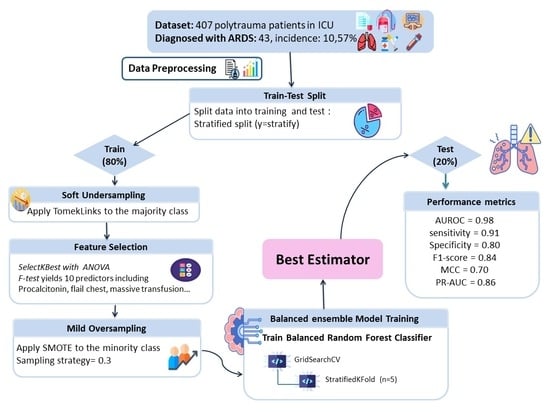
1. Introduction
2. Materials and Methods
2.1. Ethical Approval
2.2. Sample Size Calculation and Cohort Consideration
2.3. Population
2.4. Experimental Design
2.5. Clinical Assessments and Data Collection
2.5.1. Injury Severity Assessment
2.5.2. Laboratory Parameters
2.5.3. Imaging Studies
2.5.4. Hemodynamic Monitoring
2.5.5. Therapeutic Interventions
2.5.6. Emergency Surgical Interventions
2.5.7. Outcome Assessment
2.6. ARDS Diagnostic Criteria
2.7. Data Preprocessing and Feature Engineering
2.8. Outlier Detection and Management
2.9. Class Imbalance Handling Strategy
2.10. Feature Selection Methodology
2.11. ML Model Development
2.12. Model Evaluation and Validation
2.13. Data Analysis and Modeling Tools
3. Results
3.1. Clinical Characteristics and Demographics
3.2. Injury Patterns and Severity Assessment
3.3. Physiological Parameters and Laboratory Findings
3.4. Therapeutic Interventions and Resource Utilization
3.5. Early Surgical Interventions
3.6. Feature Selection and Model Development
3.7. Model Performance Assessment
3.8. Model Interpretability and Clinical Insights
4. Discussion
4.1. Principal Findings and Clinical Significance
4.2. Feature Importance and Clinical Interpretation
4.3. Thoracic Injury Patterns and ARDS Risk
4.4. Fluid Management and Transfusion-Related Risk Factors
4.5. Acid-Base Physiology and Early ARDS Recognition
4.6. Surgical Interventions and the “Second Hit” Phenomenon
4.7. Comparison with Previous Studies and Model Performance
4.8. Clinical Implementation and Decision Support
4.9. Study Limitations and Future Directions
4.10. Clinical and Policy Implications
5. Conclusions
Author Contributions
Funding
Institutional Review Board Statement
Informed Consent Statement
Data Availability Statement
Acknowledgments
Conflicts of Interest
References
- Ranieri, V.M.; Rubenfeld, G.D.; Thompson, B.T.; Ferguson, N.D.; Caldwell, E.; Fan, E.; Camporota, L.; Slutsky, A.S. Acute respiratory distress syndrome: The Berlin Definition. JAMA 2012, 307, 2526–2533. [Google Scholar]
- Ferguson, N.D.; Fan, E.; Camporota, L.; Antonelli, M.; Anzueto, A.; Beale, R.; Brochard, L.; Brower, R.; Esteban, A.; Gattinoni, L.; et al. The Berlin definition of ARDS: An expanded rationale, justification, and supplementary material. Intensive Care Med. 2012, 38, 1573–1582. [Google Scholar] [CrossRef]
- Yang, J.; Zeng, S.; Cui, S.; Zheng, J.; Wang, H. Predictive Modeling of Acute Respiratory Distress Syndrome Using Machine Learning: Systematic Review and Meta-Analysis. J. Med. Internet Res. 2025, 27, e66615. [Google Scholar] [CrossRef]
- Matthay, M.A.; Arabi, Y.; Arroliga, A.C.; Bernard, G.; Bersten, A.D.; Brochard, L.J.; Calfee, C.S.; Combes, A.; Daniel, B.M.; Ferguson, N.D.; et al. A New Global Definition of Acute Respiratory Distress Syndrome. Am. J. Respir. Crit. Care Med. 2024, 209, 37–47. [Google Scholar] [CrossRef] [PubMed]
- Bellani, G.; Laffey, J.G.; Pham, T.; Fan, E.; Brochard, L.; Esteban, A.; Gattinoni, L.; van Haren, F.; Larsson, A.; McAuley, D.F.; et al. Epidemiology, Patterns of Care, and Mortality for Patients with Acute Respiratory Distress Syndrome in Intensive Care Units in 50 Countries. JAMA 2016, 315, 788–800. [Google Scholar] [CrossRef] [PubMed]
- Ashbaugh, D.G.; Bigelow, D.B.; Petty, T.L.; Levine, B.E. Acute respiratory distress in adults. Lancet 1967, 2, 319–323. [Google Scholar] [CrossRef] [PubMed]
- Tignanelli, C.J.; Hemmila, M.R.; Rogers, M.A.M.; Raghavendran, K. Nationwide cohort study of independent risk factors for acute respiratory distress syndrome after trauma. Trauma Surg. Acute Care Open 2019, 4, e000249. [Google Scholar] [CrossRef]
- Kasotakis, G.; Stanfield, B.; Haines, K.; Vatsaas, C.; Alger, A.; Vaslef, S.N.; Brooks, K.; Agarwal, S. Acute Respiratory Distress Syndrome (ARDS) after trauma: Improving incidence, but increasing mortality. J. Crit. Care 2021, 64, 213–218. [Google Scholar] [CrossRef]
- Robinson, B.R.H.; Cohen, M.J.; Holcomb, J.B.; Pritts, T.A.; Gomaa, D.; Fox, E.E.; Branson, R.D.; Callcut, R.A.; Cotton, B.A.; Schreiber, M.A.; et al. Risk Factors for the Development of Acute Respiratory Distress Syndrome Following Hemorrhage. Shock 2018, 50, 258–264. [Google Scholar] [CrossRef]
- Hudson, L.D.; Milberg, J.A.; Anardi, D.; Maunder, R. Clinical risks for development of the acute respiratory distress syndrome. J. Am. J. Respir. Crit. Care Med. 1995, 151, 293–301. [Google Scholar] [CrossRef]
- Treggiari, M.M.; Hudson, L.D.; Martin, D.P.; Weiss, N.S.; Caldwell, E.; Rubenfeld, G. Effect of acute lung injury and acute respiratory distress syndrome on outcome in critically ill trauma patients. Crit. Care Med. 2004, 32, 327–331. [Google Scholar] [CrossRef] [PubMed]
- Engelhardt, L.J.; Olbricht, C.; Niemann, M.; Graw, J.A.; Hunsicker, O.; Weiss, B.; Bünger, V.; Weber-Carstens, S.; Boie, S.D.; Piper, S.K.; et al. Outcome Comparison of Acute Respiratory Distress Syndrome (ARDS) in Patients with Trauma-Associated and Non-Trauma-Associated ARDS: A Retrospective 11-Year Period Analysis. J. Clin. Med. 2022, 11, 5734. [Google Scholar] [CrossRef] [PubMed]
- Petrick, P.L.; Mirus, M.; Heubner, L.; Harb, H.; Menk, M.; Spieth, P.M. Clinical Phenotyping in Acute Respiratory Distress Syndrome: Steps Towards Personalized Medicine. J. Clin. Med. 2025, 14, 7204. [Google Scholar] [CrossRef] [PubMed]
- Adlung, L.; Cohen, Y.; Mor, U.; Elinav, E. Machine learning in clinical decision making. Med 2021, 2, 642–665. [Google Scholar] [CrossRef]
- Bhattarai, S.; Gupta, A.; Ali, E.; Ali, M.; Riad, M.; Adhikari, P.; Mostafa, J.A. Can Big Data and Machine Learning Improve Our Understanding of Acute Respiratory Distress Syndrome? Cureus 2021, 13, e13529. [Google Scholar] [CrossRef]
- Tran, T.K.; Tran, M.C.; Joseph, A.; Phan, P.A.; Grau, V.; Farmery, A.D. A systematic review of machine learning models for management, prediction and classification of ARDS. Respir. Res. 2024, 25, 232. [Google Scholar] [CrossRef]
- Breiman, L. Random Forests. Mach. Learn. 2001, 45, 5–32. [Google Scholar] [CrossRef]
- Khalilia, M.; Chakraborty, S.; Popescu, M. Predicting disease risks from highly imbalanced data using random forest. BMC Med. Inform. Decis. Mak. 2011, 11, 51. [Google Scholar] [CrossRef]
- He, W.; Fu, X.; Chen, S. Advancing polytrauma care: Developing and validating machine learning models for early mortality prediction. J. Transl. Med. 2023, 21, 664. [Google Scholar] [CrossRef]
- Wang, R.; Cai, L.; Zhang, J.; He, M.; Xu, J. Prediction of Acute Respiratory Distress Syndrome in Traumatic Brain Injury Patients Based on Machine Learning Algorithms. Medicina 2023, 59, 171. [Google Scholar] [CrossRef]
- Khushi, M.; Shaukat, K.; Alam, T.M.; Hameed, I.A.; Uddin, S.; Luo, S.; Yang, X.; Reyes, M.C. A Comparative Performance Analysis of Data Resampling Methods on Imbalance Medical Data. IEEE Access 2021, 9, 109960–109975. [Google Scholar] [CrossRef]
- Salmi, M.; Atif, D.; Oliva, D.; Abraham, A.; Ventura, S. Handling imbalanced medical datasets: Review of a decade of research. Artif. Intell. Rev. 2024, 57, 273. [Google Scholar] [CrossRef]
- Li, S.; Yue, R.; Lu, S.; Luo, J.; Wu, X.; Zhang, Z.; Liu, M.; Fan, Y.; Zhang, Y.; Pan, C.; et al. Artificial intelligence and machine learning in acute respiratory distress syndrome management: Recent advances. Front. Med. 2025, 12, 1597556. [Google Scholar] [CrossRef] [PubMed]
- Collins, G.S.; Moons, K.G.M.; Dhiman, P.; Riley, R.D.; Beam, A.L.; Van Calster, B.; Ghassemi, M.; Liu, X.; Reitsma, J.B.; van Smeden, M.; et al. TRIPOD + AI statement: Updated guidance for reporting clinical prediction models that use regression or machine learning methods. BMJ 2024, 385, e078378. [Google Scholar] [CrossRef]
- Sounderajah, V.; Guni, A.; Liu, X.; Collins, G.S.; Karthikesalingam, A.; Markar, S.R.; Golub, R.M.; Denniston, A.K.; Shetty, S.; Moher, D.; et al. The STARD-AI reporting guideline for diagnostic accuracy studies using artificial intelligence. Nat. Med. 2025, 31, 3283–3289. [Google Scholar] [CrossRef]
- Chow, S.-C.; Shao, J.; Wang, H.; Lokhnygina, Y. Sample Size Calculations in Clinical Research; Chapman and Hall/CRC: Boca Raton, FL, USA, 2017. [Google Scholar]
- Le, S.; Pellegrini, E.; Green-Saxena, A.; Summers, C.; Hoffman, J.; Calvert, J.; Das, R. Supervised machine learning for the early prediction of acute respiratory distress syndrome (ARDS). J. Crit. Care 2020, 60, 96–102. [Google Scholar] [CrossRef]
- Wu, W.; Zhang, Z.; Wang, S.; Xin, R.; Yang, D.; Yao, W.; Hei, Z.; Chen, C.; Luo, G. Novel machine learning models for the prediction of acute respiratory distress syndrome after liver transplantation. Front. Artif. Intell. 2025, 8, 1548131. [Google Scholar] [CrossRef]
- Cohen, J. Statistical Power Analysis for the Behavioral Sciences; Routledge: New York, NY, USA, 2013. [Google Scholar]
- Riley, R.D.; Snell, K.I.E.; Ensor, J.; Burke, D.L.; Harrell, F.E., Jr.; Moons, K.G.M.; Collins, G.S. Minimum sample size for developing a multivariable prediction model: Part I—Continuous outcomes. Stat. Med. 2019, 38, 1262–1275. [Google Scholar] [CrossRef]
- Riley, R.D.; Ensor, J.; Snell, K.I.E.; Archer, L.; Whittle, R.; Dhiman, P.; Alderman, J.; Liu, X.; Kirton, L.; Manson-Whitton, J.; et al. Importance of sample size on the quality and utility of AI-based prediction models for healthcare. Lancet. Digit. Health 2025, 7, 100857. [Google Scholar] [CrossRef]
- Baker, S.P.; O’Neill, B.; Haddon, W., Jr.; Long, W.B. The injury severity score: A method for describing patients with multiple injuries and evaluating emergency care. J. Trauma 1974, 14, 187–196. [Google Scholar] [CrossRef]
- Boyd, C.R.; Tolson, M.A.; Copes, W.S. Evaluating trauma care: The TRISS method. Trauma Score and the Injury Severity Score. J. Trauma 1987, 27, 370–378. [Google Scholar] [CrossRef] [PubMed]
- Champion, H.R.; Sacco, W.J.; Copes, W.S.; Gann, D.S.; Gennarelli, T.A.; Flanagan, M.E. A revision of the Trauma Score. J. Trauma 1989, 29, 623–629. [Google Scholar] [CrossRef] [PubMed]
- Yu, Z.; Ji, M.; Hu, X.; Yan, J.; Jin, Z. Value of procalcitonin on predicting the severity and prognosis in patients with early ARDS: A prospective observation study. Zhonghua Wei Zhong Bing Ji Jiu Yi Xue 2017, 29, 34–38. [Google Scholar] [PubMed]
- Zhang, M.; Pang, M. Early prediction of acute respiratory distress syndrome complicated by acute pancreatitis based on four machine learning models. Clinics 2023, 78, 100215. [Google Scholar] [CrossRef]
- Savage, S.A.; Zarzaur, B.L.; Croce, M.A.; Fabian, T.C. Redefining massive transfusion when every second counts. J. Trauma Acute Care Surg. 2013, 74, 396–400; discussion 400–402. [Google Scholar] [CrossRef]
- Thille, A.W.; Esteban, A.; Fernández-Segoviano, P.; Rodriguez, J.M.; Aramburu, J.A.; Peñuelas, O.; Cortés-Puch, I.; Cardinal-Fernández, P.; Lorente, J.A.; Frutos-Vivar, F. Comparison of the Berlin definition for acute respiratory distress syndrome with autopsy. Am. J. Respir. Crit. Care Med. 2013, 187, 761–767. [Google Scholar] [CrossRef]
- Mukaka, M.M. Statistics corner: A guide to appropriate use of correlation coefficient in medical research. Malawi Med. J. 2012, 24, 69–71. [Google Scholar]
- Liu, F.T.; Ting, K.M.; Zhou, Z.H. Isolation Forest. In Proceedings of the 2008 Eighth IEEE International Conference on Data Mining, Pisa, Italy, 15–19 December 2008; pp. 413–422. [Google Scholar]
- Tomek, I. Two Modifications of CNN. IEEE Trans. Syst. Man Cybern. 1976, SMC-6, 769–772. [Google Scholar]
- Chawla, N.V.; Bowyer, K.W.; Hall, L.O.; Kegelmeyer, W.P. SMOTE: Synthetic minority over-sampling technique. J. Artif. Intell. Res. 2002, 16, 321–357. [Google Scholar] [CrossRef]
- Guyon, I.; Elisseeff, A. An introduction to variable and feature selection. J. Mach. Learn. Res. 2003, 3, 1157–1182. [Google Scholar]
- Saeys, Y.; Inza, I.; Larrañaga, P. A review of feature selection techniques in bioinformatics. Bioinformatics 2007, 23, 2507–2517. [Google Scholar] [CrossRef] [PubMed]
- Fernández-Delgado, M.; Cernadas, E.; Barro, S.; Amorim, D. Do we need hundreds of classifiers to solve real world classification problems? J. Mach. Learn. Res. 2014, 15, 3133–3181. [Google Scholar]
- Chicco, D.; Jurman, G. The advantages of the Matthews correlation coefficient (MCC) over F1 score and accuracy in binary classification evaluation. BMC Genom. 2020, 21, 6. [Google Scholar] [CrossRef] [PubMed]
- Lin, F.; Lu, R.; Han, D.; Fan, Y.; Zhang, Y.; Pan, P. A prediction model for acute respiratory distress syndrome among patients with severe acute pancreatitis: A retrospective analysis. Ther. Adv. Respir. Dis. 2022, 16, 17534666221122592. [Google Scholar] [CrossRef]
- Dehghan, N.; de Mestral, C.; McKee, M.D.; Schemitsch, E.H.; Nathens, A. Flail chest injuries: A review of outcomes and treatment practices from the National Trauma Data Bank. J. Trauma Acute Care Surg. 2014, 76, 462–468. [Google Scholar] [CrossRef]
- Velmahos, G.C.; Vassiliu, P.; Chan, L.S.; Murray, J.A.; Berne, T.V.; Demetriades, D. Influence of flail chest on outcome among patients with severe thoracic cage trauma. Int. Surg. 2002, 87, 240–244. [Google Scholar]
- Rhee, P.; Wang, D.; Ruff, P.; Austin, B.; DeBraux, S.; Wolcott, K.; Burris, D.; Ling, G.; Sun, L. Human neutrophil activation and increased adhesion by various resuscitation fluids. Crit. Care Med. 2000, 28, 74–78. [Google Scholar] [CrossRef]
- Gong, M.N.; Thompson, B.T.; Williams, P.; Pothier, L.; Boyce, P.D.; Christiani, D.C. Clinical predictors of and mortality in acute respiratory distress syndrome: Potential role of red cell transfusion. Crit. Care Med. 2005, 33, 1191–1198. [Google Scholar] [CrossRef]
- Semple, J.W.; Rebetz, J.; Kapur, R. Transfusion-associated circulatory overload and transfusion-related acute lung injury. Blood 2019, 133, 1840–1853. [Google Scholar] [CrossRef]
- Mortelliti, M.P.; Manning, H. Acute respiratory distress syndrome. J. Am. Fam. Physician 2002, 65, 1823–1831. [Google Scholar]
- Guerado, E.; Bertrand, M.L.; Cano, J.R.; Cerván, A.M.; Galán, A. Damage control orthopaedics: State of the art. World J. Orthop. 2019, 10, 1–13. [Google Scholar] [CrossRef]
- Gupta, B.; Farooque, K. Early total care to early appropriate care—What every anesthesiologist must know! J. Anaesthesiol. Clin. Pharmacol. 2023, 39, 3–10. [Google Scholar] [CrossRef] [PubMed]
- Chacón-Aponte, A.A.; Durán-Vargas, É.A.; Arévalo-Carrillo, J.A.; Lozada-Martínez, I.D.; Bolaño-Romero, M.P.; Moscote-Salazar, L.R.; Grille, P.; Janjua, T. Brain-lung interaction: A vicious cycle in traumatic brain injury. Acute Crit. Care 2022, 37, 35–44. [Google Scholar] [CrossRef] [PubMed]
- Bos, L.D.J.; Ware, L.B. Acute respiratory distress syndrome: Causes, pathophysiology, and phenotypes. Lancet 2022, 400, 1145–1156. [Google Scholar] [CrossRef] [PubMed]
- Volpin, G.; Pfeifer, R.; Saveski, J.; Hasani, I.; Cohen, M.; Pape, H.C. Damage control orthopaedics in polytraumatized patients- current concepts. J. Clin. Orthop. Trauma 2021, 12, 72–82. [Google Scholar] [CrossRef]
- Röhrich, S.; Hofmanninger, J.; Negrin, L.; Langs, G.; Prosch, H. Radiomics score predicts acute respiratory distress syndrome based on the initial CT scan after trauma. Eur. Radiol. 2021, 31, 5443–5453. [Google Scholar] [CrossRef]
- Christie, S.A.; Hubbard, A.E.; Callcut, R.A.; Hameed, M.; Dissak-Delon, F.N.; Mekolo, D.; Saidou, A.; Mefire, A.C.; Nsongoo, P.; Dicker, R.A.; et al. Machine learning without borders? An adaptable tool to optimize mortality prediction in diverse clinical settings. J. Trauma Acute Care Surg. 2018, 85, 921–927. [Google Scholar] [CrossRef]
- Dergaa, I.; Ben Saad, H.; Glenn, J.M.; Ben Aissa, M.; Taheri, M.; Swed, S.; Guelmami, N.; Chamari, K. A thorough examination of ChatGPT-3.5 potential applications in medical writing: A preliminary study. Medicine 2024, 103, e39757. [Google Scholar] [CrossRef]
- Dergaa, I.; Fekih-Romdhane, F.; Glenn, J.M.; Saifeddin Fessi, M.; Chamari, K.; Dhahbi, W.; Zghibi, M.; Bragazzi, N.L.; Ben Aissa, M.; Guelmami, N. Moving beyond the stigma: Understanding and overcoming the resistance to the acceptance and adoption of artificial intelligence chatbots. J. New Asian J. Med. 2023, 1, 29–36. [Google Scholar] [CrossRef]




| Variables | % Missingness | ARDS (n = 43) | Non-ARDS (n = 392) | p-Value | |
|---|---|---|---|---|---|
| Demographics | |||||
| Age | 0% | 44 ± 16.52 | 40 ± 16.52 | 0.064 | |
| Gender | Male | 0% | 40 (93%) | 343 (84.85%) | 0.18 |
| Female | 3 (7%) | 49 (13.22%) | |||
| Medical History | |||||
| Asthma | 0% | 2 (4.3%) | 2 (0.48%) | <0.001 | |
| Tabac | 0% | 27 (58.7%) | 195 (46.87%) | 0.148 | |
| COPD | 0% | 7 (15.2%) | 6 (1.44%) | <0.001 | |
| Alcoholism | 0% | 5 (10.9%) | 92 (22.11%) | 0.049 | |
| Drug consumption | 1 (2.2%) | 17 (4.08%) | 0.516 | ||
| ASA classification | ASA 1 | 0% | 20 (47.82%) | 274 (69.89%) | 0.16 |
| ASA 2 | 0% | 21 (50%) | 114 (29%) | ||
| ASA 3 | 0% | 1 (2.17%) | 4 (1.02%) | ||
| Injury Assessment | |||||
| Severe isolated brain injury | 0% | 2 (4.3%) | 57 (13.7%) | 1.48 | |
| Axial trauma | 0% | 24 (52.2%) | 111 (26.68%) | <0.001 | |
| Abdominal trauma | 0.24% | 22 (47.8%) | 128 (30.76%) | 0.023 | |
| Pelvic trauma | 0.24% | 8 (17.4%) | 34 (8.17%) | 0.044 | |
| Pneumothorax | 0.24% | 21 (45.65%) | 63 (15.14%) | <0.001 | |
| Alveolar Hemorrhage | 0.24% | 15 (32.6%) | 40 (9.61%) | <0.001 | |
| Flail chest injury | 0.24% | 41 (89.13%) | 216 (51.92%) | <0.001 | |
| Pulmonary contusion | 0.24% | 40 (86.95%) | 169 (40.62%) | <0.001 | |
| Hemothorax | 0.24% | 26 (56.52%) | 75 (18.02%) | <0.001 | |
| Long bone fracture | 0.24% | 10 (21.73%) | 62 (14.9%) | 0.240 | |
| Trauma Severity Scores | |||||
| ISS | 0% | 35 ± 13.92 | 25.87 ± 15.16 | <0.001 | |
| TRISS | 0% | 29.28 ± 26.26 | 20.95 ± 18.16 | 0.17 | |
| RTS | 0% | 6.55 ± 1.41 | 6.43 ± 2.51 | 0.67 | |
| Emergency Procedures | |||||
| Emergency intubation | 0% | 28 (60.86%) | 265 (63.7%) | 0.629 | |
| Tranexamic acid | 0% | 29 (63.04%) | 159 (38.22%) | 0.001 | |
| Catecholamines | 0.24% | 38 (82.60%) | 250 (60.09%) | 0.002 | |
| Fibrinogen | 4.16% | 12 (26.08%) | 40 (9.61%) | <0.001 | |
| Total vascular filling/24 h (mL) | 0.5% | 3594 ± 1967 | 2055 ± 1604 | 0.025 | |
| Massive transfusion | 0.24% | 16 (34.78%) | 32 (7.69%) | <0.001 | |
| Transfusion | 0% | 32 (69.56%) | 152 (36.53%) | <0.001 | |
| Emergency surgery | |||||
| Neurosurgery | 2.6% | 5 (11.63%) | 37 (10.16%) | 0.025 | |
| Digestive surgery | 0% | 5 (11.63%) | 25 (6.87%) | 0.038 | |
| Thoracotomy | 0% | 1 (2.33%) | 5 (1.37%) | 0.574 | |
| Vascular surgery | 0% | 1 (2.33%) | 5 (1.37%) | 0.589 | |
| Orthopedic surgery | 0% | 12 (27.91%) | 49 (13.46%) | 0.007 | |
| Clinical data upon admission | |||||
| Respiratory rate (cycles/min) | 0% | 30 (21.5; 35) | 22 (18; 29) | 0.14 | |
| SPO2 (%) | 21.62% | 90.28 ± 6.49 | 92.93 ± 6.27 | <0.001 | |
| GCS | 0% | 11.48 ± 4.19 | 9.89 ± 4.41 | 0.212 | |
| Laboratory data upon admission | |||||
| Hemoglobin (g/dL) | 0% | 10.55 ± 2.57 | 11.47 ± 2.49 | 0.19 | |
| Hematocrit (%) | 0% | 31.4 ± 6.88 | 33.30 ± 6.85 | 0.41 | |
| PCT (g/L) | 13.26% | 2.8 (0.26; 7.51) | 0.18 (0.05; 1.03) | 0.035 | |
| CRP | 12% | 118 ± 112 | 95.91 ± 79.86 | 0.001 | |
| Creatinine (mmol/L) | 0% | 110 ± 60.31 | 80.2 ± 64.12 | 0.002 | |
| White blood cells (103/mm3) | 0% | 19.37 ± 8.22 | 16.28 ± 6.70 | 0.008 | |
| Prothrombin time (%) | 0.24% | 59.76 ± 19.74 | 72.01 ± 19.28 | <0.001 | |
| Platelets (103/mm3) | 0% | 203.93 ± 74.75 | 200.83 ± 71.07 | 0.66 | |
| Arterial blood gases upon admission | |||||
| pH | 7.12% | 7.30 ± 0.12 | 7.36 ± 0.11 | 0.002 | |
| PaO2 (mmHg) | 7.12% | 136.34 ± 8.46 | 190.6 ± 104.05 | 0.03 | |
| PaCO2 (mmHg) | 7.12% | 40.87 ± 13.83 | 35.75 ± 9.17 | 0.001 | |
| FiO2/PaO2 ratio | 13.76% | 98.93 ± 64.81 | 328.87 ± 133.4 | 0.001 | |
| HCO3− (mmol/L) | 7.12% | 19.14 ± 5.4 | 19.95 ± 4.01 | 0.334 | |
| Lactate (mmol/L) | 2.7% | 4.35 ± 3.41 | 3.02 ± 2.36 | 0.15 | |
| Metric | Score |
|---|---|
| AUROC | 0.98 |
| PR-AUC | 0.86 |
| MCC | 0.70 |
| Precision | 0.80 |
| Recall | 0.91 |
| F1 score | 0.84 |
Disclaimer/Publisher’s Note: The statements, opinions and data contained in all publications are solely those of the individual author(s) and contributor(s) and not of MDPI and/or the editor(s). MDPI and/or the editor(s) disclaim responsibility for any injury to people or property resulting from any ideas, methods, instructions or products referred to in the content. |
© 2025 by the authors. Licensee MDPI, Basel, Switzerland. This article is an open access article distributed under the terms and conditions of the Creative Commons Attribution (CC BY) license (https://creativecommons.org/licenses/by/4.0/).
Share and Cite
Hassine, N.B.E.H.; Barbaria, S.; Najah, O.; Ceylan, H.İ.; Bilal, M.; Rebai, L.; Muntean, R.I.; Dergaa, I.; Boussi Rahmouni, H. Early Prediction of Acute Respiratory Distress Syndrome in Critically Ill Polytrauma Patients Using Balanced Random Forest ML: A Retrospective Cohort Study. J. Clin. Med. 2025, 14, 8934. https://doi.org/10.3390/jcm14248934
Hassine NBEH, Barbaria S, Najah O, Ceylan Hİ, Bilal M, Rebai L, Muntean RI, Dergaa I, Boussi Rahmouni H. Early Prediction of Acute Respiratory Distress Syndrome in Critically Ill Polytrauma Patients Using Balanced Random Forest ML: A Retrospective Cohort Study. Journal of Clinical Medicine. 2025; 14(24):8934. https://doi.org/10.3390/jcm14248934
Chicago/Turabian StyleHassine, Nesrine Ben El Hadj, Sabri Barbaria, Omayma Najah, Halil İbrahim Ceylan, Muhammad Bilal, Lotfi Rebai, Raul Ioan Muntean, Ismail Dergaa, and Hanene Boussi Rahmouni. 2025. "Early Prediction of Acute Respiratory Distress Syndrome in Critically Ill Polytrauma Patients Using Balanced Random Forest ML: A Retrospective Cohort Study" Journal of Clinical Medicine 14, no. 24: 8934. https://doi.org/10.3390/jcm14248934
APA StyleHassine, N. B. E. H., Barbaria, S., Najah, O., Ceylan, H. İ., Bilal, M., Rebai, L., Muntean, R. I., Dergaa, I., & Boussi Rahmouni, H. (2025). Early Prediction of Acute Respiratory Distress Syndrome in Critically Ill Polytrauma Patients Using Balanced Random Forest ML: A Retrospective Cohort Study. Journal of Clinical Medicine, 14(24), 8934. https://doi.org/10.3390/jcm14248934