


Effectiveness of Natural Photosensitizers in Antimicrobial Photodynamic Therapy Within Dentistry: A Systematic Review of RCTs



Abstract
1. Introduction
1.1. Background
1.2. Objectives
2. Methods
2.1. Focused Question
2.2. Search Strategy
2.3. Study Selection Process
2.4. Data Extraction
2.5. Risk of Bias and Quality Assessment
- Clear description of the natural photosensitizer, including preparation and concentration.
- Specification of light source parameters such as wavelength, power density, and irradiation time.
- Measurement of clinically or microbiologically relevant outcomes.
- Inclusion of appropriate comparator groups, such as untreated controls or synthetic photosensitizers.
- Clear inclusion and exclusion criteria for sample selection.
- Consideration of bias control measures including randomization, calibration, or blinding, where applicable.
- Transparency and reproducibility of statistical analysis.
- Completeness of outcome reporting, including adverse effects or limitations.
- Disclosure of funding and potential conflicts of interest.
2.6. Assessment of the Quality of Evidence
3. Results
3.1. Study Selection
3.2. Assessment of the Risk of Bias
3.3. Assessment of the Quality of Evidence
3.4. Characteristics of the Included Studies
3.5. Main Outcomes from Studies
4. Discussion
4.1. Results in the Context of Other Evidence
4.2. Limitations of the Evidence
4.3. Limitations of the Review Process
4.4. Implications for Practice, Policy, and Future Research
5. Conclusions
Author Contributions
Funding
Data Availability Statement
Conflicts of Interest
References
- Gholami, L.; Shahabi, S.; Jazaeri, M.; Hadilou, M.; Fekrazad, R. Clinical Applications of Antimicrobial Photodynamic Therapy in Dentistry. Front. Microbiol. 2022, 13, 1020995. [Google Scholar] [CrossRef] [PubMed]
- Bourbour, S.; Darbandi, A.; Bostanghadiri, N.; Ghanavati, R.; Taheri, B.; Bahador, A. Effects of Antimicrobial Photosensitizers of Photodynamic Therapy to Treat Periodontitis. Curr. Pharm. Biotechnol. 2024, 25, 1209–1229. [Google Scholar] [CrossRef]
- Cieplik, F.; Tabenski, L.; Buchalla, W.; Maisch, T. Antimicrobial Photodynamic Therapy for Inactivation of Biofilms Formed by Oral Key Pathogens. Front. Microbiol. 2014, 5, 405. [Google Scholar] [CrossRef]
- Afrasiabi, S.; Partoazar, A.; Chiniforush, N.; Goudarzi, R. The Potential Application of Natural Photosensitizers Used in Antimicrobial Photodynamic Therapy Against Oral Infections. Pharmaceuticals 2022, 15, 767. [Google Scholar] [CrossRef]
- Warakomska, A.; Fiegler Rudol, J.; Kubizna, M.; Skaba, D.; Wiench, R. The Role of Photodynamic Therapy Mediated by Natural Photosensitisers in the Management of Peri-Implantitis: A Systematic Review. Pharmaceutics 2025, 17, 443. [Google Scholar] [CrossRef]
- Amendola, G.; Di Luca, M.; Sgarbossa, A. Natural Biomolecules and Light. Antimicrobial Photodynamic Strategies in the Fight Against Antibiotic Resistance. Int. J. Mol. Sci. 2025, 26, 7993. [Google Scholar] [CrossRef]
- Ebrahimi, N.; Ranjbar, A.; Shahabi, S.; Afrasiabi, S. Nanocarrier Based Drug Delivery Systems to Enhance Antimicrobial Photodynamic Therapy in Dental Applications: A Review. AAPS PharmSciTech 2025, 26, 160. [Google Scholar] [CrossRef]
- Amaral, A.L.; Hamblin, M.R.; Andrade, S.A. What Is the Potential of Antibacterial, Antiviral and Antifungal Photodynamic Therapy in Dentistry? Evid. Based Dent. 2024, 25, 186–187. [Google Scholar] [CrossRef]
- Chiniforush, N.; Pourhajibagher, M.; Shahabi, S.; Kosarieh, E.; Bahador, A. Can Antimicrobial Photodynamic Therapy Enhance the Endodontic Treatment? J. Lasers Med. Sci. 2016, 7, 76–85. [Google Scholar] [CrossRef]
- de Oliveira, A.B.; Ferrisse, T.M.; França, G.G.; de Annunzio, S.R.; Kopp, W.; Fontana, C.R.; Brighenti, F.L. Potential Use of Brazilian Green Propolis Extracts as New Photosensitizers for Antimicrobial Photodynamic Therapy Against Cariogenic Microorganisms. Pathogens 2023, 12, 155. [Google Scholar] [CrossRef]
- Pourhajibagher, M.; Plotino, G.; Chiniforush, N.; Bahador, A. Dual Wavelength Irradiation Antimicrobial Photodynamic Therapy Using Indocyanine Green and Metformin Doped with Nano-Curcumin as an Efficient Adjunctive Endodontic Treatment Modality. Photodiagnosis Photodyn. Ther. 2020, 29, 101628. [Google Scholar] [CrossRef]
- Fiegler-Rudol, J.; Zięba, N.; Turski, R.; Misiołek, M.; Wiench, R. Hypericin-Mediated Photodynamic Therapy for Head and Neck Cancers: A Systematic Review. Biomedicines 2025, 13, 181. [Google Scholar] [CrossRef] [PubMed]
- Page, M.J.; McKenzie, J.E.; Bossuyt, P.M.; Boutron, I.; Hoffmann, T.C.; Mulrow, C.D.; Shamseer, L.; Tetzlaff, J.M.; Akl, E.A.; Brennan, S.E.; et al. The PRISMA 2020 Statement: An Updated Guideline for Reporting Systematic Reviews. BMJ 2021, 372, n71. [Google Scholar] [CrossRef] [PubMed]
- Schiavo, J.H. PROSPERO: An International Register of Systematic Review Protocols. Med. Ref. Serv. Q. 2019, 38, 171–180. [Google Scholar] [CrossRef] [PubMed]
- Schardt, C.; Adams, M.B.; Owens, T.; Keitz, S.; Fontelo, P. Utilization of the PICO Framework to Improve Searching PubMed for Clinical Questions. BMC Med. Inform. Decis. Mak. 2007, 7, 16. [Google Scholar] [CrossRef]
- Higgins, J.P.T.; Thomas, J.; Chandler, J.; Cumpston, M.; Li, T.; Page, M.J.; Welch, V.A. Cochrane Handbook for Systematic Reviews of Interventions, Version 6.5; Cochrane: London, UK, 2024; Available online: www.cochrane.org/handbook (accessed on 8 September 2025).
- Guyatt, G.H.; Oxman, A.D.; Vist, G.E.; Kunz, R.; Falck-Ytter, Y.; Alonso-Coello, P.; Schünemann, H.J. GRADE: An Emerging Consensus on Rating Quality of Evidence and Strength of Recommendations. BMJ 2008, 336, 924–926. [Google Scholar] [CrossRef]
- Afrasiabi, S.; Barikani, H.R.; Chiniforush, N. Comparison of Bacterial Disinfection Efficacy Using Blue and Red Lights on Dental Implants Contaminated with Aggregatibacter actinomycetemcomitans. Photodiagnosis Photodyn. Ther. 2022, 40, 103178. [Google Scholar] [CrossRef]
- AlSunbul, H.; Murriky, A. Efficacy of Methylene Blue and Curcumin Mediated Antimicrobial Photodynamic Therapy in the Treatment of Indirect Pulp Capping in Permanent Molar Teeth. Photodiagnosis Photodyn. Ther. 2023, 42, 103598. [Google Scholar] [CrossRef]
- de Cássia Dias Viana Andrade, R.; Azevedo Reis, T.; Rosa, L.P.; de Oliveira Santos, G.P.; da Cristina Silva, F. Comparative Randomized Trial Study About the Efficacy of Photobiomodulation and Curcumin Antimicrobial Photodynamic Therapy as a Coadjuvant Treatment of Oral Mucositis in Oncologic Patients. Support Care Cancer 2022, 30, 7365–7371. [Google Scholar] [CrossRef]
- Donato, H.A.; Pratavieira, S.; Grecco, C.; Brugnera-Júnior, A.; Bagnato, V.S.; Kurachi, C. Clinical Comparison of Two Photosensitizers for Oral Cavity Decontamination. Photomed. Laser Surg. 2017, 35, 105–110. [Google Scholar] [CrossRef]
- Hashemikamangar, S.S.; Alsaedi, R.J.F.; Chiniforush, N.; Motevaselian, F. Effect of Antimicrobial Photodynamic Therapy with Different Photosensitizers and Adhesion Protocol on the Bond Strength of Resin Composite to Sound Dentin. Clin. Oral Investig. 2022, 26, 4011–4019. [Google Scholar] [CrossRef] [PubMed]
- Ivanaga, C.A.; Miessi, D.M.J.; Nuernberg, M.A.A.; Claudio, M.M.; Garcia, V.G.; Theodoro, L.H. Antimicrobial Photodynamic Therapy with Curcumin and LED as an Enhancement to Scaling and Root Planing in the Treatment of Residual Pockets in Diabetic Patients. Photodiagnosis Photodyn. Ther. 2019, 27, 388–395. [Google Scholar] [CrossRef]
- Labban, N.; Taweel, S.M.A.; ALRabiah, M.A.; Alfouzan, A.F.; Alshiddi, I.F.; Assery, M.K. Efficacy of Rose Bengal and Curcumin Mediated Photodynamic Therapy for the Treatment of Denture Stomatitis in Patients with Habitual Cigarette Smoking: A Randomized Controlled Clinical Trial. Photodiagnosis Photodyn. Ther. 2021, 35, 102380. [Google Scholar] [CrossRef] [PubMed]
- Leite, D.P.; Paolillo, F.R.; Parmesano, T.N.; Fontana, C.R.; Bagnato, V.S. Effects of Photodynamic Therapy with Blue Light and Curcumin as Mouth Rinse for Oral Disinfection: A Randomized Controlled Trial. Photomed. Laser Surg. 2014, 32, 627–632. [Google Scholar] [CrossRef] [PubMed]
- Panhóca, V.H.; Esteban Florez, F.L.; Corrêa, T.Q.; Paolillo, F.R.; de Souza, C.W.; Bagnato, V.S. Oral Decontamination of Orthodontic Patients Using Photodynamic Therapy Mediated by Blue Light Irradiation and Curcumin Associated with Sodium Dodecyl Sulfate. Photomed. Laser Surg. 2016, 34, 411–417. [Google Scholar] [CrossRef]
- Panhóca, V.H.; Florez, F.; de Faria Júnior, N.B.; de Souza Rastelli, A.N.; Tanomaru, J.; Kurachi, C.; Bagnato, V.S. Evaluation of Antimicrobial Photodynamic Therapy Against Streptococcus mutans Biofilm In Situ. J. Contemp. Dent. Pract. 2016, 17, 184–191. [Google Scholar] [CrossRef]
- Paschoal, M.A.; Moura, C.M.; Jeremias, F.; Souza, J.F.; Bagnato, V.S.; Giusti, J.S.M.; Santos-Pinto, L. Longitudinal Effect of Curcumin-Photodynamic Antimicrobial Chemotherapy in Adolescents During Fixed Orthodontic Treatment: A Single Blind Randomized Clinical Trial. Lasers Med. Sci. 2015, 30, 2059–2065. [Google Scholar] [CrossRef]
- Wiench, R.; Nowicka, J.; Pajączkowska, M.; Kuropka, P.; Skaba, D.; Kruczek-Kazibudzka, A.; Kuśka-Kiełbratowska, A.; Grzech-Leśniak, K. Influence of Incubation Time on Ortho-Toluidine Blue Mediated Antimicrobial Photodynamic Therapy Directed against Selected Candida Strains—An In Vitro Study. Int. J. Mol. Sci. 2021, 22, 10971. [Google Scholar] [CrossRef]
- Fiegler-Rudol, J.; Kapłon, K.; Kotucha, K.; Moś, M.; Skaba, D.; Kawczyk-Krupka, A.; Wiench, R. Hypocrellin-Mediated PDT: A Systematic Review of Its Efficacy, Applications, and Outcomes. Int. J. Mol. Sci. 2025, 26, 4038. [Google Scholar] [CrossRef]
- Kruczek-Kazibudzka, A.; Lipka, B.; Fiegler-Rudol, J.; Tkaczyk, M.; Skaba, D.; Wiench, R. Toluidine Blue and Chlorin-e6 Mediated Photodynamic Therapy in the Treatment of Oral Potentially Malignant Disorders: A Systematic Review. Int. J. Mol. Sci. 2025, 26, 2528. [Google Scholar] [CrossRef]
- Shahi Ardakani, A.; Benedicenti, S.; Solimei, L.; Shahabi, S.; Afrasiabi, S. Reduction of Multi Species Biofilms on an Acrylic Denture Base Model by Antimicrobial Photodynamic Therapy Mediated by Natural Photosensitizers. Pharmaceuticals 2024, 17, 1232. [Google Scholar] [CrossRef] [PubMed]
- Mikulich, A.V.; Plavskii, V.Y.; Tretyakova, A.I.; Nahorny, R.K.; Sobchuk, A.N.; Dudchik, N.V.; Emeliyanova, O.A.; Zhabrouskaya, A.I.; Plavskaya, L.G.; Ananich, T.S.; et al. Potential of Using Medicinal Plant Extracts as Photosensitizers for Antimicrobial Photodynamic Therapy. Photochem. Photobiol. 2024, 100, 1833–1847. [Google Scholar] [CrossRef]
- Alam, S.T.; Hwang, H.; Son, J.D.; Nguyen, U.T.T.; Park, J.-S.; Kwon, H.C.; Kwon, J.; Kang, K. Natural Photosensitizers from Tripterygium wilfordii and Their Antimicrobial Photodynamic Therapeutic Effects in a Caenorhabditis elegans Model. J. Photochem. Photobiol. B 2021, 218, 112184. [Google Scholar] [CrossRef]
- Fiegler-Rudol, J.; Lipka, B.; Kapłon, K.; Moś, M.; Skaba, D.; Kawczyk-Krupka, A.; Wiench, R. Evaluating the Efficacy of Rose Bengal as a Photosensitizer in Antimicrobial Photodynamic Therapy Against Candida albicans: A Systematic Review. Int. J. Mol. Sci. 2025, 26, 5034. [Google Scholar] [CrossRef]
- Dembicka-Mączka, D.; Kępa, M.; Fiegler-Rudol, J.; Grzech-Leśniak, Z.; Matys, J.; Grzech-Leśniak, K.; Wiench, R. Evaluation of the Disinfection Efficacy of Er: YAG Laser Light on Single-Species Candida Biofilms—An In Vitro Study. Dent. J. 2025, 13, 88. [Google Scholar] [CrossRef]
- Li, X.; Liu, H.; Yang, L.; Ji, Y.; Feng, D.; Shao, R.; Zhang, G.; Lin, S.; Duan, S.; Wu, X. Efficacy of Photodynamic Therapy with Various Photosensitizers for Peri-Implantitis Treatment: A Systematic Review and Meta Analysis. Lasers Med. Sci. 2025, 40, 359. [Google Scholar] [CrossRef]
- Jervøe-Storm, P.M.; Bunke, J.; Worthington, H.V.; Needleman, I.; Cosgarea, R.; MacDonald, L.; Walsh, T.; Lewis, S.R.; Jepsen, S. Adjunctive Antimicrobial Photodynamic Therapy for Treating Periodontal and Peri Implant Diseases. Cochrane Database Syst. Rev. 2024, 7, CD011778. [Google Scholar] [CrossRef]
- Dalvi, S.; Benedicenti, S.; Sălăgean, T.; Bordea, I.R.; Hanna, R. Effectiveness of Antimicrobial Photodynamic Therapy in the Treatment of Periodontitis: A Systematic Review and Meta Analysis of In Vivo Human Randomized Controlled Clinical Trials. Pharmaceutics 2021, 13, 836. [Google Scholar] [CrossRef] [PubMed]
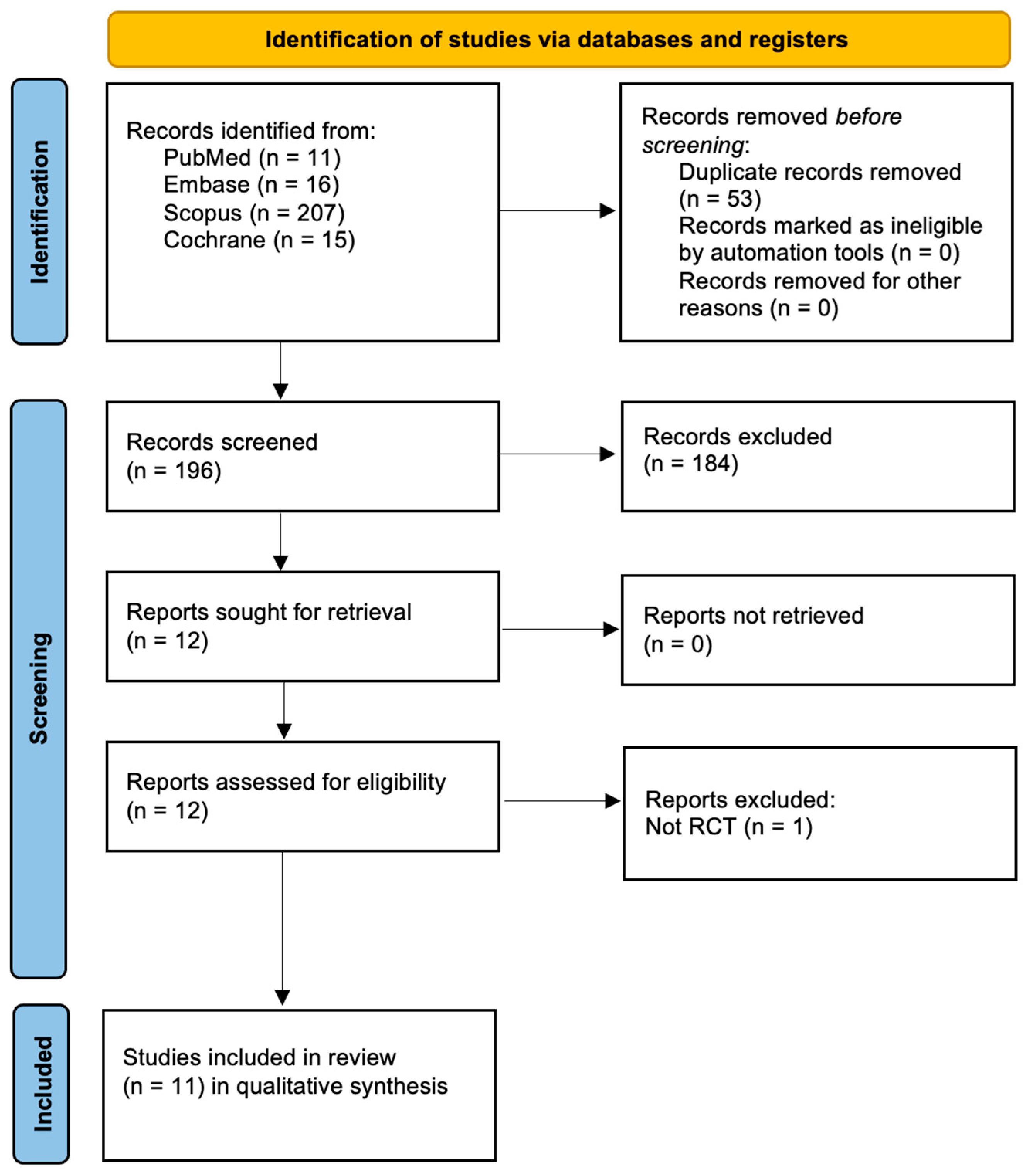

| Source | Search Syntax | Filters | N |
|---|---|---|---|
| PubMed | (photodynamic therapy[MeSH] OR photodynamic therapy[Title/Abstract] OR aPDT[Title/Abstract]) AND (natural photosensitizer*[Title/Abstract] OR plant derived photosensitizer*[Title/Abstract] OR curcumin[Title/Abstract] OR hypericin[Title/Abstract] OR quercetin[Title/Abstract] OR “gallic acid”[Title/Abstract] OR “aloe emodin”[Title/Abstract] OR chlorophyll[Title/Abstract] OR chlorophyllin[Title/Abstract] OR psoralen[Title/Abstract] OR psoralens[Title/Abstract] OR furanocoumarin*[Title/Abstract] OR polyacetylene*[Title/Abstract] OR thiophene*[Title/Abstract] OR anthraquinone*[Title/Abstract]) AND (dentistry[MeSH] OR dental[Title/Abstract] OR oral[Title/Abstract] OR odontolog*[Title/Abstract]) | RCT, 2015 to 2025 | 11 |
| Embase | (‘photodynamic therapy’/exp OR ‘photodynamic therapy’:ti,ab OR aPDT:ti,ab) AND (“natural photosensitizer*”:ti,ab OR “plant derived photosensitizer*”:ti,ab OR curcumin:ti,ab OR hypericin:ti,ab OR quercetin:ti,ab OR “gallic acid”:ti,ab OR “aloe emodin”:ti,ab OR chlorophyll:ti,ab OR chlorophyllin:ti,ab OR psoralen*:ti,ab OR furanocoumarin*:ti,ab OR polyacetylene*:ti,ab OR thiophene*:ti,ab OR anthraquinone*:ti,ab) AND (‘dentistry’/exp OR dental:ti,ab OR oral:ti,ab OR odontolog*:ti,ab) | RCT, 2015 to 2025 | 16 |
| Scopus | TITLE-ABS-KEY (“photodynamic therapy” OR aPDT) AND TITLE-ABS-KEY (“natural photosensitizer*” OR “plant derived photosensitizer*” OR curcumin OR hypericin OR quercetin OR “gallic acid” OR “aloe emodin” OR chlorophyll OR chlorophyllin OR psoralen* OR furanocoumarin* OR polyacetylene* OR thiophene* OR anthraquinone*) AND TITLE-ABS-KEY (dental OR oral OR dentistry OR odontolog*) | Article, 2015 to 2025 | 207* |
| Cochrane Library | ([mh “Photochemotherapy”] OR “photodynamic therapy”:ti,ab OR aPDT:ti,ab) AND (“natural photosensitizer*”:ti,ab OR “plant derived photosensitizer*”:ti,ab OR curcumin:ti,ab OR hypericin:ti,ab OR quercetin:ti,ab OR “gallic acid”:ti,ab OR “aloe emodin”:ti,ab OR chlorophyll:ti,ab OR chlorophyllin:ti,ab OR psoralen*:ti,ab OR furanocoumarin*:ti,ab OR polyacetylene*:ti,ab OR thiophene*:ti,ab OR anthraquinone*:ti,ab) AND ([mh Dentistry] OR dental:ti,ab OR oral:ti,ab OR odontolog*:ti,ab) | No additional filters | 15 |
| Study | 1 | 2 | 3 | 4 | 5 | 6 | 7 | 8 | 9 | Total | Risk |
|---|---|---|---|---|---|---|---|---|---|---|---|
| Afrasiabi et al. 2022 [18] | 1 | 1 | 1 | 1 | 1 | 0 | 1 | 1 | 1 | 8 | Low |
| AlSunbul et al. 2023 [19] | 1 | 1 | 1 | 1 | 1 | 1 | 1 | 1 | 1 | 9 | Low |
| de Cássia Dias Viana Andrade et al. 2022 [20] | 1 | 1 | 1 | 1 | 1 | 1 | 1 | 1 | 1 | 9 | Low |
| Donato et al. 2017 [21] | 1 | 1 | 1 | 1 | 1 | 0 | 1 | 1 | 0 | 7 | Low |
| Hashemikamangar et al. 2022 [22] | 1 | 1 | 1 | 1 | 1 | 1 | 1 | 1 | 1 | 9 | Low |
| Ivanaga et al. 2019 [23] | 1 | 1 | 1 | 1 | 1 | 1 | 1 | 1 | 1 | 9 | Low |
| Labban et al. 2021 [24] | 0 | 0 | 0 | 0 | 1 | 1 | 0 | 1 | 1 | 1 | Medium |
| Leite et al. 2014 [25] | 1 | 1 | 1 | 1 | 1 | 1 | 1 | 1 | 1 | 9 | Low |
| Panhóca et al. 2016a [26] | 1 | 1 | 1 | 1 | 1 | 1 | 1 | 1 | 1 | 9 | Low |
| Panhóca et al. 2016b [27] | 1 | 1 | 1 | 1 | 1 | 1 | 1 | 1 | 1 | 9 | Low |
| Paschoal et al. 2015 [28] | 1 | 1 | 1 | 1 | 1 | 1 | 1 | 1 | 1 | 9 | Low |
| Outcome | Number of Studies | Number of Patients/Samples | Study Design | Risk of Bias | Inconsistency | Indirectness | Imprecision | Publication Bias | Quality of Evidence | Importance |
|---|---|---|---|---|---|---|---|---|---|---|
| Microbial reduction (CFU/mL) | 5 | ~250 samples/patients | RCTs and in vitro experiments | Moderate (mix of in vitro and clinical) | Moderate (effect size varies widely) | Moderate (lab findings ≠ clinical environment) | Low | None detected | Moderate | Critical |
| Bond strength (SBS/µTBS/4P-BS) | 2 | 220 samples | In vitro RCTs | Low | Low | Moderate (lab outcomes; not clinical longevity) | Moderate (sample variability) | None detected | Moderate | Important |
| Probing depth (PD) | 1 | 25 patients | RCT | Low | Low | Low | Moderate (small N) | None detected | Moderate | Critical |
| Clinical attachment level (CAL) | 1 | 25 patients | RCT | Low | Low | Low | Moderate | None detected | Moderate | Critical |
| Gingival inflammation (BOP/GI/PI) | 2 | 70 patients | RCTs | Low | Low | Low | Moderate | None detected | Moderate | Important |
| Study | Geographical Location | Total Sample Size |
|---|---|---|
| Afrasiabi et al. 2022 [18] | Iran | 60 implants |
| AlSunbul et al. 2023 [19] | Saudi Arabia | 100 molars |
| de Cássia Dias Viana Andrade et al. 2022 [20] | Brazil | 30 patients |
| Donato et al. 2017 [21] | Brazil | 50 volunteers |
| Hashemikamangar et al. 2022 [22] | Iran | 120 tooth blocks |
| Ivanaga et al. 2019 [23] | Brazil | 25 patients |
| Labban et al. 2021 [24] | Saudi Arabia | 45 participants |
| Leite et al. 2014 [25] | Brazil | 27 adults |
| Panhóca et al. 2016a [26] | Brazil | 24 patients |
| Panhóca et al. 2016b [27] | Brazil | 18 participants |
| Paschoal et al. 2015 [28] | Brazil | 45 initial; 30 completed (final sample) |
| Study | Study Groups | Main Outcomes |
|---|---|---|
| Afrasiabi et al. 2022 [18] |
| All disinfection methods produced significant reductions in A. actinomycetemcomitans on dental implant surfaces compared with the control. The LED-based aPDT group showed the lowest CFU/mL, outperforming diode laser treatment. LED-mediated aPDT appears to be a more effective adjunct for implant surface disinfection. |
| AlSunbul et al. 2023 [19] |
| At baseline and after 12 months, MB-mediated aPDT produced the highest SBS and μTBS values, while CUR-mediated aPDT yielded the highest 4P-BS after long-term storage. MB-mediated aPDT showed the strongest antibacterial activity against S. mutans. aPDT, particularly MB-mediated, outperformed 2 percent chlorhexidine gel and 6% NaClO for cavity disinfection in IPC-treated permanent molars. |
| de Cássia Dias Viana Andrade et al. 2022 [20] |
| Both active treatments reduced Candida levels at 21 and 30 days, but not at 7 or 14 days. Mucositis worsened in the control group after day 14, while it improved in the aPDT group beginning at day 21. Both PBM and aPDT reduced mucositis and pain, with aPDT showing earlier clinical improvement and greater antifungal effectiveness. |
| Donato et al. 2017 [21] |
For each PS (CUR or Photogem):
| All treatments produced an immediate microbial reduction after PDI, regardless of the photosensitizer used. After 24 h, only natural CUR maintained the reduction, while Photogem showed a return to baseline CFU levels. Natural CUR demonstrated better sustained efficacy and appears to be a more viable photosensitizer, supporting PDI as a promising method for oral microbial reduction. |
| Hashemikamangar et al. 2022 [22] |
| aPDT did not significantly affect bonding strength in self-etch groups, but total-etch groups showed a significant reduction after aPDT. The phycocyanin self-etch group achieved the highest bond strength, and thermocycling did not significantly affect dentin bond strength except in the control total-etch group. aPDT with TBO or phycocyanin did not harm bonding to sound dentin using a universal adhesive in self-etch mode, with phycocyanin recommended as the preferred photosensitizer. |
| Ivanaga et al. 2019 [23] |
| Intergroup comparisons showed no differences among groups in PD, GR, CAL, BOP, or PI at baseline, 3 months, or 6 months. All groups showed significant reductions in PD and BOP over time, while CAL gain occurred only in the aPDT and LED groups at three months. SRP combined with CUR-mediated aPDT or LED irradiation provided short-term CAL improvement in treating residual pockets in patients with type 2 diabetes. |
| Labban et al. 2021 [24] |
| Groups I and II showed significant reductions in CFU counts after treatment and at 12 weeks, with clinical efficacy rates of 53 percent, 51 percent, and 49 percent for Groups I, II, and III. CUR- and RB-mediated PDT performed comparably to topical nystatin in treating denture stomatitis in smokers. |
| Leite et al. 2014 [25] |
| The PDT group showed significant CFU reductions immediately after treatment and at 1 h and 2 h compared with pretreatment, while the light group showed no change. The CUR only group showed a temporary increase in CFU at 1 h, returning to baseline by 2 h. PDT produced significantly greater microbial reduction than both light and CUR alone through 2 h, indicating that the blue LED–CUR protocol can reduce salivary microorganisms, though further protocol refinement is needed. |
| Panhóca et al. 2016a [26] |
| Significant log reductions were observed in the PDT, PDT + S, and chlorhexidine groups, with the greatest decreases in the PDT + S and chlorhexidine treatments. Survival rates were significantly lower in the PDT + S and chlorhexidine groups than in all other conditions, with no difference between these two groups. The findings suggest that adding surfactant enhances aPDT effectiveness, making it a useful adjunct for oral decontamination. |
| Panhóca et al. 2016b [27] |
| aPDT produced significant reductions in CFU counts, with Photogem plus light showing the greatest decrease. CUR alone, CUR plus light, and Photogem plus light all reduced S. mutans biofilm compared with the control, though differences among groups were small. Percentage reductions were 8% for CUR, 15 percent for CUR plus light, and 18% for Photogem plus light. |
| Paschoal et al. 2015 [28] |
| PI did not differ among groups at baseline or 1 month. At 3 months, Group III showed higher PI (1.52 ± 0.51) than Group I (0.91 ± 0.75) and Group II (1.03 ± 0.51), and all groups exhibited increased plaque compared with earlier periods (p ≤ 0.05). GBI decreased significantly at 1 month in Groups I and III. Photodynamic treatment with CUR did not reduce plaque accumulation. |
| Study | Light Type | Wavelength (nm) | Intensity (mW/cm2) | Irradiation Time (s) | Irradiated Area (cm2) | Fluence (J/cm2) |
|---|---|---|---|---|---|---|
| Afrasiabi et al. 2022 [18] | Blue DL | 450 | 500 | 60 | 0.5 | 60 |
| Blue LED | 430–460 | 1000 ± 100 | 60 | 0.5 | 60 | |
| Red DL | 635 | 500 | 60 | 0.5 | 60 | |
| Red LED | 630 ± 10 | 2000–4000 | 20 | 0.5 | 60 | |
| AlSunbul et al. 2023 [19] | LED curing light | 385–515 | 1200 | - | - | - |
| de Cássia Dias Viana Andrade et al. 2022 [20] | Blue LED | 450 | 67 | 600 | - | 20.1 |
| Red laser | 660 | 100 | 3 | 0.25 | 1.2 | |
| Donato et al. 2017 [21] | Blue LED | 450 | 100,000 | 360 | - | - |
| Red LED | 630 | 100,000 | 360 | - | - | |
| Hashemikamangar et al. 2022 [22] | Diode laser | 635 | 340 | 180 | - | - |
| Ivanaga et al. 2019 [23] | LED (InGaN) | 465–485 | 100 | 60 | 0.78 | 6 |
| Labban et al. 2021 [24] | Blue LED | 455 | 102 | - | - | - |
| Leite et al. 2014 [25] | Blue LED | 455 ± 30 | 600 | 300 | 0.6 | 200 |
| Panhóca et al. 2016a [26] | Extra-oral Blue LED | 450 ± 10 | 80 | - | - | 14 |
| Intra-oral Blue LED | 450 ± 10 | 472 | - | - | 85 | |
| Panhóca et al. 2016b [27] | Blue LED | 450 ± 5 | 764 | 60 | 0.25 | 45.84 |
| Red LED | 630 ± 5 | 381 | 120 | 0.25 | 45.72 | |
| Paschoal et al. 2015 [28] | Blue LED | 450 | 165 | 192 | 0.28 | 96 |
Disclaimer/Publisher’s Note: The statements, opinions and data contained in all publications are solely those of the individual author(s) and contributor(s) and not of MDPI and/or the editor(s). MDPI and/or the editor(s) disclaim responsibility for any injury to people or property resulting from any ideas, methods, instructions or products referred to in the content. |
© 2025 by the authors. Licensee MDPI, Basel, Switzerland. This article is an open access article distributed under the terms and conditions of the Creative Commons Attribution (CC BY) license (https://creativecommons.org/licenses/by/4.0/).
Share and Cite
Fiegler-Rudol, J.; Skaba, D.; Truchel, D.; Misiołek, M.; Wiench, R. Effectiveness of Natural Photosensitizers in Antimicrobial Photodynamic Therapy Within Dentistry: A Systematic Review of RCTs. J. Clin. Med. 2025, 14, 8894. https://doi.org/10.3390/jcm14248894
Fiegler-Rudol J, Skaba D, Truchel D, Misiołek M, Wiench R. Effectiveness of Natural Photosensitizers in Antimicrobial Photodynamic Therapy Within Dentistry: A Systematic Review of RCTs. Journal of Clinical Medicine. 2025; 14(24):8894. https://doi.org/10.3390/jcm14248894
Chicago/Turabian StyleFiegler-Rudol, Jakub, Dariusz Skaba, Damian Truchel, Maciej Misiołek, and Rafał Wiench. 2025. "Effectiveness of Natural Photosensitizers in Antimicrobial Photodynamic Therapy Within Dentistry: A Systematic Review of RCTs" Journal of Clinical Medicine 14, no. 24: 8894. https://doi.org/10.3390/jcm14248894
APA StyleFiegler-Rudol, J., Skaba, D., Truchel, D., Misiołek, M., & Wiench, R. (2025). Effectiveness of Natural Photosensitizers in Antimicrobial Photodynamic Therapy Within Dentistry: A Systematic Review of RCTs. Journal of Clinical Medicine, 14(24), 8894. https://doi.org/10.3390/jcm14248894

