Impact of Adjunctive Air-Polishing on Periodontal Status in Patients with Low Vitamin D3 Levels: A Retrospective Study

 ,
,  , ,
, ,  ,
,  , and
, and
Abstract
1. Introduction
- -
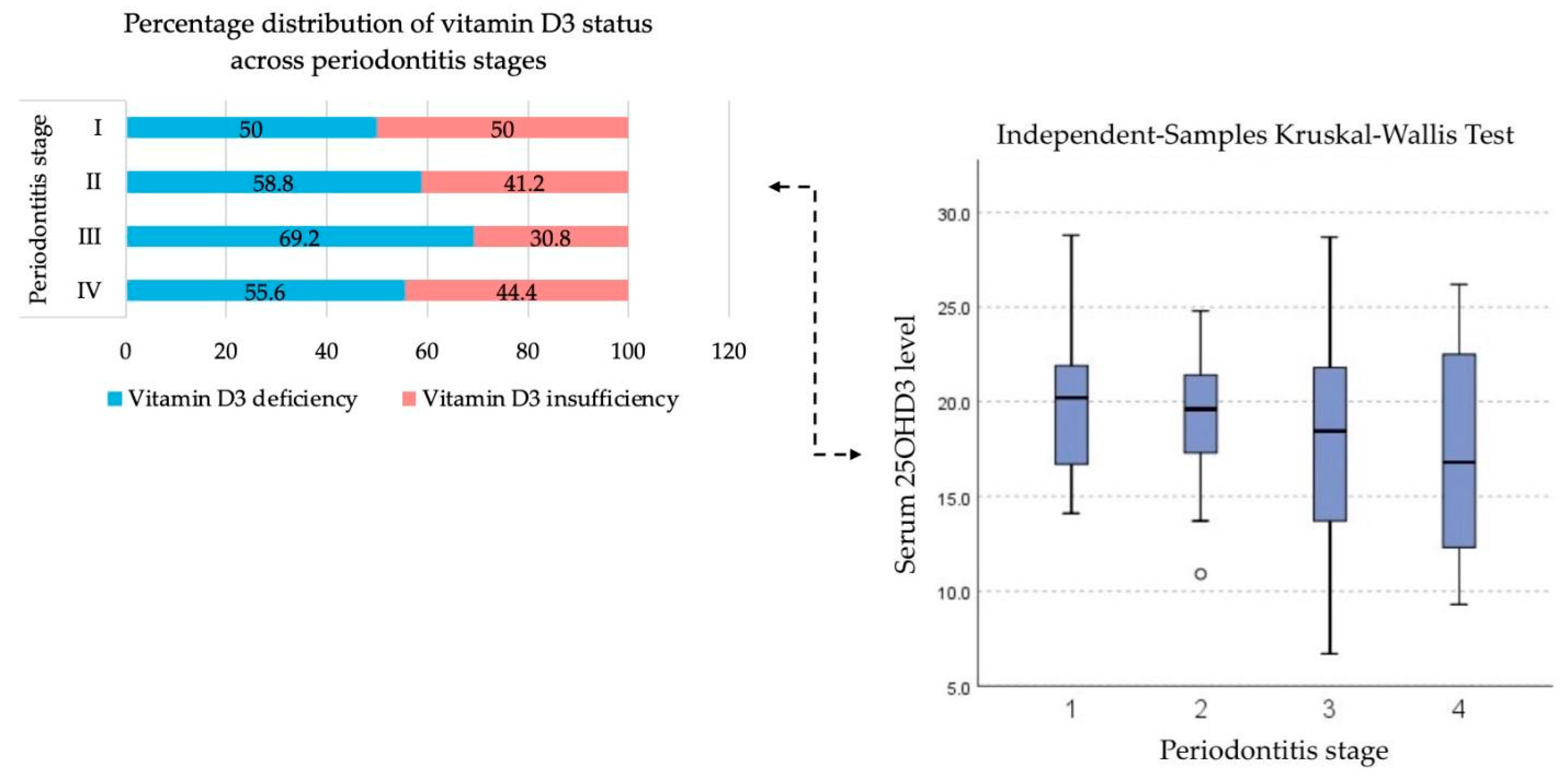
- There are no significant differences in the distribution of periodontitis stages, and no associations exist between baseline periodontal parameters and serum vitamin D3 levels;
- -
- There are no significant differences in clinical periodontal parameters (plaque index, probing pocket depth, bleeding on probing, and clinical attachment loss) between patients treated with subgingival air-polishing using glycine powder and those treated with erythritol powder.
2. Materials and Methods
2.1. Research Design and Criteria for Patient Selection
2.2. The Study Group
- -
- Low serum levels of vitamin D3;
- -
- Non-smokers;
- -
- Diagnosis of periodontitis (including stage of disease);
- -
- Ages between 18 years and 50 years;
- -
- A minimum of twenty teeth present for each patient.
- -
- Stage I: 1–2 mm interdental CAL (clinical attachment loss), with maximum probing depth of 4 mm, mostly horizontal bone loss and no teeth lost due to periodontitis;
- -
- Stage II: 3–4 mm interdental CAL, with maximum probing depth of 5 mm, mostly horizontal bone loss and no teeth missing due to periodontitis;
- -
- Stage III: ≥5 mm interdental CAL at the site of greatest loss, probing depth of at least 6 mm, a maximum of 4 periodontitis-related teeth lost; can associate vertical bone loss ≥3 mm and furcation involvement class II or III;
- -
- Stage IV: in addition to stage 3, this stage of periodontitis consists of ≥5 teeth lost due to periodontitis and a need for complex rehabilitation due to masticatory dysfunction, secondary occlusal trauma or bite collapse and drifting and flaring of the teeth.
- -
- Incomplete dataset;
- -
- Habit of smoking 3 years prior to examination, controlled substance abuse;
- -
- Ages older than 50 years;
- -
- Menopausal women;
- -
- Having fewer than 20 teeth or wearing fixed orthodontic appliances;
- -
- Taking antibiotics in the past 3 months;
- -
- Taking anti-inflammatory drugs in the past 4 weeks;
- -
- Patients with a history of vitamin D3 supplementation;
- -
- Receiving periodontal therapy within the past 6 months;
- -
- Failing to come to the 3-month follow-up.
- -
- Demographic variables, such as age and sex;
- -
- Baseline serum 25-hydroxyvitamin D3 levels;
- -
- Periodontal charting at baseline (T0) and three months post-treatment (T1), which included the plaque index (PI), periodontal probing depth (PPD), bleeding on probing (BOP) and clinical attachment loss (CAL);
- -
- Periodontitis stages;
- -
- Details of the administered periodontal therapy;
- -
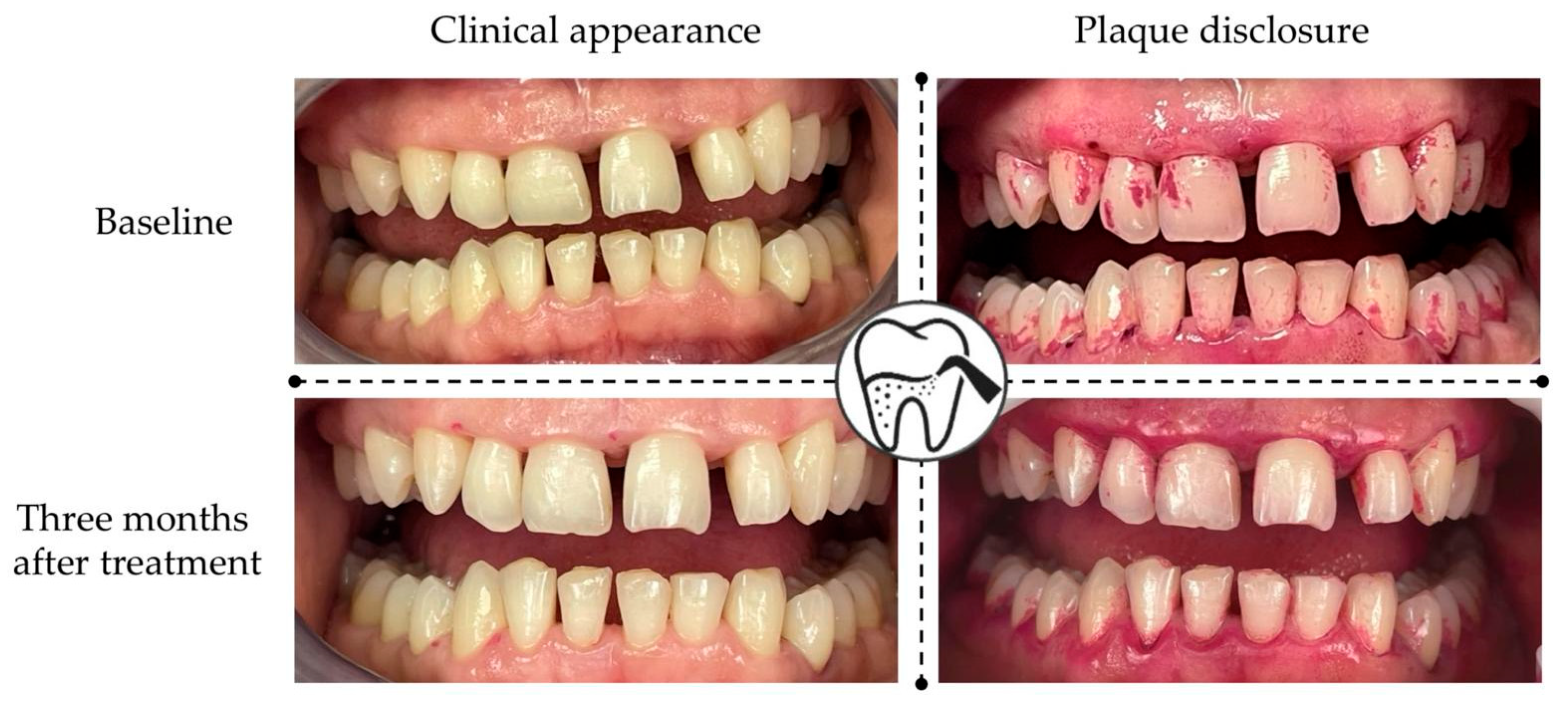
- Photographic documentation obtained before, during, and after treatment.
2.3. Clinical Evaluation and Non-Surgical Periodontal Treatment Protocol
2.4. Statistical Analysis
3. Results
3.1. Descriptive
3.2. Testing the First Hypothesis
3.3. Testing the Second Hypothesis
4. Discussion
4.1. Vitamin D3 Levels and Periodontal Status
4.2. Subgingival Air-Polishing
4.3. Study Limitations
5. Conclusions
Author Contributions
Funding
Institutional Review Board Statement
Informed Consent Statement
Data Availability Statement
Conflicts of Interest
Abbreviations
| BOP | Bleeding on probing |
| CAL | Clinical attachment loss |
| LAPP | Low-abrasive polishing powder |
| PI | Plaque index |
| PPD | Periodontal probing depth |
| SD | Standard deviation |
| SRP | Scaling and root planning |
References
- Hajishengallis, G.; Chavakis, T. Local and Systemic Mechanisms Linking Periodontal Disease and Inflammatory Comorbidities. Nat. Rev. Immunol. 2021, 21, 426–440. [Google Scholar] [CrossRef] [PubMed]
- Gheorghe, D.N.; Bennardo, F.; Silaghi, M.; Popescu, D.-M.; Maftei, G.-A.; Bătăiosu, M.; Surlin, P. Subgingival Use of Air-Polishing Powders: Status of Knowledge—A Systematic Review. J. Clin. Med. 2023, 12, 6936. [Google Scholar] [CrossRef] [PubMed]
- Jordan, R.A.; Bodechtel, C.; Hertrampf, K.; Hoffmann, T.; Kocher, T.; Nitschke, I.; Schiffner, U.; Stark, H.; Zimmer, S.; Micheelis, W.; et al. The Fifth German Oral Health Study (Fünfte Deutsche Mundgesundheitsstudie, DMS V)—Rationale, Design, and Methods. BMC Oral Health 2014, 14, 161. [Google Scholar] [CrossRef]
- Saglie, F.R.; Caranza, F.A.; Newman, M.G.; Cheng, L.; Lewin, K.J. Identification of Tissue-Invading Bacteria in Human Periodontal Diseases. J. Periodontal Res. 1982, 17, 452–455. [Google Scholar] [CrossRef]
- Surlari, Z.; Virvescu, D.I.; Baciu, E.-R.; Vasluianu, R.-I.; Budală, D.G. The Link between Periodontal Disease and Oral Cancer—A Certainty or a Never-Ending Dilemma? Appl. Sci. 2021, 11, 12100. [Google Scholar] [CrossRef]
- Lang, N.P.; Bartold, P.M. Periodontal Health. J. Periodontol. 2018, 89, S9–S16. [Google Scholar] [CrossRef]
- Ortiz-Prado, E.; Vasconez-Gonzalez, J.; Izquierdo-Condoy, J.S.; Suárez-Sangucho, I.A.; Prieto-Marín, J.G.; Villarreal-Burbano, K.B.; Barriga-Collantes, M.A.; Altamirano-Castillo, J.A.; Borja-Mendoza, D.A.; Pazmiño-Almeida, J.C.; et al. Cholecalciferol (Vitamin D3): Efficacy, Safety, and Implications in Public Health. Front. Nutr. 2025, 12, 1579957. [Google Scholar] [CrossRef]
- Borel, P.; Caillaud, D.; Cano, N.J. Vitamin D Bioavailability: State of the Art. Crit. Rev. Food Sci. Nutr. 2015, 55, 1193–1205. [Google Scholar] [CrossRef]
- Reid, I.R.; Bolland, M.J.; Grey, A. Effects of vitamin D supplements on bone mineral density: A systematic review and meta-Analysis. Lancet 2014, 383, 146–155. [Google Scholar] [CrossRef]
- Holick, F.M. Vitamin D Deficiency. N. Engl. J. Med. 2007, 357, 266–281. [Google Scholar] [CrossRef] [PubMed]
- Wong, C.L.; Givens, D.I.; Turpeinen, A.M.; Liu, X.; Guo, J. Is Vitamin D Fortification of Dairy Products Effective for Improving Vitamin D Status? A Systematic Review and Meta-Analysis of Randomised Controlled Trials. Nutrients 2025, 17, 3757. [Google Scholar] [CrossRef]
- Machado, V.; Lobo, S.; Proença, L.; Mendes, J.J.; Botelho, J. Vitamin D and Periodontitis: A Systematic Review and Meta-Analysis. Nutrients 2020, 12, 2177. [Google Scholar] [CrossRef] [PubMed]
- Anbarcioglu, E.; Kirtiloglu, T.; Öztürk, A.; Kolbakir, F.; Acıkgöz, G.; Colak, R. Vitamin D Deficiency in Patients with Aggressive Periodontitis. Oral Dis. 2018, 25, 242–249. [Google Scholar] [CrossRef] [PubMed]
- Agrawal, A.A.; Kolte, A.P.; Kolte, R.A.; Chari, S.; Gupta, M.; Pakhmode, R. Evaluation and Comparison of Serum Vitamin D and Calcium Levels in Periodontally Healthy, Chronic Gingivitis, and Chronic Periodontitis Patients with and without Diabetes Mellitus—A Cross-Sectional Study. Acta Odontol. Scand. 2019, 77, 592–599. [Google Scholar] [CrossRef] [PubMed]
- Li, W.; Zheng, Q.; Xu, M.; Zeng, C.; Deng, X. Association between Circulating 25-Hydroxyvitamin D Metabolites and Periodontitis: Results from the NHANES 2009–2012 and Mendelian Randomization Study. J. Clin. Periodontol. 2023, 50, 252–264. [Google Scholar] [CrossRef]
- Isola, G.; Alibrandi, A.; Rapisarda, E.; Matarese, G.; Williams, R.C.; Leonardi, R. Association of Vitamin D in Patients with Periodontitis: A Cross-Sectional Study. J. Periodontol. 2019, 90, 1110–1118. [Google Scholar] [CrossRef]
- Ketharanathan, V.; Torgersen, G.R.; Petrovski, B.É.; Preus, H.R. Radiographic Alveolar Bone Level and Levels of Serum 25-OH-Vitamin D3 in Ethnic Norwegian and Tamil Periodontitis Patients and Their Periodontally Healthy Controls. BMC Oral Health 2019, 19, 83. [Google Scholar] [CrossRef]
- Hu, Z.; Zhou, F.; Xu, H. Circulating vitamin C and D concentrations and risk of dental caries and periodontitis: A Mendelian randomization study. J. Clin. Periodontol. 2022, 49, 35–344. [Google Scholar] [CrossRef]
- Caviezel, B.; Szczypior, L.; Sourla, E.; Baston, T.; Kuzmitski, A.; Peschke, K.; Fetian, I.R.; Villiger, L. Optimizing Vitamin D Levels: Bridging the Gap Between Theory and Practice for Optimal Health in Switzerland. Heal. TIMES Schweiz. Ärztejournal J. 2024, 15, 8–13. [Google Scholar]
- Meghil, M.M.; Cutler, C.W. Influence of Vitamin D on Periodontal Inflammation: A Review. Pathogens 2023, 12, 1180. [Google Scholar] [CrossRef]
- Pinto, J.P.N.S.; Goergen, J.; Muniz, F.W.M.G.; Haas, A.N. Vitamin D Levels and Risk for Periodontal Disease: A Systematic Review. J. Periodontal Res. 2018, 53, 298–305. [Google Scholar] [CrossRef]
- Hu, X.; Niu, L.; Ma, C.; Huang, Y.; Yang, X.; Shi, Y.; Pan, C.; Liu, J.; Wang, H.; Li, Q.; et al. Calcitriol Decreases Live Porphyromonas gingivalis Internalized into Epithelial Cells and Monocytes by Promoting Autophagy. J. Periodontol. 2019, 91, 956–966. [Google Scholar] [CrossRef]
- Nascimento, G.G.; Leite, F.R.M.; Pennisi, P.R.C.; López, R.; Paranhos, L.R. Use of air polishing for supra- and subgingival biofilm removal for treatment of residual periodontal pockets and supportive periodontal care: A systematic review. Clin. Oral Investig. 2021, 25, 779–795. [Google Scholar] [CrossRef]
- Kröger, J.C.; Haribyan, M.; Nergiz, I.; Schmage, P. Air Polishing with Erythritol Powder: In Vitro Effects on Dentin Loss. J. Indian Soc. Periodontol. 2020, 24, 433–440. [Google Scholar] [CrossRef]
- Park, E.J.; Kwon, E.Y.; Kim, H.J.; Lee, J.Y.; Choi, J.; Joo, J.Y. Clinical and microbiological effects of the supplementary use of an erythritol powder air-polishing device in non-surgical periodontal therapy: A randomized clinical trial. J. Periodontal Implant Sci. 2018, 48, 295–304. [Google Scholar] [CrossRef] [PubMed]
- Weusmann, J.; Deschner, J.; Imber, J.C.; Damanaki, A.; Leguizamón, N.D.P.; Nogueira, A.V.B. Cellular effects of glycine and trehalose air-polishing powders on human gingival fibroblasts in vitro. Clin. Oral Investig. 2022, 26, 1569–1578. [Google Scholar] [CrossRef] [PubMed]
- Flemmig, T.F.; Arushanov, D.; Daubert, D.; Rothen, M.; Mueller, G.; Leroux, B.; Könönen, E. Randomized Controlled Trial Assessing Efficacy and Safety of Glycine Powder Air Polishing versus Ultrasonic Scaling in Patients with Moderate-to-Advanced Periodontitis. J. Clin. Periodontol. 2015, 42, 845–852. [Google Scholar]
- Yuan, Z.; Tang, Y.; Zhou, Y.; Li, W.; Chen, J.; Zhou, M. Clinical Effects of Erythritol, Glycine, and Trehalose as Subgingival Air-Polishing Powders on Non-Surgical Periodontal Treatment: A Systematic Review and Meta-Analysis of Randomized Controlled Trials. Front. Physiol. 2025, 16, 1593204. [Google Scholar]
- Tonetti, M.S.; Greenwell, H.; Kornman, K.S. Staging and Grading of Periodontitis: Framework and Proposal of a New Classification and Case Definition. J. Periodontol. 2018, 89, S159–S172. [Google Scholar] [CrossRef]
- Abreu, O.J.; Tatakis, D.N.; Elias-Boneta, A.R.; Del Valle, L.L.; Hernandez, R.; Pousa, M.S.; Palacios, C. Low vitamin D status strongly associated with periodontitis in Puerto Rican adults. BMC Oral Health 2016, 16, 89. [Google Scholar] [CrossRef]
- Laky, M.; Bertl, K.; Haririan, H.; Andrukhov, O.; Seemann, R.; Volf, I.; Assinger, A.; Gruber, R.; Moritz, A.; Rausch-Fan, X. Serum levels of 25-hydroxyvitamin D are associated with periodontal disease. Clin. Oral Investig. 2017, 21, 1553–1558. [Google Scholar] [CrossRef] [PubMed]
- Olszewska-Czyz, I.; Firkova, E. Vitamin D3 Serum Levels in Periodontitis Patients: A Case–Control Study. Medicina 2022, 58, 585. [Google Scholar] [CrossRef] [PubMed]
- Saleh, W.; Ata, F.; Nosser, N.A.; Mowafey, B. Correlation of Serum Vitamin D and IL-8 to Stages of Periodontitis: A Case-Control Analysis. Clin. Oral Investig. 2024, 28, 645. [Google Scholar] [CrossRef]
- Lindholm, F.M.; Jönsson, B.; Brustad, M. Cross-Sectional Associations between Vitamin D Status and Periodontitis in Adults in Northern Norway: The Tromsø Study 2015–2016. BMC Oral Health 2025, 25, 856. [Google Scholar] [CrossRef]
- Bonnet, C.; Rabbani, R.; Moffatt, M.E.K.; Kelekis-Cholakis, A.; Schroth, R.J. The Relation between Periodontal Disease and Vitamin D. J. Can. Dent. Assoc. 2019, 84, j4. [Google Scholar]
- Dragonas, P.; El-Sioufi, I.; Bobetsis, Y.A.; Madianos, P.N. Association of Vitamin D with Periodontal Disease: A Narrative Review. Oral Health Prev. Dent. 2020, 18, 103–114. [Google Scholar]
- Vinel, A.A.H.; Roumi, S.; Le Neindre, H.; Millavet, P.; Simon, M.; Cuny, C.; Barthet, J.-S.; Barthet, P.; Laurencin-Dalicieux, S. Non-Surgical Periodontal Treatment: SRP and Innovative Therapeutic Approaches. Adv. Exp. Med. Biol. 2022, 1373, 303–327. [Google Scholar] [PubMed]
- Zhang, W.; Wang, W.; Chu, C.; Jing, J.; Yao, N.; Sun, Q.; Li, S. Clinical, Inflammatory, and Microbiological Outcomes of Full-Mouth Scaling with Adjunctive Glycine Powder Air-Polishing: A Randomized Trial. J. Clin. Periodontol. 2021, 48, 389–399. [Google Scholar] [CrossRef]
- Divnic-Resnik, T.; Pradhan, H.; Spahr, A. The Efficacy of the Adjunct Use of Subgingival Air-Polishing Therapy with Erythritol Powder Compared to Conventional Debridement Alone during Initial Non-Surgical Periodontal Therapy. J. Clin. Periodontol. 2022, 49, 547–555. [Google Scholar] [CrossRef]
- Tsang, Y.C.; Corbet, E.F.; Jin, L.J. Subgingival Glycine Powder Air-Polishing as an Additional Approach to Nonsurgical Periodontal Therapy in Subjects with Untreated Chronic Periodontitis. J. Periodontal Res. 2018, 53, 440–445. [Google Scholar] [CrossRef]
- Seidel, M.; Borenius, H.; Schorr, S.; Christofzik, D.; Graetz, C. Results of an experimental study of subgingival cleaning effectiveness in the furcation area. BMC Oral Health 2021, 21, 381. [Google Scholar] [CrossRef] [PubMed]
- Bassetti, M.; Bassetti, R.; Sculean, A.; Salvi, G.E. Subcutaneous Emphysema following Non-Surgical Peri-Implantitis Therapy Using an Air Abrasive Device: A Case Report. Swiss Dent. J. 2014, 124, 807–817. [Google Scholar] [CrossRef] [PubMed]
- Alonso, V.; García-Caballero, L.; Couto, I.; Diniz, M.; Diz, P.; Limeres, J. Subcutaneous emphysema related to air-powder tooth polishing: A report of three cases. Aust. Dent. J. 2017, 62, 510–515. [Google Scholar] [CrossRef] [PubMed]



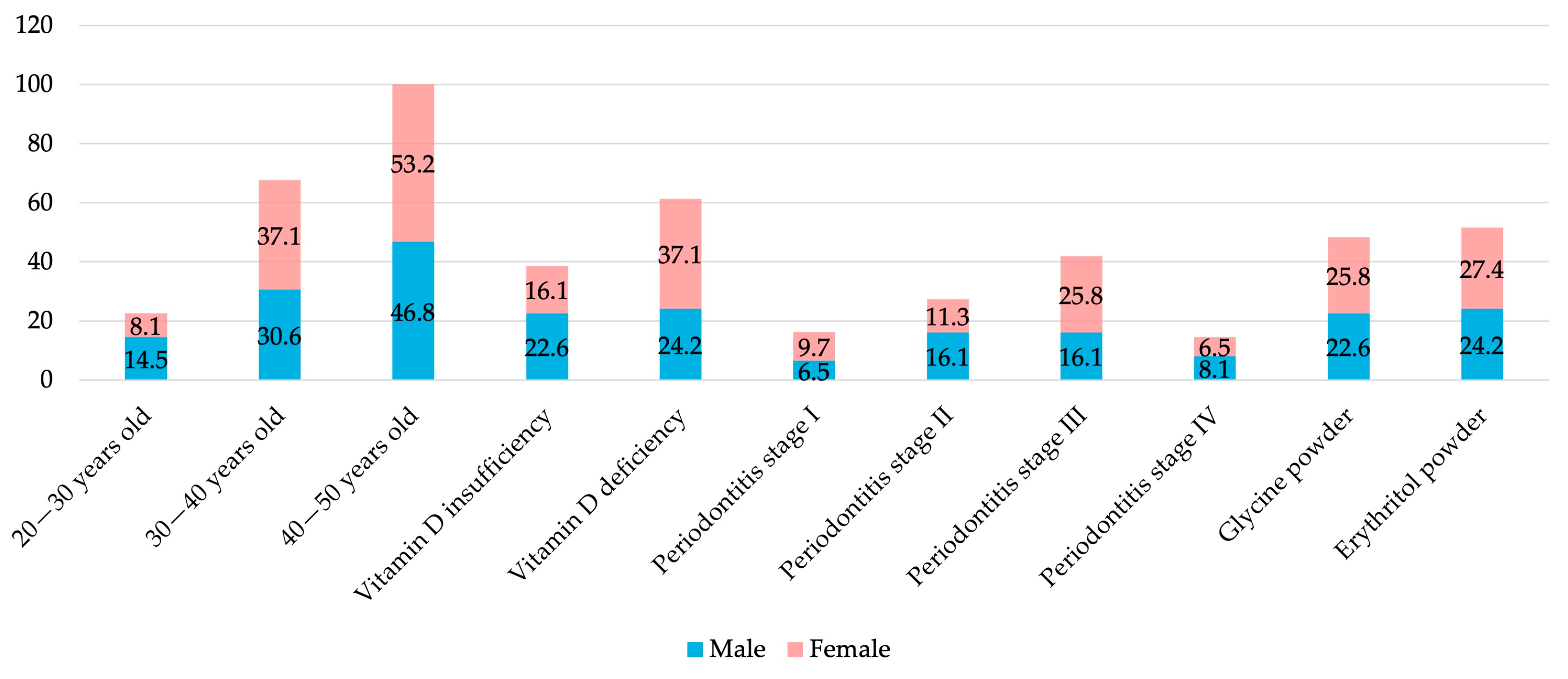
| Variable | Patient Characteristics | Count (N) | Percentage (%) |
| Gender | (Mean ± SD) | ||
| Male | 29 | 46.8 | |
| Female | 33 | 53.2 | |
| Age | |||
| 20–30 years old | 6 | 9.7 | |
| 31–40 years old | 14 | 22.6 | |
| 41–50 years old | 42 | 67.7 | |
| Mean ± SD (Minimum–Maximum) | 42.60 ± 7.09 (22–50) | ||
| Low serum 25OHD3 level (ng/mL) | |||
| Vitamin D3 insufficiency | 24 | 38.7 | |
| Vitamin D3 deficiency | 38 | 61.3 | |
| Mean ± SD (Minimum–Maximum) | 18.56 ± 5.15 (6.7–28.8) | ||
| Periodontitis | |||
| Stage I | 10 | 16.1 | |
| Stage II | 17 | 27.4 | |
| Stage III | 26 | 41.9 | |
| Stage IV | 9 | 14.5 | |
| Subgingival air-polishing | |||
| Glycine powder | 30 | 48.4 | |
| Erythritol powder | 32 | 51.6 | |
| Clinical Parameters | Periodontitis Stage (Mean ± SD) | Related-Samples Wilcoxon Signed-Rank Test | ||||
|---|---|---|---|---|---|---|
| I (N = 10) | II (N = 17) | III (N = 26) | IV (N = 9) | |||
| PI (%) | Baseline | 95.80 ± 8.12 | 88.82 ± 26.02 | 94.08 ± 13.15 | 85.67 ± 14.41 | Z = −6.853; r = 0.87 p < 0.001 * |
| 3 months | 23.10 ± 32.73 | 26.76 ± 22.88 | 27.15 ± 21.46 | 54.22 ± 14.77 | ||
| PPD (mm) | Baseline | 3.60 ± 0.58 | 4.10 ± 0.86 | 4.80 ± 0.97 | 3.98 ± 0.84 | Z = −6.792; r = 0.86 p < 0.001 * |
| 3 months | 2.09 ± 0.32 | 2.42 ± 0.43 | 2.71 ± 0.52 | 3.01 ± 0.52 | ||
| BOP (%) | Baseline | 95 ± 8.99 | 86.24 ± 21.30 | 89.73 ± 19.03 | 74.22 ± 24.05 | Z = −6.855; r = 0.87 p < 0.001 * |
| 3 months | 22.10 ± 24.37 | 17.47 ± 15.95 | 26.15 ± 13.89 | 25.78 ± 14.61 | ||
| CAL (mm) | Baseline | 1.50 ± 0.63 | 2.85 ± 0.84 | 4.33 ± 1.76 | 2.98 ± 0.64 | Z = −6.682; r = 0.85 p < 0.001 * |
| 3 months | 0.78 ± 0.43 | 1.77 ± 0.68 | 2.78 ± 1.20 | 2.15 ± 0.72 | ||
| Clinical Parameter | Periodontitis Stage (Mean ± Standard Deviation) | Kruskal–Wallis Test | |||
|---|---|---|---|---|---|
| I (N = 10) | II (N = 17) | III (N = 26) | IV (N = 9) | ||
| Serum 25OHD3 level ng/mL | 20.19 ± 4.413 | 19.482 ± 3.814 | 17.681 ± 5.869 | 17.578 ± 5.94 | p = 0.539 |
| Baseline Clinical Parameters | Vitamin D3 Insufficiency N = 24 | Vitamin D3 Deficiency N = 38 | Mann–Whitney Test | ||
|---|---|---|---|---|---|
| Mean ± SD | Min–Max | Mean ± SD | Min–Max | ||
| PI (%) | 90 ± 22.39 | 5–100 | 92.76 ± 13.30 | 54–100 | U = 451.500, Z = −0.080, r = 0.010 p = 0.936 |
| PPD (mm) | 4.29 ± 1.04 | 3–6.25 | 4.30 ± 0.94 | 2.33–6.42 | U = 483.000, Z = 0.390, r = 0.050 p = 0.696 |
| BOP (%) | 86.50 ± 20.66 | 33–100 | 87.92 ± 19.82 | 33–100 | U = 477.500, Z = 0.354, r = 0.045 p = 0.723 |
| CAL (mm) | 3.01 ± 1.49 | 0.67–5.92 | 3.44 ± 1.69 | 0.42–6.92 | U = 477.500, Z = 0.745, r = 0.095 p = 0.723 |
| Clinical Parameters | Subgingival Air-Polishing | |||||
|---|---|---|---|---|---|---|
| Glycine Powder (N = 30) | Erythritol Powder (N = 32) | |||||
| Baseline (T0) Mean ± SD | At 3 Months (T1) Mean ± SD | ΔT = T0 − T1 Mean ± SD | Baseline (T0) Mean ± SD | At 3 Months (T1) Mean ± SD | ΔT = T0 − T1 Mean ± SD | |
| PI (%) | 94.28 ± 11.32 | 29.50 ± 24.16 | 64.78 ± 28.55 | 88.93 ± 21.79 | 31.20 ± 25.78 | 57.73 ± 31.65 |
| Δ PI (%) | Mann–Whitney test, U = 539.000, Z = 0.834, r = 0.106, p = 0.404 | |||||
| PPD (mm) | 4.17 ± 0.94 | 2.49 ± 0.53 | 1.67 ± 0.96 | 4.43 ± 1.0 | 2.66 ± 0.54 | 1.76 ± 1.01 |
| Δ PPD (mm) | Mann–Whitney test, U = 446.000, Z = −0.479, r = 0.061, p = 0.632 | |||||
| BOP (%) | 87.28 ± 18.41 | 22.97 ± 17.80 | 64.31 ± 24.17 | 87.47 ± 21.54 | 23.17 ± 15.52 | 64.30 ± 23.96 |
| Δ BOP (%) | Mann–Whitney test, U = 472.000, Z = −0.113, r = 0.014, p = 0.910 | |||||
| CAL (mm) | 3.37 ± 1.72 | 2.09 ± 1.27 | 1.27 ± 0.78 | 3.17 ± 1.52 | 2.09 ± 1.02 | 1.07 ± 0.68 |
| Δ CAL (mm) | Mann–Whitney test, U = 551.500, Z = 1.008, r = 0.128, p = 0.313 | |||||
Disclaimer/Publisher’s Note: The statements, opinions and data contained in all publications are solely those of the individual author(s) and contributor(s) and not of MDPI and/or the editor(s). MDPI and/or the editor(s) disclaim responsibility for any injury to people or property resulting from any ideas, methods, instructions or products referred to in the content. |
© 2025 by the authors. Licensee MDPI, Basel, Switzerland. This article is an open access article distributed under the terms and conditions of the Creative Commons Attribution (CC BY) license (https://creativecommons.org/licenses/by/4.0/).
Share and Cite
Teodorescu, A.C.; Baciu, E.-R.; Murariu, A.; Luchian, I.; Șufaru, I.G.; Păsărin, L.; Vasiliu, B.C.; Rotundu, G.; Solomon, S.M. Impact of Adjunctive Air-Polishing on Periodontal Status in Patients with Low Vitamin D3 Levels: A Retrospective Study. J. Clin. Med. 2025, 14, 8775. https://doi.org/10.3390/jcm14248775
Teodorescu AC, Baciu E-R, Murariu A, Luchian I, Șufaru IG, Păsărin L, Vasiliu BC, Rotundu G, Solomon SM. Impact of Adjunctive Air-Polishing on Periodontal Status in Patients with Low Vitamin D3 Levels: A Retrospective Study. Journal of Clinical Medicine. 2025; 14(24):8775. https://doi.org/10.3390/jcm14248775
Chicago/Turabian StyleTeodorescu, Alexandra Cornelia, Elena-Raluca Baciu, Alice Murariu, Ionuț Luchian, Irina Georgeta Șufaru, Liliana Păsărin, Bogdan Constantin Vasiliu, Gabriel Rotundu, and Sorina Mihaela Solomon. 2025. "Impact of Adjunctive Air-Polishing on Periodontal Status in Patients with Low Vitamin D3 Levels: A Retrospective Study" Journal of Clinical Medicine 14, no. 24: 8775. https://doi.org/10.3390/jcm14248775
APA StyleTeodorescu, A. C., Baciu, E.-R., Murariu, A., Luchian, I., Șufaru, I. G., Păsărin, L., Vasiliu, B. C., Rotundu, G., & Solomon, S. M. (2025). Impact of Adjunctive Air-Polishing on Periodontal Status in Patients with Low Vitamin D3 Levels: A Retrospective Study. Journal of Clinical Medicine, 14(24), 8775. https://doi.org/10.3390/jcm14248775