


Prevalence of Steatotic Liver Disease Based on a New Nomenclature in the Japanese Population: A Health Checkup-Based Cross-Sectional Study
 , and
, and
Abstract
1. Introduction
2. Materials and Methods
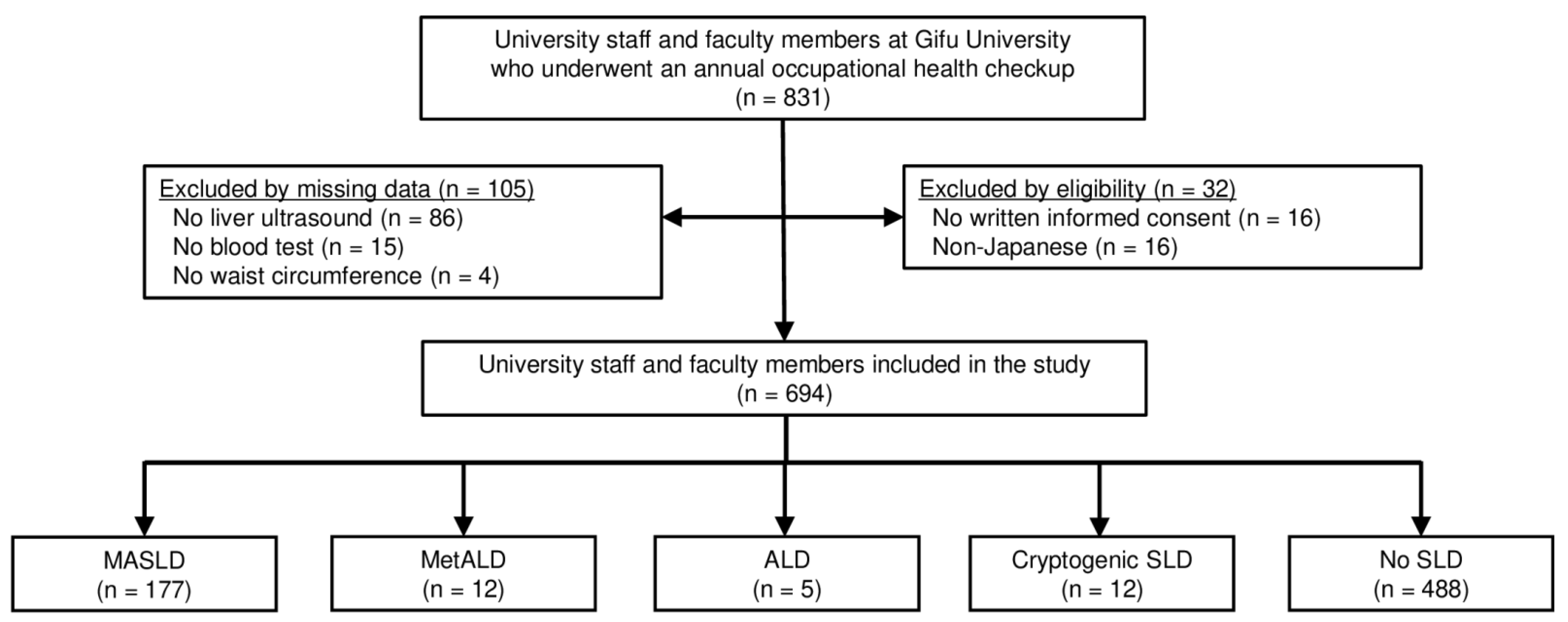
2.1. Study Design and Participants
2.2. Clinical and Biochemical Evaluations
2.3. Assessment of SLD Based on the New Nomenclature
2.4. Statistical Analyses
3. Results
3.1. Characteristics of Participants
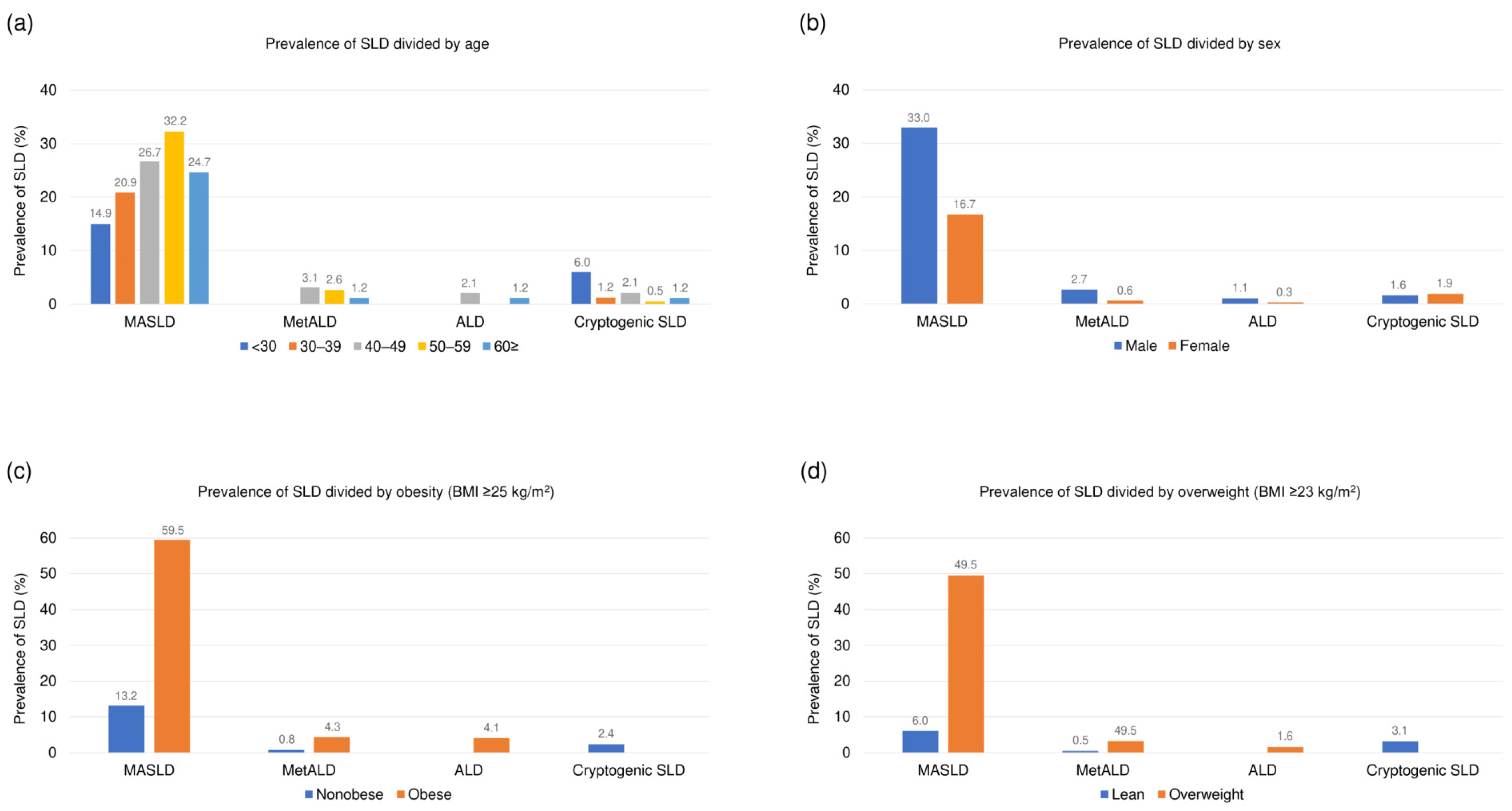
3.2. Prevalence and Characteristics of SLD in the Total Population
3.3. Prevalence and Characteristics of SLD in the Non-Obese (<25 kg/m2) Population
3.4. Prevalence and Characteristics of SLD in the Lean (<23 kg/m2) Population
4. Discussion
5. Conclusions
Author Contributions
Funding
Institutional Review Board Statement
Informed Consent Statement
Data Availability Statement
Acknowledgments
Conflicts of Interest
References
- European Association for the Study of the Liver (EASL); European Association for the Study of Diabetes (EASD); European Association for the Study of Obesity (EASO). EASL-EASD-EASO clinical practice guidelines for the management of non-alcoholic fatty liver disease. J. Hepatol. 2016, 64, 1388–1402. [Google Scholar] [CrossRef] [Scilit] [PubMed]
- Tokushige, K.; Ikejima, K.; Ono, M.; Eguchi, Y.; Kamada, Y.; Itoh, Y.; Akuta, N.; Yoneda, M.; Iwasa, M.; Yoneda, M.; et al. Evidence-based clinical practice guidelines for nonalcoholic fatty liver disease/nonalcoholic steatohepatitis 2020. J. Gastroenterol. 2021, 56, 951–963. [Google Scholar] [CrossRef] [Scilit] [PubMed]
- Rinella, M.E.; Lazarus, J.V.; Ratziu, V.; Francque, S.M.; Sanyal, A.J.; Kanwal, F.; Romero, D.; Abdelmalek, M.F.; Anstee, Q.M.; Arab, J.P.; et al. A multi-society Delphi consensus statement on new fatty liver disease nomenclature. J. Hepatol. 2023, 79, 1542–1556. [Google Scholar] [CrossRef] [PubMed]
- Examination Committee of Criteria for ‘Obesity Disease’ in Japan, Japan Society for the Study of Obesity. New criteria for ‘obesity disease’ in Japan. Circ. J. 2002, 66, 987–992. [Google Scholar] [CrossRef] [Scilit] [PubMed]
- Sterling, R.K.; Lissen, E.; Clumeck, N.; Sola, R.; Correa, M.C.; Montaner, J.; Sulkowski, M.S.; Torriani, F.J.; Dieterich, D.T.; Thomas, D.L.; et al. Development of a simple noninvasive index to predict significant fibrosis in patients with HIV/HCV coinfection. Hepatology 2006, 43, 1317–1325. [Google Scholar] [CrossRef] [Scilit] [PubMed]
- Saadeh, S.; Younossi, Z.M.; Remer, E.M.; Gramlich, T.; Ong, J.P.; Hurley, M.; Mullen, K.D.; Cooper, J.N.; Sheridan, M.J. The utility of radiological imaging in nonalcoholic fatty liver disease. Gastroenterology 2002, 123, 745–750. [Google Scholar] [CrossRef] [Scilit] [PubMed]
- Hamaguchi, M.; Kojima, T.; Itoh, Y.; Harano, Y.; Fujii, K.; Nakajima, T.; Kato, T.; Takeda, N.; Okuda, J.; Ida, K.; et al. The severity of ultrasonographic findings in nonalcoholic fatty liver disease reflects the metabolic syndrome and visceral fat accumulation. Am. J. Gastroenterol. 2007, 102, 2708–2715. [Google Scholar] [CrossRef] [Scilit] [PubMed]
- Lee, B.P.; Dodge, J.L.; Terrault, N.A. National prevalence estimates for steatotic liver disease and sub-classifications using consensus nomenclature. Hepatology 2023. [Google Scholar] [CrossRef] [Scilit] [PubMed]
- Ciardullo, S.; Carbone, M.; Invernizzi, P.; Perseghin, G. Exploring the landscape of steatotic liver disease in the general US population. Liver Int. 2023, 43, 2425–2433. [Google Scholar] [CrossRef] [Scilit] [PubMed]
- Moon, J.H.; Jeong, S.; Jang, H.; Koo, B.K.; Kim, W. Metabolic dysfunction-associated steatotic liver disease increases the risk of incident cardiovascular disease: A nationwide cohort study. EClinicalMedicine 2023, 65, 102292. [Google Scholar] [CrossRef] [Scilit] [PubMed]
- Lee, H.H.; Lee, H.A.; Kim, E.J.; Kim, H.Y.; Kim, H.C.; Ahn, S.H.; Lee, H.; Kim, S.U. Metabolic dysfunction-associated steatotic liver disease and risk of cardiovascular disease. Gut 2023. [Google Scholar] [CrossRef] [Scilit] [PubMed]
- Sano, T.; Amano, K.; Ide, T.; Isoda, H.; Honma, Y.; Morita, Y.; Yano, Y.; Nakamura, H.; Itano, S.; Miyajima, I.; et al. Metabolic management after sustained virologic response in elderly patients with hepatitis C virus: A multicenter study. Hepatol. Res. 2023. [Google Scholar] [CrossRef] [Scilit] [PubMed]
- Kobayashi, N.; Tada, T.; Nishimura, T.; Matono, T.; Yuri, Y.; Takashima, T.; Aizawa, N.; Ikeda, N.; Fukunishi, S.; Hashimoto, M.; et al. MASLD may inappropriately exclude lean female NAFLD patients with significant liver fibrosis. Hepatol. Res. 2023. [Google Scholar] [CrossRef] [Scilit]
- Magherman, L.; Van Parys, R.; Pauwels, N.S.; Verhelst, X.; Devisscher, L.; Van Vlierberghe, H.; Geerts, A.; Lefere, S. Meta-analysis: The impact of light-to-moderate alcohol consumption on progressive non-alcoholic fatty liver disease. Aliment. Pharmacol. Ther. 2023, 57, 820–836. [Google Scholar] [CrossRef] [Scilit] [PubMed]
- Sugiyama, A.; Kurisu, A.; Bunthen, E.; Ouoba, S.; Ko, K.; Rakhimov, A.; Akita, T.; Harakawa, T.; Sako, T.; Koshiyama, M.; et al. Distribution of FIB-4 index in the general population: Analysis of 75,666 residents who underwent health checkups. BMC Gastroenterol. 2022, 22, 241. [Google Scholar] [CrossRef] [Scilit] [PubMed]
- Shi, Y.; Wang, Q.; Sun, Y.; Zhao, X.; Kong, Y.; Ou, X.; Jia, J.; Wu, S.; You, H. The prevalence of lean/nonobese nonalcoholic fatty liver disease: A systematic review and meta-analysis. J. Clin. Gastroenterol. 2020, 54, 378–387. [Google Scholar] [CrossRef] [Scilit] [PubMed]
- Tamaki, N.; Imajo, K.; Sharpton, S.; Jung, J.; Kawamura, N.; Yoneda, M.; Valasek, M.A.; Behling, C.; Sirlin, C.B.; Nakajima, A.; et al. Magnetic resonance elastography plus Fibrosis-4 versus FibroScan-aspartate aminotransferase in detection of candidates for pharmacological treatment of NASH-related fibrosis. Hepatology 2022, 75, 661–672. [Google Scholar] [CrossRef] [Scilit] [PubMed]

| Characteristics | Total Participants | MASLD | MetALD | ALD | Cryptogenic SLD | No SLD | p-Value |
|---|---|---|---|---|---|---|---|
| (n = 694) | (n = 177) | (n = 12) | (n = 5) | (n = 12) | (n = 488) | ||
| Demographics | |||||||
| Age (years) | 47 (36–54) | 49 (40–54) | 50 (44–57) | 48 (46–56) | 41 (28–47) | 45 (35–54) | 0.016 |
| Male sex | 376 (54) | 124 (70) | 10 (83) | 4 (80) | 6 (50) | 232 (48) | <0.001 |
| Alcohol intake, n (%) | <0.001 | ||||||
| Mild | 275 (40) | 82 (46) | 0 (0) | 0 (0) | 4 (33) | 193 (39) | |
| Moderate | 52 (7) | 0 (0) | 12 (100) | 0 (0) | 1 (8) | 40 (8) | |
| Excessive | 13 (2) | 0 (0) | 0 (0) | 5 (100) | 0 (0) | 8 (2) | |
| Physical examination | |||||||
| Waist circumference (cm) | 78 (71–85) | 88 (82–96) | 90 (82–94) | 98 (86–111) | 75 (67–80) * | 75 (68–81) * | <0.001 |
| BMI (kg/m2) | 23 (20–25) | 26 (24–30) | 26 (24–27) | 26 (24–27) | 21 (19–22) * | 21 (19–23) * | <0.001 |
| Cardiometabolic criteria | |||||||
| Overweight, n (%) | 330 (48) | 158 (89) | 10 (83) | 5 (100) | 0 (0) | 157 (32) | <0.001 |
| Elevated waist circumference, n (%) | 311 (45) | 154 (87) | 10 (83) | 5 (100) | 0 (0) | 142 (29) | <0.001 |
| Impaired glucose tolerance, n (%) | 136 (20) | 65 (37) | 3 (25) | 1 (20) | 0 (0) | 67 (14) | <0.001 |
| Hypertension, n (%) | 201 (29) | 105 (59) | 10 (83) | 5 (100) | 0 (0) | 81 (17) | <0.001 |
| Hypertriglyceridemia, n (%) | 222 (32) | 111 (63) | 10 (83) | 3 (60) | 0 (0) | 98 (20) | <0.001 |
| Low HDL cholesterol, n (%) | 118 (17) | 67 (38) | 3 (25) | 1 (20) | 0 (0) | 47 (10) | <0.001 |
| Laboratory test | |||||||
| AST (IU/L) | 18 (15–22) | 21 (20–36) | 24 (20–36) | 22 (20–46) | 17 (15–21) | 17 (15–21) * | <0.001 |
| ALT (IU/L) | 18 (13–26) | 27 (19–42) | 32 (21–49) | 27 (18–52) | 18 (15–25) * | 15 (12–21) * | <0.001 |
| GGT (IU/L) | 20 (15–33) | 32 (22–49) | 65 (30–149) * | 64 (42–181) | 20 (15–37) | 17 (14–26) * | <0.001 |
| Creatinine (mg/dL) | 0.78 (0.67–0.93) | 0.85 (0.73–0.98) | 0.94 (0.85–1.02) | 0.79 (0.64–1.02) | 0.71 (0.61–0.84) | 0.75 (0.66–0.91) * | <0.001 |
| Triglycerides (mg/dL) | 103 (71–163) | 171 (113–241) | 221 (148–378) | 213 (76–397) | 73 (61–86) * | 88 (61–127) * | <0.001 |
| HDL cholesterol (mg/dL) | 60 (49–71) | 47 (43–57) | 48 (45–64) | 66 (55–87) | 65 (52–79) * | 64 (56–75) * | <0.001 |
| LDL cholesterol (mg/dL) | 113 (96–132) | 125 (108–148) | 123 (104–170) | 121 (83–156) | 109 (96–141) | 109 (91–127) * | <0.001 |
| HbA1c (%) | 5.4 (5.2–5.6) | 5.5 (5.3–5.8) | 5.4 (5.3–5.5) | 5.2 (5.1–5.6) | 5.2 (5.2–5.4) * | 5.3 (5.2–5.5) * | <0.001 |
| Platelet (×103/μL) | 259 (227–297) | 274 (244–324) | 235 (215–304) | 290 (243–305) | 248 (223–285) | 252 (220–288) * | <0.001 |
| FIB-4 index | 0.76 (0.56–1.06) | 0.69 (0.53–0.87) | 0.92 (0.81–1.17) * | 1.09 (0.65–1.24) | 0.64 (0.49–0.88) | 0.76 (0.56–1.06) * | <0.001 |
| Characteristics | Non-Obese Participants | MASLD | MetALD | Cryptogenic SLD | No SLD | p-Value |
|---|---|---|---|---|---|---|
| (n = 509) | (n = 67) | (n = 4) | (n = 12) | (n = 426) | ||
| Demographics | ||||||
| Age (years) | 45 (35–53) | 49 (39–57) | 44 (42–46) | 41 (28–47) | 45 (35–53) | 0.056 |
| Male sex | 239 (47) | 42 (63) | 4 (100) | 6 (50) | 187 (44) | 0.005 |
| Alcohol intake, n (%) | <0.001 | |||||
| Mild | 198 (39) | 33 (49) | 0 (0) | 4 (33) | 161 (38) | |
| Moderate | 36 (7) | 0 (0) | 4 (100) | 1 (8) | 31 (7) | |
| Excessive | 5 (1) | 0 (0) | 0 (0) | 0 (0) | 5 (1) | |
| Physical examination | ||||||
| Waist circumference (cm) | 75 (68–80) | 81 (77–85) | 81 (75–84) | 75 (67–80) * | 74 (68–78) * | <0.001 |
| BMI (kg/m2) | 21 (19–23) | 24 (22–24) | 23 (21–24) | 21 (19–22) * | 21 (19–23) * | <0.001 |
| Cardiometabolic criteria | ||||||
| Overweight, n (%) | 126 (25) | 44 (66) | 2 (50) | 0 (0) | 90 (19) | <0.001 |
| Elevated waist circumference, n (%) | 33 (6) | 12 (18) | 0 (0) | 0 (0) | 21 (5) | <0.001 |
| Impaired glucose tolerance, n (%) | 70 (14) | 19 (28) | 1 (25) | 0 (0) | 50 (12) | 0.001 |
| Hypertension, n (%) | 91 (18) | 31 (46) | 3 (75) | 0 (0) | 57 (13) | <0.001 |
| Hypertriglyceridemia, n (%) | 114 (22) | 38 (57) | 3 (75) | 0 (0) | 73 (17) | <0.001 |
| Low HDL cholesterol, n (%) | 56 (11) | 22 (33) | 0 (0) | 0 (0) | 34 (8) | <0.001 |
| Laboratory test | ||||||
| AST (IU/L) | 17 (15–21) | 19 (17–22) | 24 (20–28) | 17 (15–21) | 17 (15–21) * | 0.002 |
| ALT (IU/L) | 16 (12–21) | 23 (15–30) | 39 (22–47) | 18 (15–25) | 15 (12–21) * | <0.001 |
| GGT (IU/L) | 17 (14–26) | 26 (17–37) | 39 (28–395) | 20 (15–37) | 17 (13–23) * | <0.001 |
| Creatinine (mg/dL) | 0.75 (0.66–0.90) | 0.82 (0.70–0.95) | 0.85 (0.85–1.05) | 0.71 (0.61–0.84) | 0.74 (0.65–0.89) * | 0.012 |
| Triglycerides (mg/dL) | 90 (64–134) | 148 (102–229) | 308 (116–508) | 73 (61–86) * | 85 (60–120) * | <0.001 |
| HDL cholesterol (mg/dL) | 64 (55–76) | 50 (44–60) | 46 (43–48) | 65 (52–79) * | 64 (56–75) * | <0.001 |
| LDL cholesterol (mg/dL) | 110 (92–129) | 127 (109–134) | 148 (115–180) | 109 (96–141) | 109 (89–124) * | <0.001 |
| HbA1c (%) | 5.3 (5.2–5.5) | 5.4 (5.3–5.7) | 5.3 (5.1–5.3) | 5.2 (5.2–5.4) * | 5.3 (5.2–5.5) * | <0.001 |
| Platelet (×103/μL) | 259 (222–292) | 269 (238–310) | 258 (186–310) | 248 (224–285) | 251 (218–287) * | 0.013 |
| FIB-4 index | 0.74 (0.56–1.01) | 0.65 (0.55–0.90) | 0.73 (0.58–0.89) | 0.64 (0.49–0.88) | 0.76 (0.57–1.06) | 0.112 |
| Characteristics | Participants | MASLD | MetALD | Cryptogenic SLD | No SLD | p-Value |
|---|---|---|---|---|---|---|
| (n = 383) | (n = 23) | (n = 2) | (n = 12) | (n = 426) | ||
| Demographics | ||||||
| Age (years) | 43 (34–52) | 42 (38–51) | 44 (44–44) | 41 (28–47) | 43 (34–53) | 0.683 |
| Male sex | 144 (38) | 11 (48) | 2 (100) | 6 (50) | 125 (36) | 0.142 |
| Alcohol intake, n (%) | <0.001 | |||||
| Mild | 128 (33) | 10 (43) | 0 (0) | 4 (33) | 114 (33) | |
| Moderate | 28 (7) | 0 (0) | 2 (100) | 1 (8) | 25 (7) | |
| Excessive | 5 (1) | 0 (0) | 0 (0) | 0 (0) | 5 (1) | |
| Physical examination | ||||||
| Waist circumference (cm) | 72 (67–76) | 77 (76–81) | 77 (74–81) | 75 (67–80) | 71 (66–76) * | <0.001 |
| BMI (kg/m2) | 20 (19–22) | 22 (21–22) | 22 (21–23) | 21 (19–22) | 20 (19–22) * | <0.001 |
| Cardiometabolic criteria | ||||||
| Overweight, n (%) | 0 (0) | 0 (0) | 0 (0) | 0 (0) | 0 (0) | NA |
| Elevated waist circumference, n (%) | 19 (5) | 4 (17) | 0 (0) | 0 (0) | 15 (4) | 0.036 |
| Impaired glucose tolerance, n (%) | 41 (11) | 6 (26) | 0 (0) | 0 (0) | 35 (10) | 0.058 |
| Hypertension, n (%) | 55 (14) | 11 (48) | 2 (100) | 0 (0) | 42 (12) | <0.001 |
| Hypertriglyceridemia, n (%) | 55 (14) | 10 (43) | 2 (100) | 0 (0) | 43 (12) | <0.001 |
| Low HDL cholesterol, n (%) | 22 (6) | 4 (17) | 0 (0) | 0 (0) | 18 (5) | 0.078 |
| Laboratory test | ||||||
| AST (IU/L) | 17 (15–21) | 18 (16–21) | 24 (22–25) | 17 (15–21) | 17 (15–20) | 0.216 |
| ALT (IU/L) | 15 (12–19) | 18 (13–27) | 40 (32–47) | 18 (15–25) | 15 (12–19) | 0.002 |
| GGT (IU/L) | 16 (13–21) | 20 (13–30) | 270 (29–510) | 20 (15–37) | 16 (13–20) | 0.011 |
| Creatinine (mg/dL) | 0.73 (0.64–0.85) | 0.75 (0.69–0.89) | 0.85 (0.85–0.85) | 0.71 (0.61–0.84) | 0.73 (0.64–0.85) | 0.348 |
| Triglycerides (mg/dL) | 83 (59–114) | 123 (93–201) | 308 (198–417) | 73 (61–86) * | 81 (57–109) * | <0.001 |
| HDL cholesterol (mg/dL) | 67 (58–78) | 54 (47–62) | 45 (42–47) | 65 (52–79) | 68 (59–79) * | <0.001 |
| LDL cholesterol (mg/dL) | 108 (90–1239) | 119 (105–131) | 179 (178–180) | 109 (96–141) | 107 (88–123) | 0.016 |
| HbA1c (%) | 5.3 (5.2–5.5) | 5.5 (5.4–5.7) | 5.3 (5.3–5.3) | 5.2 (5.2–5.4) * | 5.3 (5.2–5.5) * | <0.001 |
| Platelet (×103/μL) | 249 (218–285) | 260 (243–306) | 239 (176–302) | 248 (224–285) | 249 (215–285) | 0.348 |
| FIB-4 index | 0.74 (0.56–1.04) | 0.67 (0.55–0.82) | 0.74 (0.57–0.91) | 0.64 (0.49–0.88) | 0.75 (0.56–1.06) | 0.277 |
Disclaimer/Publisher’s Note: The statements, opinions and data contained in all publications are solely those of the individual author(s) and contributor(s) and not of MDPI and/or the editor(s). MDPI and/or the editor(s) disclaim responsibility for any injury to people or property resulting from any ideas, methods, instructions or products referred to in the content. |
© 2024 by the authors. Licensee MDPI, Basel, Switzerland. This article is an open access article distributed under the terms and conditions of the Creative Commons Attribution (CC BY) license (https://creativecommons.org/licenses/by/4.0/).
Share and Cite
Miwa, T.; Tajirika, S.; Imamura, N.; Adachi, M.; Horita, R.; Hanai, T.; Fukao, T.; Shimizu, M.; Yamamoto, M. Prevalence of Steatotic Liver Disease Based on a New Nomenclature in the Japanese Population: A Health Checkup-Based Cross-Sectional Study. J. Clin. Med. 2024, 13, 1158. https://doi.org/10.3390/jcm13041158
Miwa T, Tajirika S, Imamura N, Adachi M, Horita R, Hanai T, Fukao T, Shimizu M, Yamamoto M. Prevalence of Steatotic Liver Disease Based on a New Nomenclature in the Japanese Population: A Health Checkup-Based Cross-Sectional Study. Journal of Clinical Medicine. 2024; 13(4):1158. https://doi.org/10.3390/jcm13041158
Chicago/Turabian StyleMiwa, Takao, Satoko Tajirika, Nanako Imamura, Miho Adachi, Ryo Horita, Tatsunori Hanai, Taku Fukao, Masahito Shimizu, and Mayumi Yamamoto. 2024. "Prevalence of Steatotic Liver Disease Based on a New Nomenclature in the Japanese Population: A Health Checkup-Based Cross-Sectional Study" Journal of Clinical Medicine 13, no. 4: 1158. https://doi.org/10.3390/jcm13041158
APA StyleMiwa, T., Tajirika, S., Imamura, N., Adachi, M., Horita, R., Hanai, T., Fukao, T., Shimizu, M., & Yamamoto, M. (2024). Prevalence of Steatotic Liver Disease Based on a New Nomenclature in the Japanese Population: A Health Checkup-Based Cross-Sectional Study. Journal of Clinical Medicine, 13(4), 1158. https://doi.org/10.3390/jcm13041158

