COVID-19 Vaccine Acceptance, Attitude and Perception among Slum and Underserved Communities: A Systematic Review and Meta-Analysis

 ,
,  , ,
, ,  and
and 
Abstract
1. Introduction
- (i)
- What is the prevalence of COVID-19 vaccine acceptance, hesitancy and uptake among slum and underserved communities?
- (ii)
- What are the factors associated with COVID-19 vaccine acceptance and hesitancy among slum and underserved communities?
- (iii)
- What are the attitudes and perceptions regarding COVID-19 vaccines among slum and underserved communities?
2. Materials and Methods
2.1. Study Design
2.2. Search Strategy
2.3. Inclusion Criteria
2.4. Exclusion Criteria
2.5. Data Extraction
2.6. Quality Assessment and Data Analysis
3. Results
3.1. Study Selection and Search Results
3.2. Characteristics of the Included Studies
3.3. Primary Findings
3.3.1. COVID-19 Vaccine Acceptance and Hesitancy
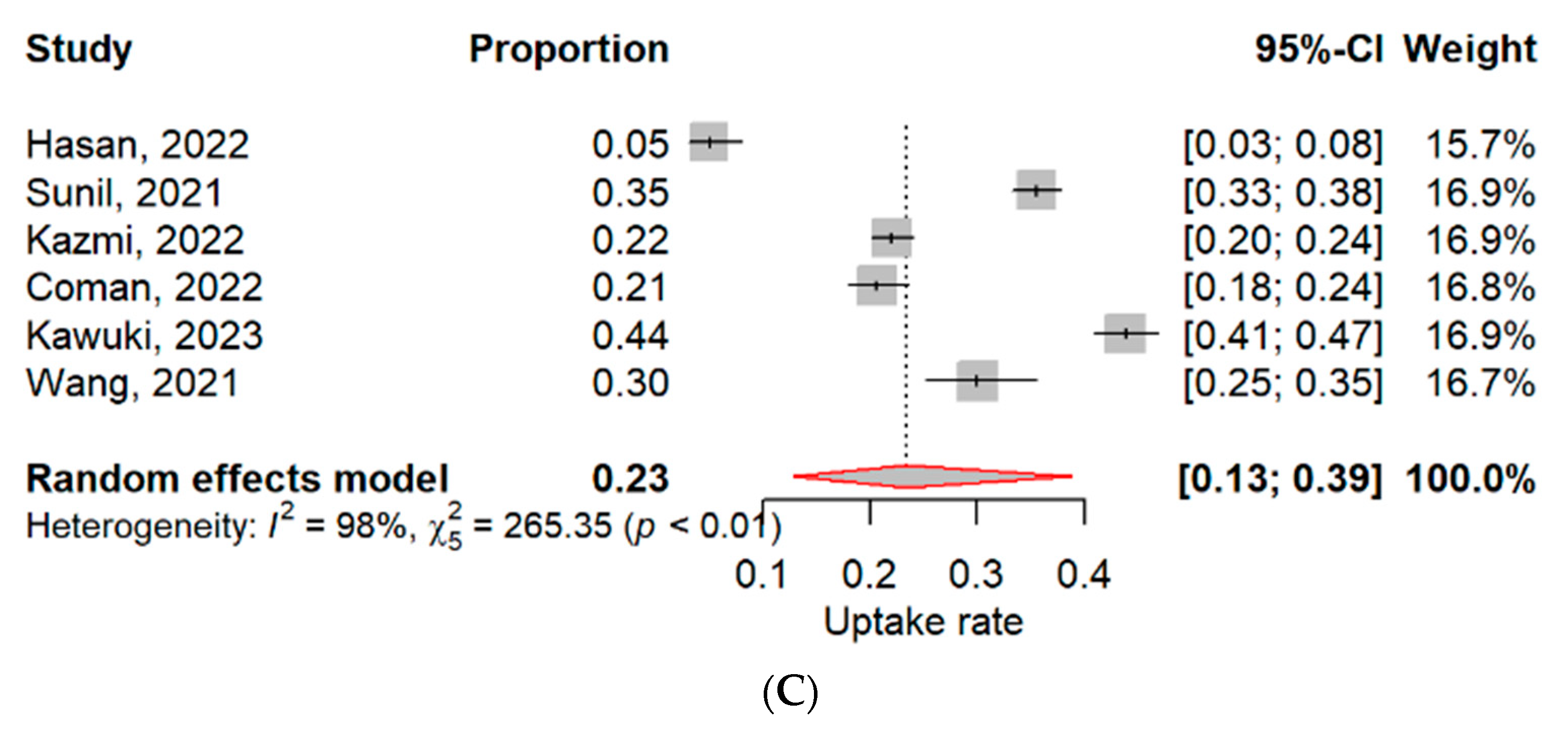
3.3.2. COVID-19 Vaccine Uptake
3.3.3. Factors Associated with COVID-19 Vaccination
3.3.4. Qualitative Reasons for COVID-19 Vaccine Hesitancy
3.3.5. Attitudes and Perceptions about COVID-19 Vaccination
4. Discussion
4.1. Primary Findings
4.2. Limitations and Future Research
5. Conclusions
Supplementary Materials
Author Contributions
Funding
Institutional Review Board Statement
Informed Consent Statement
Data Availability Statement
Conflicts of Interest
References
- Worldometer. COVID-19 Coronavirus Pandemic. 2022. Available online: https://www.worldometers.info/coronavirus/ (accessed on 22 March 2023).
- Onyeaka, H.; Anumudu, C.K.; Al-Sharify, Z.T.; Egele-Godswill, E.; Mbaegbu, P. COVID-19 pandemic: A review of the global lockdown and its far-reaching effects. Sci. Prog. 2021, 104, 00368504211019854. [Google Scholar] [CrossRef]
- Fu, Y.; Jin, H.; Xiang, H.; Wang, N. Optimal lockdown policy for vaccination during COVID-19 pandemic. Financ. Res. Lett. 2022, 45, 102123. [Google Scholar] [CrossRef] [PubMed]
- Kansakar, S.; Dumre, S.P.; Raut, A.; Huy, N.T. From lockdown to vaccines: Challenges and response in Nepal during the COVID-19 pandemic. Lancet Respir. Med. 2021, 9, 694–695. [Google Scholar] [CrossRef] [PubMed]
- Our World in Data. Coronavirus (COVID-19) Vaccinations. 2022. Available online: https://ourworldindata.org/covid-vaccinations (accessed on 21 February 2023).
- Tatar, M.; Shoorekchali, J.M.; Faraji, M.R.; Wilson, F.A. International COVID-19 vaccine inequality amid the pandemic: Perpetuating a global crisis? J. Glob. Health 2021, 11, 03086. [Google Scholar] [CrossRef] [PubMed]
- Kabagenyi, A.; Wasswa, R.; Nannyonga, B.K.; Nyachwo, E.B.; Kagirita, A.; Nabirye, J.; Atuhaire, L.; Waiswa, P. Factors Associated with COVID-19 Vaccine Hesitancy in Uganda: A Population-Based Cross-Sectional Survey. Int. J. Gen. Med. 2022, 15, 6837–6847. [Google Scholar] [CrossRef]
- Noushad, M.; Al-Awar, M.S.; Al-Saqqaf, I.S.; Nassani, M.Z.; Alrubaiee, G.G.; Rastam, S. Lack of access to COVID-19 vaccines could be a greater threat than vaccine hesitancy in low-income and conflict nations: The case of Yemen. Clin. Infect. Dis. 2022, 75, 1827–1833. [Google Scholar] [CrossRef] [PubMed]
- Lin, C.; Tu, P.; Beitsch, L.M. Confidence and receptivity for COVID-19 vaccines: A rapid systematic review. Vaccines 2020, 9, 16. [Google Scholar] [CrossRef]
- MacDonald, N.E. Vaccine hesitancy: Definition, scope and determinants. Vaccine 2015, 33, 4161–4164. [Google Scholar] [CrossRef] [PubMed]
- Aw, J.; Seng, J.J.; Seah, S.S.; Low, L.L. COVID-19 vaccine hesitancy—A scoping review of literature in high-income countries. Vaccines 2021, 9, 900. [Google Scholar] [CrossRef]
- Biswas, M.R.; Alzubaidi, M.S.; Shah, U.; Abd-Alrazaq, A.A.; Shah, Z. A scoping review to find out worldwide COVID-19 vaccine hesitancy and its underlying determinants. Vaccines 2021, 9, 1243. [Google Scholar] [CrossRef]
- Ackah, B.B.; Woo, M.; Stallwood, L.; Fazal, Z.A.; Okpani, A.; Ukah, U.V.; Adu, P.A. COVID-19 vaccine hesitancy in Africa: A scoping review. Glob. Health Res. Policy 2022, 7, 21. [Google Scholar] [CrossRef] [PubMed]
- Re, V.L.; Klungel, O.H.; Chan, K.A.; Panozzo, C.A.; Zhou, W.; Winterstein, A.G. Global COVID-19 vaccine rollout and safety surveillance—How to keep pace. BMJ 2021, 373, n1416. [Google Scholar] [PubMed]
- Estimating Global Slum Dwellers: Monitoring the Millennium Development Goal 7, Target 11. Available online: https://unstats.un.org/unsd/accsub/2002docs/mdg-habitat.pdf (accessed on 22 March 2023).
- Lines, K.; Sebbanja, J.A.; Dzimadzi, S.; Mitlin, D.; Mudimu-Matsangaise, P.; Rao, V.; Zidana, H. COVID-19 Vaccine Rollout: Challenges and Insights from Informal Settlements. IDS Bull. 2022, 53. [Google Scholar] [CrossRef]
- George, C.E.; Inbaraj, L.R.; Chandrasingh, S.; De Witte, L.P. High seroprevalence of COVID-19 infection in a large slum in South India; what does it tell us about managing a pandemic and beyond? Epidemiol. Infect. 2021, 149, e39. [Google Scholar] [CrossRef] [PubMed]
- Malani, A.; Shah, D.; Kang, G.; Lobo, G.N.; Shastri, J.; Mohanan, M.; Jain, R.; Agrawal, S.; Juneja, S.; Imad, S.; et al. Seroprevalence of SARS-CoV-2 in slums versus non-slums in Mumbai, India. Lancet Glob. Health 2021, 9, e110–e111. [Google Scholar] [CrossRef] [PubMed]
- Sallam, M. COVID-19 vaccine hesitancy worldwide: A concise systematic review of vaccine acceptance rates. Vaccines 2021, 9, 160. [Google Scholar] [CrossRef]
- Pires, C. Global predictors of COVID-19 vaccine hesitancy: A systematic review. Vaccines 2022, 10, 1349. [Google Scholar] [CrossRef]
- Limbu, Y.B.; Gautam, R.K.; Pham, L. The Health Belief Model Applied to COVID-19 Vaccine Hesitancy: A Systematic Review. Vaccines 2022, 10, 973. [Google Scholar] [CrossRef]
- Patwary, M.M.; Alam, M.A.; Bardhan, M.; Disha, A.S.; Haque, M.Z.; Billah, S.M.; Kabir, M.P.; Browning, M.H.; Rahman, M.M.; Parsa, A.D.; et al. COVID-19 Vaccine Acceptance among Low-and Lower-Middle-Income Countries: A Rapid Systematic Review and Meta-Analysis. Vaccines 2022, 10, 427. [Google Scholar] [CrossRef]
- Crocker-Buque, T.; Mindra, G.; Duncan, R.; Mounier-Jack, S. Immunization, urbanization and slums–a systematic review of factors and interventions. BMC Public Health 2017, 17, 556. [Google Scholar] [CrossRef]
- Moher, D.; Shamseer, L.; Clarke, M.; Ghersi, D.; Liberati, A.; Petticrew, M.; Shekelle, P.; Stewart, L.A. Preferred reporting items for systematic review and meta-analysis protocols (PRISMA-P) 2015 statement. Syst. Rev. 2015, 4, 1. [Google Scholar] [CrossRef]
- Lennon, R.P.; Block, R., Jr.; Schneider, E.C.; Zephrin, L.; Shah, A.; Collaborative, T.A.; 2021 COVID Group. Underserved population acceptance of combination influenza-COVID-19 booster vaccines. Vaccine 2022, 40, 562–567. [Google Scholar] [CrossRef]
- Alam, W.; Manzoor, F.; Farnaz, N.; Aktar, B.; Rashid, S.F. Perception and attitudes towards COVID-19 vaccination among urban slum dwellers in Dhaka, Bangladesh. Lancet Glob. Health 2022, 10, S3. [Google Scholar] [CrossRef]
- Kusuma, Y.S.; Kant, S. COVID-19 vaccine acceptance and its determinants: A cross-sectional study among the socioeconomically disadvantaged communities living in Delhi, India. Vaccine: X 2022, 11, 100171. [Google Scholar] [CrossRef] [PubMed]
- Hasan, M.M.; Rasel, R.I.; Sultana, F. Exploring the Prevalence and Determinants of COVID-19 Vaccine Acceptance among the Urban Slum Dwellers of Bangladesh: A Cross-Sectional Study. NAAR 2022, 5, 89–107. [Google Scholar]
- Sunil, K.; Srividya, J.; Patel, A.E.; Vidya, R. COVID-19 vaccination coverage and break through infections in urban slums of Bengaluru, India: A cross sectional study. Eur. J. Health Res. 2021, 8, 1–7. [Google Scholar]
- Aguilar Ticona, J.P.; Nery, N., Jr.; Victoriano, R.; Fofana, M.O.; Ribeiro, G.S.; Giorgi, E.; Reis, M.G.; Ko, A.I.; Costa, F. Willingness to get the COVID-19 vaccine among residents of slum settlements. Vaccines 2021, 9, 951. [Google Scholar] [CrossRef]
- Cohrs, J.R.; Mirtallo, J.M.; Seifert, J.L.; Jones, S.M.; Erdmann, A.M.; Li, J. Perceptions and barriers to the annual influenza vaccine compared with the coronavirus disease 2019 vaccine in an urban underserved population. J. Am. Pharm. Assoc. 2022, 62, 461–467. [Google Scholar] [CrossRef]
- Nasimiyu, C.; Audi, A.; Oduor, C.; Ombok, C.; Oketch, D.; Aol, G.; Ouma, A.; Osoro, E.; Ngere, I.; Njoroge, R.; et al. COVID-19 Knowledge, Attitudes and Practices and Vaccine Acceptability in Rural Western Kenya and an Urban Informal Settlement in Nairobi, Kenya: A Cross-Sectional Survey. COVID 2022, 2, 1491–1508. [Google Scholar] [CrossRef]
- Doherty, I.A.; Pilkington, W.; Brown, L.; Billings, V.; Hoffler, U.; Paulin, L.; Kimbro, K.S.; Baker, B.; Zhang, T.; Locklear, T.; et al. COVID-19 vaccine hesitancy in underserved communities of North Carolina. PLoS ONE 2021, 16, e0248542. [Google Scholar] [CrossRef]
- Patwary, M.M.; Bardhan, M.; Al Imran, S.; Hasan, M.; Tuhi, F.I.; Rahim, S.J.; Newaz, M.N.; Hasan, M.; Haque, M.Z.; Disha, A.S.; et al. Psychological determinants of COVID-19 vaccine acceptance among urban slum dwellers of Bangladesh. Front. Public Health 2022, 10, 958445. [Google Scholar] [CrossRef]
- Crozier, J.; Christensen, N.; Li, P.; Stanley, G.; Clark, D.S.; Selleck, C. Rural, underserved, and minority populations’ perceptions of COVID-19 information, testing, and vaccination: Report from a southern state. Popul. Health Manag. 2022, 25, 413–422. [Google Scholar] [CrossRef]
- Tamysetty, S.; Babu, G.R.; Sahu, B.; Shapeti, S.; Ravi, D.; Lobo, E.; Varughese, C.S.; Bhide, A.; Madhale, A.; Manyal, M.; et al. Predictors of COVID-19 Vaccine Confidence: Findings from Slums of Four Major Metro Cities of India. Vaccines 2021, 10, 60. [Google Scholar] [CrossRef]
- Qasim, R.; Shah, H.; Sultan, A.; Yaqoob, M.; Haroon, R.; Mistry, S.K.; Bestman, A.; Yousafzai, M.T.; Yadav, U.N. Exploring the beliefs and experiences with regard to COVID-19 vaccine hesitancy and acceptance in a slum of Karachi, Pakistan. Health Promot. Int. 2022, 37, daac140. [Google Scholar] [CrossRef]
- Bhartiya, S.; Kumar, N.; Singh, T.; Murugan, S.; Rajavel, S.; Wadhwani, M. Knowledge, attitude and practice towards COVID-19 vaccination acceptance in West India. Int. J. Community Med. Public Health 2021, 8, 1170–1176. [Google Scholar] [CrossRef]
- Kazmi, T.; Abdullah, M.; Khan, A.A.; Safdar, R.M.; Afzal, S.; Khan, A. COVID-19 vaccination acceptance in underserved urban areas of Islamabad and Rawalpindi: Results from a cross-sectional survey. BMC Public Health 2022, 22, 2299. [Google Scholar] [CrossRef]
- Coman, I.A.; Xu, S.; Yamamoto, M. COVID-19 Vaccine Hesitancy: Disadvantaged Groups’ Experience with Perceived Barriers, Cues to Action, and Attitudes. Am. J. Health Promot. 2022. [Google Scholar] [CrossRef] [PubMed]
- Kawuki, J.; Nambooze, J.; Chan, P.S.; Chen, S.; Liang, X.; Mo, P.K.; Wang, Z. Differential COVID-19 Vaccination Uptake and Associated Factors among the Slum and Estate Communities in Uganda: A Cross-Sectional Population-Based Survey. Vaccines 2023, 11, 440. [Google Scholar] [CrossRef]
- Abedin, M.; Islam, M.A.; Rahman, F.N.; Reza, H.M.; Hossain, M.Z.; Hossain, M.A.; Arefin, A.; Hossain, A. Willingness to vaccinate against COVID-19 among Bangladeshi adults: Understanding the strategies to optimize vaccination coverage. PLoS ONE 2021, 16, e0250495. [Google Scholar] [CrossRef] [PubMed]
- Nabirye, H.; Muwanguzi, M.; Onenchan, J. Assessing Knowledge and Perceptions towards the COVID-19 Vaccine among the Community of Kalerwe-Besina Slum. Ph.D. Thesis, Makerere University, Kampala, Uganda, 2021. [Google Scholar]
- Mamun, M.; Fatima, K. Slum Dwellers’ perception about COVID-19: A Study in Dhaka Metropolis Slums. Tech. Soc. Sci. J. 2021, 21, 728. [Google Scholar] [CrossRef]
- Wang, S.X.; Bell-Rogers, N.; Dillard, D.; Harrington, M.A. COVID-19 vaccine hesitancy in Delaware’s underserved communities. Del. J. Public Health 2021, 7, 168. [Google Scholar] [CrossRef]
- Garcini, L.M.; Ambriz, A.M.; Vázquez, A.L.; Abraham, C.; Sarabu, V.; Abraham, C.; Lucas-Marinelli, A.K.; Lill, S.; Tsevat, J. Vaccination for COVID-19 among historically underserved Latino communities in the United States: Perspectives of community health workers. Front. Public Health 2022, 10, 3900. [Google Scholar] [CrossRef] [PubMed]
- Campagnoli, T.; Mohan, G.; Taddese, N.; Santhiraj, Y.; Margeta, N.; Alvi, S.; Jabbar, U.; Bobba, A.; Alharash, J.; Hoffman, M.J. Missed Opportunity: The Unseen Driver for Low Coronavirus Disease 2019 Vaccination Rates in Underserved Patients. Open Forum Infect. Dis. 2022, 9, ofac326. [Google Scholar] [CrossRef] [PubMed]
- Robinson, R.; Nguyen, E.; Wright, M.; Holmes, J.; Oliphant, C.; Cleveland, K.; Nies, M.A. Factors contributing to vaccine hesitancy and reduced vaccine confidence in rural underserved populations. Humanit. Soc. Sci. Commun. 2022, 9, 416. [Google Scholar] [CrossRef] [PubMed]
- Hong, Q.N.; Fàbregues, S.; Bartlett, G.; Boardman, F.; Cargo, M.; Dagenais, P.; Gagnon, M.P.; Griffiths, F.; Nicolau, B.; O’Cathain, A.; et al. The Mixed Methods Appraisal Tool (MMAT) version 2018 for information professionals and researchers. Educ. Inf. 2018, 34, 285–291. [Google Scholar] [CrossRef]
- Abdullah, M.; Ahmad, T.; Kazmi, T.; Sultan, F.; Afzal, S.; Safdar, R.M.; Khan, A.A. Community engagement to increase vaccine uptake: Quasi-experimental evidence from Islamabad and Rawalpindi, Pakistan. PLoS ONE 2022, 17, e0274718. [Google Scholar] [CrossRef] [PubMed]
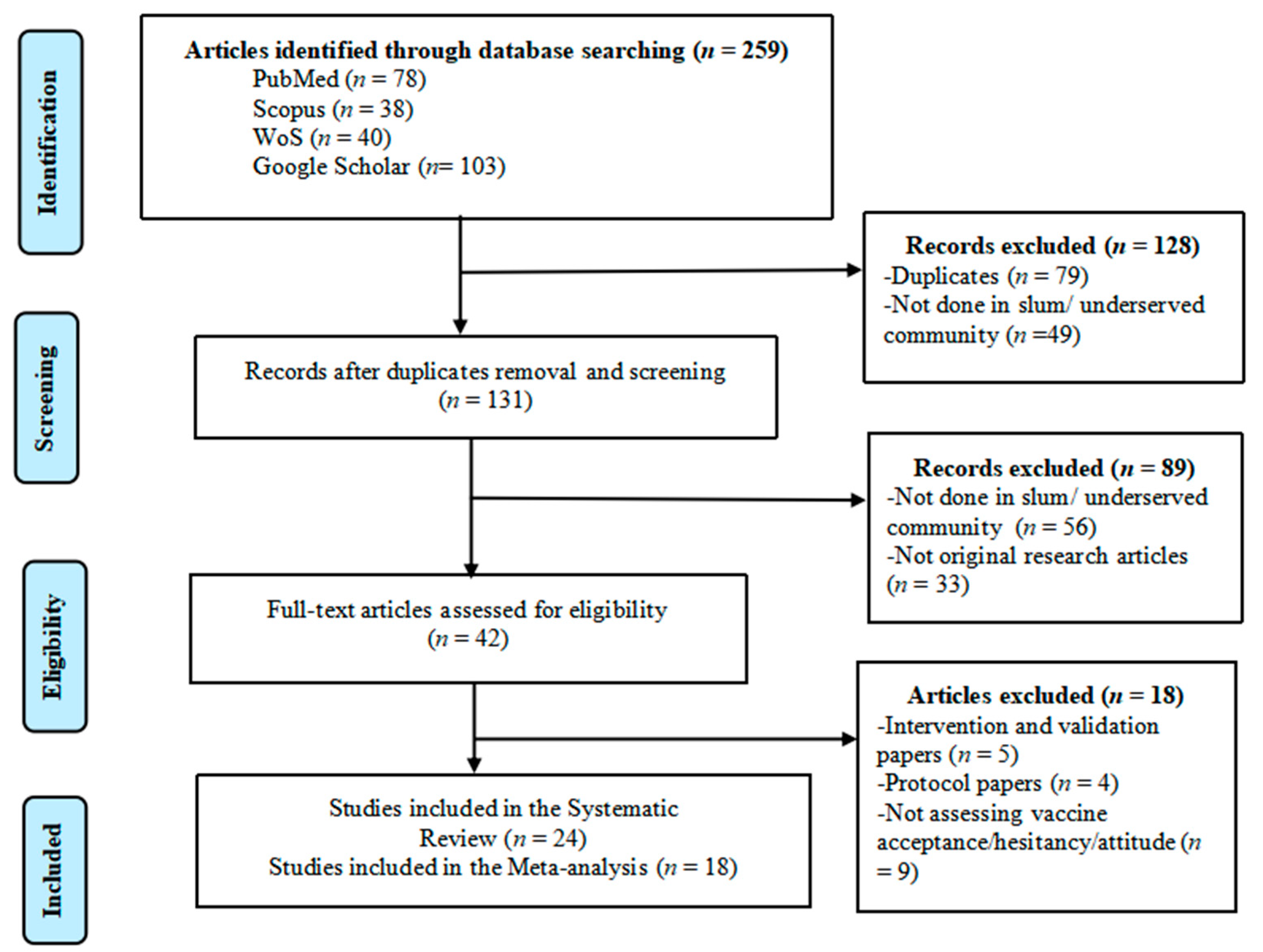
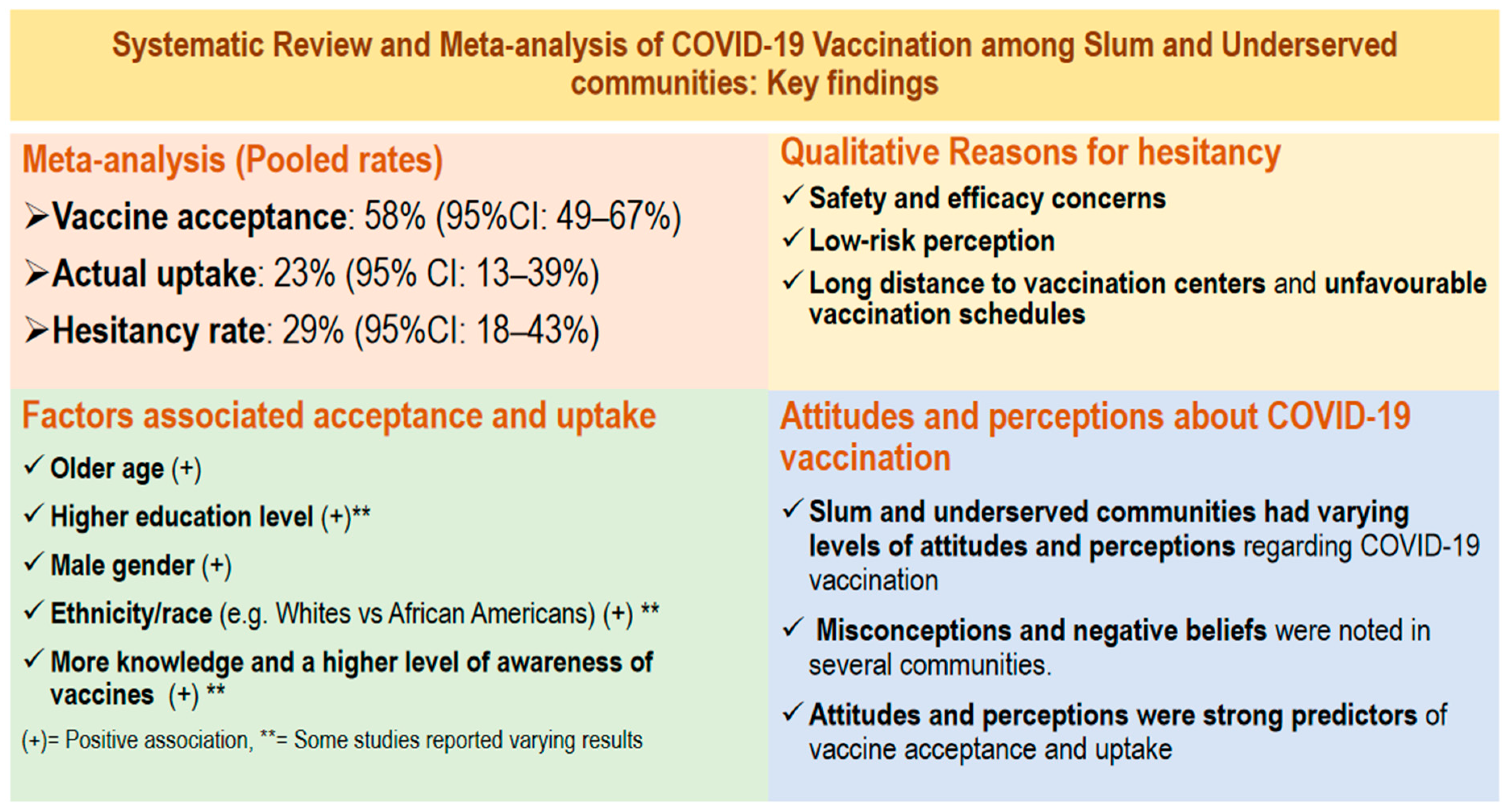
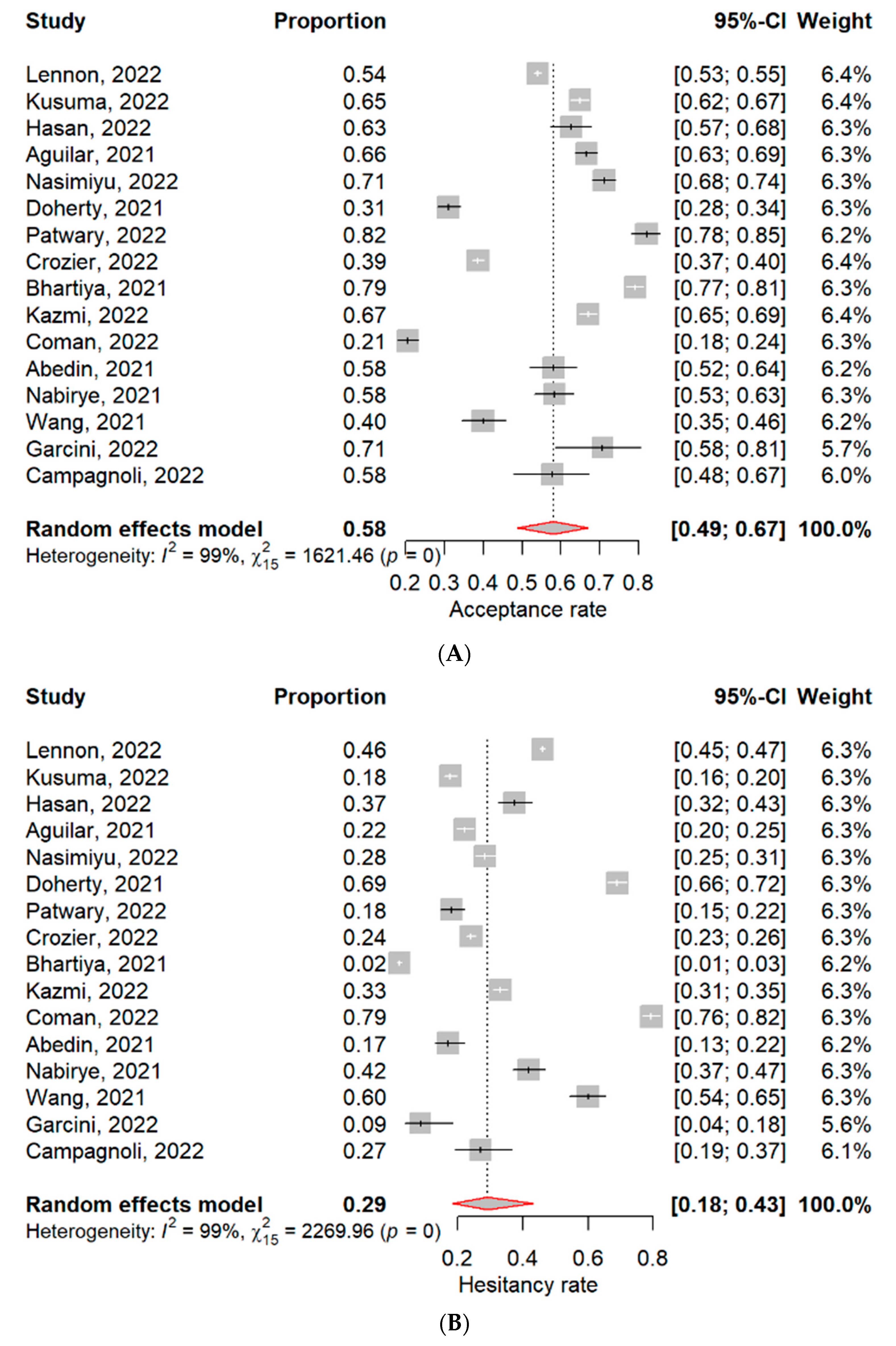


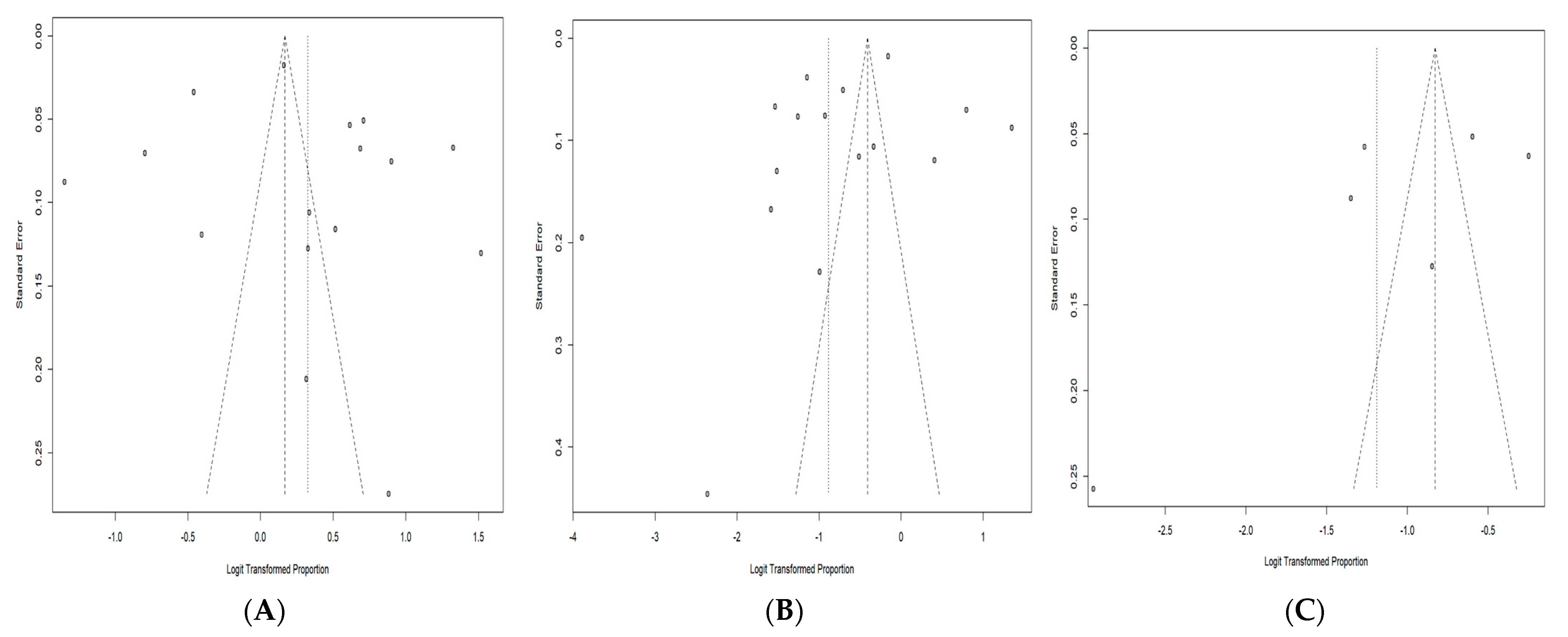
| Search | Search Terms (Boolean Operators) |
|---|---|
| 1 | “COVID-19 vaccine” OR “COVID-19 vaccination” OR “COVID-19 immunisation” OR “COVID-19 immunisation AND “slum” OR “urban poor” OR “disadvantaged” OR “underserved” OR “slum-dwellers” OR “informal settlement” OR “poor housing” |
| 2 | “SARS-CoV-2 vaccine” OR “SARS-CoV-2 vaccination” OR “SARS-CoV-2 immunisation” OR “SARS-CoV-2 immunisation AND “slum” OR “urban poor” OR “disadvantaged” OR “underserved” OR “slum-dwellers” OR “informal settlement” OR “poor housing” |
| 3 | “Coronavirus vaccine” OR “Coronavirus vaccination” OR “Coronavirus immunisation” OR “Coronavirus immunisation AND “slum” OR “urban poor” OR “disadvantaged” OR “underserved” OR “slum-dwellers” OR “informal settlement” OR “poor housing” |
| 4 | “COVID-19 vaccine acceptance” OR “COVID-19 vaccine hesitancy” OR “COVID-19 vaccine acceptability” AND “slum” OR “urban poor” OR “disadvantaged” OR “underserved” OR “slum-dwellers” OR “informal settlement” OR “poor housing” |
| 5 | “COVID-19 vaccine attitude” OR “COVID-19 vaccine knowledge” OR “COVID-19 vaccine perception” AND “slum” OR “urban poor” OR “disadvantaged” OR “underserved” OR “slum-dwellers” OR “slum dwellers” OR “informal settlement” OR “poor housing” |
| Author, Year | Study Setting /Country | Study Type and Key Measures | Study Population | Sample Size | Vaccine Acceptance/Hesitancy/Uptake Rates | Relevant Findings |
|---|---|---|---|---|---|---|
| Lennon et al., 2022 [25] | USA | Cross-sectional -Acceptance of COVID-19 booster, influenza and combination influenza-COVID-19 booster vaccines | Underserved communities | 12,887 | Acceptance: 45% for a COVID-19 booster alone; 58% for an influenza vaccine alone; 50% for a combination vaccine. |
|
| Alam et al., 2022 [26] | Bangladesh(Dhaka) | -Qualitative study -Perceptions and attitudes | Urban slum dwellers | 36 | N/A |
|
| Kusuma et al., 2022 [27] | India (Delhi) | -Cross-sectional -Acceptance and determinants | Urban slum communities | 1539 | Acceptance: 64.9%; hesitancy: 17.7%; not sure: 17.4% |
|
| Hasan et al., 2022 [28] | Bangladesh (Dhaka) | -Cross-sectional -Acceptance and determinants | Urban slum dwellers | 318 | -Uptake: 5%; acceptance: 62.6% |
|
| Sunil et al., 2021 [29] | India (Bengaluru) | Cross-sectional -Uptake and associated factors | Urban slum dwellers | 1638 | -Uptake: 35.5% |
|
| Aguilar et al. 2021 [30] | Brazil (Salvador) | Cross-sectional -Acceptance and determinants | Urban slum dwellers | 985 | Acceptance: 66.0%; hesitancy: 26.1%; not sure: 7.9% -Parental acceptance for children: 67%; hesitancy: 18%; 15% unsure |
|
| Cohrs et al., 2022 [31] | USA (Ohio) | Cross-sectional, hospital-based -Barriers and experience | Underserved patients | 189 | N/A |
|
| Nasimiyu et al., 2022 [32] | Kenya (Kibera and Asembo) | Cross-sectional -Acceptance and determinants | Urban slum dwellers | 856 | Acceptance: 83.6% in Asembo and 59.8% in Kibera |
|
| Doherty et al., 2021 [33] | USA (North Carolina) | Cross-sectional -Hesitancy and correlates | Underserved communities | 948 | Overall hesitancy was 68.9%—Whites: 62.7%; Blacks: 74%; Latinx: 59.5% |
|
| Patwary et al., 2022 [34] | Bangladesh (Dhaka and Khulna) | Cross-sectional -Acceptance determinants (antecedents) | Urban slum dwellers | 400 | Acceptance: 82% |
|
| Crozier et al., 2022 [35] | USA (Alabama) | Cross-sectional -Acceptance and correlates | Underserved communities | 3721 | Acceptance: 38.7%; hesitancy: 24.1%; not sure: 37.2% |
|
| Tamysetty et al., 2021 [36] | India (Mumbai, Bengaluru, Kolkata and Delhi) | Cross-sectional Mixed methods -Facilitators and barriers to vaccination | Urban slum dwellers | 296 | N/A |
|
| Qasim et al., 2022 [37] | Pakistan (Karachi) | Cross-sectional -Qualitative study -Perceptions and experience of vaccination | Urban slum dwellers | 46 | N/A |
|
| Bhartiya et al., 2021 [38] | India (Mumbai) | Cross-sectional -Knowledge, attitude and perception | Urban slum dwellers | 1342 | Acceptance: 79%; hesitancy: 2%; unsure: 19% |
|
| Kazmi et al., 2022 [39] | Pakistan (Islamabad and Rawalpindi) | Cross-sectional -Uptake, acceptance and determinants | Urban slum dwellers | 1760 | Uptake: 16% partially; 6% fully vaccinated; acceptance: 67% |
|
| Coman et al., 2022 [40] | USA | Cross-sectional -Attitude and perception | Underserved communities | 795 | Uptake: 20.6%; hesitancy: 79.4% |
|
| Kawuki et al., 2023 [41] | Uganda | Cross-sectional -Comparative study -Uptake and determinants | Urban slum dwellers and estate residents | 1025 | Uptake: 43.8% fully vaccinated in slums compared to 39.9% in estate |
|
| Abedin et al., 2021 [42] | Bangladesh | Cross-sectional -Acceptance and correlates | Urban slum dwellers | 253 | Acceptance: 58.1%; hesitancy 17%; not sure: 24.9% |
|
| Nabirye et al. 2021 [43] | Uganda | Cross-sectional -Acceptance, knowledge and perceptions | Urban slum dwellers | 367 | Acceptance: 58.3% |
|
| Mamun et al., 2021 [44] | Bangladesh (Dhaka) | Cross-sectional -Perceptions | Urban slum dwellers | 434 | N/A |
|
| Wang et al., 2021 [45] | USA (Delaware) | Cross-sectional -Uptake and determinants | Underserved communities | 293 | Uptake: 30%; hesitancy: 60% |
|
| Garcini et al., 2022 [46] | USA (South Texas) | Cross-sectional -Mixed methods -Barriers and facilitators | Community Health Workers in Underserved Communities | 64 | Acceptance: 70.7%; Hesitancy: 8.6%; unsure: 20.7% |
|
| Campagnoli et al., 2022 [47] | USA (Chicago) | Cross-sectional, Hospital-based -Acceptance and drivers | Underserved Patients | 97 | Acceptance: 57.8%; hesitancy: 27% |
|
| Robinson et al., 2022 [48] | USA (Alaska and Idaho) | Cross-sectional, Qualitative study -Factors for hesitancy | Underserved communities | 34 | N/A |
|
| Author | Year | Country | Study Design | Population | Sample Size | Acceptance (%) | Hesitancy (%) | Uptake (%) |
|---|---|---|---|---|---|---|---|---|
| Lennon et al. [25] | 2022 | USA | Quantitative | General | 12,887 | 54 | 46 | -- |
| Alam et al. [26] | 2022 | Bangladesh | Qualitative | General | 36 | -- | -- | -- |
| Kusuma et al. [27] | 2022 | India | Quantitative | General | 1539 | 64.9 | 17.7 | -- |
| Hasan et al. [28] | 2022 | Bangladesh | Quantitative | General | 318 | 62.6 | 37.4 | 5 |
| Sunil et al. [29] | 2021 | India | Quantitative | General | 1638 | -- | -- | 35.5 |
| Aguilar et al. [30] | 2021 | Brazil | Quantitative | Parents | 985 | 66.5 | 22.1 | -- |
| Cohrs et al. [31] | 2022 | USA | Quantitative | General | 189 | -- | -- | -- |
| Nasimiyu et al. [32] | 2022 | Kenya | Quantitative | General | 856 | 71.1 | 28.3 | -- |
| Doherty et al. [33] | 2021 | USA | Quantitative | General | 948 | 31.1 | 68.9 | -- |
| Patwary et al. [34] | 2022 | Bangladesh | Quantitative | General | 400 | 82 | 18 | -- |
| Crozier et al. [35] | 2022 | USA | Quantitative | General | 3721 | 38.7 | 24.1 | -- |
| Tamysetty et al. [36] | 2021 | India | Mixed-method | General | 296 | -- | -- | -- |
| Qasim et al. [37] | 2022 | Pakistan | Qualitative | General | 46 | -- | -- | -- |
| Bhartiya et al. [38] | 2021 | India | Quantitative | General | 1342 | 79 | 2 | -- |
| Kazmi et al. [39] | 2022 | Pakistan | Quantitative | General | 1760 | 67 | 33 | 22 |
| Coman et al. [40] | 2022 | USA | Quantitative | General | 795 | 20.6 | 79.4 | 20.6 |
| Kawuki et al. [41] | 2023 | Uganda | Quantitative | General | 1025 | -- | -- | 43.8 |
| Abedin et al. [42] | 2021 | Bangladesh | Quantitative | General | 253 | 58.1 | 17 | -- |
| Nabirye et al. [43] | 2021 | Uganda | Quantitative | General | 367 | 58.3 | 41.7 | -- |
| Mamun et al. [44] | 2021 | Bangladesh | Quantitative | General | 434 | -- | -- | -- |
| Wang et al. [45] | 2021 | USA | Quantitative | General | 293 | 40 | 60 | 30 |
| Garcini et al. [46] | 2022 | USA | Mixed-method | Healthcare workers | 64 | 70.7 | 8.6 | -- |
| Campagnoli et al. [47] | 2022 | USA | Cross-sectional | Hospital patients | 97 | 57.8 | 27 | -- |
| Robinson et al. [48] | 2022 | USA | Qualitative | General | 34 | -- | -- | -- |
| 2021: 9 2022: 14 2023: 1 | USA: 9 Bangladesh: 5 India: 4 Brazil: 2 Uganda: 2 Pakistan: 1 Kenya: 1 | Quantitative: 19 Qualitative: 3 Mixed methods: 2 | General: 21 Healthcare workers: 1 Hospital patients: 1 | N = 30,323 x = 1263.5 SD = 2610.3 |
| Moderator | Number of Studies | Proportion of Outcome (95% CI) | Heterogeneity | Moderator Effect (Meta-Regression) | ||||
|---|---|---|---|---|---|---|---|---|
| Univariate | Multivariate | |||||||
| I2 Within | p-Value | Coefficient | p-Value | Coefficient | p-Value | |||
| Acceptance studies | ||||||||
| Study year | 0.03 | 0.75 | -- | -- | ||||
| 2021 | 6 | 0.56 (0.41–0.70) | 99% | <0.01 | ||||
| 2022 | 10 | 0.59 (0.47–0.71) | 99% | <0.01 | ||||
| 2023 | -- | -- | -- | -- | ||||
| Region | 0.08 | 0.01 | 0.09 | 0.29 | ||||
| Africa | 2 | 0.65 (0.52–0.76) | 95% | <0.01 | ||||
| Americas | 8 | 0.47 (0.34–0.60) | 99% | <0.01 | ||||
| Asia | 6 | 0.70 (0.61–0.77) | 96% | <0.01 | ||||
| Slum population | 0.09 | <0.01 | 0.12 | 0.03 | ||||
| General | 13 | 0.56 (0.45–0.67) | 99% | <0.01 | ||||
| Non-general | 3 | 0.65 (0.59–0.70) | 45% | 0.16 | ||||
| Sample size | 0.04 | 0.59 | -- | -- | ||||
| Below 1000 | 11 | 0.56 (0.44–0.68) | 99% | <0.01 | ||||
| Above 1000 | 5 | 0.61 (0.47–0.74) | 100% | <0.01 | ||||
| Hesitancy studies | ||||||||
| Study year | −0.03 | 0.84 | -- | -- | ||||
| 2021 | 6 | 0.27 (0.09- 0.59) | 99% | <0.01 | ||||
| 2022 | 10 | 0.31 (0.19–0.44) | 99% | <0.01 | ||||
| 2023 | -- | -- | -- | -- | ||||
| Region | −0.11 | 0.01 | −0.13 | 0.13 | ||||
| Africa | 2 | 0.35 (0.23–0.49) | 95% | <0.01 | ||||
| Americas | 8 | 0.40 (0.23–0.61) | 99% | <0.01 | ||||
| Asia | 6 | 0.17 (0.07–0.34) | 99% | <0.01 | ||||
| Slum population | −0.17 | 0.01 | −0.21 | 0.17 | ||||
| General | 13 | 0.32 (0.19–0.49) | 99% | <0.01 | ||||
| Non-general | 3 | 0.19 (0.11–0.32) | 73% | 0.02 | ||||
| Sample size | −0.13 | 0.22 | -- | -- | ||||
| Below 1000 | 11 | 0.35 (0.22–0.51) | 99% | <0.01 | ||||
| Above 1000 | 5 | 0.19 (0.06–0.44) | 100% | <0.01 | ||||
| Uptake studies | ||||||||
| Study year | 0.02 | <0.01 | −0.06 | 0.04 | ||||
| 2021 | 2 | 0.33 (0.28–0.39) | 70% | 0.07 | ||||
| 2022 | 3 | 0.14 (0.05–0.31) | 95% | <0.01 | ||||
| 2023 | 1 | 0.44 (0.41–0.47) | -- | -- | ||||
| Region | ||||||||
| Africa | 1 | 0.44 (0.41–0.47) | -- | -- | −0.10 | <0.01 | −0.13 | 0.31 |
| Americas | 2 | 0.25 (0.17–0.35) | 90% | <0.01 | ||||
| Asia | 3 | 0.17 (0.05–0.44) | 99% | <0.01 | ||||
| Slum population | -- | -- | -- | -- | ||||
| General | 6 | 0.23 (0.13–0.39) | 98% | <0.01 | ||||
| Non-general | 0 | -- | -- | -- | ||||
| Sample size | 0.15 | 0.15 | -- | -- | ||||
| Below 1000 | 3 | 0.16 (0.05–0.38) | 96% | <0.01 | ||||
| Above 1000 | 3 | 0.33 (0.22–0.47) | 99% | <0.01 | ||||
| Author | Country | Associates Factors | Qualitative Reasons for Hesitancy |
|---|---|---|---|
| Lennon et al., 2022 [25] | USA | Acceptance: Gender; female (−) Ethnicity; non-white (−), residence; rural (−) Education; college and post-graduate (+) | N/A |
| Kusuma et al., 2022 [27] | India (Delhi) | Hesitancy: Older age (+), low perceived susceptibility and severity of COVID-19 (+), low self-efficacy to protect against COVID-19 (+), awareness and use of Aarogya Setu App (−) | A belief that they had immunity; COVID-19 was a hoax; the vaccine was not necessary; did not want to disturb the natural bodily systems by the vaccine. |
| Hasan et al., 2022 [28] | Bangladesh | Acceptance: Older age (+), Adequate knowledge of COVID-19 (+), comorbid patients in the households (+), religious misconceptions (−), doubt on safety of the vaccine (−) | N/A |
| Sunil et al., 2021 [29] | India (Bengaluru) | Uptake: Young age (+), gender; males (+), religion; Christians (+), Education; graduates (+), Occupation: clerical and skilled workers (+), SES; upper middle (+). | Mild or serious adverse effects were more reported among women than men across all age groups. |
| Aguilar et al. 2021 [30] | Brazil | Hesitancy: Younger age (+), low perceived benefit vaccination (+) Parental acceptance: acceptance among parents themselves (+) | Concerns about vaccine efficacy, potential side effects, low incidence of COVID-19 cases and low perceived susceptibility |
| Cohrs et al., 2022 [31] | USA | N/A | Adverse effects and cost of COVID-19 vaccine |
| Nasimiyu et al., 2022 [32] | Kenya (Kibera and Asembo) | Acceptance: Education; post-secondary (−) | Safety concerns, insufficient information to decide, low-risk perception and lack of belief in vaccine |
| Doherty et al., 2021 [33] | USA (North Carolina) | Hesitancy: Gender; female (+), Ethnicity; Black (+), calendar month (+), safety concerns and government distrust (+) | Safety and efficacy concerns and government mistrust |
| Patwary et al., 2022 [34] | Bangladesh | Acceptance: being confident (+), complacent (+), calculative (+), and responsible (+) Anti-vaccine attitudes (−), Information sources; newspaper (+) | N/A |
| Crozier et al., 2022 [35] | USA (Alabama) | Acceptance: Gender; male (+), ethnicity; non-Hispanic (+), older age (+), residence; urban (+) | N/A |
| Tamysetty et al., 2021 [36] | India (Mumbai, Bengaluru, Kolkata and Delhi) | N/A | Possible side effects, the uncertainty of getting the vaccine, safety concerns, long distance to vaccination centre, and inability to spare a day from work |
| Qasim et al., 2022 [37] | Pakistan (Karachi) | Acceptance: Knowledge and awareness of vaccine (+), trusted sources of information (+), good health literacy (+), Occupation; healthcare (+) Negative personal beliefs (−), vaccine mistrust (−), negative public perceptions (−) | N/A |
| Bhartiya et al., 2021 [38] | India (Mumbai) | Acceptance: Older age (+), gender; male (+), Education; post-graduate (−), and occupation; blue collar (+) | N/A |
| Kazmi et al., 2022 [39] | Pakistan (Islamabad and Rawalpindi) | Uptake and acceptance: Higher education (+), being employed (+), prior infection in the family (+), family vaccination (+), knowing of and living close to a vaccination centre (+) and being worried about COVID-19 (+) | N/A |
| Kawuki et al., 2023 [41] | Uganda | Uptake: Older age (+) and Ethnicity/Tribe; Batooro (+), Knowledge level (+), perceived benefits (+) and cues to action (+). Depressive symptoms (−), perceived barriers; serious side effects and long distances (−), Unemployment (−), Religion; Moslem (+) and Tribe; Basoga (−) | N/A |
| Abedin et al., 2021 [42] | Bangladesh | Hesitancy: Older age (+), low education (+), Occupation; day-laborers (+), having chronic diseases (+), low confidence in the country’s healthcare system (+), residence: slum (+) | N/A |
| Wang et al., 2021 [45] | USA (Delaware) | Acceptance: Ethnicity; Black (−), COVID test history (+) | N/A |
| Garcini et al., 2022 [46] | USA (South Texas) | N/A | Mistrust of manufacturers and administrators, concerns about vaccine safety, fear of discrimination/stigmatisation, fear of exploitation/ manipulation by the government or health authorities, and having personal information mishandled. Being undocumented, fear-inducing myths and beliefs, limited information and logistics of vaccination access |
| Campagnoli et al., 2022 [47] | USA (Chicago) | Acceptance: older age (+), Ethnicity; white (−), big household size (+), and trust in healthcare workers (+) | Missed opportunity (not having access to a doctor or not seen a doctor lately), fear of short- and long-term side effects, not enough research on the COVID-19 vaccines, concerns about vaccine effectiveness, and government mistrust |
| Robinson et al., 2022 [48] | USA (Alaska and Idaho) | Uptake: Vaccine confidence (+), high perceived susceptibility (+), severity (+), and benefits (+), convenient access (+), availability (+) and cues to action; SMS (+) | N/A |
Disclaimer/Publisher’s Note: The statements, opinions and data contained in all publications are solely those of the individual author(s) and contributor(s) and not of MDPI and/or the editor(s). MDPI and/or the editor(s) disclaim responsibility for any injury to people or property resulting from any ideas, methods, instructions or products referred to in the content. |
© 2023 by the authors. Licensee MDPI, Basel, Switzerland. This article is an open access article distributed under the terms and conditions of the Creative Commons Attribution (CC BY) license (https://creativecommons.org/licenses/by/4.0/).
Share and Cite
Kawuki, J.; Chen, S.; Fang, Y.; Liang, X.; Chan, P.S.-f.; Wang, Z. COVID-19 Vaccine Acceptance, Attitude and Perception among Slum and Underserved Communities: A Systematic Review and Meta-Analysis. Vaccines 2023, 11, 886. https://doi.org/10.3390/vaccines11050886
Kawuki J, Chen S, Fang Y, Liang X, Chan PS-f, Wang Z. COVID-19 Vaccine Acceptance, Attitude and Perception among Slum and Underserved Communities: A Systematic Review and Meta-Analysis. Vaccines. 2023; 11(5):886. https://doi.org/10.3390/vaccines11050886
Chicago/Turabian StyleKawuki, Joseph, Siyu Chen, Yuan Fang, Xue Liang, Paul Shing-fong Chan, and Zixin Wang. 2023. "COVID-19 Vaccine Acceptance, Attitude and Perception among Slum and Underserved Communities: A Systematic Review and Meta-Analysis" Vaccines 11, no. 5: 886. https://doi.org/10.3390/vaccines11050886
APA StyleKawuki, J., Chen, S., Fang, Y., Liang, X., Chan, P. S.-f., & Wang, Z. (2023). COVID-19 Vaccine Acceptance, Attitude and Perception among Slum and Underserved Communities: A Systematic Review and Meta-Analysis. Vaccines, 11(5), 886. https://doi.org/10.3390/vaccines11050886