Oxylipin Biomarkers of Auto-Oxidation Are Associated with Antioxidant Micronutrients and Multiple Sclerosis Disability
 , , ,
, , ,  , ,
, , 
Abstract
1. Introduction
2. Materials and Methods
2.1. Study Design
2.2. Serum Biomarker Analysis
2.2.1. Serum Analysis
2.2.2. Lipid Peroxidation Products Measurements
2.2.3. Antioxidants
2.2.4. Nuclear Magnetic Resonance (NMR) Spectroscopy
2.2.5. Apolipoproteins
2.2.6. Neurofilament Light Chain (NfL)
2.2.7. Cholesterol Auto-Oxidation
2.2.8. Mitophagy Marker
2.2.9. C-Reactive Protein
2.3. Data Analysis
3. Results
3.1. Clinical and Demographic Characteristics
3.2. Oxylipin Biomarkers of Lipid Peroxidation in MS
3.3. Antioxidant Micronutrients Are Associated with Lower Oxylipin Levels
3.4. Associations of Oxylipins with Lipoprotein Particle Size Subclasses
3.5. Association of Chronic Inflammation and Mitophagy Biomarkers
4. Discussion
5. Conclusions
Supplementary Materials
Author Contributions
Funding
Institutional Review Board Statement
Informed Consent Statement
Data Availability Statement
Acknowledgments
Conflicts of Interest
References
- McGinley, M.P.; Goldschmidt, C.H.; Rae-Grant, A.D. Diagnosis and Treatment of Multiple Sclerosis: A Review. JAMA 2021, 325, 765–779. [Google Scholar] [CrossRef]
- Jakimovski, D.; Bittner, S.; Zivadinov, R.; Morrow, S.A.; Benedict, R.H.; Zipp, F.; Weinstock-Guttman, B. Multiple sclerosis. Lancet 2024, 403, 183–202. [Google Scholar] [CrossRef]
- Reed, T.T. Lipid peroxidation and neurodegenerative disease. Free Radic. Biol. Med. 2011, 51, 1302-1319. [Google Scholar] [CrossRef] [PubMed]
- Shibata, T.; Shimizu, K.; Hirano, K.; Nakashima, F.; Kikuchi, R.; Matsushita, T.; Uchida, K. Adductome-based identification of biomarkers for lipid peroxidation. J. Biol. Chem. 2017, 292, 8223–8235. [Google Scholar] [CrossRef]
- Zheng, Y.; Sun, J.; Luo, Z.; Li, Y.; Huang, Y. Emerging mechanisms of lipid peroxidation in regulated cell death and its physiological implications. Cell Death Dis. 2024, 15, 859. [Google Scholar] [CrossRef]
- Rochette, L.; Dogon, G.; Rigal, E.; Zeller, M.; Cottin, Y.; Vergely, C. Lipid Peroxidation and Iron Metabolism: Two Corner Stones in the Homeostasis Control of Ferroptosis. Int. J. Mol. Sci. 2022, 24, 449. [Google Scholar] [CrossRef]
- Crick, D.C.P.; Halligan, S.L.; Davey Smith, G.; Khandaker, G.M.; Jones, H.J. The relationship between polyunsaturated fatty acids and inflammation: Evidence from cohort and Mendelian randomization analyses. Int. J. Epidemiol. 2025, 54, dyaf065. [Google Scholar] [CrossRef] [PubMed]
- Djuricic, I.; Calder, P.C. Beneficial Outcomes of Omega-6 and Omega-3 Polyunsaturated Fatty Acids on Human Health: An Update for 2021. Nutrients 2021, 13, 2421. [Google Scholar] [CrossRef]
- Baarnhielm, M.; Olsson, T.; Alfredsson, L. Fatty fish intake is associated with decreased occurrence of multiple sclerosis. Mult. Scler. 2014, 20, 726–732. [Google Scholar] [CrossRef]
- Jelinek, G.A.; Hadgkiss, E.J.; Weiland, T.J.; Pereira, N.G.; Marck, C.H.; van der Meer, D.M. Association of fish consumption and Omega 3 supplementation with quality of life, disability and disease activity in an international cohort of people with multiple sclerosis. Int. J. Neurosci. 2013, 123, 792–800. [Google Scholar] [CrossRef] [PubMed]
- Rezaeizadeh, H.; Mohammadpour, Z.; Bitarafan, S.; Harirchian, M.H.; Ghadimi, M.; Homayon, I.A. Dietary fish intake and the risk of multiple sclerosis: A systematic review and meta-analysis of observational studies. Nutr. Neurosci. 2022, 25, 681–689. [Google Scholar] [CrossRef] [PubMed]
- Hedstrom, A.K.; Olsson, T.; Kockum, I.; Hillert, J.; Alfredsson, L. Low fish consumption is associated with a small increased risk of MS. Neurol. Neuroimmunol. Neuroinflamm 2020, 7, e717. [Google Scholar] [CrossRef]
- Johansson, E.; Guo, J.; Wu, J.; Olsson, T.; Alfredsson, L.; Hedstrom, A.K. Impact of fish consumption on disability progression in multiple sclerosis. J. Neurol. Neurosurg. Psychiatry 2025, 96, 893–899. [Google Scholar] [CrossRef]
- AlAmmar, W.A.; Albeesh, F.H.; Ibrahim, L.M.; Algindan, Y.Y.; Yamani, L.Z.; Khattab, R.Y. Effect of omega-3 fatty acids and fish oil supplementation on multiple sclerosis: A systematic review. Nutr. Neurosci. 2021, 24, 569–579. [Google Scholar] [CrossRef] [PubMed]
- Matveeva, O.; Bogie, J.F.J.; Hendriks, J.J.A.; Linker, R.A.; Haghikia, A.; Kleinewietfeld, M. Western lifestyle and immunopathology of multiple sclerosis. Ann. N. Y. Acad. Sci. 2018, 1417, 71–86. [Google Scholar] [CrossRef] [PubMed]
- Innes, J.K.; Calder, P.C. Omega-6 fatty acids and inflammation. Prostaglandins Leukot. Essent. Fat. Acids 2018, 132, 41–48. [Google Scholar] [CrossRef] [PubMed]
- Aristotelous, P.; Stefanakis, M.; Pantzaris, M.; Pattichis, C.S.; Calder, P.C.; Patrikios, I.S.; Sakkas, G.K.; Giannaki, C.D. The Effects of Specific Omega-3 and Omega-6 Polyunsaturated Fatty Acids and Antioxidant Vitamins on Gait and Functional Capacity Parameters in Patients with Relapsing-Remitting Multiple Sclerosis. Nutrients 2021, 13, 3661. [Google Scholar] [CrossRef]
- Dunlop, E.; Daly, A.; Mori, T.A.; Langer-Gould, A.; Pereira, G.; Black, L.J. Plasma levels of polyunsaturated fatty acids and multiple sclerosis susceptibility in a US case-control study. Mult. Scler. Relat. Disord. 2024, 92, 105920. [Google Scholar] [CrossRef]
- Torkildsen, O.; Wergeland, S.; Bakke, S.; Beiske, A.G.; Bjerve, K.S.; Hovdal, H.; Midgard, R.; Lilleas, F.; Pedersen, T.; Bjornara, B.; et al. omega-3 fatty acid treatment in multiple sclerosis (OFAMS Study): A randomized, double-blind, placebo-controlled trial. Arch. Neurol. 2012, 69, 1044–1051. [Google Scholar] [CrossRef]
- Mehta, L.R.; Dworkin, R.H.; Schwid, S.R. Polyunsaturated fatty acids and their potential therapeutic role in multiple sclerosis. Nat. Clin. Pract. Neurol. 2009, 5, 82–92. [Google Scholar] [CrossRef]
- Weinstock-Guttman, B.; Baier, M.; Park, Y.; Feichter, J.; Lee-Kwen, P.; Gallagher, E.; Venkatraman, J.; Meksawan, K.; Deinehert, S.; Pendergast, D.; et al. Low fat dietary intervention with omega-3 fatty acid supplementation in multiple sclerosis patients. Prostaglandins Leukot. Essent. Fat. Acids 2005, 73, 397–404. [Google Scholar] [CrossRef]
- Ruschil, C.; Dubois, E.; Stefanou, M.I.; Kowarik, M.C.; Ziemann, U.; Schittenhelm, M.; Krumbholz, M.; Bischof, F. Treatment of progressive multiple sclerosis with high-dose all-trans retinoic acid—No clear evidence of positive disease modifying effects. Neurol. Res. Pract. 2021, 3, 25. [Google Scholar] [CrossRef]
- Carlson, N.G.; Rose, J.W. Antioxidants in multiple sclerosis: Do they have a role in therapy? CNS Drugs 2006, 20, 433–441. [Google Scholar] [CrossRef]
- Pegoretti, V.; Swanson, K.A.; Bethea, J.R.; Probert, L.; Eisel, U.L.M.; Fischer, R. Inflammation and Oxidative Stress in Multiple Sclerosis: Consequences for Therapy Development. Oxid. Med. Cell. Longev. 2020, 2020, 7191080. [Google Scholar] [CrossRef] [PubMed]
- Ohl, K.; Tenbrock, K.; Kipp, M. Oxidative stress in multiple sclerosis: Central and peripheral mode of action. Exp. Neurol. 2016, 277, 58–67. [Google Scholar] [CrossRef]
- Zhu, K.; Browne, R.W.; Blair, R.H.; Bonner, M.R.; Tian, M.; Niu, Z.; Deng, F.; Farhat, Z.; Mu, L. Changes in arachidonic acid (AA)- and linoleic acid (LA)-derived hydroxy metabolites and their interplay with inflammatory biomarkers in response to drastic changes in air pollution exposure. Environ. Res. 2021, 200, 111401. [Google Scholar] [CrossRef]
- Browne, R.W.; Armstrong, D. Simultaneous determination of serum retinol, tocopherols, and carotenoids by HPLC. Methods Mol. Biol. 1998, 108, 269–275. [Google Scholar] [CrossRef] [PubMed]
- Otvos, J.D.; Collins, D.; Freedman, D.S.; Shalaurova, I.; Schaefer, E.J.; McNamara, J.R.; Bloomfield, H.E.; Robins, S.J. Low-density lipoprotein and high-density lipoprotein particle subclasses predict coronary events and are favorably changed by gemfibrozil therapy in the Veterans Affairs High-Density Lipoprotein Intervention Trial. Circulation 2006, 113, 1556–1563. [Google Scholar] [CrossRef]
- Browne, R.W.; Weinstock-Guttman, B.; Horakova, D.; Zivadinov, R.; Bodziak, M.L.; Tamaño-Blanco, M.; Badgett, D.; Tyblova, M.; Vaneckova, M.; Seidl, Z.; et al. Apolipoproteins are associated with new MRI lesions and deep grey matter atrophy in clinically isolated syndromes. J. Neurol. Neurosurg. Psychiatry 2014, 85, 859–864. [Google Scholar] [CrossRef]
- Narayanaswamy, R.; Iyer, V.; Khare, P.; Bodziak, M.L.; Badgett, D.; Zivadinov, R.; Weinstock-Guttman, B.; Rideout, T.C.; Ramanathan, M.; Browne, R.W. Simultaneous determination of oxysterols, cholesterol and 25-hydroxy-vitamin D3 in human plasma by LC-UV-MS. PLoS ONE 2015, 10, e0123771. [Google Scholar] [CrossRef] [PubMed]
- Kassambara, A. rstatix: Pipe-Friendly Framework for Basic Statistical Tests. 2023. Available online: https://cran.r-project.org/web/packages/rstatix/index.html (accessed on 5 January 2026).
- Wolska, A.; Dunbar, R.L.; Freeman, L.A.; Ueda, M.; Amar, M.J.; Sviridov, D.O.; Remaley, A.T. Apolipoprotein C-II: New findings related to genetics, biochemistry, and role in triglyceride metabolism. Atherosclerosis 2017, 267, 49–60. [Google Scholar] [CrossRef] [PubMed]
- Browne, R.W.; Armstrong, D. Simultaneous determination of polyunsaturated fatty acids and corresponding monohydroperoxy and monohydroxy peroxidation products by HPLC. Methods Mol. Biol. 2002, 186, 13–20. [Google Scholar] [CrossRef]
- Browne, R.W.; Armstrong, D. HPLC analysis of lipid-derived polyunsaturated fatty acid peroxidation products in oxidatively modified human plasma. Clin. Chem. 2000, 46, 829–836. [Google Scholar] [CrossRef]
- Browne, R.W.; Armstrong, D. Reduced glutathione and glutathione disulfide. Methods Mol. Biol. 1998, 108, 347–352. [Google Scholar] [CrossRef]
- Trevisan, M.; Browne, R.; Ram, M.; Muti, P.; Freudenheim, J.; Carosella, A.M.; Armstrong, D. Correlates of markers of oxidative status in the general population. Am. J. Epidemiol. 2001, 154, 348–356. [Google Scholar] [CrossRef]
- Rideout, T.C.; Carrier, B.; Wen, S.; Raslawsky, A.; Browne, R.W.; Harding, S.V. Complementary Cholesterol-Lowering Response of a Phytosterol/alpha-Lipoic Acid Combination in Obese Zucker Rats. J. Diet. Suppl. 2016, 13, 283–299. [Google Scholar] [CrossRef] [PubMed]
- Otvos, J.D.; Shalaurova, I.; May, H.T.; Muhlestein, J.B.; Wilkins, J.T.; McGarrah, R.W., 3rd; Kraus, W.E. Multimarkers of metabolic malnutrition and inflammation and their association with mortality risk in cardiac catheterisation patients: A prospective, longitudinal, observational, cohort study. Lancet Healthy Longev. 2023, 4, e72–e82. [Google Scholar] [CrossRef] [PubMed]
- Kannan, K.; Jain, S.K. Oxidative stress and apoptosis. Pathophysiol. Off. J. Int. Soc. Pathophysiol. 2000, 7, 153–163. [Google Scholar] [CrossRef]
- Newcombe, J.; Li, H.; Cuzner, M.L. Low density lipoprotein uptake by macrophages in multiple sclerosis plaques: Implications for pathogenesis. Neuropathol. Appl. Neurobiol. 1994, 20, 152–162. [Google Scholar] [CrossRef]
- Haider, L.; Fischer, M.T.; Frischer, J.M.; Bauer, J.; Hoftberger, R.; Botond, G.; Esterbauer, H.; Binder, C.J.; Witztum, J.L.; Lassmann, H. Oxidative damage in multiple sclerosis lesions. Brain A J. Neurol. 2011, 134, 1914–1924. [Google Scholar] [CrossRef]
- Naidoo, R.; Knapp, M.L. Studies of lipid peroxidation products in cerebrospinal fluid and serum in multiple sclerosis and other conditions. Clin. Chem. 1992, 38, 2449–2454. [Google Scholar] [CrossRef]
- Koch, M.; Mostert, J.; Arutjunyan, A.; Stepanov, M.; Teelken, A.; Heersema, D.; De Keyser, J. Peripheral blood leukocyte NO production and oxidative stress in multiple sclerosis. Mult. Scler. 2008, 14, 159–165. [Google Scholar] [CrossRef] [PubMed]
- Kallaur, A.P.; Reiche, E.M.; Oliveira, S.R.; Simao, A.N.; Pereira, W.L.; Alfieri, D.F.; Flauzino, T.; Proenca, C.M.; Lozovoy, M.A.; Kaimen-Maciel, D.R.; et al. Genetic, Immune-Inflammatory, and Oxidative Stress Biomarkers as Predictors for Disability and Disease Progression in Multiple Sclerosis. Mol. Neurobiol. 2017, 54, 31–44. [Google Scholar] [CrossRef] [PubMed]
- Gironi, M.; Borgiani, B.; Mariani, E.; Cursano, C.; Mendozzi, L.; Cavarretta, R.; Saresella, M.; Clerici, M.; Comi, G.; Rovaris, M.; et al. Oxidative stress is differentially present in multiple sclerosis courses, early evident, and unrelated to treatment. J. Immunol. Res. 2014, 2014, 961863. [Google Scholar] [CrossRef]
- Miller, E.; Mrowicka, M.; Saluk-Juszczak, J.; Ireneusz, M. The level of isoprostanes as a non-invasive marker for in vivo lipid peroxidation in secondary progressive multiple sclerosis. Neurochem. Res. 2011, 36, 1012–1016. [Google Scholar] [CrossRef]
- Greco, A.; Minghetti, L.; Sette, G.; Fieschi, C.; Levi, G. Cerebrospinal fluid isoprostane shows oxidative stress in patients with multiple sclerosis. Neurology 1999, 53, 1876–1879. [Google Scholar] [CrossRef]
- Bartova, R.; Petrlenicova, D.; Oresanska, K.; Prochazkova, L.; Liska, B.; Turecky, L.; Durfinova, M. Changes in levels of oxidative stress markers and some neuronal enzyme activities in cerebrospinal fluid of multiple sclerosis patients. Neuro Endocrinol. Lett. 2016, 37, 102–106. [Google Scholar]
- Hakansson, I.; Gouveia-Figueira, S.; Ernerudh, J.; Vrethem, M.; Ghafouri, N.; Ghafouri, B.; Nording, M. Oxylipins in cerebrospinal fluid in clinically isolated syndrome and relapsing remitting multiple sclerosis. Prostaglandins Other Lipid Mediat. 2018, 138, 41–47. [Google Scholar] [CrossRef]
- Fung, W.H.; van Lingen, M.R.; Broos, J.Y.; Lam, K.H.; van Dam, M.; Fung, W.K.; Noteboom, S.; Koubiyr, I.; de Vries, H.E.; Jasperse, B.; et al. 9-HODE associates with thalamic atrophy and predicts white matter damage in multiple sclerosis. Mult. Scler. Relat. Disord. 2024, 92, 105946. [Google Scholar] [CrossRef]
- Nadimi, E.; Jamal Omidi, S.; Ghasemi, M.; Hashempur, M.H.; Iraji, A. Carotenoids as neuroprotective agents in multiple sclerosis: Pathways, mechanisms, and clinical prospects. Biomed. Pharmacother. 2025, 191, 118496. [Google Scholar] [CrossRef] [PubMed]
- Loken-Amsrud, K.I.; Myhr, K.M.; Bakke, S.J.; Beiske, A.G.; Bjerve, K.S.; Bjornara, B.T.; Hovdal, H.; Lilleas, F.; Midgard, R.; Pedersen, T.; et al. Alpha-tocopherol and MRI outcomes in multiple sclerosis--association and prediction. PLoS ONE 2013, 8, e54417. [Google Scholar] [CrossRef]
- Zhang, S.M.; Hernan, M.A.; Olek, M.J.; Spiegelman, D.; Willett, W.C.; Ascherio, A. Intakes of carotenoids, vitamin C, and vitamin E and MS risk among two large cohorts of women. Neurology 2001, 57, 75–80. [Google Scholar] [CrossRef] [PubMed]
- Martell, S.G.; Kim, J.; Cannavale, C.N.; Mehta, T.D.; Erdman, J.W., Jr.; Adamson, B.; Motl, R.W.; Khan, N.A. Randomized, Placebo-Controlled, Single-Blind Study of Lutein Supplementation on Carotenoid Status and Cognition in Persons with Multiple Sclerosis. J. Nutr. 2023, 153, 2298–2311. [Google Scholar] [CrossRef] [PubMed]
- Li, W.; Luo, L.X.; Zhou, Q.Q.; Gong, H.B.; Fu, Y.Y.; Yan, C.Y.; Li, E.; Sun, J.; Luo, Z.; Ding, Z.J.; et al. Phospholipid peroxidation inhibits autophagy via stimulating the delipidation of oxidized LC3-PE. Redox Biol. 2022, 55, 102421. [Google Scholar] [CrossRef] [PubMed]
- Misrielal, C.; Alsema, A.M.; Wijering, M.H.C.; Miedema, A.; Mauthe, M.; Reggiori, F.; Eggen, B.J.L. Transcriptomic changes in autophagy-related genes are inversely correlated with inflammation and are associated with multiple sclerosis lesion pathology. Brain Behav. Immun. Health 2022, 25, 100510. [Google Scholar] [CrossRef]
- Iriondo, M.N.; Etxaniz, A.; Varela, Y.R.; Ballesteros, U.; Hervas, J.H.; Montes, L.R.; Goni, F.M.; Alonso, A. LC3 subfamily in cardiolipin-mediated mitophagy: A comparison of the LC3A, LC3B and LC3C homologs. Autophagy 2022, 18, 2985–3003. [Google Scholar] [CrossRef]



| HC | RR-MS | P-MS | p-Value | |
|---|---|---|---|---|
| Sample size | 30 | 68 | 37 | |
| Gender, Female (%) | 20 (66.6%) | 48 (71%) | 28 (75.7%) | 0.71 |
| Age, years | 46.3 (13.0) | 44.7 (10.9) | 56.3 (6.33) | <0.001 |
| Body mass index, kg/m2 | 27.6 (5.38) | 27.4 (5.58) | 26.2 (3.95) | 0.45 |
| Race: | 0.028 | |||
| Caucasian | 26 | 65 | 36 | |
| African American | 4 | 1 | 0 | |
| Hispanic/Latino | 0 | 1 | 0 | |
| Asian | 0 | 0 | 0 | |
| Other | 0 | 0 | 0 | |
| Missing | 0 | 1 | 1 | |
| Disease duration, years | - | 13.6 (9.01) | 22.2 (10.6) | <0.001 |
| EDSS | - | 2.0 (1.5–3.0) | 5.0 (3.5–6.5) | <0.001 |
| Disease-modifying treatments: | - | 0.045 | ||
| No treatment | ||||
| Interferon | 14 | 1 | ||
| Glatiramer acetate | 38 | 22 | ||
| Other | 14 | 13 | ||
| 2 | 1 | |||
| Oxylipins, ng/mL: | ||||
| 9-HODE | 126 | 178 | 235 | 0.15 |
| 13-HODE | 205 | 266 | 283 | 0.45 |
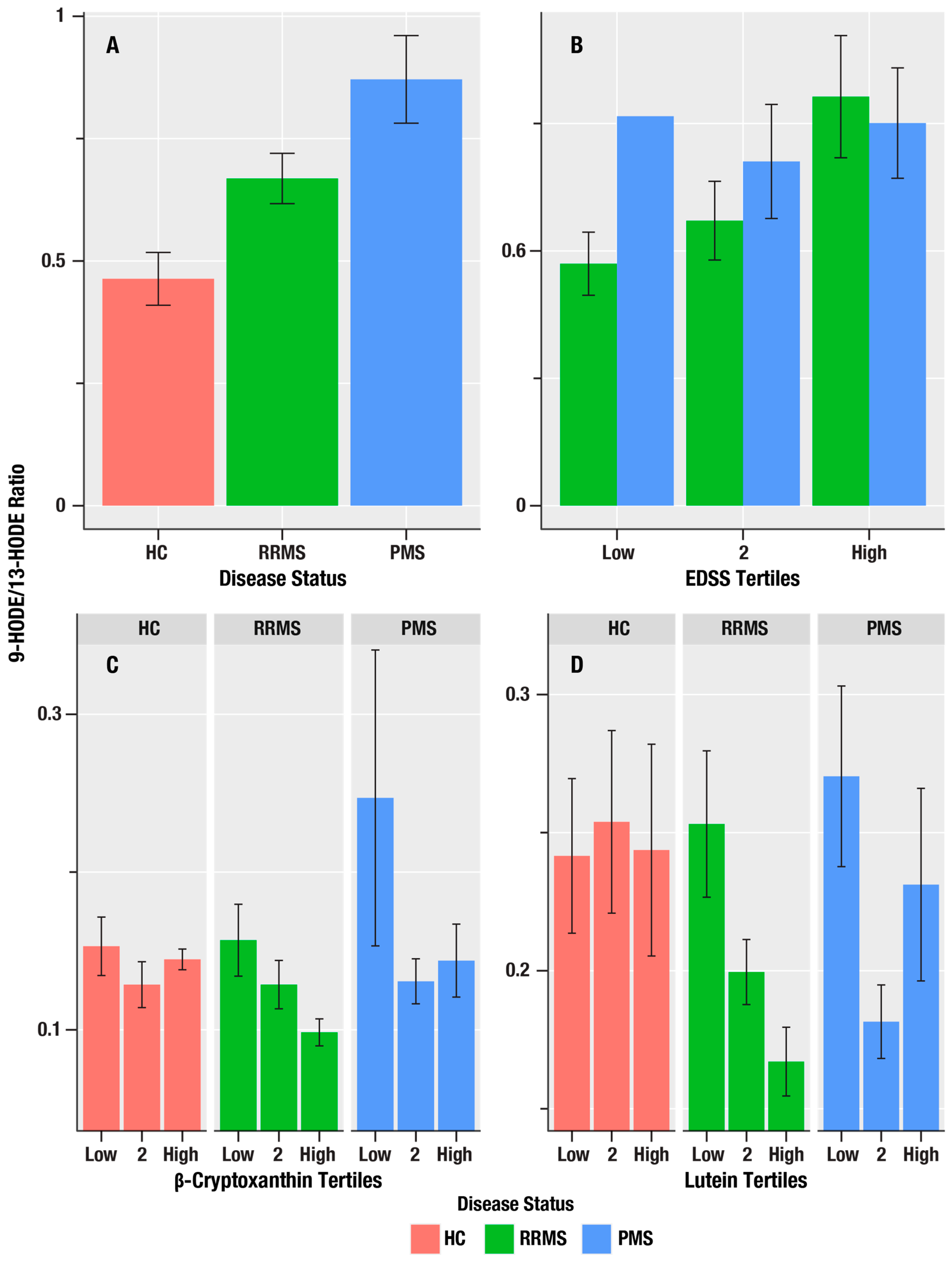
| 9-HODE/13-HODE | 0.463 | 0.669 | 0.871 | <0.001 |
| 9-HpODE | 7010 | 7260 | 8930 | 0.68 |
| 13-HpODE | 2900 | 2830 | 3400 | 0.65 |
| 13-HOTE | 258 | 190 | 230 | 0.6 |
| 12-HEPE | 180 | 282 | 337 | 0.14 |
| 5-HETE | 5.04 | 8.79 | 9.30 | 0.14 |
| 12-HETE | 502 | 539 | 563 | 0.66 |
| 12-HpETE | 37.2 | 47.9 | 52.2 | 0.52 |
| Dependent Variables | |||
|---|---|---|---|
| MS Disease Course (βRR, βPMS) η2 (p-Value) | EDSS β η2 (p-Value) | sNFL β η2 (p-Value) | |
| 9-HODE | (0.111, 0.496) 0.040 (0.072) | 0.378 0.038 (0.074) | 0 <0.001 (0.94) |
| 13-HODE | (0.093, −0.017) 0.004 (0.77) | 0.117 0.002 (0.65) | −0.013 0.001 (0.71) |
| 9-HODE/13-HODE | (0.128, 0.402) 0.096 (0.002) | 1.19 0.094 (0.004) | 00.005 (0.46) |
| 9-HpODE | (−0.042, 0.003) 0.004 (0.78) | 0.03 <0.001 (0.96) | −0.017 <0.001 (0.80) |
| 13-HpODE | (−0.051, −0.010) 0.005 (0.74) | 0.051 <0.001 (0.93) | −0.037 0.002 (0.60) |
| 13-HOTE | (−0.135, −0.095) 0.015 (0.38) | 0.023 <0.001 (0.95) | −0.013 <0.001 (0.80) |
| 12-HEPE | (0.097, 0.127) 0.010 (0.52) | 0.332 0.009 (0.40) | −0.018 0.001 (0.72) |
| 5-HETE | (0.119, 0.157) 0.027 (0.16) | 0.203 0.002 (0.69) | 00.003 (0.53) |
| 12-HETE | (0.072, 0.166) 0.017 (0.35) | −0.412 0.010 (0.36) | −0.029 0.003 (0.58) |
| 12-HpETE | (0.023, 0.039) <0.001 (0.94) | 0.542 0.022 (0.17) | −0.007 <0.001 (0.89) |
| α-Carotene | β-Carotene | α-Tocopherol | δ-Tocopherol | γ-Tocopherol | β-Cryptoxanthin | Lutein/Zeaxanthin | Lycopene | |
|---|---|---|---|---|---|---|---|---|
| 9-HODE | −0.018 0.003 (0.59) | −0.022 0.004 (0.49) | 0.013 0.007 (0.36) | 0.008 0.003 (0.74) | 0.069 0.056 (0.009) | −0.048 0.028 (0.068) | −0.016 0.006 (0.41) | −0.009 0.002 (0.60) |
| 13-HODE | −0.004 <0.001 (0.92) | −0.007 <0.001 (0.85) | 0.031 0.026 (0.079) | 0.015 0.004 (0.70) | 0.096 0.068 (0.004) | −0.030 0.007 (0.37) | 0.010 0.001 (0.69) | 0.005 <0.001 (0.81) |
| 9-HODE/13-HODE | −0.061 0.007 (0.36) | −0.067 0.010 (0.28) | −0.027 0.008 (0.34) | 0.008 <0.001 (0.87) | 0.033 0.003 (0.53) | −0.114 0.040 (0.028) | −0.088 0.043 (0.023) | −0.050 0.017 (0.16) |
| 9-HpODE | 0.036 0.002 (0.67) | 0.066 0.006 (0.42) | 0.070 0.031 (0.053) | 0.068 0.033 (0.23) | 0.140 0.035 (0.039) | −0.056 0.006 (0.41) | 0.011 <0.001 (0.82) | 0.001 <0.001 (0.98) |
| 13-HpODE | 0.032 0.001 (0.71) | 0.058 0.004 (0.48) | 0.077 0.037 (0.035) | 0.079 0.043 (0.17) | 0.127 0.028 (0.066) | −0.068 0.008 (0.32) | 0.009 <0.001 (0.86) | 0.005 <0.001 (0.91) |
| 13-HOTE | 0.150 0.047 (0.018) | 0.132 0.039 (0.030) | 0.066 0.047 (0.017) | 0.067 0.043 (0.17) | −0.034 0.004 (0.52) | 0.094 0.028 (0.067) | 0.085 0.041 (0.026) | 0.067 0.030 (0.057) |
| 12-HEPE | −0.044 0.004 (0.47) | <0.001 <0.001 (0.99) | 0.031 0.011 (0.25) | −0.008 <0.001 (0.86) | 0.157 0.083 (0.001) | −0.081 0.023 (0.100) | −0.030 0.005 (0.42) | −0.001 <0.001 (0.97) |
| 5-HETE | −0.090 0.010 (0.28) | −0.112 0.017 (0.16) | 0.012 0.001 (0.74) | −0.031 0.008 (0.55) | 0.260 0.123 (<0.001) | −0.150 0.042 (0.024) | −0.065 0.014 (0.19) | −0.044 0.008 (0.34) |
| 12-HETE | −0.008 <0.001 (0.90) | −0.032 0.002 (0.60) | 0.010 0.005 (0.64) | −0.100 0.054 (0.13) | 0.037 0.004 (0.48) | −0.014 <0.001 (0.79) | 0.024 0.003 (0.54) | −0.007 <0.001 (0.85) |
| 12-HpETE | −0.087 0.016 (0.17) | −0.060 0.008 (0.33) | 0.021 0.005 (0.46) | −0.009 <0.001 (0.84) | 0.218 0.148 (<0.001) | −0.096 0.029 (0.060) | −0.037 0.008 (0.34) | 0.007 <0.001 (0.84) |
| TRLP Total | VL-TRLP | L-TRLP | M-TRLP | S-TRLP | VS-TRLP (IDL) | ApoC-II | |
|---|---|---|---|---|---|---|---|
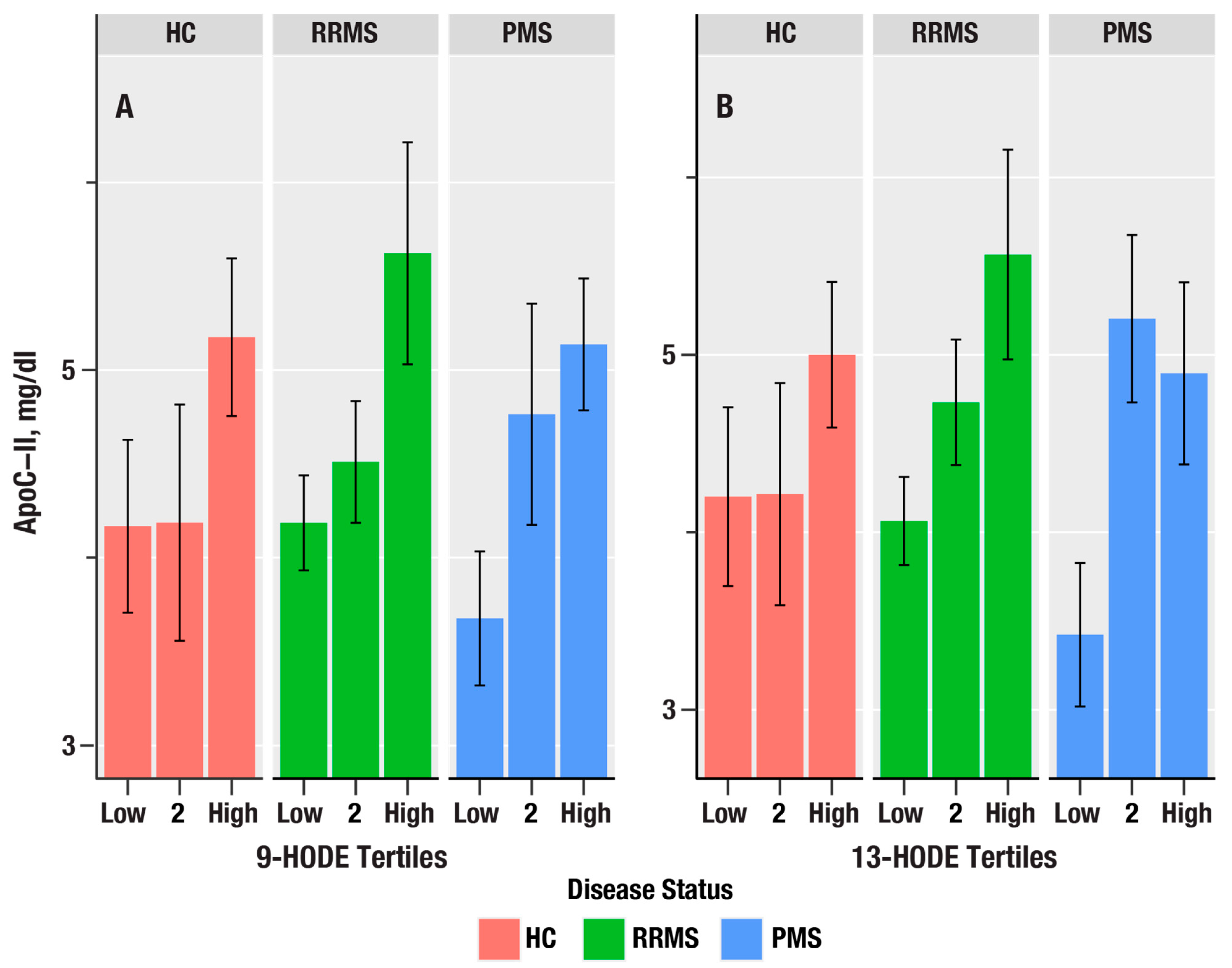
| 9-HODE | 0.091 0.177 (<0.001) | 0.055 0.011 (0.42) | 0.189 0.049 (0.110) | 0.250 0.138 (0.004) | 0.019 0.003 (0.69) | 0.187 0.178 (<0.001) | 0.044 0.055 (0.030) |
| 13-HODE | 0.073 0.089 (0.022) | 0.050 0.007 (0.53) | 0.201 0.041 (0.14) | 0.342 0.197 (<0.001) | 0.025 0.004 (0.65) | 0.131 0.066 (0.049) | 0.058 0.065 (0.019) |
| 9-HODE/13-HODE | 0.119 0.089 (0.022) | 0.060 0.004 (0.64) | 0.137 0.007 (0.540) | −0.037 <0.001 (0.82) | <0.001 <0.001 (1.00) | 0.300 0.133 (0.005) | 0.018 0.002 (0.65) |
| 9-HpODE | 0.098 0.027 (0.21) | −0.025 <0.001 (0.90) | 0.285 0.015 (0.380) | 0.466 0.063 (0.055) | 0.249 0.065 (0.051) | −0.007 <0.001 (0.97) | 0.099 0.046 (0.050) |
| 13-HpODE | 0.107 0.031 (0.180) | −0.030 <0.001 (0.88) | 0.411 0.031 (0.210) | 0.488 0.067 (0.048) | 0.260 0.069 (0.045) | 0.027 <0.001 (0.87) | 0.097 0.041 (0.062) |
| 13-HOTE | −0.039 0.011 (0.42) | −0.082 0.009 (0.48) | 0.110 0.006 (0.580) | 0.162 0.020 (0.28) | 0.148 0.060 (0.061) | −0.152 0.041 (0.12) | −0.014 0.002 (0.70) |
| 12-HEPE | 0.147 0.126 (0.006) | 0.043 0.002 (0.75) | 0.023 <0.001 (0.920) | 0.250 0.038 (0.140) | 0.045 0.004 (0.62) | 0.221 0.068 (0.046) | 0.069 0.039 (0.069) |
| 5-HETE | 0.211 0.116 (0.008) | −0.028 <0.001 (0.89) | 0.178 0.006 (0.600) | 0.507 0.069 (0.044) | 0.062 0.004 (0.65) | 0.363 0.081 (0.029) | 0.134 0.089 (0.005) |
| 12-HETE | −0.050 0.015 (0.35) | 0.067 0.005 (0.61) | −0.256 0.027 (0.240) | −0.116 0.008 (0.49) | −0.011 <0.001 (0.900) | −0.070 0.007 (0.53) | 0.021 0.003 (0.63) |
| 12-HpETE | 0.163 0.165 (0.001) | −0.003 <0.001 (0.98) | 0.216 0.019 (0.32) | 0.341 0.074 (0.037) | 0.080 0.015 (0.36) | 0.197 0.057 (0.069) | 0.106 0.092 (0.005) |
| CRP | GlycA | LC3A | 7-KC | |
|---|---|---|---|---|
| 9-HODE | 0.168 0.063 (0.012) | 0.019 0.055 (0.036) | −0.028 0.035 (0.041) | 0.076 0.051 (0.025) |
| 13-HODE | 0.195 0.053 (0.021) | 0.028 0.086 (0.008) | −0.049 0.070 (0.004) | 0.097 0.053 (0.022) |
| 9-HODE/13-HODE | 0.166 0.017 (0.20) | −0.002 <0.001 (0.89) | 0.014 0.002 (0.61) | 0.050 0.006 (0.45) |
| 9-HpODE | 0.182 0.011 (0.31) | 0.044 0.044 (0.062) | −0.122 0.108 (<0.001) | 0.191 0.048 (0.031) |
| 13-HpODE | 0.173 0.009 (0.34) | 0.041 0.037 (0.087) | −0.122 0.103 (<0.001) | 0.189 0.046 (0.034) |
Disclaimer/Publisher’s Note: The statements, opinions and data contained in all publications are solely those of the individual author(s) and contributor(s) and not of MDPI and/or the editor(s). MDPI and/or the editor(s) disclaim responsibility for any injury to people or property resulting from any ideas, methods, instructions or products referred to in the content. |
© 2026 by the authors. Licensee MDPI, Basel, Switzerland. This article is an open access article distributed under the terms and conditions of the Creative Commons Attribution (CC BY) license.
Share and Cite
Wicks, T.R.; Wolska, A.; Ghazal, D.; Shalaurova, I.; Weinstock-Guttman, B.; Browne, R.W.; Remaley, A.T.; Zivadinov, R.; Ramanathan, M. Oxylipin Biomarkers of Auto-Oxidation Are Associated with Antioxidant Micronutrients and Multiple Sclerosis Disability. Antioxidants 2026, 15, 102. https://doi.org/10.3390/antiox15010102
Wicks TR, Wolska A, Ghazal D, Shalaurova I, Weinstock-Guttman B, Browne RW, Remaley AT, Zivadinov R, Ramanathan M. Oxylipin Biomarkers of Auto-Oxidation Are Associated with Antioxidant Micronutrients and Multiple Sclerosis Disability. Antioxidants. 2026; 15(1):102. https://doi.org/10.3390/antiox15010102
Chicago/Turabian StyleWicks, Taylor R., Anna Wolska, Diala Ghazal, Irina Shalaurova, Bianca Weinstock-Guttman, Richard W. Browne, Alan T. Remaley, Robert Zivadinov, and Murali Ramanathan. 2026. "Oxylipin Biomarkers of Auto-Oxidation Are Associated with Antioxidant Micronutrients and Multiple Sclerosis Disability" Antioxidants 15, no. 1: 102. https://doi.org/10.3390/antiox15010102
APA StyleWicks, T. R., Wolska, A., Ghazal, D., Shalaurova, I., Weinstock-Guttman, B., Browne, R. W., Remaley, A. T., Zivadinov, R., & Ramanathan, M. (2026). Oxylipin Biomarkers of Auto-Oxidation Are Associated with Antioxidant Micronutrients and Multiple Sclerosis Disability. Antioxidants, 15(1), 102. https://doi.org/10.3390/antiox15010102