1. Introduction
In our daily life, there are many problems where uncertainty is involved in the data associated with them. These problems are very common in engineering, economics, medicine and social sciences. There always occurs difficulties in addressing such problems by applying classical mathematical techniques because such techniques are structured for clear situations. One of the best known theories to deal with uncertainty is a fuzzy set theory. Following the pioneering work of Zadeh [
1], the fuzzy set theory has expanded in a numerous directions, such as intuitionistic fuzzy set [
2], hesitant fuzzy set [
3], hesitant probabilistic fuzzy set [
4], expanded hesitant fuzzy set [
5], and necessary and possible hesitant fuzzy set [
6]. Atanassov [
2] generalized the notion of fuzzy set to intuitionistic fuzzy set (IFS) by adding the concept of a non-membership function to a fuzzy set. IFS is a powerful tool used to handle the problems of decision-making that a fuzzy set could not address properly. Yager [
7] suggested the concept of Pythagorean fuzzy subsets which are the most effective ones that relate to the representation of the membership degrees of the underlying fuzzy set. Torra [
3] introduced a new generalized form of fuzzy set called hesitant fuzzy set (HFS), which opens a new dimension of further research in decision theory.
HFS has a lot of merits over the traditional fuzzy set and its extensions, especially in group decision-making with anonymity. HFS has attracted several researchers’ attention. Xu and Xia [
8,
9] initially provided the mathematical expression of HFS and investigated the distance, similarity and correlation measure for HFSs. Torra also set up the relation between HFS and IFS, according to which Xia and Xu [
8] defined some basic operational laws for HFSs. In addition, many extensions of HFS [
10,
11,
12,
13] were proposed to model the fuzzy hesitant problems from different prospectives. The HFS is a widely used fuzzy set in decision-making, especially, in those situations in which DMs hesitate to give their preferences. Anyhow, it has the following two major deficiencies:
HFS provides only the membership information of DMs’ opinions and pay no attention to the non-membership information. In order to get accurate results, DMs should be allowed to provide the membership as well as the non-membership information.
HFS ignores the importance of multiple times occurring opinions, which may lead to unfruitful decision ranking results.
To handle real life scenarios more accurately, Zhu et al. [
13] proposed a dual hesitant fuzzy set (DHFS) that permits both the membership and non-membership grades of an element to a given set having different values. The DHFS is a more flexible tool for DMs to assign their views for each element in the domain. Pathinathan and Savarimuthu [
14] extended the TOPSIS method for DHFS and describe the application of this new type of set in the framework of decision making. Wang et al. [
15] investigated the correlation measure of DHFS and develop a direct transfer algorithm regarding the problem of complex operation of matrix synthesis. Zhu and Xu [
16] extended the DHFS to typical dual hesitant fuzzy set (TDHFS) and construct a number of operations and properties to generalize the operations of this new type of set. After that, the distance and similarity measure [
17,
18], the entropy measure [
19] and the evaluation model [
20] regarding DHFS have been developed to handle the MAGDM problems. For the purpose of comparison of DHFSs, Ren et al. [
21] studied the score function and distance measure. In addition to this, they also extended the VIKOR method for DHFSs.
Anyhow, DHFSs, as well as its extensions, cover the deficiency 1 of HFS, but they are not suitable for the situation where DMs could not reach agreement. For example, assume that a decision is made by a decision-making group that contains no less than two DMs. Different DMs have different opinions on the membership and non-membership degrees and it is possible that some DMs opinions may coincide. Thus, repeated rating values occur in data. This repetition is important and removal of this may lead to unfruitful decision results. Recently, Xiong et al. [
22] defined a proportional hesitant fuzzy set (PHFS) to handle deficiency 2 of HFS. This is a new approach for handling the imprecise data with more care.
In order to cover both the aforementioned deficiencies of HFS, in this paper, the concept of PDHFS is developed, in which the membership grades as well as the non-membership grades are presented by several possible numbers along with their proportions. The PHFS enclosed HFS, DHFS and PHFS as special cases, making it a more powerful tool to handle uncertainty and complexity of real life.
We highlight the article by the following pioneering work:
A novel concept known as PDHFS is proposed along with practical example which encompasses DHFS and its extensions.
For the purpose of comparison of PDHFSs, score function and deviation degree of PDHFSs are designed.
Some basic operations, main results and normalized Hamming distance on DHFSs are extended to the PDHFS setting.
A comprehensive MAGDM TOPSIS method with a proportional dual hesitant fuzzy decision information is introduced and applied to the university faculty evaluation problem.
The detailed comparative analysis with other MAGDM methods is done in order to show the advantages of the proposed set and methodology.
The remainder of the paper is structured as follows: in
Section 2, some basic concepts are provided, which is essential for the understanding of our research work. In
Section 3, we first define the concept of PDHFS and then prove some of its interesting mathematical properties. In
Section 4, distance measure is proposed between two PDHFSs in order to study a comparison between them.
Section 5 is dedicated to presenting the working algorithm for TOPSIS.
Section 6 gives an application to elaborate our proposed methodology. The comparative analysis is studied in
Section 7.
Section 8 makes the concluding remarks and indicates future work lines.
3. The Notion of the Proportional Dual Hesitant Fuzzy Set
Inspired by the idea behind proportional hesitant fuzzy set, this section puts forward a novel concept called PDHFS to model and compute the group decision making (GDM) problems with more care and produce more accurate results. The basic operations and properties are also studied in this section.
Definition 8. Let X be a universe of discourse, and a proportional dual hesitant fuzzy set (PDHFS) on X is a triplet described asin which and are two sets in , presenting n kinds of possible membership and m kinds of possible non-membership degrees of the element to the set S, respectively, and , are sets in , presenting the proportion of membership degrees and non-membership degrees respectively, with the conditions:where and . For convenience and simplicity, we call the pair as a proportional dual hesitant fuzzy element (PDHFE) and also will be written in short.
For clarification, we provide the following example.
Example 1. Let . Consider Then, it is easy to check the conditions of PDHFS and
are PDHFEs.
Remark 2. Particularly, if the proportion values of all terms in membership part and non-membership part become equal, then PDHFS reduces to DHFS. Then, in that case, PDHFS reduces to HFS. Thus, the definition of PDHFS encompasses these fuzzy set extensions.
In order to illustrate the PDHFS more straightforwardly, in the following, a practical life example is provided to depict the difference between PDHFS and DHFS:
Example 2. Take the evaluation of a university teacher based on the attribute/criteria like research skill as an example. Three experts provide the following evaluation values to measure his performance.in terms of DHFS the above evaluation data can be expressed as The proportion of the membership value is . Similarly, we can find the proportion of all other membership and non-membership values. The overall evaluation can be represented by PDHFE as follows: In the DHFE, a value repeated more times has no more importance than less repeated values, which is unrealistic because a higher repeated value should be more important in aggregating DMs’ opinions than the other values. Thus, DHFE fails to express the evaluation of a teacher more reasonably. Therefore, to get more reasonable results, it is better that the experts provide their evaluations in terms of PDHFEs because PDHFE gives importance to the repeated values.
Definition 9. Let X be a universe of discourse, for any , we call:
as the empty proportional dual hesitant fuzzy element (EPDHFE).
A PDHFS whose all PDHFEs are EPDHFEs is called an empty proportional dual hesitant fuzzy set (EPDHFS), denoted by Θ;
as the fully proportional dual hesitant fuzzy element (FPDHFE).
A PDHFS whose all PDHFEs are FPDHFEs is called fully proportional dual hesitant fuzzy set (FPDHFS), denoted by ϝ.
Definition 10. For a given PDHFE its complement is defined as follows: Proposition 1. The complement is involuative, i.e.,
Proof. It trivially follows from the Definition 10. □
Next, the union and intersection of PDHFSs are defined which are based on the corresponding lower and upper bounds of membership and non-membership PHFSs. For any two PDHFSs say, and , one should note that , , and represent the corresponding lower and upper bounds to and , respectively.
Definition 11. Let X be a universe of discourse and , be two PDHFEs. Then,
;
.
and are computed according to Definition 6.
Let and represent the number of values in and , respectively, of a PDHFE . To prove this, in most cases i.e., . To overcome this issue of ordering and adding, a method for PDHFEs is proposed in which the following two simple steps are performed:
Step : Ordering;
Arrange the elements in and in decreasing order according to the product values of the assessment and their associated proportions.
Step : Adding;
Extended the shorter one by adding the element several times until their lengths becomes the same.
Definition 12. Let A and B be any two PDHFSs on a fixed set X. Then, they are said to be of equal length if their corresponding PDHFEs are of equal length.
Note: One can generalize the above definition to n PDHFSs.
The following operations are defined for PDHFSs in order to use them in practical decision-making problems:
Definition 13. Let X be a universe of discourse, and be two PDHFEs of equal length; then, the following operations are defined:
where α is a positive integral, and are chosen such that and are the jth and tth smallest product values in PDHFEs and , respectively.
Remark 3. Here, we have assumed that all PDHFEs are of equal length. However, in most cases, they are unequal, which produces problems in basic operations and distance measure. Then, in that situation, their lengths are equalized according to the ordering and adding method as discussed above.
Theorem 1. Let be any three PDHFSs on X. Suppose ; then:
,
,
,
Proof. Then, . Similarly, one can show that .
Since
then
.
Similarly,
Since
then
.
Similarly, one can show that .
Since
Case(I); If
Case(II); If
Case(III); If
Then, .
Similarly, one can show that . □
4. The Comparison Notions between PDHFSs Based on PDHFEs
A distance measure is designed for determining the degree of distance between two sets in the fuzzy set theory, which has received attention from scholars [
25,
26,
27]. This section first defines the distance between two PDHFSs. Based on it, the comparison law is developed for PDHFSs.
Based on Definition 4, we come up with the following definition.
Definition 14. Let A and B be any two PDHFSs of equal length on ; then, the proportional dual hesitant normalized Hamming distance iswhere , and represent the number of elements in h and g, respectively, is the largest product value in and is the largest product value in . One can check easily that the following properties hold for .
For the purpose of ranking alternatives, in the following, we develop the comparison method for PDHFSs.
Definition 15. Let be a PDHFE on ; then, the score function of is defined as follows:and the deviation function of is defined as follows: Combining with the distance measure, the comparison method for PDHFEs can be defined as follows:
Definition 16. Let be two PDHFEs, and be their score and deviation values, respectively.
if , then ; on the contrary, there is
if and , then
if ,
(a) and , then ,
(b) and , then ,
where ϝ is the fully proportional dual hesitant fuzzy set and is the distance between A and B.
Example 3. Let and be two PDHFEs. Then, and . According to Definition 16, .
5. A Group Decision-Making Approach for Proportional Dual Hesitant Fuzzy Information
This section concentrates on introducing some theory in order to construct an algorithm to model real world problems.
5.1. Algorithm Based on Proportional Dual Hesitant Fuzzy MAGDM
The multi attribute group decision making (MAGDM) problem under the proportional dual hesitant fuzzy environment is described as follows:
Consider the MAGDM problem in which there is a set of
m alternatives
and a set of attributes
. Furthermore, let there be ‘
l’ DMs
. The DMs offer their evaluation values in the form of classical intuitionistic fuzzy numbers (IFNs) keeping in mind all the alternatives and attributes and thus
k evaluation matrices
are constructed with the classical IFNs. Then, the overall evaluation matrix
R is computed as follows:
where
Furthermore, and contain the proportional (repetition) values of the members of and , respectively, for .
It is noted that the overall values of R are PDHFEs.
Definition 17. Let be the overall evaluation matrix. Then, is referred as the positive ideal solution (PIS) of alternatives, where Definition 18. Let be the overall evaluation matrix. Then, is referred to as the negative ideal solution (NIS) of alternatives, where It is noted that, in the above definitions, max and min are taken based on Definition 7.
Definition 19. The separation of each alternative from the PIS is defined with the help of proportional dual hesitant normalized Hamming distance as follows:where . Definition 20. The separation of each alternative from the NIS is defined as follows:where . Clearly, the smaller the distance the better the alternative and the larger distance implies the better alternative .
After obtaining the separations of alternatives, the closeness coefficient are calculated by the following formula to rank all the alternatives:
where
represents the closeness coefficient of each alternative. The larger the
, the better the alternative
. Therefore, all the alternatives can be ranked by using the closeness coefficient and thus the best alternative
can be chosen.
5.2. TOPSIS
To solve decision-making problems with PDHFS, our choice is to design a TOPSIS (Technique for Order Preference by Similarity to Ideal Solution) method that uses PDHFEs to express the opinions of DMs. The TOPSIS was constructed to address problems of multi-attribute decision-making with uncertain and complex data. It is a practical and effective technique for ranking and choosing of the best alternative in a group decision environment. For better visibility, in this technique, the given data of alternatives judged against each criteria provided by DMs are placed in the evaluation matrices and then these preferences of DMs are aggregated into the overall evaluation matrix. Normalization process is done, if needed. After that, positive ideal solution and negative ideal solution are computed by applying specific formulae. Then, the separation of each alternative from the positive ideal solution and the negative ideal solution are calculated by using distance formula. In the end of TOPSIS, a closeness coefficient is computed in order to find a scenario that is closest to the positive ideal solution and farthest from the negative ideal solution to classify the alternatives from best to worst. Unlike other developments, this scheme is indeed a unified mechanism and is easily applicable to many real life decision-making problems without enlarging the computational burden. Motivated by [
14,
22], in the following, we design the TOPSIS in the PDHFS regard. This decision raking procedure involves the following steps.
Step no 1: Analyze the given MAGDM problem and determine a set of alternatives , a set of attributes and DMs provide evaluation matrices .
Step no 2: Calculate the overall evaluation information matrix
is a PDHFE.
Step no 3: Since all the values in the overall evaluation matrix R are PDHFEs, there is no need to normalize them.
Step no 4: Compute the PIS and the NIS of all the alternatives by using Definitions 17 and 18, respectively.
Step no 5: Definitions 19 and 20 are utilized to find and of each alternative.
Step no 6: Obtain the closeness coefficient
of each alternative by solving Equation (
15).
Step no 7: Rank all alternatives and pick the best one according to the closeness coefficient .
Step no 8: End.
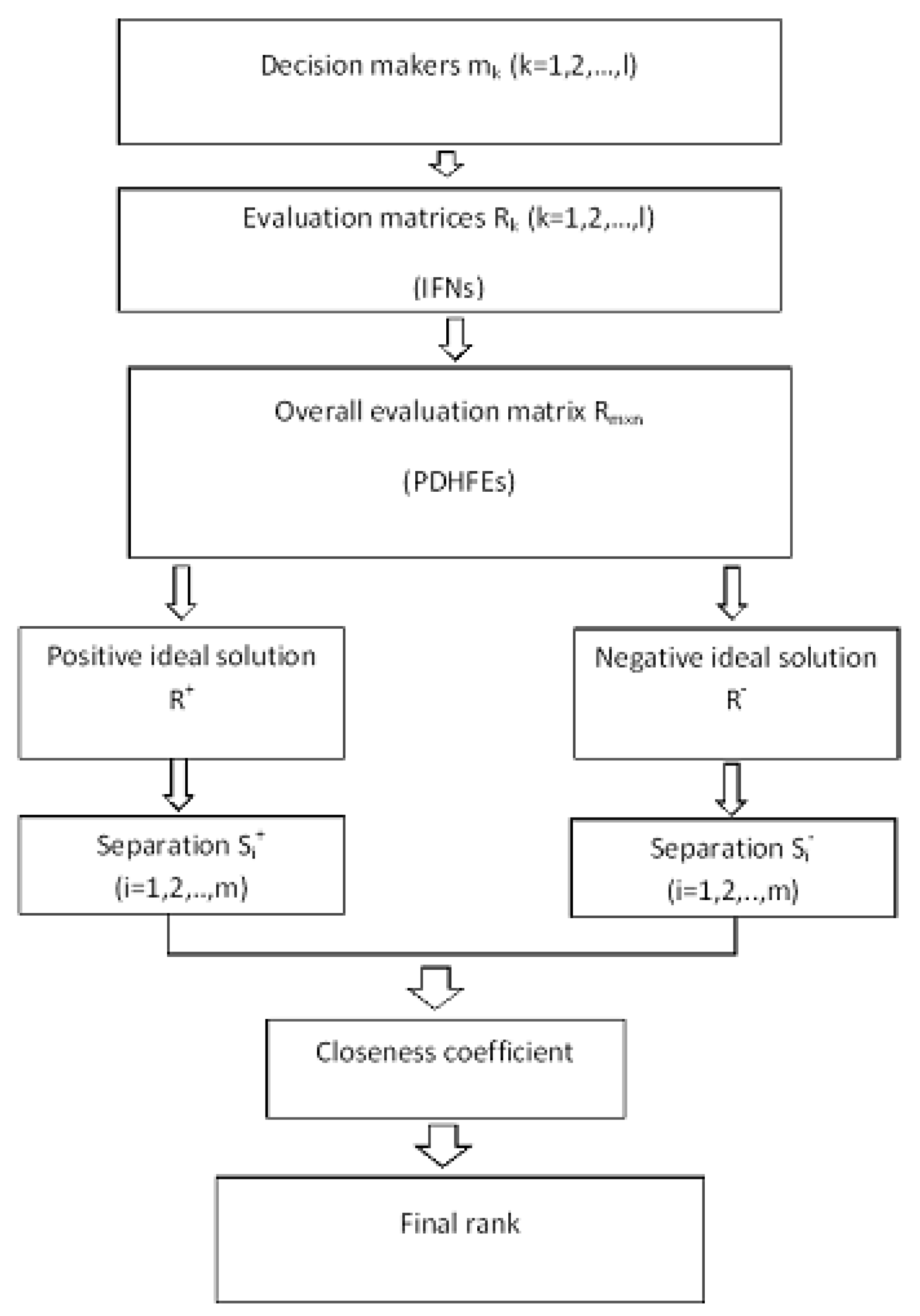
The
Figure 1 presents the flowchart of proposed decision methodology.
6. A Case Study
In order to demonstrate the applicability of proposed scheme, we choose the case study proposed by Katz et al. [
28]. They studied the promotion criteria of university professors and used multiple regression analysis to choose the factors that play important roles in the professors’ promotion while making decisions at the university level and build a more reasonable method for rewarding and evaluating university professors. Actually, they were inspired by the fact that there is an unfair way under which professors get a promotion from assistant to associate and associate to full professor. They said that a professor’s promotion runs through an irrational and chaotic way and a more justifiable approach could be designed to improve the decision ranking process. In this section, we depict our proposed methodology by evaluating the university faculty in Pakistan adapted from [
29].
The problem is formulated as follows: Let
be a set of four faculty professors (alternatives) to be evaluated using the IFNs. Suppose that we use three criteria
teaching,
research and
service to evaluate the faculty professors for tenure and promotion. Based on these criteria, a committee of four experts
,
and
and
provides their opinions in
Table 1,
Table 2,
Table 3 and
Table 4, respectively, in the form of IFNs.
TOPSIS Method for the Illustrative Example
We employ the proposed TOPSIS method designed in
Section 5 to handle the above problem as follows:
Step 1: Based on the evaluation matrices
, we compute the overall evaluation matrix
given in the
Table 5.
Step 2: The score and deviation values of the PDHFEs in the overall evaluation matrix R are computed according to Equations (
10) and (
11) and displayed in
Table 6.
Step 3: Since all criteria are benefit criteria, following Definitions 17 and 18, the positive ideal solution is
and the negative ideal solution is
Step 4: According to Definition 19, the separation of each alternative from the PIS are and according to Definition 20, the separation of each alternative from the NIS are
Step 5: Compute the closeness coefficient
Step 6: The ranking result of all professors on their performance is
Therefore, professor achievement is the top of the range.
7. Comparative Analysis of the Proposed Decision-Making Scheme with
Existing Ones on the Basis of Case Study
In what follows, the detailed comparative analysis is presented with the traditional approach and Ref. [
22] approach to illustrate the essentiality of our proposed scheme.
7.1. Dual Hesitant Fuzzy TOPSIS Approach for MAGDM
Neglecting the proportional figures, the major steps involved in the traditional TOPSIS approach are:
Step : DMs provide evaluation matrices with the traditional IFNs.
Step : Compute the overall evaluation information matrix is a DHFE.
Step
: The positive ideal solution (PIS) of alternatives is defined as follows:
where
Similarly, the negative ideal solution (NIS) of alternatives is defined as follows:
where
Step
Based on Definition 4, measure the separation of each alternative
from the PIS as follows:
where
.
Similarly, measure the separation of each alternative
from the NIS as follows:
where
.
Step
: Obtain the closeness coefficient of each alternative
with respect to the PIS and NIS as:
Step : Classify all alternatives on the basis of their closeness coefficient. The greater the closeness coefficient , the more acceptable the alternative .
7.2. Handling the Case Study through the Dual Hesitant Fuzzy TOPSIS
Approach
In order to conduct a comparative analysis, the illustrative example is again solved according to the above dual hesitant fuzzy TOPSIS approach as follows:
Step
: We compute the overall evaluation dual hesitant fuzzy information matrix
given in the
Table 7.
Step
: Based on the Definition
of Reference [
13], the score and deviation values of DHFEs in overall evaluation matrix
R are computed and displayed in
Table 8.
Step
: Since all criteria are benefit criteria, the positive ideal solution is therefore
and the negative ideal solution is
Step : The separation of each alternative from the PIS are while the separation of each alternative from the NIS are
Step : Compute the closeness coefficient
Step
: The ranking result of all professors on their performance is
Therefore, professor is the top of the range.
7.3. Handling the Case Study through the Proportional Hesitant Fuzzy
TOPSIS Approach
Assume that DMs provide their decision information in the form of proportional hesitant fuzzy sets rather than proportional dual hesitant fuzzy elements. Then, according to proportional hesitant fuzzy TOPSIS method [
22], we solve the fuzzy MAGDM as follows:
Step
: Based on the evaluation matrices
given in
Table 9,
Table 10,
Table 11 and
Table 12, we compute the overall evaluation matrix
displayed in the
Table 13.
Step
: The score and deviation values of PHFEs in overall evaluation matrix
R are computed according to Equations (
5) and (
6) and displayed in
Table 14.
Step
: The PIS of alternatives is
and the NIS of alternatives is
Step : The separation of each alternative from the PIS are and the separation of each alternative from the NIS are
Step : Compute the closeness coefficient
Step
: The ranking result of all professors on their performance is
From the above ranking, one can see that professor achievement is again the top of the range.
7.4. Discussion
The major advantages of the proposed set and methodology over the existing studies are summarized below.
From
Table 7, the disadvantages of DHFS are apparent. As in DHFS, the proportion figures of the assessments are ignored, which means that all possible assessments in DHFS have the same occurrence probability, which is unrealistic because those values that occur multiple times have lost their importance. On the other hand, the inspection of
Table 5 shows that PDHFS contains not only the membership and non-membership parts, but also take into account their associated proportion figures, and, thus PDHFS constitutes an extension of DHFS.
Table 13 indicates that PHFS only assigns to each element a membership grades along with proportion, while PDHFS assigns to each element the membership grades as well as the non-membership grades along with their associated proportions. Thus, PDHFS provides a more flexible expression way for DMs to express their opinions from different prospectives in a more conformed to the reality approach.
The score function and the deviation degree results of PDHFS shown in
Table 6 are quite similar to those displayed in
Table 8 for DHFS. However, from
Table 14, we observe that these values are different from those derived for PHFS. The main reason of this difference is that the non-membership part of DM opinions is ignored in PHFS and thus partial information is lost. This comparison guarantees that the values of the score function and the deviation degree of PDHFS are reasonable and interpretable.
From
Table 15, we can see that the ranking order of traditional approach is different from the proposed method and the method in Ref. [
22]. This difference is due to the effect of proportions. Although neglecting the proportional figures reduce the complexity of calculations, but its neglect leads to unsatisfactory ranking results.
Various remarkable similarities and dissimilarities of the novel approach with other approaches are summarized in
Table 16.