Abstract
Conventional orthogonal frequency division multiple access (OFDMA) burst construction methods can only support limited numbers of connections due to the map overhead and corresponding limitations in the numbers of orthogonal resources blocks, which limits the capacity of current 4G and the following 5th generation (5G) networks. This study therefore provides a novel OFDMA burst construction algorithm and enhanced burst indexing aware algorithm (EHA), which try to maximize the throughput while considering the subchannel diversity and optimizing burst indexing issues. The EHA not only allocates the subchannels with the best channel quality for each burst, but also groups the bursts to alleviate the MAP overhead. Simulation results showed that the EHA yields two times the throughput that has been achieved using previous algorithms under a heavy load. Two contributions of the EHA are: (1) the overhead of burst indexing decreases because massive numbers of connections can be accommodated by one burst; and (2) the overall throughput increases due to that one connection with large data transferring requirements can be split and distributed into several bursts and placed on the subchannels with good channel quality to adopt better modulation coding scheme (MCS), if the saved bandwidth in this burst construction is more than the increased overhead of burst indexing.
1. Introduction
As orthogonal frequency division multiple access (OFDMA) adopted by long-term evolution (LTE) acquires enormous 4G market success because it makes signal detection relatively simple [1]. For OFDMA systems, resource blocks are orthogonally divided in time and frequency, which are called bursts, and allocated to connections. The bandwidth allocation therefore becomes a two-dimensional bin packing problem. That is, the burst construction can be regarded as the process of placing items of variable heights, widths, and values into a two-dimensional area to maximize the total value of all items in the area.
Subchannel diversity must be considered during burst construction to efficiently utilize the bandwidth resources. Subchannel diversity means that a user locating different locations may encounter different channel qualities in different subchannels, and the connection have different modulation coding scheme (MCS) on various subchannels [2]. Thus, burst should be placed on the subchannel with the best channel quality (called best subchannels), while considering the subchannel diversity. Various burst construction methods have been proposed to solve the subchannel diversity issue [3,4,5,6,7,8,9,10,11,12,13,14].
The conventional OFDMA burst construction methods, however, can only support a limited number of connections due to the map overhead (also called MAP overhead) and corresponding limitations in the numbers of orthogonal resources blocks, which limits the capacity of current 4G and the following 5G networks [1]. The MAP overhead is the size of the index of each burst, and it increases along with number of bursts, while the index indicates the position and size of each burst. The more bursts that exist, the bigger the MAP overhead that occurs, leading to more bandwidth resources that are wasted to transmit MAP overhead. Optimizing the burst indexing becomes an urgent need to support a massive number of and dramatically different classes of users and applications in 4G and following 5G networks. However, the methods in References [3,4,5,6,7,8,9,10,11,12,13,14] do not consider the burst index optimization problem.
This study therefore provides a novel OFDMA burst construction algorithm, enhanced burst indexing aware algorithm (EHA), which try to maximize the throughput while considering the subchannel diversity and optimizing burst indexing issues mentioned above. The basic idea of EHA is to transform the burst construction problem, which is a two-dimensional bin packing problem, to the max-weighted bipartite matching problem, which assigns different numbers of subchannels to connections according to the channel quality of connections, given the constrains of the MAP overhead. The EHA also uses a burst to accommodate the connections belonging to a user in order to decrease the MAP overhead. Furthermore, the EHA minimizes the internal fragmentation of a burst by flexibly constructing the burst area in a subchannel that the requested bandwidth is satisfied, and thus the remaining slots in a subchannel can be used by other connections. Based on the above design, the two contributions of EHA are: (1) the overhead of burst indexing decreases because massive numbers of connections can be accommodated by one burst; and (2) the overall throughput increases if that one connection with a large data transferring requirement can be split and distributed into several bursts and placed on the subchannels with good channel quality to adopt better MCS.
The rest of this paper is organized as follows. In Section 2, we describe the background in the OFDMA network and previous related works. Section 3 presents the problem statement of the downlink burst allocation. In Section 4, our proposed EHA algorithm is described in detail. Then, the performance evaluation is presented in Section 5. Finally, some conclusions are given in Section 6 by summarizing the gains.
2. Background and Related Works
2.1. OFDMA Network
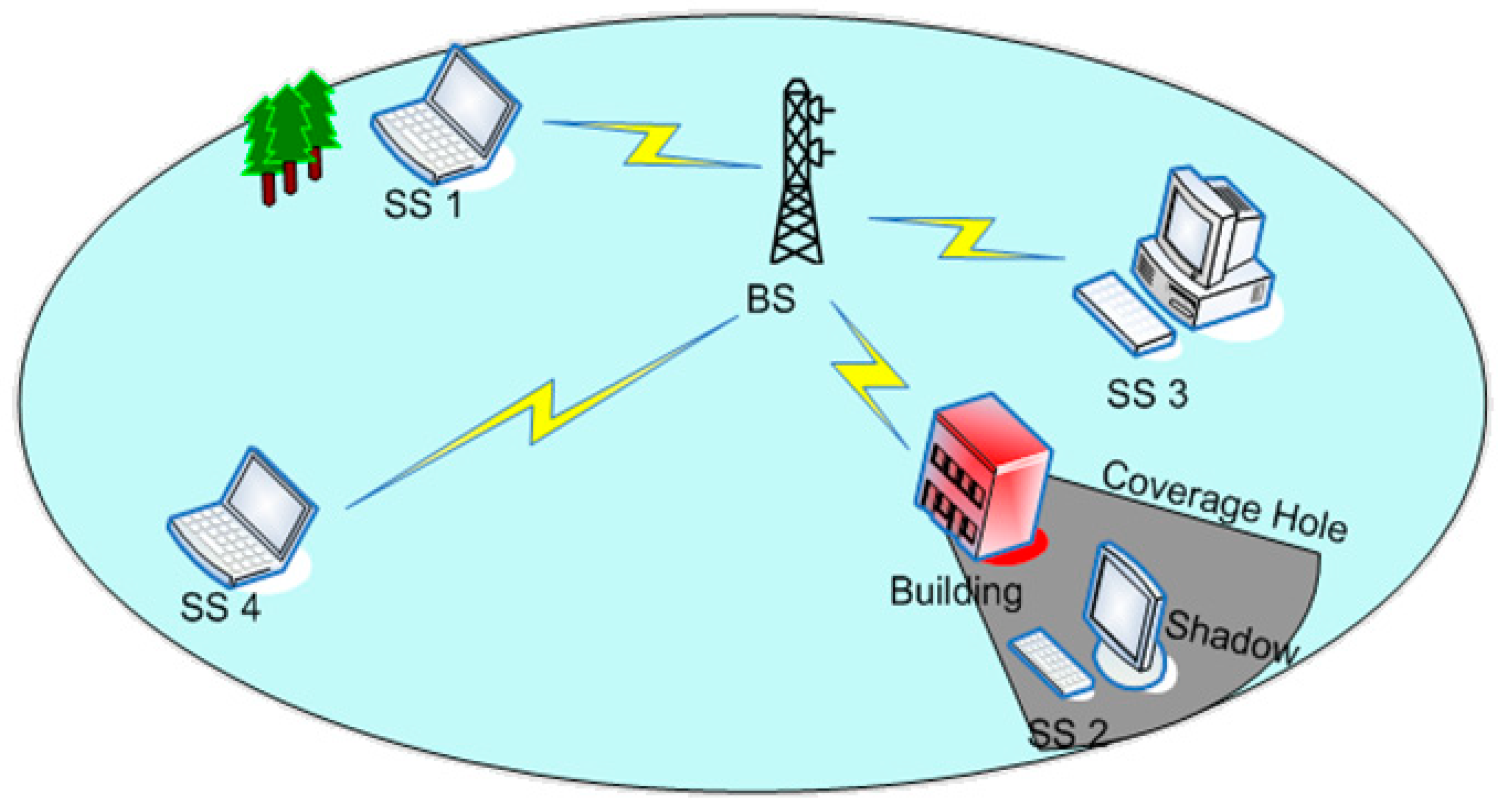
The conventional OFDMA network architecture consists of two fixed stations, namely the base station (BS in Figure 1) and subscriber station (SS in Figure 1), as shown in Figure 1. The BS is typically a service provider, which connects to a public network and provides each SS with the last-mile access to public networks. The SS may be a portable device which is called a mobile station (MS). Each frame consists of downlink (DL) and uplink (UL) subframes. The DL carries information from a BS to SSs, while the UL carries information from the opposite direction (i.e., subscriber to base station).
Figure 1.
Orthogonal frequency division multiple access (OFDMA) network.
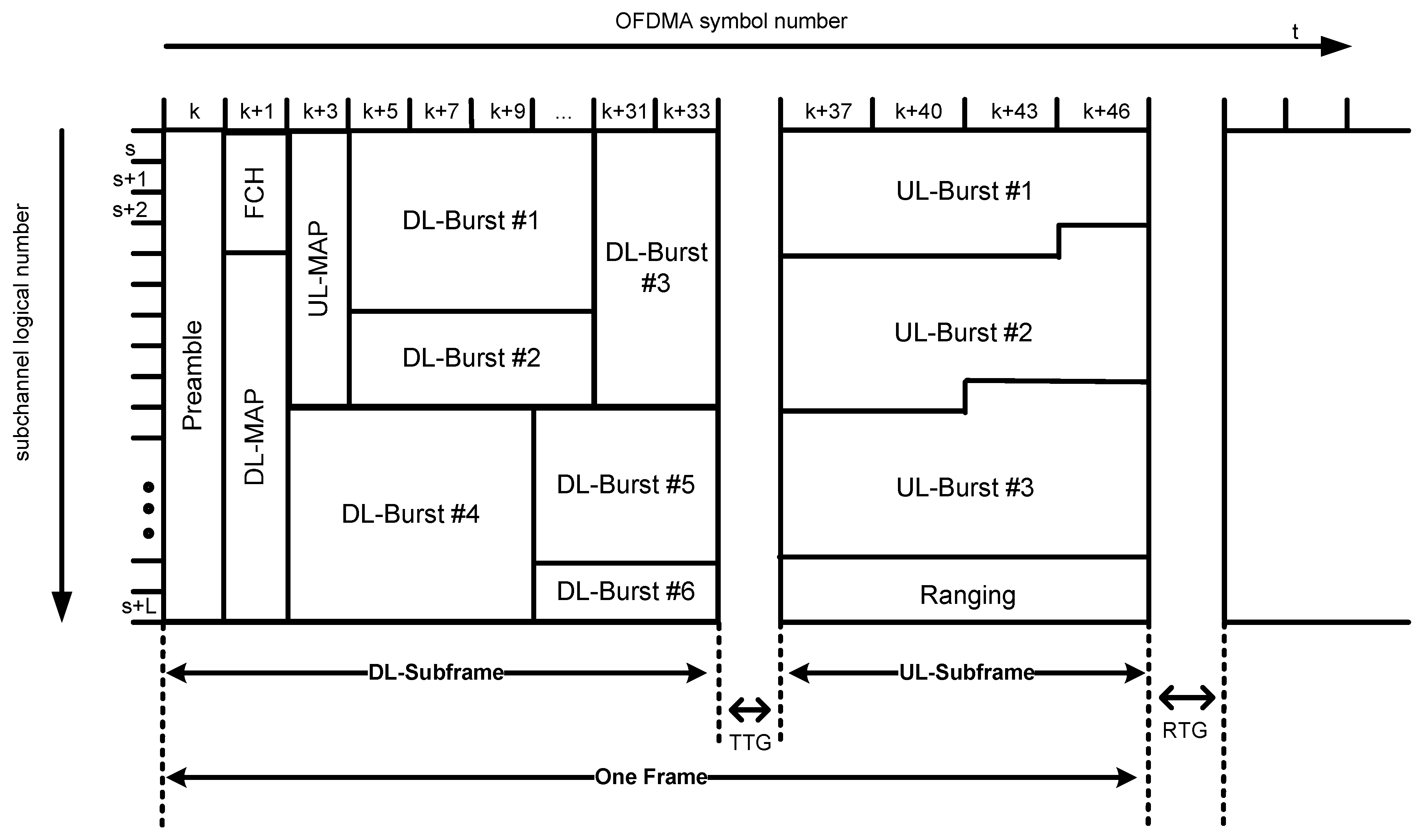
Downlink and uplink subframes are duplexed by either using frequency division duplex (FDD) or time division duplex (TDD). Frequency division duplex is suitable for bi-directional communication since it uses different frequency bands for transmitting DL sub-frame and UL sub-frame at the same time domain. In TDD mode, the BS divides one channel for transmitting DL and UL sub-frames at two distinct domains, as shown in Figure 2. Time division duplex allows the service provider to decide the ratio of uplink and downlink transmission times, and thus the flexibility of TDD mode allocated to serve the un-balanced traffic load is selected in this paper.
Figure 2.
OFDMA frame structure.
One of the major functions and services performed by the physical layer (PHY) is modulation coding scheme (MCS) selecting rule in the data transmission and the data reception. Several MCSs in this PHY are supported, such as quadrature phase shift keying (QPSK) and several quadrature amplitude modulation (QAM) schemes. Subscriber stations at different locations may encounter different channel qualities and then adopt different MCSs, resulting in different bandwidth resource allocations. If the SSs randomly acquire channels for data transmission, they are likely to suffer poor channel quality and low transmission rate.
The OFDMA frame for TDD, as shown in Figure 2, begins with a downlink preamble (Preamble in Figure 2) which synchronizes each SS, and performs channel estimation. The frame control header (FCH in Figure 2) is used to specify DL sub-frame prefix (DLFP) and the length of the MAP message. The burst (Burst in Figure 2) means the bandwidth region in which data is placed in and formed by slots. Each user can be described by a burst profile, which constitutes a set of transmission parameters (MCSs). The download link/ upload link map (DL/UL-MAP) messages describe the information for each DL/UL burst. On uplink, each SS uses the assigned burst allocated by BS to transmit its data through UL-MAP. On downlink, each SS determines when and where the data designated for it is via MAP. In addition, TTG described in Figure 2 means Transmit Transition Gap, and RTG in Figure 2 means Receive Transition Gap (RTG).
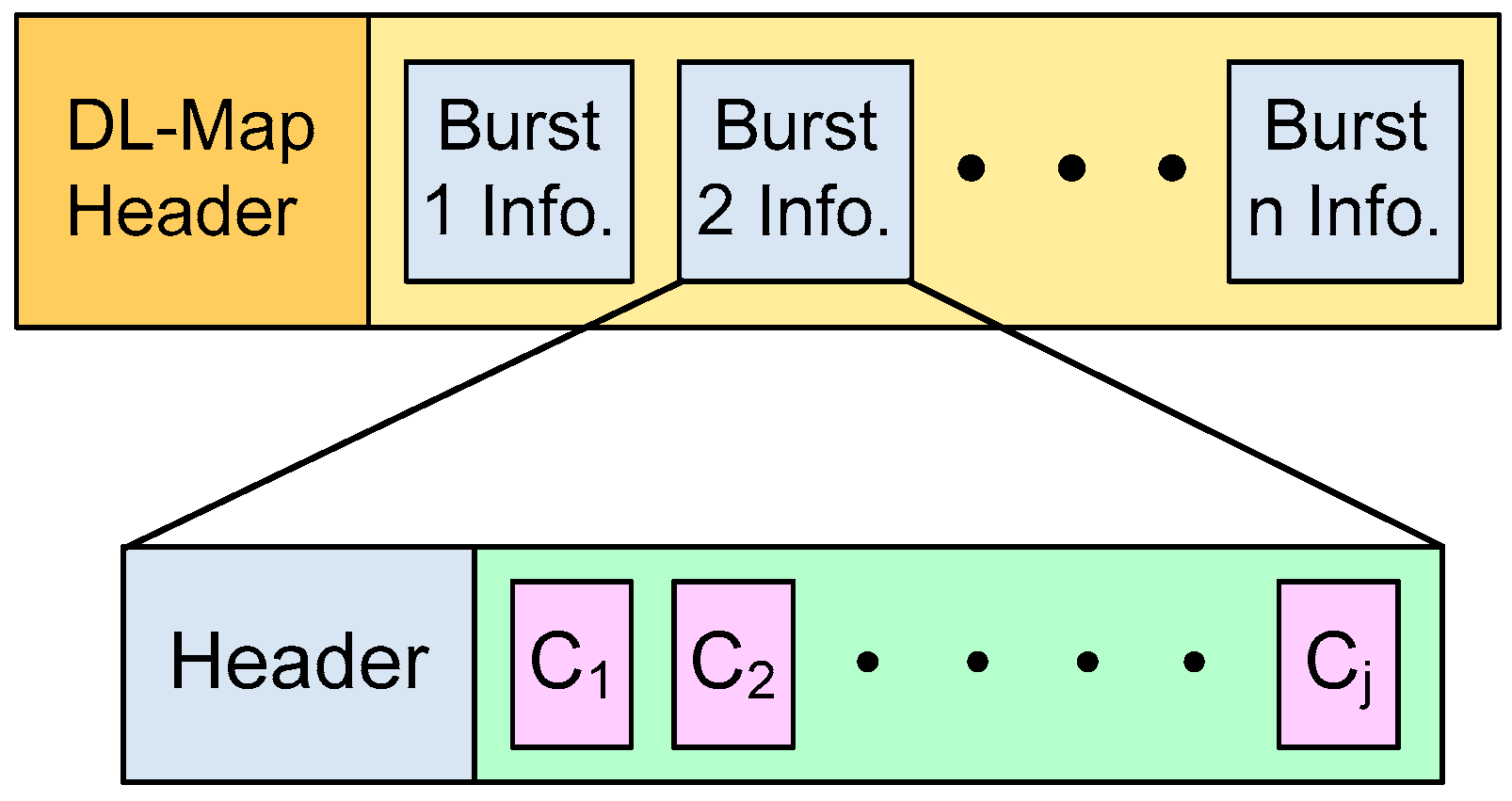
The MAP message starts with the header followed by the burst information list, as shown in Figure 3 [1]. After computing the total number of bits in the MAP, the size of the MAP header can be made. The burst information (called Burst Info. in Figure 3) contains information element (IE) of each burst, and each burst is formed by the header and the payload. The total number of bits in the MAP IE [1] is (bits) ().
Figure 3.
Map element structure.
The MAP overhead is mainly dominated by the size of IEs. Let B denote the number of bursts in this map and denote the number of some connection identifiers (CIDs) in the burst j. In the downlink, one connection is allowed to be assigned into more than one burst with the increased MAP IE size, i.e., 16 bits. The size of the MAP formula is shown in Equation (1), accordingly. It is even possible to pack multiple connections into one burst for reducing MAP overhead. In this scenario, the unique CID is used to specify the connections.
2.2. Related Works
Because burst allocation is non-deterministic polynomial time (NP) problem [7], there are some algorithms proposed to maximize throughput. Positioning bursts can be viewed as a variation of a bin or strip packing problem [3,7,8,9,10,11,12,13,14].
Reference [7] gives a fixed MAP space and then allocates the bursts by minimizing the variance of sub-blocks on leftover space and by maximizing leftover area flexibility for the following bursts. In Reference [8], the author proposed algorithms which try to maximize throughput by minimizing internal fragmentation and by minimizing the leftover space. These methods place downlink burst from right to left and bottom to top, and then they find the best suitable place in unusual space. However, fully utilizing the bandwidth resource does not mean higher throughput, since they all do not consider the problem of subchannel diversity. Therefore, the algorithms proposed in References [9,10] are to reduce the number of bursts by grouping bursts with the same modulation coding scheme (MCS) but for different connections, so the MAP size is minimal. The adopted MCS of each connection is given in advance. This implies that each connection will adopt one MCS in different subchannels. Reference [9] even suggests that there is only a slightly difference in the carrier-to-noise ratio (CNR) between different subchannels for connections.
References [3,12,13,14] treated the burst construction as a job assignment problem and modified the Hungarian Algorithm (HA) [11]. That is, they transform the burst construction problem, i.e., r bursts with r subchannels, to minimum the matching problem with r workers and r jobs. The element indicates the cost if the activity is assigned to the related person. The Hungarian Algorithm finds the best matches between workers and jobs.
However, the above methods do not consider the design that the burst can split into different bursts placing in the subchannel with good channel qualities. They also do not consider the burst indexing overhead problem.
3. Problem Statement
In this section, we give a formal problem statement for the two-dimensional downlink burst construction. We present basic notations needed for the definition and analysis of the problem in Table 1.
Table 1.
Used notation.
Let a set of downlink connections as , and let n represent the number of downlink connections. A downlink subframe is composed of slots where is the number of symbols and is the number of subchannels. Also represent the i-th connection after flow scheduling. and denote its number of allocated slots and the requested bandwidth, respectively, in the flow scheduling. When each connection queues in the flow scheduling, the flow scheduler estimates quality of service (QoS) requirements, power saving policy, channel quality variation, and it also considers many other factors to do this estimation. Therefore, the throughput provided by may be lower than since the flow scheduler does not allocate sufficient slots for i-th connection.
One connection can transmit in different bursts with different MCSs in different subchannels, let be a set of downlink burst allocated for . That is, connection can be served by multi-bursts , and denote the j-th burst of connection . To estimate the MAP size, we assume that each connection adopts its best MCS, and then determine how many bursts would be created in downlink sub-frame. After obtaining the size of the MAP, we can derive total number of bursts that the MAP would calculate based on the Formula (1).
Therefore, the problem statement: According to the above parameters, given an downlink subframe, a set of including each of connection and , and the MCS matrix , construct a fixed MAP size and then allocate all bursts in remaining space to maximize the total throughput .
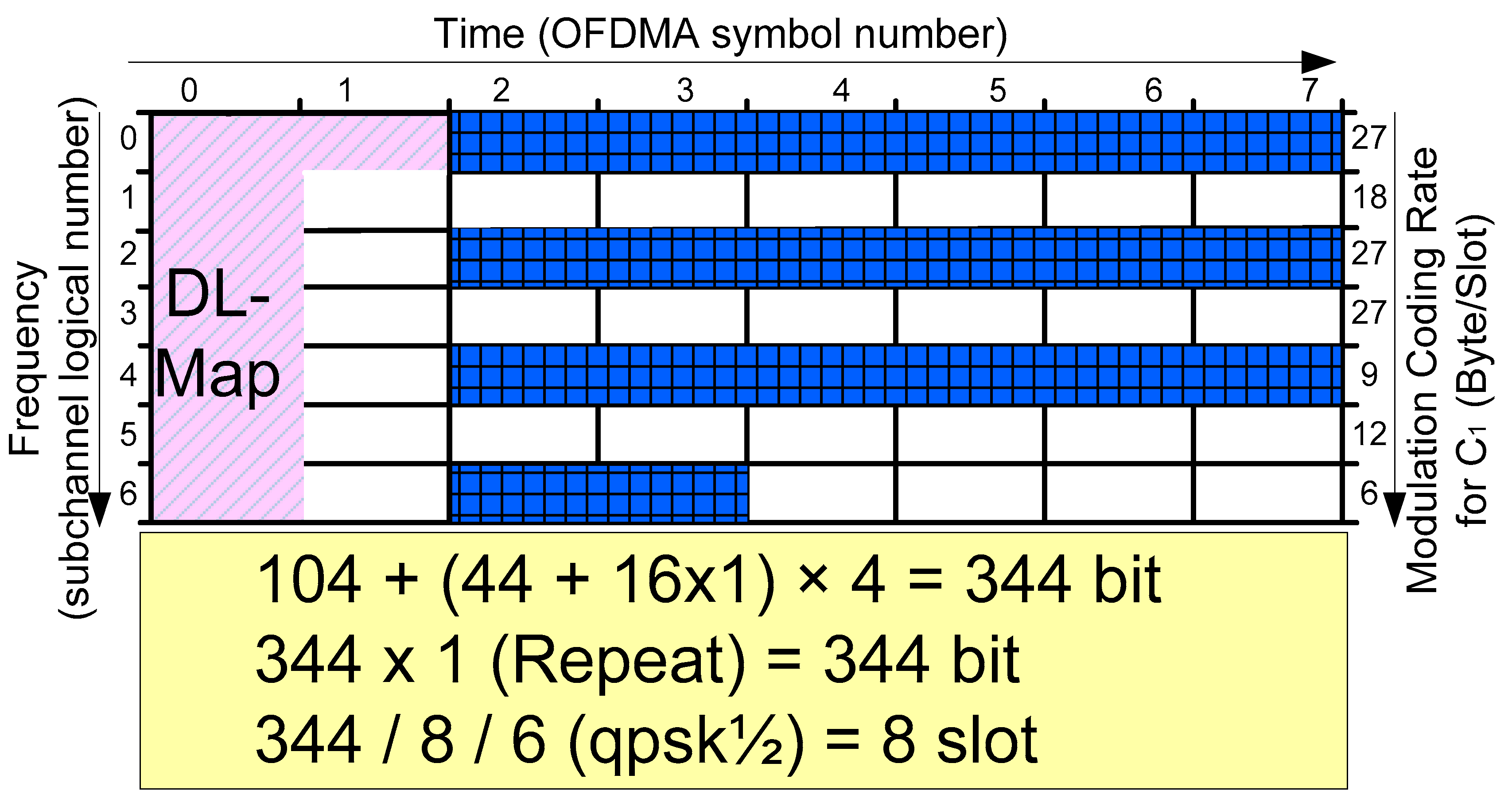
Several examples are provided here based on the above problem statement. Figure 4 shows four bursts and the MAP size in a downlink subframe. The MAP message is transmitted with the most robust MCS, i.e., quadrature phase shift keying (QPSK). Since the MAP message is allocated within the downlink subframe in a column-wise order and the whole column, it would have extra space for building more bursts. Figure 4 shows the unused slots in the MAP is six slots. Therefore, we would construct more than four bursts under a fixed MAP size.
Figure 4.
The MAP is allocated in a column-wise order.
On the other hand, when allocating a burst, we need to consider the characteristics of subchannel diversity. Let a two-dimensional matrix, , represent adopted MCSs in different subchannels for each connection, and denote the MCSs used by in the y-th subchannel. Let and denote the adopted MCSs and the number of occupied slots by of , respectively. A burst is in a continuous area, and it can be represented as the starting slot to the ending slot; burst , where and represent the starting slot and the ending slot, respectively. The throughput for connection is computed by where is the bandwidth that can support. Figure 5 shows when is allocated in the poor subchannel condition, the throughput of is low. However, the throughput of is high since is allocated in good subchannel condition. When exceeds required bandwidth connection only requires to transmit its data, the effective throughput is only .
Figure 5.
Subchannel diversity.
To well utilize the bandwidth resources, the internal fragmentation should be avoided. For any connection , the number of occupied slot is sufficient for providing the requested bandwidth . The connection should be occupied rather than because unused slots internal to a burst are wasted. Figure 6 shows connection allocated 14 slots while it only uses 12 slots to transmit its data and the remaining two slots are wasted.
Figure 6.
Internal fragmentation.
4. Proposed Algorithm: Enhanced Burst Indexing Aware Algorithm
In order to achieve the goals in Section 3, the proposed enhanced burst indexing aware algorithm (EHA) is divided into three phases. In the first phase, we determine the burst indexing size (also called the MAP size). In the second phase, the EHA finds the optimal matching between subchannel and connection according to the channel quality and bandwidth request of each connection. In the third phase, the EHA constructs bursts and leaves unused slots/subchannels for remaining bursts. The method is based on the following key concepts:
- The number of bursts should be under the constraint of the MAP overhead.
- One connection can be served by multi-bursts, so bursts should be constructed according to their good channel quality.
- To maximize the overall throughput, we should shrink the burst area to minimize internal fragmentation and leave the saved slots to other bursts, if the requested bandwidth has been satisfied.
The three EHA functions are , , and . The first one is used to calculate the MAP message size, and the formula is shown in Formula (1), Section 2. and are used to calculate the unused slots in subchannel m, and the modulation coding rate adopted by in subchannel m, respectively.
Table 2 shows the pseudo code of EHA. When the MAP becomes larger, the bursts which have been allocated in the downlink subframe have to be reassigned. To allocate bursts under the constraint of the MAP overhead, we give a fixed MAP length by each connection averaging its modulation coding rate schema of each subchannel (line 1, Table 2). After getting the minimum number of bursts that each connection requires, the total number of bursts can be made, and the MAP message size can be confirmed (line 2, Table 2). Considering that the MAP message is allocated within the downlink subframe in the whole column, we can therefore estimate (1) the number of slots occupied in the column of the MAP message and (2) the total number of bursts that the MAP would provide in the downlink sub-frame from the formula (line 3, Table 2). To allocate available for each connection , we assign the number of bursts to each connection based on its bandwidth request () in the percentage of total bandwidth request and round it off to the nearest integer (line 4, Table 2). Since the higher of connection would use more slots, we will assign sufficient bursts for each connection .
Table 2.
EHA Algorithm.
In order to find the best subchannel for each connection, we revise the Hungarian Algorithm with a row representing a burst for connection and a column representing subchannel . Each element in the matrix indicates the throughput of a burst if the subchannel is assigned to the related connection. The throughput of in subchannel m of unused slots would be calculated by (line 10, Table 2). To find the maximum throughput assignment, we need to transform the profit matrix as the needed cost matrix (line 11, Table 2). Thus, it would be suitable to solve the minimum assignment by the Hungarian Algorithm. After using the Hungarian Algorithm (as shown in Figure 4, Section 2), we can obtain the optimal solution of one subchannel with one connection to allocate the burst (line 12, Table 2). After obtaining the optimal solution , we construct bursts by one subchannel with one connection in unused slots. Although is the optimal solution for this resource allocation, there are different MCSs between assigned subchannels of each connection. Assign each connection to use higher subchannel qualities first, rather than using worse ones (line 13, Table 2).
To reduce internal fragmentation, should occupy sufficient slots for transmitting data (line 15, Table 2). The unused slots in a subchannel can be used by other bursts. indicates the available area of a burst is from slot to slot in subchannel m. Function indicates the j-th burst allocated for connection and marks all slots occupied by . If the throughput of is sufficient to satisfy of connection , EHA revokes the latter subchannel, which has not constructed a burst for connection yet. After finishing the first mapping process, if there are remaining and bandwidth request, line 4 again should be repeated.
We present an example of EHA to construct bursts for connection , and in a downlink subframe within 8 × 8 slots, where the requested bandwidths are bytes, bytes, and bytes, respectively, and the allocated slots are , , and . The matrix represents the adopted MCSs for each connection in each subchannel.
We give a fixed MAP length by assuming each connection adopt its best MCS and then calculate how many bursts would be created in a downlink subframe. Therefore, requires at least two bursts to transmit its data. and require at least two bursts and one burst to transmit. Through the formula of the MAP message size, the MAP message size is nine slots and allocated in two columns. The slots occupied by the MAP message are 16 slots. We inverse derive the total number of bursts that the MAP would provide in a downlink subframe and assign the number of bursts to each connection that for connection , , and for connection and , respectively. The matrix shows the throughput of in each subchannel of unused slots.
In order transform the profit matrix to the cost matrix that is suitable for the Hungarian Algorithm, we find the maximal throughput in the profit matrix and subtract each profit value by . In the result, the profit matrix is transformed to the cost matrix shown in matrix .
Next, we find the minimum element in each row/column and subtract it from all elements in that row/column. After obtaining , we can draw eleven lines to cover all zeros in the matrix and then find the optimal solution from and assign one subchannel to one connection .
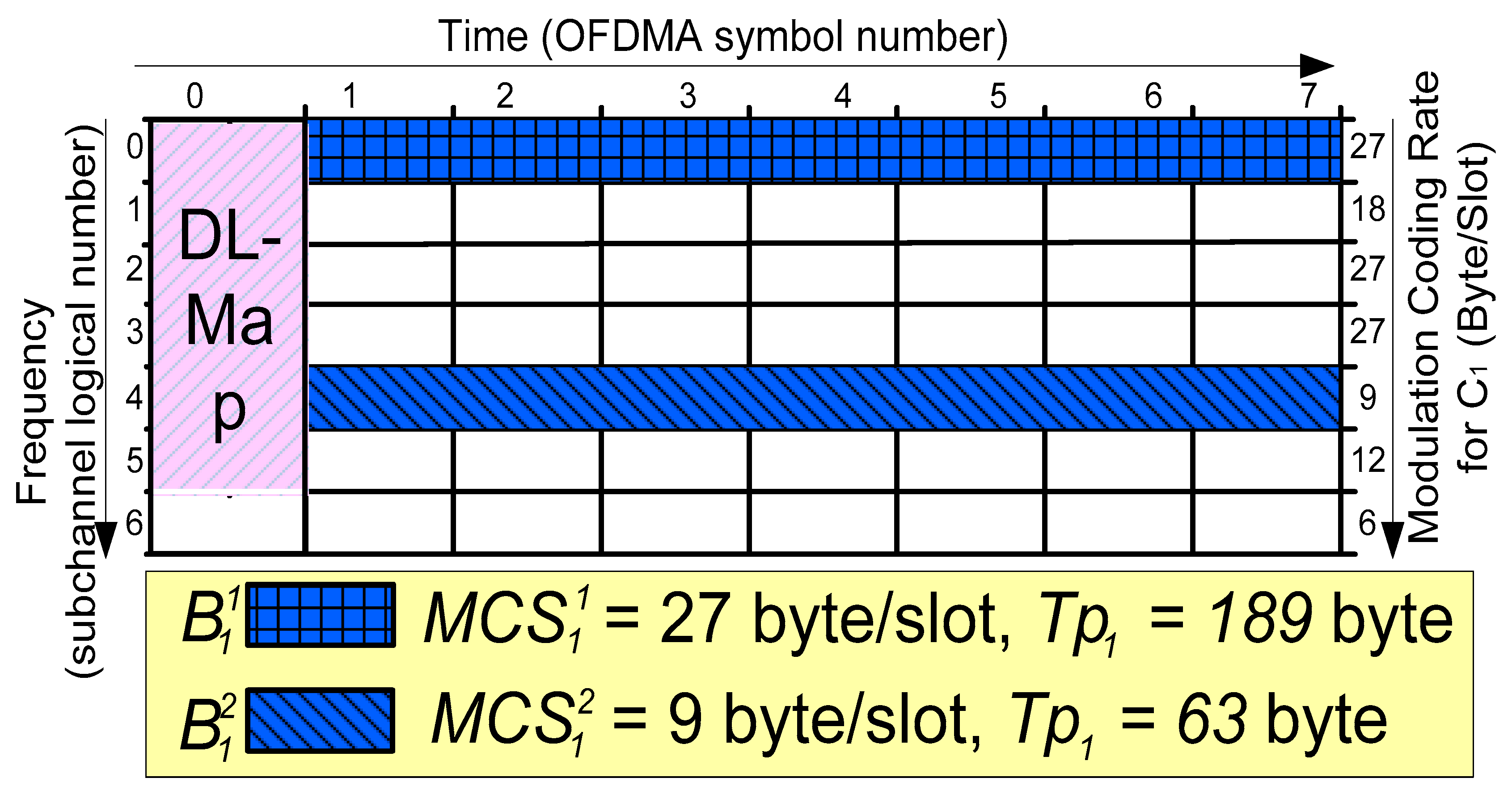
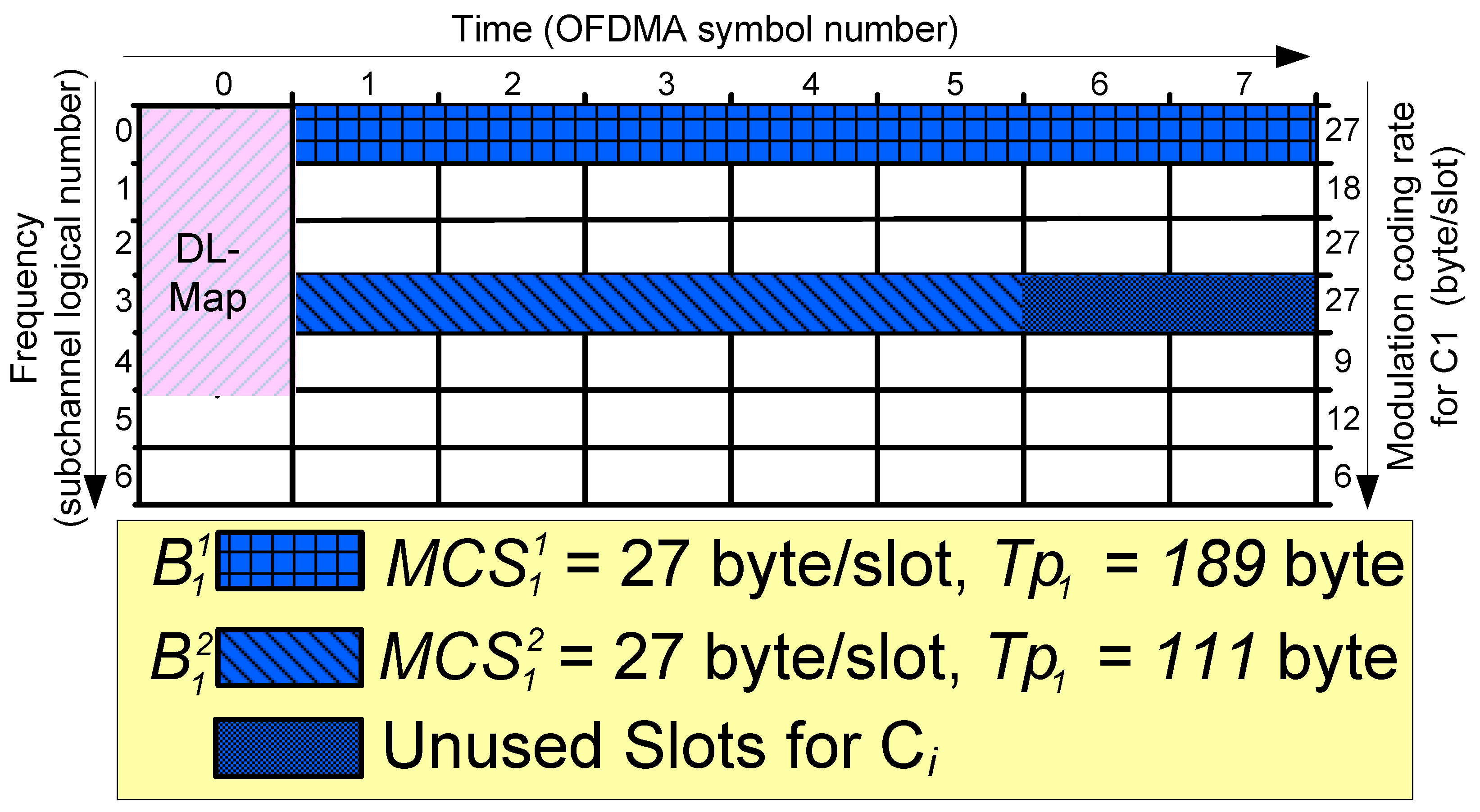
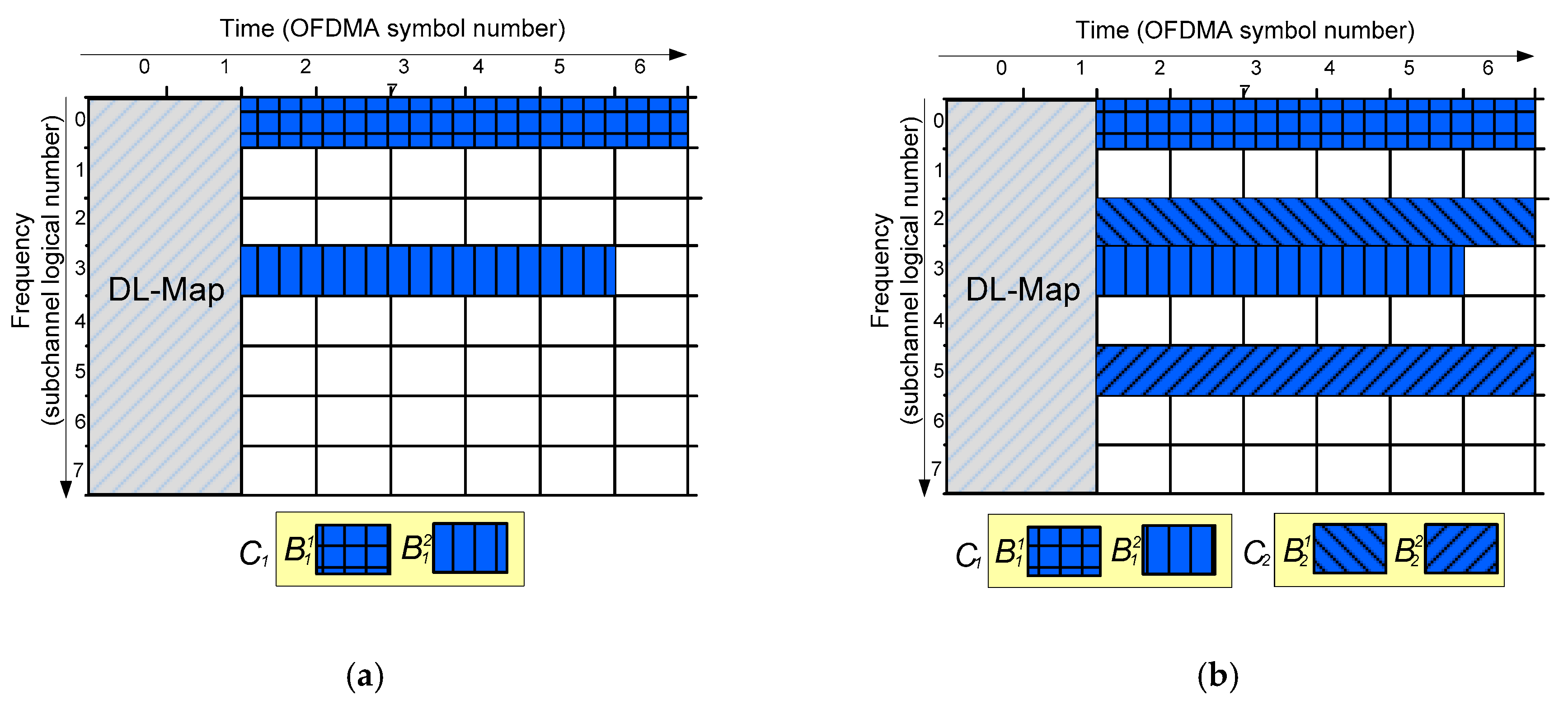
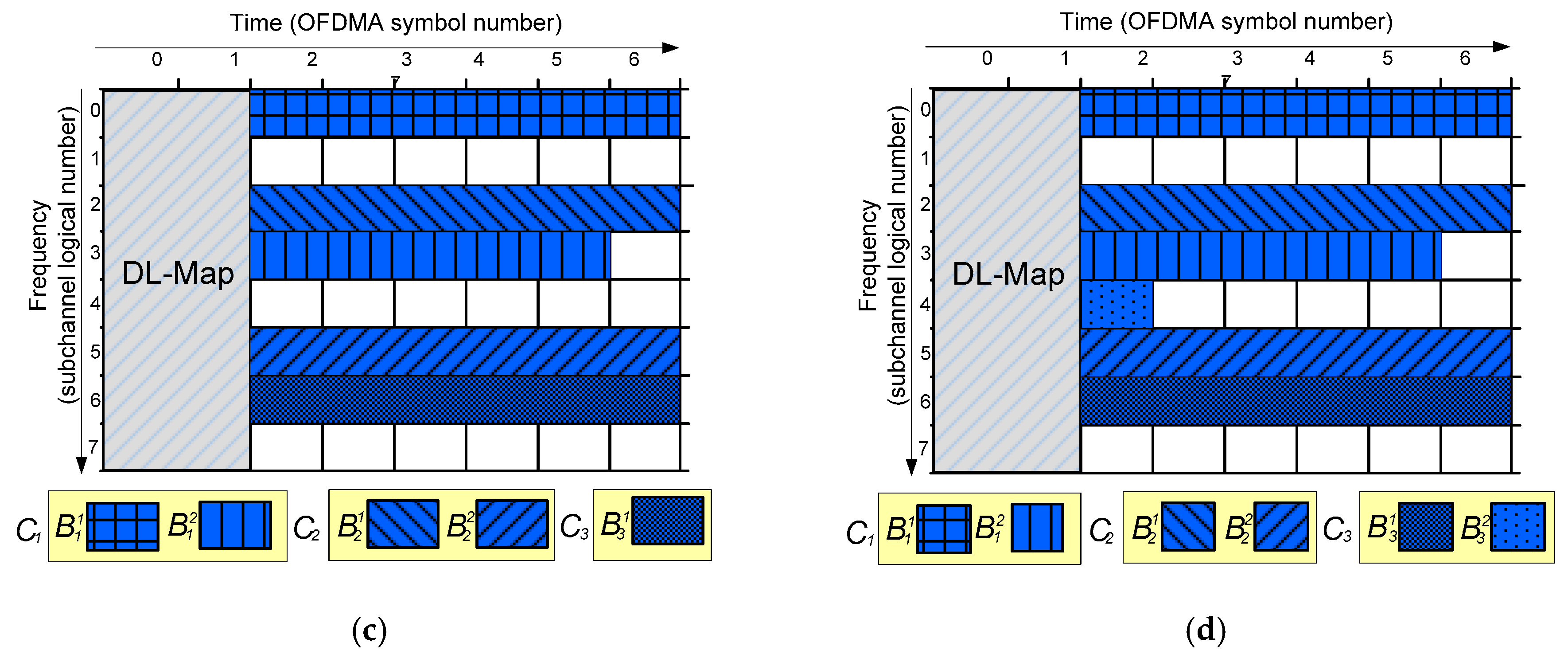
By , can use subchannel 0, 1, 3, and 4 to transmit its data. can use subchannel 2, 5, and 7 to transmit its data and is assigned to use subchannel 6. is assigned to subchannels 0, 1, 3, and 4, the MCSs are 27, 18, 27, and 27, respectively. Assign to use higher subchannel qualities (MCS 27) first. Figure 7a shows that uses the good subchannel quality 0 and 3 to construct its bursts and transmit its complete data of 290 bytes. uses the good subchannel quality 2 and 5 to construct its bursts as shown in Figure 7b. Notably, the available number of slots for is 12. Therefore, only transmits the data of 306 bytes. Figure 7c shows connection is assigned to use subchannel 6 and transmits the data of 162 bytes. After first mapping process, there still remain 6 bursts which can be created and remains bytes and slots. Therefore, we construct burst for connection and transmit its data of 180 bytes completely (Figure 7d).

Figure 7.
An Example of an enhanced burst indexing aware algorithm (EHA). (a) allocating bandwidth to C1; (b) allocating bandwidth to C2; (c) allocating bandwidth to C3; (d) splitting the burst for C3.
5. Simulations Results and Discussion
5.1. Simulation and Modeling
The simulation scenario was an OFDMA system with a 20-MHz channel, which was comprised of 24 OFDMA symbols and 60 subchannels in a downlink subframe. Because the partial usage subchannelization technique allocated two OFDMA symbols for each slot, the total number of slots in the DL sub-frame was 720. According to the received signal-to-noise ratio (SNR), we adopt many quadrature amplitude modulations of QPSK1/2, QPSK3/4, 16QAM1/2, 16QAM3/4, 64AQM2/3, and 64QAM3/4. The SNR in each subchannel received by each SS followed the normal distribution. The mean SNR was set to 15 db, and the standard deviation was set to 5 db. The arriving traffic of each downlink connection followed the Poisson distribution. Furthermore, the simulation tool we used was the ns2 Worldwide Interoperability for Microwave Access (WiMAX) module with some modifications [15].
The flow scheduling which estimated the appropriate number of slots to each connection applied channel quality and the Quality of Service (QoS) aware bandwidth allocation algorithm (CQQ) [16] in this paper. The CQQ examined channel quality, avoided wasting system bandwidth by dynamically modifying the DL/UL bandwidth ratio to match the DL/UL traffic ratio, and provided QoS guarantee in the OFDMA network. It applied a weighted fair queuing strategy to the connection which demanded a larger requested bandwidth and a higher average transmission rate was assigned higher weight and a larger allocation of slots.
In Section 5.2, we provide simulation results to illustrate the performance of the proposed algorithm, EHA, and compare it with other algorithms. The simulations investigate several performances including the requested bandwidth, the number of bursts, and the variation of channel quality between subchannels under the total throughput. In order to evaluate the total throughput of the subframe allocation alone, the results in this section were obtained without taking into account the DL-MAC overhead.
5.2. Simulation Results
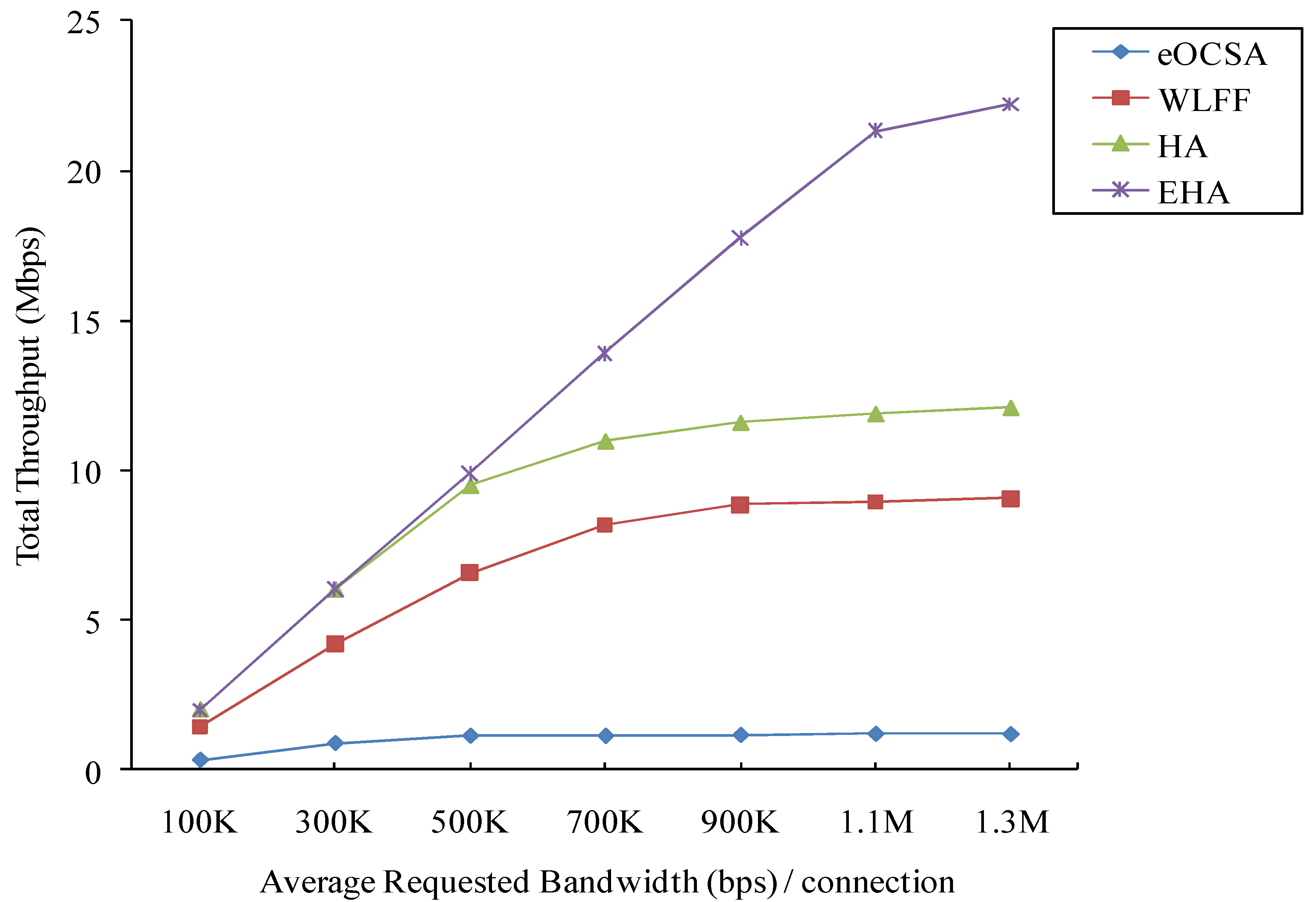
The effect of the average requested bandwidth on total throughput were also investigated. The arrival data rate varied from 100 Kbps to 1.3 Mbps with the same number of connections, 20 (SSs). Figure 8 shows the total throughputs achieved by EHA, enhanced One Column Striping with non-increasing Area first mapping (eOCSA) [8], Weighted Less Flexibility First (WLFF) [7], and Hungary Algorithm (HA) [11]. Each burst adopts only one MCS based on the worst SNR of all assigned subchannels. The WLFF and eOCSA constructed the burst that may occupy more than one subchanel to fully utilize the bandwidth. However, they did not consider subchannel diversity and often constructed bursts with poor MCS. Even when the traffic was light, WLFF and eOCSA could not satisfy the requested bandwidth (300 kbps × 20 connections = 6 Mbps). The reason is that WLFF and eOCSA constructed bursts without considering subchannel diversity, and therefore the allocated bandwidth for each connection is placed on the unsuitable subchannel.
Figure 8.
The effect of different average requested bandwidths.
The EHA and HA considered the characteristic of subchannel diversity. When the traffic was light, they constructed bursts in good subchannel quality. The number of available slots, , was sufficient to satisfy the requested bandwidth. However, when the requested bandwidth increased, EHA provided at most two times the throughput that HA provides. The reason is that EHA shrink occupied slots of the burst if the requested bandwidth was satisfied. Thus, unused slots in this subchannel can be used by other bursts. Further, HA did not consider the requested bandwidth of each connection. The connection may only require a few subchannel to transmit its data, but it was allocated too many subchannels that could not be used by other connections.
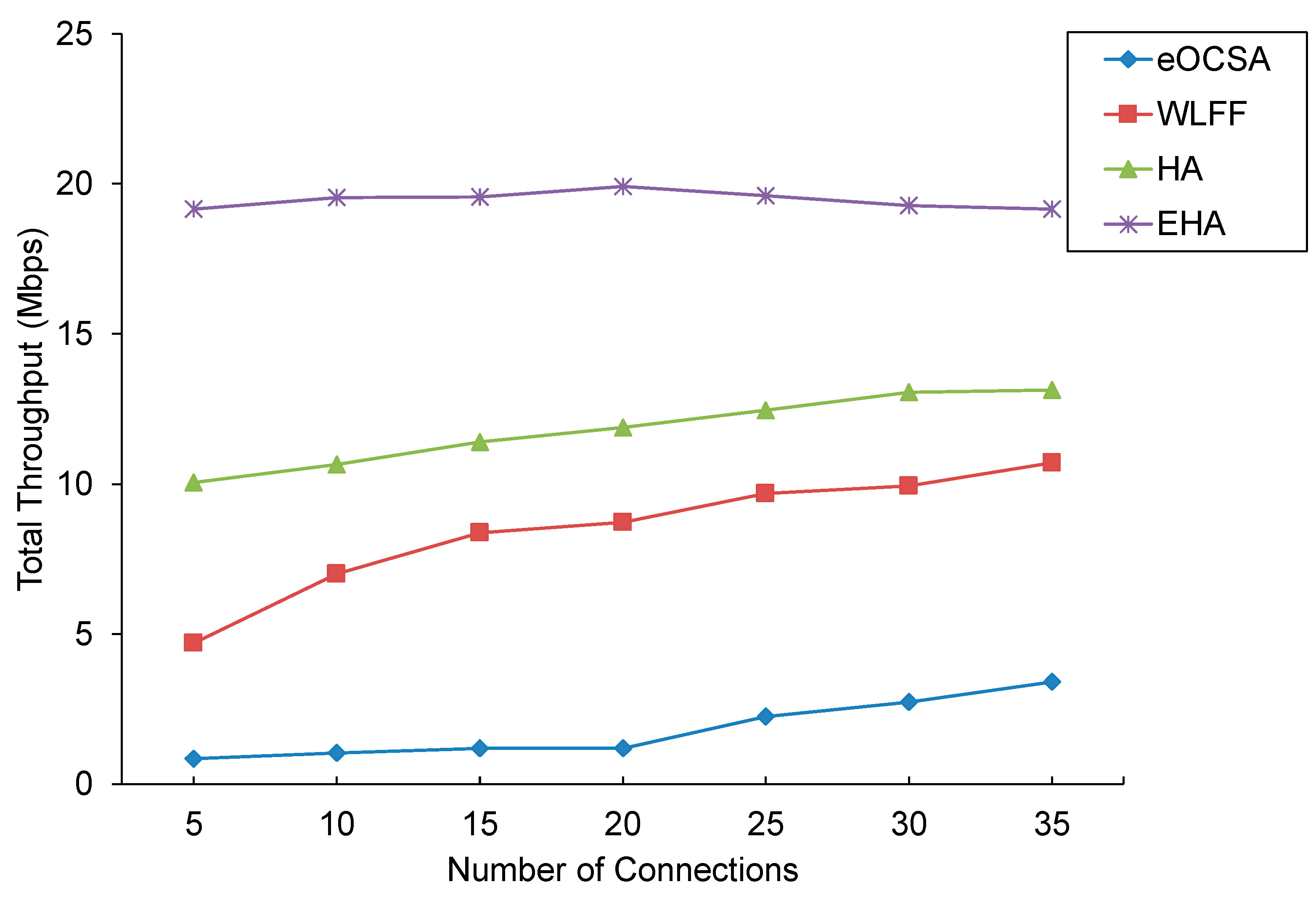
Figure 9 illustrates the total throughput of EHA, eOCSA, WLFF, and HA in different numbers of connections, Mbps means mega bit per second. The number of connections increased gradually from 5 to 35 with the same overall data arrival rates, 20 Mbps. The total throughputs of EHA, eOCSA, WLFF, and HA increased when the number of bursts increased. The EHA and HA gave each connection multi-bursts to construct its bursts in good subchannel quality. However, EHA constructed the burst by reducing the number of occupied slots to considered internal fragmentation and it left the unused free slots to other bursts. The WLFF and eOCSA gave each connection one burst to construct its bursts and did not consider subchannel diversity. Thus, they had more opportunities to construct a burst in bad quality subchannels.
Figure 9.
The effect of different number of connections.
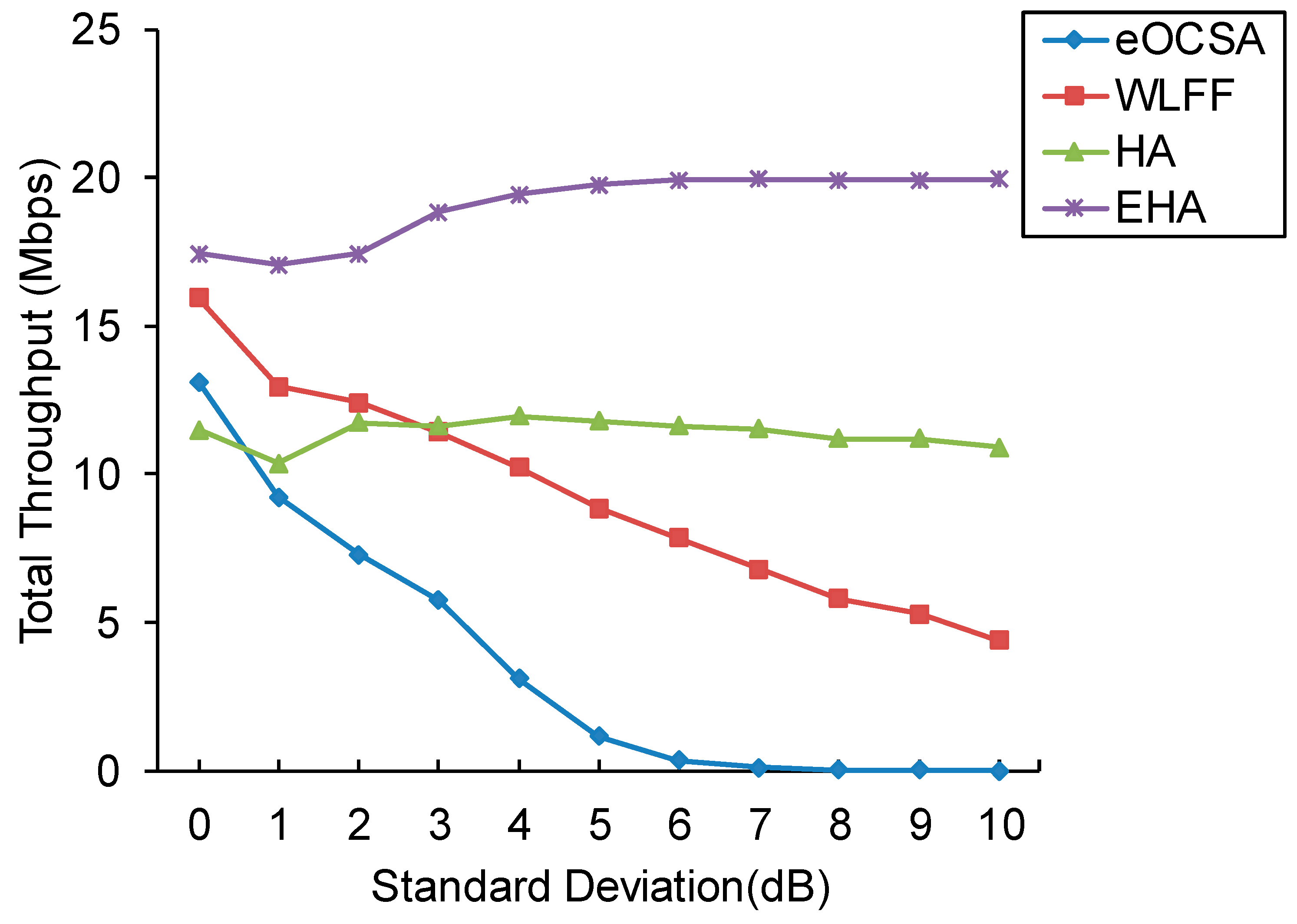
Figure 10 illustrates the total throughput of EHA, eOCSA, WLFF, and HA in variation of the channel quality between subchannels. As the standard deviation of the SNR increased, the numbers of subchannels with good SNR increased, and the numbers of subchannels with poor SNR increased, too. The EHA always constructed bursts in good channel quality and reserved unused slots to other bursts. The subchannel allocated to the connection could redistribute to others if the connection did not use it. However, HA did not consider the requested bandwidth of each connection. The connection with a better channel condition might get more subchannels to transmit data. The unused subchannels could not reassign to other connections. The WLFF and eOCSA constructed bursts in the subchannels with worse SNRs as the standard deviation of the SNR increased since they did not consider subchannel diversity.
Figure 10.
The effect of variance of signal-to-noise ratios (SNRs).
6. Conclusions
This study proposed an EHA algorithm to divide a burst into several bursts and place these bursts to the subchannel with better channel quality, under the consideration of MAP overhead. This strategy maximizes the overall network throughput and optimizes burst indexing issues. That is, EHA not only allocates the subchannels with best channel quality for each burst, but also groups the bursts to alleviate the MAP overhead. The two contributions of EHA are: (1) the overhead of burst indexing decreases because massive numbers of connections can be accommodated by one burst; and (2) the overall throughput increases due to that one connection with large data transferring requirements that can be split and distributed into several bursts and placed on the subchannels with good channel quality to adopt better MCS, if the saved bandwidth in this burst construction is more than the increased overhead of burst indexing. It should be noted that EHA might not provide superior performance when the number of connections is large, because there is no sufficient bandwidth to divide bursts.
As described above, EHA maximizes the throughput during OFDMA burst construction for each connection. The EHA considers the issues of subchannel diversity and burst indexing overhead to obtain outstanding throughput. The simulation results confirm that EHA provides higher throughputs compared with eOCSA and WLFF. In addition, the improvement ratios achieved by EHA increased in conjunction with the requested bandwidth, as the number of connections decreased, and as the channel quality varied. In addition, the performance of EHA slightly increases when the channel quality between subchannels became more diverse, whereas that of HA, WLFF, and eOCSA decreased considerably, thereby causing an increase in the EHA improvement ratio.

Author Contributions
Conceptualization, Y.-H.C.; Data curation, P.-T.J.; Formal analysis, Y.-H.C.; Investigation, Y.-H.C.; Methodology, Y.-H.C.; Project administration, Y.-H.C.; Software, Y.-H.C. and R.-Z.H.; Supervision, Y.-H.C.; Writing—original draft, Y.-H.C., L.-K.C. and Y.-J.L.; Writing—review and editing, Y.-H.C., L.-K.C. and P.-T.J.
Funding
This research received no external funding.
Conflicts of Interest
The authors declare no conflicts of interest.
References
- Cai, Y.; Qin, Z.; Cui, F.; Li, G.Y.; McCann, J.A. Modulation and Multiple Access for 5G Networks. IEEE Commun. Surv. Tutor. 2018, 20, 629–646. [Google Scholar] [CrossRef]
- Einhaus, M.; Wolz, B.; Walke, B. The influence of subchannel diversity on the performance of OFDMA systems based on IEEE 802.16. In Proceedings of the IEEE International Conference on Circuits and Systems for Communications, Shanghai, China, 26–38 May 2008; pp. 20–24. [Google Scholar]
- Sheu, S.-T.; Yang, C.-C.; Chang, H.-S. A dynamic frequency allocation scheme for IEEE 802.16 OFDMA-based WMANs using Hungary algorithm. In Proceedings of the EUC Workshops, Taipei, Taiwan, 17–20 December 2007; pp. 205–214. [Google Scholar]
- Chen, Y.; Shon, S.H.; Yoo, S.-J.; Kim, J.M. Dynamic frequency selection in OFDMA. In Proceedings of the 8th International Conference on Advanced Communication Technology, Phoenix Park, Korea, 20–22 February 2006; Volume 1, pp. 574–578. [Google Scholar]
- Toufik, I.; Knopp, R. Channel allocation algorithms for multi-carrier systems. In Proceedings of the IEEE 60th Vehicular Technology Conference, Los Angeles, CA, USA, 26–29 September 2004; Volume 2, pp. 1129–1133. [Google Scholar]
- Kivanc, D.; Li, G.; Liu, H. Computationally efficient bandwidth allocation and power control for OFDMA. IEEE Trans. Wirel. Commun. 2003, 2, 1150–1158. [Google Scholar] [CrossRef]
- Wang, T.; Feng, H.; Hu, B. Two-Dimensional Resource Allocation for OFDMA System. In Proceedings of the 2008 IEEE International Conference on Communications Workshops, Beijing, China, 19–23 May 2008; pp. 1–5. [Google Scholar]
- So-In, C.; Jain, R.; Al, T.A.-K. eOCSA: An algorithm for burst mapping with strict QoS requirements in IEEE 802.16e Mobile WiMAX networks. In Proceedings of the 2009 2nd IFIP Wireless Days, Paris, France, 15–17 December 2009. [Google Scholar]
- Ohseki, T.; Morita, M.; Inoue, T. Burst Construction and Packet Mapping Scheme for OFDMA Downlinks in IEEE 802.16 Systems. In Proceedings of the Global Telecommunications Conference, Washington, DC, USA, 26–30 November 2007; pp. 4307–4311. [Google Scholar]
- del-Castillo, J.I.; Delicado, F.M.; Villalón, J. OFDMA Downlink Burst Allocation Mechanism for IEEE 802.16e Networks. In Lecture Notes in Computer Science (LNCS); Springer: Berlin/Heidelberg, Germany, 2011; Volume 6641, pp. 250–262. [Google Scholar]
- Kuhn, H.W. The Hungarian method for the assignment problem. Nav. Res. Logist. Q. 1955, 2, 83–97. [Google Scholar] [CrossRef]
- Thanh, N.H.; Tung, D.V.; Thu, N.Q.; Nam, N.C.; Sandrasegaran, K. Joint scheduling and mapping in support of downlink fairness and spectral efficiency in ieee 802.16e OFDMA system. Int. J. Commun. Syst. 2016, 29, 2227–2248. [Google Scholar] [CrossRef]
- Tham, M.-L.; Chow, C.-O.; Xu, Y.-H.; Ramli, N. Two-Level Scheduling for Video Transmission over Downlink OFDMA Networks. PLoS ONE 2016, 11, e0152844. [Google Scholar]
- Chen, T.; Zhao, X.; Gao, T.; Zhang, L. A novel downlink scheduling strategy for traffic communication system based on TD-LTE technology. SpringerPlus 2016, 1631. [Google Scholar] [CrossRef] [PubMed]
- Lai, Y.-C.; Chen, Y.-H. Designing and Implementing an IEEE 802.16 Network Simulator for Performance Evaluation of Bandwidth Allocation Algorithms. In Proceedings of the 2009 11th IEEE International Conference on High Performance Computing and Communications, Seoul, Korea, 24–27 June 2009; pp. 432–437. [Google Scholar]
- Lai, Y.-C.; Chen, Y.-H. A channel quality and QoS aware bandwidth allocation algorithm for IEEE 802.16 base stations. In Proceedings of the 22nd International Conference on Advanced Information Networking and Applications, Okinawa, Japan, 25–28 March 2008; pp. 472–479. [Google Scholar]
© 2019 by the authors. Licensee MDPI, Basel, Switzerland. This article is an open access article distributed under the terms and conditions of the Creative Commons Attribution (CC BY) license (http://creativecommons.org/licenses/by/4.0/).