1. Introduction
The fleet of battery electric vehicle (BEV) is growing dramatically every year impacted by government policies to meet the greenhouse gas reduction [
1,
2]. As a result, the risk of tunnel fires caused by rear-end collisions and spontaneous combustion is expected to change over time, severely disrupting normal highway transportation operations. Once fire accidents of BEV occur, it is difficult to control due to a large amount of heat release and the generation of toxic and harmful smoke. Such incidents not only pose severe threats to vehicle and personnel safety but also lead to damage to tunnel lining structures, significantly reducing their load-bearing capacity and safety [
3]. Therefore, it is necessary to study the temperature distribution characteristics and residual load-bearing capacity of road tunnel after fire accidents of BEVs.
The heat release rate (HRR) curve and maximum temperature beneath the tunnel ceiling are the key parameters which determine the damage degree of tunnel structure [
4]. Extensive investigations from theoretical, experimental, and numerical analysis perspectives have been performed to study the characteristics of tunnel fires during the past few years [
5,
6,
7]. Li et al. [
8] studied the effect of tunnel widths and heights on the heat release rate (HRR) by model scale fir tests. Tang et al. [
9] theoretically and experimentally investigated the distribution of maximum smoke temperature below ceiling and air entrainment characteristics of tunnel fire under different smoke extraction systems. The temperature distribution induced by the large area fire in tunnel well were obtained based on a series of experiments. Li et al. [
10] conducted a series of experiments to investigate temperature distribution under tunnel ceiling considering fire source variation in transverse location. Based on theoretical and experimental investigations, a series of temperature rise models caused by underground space fire have been established. Li et al. [
11] derived the relationship between the heat release rates (HRR) and maximum ceiling smoke temperature of fire in ventilation tunnel. Liu et al. [
12] modified Li’s formula to predict temperature distribution of closed utility tunnel fire. Gao et al. [
13] proposed modified equations for the ceiling maximum temperature rise beneath the tunnel ceiling by experiments and numerical simulations. Considering van shape, a new normalized equation of the maximum temperature of a ceiling jet induced by rectangular-source fire was established by Tang et al. [
14]. Ye et al. [
15] studied the attenuation law of longitudinal maximum smoke temperature induced by strong plume.
As for BEVs, traction batteries are the main source of BEV fires, which cause rapid changes in power release and larger peak heat release (PHRR) rate and total heat release rate (THRR) compared to the fire hazards of ICEV. Numerous tunnel fire tests, as well as numerical simulations have been conducted to quantify the BEV fires and key parameters to guide the fires safety design both domestically and internationally [
1]. Dorsz and Lewandowski [
16] studied the differences between BEV and ICEV during a fire and assessed the magnitude of the BEV fire hazard compared to ICEV hazards with reference to HRR in enclosed spaces performed using computational fluid dynamics (CFD) method. Hodges et al. [
17] pointed out that the total energy released by BEVs was consistently greater than the corresponding ICEVs, especially for larger vehicles. Sturm et al. [
18] measured the HRR of BEV fires by a series of full-scale fire test in road tunnels and studied the difference in burning behavior between BEV fires and ICEV fires. Held and Bronnimann [
19] performed a series experiments to investigate thermal runaway and temperatures of batteries in fully equipped vehicles after nail penetration into cells. Bai et al. [
20] used height heat release rate of BEV battery to analyze the fire development characteristics in a tunnel.
Post-fire assessment of the residual load-bearing capacity is essential for understanding the structural condition and preventing secondary disasters, thereby enabling accurate evaluation of fire-induced damage to tunnel linings. Existing studies have demonstrated that concrete experiences significant compression strength reduction following high-temperature exposure, with the residual strength influenced by multiple factors, including aggregate type, duration of exposure, and cooling methods [
21]. Caliendo et al. [
22] proposed a three-dimensional CFD model incorporating a temperature-based element removal criterion to couple heat transfer and material loss, enabling evaluation of the extent of high-temperature spalling and deep delamination in tunnel linings caused by heavy goods vehicle fires. By analyzing typical defects such as cracks, lining thickness variations, and voids behind the lining, they established a quantitative model correlating defect severity with loss of structural capacity. Serafini et al. [
23] combined experimental and numerical approaches using thermo-mechanical coupling to evaluate the temperature distribution and residual bearing capacity of steel fiber-reinforced concrete tunnel segments after exposure to both the ISO834 standard heating curve and the Hydrocarbon Curve (HFC). Lu et al. [
24] established a thermo-mechanical tunnel model incorporating thermal spalling effects based on a concrete constitutive model. Using damage mechanics methods, they calculated the residual load-bearing capacity of reinforced concrete, fiber-reinforced concrete, and hybrid structural members under fire conditions. The research on damage characteristics of road tunnels caused by BEV accidents is not as mature as that of ICEV. Lack of definition of the relevant parameter values may lead to analyses of questionable quality, which in many cases may result in non-optimal design of fire safety systems, consequently leading to insufficient level of safety of tunnels after fire accidents.
In summary, the special study on tunnel firefighting, especially the effect of sealing on fire temperature characteristics inside tunnel is relatively less at present. Hence, it is essential to evaluate accurately the residual load-bearing capacity of road tunnel subjected to high temperature. This study investigates the damage characteristics and residual load-bearing capacity of highway tunnel structures subjected to fires induced by BEVs and ICEVs. Using finite element numerical simulation, temperature and mechanical field models were established under three fire scenarios. Under various heating curves, key indicators such as the distribution of damaged zones, the development of plastic strain, and residual load-bearing capacity were systematically compared. Then, through two sets of simulations of the same vehicle type but different power sources, the differences between battery electric vehicles and fuel vehicles were compared.
2. Methodology
Finite element numerical simulations were conducted using the Abaqus/CAE 2022 platform in conjunction with the Abaqus/Standard implicit solver to investigate the thermal response, damage evolution, and post-fire residual load-bearing capacity of tunnel lining structures subjected to vehicle fire scenarios. Representative fire temperature–time curves were selected based on previous vehicle fire experiments and used as thermal loading inputs. Transient heat conduction analyses were performed in Abaqus to calculate the temperature distribution within the tunnel lining under different fire conditions and to capture its temporal evolution.
A sequentially coupled thermal–mechanical analysis was then implemented, in which the temperature fields obtained from the heat transfer analysis were applied as predefined fields in the structural model to account for thermally induced strains and material degradation effects. The nonlinear mechanical behavior of the tunnel lining concrete was described using the Concrete Damage Plasticity (CDP) model.
The CDP model, based on elastoplastic damage theory, defines concrete damage through three stages: elastic, plastic-damage, and complete failure. In the elastic stage (damage variable is 0), material behavior follows Hooke’s law. Upon entering the plastic-damage stage, the damage variables DAMAGEC and DAMAGET increase from 0 to 1, where 1 indicates complete material failure. When the concrete strain reaches three times the peak strain, the material is considered to have no load-carrying capacity. This approach allows the quantification of damage variables at failure, providing a means to evaluate the degree of concrete degradation.
Structural displacements, deformations, and damage indicators were extracted from the simulations. The post-fire residual load-bearing capacity of the tunnel lining was assessed by combining these results with the deflection limit method, ensuring a comprehensive evaluation of the structural performance under extreme fire scenarios.
3. Temperature Distribution Analysis of Road Tunnel Under Fire
3.1. Fire Curve Selection
There are significant differences in combustion law between new energy vehicles and traditional fuel vehicles. Traditional fuel vehicles rely on fuel to burn in the internal combustion engine, and the heat energy released by combustion is converted into mechanical energy. The combustion process is relatively stable but the efficiency is low, and the exhaust emissions include pollutants such as carbon dioxide and nitrogen oxides. The new energy vehicle does not involve the combustion process, mainly relies on the electric energy stored in the battery to drive the motor, and the energy conversion efficiency is high. The combustion risk of new energy vehicles mainly comes from the thermal runaway of the battery. Its combustion speed is fast and sudden, accompanied by the release of a large number of toxic gases, which is difficult to extinguish. At the later stages of the fire, the differences between BEV and traditional vehicles become minimal, as the combustion is dominated by common materials such as interior plastics, upholstery, and tires.
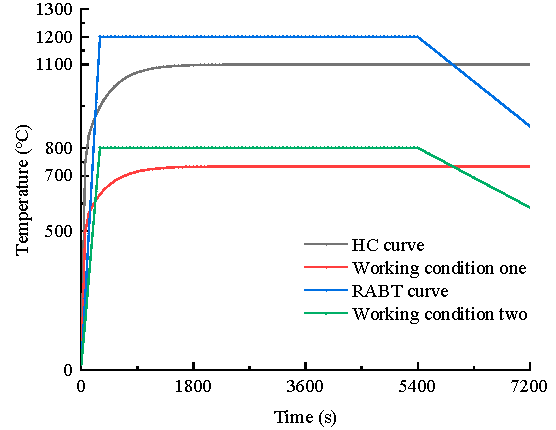
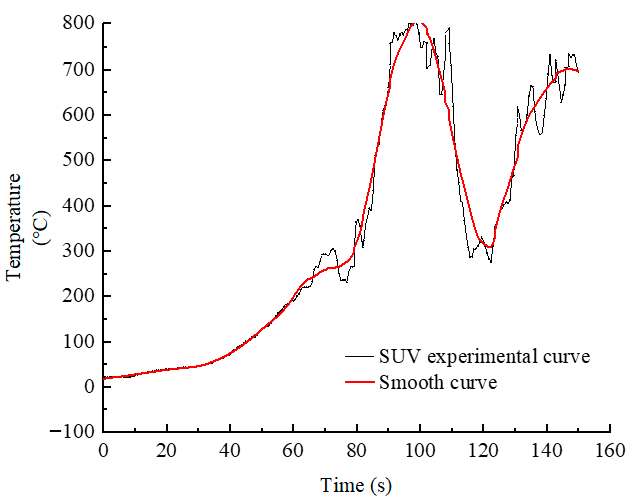
According to the classification of the specification, different types of tunnels use different heating curves in fire simulation. Two working conditions of Hydrocarbon Standard Temperature-Time Curve (HC curve) and Richtlinie für die Ausstattung und den Betrieb von Straßentunneln (RABT curve) will be set for traditional fuel vehicles. Guo et al. [
25] gave the temperature change diagram in different areas of the pure tram electric vehicle and took the temperature change in the compartment as the third working condition. In order to ensure the reliability of the calculation, the curve is smoothed, and the processed curve is shown in
Figure 1.
In the specification [
26], the rapid heating phase of both the HC and RABT curves occurs primarily within the first 5 min, whereas the rapid heating phase of the electric vehicle experimental curve is mostly completed within the first 3 min. It can be seen that the combustion rate of new energy vehicles is greater than that of ordinary fuel vehicles. The HC curve and the RABT curve maintain a high temperature to 120 min after reaching the highest temperature, simulating the high temperature persistence in extreme fire scenarios and covering the main stages of the fire. Here, condition three extends the experimental curve from 150 s to 120 min, conforming to the 2 h fire resistance limit defined by the HC and RABT curves. This extension is mainly to calculate the most unfavorable situation, as the short-term experimental data itself cannot capture all the thermal effects on the tunnel lining. By maintaining the peak temperature over a standard duration of 120 min, a more comprehensive assessment of the long-term impact of high temperatures on structural materials and components can be made, including stability and safety throughout the fire process. This method can comprehensively evaluate the overall fire resistance performance of tunnels under fire conditions, enhancing the value of the test results. However, it should be noted that this does not mean that electric vehicles can maintain the maximum temperature and burn for 120 min.
In the trial calculation stage, it is found that the HC curve and the RABT curve are both simulated values. It can be known from references [
27,
28] that the actual vehicle fire temperature in the tunnel environment is usually lower than the maximum values defined by the standardized HC and RABT design curves. In the real fire situation, they cannot reach 1100 °C and 1200 °C, and the third working condition is the experimental value, and the maximum value is only about 810 °C. If there is no expansion or contraction, it will artificially magnify the structural damage and lose the representativeness of the project. Therefore, to consider whether the HC curve and the RABT curve can be used for electric vehicles, the HC curve and the RABT curve are scaled in proportion, and the maximum temperature is set to 800 °C, which is used to simulate the temperature rise curve of the real fire, so that it can be compared with the third working condition. The adjusted heating curve is shown in
Figure 2. Although the three fire scenarios share similar peak surface temperatures, their temperature–time histories differ significantly. The heating rate, duration at elevated temperature, presence or absence of a cooling phase, and the overall shape of the curves vary among the three cases, leading to distinct thermo-mechanical responses of the lining. The environmental conditions for the simulations were set as follows: the initial ambient temperature was 20 °C, and the tunnel was assumed to be naturally ventilated. These conditions provide a baseline for the analysis of fire-induced thermal and structural responses under realistic ventilation scenarios.
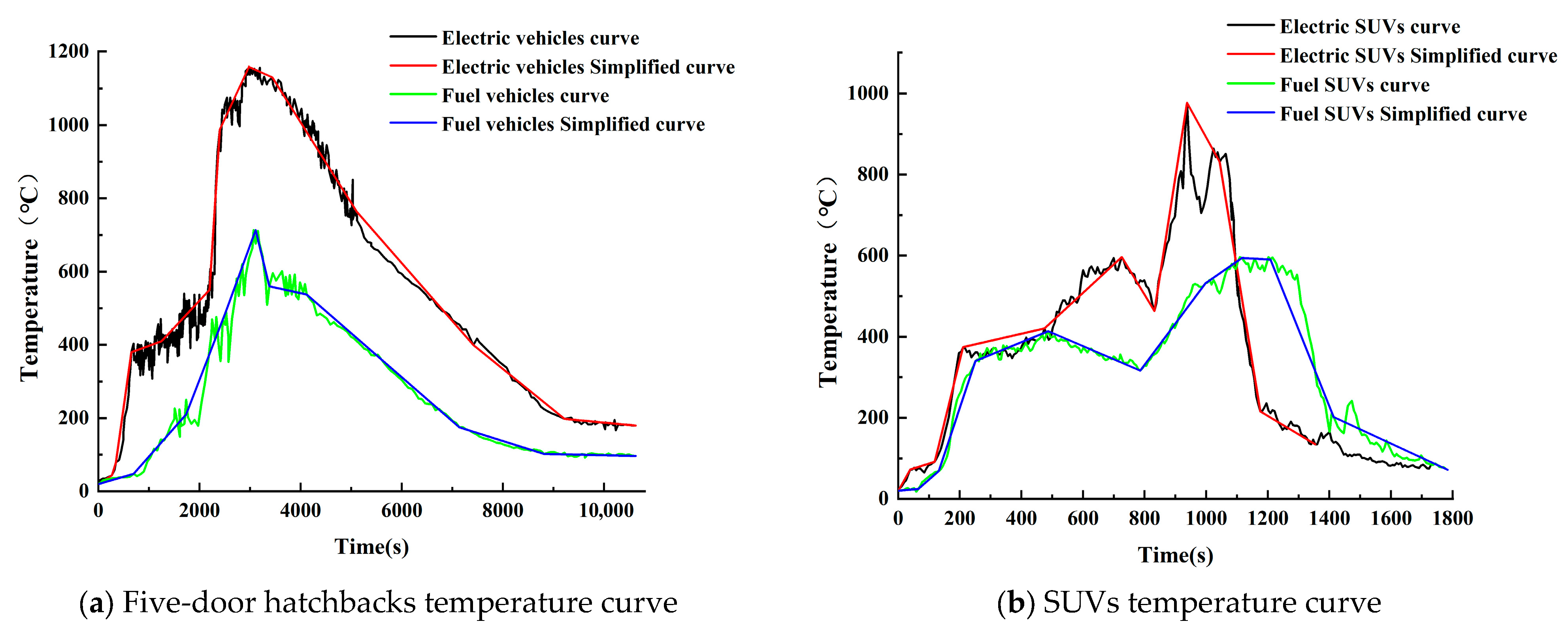
To further explore the impact of fires involving the same vehicle type but with different power compositions on tunnels, two additional sets of operating conditions were also considered. The first group considers five-door hatchbacks [
29,
30], including electric vehicles (Condition 4) and traditional fuel vehicles (Condition 5). The second category focuses on sport utility vehicles (SUVs) [
18], including electric SUVs (Condition 6) and traditional fuel-powered SUVs (Condition 7). It is worth noting that both of these groups are experimental curves, and the temperature curves are given in the citation. In this study, the temperature of each vehicle with time was simplified into increase, maintenance, and decrease sections, as indicated by the red and blue solid line in
Figure 3. By introducing these additional scenarios, this study is able to conduct systematic comparisons between electric vehicles and traditional vehicles within the same vehicle category and can assess how vehicle categories affect the final temperature field, damage evolution, and the remaining structural performance of tunnel linings. These extended scenarios enhance the reliability of parameter analysis and support a more comprehensive assessment of tunnel fire resistance under different vehicle fire conditions.
3.2. Finite Element Model of Temperature Field
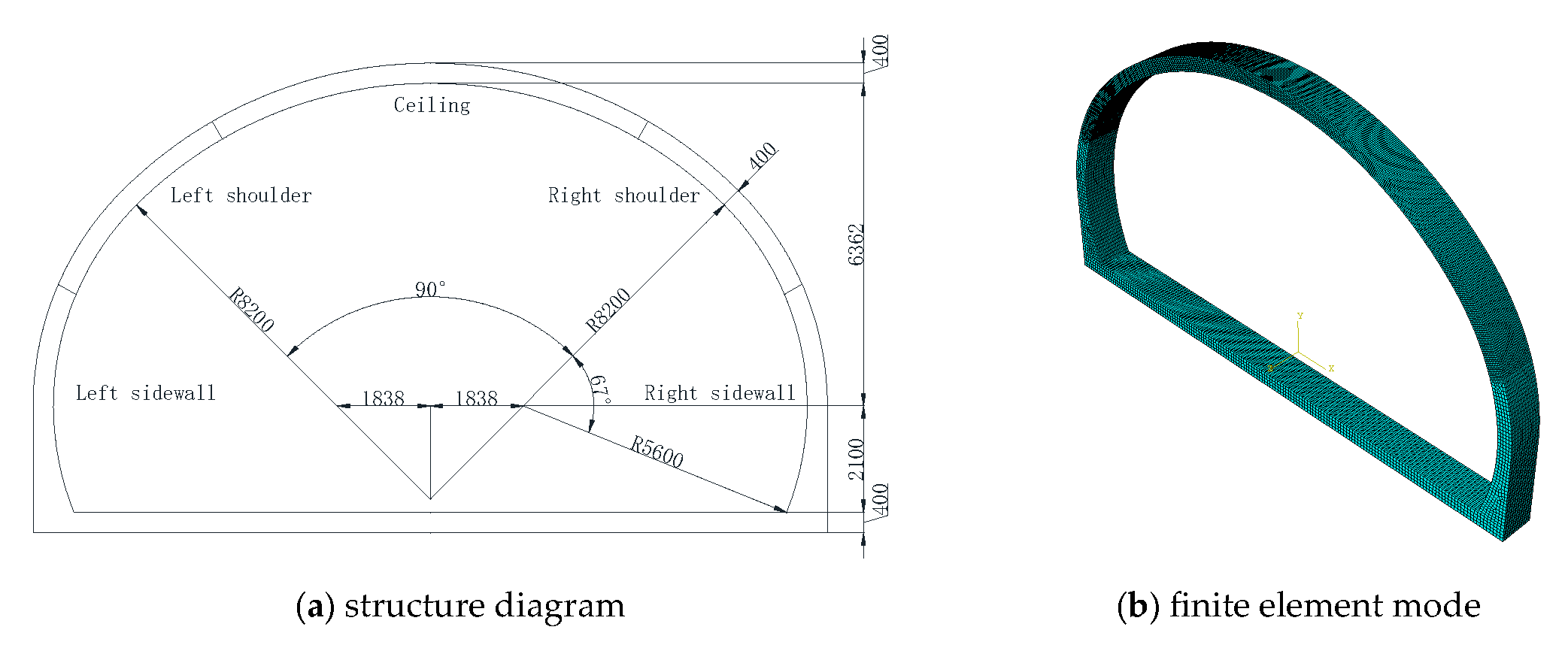
The experimental tunnel adopts the up-down separate tunnel type. The length of the left line is 100 m, the net width is 14 m, and the net height is 5 m, which meets the three-lane standard clearance requirements. The portals at the inlet and outlet of the tunnel are semi-open hole type, and the natural ventilation mode is adopted. The tunnel lining structure is designed according to the open-cut tunnel lining, and the cast-in-place reinforced concrete lining structure is adopted. The main structure design reference period is 100 years. The lining adopts C30 pumping self-waterproof concrete structure, the impermeability grade reaches P8, and the tunnel waterproof grade is grade two. The specific size is shown in
Figure 4.
The main structural material used for tunnel lining is C30 concrete, as shown in
Table 1. The table lists the relevant mechanical and thermal properties used in the numerical simulation. These parameters are necessary inputs for thermal-force coupling analysis using the concrete damage plastic model and the steel bar elastoplastic model in Abaqus/CAE.
Based on the drawings of highway tunnel in practical engineering, the tunnel structure model is established. The tunnel was divided into vault, arch shoulder and side wall along the arch ring from the top of the tunnel to the left and right sides at a 30° interval to the horizontal position. Moreover, the vault is most affected by the fire, followed by the side wall, and the arch foot is basically not affected. Therefore, it is considered that the lining fire area can be identified in the range of 0–30°. This lining fire area is referenced in the temperature field model, as shown in
Figure 4. In this study, the temperature field of the tunnel lining is directly represented by the temperature-time curve of the fire-exposed surface of the lining. The adopted fire curve is applied to the inner surface of the lining as a time-varying thermal boundary condition, while the remaining surfaces are assumed to be affected by the ambient temperature conditions. The temperature distribution within the lining thickness was calculated through transient heat conduction analysis, while also taking into account the heat diffusion from the exposed surface to the interior. Subsequently, the obtained temperature field is input into the mechanical analysis. The sequential coupling thermo-mechanical coupling analysis is used, allowing the influence of thermal strain and material degradation caused by temperature to be considered in the damage analysis.
3.3. The Temperature Distribution of Tunnel Lining
In the study of tunnel lining fire, it is very important to understand the temperature variation law at different positions from the lining surface under different fire time to evaluate the performance and safety of lining structure in fire. By analyzing the temperature data under different working conditions, it provides a key basis for the fire protection design of tunnel lining and the evaluation of structural damage after fire. The concrete temperature at the lining surface and 5 cm, 10 cm, 15 cm, 20 cm, 25 cm, 30 cm, and 40 cm from the lining surface was analyzed to explore the concrete temperature curve at different distances from the fire surface under the same working condition.
3.3.1. Analysis of the Results of Condition One in Temperature Distribution
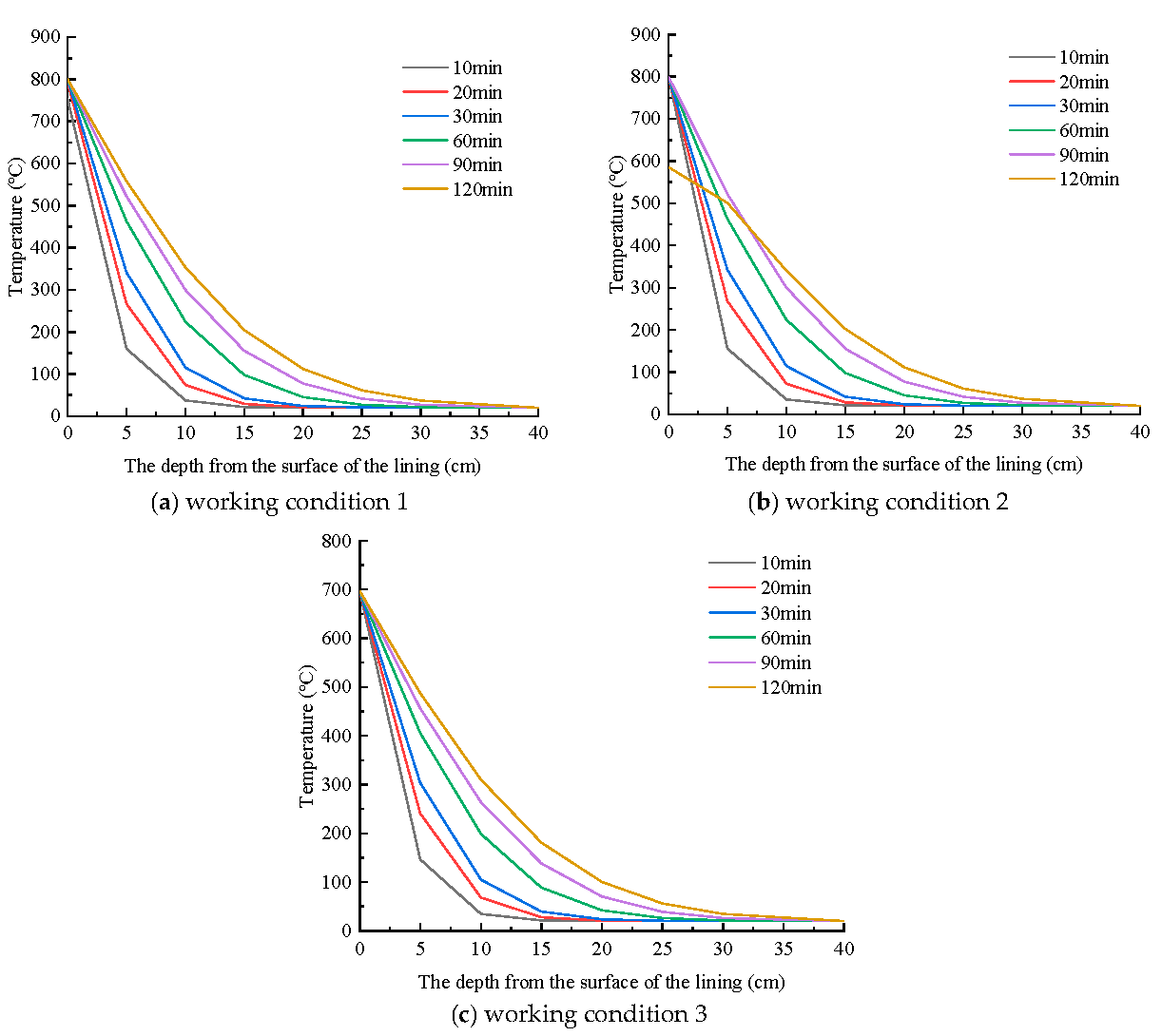
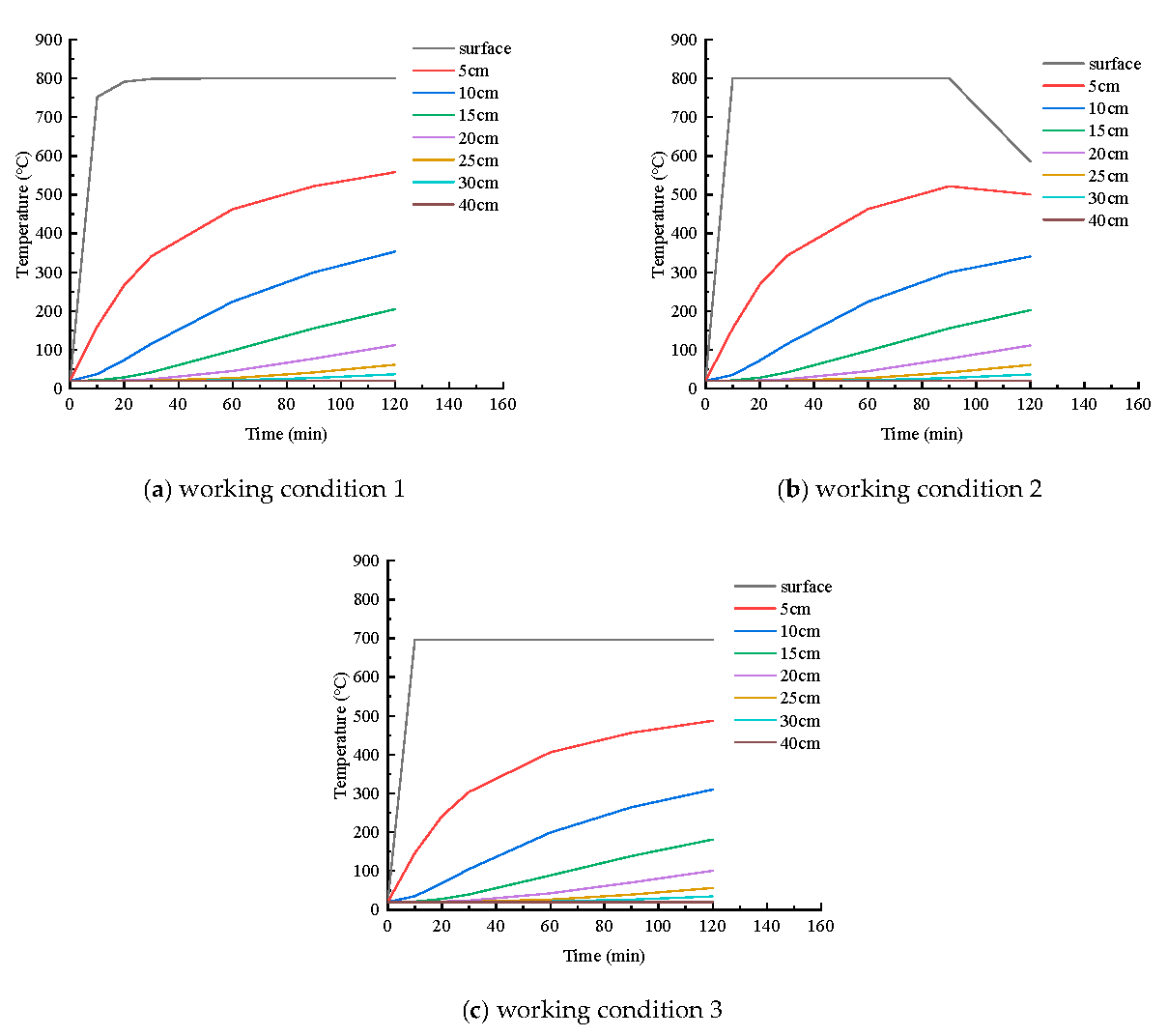
With the increase in fire duration, the surface temperature of tunnel lining rises sharply, and the depth of high-temperature influence increases gradually. Within 120 min, the surface temperature of the tunnel lining gradually increased from 20 °C to 800.00 °C, and the depth of the concrete affected by the high temperature was about 30 cm, and the concrete in the range of 0 to 8.3 cm was significantly affected. The temperature changes at different depths show a significant exponential decay law. For every 5 cm increase in depth, the temperature drop gradually decreases, and the temperature change at 30 cm depth is almost negligible.
As summarized in
Table 2, the high-temperature effect is strongly localized near the lining surface during the early fire stage. Even though the surface temperature reaches over 750 °C at 10 min, the temperature at 5 cm remains significantly lower, highlighting the rapid temperature attenuation. With longer fire exposure (e.g., 30–120 min), the surface temperature stabilizes near 800 °C, but the internal temperature continues to rise gradually, indicating progressive thermal penetration. However, the growth rate of the affected depth reduces over time, and by 120 min, approximately 8.3 cm of concrete experiences significant thermal influence. The temperature evolution at different depths is illustrated in
Figure 5.
3.3.2. Analysis of the Results of Condition Two in Temperature Distribution
The HC curve describes the change in mechanical properties of materials or structures with time under high temperature conditions. The curve can be heated to the highest temperature after 10 min of fire, while the RABT curve describes the mechanical properties of materials or structures in the cooling stage after fire. The significant difference is that the RABT curve contains a descending section, reflecting the further degradation of mechanical properties during the cooling process, and it takes only 5 min to heat up to the highest temperature.
Under high-temperature exposure, the tunnel lining surface temperature remains stable at 800 °C from 5 to 90 min. After 90 min, the surface temperature gradually decreases, reaching 585.46 °C at 120 min. The effective high-temperature penetration depth is about 30 cm, with the most significant thermal effect concentrated within the top 7.7 cm. Temperature profiles at different depths follow a clear exponential decay pattern, with attenuation diminishing with increasing depth; beyond 30 cm, temperature changes are negligible. The overall influence range is similar to that of condition one.
As shown in
Table 3, during the early fire stage (10 min), the surface temperature reaches 800 °C while the temperature at 5 cm depth is only 155.52 °C, indicating a strong localization of the high-temperature effect near the surface. With prolonged exposure (30–90 min), the surface temperature remains constant, but the internal temperature gradually rises, with the affected depth expanding more slowly over time. By 120 min, the surface temperature decreases to 585.46 °C, and approximately 7.7 cm of concrete experiences significant thermal impact. The temperature evolution at different depths is illustrated in
Figure 5.
3.3.3. Analysis of the Results of Condition Three in Temperature Distribution
The main heating stage of condition 3 is in the first 150 s. The temperature in the vehicle increases gradually between 0 s and 70 s. The battery explodes between 70 s and 110 s, and the temperature rises sharply to about 800 °C. After reaching the peak, the temperature drops to about 300 °C in 110–120 s, and the combustibles burn one after another in 120–150 s, and the temperature rises again. According to the comprehensive performance, the fire is sudden and strong. It takes only tens of seconds from the fire to the peak of combustion, which is much higher than that of traditional fuel vehicles.
After the fire temperature stabilizes, the surface temperature of the tunnel lining rises sharply, and the depth of high-temperature influence gradually increases. After 120 min, the effective thermal penetration depth reaches approximately 30 cm, with the most severe effects concentrated within the top 8.2 cm. Temperature profiles at different depths exhibit a clear exponential decay; for every 5 cm increase in depth, the temperature drop decreases, and at 30 cm, temperature changes are negligible.
As summarized in
Table 4, the surface temperature reaches 805 °C within the first 3 min, while the temperature at 5 cm depth is only 49.02 °C, indicating a rapid temperature attenuation. By 10 min, the surface temperature stabilizes around 696.90 °C, and the 5 cm depth temperature rises to 146.51 °C, reducing the temperature decay rate. With longer fire exposure (90–120 min), internal temperatures continue to rise, but the growth rate of affected depth slows, and after 120 min, approximately 8.2 cm of concrete experiences significant thermal influence. The temperature evolution at various depths is illustrated in
Figure 5.
3.4. The Influence of Temperature Field of Highway Tunnel Structure Under the Same Working Condition
In order to evaluate the safety of tunnel structure from many aspects and judge the stability and bearing capacity of structure, the damage evolution process of tunnel structure caused by fire can be clarified by analyzing the variation law of temperature field under different fire duration, which provides key theoretical support and data basis for ensuring the safe operation of tunnel after fire. The temperature field of the model under fire for 10 min, 20 min, 30 min, 60 min, 90 min and 120 min is analyzed, respectively, which lays a foundation for the subsequent study of residual bearing capacity.
Figure 6 shows the temperature rise curve at different distances from the fire surface under three working conditions. According to
Table 2,
Table 3 and
Table 4, we can obtain the temperature rise curves at different distances from the fire surface under different fire time under three working conditions. It can be seen that the temperature field of highway tunnel structure under different fire time shows significant differences.
In the early stage of fire, such as 10 min, the surface temperature of concrete rises rapidly to a higher value, and the internal temperature of the structure decreases rapidly with the increase in depth, showing a great temperature gradient.
As the fire time is extended to 30 min, the surface temperature continues to rise, and the range of the higher internal temperature area gradually expands, indicating that the heat continues to conduct to the interior of the structure.
At 60 min, the surface temperature growth trend slowed down, but the internal temperature was still rising, and the temperature difference at different depths decreased.
After 120 min of fire, the temperature difference between the surface and the interior of the structure is further reduced, but the overall temperature level is still in a high state.
Figure 6.
The temperature curves at different positions from the fire surface under different fire time.
Figure 6.
The temperature curves at different positions from the fire surface under different fire time.
The dynamic change process of this temperature field shows that the influence of fire on the tunnel structure is not instantaneous, but with the passage of time, it gradually deepens from the outside to the inside, the thermal influence range of the structure continues to expand, and the thermal damage to the structure continues to accumulate.
4. Analysis of Residual Bearing Capacity of Highway Tunnel Lining
4.1. The Finite Element Model of Residual Bearing Capacity
In order to evaluate the residual bearing capacity of tunnel structure after fire, thermal-mechanical coupling analysis was carried out. The temperature field was loaded into the mechanical model. Combined with the concrete plastic damage model, the structural failure state was judged by the deflection limit method, and the key indicators were extracted for comprehensive evaluation. The degradation mechanism of residual mechanical properties is analyzed based on the damage and deformation behavior when the structure reaches the design deflection limit. Combined with the CDP model, the structural failure state was evaluated using the deflection limit method, and key indicators were extracted for comprehensive assessment. The degradation of residual mechanical properties refers to the damage- and temperature-induced deterioration of the concrete elastic modulus, compressive strength, tensile strength, and stiffness, which are represented by the evolution of DAMAGEC and DAMAGET as well as the associated deformation behavior when the structure reaches the design deflection limit. According to the elastic theory, l0 is the net span distance of the structure, and l0 = 14,876 mm is calculated according to the size of the tunnel section. The structure is an underground structure with high requirements for deflection deformation. According to the deflection limit of l0/400, the obtained deflection limit is l0 = 37.19 mm.
4.2. Damage and Deflection Response of Tunnel Structure Under Different Fire Conditions
The high temperature caused by fire will change the physical and mechanical properties of tunnel lining materials, thus affecting the stability and bearing capacity of the tunnel. In addition, there may be unknown damages and defects in the tunnel structure after fire. If these damages are not detected and evaluated in time, they may lead to further degradation or even collapse of the structure, posing a threat to public safety. The analysis of the residual bearing capacity of the tunnel after fire is helpful to formulate a scientific repair and reinforcement scheme. By analyzing the residual bearing capacity of the tunnel under different working conditions, the maximum deflection and pressure damage area of the tunnel under different working conditions are explored, so as to calculate the residual bearing capacity of the tunnel structure under fire and analyze the safety of the tunnel structure.
In order to explore the residual bearing capacity of tunnel lining after fire, this section carries out a step-by-step loading simulation of the tunnel structure, and discusses the change in damage factor, deflection response, equivalent plastic strain and residual bearing capacity when the structure reaches the deflection limit.
4.2.1. Analysis of the Results of Condition One in Damage and Deflection Response
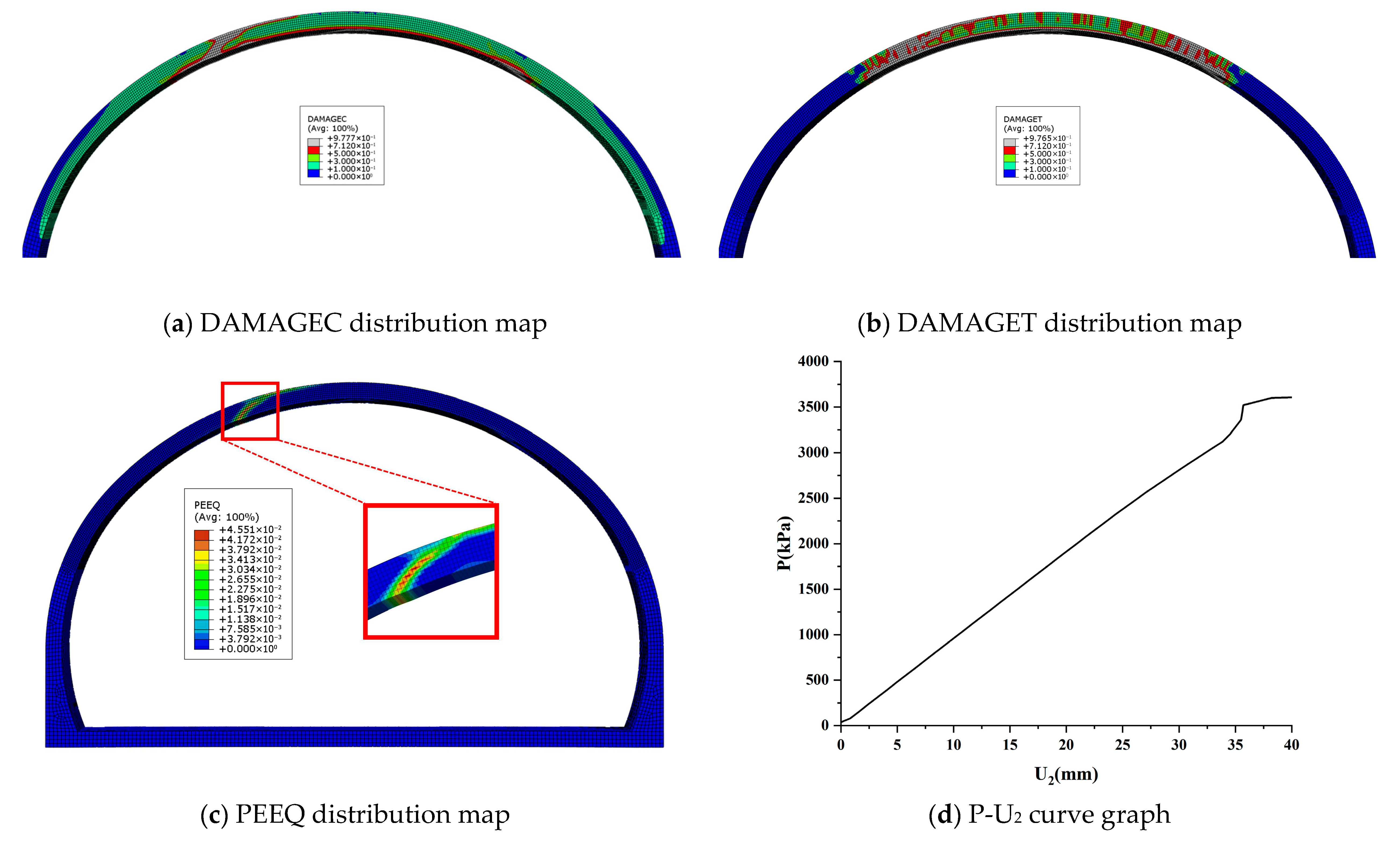
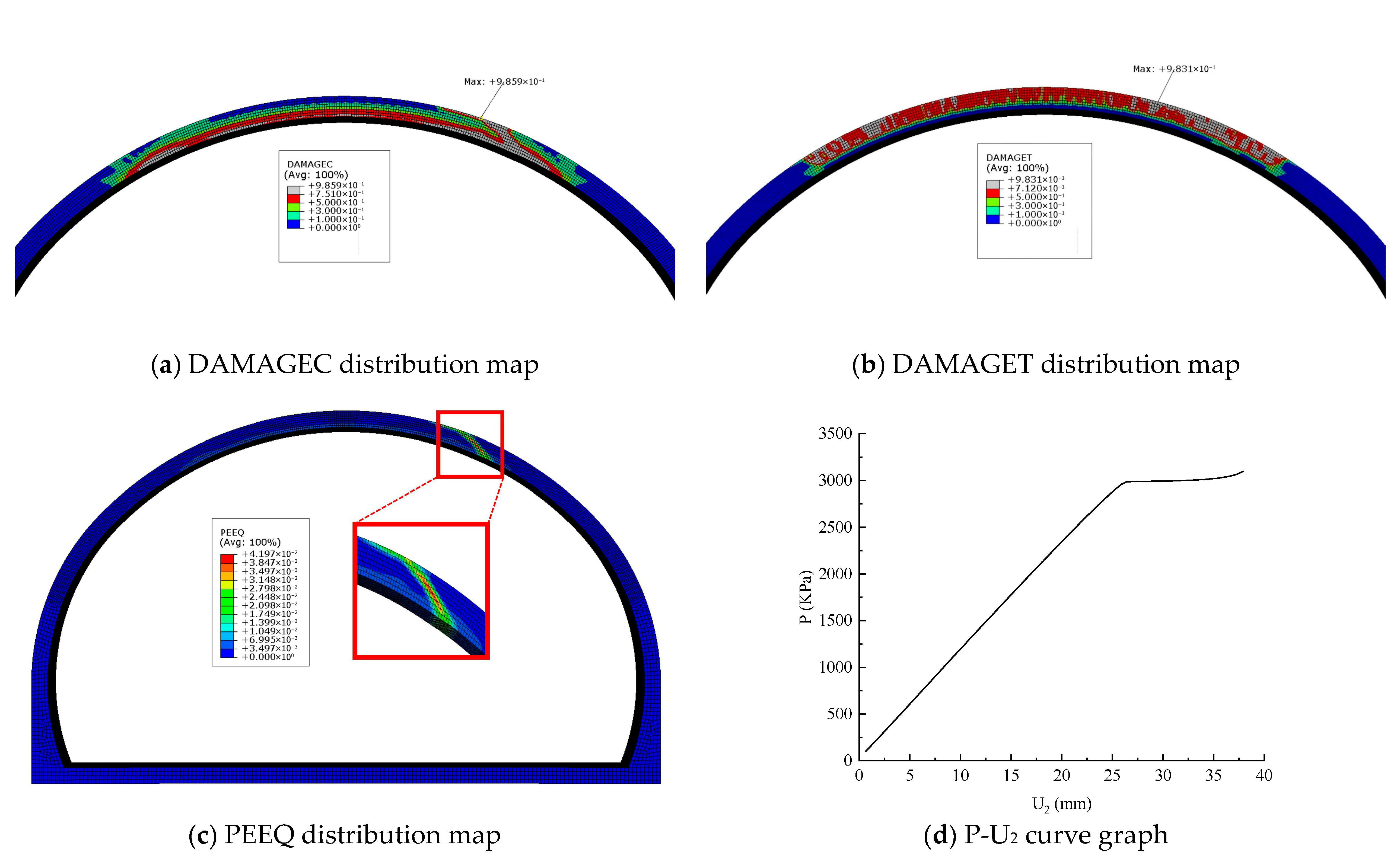
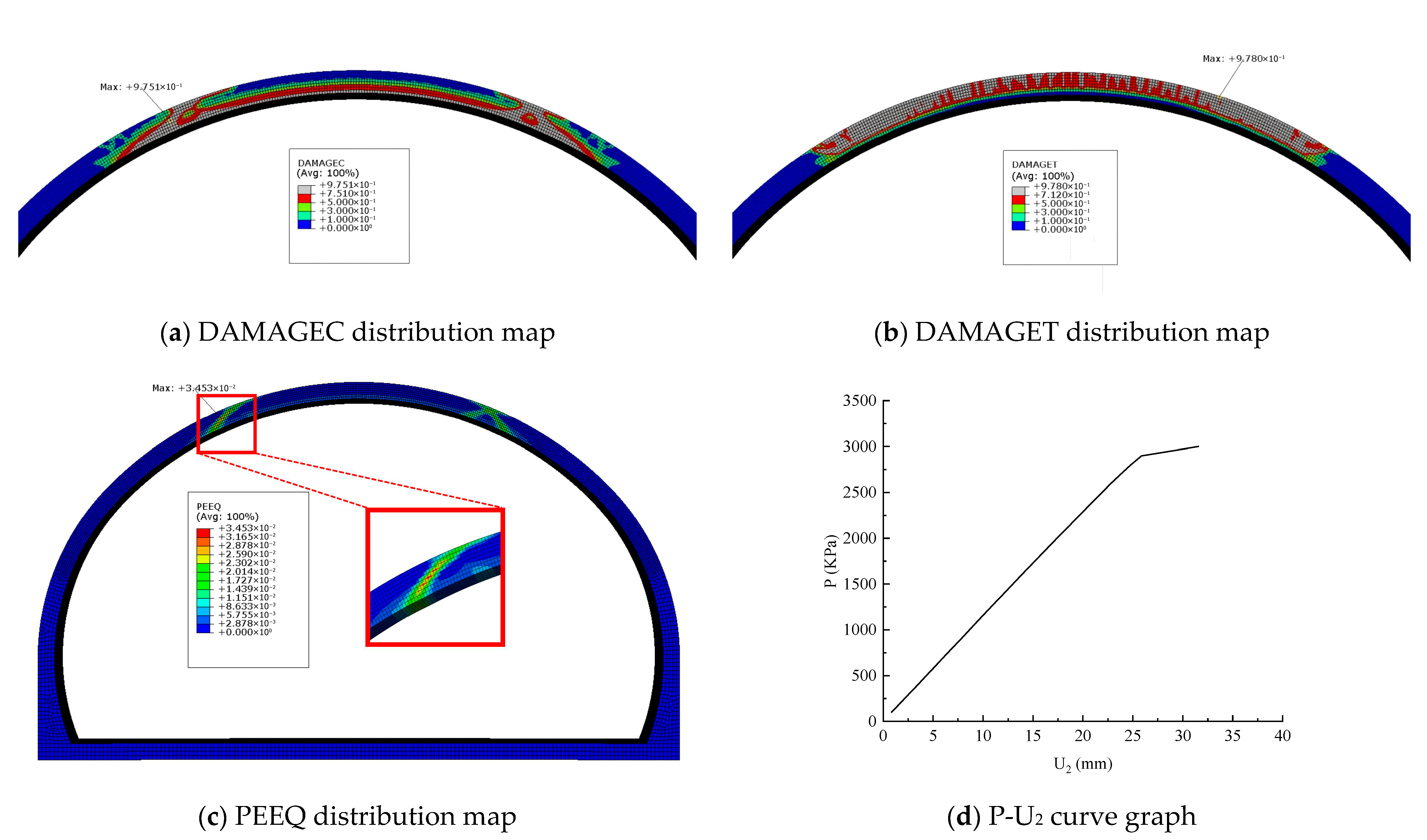
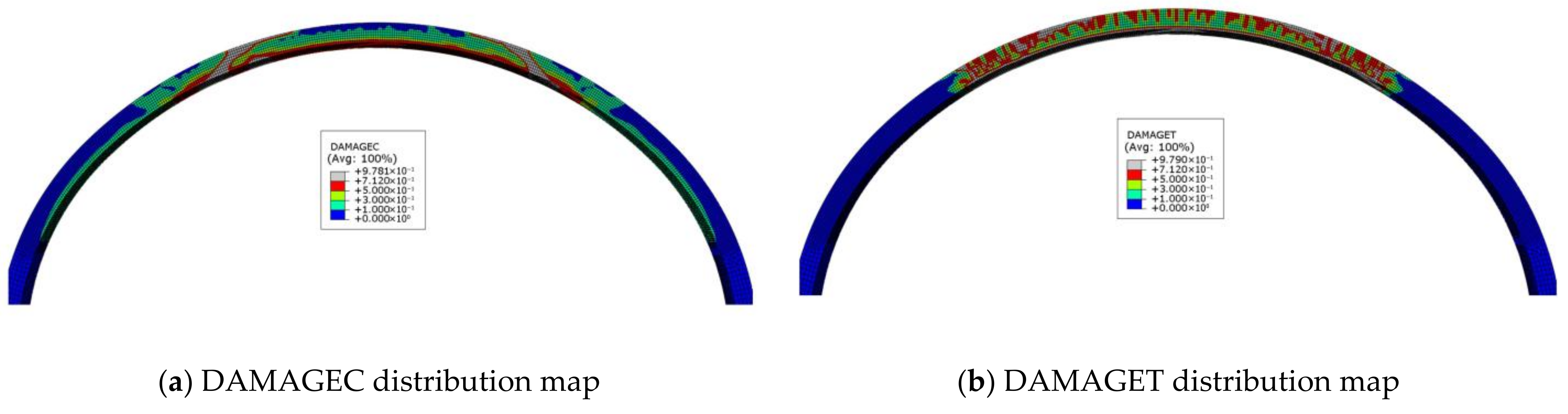
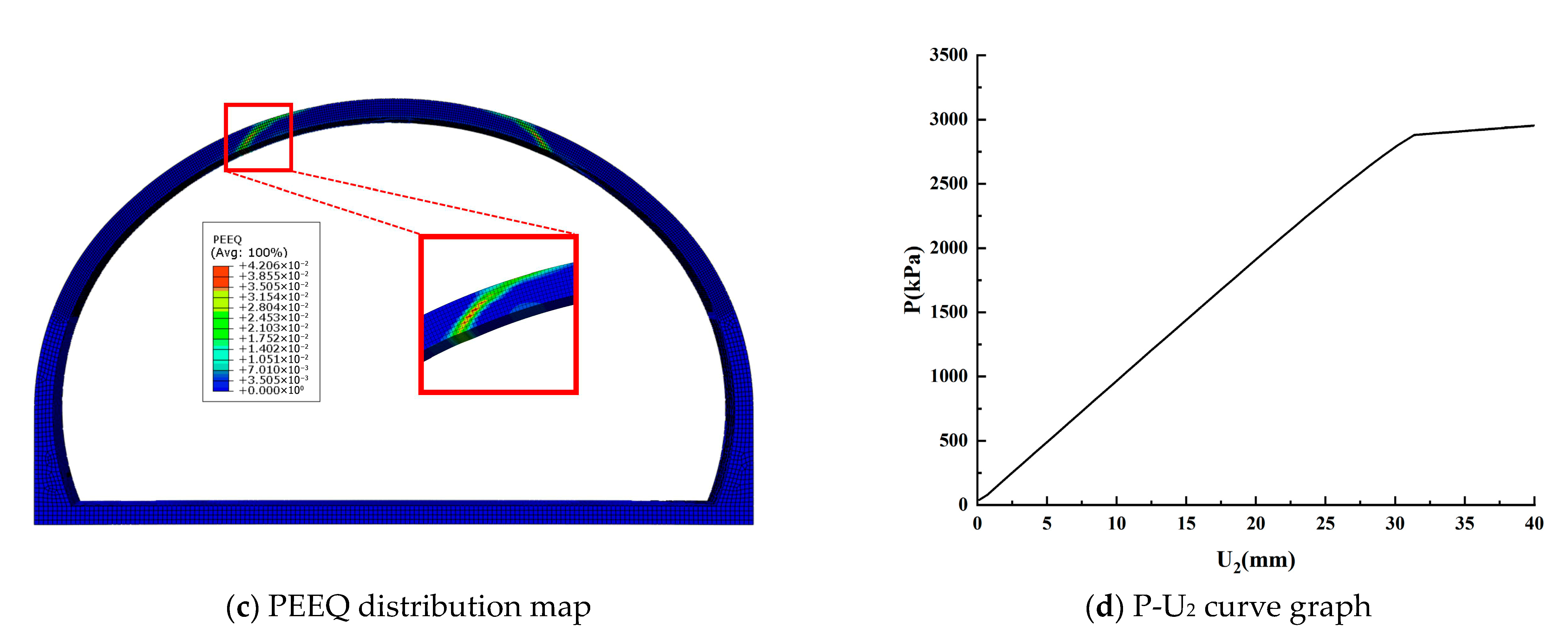
The damage results of condition 1 are shown in
Figure 7. According to the simulation results, when the structure reaches the deflection limit of 37.19 mm, the surface damage of the structure is significant. The maximum value of the compressive damage factor (DAMAGEC) is 0.986, and an obvious compressive damage concentration zone is formed on the right side of the fire area, which is mainly concentrated at the junction of the right spandrel and the side wall, and the concrete compressive damage core area (DAMAGEC > 0.751) with a length of more than 8 cm is extended along the longitudinal direction, and the corresponding serious damage area volume is about 10.89 m
3. This indicates that the area is subjected to large compressive stress, and the concrete has obvious nonlinear deformation and compression failure, and the crack initiation is obvious. The maximum value of tensile damage factor (DAMAGET) reaches 0.983. The tensile damage in the upper part of the structure is widely distributed and the damage degree is high. The volume of the severe tensile damage area (DAMAGET > 0.712) is about 20.76 m
3, indicating that the area is subjected to large tensile stress or strain, resulting in micro-crack propagation and reducing the overall tensile bearing capacity. At this time, the maximum value of equivalent plastic strain (PEEQ) reaches 0.042, which appears on the right side of the vault, indicating that significant plastic deformation occurs under the combined action of high temperature and load, resulting in local stiffness degradation and stress concentration, thus weakening the overall bearing capacity of the structure. The P-U
2 curve enters the platform stage when the pressure is about 3000 kPa, which indicates that the structural stiffness decreases greatly, the deformation no longer increases linearly with the load, and the bearing capacity tends to be critical instability. When the vertical deflection of the structure reaches the limit value of 37.19 mm, the corresponding load pressure is 2942.247 kPa. After calculation, the residual bearing capacity of the structure is 67,479 kN.
4.2.2. Analysis of the Results of Condition Two in Damage and Deflection Response
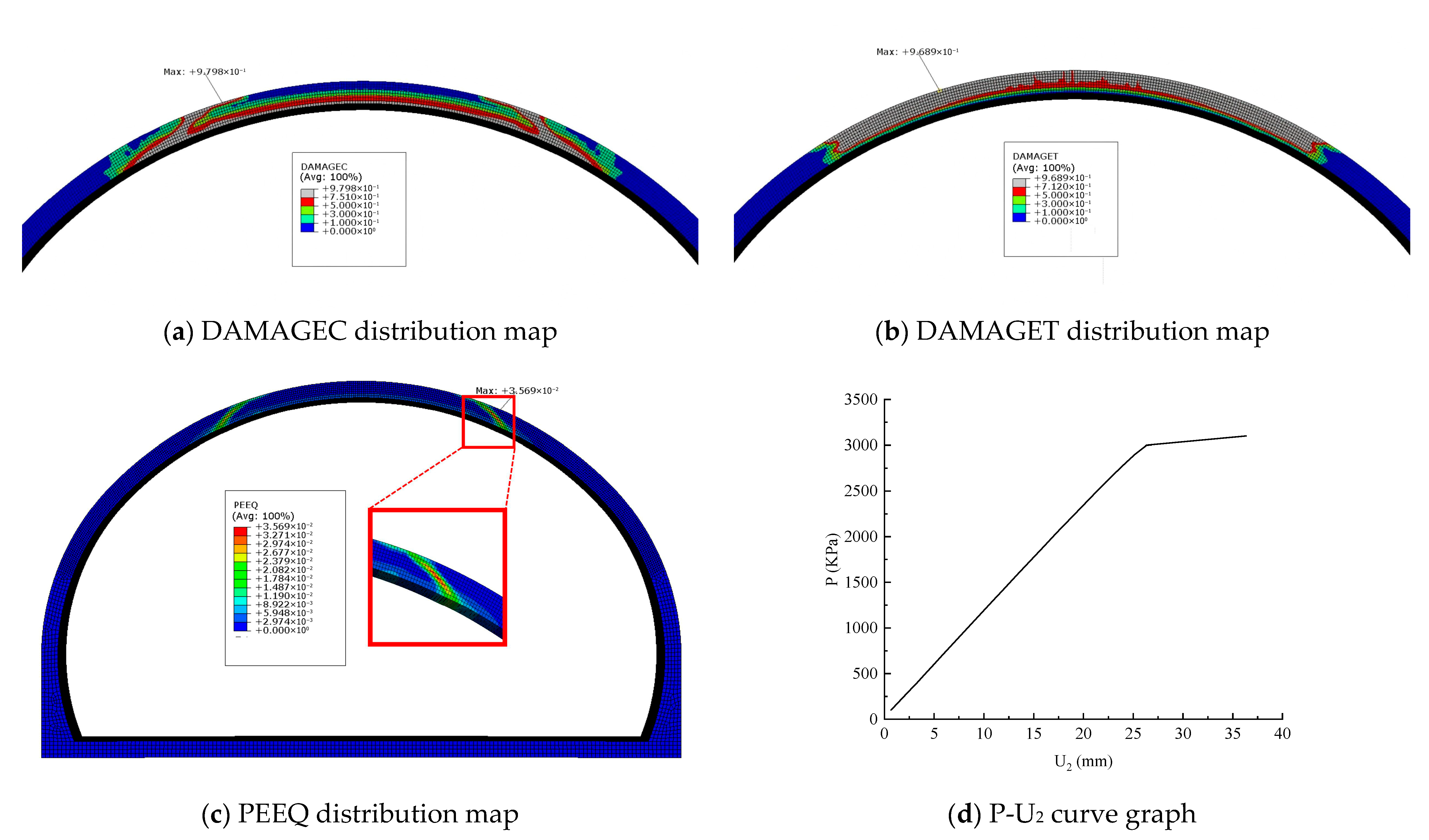
The damage results of condition 2 are shown in
Figure 8. When the vertical deflection of the structure reaches the limit value of 37.19 mm, the maximum value of DAMAGEC reaches 0.975, and a more obvious compressive damage zone is formed on both sides of the fire action area, especially in the near-fire side area, the compressive damage is concentrated and continuous. The volume of the severely damaged area (DAMAGEC > 0.751) is about 12.87 m
3, indicating that the compressive strength of the concrete in this area is significantly reduced, and plastic compression and crack closure occur locally, and the bearing capacity of the structure is significantly degraded. At the same time, the maximum value of DAMAGET reaches 0.978, and the tensile damage in the upper part of the structure is more concentrated, especially in the vault and its two sides. The volume of the severe tensile damage area (DAMAGET > 0.712) is about 26.00 m
3, indicating that the area continues to withstand tensile stress or tensile strain after high temperature, resulting in crack propagation and rapid accumulation of material damage, which seriously weakens the tensile performance and ductility of the structure. The maximum value of PEEQ is 0.035, which is located in the upper left side of the structure, reflecting the significant plastic deformation of this part under the coupling action of high temperature and load. In addition, the P-U
2 curve enters the platform stage when the pressure is about 2900 kPa, indicating that the overall stiffness of the structure decreases rapidly. When the vertical deflection of the structure reaches the limit value of 37.19 mm, the corresponding load pressure is 3054.013 kPa. After calculation, the residual bearing capacity of the structure is 70,043 kN. After the bearing capacity reaches the limit, the deformation continues to increase and the load is difficult to further increase. The structure enters the edge of instability and faces the risk of systematic damage.
4.2.3. Analysis of the Results of Condition Three in Damage and Deflection Response
The damage results of condition 3 are shown in
Figure 9. When the vertical deflection of the structure reaches the limit value of 37.19 mm, the maximum value of DAMAGEC is 0.980, and obvious compressive damage zones are formed on both sides of the fire area, especially in the near-fire area. The concrete damage is serious, and the damage depth is about 6 cm. The volume of the severely damaged area (DAMAGEC > 0.751) is about 11.67 m
3, indicating that the compressive performance of the area decreases significantly under high temperature. There is a significant nonlinear deformation inside the concrete, and the phenomenon of crack closure and crushing tends to be serious, and the local stiffness of the structure decreases. The maximum value of DAMAGET is 0.969, and the damage in the upper part of the structure is more concentrated, showing a stronger local aggregation trend than the previous two conditions. The volume of the severe tensile damage area (DAMAGET > 0.712) is about 33.19 m
3, indicating that the area is subjected to greater tensile stress concentration effect, resulting in accelerated crack initiation and propagation rate, rapid development of material internal damage, and significant reduction in structural tensile performance and ductility. The maximum value of PEEQ reached 0.036, which appeared in the right area of the structural vault. The P-U
2 curve of the structure enters the platform stage when the pressure is about 3000 kPa, the overall stiffness of the structure is greatly reduced, and the structure enters the critical state of instability. When the deflection reaches 37.19 mm, the corresponding pressure is 3045.14 kPa, and the residual bearing capacity of the structure is calculated to be 69,839 kN.
By analyzing the evolution characteristics of compressive damage factor, tensile damage factor, equivalent plastic strain, P-U
2 curve and residual bearing capacity of tunnel structure under the same deflection limit, it is helpful to reveal the different effects of different fire heating processes on the damage development law and residual bearing capacity of tunnel structure. The main structural performance parameters of the three working conditions are compared in
Table 5.
The tunnel structure under the three fire conditions still maintains a high residual bearing capacity when the deflection reaches the limit value, which is 67,479 kN, 70,043 kN and 69,839 kN, respectively. The difference is not more than 4%, and the whole still has a certain safety reserve. Although there are differences in the indexes of compressive damage, tensile damage and plastic deformation in the three fire conditions, these indexes are based on the same damage mechanism and evaluation system, reflecting the common characteristics of structural damage.
4.3. Comparison of Tunnel Damage Caused by Fires of the Same Vehicle Type but with Different Power Sources
By comparing the temperature-time curves of the five-door hatchbacks model (conditions 4–5) and the SUVs model (conditions 6–7) in
Figure 3, it can be found that the common feature is that the electric models all show rapid heating and relatively high peak temperatures, while the fuel models heat up more slowly and have significantly lower peak temperatures. This indicates that regardless of the type of vehicle, the difference in power sources is the main factor determining the thermal development characteristics of fires. Electric vehicles release a large amount of heat due to battery thermal runaway, resulting in a long duration of high-temperature stages and a large temperature gradient. Fuel vehicles, on the other hand, develop a relatively gentle and uniform temperature field due to more uniform fuel combustion. This rule suggests that in the fire prevention and control of tunnels and the design of structural fire resistance, the influence of the type of vehicle power source on the temperature field should be given priority consideration.
4.3.1. Comparison Between Five-Door Hatchbacks Electric and Fuel Vehicles (Conditions Four and Five)
In
Figure 3a, conditions 4 and 5, respectively, correspond to the fire situations of five-door hatchbacks fueled by electric and traditional fuels. Although both five-door hatchbacks car fires, their temperature–time curves exhibit distinct characteristics. Condition 4 is characterized by a rapid temperature rise during the early fire stage, reflecting the intense heat release associated with battery thermal runaway. In contrast, Condition 5 shows a relatively smoother heating process with a more gradual temperature increase. The maximum temperatures of the two fire curves are different, reaching approximately 1137 °C and 713 °C, respectively. However, differences in heating rate, duration of the high-temperature stage, and cooling behavior indicate distinct thermal loading histories imposed on the tunnel lining.
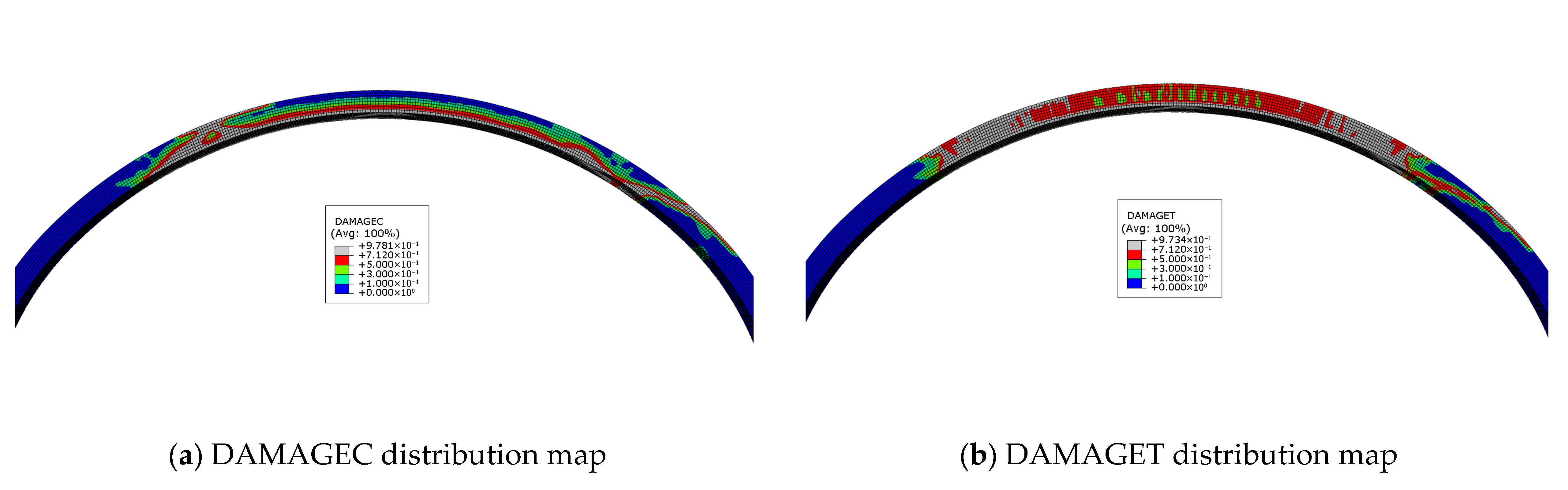
The damage results of condition 4 are shown in
Figure 10. When the vertical deflection of the structure reaches the limit value of 37.19 mm, the maximum value of DAMAGEC reaches 0.978, and a distinct compression damage zone was formed in the fire-affected area. The volume of the severely damaged area (DAMAGEC > 0.751) is about 7.38 m
3. At the same time, the maximum value of DAMAGET reaches 0.973, and the tensile damage in the upper part of the structure is more concentrated, especially on both sides. The volume of the severe tensile damage area (DAMAGET > 0.712) is about 20.18 m
3. The maximum value of PEEQ is 0.037, which is located in the upper left side of the structure, reflecting the significant plastic deformation of this part under the coupling action of high temperature and load. In addition, the P-U
2 curve enters the platform stage when the pressure is about 2918 kPa, indicating that the overall stiffness of the structure decreases rapidly.
When the vertical deflection of the structure reaches the limit value of 37.19 mm, the corresponding load pressure is 2918 kPa. After calculation, the residual bearing capacity of the structure is 65,634 kN. After the bearing capacity reaches the limit, the deformation continues to increase and the load is difficult to further increase. The structure enters the edge of instability and faces the risk of systematic damage.
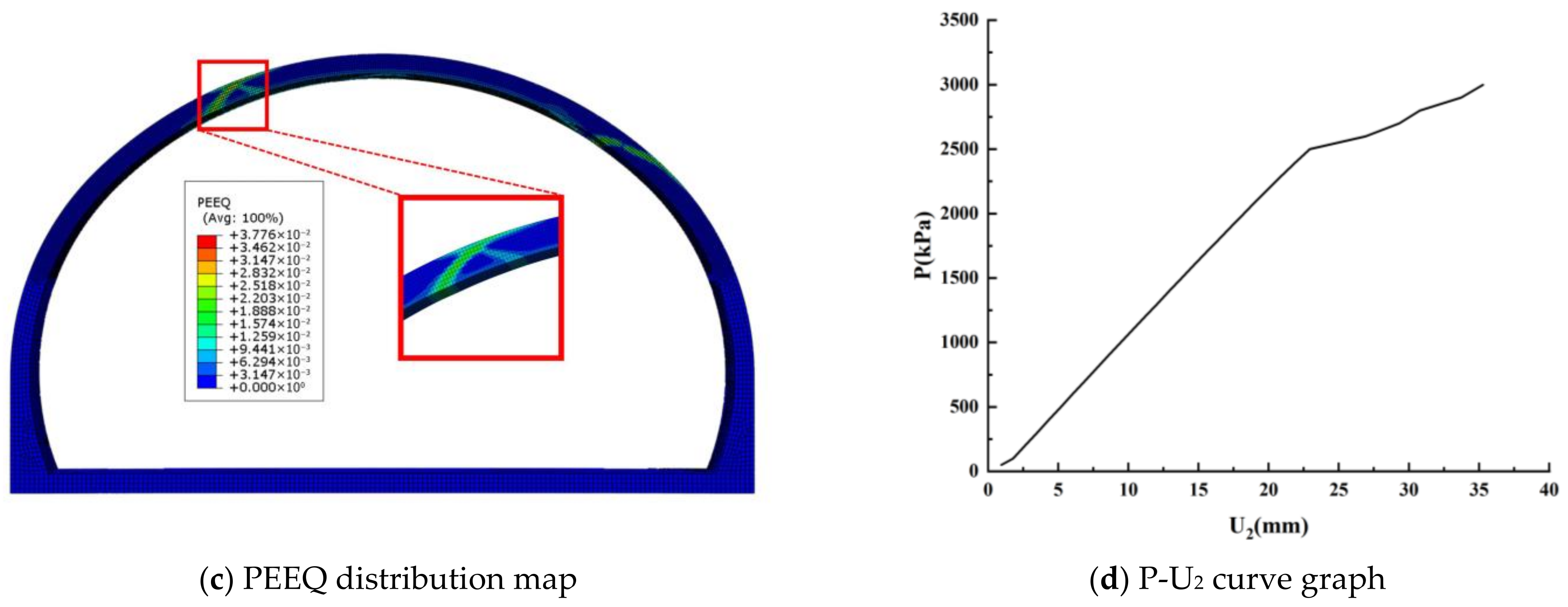
The damage results of condition 5 are shown in
Figure 11. When the vertical deflection of the structure reaches the limit value of 37.19 mm, the maximum value of DAMAGEC reaches 0.978. Moreover, distinct compression damage zones were formed on both sides of the fire-affected area. The volume of the severely damaged area (DAMAGEC > 0.751) is about 3.52 m
3. At the same time, the maximum value of DAMAGET reaches 0.979, and the tensile damage in the upper part of the structure is more concentrated. The volume of the severe tensile damage area (DAMAGET > 0.712) is about 13.65 m
3. The maximum value of PEEQ is 0.042, which is located in the upper left side of the structure, reflecting the significant plastic deformation of this part under the coupling action of high temperature and load. In addition, the P-U
2 curve enters the platform stage when the pressure is about 3467 kPa, indicating that the overall stiffness of the structure decreases rapidly.
When the vertical deflection of the structure reaches the limit value of 37.19 mm, the corresponding load pressure is 3467 kPa. After calculation, the residual bearing capacity of the structure is 77,983 kN. After the bearing capacity reaches the limit, the deformation continues to increase and the load is difficult to further increase. The structure enters the edge of instability and faces the risk of systematic damage.
To more intuitively present the differentiated impacts of the two types of five-door hatchback fire scenarios on the tunnel lining structure, and to clearly compare the similarities and differences in key indicators such as damage degree and mechanical properties between the two, we have sorted and summarized the core data of working conditions 4 and 5 in the above analysis to form
Table 6.
4.3.2. Comparison Between SUVs Electric and Fuel Vehicles (Conditions Six and Seven)
In
Figure 3b, Condition 6 represents an electric SUV and Condition 7 represents a fuel-powered SUV. Although both are SUV models, their heating curves show significant differences due to their different power sources. Electric SUVs are affected by battery thermal runaway, releasing heat at a relatively fast rate, causing the temperature to rise rapidly, with the peak temperature reaching approximately 977 °C. In contrast, fuel-powered SUVs heat up relatively slowly, with a peak temperature of only about 594 °C. This contrast reflects the significant influence of power types on the development characteristics of vehicle fire temperatures.
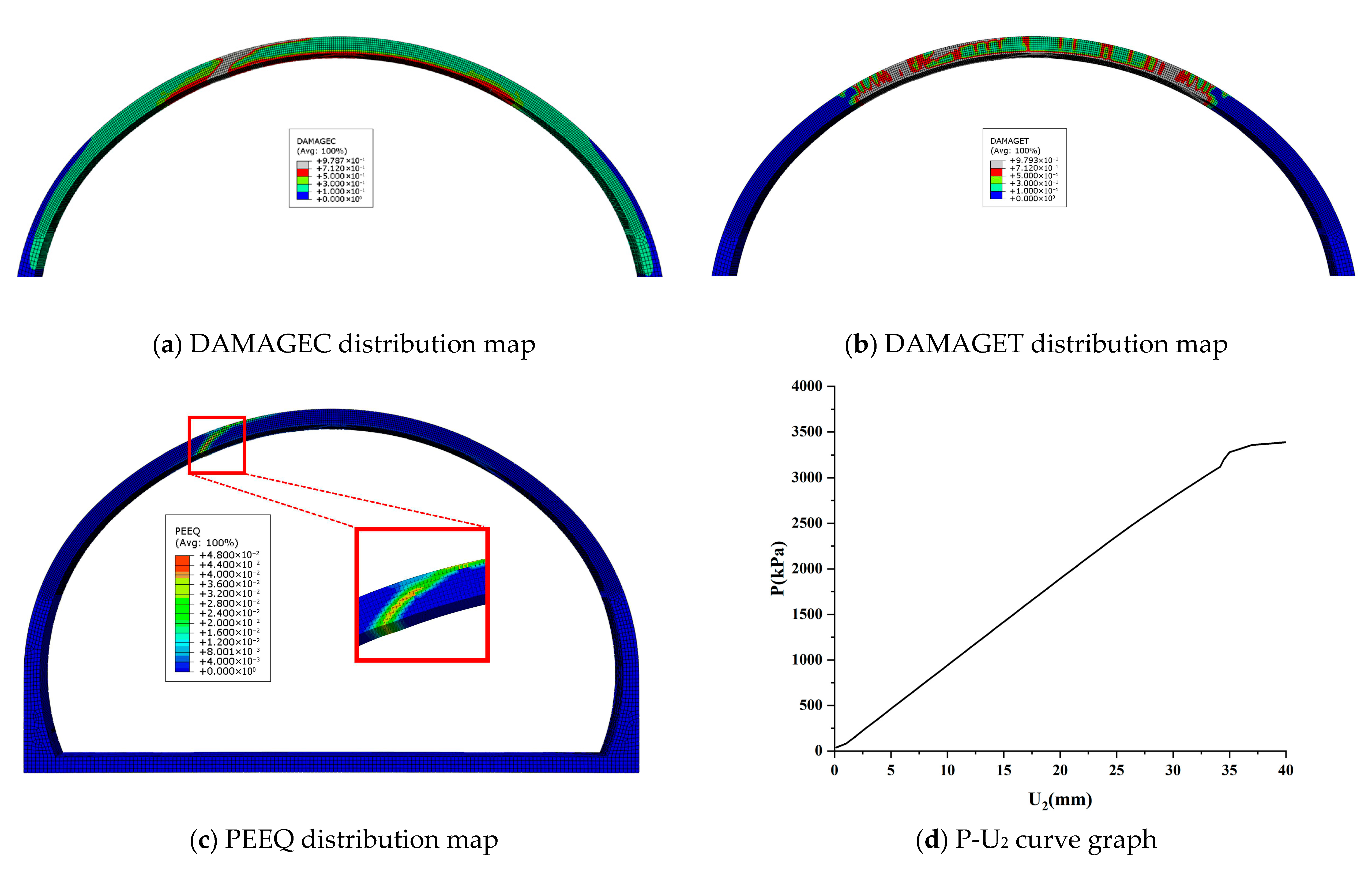
The damage results of condition 6 are shown in
Figure 12. When the vertical deflection of the structure reaches the limit value of 37.19 mm, the maximum value of DAMAGEC reaches 0.979, and obvious compression damage zones were formed on the left side of the lining. The volume of the severely damaged area (DAMAGEC > 0.751) is about 7.26 m
3. At the same time, the maximum value of DAMAGET reaches 0.979, and the tensile damage in the upper part of the structure is more concentrated. The volume of the severe tensile damage area (DAMAGET > 0.712) is about 13.5 m
3. The maximum value of PEEQ is 0.048, which is located in the upper left side of the structure, reflecting the significant plastic deformation of this part under the coupling action of high temperature and load. In addition, the P-U
2 curve enters the platform stage when the pressure is about 3120 kPa, indicating that the overall stiffness of the structure decreases rapidly.
When the vertical deflection of the structure reaches the limit value of 37.19 mm, the corresponding load pressure is 3120 kPa. After calculation, the residual bearing capacity of the structure is 70,168 kN. After the bearing capacity reaches the limit, the deformation continues to increase and the load is difficult to further increase. The structure enters the edge of instability and faces the risk of systematic damage.
The damage results of condition 7 are shown in
Figure 13. When the vertical deflection of the structure reaches the limit value of 37.19 mm, the maximum value of DAMAGEC reaches 0.979, and obvious compression damage zones were formed on the left side of the lining. The volume of the severely damaged area (DAMAGEC > 0.751) is about 3.06 m
3. At the same time, the maximum value of DAMAGET reaches 0.976, and the tensile damage in the upper part of the structure is more concentrated. The volume of the severe tensile damage area (DAMAGET > 0.712) is about 12.74 m
3. The maximum value of PEEQ is 0.045, which is located in the upper left side of the structure, reflecting the significant plastic deformation of this part under the coupling action of high temperature and load. In addition, the P-U
2 curve enters the platform stage when the pressure is about 3845 kPa, indicating that the overall stiffness of the structure decreases rapidly.
When the vertical deflection of the structure reaches the limit value of 37.19 mm, the corresponding load pressure is 3845 kPa. After calculation, the residual bearing capacity of the structure is 86,485 kN. After the bearing capacity reaches the limit, the deformation continues to increase and the load is difficult to further increase. The structure enters the edge of instability and faces the risk of systematic damage.
To present more intuitively the differentiated impacts of the two types of SUV fire scenarios on the tunnel lining structure and to more clearly compare the similarities and differences in key indicators such as damage degree and mechanical properties between the two, we have sorted out and summarized the core data of working conditions 6 and 7 in the above analysis to form
Table 7.
5. Discussion
The temperature distribution and damage evolution of the lining obtained in this paper are basically consistent with previous studies on the fire–structure interaction of tunnels. Existing studies have shown that the applied thermal boundary conditions mainly represent the thermal load on the lining surface, while the temperature field inside the lining is controlled by heat conduction and material properties, resulting in an obvious temperature gradient within the lining thickness [
31]. This observation explains why similar peak surface temperatures under different heating curves may lead to different internal damage patterns.
From the perspective of materials, the mechanical properties of concrete will significantly decline when exposed to high temperatures, especially when the temperature exceeds 600–700 °C. Previous experimental studies have shown that compressive strength, elastic modulus and tensile capacity will rapidly decline after exceeding this threshold, accompanied by microcracks, stiffness loss and irreversible damage accumulation [
32]. The damage distribution characteristics obtained in this study are that the tensile and compressive damage indices in the near-surface area increase, which is in good agreement with these findings.
Compared with traditional vehicle fire scenarios, electric vehicle fires exhibit distinct thermal characteristics due to lithium-ion battery thermal runaway, which produces rapid heat release and highly localized temperature peaks. Full-scale tests on electric vehicles have shown that battery pack surface temperatures can reach approximately 800 °C within a few minutes as thermal runaway propagates through the cells, and the temperature evolution profile differs significantly from conventional hydrocarbon fires where heat release is governed by fuel load and ventilation conditions [
33]. Experimental studies on large automotive lithium-ion cells confirm that thermal runaway is a fast, self-accelerating exothermic reaction, with cell temperatures and hotspots reaching values often above 800 °C and potentially approaching 1000 °C in localized regions [
34]. Detailed thermal runaway experiments further indicate that, beyond peak temperature values, the rate of temperature rise and subsequent decay are markedly different in battery fires compared to traditional vehicle fire curves [
35]. Although the peak temperature adopted in this study is comparable to that in a severe tunnel fire scenario, the temporal evolution of the heating curve is significantly different. The results show that even at similar maximum surface temperatures, changes in the heating and cooling stages can lead to different structural responses and residual damage states. This highlights the importance of considering the fire curve characteristics when assessing the fire resistance of tunnels in electric vehicle fire scenarios, rather than relying solely on peak temperatures.
Through comparative tests of different power sources of the same vehicle model, it can be concluded that the type of vehicle power is the core factor determining the thermal evolution characteristics and structural damage degree of tunnel fires. The type of power will fundamentally change the heat release process of vehicle fires, thereby affecting the thermal environment and structural response of tunnels. Whether it is a five-door hatchback or an SUV, the volume of the severely damaged areas in the compression and tension of the tunnel lining corresponding to an electric vehicle fire is significantly larger than that of a fuel vehicle fire of the same model. At the same time, the residual bearing capacity of the structure is lower, and the overall stiffness decreases more rapidly. The fuel combustion in fuel vehicle fires is more uniform, creating a milder and more uniform thermal environment. Therefore, the thermal effect on the tunnel lining is weaker, and the degree of structural damage is lower. This result is consistent with the tunnel fire test results in [
30], which found that the heat release in fuel vehicle fires is more stable, and the negative impact on the tunnel structure is smaller.
Electric vehicle fires will cause tunnel structures to enter the platform stage of rapid stiffness decline earlier, with lower residual bearing capacity. And among different vehicle models, the impact also varies: The differences in the volume of tensile damage zones and the residual load-bearing capacity of structures between electric five-door hatchbacks and fuel vehicles in terms of fire are greater than those of SUV models. This may be related to the battery layout position and vehicle space dimensions of five-door hatchbacks. This difference also indicates that in tunnel fire protection design, both the vehicle model and power type need to be considered together. This view is consistent with the research in [
29], which holds that the prevention and control of tunnel fires require simultaneous attention to the power type and vehicle model characteristics of vehicles.
Overall, the current research results support and expand the existing knowledge, indicating that although the maximum temperatures are similar, the thermal loads caused by electric vehicle fires may lead to damage patterns comparable to or even more unfavorable than those of traditional tunnel fires.





 ,
,