In Situ Stress Inversion in a Pumped-Storage Power Station Based on the PSO-SVR Algorithm


Abstract
1. Introduction
2. Engineering Geological Conditions of the Project Area
3. In Situ Stress Inversion Using MLR
3.1. Basic Principles
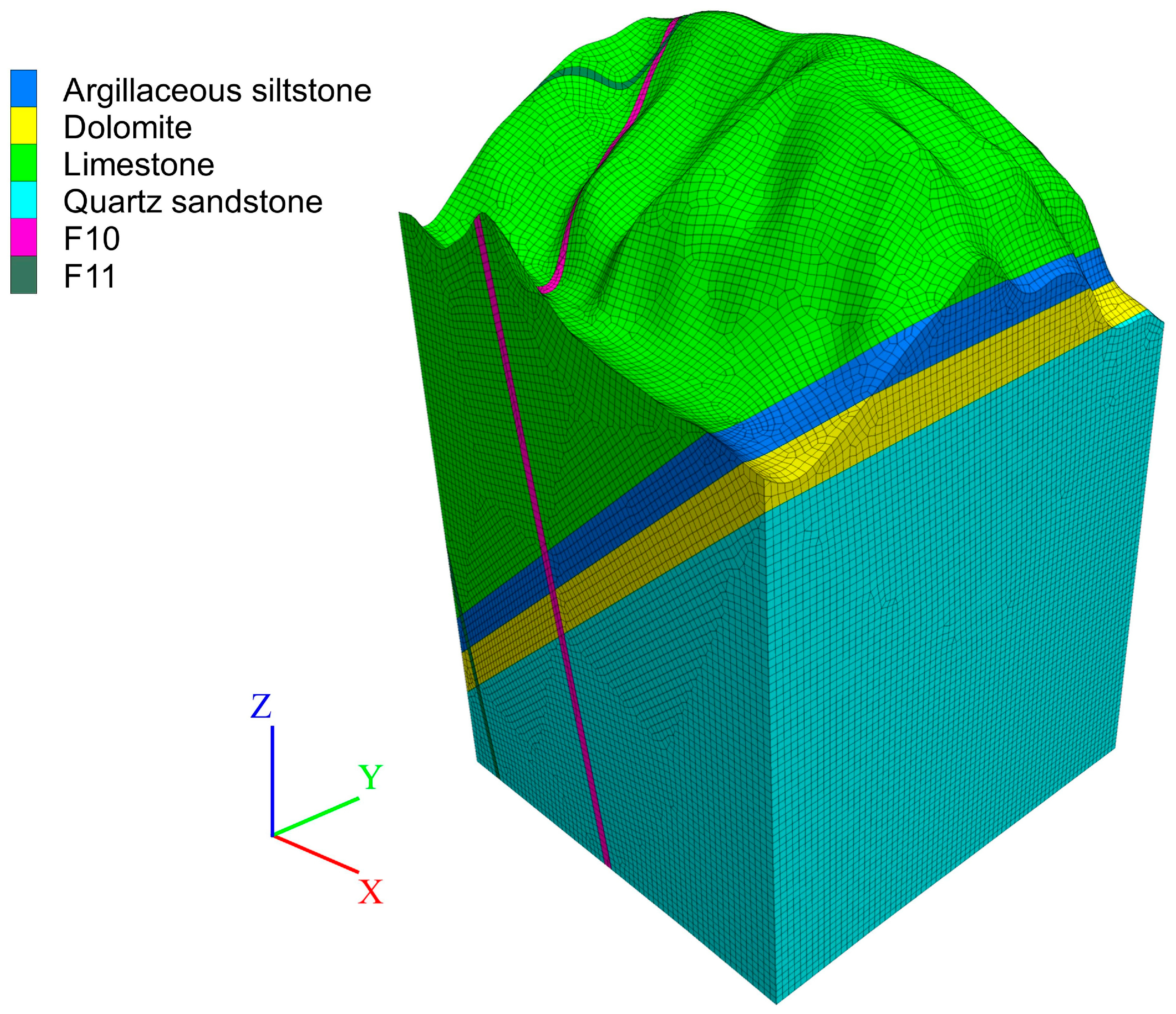
3.2. Three-Dimensional Geological Model and Rock Mass Mechanical Parameters
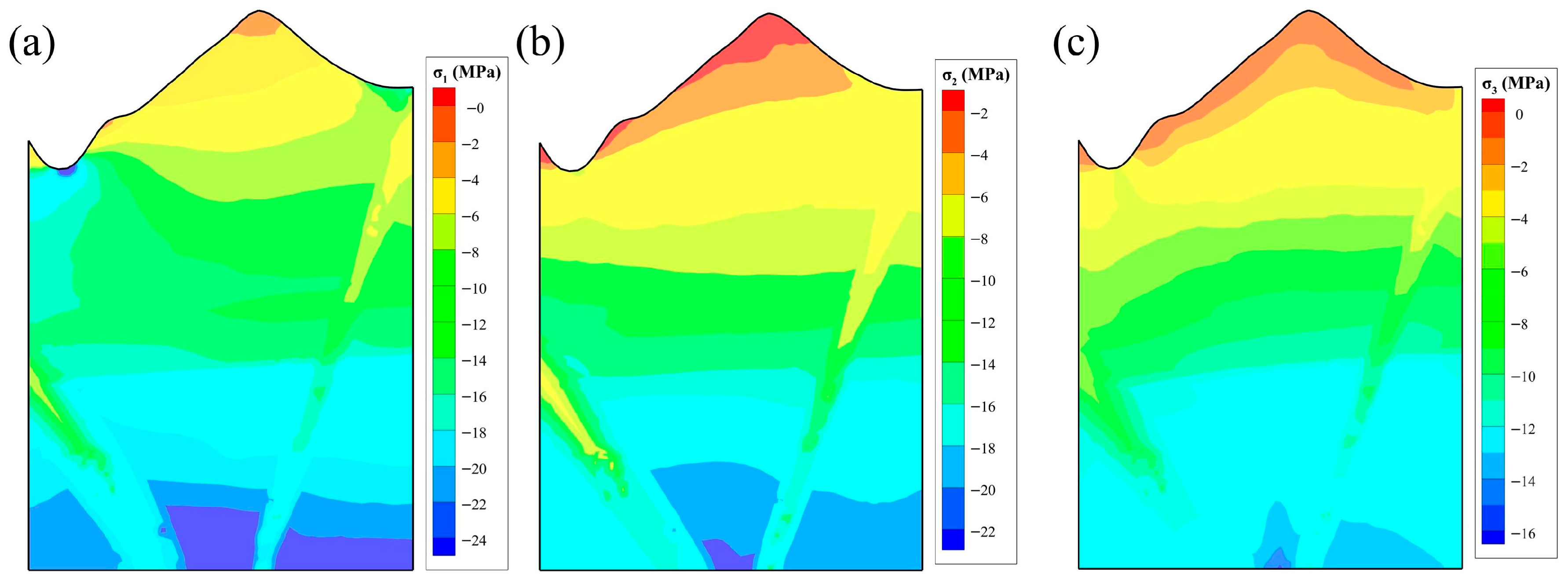
3.3. Results of In Situ Stress Inversion
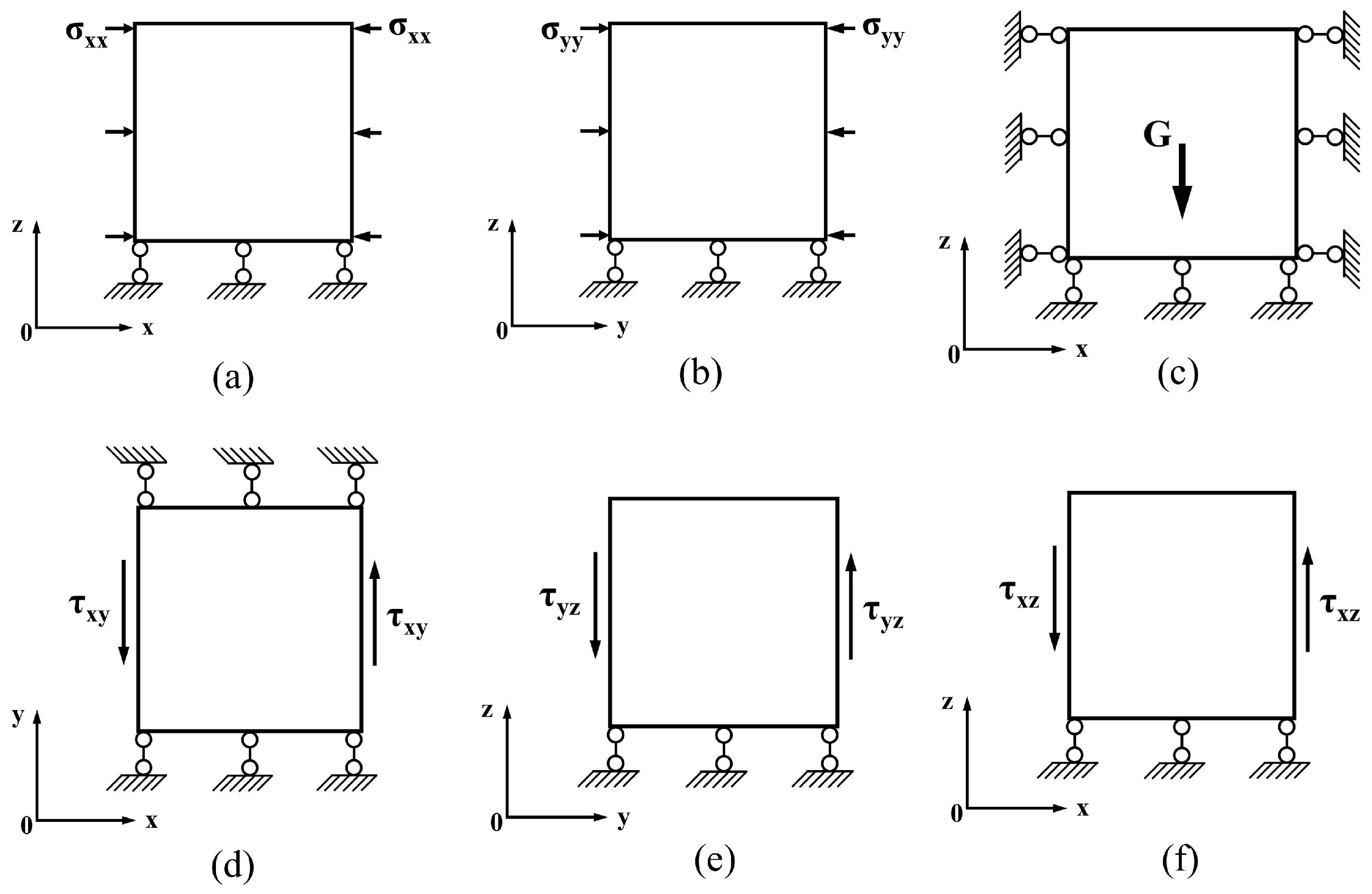
- For tectonic compressive stress in the y direction, fix the four faces of the numerical model at x = 0, x = 529.6 m, y = 0, and z = 0, and apply a boundary-normal velocity of 5 × 10⁻⁵ m/s to the y = 570 m face to compress the model in the y direction;
- For gravitational stress, fix the four lateral faces and the bottom face (x = 0, x = 529.6 m, y = 0, y = 570 m, and z = 0), and activate the gravitational body force in the model;
- For xy shear stress, fix the four faces of the numerical model at x = 0, y = 0, y = 570 m, and z = 0, and apply a tangential velocity of 5 × 10⁻⁵ m/s in the y direction to the x = 529.6 m face to generate shear deformation in the xy plane.
4. In Situ Stress Inversion Using the PSO-SVR Algorithm
4.1. Basic Principles and Methods

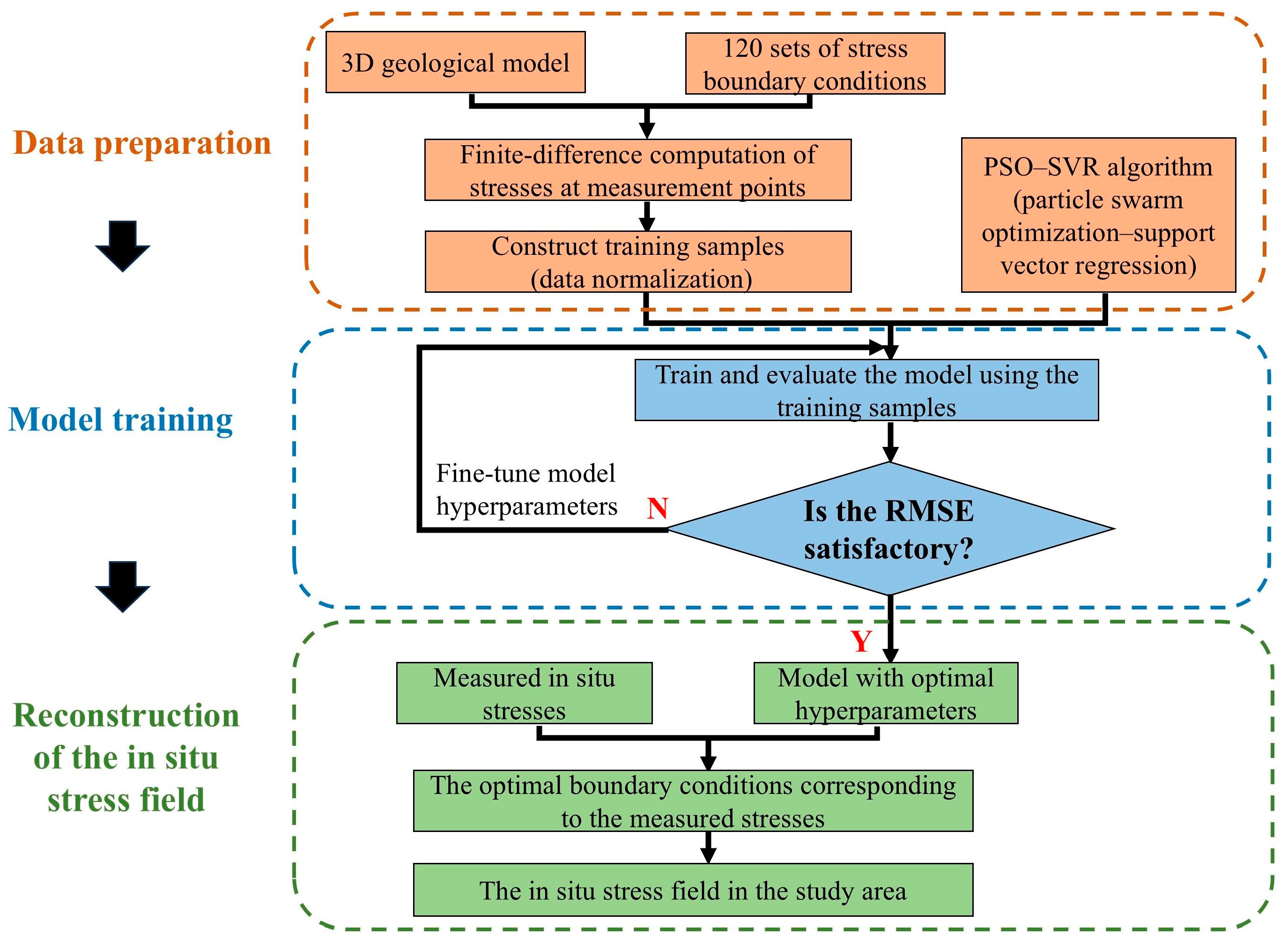
4.2. PSO-SVR Model Training and Prediction of Optimal Stress Boundary Conditions
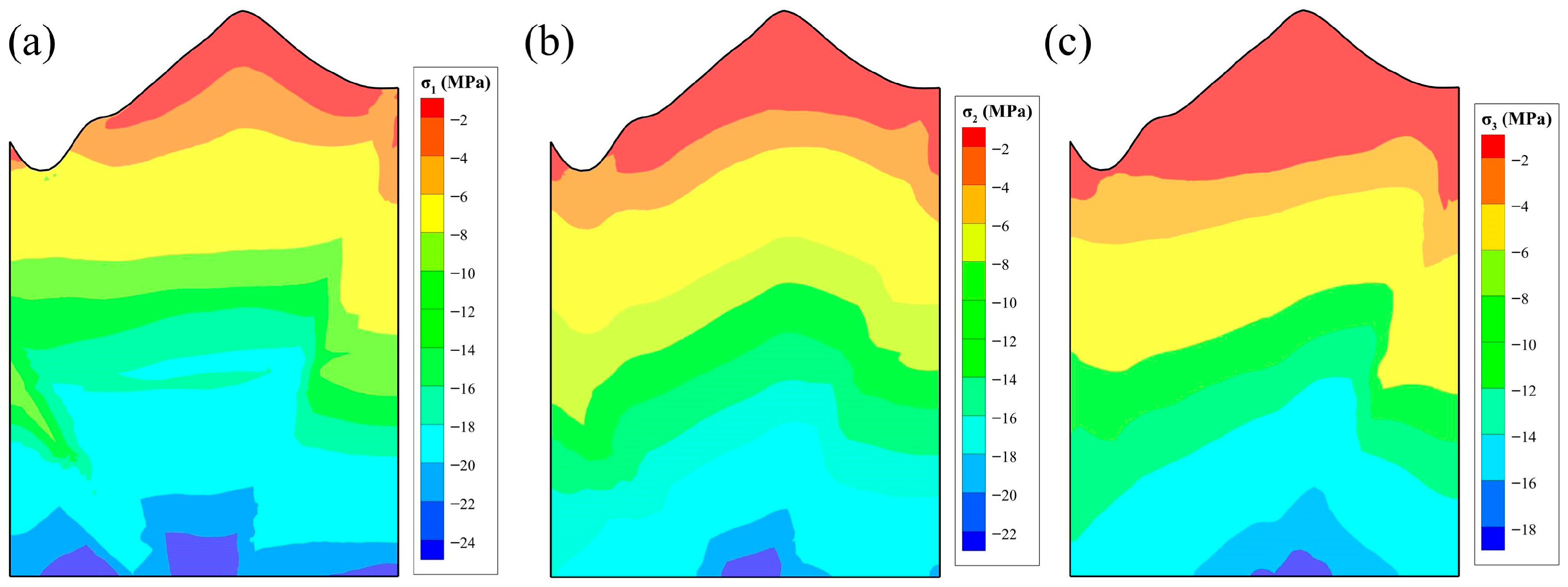
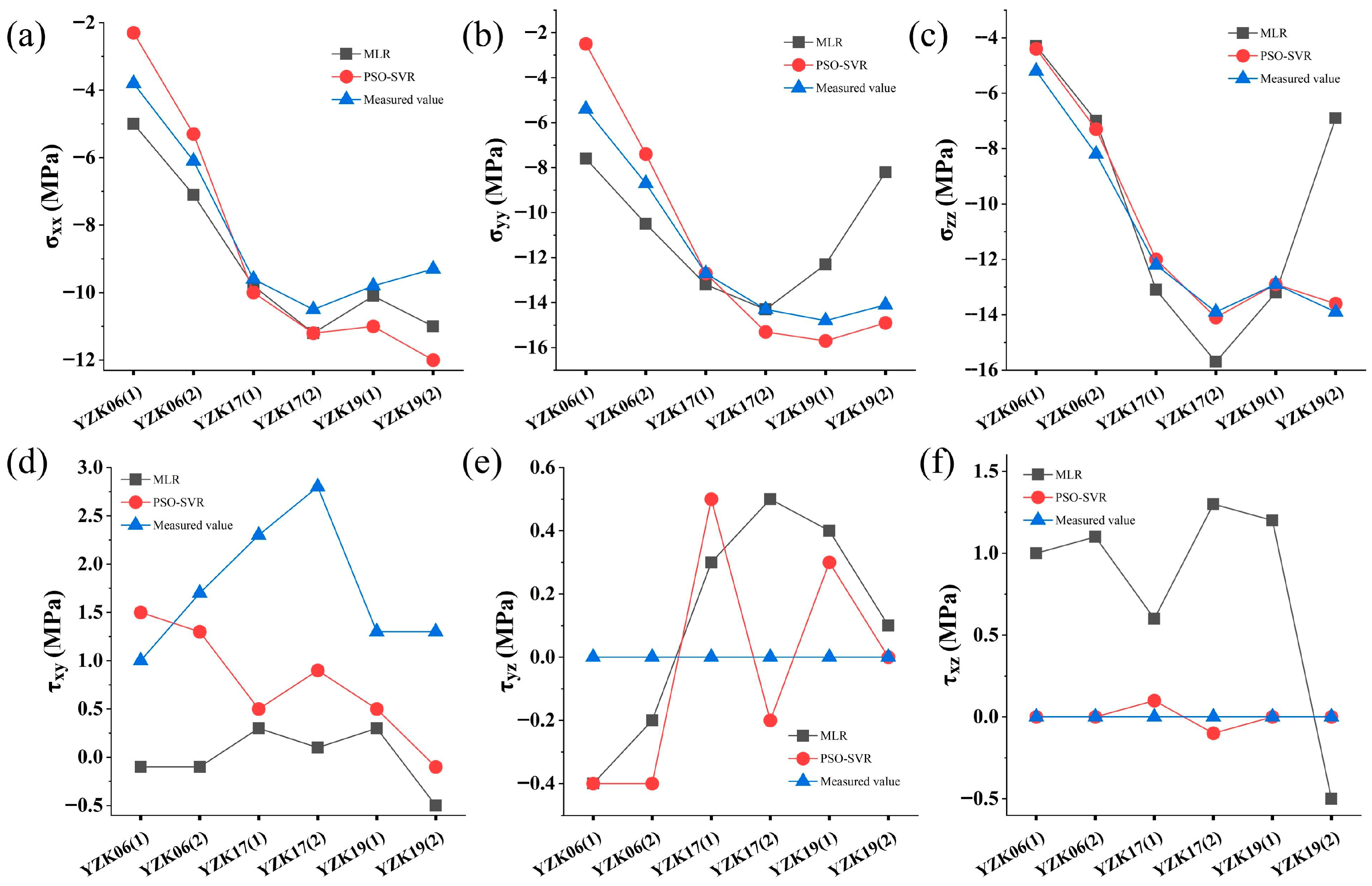
4.3. Inversion Results and Reconstructed In Situ Stress Field
5. Discussion
6. Conclusions
- (1)
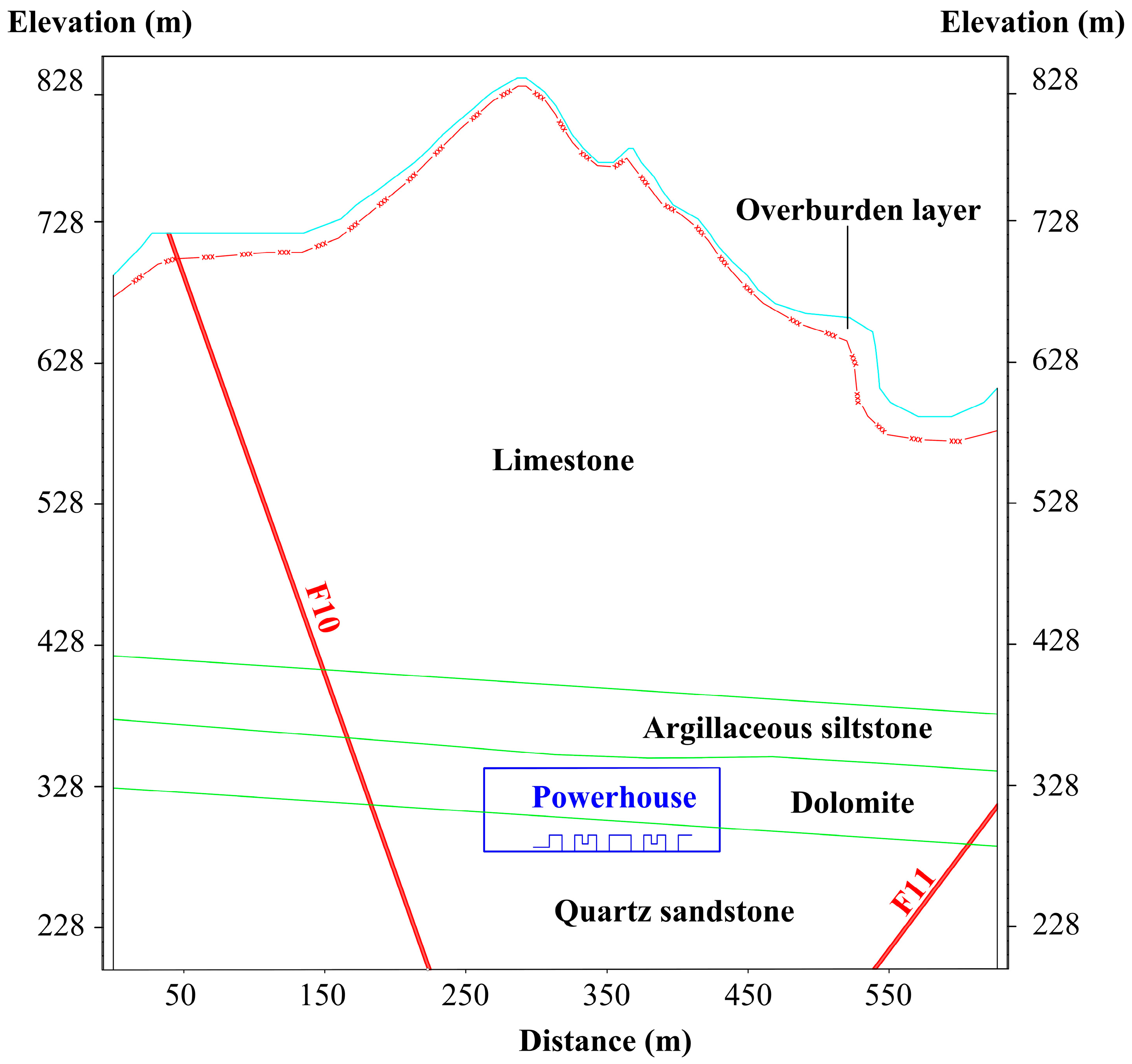
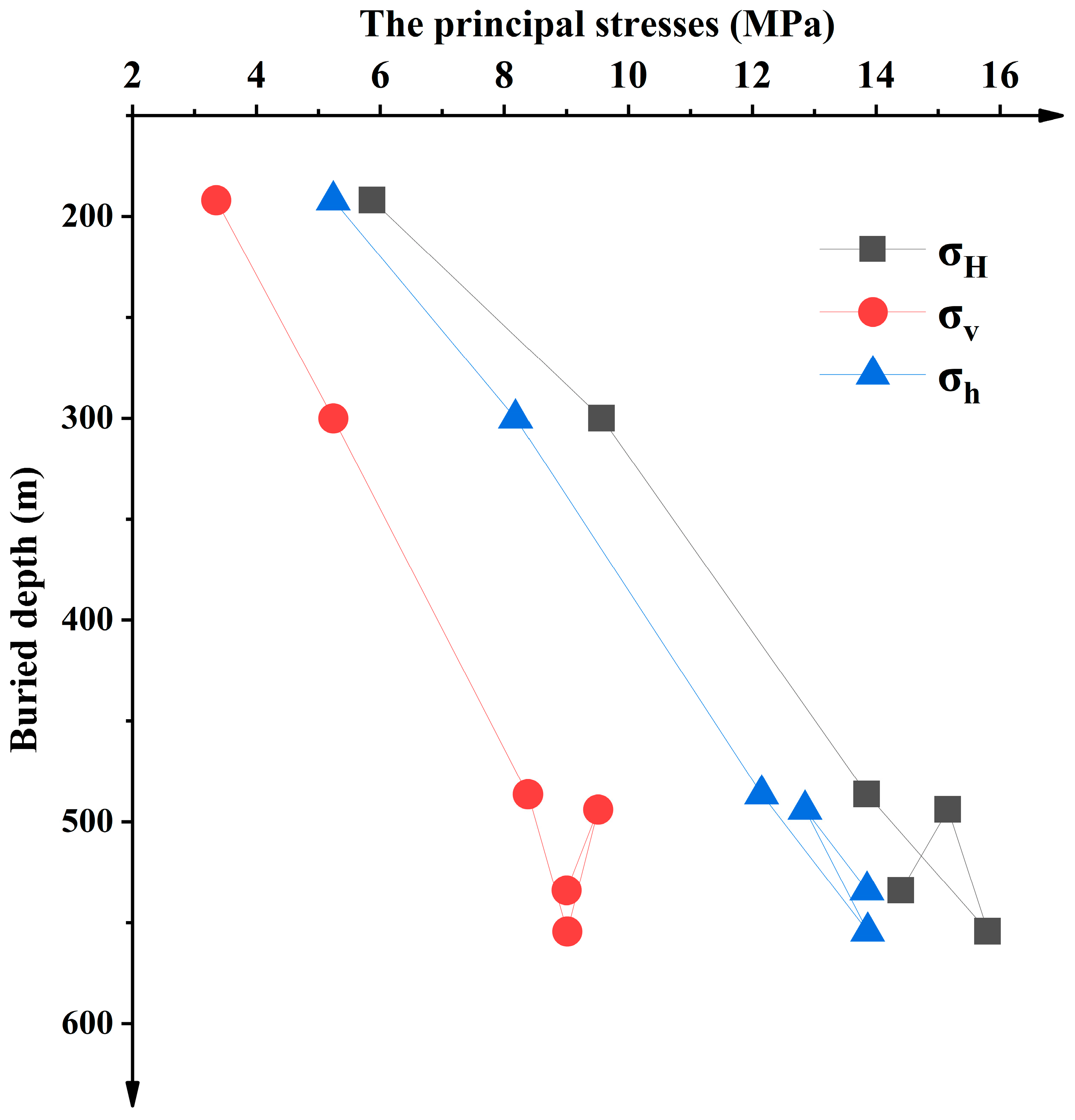
- The PSPS area is characterized by relatively simple layered Cambrian strata and a horizontal tectonic stress regime, with σH > σv > σh, a west–southwest-oriented maximum principal stress, and all three principal stresses increasing with burial depth.
- (2)
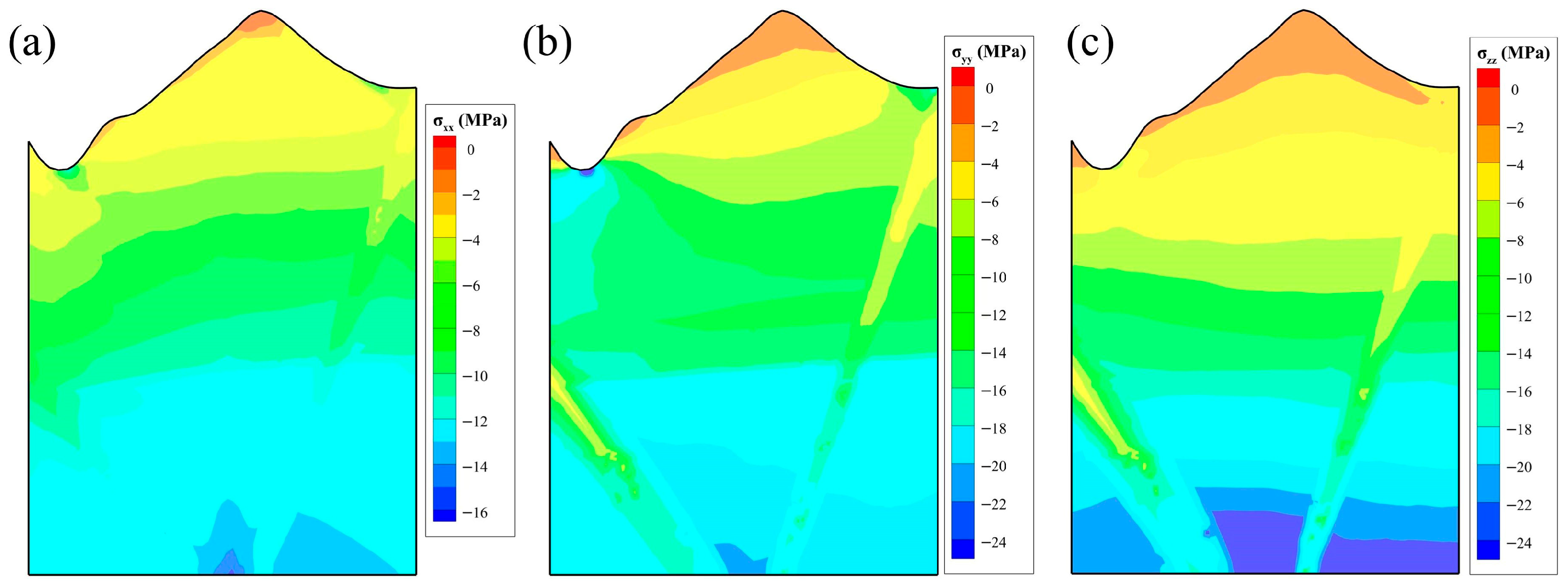
- The MLR combined with the zone-stress loading method reproduces the in situ stresses at the measurement points (R2 = 0.894), and the normal-stress components are generally consistent with the measured values. However, the reconstructed stress field contains numerous local stress anomalies and substantially exaggerates the influence of faults, so that noticeable discrepancies remain between the inverted and the actual in situ stress distribution.
- (3)
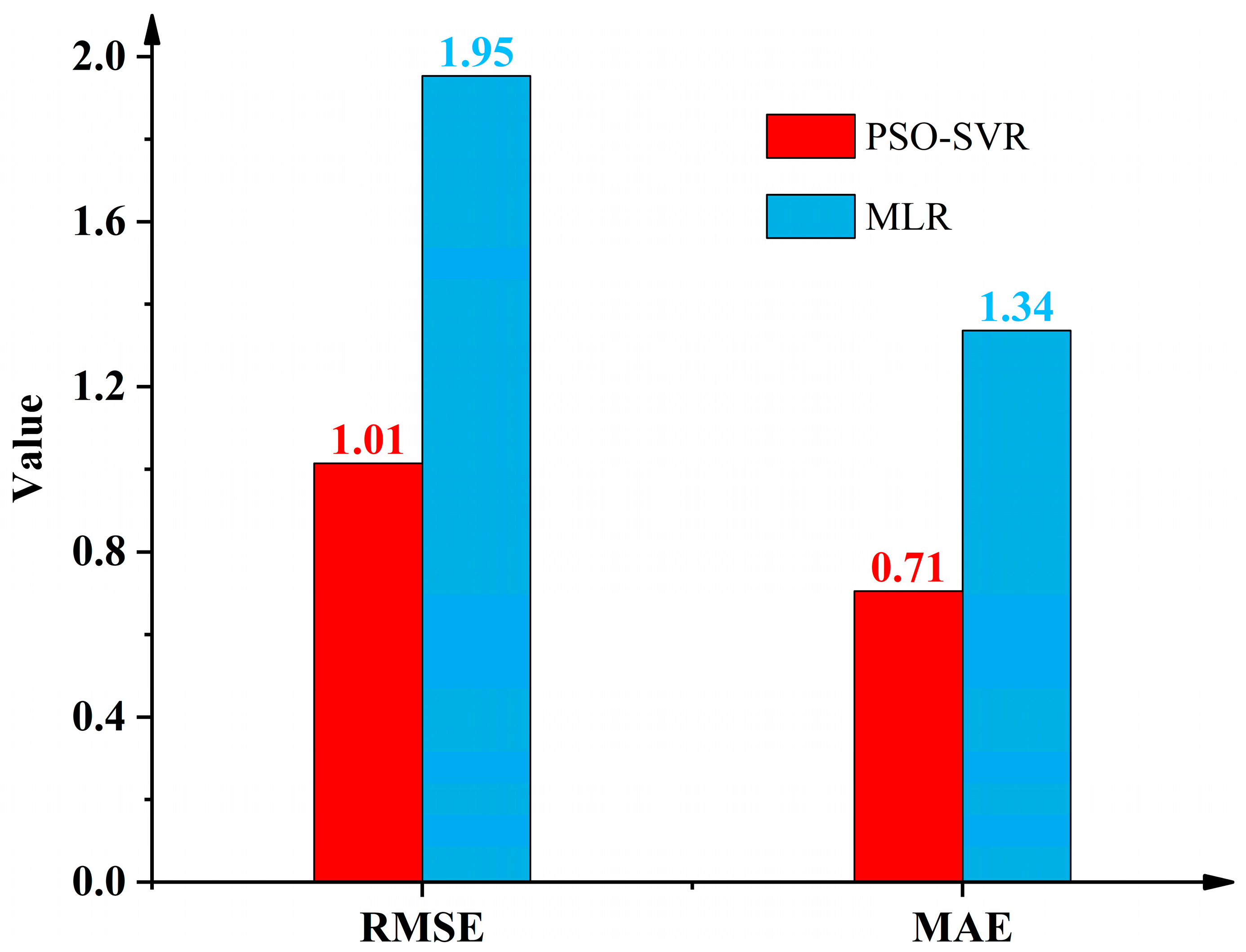
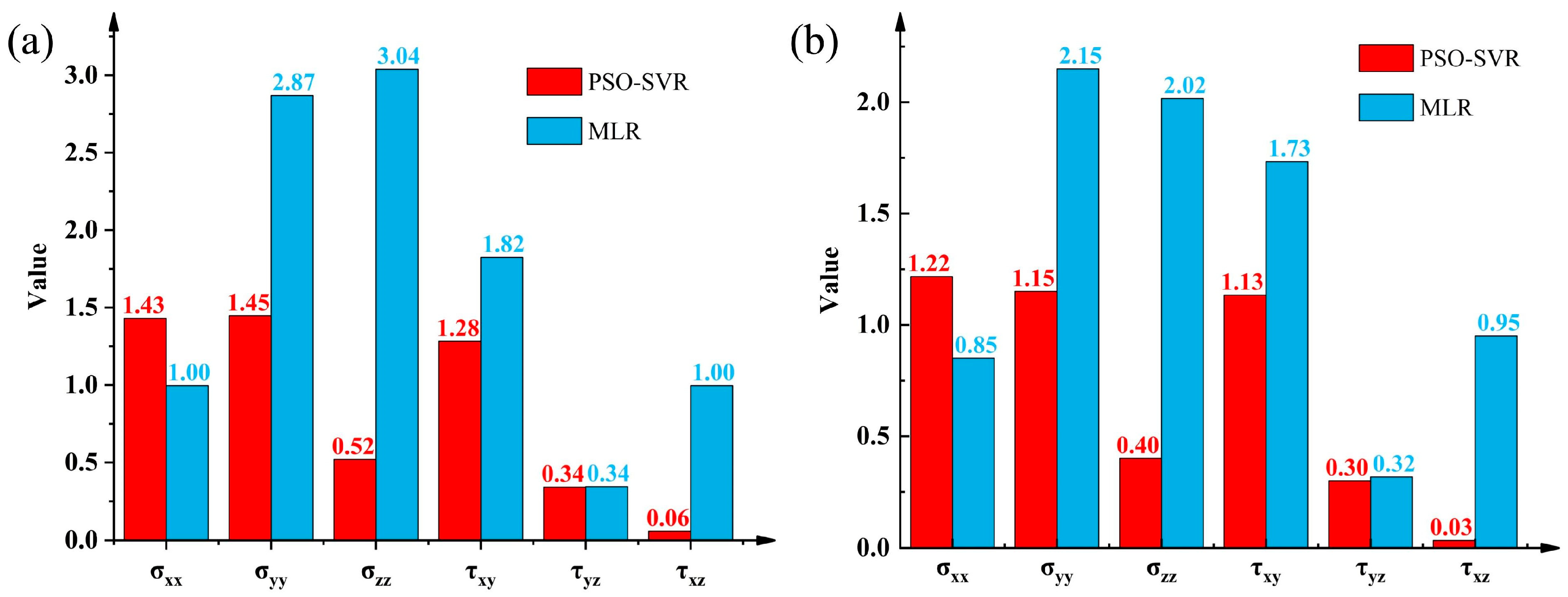
- By defining the stress boundary conditions in terms of lateral stress coefficients and shear stresses and inverting them with a PSO-SVR algorithm, the stresses at the measurement points and the in situ stress field can be determined with good accuracy. Compared with MLR combined with the zone-stress loading method, PSO-SVR yields lower RMSE and MAE values and a smoother stress field with fewer anomalous zones.
- (4)
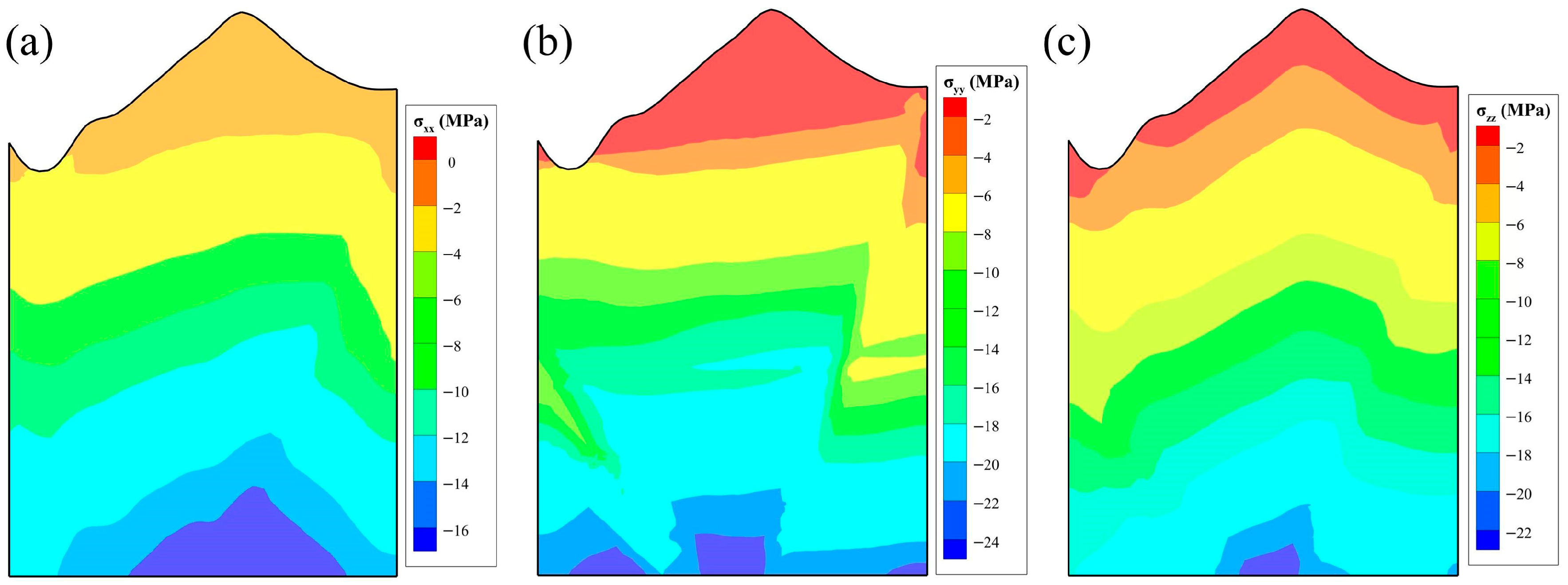
- From a mechanistic perspective, the PSO-SVR inversion based on lateral stress coefficients reduces artificial boundary effects compared with the conventional MLR scheme that repeatedly adjusts external displacement or stress boundaries, thereby yielding a smoother and more geomechanically consistent in situ stress field.
- (5)
- The acute angle between the maximum principal stress and the main powerhouse axis mainly falls within 2.0–24.4°, indicating that the selected powerhouse axis orientation is reasonable. The reconstructed principal stress ranges in the underground cavern group are σ1 = −14.74 to −19.05 MPa, σ2 = −10.21 to −14.45 MPa, and σ3 = −7.91 to −12.26 MPa, and the stress level is moderate (strength-to-maximum-stress ratio 2.31–3.20).
Author Contributions
Funding
Institutional Review Board Statement
Informed Consent Statement
Data Availability Statement
Conflicts of Interest
References
- Meng, W.; He, C.; Zhou, Z.; Li, Y.; Chen, Z.; Wu, F.; Kou, H. Application of the Ridge Regression in the Back Analysis of a Virgin Stress Field. Bull. Eng. Geol. Environ. 2021, 80, 2215–2235. [Google Scholar] [CrossRef]
- González de Vallejo, L.I.; Hijazo, T. A New Method of Estimating the Ratio between in Situ Rock Stresses and Tectonics Based on Empirical and Probabilistic Analyses. Eng. Geol. 2008, 101, 185–194. [Google Scholar] [CrossRef]
- Gong, M.; Qi, S.; Liu, J. Engineering Geological Problems Related to High Geo-Stresses at the Jinping I Hydropower Station, Southwest China. Bull. Eng. Geol. Environ. 2010, 69, 373–380. [Google Scholar] [CrossRef]
- Zhang, S.; Hu, A.; Wang, C. Three-Dimensional Inversion Analysis of an In Situ Stress Field Based on a Two-Stage Optimization Algorithm. J. Zhejiang Univ.-Sci. A 2016, 17, 782–802. [Google Scholar] [CrossRef]
- Yan, H.-C.; Liu, H.-Z.; Li, Y.; Zhuo, L.; Xiao, M.-L.; Chen, K.-P.; Wu, J.-M.; Pei, J.-L. Inversion Analysis of the In Situ Stress Field around Underground Caverns Based on Particle Swarm Optimization Optimized Back Propagation Neural Network. Appl. Sci. 2023, 13, 4697. [Google Scholar] [CrossRef]
- Guo, M.; Yin, S.; Li, C.; Wang, S. 3D In Situ Stress Estimation by Inverse Analysis of Tectonic Strains. Appl. Sci. 2021, 11, 5284. [Google Scholar] [CrossRef]
- Luo, M.-R.; Zhang, C.-Y.; Wang, B.; Zeng, Y.-H. Discrete Element-Based Regression Analysis of Initial Ground Stress and Application to an Extra-Long Tunnel in China. Bull. Eng. Geol. Environ. 2023, 82, 405. [Google Scholar] [CrossRef]
- Meng, W.; Zhou, H.; Luo, C.; Qin, S.; Zhang, X.; Chen, B. Multiple Linear Regression Inversion of the Ground Stress Field in Rock Masses for Tunnel Engineering: A Novel Approach to Stress Field Reconstruction. Buildings 2025, 15, 547. [Google Scholar] [CrossRef]
- Li, Y.; Guo, Y.; Zhu, W.; Li, S.; Zhou, H. A Modified Initial In-Situ Stress Inversion Method Based on FLAC3D with an Engineering Application. Open Geosci. 2015, 7, 20150065. [Google Scholar] [CrossRef]
- Chen, B.; Ren, Q.; Wang, F.; Zhao, Y.; Liu, C. Inversion Analysis of In-Situ Stress Field in Tunnel Fault Zone Considering High Geothermal. Geotech. Geol. Eng. 2021, 39, 5007–5019. [Google Scholar] [CrossRef]
- Zhou, Z.; Chen, Z.; Wang, B.; Jiang, C.; Li, T.; Meng, W. Study on the Applicability of Various In-Situ Stress Inversion Methods and Their Application on Sinistral Strike-Slip Faults. Rock Mech. Rock Eng. 2023, 56, 3093–3113. [Google Scholar] [CrossRef]
- Li, G.; Hu, Y.; Li, Q.-B.; Yin, T.; Miao, J.-X.; Yao, M. Inversion Method of In-Situ Stress and Rock Damage Characteristics in Dam Site Using Neural Network and Numerical Simulation—A Case Study. IEEE Access 2020, 8, 46701–46712. [Google Scholar] [CrossRef]
- Song, Z.; Jiang, Q.; Chen, P.; Xia, Y.; Xiang, T. Nonlinear Intelligent Inversion Method and Practice for In-Situ Stress in Stratified Rock Masses with Deep Valley. Rock Mech. Rock Eng. 2025, 58, 1933–1955. [Google Scholar] [CrossRef]
- Li, Q. Research on Geostress Inversion Method of Computer Big Data Technology in Support Vector Regression Algorithm. In Proceedings of the 2022 IEEE 2nd International Conference on Power, Electronics and Computer Applications (ICPECA), Shenyang, China, 21–23 January 2022; pp. 810–814. [Google Scholar]
- Bao, T.; Cheng, J.; Xing, Y.; Zhou, X.; Chen, Y.; Zhao, X. Inversion of Initial In-situ Stress Field of Underground Caverns of Hydropower Station Based on GD-PSO. J. Zhengzhou Univ. (Eng. Sci.) 2025, 46, 130. [Google Scholar] [CrossRef]
- Zhang, P. In Situ Stress Inversion and Distribution Characteristics of Tunnel Based on Numerical Simulation and Neural Network Technology. Shock Vib. 2021, 2021, 5545283. [Google Scholar] [CrossRef]
- Zhou, Z.; Chen, H.; Luo, T.; Fu, S. A simple inversion method for initial ground stress of underground powerhouses based on FLAC3D. Eng. J. Wuhan Univ. 2024, 57, 11–15. [Google Scholar]
- Li, T.; Chen, Z.; Zhou, Z.; Bao, Y. In Situ Stress Distribution Law of Fault Zone in Tunnel Site Area Based on the Inversion Method with Optimized Fitting Conditions. Front. Earth Sci. 2023, 10, 1031985. [Google Scholar] [CrossRef]
- Fu, H.; Li, J.; Li, G.; Chen, J.; An, P. Determination of In Situ Stress by Inversion in a Superlong Tunnel Site Based on the Variation Law of Stress—A Case Study. KSCE J. Civ. Eng. 2023, 27, 2637–2653. [Google Scholar] [CrossRef]
- Liu, Q.; Wang, D.; Zhu, Y.; Yang, Z.; Bo, Y. Application of support vector regression algorithm in inversion of geostress field. Rock Soil Mech. 2020, 41, 319–328. [Google Scholar] [CrossRef]
- Smola, A.J.; Schölkopf, B. A Tutorial on Support Vector Regression. Stat. Comput. 2004, 14, 199–222. [Google Scholar] [CrossRef]







| Borehole ID | Buried Depth (m) | The Values of Principal Stresses (MPa) | Fracture Azimuth (°) | ||
|---|---|---|---|---|---|
| σH | σv | σh | |||
| YZK06 | 191.99 | 5.87 | 3.35 | 5.24 | 251 |
| 300.09 | 9.57 | 5.24 | 8.18 | 251 | |
| YZK17 | 486.29 | 13.85 | 8.38 | 12.15 | 249 |
| 554.29 | 15.80 | 9.01 | 13.86 | 249 | |
| YZK19 | 493.90 | 15.16 | 9.51 | 12.85 | 263 |
| 533.90 | 14.40 | 9.00 | 13.85 | 263 | |
| Layer ID | Lithology | Density (g·cm−3) | Elastic Modulus (GPa) | Poisson’s Ratio | Cohesion (MPa) | Friction Angle |
|---|---|---|---|---|---|---|
| Layer 1 | Limestone | 2.60 | 6.0 | 0.26 | 0.85 | 41.66° |
| Layer 2 | Argillaceous siltstone | 2.55 | 5.0 | 0.26 | 0.60 | 28.81° |
| Layer 3 | Dolomite | 2.65 | 6.0 | 0.26 | 1.00 | 43.53° |
| Layer 4 | Quartz sandstone | 2.70 | 10.0 | 0.24 | 1.10 | 45.00° |
| Fault (F10, F11) | 2.15 | 1.00 | 0.30 | 0.45 | 4.57° | |
| ID | σxx (MPa) | |||
|---|---|---|---|---|
| 10−5 m·s−1 | 5 × 10⁻⁵ m·s−1 | 10−4 m·s−1 | 5 × 10⁻⁴ m·s−1 | |
| YZK06(1) | −0.15 | −0.75 | −1.32 | −2.91 |
| YZK06(2) | −0.20 | −1.00 | −1.60 | −4.04 |
| YZK17(1) | −0.26 | −1.28 | −1.99 | −5.36 |
| YZK17(2) | −0.28 | −1.39 | −2.48 | −10.01 |
| YZK19(1) | −0.26 | −1.30 | −1.69 | −2.73 |
| YZK19(2) | −0.29 | −1.47 | −2.58 | −10.21 |
| ID | σxx (MPa) | σyy (MPa) | σzz (MPa) | τxy (MPa) | τyz (MPa) | τxz (MPa) | |||||||
|---|---|---|---|---|---|---|---|---|---|---|---|---|---|
| IV | MV | IV | MV | IV | MV | IV | MV | IV | MV | IV | MV | ||
| YZK06(1) | −5.0 | −3.8 | −7.6 | −5.4 | −4.3 | −5.2 | −0.1 | 1.0 | −0.4 | 0.0 | 1.0 | 0.0 | |
| YZK06(2) | −7.1 | −6.1 | −10.5 | −8.7 | −7.0 | −8.2 | −0.1 | 1.7 | −0.2 | 0.0 | 1.1 | 0.0 | |
| YZK17(1) | −9.8 | −9.6 | −13.2 | −12.7 | −13.1 | −12.2 | 0.3 | 2.3 | 0.3 | 0.0 | 0.6 | 0.0 | |
| YZK17(2) | −11.2 | −10.5 | −14.3 | −14.3 | −15.7 | −13.9 | 0.1 | 2.8 | 0.5 | 0.0 | 1.3 | 0.0 | |
| YZK19(1) | −10.1 | −9.8 | −12.3 | −14.8 | −13.2 | −12.9 | 0.3 | 1.3 | 0.4 | 0.0 | 1.2 | 0.0 | |
| YZK19(2) | −11.0 | −9.3 | −8.2 | −14.1 | −6.9 | −13.9 | −0.5 | 1.3 | 0.1 | 0.0 | −0.5 | 0.0 | |
| Regression coefficients | L1 = 3.049; L2 = 8.069; L3 = 1.120; L4 = −39.642 c = 0.11(intercept of the regression equation) | ||||||||||||
| Coefficient of determination | R2 = 0.894 | ||||||||||||
| Inversion Parameter | λx | λy | τxy (MPa) | τyz (MPa) | τxz (MPa) |
|---|---|---|---|---|---|
| Range | 0.50~1.25 | 0.81~1.50 | −2.12~4.90 | −2.22~1.03 | −1.74~1.62 |
| Number | λx | λy | τxy (MPa) | τyz (MPa) | τxz (MPa) |
|---|---|---|---|---|---|
| 1 | 1.194 | 1.288 | 1.369 | 0.869 | −0.432 |
| 2 | 0.510 | 0.867 | 0.540 | −0.990 | 0.826 |
| 3 | 1.102 | 0.960 | 3.858 | 0.051 | 1.558 |
| 4 | 0.696 | 1.313 | 4.780 | −1.692 | 1.414 |
| 5 | 1.069 | 1.023 | −1.507 | −1.459 | 1.149 |
| 6 | 1.040 | 0.813 | 3.217 | 0.666 | −0.905 |
| … | … | … | … | … | … |
| 117 | 0.843 | 1.303 | 2.711 | −0.146 | −0.119 |
| 118 | 0.715 | 1.044 | 1.593 | 0.254 | 0.533 |
| 119 | 0.779 | 1.015 | 1.457 | 0.804 | −0.466 |
| 120 | 0.988 | 1.098 | 0.657 | −1.792 | −1.063 |
| Model | RMSE | C | γ | ε |
|---|---|---|---|---|
| Model_λx | 0.001 | 1000.00 | 4.57 × 10⁻⁴ | 0.003 |
| Model_λy | 0.011 | 1000.00 | 4.88 × 10⁻⁴ | 0.006 |
| Model_τxy | 0.090 | 1000.00 | 2.95 × 10⁻⁴ | 0.001 |
| Model_τyz | 0.075 | 1000.00 | 3.86 × 10⁻⁴ | 0.026 |
| Model_τxz | 0.071 | 1000.00 | 4.28 × 10⁻⁴ | 0.015 |
| Inversion Parameters | λx | λy | τxy (MPa) | τyz (MPa) | τxz (MPa) |
|---|---|---|---|---|---|
| Value | 0.606 | 1.467 | 2.891 | 0.765 | −0.353 |
| ID | σxx (MPa) | σyy (MPa) | σzz (MPa) | τxy (MPa) | τyz (MPa) | τxz (MPa) | ||||||
|---|---|---|---|---|---|---|---|---|---|---|---|---|
| PS | MV | PS | MV | PS | MV | PS | MV | PS | MV | PS | MV | |
| YZK06(1) | −2.3 | −3.8 | −2.5 | −5.4 | −4.4 | −5.2 | 1.5 | 1.0 | −0.4 | 0.0 | 0.0 | 0.0 |
| YZK06(2) | −5.3 | −6.1 | −7.4 | −8.7 | −7.3 | −8.2 | 1.3 | 1.7 | −0.4 | 0.0 | 0.0 | 0.0 |
| YZK17(1) | −10.0 | −9.6 | −12.7 | −12.7 | −12.0 | −12.2 | 0.5 | 2.3 | 0.5 | 0.0 | 0.1 | 0.0 |
| YZK17(2) | −11.2 | −10.5 | −15.3 | −14.3 | −14.1 | −13.9 | 0.9 | 2.8 | −0.2 | 0.0 | −0.1 | 0.0 |
| YZK19(1) | −11.0 | −9.8 | −15.7 | −14.8 | −12.9 | −12.9 | 0.5 | 1.3 | 0.3 | 0.0 | 0.0 | 0.0 |
| YZK19(2) | −12.0 | −9.3 | −14.9 | −14.1 | −13.6 | −13.9 | −0.1 | 1.3 | 0.0 | 0.0 | 0.0 | 0.0 |
| Model ID | Number of Gridpoints | Number of Zones |
|---|---|---|
| M-1 | 205,511 | 309,749 |
| M-2 * | 456,608 | 592,711 |
| M-3 | 1,082,522 | 1,410,163 |
| Measurement Point | Model ID | σxx (MPa) | σyy (MPa) | σzz (MPa) | τxy (MPa) | τyz (MPa) | τxz (MPa) |
|---|---|---|---|---|---|---|---|
| YZK06(1) | M-1 | −2.3 | −2.6 | −4.5 | 1.6 | −0.3 | −0.1 |
| M-2 * | −2.3 | −2.5 | −4.4 | 1.5 | −0.4 | 0.0 | |
| M-3 | −2.3 | −2.5 | −4.3 | 1.5 | −0.3 | −0.2 | |
| YZK17(1) | M-1 | −10.0 | −12.7 | −12.0 | 0.5 | 0.5 | 0.1 |
| M-2 | −10.0 | −12.7 | −12.0 | 0.5 | 0.5 | 0.1 | |
| M-3 | −10.0 | −12.5 | −12.0 | 0.5 | 0.6 | 0.1 | |
| YZK19(1) | M-1 | −11.0 | −15.6 | −12.8 | 0.5 | 0.2 | 0.0 |
| M-2 | −11.0 | −15.7 | −12.9 | 0.5 | 0.3 | 0.0 | |
| M-3 | −11.2 | −15.8 | −13.1 | 0.5 | 0.3 | 0.0 |
Disclaimer/Publisher’s Note: The statements, opinions and data contained in all publications are solely those of the individual author(s) and contributor(s) and not of MDPI and/or the editor(s). MDPI and/or the editor(s) disclaim responsibility for any injury to people or property resulting from any ideas, methods, instructions or products referred to in the content. |
© 2026 by the authors. Licensee MDPI, Basel, Switzerland. This article is an open access article distributed under the terms and conditions of the Creative Commons Attribution (CC BY) license.
Share and Cite
Liu, L.; Ouyang, J.; Nian, G.; Zhu, Y.; Liang, N. In Situ Stress Inversion in a Pumped-Storage Power Station Based on the PSO-SVR Algorithm. Appl. Sci. 2026, 16, 1101. https://doi.org/10.3390/app16021101
Liu L, Ouyang J, Nian G, Zhu Y, Liang N. In Situ Stress Inversion in a Pumped-Storage Power Station Based on the PSO-SVR Algorithm. Applied Sciences. 2026; 16(2):1101. https://doi.org/10.3390/app16021101
Chicago/Turabian StyleLiu, Lu, Jinhui Ouyang, Genqian Nian, Youping Zhu, and Ning Liang. 2026. "In Situ Stress Inversion in a Pumped-Storage Power Station Based on the PSO-SVR Algorithm" Applied Sciences 16, no. 2: 1101. https://doi.org/10.3390/app16021101
APA StyleLiu, L., Ouyang, J., Nian, G., Zhu, Y., & Liang, N. (2026). In Situ Stress Inversion in a Pumped-Storage Power Station Based on the PSO-SVR Algorithm. Applied Sciences, 16(2), 1101. https://doi.org/10.3390/app16021101