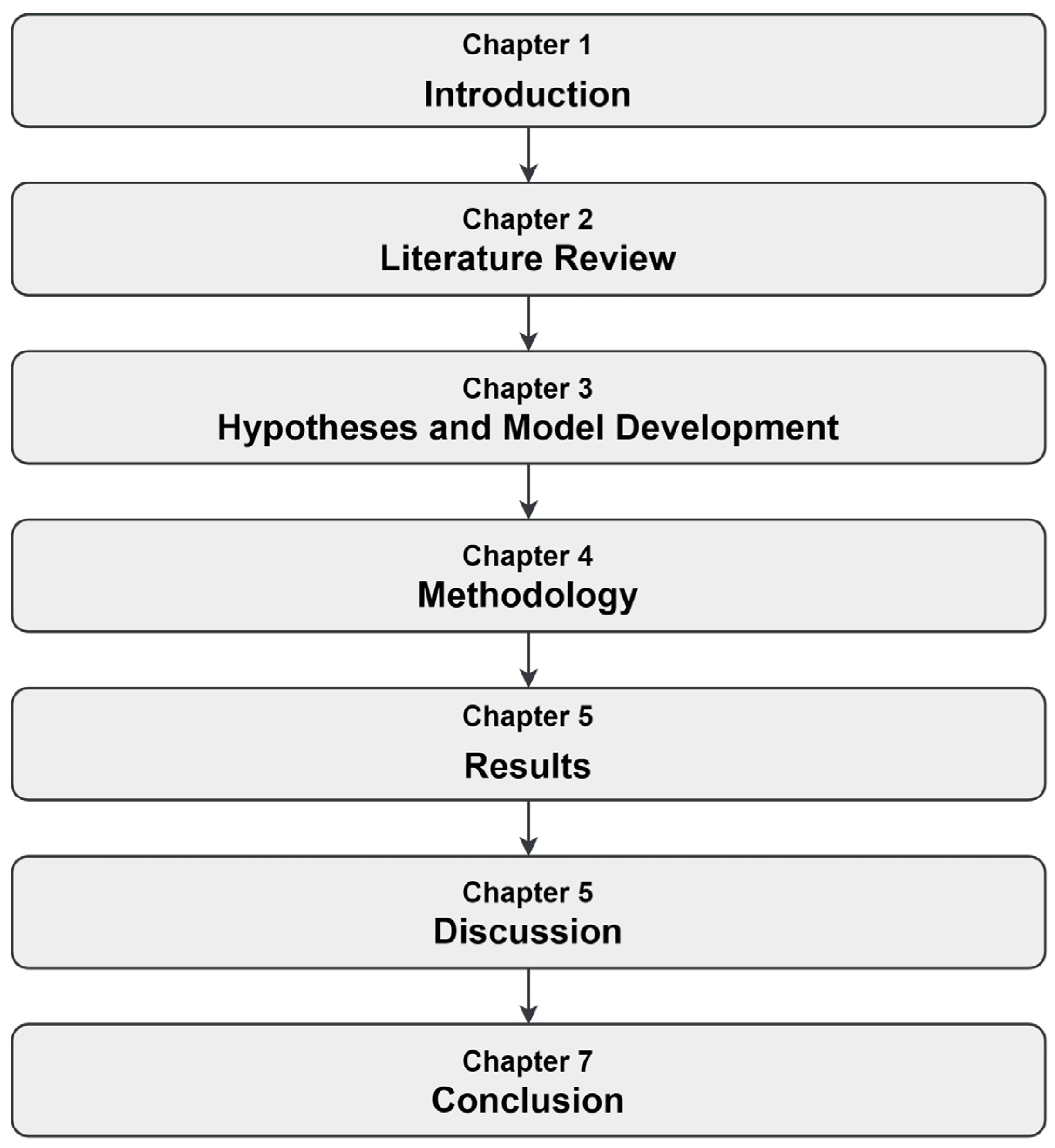
Smart Learning with Generative AI Tools in Higher Education: An Integrated SOR–SDT Model of Student Creative Confidence and Engagement




Abstract
1. Introduction
2. Literature Review
2.1. The Stimulus–Organism–Response Model
2.2. Self-Determination Theory
2.3. Perceptual Dimensions of Generative AI Tools in Smart Learning
2.4. Behavioral Responses to Generative AI Tools in Smart Learning
3. Research Model and Hypotheses Development
3.1. Hypotheses Related to Perception Variables
3.1.1. The Influence of Perceived Usefulness on Perceived Autonomy and Perceived Competence
3.1.2. The Influence of Perceived Ease of Use on Perceived Autonomy and Perceived Competence
3.1.3. The Influence of Perceived Creative Benefit on Perceived Autonomy and Perceived Competence
3.1.4. The Influence of Perceived Personalization on Perceived Autonomy and Perceived Competence
3.2. Hypotheses Related to Motivational Variables
3.2.1. The Influence of Perceived Autonomy on Perceived Competence
3.2.2. The Impact of Perceived Autonomy and Perceived Competence on Creative Confidence and Creative Engagement
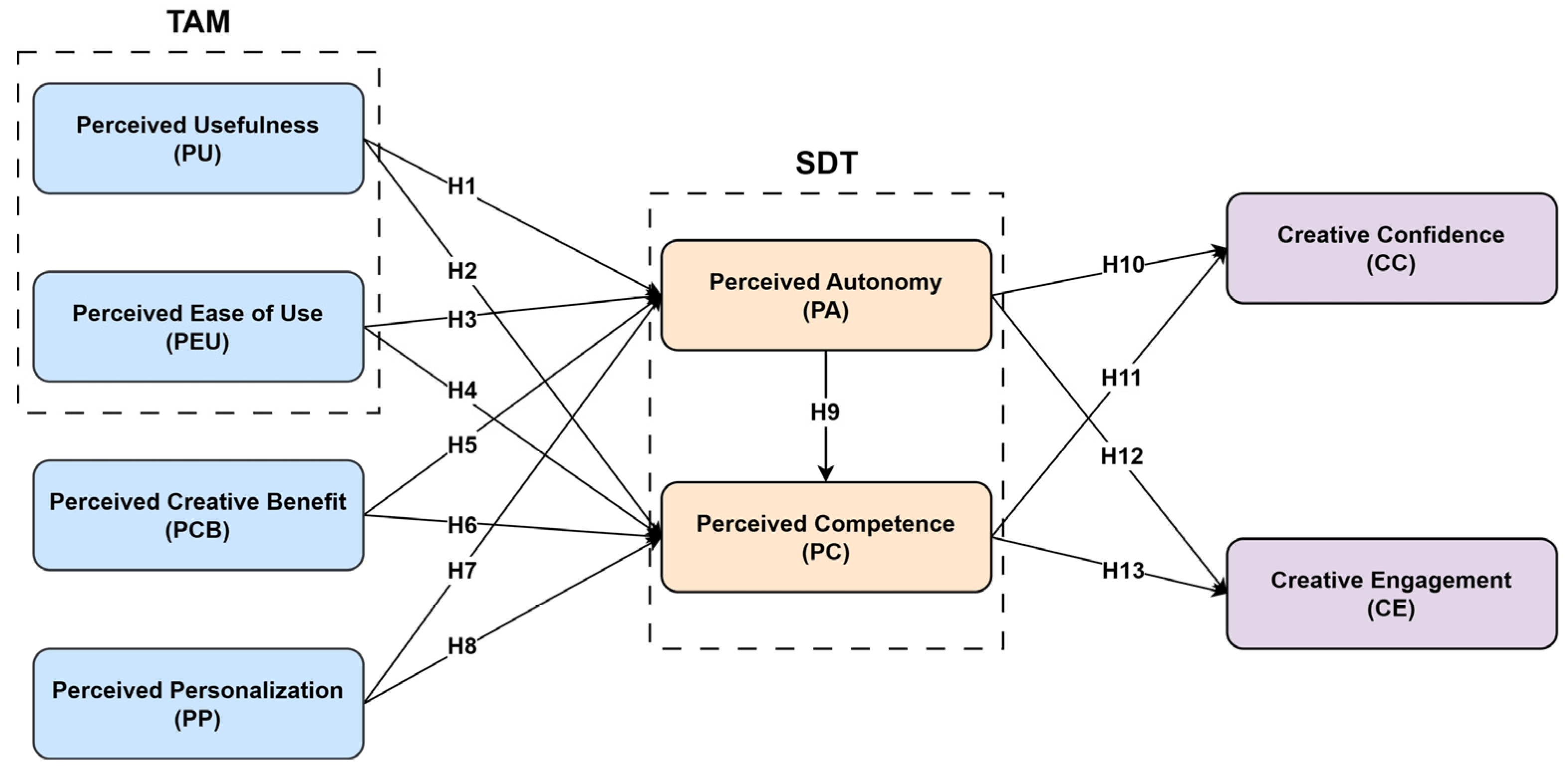
3.3. Model Structure and Path Diagram
4. Methodology
4.1. Measures
4.2. Data Collection
4.3. Analytical Approach
5. Results
5.1. Reliability Analysis
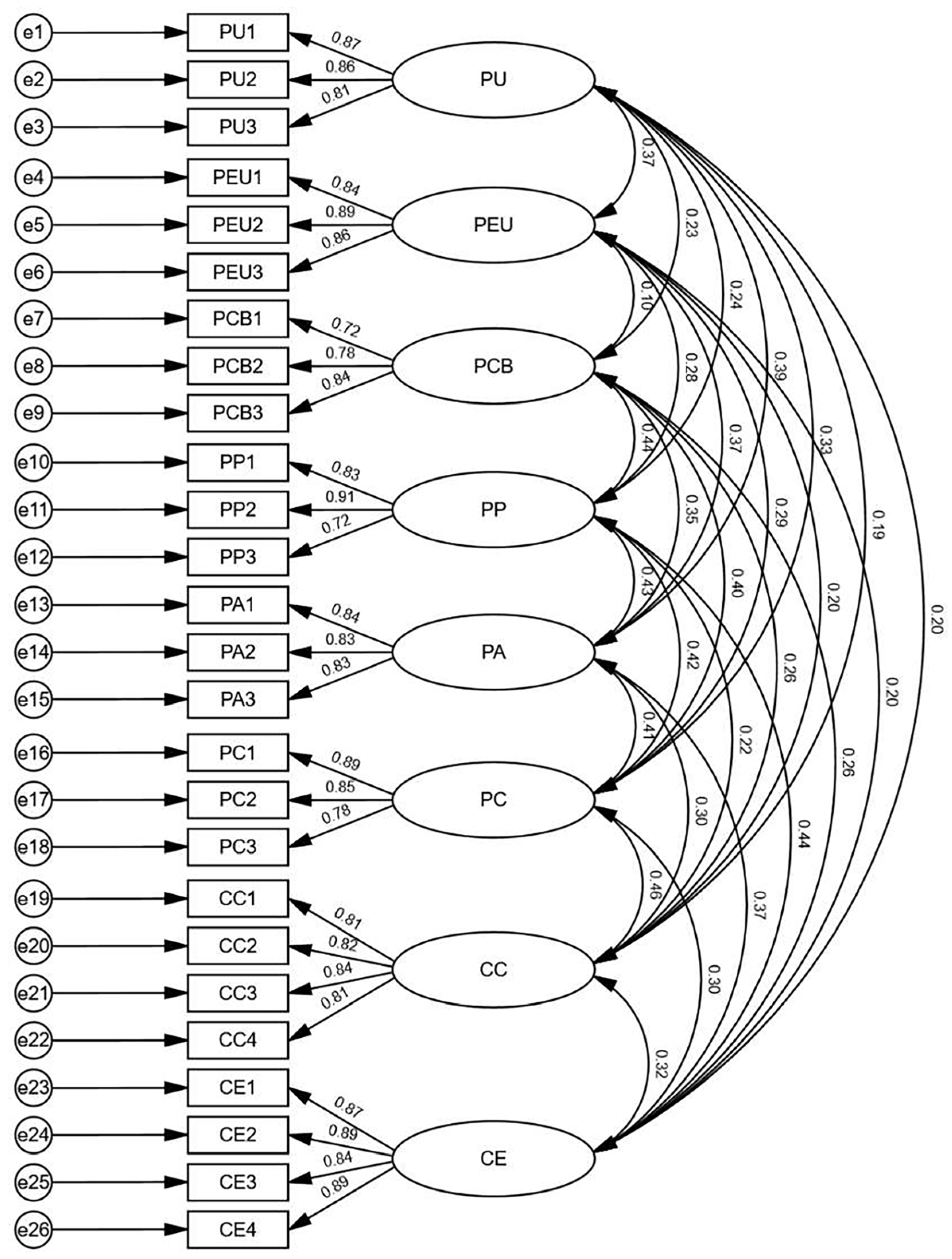
5.2. Confirmatory Factor Analysis
5.3. Convergent Validity
5.4. Discriminant Validity
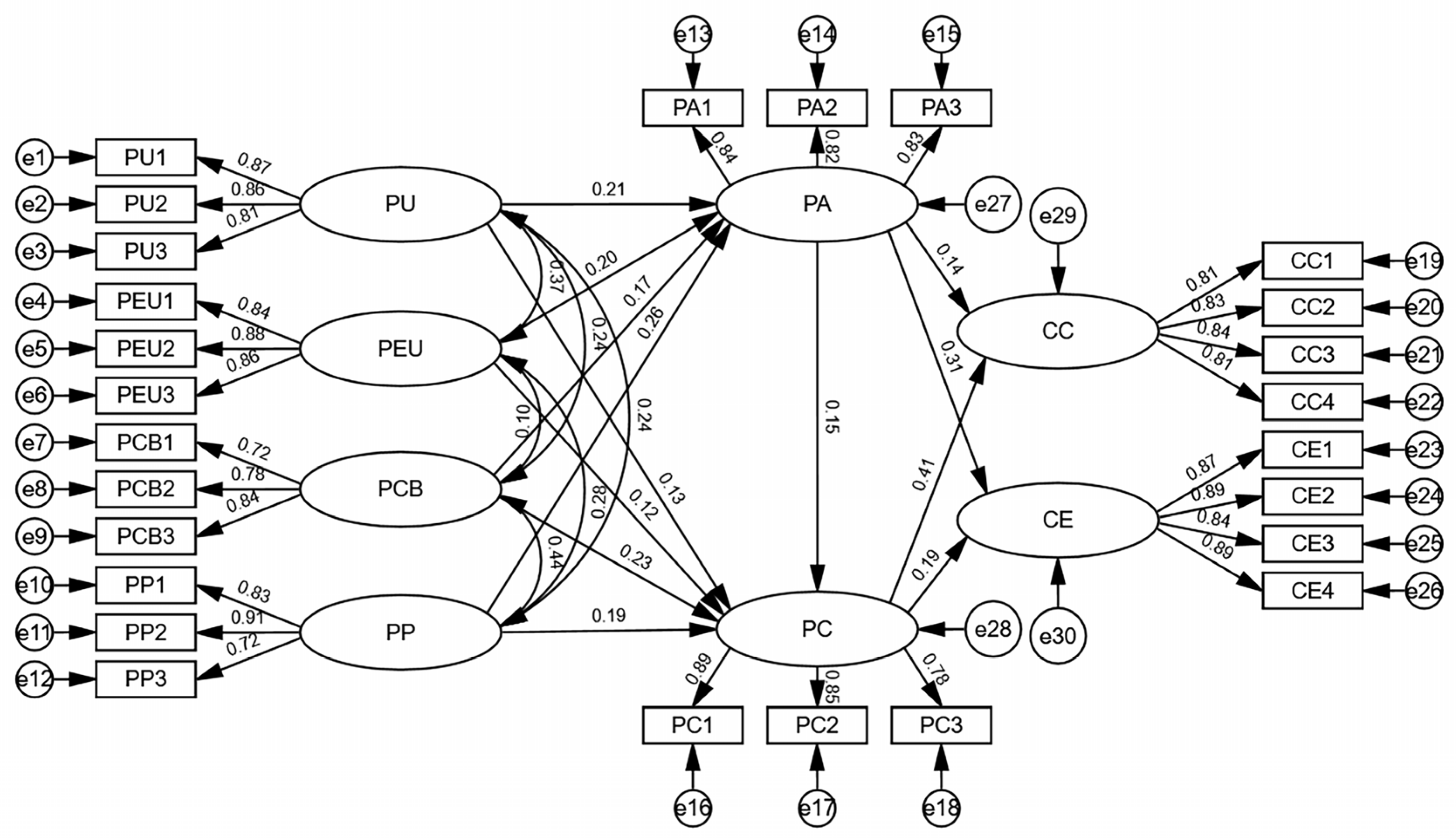
5.5. Structural Model Assessment
5.6. Path Analysis
5.7. Mediation Analysis
6. Discussion
6.1. Major Findings
6.2. Theoretical and Practical Implications
6.3. Limitations and Future Research
7. Conclusions
Author Contributions
Funding
Institutional Review Board Statement
Informed Consent Statement
Data Availability Statement
Acknowledgments
Conflicts of Interest
References
- Creely, E.; Blannin, J. Creative Partnerships with Generative AI. Possibilities for Education and Beyond. Think. Ski. Creat. 2025, 56, 101727. [Google Scholar] [CrossRef] [Scilit]
- Ruiz-Rojas, L.I.; Salvador-Ullauri, L.; Acosta-Vargas, P. Collaborative Working and Critical Thinking: Adoption of Generative Artificial Intelligence Tools in Higher Education. Sustainability 2024, 16, 5367. [Google Scholar] [CrossRef] [Scilit]
- Ahmed, Z.; Shanto, S.S.; Rime, M.H.K.; Morol, M.K.; Fahad, N.; Hossen, M.J.; Abdullah-Al-Jubair, M. The Generative AI Landscape in Education: Mapping the Terrain of Opportunities, Challenges, and Student Perception. IEEE Access 2024, 12, 147023–147050. [Google Scholar] [CrossRef] [Scilit]
- Chandrasekera, T.; Hosseini, Z.; Perera, U. Can Artificial Intelligence Support Creativity in Early Design Processes? Int. J. Archit. Comput. 2025, 23, 122–136. [Google Scholar] [CrossRef] [Scilit]
- Tsidylo, I.M.; Chele, E.S. Artificial Intelligence as a Methodological Innovation in the Training of Future Designers: Midjourney Tools. Inf. Technol. Learn. Tools 2023, 97, 203–214. [Google Scholar] [CrossRef] [Scilit]
- Xiao, C.; Xu, S.X.; Zhang, K.; Wang, Y.; Xia, L. Evaluating Reading Comprehension Exercises Generated by LLMs: A Showcase of ChatGPT in Education Applications. In Proceedings of the 18th Workshop on Innovative Use of NLP for Building Educational Applications (BEA 2023), Toronto, ON, Canada, 13 July 2023; Kochmar, E., Burstein, J., Horbach, A., Laarmann-Quante, R., Madnani, N., Tack, A., Yaneva, V., Yuan, Z., Zesch, T., Eds.; Association for Computational Linguistics: Toronto, ON, Canada, 2023; pp. 610–625. [Google Scholar]
- Uddin, S.M.I.; Sumon, R.I.; Mozumder, M.A.I.; Chowdhury, M.K.H.; Armand, T.P.T.; Kim, H.C. Innovations and Challenges of AI in Film: A Methodological Framework for Future Exploration. ACM Trans. Multimed. Comput. Commun. Appl. 2025, 21, 1–55. [Google Scholar] [CrossRef] [Scilit]
- Verheijden, M.P.; Funk, M. Collaborative Diffusion: Boosting Designerly Co-Creation with Generative AI. In Proceedings of the Extended Abstracts of the 2023 CHI Conference on Human Factors in Computing Systems, Hamburg, Germany, 23–28 April 2023; Association for Computing Machinery: New York, NY, USA, 2023; pp. 1–8. [Google Scholar]
- Epstein, Z.; Hertzmann, A. The Investigators of Human Creativity. Art and the Science of Generative AI. Science 2023, 380, 1110–1111. [Google Scholar] [CrossRef] [Scilit] [PubMed]
- Alzubi, A.A.F.; Nazim, M.; Alyami, N. Do AI-Generative Tools Kill or Nurture Creativity in EFL Teaching and Learning? Educ. Inf. Technol. 2025, 30, 15147–15184. [Google Scholar] [CrossRef] [Scilit]
- Chen, L. Unlocking the Beat: How AI Tools Drive Music Students’ Motivation, Engagement, Creativity and Learning Success. Eur. J. Educ. 2025, 60, e12823. [Google Scholar] [CrossRef] [Scilit]
- Gasaymeh, A.-M.M.; Beirat, M.A.; Abu Qbeita, A.A. University Students’ Insights of Generative Artificial Intelligence (AI) Writing Tools. Educ. Sci. 2024, 14, 1062. [Google Scholar] [CrossRef] [Scilit]
- Habib, S.; Vogel, T.; Anli, X.; Thorne, E. How Does Generative Artificial Intelligence Impact Student Creativity? J. Creat. 2024, 34, 100072. [Google Scholar] [CrossRef] [Scilit]
- Caporusso, N. Generative Artificial Intelligence and the Emergence of Creative Displacement Anxiety: Review. Res. Psychol. Behav. 2023, 3, 10795. [Google Scholar] [CrossRef] [Scilit]
- Zheng, Y.; Chang, C.-H.; Huang, S.-H.; Chen, P.-Y.; Picek, S. An Overview of Trustworthy AI: Advances in IP Protection, Privacy-Preserving Federated Learning, Security Verification, and GAI Safety Alignment. IEEE J. Emerg. Sel. Top. Circuits Syst. 2024, 14, 582–607. [Google Scholar] [CrossRef] [Scilit]
- Oc, Y.; Gonsalves, C.; Quamina, L.T. Generative AI in Higher Education Assessments: Examining Risk and Tech-Savviness on Student’s Adoption. J. Mark. Educ. 2024, 47, 138–155. [Google Scholar] [CrossRef] [Scilit]
- Kanont, K.; Pingmuang, P.; Simasathien, T.; Wisnuwong, S.; Wiwatsiripong, B.; Poonpirome, K.; Songkram, N.; Khlaisang, J. Generative-AI, a Learning Assistant? Factors Influencing Higher-Ed Students’ Technology Acceptance. Electron. J. e-Learn. 2024, 22, 18–33. [Google Scholar] [CrossRef] [Scilit]
- Hazzan-Bishara, A.; Kol, O.; Levy, S. The Factors Affecting Teachers’ Adoption of AI Technologies: A Unified Model of External and Internal Determinants. Educ. Inf. Technol. 2025, 30, 15043–15069. [Google Scholar] [CrossRef] [Scilit]
- Hsiao, C.-H.; Tang, K.-Y. Beyond Acceptance: An Empirical Investigation of Technological, Ethical, Social, and Individual Determinants of GenAI-Supported Learning in Higher Education. Educ. Inf. Technol. 2025, 30, 10725–10750. [Google Scholar] [CrossRef] [Scilit]
- Mehrabian, A.; Russell, J.A. An Approach to Environmental Psychology; The MIT Press: Cambridge, MA, USA, 1974; ISBN 978-0-262-63071-9. [Google Scholar]
- Duong, C.D.; Bui, H.N.; Chu, T.V.; Van Pham, T.; Do, N.D. ICT Skills, Entrepreneurial Self-Perceived Creativity, and Digital Entrepreneurship: Insights from the Stimulus-Organism-Response Model. Think. Ski. Creat. 2024, 54, 101646. [Google Scholar] [CrossRef] [Scilit]
- Jang, S.; Namkung, Y. Perceived Quality, Emotions, and Behavioral Intentions: Application of an Extended Mehrabian–Russell Model to Restaurants. J. Bus. Res. 2009, 62, 451–460. [Google Scholar] [CrossRef] [Scilit]
- Mummalaneni, V. An Empirical Investigation of Web Site Characteristics, Consumer Emotional States and on-Line Shopping Behaviors. J. Bus. Res. 2005, 58, 526–532. [Google Scholar] [CrossRef] [Scilit]
- Mazaheri, E.; Richard, M.-O.; Laroche, M. Online Consumer Behavior: Comparing Canadian and Chinese Website Visitors. J. Bus. Res. 2011, 64, 958–965. [Google Scholar] [CrossRef] [Scilit]
- Cheng, Y.-M. How Different Categories of Gamified Stimuli Affect Massive Open Online Courses Continuance Intention and Learning Performance? Mediating Roles of Internal Experiences. Soc. Sci. Comput. Rev. 2023, 41, 495–527. [Google Scholar] [CrossRef] [Scilit]
- Kim, M.; Kim, J.; Knotts, T.L.; Albers, N.D. AI for Academic Success: Investigating the Role of Usability, Enjoyment, and Responsiveness in ChatGPT Adoption. Educ. Inf. Technol. 2025, 30, 14393–14414. [Google Scholar] [CrossRef] [Scilit]
- Cheng, Y.-M. What Makes Learners Enhance Learning Outcomes in MOOCs? Exploring the Roles of Gamification and Personalization. Interact. Technol. Smart Educ. 2024, 21, 308–330. [Google Scholar] [CrossRef] [Scilit]
- Chahal, J.; Dagar, V.; Shoukat, M.H. Sustainable Entrepreneurship: Examining Stimulus-Organism-Response to the Nexus of Environment, Education and Motivation. Manag. Decis. 2025, 63, 1391–1416. [Google Scholar] [CrossRef] [Scilit]
- Deci, E.L.; Ryan, R.M. Self-Determination Theory: A Macrotheory of Human Motivation, Development, and Health. Can. Psychol./Psychol. Can. 2008, 49, 182–185. [Google Scholar] [CrossRef] [Scilit]
- Renfeng, J.; Gang, Y.; Qi, S. The Motivational Impact of GenAI Tools in Language Learning: A Quasi-experiment Study. Int. J. Appl. Linguist. 2025, 35, 1338–1350. [Google Scholar] [CrossRef] [Scilit]
- Levesque, C.; Zuehlke, A.N.; Stanek, L.R.; Ryan, R.M. Autonomy and Competence in German and American University Students: A Comparative Study Based on Self-Determination Theory. J. Educ. Psychol. 2004, 96, 68–84. [Google Scholar] [CrossRef] [Scilit]
- Vasconcellos, D.; Parker, P.D.; Hilland, T.; Cinelli, R.; Owen, K.B.; Kapsal, N.; Lee, J.; Antczak, D.; Ntoumanis, N.; Ryan, R.M.; et al. Self-Determination Theory Applied to Physical Education: A Systematic Review and Meta-Analysis. J. Educ. Psychol. 2020, 112, 1444–1469. [Google Scholar] [CrossRef] [Scilit]
- Yu, S.; Levesque-Bristol, C. A Cross-Classified Path Analysis of the Self-Determination Theory Model on the Situational, Individual and Classroom Levels in College Education. Contemp. Educ. Psychol. 2020, 61, 101857. [Google Scholar] [CrossRef] [Scilit]
- Guay, F. Applying Self-Determination Theory to Education: Regulations Types, Psychological Needs, and Autonomy Supporting Behaviors. Can. J. Sch. Psychol. 2022, 37, 75–92. [Google Scholar] [CrossRef] [Scilit]
- Kusurkar, R.A.; Croiset, G.; Ten Cate, O.T.J. Twelve Tips to Stimulate Intrinsic Motivation in Students through Autonomy-Supportive Classroom Teaching Derived from Self-Determination Theory. Med. Teach. 2011, 33, 978–982. [Google Scholar] [CrossRef] [Scilit]
- Linnenbrink-Garcia, L.; Patall, E.A.; Pekrun, R. Adaptive Motivation and Emotion in Education. Policy Insights Behav. Brain Sci. 2016, 3, 228–236. [Google Scholar] [CrossRef] [Scilit]
- Meirbekov, A.; Berdi, D.; Burayeva, Z.; Ikramov, I.; Sarbaeva, M. A Novel Approach to Enhancing the Effectiveness of Chemistry Teaching by Preservice Teachers. Emerg. Sci. J. 2025, 9, 45–71. [Google Scholar] [CrossRef] [Scilit]
- Chiu, T.K.F.; Moorhouse, B.L.; Chai, C.S.; Ismailov, M. Teacher Support and Student Motivation to Learn with Artificial Intelligence (AI) Based Chatbot. Interact. Learn. Environ. 2023, 32, 3240–3256. [Google Scholar] [CrossRef] [Scilit]
- Chen, A.; Liu, H.; Li, K.-C.; Jia, J. For Educational Inclusiveness: Design and Implementation of an Intelligent Tutoring System for Student-Athletes Based on Self-Determination Theory. Sustainability 2023, 15, 14709. [Google Scholar] [CrossRef] [Scilit]
- Jose, E.M.K.; Prasanna, A.; Kushwaha, B.P.; Das, M. Can Generative AI Motivate Management Students? The Role of Perceived Value and Information Literacy. Int. J. Manag. Educ. 2024, 22, 101082. [Google Scholar] [CrossRef] [Scilit]
- Wang, F.; Cheung, A.C.K.; Chai, C.S.; Liu, J. Development and Validation of the Perceived Interactivity of Learner-AI Interaction Scale. Educ. Inf. Technol. 2025, 30, 4607–4638. [Google Scholar] [CrossRef] [Scilit]
- Gervacio, A.P. Exploring How Generative AI Contributes to the Motivated Engagement and Learning Production of Science-Oriented Students. Environ. Soc. Psychol. 2024, 9. [Google Scholar] [CrossRef] [Scilit]
- Granić, A.; Marangunić, N. Technology Acceptance Model in Educational Context: A Systematic Literature Review. Br. J. Educ. Technol. 2019, 50, 2572–2593. [Google Scholar] [CrossRef] [Scilit]
- Venkatesh, V.; Morris, M.G.; Davis, G.B.; Davis, F.D. User Acceptance of Information Technology: Toward a Unified View. MIS Q. 2003, 27, 425. [Google Scholar] [CrossRef] [Scilit]
- Akman, I.; Turhan, C. User Acceptance of Social Learning Systems in Higher Education: An Application of the Extended Technology Acceptance Model. Innov. Educ. Teach. Int. 2017, 54, 229–237. [Google Scholar] [CrossRef] [Scilit]
- Gado, S.; Kempen, R.; Lingelbach, K.; Bipp, T. Artificial Intelligence in Psychology: How Can We Enable Psychology Students to Accept and Use Artificial Intelligence? Psychol. Learn. Teach. 2022, 21, 37–56. [Google Scholar] [CrossRef] [Scilit]
- Li, K. Determinants of College Students’ Actual Use of AI-Based Systems: An Extension of the Technology Acceptance Model. Sustainability 2023, 15, 5221. [Google Scholar] [CrossRef] [Scilit]
- Lim, J.; Leinonen, T.; Lipponen, L.; Lee, H.; DeVita, J.; Murray, D. Artificial Intelligence as Relational Artifacts in Creative Learning. Digit. Creat. 2023, 34, 192–210. [Google Scholar] [CrossRef] [Scilit]
- Weng, X.; Ng, O.-L.; Cui, Z.; Leung, S. Creativity Development with Problem-Based Digital Making and Block-Based Programming for Science, Technology, Engineering, Arts, and Mathematics Learning in Middle School Contexts. J. Educ. Comput. Res. 2023, 61, 304–328. [Google Scholar] [CrossRef] [Scilit]
- Wang, S.; Sun, Z.; Chen, Y. Effects of Higher Education Institutes’ Artificial Intelligence Capability on Students’ Self-Efficacy, Creativity and Learning Performance. Educ. Inf. Technol. 2023, 28, 4919–4939. [Google Scholar] [CrossRef] [Scilit]
- Mittal, U.; Sai, S.; Chamola, V.; Sangwan, D. A Comprehensive Review on Generative AI for Education. IEEE Access 2024, 12, 142733–142759. [Google Scholar] [CrossRef] [Scilit]
- Gunawan, A.; Wiputra, R. Exploring the Impact of Generative AI on Personalized Learning in Higher Education. In Proceedings of the 2024 IEEE 12th Conference on Systems, Process & Control (ICSPC), Malacca, Malaysia, 7 December 2024; pp. 280–285. [Google Scholar] [CrossRef] [Scilit]
- Ikwuanusi, U.F.; Adepoju, P.A.; Odionu, C.S. AI-Driven Solutions for Personalized Knowledge Dissemination and Inclusive Library User Experiences. Int. J. Eng. Res. Updates 2023, 4, 52–62. [Google Scholar] [CrossRef] [Scilit]
- Monzon, N.; Hays, F.A. Leveraging Generative Artificial Intelligence to Improve Motivation and Retrieval in Higher Education Learners. JMIR Med. Educ. 2025, 11, e59210. [Google Scholar] [CrossRef] [Scilit] [PubMed]
- Capron Puozzo, I.; Audrin, C. Improving Self-Efficacy and Creative Self-Efficacy to Foster Creativity and Learning in Schools. Think. Ski. Creat. 2021, 42, 100966. [Google Scholar] [CrossRef] [Scilit]
- Beghetto, R. Creative Self-Efficacy: Correlates in Middle and Secondary Students. Creat. Res. J. 2006, 18, 447–457. [Google Scholar] [CrossRef] [Scilit]
- Sedivy, J.; Johnson, H. Multimodal Tool Support for Creative Tasks in the Visual Arts. Knowl.-Based Syst. 2000, 13, 441–450. [Google Scholar] [CrossRef] [Scilit]
- Liu, H.; Guo, W. Effectiveness of AI-driven Vocal Art Tools in Enhancing Student Performance and Creativity. Eur. J. Educ. 2025, 60, e70037. [Google Scholar] [CrossRef] [Scilit]
- Anderson, R.C.; Haney, M.; Pitts, C.; Porter, L.; Bousselot, T. “Mistakes Can Be Beautiful”: Creative Engagement in Arts Integration for Early Adolescent Learners. J. Creat. Behav. 2020, 54, 662–675. [Google Scholar] [CrossRef] [Scilit]
- Fleming, J.; Gibson, R.; Anderson, M.; Martin, A.J.; Sudmalis, D. Cultivating Imaginative Thinking: Teacher Strategies Used in High-Performing Arts Education Classrooms. Camb. J. Educ. 2016, 46, 435–453. [Google Scholar] [CrossRef] [Scilit]
- Baltà-Salvador, R.; El-Madafri, I.; Brasó-Vives, E.; Peña, M. Empowering Engineering Students through Artificial Intelligence (AI): Blended Human–AI Creative Ideation Processes with ChatGPT. Comput. Appl. Eng. Educ. 2025, 33, e22817. [Google Scholar] [CrossRef] [Scilit]
- Feng, L.; Shen, X.; Xie, Z.; Yan, X. How Gamification-Based Course Drives Online Learners’ Engagement: Focusing on Intrinsic Motivation and Effect Mechanism. Educ. Inf. Technol. 2025, 30, 10943–10977. [Google Scholar] [CrossRef] [Scilit]
- Chen, C.-H.; Chang, C.-L. Effectiveness of AI-Assisted Game-Based Learning on Science Learning Outcomes, Intrinsic Motivation, Cognitive Load, and Learning Behavior. Educ. Inf. Technol. 2024, 29, 18621–18642. [Google Scholar] [CrossRef] [Scilit]
- Lijie, H.; Mat Yusoff, S.; Mohamad Marzaini, A.F. Influence of AI-Driven Educational Tools on Critical Thinking Dispositions among University Students in Malaysia: A Study of Key Factors and Correlations. Educ. Inf. Technol. 2025, 30, 8029–8053. [Google Scholar] [CrossRef] [Scilit]
- Wu, H.; Wang, Y.; Wang, Y. “To Use or Not to Use?” A Mixed-Methods Study on the Determinants of EFL College Learners’ Behavioral Intention to Use AI in the Distributed Learning Context. Int. Rev. Res. Open Distrib. Learn. 2024, 25, 158–178. [Google Scholar] [CrossRef] [Scilit]
- Liu, B.; Liao, Y. Integrating IBM Watson BEAT Generative AI Software into Flute Music Learning: The Impact of Advanced AI Tools on Students’ Learning Strategies. Educ. Inf. Technol. 2025, 30, 14577–14596. [Google Scholar] [CrossRef] [Scilit]
- Karimova, G.Z.; Kim, Y.D.; Shirkhanbeik, A. Poietic Symbiosis or Algorithmic Subjugation: Generative AI Technology in Marketing Communications Education. Educ. Inf. Technol. 2025, 30, 2185–2209. [Google Scholar] [CrossRef] [Scilit]
- Chiu, W.C.-K.; Lun, V.M.-C.; Bond, M.H. Engaging in Creative Work: The Influences of Personal Value, Autonomy at Work, and National Socialization for Self-Directedness in 50 Nations. J. Cross-Cult. Psychol. 2018, 49, 239–260. [Google Scholar] [CrossRef] [Scilit]
- Patel, N.S.; Lim, J.T. Critical Design Futures Thinking and GenerativeAI: A Foresight 3.0 Approach in Higher Education to Design Preferred Futures for the Industry. Foresight 2025, 27, 380–402. [Google Scholar] [CrossRef] [Scilit]
- Pesovski, I.; Santos, R.; Henriques, R.; Trajkovik, V. Generative AI for Customizable Learning Experiences. Sustainability 2024, 16, 3034. [Google Scholar] [CrossRef] [Scilit]
- Niu, W.; Zhang, W.; Zhang, C.; Chen, X. The Role of Artificial Intelligence Autonomy in Higher Education: A Uses and Gratification Perspective. Sustainability 2024, 16, 1276. [Google Scholar] [CrossRef] [Scilit]
- Jeno, L.M.; Nylehn, J.; Hole, T.N.; Raaheim, A.; Velle, G.; Vandvik, V. Motivational Determinants of Students’ Academic Functioning: The Role of Autonomy-Support, Autonomous Motivation, and Perceived Competence. Scand. J. Educ. Res. 2023, 67, 194–211. [Google Scholar] [CrossRef] [Scilit]
- Valenzuela, R.; Codina, N.; Pestana, J.V. Self-Determination Theory Applied to Flow in Conservatoire Music Practice: The Roles of Perceived Autonomy and Competence, and Autonomous and Controlled Motivation. Psychol. Music 2018, 46, 33–48. [Google Scholar] [CrossRef] [Scilit]
- Collie, R.J.; Martin, A.J. Students’ Perceived Competence across Academic and Social-Emotional Domains: Unique Roles in Relation to Autonomy-Supportive Teaching, Academic Engagement, and Well-Being. Learn. Individ. Differ. 2024, 116, 102563. [Google Scholar] [CrossRef] [Scilit]
- Zeng, S.; Rahim, N.; Xu, S. Enhancing College Students’ Achievement, Motivation and Engagement in Film Character Design through AI-Driven Smart Sketchpad: A Personalized Interactive Learning Model for Art Education. IEEE Access 2025, 13, 90814–90831. [Google Scholar] [CrossRef] [Scilit]
- Montag-Smit, T.; Keith, M.G. Changes in Positive and Negative Affect during Creative Process Engagement. J. Creat. Behav. 2023, 57, 690–710. [Google Scholar] [CrossRef] [Scilit]
- Doshi, A.R.; Hauser, O.P. Generative AI Enhances Individual Creativity but Reduces the Collective Diversity of Novel Content. Sci. Adv. 2024, 10, eadn5290. [Google Scholar] [CrossRef] [Scilit] [PubMed]
- Weng, X.; Chiu, T.K.F. The Mediating Effects of Engagement on the Relationship between Perceived Digital Inquiry and Creativity. J. Res. Technol. Educ. 2024, 56, 431–443. [Google Scholar] [CrossRef] [Scilit]
- Pagani, M.; Wind, Y. Unlocking Marketing Creativity Using Artificial Intelligence. J. Interact. Mark. 2025, 60, 1–24. [Google Scholar] [CrossRef] [Scilit]
- Verdenhofa, O.; Kinderis, R.; Berjozkina, G. Ai as a Creative Partner: How Artificial Intelligence Impacts Student Creativity and Innovation: Case Study of Students from Latvia, Ukraine and Spain. Balt. J. Econ. Stud. 2024, 10, 111–119. [Google Scholar] [CrossRef] [Scilit]
- Hattori, E.A.; Yamakawa, M.; Miwa, K. Human Bias in Evaluating AI Product Creativity. J. Creat. 2024, 34, 100087. [Google Scholar] [CrossRef] [Scilit]
- Hartato, F.; Yahya, J.; Enrico Christiano Hartono, L. Sudiana Art in the Era of Algorithms: Is Generative AI a Friend or Foe for 2D Artists? In Proceedings of the 2024 International Seminar on Application for Technology of Information and Communication (iSemantic), Semarang, Indonesia, 21–22 September 2024; pp. 190–195. [Google Scholar] [CrossRef] [Scilit]
- Zhang, X.; Yu, P.; Ma, L. How and When Generative AI Use Affects Employee Incremental and Radical Creativity: An Empirical Study in China. Eur. J. Innovation Manag. 2025; ahead-of-print. [CrossRef] [Scilit]
- Chen, Y. Perceptions of AI-Facilitated Creativity in Language Education: A Study on Digital Storytelling. JALT CALL J. 2024, 20, 2089. [Google Scholar] [CrossRef] [Scilit]
- Montero, J.B. Revolutionizing Creativity: Unleashing the Power of AI in Upper Elementary Art Education. Int. J. Learn. Teach. 2024, 10, 510–515. [Google Scholar] [CrossRef] [Scilit]
- Maltese, A.-G.; Pelletier, P.; Guichardaz, R. Can AI Enhance Its Creativity to Beat Humans? arXiv 2024. [Google Scholar] [CrossRef] [Scilit]
- Main, A.; Grierson, M.; Yamada-Rice, D.; Murr, J. Augmenting Personal Creativity with Artificial Intelligence: Workshop Proposal for Creativity and Cognition 2022. In Proceedings of the C&C ’22: Proceedings of the 14th Conference on Creativity and Cognition, Venice, Italy, 20–23 June 2022; pp. 462–465. [Google Scholar] [CrossRef] [Scilit]
- Ünlü, S.C. Enhancing User Experience through AI-Driven Personalization in User Interfaces. Hum. Comput. Interact. 2024, 8, 19. [Google Scholar] [CrossRef] [Scilit]
- Crimaldi, F.; Leonelli, M. AI and the Creative Realm: A Short Review of Current and Future Applications. arXiv 2023. [Google Scholar] [CrossRef] [Scilit]
- Sankaran, S.; Zhang, C.; Aarts, H.; Markopoulos, P. Exploring Peoples’ Perception of Autonomy and Reactance in Everyday AI Interactions. Front. Psychol. 2021, 12, 713074. [Google Scholar] [CrossRef] [Scilit]
- Kassens-Noor, E.; Wilson, M.; Kotval-Karamchandani, Z.; Cai, M.; Decaminada, T. Living with Autonomy: Public Perceptions of an AI-Mediated Future. J. Plan. Educ. Res. 2024, 44, 375–386. [Google Scholar] [CrossRef] [Scilit]
- Prunkl, C. Human Autonomy at Risk? An Analysis of the Challenges from AI. Mines Mach. 2024, 34, 26. [Google Scholar] [CrossRef] [Scilit]
- Zhang, Q.; Liao, G.; Ran, X.; Wang, F. The Impact of AI Usage on Innovation Behavior at Work: The Moderating Role of Openness and Job Complexity. Behav. Sci. 2025, 15, 491. [Google Scholar] [CrossRef] [Scilit]
- Liem, G.A.D. Perceived Competence and Coping Strategies. Educ. Psychol. 2022, 42, 275–277. [Google Scholar] [CrossRef] [Scilit]
- Pont-Niclos, I.; Echegoyen-Sanz, Y.; Orozco-Gómez, P.; Martín-Ezpeleta, A. Creativity and Artificial Intelligence: A Study with Prospective Teachers. Digit. Educ. Rev. 2024, 91–97. [Google Scholar] [CrossRef] [Scilit]
- Choi, Y.; Sung, E.; Han, J.; Lee, S.; Lee, D.; Lim, Y. The Development and Validation of a Measure of Creative Confidence. Int. J. Technol. Des. Educ. 2025, 35, 2073–2091. [Google Scholar] [CrossRef] [Scilit]
- Shahzad, M.F.; Xu, S.; Zahid, H. Exploring the Impact of Generative AI-Based Technologies on Learning Performance through Self-Efficacy, Fairness & Ethics, Creativity, and Trust in Higher Education. Educ. Inf. Technol. 2025, 30, 3691–3716. [Google Scholar] [CrossRef] [Scilit]
- Ladachart, L.; Radchanet, V.; Phothong, W.; Ladachart, L. Nurturing Middle School Students’ Creative Confidence through Design-Based Learning. Res. Sci. Technol. Educ. 2024, 42, 1250–1263. [Google Scholar] [CrossRef] [Scilit]
- Chen, X.; Xie, H.; Qin, S.J.; Wang, F.L.; Hou, Y. Artificial Intelligence-Supported Student Engagement Research: Text Mining and Systematic Analysis. Eur. J. Educ. 2025, 60, e70008. [Google Scholar] [CrossRef] [Scilit]
- Darban, M. Navigating Virtual Teams in Generative AI-Led Learning: The Moderation of Team Perceived Virtuality. Educ. Inf. Technol. 2024, 29, 23225–23248. [Google Scholar] [CrossRef] [Scilit]



| Variables | Items | References |
|---|---|---|
| PU | Using AI tools makes my creative tasks more efficient. | [79,80,81] |
| AI tools are useful for improving my creative performance. | ||
| AI tools help me achieve meaningful creative goals. | ||
| PEU | It is straightforward to become familiar with generative AI tools. | [1,82,83] |
| I can become proficient quickly in using generative AI tools. | ||
| AI tools are easy to navigate and operate. | ||
| PCB | AI tools help me generate more original or expressive outputs. | [84,85,86] |
| Using AI enhances my creative imagination and ideation. | ||
| AI tools help me explore new creative possibilities. | ||
| PP | AI tools adapt to my personal creative preferences. | [87,88,89] |
| The AI output reflects my personal style. | ||
| AI tools allow me to create in my own way. | ||
| PA | I feel free to decide whether or not to use AI in my creative work. | [90,91,92] |
| I can make independent decisions while using AI in my work. | ||
| I can autonomously define goals and methods when using AI tools. | ||
| PC | I feel capable of producing quality creative work with AI tools. | [93,94,95] |
| I am able to overcome creative challenges using AI tools. | ||
| I have confidence in using AI tools for creative work. | ||
| CC | I am confident in my ability to develop original ideas with the assistance of AI tools. | [96,97,98] |
| I feel confident in my creative skills when working with AI. | ||
| I expect others to recognize the creativity in my AI-assisted work. | ||
| I feel confident addressing creative challenges when using AI tools. | ||
| CE | I focus deeply when creating with AI tools. | [11,75,99] |
| Doing creative work with AI is absorbing and enjoyable for me. | ||
| I see AI-assisted creative tasks through to completion. | ||
| When creating with AI, time often slips by unnoticed. |
| Characteristic | Category | Frequency | Percentage (%) |
|---|---|---|---|
| Gender | Male | 258 | 47.78% |
| Female | 282 | 52.22% | |
| Age | 16–18 | 85 | 15.74% |
| 19–22 | 210 | 38.89% | |
| 23–26 | 147 | 27.22% | |
| 27 or above | 98 | 18.15% | |
| Education Level | High School/Vocational | 123 | 22.78% |
| Associate Degree | 182 | 33.70% | |
| Bachelor’s Degree | 163 | 30.19% | |
| Master’s Degree or above | 72 | 13.33% | |
| Field of Study | Arts & Design | 136 | 25.19% |
| Science & Engineering | 99 | 18.33% | |
| Social Sciences | 109 | 20.19% | |
| Management & Business | 99 | 18.33% | |
| Other | 97 | 17.96% | |
| Familiarity with Generative AI Tools | First-time user | 110 | 20.37% |
| Aware but rarely use | 142 | 26.30% | |
| Occasionally use for learning/creation | 168 | 31.11% | |
| Frequently use for learning/creation | 120 | 22.22% |
| Construct | Number of Items | Cronbach’s Alpha |
|---|---|---|
| PU | 3 | 0.882 |
| PEU | 3 | 0.897 |
| PCB | 3 | 0.822 |
| PP | 3 | 0.855 |
| PA | 3 | 0.870 |
| PC | 3 | 0.876 |
| CC | 4 | 0.891 |
| CE | 4 | 0.927 |
| Fit Index | Recommended Threshold | Actual Value | Fit Evaluation |
|---|---|---|---|
| Absolute Fit Indices | |||
| CMIN/DF | <3 | 2.109 | Good |
| GFI | >0.80 | 0.926 | Good |
| AGFI | >0.80 | 0.904 | Good |
| RMSEA | <0.08 | 0.045 | Good |
| Incremental Fit Indices | |||
| NFI | >0.9 | 0.938 | Good |
| IFI | >0.9 | 0.966 | Good |
| TLI | >0.9 | 0.959 | Good |
| CFI | >0.9 | 0.966 | Good |
| Parsimonious Fit Indices | |||
| PNFI | >0.5 | 0.782 | Good |
| PCFI | >0.5 | 0.805 | Good |
| Construct | Item | Loading | S.E. | C.R. | p | CR | AVE |
|---|---|---|---|---|---|---|---|
| PU | PU1 | 0.872 | 0.883 | 0.716 | |||
| PU2 | 0.858 | 0.043 | 23.398 | *** | |||
| PU3 | 0.808 | 0.044 | 21.940 | *** | |||
| PEU | PEU1 | 0.843 | 0.898 | 0.746 | |||
| PEU2 | 0.885 | 0.043 | 24.492 | *** | |||
| PEU3 | 0.862 | 0.041 | 23.859 | *** | |||
| PCB | PCB1 | 0.725 | 0.823 | 0.609 | |||
| PCB2 | 0.777 | 0.068 | 15.863 | *** | |||
| PCB3 | 0.836 | 0.073 | 16.314 | *** | |||
| PP | PP1 | 0.830 | 0.864 | 0.681 | |||
| PP2 | 0.914 | 0.045 | 22.783 | *** | |||
| PP3 | 0.721 | 0.047 | 18.243 | *** | |||
| PA | PA1 | 0.835 | 0.871 | 0.692 | |||
| PA2 | 0.826 | 0.053 | 21.030 | *** | |||
| PA3 | 0.834 | 0.052 | 21.226 | *** | |||
| PC | PC1 | 0.888 | 0.879 | 0.708 | |||
| PC2 | 0.851 | 0.042 | 23.848 | *** | |||
| PC3 | 0.780 | 0.044 | 21.363 | *** | |||
| CC | CC1 | 0.810 | 0.891 | 0.672 | |||
| CC2 | 0.824 | 0.049 | 21.050 | *** | |||
| CC3 | 0.835 | 0.047 | 21.409 | *** | |||
| CC4 | 0.810 | 0.045 | 20.618 | *** | |||
| CE | CE1 | 0.871 | 0.927 | 0.761 | |||
| CE2 | 0.894 | 0.038 | 28.610 | *** | |||
| CE3 | 0.838 | 0.039 | 25.395 | *** | |||
| CE4 | 0.886 | 0.037 | 28.180 | *** |
| PU | PEU | PCB | PP | PA | PC | CC | CE | |
|---|---|---|---|---|---|---|---|---|
| PU | 0.846 | |||||||
| PEU | 0.375 *** | 0.864 | ||||||
| PCB | 0.235 *** | 0.101 * | 0.78 | |||||
| PP | 0.240 *** | 0.277 *** | 0.440 *** | 0.825 | ||||
| PA | 0.389 *** | 0.365 *** | 0.352 *** | 0.432 *** | 0.832 | |||
| PC | 0.329 *** | 0.294 *** | 0.404 *** | 0.417 *** | 0.409 *** | 0.841 | ||
| CC | 0.187 *** | 0.201 *** | 0.264 *** | 0.224 *** | 0.303 *** | 0.462 *** | 0.82 | |
| CE | 0.197 *** | 0.204 *** | 0.260 *** | 0.437 *** | 0.373 *** | 0.303 *** | 0.318 *** | 0.873 |
| Fit Index | Recommended Threshold | Actual Value | Fit Evaluation |
|---|---|---|---|
| Absolute Fit Indices | |||
| CMIN/DF | <3 | 2.231 | Good |
| GFI | >0.80 | 0.920 | Good |
| AGFI | >0.80 | 0.900 | Good |
| RMSEA | <0.08 | 0.048 | Good |
| Incremental Fit Indices | |||
| NFI | >0.9 | 0.932 | Good |
| IFI | >0.9 | 0.961 | Good |
| TLI | >0.9 | 0.955 | Good |
| CFI | >0.9 | 0.961 | Good |
| Parsimonious Fit Indices | |||
| PNFI | >0.5 | 0.803 | Good |
| PCFI | >0.5 | 0.828 | Good |
| Path | Estimate | S.E. | C.R. | p | ||
|---|---|---|---|---|---|---|
| PA | ← | PU | 0.212 | 0.045 | 4.409 | *** |
| PA | ← | PEU | 0.199 | 0.047 | 4.171 | *** |
| PA | ← | PCB | 0.172 | 0.057 | 3.350 | *** |
| PA | ← | PP | 0.262 | 0.046 | 5.123 | *** |
| PC | ← | PU | 0.128 | 0.046 | 2.610 | 0.009 |
| PC | ← | PEU | 0.118 | 0.048 | 2.434 | 0.015 |
| PC | ← | PCB | 0.229 | 0.059 | 4.356 | *** |
| PC | ← | PP | 0.193 | 0.047 | 3.670 | *** |
| PC | ← | PA | 0.148 | 0.054 | 2.718 | 0.007 |
| CC | ← | PA | 0.145 | 0.049 | 2.917 | 0.004 |
| CE | ← | PA | 0.312 | 0.051 | 6.162 | *** |
| CC | ← | PC | 0.408 | 0.051 | 7.954 | *** |
| CE | ← | PC | 0.194 | 0.049 | 3.927 | *** |
| Parameter | Coeff | SE | Bias-Corrected 95% CI | ||
|---|---|---|---|---|---|
| Lower | Upper | p | |||
| PU-PA-CC | 0.031 | 0.015 | 0.008 | 0.066 | 0.003 |
| PU-PC-CC | 0.052 | 0.024 | 0.009 | 0.104 | 0.018 |
| PU-PA-CE | 0.066 | 0.023 | 0.027 | 0.119 | 0.000 |
| PU-PC-CE | 0.025 | 0.014 | 0.004 | 0.062 | 0.014 |
| PEU-PA-CC | 0.029 | 0.013 | 0.010 | 0.061 | 0.002 |
| PEU-PC-CC | 0.048 | 0.025 | 0.003 | 0.102 | 0.039 |
| PEU-PA-CE | 0.062 | 0.021 | 0.025 | 0.111 | 0.001 |
| PEU-PC-CE | 0.023 | 0.015 | 0.002 | 0.061 | 0.029 |
| PCB-PA-CC | 0.025 | 0.013 | 0.006 | 0.058 | 0.006 |
| PCB-PC-CC | 0.094 | 0.030 | 0.043 | 0.159 | 0.000 |
| PCB-PA-CE | 0.054 | 0.021 | 0.018 | 0.102 | 0.003 |
| PCB-PC-CE | 0.044 | 0.019 | 0.014 | 0.093 | 0.003 |
| PP-PA-CC | 0.038 | 0.017 | 0.012 | 0.081 | 0.003 |
| PP-PC-CC | 0.079 | 0.028 | 0.029 | 0.141 | 0.004 |
| PP-PA-CE | 0.082 | 0.030 | 0.034 | 0.155 | 0.000 |
| PP-PC-CE | 0.037 | 0.021 | 0.006 | 0.091 | 0.006 |
Disclaimer/Publisher’s Note: The statements, opinions and data contained in all publications are solely those of the individual author(s) and contributor(s) and not of MDPI and/or the editor(s). MDPI and/or the editor(s) disclaim responsibility for any injury to people or property resulting from any ideas, methods, instructions or products referred to in the content. |
© 2025 by the authors. Licensee MDPI, Basel, Switzerland. This article is an open access article distributed under the terms and conditions of the Creative Commons Attribution (CC BY) license.
Share and Cite
Huang, Y.; Yu, T.; Chen, Y.; Tian, Y.; Yim, J. Smart Learning with Generative AI Tools in Higher Education: An Integrated SOR–SDT Model of Student Creative Confidence and Engagement. Appl. Sci. 2026, 16, 63. https://doi.org/10.3390/app16010063
Huang Y, Yu T, Chen Y, Tian Y, Yim J. Smart Learning with Generative AI Tools in Higher Education: An Integrated SOR–SDT Model of Student Creative Confidence and Engagement. Applied Sciences. 2026; 16(1):63. https://doi.org/10.3390/app16010063
Chicago/Turabian StyleHuang, Yang, Tao Yu, Yihui Chen, Yihuan Tian, and Jinho Yim. 2026. "Smart Learning with Generative AI Tools in Higher Education: An Integrated SOR–SDT Model of Student Creative Confidence and Engagement" Applied Sciences 16, no. 1: 63. https://doi.org/10.3390/app16010063
APA StyleHuang, Y., Yu, T., Chen, Y., Tian, Y., & Yim, J. (2026). Smart Learning with Generative AI Tools in Higher Education: An Integrated SOR–SDT Model of Student Creative Confidence and Engagement. Applied Sciences, 16(1), 63. https://doi.org/10.3390/app16010063