Characteristics of Compressive Stress Wave Propagation Across a Nonlinear Viscoelastic Filled Rock Joint

Abstract
1. Introduction
2. Methods
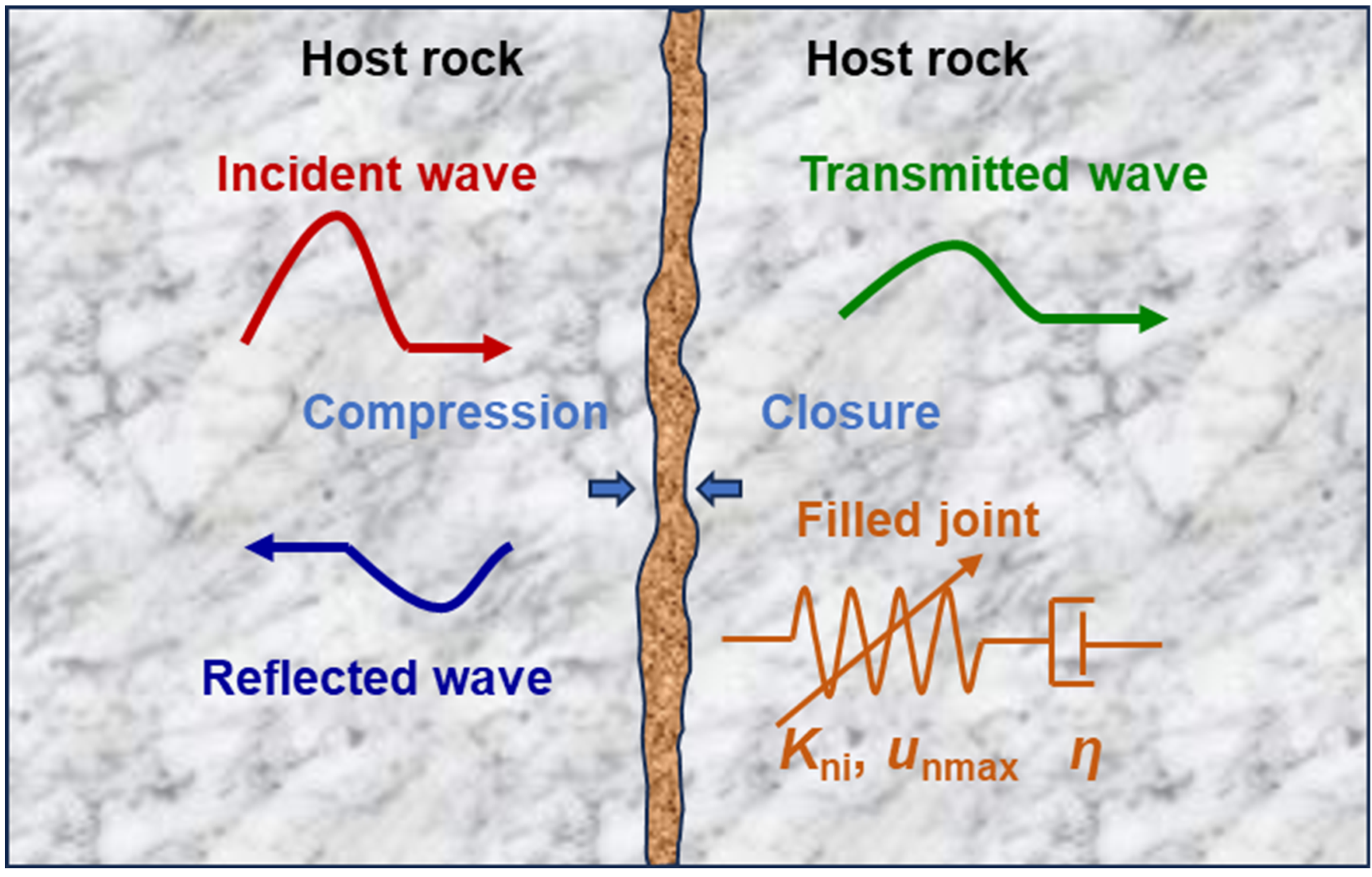
2.1. Problem Description
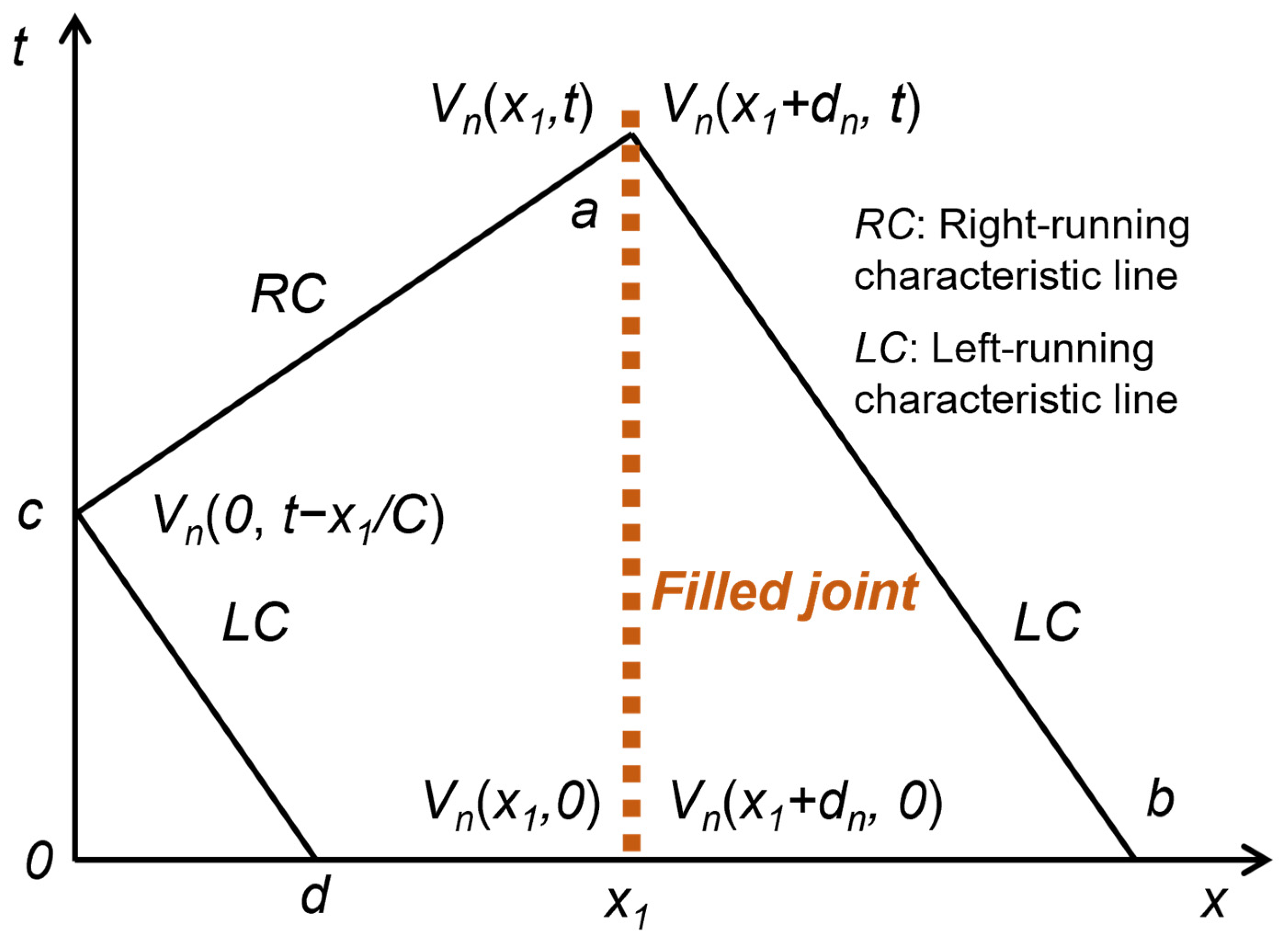
2.2. Modeling Wave Propagation Across a Filled Joint Using the Method of Characteristics
3. Results
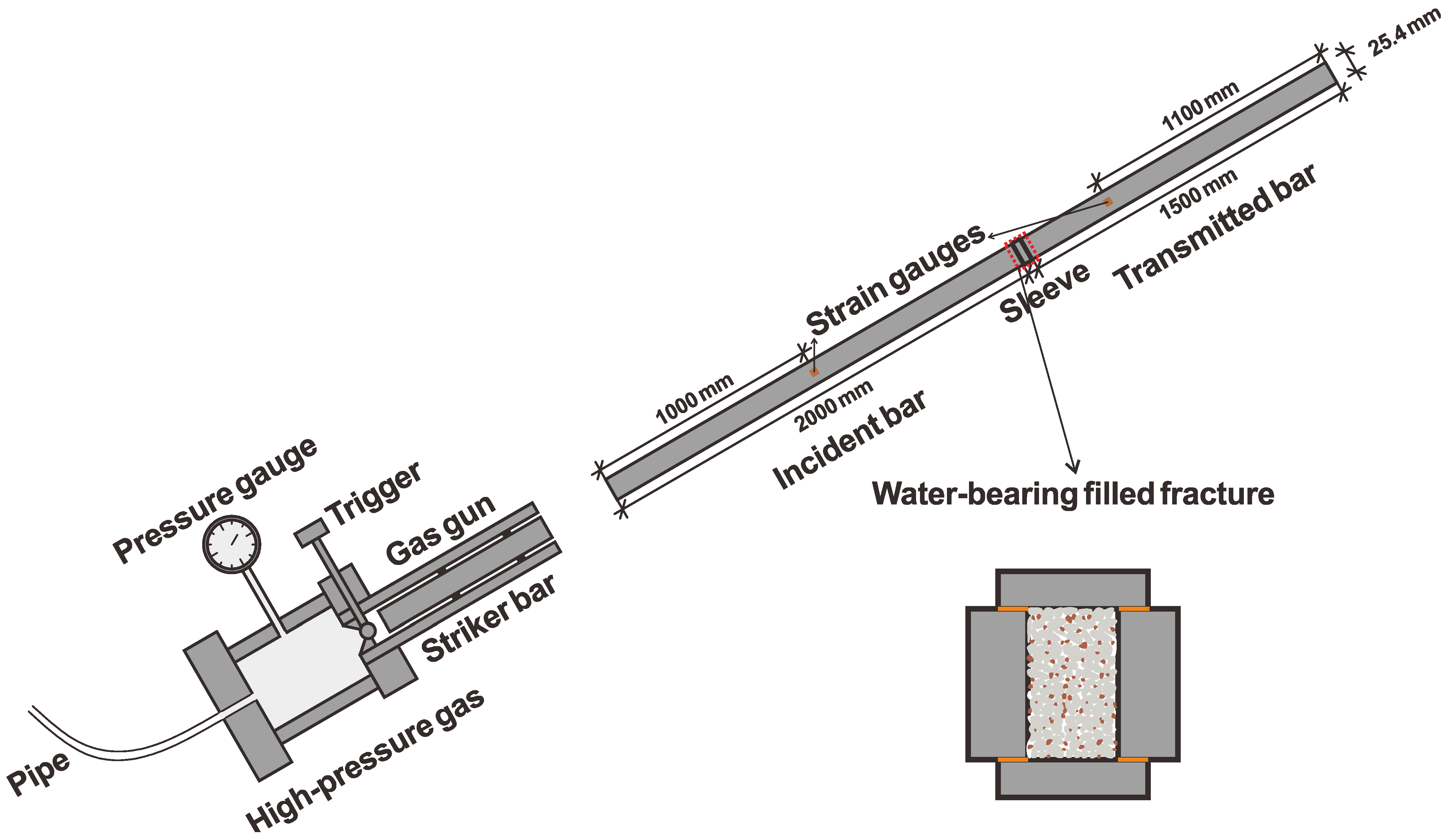
3.1. Model Validation
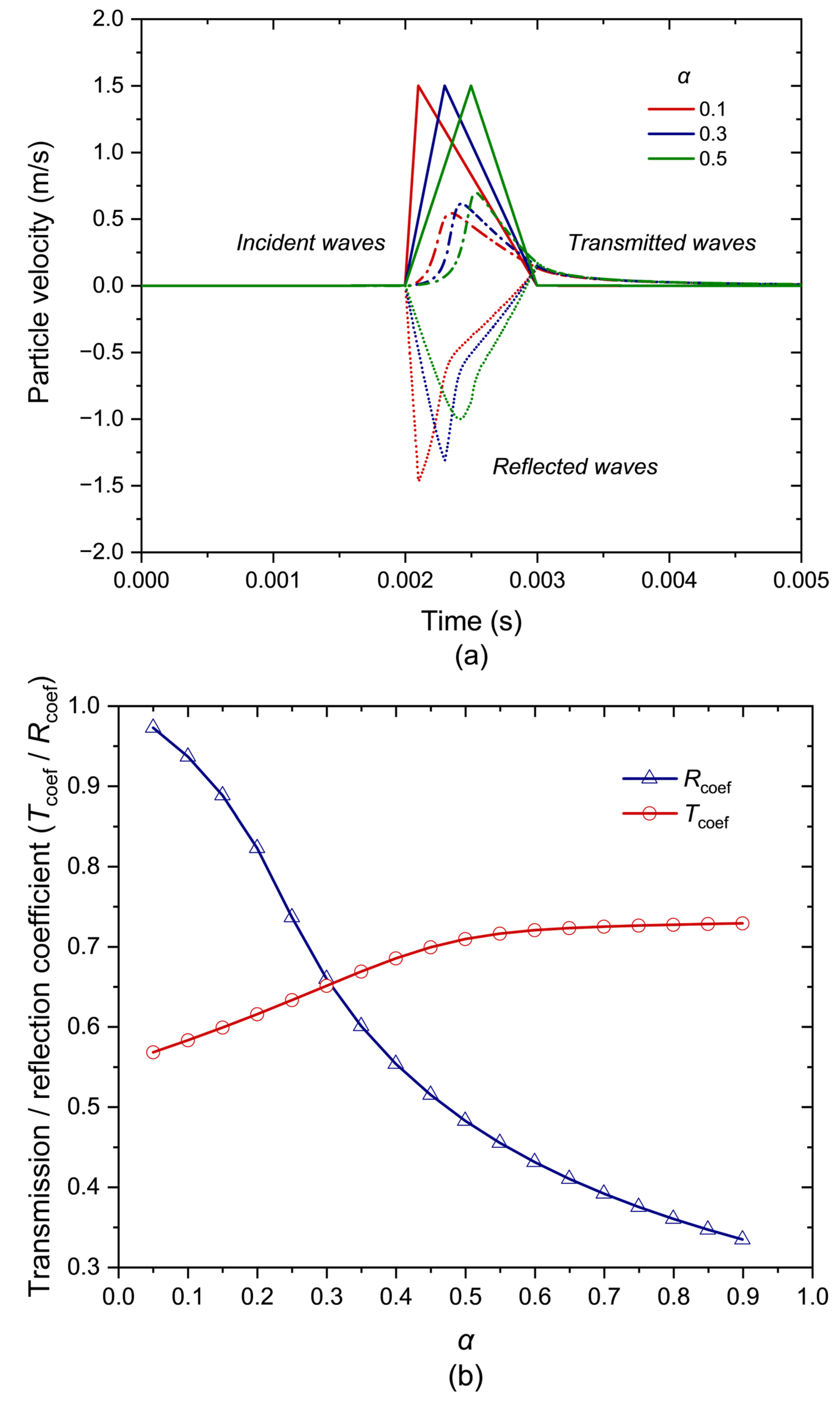
3.2. Waveform
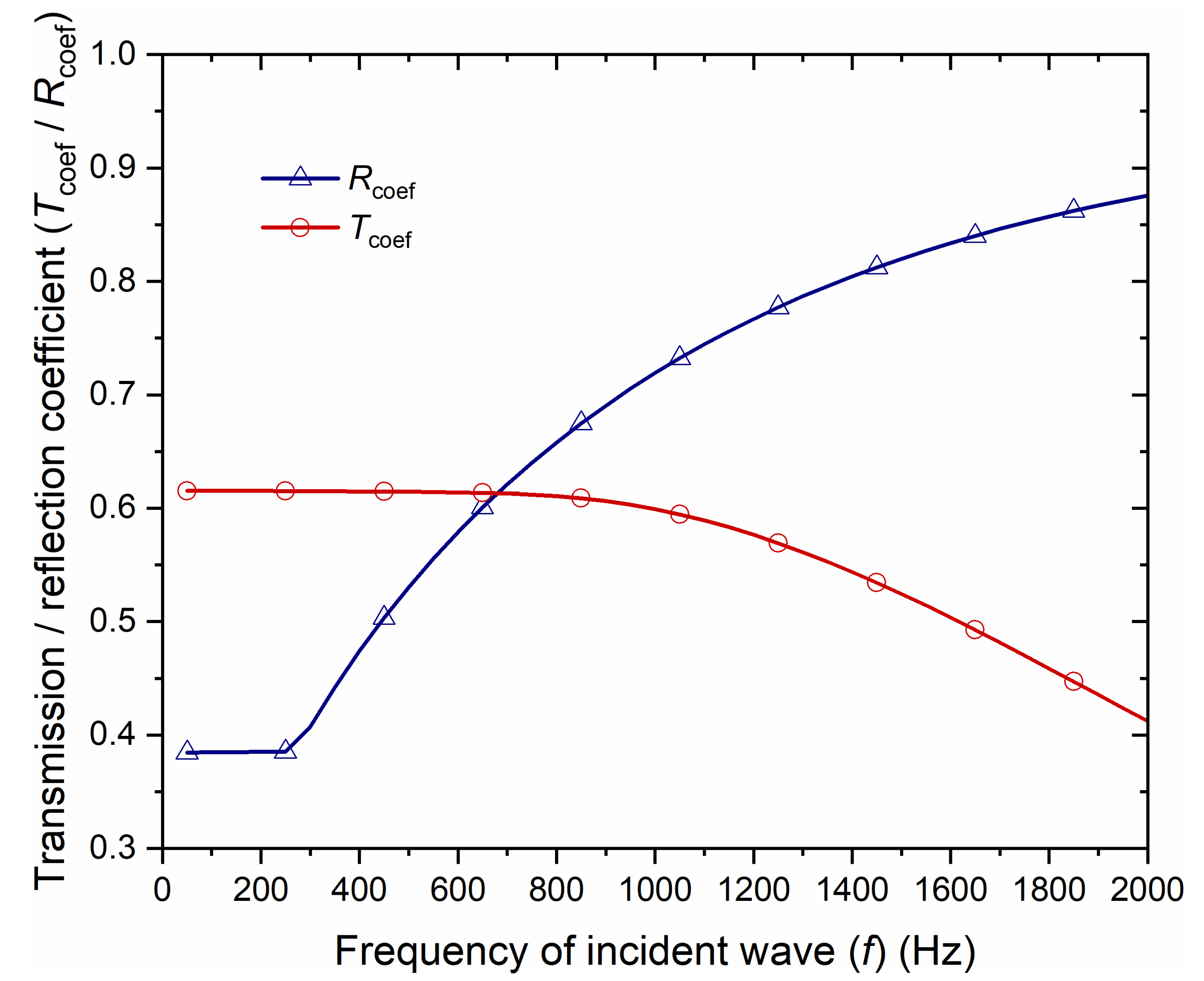
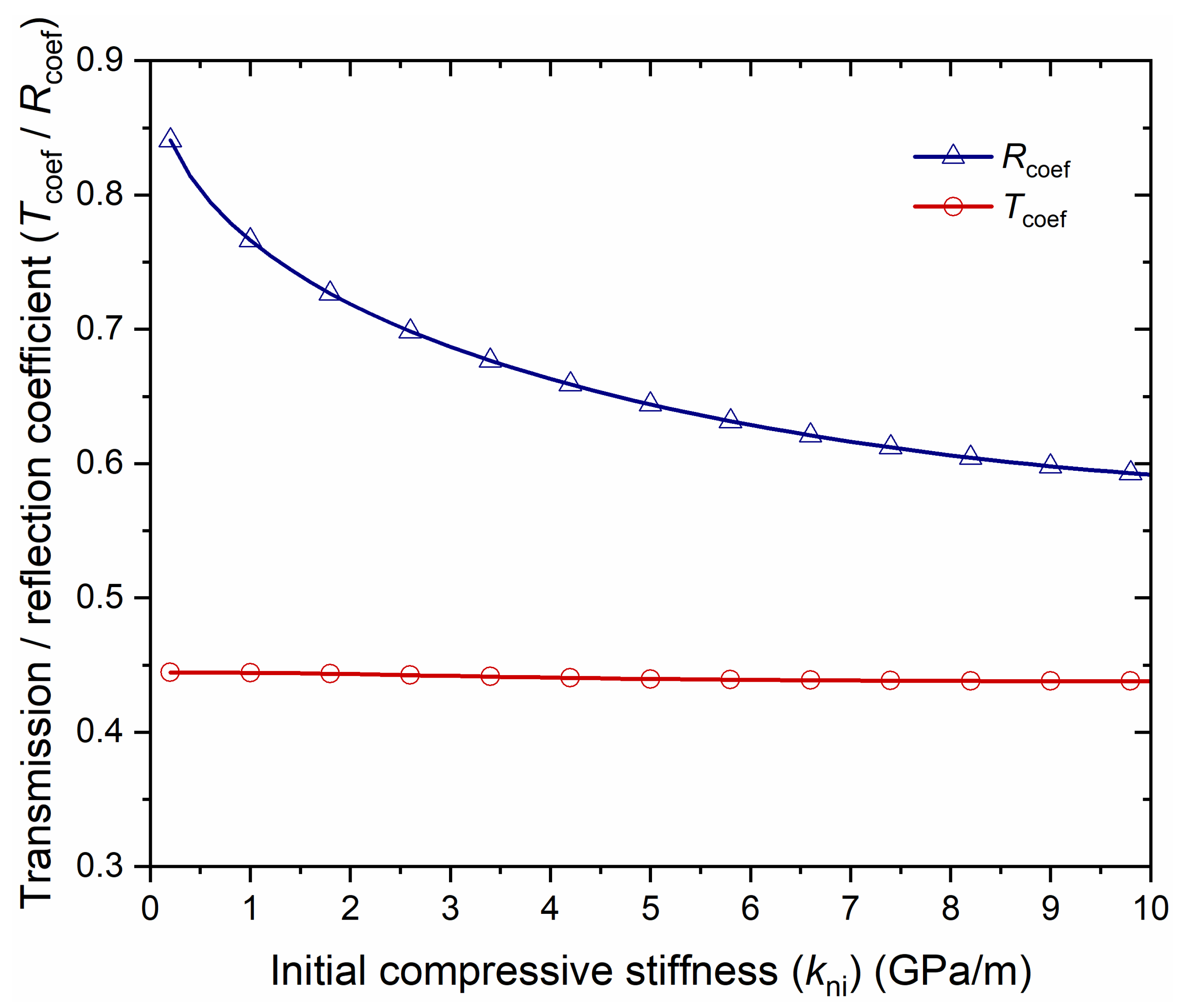
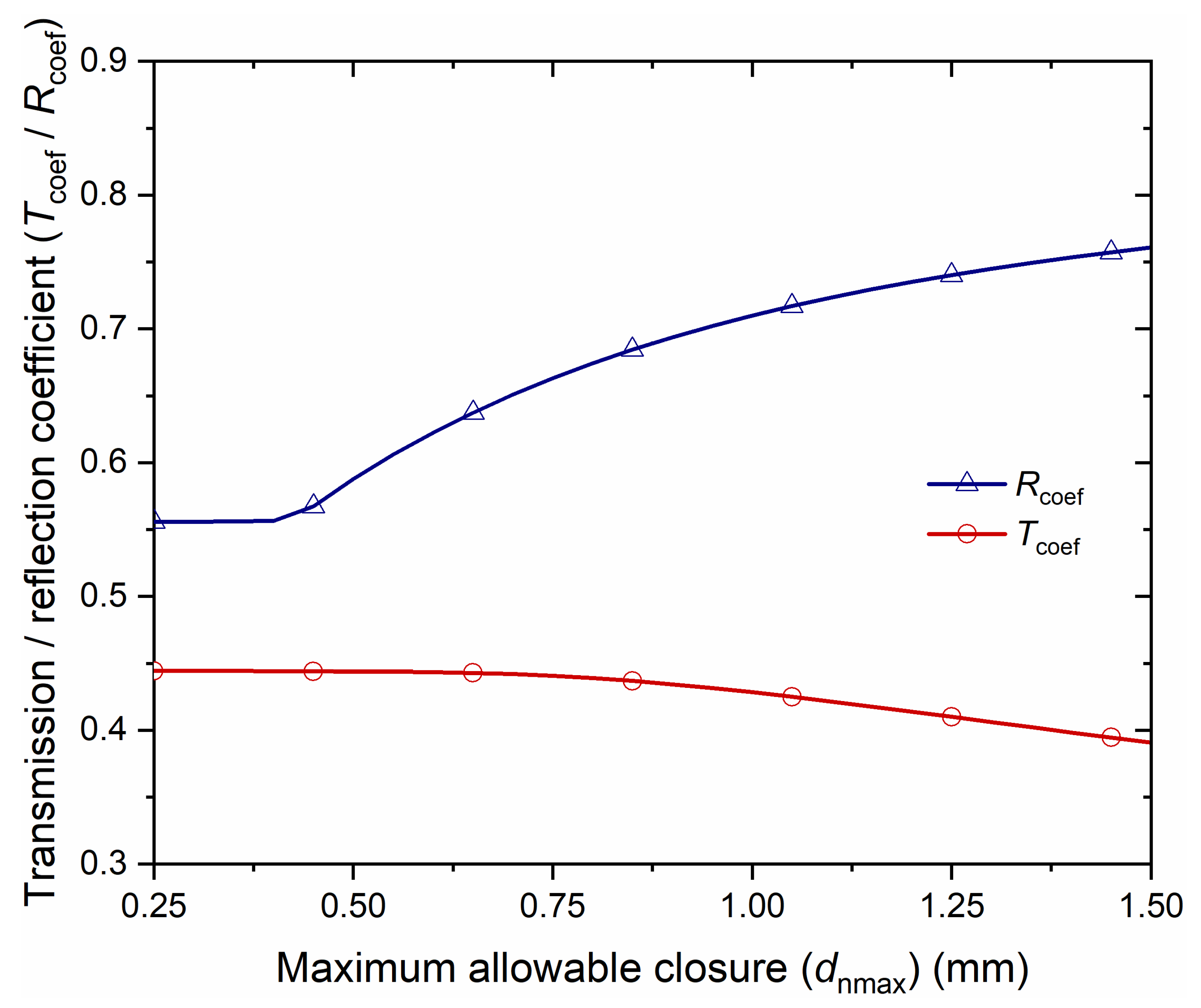
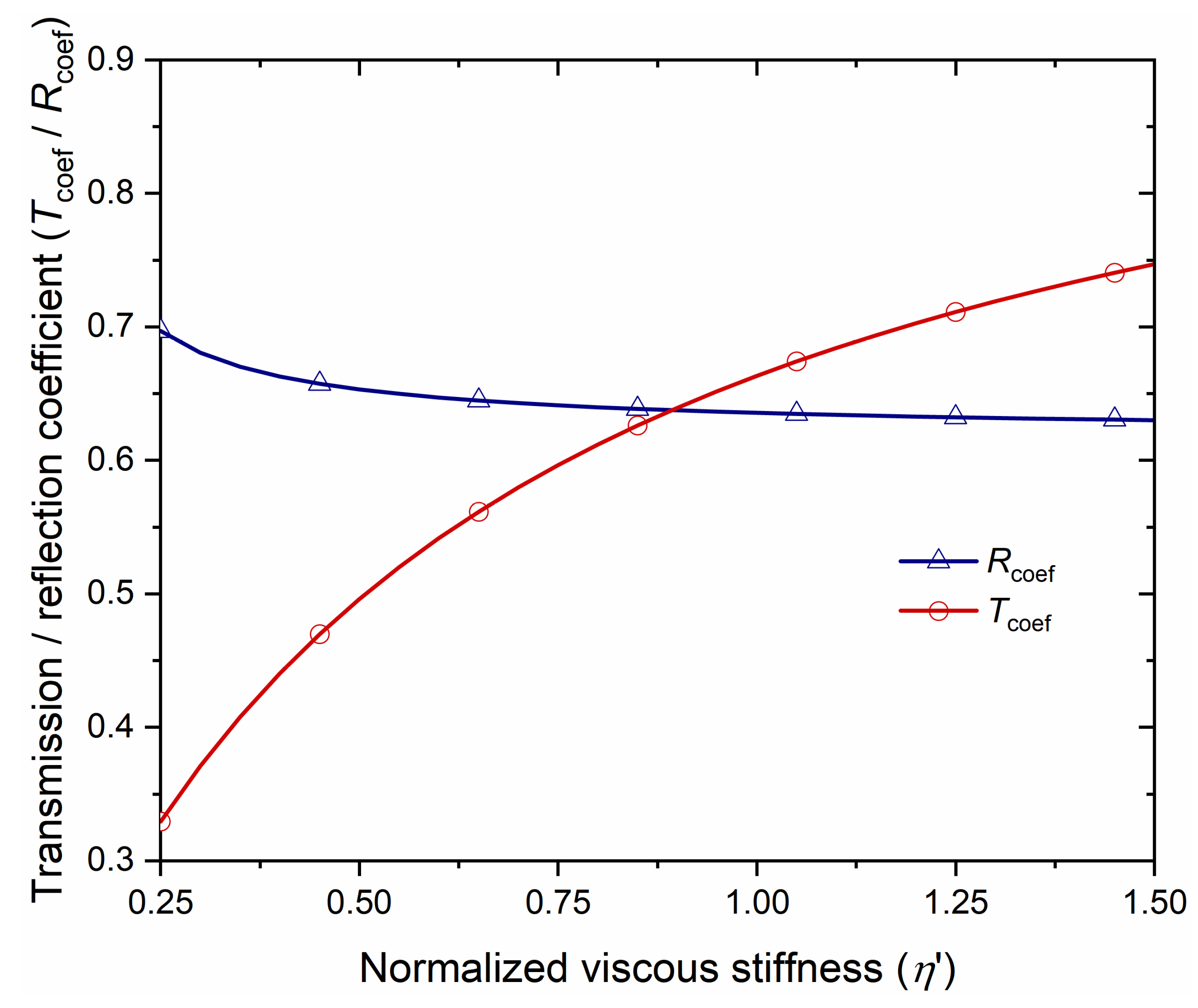
3.3. Reflection and Transmission Coefficients
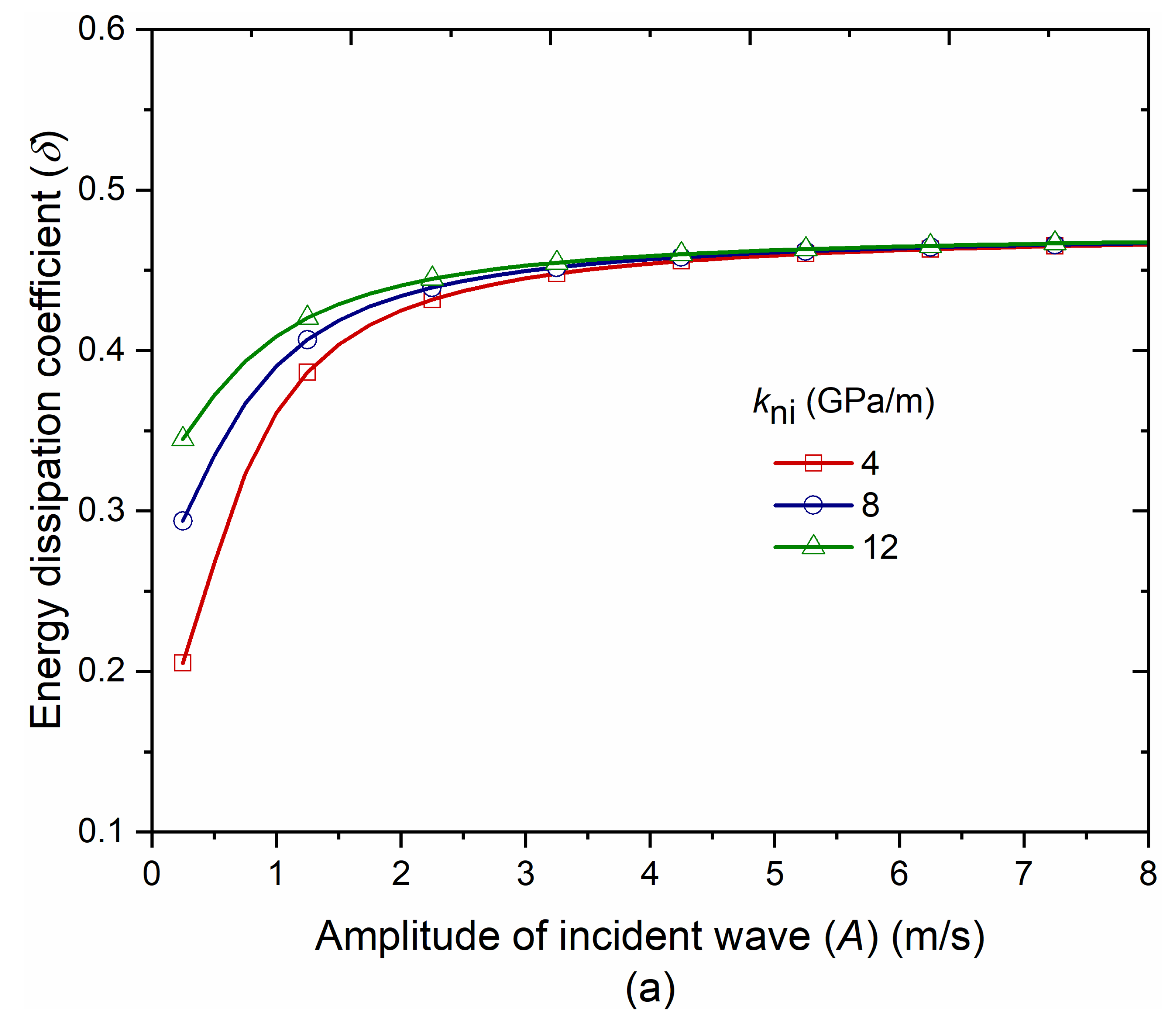
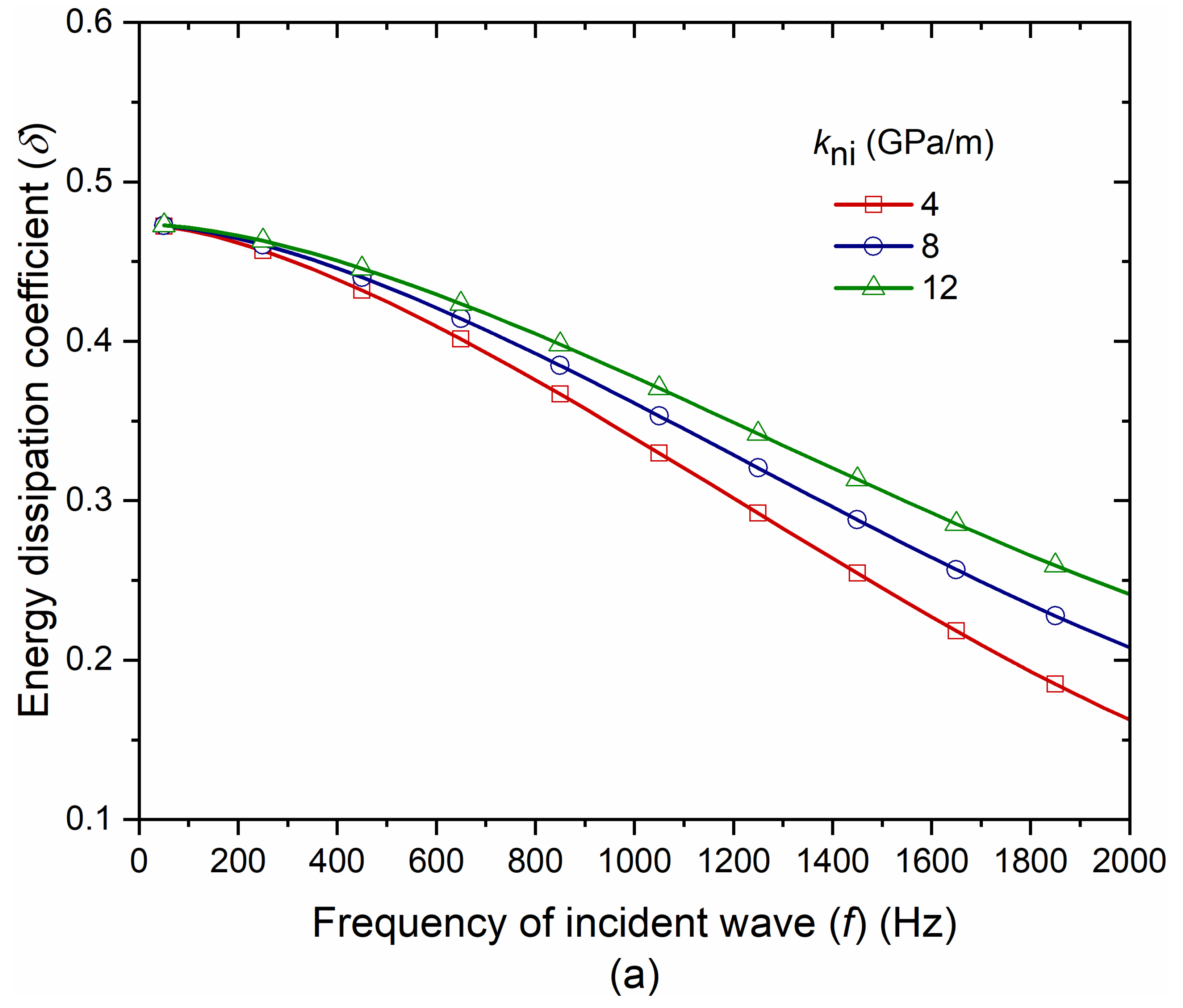
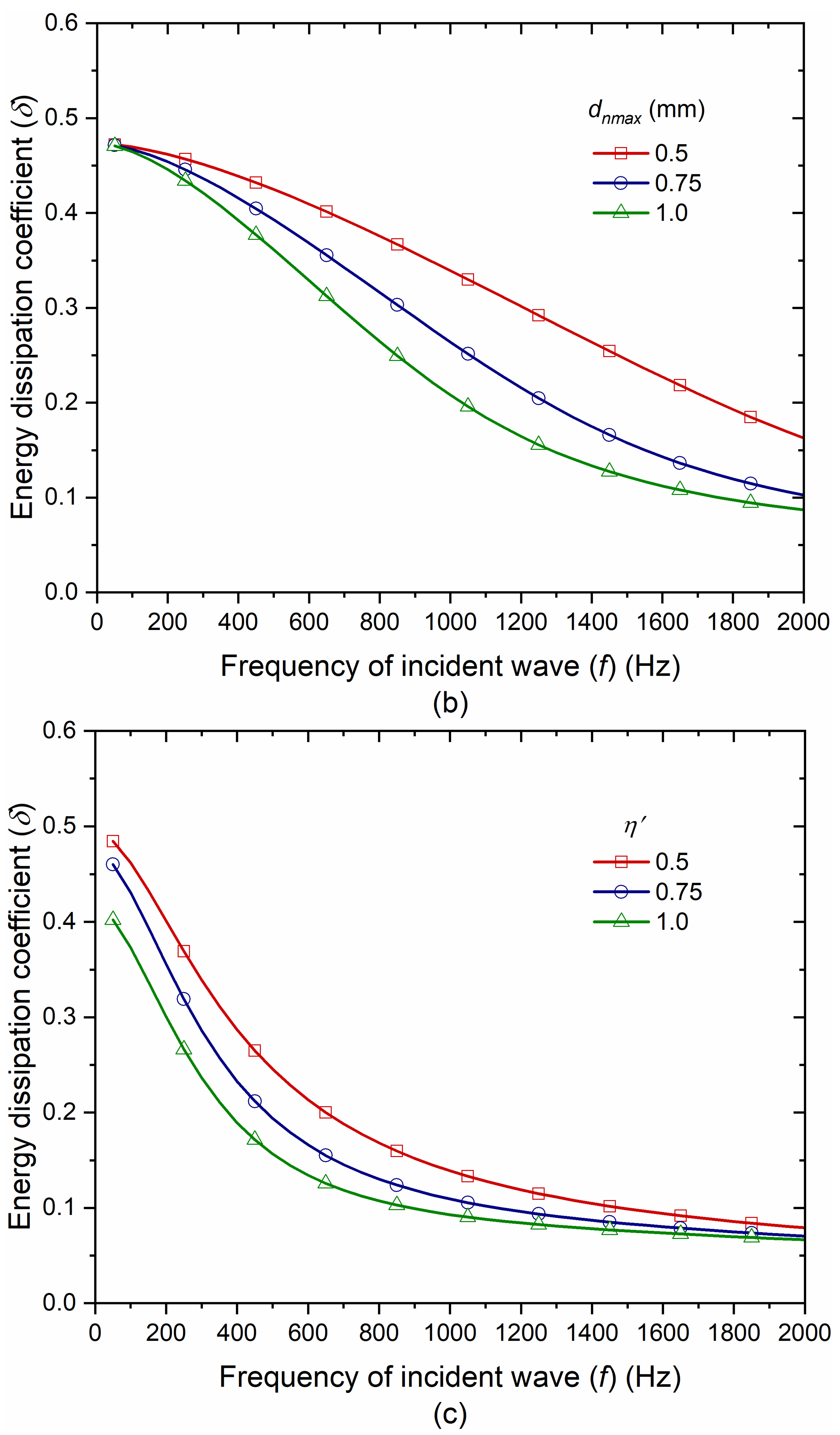
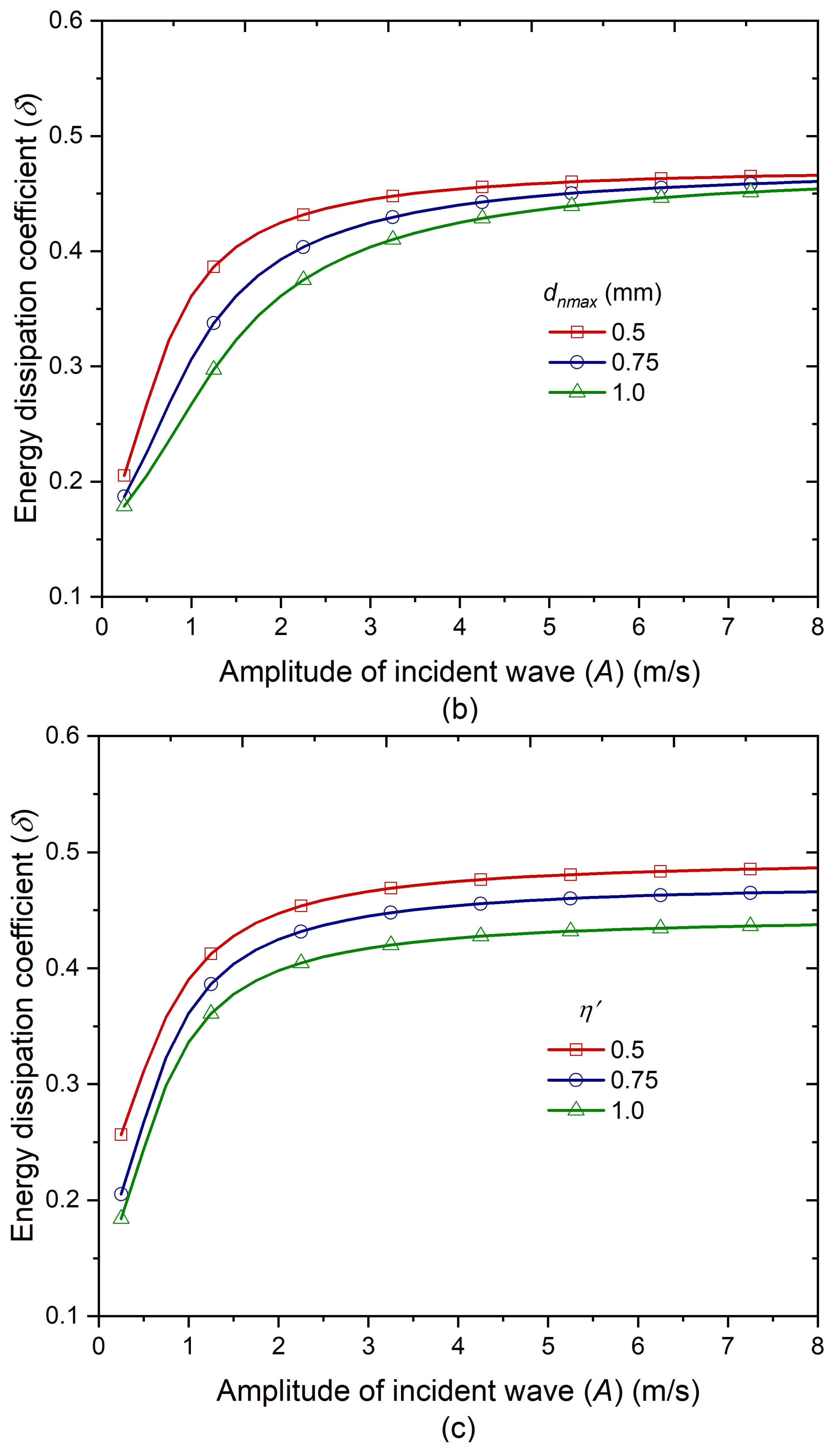
3.4. Energy Dissipation Coefficient
4. Discussion
5. Conclusions
Supplementary Materials
Author Contributions
Funding
Institutional Review Board Statement
Informed Consent Statement
Data Availability Statement
Conflicts of Interest
References
- Hoek, E.; Brown, E.T. The Hoek-Brown failure criterion and GSI—2018 edition. J. Rock Mech. Geotech. Eng. 2019, 11, 445–463. [Google Scholar] [CrossRef] [Scilit]
- Huang, X.L.; Qi, S.W.; Liu, Y.S.; Zhan, Z.F. Stress wave propagation through viscous-elastic jointed rock masses using propagator matrix method (PMM). Geophys. J. Int. 2015, 200, 452–470. [Google Scholar] [CrossRef] [Scilit]
- Huang, X.; Xu, L.; Du, J.; Ding, D. Propagation of the Longitude Stress Wave through a Filled Fracture Considering Cyclic Loading/Unloading Behaviours. Rock Mech. Rock Eng. 2024, 57, 4771–4786. [Google Scholar] [CrossRef] [Scilit]
- Fan, L.F.; Jiang, F.; Wang, M. Critical Angles of Obliquely Incident Stress Wave Through a Single Joint with Different Mediums on Both Sides. Rock Mech. Rock Eng. 2022, 55, 3317–3329. [Google Scholar] [CrossRef] [Scilit]
- Fan, L.F.; Wong, L.N.Y. Stress wave transmission across a filled joint with different loading/unloading behavior. Int. J. Rock Mech. Min. Sci. 2013, 60, 227–234. [Google Scholar] [CrossRef] [Scilit]
- Li, J.C.; Ma, G.W. Experimental study of stress wave propagation across a filled rock joint. Int. J. Rock Mech. Min. Sci. 2009, 46, 471–478. [Google Scholar] [CrossRef] [Scilit]
- Varma, M.; Maji, V.B. Influence of rock joints on longitudinal wave velocity using experimental and numerical techniques. Int. J. Rock Mech. Min. Sci. 2021, 141, 104699. [Google Scholar] [CrossRef] [Scilit]
- Lan, H.; Zhang, Y.; Macciotta, R.; Li, L.; Wu, Y.; Bao, H.; Peng, J. The role of discontinuities in the susceptibility, development, and runout of rock avalanches: A review. Landslides 2022, 19, 1391–1404. [Google Scholar] [CrossRef] [Scilit]
- Song, D.; Zhang, S.; Liu, C.; Nie, W. Cumulative damage evolution of jointed slopes subject to continuous earthquakes: Influence of joint type on dynamic amplification effect and failure mode of slopes. Comput. Geotech. 2024, 166, 106016. [Google Scholar] [CrossRef] [Scilit]
- Zhu, J.; Li, Y.; Peng, Q.; Deng, X.; Gao, M.; Zhang, J. Stress wave propagation across jointed rock mass under dynamic extension and its effect on dynamic response and supporting of underground opening. Tunn. Undergr. Space Technol. 2021, 108, 103648. [Google Scholar] [CrossRef] [Scilit]
- Bandis, S.C.; Lumsden, A.C.; Barton, N.R. Fundamentals of Rock Joint Deformation. Int. J. Rock Mech. Min. Sci. 1983, 20, 249–268. [Google Scholar] [CrossRef] [Scilit]
- Huang, X.L.; Qi, S.W.; Xia, K.W.; Shi, X.S. Particle Crushing of a Filled Fracture During Compression and Its Effect on Stress Wave Propagation. J. Geophys. Res. Solid Earth 2018, 123, 5559–5587. [Google Scholar] [CrossRef] [Scilit]
- Saadat, M.; Taheri, A. A cohesive discrete element based approach to characterizing the shear behavior of cohesive soil and clay-infilled rock joints. Comput. Geotech. 2019, 114, 103109. [Google Scholar] [CrossRef] [Scilit]
- Sinha, U.N.; Singh, B. Testing of rock joints filled with gouge using a triaxial apparatus. Int. J. Rock Mech. Min. Sci. 2000, 37, 963–981. [Google Scholar] [CrossRef] [Scilit]
- Han, Z.; Li, D.; Zhou, T.; Zhu, Q.; Ranjith, P.G. Experimental study of stress wave propagation and energy characteristics across rock specimens containing cemented mortar joint with various thicknesses. Int. J. Rock Mech. Min. Sci. 2020, 131, 104352. [Google Scholar] [CrossRef] [Scilit]
- Li, J.; Ma, G. Analysis of Blast Wave Interaction with a Rock Joint. Rock Mech. Rock Eng. 2009, 43, 777–787. [Google Scholar] [CrossRef] [Scilit]
- Cai, J.G.; Zhao, J. Effects of multiple parallel fractures on apparent attenuation of stress waves in rock masses. Int. J. Rock Mech. Min. Sci. 2000, 37, 661–682. [Google Scholar] [CrossRef] [Scilit]
- Li, J.; Ma, G.; Huang, X. Analysis of Wave Propagation Through a Filled Rock Joint. Rock Mech. Rock Eng. 2009, 43, 789–798. [Google Scholar] [CrossRef] [Scilit]
- Pyrak-Nolte, L.J.; Myer, L.R.; Cook, N.G.W. Transmission of seismic waves across single natural fractures. J. Geophys. Res. Solid Earth 1990, 95, 8617–8638. [Google Scholar] [CrossRef] [Scilit]
- Wang, L.J.; Fan, L.F.; Du, X.L. Non-attenuation Behavior of Stress Wave Propagation Through a Rock Mass. Rock Mech. Rock Eng. 2022, 55, 3807–3815. [Google Scholar] [CrossRef] [Scilit]
- Zhao, X.B.; Zhao, J.; Cai, J.G. P-wave transmission across fractures with nonlinear deformational behaviour. Int. J. Numer. Anal. Methods Geomech. 2006, 30, 1097–1112. [Google Scholar] [CrossRef] [Scilit]
- Schoenberg, M. Elastic wave behavior across linear slip interfaces. J. Acoust. Soc. Am. 1980, 68, 1516–1521. [Google Scholar] [CrossRef] [Scilit]
- Wang, M.; Jia, L.; Li, G.Y.; Wang, W.; Fan, L.F. A modified displacement discontinuity method for seismic wave propagation across rock masses with thin-layer joints. Geophysics 2024, 89, T227–T234. [Google Scholar] [CrossRef] [Scilit]
- Fan, L.F.; Wang, L.J.; Wu, Z.J. Wave transmission across linearly jointed complex rock masses. Int. J. Rock Mech. Min. Sci. 2018, 112, 193–200. [Google Scholar] [CrossRef] [Scilit]
- Fan, L.; Ma, G.; Li, J. Nonlinear viscoelastic medium equivalence for stress wave propagation in a jointed rock mass. Int. J. Rock Mech. Min. Sci. 2012, 50, 11–18. [Google Scholar] [CrossRef] [Scilit]
- Fan, L.F.; Wang, L.J.; Wang, M.; Wu, Z.J. Investigation of stress wave transmission across a nonlinearly jointed complex rock mass. Int. J. Rock Mech. Min. Sci. 2020, 136, 104485. [Google Scholar] [CrossRef] [Scilit]
- Li, X.F.; Li, H.B.; Li, J.C.; Li, Z.W. Research on Transient Wave Propagation Across Nonlinear Joints Filled with Granular Materials. Rock Mech. Rock Eng. 2018, 51, 2373–2393. [Google Scholar] [CrossRef] [Scilit]
- Zhao, J.; Cai, J.G. Transmission of Elastic P-waves across Single Fractures with a Nonlinear Normal Deformational Behavior. Rock Mech. Rock Eng. 2001, 34, 3–22. [Google Scholar] [CrossRef] [Scilit]
- Du, J.H.; Huang, X.L.; Yang, G.X.; Xue, L.; Wu, B.B.; Zang, M.D.; Zhang, X. UDEC Modelling on Dynamic Response of Rock Masses with Joint Stiffness Weakening Attributed to Particle Crushing of Granular Fillings. Rock Mech. Rock Eng. 2023, 56, 1823–1841. [Google Scholar] [CrossRef] [Scilit]
- Chen, J.; Tong, J.; Rui, Y.C.; Cui, Y.; Pu, Y.Y.; Du, J.S.; Apel, D.B. Step-path failure mechanism and stability analysis of water-bearing rock slopes based on particle flow simulation. Theor. Appl. Fract. Mech. 2024, 131, 104370. [Google Scholar] [CrossRef] [Scilit]
- Huang, J.; Liu, X.; Zhao, J.; Wang, E.; Wang, S. Propagation of Stress Waves Through Fully Saturated Rock Joint Under Undrained Conditions and Dynamic Response Characteristics of Filling Liquid. Rock Mech. Rock Eng. 2020, 53, 3637–3655. [Google Scholar] [CrossRef] [Scilit]
- Huang, X.; Qi, S.; Yao, W.; Xia, K. Effect of Filling Humidity on the Propagation of High-Amplitude Stress Waves through an Artificial Joint. Geotech. Test. J. 2019, 42, 30–42. [Google Scholar] [CrossRef] [Scilit]
- Yang, H.; Duan, H.F.; Zhu, J.B. Ultrasonic P-wave propagation through water-filled rock joint: An experimental investigation. J. Appl. Geophys. 2019, 169, 1–14. [Google Scholar] [CrossRef] [Scilit]
- Yang, H.; Duan, H.F.; Zhu, J.B.; Zhao, Q. Water Effects on Elastic S-Wave Propagation and Attenuation Across Single Clay-Rich Rock Fractures: Insights from Ultrasonic Measurements. Rock Mech. Rock Eng. 2024, 57, 2645–2659. [Google Scholar] [CrossRef] [Scilit]
- Chai, L.; Chai, S.; Li, P.; Liu, J.; Song, B.; Li, X. Analysis of P-wave propagation in filled jointed rock mass with viscoelastic properties. Geomech. Geophys. Geo-Energy Geo-Resour. 2023, 9, 102. [Google Scholar] [CrossRef] [Scilit]
- Wang, R.; Hu, Z.; Zhang, D.; Wang, Q. Propagation of the Stress Wave Through the Filled Joint with Linear Viscoelastic Deformation Behavior Using Time-Domain Recursive Method. Rock Mech. Rock Eng. 2017, 50, 3197–3207. [Google Scholar] [CrossRef] [Scilit]
- Zhu, J.B.; Perino, A.; Zhao, G.F.; Barla, G.; Li, J.C.; Ma, G.W.; Zhao, J. Seismic response of a single and a set of filled joints of viscoelastic deformational behaviour. Geophys. J. Int. 2011, 186, 1315–1330. [Google Scholar] [CrossRef] [Scilit]
- Yoshioka, N.; Kikuchi, M. Visco-elastic response of joints to transmission waves. Geophys. Res. Lett. 2012, 20, 1143–1146. [Google Scholar] [CrossRef] [Scilit]
- Liu, H.B.; Dai, G.L.; Zhou, F.X.; Cao, X.L.; Wang, L.Y. Effect of flow-independent viscosity on the propagation behavior of Rayleigh wave in partially saturated soil based on the fractional standard linear solid model. Comput. Geotech. 2022, 147, 104763. [Google Scholar] [CrossRef] [Scilit]
- Zhang, M.-F.; He, Y.-X.; Wang, S.-X.; Tang, G.-Y.; Sun, C. A benchmark study for quasi-static numerical upscaling of seismic wave attenuation and dispersion in fractured poroelastic rocks. Comput. Geosci. 2023, 180, 105459. [Google Scholar] [CrossRef] [Scilit]
- Huang, X.; Qi, S.; Zheng, B.; Liu, Y.; Xue, L.; Liang, N. Stress Wave Propagation through Rock Joints Filled with Viscoelastic Medium Considering Different Water Contents. Appl. Sci. 2020, 10, 4797. [Google Scholar] [CrossRef] [Scilit]
- Zou, Y.; Li, J.; Laloui, L.; Zhao, J. Analytical Time-Domain Solution of Plane Wave Propagation Across a Viscoelastic Rock Joint. Rock Mech. Rock Eng. 2017, 50, 2731–2747. [Google Scholar] [CrossRef] [Scilit]
- Zhao, X.B.; Zhao, J.; Hefny, A.M.; Cai, J.G. Normal Transmission of S-Wave Across Parallel Fractures with Coulomb Slip Behavior. J. Eng. Mech. 2006, 132, 641–650. [Google Scholar] [CrossRef] [Scilit]
- Li, X.; Zhu, B.; Xiao, W. A modified Barton-Bandis normal closure model for infilled rock joint. Environ. Earth Sci. 2025, 84, 403. [Google Scholar] [CrossRef] [Scilit]




Disclaimer/Publisher’s Note: The statements, opinions and data contained in all publications are solely those of the individual author(s) and contributor(s) and not of MDPI and/or the editor(s). MDPI and/or the editor(s) disclaim responsibility for any injury to people or property resulting from any ideas, methods, instructions or products referred to in the content. |
© 2025 by the authors. Licensee MDPI, Basel, Switzerland. This article is an open access article distributed under the terms and conditions of the Creative Commons Attribution (CC BY) license.
Share and Cite
Zhan, Z.; Huang, X.; Du, J.; Sun, Y.; Wang, J. Characteristics of Compressive Stress Wave Propagation Across a Nonlinear Viscoelastic Filled Rock Joint. Appl. Sci. 2026, 16, 428. https://doi.org/10.3390/app16010428
Zhan Z, Huang X, Du J, Sun Y, Wang J. Characteristics of Compressive Stress Wave Propagation Across a Nonlinear Viscoelastic Filled Rock Joint. Applied Sciences. 2026; 16(1):428. https://doi.org/10.3390/app16010428
Chicago/Turabian StyleZhan, Zhifa, Xiaolin Huang, Jiahu Du, Yilin Sun, and Jilin Wang. 2026. "Characteristics of Compressive Stress Wave Propagation Across a Nonlinear Viscoelastic Filled Rock Joint" Applied Sciences 16, no. 1: 428. https://doi.org/10.3390/app16010428
APA StyleZhan, Z., Huang, X., Du, J., Sun, Y., & Wang, J. (2026). Characteristics of Compressive Stress Wave Propagation Across a Nonlinear Viscoelastic Filled Rock Joint. Applied Sciences, 16(1), 428. https://doi.org/10.3390/app16010428