Radiation Dose Reduction in CT Exams with Iterative and Deep Learning Reconstruction: A Systematic Review




Abstract
1. Introduction
2. Materials and Methods
2.1. Eligibility Criteria
2.2. Information Sources
2.3. Search Strategy
2.4. Selection Process
2.5. Data Collection
2.6. Data Items
2.7. Risk of Bias
2.8. Effect Measures
2.9. Synthesis of Results
2.10. Reporting Bias and Certainty Assessment
3. Results
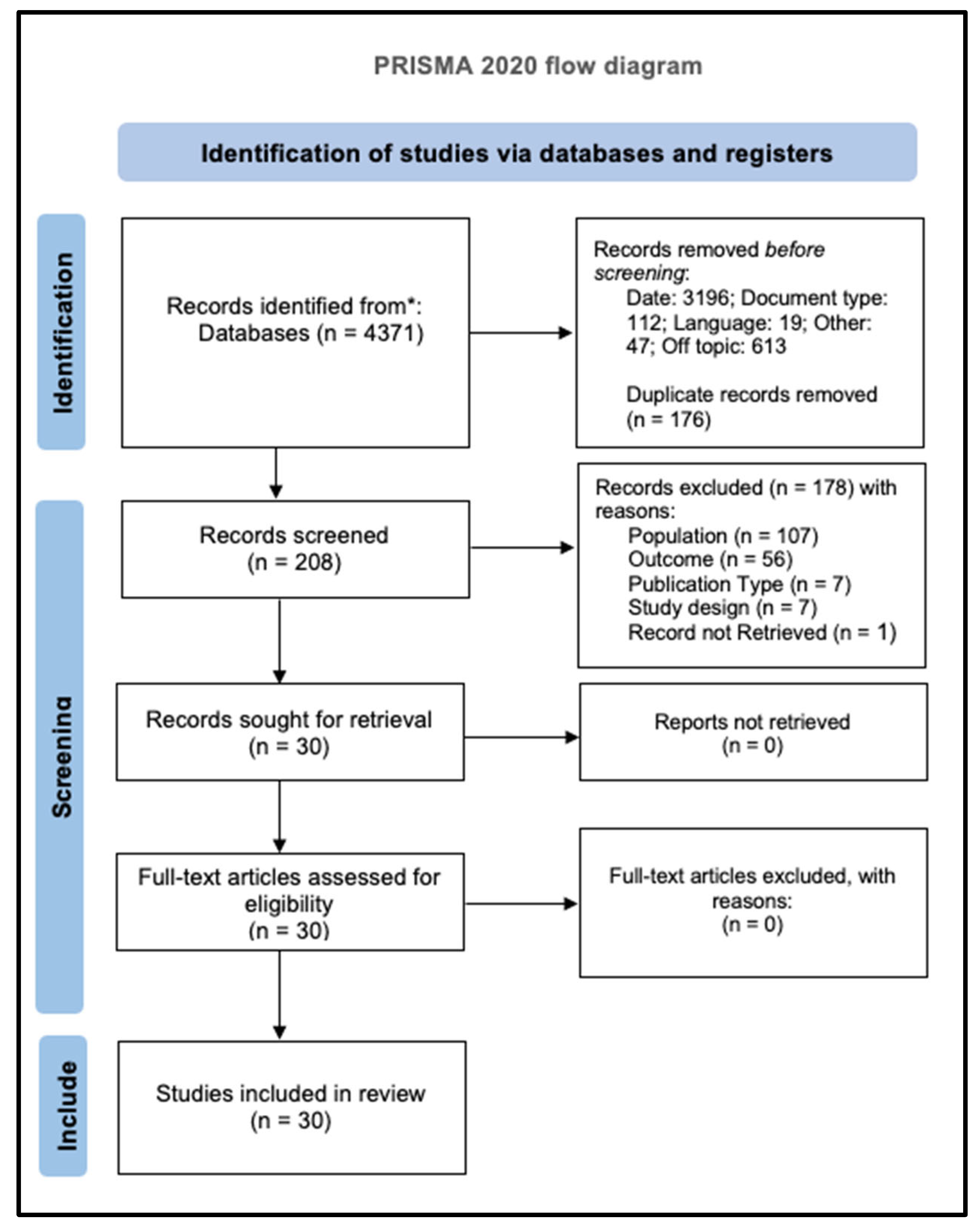
3.1. Study Selection
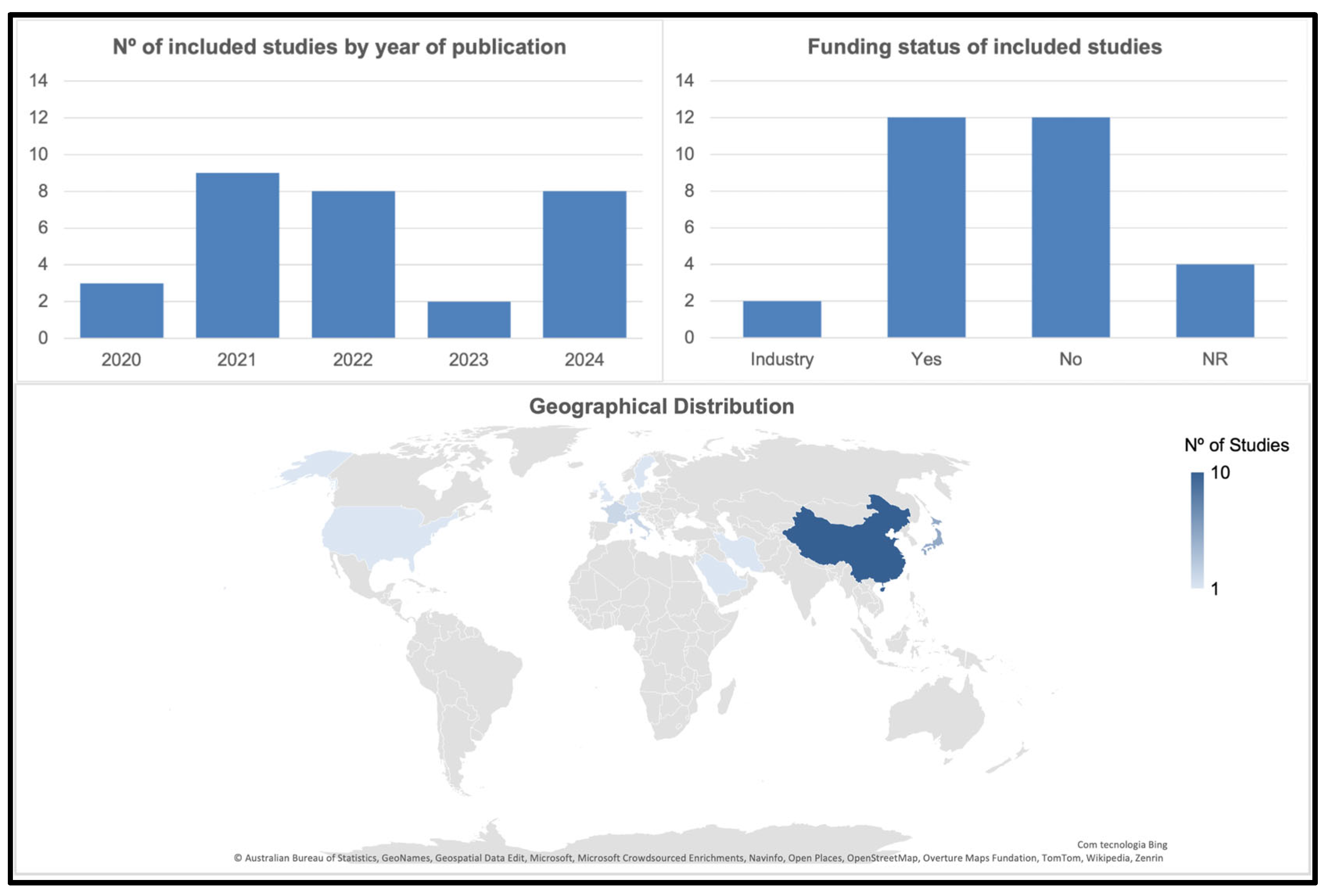
3.2. Study Characteristics
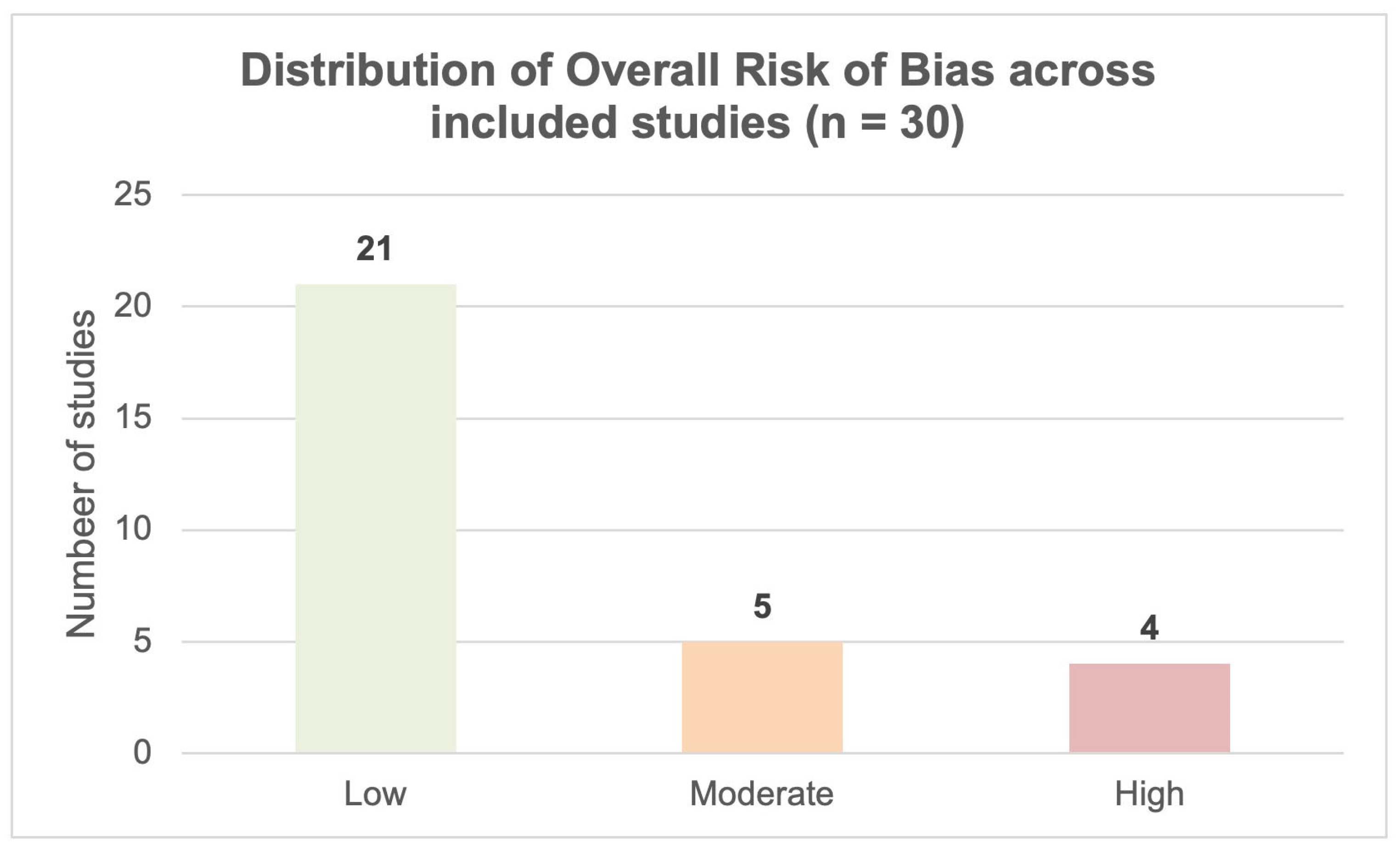
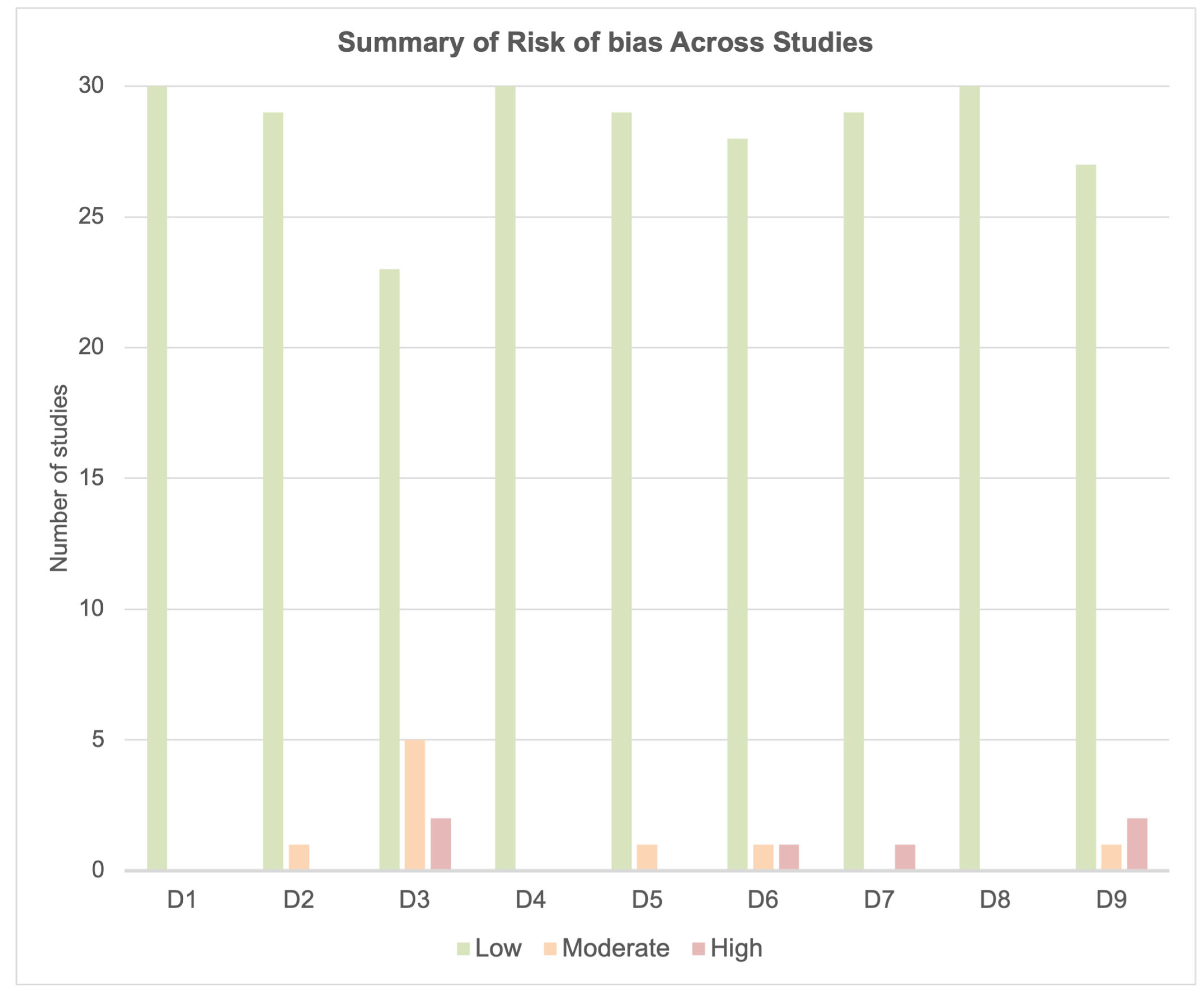
3.3. Risk of Bias in Studies
3.4. Results of Individual Studies
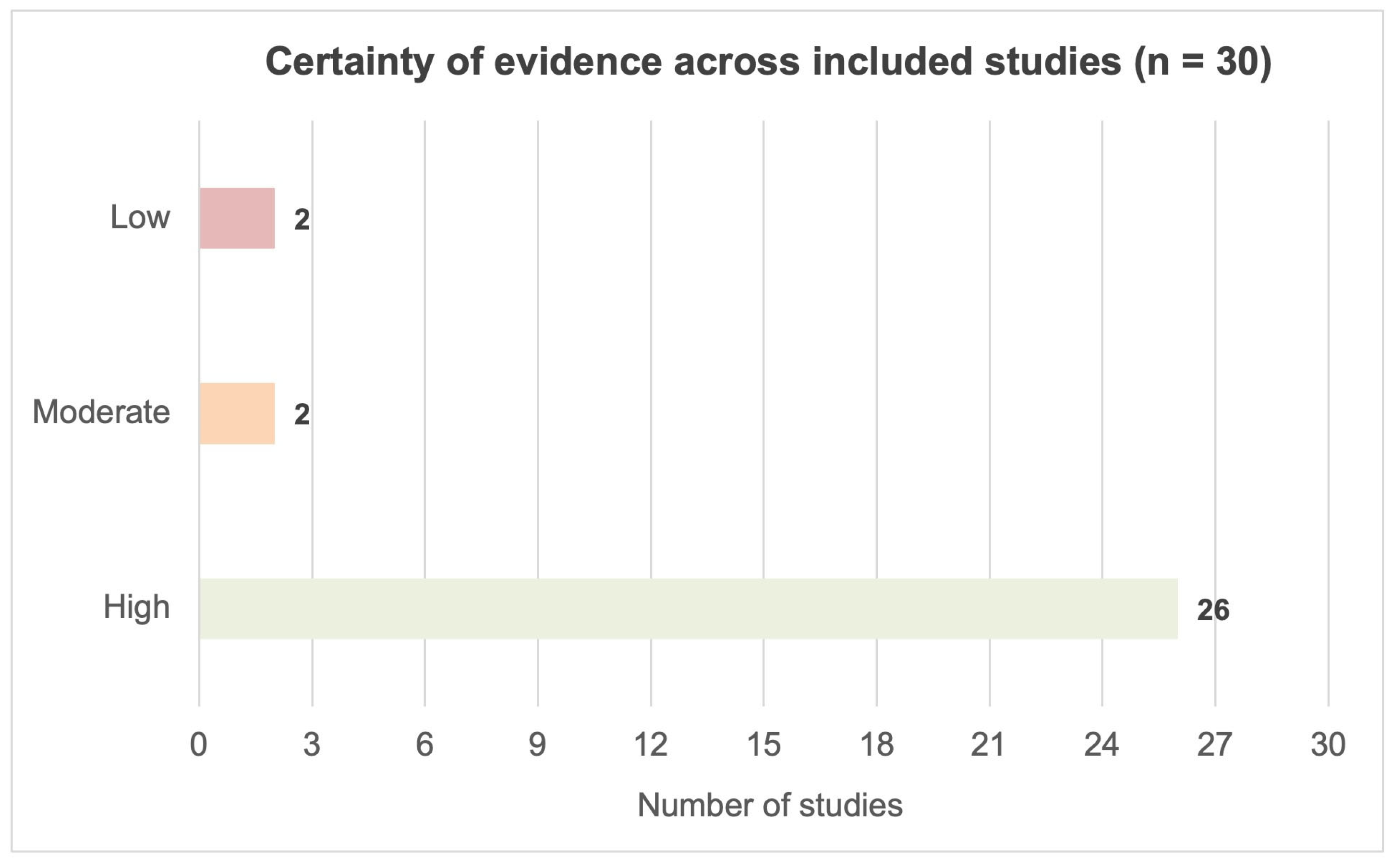
3.5. Reporting Biases and Certainty of Evidence
4. Discussion
Limitations and Biases in Current Research
5. Conclusions
Author Contributions
Funding
Institutional Review Board Statement
Informed Consent Statement
Data Availability Statement
Acknowledgments
Conflicts of Interest
Appendix A

| Database | Platform | Search String (Title/Abstract) | Filters Applied | Date |
|---|---|---|---|---|
| PubMed | NCBI | ((“Computed Tomography”[All Fields] OR “CT Exam”[All Fields]) AND (“Dose Reduction”[All Fields] OR “Radiation Risk”[All Fields] OR “Radiation Dose Reduction”[All Fields]) AND (“Iterative Reconstruction”[All Fields] OR “Tube Voltage Modulation”[All Fields])) AND ((humans[Filter]) AND (2020/1/1:2025/3/22[pdat]) AND (english[Filter])) | Humans, English; 2020–2025 | 22 March 2025 |
| ((“Computed Tomography”[All Fields] OR “CT Exam”[All Fields]) AND (“Dose Reduction”[All Fields] OR “Radiation Risk”[All Fields] OR “Radiation Dose Reduction”[All Fields]) AND (“Automatic Exposure”[All Fields] OR “Tube Current Modulation”[All Fields])) AND ((humans[Filter]) AND (2020/1/1:2025/3/22[pdat]) AND (english[Filter])) | ||||
| ((“Computed Tomography”[All Fields] OR “CT Exam”[All Fields]) AND (“Dose Reduction”[All Fields] OR “Radiation Risk”[All Fields] OR “Radiation Dose Reduction”[All Fields]) AND (“Noise-Based Tube Current”[All Fields] OR “Innovation”[All Fields])) AND ((humans[Filter]) AND (2020/1/1:2025/3/22[pdat]) AND (english[Filter])) | ||||
| Scopus | Elsevier | TITLE-ABS-KEY((“Computed Tomography” OR “CT Exam”) AND (“Dose Reduction” OR “Radiation Risk” OR “Radiation Dose Reduction”) AND (“Iterative Reconstruction” OR “Tube Voltage Modulation”))AND PUBYEAR > 2019 AND PUBYEAR < 2026 AND (LIMIT-TO (DOCTYPE,”ar”)) AND (LIMIT-TO (SRCTYPE,”j”)) AND LIMIT-TO (LANGUAGE,”English”)) AND (LIMIT-TO (PUBSTAGE,”final”)) | Article, Journal, English; 2020–2025 | 22 March 2025 |
| TITLE-ABS-KEY((“Computed Tomography” OR “CT Exam”) AND (“Dose Reduction” OR “Radiation Risk” OR “Radiation Dose Reduction”) AND (“Automatic Exposure” OR “Tube Current Modulation”)) AND PUBYEAR > 2019 AND PUBYEAR < 2026 AND (LIMIT-TO (DOCTYPE,”ar”)) AND (LIMIT-TO (SRCTYPE,”j”)) AND (LIMIT-TO (LANGUAGE,”English”)) AND (LIMIT-TO (PUBSTAGE,”final”)) | ||||
| TITLE-ABS-KEY((“Computed Tomography” OR “CT Exam”) AND (“Dose Reduction” OR “Radiation Risk” OR “Radiation Dose Reduction”) AND (“Noise-Based Tube Current” OR “Innovation”)) AND PUBYEAR > 2019 AND PUBYEAR < 2026 AND (LIMIT-TO (SRCTYPE,”j”)) AND (LIMIT-TO (LANGUAGE,”English”)) AND (LIMIT-TO (DOCTYPE,”ar”) OR LIMIT-TO (DOCTYPE,”re”)) | ||||
| Web of Science | Clarivate | (“Computed Tomography” OR “CT Exam”) AND (“Dose Reduction” OR “Radiation Risk” OR “Radiation Dose Reduction”) AND (“Iterative Reconstruction” OR “Tube Voltage Modulation”) (Topic) and 2025 or 2024 or 2023 or 2022 or 2021 or 2020 (Publication Years) and Article (Document Types) and English (Languages) | Article, English; 2020–2025 | 22 March 2025 |
| (“Computed Tomography” OR “CT Exam”) AND (“Dose Reduction” OR “Radiation Risk” OR “Radiation Dose Reduction”) AND (“Automatic Exposure” OR “Tube Current Modulation”) (Topic) and 2025 or 2024 or 2023 or 2022 or 2021 or 2020 (Publication Years) and Article (Document Types) and English (Languages) and Article (Document Types) | ||||
| (“Computed Tomography” OR “CT Exam”) AND (“Dose Reduction” OR “Radiation Risk” OR “Radiation Dose Reduction”) AND (“Noise-Based Tube Current” OR “Innovation”) (Topic) and 2025 or 2023 or 2021 or 2020 (Publication Years) and Article (Document Types) and English (Languages) |
| Ref. | Authors | Date | D1 | D2 | D3 | D4 | D5 | D6 | D7 | D8 | D9 | Overall RoB |
|---|---|---|---|---|---|---|---|---|---|---|---|---|
| [2] | Jeong-A Yeom, Ki-Uk Kim, et al. | 7.2022 | Low | Low | Low | Low | Low | Low | Low | Low | Low | Low |
| [4] | Karolin J Paprottka, Karina Kupfer, et al. | 11.2021 | Low | Low | Low | Low | Low | Low | Low | Low | Low | Low |
| [21] | Weitao He, Ping Xu, and Mengchen Zhang, et al. | 9.2024 | Low | Low | Low | Low | Low | Low | Low | Low | Low | Low |
| [22] | Sarah Prod’homme, Roger Bouzerar, et al. | 3.2024 | Low | Low | Low | Low | Low | Low | Low | Low | Low | Low |
| [23] | Ramandeep Singh, Subba R Digumarthy, et al. | 3.2020 | Low | Low | Low | Low | Low | Moderate | Low | Low | High | High |
| [24] | Yuko Nakamura, Keigo Narita, et al. | 1.2021 | Low | Low | Moderate | Low | Low | Low | Low | Low | High | High |
| [25] | Yanshan Chen, Zixuan Huang, et al. | 3.2024 | Low | Low | Low | Low | Low | Low | Low | Low | Low | Low |
| [26] | Liyong Zhuo, Shijie Xu, et al. | 9.2024 | Low | Low | Low | Low | Low | Low | Low | Low | Low | Low |
| [27] | Akio Tamura, Eisuke Mukaida, et al. | 5.2022 | Low | Low | Low | Low | Low | Low | Low | Low | Low | Low |
| [28] | Ali Chaparian, Mohamadhosein Asemanrafat, et al. | 12.2021 | Low | Low | Low | Low | Low | Low | Low | Low | Low | Low |
| [29] | Huiyuan Zhu, Zike Huang, et al. | 11.2024 | Low | Low | Low | Low | Low | Low | Low | Low | Low | Low |
| [30] | Ruijie Zhao, Xin Sui, et al. | 6.2022 | Low | Low | Low | Low | Low | Low | Low | Low | Low | Low |
| [31] | Shumeng Zhu, Baoping Zhan, et al. | 9.2024 | Low | Low | Low | Low | Low | Low | Low | Low | Low | Low |
| [32] | Nieun Seo, Mi-Suk Park, et al. | 2.2021 | Low | Low | Moderate | Low | Low | Low | Low | Low | Low | Moderate |
| [33] | Peijie Lyu, Zhen Li, et al. | 1.2023 | Low | Low | Low | Low | Low | Low | Low | Low | Low | Low |
| [34] | Tetsuro Kaga, Yoshifumi Noda, et al. | 3.2022 | Low | Low | Moderate | Low | Low | Low | Low | Low | Low | Moderate |
| [35] | E Hettinger, M.-L Aurumskjöld, H Sartor, et al. | 3.2021 | Low | Low | Low | Low | Low | Low | Low | Low | Low | Low |
| [36] | Hayato Tomita, Kenji Kuramochi, et al. | 6.2022 | Low | Low | Low | Low | Low | Low | Low | Low | Low | Low |
| [37] | Xu Lin, Yankun Gao, et al. | 3.2024 | Low | Low | Low | Low | Low | Low | Low | Low | Moderate | Moderate |
| [38] | Abdul Rauf, Saqib Javed, et al. | 10.2023 | Low | Moderate | High | Low | Low | Low | Low | Low | Low | High |
| [39] | Angélique Bernard, Pierre-Olivier Comby, et al. | 1.2021 | Low | Low | Low | Low | Low | Low | Low | Low | Low | Low |
| [40] | L E Cao, Xiang Liu, et al. | 9.2020 | Low | Low | Low | Low | Low | Low | Low | Low | Low | Low |
| [41] | June Park, Jaeseung Shin, et al. | 1.2022 | Low | Low | Low | Low | Low | Low | Low | Low | Low | Low |
| [42] | Emilio Quaia, Elena Kiyomi, et al. | 6.2024 | Low | Low | Low | Low | Low | Low | Low | Low | Low | Low |
| [43] | Sungeun Park, Jeong Hee Yoon, et al. | 7.2022 | Low | Low | Low | Low | Low | Low | Low | Low | Low | Low |
| [44] | Dominik C Benz and Sara Ersözlü, et al. | 11.2022 | Low | Low | Low | Low | Low | Low | Low | Low | Low | Low |
| [45] | Lingming Zeng, Xu Xu, et al. | 1.2021 | Low | Low | Moderate | Low | Low | Low | Low | Low | Low | Moderate |
| [46] | Davide Ippolito, Cesare Maino, et al. | 6.2021 | Low | Low | Moderate | Low | Low | Low | Low | Low | Low | Moderate |
| [47] | A Sulieman, H Adam, et al. | 5.2020 | Low | Low | High | Low | Moderate | High | High | Low | Low | High |
| [48] | Yoshifumi Noda, Tetsuro Kaga, et al. | 2.2021 | Low | Low | Low | Low | Low | Low | Low | Low | Low | Low |
| Ref. | Authors | Main Outcome | Risk of Bias | Inconsistency | Imprecision | Indirectness | Publication Bias | Overall Certainty |
|---|---|---|---|---|---|---|---|---|
| [2] | Jeong-A Yeom, Ki-Uk Kim, et al. | Emphysema quantification (ULCT vs. SDCT) | Not serious | Not serious | Not serious | Not serious | Undetected | High |
| [4] | Karolin J Paprottka, Karina Kupfer, et al. | Dose reduction + image quality | Not serious | Not serious | Not serious | Not serious | Undetected | High |
| [21] | Weitao He, Ping Xu, and Mengchen Zhang, et al. | CT enterography IQ + dose (IBD) | Not serious | Not serious | Not serious | Not serious | Undetected | High |
| [22] | Sarah Prod’homme, Roger Bouzerar, et al. | Stone detection on sub-mSv CT | Not serious | Not serious | Not serious | Not serious | Undetected | High |
| [23] | Ramandeep Singh, Subba R Digumarthy, et al. | Sub-mSv chest/abdominal CT DLIR vs. IR | Serious | Not serious | Not serious | Not serious | Suspected | Moderate |
| [24] | Yuko Nakamura, Keigo Narita, et al. | U-HRCT abdomen DLIR vs. IR/MBIR | Serious | Not serious | Not serious | Not serious | Suspected | Moderate |
| [25] | Yanshan Chen, Zixuan Huang, et al. | Dose reduction + image quality | Not serious | Not serious | Not serious | Not serious | Undetected | High |
| [26] | Liyong Zhuo, Shijie Xu, et al. | Dose reduction + image quality | Not serious | Not serious | Not serious | Not serious | Undetected | High |
| [27] | Akio Tamura, Eisuke Mukaida, et al. | Dose reduction + image quality | Not serious | Not serious | Not serious | Not serious | Undetected | High |
| [28] | Ali Chaparian, Mohamadhosein Asemanrafat, et al. | Dose reduction + image quality | Not serious | Not serious | Not serious | Not serious | Undetected | High |
| [29] | Huiyuan Zhu, Zike Huang, et al. | Sub-mSv LDCT for subsolid nodules | Not serious | Not serious | Not serious | Not serious | Undetected | High |
| [30] | Ruijie Zhao, Xin Sui, et al. | Dose reduction + image quality | Not serious | Not serious | Not serious | Not serious | Undetected | High |
| [31] | Shumeng Zhu, Baoping Zhan, et al. | Abdominal LDCT with DLIR vs. routine dose IR | Not serious | Not serious | Not serious | Not serious | Undetected | High |
| [32] | Nieun Seo, Mi-Suk Park, et al. | ULDCT IR in follow-up of abscess | Not serious | Not serious | Not serious | Not serious | Undetected | High |
| [33] | Peijie Lyu, Zhen Li, et al. | Dose reduction + image quality | Not serious | Not serious | Not serious | Not serious | Undetected | High |
| [34] | Tetsuro Kaga, Yoshifumi Noda, et al. | Dose reduction + image quality | Not serious | Not serious | Not serious | Not serious | Undetected | High |
| [35] | E Hettinger, M.-L Aurumskjöld, H Sartor, et al. | Dose reduction + image quality | Not serious | Not serious | Not serious | Not serious | Undetected | High |
| [36] | Hayato Tomita, Kenji Kuramochi, et al. | Dose reduction + image quality | Not serious | Not serious | Not serious | Not serious | Undetected | High |
| [37] | Xu Lin, Yankun Gao, et al. | LD DECT enterography DLIR vs. ASIR-V | Not serious | Not serious | Not serious | Not serious | Suspected | High |
| [38] | Abdul Rauf, Saqib Javed, et al. | Dose reduction + image quality | Serious | Serious | Not serious | Not serious | Undetected | Low |
| [39] | Angélique Bernard, Pierre-Olivier Comby, et al. | Dose reduction + image quality | Not serious | Not serious | Not serious | Not serious | Undetected | High |
| [40] | L E Cao, Xiang Liu, et al. | Dose reduction + image quality | Not serious | Not serious | Not serious | Not serious | Undetected | High |
| [41] | June Park, Jaeseung Shin, et al. | Dose reduction + image quality | Not serious | Not serious | Not serious | Not serious | Undetected | High |
| [42] | Emilio Quaia, Elena Kiyomi, et al. | ICU CT: DLIR vs. FBP/IR dose + IQ | Not serious | Not serious | Not serious | Not serious | Undetected | High |
| [43] | Sungeun Park, Jeong Hee Yoon, et al. | Liver CT: LD DLD vs. SD MBIR | Not serious | Not serious | Not serious | Not serious | Suspected | High |
| [44] | Dominik C Benz and Sara Ersözlü, et al. | CCTA dose + plaque metrics | Not serious | Not serious | Not serious | Not serious | Suspected | High |
| [45] | Lingming Zeng, Xu Xu, et al. | Half-dose liver CT DLIR vs. HIR | Not serious | Not serious | Not serious | Not serious | Undetected | High |
| [46] | Davide Ippolito, Cesare Maino, et al. | Dose reduction + image quality | Not serious | Not serious | Not serious | Not serious | Undetected | High |
| [47] | A Sulieman, H Adam, et al. | Dose metrics with IR package | Serious | Serious | Not serious | Not serious | Undetected | Low |
| [48] | Yoshifumi Noda, Tetsuro Kaga, et al. | Whole-body CT lesion detection + dose | Not serious | Not serious | Not serious | Not serious | Undetected | High |
| Ref. | Author | Outcome | GRADE Certainty |
|---|---|---|---|
| [2] | Jeong-A Yeom, Ki-Uk Kim, et al. | Emphysema quantification (ULCT vs. SDCT) | High |
| [4] | Karolin J Paprottka, Karina Kupfer, et al. | Dose reduction + image quality | |
| [21] | Weitao He, Ping Xu, and Mengchen Zhang, et al. | CT enterography IQ + dose (IBD) | High |
| [22] | Sarah Prod’homme, Roger Bouzerar, et al. | Stone detection on sub-mSv CT | High |
| [23] | Ramandeep Singh, Subba R Digumarthy, et al. | Sub-mSv chest/abd CT DLIR vs. IR | Moderate |
| [24] | Yuko Nakamura, Keigo Narita, et al. | U-HRCT abdomen DLIR vs. IR/MBIR | Moderate |
| [25] | Yanshan Chen, Zixuan Huang, et al. | Dose reduction + image quality | High |
| [26] | Liyong Zhuo, Shijie Xu, et al. | Dose reduction + image quality | High |
| [27] | Akio Tamura, Eisuke Mukaida, et al. | Dose reduction + image quality | High |
| [28] | Ali Chaparian, Mohamadhosein Asemanrafat, et al. | Dose reduction + image quality | High |
| [29] | Huiyuan Zhu, Zike Huang, et al. | Sub-mSv LDCT for subsolid nodules | High |
| [30] | Ruijie Zhao, Xin Sui, et al. | Dose reduction + image quality | High |
| [31] | Shumeng Zhu, Baoping Zhan, et al. | Abdominal LDCT with DLIR vs. routine dose IR | High |
| [32] | Nieun Seo, Mi-Suk Park, et al. | ULDCT IR in follow-up of abscess | High |
| [33] | Peijie Lyu, Zhen Li, et al. | Dose reduction + image quality | High |
| [34] | Tetsuro Kaga, Yoshifumi Noda, et al. | Dose reduction + image quality | High |
| [35] | E Hettinger, M.-L Aurumskjöld, H Sartor, et al. | Dose reduction + image quality | High |
| [36] | Hayato Tomita, Kenji Kuramochi, et al. | Dose reduction + image quality | High |
| [37] | Xu Lin, Yankun Gao, et al. | LD DECT enterography DLIR vs. ASIR-V | High |
| [38] | Abdul Rauf, Saqib Javed, et al. | Dose reduction + image quality | Low |
| [39] | Angélique Bernard, Pierre-Olivier Comby, et al. | Dose reduction + image quality | High |
| [40] | L E Cao, Xiang Liu, et al. | Dose reduction + image quality | High |
| [41] | June Park, Jaeseung Shin, et al. | Dose reduction + image quality | High |
| [42] | Emilio Quaia, Elena Kiyomi, et al. | ICU CT: DLIR vs. FBP/IR dose + IQ | High |
| [43] | Sungeun Park, Jeong Hee Yoon, et al. | Liver CT: LD DLD vs. SD MBIR | High |
| [44] | Dominik C Benz and Sara Ersözlü, et al. | CCTA dose + plaque metrics | High |
| [45] | Lingming Zeng, Xu Xu, et al. | Half-dose liver CT DLIR vs. HIR | High |
| [46] | Davide Ippolito, Cesare Maino, et al. | Dose reduction + image quality | High |
| [47] | A Sulieman, H Adam, et al. | Dose metrics with IR package | Low |
| [48] | Yoshifumi Noda, Tetsuro Kaga, et al. | Whole-body CT lesion detection + dose | High |

References
- Smith-Bindman, R.; Wang, Y.; Chu, P.; Chung, R.; Einstein, A.J.; Balcombe, J.; Cocker, M.; Das, M.; Delman, B.N.; Flynn, M.; et al. International Variation in Radiation Dose for Computed Tomography Examinations: Prospective Cohort Study. BMJ 2019, 364, k4931. [Google Scholar] [CrossRef] [PubMed]
- Yeom, J.A.; Kim, K.U.; Hwang, M.; Lee, J.W.; Kim, K.I.; Song, Y.S.; Lee, I.S.; Jeong, Y.J. Emphysema Quantification Using Ultra-Low-Dose Chest CT: Efficacy of Deep Learning-Based Image Reconstruction. Medicina 2022, 58, 939. [Google Scholar] [CrossRef] [PubMed]
- Shin, H.J.; Chung, Y.E.; Lee, Y.H.; Choi, J.Y.; Park, M.S.; Kim, M.J.; Kim, K.W. Radiation Dose Reduction via Sinogram Affirmed Iterative Reconstruction and Automatic Tube Voltage Modulation (CARE KV) in Abdominal CT. Korean J. Radiol. 2013, 14, 886–893. [Google Scholar] [CrossRef] [PubMed]
- Paprottka, K.J.; Kupfer, K.; Riederer, I.; Zimmer, C.; Beer, M.; Noël, P.B.; Baum, T.; Kirschke, J.S.; Sollmann, N. Impact of Dose Reduction and Iterative Model Reconstruction on Multi-Detector CT Imaging of the Brain in Patients with Suspected Ischemic Stroke. Sci. Rep. 2021, 11, 22271. [Google Scholar] [CrossRef]
- Baskan, O.; Erol, C.; Ozbek, H.; Paksoy, Y. Effect of Radiation Dose Reduction on Image Quality in Adult Head CT with Noise-Suppressing Reconstruction System with a 256 Slice MDCT. J. Appl. Clin. Med. Phys. 2015, 16, 285–296. [Google Scholar] [CrossRef]
- Ulyanov, D.; Vedaldi, A.; Lempitsky, V. Deep Image Prior. In Proceedings of the 2018 IEEE/CVF Conference on Computer Vision and Pattern Recognition (CVPR), Salt Lake City, UT, USA, 18–23 June 2018; pp. 9446–9454. [Google Scholar] [CrossRef]
- Page, M.J.; McKenzie, J.E.; Bossuyt, P.M.; Boutron, I.; Hoffmann, T.C.; Mulrow, C.D.; Shamseer, L.; Tetzlaff, J.M.; Akl, E.A.; Brennan, S.E.; et al. The PRISMA 2020 Statement: An Updated Guideline for Reporting Systematic Reviews. BMJ 2021, 372, n71. [Google Scholar] [CrossRef]
- Page, M.J.; Moher, D.; Bossuyt, P.M.; Boutron, I.; Hoffmann, T.C.; Mulrow, C.D.; Shamseer, L.; Tetzlaff, J.M.; Akl, E.A.; Brennan, S.E.; et al. PRISMA 2020 Explanation and Elaboration: Updated Guidance and Exemplars for Reporting Systematic Reviews. BMJ 2021, 372, n160. [Google Scholar] [CrossRef]
- Mendeley. Com/Reference-Manager. Available online: http://www.mendeley.com (accessed on 6 December 2025).
- Ouzzani, M.; Hammady, H.; Fedorowicz, Z.; Elmagarmid, A. Rayyan—A Web and Mobile App for Systematic Reviews. Syst. Rev. 2016, 5, 210. [Google Scholar] [CrossRef]
- SCISPACE. Available online: http://www.scispace.com (accessed on 5 June 2025).
- Rozema, R.; Kruitbosch, H.T.; van Minnen, B.; Dorgelo, B.; Kraeima, J.; van Ooijen, P.M.A. Structural Similarity Analysis of Midfacial Fractures—A Feasibility Study. Quant. Imaging Med. Surg. 2022, 12, 1571–1578. [Google Scholar] [CrossRef]
- Rozema, R.; Kruitbosch, H.T.; van Minnen, B.; Dorgelo, B.; Kraeima, J.; van Ooijen, P.M.A. Iterative Reconstruction and Deep Learning Algorithms for Enabling Low-Dose Computed Tomography in Midfacial Trauma. Oral. Surg. Oral. Med. Oral. Pathol. Oral. Radiol. 2021, 132, 247–254. [Google Scholar] [CrossRef]
- Feldle, P.; Grunz, J.P.; Kunz, A.S.; Pannenbecker, P.; Patzer, T.S.; Pichlmeier, S.; Sauer, S.T.; Hendel, R.; Ergün, S.; Bley, T.A.; et al. Influence of Spectral Shaping and Tube Voltage Modulation in Ultralow-Dose Computed Tomography of the Abdomen. BMC Med. Imaging 2024, 24, 49. [Google Scholar] [CrossRef] [PubMed]
- Boubaker, F.; Puel, U.; Eliezer, M.; Hossu, G.; Assabah, B.; Haioun, K.; Blum, A.; Gondim-Teixeira, P.A.; Parietti-Winkler, C.; Gillet, R. Radiation Dose Reduction and Image Quality Improvement with Ultra-High Resolution Temporal Bone CT Using Deep Learning-Based Reconstruction: An Anatomical Study. Diagn. Interv. Imaging 2024, 105, 371–378. [Google Scholar] [CrossRef] [PubMed]
- Alsaihati, N.; Solomon, J.; McCrum, E.; Samei, E. Development, Validation, and Application of a Generic Image-Based Noise Addition Method for Simulating Reduced Dose Computed Tomography Images. Med. Phys. 2025, 52, 171–187. [Google Scholar] [CrossRef] [PubMed]
- Tsuboi, K.; Kanbe, T.; Matsushima, H.; Ohtani, Y.; Tanikawa, K.; Kaneko, M. Three-Dimensional CT Imaging in Extensor Tendons Using Deep Learning Reconstruction: Optimal Reconstruction Parameters and the Influence of Dose. Phys. Eng. Sci. Med. 2023, 46, 1659–1666. [Google Scholar] [CrossRef]
- Legeas, O.; Bourhis, D.; Garetier, M.; Pennaneach, A.; Meriot, P.; Ognard, J.; Ben Salem, D. Quantitative and Qualitative Optimisation of Dosimetry in Computed Tomography Explorations of the Temporal Bone Using Two Iterative Reconstruction Algorithms. Neurosci. Inform. 2021, 1, 100017. [Google Scholar] [CrossRef]
- Emoto, T.; Nagayama, Y.; Takada, S.; Sakabe, D.; Shigematsu, S.; Goto, M.; Nakato, K.; Yoshida, R.; Harai, R.; Kidoh, M.; et al. Super-Resolution Deep-Learning Reconstruction for Cardiac CT: Impact of Radiation Dose and Focal Spot Size on Task-Based Image Quality. Phys. Eng. Sci. Med. 2024, 47, 1001–1014. [Google Scholar] [CrossRef]
- Kim, D.; Lee, H.; Shin, D.S.; Lee, Y. Feasibility Study of Hybrid Scanning Technique Parameters on Dose Reduction and CT-Image Quality. Radiat. Phys. Chem. 2025, 226, 112179. [Google Scholar] [CrossRef]
- He, W.; Xu, P.; Zhang, M.; Xu, R.; Shen, X.; Mao, R.; Li, X.H.; Sun, C.H.; Zhang, R.N.; Lin, S. Deep Learning-Based Reconstruction Improves the Image Quality of Low-Dose CT Enterography in Patients with Inflammatory Bowel Disease. Abdom. Radiol. 2024, 50, 3907–3916. [Google Scholar] [CrossRef]
- Prod’homme, S.; Bouzerar, R.; Forzini, T.; Delabie, A.; Renard, C. Detection of Urinary Tract Stones on Submillisievert Abdominopelvic CT Imaging with Deep-Learning Image Reconstruction Algorithm (DLIR). Abdom. Radiol. 2024, 49, 1987–1995. [Google Scholar] [CrossRef]
- Singh, R.; Digumarthy, S.R.; Muse, V.V.; Kambadakone, A.R.; Blake, M.A.; Tabari, A.; Hoi, Y.; Akino, N.; Angel, E.; Madan, R.; et al. Image Quality and Lesion Detection on Deep Learning Reconstruction and Iterative Reconstruction of Submillisievert Chest and Abdominal CT. Am. J. Roentgenol. 2020, 214, 566–573. [Google Scholar] [CrossRef]
- Nakamura, Y.; Narita, K.; Higaki, T.; Akagi, M.; Honda, Y.; Awai, K. Diagnostic Value of Deep Learning Reconstruction for Radiation Dose Reduction at Abdominal Ultra-High-Resolution CT. Eur. Radiol. 2021, 31, 4700–4709. [Google Scholar] [CrossRef] [PubMed]
- Chen, Y.; Huang, Z.; Feng, L.; Zou, W.; Kong, D.; Zhu, D.; Dai, G.; Zhao, W.; Zhang, Y.; Luo, M. Deep Learning-Based Reconstruction Improves the Image Quality of Low-Dose CT Colonography. Acad. Radiol. 2024, 31, 3191–3199. [Google Scholar] [CrossRef] [PubMed]
- Zhuo, L.; Xu, S.; Zhang, G.; Xing, L.; Zhang, Y.; Ma, Z.; Wang, J.; Yin, X. Ultralow Dose Coronary Calcium Scoring CT at Reduced Tube Voltage and Current by Using Deep Learning Image Reconstruction. Eur. J. Radiol. 2024, 181, 111742. [Google Scholar] [CrossRef] [PubMed]
- Tamura, A.; Mukaida, E.; Ota, Y.; Nakamura, I.; Arakita, K.; Yoshioka, K. Deep Learning Reconstruction Allows Low-Dose Imaging While Maintaining Image Quality: Comparison of Deep Learning Reconstruction and Hybrid Iterative Reconstruction in Contrast-Enhanced Abdominal CT. Quant. Imaging Med. Surg. 2022, 12, 2977–2984. [Google Scholar] [CrossRef]
- Asemanrafat, M.; Chaparian, A.; Lotfi, M.; Rasekhi, A. Impact of Iterative Reconstruction Algorithms on Image Quality and Radiation Dose in Computed Tomography Scan of Patients with Malignant Pancreatic Lesions. J. Med. Signals Sens. 2022, 12, 69–75. [Google Scholar] [CrossRef]
- Zhu, H.; Huang, Z.; Chen, Q.; Ma, W.; Yu, J.; Wang, S.; Tao, G.; Xing, J.; Jiang, H.; Sun, X.; et al. Feasibility of Sub-MilliSievert Low-Dose Computed Tomography with Deep Learning Image Reconstruction in Evaluating Pulmonary Subsolid Nodules: A Prospective Intra-Individual Comparison Study. Acad. Radiol. 2024, 32, 2309–2319. [Google Scholar] [CrossRef]
- Zhao, R.; Sui, X.; Qin, R.; Du, H.; Song, L.; Tian, D.; Wang, J.; Lu, X.; Wang, Y.; Song, W.; et al. Can Deep Learning Improve Image Quality of Low-Dose CT: A Prospective Study in Interstitial Lung Disease. Eur. Radiol. 2022, 32, 8140–8151. [Google Scholar] [CrossRef]
- Zhu, S.; Zhang, B.; Tian, Q.; Li, A.; Liu, Z.; Hou, W.; Zhao, W.; Huang, X.; Xiao, Y.; Wang, Y.; et al. Reduced-Dose Deep Learning Iterative Reconstruction for Abdominal Computed Tomography with Low Tube Voltage and Tube Current. BMC Med. Inform. Decis. Mak. 2024, 24, 389. [Google Scholar] [CrossRef]
- Seo, N.; Park, M.S.; Choi, J.Y.; Yeom, J.S.; Kim, M.J.; Chung, Y.E.; Ku, N.S. A Prospective Study on the Use of Ultralow-Dose Computed Tomography with Iterative Reconstruction for the Follow-up of Patients Liver and Renal Abscess. PLoS ONE 2021, 16, e0246532. [Google Scholar] [CrossRef]
- Lyu, P.; Li, Z.; Chen, Y.; Wang, H.; Liu, N.; Liu, J.; Zhan, P.; Liu, X.; Shang, B.; Wang, L.; et al. Deep Learning Reconstruction CT for Liver Metastases: Low-Dose Dual-Energy vs Standard-Dose Single-Energy. Eur. Radiol. 2024, 34, 28–38. [Google Scholar] [CrossRef]
- Kaga, T.; Noda, Y.; Mori, T.; Kawai, N.; Miyoshi, T.; Hyodo, F.; Kato, H.; Matsuo, M. Unenhanced Abdominal Low-Dose CT Reconstructed with Deep Learning-Based Image Reconstruction: Image Quality and Anatomical Structure Depiction. Jpn. J. Radiol. 2022, 40, 703–711. [Google Scholar] [CrossRef] [PubMed]
- Hettinger, E.; Aurumskjöld, M.L.; Sartor, H.; Holmquist, F.; Svärd, D.; Timberg, P. Evaluation of Model-Based Iterative Reconstruction in Abdominal Computed Tomography Imaging at Two Different Dose Levels. Radiat. Prot. Dosim. 2021, 195, 205–211. [Google Scholar] [CrossRef] [PubMed]
- Tomita, H.; Kuramochi, K.; Fujikawa, A.; Ikeda, H.; Komita, M.; Kurihara, Y.; Kobayashi, Y.; Mimura, H. Effects of Model-Based Iterative Reconstruction in Low-Dose Paranasal Computed Tomography: A Comparison with Filtered Back Projection and Hybrid Iterative Reconstruction. Acta Med. Okayama 2022, 76, 511–517. [Google Scholar] [CrossRef] [PubMed]
- Lin, X.; Gao, Y.; Zhu, C.; Song, J.; Liu, L.; Li, J.; Wu, X. Improved Overall Image Quality in Low-Dose Dual-Energy Computed Tomography Enterography Using Deep-Learning Image Reconstruction. Abdom. Radiol. 2024, 49, 2979–2987. [Google Scholar] [CrossRef]
- Rauf, A.; Javed, S.; Chandrasekar, B.; Miah, S.; Lyttle, M.; Siraj, M.; Mukherjee, R.; McLeavy, C.M.; Alaaraj, H.; Hawkins, R. The Use of Artificial Intelligence and Deep Learning Reconstruction in Urological Computed Tomography: Dose Reduction at Ghost Level. Urol. Ann. 2023, 15, 417–423. [Google Scholar] [CrossRef]
- Bernard, A.; Comby, P.O.; Lemogne, B.; Haioun, K.; Ricolfi, F.; Chevallier, O.; Loffroy, R. Deep Learning Reconstruction versus Iterative Reconstruction for Cardiac CT Angiography in a Stroke Imaging Protocol: Reduced Radiation Dose and Improved Image Quality. Quant. Imaging Med. Surg. 2021, 11, 392–401. [Google Scholar] [CrossRef]
- Cao, L.; Liu, X.; Li, J.; Qu, T.; Chen, L.; Cheng, Y.; Hu, J.; Sun, J.; Guo, J. A Study of Using a Deep Learning Image Reconstruction to Improve the Image Quality of Extremely Low-Dose Contrast-Enhanced Abdominal CT for Patients with Hepatic Lesions. Br. J. Radiol. 2021, 94, 20201086. [Google Scholar] [CrossRef]
- Park, J.; Shin, J.; Min, I.K.; Bae, H.; Kim, Y.-E.; Chung, Y.E. Image Quality and Lesion Detectability of Lower-Dose Abdominopelvic CT Obtained Using Deep Learning Image Reconstruction. Korean J. Radiol. 2022, 23, 402–412. [Google Scholar] [CrossRef]
- Quaia, E.; Kiyomi Lanza de Cristoforis, E.; Agostini, E.; Zanon, C. Computed Tomography Effective Dose and Image Quality in Deep Learning Image Reconstruction in Intensive Care Patients Compared to Iterative Algorithms. Tomography 2024, 10, 912–921. [Google Scholar] [CrossRef]
- Park, S.; Yoon, J.H.; Joo, I.; Yu, M.H.; Kim, J.H.; Park, J.; Kim, S.W.; Han, S.; Ahn, C.; Kim, J.H.; et al. Image Quality in Liver CT: Low-Dose Deep Learning vs Standard-Dose Model-Based Iterative Reconstructions. Eur. Radiol. 2022, 32, 2865–2874. [Google Scholar] [CrossRef]
- Benz, D.C.; Ersözlü, S.; Mojon, F.L.A.; Messerli, M.; Mitulla, A.K.; Ciancone, D.; Kenkel, D.; Schaab, J.A.; Gebhard, C.; Pazhenkottil, A.P.; et al. Radiation Dose Reduction with Deep-Learning Image Reconstruction for Coronary Computed Tomography Angiography. Eur. Radiol. 2022, 32, 2620–2628. [Google Scholar] [CrossRef] [PubMed]
- Zeng, L.; Xu, X.; Zeng, W.; Peng, W.; Zhang, J.; Sixian, H.; Liu, K.; Xia, C.; Li, Z. Deep Learning Trained Algorithm Maintains the Quality of Half-Dose Contrast-Enhanced Liver Computed Tomography Images: Comparison with Hybrid Iterative Reconstruction: Study for the Application of Deep Learning Noise Reduction Technology in Low Dose. Eur. J. Radiol. 2021, 135, 109487. [Google Scholar] [CrossRef] [PubMed]
- Ippolito, D.; Maino, C.; Pecorelli, A.; Salemi, I.; Gandola, D.; Riva, L.; Franzesi, C.T.; Sironi, S. Application of Low-Dose CT Combined with Model-Based Iterative Reconstruction Algorithm in Oncologic Patients during Follow-up: Dose Reduction and Image Quality. Br. J. Radiol. 2021, 94, 20201223. [Google Scholar] [CrossRef] [PubMed]
- Sulieman, A.; Adam, H.; Elnour, A.; Tamam, N.; Alhaili, A.; Alkhorayef, M.; Alghamdi, S.; Khandaker, M.U.; Bradley, D.A. Patient Radiation Dose Reduction Using a Commercial Iterative Reconstruction Technique Package. Radiat. Phys. Chem. 2021, 178, 108996. [Google Scholar] [CrossRef]
- Noda, Y.; Kaga, T.; Kawai, N.; Miyoshi, T.; Kawada, H.; Hyodo, F.; Kambadakone, A.; Matsuo, M. Low-Dose Whole-Body CT Using Deep Learning Image Reconstruction: Image Quality and Lesion Detection. Br. J. Radiol. 2021, 94, 20201329. [Google Scholar] [CrossRef]


| Ref. | Year | Authors | Country | Study Design | N | Anatomical Region | Scanner | Recon. Type | Standard Protocol | Low-Dose Protocol | Dose Reduction |
|---|---|---|---|---|---|---|---|---|---|---|---|
| [2] | 7.2022 | Jeong-A Yeom, Ki-Uk Kim, et al. | Korea | Prospective Comparative | 32 | Chest | NR | DLR | 120 kV, 60–120 mAs | ULDCT at 120 kVp/10 mAs | DLIR: 32–65% reduction |
| [4] | 11.2021 | Karolin J Paprottka, Karina Kupfer, et al. | Germany | Retrospective Comparative | 131 | Brain | Philips—128-row | HIR | 120 kV, 300 mAs | SDCT (120 kVp, 300 mAs) vs. LDCT (120 kVp, 200 mAs) | IR methods reduced dose; ~33% reduction reported |
| [21] | 9.2024 | Weitao He, Ping Xu, et al. | China | Mixed Comparative (Prospective + Retrospective) | 76 | Abdomen | Canon—320-row | DLR | AIDR 3D | Plain and dual-phase contrast CT using two 320-row CT scanners | AiCE reduced dose > 54%; AIDR-3D increased noise |
| [22] | 3.2024 | Sarah Prod’homme, Roger Bouzerar, et al. | France | Cross-sectional Comparative | 57 | Abdomen and Pelvis | Ge—256-row | DLR | IR (100 kV, 50–200 mA) | LDCT (100 kVp, 50–200 mA) vs. ULDCT (100 kVp, 10–60 mA) reconstructed using ASIR-V 70% and DLIR-H | Low-dose CT < 3 mSv; dose consistently reduced by DLR/IR |
| [23] | 3.2020 | Ramandeep Singh, Subba R Digumarthy, et al. | United States | Prospective Multi-institutional Comparative | 59 | Chest and Abdomen | Canon—64-row | DLR | AIDR 3D | SDCT (120 kVp/20 mA) vs. LDCT (100 kVp, 30–50 mA) | DLR enabled up to 36% reduction in CCTA |
| [24] | 1.2021 | Yuko Nakamura, Keigo Narita, et al. | Japan | Comparative (Not Specified) | 72 | Abdomen | Canon | DLR | IR | Hepatic arterial and equilibrium phase CT; SDCT: 250 mA vs. LDCT: 175 mA | 30% total dose reduction; DLR superior at low dose |
| [25] | 3.2024 | Yanshan Chen, Zixuan Huang, et al. | China | Comparative (Not Specified) | 270 | Abdomen and Pelvis | Canon—64-row | DLR | CTC at 120 kVp and reconstructed using IR (RD-IR). | LDCT at 100 kVp reconstructed with IR (LD-IR) and DLR (LD-DLR) | 83% dose reduction with LDCT; DLR superior to IR |
| [26] | 9.2024 | Liyong Zhuo, Shijie Xu, et al. | China | Prospective Comparative | 156 | Cardiac | Canon—320-row | DLR | 120 kVp/30 mAs | SDCT (120 kVp/30 mAs), LDCT (120 kVp/20 mAs), and ULDCT (80 kVp/20 mAs) | Group A:31%; Group B: 83% reduction depending on kVp/mAs; CTDIvol reduced by 50% |
| [27] | 5.2022 | Akio Tamura, Eisuke Mukaida, et al. | Japan | Retrospective Comparative | 71 | Abdomen | Canon—320-row | DLR HIR | AIDR 3D | LDCT with AiCE vs. routine-dose CT with AIDR-3D | 43–45% reduction in CTDIvol, ED, and SSDE with AiCE |
| [28] | 12.2021 | Ali Chaparian, Mohamadhosin Asemanrafat, et al. | Iran | Prospective Comparative | 40 | Abdomen | Toshiba—160-row | IR | 120 kV; mA 80–500; N 8 | Routine-dose and reduced-dose CT with FBP vs. AIDR-3D | ~48% reduction with low-dose AIDR-3D |
| [29] | 11.2024 | Huiyuan Zhu, Zike Huang, et al. | China | Prospective Comparative | 102 | Chest | GE—256-row | DLR | NR | SDCT vs. LDCT, with LDCT reconstructed using DLIR-H | LDCT achieved 84% reduction; DLIR-H superior to IR |
| [30] | 6.2022 | Ruijie Zhao, Xin Sui, et al. | China | Prospective Comparative | 70 | Chest | Canon—320-row | DLR | 120 kV, automatic tube current | Chest HRCT vs. LDCT at 120 kVp; LDCT performed with 30 mAs | 58–62% reduction depending on BMI group |
| [31] | 9.2024 | Shumeng Zhu, Baoping Zhan, et al. | China | Comparative (Not Specified) | 60 | Abdomen | United Imaging—320-row | DLR | 100 kV, 213 mAs | Group A: 100 kVp (AEC); Group B: 80 kVp (AEC) | Deep IR enabled ~70% reduction; 80 kVp scans reduced dose by 57–65% |
| [32] | 2.2021 | Nieun Seo, Mi-Suk Park, et al. | Korea | Prospective Comparative | 32 | Abdomen | GE/Philips—128-row | DLR | Asir-V | Portal venous CT (120 kVp, 100–350 mAs) with optional pre-contrast or arterial phases | ULDCT achieved 68–72% dose reduction in CTDIvol and DLP |
| [33] | 1.2023 | Peijie Lyu, Zhen Li, et al. | China | Prospective Comparative | 80 | Head, chest, and abdomen | GE—Dual-energy | DLR | Full-dose single-energy CT (SECT) at 120 kVp, tube current of 400 mA | Reduced-dose DECT with virtual monochromatic images (40–60 keV, 350 mA) | 34% reduction achieved |
| [34] | 3.2022 | Tetsuro Kaga, Yoshifumi Noda, et al. | Japan | Prospective Comparative | 106 | Abdomen | GE—Dual-energy | DLR | IR-Veo | Unenhanced abdominal LDCT using DLIR; comparison with SDCT reconstructed with ASIR-V | >75% dose reduction with DLIR vs. SDCT |
| [35] | 3.2021 | E Hettinger, M.-L Aurumskjöld, et al. | Sweden | Retrospective Comparative | 39 | Abdomen and Pelvis | Philips—256-row | IR iDose 4 | 100 kV, 233 mAs | CT urography with three phases: LD unenhanced scan + two SD contrast phases (100 kVp/120 mAs) | 35% reduction using MIR |
| [36] | 6.2022 | Hayato Tomita, Kenji Kuramochi, et al. | Japan | Retrospective Comparative | 24 | Brain | Canon—320-row | MIR IR | 120 kV | 100 kV | LDCT achieved 44% reduction vs. SDCT |
| [37] | 3.2024 | Xu Lin, Yankun Gao, et al. | China | Prospective Comparative | 86 | Abdomen and Pelvis | Ge—256-row | DLR | Fast kVp switching DECT (80/140 kVp), auto-mA (200–250 mA), NI = 8 | Fast kVp switching DECT (80/140 kVp), auto-mA (200–250 mA), NI = 12 | 50% reduction |
| [38] | 10.2023 | Abdul Rauf, Saqib Javed, et al. | United Kingdom | Comparative (Not Specified) | 121 | Abdomen | Canon/GE-660 | DLR | non-IA/IR-Veo | Comparison between Canon Genesis (AiCE) and GE Optima 660 (non-AI) | AI-based CT KUB and CTU protocols achieved substantial dose reduction |
| [39] | 1.2021 | Angélique Bernard, Pierre-Olivier Comby, et al. | France | Retrospective Comparative | 289 | Brain and Cardiac (Stroke) | Canon—320-row | DLR | NR | Brain CT protocol including unenhanced CT, perfusion CT, CTA, and CCTA (120 kVp, automatic mA modulation) | ~28% reduction with AiCE |
| [40] | 9.2020 | L E Cao, Xiang Liu, et al. | China | Prospective Comparative | 40 | Abdomen | GE—256-row | DLR ASIR | 120 kV, NI 11 | SDCT (120 kVp, NI 11) vs. LDCT (NI 24) with ASIR-V | 76% reduction in delayed-phase CT with DLIR |
| [41] | 1.2022 | June Park, Jaeseung Shin, et al. | Korea | Retrospective Comparative | 123 | Abdomen and Pelvis | GE | DLR IR | h-IR | LDCT reconstructed with DLIR vs. SDCT with hybrid IR (h-IR) | DLIR maintained image quality with ~76% dose reduction |
| [42] | 6.2024 | Emilio Quaia, Elena Kiyomi, et al. | Italy | Retrospective Comparative | 83 | Chest and Abdomen | NR | DLR | FBP | CT from lower neck to costophrenic angle (100–120 kVp, auto-mA) | DLIR achieved reduced ED vs. FBP and IR (ED: 18.45 vs. 22.06 mSv) |
| [43] | 7.2022 | Sungeun Park, Jeong Hee Yoon, et al. | Korea | Retrospective Comparative | 80 | Abdomen | Siemens—Dual-source | DLR | IR | Split-dose protocol: dual-tube acquisition (66.7% vs. 33.3% dose), 90 kVp, auto-mA | 67% reduction with DLD vs. SDCT |
| [44] | 11.2022 | Dominik C Benz and Sara Ersözlü, et al. | Switzerland | Prospective Comparative | 50 | Cardiac | Ge—256-row | DLR | Asir-V | Coronary calcium score LDCT with ECG triggering (60% tube current) | 43–56% reduction with DLIR in CCTA |
| [45] | 1.2021 | Lingming Zeng, Xu Xu, et al. | China | Comparative (Not Specified) | 207 | Abdomen | NR | DLR | IR | SDCT vs. LDCT comparison | LDCT with DELTA: ~49% reduction vs. HIR |
| [46] | 6.2021 | Davide Ippolito, Cesare Maino, et al. | Italy | Retrospective Comparative | 125 | Chest and Abdomen | NR—256-row | MIR | IR | Contrast-enhanced LDCT (100 kVp) vs. SDCT (120 kVp) | MBIR protocol reduced DLP by 42% and CTDIvol by 49% |
| [47] | 5.2020 | A Sulieman, H Adam, et al. | Saudi Arabia | Comparative (Not Specified) | 111 | Abdomen | NR | IR | NR | Standard imaging protocol vs. LDCT using 3D Sure Exposure | LDCT achieved ~48% reduction |
| [48] | 2.2021 | Yoshifumi Noda, Tetsuro Kaga, et al. | Japan | Prospective Comparative | 59 | Chest and Abdomen | GE—Dual-energy | DLR | 120 kV; auto mA; N 7 | LDCT protocol (120 kVp, auto-mA, noise index 14) | Hybrid-IR: 58%; Full-IR: 75%; DLIR >75% |
| Ref. | Authors | Study Duration (Months) | Dose Metrics | Radiation Dose Reduction (%) | Confidence Intervals (%) | Image Quality Metrics | Main Dose-Related Finding | Funding |
|---|---|---|---|---|---|---|---|---|
| [2] | Jeong-A Yeom, Ki-Uk Kim, et al. | 8 | ED ULDCT = 0.39 ± 0.03 mSv ED SDCT = 3.43 ± 0.57 mSv | 89.0 | 95 | DLIR preserved diagnostic quality in ULDCT, matching SDCT performance in emphysema quantification. | Ultra-low-dose CT achieved substantial reductions in exposure while maintaining acceptable image quality. | Yes |
| [4] | Karolin J Paprottka, Karina Kupfer, et al. | 10 | Tube current = 300 → 200 mAs → NR | 24.0 | NR | Model-based IR improved CNR and lesion demarcation in ischemic imaging. | Low-dose cerebral CT achieved meaningful radiation reduction while maintaining image quality. | Yes |
| [21] | Weitao He, Ping Xu, and Mengchen Zhang, et al. | NR | ED LDCTE = 2.21 ± 0.23 mSv ED SDCTE = 4.82 ± 1.48 mSv | 54.1 | 95 | AiCE improved image quality over FBP and MBIR, maintaining diagnostic efficiency. | LDCT urography protocols reduced radiation dose meaningfully relative to standard CTU. | Yes |
| [22] | Sarah Prod’homme, Roger Bouzerar, et al. | NR | ED ULD CT = 0.59 mSv ED LD CT = 1.96 mSv | 70.0 | NR | DLR maintained diagnostic quality at <3 mSv, with improved SNR. | Ultra-low-dose CT achieved strong radiation reduction, with preserved clinical interpretability. | No |
| [23] | Ramandeep Singh, Subba R Digumarthy, et al. | NR | NR (only % reported) | 36.0 | NR | DLR improved image quality in abdominal and chest LDCT. | DLR supported meaningful dose reductions across coronary CT imaging. | Industry |
| [24] | Yuko Nakamura, Keigo Narita, et al. | 2 | SD CTDIvol = 7.2 ± 2.3 mGy LD → NR | 30.0 | 95 | DLR produced higher quality images than SD hybrid-IR, with superior noise and CNR. | Low-dose abdominal CT achieved notable exposure reduction with preserved diagnostic confidence. | Industry |
| [25] | Yanshan Chen, Zixuan Huang, et al. | 12 | ED LDCT = 0.86 mSv ED SDCT = 5.18 mSv | 83.2 | 95 | DLR showed superior SNR, CNR, and subjective quality compared with LD-IR. | Low-dose CT colonography achieved substantial radiation dose reduction while maintaining diagnostic image quality. | Yes |
| [26] | Liyong Zhuo, Shijie Xu, et al. | 9 | CTDIvol: 4.2 → 2.0 mGy | 82.7 | 95 | DLR improved noise suppression and CNR, maintaining diagnostic image quality in ULDCT. | Low-dose and ultralow-dose protocols markedly reduced radiation exposure without impairing evaluation. | Yes |
| [27] | Akio Tamura, Eisuke Mukaida, et al. | 11 | NR (only % reported) | 40.0 | NR | AiCE provided lower noise and better diagnostic quality than AIDR-3D. | AiCE consistently lowered radiation exposure while preserving overall image quality. | Yes |
| [28] | Ali Chaparian, Mohamadhosein Asemanrafat, et al. | 12 | NR (only % reported) | 48.0 | NR | IR improved objective image quality and reduced noise vs. FBP. | Reduced-dose abdominal CT protocol meaningfully lowered radiation exposure relative to routine CT. | Yes |
| [29] | Huiyuan Zhu, Zike Huang, et al. | 4 | ED LDCT = 0.86 mSv ED SDCT = 5.37 mSv | 84.0 | 95 | DLIR-H improved detection rates of subsolid nodules and overall quality. | LDCT enabled very large exposure reductions while maintaining diagnostic acceptability. | Yes |
| [30] | Ruijie Zhao, Xin Sui, et al. | 7 | NR (BMI categories only) | 61.9 | NR | DLR improved image quality in ILD evaluations compared with hybrid-IR. | In ILD imaging, DLR markedly reduced dose compared with HRCT while sustaining adequate quality. | Yes |
| [31] | Shumeng Zhu, Baoping Zhan, et al. | 4 | ED Deep IR = 1.53 ± 0.37 mSv ED SDCT = 5.09 ± 0.91 mSv | 69.9 | NR | Deep IR improved SNR, CNR, and subjective quality over hybrid-IR. | Deep IR substantially decreased radiation exposure with improved image quality metrics. | Yes |
| [32] | Nieun Seo, Mi-Suk Park, et al. | 42 | NR (only % reported) | 71.8 | 95 | ULDCT with IMR preserved diagnostic quality with higher CNR and lower noise. | Ultra-low-dose protocols achieved large dose reductions with maintained diagnostic utility. | Yes |
| [33] | Peijie Lyu, Zhen Li, et al. | 19 | NR (only % reported) | 34.0 | NR | DLIR enhanced resolution, contrast, and lesion conspicuity compared with IR. | Reduced dose with DLIR lowered radiation exposure while maintaining adequate perceptual quality. | Yes |
| [34] | Tetsuro Kaga, Yoshifumi Noda, et al. | 6 | NR (only % reported) | 75.0 | NR | DLIR preserved image quality with lower noise and comparable lesion detectability to SDCT. | DLIR enabled major radiation dose reductions compared with standard-dose hybrid IR. | NR |
| [35] | E Hettinger, M.-L Aurumskjöld, H Sartor, et al. | NR | NR (only % reported) | 35.0 | 95 | IMR improved low-contrast resolution compared with iDose and maintained diagnostic quality. | IMR-based abdominal CT enabled relevant dose reductions without compromising diagnostic value. | NR |
| [36] | Hayato Tomita, Kenji Kuramochi, et al. | 10 | NR (only % reported) | 44.2 | NR | FIRST improved noise reduction and image quality compared with FBP and AIDR-3D. | Low-dose paranasal CT achieved notable radiation savings compared with standard protocols. | NR |
| [37] | Xu Lin, Yankun Gao, et al. | 7 | Early enteric ED = 6.31 mSv Late-enteric ED = 3.01 mSv | 50.0 | NR | DLIR provided higher noise suppression, SNR, and overall quality compared with ASIR-V. | Late-enteric-phase imaging resulted in lower radiation exposure compared with early-phase acquisition. | NR |
| [38] | Abdul Rauf, Saqib Javed, et al. | NR | CT KUB = 78 mGy·cm CTU = 401.9 mGy·cm | ~82.0 | NR | DLR achieved diagnostic-quality CT KUB/CTU images at reduced exposure. | AI-based CT KUB/CTU protocols substantially reduced radiation dose compared with conventional techniques. | No |
| [39] | Angélique Bernard, Pierre-Olivier Comby, et al. | 4 | ED AiCE = 1.5 ± 0.7 mSv ED AIDR = 2.5 ± 0.5 mSv | 40.0 | 95 | DLR improved noise and diagnostic quality in cardiac CTA compared with AIDR-3D. | AiCE reduced radiation dose across multiphase stroke imaging, with preserved diagnostic utility. | No |
| [40] | L E Cao, Xiang Liu, et al. | NR | Delayed-phase ED = 0.76 ± 0.09 mSv Arterial-phase ED = 3.18 ± 0.48 mSv | 76.0 | NR | DLIR-H produced image quality comparable to routine-dose ASIR-V, with improved noise and confidence. | Delayed-phase CT achieved a pronounced dose reduction compared with standard arterial-phase imaging. | No |
| [41] | June Park, Jaeseung Shin, et al. | NR | SSDE LDCT = 6.6 ± 1.0 mGy SSDE SDCT = 10.3 ± 1.6 mGy | 35.1 | 95 | DLIR-M reduced noise and maintained diagnostic quality even at lower dose levels. | LDCT protocols reduced radiation exposure, with preserved image quality in abdominal imaging. | No |
| [42] | Emilio Quaia, Elena Kiyomi, et al. | 16 | ED DLIR = 18.45 ± 13.16 mSv ED FBP = 22.06 ± 9.55 mSv | 16.0 | NR | DLIR improved noise, SNR, and diagnostic confidence over IR and FBP. | DLIR demonstrated a lower effective dose compared with IR while maintaining image quality metrics. | No |
| [43] | Sungeun Park, Jeong Hee Yoon, et al. | 5 | NR (only % reported) | 67.0 | 95 | DLD maintained diagnostic image quality with improved contrast-to-noise ratio compared with SDCT. | Deep-learning liver CT achieved major dose reductions while maintaining non-inferior quality. | No |
| [44] | Dominik C Benz and Sara Ersözlü, et al. | NR | NR (only % reported) | 43.0 | 95 | DLIR improved CCTA image quality, SNR, and noise versus ASIR-V. | DLR meaningfully reduced radiation exposure in CCTA without impairing plaque or stenosis assessment. | No |
| [45] | Lingming Zeng, Xu Xu, et al. | 2 | NR (only % reduction) | 49.0 | NR | LDCT-DELTA preserved image quality and improved SNR/CNR compared with HIR. | DLR reconstruction allowed significant radiation savings compared with hybrid iterative methods. | No |
| [46] | Davide Ippolito, Cesare Maino, et al. | 16 | NR (only % reported) | 42.0–49.0 | NR | MBIR produced higher SNR/CNR and better quality than HIR while maintaining diagnostic value. | MBIR enabled substantial radiation dose reductions while enhancing image quality. | No |
| [47] | A Sulieman, H Adam, et al. | NR | CTDIvol SD = 7.2 ± 2.3 mGy, LD → NR | 48.0 | NR | Low-dose IR preserved diagnostic quality with acceptable noise levels. | Low-dose Sure Exposure protocols reduced radiation meaningfully without compromising the evaluation. | No |
| [48] | Yoshifumi Noda, Tetsuro Kaga, et al. | 2 | NR (only % reported) | 75.0 | NR | DLIR showed higher SNR and lower noise than SD-IR and LD-IR across metrics. | DLIR provided a substantial dose reduction superior to hybrid and full IR approaches. | No |
| Metric | HIR | MBIR | DLR |
|---|---|---|---|
| Dose Reduction Range (%) | 24–50 | 35–75 | 34–89 |
| Noise Reduction | Moderate | High | Very High |
| Image Noise (SD) | ↓ 30–40% | ↓ 50–60% | ↓ 65–83% |
| SNR | Moderate | High | Very High |
| CNR | Moderate | High | Very High |
| Reconstruction Speed | Fast | Slow (3–7 min) | Fast * |
| Anatomical Region | No. of Studies | Techniques Used | Mean Dose Reduction (%) | Clinical Applicability (Examples) |
|---|---|---|---|---|
| Abdomen | 12 | DLR, IR | 57.8 | Oncology, hepatic imaging |
| Chest | 3 | DLR | 78.3 | Emphysema, thoracic imaging |
| Chest—Abdomen | 4 | DLR, IR | 43.6 | Contrast-enhanced studies |
| Abdomen–Pelvis | 5 | DLR, IR | 54.7 | Follow-up exams, pelvic oncology |
| Cardiac | 2 | DLR | 62.9 | Coronary angiography, CACS |
| Brain | 2 | IR | 34.1 | Acute stroke/emergency imaging |
| Brain—Cardiac (Stroke) | 1 | DLR | 40.0 | Stroke pathway, perfusion CT |
| Head, Chest, and Abdomen | 1 | DLR | 34.0 | Whole-body oncology or trauma pathway |
| Manufacturer | Scanner Model | IR Type(s) | DLR Version | No. of Studies |
|---|---|---|---|---|
| GE Healthcare | Revolution CT (Apex, Evo), Optima | ASIR, ASIR-V | TrueFidelity/DLIR | 11 |
| Canon Medical | Aquilion One, Aquilion Precision | AIDR 3D | AiCE (DLR) | 9 |
| Siemens Healthineers | SOMATOM Force | SAFIRE/ ADMIRE (IR) * | — | 1 |
| Philips Healthcare | Brilliance, Ingenuity CT One | iDose, IMR | Precise DL (Beta) | 3 |
| Toshiba | Aquilion Prime SP | AIDR 3D | — | 1 |
| United Imaging | NR | Generic IR | — | 1 |
| Mixed/Not Stated | — | Generic IR | Custom/unspecified | 5 |
Disclaimer/Publisher’s Note: The statements, opinions and data contained in all publications are solely those of the individual author(s) and contributor(s) and not of MDPI and/or the editor(s). MDPI and/or the editor(s) disclaim responsibility for any injury to people or property resulting from any ideas, methods, instructions or products referred to in the content. |
© 2025 by the authors. Licensee MDPI, Basel, Switzerland. This article is an open access article distributed under the terms and conditions of the Creative Commons Attribution (CC BY) license.
Share and Cite
Coelho, S.; Dinis, M.d.L.; Freitas, M.; Baptista, J.S. Radiation Dose Reduction in CT Exams with Iterative and Deep Learning Reconstruction: A Systematic Review. Appl. Sci. 2026, 16, 316. https://doi.org/10.3390/app16010316
Coelho S, Dinis MdL, Freitas M, Baptista JS. Radiation Dose Reduction in CT Exams with Iterative and Deep Learning Reconstruction: A Systematic Review. Applied Sciences. 2026; 16(1):316. https://doi.org/10.3390/app16010316
Chicago/Turabian StyleCoelho, Sandra, Maria de Lurdes Dinis, Marco Freitas, and João Santos Baptista. 2026. "Radiation Dose Reduction in CT Exams with Iterative and Deep Learning Reconstruction: A Systematic Review" Applied Sciences 16, no. 1: 316. https://doi.org/10.3390/app16010316
APA StyleCoelho, S., Dinis, M. d. L., Freitas, M., & Baptista, J. S. (2026). Radiation Dose Reduction in CT Exams with Iterative and Deep Learning Reconstruction: A Systematic Review. Applied Sciences, 16(1), 316. https://doi.org/10.3390/app16010316