Motor–Behavioral Phenotypes in the RBD-PD Continuum: Neurophysiological Mechanisms and Rehabilitative Implications


Abstract
1. Introduction
2. Neurophysiological Mechanisms of Inhibitory Network Breakdown
2.1. Brainstem Origins of REM Atonia and Postural Tone Regulation
2.2. Cortical Inhibition and Maladaptive Plasticity
2.3. Cholinergic and GABAergic Imbalance
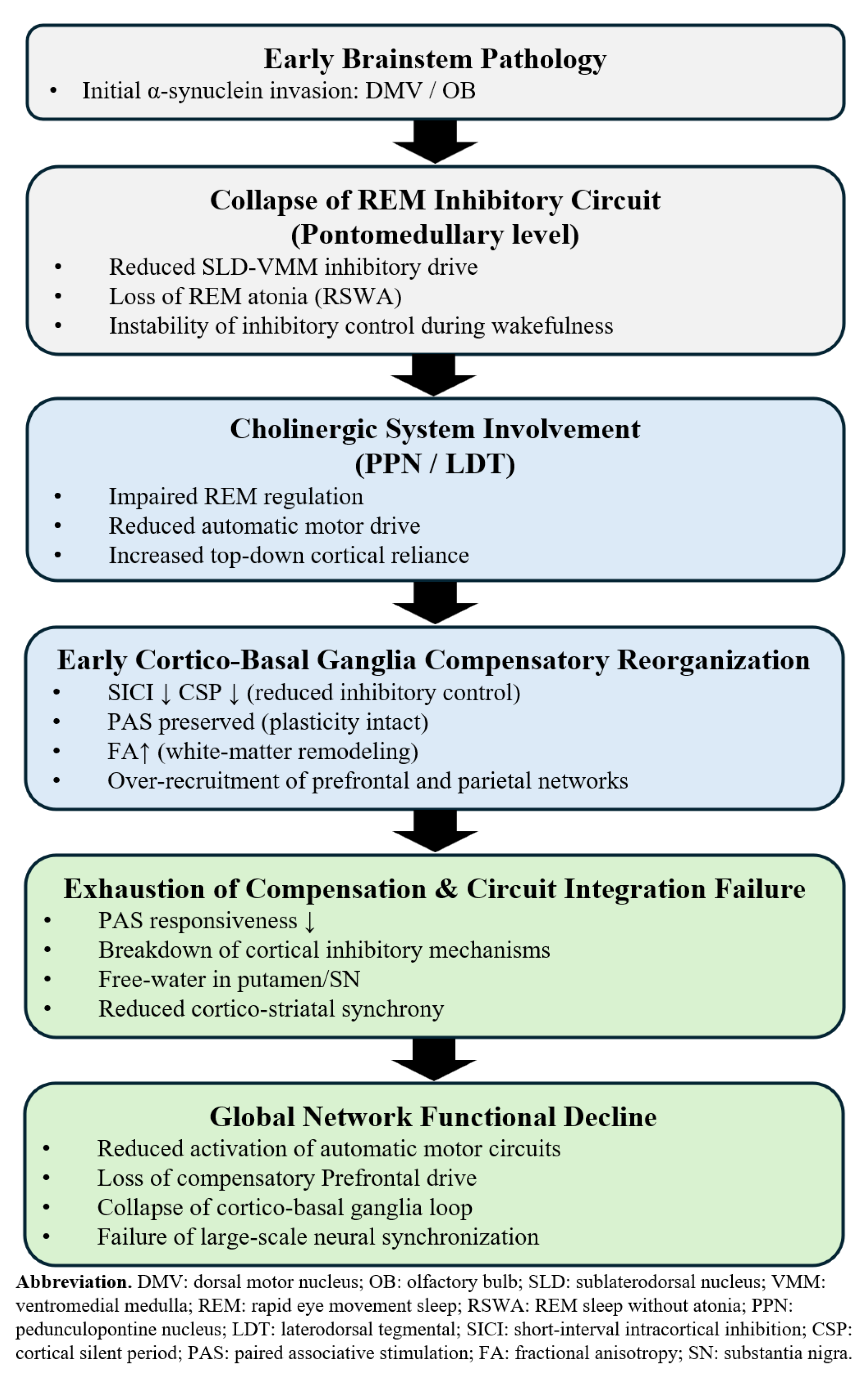
2.4. An Integrative Model of Dynamic Degeneration and Compensation

3. Behavioral and Motor Signatures of the RBD-PD Continuum
3.1. Upper-Limb Inhibitory Dysfunction: From Force Variability to Rigidity and Fine-Motor Bradykinesia
3.2. Lower-Limb Inhibitory Dysfunction
3.3. Gait and Locomotor Regulation
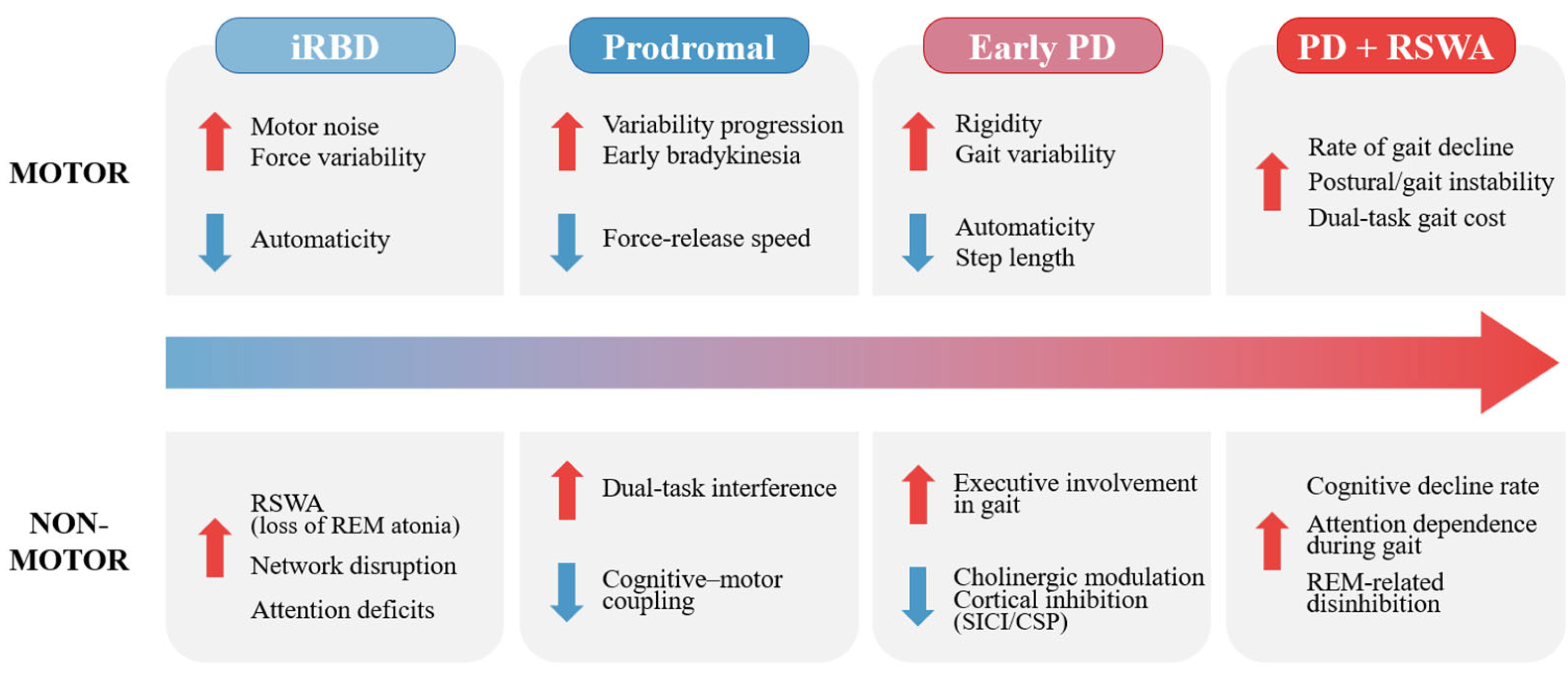
3.4. Integrated Physiological-Behavioral Continuum
4. Biomarkers and Neuroimaging Correlates of Inhibitory Network Breakdown
4.1. Electrophysiological Markers of Cortical Inhibition
4.2. Diffusion MRI: Microstructural Adaptation and Degeneration
4.3. Functional Imaging: Network Reorganization and Loss of Automaticity
4.4. Integrated Model of Compensatory Plasticity and Inhibitory Network Collapse
5. Rehabilitative and Translational Implications
5.1. From Neurodegeneration to Network Preservation
5.2. Rehabilitation Framework for the iRBD Stage
5.3. Decline of Automaticity and Sensory Recalibration
5.4. Upper-Limb Motor Control and Early Inhibitory Deficits
5.5. An Integrated Prehabilitation Framework
5.6. Digital Biomarkers and Precision Monitoring
5.7. Ethical and Clinical Considerations
6. Conclusions and Future Perspectives
6.1. Integrative Summary
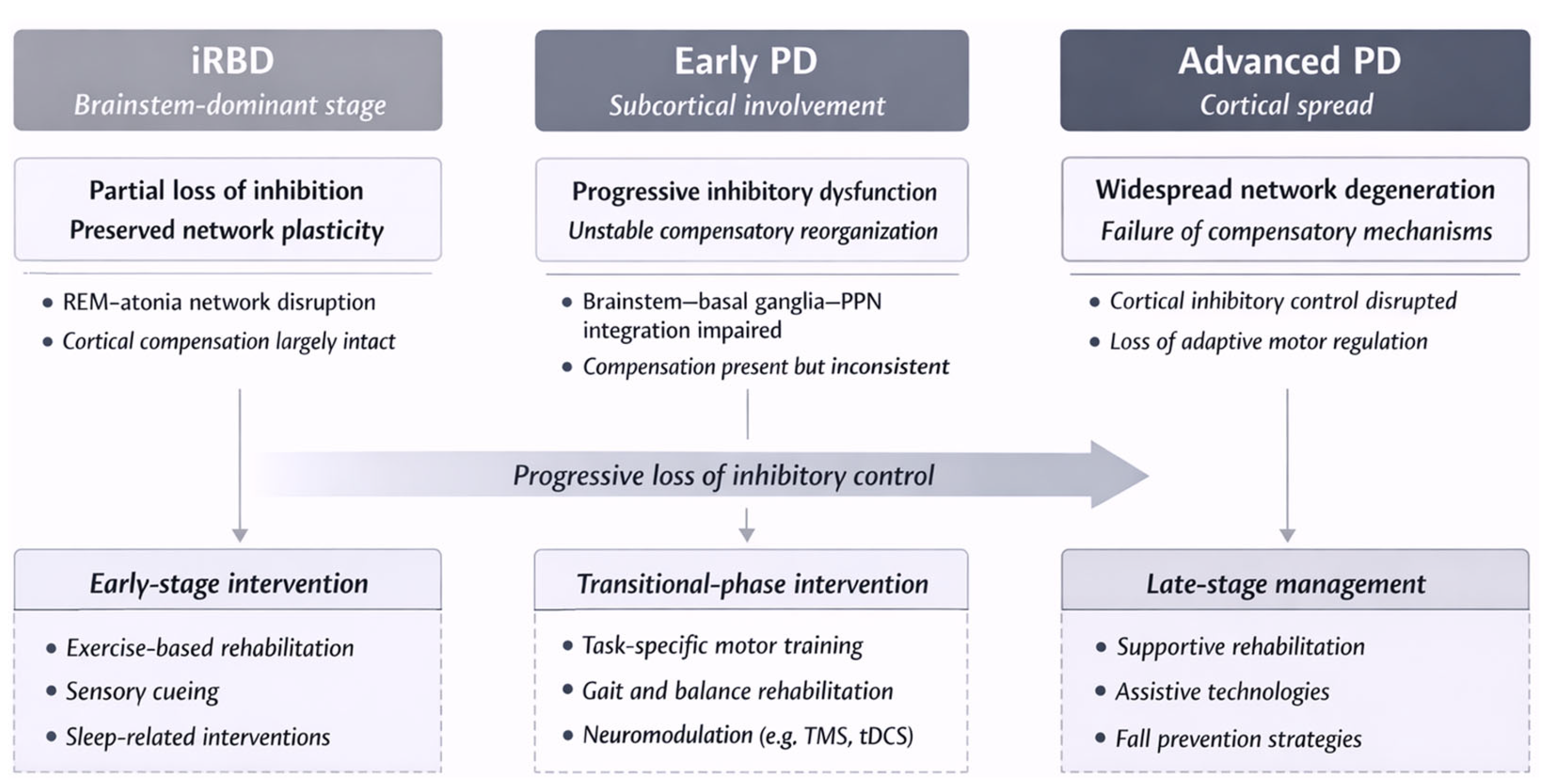
6.2. Conceptual Model of the RBD–PD Continuum
6.3. Translational and Rehabilitative Outlook
6.4. Future Directions
6.5. Closing Perspective
Author Contributions
Funding
Acknowledgments
Conflicts of Interest
Abbreviations
| BOLD | blood-oxygen-level–dependent |
| CSP | cortical silent period |
| DLB | dementia with Lewy bodies |
| dMRI | diffusion magnetic resonance imaging |
| EMG | electromyography |
| FA | fractional anisotropy |
| FEOBV | [18F] fluoroethoxybenzovesamicol |
| FoG | freezing of gait |
| fMRI | functional magnetic resonance imaging |
| GABA | gamma-aminobutyric acid |
| iRBD | idiopathic REM sleep behavior disorder |
| LDT | laterodorsal tegmental nucleus |
| LTD | long-term depression |
| LTP | long-term potentiation |
| MRI | magnetic resonance imaging |
| MSA | multiple system atrophy |
| NAPS | North American Prodromal Synucleinopathy |
| PAS | paired-associative stimulation |
| PD | Parkinson’s disease |
| PET | positron emission tomography |
| PIGD | postural instability/gait difficulty phenotype |
| PPN | pedunculopontine nucleus |
| PPMI | Parkinson’s Progression Markers Initiative |
| PSG | polysomnography |
| RBD | REM sleep behavior disorder |
| RD | radial diffusivity |
| REM | rapid eye movement |
| RSWA | REM sleep without atonia |
| SICI | short-interval intracortical inhibition |
| SLD | sublaterodorsal nucleus |
| TMS | transcranial magnetic stimulation |
| tACS | transcranial alternating current stimulation |
| VMM | ventromedial medulla |
References
- Braak, H.; Del Tredici, K.; Rüb, U.; de Vos, R.A.; Jansen Steur, E.N.; Braak, E. Staging of brain pathology related to sporadic Parkinson’s disease. Neurobiol. Aging 2003, 24, 197–211. [Google Scholar] [CrossRef]
- Postuma, R.B.; Iranzo, A.; Hu, M.; Högl, B.; Boeve, B.F.; Manni, R.; Oertel, W.H.; Arnulf, I.; Ferini-Strambi, L.; Puligheddu, M.; et al. Risk and predictors of dementia and parkinsonism in idiopathic REM sleep behaviour disorder: A multicentre study. Brain 2019, 142, 744–759. [Google Scholar] [CrossRef]
- Braak, H.; Bohl, J.R.; Müller, C.M.; Rüb, U.; de Vos, R.A.; Del Tredici, K. Stanley Fahn Lecture 2005: The staging procedure for the inclusion body pathology associated with sporadic Parkinson’s disease reconsidered. Mov. Disord. 2006, 21, 2042–2051. [Google Scholar] [CrossRef]
- McCann, H.; Stevens, C.H.; Cartwright, H.; Halliday, G.M. α-Synucleinopathy phenotypes. Park. Relat. Disord. 2014, 20, S62–S67. [Google Scholar] [CrossRef]
- Dickson, D.W.; Uchikado, H.; Fujishiro, H.; Tsuboi, Y. Evidence in favor of Braak staging of Parkinson’s disease. Mov. Disord. 2010, 25, S78–S82. [Google Scholar] [CrossRef] [PubMed]
- Jellinger, K.A. A critical evaluation of current staging of α-synuclein pathology in Lewy body disorders. Biochim. et Biophys. Acta (BBA)-Mol. Basis Dis. 2009, 1792, 730–740. [Google Scholar] [CrossRef]
- Alafuzoff, I.; Ince, P.G.; Arzberger, T.; Al-Sarraj, S.; Bell, J.; Bodi, I.; Bogdanovic, N.; Bugiani, O.; Ferrer, I.; Gelpi, E.; et al. Staging/typing of Lewy body related alpha-synuclein pathology: A study of the BrainNet Europe Consortium. Acta Neuropathol. 2009, 117, 635–652. [Google Scholar] [CrossRef]
- Iranzo, A.; Fernández-Arcos, A.; Tolosa, E.; Serradell, M.; Molinuevo, J.L.; Valldeoriola, F.; Gelpi, E.; Vilaseca, I.; Sánchez-Valle, R.; Lladó, A.; et al. Neurodegenerative disorder risk in idiopathic REM sleep behavior disorder: Study in 174 patients. PLoS ONE 2014, 9, e89741. [Google Scholar] [CrossRef] [PubMed]
- Elliott, J.E.; Lim, M.M.; Keil, A.T.; Postuma, R.B.; Pelletier, A.; Gagnon, J.F.; St Louis, E.K.; Forsberg, L.K.; Fields, J.A.; Huddleston, D.E.; et al. Baseline characteristics of the North American prodromal Synucleinopathy cohort. Ann. Clin. Transl. Neurol. 2023, 10, 520–535. [Google Scholar] [CrossRef] [PubMed]
- Grimaldi, S.; Guye, M.; Bianciardi, M.; Eusebio, A. Brain MRI Biomarkers in Isolated Rapid Eye Movement Sleep Behavior Disorder: Where Are We? A Systematic Review. Brain Sci. 2023, 13, 1398. [Google Scholar] [CrossRef]
- Haba-Rubio, J.; Frauscher, B.; Marques-Vidal, P.; Toriel, J.; Tobback, N.; Andries, D.; Preisig, M.; Vollenweider, P.; Postuma, R.; Heinzer, R. Prevalence and determinants of rapid eye movement sleep behavior disorder in the general population. Sleep 2017, 41, zsx197. [Google Scholar] [CrossRef] [PubMed]
- Romenets, S.R.; Gagnon, J.F.; Latreille, V.; Panniset, M.; Chouinard, S.; Montplaisir, J.; Postuma, R.B. Rapid eye movement sleep behavior disorder and subtypes of Parkinson’s disease. Mov. Disord. 2012, 27, 996–1003. [Google Scholar] [CrossRef]
- Berg, D.; Borghammer, P.; Fereshtehnejad, S.-M.; Heinzel, S.; Horsager, J.; Schaeffer, E.; Postuma, R.B. Prodromal Parkinson disease subtypes—Key to understanding heterogeneity. Nat. Rev. Neurol. 2021, 17, 349–361. [Google Scholar] [CrossRef] [PubMed]
- Galbiati, A.; Verga, L.; Giora, E.; Zucconi, M.; Ferini-Strambi, L. The risk of neurodegeneration in REM sleep behavior disorder: A systematic review and meta-analysis of longitudinal studies. Sleep. Med. Rev. 2019, 43, 37–46. [Google Scholar] [CrossRef]
- Iranzo, A.; Molinuevo, J.L.; Santamaría, J.; Serradell, M.; Martí, M.J.; Valldeoriola, F.; Tolosa, E. Rapid-eye-movement sleep behaviour disorder as an early marker for a neurodegenerative disorder: A descriptive study. Lancet Neurol. 2006, 5, 572–577. [Google Scholar] [CrossRef]
- Luppi, P.-H.; Malcey, J.; Chancel, A.; Duval, B.; Cabrera, S.; Fort, P. Neuronal network controlling REM sleep. J. Sleep Res. 2025, 34, e14266. [Google Scholar] [CrossRef]
- Vetrivelan, R.; Bandaru, S.S. Neural Control of REM Sleep and Motor Atonia: Current Perspectives. Curr. Neurol. Neurosci. Rep. 2023, 23, 907–923. [Google Scholar] [CrossRef]
- Boeve, B.F.; Silber, M.H.; Ferman, T.J. REM sleep behavior disorder in Parkinson’s disease and dementia with Lewy bodies. J. Geriatr. Psychiatry Neurol. 2004, 17, 146–157. [Google Scholar] [CrossRef]
- Karachi, C.; Grabli, D.; Bernard, F.A.; Tandé, D.; Wattiez, N.; Belaid, H.; Bardinet, E.; Prigent, A.; Nothacker, H.P.; Hunot, S.; et al. Cholinergic mesencephalic neurons are involved in gait and postural disorders in Parkinson disease. J. Clin. Investig. 2010, 120, 2745–2754. [Google Scholar] [CrossRef]
- Videnovic, A.; Marlin, C.; Alibiglou, L.; Planetta, P.J.; Vaillancourt, D.E.; Mackinnon, C.D. Increased REM sleep without atonia in Parkinson disease with freezing of gait. Neurology 2013, 81, 1030–1035. [Google Scholar] [CrossRef] [PubMed]
- Amundsen-Huffmaster, S.L.; Petrucci, M.N.; Linn-Evans, M.E.; Chung, J.W.; Howell, M.J.; Videnovic, A.; Tuite, P.J.; Cooper, S.E.; MacKinnon, C.D. REM Sleep Without Atonia and Gait Impairment in People with Mild-to-Moderate Parkinson’s Disease. J. Park. Dis. 2021, 11, 767–778. [Google Scholar] [CrossRef] [PubMed]
- Müller, M.L.; Bohnen, N.I. Cholinergic dysfunction in Parkinson’s disease. Curr. Neurol. Neurosci. Rep. 2013, 13, 377. [Google Scholar] [CrossRef]
- Duarte Folle, A.; Paul, K.C.; Bronstein, J.M.; Keener, A.M.; Ritz, B. Clinical progression in Parkinson’s disease with features of REM sleep behavior disorder: A population-based longitudinal study. Park. Relat. Disord. 2019, 62, 105–111. [Google Scholar] [CrossRef]
- Nutt, J.G.; Bloem, B.R.; Giladi, N.; Hallett, M.; Horak, F.B.; Nieuwboer, A. Freezing of gait: Moving forward on a mysterious clinical phenomenon. Lancet Neurol. 2011, 10, 734–744. [Google Scholar] [CrossRef]
- Schenck, C.H.; Mahowald, M.W. REM sleep behavior disorder: Clinical, developmental, and neuroscience perspectives 16 years after its formal identification in SLEEP. Sleep 2002, 25, 120–138. [Google Scholar] [CrossRef] [PubMed]
- Fraigne, J.J.; Torontali, Z.A.; Snow, M.B.; Peever, J.H. REM Sleep at its Core—Circuits, Neurotransmitters, and Pathophysiology. Front. Neurol. 2015, 6, 123. [Google Scholar] [CrossRef] [PubMed]
- Vetrivelan, R.; Fuller, P.M.; Tong, Q.; Lu, J. Medullary circuitry regulating rapid eye movement sleep and motor atonia. J. Neurosci. 2009, 29, 9361–9369. [Google Scholar] [CrossRef]
- Rizzo, V.; Siebner, H.S.; Morgante, F.; Mastroeni, C.; Girlanda, P.; Quartarone, A. Paired Associative Stimulation of Left and Right Human Motor Cortex Shapes Interhemispheric Motor Inhibition based on a Hebbian Mechanism. Cereb. Cortex 2008, 19, 907–915. [Google Scholar] [CrossRef]
- Ziemann, U. TMS induced plasticity in human cortex. Rev. Neurosci. 2004, 15, 253–266. [Google Scholar] [CrossRef]
- Di Lazzaro, V.; Rothwell, J.; Capogna, M. Noninvasive Stimulation of the Human Brain: Activation of Multiple Cortical Circuits. Neurosci. 2018, 24, 246–260. [Google Scholar] [CrossRef]
- Kojovic, M.; Kassavetis, P.; Bologna, M.; Pareés, I.; Rubio-Agusti, I.; Berardelli, A.; Edwards, M.J.; Rothwell, J.C.; Bhatia, K.P. Transcranial magnetic stimulation follow-up study in early Parkinson’s disease: A decline in compensation with disease progression? Mov. Disord. 2015, 30, 1098–1106. [Google Scholar] [CrossRef]
- Kojovic, M.; Bologna, M.; Kassavetis, P.; Murase, N.; Palomar, F.J.; Berardelli, A.; Rothwell, J.C.; Edwards, M.J.; Bhatia, K.P. Functional reorganization of sensorimotor cortex in early Parkinson disease. Neurology 2012, 78, 1441–1448. [Google Scholar] [CrossRef] [PubMed]
- Bologna, M.; Suppa, A.; Conte, A.; Latorre, A.; Rothwell, J.C.; Berardelli, A. Are studies of motor cortex plasticity relevant in human patients with Parkinson’s disease? Clin. Neurophysiol. 2016, 127, 50–59. [Google Scholar] [CrossRef] [PubMed]
- Bologna, M.; Guerra, A.; Paparella, G.; Giordo, L.; Alunni Fegatelli, D.; Vestri, A.R.; Rothwell, J.C.; Berardelli, A. Neurophysiological correlates of bradykinesia in Parkinson’s disease. Brain 2018, 141, 2432–2444. [Google Scholar] [CrossRef]
- Zhang, H.J.; Wang, S.H.; Bai, Y.Y.; Zhang, J.W.; Chen, S. Abnormal Striatal-Cortical Networks Contribute to the Attention/Executive Function Deficits in Idiopathic REM Sleep Behavior Disorder: A Resting State Functional MRI Study. Front. Aging Neurosci. 2021, 13, 690854. [Google Scholar] [CrossRef]
- Bohnen, N.I.; Frey, K.A.; Studenski, S.; Kotagal, V.; Koeppe, R.A.; Scott, P.J.; Albin, R.L.; Müller, M.L. Gait speed in Parkinson disease correlates with cholinergic degeneration. Neurology 2013, 81, 1611–1616. [Google Scholar] [CrossRef]
- Bohnen, N.I.; Hu, M.T.M. Sleep Disturbance as Potential Risk and Progression Factor for Parkinson’s Disease. J. Park. Dis. 2019, 9, 603–614. [Google Scholar] [CrossRef]
- Bohnen, N.I.; Müller, M.L.; Koeppe, R.A.; Studenski, S.A.; Kilbourn, M.A.; Frey, K.A.; Albin, R.L. History of falls in Parkinson disease is associated with reduced cholinergic activity. Neurology 2009, 73, 1670–1676. [Google Scholar] [CrossRef] [PubMed]
- Albin, R.L.; van der Zee, S.; van Laar, T.; Sarter, M.; Lustig, C.; Muller, M.; Bohnen, N.I. Cholinergic systems, attentional-motor integration, and cognitive control in Parkinson’s disease. Prog. Brain Res. 2022, 269, 345–371. [Google Scholar] [CrossRef]
- Craig, C.E.; Jenkinson, N.J.; Brittain, J.S.; Grothe, M.J.; Rochester, L.; Silverdale, M.; Alho, A.; Alho, E.J.L.; Holmes, P.S.; Ray, N.J. Pedunculopontine Nucleus Microstructure Predicts Postural and Gait Symptoms in Parkinson’s Disease. Mov. Disord. 2020, 35, 1199–1207. [Google Scholar] [CrossRef]
- McDade, E.M.; Boot, B.P.; Christianson, T.J.; Pankratz, V.S.; Boeve, B.F.; Ferman, T.J.; Bieniek, K.; Hollman, J.H.; Roberts, R.O.; Mielke, M.M.; et al. Subtle gait changes in patients with REM sleep behavior disorder. Mov. Disord. 2013, 28, 1847–1853. [Google Scholar] [CrossRef] [PubMed]
- Ehgoetz Martens, K.A.; Matar, E.; Hall, J.M.; Phillips, J.; Szeto, J.Y.Y.; Gouelle, A.; Grunstein, R.R.; Halliday, G.M.; Lewis, S.J.G. Subtle gait and balance impairments occur in idiopathic rapid eye movement sleep behavior disorder. Mov. Disord. 2019, 34, 1374–1380. [Google Scholar] [CrossRef]
- Simonet, C.; Pérez-Carbonell, L.; Galmés-Ordinas, M.A.; Huxford, B.F.R.; Chohan, H.; Gill, A.; Leschziner, G.; Lees, A.J.; Schrag, A.; Noyce, A.J. The Motor Dysfunction Seen in Isolated REM Sleep Behavior Disorder. Mov. Disord. 2024, 39, 1054–1059. [Google Scholar] [CrossRef]
- Bugalho, P.; Viana-Baptista, M. REM sleep behavior disorder and motor dysfunction in Parkinson’s disease—A longitudinal study. Park. Relat. Disord. 2013, 19, 1084–1087. [Google Scholar] [CrossRef]
- Maetzler, W.; Mirelman, A.; Pilotto, A.; Bhidayasiri, R. Identifying Subtle Motor Deficits Before Parkinson’s Disease is Diagnosed: What to Look for? J. Park. Dis. 2024, 14, S287–S296. [Google Scholar] [CrossRef]
- Elasfar, S.; Hameed, H.; Ehgoetz Martens, K. Motor features that distinguish isolated REM sleep behavior disorder patients from healthy controls: A systematic review. J. Park. Dis. 2025, 15, 1155–1193. [Google Scholar] [CrossRef]
- Kim, Y.E.; Jeon, B.S.; Yang, H.-J.; Ehm, G.; Yun, J.Y.; Kim, H.-J.; Kim, J.-M. REM sleep behavior disorder: Association with motor complications and impulse control disorders in Parkinson’s disease. Park. Relat. Disord. 2014, 20, 1081–1084. [Google Scholar] [CrossRef]
- Tobin, E.R.; Delmas, S.; Kim, J.J.; Hubbard, J.C.; Yacoubi, B.; Lou, X.; Presti, M.F.; Kraus, A.; Berry, R.B.; Jaffee, M.S.; et al. Force control deficits in rapid eye movement behavior disorder and Parkinson’s disease. Clin. Neurophysiol. 2025, 176, 2110763. [Google Scholar] [CrossRef] [PubMed]
- Louie, K.H.; Petrucci, M.N.; Grado, L.L.; Lu, C.; Tuite, P.J.; Lamperski, A.G.; MacKinnon, C.D.; Cooper, S.E.; Netoff, T.I. Semi-automated approaches to optimize deep brain stimulation parameters in Parkinson’s disease. J. Neuroeng. Rehabil. 2021, 18, 83. [Google Scholar] [CrossRef]
- Linn-Evans, M.E.; Petrucci, M.N.; Amundsen Huffmaster, S.L.; Chung, J.W.; Tuite, P.J.; Howell, M.J.; Videnovic, A.; MacKinnon, C.D. REM sleep without atonia is associated with increased rigidity in patients with mild to moderate Parkinson’s disease. Clin. Neurophysiol. 2020, 131, 2008–2016. [Google Scholar] [CrossRef] [PubMed]
- Guarín, D.L.; Acevedo, G.; Calonge, C.; Wong, J.K.; McFarland, N.R.; Ramirez-Zamora, A.; Vaillancourt, D.E. Video analysis reveals early signs of Bradykinesia in REM sleep behavior disorder and Parkinson’s disease. npj Park. Dis. 2025, 11, 222. [Google Scholar] [CrossRef]
- Chahine, L.M.; Kauta, S.R.; Daley, J.T.; Cantor, C.R.; Dahodwala, N. Surface EMG activity during REM sleep in Parkinson’s disease correlates with disease severity. Park. Relat. Disord. 2014, 20, 766–771. [Google Scholar] [CrossRef][Green Version]
- Amundsen-Huffmaster, S.L.; Chung, J.W.; Linn-Evans, M.E.; Petrucci, M.N.; Lu, C.; Weaver, D.J.; De Kam, J.; Cooper, S.E.; Tuite, P.J.; Videnovic, A.; et al. Accelerated Progression of Gait Impairment in Parkinson’s Disease and REM Sleep Without Atonia. Ann. Clin. Transl. Neurol. 2025, Early View. [Google Scholar] [CrossRef] [PubMed]
- Sarasso, E.; Gardoni, A.; Piramide, N.; Volontè, M.A.; Canu, E.; Tettamanti, A.; Filippi, M.; Agosta, F. Dual-task clinical and functional MRI correlates in Parkinson’s disease with postural instability and gait disorders. Park. Relat. Disord. 2021, 91, 88–95. [Google Scholar] [CrossRef]
- Dagay, A.; Katzav, S.; Elisha, N.; Volkov, J.; Tauman, R.; Giladi, N.; Hausdorff, J.M.; Mirelman, A.; Zitser, J. REM density in Parkinson’s disease: Association with motor, cognitive, autonomic function, and dopaminergic medication. npj Park. Dis. 2025, 11, 211. [Google Scholar] [CrossRef]
- Postuma, R.B.; Gagnon, J.F.; Vendette, M.; Fantini, M.L.; Massicotte-Marquez, J.; Montplaisir, J. Quantifying the risk of neurodegenerative disease in idiopathic REM sleep behavior disorder. Neurology 2009, 72, 1296–1300. [Google Scholar] [CrossRef]
- Mirelman, A.; Bernad-Elazari, H.; Thaler, A.; Giladi-Yacobi, E.; Gurevich, T.; Gana-Weisz, M.; Saunders-Pullman, R.; Raymond, D.; Doan, N.; Bressman, S.B.; et al. Arm swing as a potential new prodromal marker of Parkinson’s disease. Mov. Disord. 2016, 31, 1527–1534. [Google Scholar] [CrossRef] [PubMed]
- Patriat, R.; Pisharady, P.K.; Amundsen-Huffmaster, S.; Linn-Evans, M.; Howell, M.; Chung, J.W.; Petrucci, M.N.; Videnovic, A.; Holker, E.; De Kam, J.; et al. White matter microstructure in Parkinson’s disease with and without elevated rapid eye movement sleep muscle tone. Brain Commun. 2022, 4, fcac027. [Google Scholar] [CrossRef]
- Tobin, E.R.; Arpin, D.J.; Schauder, M.B.; Higgonbottham, M.L.; Chen, R.; Lou, X.; Berry, R.B.; Christou, E.A.; Jaffee, M.S.; Vaillancourt, D.E. Functional and free-water imaging in rapid eye movement behaviour disorder and Parkinson’s disease. Brain Commun. 2024, 6, fcae344. [Google Scholar] [CrossRef]
- Pasternak, O.; Sochen, N.; Gur, Y.; Intrator, N.; Assaf, Y. Free water elimination and mapping from diffusion MRI. Magn. Reson. Med. 2009, 62, 717–730. [Google Scholar] [CrossRef] [PubMed]
- Ofori, E.; Pasternak, O.; Planetta, P.J.; Li, H.; Burciu, R.G.; Snyder, A.F.; Lai, S.; Okun, M.S.; Vaillancourt, D.E. Longitudinal changes in free-water within the substantia nigra of Parkinson’s disease. Brain 2015, 138, 2322–2331. [Google Scholar] [CrossRef] [PubMed]
- Burciu, R.G.; Ofori, E.; Archer, D.B.; Wu, S.S.; Pasternak, O.; McFarland, N.R.; Okun, M.S.; Vaillancourt, D.E. Progression marker of Parkinson’s disease: A 4-year multi-site imaging study. Brain 2017, 140, 2183–2192. [Google Scholar] [CrossRef]
- Rolinski, M.; Griffanti, L.; Piccini, P.; Roussakis, A.A.; Szewczyk-Krolikowski, K.; Menke, R.A.; Quinnell, T.; Zaiwalla, Z.; Klein, J.C.; Mackay, C.E.; et al. Basal ganglia dysfunction in idiopathic REM sleep behaviour disorder parallels that in early Parkinson’s disease. Brain 2016, 139, 2224–2234. [Google Scholar] [CrossRef] [PubMed]
- Ellmore, T.M.; Castriotta, R.J.; Hendley, K.L.; Aalbers, B.M.; Furr-Stimming, E.; Hood, A.J.; Suescun, J.; Beurlot, M.R.; Hendley, R.T.; Schiess, M.C. Altered nigrostriatal and nigrocortical functional connectivity in rapid eye movement sleep behavior disorder. Sleep 2013, 36, 1885–1892. [Google Scholar] [CrossRef]
- Agosta, F.; Sarasso, E.; Filippi, M. Functional MRI in Atypical Parkinsonisms. Int. Rev. Neurobiol. 2018, 142, 149–173. [Google Scholar] [CrossRef]
- Summers, R.L.S.; Rafferty, M.R.; Howell, M.J.; MacKinnon, C.D. Motor Dysfunction in REM Sleep Behavior Disorder: A Rehabilitation Framework for Prodromal Synucleinopathy. Neurorehabilit. Neural Repair 2021, 35, 611–621. [Google Scholar] [CrossRef]
- Johansson, H.; Hagströmer, M.; Grooten, W.J.A.; Franzén, E. Exercise-Induced Neuroplasticity in Parkinson’s Disease: A Metasynthesis of the Literature. Neural Plast. 2020, 2020, 8961493. [Google Scholar] [CrossRef] [PubMed]
- Petzinger, G.M.; Fisher, B.E.; McEwen, S.; Beeler, J.A.; Walsh, J.P.; Jakowec, M.W. Exercise-enhanced neuroplasticity targeting motor and cognitive circuitry in Parkinson’s disease. Lancet Neurol. 2013, 12, 716–726. [Google Scholar] [CrossRef]
- Corcos, D.M.; Robichaud, J.A.; David, F.J.; Leurgans, S.E.; Vaillancourt, D.E.; Poon, C.; Rafferty, M.R.; Kohrt, W.M.; Comella, C.L. A two-year randomized controlled trial of progressive resistance exercise for Parkinson’s disease. Mov. Disord. 2013, 28, 1230–1240. [Google Scholar] [CrossRef]
- Patterson, C.G.; Joslin, E.; Gil, A.B.; Spigle, W.; Nemet, T.; Chahine, L.; Christiansen, C.L.; Melanson, E.; Kohrt, W.M.; Mancini, M.; et al. Study in Parkinson’s disease of exercise phase 3 (SPARX3): Study protocol for a randomized controlled trial. Trials 2022, 23, 855. [Google Scholar] [CrossRef]
- Freidle, M.; Johansson, H.; Ekman, U.; Lebedev, A.V.; Schalling, E.; Thompson, W.H.; Svenningsson, P.; Lövdén, M.; Abney, A.; Albrecht, F.; et al. Behavioural and neuroplastic effects of a double-blind randomised controlled balance exercise trial in people with Parkinson’s disease. npj Park. Dis. 2022, 8, 12. [Google Scholar] [CrossRef]
- Marino, G.; Campanelli, F.; Natale, G.; De Carluccio, M.; Servillo, F.; Ferrari, E.; Gardoni, F.; Caristo, M.E.; Picconi, B.; Cardinale, A.; et al. Intensive exercise ameliorates motor and cognitive symptoms in experimental Parkinson’s disease restoring striatal synaptic plasticity. Sci. Adv. 2023, 9, eadh1403. [Google Scholar] [CrossRef]
- Silva-Batista, C.; de Lima-Pardini, A.C.; Nucci, M.P.; Coelho, D.B.; Batista, A.; Piemonte, M.E.P.; Barbosa, E.R.; Teixeira, L.A.; Corcos, D.M.; Amaro, E., Jr.; et al. A Randomized, Controlled Trial of Exercise for Parkinsonian Individuals with Freezing of Gait. Mov. Disord. 2020, 35, 1607–1617. [Google Scholar] [CrossRef]
- Stefani, A.; Cesari, M. Digital health technologies and digital biomarkers in REM sleep behavior disorder: Need for order out of chaos. Sleep 2023, 46, zsad109. [Google Scholar] [CrossRef]
- Cesari, M.; Brink-Kjaer, A.; During, E.; Ganglberger, W.; Gnarra, O.; Huang, B.; Sommerauer, M.; Ratti, P.L.; Rechichi, I.; Wing, Y.K.; et al. Isolated REM Sleep Behaviour Disorder-Is Screening Possible? J. Sleep Res. 2025, 34, e70109. [Google Scholar] [CrossRef]
- Colman, K.; Schyvens, A.-M.; De Volder, I.; Verbraecken, J.; Pijpers, A.; Viaene, M.; Oertel, W.; Dijkstra, F.; Crosiers, D. Novel technologies for REM sleep behavior disorder detection for home screening in Parkinson’s disease and related alpha-synucleinopathies. npj Park. Dis. 2025, 11, 196. [Google Scholar] [CrossRef] [PubMed]
- Ma, L.; Liu, S.Y.; Cen, S.S.; Li, Y.; Zhang, H.; Han, C.; Gu, Z.Q.; Mao, W.; Ma, J.H.; Zhou, Y.T.; et al. Detection of Motor Dysfunction with Wearable Sensors in Patients With Idiopathic Rapid Eye Movement Disorder. Front. Bioeng. Biotechnol. 2021, 9, 627481. [Google Scholar] [CrossRef]
- Horsager, J.; Andersen, K.B.; Knudsen, K.; Skjærbæk, C.; Fedorova, T.D.; Okkels, N.; Schaeffer, E.; Bonkat, S.K.; Geday, J.; Otto, M.; et al. Brain-first versus body-first Parkinson’s disease: A multimodal imaging case-control study. Brain 2020, 143, 3077–3088. [Google Scholar] [CrossRef] [PubMed]
- Postuma, R.B.; Gagnon, J.F.; Vendette, M.; Charland, K.; Montplaisir, J. REM sleep behaviour disorder in Parkinson’s disease is associated with specific motor features. J. Neurol. Neurosurg. Psychiatry 2008, 79, 1117–1121. [Google Scholar] [CrossRef] [PubMed]
- Schenck, C.H.; Boeve, B.F.; Mahowald, M.W. Delayed emergence of a parkinsonian disorder or dementia in 81% of older men initially diagnosed with idiopathic rapid eye movement sleep behavior disorder: A 16-year update on a previously reported series. Sleep Med. 2013, 14, 744–748. [Google Scholar] [CrossRef]
- Joza, S.; Hu, M.T.; Jung, K.Y.; Kunz, D.; Stefani, A.; Dušek, P.; Terzaghi, M.; Arnaldi, D.; Videnovic, A.; Schiess, M.C.; et al. Progression of clinical markers in prodromal Parkinson’s disease and dementia with Lewy bodies: A multicentre study. Brain 2023, 146, 3258–3272. [Google Scholar] [CrossRef] [PubMed]



| Pathological Stage | iRBD (Brainstem-Dominant Stage) | Early PD (Subcortical Involvement) | Advanced PD (Cortical Spread) |
|---|---|---|---|
| Dominant neural structures |
|
|
|
| Key neural mechanisms |
|
|
|
| Supporting basic research evidence |
|
|
|
| Functional/clinical implications |
|
|
|
| Domain | iRBD (Prodromal Stage) | PD − RSWA (Mild/Intermediate) | PD + RSWA (Advanced/Non-Motor Dominant) |
|---|---|---|---|
| Behavioral/Motor |
|
|
|
| Neurophysiological |
|
|
|
| Sleep Physiology |
|
|
|
| Neuroimaging |
|
|
|
Disclaimer/Publisher’s Note: The statements, opinions and data contained in all publications are solely those of the individual author(s) and contributor(s) and not of MDPI and/or the editor(s). MDPI and/or the editor(s) disclaim responsibility for any injury to people or property resulting from any ideas, methods, instructions or products referred to in the content. |
© 2025 by the authors. Licensee MDPI, Basel, Switzerland. This article is an open access article distributed under the terms and conditions of the Creative Commons Attribution (CC BY) license.
Share and Cite
Chung, J.W.; Yook, D.; Lee, H.K. Motor–Behavioral Phenotypes in the RBD-PD Continuum: Neurophysiological Mechanisms and Rehabilitative Implications. Appl. Sci. 2026, 16, 237. https://doi.org/10.3390/app16010237
Chung JW, Yook D, Lee HK. Motor–Behavioral Phenotypes in the RBD-PD Continuum: Neurophysiological Mechanisms and Rehabilitative Implications. Applied Sciences. 2026; 16(1):237. https://doi.org/10.3390/app16010237
Chicago/Turabian StyleChung, Jae Woo, Dongwon Yook, and Hyo Keun Lee. 2026. "Motor–Behavioral Phenotypes in the RBD-PD Continuum: Neurophysiological Mechanisms and Rehabilitative Implications" Applied Sciences 16, no. 1: 237. https://doi.org/10.3390/app16010237
APA StyleChung, J. W., Yook, D., & Lee, H. K. (2026). Motor–Behavioral Phenotypes in the RBD-PD Continuum: Neurophysiological Mechanisms and Rehabilitative Implications. Applied Sciences, 16(1), 237. https://doi.org/10.3390/app16010237