Microbiological Purity of Autogenous Dental Augmentative Material After Processing with an Alkaline Ethanol Solution—In Vitro Study

 , , , ,
  ,
,  and
and 
Abstract
1. Introduction
The Purpose of the Study
2. Materials and Methods
2.1. Research Material
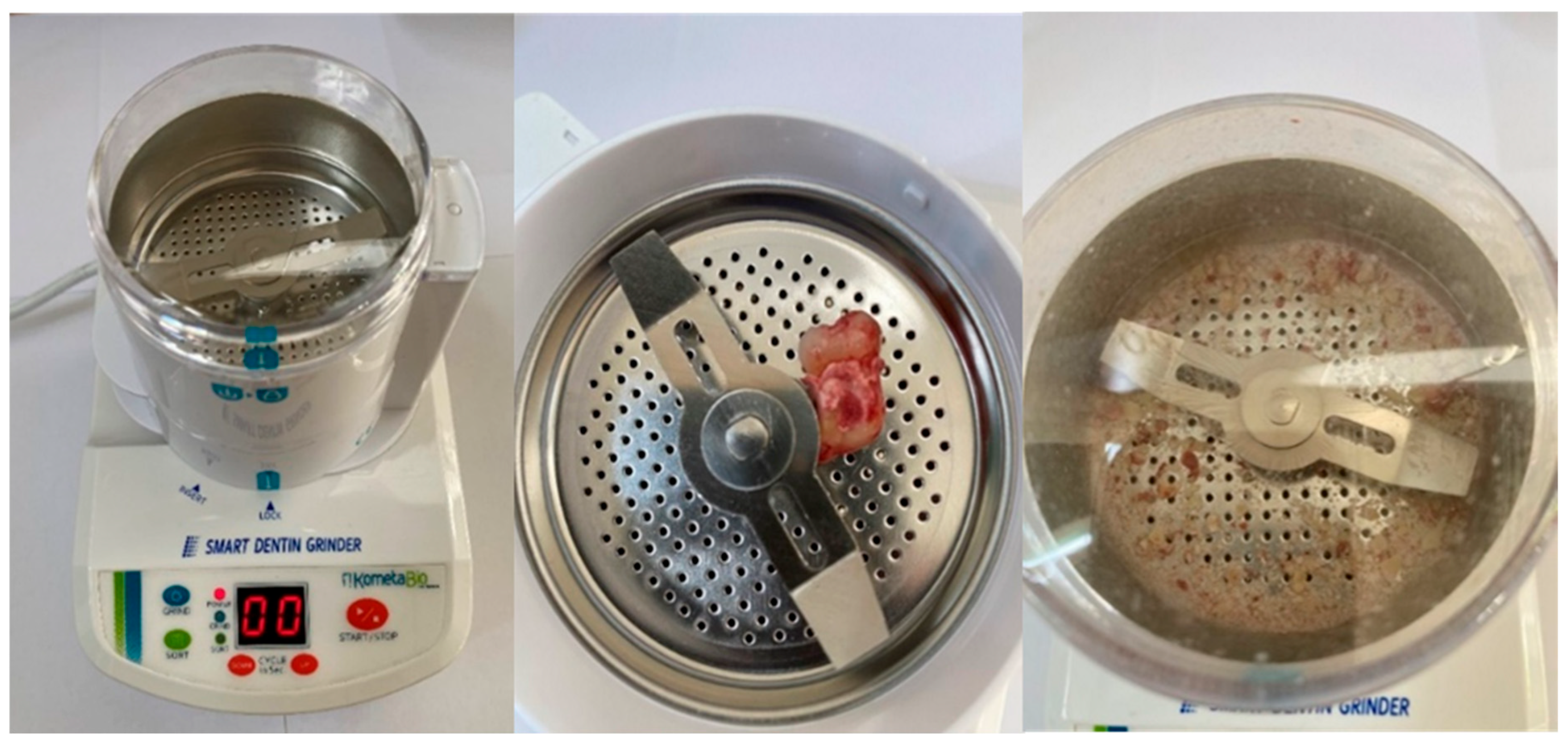
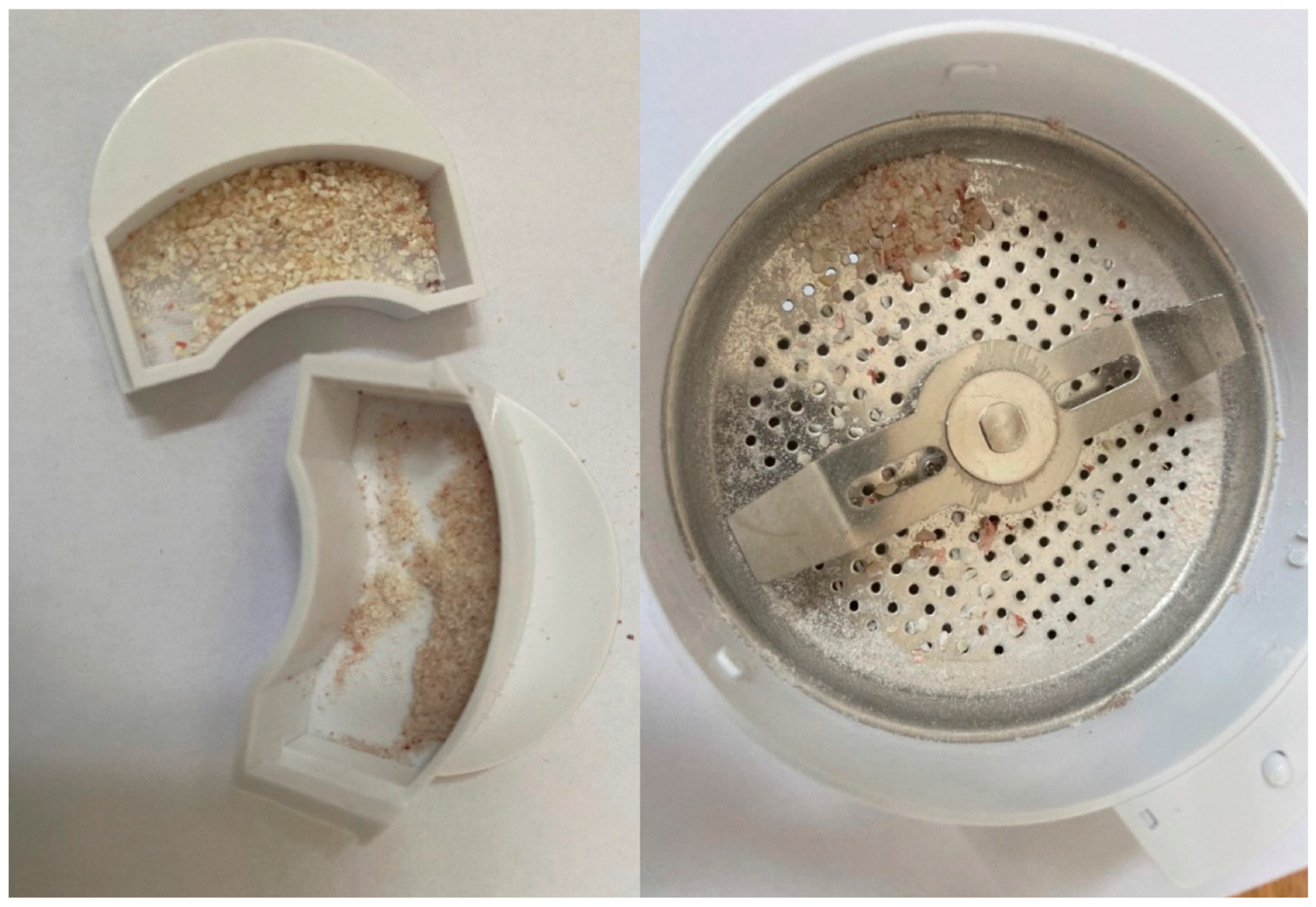
2.2. Preparation of the Research Material
2.3. Microbiological Evaluation
2.4. Statistical Analysis
3. Results
4. Discussion
5. Conclusions
Author Contributions
Funding
Institutional Review Board Statement
Informed Consent Statement
Data Availability Statement
Conflicts of Interest
References
- Akhter, R.; Hassan, N.M.M.; Aida, J.; Zaman, K.U.; Morita, M. Risk Indicators for Tooth Loss Due to Caries and Periodontal Disease in Recipients of Free Dental Treatment in an Adult Population in Bangladesh. Oral Health Prev. Dent. 2008, 6, 199–207. [Google Scholar] [PubMed]
- AlGhamdi, A.; Almarghlani, A.; Alyafi, R.; Ibraheem, W.; Assaggaf, M.; Howait, M.; Alsofi, L.; Banjar, A.; Al-Zahrani, M.; Kayal, R. Prevalence of Periodontitis in High School Children in Saudi Arabia: A National Study. Ann. Saudi Med. 2020, 40, 7–14. [Google Scholar] [CrossRef] [PubMed]
- Aljafar, A.; Alibrahim, H.; Alahmed, A.; AbuAli, A.; Nazir, M.; Alakel, A.; Almas, K. Reasons for Permanent Teeth Extractions and Related Factors among Adult Patients in the Eastern Province of Saudi Arabia. Sci. World J. 2021, 2021, 5534455. [Google Scholar] [CrossRef] [PubMed]
- Almarghlani, A. Prevalence, Predictors, and Reasons for Permanent Tooth Extraction Among High School Students in Saudi Arabia: A National Cross-Sectional Study. Cureus 2022, 14, e28687. [Google Scholar] [CrossRef]
- Broers, D.L.M.; Dubois, L.; de Lange, J.; Su, N.; de Jongh, A. Reasons for Tooth Removal in Adults: A Systematic Review. Int. Dent. J. 2022, 72, 52–57. [Google Scholar] [CrossRef]
- Fayaz, Y.; Ahmadi, N.A.; Ahmadi, S.U.; Atiq, M.A. Common Reasons for Permanent Tooth Extraction and Its Correlation with Demographical Factors in Kabul, Afghanistan. Clin. Cosmet. Investig. Dent. 2024, 16, 25–31. [Google Scholar] [CrossRef]
- Suzuki, S.; Sugihara, N.; Kamijo, H.; Morita, M.; Kawato, T.; Tsuneishi, M.; Kobayashi, K.; Hasuike, Y.; Sato, T. Reasons for Tooth Extractions in Japan: The Second Nationwide Survey. Int. Dent. J. 2022, 72, 366–372. [Google Scholar] [CrossRef]
- Zakrzewski, W.; Dobrzynski, M.; Wiglusz, R.J.; Rybak, Z.; Szymonowicz, M. Selected Nanomaterials’ Application Enhanced with the Use of Stem Cells in Acceleration of Alveolar Bone Regeneration during Augmentation Process. Nanomaterials 2020, 10, 1216. [Google Scholar] [CrossRef]
- Kim, E.-S. Autogenous Fresh Demineralized Tooth Graft Prepared at Chairside for Dental Implant. Maxillofac. Plast. Reconstr. Surg. 2015, 37, 8. [Google Scholar] [CrossRef]
- Kim, E.-S.; Lee, I.-K.; Kang, J.-Y.; Lee, E.-Y. Various Autogenous Fresh Demineralized Tooth Forms for Alveolar Socket Preservation in Anterior Tooth Extraction Sites: A Series of 4 Cases. Maxillofac. Plast. Reconstr. Surg. 2015, 37, 27. [Google Scholar] [CrossRef]
- Murata, M. Autogenous Demineralized Dentin Matrix for Maxillary Sinus Augmentation in Humans: The First Clinical Report. J. Dent. Res. 2003, 82, B243. [Google Scholar]
- Nordenram, Å.; Bang, G.; Bernhoft, C.-H. A Clinical-Radiographic Study of Allogenic Demineralized Dentin Implants in Cystic Jaw Cavities. Int. J. Oral Surg. 1975, 4, 61–64. [Google Scholar] [CrossRef] [PubMed]
- Yeomans, J.D.; Urist, M.R. Bone Induction by Decalcified Dentine Implanted into Oral, Osseous and Muscle Tissues. Arch. Oral Biol. 1967, 12, 999–IN16, IN13–IN14, 1007–1008, IN15–IN16. [Google Scholar] [CrossRef] [PubMed]
- Dłucik, R.; Orzechowska-Wylęgała, B.; Dłucik, D.; Puzzolo, D.; Santoro, G.; Micali, A.; Testagrossa, B.; Acri, G. Comparison of Clinical Efficacy of Three Different Dentin Matrix Biomaterials Obtained from Different Devices. Expert Rev. Med. Devices 2023, 20, 313–327. [Google Scholar] [CrossRef]
- Struzik, N.; Kensy, J.; Piszko, P.J.; Kiryk, J.; Wiśniewska, K.; Kiryk, S.; Korjat, L.; Horodniczy, T.; Sobierajska, P.; Matys, J.; et al. Contamination in Bone Substitute Materials: A Systematic Review. Appl. Sci. 2024, 14, 8266. [Google Scholar] [CrossRef]
- Kosior, P.; Kosior, I.; Dobrzyński, M. Immediate implantation with augmentation using material obtained from the patient’s own removed teeth—A case report. Implantol. Stomatol. 2017, 8, 78–81. [Google Scholar]
- Sun, H.; Yin, X.; Yang, C.; Kuang, H.; Luo, W. Advances in Autogenous Dentin Matrix Graft as a Promising Biomaterial for Guided Bone Regeneration in Maxillofacial Region: A Review. Medicine 2024, 103, e39422. [Google Scholar] [CrossRef]
- Um, I.W. Demineralized Dentin Matrix (DDM) As a Carrier for Recombinant Human Bone Morphogenetic Proteins (RhBMP-2). Adv. Exp. Med. Biol. 2018, 1077, 487–499. [Google Scholar] [CrossRef]
- Kim, Y.-K.; Yun, P.-Y.; Um, I.-W.; Lee, H.-J.; Yi, Y.-J.; Bae, J.-H.; Lee, J. Alveolar Ridge Preservation of an Extraction Socket Using Autogenous Tooth Bone Graft Material for Implant Site Development: Prospective Case Series. J. Adv. Prosthodont. 2014, 6, 521. [Google Scholar] [CrossRef]
- Elfana, A.; El-Kholy, S.; Saleh, H.A.; Fawzy El-Sayed, K. Alveolar Ridge Preservation Using Autogenous Whole-tooth versus Demineralized Dentin Grafts: A Randomized Controlled Clinical Trial. Clin. Oral Implant. Res. 2021, 32, 539–548. [Google Scholar] [CrossRef]
- Alrmali, A.; Saleh, M.H.A.; Mazzocco, J.; Zimmer, J.M.; Testori, T.; Wang, H. Auto-dentin Platelet-rich Fibrin Matrix Is an Alternative Biomaterial for Different Augmentation Procedures: A Retrospective Case Series Report. Clin. Exp. Dent. Res. 2023, 9, 993–1004. [Google Scholar] [CrossRef] [PubMed]
- Pogorzelska, A.; Adamiec, M.; Kotarski, J. Autogenous Augmentation of the Maxillary Alveolar Process Using Odontogenic Material—A Case Report. Nowa Stomatol. 2025, 1, 36–40. [Google Scholar]
- Minetti, E.; Taschieri, S.; Corbella, S. Autologous Deciduous Tooth-Derived Material for Alveolar Ridge Preservation: A Clinical and Histological Case Report. Case. Rep. Dent. 2020, 2020, 2936878. [Google Scholar] [CrossRef] [PubMed]
- Mahardawi, B.; Jiaranuchart, S.; Phrueksotsai, C.; Panya, S.; Arunjaroensuk, S.; Pimkhaokham, A. Using Autogenous Tooth Graft for Alveolar Ridge Preservation: A Systematic Review and Meta-Analysis. J. Prosthet. Dent. 2025, in press. [Google Scholar] [CrossRef]
- Bębenek, K.; Kiryk, J.; Kosior, P.; Szczygielski, T.; Mikulewicz, M.; Dobrzyński, M. The Use of Autogenous Augmentation Material Obtained from the Patient’s Own Teeth. Inżynier. Fiz. Med. 2018, 7, 289–292. [Google Scholar]
- Calvo-Guirado, J.L.; Garcés-Villalá, M.A.; Mahesh, L.; De Carlos-Villafranca, F.A. Effectiveness of Chemical Disinfection in Discarding Pathogenic Bacteria of Human Particulate Tooth Graft. Indian J. Dent. Sci. 2021, 13, 277–282. [Google Scholar] [CrossRef]
- Kommerein, N.; Weigel, A.J.; Stiesch, M.; Doll, K. Plant-Based Oral Care Product Exhibits Antibacterial Effects on Different Stages of Oral Multispecies Biofilm Development in Vitro. BMC Oral Health 2021, 21, 170. [Google Scholar] [CrossRef]
- Karacic, J.; Ruf, M.; Herzog, J.; Astasov-Frauenhoffer, M.; Sahrmann, P. Effect of Dentifrice Ingredients on Volume and Vitality of a Simulated Periodontal Multispecies Biofilm. Dent. J. 2024, 12, 141. [Google Scholar] [CrossRef]
- Bruzda-Zwiech, A. Stomatologia Wieku Rozwojowego; Szpringer-Nodzak, M., Wochna-Sobańska, M., Eds.; PZWL: Warsaw, Poland, 2003. [Google Scholar]
- Cameron, A.C.; Widmer, R.P. Stomatologia Dziecięca; Edra Urban & Partner: Wrocław, Poland, 2012. [Google Scholar]
- Dobrzyński, M.; Bazan, J.; Rosińczuk-Tonderys, J.; Pałka, Ł.; Parulska, O.; Całkosiński, I. Odontogenesis as a Research Model in Experimental Toxicology. Życie Weter. 2014, 89, 58–60. [Google Scholar]
- Herman, P.; Uracz, W.; Kopański, Z.; Brukwicka, I. Selected Aspects of Temporary and Permanent Teeth Physiology—The Role of Nutrients. J. Clin. Healthc. 2016, 4, 22–24. [Google Scholar]
- Hovorakova, M.; Lesot, H.; Peterka, M.; Peterkova, R. The Developmental Relationship between the Deciduous Dentition and the Oral Vestibule in Human Embryos. Anat. Embryol. 2005, 209, 303–313. [Google Scholar] [CrossRef] [PubMed]
- Hovorakova, M.; Lesot, H.; Peterka, M.; Peterkova, R. Early Development of the Human Dentition Revisited. J. Anat. 2018, 233, 135–145. [Google Scholar] [CrossRef] [PubMed]
- Hovorakova, M.; Lesot, H.; Vonesch, J.; Peterka, M.; Peterkova, R. Early Development of the Lower Deciduous Dentition and Oral Vestibule in Human Embryos. Eur. J. Oral Sci. 2007, 115, 280–287. [Google Scholar] [CrossRef] [PubMed]
- Kaushal, A.; Kamboj, M. Odontogenesis: A Highly Complex Cell-Cell Interaction Process. In Proceedings of the BEBI’09, 2nd WSEAS International Conference on Biomedical Electronics and Biomedical Informatic, Moscow, Russia, 20–22 August 2009; pp. 143–147. [Google Scholar]
- Chestnutt, I.G.; Binnie, V.I.; Taylor, M.M. Reasons for Tooth Extraction in Scotland. J. Dent. 2000, 28, 295–297. [Google Scholar] [CrossRef] [PubMed]
- Lesolang, R.R.; Motloba, D.P.; Lalloo, R. Patterns and Reasons for Tooth Extraction at the Winterveldt Clinic: 1998–2002. South Afr. Dent. J. 2009, 64, 214–218. [Google Scholar]
- McCaul, L.K.; Jenkins, W.M.M.; Kay, E.J. The Reasons for the Extraction of Various Tooth Types in Scotland: A 15-Year Follow Up. J. Dent. 2001, 29, 401–407. [Google Scholar] [CrossRef] [PubMed]
- Alsaegh, M.A.; Abushweme, D.A.; Ahmed, K.O.; Ahmed, S.O. The Pattern of Mandibular Third Molar Impaction and Its Relationship with the Development of Distal Caries in Adjacent Second Molars among Emiratis: A Retrospective Study. BMC Oral Health 2022, 22, 306. [Google Scholar] [CrossRef]
- Anwar, N.; Khan, A.R.; Narayan, K.A.; Ab Manan, A.H. A Six-Year Review of the Third Molar Cases Treated in the Dental Department of Penang Hospital in Malaysia. Dent. Res. J. 2008, 5, 53–60. [Google Scholar]
- Dominiak, M.; Gedrange, T.; Rahnama, M. Podstawy Chirurgii Stomatologicznej; Dominiak, M., Gedrange, T., Rahnama, M., Eds.; Edra Urban & Partner: Wrocław, Poland, 2022. [Google Scholar]
- Eshghpour, M.; Nezadi, A.; Moradi, A.; Shamsabadi, R.M.; Rezaei, N.; Nejat, A. Pattern of Mandibular Third Molar Impaction: A Cross-Sectional Study in Northeast of Iran. Niger. J. Clin. Pract. 2014, 17, 673. [Google Scholar] [CrossRef]
- Kumar, V.R.; Yadav, P.; Kahsu, E.; Girkar, F.; Chakraborty, R. Prevalence and Pattern of Mandibular Third Molar Impaction in Eritrean Population: A Retrospective Study. J. Contemp. Dent. Pract. 2017, 18, 100–106. [Google Scholar] [CrossRef]
- Padhye, M.N.; Dabir, A.V.; Girotra, C.S.; Pandhi, V.H. Pattern of Mandibular Third Molar Impaction in the Indian Population: A Retrospective Clinico-Radiographic Survey. Oral Surg. Oral Med. Oral Pathol. Oral Radiol. 2013, 116, e161–e166. [Google Scholar] [CrossRef] [PubMed]
- Zaman, M.U.; Almutairi, N.S.; Abdulrahman Alnashwan, M.; Albogami, S.M.; Alkhammash, N.M.; Alam, M.K. Pattern of Mandibular Third Molar Impaction in Nonsyndromic 17760 Patients: A Retrospective Study among Saudi Population in Central Region, Saudi Arabia. Biomed. Res. Int. 2021, 2021, 1880750. [Google Scholar] [CrossRef] [PubMed]
- Jaworski, A.; Dudek, K.; Jurczak, I. Structure and Functional Capacity of the Bacterial Human Gastrointestinal Microbiota in Healthy State and Variety of Disease States. J. Health Study Med. 2016, 4, 37–61. [Google Scholar]
- Krakowiak, O.; Nowak, R. Human Digestive Tract Microflora—Significance, Development, Modification. Postępy Fitoter. 2015, 3, 193–200. [Google Scholar]
- Swora-Cwynar, E.; Miżdal, A.; Pompecka, A.; Karczewski, J.; Dobrowolska-Zachwieja, A. Funkcje i Znaczenie Mikrobioty Jelitowej. In Fizjologia Żywienia; Krauss, H., Ed.; PZWL Wydawnictwo Lekarskie: Warsaw, Poland, 2019. [Google Scholar]
- Li, J.; Quinque, D.; Horz, H.-P.; Li, M.; Rzhetskaya, M.; Raff, J.A.; Hayes, M.G.; Stoneking, M. Comparative Analysis of the Human Saliva Microbiome from Different Climate Zones: Alaska, Germany, and Africa. BMC Microbiol. 2014, 14, 316. [Google Scholar] [CrossRef] [PubMed]
- Nasidze, I.; Li, J.; Quinque, D.; Tang, K.; Stoneking, M. Global Diversity in the Human Salivary Microbiome. Genome Res. 2009, 19, 636–643. [Google Scholar] [CrossRef]
- Sarkar, A.; Stoneking, M.; Nandineni, M.R. Unraveling the Human Salivary Microbiome Diversity in Indian Populations. PLoS ONE 2017, 12, e0184515. [Google Scholar] [CrossRef]
- Takayasu, L.; Suda, W.; Takanashi, K.; Iioka, E.; Kurokawa, R.; Shindo, C.; Hattori, Y.; Yamashita, N.; Nishijima, S.; Oshima, K.; et al. Circadian Oscillations of Microbial and Functional Composition in the Human Salivary Microbiome. DNA Res. 2017, 24, 261–270. [Google Scholar] [CrossRef]
- Minetti, E.; Dipalma, G.; Palermo, A.; Inchingolo, A.D.; Viapiano, F.; Inchingolo, A.M.; Inchingolo, F. The Most Suitable System to Grind the Whole Tooth to Use It as Graft Material. Explor. Med. 2024, 5, 1–16. [Google Scholar] [CrossRef]
- Obulareddy, V.T.; Porwal, A.; Noor, T.; Catalano, F.; Minervini, G.; D’Amico, C.; Mancini, M.; Gorassini, F.; Fiorillo, L.; Cervino, G. Tooth as a Bone Graft Material: A Narrative Review. Eur. J. Gen. Dent. 2023, 12, 072–081. [Google Scholar] [CrossRef]
- Nisyrios, T.; Karygianni, L.; Fretwurst, T.; Nelson, K.; Hellwig, E.; Schmelzeisen, R.; Al-Ahmad, A. High Potential of Bacterial Adhesion on Block Bone Graft Materials. Materials 2020, 13, 2102. [Google Scholar] [CrossRef] [PubMed]
- Janjua, O.S.; Qureshi, S.M.; Shaikh, M.S.; Alnazzawi, A.; Rodriguez-Lozano, F.J.; Pecci-Lloret, M.P.; Zafar, M.S. Autogenous Tooth Bone Grafts for Repair and Regeneration of Maxillofacial Defects: A Narrative Review. Int. J. Environ. Res. Public. Health 2022, 19, 3690. [Google Scholar] [CrossRef] [PubMed]
- Całkosiński, I.; Dobrzyński, M.; Całkosińska, M.; Seweryn, E.; Bronowicka-Szydełko, A.; Dzierzba, K.; Ceremuga, I.; Gamian, A. Characterization of an Inflammatory Response. Postep. Hig. Med. Dosw. 2009, 63, 395–408. [Google Scholar]
- Singh, S.; Sarma, D.K.; Verma, V.; Nagpal, R.; Kumar, M. From Cells to Environment: Exploring the Interplay between Factors Shaping Bone Health and Disease. Medicina 2023, 59, 1546. [Google Scholar] [CrossRef]
- Munakata, M.; Kataoka, Y.; Yamaguchi, K.; Sanda, M. Risk Factors for Early Implant Failure and Selection of Bone Grafting Materials for Various Bone Augmentation Procedures: A Narrative Review. Bioengineering 2024, 11, 192. [Google Scholar] [CrossRef]
- Kaddas, C.; Papamanoli, E.; Bobetsis, Y.A. Etiology and Treatment of Peri-Implant Soft Tissue Dehiscences: A Narrative Review. Dent. J. 2022, 10, 86. [Google Scholar] [CrossRef]
- He, S.; Hu, R.; Yao, X.; Cui, J.; Liu, H.; Zhu, M.; Ning, L. The Effects of Heat and Hydrogen Peroxide Treatment on the Osteoinductivity of Demineralized Cortical Bone: A Potential Method for Preparing Tendon/Ligament Repair Scaffolds. Regen. Biomater. 2024, 11, rbae116. [Google Scholar] [CrossRef]
- Bono, N.; Tarsini, P.; Candiani, G. BMP-2 and Type I Collagen Preservation in Human Deciduous Teeth after Demineralization. J. Appl. Biomater. Funct. Mater. 2018, 17. [Google Scholar] [CrossRef]
- Murata, M.; Akazawa, T.; Mitsugi, M.; Um, I.-W.; Kim, K.-W.; Kim, Y.-K. Human Dentin as Novel Biomaterial for Bone Regeneration. In Biomaterials—Physics and Chemistry; InTech: Rijeka, Croatia, 2011. [Google Scholar]
- Olchowy, A.; Olchowy, C.; Zawiślak, I.; Matys, J.; Dobrzyński, M. Revolutionizing Bone Regeneration with Grinder-Based Dentin Biomaterial: A Systematic Review. Int. J. Mol. Sci. 2024, 25, 9583. [Google Scholar] [CrossRef]
- Grawish, M.E.; Grawish, L.M.; Grawish, H.M.; Grawish, M.M.; Holiel, A.A.; Sultan, N.; El-Negoly, S.A. Demineralized Dentin Matrix for Dental and Alveolar Bone Tissues Regeneration: An Innovative Scope Review. Tissue Eng. Regen. Med. 2022, 19, 687–701. [Google Scholar] [CrossRef]
- Gual-Vaques, P.; Polis-Yanes, C.; Estrugo-Devesa, A.; Ayuso-Montero, R.; Mari-Roig, A.; Lopez-Lopez, J. Autogenous Teeth Used for Bone Grafting: A Systematic Review. Med. Oral Patol. Oral Cir. Bucal. 2017, 23, e112. [Google Scholar] [CrossRef] [PubMed]
- Khanijou, M.; Zhang, R.; Boonsiriseth, K.; Srisatjaluk, R.L.; SuphanguL, S.; Pairuchvej, V.; Wongsirichat, N.; Seriwatanachai, D. Physicochemical and Osteogenic Properties of Chairside Processed Tooth Derived Bone Substitute and Bone Graft Materials. Dent. Mater. J. 2021, 40, 173–183. [Google Scholar] [CrossRef] [PubMed]
- Kubaszek, B.; Morawiec, T.; Mertas, A.; Wachol, K.; Nowak-Wachol, A.; Śmieszek-Wilczewska, J.; Łopaciński, M.; Cholewka, A. Radiological and Microbiological Evaluation of the Efficacy of Alveolar Bone Repair Using Autogenous Dentin Matrix—Preliminary Study. Coatings 2022, 12, 909. [Google Scholar] [CrossRef]
- Rath, S.; Bal, S.C.B.; Dubey, D. Oral Biofilm: Development Mechanism, Multidrug Resistance, and Their Effective Management with Novel Techniques. Rambam Maimonides Med. J. 2021, 12, e0004. [Google Scholar] [CrossRef]
- Thomas, J.G.; Nakaishi, L.A. Managing the Complexity of a Dynamic Biofilm. J. Am. Dent. Assoc. 2006, 137, S10–S15. [Google Scholar] [CrossRef]
- Saleem, H.G.M.; Seers, C.A.; Sabri, A.N.; Reynolds, E.C. Dental Plaque Bacteria with Reduced Susceptibility to Chlorhexidine Are Multidrug Resistant. BMC Microbiol. 2016, 16, 214. [Google Scholar] [CrossRef]
- Wang, Z.; Shen, Y.; Haapasalo, M. Dynamics of Dissolution, Killing, and Inhibition of Dental Plaque Biofilm. Front Microbiol. 2020, 11, 964. [Google Scholar] [CrossRef]
- Wojtowicz, A.; Wychowański, P.; Osiak, M.; Kresa, I. Microbiological Analysis of Dental Tissues in Grinding, Processing and GBR Autotransplantation Procedures; Dental Tribune International: Leipzig, Germany, 2018. [Google Scholar]
- Dobrzynski, M.; Pajaczkowska, M.; Nowicka, J.; Jaworski, A.; Kosior, P.; Szymonowicz, M.; Kuropka, P.; Rybak, Z.; Bogucki, Z.A.; Filipiak, J.; et al. Study of Surface Structure Changes for Selected Ceramics Used in the CAD/CAM System on the Degree of Microbial Colonization, In Vitro Tests. Biomed. Res. Int. 2019, 2019, 9130806. [Google Scholar] [CrossRef]
- Mahajan, S.; Kaur, R.K.; Grover, V.; Mehta, M.; Prashar, S.; Jain, A. Efficacy of Different Sterilization Protocols and Its Impact on Osteogenic Potential of Autogenous Tooth Bone Graft: A Comparative in Vitro Study. J. Indian Soc. Periodontol. 2024, 28, 673–679. [Google Scholar] [CrossRef]
- Pelozo, L.; Silva-Neto, R.; de Oliveira, L.; Salvador, S.; Corona, S.; Souza-Gabriel, A. Comparison of the Methods of Disinfection/Sterilization of Extracted Human Roots for Research Purposes. Dent. Med. Probl. 2022, 59, 381–387. [Google Scholar] [CrossRef]
- Minetti, E.; Taschieri, S.; Corbella, S. A Histologic Study on the Use of Tooth as a Graft Material in Oral Surgery: Analysis of 187 Samples. Materials 2025, 18, 2518. [Google Scholar] [CrossRef]
- Inchingolo, A.M.; Patano, A.; Di Pede, C.; Inchingolo, A.D.; Palmieri, G.; de Ruvo, E.; Campanelli, M.; Buongiorno, S.; Carpentiere, V.; Piras, F.; et al. Autologous Tooth Graft: Innovative Biomaterial for Bone Regeneration. Tooth Transformer® and the Role of Microbiota in Regenerative Dentistry. A Systematic Review. J. Funct. Biomater. 2023, 14, 132. [Google Scholar] [CrossRef]
- Sah, A.; Shridhar, D.B. Clinical Application of Autogenous Tooth as Bone Graft Material in Extraction Socket- A Prospective Study. Clin. Epidemiol. Glob. Health 2022, 16, 101063. [Google Scholar] [CrossRef]



| No. of Sample | Sample Type | Microbiological Analysis | ||
|---|---|---|---|---|
| 1 | * control | 1A: Gram+ cocci | ||
| ** research | 1B: Gram+ cocci | |||
| 2 | control | 2A1: Gram+ cocci | 2A2: Gram+ cocci | 2A3: Gram+ rods |
| research | 2B1: Gram+ cocci | 2B2: Gram+ cocci | - | |
| 3 | control | 3A1: Gram+ cocci, stringing together | 3A2: Gram+ cocci | |
| research | - | 3B2: Gram+ cocci | ||
| 4 | control | 4A1: Gram+ cocci | ||
| research | - | |||
| 5 | control | 5A1: Gram+ cocci | ||
| research | 5B1: Gram+ cocci | |||
| 6 | control | 6A1: Gram+ cocci | ||
| research | - | |||
| 7 | control | 7A1: Gram+ cocci | 7A2: Gram+ rods | 7A3: Gram+ cocci forming clusters |
| research | - | 7B2: Gram+ rods | - | |
| 8 | control | 8A1: Gram+ cocci, stringing together | 8A2: Gram+ cocci, forming clusters | |
| research | - | 8B2: Gram+ cocci, forming clusters | ||
| 9 | control | 9A1: Gram+ cocci, forming clusters | ||
| research | - | |||
| 10 | control | 10A1: Gram- rods | ||
| research | 10B1: Gram- rods | |||
| 11 | control | 11A1: Gram+ rods | 11A2: Gram+ cocci, forming clusters | |
| research | - | 11B2: Gram+ cocci, forming clusters | ||
| 12 | control | 12A1: Gram+ cocci, forming clusters | 12A2: Gram+ cocci | |
| research | 12B1: Gram+ cocci, forming clusters | - | ||
| 13 | control | 13A1: Gram+ cocci, stringing together | ||
| research | - | |||
| 14 | control | 14A1: Gram+ cocci | ||
| research | 14B1: Gram+ cocci | |||
| 15 | control | 15A1: Gram+ cocci | 15A2: Gram+ cocci, stringing together | |
| research | 15B1: Gram+ cocci | 15B2: Gram+ cocci, stringing together | ||
| 16 | control | 16A1: Gram+ cocci | 16A2: Gram+ rods | 16A3: Gram+ cocci forming clusters |
| research | 16B1: Gram+ cocci | - | 16B3: Gram+ cocci forming clusters | |
| 17 | control | 17A1: Gram+ rods | 17A2: Gram+ cocci | |
| research | - | - | ||
| 18 | control | 18A1: Gram+ cocci | ||
| research | - | |||
| 19 | control | 19A1: Gram- rods | 19A2: Gram+ cocci | |
| research | - | 19B2: Gram+ cocci | ||
| 20 | control | 20A1: yeast | 20A2: Gram+ rods | |
| research | - | - | ||
| 21 | control | 21A1: Gram+ cocci | 21A2: Gram+ cocci | |
| research | 21B1: Gram+ cocci | - | ||
| 22 | control | 22A1: Gram+ cocci, stringing together | ||
| research | - | |||
| No. of Sample | Sample Type | Microbiological Analysis | ||
|---|---|---|---|---|
| 1 | * control | 23A1: Gram+ cocci | 23A2: Gram+ cocci | |
| ** research | - | - | ||
| 2 | control | 24A1: Gram+ cocci | ||
| research | - | |||
| 3 | control | 25A: Gram+ cocci stringing together | ||
| research | - | |||
| 4 | control | 26A1: Gram+ cocci, stringing together | ||
| research | - | |||
| 5 | control | - | ||
| research | - | |||
| 6 | control | 28A1: Gram+ cocci | ||
| research | - | |||
| 7 | control | 29A1: Gram+ cocci, stringing together | ||
| research | - | |||
| 8 | control | 30A1: Gram+ cocci | ||
| research | - | |||
| 9 | control | 31A1: Gram+ cocci | ||
| research | - | |||
| 10 | control | 32A1: Gram+ cocci | ||
| research | - | |||
| 11 | control | - | ||
| research | - | |||
| 12 | control | - | ||
| research | - | |||
| 13 | control | 35A1: Gram+ cocci, forming clusters | ||
| research | 35B1: Gram+ cocci | |||
| 14 | control | 36A1: Gram+ cocci | ||
| research | - | |||
| 15 | control | - | - | |
| research | - | - | ||
| 16 | control | |||
| research | - | |||
| 17 | control | 39A1: Gram+ rods | ||
| research | - | |||
| 18 | control | 40A1: Gram+ cocci | 40A2: Gram+ cocci, stringing together | |
| research | - | - | ||
| 19 | control | 41A1: Gram+ cocci, forming clusters | ||
| research | - | |||
| 20 | control | 42A1: Gram+ cocci, forming clusters | ||
| research | - | |||
| 21 | control | 43A1: Gram+ cocci, stringing together | ||
| research | - | |||
| 22 | control | 44A1: cocci | ||
| research | - | |||
| The Process of Tooth Eruption | Sample Type | Presence of Bacteria in the Sample | Total | p | OR | |
|---|---|---|---|---|---|---|
| Present | Absent | |||||
| Partially retained | control | 22 | 0 | 22 | 0.002 | 26.4 |
| research | 14 | 8 | 22 | |||
| Total | 36 | 8 | 44 | |||
| Completely impacted | control | 17 | 5 | 22 | <0.001 | 143.2 |
| research | 0 | 22 | 22 | |||
| Total | 17 | 27 | 44 | |||
| The Process of Tooth Eruption | Presence of Bacteria in the Sample | Total | p | OR | |
|---|---|---|---|---|---|
| Present | Absent | ||||
| Partially retained | 14 | 8 | 22 | <0.001 | 77.0 |
| Completely impacted | 0 | 22 | 22 | ||
Disclaimer/Publisher’s Note: The statements, opinions and data contained in all publications are solely those of the individual author(s) and contributor(s) and not of MDPI and/or the editor(s). MDPI and/or the editor(s) disclaim responsibility for any injury to people or property resulting from any ideas, methods, instructions or products referred to in the content. |
© 2025 by the authors. Licensee MDPI, Basel, Switzerland. This article is an open access article distributed under the terms and conditions of the Creative Commons Attribution (CC BY) license.
Share and Cite
Jaworski, A.; Zawiślak, I.; Pajączkowska, M.; Nowicka, J.; Kosior, P.; Watras, A.; Dobrzyński, M.; Wiglusz, R.J. Microbiological Purity of Autogenous Dental Augmentative Material After Processing with an Alkaline Ethanol Solution—In Vitro Study. Appl. Sci. 2026, 16, 238. https://doi.org/10.3390/app16010238
Jaworski A, Zawiślak I, Pajączkowska M, Nowicka J, Kosior P, Watras A, Dobrzyński M, Wiglusz RJ. Microbiological Purity of Autogenous Dental Augmentative Material After Processing with an Alkaline Ethanol Solution—In Vitro Study. Applied Sciences. 2026; 16(1):238. https://doi.org/10.3390/app16010238
Chicago/Turabian StyleJaworski, Adam, Ireneusz Zawiślak, Magdalena Pajączkowska, Joanna Nowicka, Piotr Kosior, Adam Watras, Maciej Dobrzyński, and Rafal J. Wiglusz. 2026. "Microbiological Purity of Autogenous Dental Augmentative Material After Processing with an Alkaline Ethanol Solution—In Vitro Study" Applied Sciences 16, no. 1: 238. https://doi.org/10.3390/app16010238
APA StyleJaworski, A., Zawiślak, I., Pajączkowska, M., Nowicka, J., Kosior, P., Watras, A., Dobrzyński, M., & Wiglusz, R. J. (2026). Microbiological Purity of Autogenous Dental Augmentative Material After Processing with an Alkaline Ethanol Solution—In Vitro Study. Applied Sciences, 16(1), 238. https://doi.org/10.3390/app16010238