1. Introduction
Globally, electricity transmission relies more and more on high-voltage transmission lines. Particularly in China, as of the end of 2024, the total length of transmission lines rated at 35 kV and above has reached 2.477 million kilometers, crisscrossing the country from east to west and north to south [
1]. All of these transmission lines are supported by transmission towers. Since the lines cut through a variety of terrains, the associated transmission towers are exposed to complex geographical and climatic conditions.
In transmission towers, guy wires, as critical components for ensuring the safe and stable operation of power transmission networks, are widely used flexible tension members in power systems [
2]. Throughout their service life, these members are continuously exposed to natural environments and vulnerable to various external impacts [
3]. For example, in mountainous regions, transmission towers may be impacted by falling rocks or uprooted trees, which can cause significant stress on tower foundations and potentially lead to structural failure [
4]; in high-altitude areas, by falling ice and snow; in strong winds, by wind-borne debris [
5]; and in coastal regions, by hard objects carried by typhoons, which annually attack the coastal areas of South China and cause varying degrees of damage to overhead lines [
2]. Such impacts can induce excessive tensile deformation in guy wires and loosening of anchorage components [
1]. In severe scenarios, these effects may result in fractures at tower nodes and overall structural instability, thereby threatening transmission reliability [
6].
Current designs of transmission towers mainly adhere to static load specifications (e.g., DL/T 5486-2020 [
7]), with insufficient attention paid to the dynamic mechanical behavior under transient impact loads [
8]. Developing a theoretical model for the impact response of transmission tower guy wires and quantifying key parameters during impact processes [
4] is therefore essential to address the gap between static design and actual service conditions, which is of practical value for enhancing the impact-resistant design [
6] and improving the overall safety of power grid infrastructure.
As a typical type of flexible cable structure, the impact response of transmission tower guy wires can be examined within the broader framework of cable structure dynamics research. Currently, in terms of theory, studies on the impact response of cable structures largely rely on finite element simulations. For instance, Judge et al. [
8] revealed the influence of impact angle on fracture risk through simulations of bullet impacts on steel cables. Wu Zhijie [
9] demonstrated that increased prestress enhances the impact resistance of steel strands via simulations. Hakim et al. [
10] discovered that larger hammer diameters lead to higher impact forces and shorter impact durations through numerical studies of drop-weight impacts on composite materials. Nevertheless, they lack universal theoretical models tailored to the specific components and operating conditions of power guy wires. Experimentally, tests like Feng Junzhu et al.’s [
11] on lateral impacts on steel wire ropes have accumulated data. However, for the response of cable-stayed structures under impact, theoretical derivations remain scarce.
In the field of cable structure theory and modeling methods, Irvine’s nonlinear analysis of flat cables [
12] and Wu Qingxiong’s [
13] derivation of concentrated force configurations for stay cables concurrently laid the foundation for mechanical modeling of cable structures. However, both theoretical frameworks [
12,
13] are strictly limited to static loading scenarios, with no consideration of dynamic behavior under transient impact loads. This lack of dynamic analysis represents a critical limitation for power guy wires, which operate under distinct conditions not fully addressed by existing theories. Power guy wires are typically installed at specific inclinations from horizontal, operate with initial prestress levels within a certain range, have specific span lengths, and are frequently exposed to impact loads from falling rocks, ice masses, and de-icing operations. These specific operating conditions introduce gravitational effects, stiffness modulation, and geometric nonlinearities that create complex dynamic behaviors requiring specialized theoretical treatment beyond the static equilibrium approaches of Irvine [
12] and Wu Qingxiong [
13].
Recent advances in nonlinear spring models for flexible body collisions provide valuable insights for simplified modeling of cable impact responses. Specifically, tether element models [
14] and mass-spring-damper systems [
15] have demonstrated effective approaches for capturing dynamic interactions in flexible structures. These modeling techniques, when integrated with the static cable mechanics principles established by Irvine [
12] and Wu Qingxiong [
13], offer a promising pathway to develop a comprehensive theoretical framework for power guy wire impact responses. This integration of static cable theory with dynamic spring modeling approaches forms the conceptual basis for the theoretical development presented in this study.
Such a theoretical framework is urgently needed because transmission tower guy wires are vital to grid operational safety, yet current research on their impact responses mostly relies on numerical simulations [
8,
9,
10], lacking theoretical models that can accurately predict peak indices (e.g., axial force, displacement) critical for anti-impact design. Moreover, existing standards (e.g., DL/T 5486-2020 [
7]) only consider static loads, ignoring dynamic behavior under transient impacts, leading to blind spots in engineering design and elevated accident risks.
To address the above critical gaps, this study is driven by the need to establish a quantitative theoretical framework for guy wire impact responses. The specific objectives are as follows: to develop a theoretical model integrating cable theory with energy-based elastic potential methods; to derive closed-form analytical solutions for key response parameters including axial force, displacement, and peak impact force; to validate the theoretical model through systematic finite element simulations; to analyze the influence of key parameters such as inclination angle, prestress level, and impact conditions on response characteristics; and to provide practical guidance for engineering anti-impact design optimization.
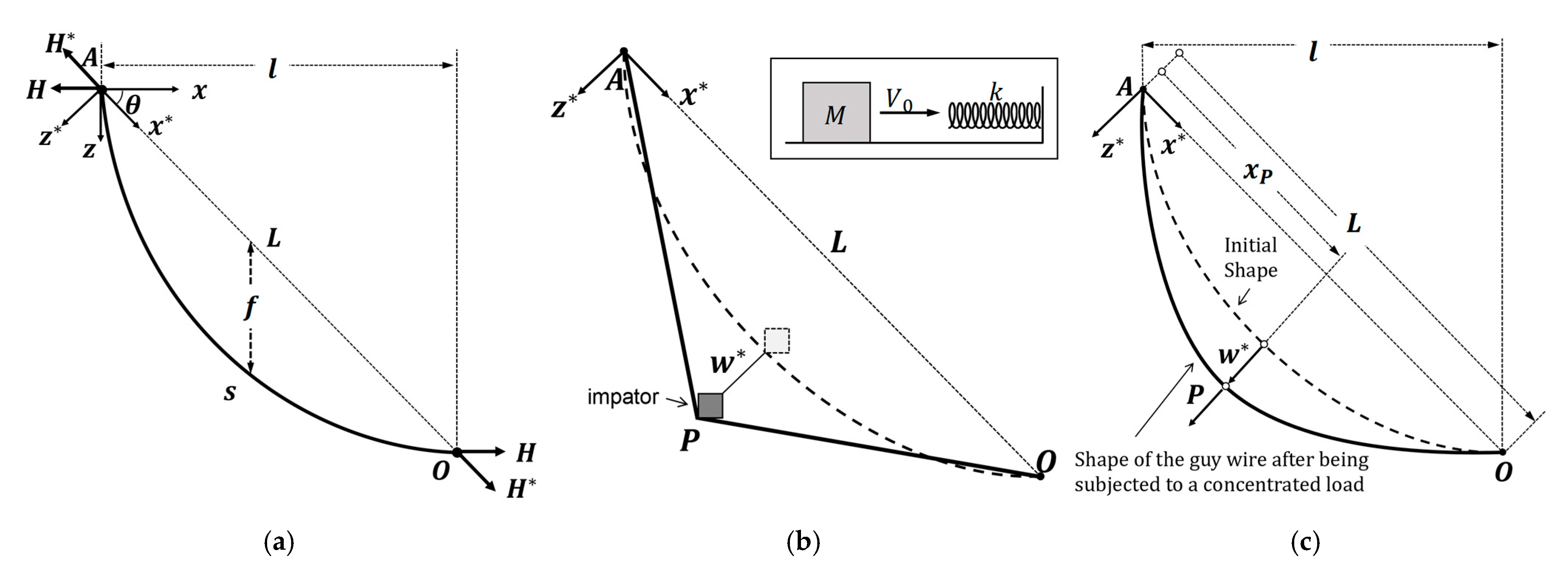
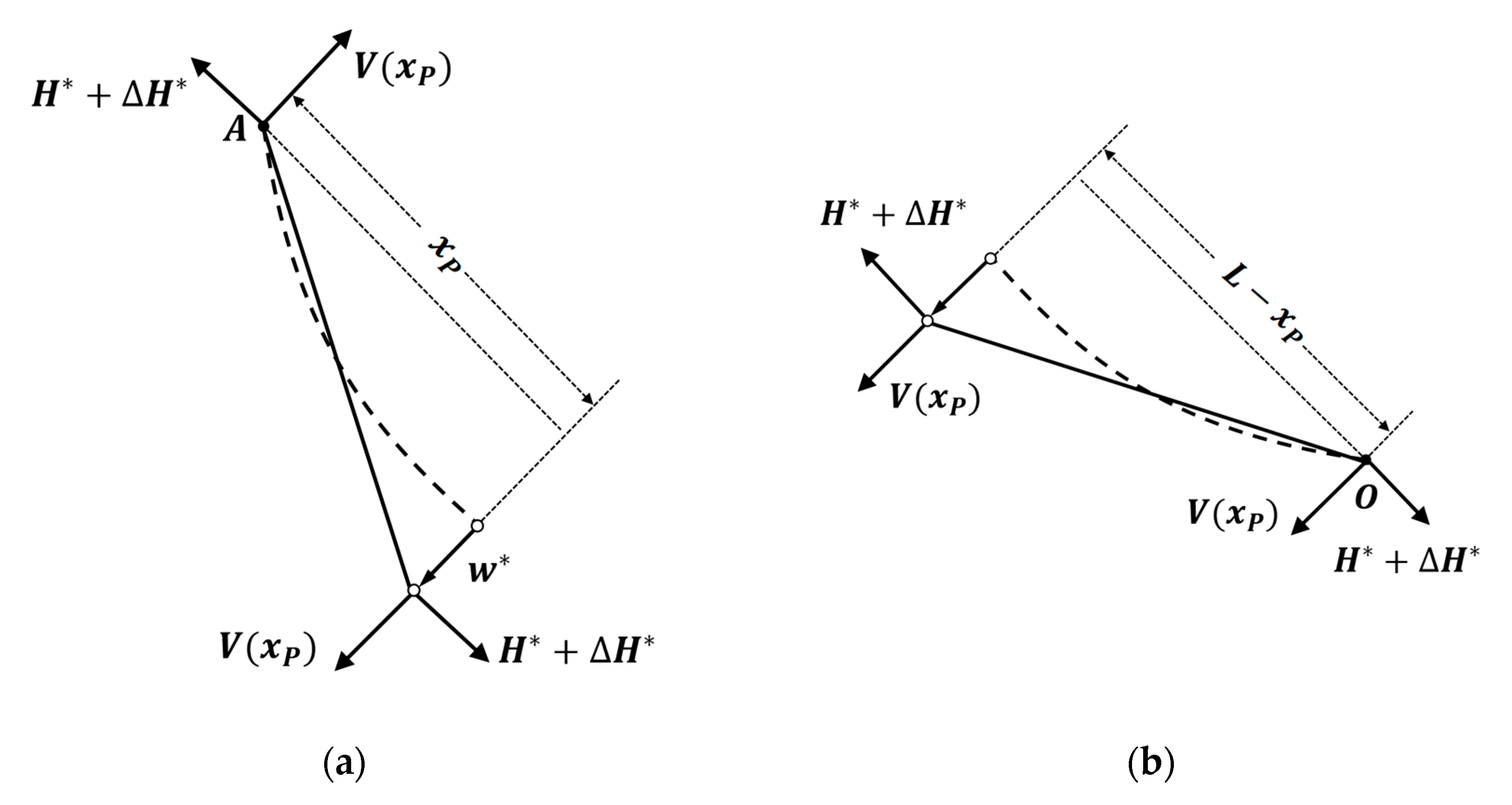
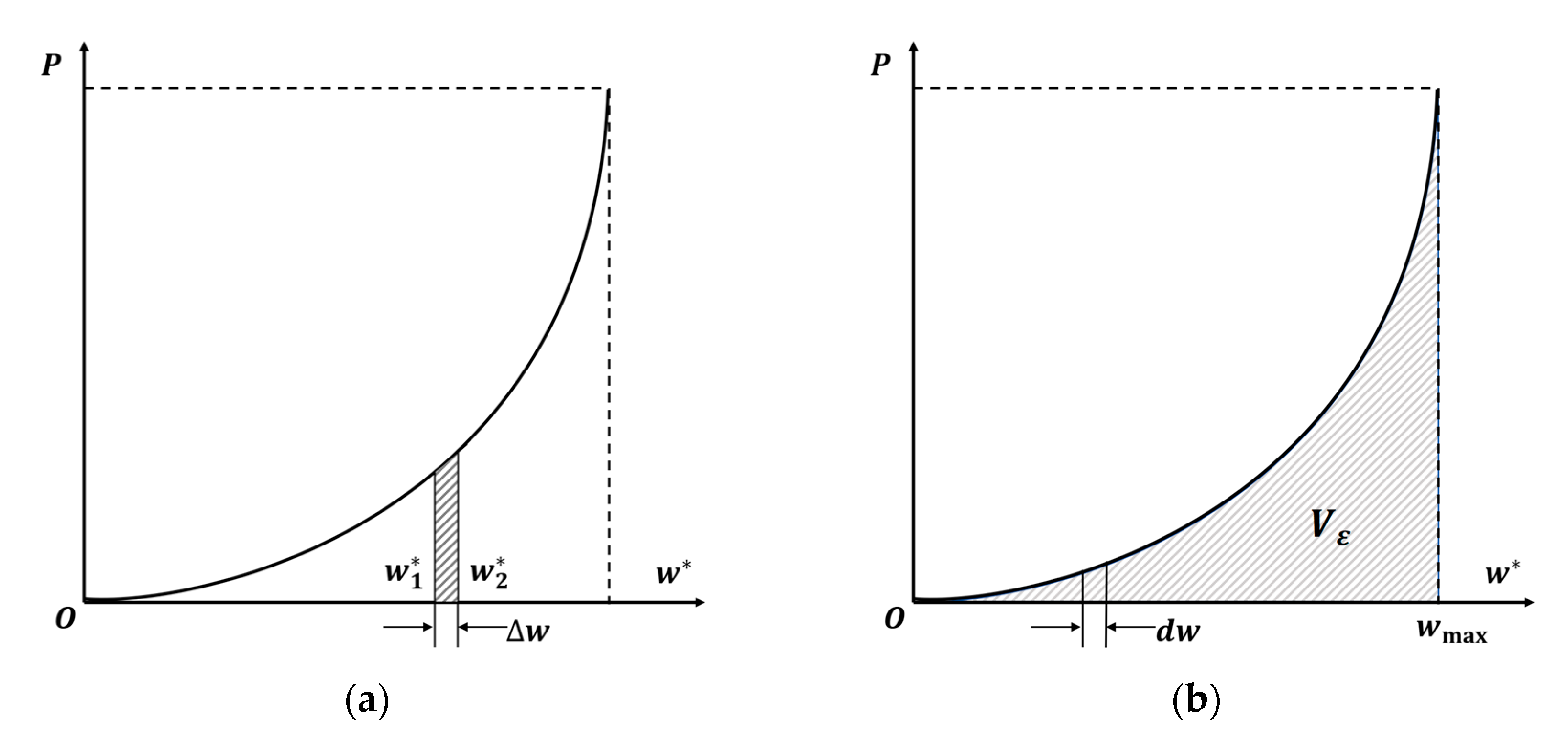
To achieve these research objectives, this paper focuses on the impact response characteristics of guy wires, equivalently modeling the impact process as a point mass impacting a nonlinear spring system. By solving for equivalent stiffness using cable theory and combining energy methods to derive calculation formulas for axial force, displacement, and peak impact force, this study provides theoretical support for the impact-resistant design of guy wire structures in power systems.
The remainder of this paper is organized as follows:
Section 2 presents the development of the theoretical model for guy wire impact response.
Section 3 describes the numerical validation and parametric analysis, where finite element simulations are conducted to verify the theoretical model, followed by systematic investigations of how guy wire characteristics (inclination angle, prestress, length) and impact conditions (position, mass, velocity) influence the dynamic response. Finally,
Section 4 summarizes the key findings and discusses the practical implications of this research.
3. Dynamic Simulation of Guy Wire Impact Response
In the previous section, the development of the theoretical model for guy wire impact response was presented, including the establishment of the collision model and the derivation of analytical solutions using energy-based methods. Based on Equations (4), (7) and (11), the analytical solutions for key responses of guy wires under impact loads, including axial forces, displacements and impact force peaks, can be directly obtained. Meanwhile, the conversion of impact kinetic energy to elastic potential energy can be quantified. Furthermore, by means of Newton–Cotes numerical integration, the implicit function is solved to obtain a closed-form solution, thus achieving the efficient theoretical prediction of response peaks.
Building upon these theoretical foundations from
Section 2, this section presents a comprehensive analysis that integrates both theoretical predictions and numerical simulation results. The numerical simulations, performed using ANSYS LS-DYNA 2022 R1, serve two primary purposes: first, to validate the theoretical model through systematic computational analysis; and second, to provide complementary insights that mutually reinforce the theoretical findings. Ultimately, by synthesizing results from both theoretical investigations and ANSYS-based numerical simulations, and focusing on specific case studies (see
Table 1), this section examines how key parameters influence the guy wire’s response to external impacts, ensuring a robust and validated understanding of the underlying mechanisms.
3.1. Model Establishment and Solution
This subsection validates the theoretical model through energy conversion efficiency analysis, the first step in the integrated theoretical–numerical approach. Energy conversion efficiency is quantified by comparing theoretical predictions of guy wire elastic potential energy with ANSYS LS-DYNA simulation results of impactor mechanical energy, verifying the energy conservation assumption. This analysis validates the theoretical model and establishes a reference benchmark based on specific case parameters (
Table 1), enabling systematic comparison of theoretical and numerical results in subsequent subsections.
To implement this validation and establish the reference benchmark, a representative case is defined based on typical material properties of power guy wires and actual engineering conditions [
19], the guy wire is set with a
inclination angle relative to the ground, a length of 30 m, a radius of 0.0122 m, and a prestress of 150 MPa (overall parameter values are shown in
Table 1). The impactor is set with a mass of 1000 kg and a velocity of 9 m/s. It strikes the midpoint of the guy wire.
Using the above parameter values and the finite element method, the dynamic response of the guy wire under impact is simulated by ANSYS LS-DYNA.
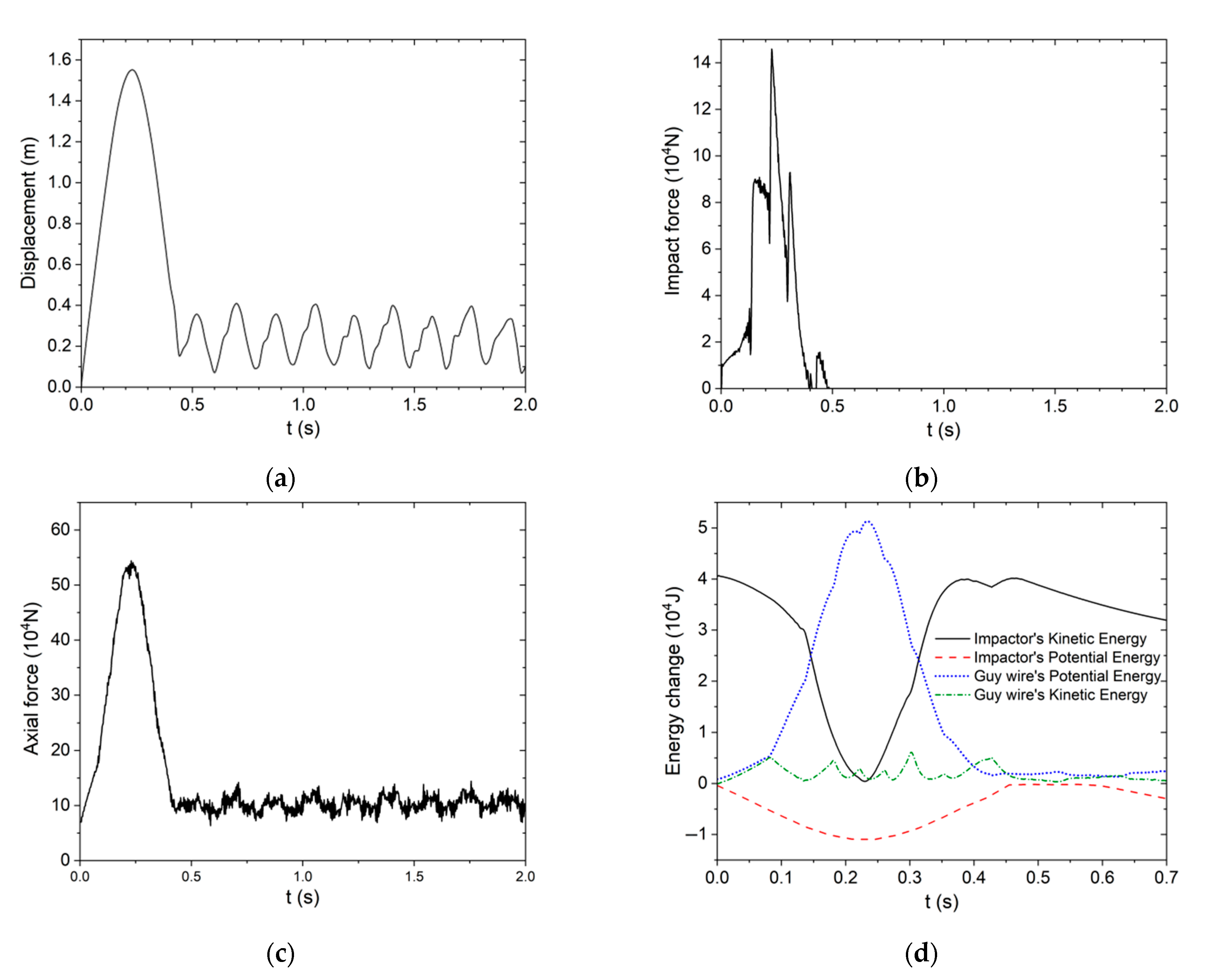
Figure 4 show the time–history curve of the displacement, the impact force and the axial force (displacement direction corresponds to the impact direction). The latter are obtained by the numerical simulation.
As shown in
Figure 4b, the impact force time–history curve exhibits multiple peak points. The peak points appearing before 0.4 s result from the acceleration at the impact point of the tension wire not always matching that of the impactor during the impact process. Specifically, When the acceleration at the tension wire’s force point is less than that of the impactor, the impact force increases; when the acceleration is greater than that of the impactor, the impact force decreases. Repeating this process results in multiple extreme points on the impact force time–history curve. The extreme points appearing after 0.4 s are caused by the brief re-contact between the impactor and the cable after the cable rebounds following separation from the impactor.
In the theoretical derivation, it is assumed that all the kinetic energy and gravitational potential energy of the impactor are converted into the elastic potential energy of the guy wire. To preliminarily verify the accuracy of this theoretical assumption, the energy time–history curves of the impactor and the guy wire are compared. The time–history curves of the energy variation (kinetic energy and gravitational potential energy) for both the impactor and the guy wire are shown in
Figure 4d.
As can be seen from
Figure 4d, both the kinetic energy and gravitational potential energy of the impactor reach their minimum values around 0.23 s, while the elastic potential energy of the guy wire reaches its maximum around 0.23 s. The kinetic energy of the guy wire changes very little. The initial kinetic energy of the impactor is 40,482 J. At 0.23 s, the change in gravitational potential energy of the impactor is 10,996 J, while the change in elastic potential energy of the guy wire is 50,448 J. From the above analysis, it can be seen that the kinetic energy and gravitational potential energy of the impactor are essentially converted into the elastic potential energy of the guy wire, confirming the validity of the theoretical assumption. Notably, the “near-100% energy conversion” here aligns with the theoretical simplification; in reality, the frictional sliding of the impactor (observed in
Section 3.2.1) causes slight energy dissipation, making the actual conversion efficiency marginally lower than 100% and this aligns with the conservative nature of the theoretical assumption.
3.2. Analysis of the Influence of Guy Wire Characteristics on Its Dynamic Response
Based on the above parameter settings, this section of this study investigates how variations in the guy wire’s own parameters (the guy wire’s ground inclination angle, prestress and length) affect the guy wire’s dynamic behavior.
3.2.1. Analysis of the Influence of the Guy Wire’s Ground Inclination Angle
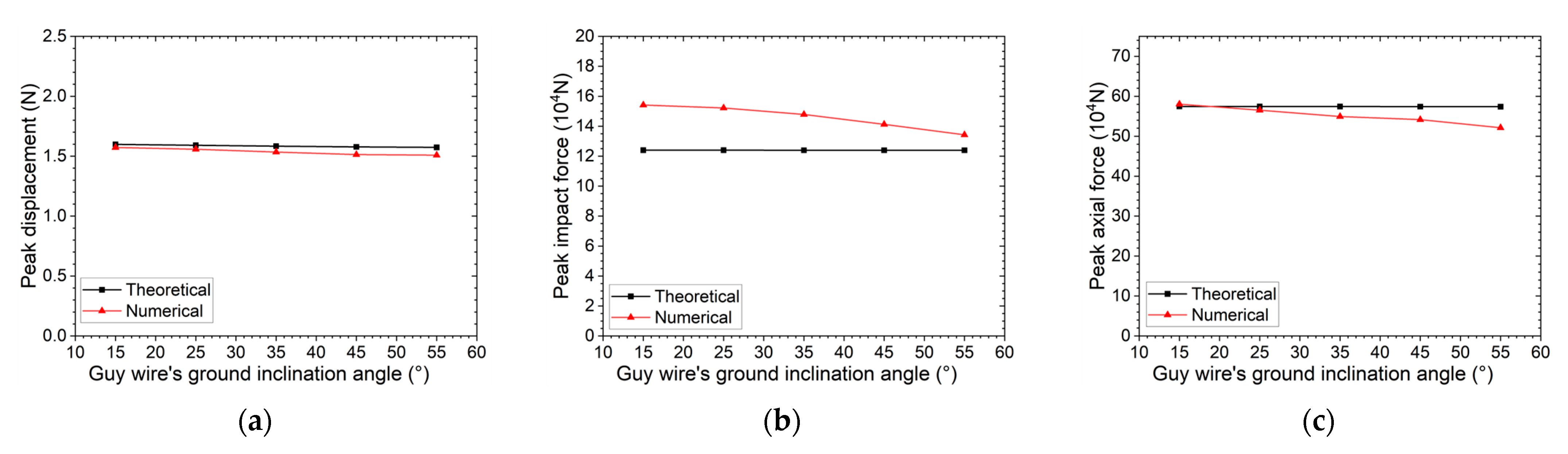
As shown in
Figure 5, with the guy wire’s ground inclination angle increasing from 15° to 55°, the simulated results for peak displacement, peak impact force, and peak axial force all decrease significantly, while the theoretical results remain nearly constant with minimal variation.
Quantitatively, the theoretical peak displacement only decreases slightly from 1.5991 m to 1.5734 m (a reduction of approximately 1.6%), and the theoretical peak impact force and axial force change by less than 0.1% (from 124,010 × 104 N to 123,970 × 104 N and 574,450 × 104 N to 573,930 × 104 N, respectively). In contrast, the numerical simulation results show more obvious downward trends: peak displacement decreases from 1.5722 m to 1.5081 m (a reduction of about 4.1%), peak impact force drops from 154,129 × 104 N to 134,304 × 104 N (a reduction of approximately 12.9%), and peak axial force decreases from 580,356 × 104 N to 521,194 × 104 N (a reduction of about 10.2%).
This discrepancy arises because during numerical simulations, the impactor slides downward along the guy wire under gravity immediately upon contact—this sliding motion induces frictional dissipation of the impact energy’s parallel component (relative to the cable tangent), which aligns with the theoretical assumption that only the perpendicular component contributes to the guy wire’s axial deformation. As the inclination angle increases, this downward sliding tendency becomes more pronounced, leading to greater energy loss through friction between the impactor and the guy wire.
The results above indicate that axial force, impact force, and displacement are all minimally affected by changes in the ground inclination angle of the guy wires in theoretical predictions, while numerical simulations reflect more significant sensitivity due to friction effects. Increasing the ground inclination angle of the guy wires on the guyed tower can relatively enhance the guy wires’ ability to resist impact loads. This finding holds significant practical reference value for real-world applications. In addition,
Figure 5 reveals a negative correlation between the ground inclination angle of the guy wire and the peak response values for displacement, impact force, and peak axial force. This implies that in areas susceptible to external impact loads, the safety of guy wires can be enhanced by moderately increasing their inclination angle (e.g., from 15° to 55°), which can reduce the simulated peak impact force by over 10% and peak axial force by around 10% without significant changes in theoretical prediction stability.
3.2.2. Analysis of the Effects of Prestressing
While inclination angle influences stiffness through geometric force redistribution, prestress directly modulates the initial axial stiffness of guy wires. These two parameters interact synergistically to determine the fundamental mechanical properties governing impact resistance. Whereas inclination angle affects the spatial distribution of forces, prestress provides a direct means to adjust the baseline stiffness, making it a more controllable parameter in engineering design.
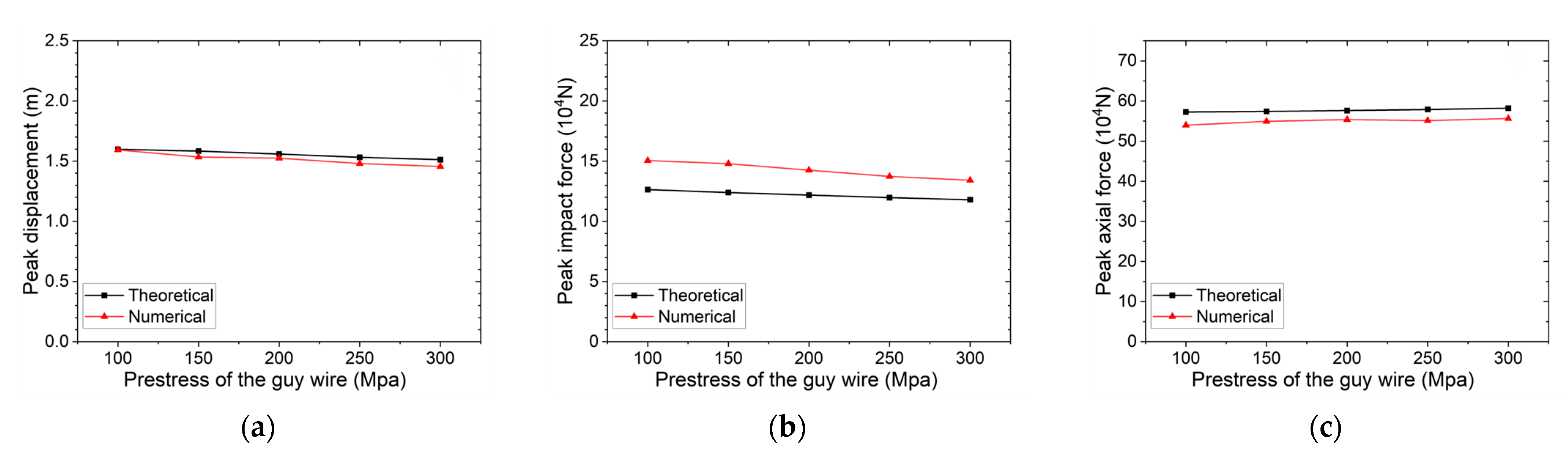
Figure 6 illustrates the effects of guy wire prestress (100–300 MPa) on peak displacement, peak impact force, and peak axial force. Quantitatively, as prestress increases from 100 MPa to 300 MPa, theoretical and numerical results consistently show: peak displacement decreases by approximately 5.4% (theoretical) and 8.6% (simulation), peak impact force reduces by around 6.7% (theoretical) and 10.8% (simulation), while peak axial force increases by only 1.7% (theoretical) and 3.1% (simulation). This trend arises because higher prestress enhances the guy wire’s initial equivalent stiffness, improving impact resistance and reducing deformation; the more significant response changes in simulations align with the friction-induced energy dissipation observed in
Section 3.2.1, as stiffer guy wires amplify friction’s influence on response variation.
The results above indicate peak axial force is minimally sensitive to prestress, while peak impact force and displacement show notable reductions—this differential sensitivity stems from stable total energy conversion (constant impactor mass/velocity) and stiffness-mediated force-deformation redistribution. In summary, increasing prestress effectively enhances impact resistance (over 8% displacement reduction and 10% impact force reduction in simulations) with only slight axial force growth, offering a controllable way to balance deformation control and structural safety in engineering design, complementing the geometric stiffness effects of inclination angle.
3.2.3. Analysis of the Effects of Guy Wire Length
Prestress establishes the initial stiffness baseline, but guy wire length further modifies the effective stiffness distribution along the span, and this modification aligns with the load–displacement relationship derived for concentrated forces (
Section 2.2) and energy conservation verification (
Section 2.3). These two theoretical foundations together indicate that length-induced stiffness variation significantly alters dynamic response characteristics, and this effect becomes more pronounced when combined with prestress adjustments to tune initial stiffness.
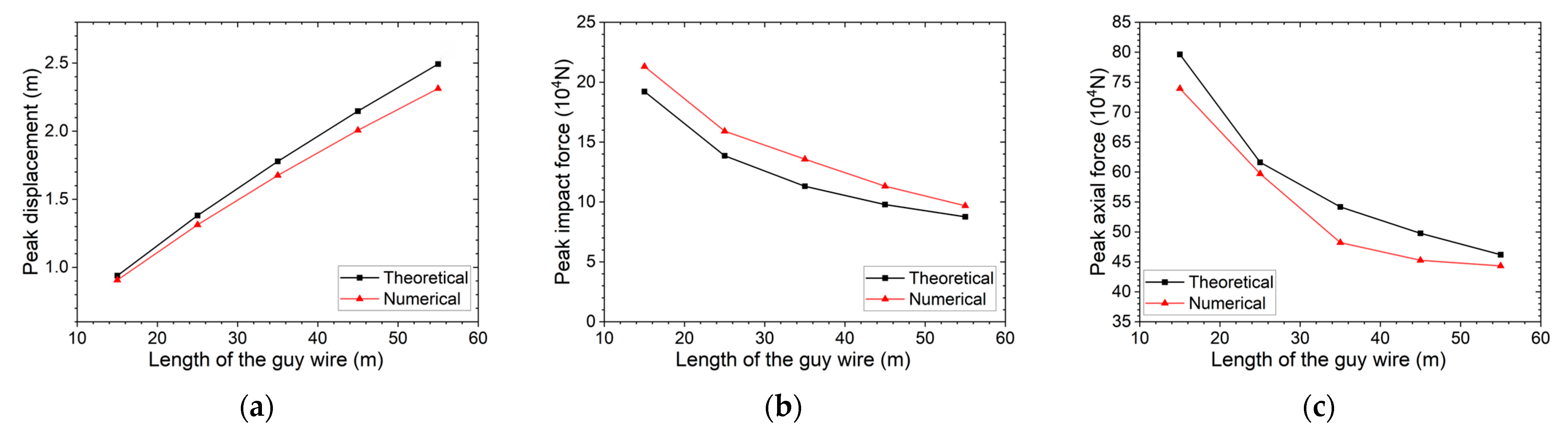
Figure 7 illustrates the effect of guy wire length (15–55 m) on peak displacement, peak impact force, and peak axial force. Quantitatively, as length increases from 15 m to 55 m, theoretical and numerical results consistently show: peak displacement increases by approximately 165.3% (theoretical) and 155.1% (simulation) in a nearly linear trend, while peak impact force reduces by around 54.4% (theoretical) and 54.5% (simulation), and peak axial force decreases by about 42.0% (theoretical) and 39.0% (simulation)—both forces exhibit nonlinear reduction with gradually slowing decay rates.
The results above indicate that length adjustment offers a practical trade-off in engineering design: moderately increasing guy wire length can cut peak impact force by over 50% and axial force by nearly 40% (simulation data), but displacement must be constrained by safety codes to avoid interphase flashover. This quantitative rule complements the stiffness modulation effects of inclination angle and prestress, forming a comprehensive optimization framework for balancing force control and deformation limits in guy wire impact-resistant design.
3.3. Analysis of the Impact of Impact Factors on the Dynamic Response of the Guy Wire
3.3.1. Analysis of the Influence of Impact Position
Having examined how inherent guy wire characteristics determine the overall stiffness distribution, we now shift focus to how external impact conditions interact with this stiffness field. Impact position is particularly significant as it determines which segment of the stiffness distribution is primarily engaged during impact, thereby influencing local deformation patterns and force transmission efficiency.
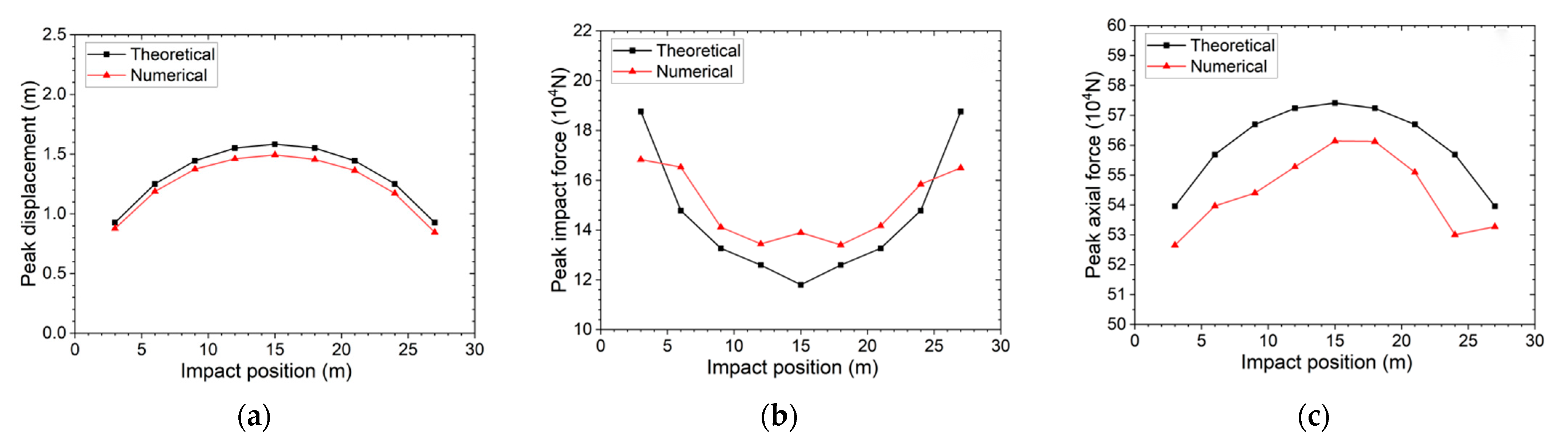
Figure 8 illustrates the effect of impact position (3–15 m, from anchorage point to midpoint) on peak displacement, peak impact force, and peak axial force. Quantitatively, as impact position moves from 3 m to 15 m: peak displacement increases by approximately 71.0% (theoretical) and 70.2% (simulation) in a decelerating growth trend; peak axial force increases by about 6.4% (theoretical) and 6.6% (simulation) with gradually slowing growth; peak impact force shows a nonlinear trend—theoretical values decrease by 37.1% (from 187,630 × 10
4 N to 118,000 × 10
4 N), while simulation values first decrease then slightly rise (from 168,318 × 10
4 N to 139,004 × 10
4 N), with both showing reduced variation near the midpoint.
The results above indicate that impact position significantly affects local response: impacts near anchorage points (e.g., 3 m) yield 70% lower displacement than midpoint impacts, helping control safety distance risks; midpoint impacts exhibit larger deformation but stable force transmission. In engineering design, priority should be given to protecting midpoint regions with impact-resistant baffles, while leveraging the high stiffness of anchorage ends to constrain displacement. This quantitative rule complements the stiffness modulation effects of inclination angle, prestress, and length, providing targeted guidance for impact-resistant optimization based on potential impact positions.
3.3.2. Analysis of the Impact of Mass Quantity
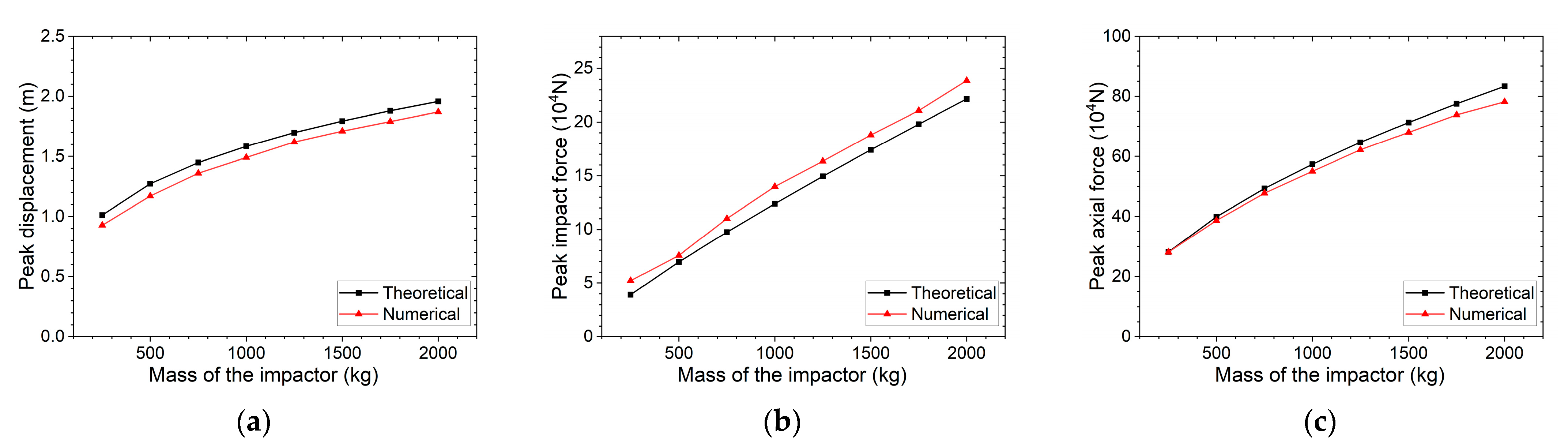
Impact position defines where the impact energy is initially applied, but the magnitude of that energy depends on the impactor’s physical properties. Mass is a fundamental parameter determining impact energy (), and its linear relationship with momentum makes it a key factor in force transmission dynamics. Unlike position effects which are localized, mass influences the global energy input to the system.
Figure 9 demonstrates the effect of impactor mass on peak displacement, peak impact force, and peak axial force. Quantitatively, as mass increases from 250 kg to 1250 kg: peak displacement exhibits nonlinear growth with slowing rates, increasing by approximately 67.7% (theoretical, from 1.0126 m to 1.6976 m) and 74.6% (simulation, from 0.928 m to 1.62 m); peak axial force also shows nonlinear growth, rising by about 129.5% (theoretical, from 281,700 × 10
4 N to 646,600 × 10
4 N) and 120.9% (simulation, from 281,340 × 10
4 N to 621,770 × 10
4 N); while peak impact force increases approximately linearly, with theoretical values growing by 281.3% (from 39,190 × 10
4 N to 149,410 × 10
4 N) and simulation values increasing by 213.6% (from 52,110 × 10
4 N to 163,410 × 10
4 N).
The results above indicate that impactor mass exerts differential influences on responses: linear control over peak impact force, and nonlinear modulation of peak displacement and axial force with diminishing growth rates. For large-mass impacts (e.g., ≥1000 kg), higher prestress is required to constrain displacement (which increases by over 70% in simulations), while careful attention must be paid to axial force limits to avoid material failure. This quantitative rule complements the influence of impact position and guy wire inherent parameters (inclination angle, prestress, length), providing targeted guidance for impact-resistant design in areas prone to large-mass falling objects (e.g., mountainous regions)—such as prioritizing stiffness optimization to balance force control and deformation limits.
3.3.3. Analysis of the Impact of Impactor Velocity
Mass and velocity jointly determine impact energy through the kinetic energy relationship, but their influences differ fundamentally due to velocity’s quadratic effect. This mathematical relationship means velocity exerts a more dominant influence on impact severity: doubling velocity increases energy fourfold, while doubling mass only doubles energy. For example, increasing velocity from 3 m/s to 11 m/s (≈3.67-fold increase) boosts theoretical kinetic energy by ≈13.4-fold, whereas increasing mass from 250 kg to 1250 kg (5-fold increase) only raises energy by 5-fold—this velocity dominance has critical implications for impact protection strategy prioritization.
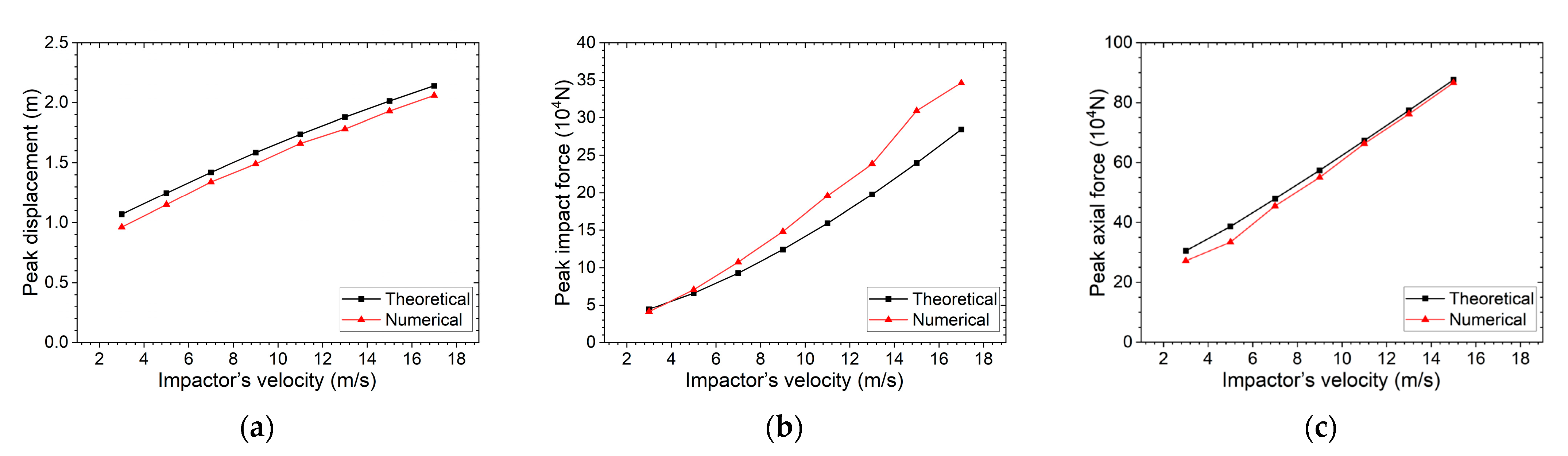
As shown in
Figure 10, both peak axial force and peak displacement exhibit near-linear growth with increasing impactor velocity. Quantitatively, as velocity rises from 3 m/s to 11 m/s: peak displacement increases by approximately 62.5% (theoretical, from 1.0691 m to 1.7363 m) and 72.6% (simulation, from 0.962 m to 1.66 m); peak axial force rises by about 120.6% (theoretical, from 305,130 × 10
4 N to 673,200 × 10
4 N) and 144.1% (simulation, from 271,569 × 10
4 N to 662,833 × 10
4 N).
More significantly, a comparison of
Figure 9 and
Figure 10 reveals the following: for equivalent energy input, the rate of change in peak responses induced by velocity is substantially greater than that induced by mass. Simulation results show velocity-induced displacement growth (72.6%) is nearly equivalent to mass-induced growth (74.6%) despite a 30% lower velocity multiple (3.67-fold vs. 5-fold mass); meanwhile, velocity-induced impact force growth (375.1%) is 1.8-fold that of mass-induced growth (213.6%). This velocity-dominant influence arises from an energy mechanism: since kinetic energy is proportional to the square of velocity, velocity has a far greater influence on response than mass.
These distinct characteristics reveal the dominant role of the velocity component in impact kinetic energy regarding the damage potential to guy wire structures. In high-speed impact risk areas (such as mountainous regions), velocity control measures (e.g., buffer devices) should be prioritized over simply increasing guy wire strength. This provides a clear optimization direction for impact-resistant protection design. For instance, in scenarios prone to high-speed impacts (such as mountain rockfalls or high-speed falling objects), controlling impact velocity should be a key focus. Specifically, installing buffer deceleration devices and optimizing the energy absorption characteristics of protective structures can more effectively mitigate impact hazards. This prevents guy wire breakage or tower instability caused by excessive axial force and displacement resulting from high impact speeds. Such measures further enhance the impact-resistant safety redundancy of transmission networks.
3.4. Integrated Analysis and Key Findings Summary
Building upon the systematic investigations presented in
Section 3.1,
Section 3.2 and
Section 3.3 this section synthesizes the fundamental insights into guy wire impact behavior, revealing the interconnected relationships between parameters and their combined effects on dynamic response. By integrating individual parameter analyses into a cohesive framework, this synthesis addresses the complex interplay of factors governing impact resistance and response characteristics.
3.4.1. Model Validation and Foundation Establishment
The theoretical model validation confirmed effective energy conversion, with the kinetic and gravitational potential energy of the impactor being essentially converted into the elastic potential energy of the guy wire. This validation establishes the model’s reliability for predicting peak responses, with theoretical and numerical results showing consistent trends across all parameter configurations. Specifically, deviations between theoretical and numerical results are strictly controlled within ±4% for peak displacement and peak axial force, and within ±18% for peak impact force. This level of agreement validates the model’s accuracy for engineering applications. The larger deviation in peak impact force primarily arises from friction-induced energy dissipation during impactor sliding (observed in
Section 3.2.1), which is simplified in the theoretical model but fully captured in numerical simulations.
Despite these discrepancies, the parametric trend consistency is maintained: for example, increasing the guy wire’s ground inclination angle from 15° to 55° leads to theoretical reductions of 2–4% in peak displacement, 1–13% in peak impact force, and 1–10% in peak axial force, which aligns closely with numerical simulation trends (displacement reduction ~4.1%, impact force reduction ~12.9%, axial force reduction ~10.2%). This consistency further confirms the model’s validity for guiding parameter optimization.
3.4.2. Parameter Influence Hierarchy
A clear influence hierarchy emerges from the comprehensive investigation. Impact velocity dominates response severity due to its quadratic relationship with kinetic energy, exerting a substantially greater influence than mass for equivalent energy input. Guy wire stiffness, collectively determined by prestress, length, and inclination angle, governs energy absorption capacity.
Prestress offers the most direct means of stiffness control, with increasing prestress reducing displacement while increasing axial force. Length exhibits a linear inverse relationship with displacement, while inclination angle demonstrates nonlinear effects due to friction in numerical simulations. Impact position influences local response distribution but has minimal effect on global energy absorption, with midspan impacts producing significantly greater displacement than anchorage impacts due to substantial stiffness variation between these regions.
3.4.3. Critical Parameter Interactions
Several key parameter interactions amplify or mitigate individual effects. Higher prestress is particularly effective in mitigating high-velocity impacts, reducing velocity-induced displacement growth compared to low-prestress configurations. Longer spans exhibit more pronounced position effects due to amplified stiffness gradients. The geometric nonlinearity of guy wires creates a self-limiting effect for large-mass impacts, with stiffness increasing during deformation to constrain displacement growth despite increasing impact energy.
3.4.4. Response Trade-Offs and Design Implications
The integrated analysis reveals inherent response trade-offs that guide engineering design. Increasing stiffness via prestress or inclination angle reduces displacement but increases internal forces, requiring careful balance to avoid material failure. Velocity control is far more efficient than mass control for energy reduction due to the quadratic relationship between velocity and kinetic energy. Midspan protection is critical for displacement control, while anchorage zones provide natural stiffness advantages for force management.
This synthesis establishes a comprehensive understanding of guy wire impact behavior, moving beyond isolated parameter effects to reveal the interconnected mechanisms governing response. The findings provide a systematic basis for impact-resistant design, with clear guidance on parameter prioritization and interaction management, forming a cohesive foundation for the engineering implications discussed in
Section 4.
4. Conclusions and Discussion
To address the gap of insufficient quantitative models for transmission tower guy wire impact responses, this study’s core contributions to the topic are reflected in its integrated theoretical–numerical framework and engineering insights: we proposed a targeted theoretical model—analogizing impact as a “point mass-nonlinear spring system”, integrating cable theory with an energy-based elastic potential method to derive closed-form solutions for peak axial force, displacement, and impact force; introduced Newton–Cotes numerical integration to efficiently solve the implicit energy function for rapid response prediction; validated the model via ANSYS LS-DYNA, quantifying deviations to ensure reliability; systematically revealed parametric influence laws for engineering optimization; and bridged theory with practice to support impact-resistant design of power grids and de-icing strategy optimization.
While theoretical and numerical results show minor discrepancies (due to omitted guy wire kinetic energy and impactor slip dissipation), their parameter influence trends remain highly consistent. Notably, the perpendicular impact force assumption works best for 15–55° guy wires (typical in engineering) and may have minor errors for rarely used near-vertical ones (>80°). Additionally, the “no energy loss” assumption (
Section 2.1.2), though simplifying derivation, may slightly over-predict peak displacement and force, and this conservatism aligns with safety-focused engineering principles. Future work will add damping/frictional models to quantify real energy losses and improve accuracy. Despite these assumption limitations, their consistent trends still clearly reveal key guy wire parameters’ impacts on displacement, axial force, and peak impact force. Furthermore, the theoretical model offers a more direct way to illustrate impact response patterns than simulations, acting as an effective complement and providing key quantitative references for engineering practice.
More importantly, the aforementioned research and conclusions hold significant reference value for de-icing overhead transmission lines. The structure of overhead transmission lines is similar to that of guy wires. During de-icing operations, they are similarly subjected to external impacts from de-icing rods. The patterns revealed in this study regarding how parameters such as ground inclination angle, prestress and length influence impact response can directly provide theoretical support for ground wire de-icing. For instance, by adjusting the suspension angle, pretension and span length of ground wires, the mechanical response characteristics during de-icing can be optimized. This enhances de-icing efficiency while reducing the risk of excessive deformation or breakage of ground wires caused by impact. Consequently, it offers quantitative references for the optimized design of ground wire de-icing solutions.