The Role of Motion Capture Analysis in Evaluating Postoperative Functional Outcomes in Adolescent Idiopathic Scoliosis: A Systematic Review

 ,
,  , , ,
, , ,  and
and
Abstract
1. Introduction
2. Material and Methods
2.1. Eligibility Criteria
2.2. Information Sources
2.3. Search Strategy
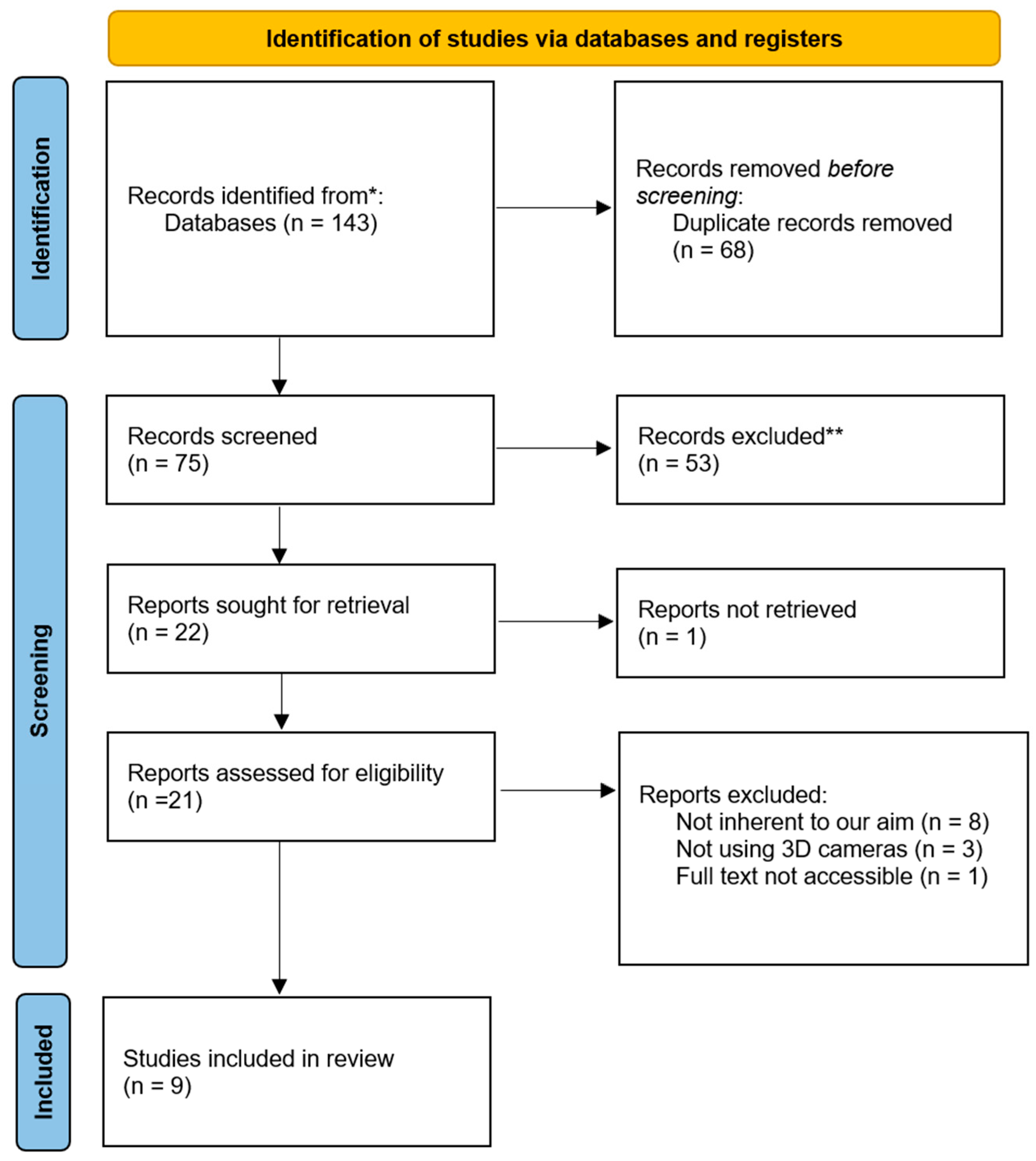
2.4. Study Selection
2.5. Data Collection Process
2.6. Data Items
2.7. Risk of Bias Assessment
2.8. Summary Measures and Data Synthesis
3. Results
3.1. Study Characteristics and Design
3.2. Motion Capture Timing
3.3. Spatiotemporal Gait Parameters and Symmetry
3.4. Trunk–Pelvic Coordination and Range of Motion (ROM)
3.5. Postoperative Compensatory Mechanisms and Adjacent Segment Biomechanics
3.6. Respiratory Function and Thoracic Expansion
3.7. Summary of Findings and Clinical Implications
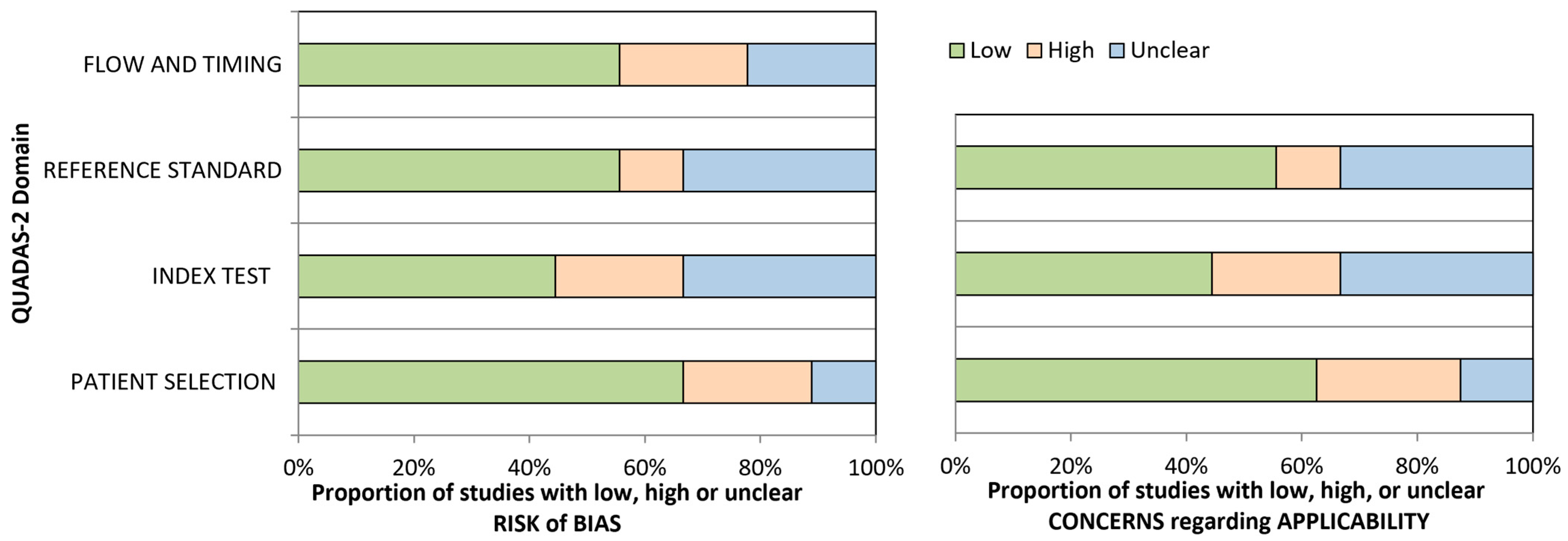
3.8. Risk of Bias
- Patient Selection: Most studies had low risk and high applicability regarding patient selection, reflecting the target population of adolescents with idiopathic scoliosis undergoing spinal fusion. However, two studies presented a high risk of bias due to selection methods that may limit generalizability.
- Index Test: Motion capture protocols were generally consistent, showing low risk and good applicability. Nonetheless, a few studies showed moderate risk and uncertain applicability due to variations in data acquisition protocols, impacting comparability.
- Reference Standard: The majority adhered to valid reference standards for assessing postoperative functional outcomes, yielding low bias and high applicability. However, some studies showed unclear applicability due to variations in the criteria used for outcome classification, which could affect uniformity in results interpretation.
- Flow and Timing: This domain exhibited the most significant variability, with specific studies rated as high risk due to incomplete follow-up or inconsistent assessment timing, potentially impacting longitudinal robustness.
4. Discussion
4.1. Functional Gait Restoration: Achievements and Limitations
4.2. Respiratory Function and Thoracic Mechanics
4.3. Postoperative ROM and Adjacent Segment Biomechanics
4.4. Rehabilitation as a Cornerstone of Functional Recovery
4.5. Quality of Life and Psychosocial Considerations
5. Study Limitations
6. Conclusions
Author Contributions
Funding
Conflicts of Interest
Abbreviations
| AIS | Adolescent Idiopathic Scoliosis |
| ASD | Adjacent Segment Disease |
| COM | Center of Mass |
| MCA | Motion Capture Analysis |
| MeSH | Medical Subject Headings |
| PRISMA | Preferred Reporting Items for Systematic Reviews and Meta-Analyses |
| PROMs | Patient-Reported Outcome Measures |
| QUADAS-2 | Quality Assessment of Diagnostic Accuracy Studies-2 |
| ROM | Range of Motion |
Appendix A. Search String
References
- Konieczny, M.R.; Senyurt, H.; Krauspe, R. Epidemiology of adolescent idiopathic scoliosis. J. Child. Orthop. 2013, 7, 3–9. [Google Scholar] [CrossRef]
- Weinstein, S.L.; Dolan, L.A.; Wright, J.G.; Dobbs, M.B. Effects of bracing in adolescents with idiopathic scoliosis. N. Engl. J. Med. 2013, 369, 1512–1521. [Google Scholar] [CrossRef] [PubMed]
- Negrini, S.; Donzelli, S.; Aulisa, A.G.; Czaprowski, D.; Schreiber, S.; de Mauroy, J.C.; Diers, H.; Grivas, T.B.; Knott, P.; Kotwicki, T.; et al. 2016 SOSORT guidelines: Orthopaedic and rehabilitation treatment of idiopathic scoliosis during growth. Scoliosis Spinal Disord. 2018, 13, 3. [Google Scholar] [CrossRef]
- Reamy, B.V.; Slakey, J.B. Adolescent idiopathic scoliosis: Review and current concepts. Am. Fam. Physician 2001, 64, 111–116. [Google Scholar] [PubMed]
- De Salvatore, S.; Ruzzini, L.; Longo, U.G.; Marino, M.; Greco, A.; Piergentili, I.; Costici, P.F.; Denaro, V. Exploring the association between specific genes and the onset of idiopathic scoliosis: A systematic review. BMC Med. Genom. 2022, 15, 115. [Google Scholar] [CrossRef] [PubMed]
- Peng, Y.; Wang, S.R.; Qiu, G.X.; Zhang, J.G.; Zhuang, Q.Y. Research progress on the etiology and pathogenesis of adolescent idiopathic scoliosis. Chin. Med. J. 2020, 133, 483–493. [Google Scholar] [CrossRef] [PubMed]
- Courvoisier, A.; Vialle, R.; Skalli, W. EOS 3D Imaging: Assessing the impact of brace treatment in adolescent idiopathic scoliosis. Expert Rev. Med. Devices 2014, 11, 1–3. [Google Scholar] [CrossRef] [PubMed]
- Kim, H.S. Evidence-based of nonoperative treatment in adolescent idiopathic scoliosis. Asian Spine J. 2014, 8, 695–702. [Google Scholar] [CrossRef]
- Braun, S.; Brenneis, M.; Schönnagel, L.; Caffard, T.; Diaremes, P. Surgical Treatment of Spinal Deformities in Pediatric Orthopedic Patients. Life 2023, 13, 1341. [Google Scholar] [CrossRef] [PubMed]
- Lonner, B.S.; Ren, Y.; Bess, S.; Kelly, M.; Kim, H.J.; Yaszay, B.; Lafage, V.; Marks, M.; Miyanji, F.; Shaffrey, C.I.; et al. Surgery for the Adolescent Idiopathic Scoliosis Patients After Skeletal Maturity: Early Versus Late Surgery. Spine Deform. 2019, 7, 84–92. [Google Scholar] [CrossRef] [PubMed]
- Cuartas, E.; Rasouli, A.; O’Brien, M.; Shufflebarger, H.L. Use of all-pedicle-screw constructs in the treatment of adolescent idiopathic scoliosis. J. Am. Acad. Orthop. Surg. 2009, 17, 550–561. [Google Scholar] [CrossRef] [PubMed]
- Baker, R.; McGinley, J.L.; Schwartz, M.H.; Beynon, S.; Rozumalski, A.; Graham, H.K.; Tirosh, O. The gait profile score and movement analysis profile. Gait Posture 2009, 30, 265–269. [Google Scholar] [CrossRef] [PubMed]
- Kruger, K.M.; Garman, C.M.R.; Krzak, J.J.; Graf, A.; Hassani, S.; Tarima, S.; Sturm, P.F.; Hammerberg, K.W.; Gupta, P.; Harris, G.F. Effects of Spinal Fusion for Idiopathic Scoliosis on Lower Body Kinematics During Gait. Spine Deform. 2018, 6, 441–447. [Google Scholar] [CrossRef] [PubMed]
- Kramers-de Quervain, I.A.; Müller, R.; Stacoff, A.; Grob, D.; Stüssi, E. Gait analysis in patients with idiopathic scoliosis. Eur. Spine J. 2004, 13, 449–456. [Google Scholar] [CrossRef] [PubMed]
- Mahaudens, P.; Banse, X.; Mousny, M.; Detrembleur, C. Gait in adolescent idiopathic scoliosis: Kinematics and electromyographic analysis. Eur. Spine J. 2009, 18, 512–521. [Google Scholar] [CrossRef] [PubMed]
- Beaudoin, L.; Zabjek, K.F.; Leroux, M.A.; Coillard, C.; Rivard, C.H. Acute systematic and variable postural adaptations induced by an orthopaedic shoe lift in control subjects. Eur. Spine J. 1999, 8, 40–45. [Google Scholar] [CrossRef] [PubMed][Green Version]
- Fischer, C.R.; Kim, Y. Selective fusion for adolescent idiopathic scoliosis: A review of current operative strategy. Eur. Spine J. 2011, 20, 1048–1057. [Google Scholar] [CrossRef]
- Mahaudens, P.; Dalemans, F.; Banse, X.; Mousny, M.; Cartiaux, O.; Detrembleur, C. Gait in patients with adolescent idiopathic scoliosis. Effect of surgery at 10 years of follow-up. Gait Posture 2018, 61, 141–148. [Google Scholar] [CrossRef] [PubMed]
- Hopf, C.; Scheidecker, M.; Steffan, K.; Bodem, F.; Eysel, P. Gait analysis in idiopathic scoliosis before and after surgery: A comparison of the pre- and postoperative muscle activation pattern. Eur. Spine J. 1998, 7, 6–11. [Google Scholar] [CrossRef] [PubMed]
- Watanabe, H.; Goto, R.; Tanaka, N.; Matsumura, A.; Yanagi, H. Effects of gait training using the Hybrid Assistive Limb® in recovery-phase stroke patients: A 2-month follow-up, randomized, controlled study. NeuroRehabilitation 2017, 40, 363–367. [Google Scholar] [CrossRef] [PubMed]
- Al-Mohrej, O.A.; Aldakhil, S.S.; Al-Rabiah, M.A.; Al-Rabiah, A.M. Surgical treatment of adolescent idiopathic scoliosis: Complications. Ann. Med. Surg. 2020, 52, 19–23. [Google Scholar] [CrossRef] [PubMed]
- Wilke, H.J.; Großkinsky, M.; Ruf, M.; Schlager, B. Range of international surgical strategies for adolescent idiopathic scoliosis: Evaluation of a multi-center survey. JOR Spine 2024, 7, e1324. [Google Scholar] [CrossRef] [PubMed]
- Whiting, P.F.; Rutjes, A.W.; Westwood, M.E.; Mallett, S.; Deeks, J.J.; Reitsma, J.B.; Leeflang, M.M.; Sterne, J.A.; Bossuyt, P.M.; QUADAS-2 Group. QUADAS-2: A revised tool for the quality assessment of diagnostic accuracy studies. Ann. Intern. Med. 2011, 155, 529–536. [Google Scholar] [CrossRef]
- Paul, J.C.; Patel, A.; Bianco, K.; Godwin, E.; Naziri, Q.; Maier, S.; Lafage, V.; Paulino, C.; Errico, T.J. Gait stability improvement after fusion surgery for adolescent idiopathic scoliosis is influenced by corrective measures in coronal and sagittal planes. Gait Posture 2014, 40, 510–515. [Google Scholar] [CrossRef]
- Holewijn, R.M.; Kingma, I.; de Kleuver, M.; Schimmel, J.J.P.; Keijsers, N.L.W. Spinal fusion limits upper body range of motion during gait without inducing compensatory mechanisms in adolescent idiopathic scoliosis patients. Gait Posture 2017, 57, 1–6. [Google Scholar] [CrossRef] [PubMed]
- Schmid, S.; Studer, D.; Hasler, C.C.; Romkes, J.; Taylor, W.R.; Lorenzetti, S.; Brunner, R. Quantifying spinal gait kinematics using an enhanced optical motion capture approach in adolescent idiopathic scoliosis. Gait Posture 2016, 44, 231–237. [Google Scholar] [CrossRef]
- Delpierre, Y.; Vernet, P.; Surdel, A. Effect of preferred walking speed on the upper body range of motion and mechanical work during gait before and after spinal fusion for patients with idiopathic scoliosis. Clin. Biomech. 2019, 70, 265–269. [Google Scholar] [CrossRef] [PubMed]
- Wong-Chung, D.A.C.F.; Schimmel, J.J.P.; de Kleuver, M.; Keijsers, N.L.W. Asymmetrical trunk movement during walking improved to normal range at 3 months after corrective posterior spinal fusion in adolescent idiopathic scoliosis. Eur. Spine J. 2018, 27, 388–396. [Google Scholar] [CrossRef]
- Holewijn, R.M.; de Kleuver, M.; Kingma, I.; Keijsers, N.L.W. A prospective analysis of motion and deformity at the shoulder level in surgically treated adolescent idiopathic scoliosis. Gait Posture 2019, 69, 150–155. [Google Scholar] [CrossRef] [PubMed]
- Patel, A.; Pivec, R.; Shah, N.V.; Leven, D.M.; Margalit, A.; Day, L.M.; Godwin, E.M.; Lafage, V.; Post, N.H.; Yoshihara, H.; et al. Motion analysis in the axial plane after realignment surgery for adolescent idiopathic scoliosis. Gait Posture 2018, 66, 181–188. [Google Scholar] [CrossRef] [PubMed]
- Xun, F.; Canavese, F.; Xu, H.; Kaelin, A.; Li, Y.; Dimeglio, A. Dynamic 3D Reconstruction of Thoracic Cage and Abdomen in Children and Adolescents With Scoliosis: Preliminary Results of Optical Reflective Motion Analysis Assessment. J. Pediatr. Orthop. 2020, 40, 196–202. [Google Scholar] [CrossRef] [PubMed]
- Fan, W.; Wang, S.; Li, Q.; Ren, X.; Zhang, C.; Wang, H.; Li, M.; Yang, W.; Deng, W. An All-in-One Array of Pressure Sensors and sEMG Electrodes for Scoliosis Monitoring. Small 2024, 20, e2404136. [Google Scholar] [CrossRef] [PubMed]
- Nishida, M.; Nagura, T.; Fujita, N.; Nakamura, M.; Matsumoto, M.; Watanabe, K. Spinal correction surgery improves asymmetrical trunk kinematics during gait in adolescent idiopathic scoliosis with thoracic major curve. Eur. Spine J. 2019, 28, 619–626. [Google Scholar] [CrossRef] [PubMed]
- Li, Y.; Li, X.; Fan, Q.; Liang, J.; Zhang, T.; Chen, Z.; Guo, H.; Cai, L.; Zhou, X.; Du, Q. Comprehensive spinal correction rehabilitation (CSCR) study: A randomised controlled trial to investigate the effectiveness of CSCR in children with early-onset idiopathic scoliosis on spinal deformity, somatic appearance, functional status and quality of life in Shanghai, China. BMJ Open 2024, 14, e085243. [Google Scholar] [CrossRef]


| Authors | Year | Level of Evidence | Sample Size | F/M | Type of Study | Group Comparison | Type of Scoliosis | Type of Scoliosis |
|---|---|---|---|---|---|---|---|---|
| Delpierre et al. [20] | 2019 | III | 44 | 18/4 | CS | Group 1: 22 AIS patients Group 2: 22 healthy controls | Lenke 1:9 Lenke 3:3 Lenke 4:2 Lenke 5:8 | AIS |
| Holewijn et al. [22] | 2017 | II | 18 | NA | PSo | Group 1: 14 Single curve Group 2: 4 Double curve | NA | AIS |
| Holewijn et al. [23] | 2019 | II | 18 | NA | PSo | Group 1: 14 Single curve Group 2: Four Double curve | AIS | |
| Nishida et al. [24] | 2018 | II | 18 | 18/0 | PSo | Group 1: 18 | Lenke 1A or 1B | AIS |
| Patel et al. [25] | 2018 | II | 28 | Group 1: 10/5; Group 2: 7/6 | PCS | Group 1: 15 PSF Group 2: 13 healthy subjects | AIS | |
| Paul et al. [21] | 2014 | II | 16 | 12/4 | PSo | Group 1 PSF: 10 | Lenke 1:10 Lenke 2, 2 Lenke 3:1 Lenke 5:3 | AIS |
| Schmid et al. [26] | 2015 | III | 29 | Group 1: 12/2; Group 2: 7/8 | CS | Group 1: 14 AIS Group 2: 15 healthy subjects | AIS | |
| Wong-chung et al. [27] | 2017 | III | 24 | 24/0 | CS | Group 1: 18 Group 2: 6 | Group 1: Lenke 1A, 1B, 2A Group 2: Lenke 1C, 3C, 4C | AIS |
| Xun et al. [28] | 2019 | III | 21 | Group A 3/3 Group B 5/2 Group C 5/3 | CS | Group A: Six healthy subjects Group B: Seven Untreated AIS > 50° Group C: Eight PSF | AIS o EOS (>5 years) |
| Authors | Year | Timing of Mocap Assessments | Type of Assessment | Marker Placement | Technology |
|---|---|---|---|---|---|
| Delpierre et al. [20] | 2019 | 2 months prior surgery 1 year after surgery | 10 m walkway self-selected speed | 31 retro reflective spherical markers (14 mm) “Plug-in Gait Full Body” model | VICON, Oxford Metrics, Oxford, UK, 100 Hz |
| Holewijn et al. [22] | 2017 | Pre-operatively 12 months after surgery | Barefooted on a treadmill at seven different velocities; 0.45, 0.78, 1.06, 1.35, 1.63, 1.94 and 2.22 m/s. | 23 markers on the upper body and lower extremities “Plug-in-Gait model” | 10 cameras sampling at 100 HzVICON, Oxford Metrics, Oxford, UK |
| Holewijn et al. [23] | 2019 | Pre-operatively 12 months after surgery | Barefooted on a treadmill at seven different velocities; 0.45, 0.78, 1.06, 1.35, 1.63, 1.94 and 2.22 m/s. | 23 markers on the upper body and lower extremities “Plug-in-Gait model” | 10 cameras sampling at 100 Hz VICON, Oxford Metrics, Oxford, UK |
| Nishida et al. [24] | 2018 | Pre-operatively 2 years after surgery. | First time: Trunk and pelvic positions were measured for 5 s while patients standing. Second time: Trunk and pelvic kinematics during gait on a 10 m straight path with normal walking speed | 31 locations trunk, upper extremity, pelvic, and lower extremity | Oqus, Qualysis, eight cameras, 120 Hz, Gothenburg, Sweden) Two floor reaction force plates (Frequency 600 Hz, Type 4060-10, Bertec, Columbus, OH, USA) |
| Patel et al. [25] | 2018 | Pre-operatively 1 years after surgery. | Walking with a 24 ft. walkway | 34 markers “Helen Hayes Marker and Plug-In-Gait Model” | Seven-camera system Vicon 512, Vicon Peak, Oxford, UK, at 100 Hz |
| Paul et al. [21] | 2014 | Pre-operatively 1 years after surgery | Walking with a 24 ft. walkway Two AMTI OR-6 force-plates (Advanced Mechanical Technology Inc., Watertown, MA, USA) | 39 retro-reflective markers “Helen Hayes marker and Plug-In-Gait Model” | Six-camera system Vicon 512, Vicon Peak, Oxford, UK at 60 Hz |
| Schmid et al. [27] | 2015 | NA | 10 m walkway self-selected speed | 56 retro-reflective markers “Plug-in Gait full body and the IfB marker sets” | 12-camera MXT20, Vicon, Oxford, UK; frequency: 200–300 Hz |
| Wong-chung et al. [27] | 2017 | Pre-operatively 1 years after surgery | Barefooted at their self-selected walking speed in a 10-m walkway | “Vicon’s Plug-in-Gait model” | 10 infrared cameras 3D VICON system, Oxford, Metrics |
| Xun et al. [28] | 2019 | NA | Movements during quiet and deep breathing in a standing position | Anterior: 37 markers Lateral: 10 markers Posterior: 35 markers | 10-camera 3D Motion Analysis Corp., San Diego, CA, USA |
| Authors | Year | Variables Assesed | Quantitative Results |
|---|---|---|---|
| Delpierre et al. [20] | 2019 | Spatiotemporal gait data (Gait speed, cadence and stride length) ROM: (difference between maximal and minimal angles, noted ROM) | N.R. |
| Holewijn et al. [22] | 2017 | ROM of the upper (thorax, thoracic–pelvic, and pelvis) and lower body (hip, knee, and ankle) | Pelvis ROM (transverse) decreased by 13% at 3 months, stable at 12 months post-op. Pelvis ROM (sagittal) reduced by 11% at 3 months, 15% at 12 months. Thorax ROM (sagittal) decreased by 9% at 3 and 12 months post-op. Hip ROM in sagittal plane increased at 3 months, then normalized at 12 months (p > 0.05). Ankle transverse ROM increased at 3 months, returned to baseline at 12 months (p > 0.05). |
| Holewijn et al. [23] | 2019 | Phase difference, ROM, and deformity between the shoulders, thorax, and pelvis | Shoulder–thorax ROM decreased at 3 months, returning to baseline at 12 months (p = 0.213). Pre-operative asymmetry in shoulder–thorax motion significantly reduced post-op (p < 0.001). Shoulder–pelvis phase difference decreased at 3 months, also returning to pre-op values at 12 months (p = 0.290). |
| Nishida et al. [24] | 2018 | Trunk and pelvic kinematics during gait sagittal trunk inclination angle, coronal trunk inclination angle, trunk rotation angle, pelvic angle) Trunk and pelvic symmetry, sagittal, and transverse planes between concave and convex sides | Pre-op trunk rotation angled left during standing (4.3° ± 2.0°) and gait (8.8° ± 0.6°, p < 0.01), while pelvis angled right (4.0° ± 3.8°) in standing. Post-op, trunk and pelvis achieved symmetrical rotation during gait. |
| Patel et al. [25] | 2018 | Axial plane motion of the thorax: Maximum and minimum rotation of the thorax and pelvis Angular difference between rotation of the thorax and pelvis (pelvic–thorax rotational difference) Phase shift between thoracic and pelvic rotational movement | Significant reduction in major curve angles post-surgery (p < 0.05). Thoracic axial rotation range decreased post-op; pelvic rotation remained stable. Pre- and post-op pelvic–thorax ROM showed no significant differences (p > 0.05). |
| Paul et al. [21] | 2014 | Clinical outcomes measures, X-rays, and 3D MOCAP Sagittal and coronal center of mass (COM) and center of pressure (COP) offsets and inclination angles were calculated from positional data. | COM peak displacement decreased post-op (42.6 mm to 13.1 mm, p = 0.001); vertical COM displacement unchanged (p = 0.472). Coronal COM-COP inclination angle reduced post-op (p < 0.05); sagittal inclination unchanged |
| Schmid et al. [27] | 2015 | ROM of the spinal curvature angles over the full gait cycle; ROM values of the segmental angles over the full gait cycle and selected spatio-temporal gait parameters; Spatio-temporal gait parameters consisted of speed, cadence, left and right step length, left and right step time. | Thoracic curvature: average kyphosis reduced by 10.7°; sagittal ROM increased by 4.9°. Thoracolumbar/lumbar: more lordosis and lateral deviation noted, with minor increase in ROM (p > 0.05). |
| Wong-chung et al. [27] | 2017 | Mean kinematic data of the upper body (thorax, pelvis, and trunk) Position and motion of the thorax and pelvis were measured. Mean angle and ROM of lower body kinematic angles (hip, knee, and ankle angles) | Trunk position improved post-op in transverse (7.0° to 2.9°) and frontal planes (5.0° to −0.8°) by 3 months, maintained at 1 year (p < 0.001). Trunk transverse ROM decreased from 9.6° to 7.5° (p < 0.001). |
| Xun et al. [28] | 2019 | Thoracic expansion; abdominal wall motion Spinal flexibility in the sagittal plane | Thoracic and abdominal kinematics significantly better in operated patients than untreated severe scoliosis patients (p < 0.05). Breathing kinematics closer to normal in operated subjects (p < 0.05). |
| Authors | Year | Qualitative Results | Conclusions |
|---|---|---|---|
| Delpierre et al. [20] | 2019 | Asymptomatic subjects showed greater gait speed than IS patients. One year post-fusion, gait speed, cadence, and stride length were similar between groups, although sagittal pelvic mobility was reduced in fused patients compared to controls. | Spinal fusion improves pelvic and thorax–pelvis mobility in the frontal plane. Scoliosis limits thorax–pelvis mobility, leading to upper body stiffness. |
| Holewijn et al. [22] | 2017 | Spinal fusion reduced thoracic–pelvic ROM in the transverse plane, especially at higher speeds, while pelvis ROM reduction was consistent across speeds. Lower body ROM, step length, and cadence were unaffected; no compensatory mechanisms were identified for reduced upper body ROM | Future studies should examine potential compensatory mechanisms in spinal segments above and below the fusion. No compensatory mechanisms were identified post-surgery. |
| Holewijn et al. [23] | 2019 | Shoulder–thorax phase difference and walking speed were unaffected by surgery. Postoperative improvements in shoulder asymmetry were observed without specific surgical strategies targeting this issue. | No compensatory mechanisms were observed in shoulder–thorax movement post-surgery. Shoulder asymmetry in the transverse plane improved without specific surgical interventions. |
| Nishida et al. [24] | 2018 | Trunk and pelvic angles in sagittal and coronal planes remained balanced between concave and convex sides both before and after surgery, indicating maintained alignment. | Posterior correction and fusion successfully corrected asymmetry in transverse trunk and pelvis rotation. Symmetric transverse kinematics were achieved in AIS patients with thoracic curves. |
| Patel et al. [25] | 2018 | AIS patients showed abnormal axial gait patterns, which improved significantly after surgical realignment and de-rotation. | AIS patients had abnormal axial gait patterns compared to controls. Significant improvements in axial plane motion were observed post-surgical realignment and de-rotation. |
| Paul et al. [21] | 2014 | Thoracic curve angle, kyphosis, and C7 plumb-line were predictors of COM excursion changes. Reduced mediolateral COM excursion post-surgery may reflect decreased kinetic demands from improved alignment; sagittal spinopelvic parameters might impact gait performance more than previously thought. | Spinal fusion affects gait by correcting both coronal and sagittal alignment. Sagittal parameters may play a more critical role in motion performance for AIS patients than previously recognized. |
| Schmid et al. [27] | 2015 | Positive correlations between major curve angle and sagittal ROM, as well as between thoracic and lumbar curvatures, were noted, though general trunk kinematics and gait parameters showed no clinically relevant group differences. | Non-invasive optical methods are effective for assessing the dynamic functionality of the scoliotic spine during gait. |
| Wong-chung et al. [27] | 2017 | PSF did not alter lower body kinematics. Patients with double-curve patterns exhibited increased axial trunk rotation pre- and post-surgery. | Trunk asymmetry improved to near symmetry by 3 months post-fusion and was maintained at 1 year. Lower body kinematics remained stable despite reduced trunk ROM |
| Xun et al. [28] | 2019 | Kinematics were reduced in untreated scoliosis and improved post-fusion, with both closer to normal in operated subjects during quiet and deep breathing (p < 0.05). | Operated AIS patients demonstrated better thoracic and abdominal kinematics than untreated patients. Breathing patterns in operated patients were closer to normal, indicating improved respiratory function. |
Disclaimer/Publisher’s Note: The statements, opinions and data contained in all publications are solely those of the individual author(s) and contributor(s) and not of MDPI and/or the editor(s). MDPI and/or the editor(s) disclaim responsibility for any injury to people or property resulting from any ideas, methods, instructions or products referred to in the content. |
© 2025 by the authors. Licensee MDPI, Basel, Switzerland. This article is an open access article distributed under the terms and conditions of the Creative Commons Attribution (CC BY) license (https://creativecommons.org/licenses/by/4.0/).
Share and Cite
De Salvatore, S.; Brigato, P.; Palombi, D.; Oggiano, L.; Sessa, S.; Longo, U.G.; Costici, P.F. The Role of Motion Capture Analysis in Evaluating Postoperative Functional Outcomes in Adolescent Idiopathic Scoliosis: A Systematic Review. Appl. Sci. 2025, 15, 1829. https://doi.org/10.3390/app15041829
De Salvatore S, Brigato P, Palombi D, Oggiano L, Sessa S, Longo UG, Costici PF. The Role of Motion Capture Analysis in Evaluating Postoperative Functional Outcomes in Adolescent Idiopathic Scoliosis: A Systematic Review. Applied Sciences. 2025; 15(4):1829. https://doi.org/10.3390/app15041829
Chicago/Turabian StyleDe Salvatore, Sergio, Paolo Brigato, Davide Palombi, Leonardo Oggiano, Sergio Sessa, Umile Giuseppe Longo, and Pier Francesco Costici. 2025. "The Role of Motion Capture Analysis in Evaluating Postoperative Functional Outcomes in Adolescent Idiopathic Scoliosis: A Systematic Review" Applied Sciences 15, no. 4: 1829. https://doi.org/10.3390/app15041829
APA StyleDe Salvatore, S., Brigato, P., Palombi, D., Oggiano, L., Sessa, S., Longo, U. G., & Costici, P. F. (2025). The Role of Motion Capture Analysis in Evaluating Postoperative Functional Outcomes in Adolescent Idiopathic Scoliosis: A Systematic Review. Applied Sciences, 15(4), 1829. https://doi.org/10.3390/app15041829