1. Introduction
Under the context of the coordinated development of the transportation power strategy and the “dual carbon” strategy, the “zero-excavation” tunneling technology for tunnel engineering has become an important option for transportation construction in mountainous areas due to its significant advantages of minimal surface disturbance and low ecological impact. However, under complex geological conditions and fragile ecological environments, this technology faces multiple challenges, such as the high risk of collapse at the tunnel portal shallow-buried section due to the difficulty in forming a natural arch in the slope deposits, the unclear dynamic response mechanism of the surrounding rock, and the complex coupling among multiple risk factors. These issues often lead to adverse geological events, such as collapses and large deformation during construction, posing serious risks to personnel and property safety and significantly affecting the project schedule and construction costs. Therefore, efficient and reliable tunnel construction safety assessment has become a pressing need in the industry [
1].
Lu Xinyue et al. [
2] addressed the multi-stage risk coupling problem in subway tunnels and established a risk transmission model using dynamic Bayesian networks, verifying the dynamic prediction capabilities of risks such as water inrush and surface subsidence in the Chengdu Metro Line 6 project. Peng Hao et al. [
1] innovatively proposed a multi-source information fusion assessment method, integrating multi-dimensional data such as geological radar and microseismic signals, and achieving safety state classification through fuzzy algorithms, thereby reducing the accident rate in the Dianzhong Water Diversion Project by 30%. In terms of weight optimization, Huang Wenhong et al. [
3] pioneered the coupling method of rough set and cloud model; through attribute reduction and fuzzy randomness quantification, they reduced the risk misjudgment rate of the Zhengwan High-Speed Railway tunnel by 15%. Li Haiwen et al. [
4] proposed a dynamic weight adjustment mechanism for high-altitude tunnels and constructed a thermal coupling risk evaluation cloud map to effectively improve the response speed of the temperature field. Huang Zhen et al. [
5] expanded the two-dimensional cloud model to deep foundation pit engineering and improved the evaluation accuracy of support instability risk through the membership matrix and Monte Carlo simulation. In the application of intelligent algorithms, Xie Bin et al. [
6], based on the Nash equilibrium optimization weighting method, constructed a warning system for high-altitude railway tunnels, reducing the response time to 2 h. Wang Jingchun et al. [
7] proposed an entropy-weighted two-dimensional cloud model and constructed membership functions in the risk classification of deep foundation pits; Li Ke [
8] simplified the classification process of surrounding rock, achieving a discrimination accuracy rate of 92% for the Wuzhai Ling Tunnel. Zhou Yong et al. [
9] established a cloud-theory assessment system and effectively predicted the risk of water inrush in the Yihan Jijie Project. In the field of machine learning, Wu Bo et al. [
10] constructed a three-level optimization model, increasing the accuracy of collapse identification to 96.7%; Wang Yingchao et al. [
11] developed an XGBOOST-based system to visualize key risks; Gao Yangyang et al. [
12] provided cross-disciplinary methodological references for tunnel risk assessment through the cloud model and an improved entropy weight method. Wen Zhijie et al. [
13], based on the risk matrix method, expanded the possibility and severity levels of risk assessment from discrete points to intervals, refined the standards and constructed a risk level regional map. At the same time, by introducing the concept of dynamic weight, they refined the probability level of rockburst and established a dynamic assessment model for rockburst risk to improve the accuracy of risk assessment.
At present, there are many methods for determining index weights both at home and abroad, mainly including subjective weighting methods and objective weighting methods. Such methods include the Delphi method, G1 method, analytic hierarchy process, expert investigation method, efficacy coefficient method, entropy weight method, variable weight theory, standard deviation method, coefficient of variation method, etc. However, traditional risk assessment methods often rely on linear assumptions and static weight allocation, making it difficult to effectively analyze the spatio-temporal variation characteristics of risk factors and the multi-objective synergy relationships. This may lead to significant cognitive biases in risk decision-making. Artificial intelligence algorithms have become a hot topic in recent years. In engineering risk assessment, algorithms such as neural networks, Monte Carlo simulation, particle swarm optimization and support vector machines have been widely applied and have shown good performance [
14,
15,
16,
17,
18]. Moreover, as the construction of highway tunnels progresses, engineers’ understanding of engineering conditions gradually deepens, and relevant data for risk assessment gradually becomes richer. At this stage, using artificial intelligence models for assessment can yield better results.
In this paper, the term “machine learning models” (MLs) refers to supervised learning algorithms that establish a mapping from an input vector of risk indicators to a discrete collapse risk label. Typical examples include tree-based ensemble methods such as random forest, gradient boosting and extreme gradient boosting (XGBOOST), as well as their optimized or hybrid variants. Throughout this study, these algorithms are collectively referred to as ML models (MLs), and they are used as data-driven tools to approximate the nonlinear relationship between the engineering geological, design and construction management indicators and the tunnel collapse risk levels.
In addition to single-model ensembles, recent studies have proposed more advanced dynamic ensemble-learning frameworks for structural and seismic risk assessment. For example, dynamic ensemble machine learning (DE-ML) models have been developed to predict seismic performance measures and failure probability curves of masonry-infilled steel moment-resisting frames while considering soil-foundation-structure interaction [
19]. In these studies, a large database of incremental dynamic analysis results and failure probability curves is used to train stacked and automated ensemble models whose hyperparameters are optimized by metaheuristic algorithms such as genetic algorithms and particle swarm optimization. The proposed DE-ML models have been shown to outperform conventional ML models (e.g., XGBOOST, gradient boosting, random forest and LightGBM) and automated stacked ML (AS-ML) models in terms of prediction accuracy and robustness across different datasets and case studies. Similarly, multi-objective stacked machine learning (MOS-ML) frameworks have been introduced to jointly optimize multiple performance criteria and to combine different base learners in a data-driven manner. These MOS-ML and DE-ML approaches demonstrate the potential of dynamic ensemble-learning strategies that integrate multiple ML models with global optimization techniques. However, they typically rely on large simulation-based datasets and are mainly designed for continuous seismic demand or probability curves. In contrast, the present study focuses on a relatively small and collapse-prone database of 100 tunnel construction sections and on a five-class discrete collapse risk label. Under such small-sample and imbalanced conditions, we adopt a single tree-based ensemble model (XGBOOST) whose hyperparameters are optimized by the Whale Optimization Algorithm (WOA), rather than a fully dynamic ensemble of multiple base learners. Nevertheless, the idea of combining metaheuristic optimization with ensemble ML is consistent with the spirit of MOS-ML and DE-ML, and extending the current WOA–XGBOOST framework to more general dynamic ensemble-learning schemes is an important direction for future research.
This paper integrates game-theory-based combined weighting, the cloud model and an improved Whale Optimization Algorithm–XGBOOST (WOA–XGBOOST) hybrid model to construct a risk evaluation framework for collapse during tunnel entrance construction. Through the Nash-equilibrium-based game, the Pareto optimal allocation of subjective and objective weights is achieved, which overcomes the drawback of a single weighting method whose results are prone to be inaccurate. To a certain extent, it not only reflects the subjective judgments of decision-makers but also makes the weight coefficients more objective by anchoring them in the original data, which can make the determination of index weights in risk evaluation more reasonable. Meanwhile, the cloud model is utilized to quantify fuzzy and random risks, forming a complete risk assessment system for tunnel entrance construction.
2. Establish the Risk Evaluation System and Standard for Tunnel Entry Construction
2.1. The Construction of the Evaluation System
Firstly, it is necessary to clarify the risk indicators considered for tunnel entrance construction in this study. Referring to the classification of engineering geological factors in “Specifications for Design of Highway Tunnels Section 1 Civil Engineering” (JTG 3370.1—2018) [
20] and “Technical Specifications for Construction of Highway Tunnel” (JTG/T3660-2020) [
21], the collapse risk of highway tunnel construction is divided into five levels, as shown in
Table 1. Secondly, before risk assessment, it is necessary to identify the risk factors that affect tunnel entrance construction. Based on relevant literature [
10,
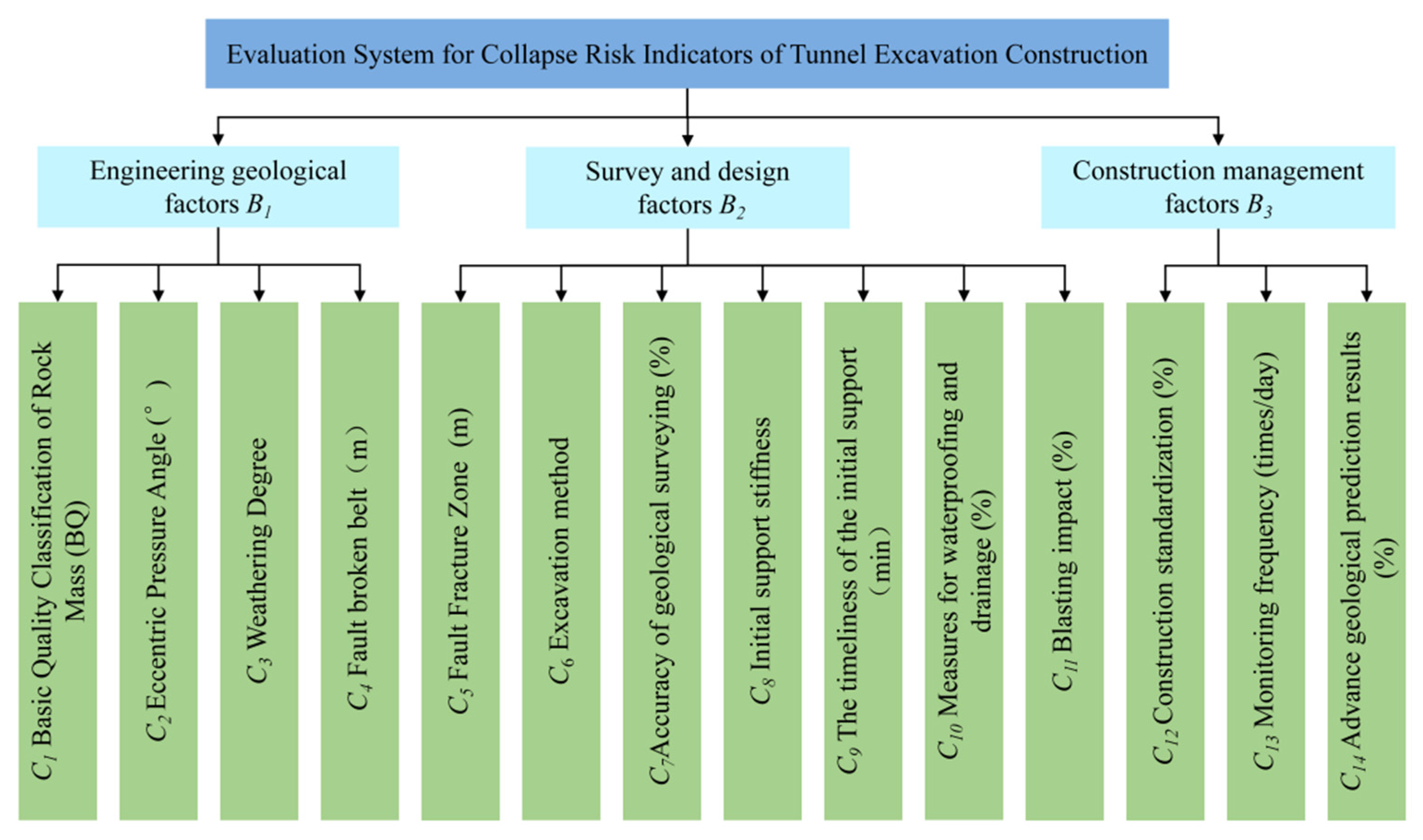
22] and field experience, this study summarizes three major categories of risk factors for highway tunnel construction, namely engineering geological factors, survey and design factors, and construction management factors, from a multi-objective perspective considering safety, environmental protection and cost, and integrates advanced geological prediction techniques to establish a risk assessment index system for collapse during highway tunnel entrance construction, as shown in
Figure 1.
2.2. Risk Level Classification Criteria
This paper refers to the research findings of relevant scholars [
11,
22,
23,
24,
25] and the special risk level standards in the “Guidelines for Safety Risk Assessment of Highway Bridges and Tunnels Engineering Design (Trial)” to divide the evaluation indicators into five risk levels: I (low), II (relatively low), III (medium), IV (high), and V (extremely high). In the prediction model, these levels are quantified as numerical values 1, 2, 3, 4, and 5, respectively. The grade divisions of each evaluation indicator are shown in
Table 1.
In practical tunnel safety management and risk assessment guidelines, geotechnical and construction-related indicators are commonly evaluated using discrete grades rather than raw continuous values. For example, the relevant tunnel design and construction specifications typically adopt four or five classes (e.g., “very low”, “low”, “medium”, “high” and “very high”) to describe hazard levels, surrounding rock quality and adverse geological conditions. To be consistent with these engineering practices and to facilitate expert scoring in real projects, the continuous or semi-continuous indicators in this study are mapped into five ordered levels from 1 to 5 according to the threshold values given in
Table 1. The thresholds for each indicator are not arbitrarily chosen; instead, they are determined with reference to existing design codes, empirical ranges from previous tunnel collapse case studies and expert consultation. In this way, each grade corresponds to a qualitatively different stability state or construction difficulty level that is meaningful for engineering decision-making.
It is acknowledged that discretizing continuous indicators into five integer levels inevitably reduces numerical resolution. However, the collapse risk levels themselves are defined on an ordinal five-grade scale (Levels I–V), and field assessments by engineers are usually made in terms of such qualitative grades rather than exact numerical values. Under the current sample size and data quality conditions, using a unified five-level discretization for the input indicators helps to reduce the impact of measurement noise and subjective variability in historical records, and improves the interpretability and comparability of the results across different projects. Moreover, the discretization is monotonic and preserves the ordinal structure of the indicators, so it does not artificially create separable clusters that do not exist in engineering reality; instead, it aligns the model input space with the way collapse risk is commonly assessed and communicated in practice.
2.3. Classification of Collapse Risk Levels
The risk of tunnel construction collapse mainly arises from the combined influence of the hazard and the probability of occurrence. Based on the severity of hazard and the probability of occurrence, this paper classifies the collapse risk of tunnel entrance construction into five risk levels. On the basis of referring to the research results of various scholars [
9,
10,
11,
26,
27], this paper establishes the classification standard for the risk levels of tunnel entrance construction collapse, as shown in
Table 2.
The database collected in this study consists of information from 100 tunnel construction sections, sourced from relevant literature [
10,
28,
29,
30,
31,
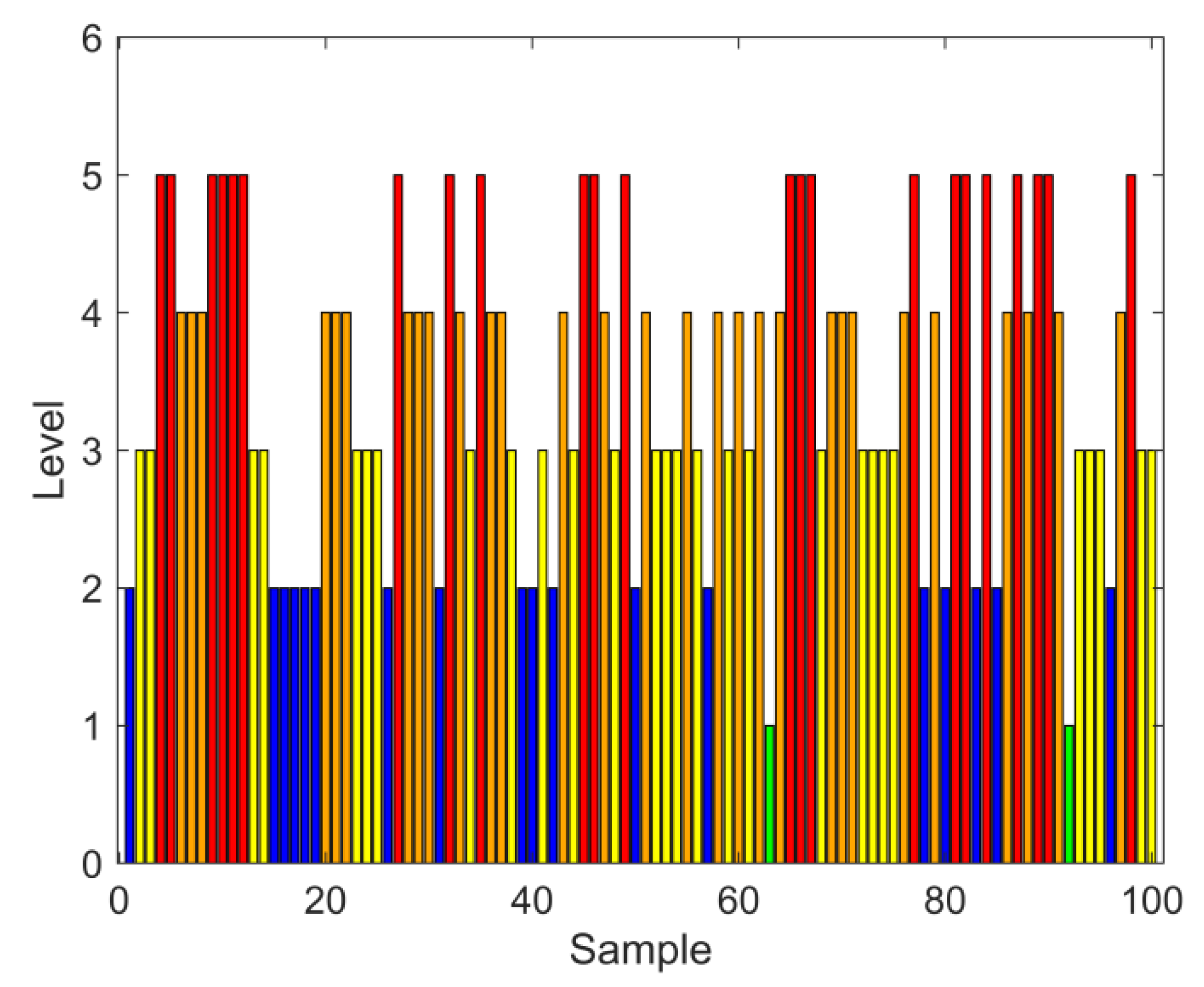
32] on tunnel collapses, public reports, and the tunnel construction sections encountered by the authors in their projects. According to this paper classified the 100 tunnel construction collapse sections collected into risk levels. Among them, there were 2 sections at risk level I, 18 at risk level II, 28 at risk level III, 29 at risk level IV, and 23 at risk level V. As shown in
Figure 2.
It should be noted, however, that the current database primarily includes cases of sections that have experienced collapses or were assessed as high-risk in construction reports, while long-term stable or non-collapsed tunnel sections are significantly underrepresented. Thus, these 100 sections form a collapse-prone sample set rather than a comprehensively balanced representation of tunnel working conditions. Moreover, the sections were collected from multiple mountainous highway tunnel projects rather than a single tunnel; several sections from the same tunnel may share similar geological and construction backgrounds. At this stage, we do not have access to a large-scale, systematically collected database of non-collapsed tunnels. Consequently, the model in this study was mainly trained and evaluated under collapse-prone scenarios, and its generalizability to ordinary low-risk tunnel sections remains uncertain. Therefore, the findings should be interpreted with caution.
Taking the fracture zone of a certain expressway tunnel as an example [
33,
34], the information of the tunnel construction section was sorted out and described, and the corresponding grades of each factor were determined, as shown in
Table 3. During the excavation process of this tunnel construction section, a collapse occurred, with a collapse volume of approximately 65 m
3. The collapse risk grade of this section was IV. When conducting data processing and analysis, 80 tunnel construction section data were taken as the learning sample, and 20 tunnel construction section data were taken as the test sample of the model.
3. Game Theory Combined Weighted Joint Cloud Model Hybrid-Driven Model
3.1. XGBOOST Algorithm
The XGBOOST algorithm is a boosting-based ensemble method. During the training process, new regression trees are successively added to learn and fit the residuals of the previous model, thereby forming strong learners for prediction. As shown in Formula (1): For a given dataset:
containing
n samples, the result is shown as Equation (1):
where
is the predicted values of the
i-th samples,
is the output of the weak learner in the
t-th round.
The objective function of XGBOOST consists of two distinct parts, representing the traditional loss function and the regularization term, respectively. The mathematical expression of the objective function of XGBOOST is shown as Equation (2):
where
l is the loss term of the
t-th round, Ω is the regularization term, and its mathematical expression is as shown in Equation (3):
where
T is the number of leaf nodes,
j is the corresponding weight of the leaf nodes, γ is the penalty factor for node partitioning, and
is the regularization coefficient.
In this study, collapse risk is represented as a five-class discrete label corresponding to risk levels I–V. Accordingly, the XGBOOST model is configured in multi-class classification mode, where the loss term in Equation (2) is specified as the multinomial logistic loss. For each tunnel section i and each risk level k, the model outputs the class probability via a softmax transformation, and the loss is defined as the negative log-likelihood of the true class. This setting ensures that the optimization objective is consistent with the final decision task, namely assigning each section to one of the five discrete collapse risk levels.
3.2. Improve the Whale Algorithm Optimization Model XGBOOST (WOA–XGB)
The Whale Optimization Algorithm (WOA) is a swarm intelligence optimization algorithm inspired by the hunting strategy of humpback whales. During the optimization process, the whale population searches for the global optimum through random exploration, while individual whales are attracted to the current best solution and encircle it. They update their positions by contracting the encircling region and performing spiral movements around the prey. Through iterative updates of the population, WOA gradually approaches the target prey and eventually obtains an approximate global optimum.
The prediction performance of XGBOOST mainly depends on several key hyperparameters, including the maximum tree depth (max_depth), minimum child weight (min_child_weight), gamma, subsample rate (subsample), column sampling rate (colsample_bytree), learning rate, and regularization coefficients [
14,
15]. In this study, the Whale Optimization Algorithm is employed to optimize these hyperparameters. The specific steps are as follows:
Step 1: Initialize the whale population and the maximum number of iterations in WOA, and set the search range for each XGBOOST hyperparameter.
Step 2: Input the training set data into the XGBOOST model and define the eight hyperparameters to be optimized by WOA (including the maximum tree depth, learning rate, subsample ratio, column sampling ratio, and regularization coefficients, etc.). For a given whale position (i.e., a specific hyperparameter combination), perform five-fold stratified cross-validation on the training set in multi-class classification mode.
Step 3: For each whale position, compute the classification performance on the validation folds and use the average macro-F1 score over the five folds as the fitness value. A higher macro-F1 score indicates better overall classification performance across the five risk levels, especially considering the imbalanced distribution among classes. The whale positions are updated iteratively according to the WOA updating rules, based on the current global and individual optima, until the termination criterion is met.
Step 4: When the iterations terminate, output the optimal whale position, which corresponds to the optimal set of XGBOOST hyperparameters.
Step 5: Input the optimal hyperparameters into the XGBOOST model and train the final WOA–XGB model, which is then used to simulate and evaluate the collapse risk of tunnel construction sections.
3.3. The G1 Method Determines the Subjective Weight of Each Index
The G1 Method (Precedence Relation Method) is an improved subjective assignment method based on the AHP method. Compared with the AHP method, the G1 method is more concise and efficient in calculation, and avoids the problem of consistency verification. The specific steps are as follows:
- (1)
Determine the precedence relation
Sort the evaluation indicators by their importance. If the importance of indicator
Yi is greater than that of
Yj, it is recorded as
Yi >
Yj. For t evaluation indicators, the precedence relation can be established as
H1 >
H2 > ⋯ >
Ht.
Hi is the
i-th indicator after establishing the precedence relation, and the precedence relation assignment reference is shown in
Table 4.
- (2)
Determine the importance ratio
After the precedence relation is determined, experts assign values to the importance of the evaluation indicators based on relevant standards and their own experience, as shown in Equation (4):
where
is the ratio of importance between
Ht−1 and
Hi,
[1.0, 2.0];
m is the number of evaluation indicators;
and
are the subjective weights of the
t-th and (
t − 1)-th indicators, respectively.
- (3)
Calculate the subjective weight of each index
Based on the assigned importance ratios, calculate the subjective weight
of the
t-th indicator: The subjective weights of the indicators can be obtained by Equation (5):
where
is the ratio of the importance degree of the evaluation indicators.
3.4. The Comprehensive Weight of Each Index Is Determined Based on the Game Theory Method
Game theory, as a branch of modern mathematics, focuses on analyzing the interaction mechanisms and mathematical models of competitive decision-making behaviors. Its core value lies in revealing the strategic interdependence relationships among multiple decision-making entities. However, in traditional weight allocation models, negative weight anomalies often occur, resulting in distorted evaluation results. To address this issue, a combined game-theory-based optimization strategy has been constructed, which achieves dual improvements by integrating subjective and objective constraints; it not only enhances the coordination of the index system but also enables dynamic adaptation to changes in index attributes, ensuring the robustness of the evaluation system even when parameters fluctuate. The specific steps are as follows:
Step 1: Calculate the weights of the indicators by using method
S, and construct the set of indicator weights vectors, as shown in Equation (6):
where
n is the number of evaluation indicators. Then, any linear combination of these
S vectors can be obtained by Equation (7):
Step 2: By seeking a balance among various weighting methods, the optimal weight combination coefficients are determined. Assuming that there exists a most satisfactory linear combination coefficient
, which can minimize the deviation between
and
, thereby achieving the balance among the
S weights, the optimization function can be obtained from Equation (8):
After solving, the optimal combination coefficient = (1, 2, L) can be obtained.
Step 3: Solve for the comprehensive weight. The normalization processing of the optimal combination coefficient can be obtained from Equation (9):
The final comprehensive weight can be obtained from Equation (10):
3.5. Risk Size Is Determined Based on the Cloud Model
- (1)
Determine the standard cloud
The tunnel collapse risk level is divided into five rating intervals I–V on the continuous risk axis [0, 10], namely I [0, 2), II [2, 4), III [4, 6), IV [6, 8) and V [8, 10), corresponding to “safe”, “relatively safe”, “moderately safe”, “relatively dangerous” and “dangerous”, respectively. For each risk level, a standard cloud is constructed on the basis of the corresponding interval. The cloud characteristic parameters
of each risk level are obtained by the following Equation (11):
where
and
are the lower and upper bounds of the corresponding risk interval;
is the expectation, representing the most typical value of the risk level;
is the entropy, characterizing the fuzziness and randomness of the risk level; and
is the hyper-entropy, reflecting the uncertainty of the entropy itself. The coefficient
is a dimensionless constant that describes the linear relationship between entropy and hyper-entropy.
In the classical cloud model theory,
is usually chosen within a small interval (e.g., 0.01–0.1) to obtain clouds with a moderate “thickness” that neither collapse into an excessively sharp membership curve nor become overly diffuse. In this study,
is set to 0.05 following common practice in cloud model applications, so that the hyper-entropy is 5% of the entropy. This choice yields standard clouds with smooth and gradually overlapping membership distributions between adjacent risk levels, which is consistent with the engineering understanding that the boundaries between different collapse risk levels are gradual rather than abrupt. The standard cloud parameters computed from Equation (11) for the five risk levels are summarized in
Table 5.
- (2)
Stability of the backward cloud generator
In the risk evaluation process, the backward cloud generator is used to estimate the cloud characteristic parameters of the comprehensive risk level from the simulated cloud drops. To ensure that the numerical implementation of the cloud generator is stable, the standard forward and backward cloud generators are adopted, and a sufficiently large number of cloud drops is generated in each simulation so that the statistical estimates of and converge. Under the setting = 0.05 and with the adopted number of cloud drops, the regenerated cloud parameters fluctuate only slightly around the theoretical values given by Equation (11), and the shapes of the corresponding cloud maps remain smooth and consistent across repeated simulations. Therefore, the multi-step application of the backward cloud generator in this study does not introduce noticeable numerical instability and can be considered stable for the purpose of engineering risk assessment.
- (3)
Calculate the cloud parameters of the indicators
Based on the index scores, the
,
and
of each index are obtained through the backward cloud generator. To ensure that 4 (that is,
−
) does not appear less than 0 and make the cloud model more stable, the multi-step backward cloud transformation algorithm as shown in the following Equation (12) is adopted:
- (4)
Compute the integrated cloud parameters
Using the comprehensive cloud algorithm, and comprehensively considering the correlation between each index, combined with the index cloud parameters and combination weights of each index, the comprehensive cloud parameters (
Ex,
En,
He) are calculated and summarized according to Equation (13):
where
n is the number of indicators,
Wj is the combined weight of the indicator, and (
,
,
) are the cloud parameters of each indicator.
- (5)
Similarity calculation
The calculation of similarity between the cloud model and the standard cloud model is shown in Equation (14):
where
is the degree of certainty;
is the average degree of certainty.
- (6)
Validation against engineering judgment
To verify that the constructed standard clouds and the resulting comprehensive risk clouds are consistent with engineering judgment, the cloud-based risk evaluation results are compared with expert assessments and with the classification outputs of the WOA–XGBOOST model. As discussed in
Section 5, for the two typical tunnel sections where collapse accidents have occurred, the risk levels obtained from the comprehensive cloud model are in good agreement with both the expert-evaluated risk grades and the predicted grades of the WOA–XGBOOST model. This consistency indicates that the selected cloud parameters and membership distributions are reasonable from an engineering perspective and that the cloud model can provide a meaningful representation of the fuzziness and uncertainty in tunnel collapse risk assessment.
3.6. Model Evaluation Process
The overall model evaluation process is organized as follows:
Step 1: Construct the risk evaluation index system for collapse during the construction of tunnel entrances in mountainous highway tunnels. Based on the hazard level and occurrence probability, the collapse risk during tunnel construction is divided into five grades, and the corresponding risk classification standards are established.
Step 2: Take the 14 secondary indicators as feature variables and the overall collapse risk of the tunnel as the dependent variable. Perform discretization processing on the collected information from 100 tunnel construction sections according to the classification criteria.
Step 3: Optimize the eight key hyperparameters of the XGBOOST model using the Whale Optimization Algorithm. During this process, five-fold stratified cross-validation is performed on the 80 training samples in multi-class classification mode, and the average macro-F1 score over the five folds is used as the fitness function to guide the WOA search. After convergence, the selected hyperparameters are further evaluated on both the cross-validation folds and the independent 20-sample test set using accuracy, macro-F1, and per-class recall and precision.
Step 4: Select a specific mountainous highway tunnel as the engineering case. Determine the subjective weights of the indicators using the G1 method and combine them with the objective weights obtained from the trained WOA–XGB model. Calculate the comprehensive weights based on game theory and obtain the cloud model parameters of the collapse risk for the tunnel.
Step 5: Evaluate the comprehensive collapse risk of the tunnel entrance construction using the cloud model, draw the comprehensive evaluation cloud map, and compare it with the standard cloud map to visually display the risk distribution characteristics.
Step 6: Finally, select two typical sections where collapse accidents have occurred and perform risk level prediction to further verify the validity and reliability of the proposed model.
4. Model Establishment and Optimization
Based on the indicator system in
Table 1, information from 100 tunnel construction sections was collected, including the specific values of the secondary indicators under each of the engineering geological factors, survey and design factors, and construction management factors. The risk grading of both conditional attributes and the decision attribute (overall collapse risk) was then carried out according to the classification criteria. The risk levels I, II, III, IV and V are quantified as the numerical values 1, 2, 3, 4 and 5 for discretization processing.
Since each secondary indicator is correlated with tunnel construction collapse, the Spearman correlation coefficient matrix [
34] is used to analyze the correlation between each indicator and the collapse risk level. As shown in
Figure 3, absolute values within the range of 0–0.2 indicate extremely weak correlation, 0.2–0.4 weak correlation, 0.4–0.6 medium correlation, 0.6–0.8 strong correlation and 0.8–1.0 extremely strong correlation. It can be seen that indicator C5 (excavation span) has the highest correlation with the risk level, while indicator C10 (waterproof and drainage measures) has the lowest correlation. Overall, the obtained correlations are consistent with engineering experience, which indirectly verifies the rationality of the discretization processing of each indicator.
In addition to the decision attribute, the 14 secondary indicators are also expressed by discrete scores from 1 to 5, following the classification thresholds in
Table 1. Although this discretization inevitably compresses the original numerical variability of some geophysical and construction indicators, it can be viewed as a form of regularization under the current small-sample setting. By avoiding spurious numerical precision that is not supported by the limited and partly subjective case data, the five-level scores help to stabilize the model training process and to prevent the learning algorithm from overfitting to minor fluctuations in the raw measurements. At the same time, the discrete scores remain closely aligned with the engineering meaning of the indicator grades and with the five-class risk levels to be predicted.
For model development, the 100 sections were randomly divided into 80 training samples and 20 testing samples. To mitigate the impact of class imbalance when forming the two subsets, stratified sampling according to the five risk levels (I–V) was adopted, so that the relative proportions of each risk level in the training and testing sets are approximately consistent with those of the full database. This strategy preserves the original distribution of collapse risk levels while reducing sampling bias caused by random splitting on such a small dataset.
4.1. Optimization Setting of the Model Parameters
In this paper, the WOA–XGBOOST hybrid model is developed by integrating WOA with XGBOOST. The WOA is employed to optimize the hyperparameters of XGBOOST, thereby enhancing the model’s prediction efficiency. Specifically, this study focuses on optimizing eight critical parameters of the XGBOOST model using the WOA. These parameters, including maximum tree depth (max_depth), minimum leaf weight (min_child_weight), minimum loss reduction threshold (gamma), subsample ratio (subsample), column sample rate (colsample_bytree), learning rate (eta), L2 regularization term (lambda), and L1 regularization term (alpha), play a significant role in determining the model’s performance. By leveraging the WOA optimization algorithm, the optimal values for these parameters can be efficiently identified, leading to improved model performance and accuracy. Detailed parameter information is presented in
Table 6.
It should be noted that the optimal hyperparameters obtained by WOA (e.g., a moderate maximum tree depth, an intermediate learning rate, subsample and colsample_bytree values smaller than 1.0, and non-zero L1 and L2 regularization coefficients) lie well within the predefined search ranges in
Table 6 and do not correspond to excessively deep trees or vanishing regularization. In other words, the optimized WOA–XGBOOST model represents a moderately complex ensemble with explicit regularization, rather than an extremely over-parameterized model. Combined with the cross-validation and test results in
Section 4.2 and
Section 4.3, where the performance remains highly consistent across different folds and on the independent test set, these observations suggest that the chosen hyperparameter configuration is reasonable and that the risk of severe overfitting is effectively mitigated under the current data conditions. WOA iteration curve as shown in
Figure 4.
4.2. Optimize the Results
Based on the parameter ranges in
Table 6, the WOA–XGBOOST model was trained and evaluated using five-fold stratified cross-validation on the 80 training samples. For each whale position, the average macro-F1 score over the five folds was computed as the fitness value, and the whale population was iteratively updated until convergence.
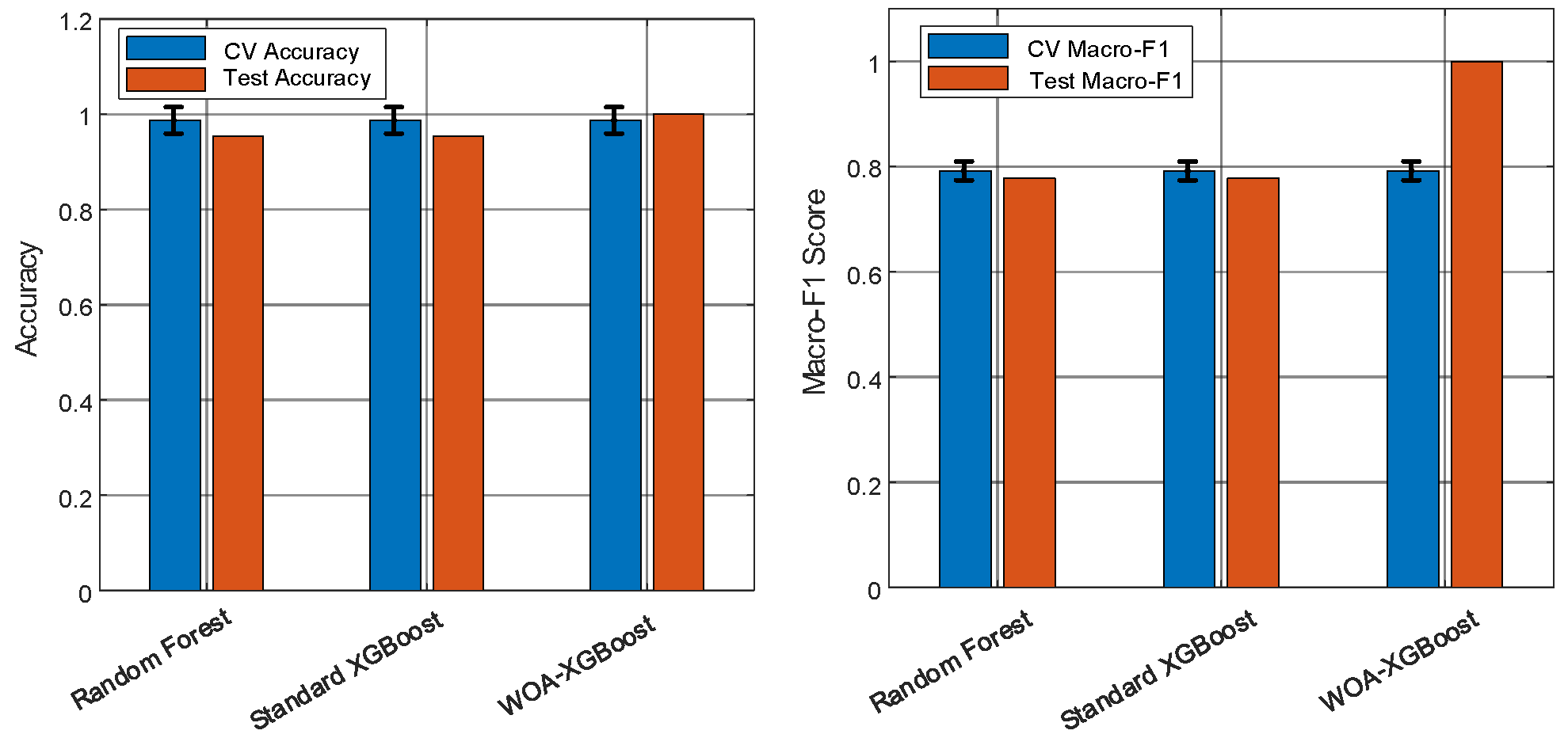
Table 7 summarizes the cross-validation performance of the three models. All three models, namely Random Forest, standard XGBOOST, and WOA–XGBOOST, achieve a very high mean cross-validation accuracy of 0.9875 with a relatively small standard deviation of approximately 0.0280. The mean macro-F1 score of each model reaches about 0.7920 with a standard deviation of approximately 0.0179. These results indicate that, under the current indicator system and discretized risk levels, tree-based ensemble models can effectively learn the mapping from input indicators to collapse risk levels on the available training data.
After the optimization stage, the XGBOOST model with the best hyperparameters obtained by WOA was retrained on the full training set and then evaluated on the independent 20-sample test set.
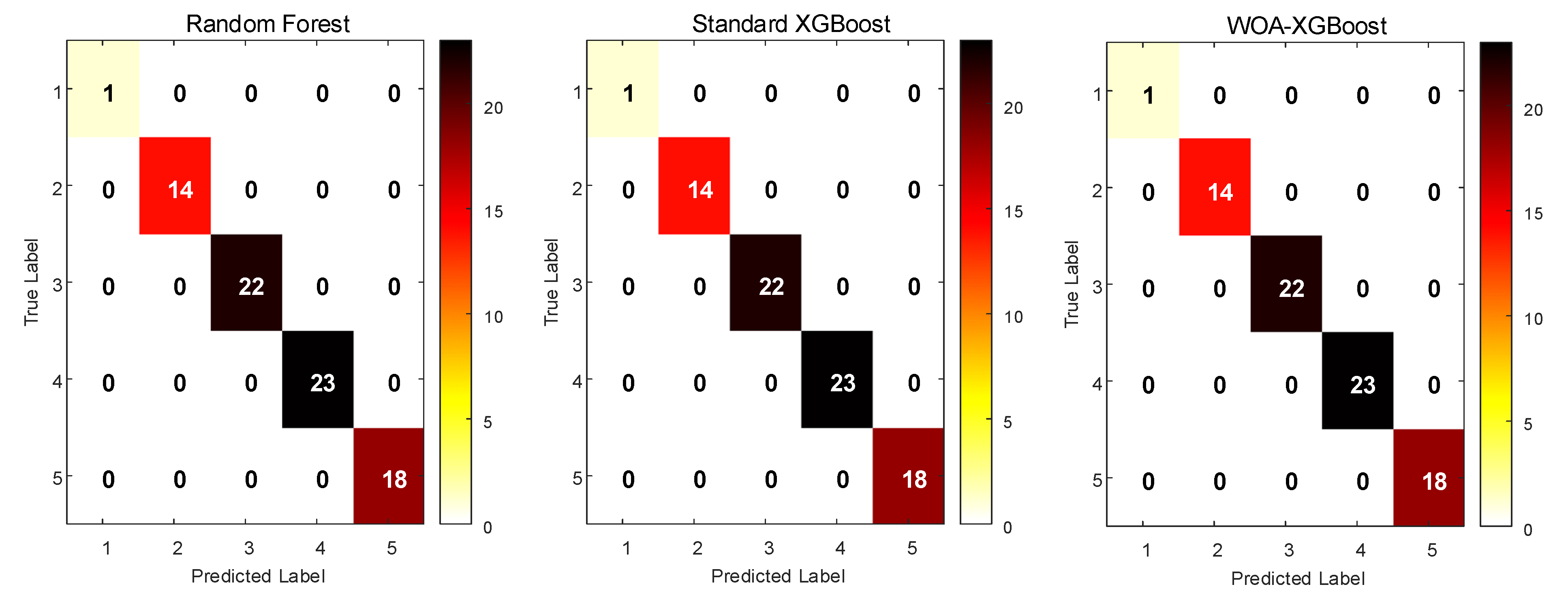
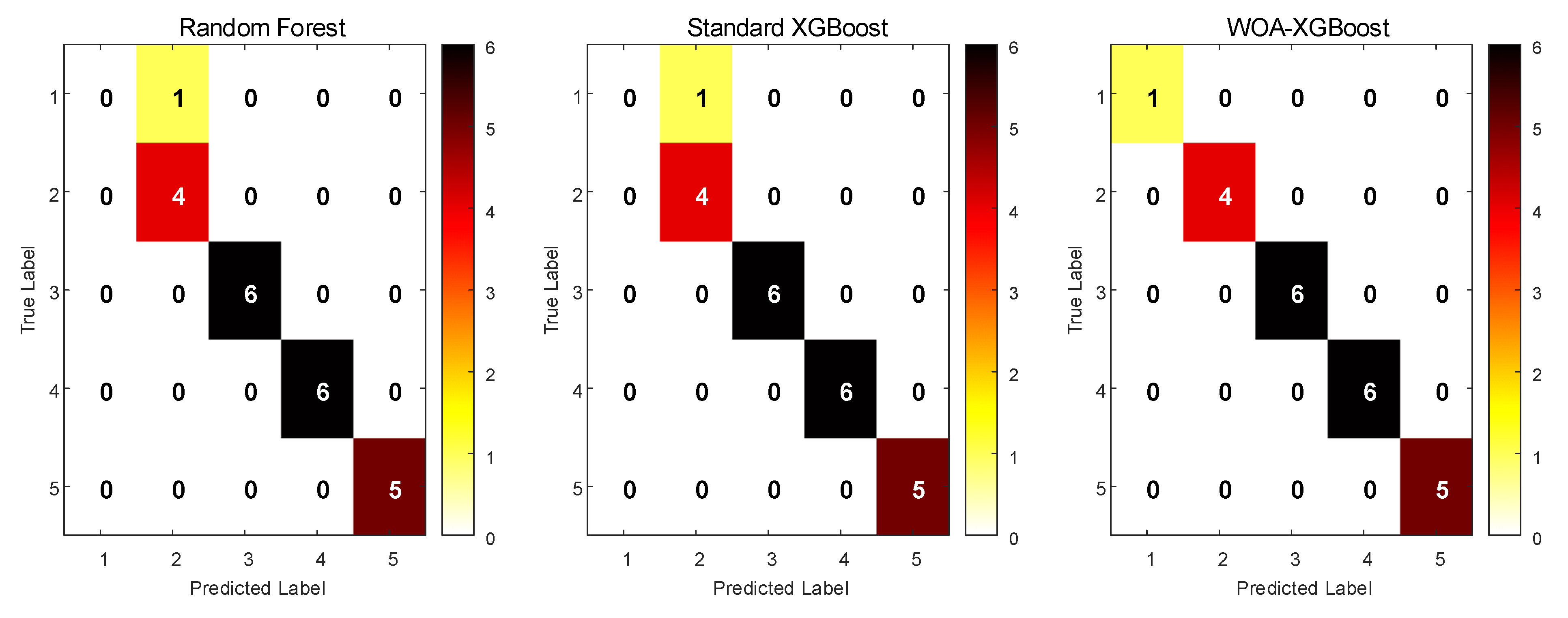
Figure 5 and
Figure 6 show the confusion matrices for the training set and the test set, respectively. As reported in
Figure 7, both the Random Forest model and the standard XGBOOST model achieve a test accuracy of 0.9545 and a test macro-F1 of 0.7778, while the proposed WOA–XGBOOST model attains a test accuracy of 1.0000 and a test macro-F1 of 1.0000, i.e., it correctly predicts the risk levels of all 20 test samples. These results demonstrate that the WOA–XGBOOST model not only maintains excellent performance under cross-validation, but also exhibits the best generalization performance on the independent test set among the three models.
It should be emphasized, however, that the sample size is very small and the test set contains only 20 sections. In such a setting, even a single misclassification would noticeably change the numerical values of accuracy and macro-F1. Therefore, the nearly perfect performance observed in both cross-validation and test-set evaluation should be interpreted with caution and regarded as preliminary evidence of the feasibility and potential of the proposed hybrid model rather than as definitive proof of its generalizability to all tunnel projects.
4.3. Comparison with Baseline Models
To further evaluate the effectiveness of the proposed WOA–XGBOOST model, two baseline models were implemented for comparison, namely a standard XGBOOST model with default hyperparameters and a Random Forest classifier. All models were trained on the same 80 training samples and evaluated using five-fold stratified cross-validation and the independent 20-sample test set. For a fair comparison, the same input indicators and collapse risk labels were used, and the performance metrics included overall accuracy and macro-F1 score. The results are summarized in
Table 7.
As shown in
Table 7, all three models achieve similarly high performance under cross-validation, with a mean accuracy of 0.9875 and a mean macro-F1 of 0.7920. This indicates that, for the current indicator system and discretized risk levels, tree-based ensemble methods can effectively capture the relationship between the geotechnical and construction indicators and the collapse risk levels. On the independent test set, both the Random Forest model and the standard XGBOOST model obtain an accuracy of 0.9545 and a macro-F1 of 0.7778, whereas the proposed WOA–XGBOOST model achieves a test accuracy of 1.0000 and a test macro-F1 of 1.0000. In other words, WOA–XGBOOST correctly predicts the risk levels of all test samples, outperforming the baseline models in terms of both accuracy and macro-F1 on the test set.
Combining the cross-validation and test results, it can be concluded that the WOA–XGBOOST model yields performance that is at least comparable to the baseline tree-based models in terms of average cross-validation metrics and provides the best generalization performance on the independent test set for this collapse-prone dataset. Nevertheless, given the limited number of samples and the small size of the test set, the apparent performance differences among the models should be interpreted cautiously, and additional validation on larger and more diverse datasets is still required.
5. Verification of Engineering Cases
5.1. Case Overview
A mountainous road tunnel [
35,
36] is a left-right separated structure with a two-way, four-lane pavement. The maximum span of the inner contour reaches 11.6 m, and one pedestrian cross-passage is installed. The tunnel site is located in a medium-low mountainous area, with ground elevations ranging from 530 to 1260 m. The bedrock exposure on the slopes is poor, and the surface is covered by Quaternary slope alluvium and residual soil layers. The annual average rainfall ranges between 1460 and 1580 mm, with the rainy season occurring from February to September, during which geological disasters are more likely to occur. This study focuses on the right tunnel, whose entrance and exit sections have shallow burial depths and are subject to strong terrain-induced bias pressure. Additionally, the cover layer and fully/strongly weathered rock layers are thick, resulting in low roof strength and poor stability. After excavation, the arch and side walls are prone to collapse.
5.2. Determination of the Evaluation Index Weight
Ten experts with extensive experience in tunnel safety assessment were invited to first rank the importance of collapse risks during tunnel entrance construction. The expert scoring process was conducted anonymously, and no personal data, identifiable information or sensitive details about the participants were collected. As this study focused solely on professional opinions and did not involve human subjects or private information, ethical approval was deemed unnecessary in accordance with institutional guidelines.
Based on the G1 method and Equations (4) and (5), the subjective weights were determined, as shown in
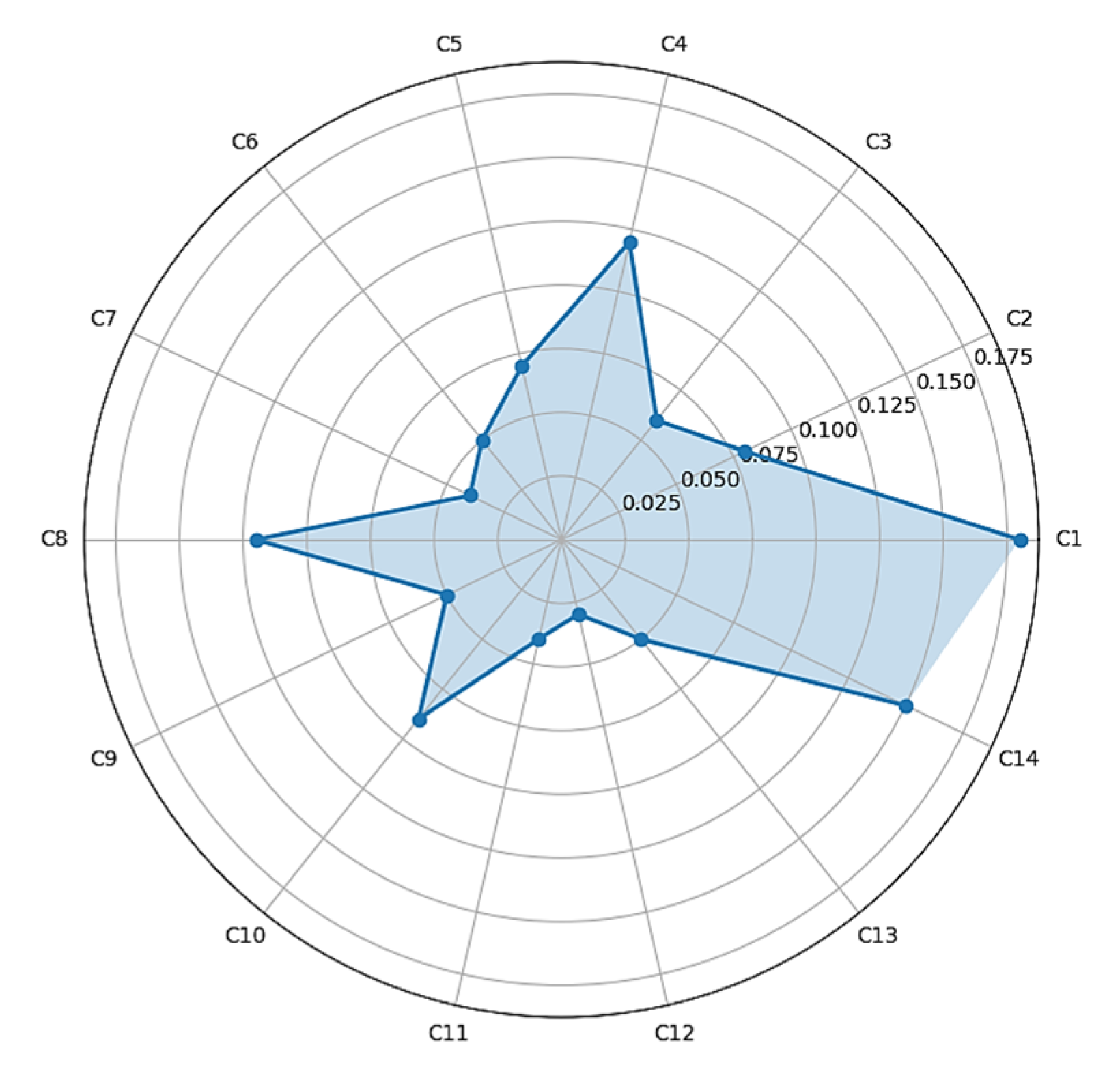
Figure 8. Using the WOA–XGB model, the initial weight distribution of 14 input variables was obtained during the sample learning process. The weights of the 14 evaluation indicators (C1–C14) were then calculated based on this distribution. Combining game theory principles and Equations (6)–(10), the combination coefficients
1 and
2 were calculated as 0.57 and 0.43, respectively. The comprehensive weights are presented in
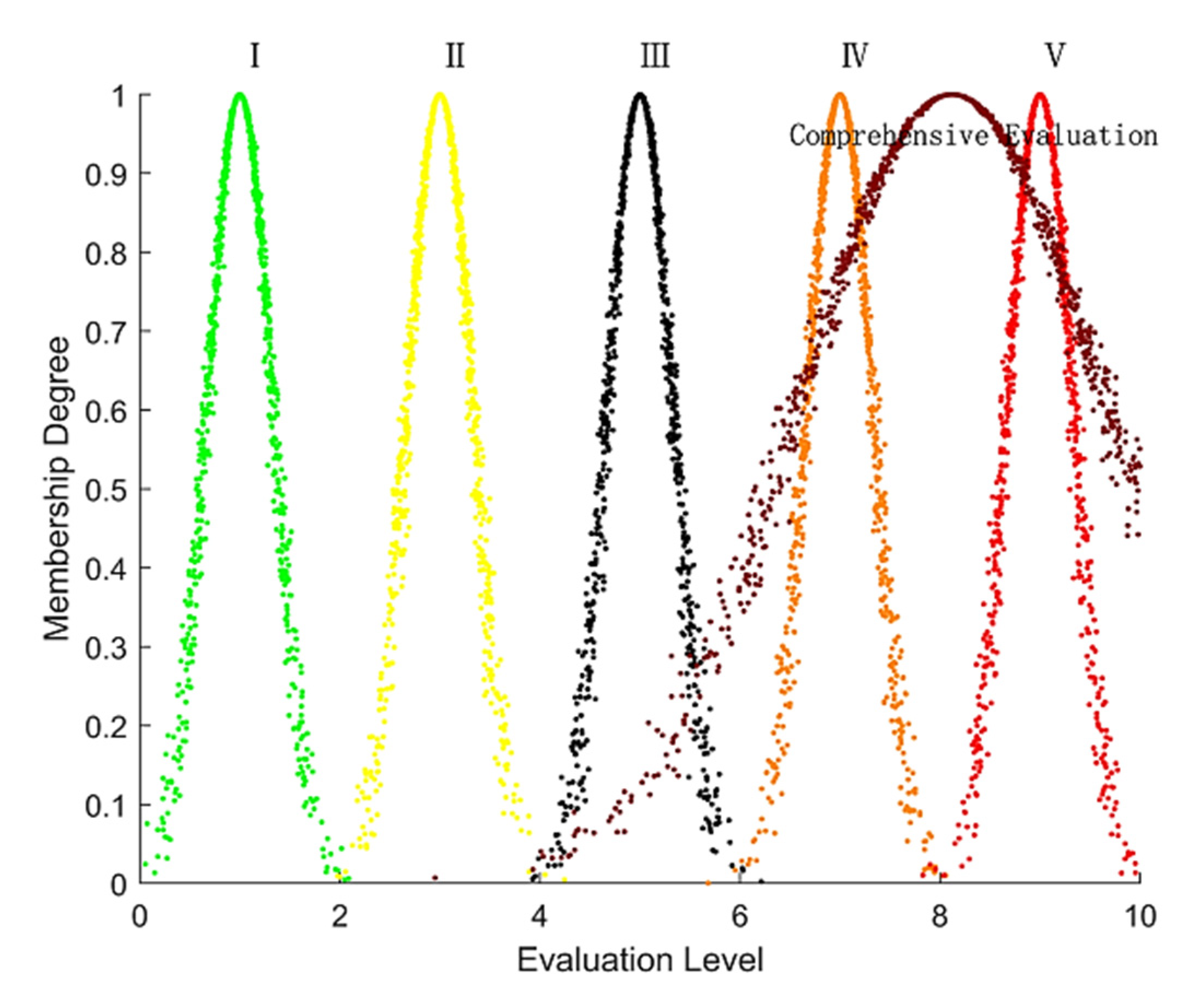
Table 8. Based on the tunnel entrance construction collapse risk assessment report, the scores provided by the 10 experts were comprehensively analyzed, and Formula (12) was used to calculate the cloud digital characteristic parameters for each evaluation indicator. Finally, using Formula (13), the comprehensive cloud model digital characteristics for tunnel entrance construction were determined as (8.12, 1.54, 0.08).
From the comprehensive weights it can be seen that indicators such as C1 (basic quality classification of rock mass), C5 (excavation span) and C14 (advance geological prediction results) receive relatively high combined weights, whereas indicators such as C10 (measures for waterproofing and drainage) are assigned comparatively lower weights. This ranking is consistent with engineering experience, which recognizes surrounding rock quality, excavation span and adverse geological prediction results as primary drivers of collapse risk, while the influence of waterproofing and drainage measures on immediate collapse at the tunnel entrance is generally secondary. In addition, a simple one-at-a-time sensitivity analysis shows that, for representative tunnel sections, the predicted risk level increases monotonically when the scores of key indicators (e.g., C1, C5 and C14) deteriorate from Level I to Level V, whereas variations in less important indicators such as C10 produce much smaller changes in the predicted risk. These monotonic and physically reasonable trends indicate that the model has learned an interpretable mapping from the input indicators to the collapse risk levels that is consistent with engineering understanding.
5.3. Tunnel Risk Determination Based on the Cloud Model
A reference diagram for evaluating the collapse risk of tunnel entrance construction using the standard cloud model was constructed based on Equation (11) with
k = 0.05. The comprehensive evaluation cloud map was then plotted and compared with the standard cloud map. According to Formula (14), the similarity of the comprehensive risk is 0.882, indicating a dangerous state. The results are presented in
Figure 9. By analyzing the cloud distribution of the collapse risk during tunnel entrance construction, it can be observed that during the construction of this tunnel, the expected comprehensive risk Ex approaches the high-risk interval (8–10), suggesting a relatively high overall safety risk for the tunnel. The En value is moderately large, reflecting significant variations in risk distribution across different sections of the tunnel (e.g., fractured zones versus stable surrounding rock sections) or discrepancies in evaluation results due to the superposition of multiple factors (e.g., collapse, water inrush, and overburden pressure) within the same section. The He value is extremely low, indicating that despite variations in risk distribution (En = 1.54), there is high consistency in the evaluation method and expert opinions, thus ensuring strong data credibility.
Due to the geological structure of this tunnel, the rock mass exhibits extreme fragmentation (fractured structure), which aligns with the high Ex value. Hydrological conditions are characterized by a prolonged rainy season (May to September) and substantial annual rainfall, exacerbating the risks of water gushing and mud surging. The terrain is subject to compression, with thick overburden layers at the entrance and exit sections as well as fully weathered zones, leading to instability risks in the lateral walls during construction (supported by the Ex value). The right tunnel line encompasses diverse rock types (diorite, diabase) and structural planes (joint fissures, low-resistance zones), resulting in an expanded evaluation range for surrounding rock stability. The risk levels vary significantly across different sections, consistent with the discrete characteristic of En = 1.54.
5.4. Risk Determination of Tunnel Section Based on WOA–XGBOOST Model
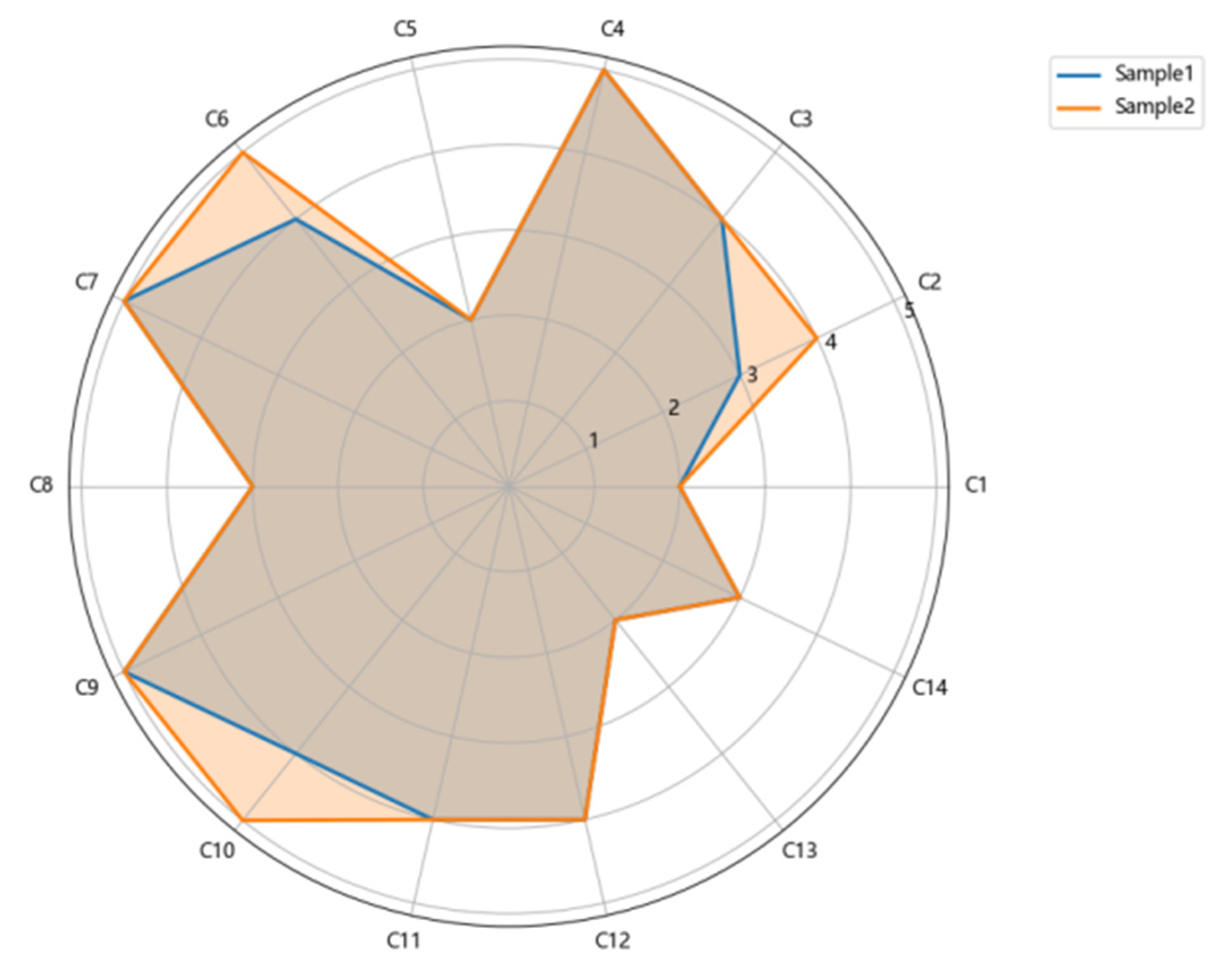
To validate the model’s effectiveness, two typical sections where tunnel collapse accidents occurred were selected for predicting the risk levels of tunnel collapse. Both accident sections were located in areas with unfavorable geological conditions. Based on the risk classification standard for tunnel cave-ins during entry construction presented in this paper, the risks of the two selected tunnel sections were categorized, and data preprocessing was performed. Specifically, accident Section 1 was designated as sample 1, and accident Section 2 as sample 2, as shown in
Figure 10.
By inputting the preprocessed data from
Figure 10 into the collapse risk prediction model for tunnel entrance construction developed in this study, a risk level prediction analysis was performed for the two tunnel sections. The validation results show that the predicted risk levels of the two sections are Level IV for Section 1 and Level V for Section 2, respectively, which are largely consistent with the actual risk levels. It can be observed that for the two selected sections where sudden water gushing accidents occurred, the predicted risk levels were largely consistent with the actual risk levels, indicating that the overall performance of the model is satisfactory.
Although the two sections differ slightly in some indicator values, there is one mismatch in the detailed comparison: the actual risk level of Section 1 is Grade V, whereas the model prediction is Grade IV. The main reason for this might be that the lithology of the strata, adverse geological conditions, dip angle of the rock layer, and surrounding rock grade all reach relatively high levels, leading the model to classify the section as high risk but not at the very highest grade. Nevertheless, the fact that the section did experience a collapse accident shows that the model provides a conservative and practically useful warning; no “high prediction but low actual” situation occurs. Overall, the model can accurately predict the collapse risk of tunnel entrance construction.
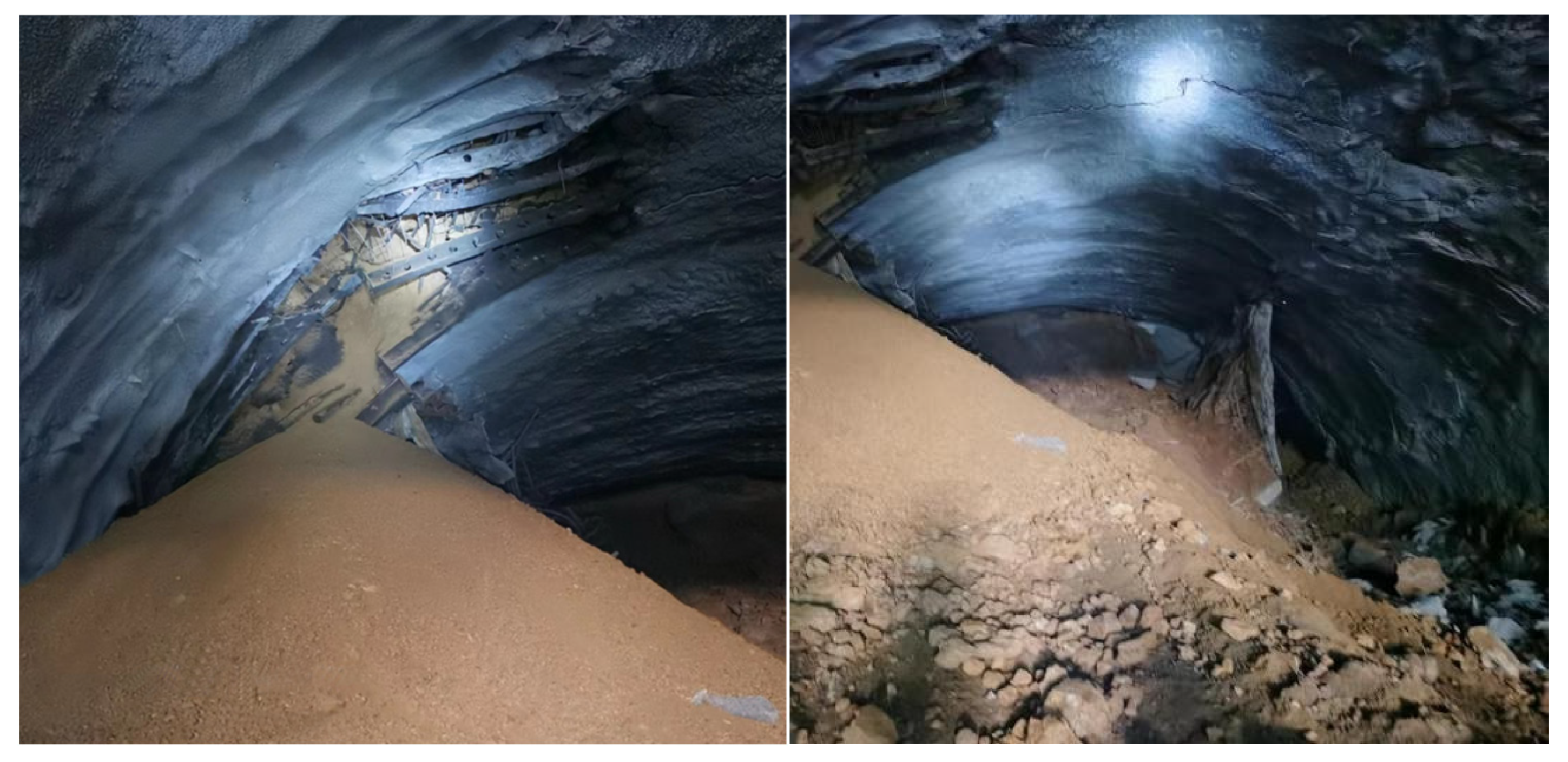
Cross-section 1 of the accident has well-developed joints and fissures, and the rock mass is relatively fragmented, presenting an interlocking and fragmented structure. After excavation, it is prone to collapse and rock fall. At the same time, it has experienced sudden water- and mud-gushing phenomena, as shown in the
Figure 11. Cross-section 2 of the accident is a fractured zone of faults. Drilling revealed that the rock mass in this section is in a state of typical to extreme fragmentation. The rock mass presents a fragmented structure, and geophysical exploration revealed that this section is a low-resistance zone. After excavation, a collapse disaster occurred, as shown in
Figure 11.
6. Discussion
Traditional theoretical methods have achieved some success in predicting tunnel construction collapses; however, they are highly subjective and exhibit poor applicability with certain limitations. In recent years, with the continuous advancement of machine learning technologies, intelligent prediction has gradually become a critical approach for predicting tunnel construction collapses. XGBOOST (Extreme Gradient Boosting), an efficient and widely adopted gradient boosting decision tree (GBDT) algorithm, employs a forward distribution algorithm for greedy learning. It reduces the residual between predicted results and real samples through multiple iterations to achieve fitting outcomes. The XGBOOST model introduces several optimizations to GBDT by expanding the cost function using a second-order Taylor series and adding regularization terms to the cost function. This enhances model accuracy while mitigating overfitting caused by excessive complexity. Nevertheless, due to the multi-factor coupling triggering effects of tunnel construction collapse risks and the discrete feature values among various indicators, the prediction accuracy of a single machine learning model for tunnel entrance construction collapse risks remains suboptimal.
To develop a high-accuracy, high-stability, and high-robustness tunnel entrance construction collapse risk prediction model, this paper proposes a risk assessment framework for weak surrounding rock tunnel entrances based on the WOA–XGBOOST hybrid model and game theory combined with a cloud model. The WOA–XGBOOST hybrid model analyzes the influence of evaluation indicators on collapse risk through collected samples. The G1 method treats the research object as a system and makes decisions via decomposition, comparison, judgment and comprehensive reasoning. Thus, the algorithm model and the G1 method are used to assign subjective and objective weights to the tunnel risk indicators under evaluation, while game theory adjusts these weights to obtain comprehensive weights, enhancing the scientific nature of index weighting. By comparing the risk levels determined by the cloud model with those predicted by the WOA–XGBOOST model, the accuracy and effectiveness of the model predictions are verified. Ultimately, this achieves more precise prediction of collapse disaster risks during mountainous highway tunnel entrance construction.
Overall, the proposed WOA–XGBOOST model, together with the other tree-based ensemble models, achieves very high predictive performance on the available dataset, with cross-validation accuracy close to 99% and test accuracy above 95%. This suggests that the constructed indicator system and the adopted machine learning framework are capable of effectively characterizing tunnel collapse risk under the current data conditions. However, the nearly perfect performance is also partly related to the small and biased sample set, and therefore should be interpreted as preliminary evidence of feasibility rather than as definitive proof of generalizable performance across all tunnel projects.
Nevertheless, it should also be noted that, although the present framework combines a metaheuristic optimizer (WOA) with a tree-based ensemble model (XGBOOST), it is still a single-model ensemble in nature and does not yet exploit the full potential of dynamic ensemble-learning strategies. Recent developments such as MOS-ML and DE-ML have shown that dynamically combining multiple base learners and jointly optimizing their hyperparameters can further enhance predictive performance and robustness when large and diverse datasets are available. Given the limited and collapse-prone dataset used in this study, the current WOA–XGBOOST model is a pragmatic choice that balances interpretability and data requirements. In future work, once a larger and more comprehensive tunnel risk database has been established, the proposed framework could be extended toward a dynamic ensemble ML architecture inspired by MOS-ML and DE-ML to further improve risk prediction and decision support.
7. Limitations
Due to the difficulty in acquiring detailed tunnel accident records and the challenges associated with data collection and statistics, the number of cases in this study is relatively limited, with only 100 tunnel construction sections included. More importantly, the collected cases predominantly consist of sections that have already collapsed or have been judged as high-risk, while information on long-term stable or non-collapsed tunnels is scarce. As a result, the current database should be regarded as a collapse-prone sample set, and the model performance reported in this paper mainly reflects its behavior within such scenarios. This sampling bias may cause an overestimation of collapse risks and makes the generalizability of the model to ordinary, low-risk tunnel projects uncertain.
In future research, efforts should focus on further enriching the case database by systematically collecting more tunnel sections that did not collapse and by collaborating with owners and contractors to obtain long-term monitoring data from normal operations. In addition, recent studies have shown that synthetic data generation and data augmentation techniques can help alleviate sample imbalance in reliability and risk assessment. Incorporating such techniques to generate additional low-risk and non-collapsed tunnel samples is a promising direction to reduce sampling bias and more comprehensively evaluate the robustness of the proposed model.
Although this study has achieved promising results, several other limitations remain. The current work still relies on a relatively simple hybrid modeling framework and a static dataset. Future research will therefore concentrate on the following directions: (1) further expanding and diversifying the case database, especially by increasing the number of non-collapsed and low-risk tunnel sections to improve the comprehensiveness and accuracy of the model; (2) exploring the integration of more advanced intelligent algorithms with traditional risk assessment methods to develop a dynamic risk assessment and early-warning system for tunnel construction, thereby advancing the informatization and intelligence level of tunnel construction safety management; and (3) developing, in conjunction with actual engineering requirements, a tunnel construction risk visualization platform to provide more intuitive and practical decision-support tools for engineers and project managers.
Another limitation lies in the discretization of continuous or quasi-continuous indicators into five integer levels. While this design choice follows current engineering practice and enhances interpretability and robustness for small and noisy datasets, it may also smooth out local variations that could be informative for collapse prediction. In future work, it would be useful to compare the present five-level discretization scheme with alternative representations, such as using raw continuous indicators or finer-grained ordinal scales, and to investigate whether the main conclusions of this study remain robust under different input encodings.
8. Conclusions
This paper focuses on the issue of tunnel collapse during the construction of mountainous highway tunnels. By collecting and analyzing accident cases, a risk assessment model for tunnel collapse during the initial construction phase is established based on the WOA–XGBOOST algorithm. This model achieves rapid and accurate assessment of tunnel collapse risks by fully leveraging the value of engineering data. The model’s performance is evaluated using various classification effect assessment indicators and confusion matrices, leading to the following main conclusions:
By comprehensively considering engineering geological factors, survey and design factors, and construction management factors, 14 secondary indicators are selected to construct a comprehensive risk assessment index system for tunnel collapse during the initial construction phase. Clear classification standards are defined for each indicator. This system can comprehensively cover the primary risk factors in the tunnel construction process, providing a scientific basis for subsequent risk assessments.
Subjective weights of each indicator are determined using the G1 method, and combined with objective weights obtained from the WOA–XGBOOST model, comprehensive weights are optimized through game theory. This approach not only incorporates the subjective experience of experts but also fully utilizes data-driven objective information, effectively enhancing the scientificity and rationality of the indicator weights while overcoming the limitations of single weighting methods.
The model’s performance on the training set, cross-validation folds and test set is evaluated using confusion matrices, accuracy, macro-F1 and other indicators. Within the available database of 100 tunnel construction sections, all three tree-based ensemble models achieve cross-validation accuracy close to 99% and macro-F1 around 0.79, while the test accuracy of the proposed WOA–XGBOOST model reaches 1.0000 with a test macro-F1 of 1.0000. This indicates that the WOA–XGBOOST model can provide highly accurate collapse risk predictions on the current sample set and slightly outperforms the baseline models on the independent test set. Nevertheless, due to the limited and collapse-prone nature of the dataset, these performance figures should still be regarded as preliminary, and further validation on larger and more balanced datasets is required.
Tunnel risk levels are quantitatively evaluated using the cloud model, and risk distribution characteristics are visually presented through cloud diagrams. This method effectively addresses the fuzziness and uncertainty inherent in risk assessment, providing visual support for tunnel construction risk decision-making.





 ,
,