Methodological Applicability of Ultra-Low Background Liquid Scintillation Counters in Low-Level Tritium Measurement
Abstract
1. Introduction
2. Materials and Methods
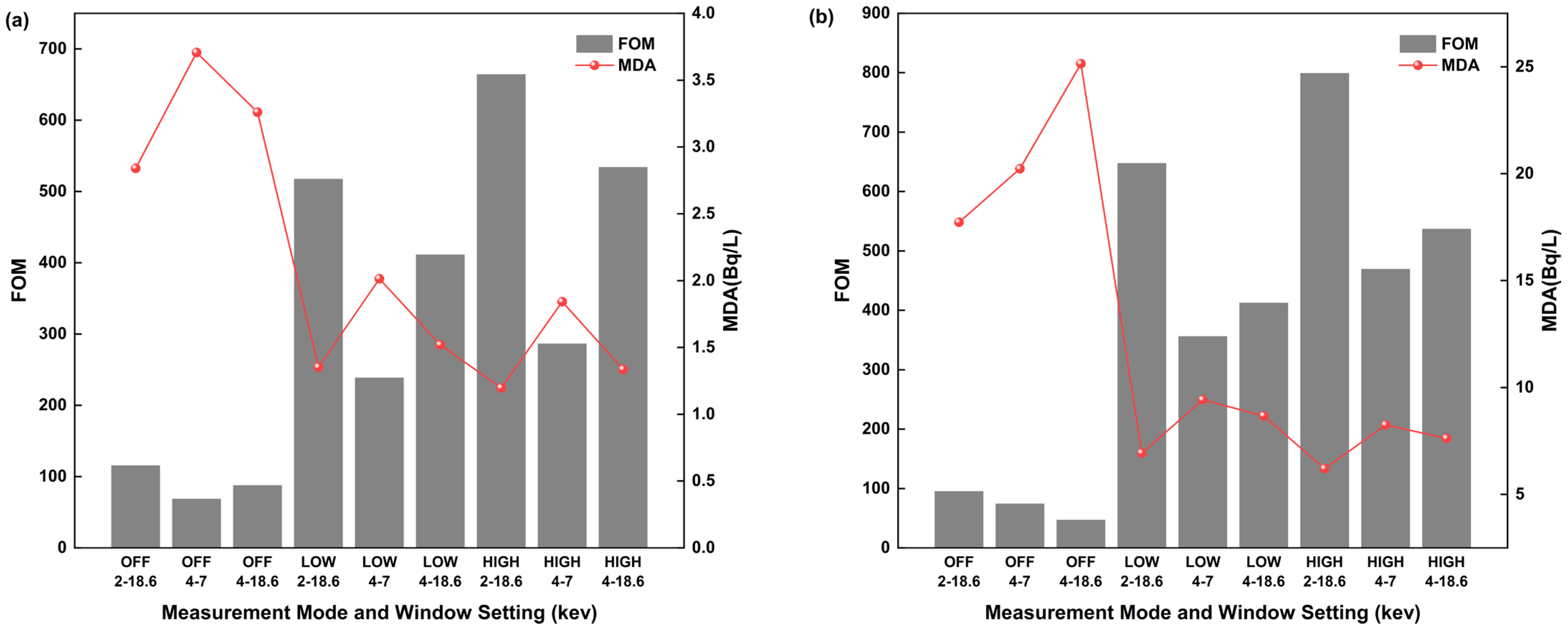
- Introduction of different quench conditions: by varying the sample-to-cocktail ratios (1:9 and 2:3), two categories of conditions—“low quench” and “high quench”—were established to simulate the differences in quenching levels found in real environmental samples and to evaluate the applicability of the methods.
- Methodological comparison: the relative measurement method and the internal standard method were employed to analyze the applicability of different approaches under varying quench conditions.
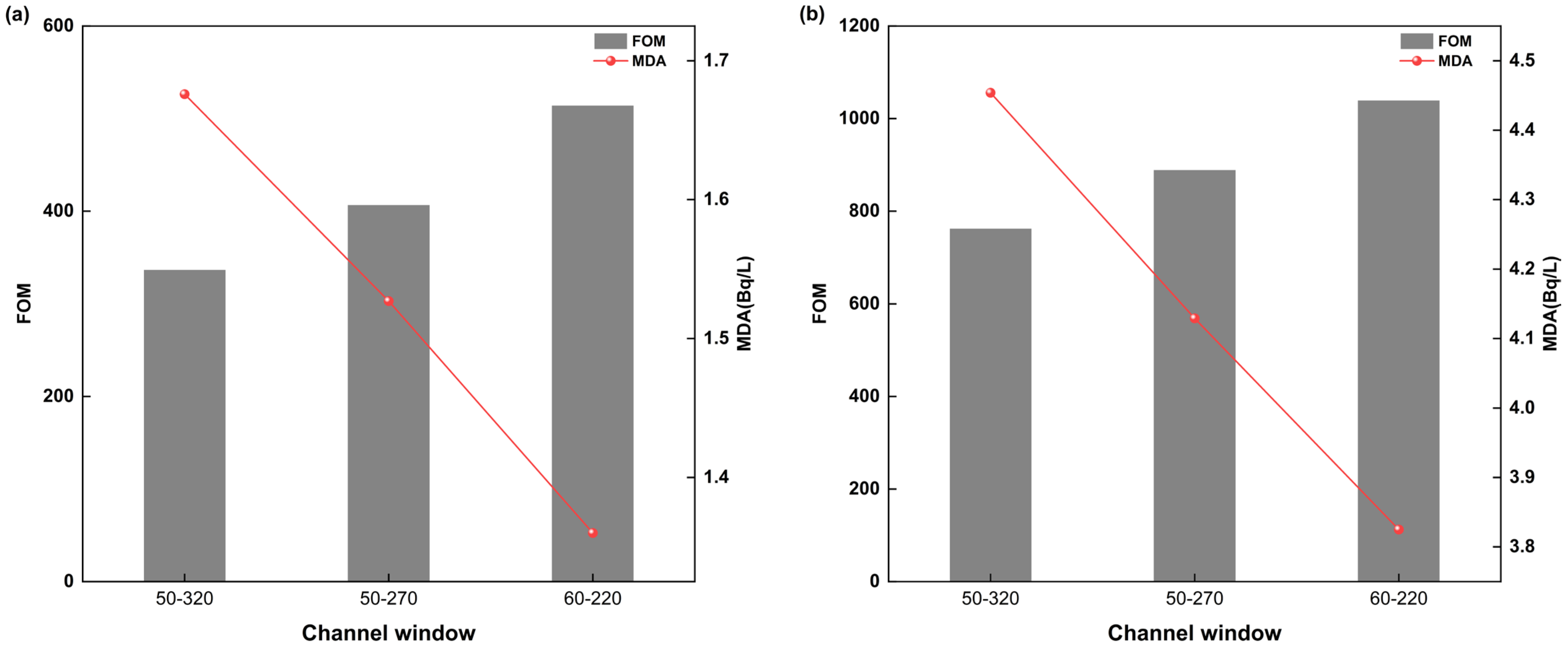
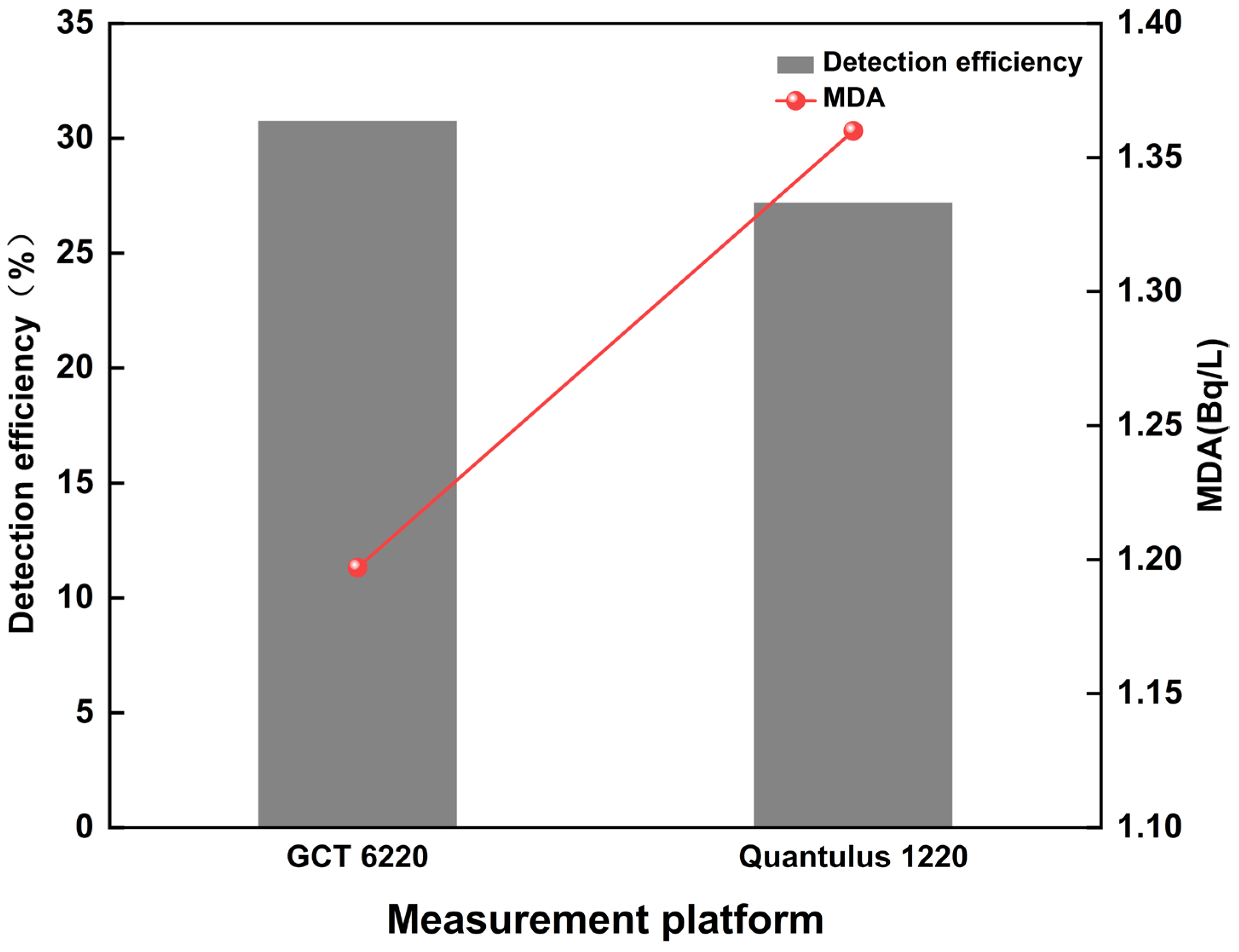
- Performance evaluation: the detection performance under different conditions was comprehensively assessed using three indicators—detection efficiency (Eff), minimum detectable activity (MDA), and figure of merit (FOM).
2.1. Instruments and Experimental Environment
2.2. Samples and Materials
2.3. Methods
2.3.1. Relative Measurement
2.3.2. Internal Standard Method
2.3.3. Uncertainty Evaluation
3. Results and Discussion
3.1. Region of Interest (ROI)
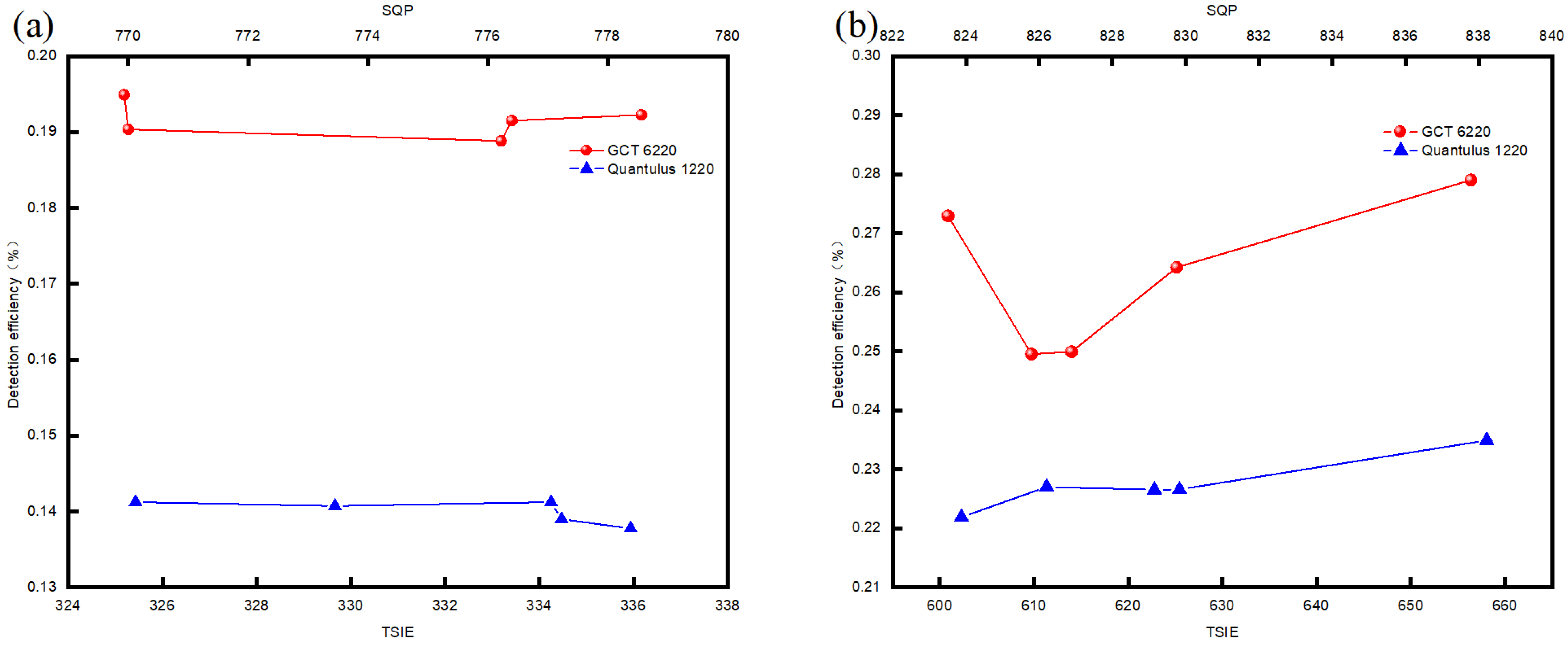
3.1.1. Optimization Results of GCT 6220
3.1.2. Optimization Results of Quantulus 1220
3.2. Evaluation of the Relative Measurement Method
3.3. Evaluation of the Internal Standard Method
3.4. Summary and Discussion
4. Conclusions
- Under high-quench conditions using the relative measurement method, the GCT 6220 platform outperformed the Quantulus 1220 in terms of combined indicators of efficiency, background, and detection limit, characterized by a lower minimum detectable activity and a higher figure of merit.
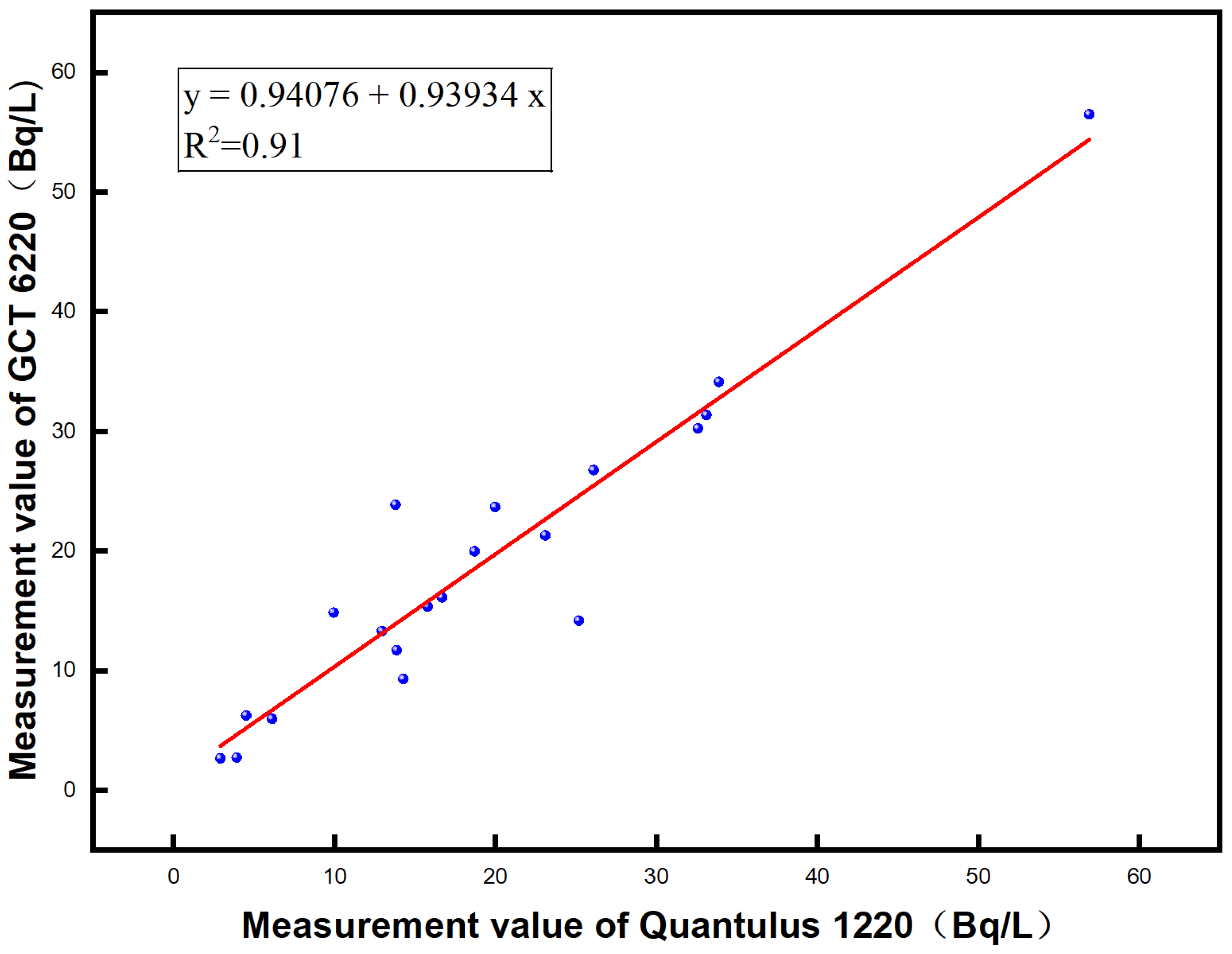
- Under high-quench conditions using the relative measurement method, the measurements from the two platforms showed linear consistency (R2 = 0.90), suggesting the potential for aligning results through a linear model, though its robustness requires further verification across broader quench ranges and additional parameter settings.
- Under low-quench conditions using the internal standard method, the efficiency–quench relationship of the Quantulus 1220 platform was smoother, with more stable results and smaller deviations, making it more suitable for applications that rely on quench correction.
Supplementary Materials
Author Contributions
Funding
Institutional Review Board Statement
Informed Consent Statement
Data Availability Statement
Acknowledgments
Conflicts of Interest
References
- Hou, X. Liquid scintillation counting for determination of radionuclides in environmental and nuclear application. J. Radioanal. Nucl. Chem. 2018, 318, 1597–1628. [Google Scholar] [CrossRef]
- Zhang, L.; Wang, Y.; Liu, F.L. Changes in 3H concentration in atmospheric precipitation in China over the past two decades. South-to-North Water Transf. Water Sci. Technol. 2008, 6, 94–96. [Google Scholar] [CrossRef]
- Ducros, L.; Eyrolle, F.; Della Vedova, C.; Charmasson, S.; Leblanc, M.; Mayer, A.; Babic, M.; Antonelli, C.; Mourier, D.; Giner, F. Tritium in river waters from French Mediterranean catchments: Background levels and variability. Sci. Total Environ. 2018, 612, 672–682. [Google Scholar] [CrossRef]
- Charles, M. UNSCEAR Report 2000: Sources and Effects of Ionizing Radiation. J. Radiol. Prot. 2001, 21, 83–85. [Google Scholar] [CrossRef] [PubMed]
- Investigation of the Environmental Fate of 3H in the Atmosphere: Part of the 3H Studies Project; Canadian Nuclear Safety Commission: Ottawa, ON, Canada, 2009.
- Boyer, C.; Vichot, L.; Fromm, M.; Losset, Y.; Tatin-Froux, F.; Guétat, P.; Badot, P.M. Tritium in plants: A review of current knowledge. Environ. Exp. Bot. 2009, 67, 34–51. [Google Scholar] [CrossRef]
- Okada, S.; Momoshima, N. Overview of 3H. Health Phys. 1993, 65, 595–609. [Google Scholar] [CrossRef] [PubMed]
- Winslow, S.D.; Pepich, B.V.; Bassett, M.V.; Wendelken, S.C.; Munch, D.J.; Sinclair, J.L. Microbial Inhibitors for, U.S. EPA Drinking Water Methods for the Determination of Organic Compounds. Environ. Sci. Technol. 2001, 35, 4103–4110. [Google Scholar] [CrossRef]
- Li, X.S.; Han, G.; Lu, X.J. Comparison of TDCR and ESCR methods for liquid scintillation measurement of 3H activity. Shanghai Meas. Test. (In Chinese). 2020, 47, 8–10. [Google Scholar]
- PerkinElmer. 1220 Quantulus Ultra Low Level Liquid Scintillation Spectrometer Manual; PerkinElmer: Turku, Finland, 2002. [Google Scholar]
- PerkinElmer. Tri-Carb 4910TR Liquid Scintillation Counter Manual; PerkinElmer: Waltham, MA, USA, 2015. [Google Scholar]
- Pujol, L.L.; Sanchez-Cabeza, J.A. Optimisation of liquid scintillation counting conditions for rapid 3H determination in aqueous samples. J. Radioanal. Nucl. Chem. 1999, 242, 391–398. [Google Scholar] [CrossRef]
- Edler, R.H.W. Measurement of 3H, gross α/β and 222Rn in drinking water using the new Quantulus GCT 6220. J. Radioanal. Nucl. Chem. 2017, 314, 695–699. [Google Scholar] [CrossRef]
- García-León, J.L.; García-León, M.; Manjón, G. Comparison of the performance of the Quantulus GCT 6220 and the Quantulus 1220 for the determination of 55Fe and 63Ni. Radiat. Phys. Chem. 2025, 233, 112704. [Google Scholar] [CrossRef]
- Feng, X.; Jiang, G.; Huang, J.; Du, J.; He, Q.; Wang, J.; Chen, J. A performance comparison of two kinds of liquid scintillation counters from PerkinElmer, Inc. J. Radioanal. Nucl. Chem. 2017, 314, 629–635. [Google Scholar] [CrossRef]
- Ling, A.C. Applications of liquid scintillation counting (Horrocks, Donald L.). J. Chem. Educ. 1975, 52, A360. [Google Scholar] [CrossRef][Green Version]
- Duliu, O.G.; Varlam, C.; Shnawaw, M.D. 18 years of continuous observation of 3H and atmospheric precipitations in Ramnicu Valcea (Romania): A time series analysis. J. Environ. Radioact. 2018, 190–191, 105–110. [Google Scholar] [CrossRef]
- Jin, L.Y. Measurement of Organically Bound 3H (OBT) in Plant Samples Around Nuclear Facilities. Master’s Thesis, East China University of Technology, Nanchang, China, 2017. [Google Scholar]
- Cho, S.; Kim, B.-C.; Kim, M.J.; Lee, K.B.; Park, Y.J.; Heo, D.H.; Kim, T.H.; Lee, J.-M. Study on the Quench Curve for Low-Level 3H Measurement Using a Liquid Scintillation Counter. J. Nucl. Fuel Cycle Waste Technol. (JNFCWT) 2024, 22, 441–449. [Google Scholar] [CrossRef]
- Piraner, O.; Button, J.; Ward, C.D.; Valentin-Blasini, L. Investigation of select radionuclides stability in urine under various conditions for liquid scintillation counting (LSC). J. Radioanal. Nucl. Chem. 2024, 333, 2115–2120. [Google Scholar] [CrossRef] [PubMed]
- Mao, J.; Chen, L.; Xia, W.; Gong, J.; Chen, J.; Liang, C. Measurement Techniques for Low-Concentration 3H Radiation in Water: Review and Prospects. Sensors 2024, 24, 5722. [Google Scholar] [CrossRef]
- García-León, J.L.; García-León, M.; Manjón, G.; Rivera-Silva, J. Optimization of a new liquid scintillation spectrometer for the measurement of environmental levels of 3H in water samples. J. Environ. Radioact. 2024, 277, 107465. [Google Scholar] [CrossRef] [PubMed]
- Currie, L.A. Limits for qualitative detection and quantitative determination. Application to radiochemistry. Anal. Chem. 1968, 40, 586–593. [Google Scholar] [CrossRef]
- Jakonić, I.; Nikolov, J.; Todorović, N.; Tenjović, B.; Vesković, M. Study on quench effects in liquid scintillation counting during 3H measurements. J. Radioanal. Nucl. Chem. 2014, 302, 253–259. [Google Scholar] [CrossRef]
- Piraner, O.; Jones, R.L. Limit of detection comparison on urine gross alpha/beta, H-3, and P-32 analysis between different liquid scintillation counters. J. Radioanal. Nucl. Chem. 2021, 330, 381–384. [Google Scholar] [CrossRef] [PubMed]


Disclaimer/Publisher’s Note: The statements, opinions and data contained in all publications are solely those of the individual author(s) and contributor(s) and not of MDPI and/or the editor(s). MDPI and/or the editor(s) disclaim responsibility for any injury to people or property resulting from any ideas, methods, instructions or products referred to in the content. |
© 2025 by the authors. Licensee MDPI, Basel, Switzerland. This article is an open access article distributed under the terms and conditions of the Creative Commons Attribution (CC BY) license (https://creativecommons.org/licenses/by/4.0/).
Share and Cite
Li, H.-Y.; Shan, J.; Zhang, H.; Yang, H.; Wei, N.-N. Methodological Applicability of Ultra-Low Background Liquid Scintillation Counters in Low-Level Tritium Measurement. Appl. Sci. 2025, 15, 13168. https://doi.org/10.3390/app152413168
Li H-Y, Shan J, Zhang H, Yang H, Wei N-N. Methodological Applicability of Ultra-Low Background Liquid Scintillation Counters in Low-Level Tritium Measurement. Applied Sciences. 2025; 15(24):13168. https://doi.org/10.3390/app152413168
Chicago/Turabian StyleLi, Hong-Yi, Jian Shan, Hao Zhang, Hui Yang, and Nan-Nan Wei. 2025. "Methodological Applicability of Ultra-Low Background Liquid Scintillation Counters in Low-Level Tritium Measurement" Applied Sciences 15, no. 24: 13168. https://doi.org/10.3390/app152413168
APA StyleLi, H.-Y., Shan, J., Zhang, H., Yang, H., & Wei, N.-N. (2025). Methodological Applicability of Ultra-Low Background Liquid Scintillation Counters in Low-Level Tritium Measurement. Applied Sciences, 15(24), 13168. https://doi.org/10.3390/app152413168