


Abstract
As global infrastructure systems face increasing environmental, social, and operational challenges, enhancing their resilience through digital and intelligent technologies has become a strategic priority. Digital Twin (DT) and Artificial Intelligence (AI) technologies offer transformative capabilities for monitoring, predicting, and optimizing infrastructure performance under stress. However, research on their integration within resilience frameworks remains fragmented. This study presents a comprehensive bibliometric analysis to clarify how DT and AI are being applied to strengthen infrastructure resilience (IR). Using data exclusively from the Web of Science (WoS) database, co-occurrence and overlay visualizations were employed to map thematic structures, identify research clusters, and track emerging trends. The analysis revealed six interconnected research domains linking DT, AI, and resilience, including artificial intelligence and industrial applications, digital twins and machine learning, cyber–physical systems, smart cities and sustainability, data-driven resilience modeling, and methodological frameworks. Overlay mapping revealed a temporal shift from early work on sensors and cyber–physical systems toward integrated, sustainability-oriented applications, including predictive maintenance, urban digital twins, and environmental resilience. The findings underscore the need for adaptive and interoperable DT ecosystems incorporating AI-driven analytics, ethical data governance, and sustainability metrics, providing a unified foundation for advancing resilient and intelligent infrastructure systems.
1. Introduction
Extreme weather, aging assets, connections between digital and physical systems, and intensifying population demands are stressing infrastructure systems beyond the design assumptions of many older infrastructures. As a result, development of civil infrastructures with the capacity to prepare for hazards, absorb disturbances, recover functionality, and adapt has become a governing objective across transportation, energy, water, and the built environment [1]. Foundational frameworks define resilience not merely as a system’s ability to resist failure but as a dynamic, time-dependent performance process encompassing degradation and recovery stages following disruption [2,3]. This conceptualization is often represented through the resilience triangle, a graphical model first introduced in seismic risk research and later generalized to lifeline systems and community resilience studies [4].
Over the past decade, digital twin (DT) technologies have evolved into data-driven virtual models that mirror real-world systems, supporting predictive maintenance, scenario analysis, and coordinated infrastructure management [5,6]. Governance initiatives, such as the UK’s Gemini Principles and the National Digital Twin Programme, have articulated ethics, trust, interoperability, and public value requirements for DT ecosystems, shifting focus from single-asset models toward federated, multi-scale twins that inform resilience decisions [7]. Recent urban and transportation studies demonstrate how DTs integrate heterogeneous sensing and simulation to test disruption scenarios, plan recovery, and optimize operations under uncertainty [8,9]. However, these implementations remain fragmented, characterized by inconsistent data curation, limited interoperability, and uneven integration with resilience metrics [10].
In parallel, artificial intelligence (AI), including machine learning (ML) and deep learning, has advanced rapidly to detect patterns, forecast failures, and learn adaptive policies in complex infrastructure networks [11]. Recent studies have highlighted AI’s expanding role in forecasting disruptions, planning repairs, and optimizing resources, demonstrating benefits in reducing losses and improving recovery when applied to resilience planning [12]. At the network level, graph neural networks (GNNs) have emerged as powerful tools for capturing spatiotemporal dependencies, identifying critical nodes and links, and approximating computationally expensive reliability or recovery simulations, enhancing the scalability of resilience analyses [13].
Despite this momentum, ensuring that AI models perform reliably across different infrastructure networks while remaining explainable, data-efficient, and physically consistent remains a significant research focus [14]. Earlier models of interdependent infrastructures, such as input–output, agent-based, and network approaches, provided valuable insights but were developed before the emergence of DT- and AI-based modeling [15,16]. Moreover, metrics used to evaluate resilience (e.g., loss of functionality over time, recovery time, redundancy, and socio-economic consequences) are not consistently aligned with objectives optimized by AI-enabled digital twins [15,17]. A systematic synthesis is therefore needed to map main research themes, emerging topics, and future directions.
This systematic review presents an integrated knowledge map of the burgeoning field of resilient infrastructure, with a focus on the transformative role of DT and AI. The review connects DT and AI advancements with established resilience frameworks, categorizes AI models by function and scale, examines methodologies for measuring resilience, and identifies key systemic challenges such as data sharing, cybersecurity, and scalability. The study provides a strategic roadmap for advancing both research and practice toward resilient, data-driven infrastructures that are supported by the integration of DT and AI.
2. Literature Review
2.1. Digital Twin (DT) for Infrastructure Resilience
The concept of the Digital Twin (DT) originated in aerospace and manufacturing but has expanded rapidly into infrastructure management and urban systems [18,19]. DT is a virtual model that mirrors the behavior and condition of a physical asset or system in real time through data from sensors and other digital sources [5]. This continuous harmonization allows engineers and planners to analyze performance, predict failures, and test recovery strategies before they occur [8,20].
In infrastructure resilience, DTs are vital for understanding responses to extreme events, disruptions, and long-term stresses. They provide dynamic platforms for simulating the impacts of hazards, assessing service continuity, and planning rapid recovery actions [21,22]. Examples include ports and water networks using DTs to track conditions, run “what-if” analyses, and develop contingency plans under uncertainty [21,22].
Challenges include fragmented data ownership, limited interoperability, and a focus on individual assets rather than multi-infrastructure systems [10,23]. Scalability and governance issues, such as cybersecurity, privacy, and standardized resilience metrics, remain significant barriers [5,21]. Therefore, DTs must be better connected with resilience frameworks and policy objectives for practical, scalable, and wide-impact implementation [16].
2.2. AI and ML in Resilience Modeling
Artificial Intelligence (AI) and Machine Learning (ML) are transforming the way resilience is modeled in infrastructure systems. These technologies can process large datasets to recognize patterns, predict failures, and optimize decisions under uncertainty [11]. Unlike traditional models with static assumptions, AI and ML enable dynamic, data-driven analysis that evolves with new information [6].
AI functions in resilience modeling include:
- ▪
- Predictive algorithms: forecast risks, identifying infrastructure most likely to fail during floods or earthquakes [24].
- ▪
- Diagnostic models: detect damage or performance degradation via sensor data and remote monitoring [25].
- ▪
- Optimization algorithms: facilitate repair scheduling and resource allocation to restore critical services efficiently [26].
Integrating AI into resilience planning reduces losses and shortens recovery times, enhancing adaptability and cost-effectiveness [27]. Graph Neural Networks (GNNs) represent an advanced AI approach for modeling interdependencies in networked infrastructures, enabling simulations of cascading failures or the optimization of recovery routes [13,20].
Challenges include model generalization, interpretability, and physical consistency [22,23]. Many AI systems remain opaque, offering limited insight into their decision-making processes. Future research should focus on transparency, grounding AI in real-world principles, and ensuring reliability for resilience planning.
2.3. Integration of Digital Twin and AI for Resilient Infrastructure
The integration of DT and AI offers a transformative approach to intelligent, adaptive, and resilient infrastructure. DTs create real-time digital replicas of physical systems, while AI provides analytical and predictive power to interpret data and support decision-making [18,19]. Combined, DT-AI systems enable continuous monitoring, automatic fault detection, and adaptive responses during disruptions [8,12].
Practical examples include AI-driven DTs for urban water distribution networks enabling predictive control and faster recovery [21], and DT-AI platforms in ports and transportation supporting real-time disruption management [20,22]. Dui et al. [21] developed a DT-based resilience evaluation and intelligent control system for urban water distribution. The system integrates real-time sensor data (flow rates, pressure readings, pump status) into a continuously synchronized hydraulic model of the network. Artificial intelligence played a central role in leak detection and anomaly diagnosis using ML-trained classification models, predictive failure detection with LSTM networks that forecast pump degradation several hours before failure, and reinforcement learning algorithms that recommended optimal valve operations during disruptions [21]. The combined DT–AI platform successfully reduced diagnostic delay, improved water pressure stability, and shortened recovery time during simulated outage events [21]. This case demonstrates how intelligent DT systems support resilience by enabling anticipatory maintenance and adaptive emergency response rather than reactive troubleshooting.
However, integration remains limited: applications are often experimental and lack interoperability across various sectors, such as energy, transportation, and communication networks [10]. Data governance, cybersecurity, and standardization issues also hinder large-scale deployment [5,23]. Aligning AI objectives with resilience-based performance measures, such as recovery time and redundancy, is crucial for translating technological innovation into enhanced public safety and system reliability. To clarify the integration between Digital Twins (DTs) and Artificial Intelligence (AI), this review adopted a conceptual DT–AI pathway model (see Figure 1) consisting of five sequential components: (1) data acquisition from sensors and cyber–physical systems in the physical infrastructure; (2) data harmonization in the data management layer (3) Virtual synchronization through the DT; (4) AI-based analytics which includes machine learning, deep learning, and graph neural networks to generate predictions, detect anomalies, or optimize response actions; and (5) resilience-oriented decision support for infrastructure operators.
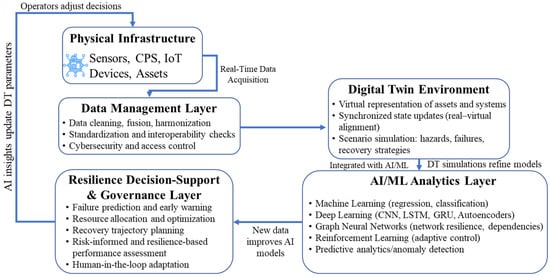
Figure 1.
Conceptual Framework for DT–AI Integration Pathways.
In this pathway, the DT serves as the continuously updated digital environment, while AI provides the computational intelligence that interprets system states, forecasts disruptions, and recommends recovery strategies. The integration forms a closed-loop learning system, whereby AI models improve as the DT accumulates new data, and AI-generated insights refine the DT’s behavior. This framework, as illustrated in Figure 1, reflects current applications in water networks, transportation systems, smart grids, and port infrastructure, where DT–AI platforms are increasingly supporting predictive maintenance, failure detection, and adaptive control under uncertainty [18,19,20,21,22].
2.4. Research Gap
The literature indicates a growing interest in utilizing DTs and AI for infrastructure resilience; however, research often progresses independently. Few studies provide an integrated framework aligning both technologies with resilience metrics and policy goals. DT studies focus on modeling and visualization, while AI research emphasizes data analytics and optimization. Most applications are sector-specific, which limits generalization to interdependent networks. Inconsistent resilience metrics further complicate the evaluation of whether AI-enabled DTs truly enhance resilience. This review maps the knowledge landscape of DT and AI applications in infrastructure resilience, identifying research themes, emerging topics, and future directions to guide the development of coordinated, transparent, and impact-driven digital resilience frameworks.
3. Research Methodology
3.1. Design and Rationale
This study employed a systematic literature review (SLR) approach, guided by Francis and Bekera [28], to identify, screen, and synthesize peer-reviewed studies on DT- and AI-based models for infrastructure resilience from 2016 to 2025. Bibliometric and content analyses were combined to map research patterns, methodologies, and conceptual gaps [29,30].
3.2. Data Source and Search Strategy
The Web of Science (WoS) Core Collection was used exclusively due to its comprehensive coverage, advanced filtering capabilities, and citation-tracking features [30,31]. While the Web of Science (WoS) Core Collection offers high-quality indexing of research in engineering, computer science, environmental science, and urban technology, its coverage may not be fully exhaustive across civil engineering and urban planning journals. As a result, the estimated recall of the search strategy, defined as the proportion of relevant studies retrieved, may be moderately reduced compared to multi-database searches. The search string included:
- ▪
- “digital twin*” OR “virtual twin*” OR “smart infrastructure” AND
- ▪
- “artificial intelligence” OR “machine learning” OR “deep learning” OR “graph neural network*” OR “AI-driven” AND
- ▪
- “resilient” OR “risk management” OR “hazard recovery” OR “infrastructure robustness” OR “system recovery.”
The query searched titles, abstracts, author keywords, and Keywords Plus. Only English peer-reviewed journal articles and conference papers were included; books, theses, editorials, and review articles were excluded.
3.3. Eligibility Criteria and Screening Process
Studies were included if they:
- ▪
- Examined DT applications in infrastructure systems (transportation, energy, water, urban networks).
- ▪
- Incorporated AI-based methods (ML, deep learning, GNNs).
- ▪
- Focused explicitly on resilience objectives (prediction, damage assessment, recovery planning, system robustness).
The PRISMA four-stage process (identification, screening, eligibility, and inclusion) was applied, and from 599 initial records, topical, sectoral, and methodological filters reduced the dataset to 108 studies for in-depth analysis. Figure 2 summarizes the PRISMA flow.
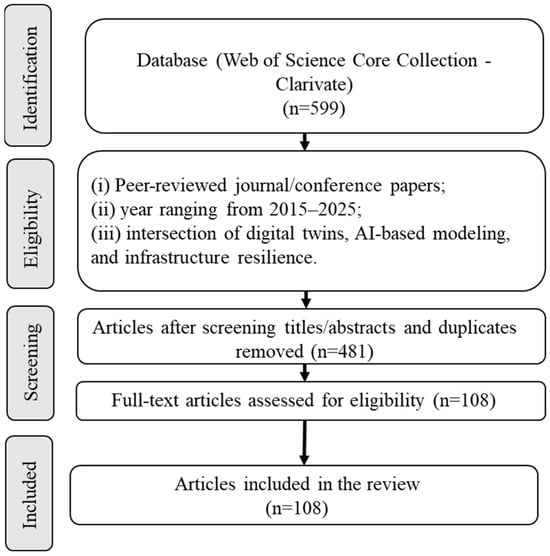
Figure 2.
PRISMA-style flow diagram used for this study.
3.4. Data Extraction and Analysis
Following the screening process, bibliographic information for the 108 included studies was exported from the Web of Science Core Collection in tab-delimited format. The dataset was processed using VOSviewer (version 1.6.20) to perform bibliometric visualization and clustering [32]. VOSviewer is an open-source software for exploring, visualizing, and creating bibliometric maps of science [32]. It applies text mining to identify relevant noun phrases. It uses unified mapping and clustering techniques to investigate networks of co-authorship, keyword co-occurrence, citation relationships, influential authors, and emerging thematic patterns across the DT–AI–resilience domain. After VOSviewer generated the cluster partitions, thematic labels for the six clusters were derived through an iterative interpretive process. Two reviewers independently examined the dominant keywords, their co-occurrence patterns, and the representative publications associated with each cluster. The initial labels proposed by each reviewer were then compared and refined through discussion until a consensus was reached.
After bibliometric mapping, a qualitative content analysis complemented the quantitative findings. Each article was reviewed to determine its contribution to the study’s core objectives, specifically identifying main research themes, emerging topics, and future directions. The integration of bibliometric visualization and systematic content analysis allowed the study to move beyond frequency counts, constructing a structured understanding of how DT and AI research has evolved toward resilience applications. This combined approach provides both breadth and depth, revealing quantitative trends and qualitative conceptual developments. The resulting synthesis offers a transparent and reproducible framework for mapping the intellectual landscape of DT- and AI-based models in infrastructure resilience, laying the foundation for future interdisciplinary research and practice.
4. Result
4.1. Trends in Publication and Citation
Figure 3 illustrates the progression of research on DT- and AI-based models for infrastructure resilience from 2017 to 2025. The early period (2017–2020) exhibited limited scholarly activity, with few publications and low citation counts, reflecting the initial experimentation phase of DT concepts and early AI integration in engineering applications. From 2022 onward, publications and citations increased sharply, coinciding with the post-pandemic acceleration of smart infrastructure and data-driven resilience research. The spike in 2023–2024, when citations surpassed 300, indicates a growing recognition of foundational studies focusing on data integration for DT, ML for hazard prediction, and simulation-based recovery models.
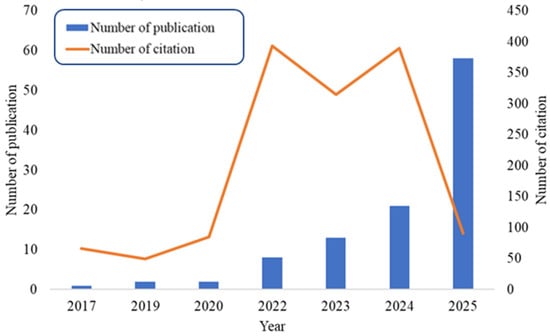
Figure 3.
Trend of published documents and citations from 2017 to 2025.
In 2025, publication output reached its highest level, indicating rapid expansion and diversification of research themes, including graph-based modeling, real-time sensing, and resilience analytics at community scales. The decline in citation counts during the same year reflects the short time since publication rather than reduced impact. Overall, the trend highlights a maturing and interdisciplinary field, shifting from conceptual frameworks to applied AI-enabled DT platforms that support resilience assessment, recovery optimization, and adaptive decision-making in interconnected infrastructure systems.
Figure 4 illustrates the distribution of publications across the top ten journals that contribute to research on digital twins (DT) and AI-based models for infrastructure resilience. The analysis reveals that IEEE Access leads prominently, with eight publications, reflecting its broad interdisciplinary scope and focus on emerging technologies that integrate AI, sensing, and cyber–physical systems. Sustainability, Energies, and Sensors follow closely, each emphasizing the application of digital technologies to sustainable and intelligent infrastructure systems. Other outlets, including IEEE Transactions on Smart Grid, Journal of Building Engineering, and Environmental Science and Ecotechnology, each published two to three relevant studies, highlighting diverse disciplinary engagement from energy systems and civil engineering to environmental resilience. This distribution indicates that while a few high-impact, open-access journals dominate publication output, the topic has achieved strong cross-disciplinary appeal across engineering, sustainability, and information science domains.
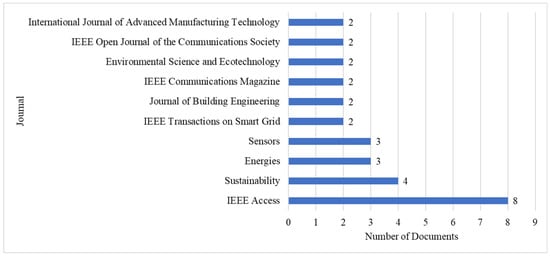
Figure 4.
Top 10 Journals contributing to Digital Twin and AI-Based Models for Infrastructure Resilience.
4.2. Main Research Themes and Topics
The cluster division emerged from quantitative mapping of term relationships across the 108 included studies. The co-occurrence analysis revealed six interconnected thematic clusters that represent the evolving research landscape of digital twins (DTs), artificial intelligence (AI), and infrastructure resilience (Figure 5). Each cluster highlights unique and complementary trajectories, collectively demonstrating how emerging computational frameworks are reshaping resilience, sustainability, and decision-making across multiple domains. The division of the six major research clusters is based on VOSviewer’s unified clustering technique, as shown in the Legend in Figure 5, which groups keywords according to their co-occurrence frequency, link strength, and semantic proximity within the bibliographic dataset. Keywords that frequently appear together in the same publications form strong associative links, causing them to cluster in the same color-coded group. On the other hand, keywords with weaker link strengths or distinct thematic orientations are positioned in separate clusters. This data-driven approach allows the clusters to represent natural thematic concentrations within the DT–AI–resilience research landscape. The resulting six clusters therefore reflect coherent research domains shaped by shared methodological approaches (e.g., machine learning, digital twin), application areas (e.g., smart cities, urban planning, environmental sustainability), and conceptual themes (e.g., resiliency, security).
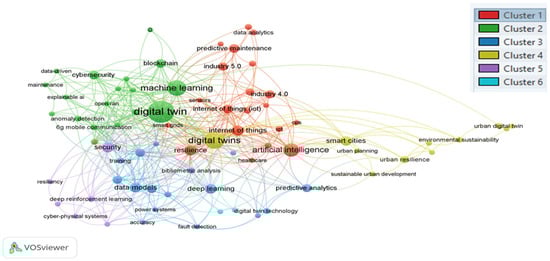
Figure 5.
Network visualization from Co-occurrence analysis.
The distribution of the six clusters provides deeper insight into the structural evolution of the DT–AI–resilience research landscape. Figure 5 reveals that clusters located toward the center, such as digital twins, machine learning, artificial intelligence, and the Internet of Things (IoT), represent foundational research themes that anchor the field. The outlying clusters highlight emerging application areas, including smart cities, sustainability, cybersecurity, blockchain, and data analytics. The spatial relationships between clusters indicate increased convergence between computational intelligence (AI/ML/GNNs) and applied infrastructure resilience, suggesting that the field is transitioning from isolated modeling efforts toward integrated DT–AI ecosystems. This distribution highlights how resilience research is increasingly driven by cross-linking computational advances with real-world infrastructure challenges. Clusters related to Industry 5.0, security, and predictive analytics are closely connected, indicating a convergence toward integrated DT–AI architectures that support real-time decision-making. Meanwhile, the Smart Cities & Sustainability cluster bridges technical and socio-environmental domains, demonstrating the expansion from asset-focused DTs toward city-scale, human-centered resilience frameworks. Additionally, the relative separation of the methodological cluster highlights a continued gap between conceptual frameworks and their practical implementation, emphasizing the need for standardized data governance, interoperability protocols, and resilience metrics.
4.2.1. Cluster 1 (Red): Artificial Intelligence and Industry Applications
This cluster encompasses topics such as AI, Industry 4.0/5.0, predictive maintenance, the Internet of Things (IoT), smart grids, and data analytics, with a focus on data-driven automation for infrastructure resilience [10,33]. Rejeb et al. [34] and Sadri et al. [35] focused on intelligent production and real-time analytics, demonstrating AI as a decision engine that links the physical and digital layers. Wakili et al. [36] highlighted IoT-enabled DTs for securing industrial control systems against cyber threats. These studies illustrate Industry 4.0′s shift toward intelligent, self-adaptive manufacturing ecosystems that strengthen operational resilience through continuous data feedback and predictive optimization.
4.2.2. Cluster 2 (Green): Digital Twins, Machine Learning, and Data Security
This cluster centers on DTs, ML, and security architectures, reflecting the convergence of data analytics and cyber-protection [37,38,39,40]. Ebrahimi et al. [38] proposed a twin-driven anomaly detection system for healthcare, preserving integrity and privacy in connected environments. Wakili et al. [36] introduced hybrid twin–AI architectures that leverage both historical and real-time sensor data to forecast vulnerabilities. Embedding ML within DT frameworks establishes the foundations for resilience and compliance, enabling critical infrastructures to detect disruptions, adapt to uncertainties, and maintain functionality [35].
4.2.3. Cluster 3 (Blue): Deep Learning and Cyber–Physical Systems
Topics in this cluster include deep learning, predictive analytics, fault detection, power systems, and environmental sensing [38,41,42,43,44]. Ravinder and Kulkarni [43] applied deep learning for smart-grid anomaly detection, while Pawar et al. [42] used LSTM networks for predicting mechanical failures. Motroni et al. [41] demonstrated RFID-based smart gates integrated with edge learning to streamline logistics and reduce fault latency. These approaches enhance early warning, reliability, and resilience across cyber–physical systems.
4.2.4. Cluster 4 (Yellow): Smart Cities and Sustainability
This cluster links urban DTs, sustainability, and resilient infrastructure planning [11,45,46,47,48]. Topics include smart cities, urban resilience, sustainable urban development, and data-driven policy frameworks. Kumar et al. [45] explored AI-based smart city planning for energy optimization. Zhao et al. [48] proposed immersive DT frameworks for smart water management, and Zeng et al. [46] applied multi-source data analytics for pedestrian flow optimization. These studies demonstrate how AI-driven urban intelligence strengthens resilience through sustainable planning and adaptive governance.
4.2.5. Cluster 5 (Purple): Cyber–Physical Systems and Data Models for Resilience
This cluster emphasizes CPS, deep reinforcement learning (RL), reliability, and graph-based data models [49,50]. Alevizos et al. [49] proposed an Advanced Graph-Physics Hybrid Framework (AGPHF) coupling physics-informed neural networks with graph learning for wastewater treatment optimization. Rodriguez-Casavilca et al. [51] applied RL-driven control to infrastructure resilience modeling. These frameworks support resilient DT systems capable of autonomously responding to shocks and maintaining stability in complex networks.
4.2.6. Cluster 6 (Teal): Meta-Research and Methodological Frameworks
This cluster consolidates bibliometric and methodological studies that strengthen the knowledge base for resilient infrastructures [51,52,53,54,55]. Miraftabzadeh et al. [52] charted the evolution of DT studies and identified resilience as a growing theme. Pulikottil et al. [53] proposed immune-inspired maintenance frameworks, while Amanlou et al. [54] outlined a cybersecurity roadmap for smart grids. These works define methodological pathways, standards, and competencies that underpin resilient, secure, and sustainable digital ecosystems.
4.3. Early and Emerging Research Topics
The overlay visualization in Figure 6 illustrates the temporal evolution of research themes related to digital twins (DTs), artificial intelligence (AI), and infrastructure resilience. Nodes are color-coded according to the average publication year, revealing a gradual transition from foundational studies (blue) to more contemporary developments (yellow). This gradient demonstrates the maturation of DT research from technical modeling and data analytics toward intelligent, predictive, and sustainability-driven applications.
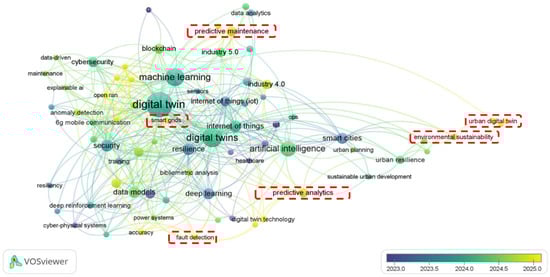
Figure 6.
Visualization overlay from Co-occurrence analysis showing the temporal evolution of research themes.
The emerging research topics (yellow nodes), corresponding to the most recent studies (2024–2025), emphasize urban digital twins, predictive maintenance, smart grids, fault detection, predictive analytics, and environmental sustainability [56,57,58,59,60,61]. Zhao et al. [48] illustrated how urban DT environments can optimize water resources and enhance sustainability through real-time simulation. Wakili et al. [36] presented a DT-enhanced cybersecurity framework integrating predictive maintenance and intelligent analytics to improve system resilience. Sadri [35] examined AI-driven DT integration with blockchain for predictive urban analytics, bridging digital governance and smart infrastructure. Ebrahimi et al. [38] developed a DT-driven health management framework for microgrids, providing predictive fault detection adaptable to smart grids. Varzeshi et al. [56] focused on smart technologies for resilient cities, positioning urban DTs as enablers of environmental sustainability. Cichocki [58] contributed to predictive analytics and system intelligence in maritime cybersecurity, extending predictive modeling to broader infrastructure domains. Collectively, these studies highlight a shift toward adaptive, environmentally conscious, and data-driven DT applications supporting sustainability and performance outcomes.
In contrast, the blue nodes represent earlier foundational topics, including deep learning, smart cities, cyber–physical systems (CPS), resilience, sensors, and data analytics [40]. These studies established the analytical backbone of DT and AI research—Motroni et al. [41] advanced sensing precision and signal optimization for CPS and smart infrastructure. O’Connell et al. [60] explored DT-enabled interoperability in smart cities. Zhang et al. [57] examined cyber resilience in healthcare DTs, informing CPS resilience strategies. Ahmed et al. [59] demonstrated the integration of sensing and AI analytics for adaptive system intelligence in telehealth.
Occupying the middle spectrum, the green nodes include IoT, Industry 5.0, digital twin, urban resilience, sustainable urban development, ML, AI, and cybersecurity, representing transitional and enduring research priorities [57,58,59]. Ebrahimi et al. [38] proposed a twin-driven cybersecurity framework integrating IoT and AI for anomaly detection and data integrity. Rejeb et al. [34] and Sadri et al. [35] connected Industry 5.0 and urban resilience with the DT model, emphasizing human-centered innovation and sustainable development. These studies demonstrate how AI, IoT, and ML are evolving toward secure, intelligent, and socio-technically integrated systems across industrial and urban environments.
The bibliometric co-occurrence map captures a research field in transition. Early work on sensors, CPS, and deep learning laid the groundwork. At the same time, newer studies on predictive analytics, sustainability, and Industry 5.0 indicate a broader vision in which DTs function as dynamic, intelligent frameworks for resilient and environmentally responsible decision-making.
5. Discussion and Future Development Frameworks for DT-AI Integration
This systematic review synthesized the intellectual and technological landscape at the intersection of Digital Twins (DTs), Artificial Intelligence (AI), and infrastructure resilience. The bibliometric and content analyses revealed the field’s thematic evolution, highlighting six interconnected clusters that collectively illustrate the growing convergence of AI, Machine Learning (ML), and DT technologies in enhancing predictive maintenance, cybersecurity, and adaptive capacity across industrial, urban, and environmental infrastructures.
The co-occurrence visualization (Figure 7) identifies the emerging frontier of DT and AI research, marking a shift from isolated technological innovation toward integrated frameworks for resilient and sustainable urban systems. Key thematic nodes such as urban digital twins, environmental sustainability, smart cities, and urban resilience indicate a trajectory where digital twins evolve into dynamic decision-support systems capable of managing adaptive and data-driven infrastructures. These developments reflect a transition from descriptive digital models to intelligent, real-time ecosystems that link sensing, simulation, and governance for sustainable urban planning and management.
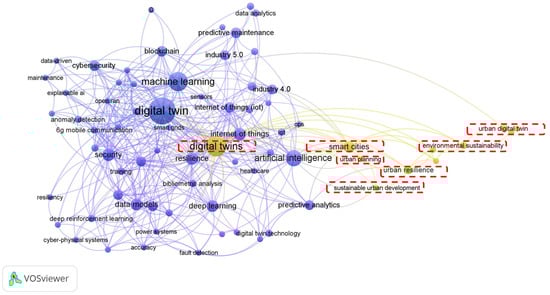
Figure 7.
Visualization overlay from Co-occurrence analysis showing future works and research directions.
The current research status indicates that digital twins are widely adopted in transportation, water systems, energy grids, ports, and urban environments, primarily for monitoring, simulation, and predictive maintenance purposes [21,22,23,24,36,38,42]. Several studies show that AI is increasingly used for failure prediction, anomaly detection, system optimization, and resilience assessment, with deep learning and GNNs emerging as dominant approaches [11,12,13,14,15]. Similarly, current DT–AI systems leverage sensors, IoT devices, CPS, and remote sensing to create continuously synchronized virtual representations of assets and systems. However, most projects remain siloed within individual infrastructure domains, which limits interoperability and holistic resilience assessment [5,10,23]. The studies reviewed highlight that challenges persist regarding data integration, cybersecurity, privacy, ontology alignment, and the development of standardized resilience metrics.
For the future, this study opines that the accelerated integration of DT and AI suggests a shift toward next-generation DT–AI development frameworks characterized by interoperability, adaptability, and cross-domain intelligence. As previously noted, many existing applications of DT–AI technologies remain sector-specific. Therefore, this study proposes a framework that can be operationalized across interdependent infrastructure networks through a federated digital twin architecture. This federated digital twin ecosystem ensures interconnected sectoral twins exchange data autonomously, enabling infrastructure-wide situational awareness [7]. This federated approach transforms the DT–AI ecosystem from isolated digital representations into an integrated systems-of-systems framework capable of supporting regional resilience planning, dynamic resource allocation, and multi-sector emergency response. The results of the bibliometric analysis indicate that these future frameworks will rely increasingly on: (1) multi-scale digital twins that interconnect asset-level, system-level, and regional models; (2) hybrid AI approaches combining deep learning, graph neural networks, and human-in-the-loop systems to improve prediction under uncertainty [49,55]; (3) reinforcement learning, autonomous control, and predictive optimization will allow DTs to support proactive, real-time decision-making [49,50]; and (4) DT–AI frameworks will increasingly incorporate carbon impacts, environmental indicators, and adaptive planning for climate-driven hazards.
Key issues shaping these future frameworks include interoperability (e.g., lack of standardized APIs and ontologies), data governance (ensuring privacy, cybersecurity, and ethical AI use), the ability to explain and transparency of AI models, and the alignment of AI objectives with resilience metrics such as recovery time, functional degradation, redundancy, and socio-economic impacts. Addressing these challenges will be essential for DT–AI systems to support trustworthy, scalable, and operationally meaningful decision-making for resilience.
Also, this study suggests that AI will play a central role by enabling self-learning, adaptive control, and automated recovery planning. To address the observed misalignment between AI optimization objectives and resilience-based performance metrics, this study proposes the adoption of composite indicators and structured evaluation protocols. The Composite Resilience–AI Performance Index (RAPI) would integrate AI-derived predictions with resilience metrics, including recovery time, residual system functionality, redundancy, and robustness. This index enables comparative evaluation of AI strategies based on their capacity to minimize functional losses and accelerate system recovery following disruptions.
6. Limitations and Future Studies
Despite these advances, the study acknowledges inherent methodological constraints. Bibliometric mapping, while effective in revealing global trends, may overlook qualitative insights related to implementation challenges, model validation, and cross-sectoral interoperability. Future research should therefore extend beyond bibliometric synthesis to empirically validate DT–AI models within real-world operational contexts. Integrating real-time data from infrastructure systems can improve understanding of predictive performance, resilience modeling, and adaptive behavior.
This review relied exclusively on the WoS Core Collection, which, although widely used for bibliometric studies due to its indexing quality and structured metadata, may not capture all relevant publications in civil engineering, infrastructure planning, or urban studies. Journals such as Journal of Infrastructure Systems, Cities, Urban Studies, or regional infrastructure planning outlets may contain relevant digital twin (DT), artificial intelligence (AI), or resilience-focused studies that are not indexed or only partially indexed in WoS. As a result, some interdisciplinary contributions may have been missed. Future studies can enhance recall by incorporating additional databases, such as Scopus, IEEE Xplore, and Engineering Village, or by conducting targeted manual searches for key journals in civil engineering and urban planning.
Advancing this field will require the establishment of interoperable digital ecosystems supported by standardized data architecture, ethical AI frameworks, and participatory governance models. Future studies should also focus on developing intelligent, self-learning digital twins that can integrate community-generated and environmental data to enhance resilience and social equity. Collectively, these efforts will pave the way for the next generation of sustainable, adaptive, and ethically governed digital infrastructures that support long-term environmental and societal resilience.
Author Contributions
A.A.: data collection, review of technical concepts, and draft writing; O.O.: review of technical and data collection; A.Z.: review of technical contents, editing, and draft writing. All authors have read and agreed to the published version of the manuscript.
Funding
This research received no external funding.
Institutional Review Board Statement
Not applicable.
Informed Consent Statement
Not applicable.
Data Availability Statement
Not applicable.
Acknowledgments
The authors wish to thank the support provided by Mayfield College of Engineering and the Department of Physics at Tarleton State University.
Conflicts of Interest
The authors declare that they have no conflicts of interest.
References
- National Institute of Standards and Technology (NIST). Community Resilience Planning Guide for Buildings and Infrastructure Systems; U.S. Department of Commerce: Gaithersburg, MD, USA, 2020.
- Bruneau, M.; Chang, S.E.; Eguchi, R.T.; Lee, G.C.; O’Rourke, T.D.; Reinhorn, A.M.; Shinozuka, M.; Tierney, K.; Wallace, W.A.; von Winterfeldt, D. A framework to quantitatively assess and enhance the seismic resilience of communities. Earthq. Spectra 2003, 19, 733–752. [Google Scholar] [CrossRef]
- Cimellaro, G.P.; Reinhorn, A.M.; Bruneau, M. Framework for analytical quantification of disaster resilience. Eng. Struct. 2010, 32, 3639–3649. [Google Scholar] [CrossRef]
- Ouyang, M. Review on modeling and simulation of interdependent critical infrastructure systems. Reliab. Eng. Syst. Saf. 2014, 121, 43–60. [Google Scholar] [CrossRef]
- Madni, A.M.; Madni, C.C.; Lucero, S.D. Leveraging digital twin technology in model-based systems engineering. Systems 2019, 7, 7. [Google Scholar] [CrossRef]
- Jones, D.; Snider, C.; Nassehi, A.; Yon, J.; Hicks, B. Characterising the digital twin: A systematic literature review. CIRP J. Manuf. Sci. Technol. 2020, 29, 36–52. [Google Scholar] [CrossRef]
- Bolton, A.; Butler, L.; Dabson, I.; Enzer, M.; Evans, M.; Fenemore, T.; Harradence, F.; Keaney, A.; Kemp, A.; Luck, A.; et al. The Gemini Principles; Centre for Digital Built Britain: Cambridge, UK, 2018. [Google Scholar] [CrossRef]
- Boje, C.; Guerriero, A.; Kubicki, S.; Rezgui, Y. Towards a semantic construction digital twin: Directions for future research. Autom. Constr. 2020, 114, 103179. [Google Scholar] [CrossRef]
- Ye, X.; Du, J.; Han, Y.; Newman, G.; Retchless, D.; Zou, L.; Ham, Y.; Cai, Z. Developing human-centered urban digital twins for community infrastructure resilience: A research agenda. J. Plan. Lit. 2023, 38, 187–199. [Google Scholar] [CrossRef]
- Jiang, F.; Ma, L.; Broyd, T.; Chen, K. Digital twin and its implementations in the civil engineering sector. Autom. Constr. 2021, 130, 103838. [Google Scholar] [CrossRef]
- Chen, K.; Zhou, X.; Bao, Z.; Skibniewski, M.J.; Fang, W. Artificial intelligence in infrastructure construction: A critical review. Front. Eng. Manag. 2025, 12, 24–38. [Google Scholar] [CrossRef]
- Abid, S.K.; Sulaiman, N.; Chan, S.W.; Nazir, U.; Abid, M.; Han, H.; Ariza-Montes, A.; Vega-Muñoz, A. Toward an Integrated Disaster Management Approach: How Artificial Intelligence Can Boost Disaster Management. Sustainability 2021, 13, 12560. [Google Scholar] [CrossRef]
- Ajayi, O.O.; Kurien, A.; Djouani, K.; Dieng, L. Artificial Intelligence for Infrastructure Resilience: Transportation Systems as a Strategic Case for Policy and Practice. Sustainability 2025, 17, 8992. [Google Scholar] [CrossRef]
- Wettewa, E.; Perera, S.; Jayasinghe, S.; Siriwardhana, C. Graph neural networks for infrastructure resilience assessment under uncertainty. Comput.-Aided Civ. Infrastruct. Eng. 2024, 39, 1259–1278. [Google Scholar] [CrossRef]
- Masud, M.T.; Keshk, M.; Moustafa, N.; Linkov, I.; Emge, D.K. Explainable artificial intelligence for resilient security applications in the Internet of Things. IEEE Open J. Commun. Soc. 2024, 6, 2877–2906. [Google Scholar] [CrossRef]
- Pant, R.; Hall, J.W.; Blainey, S.P. Vulnerability assessment framework for interdependent critical infrastructures: Case-study for Great Britain’s transport network. Eur. J. Transp. Infrastruct. Res. 2016, 16, 142–168. [Google Scholar] [CrossRef]
- Wang, S.; Gu, X.; Luan, S.; Zhao, M. Resilience analysis of interdependent critical infrastructure systems considering deep learning and network theory. Int. J. Crit. Infrastruct. Prot. 2021, 35, 100459. [Google Scholar] [CrossRef]
- Hosseini, S.; Barker, K.; Ramirez-Marquez, J.E. A review of definitions and measures of system resilience. Reliab. Eng. Syst. Saf. 2016, 145, 47–61. [Google Scholar] [CrossRef]
- Tao, F.; Zhang, H.; Liu, A.; Nee, A.Y.C. Digital twin in industry: State-of-the-art. IEEE Trans. Ind. Inform. 2019, 15, 2405–2415. [Google Scholar] [CrossRef]
- Batty, M. Digital twins. Environ. Plan. B Urban Anal. City Sci. 2018, 45, 817–820. [Google Scholar] [CrossRef]
- Dui, H.; Cao, T.; Wang, F. Digital twin-based resilience evaluation and intelligent strategies of smart urban water distribution networks for emergency management. Resilient Cities Struct. 2025, 4, 41–52. [Google Scholar] [CrossRef]
- Zhu, M.; Calderon, C.; Ford, A.; Robson, C.; Jin, J. Digital twin for resilience and sustainability assessment of port facility. Sustain. Resilient Infrastruct. 2025, 1–34. [Google Scholar] [CrossRef]
- Amin, U.; Kim, D.; Ahmed, F.N.; Ahmad, G.; Hossain, M.J. Digital twins for smart asset management in the energy industry: State of the art. Expert Syst. Appl. 2025, 289, 128358. [Google Scholar] [CrossRef]
- Zhou, Y.; Dan, Z. Modern energy resilience studies with artificial intelligence for energy transitions. Cell Rep. Phys. Sci. 2025, 6, 102508. [Google Scholar] [CrossRef]
- Faruk, M.I.; Plabon, F.W.; Saha, U.S.; Hossain, M.D. AI-driven project risk management: Leveraging AI to predict, mitigate, and manage project risks in critical infrastructure and national security projects. J. Comput. Sci. Technol. Stud. 2025, 7, 123–137. [Google Scholar] [CrossRef]
- Azimi, M.; Eslamlou, A.D.; Pekcan, G. Data-driven structural health monitoring and damage detection through deep learning: State-of-the-art review. Sensors 2020, 20, 2778. [Google Scholar] [CrossRef]
- Pant, R.; Barker, K.; Zobel, C.W. Static and dynamic metrics of economic resilience for interdependent infrastructure and industry sectors. Reliab. Eng. Syst. Saf. 2014, 125, 92–102. [Google Scholar] [CrossRef]
- Francis, R.; Bekera, B. A metric and frameworks for resilience analysis of engineered and infrastructure systems. Reliab. Eng. Syst. Saf. 2014, 121, 90–103. [Google Scholar] [CrossRef]
- Jana, D.; Malama, S.; Narasimhan, S.; Taciroglu, E. Edge-based graph neural network for ranking critical road segments in a network. PLoS ONE 2023, 18, e0296045. [Google Scholar] [CrossRef]
- Wettewa, S.; Hou, L.; Zhang, G. Graph neural networks for building and civil infrastructure operation and maintenance enhancement. Adv. Eng. Inform. 2024, 62, 102868. [Google Scholar] [CrossRef]
- Van der Sluis, F.; van den Broek, E.L. Model interpretability enhances domain generalization in textual complexity modeling. Patterns 2025, 6, 101177. [Google Scholar] [CrossRef]
- VOSviewer; Version 1.6.20; Centre for Science and Technology Studies: Leiden, The Netherlands, 2020.
- Brandtner, P.; Dakon, M. AI-powered forecasting under disruption: Lessons from the COVID-19 crisis for adaptive supply chains. In Proceedings of the IntelliSys 2025, Amsterdam, The Netherlands, 28–29 August 2025; pp. 123–137. [Google Scholar] [CrossRef]
- Rejeb, A.; Rejeb, K.; Suele, E.; Hassoun, A.; Keogh, J. Knowledge flows in industry 4.0 research: A longitudinal and dynamic analysis. J. Data Inf. Manag. 2025, 7, 123–145. [Google Scholar] [CrossRef]
- Sadri, H. AI-driven integration of digital twins and blockchain for smart building management systems: A multi-stage empirical study. J. Build. Eng. 2025, 105, 112439. [Google Scholar] [CrossRef]
- Wakili, A.; Bakkali, S.; Ibrahim, I. A digital twin-enhanced cybersecurity framework for IoT in healthcare: Applications in industry 4.0. Telemat. Inform. Rep. 2025, 20, 25. [Google Scholar] [CrossRef]
- Achuthan, K.; Gupta, B.; Raman, R. Bridging cybersecurity with digital twin technology: A thematic analysis. Int. J. Inf. Secur. 2025, 24, 207. [Google Scholar] [CrossRef]
- Ebrahimi, S.; Seyedi, M.; Sheida, K.; Ferdowsi, F.; Carbone, M. Digital Twin-Driven Health Management in Microgrids. IEEE Access 2025, 13, 162406–162421. [Google Scholar] [CrossRef]
- Page, M.J.; McKenzie, J.E.; Bossuyt, P.M.; Boutron, I.; Hoffmann, T.C.; Mulrow, C.D.; Shamseer, L.; Tetzlaff, J.M.; Akl, E.A.; Brennan, S.E.; et al. The PRISMA 2020 statement: An updated guideline for reporting systematic reviews. BMJ 2021, 372, n71. [Google Scholar] [CrossRef] [PubMed]
- Zupic, I.; Čater, T. Bibliometric methods in management and organization. Organ. Res. Methods 2015, 18, 429–472. [Google Scholar] [CrossRef]
- Motroni, A.; Pino, M.; Cecchi, G.; Nepa, P. A Near-Field Focused Array Antenna Empowered by Deep Learning for UHF-RFID Smart Gates. IEEE Trans. Antennas Propag. 2023, 71, 7946–7957. [Google Scholar] [CrossRef]
- Pawar, A.; Khan, S.; El-Ebiary, Y.; Burugari, V.; Abdufattokhov, S.; Saravanan, A.; Ghodhbani, R. Digital Twin-Based Predictive Analytics for Urban Traffic Optimization and Smart Infrastructure Management. Int. J. Adv. Comput. Sci. Appl. 2025, 16. [Google Scholar] [CrossRef]
- Ravinder, M.; Kulkarni, V. Smart grid anomaly detection using MFDA and dilated GRU-based neural networks. Smart Grids Sustain. Energy 2025, 10, 9. [Google Scholar] [CrossRef]
- Bhatia, M.; Kumar, V. Bibliometric analysis of digital twin: Scientometrics and future research trends. IEEE Internet Things J. 2025, 12, 19043–19064. [Google Scholar] [CrossRef]
- Kumar, H.; Tanweer, S.; Agarwal, P.; Rao, N. Machine learning and artificial intelligence-based energy efficient smart cities: A concise survey. J. Inf. Optim. Sci. 2025, 46, 657–668. [Google Scholar] [CrossRef]
- Zeng, S.; Chen, X.; Su, D.; Gong, H. Multi-source data-driven intelligent analysis and decision optimization for high-density pedestrian flows in urban public spaces. Autom. Constr. 2025, 177, 106367. [Google Scholar] [CrossRef]
- Galkin, A.; Samchuk, G.; Kopytkov, D.; Thompson, R. Digital twins in logistics: A comprehensive bibliometric analysis for advancing smart cities and sustainable development. Discov. Sustain. 2025, 6, 853. [Google Scholar] [CrossRef]
- Zhao, T.; Song, C.; Yu, J.; Xing, L.; Xu, F.; Li, W.; Wang, Z. Leveraging Immersive Digital Twins and AI-Driven Decision Support Systems for Sustainable Water Reserves Management: A Conceptual Framework. Sustainability 2025, 17, 3754. [Google Scholar] [CrossRef]
- Alevizos, V.; Gerolimos, N.; Yue, Z.; Edralin, S.; Xu, C.; Papakostas, G.; Vrochidou, E.; Marnellos, G.; Mustafa, M. Advanced Graph-Physics Hybrid Framework (AGPHF) for Holistic Integration of AI-Driven Graph- and Physics-Methodologies to Promote Resilient Wastewater Management in Dynamic Real-World Conditions. Appl. Sci. 2025, 15, 9905. [Google Scholar] [CrossRef]
- Makabate, C.T.; Musonda, I.; Okoro, C.S.; Chileshe, N. Scientometric analysis of BIM adoption by SMEs in the architecture, construction and engineering sector. Eng. Constr. Archit. Manag. 2022, 29, 179–203. [Google Scholar] [CrossRef]
- Rodriguez-Casavilca, H.; Mauricio, D.; Villanueva, J. Evolution of Artificial Intelligence-Based OT Cybersecurity Models in Energy Infrastructures: Services, Technical Means, Facilities and Algorithms. Energies 2025, 18, 5163. [Google Scholar] [CrossRef]
- Miraftabzadeh, S.; Di Martino, A.; Longo, M.; Zaninelli, D. Deep Learning in Power Systems: A Bibliometric Analysis and Future Trends. IEEE Access 2024, 12, 163172–163196. [Google Scholar] [CrossRef]
- Pulikottil, T.; Martinez-Arellano, G.; Barata, J. Immune system inspired smart maintenance framework: Tool wear monitoring use case. Int. J. Adv. Manuf. Technol. 2024, 132, 4699–4721. [Google Scholar] [CrossRef]
- Amanlou, S.; Hasan, M.; Mokhtar, U.; Malik, K.; Islam, S.; Khan, S.; Khan, M.; Khan, M. Cybersecurity Challenges in Smart Grid Systems: Current and Emerging Attacks, Opportunities, and Recommendations. IEEE Open J. Commun. Soc. 2025, 6, 1965–1997. [Google Scholar] [CrossRef]
- Alhaddad, U.; Basuhail, A.; Khemakhem, M.; Eassa, F.; Jambi, K. Ensemble Model Based on Hybrid Deep Learning for Intrusion Detection in Smart Grid Networks. Sensors 2023, 23, 7464. [Google Scholar] [CrossRef]
- Varzeshi, S.; Fien, J.; Irajifar, L. Smart Technologies for Resilient and Sustainable Cities: Comparing Tier 1 and Tier 2 Approaches in Australia. Sustainability 2025, 17, 5485. [Google Scholar] [CrossRef]
- Zhang, J.; Gao, R. Data-Enhanced Sensing: A New Approach to Information Acquisition. IEEE Trans. Instrum. Meas. 2025, 74, 1–20. [Google Scholar] [CrossRef]
- Cichocki, R. Artificial Intelligence in Maritime Cybersecurity: Dual-Use Applications for Defense and Offense in the Age of Digital Seas. TransNav 2025, 19, 617–623. [Google Scholar] [CrossRef]
- Ahmed, S.; Kumar, V.; Kim, J. AITel: eHealth Augmented-Intelligence-Based Telemedicine Resource Recommendation Framework for IoT Devices in Smart Cities. IEEE Internet Things J. 2023, 10, 18461–18468. [Google Scholar] [CrossRef]
- O’Connell, E.; O’Brien, W.; Bhattacharya, M.; Moore, D.; Penica, M. Digital Twins: Enabling Interoperability in Smart Manufacturing Networks. Telecom 2023, 4, 265–278. [Google Scholar] [CrossRef]
- Zhang, J.; Li, L.; Lin, G.; Fang, D.; Tai, Y.; Huang, J. Cyber Resilience in Healthcare Digital Twin on Lung Cancer. IEEE Access 2020, 8, 201900–201913. [Google Scholar] [CrossRef]
Disclaimer/Publisher’s Note: The statements, opinions and data contained in all publications are solely those of the individual author(s) and contributor(s) and not of MDPI and/or the editor(s). MDPI and/or the editor(s) disclaim responsibility for any injury to people or property resulting from any ideas, methods, instructions or products referred to in the content. |
© 2025 by the authors. Licensee MDPI, Basel, Switzerland. This article is an open access article distributed under the terms and conditions of the Creative Commons Attribution (CC BY) license (https://creativecommons.org/licenses/by/4.0/).