1. Introduction
Functionally graded materials (FGM) are materials in which a continuous change in functional or construction properties has been achieved in at least one specific direction in a selected technological process [
1]. FGMs are widely used in aerospace, automotive, biomedical, energy, and other applications due to their unique and personalized features as well as multifunctional properties such as heat, corrosion, and/or wear resistance, improved mechanical performance, light weight, high strength, etc. For example, FGM concepts, their use, and manufacturing processes can be found elsewhere [
2]. Different aspects of FGM, state-of-the-art research, and development findings can also be found in [
3].
The progress in FGM research is presented in an overview of Naebe and Shirvanimoghaddam [
4]. This overview focuses on the selection, production, characterization, analysis, and modeling of FGMs, and challenges are discussed. The achievements in the field of PBF processing technologies are presented in the overview of Kieback et al. [
5]. Examples of numerical simulations of the formation of gradients in the microstructure are presented there. In a review by DebRoy et al. [
6], the process, structure, and properties of additive manufacturing (AM) of metallic components are analyzed. AM processes are described in which laser, electron beams, electric arcs, or ultrasonic vibrations melt and solidify powder, wire, or sheets into dense metal parts [
7]. Review of Yadav et al. [
7] guided on the current state of applications, manufacturing possibilities, and challenges in FGM and presented the application for FGM of all seven AM processes included in the guided on the current state of applications, manufacturing possibilities, and challenges in FGM and presented the application for FGM of all seven AM processes included in the ISO ASTM 52900 standard [
8], namely vat photopolymerization (VAT), material extrusion (MEX), material jetting (MJT), sheet lamination (SHL), binder jetting (BJT), powder bed fusion (PBF) and direct energy deposition (DED).
Although DED is the most common AM process used to manufacture FGMs, it suffers from limited spatial resolution for precise control of composition and microstructure. Therefore, there is growing interest in the application of PBFs for manufacturing FGMs with complex shapes, especially with thin walls. Mussatto [
9] presented a review of several powder deposition techniques in the multi-material PFB process: conventional spreading, patterning drums, spreading plus suction, vibrating nozzle, hopper feeding, alternating, and electrophotographic. Tian et al. [
10] proposed to classify the metallic FGMs in different ways: structural (porosity, grain size), compositional, coating and bulk, and continuous and discontinuous. They presented experimental results on the chemical composition and microstructure in AM processes. Wu et al. [
11], based on experimental observations of AM processes including multi-material LPBF, described the challenges associated with material delivery that lead to defects, segregation, and phase separation.
Recent reviews on modeling and simulations of LPBF processes can be found in [
12,
13,
14]. Shinjo and Panwisawas [
15] modeled the flow of different elements, the formation of the melt pool, and keyholes in multi-material AM processes using the coupled level-set and volume-of-fluid (VOF) method. A multi-material model based on the Lattice Boltzmann method is presented by Küng et al. [
16]. The model takes into account concentration-dependent heat capacities, latent heat, and other parameters and is applied to a mixture of two elements processed into a binary alloy in the PBF process. A VOF model presented by Tang et al. [
17] was used to simulate the multi-material LPBF process with two- and three-component powders of titanium Ti, niobium Nb, vanadium V, and arsenic Ar elements.
Several publications [
18,
19,
20,
21] presented the application of DEM in the modeling of powder flow. Nan et al. [
18] employed DEM simulation for the powder with spherical particles to analyze the effects of gap height and blade spreading speed on the evolution of shear band and mass flow rate through the gap. They showed that the Gauss error function well describes the particle velocity.
Haeri et al. [
19] presented simulations using the DEM for the spreading of rod-shaped particles. They investigated the effects of particle shape and operating conditions on the bed quality, surface roughness, and solid volume fraction. They also documented a shape segregation when particles with a larger aspect ratio tend to accumulate in the upper layers of the bed. Haeri [
20] used a set of DEM simulations to optimize the geometry of blade spreaders for better powder bed quality. In [
21], the DEM simulation is used to investigate the effects of different powder spreading parameters on the powder density and particle distribution within the powder bed, including across multiple layers. They also presented experimental measurements of the powder packing density and the powder particle size distribution on the build platform.
Each of these publications [
18,
19,
20,
21] considered only one material and delivered some information about size and shape segregation in longitude and building directions, but did not consider multiple powder materials with different properties. Information about real segregation, including in the transversal direction, can be found in the experimental investigation presented elsewhere [
21,
22,
23,
24,
25,
26].
Recently, the authors of the paper participated in the creation and development of the platform for LPBF processes realized in both the melting and sintering modes (SLM and SLS), which allows multistage multi-material simulations [
22,
23] including FDM [
1]. The authors also have experience in the practical operation of gradients in the PBF process.
It should be noted that there are three directions for obtaining a gradient when creating a product in LPBF: toward construction, toward the blade (roller) movement, and across its movement (along the blade). The gradient toward construction seems to be a very promising method in view of the control of this gradient, but it has two main disadvantages. The powder composition should be changed from layer to layer according to the required gradient, which is impossible for most machine constructions or very difficult for others; the composition and properties are also changed in steps, not smoothly. The second disadvantage is the high consumption of inoperable powder, which requires additional treatment to be reused [
24,
25,
26], especially when the gradient should be along the longest dimension of the product. The second method, which consists of obtaining a gradient toward the powder distribution, seems to be completely uncontrollable. The last method, the gradient across the distribution direction, is preferable to the first because of the lower consumption of the material, but the gradient control is very difficult. Therefore, the main challenge of the study is to design a well-controlled smooth gradient in the PBF process.
The purpose of the study, which is beginning, is to design LPBF process conditions with effective gradient control in FGM based on simulations, modeling, and experimental studies. The development of advanced mathematical models that support the design and processing of such a novel process is within the main objectives of the study. The three-dimensional simulation and modeling of the LPBF manufacturing of FGMs will lead to the development of recommendations for process modifications, the production of necessary elements for implementing the developed process, and the testing and experimental LPBF manufacturing of FGMs.
The analysis of several publications [
27,
28,
29,
30] on experimental studies of the distribution of powdered materials to produce FGM in the LPBF process showed that the methods proposed in these publications are not very effective. In the previous paper [
1], one of the schemes (with inclined separation line) presented in [
30] was analyzed by the Unity model. The results were qualitatively similar, which confirms that Unity can be used for testing different schemes, at least qualitatively. Another scheme with a periodic separation line proposed in personal communication, but not published, was modeled and presented in this paper. It also shows low effectiveness. After this, an additional aim of the paper is to define the essential factors that influence the powder deposition process and allow effective control of the final materials’ distribution.
The paper presents the first preliminary results, that is, the development of the model, the results of several simulation cases, analysis of the percolation process, the influence of various constructive and material parameters on the delivery process and final distribution, and conclusions. The results of the simulations allow define a direction for further theoretical and experimental research, optimizing the number and kind of experimental research.
3. Modeling Results and Short Discussion
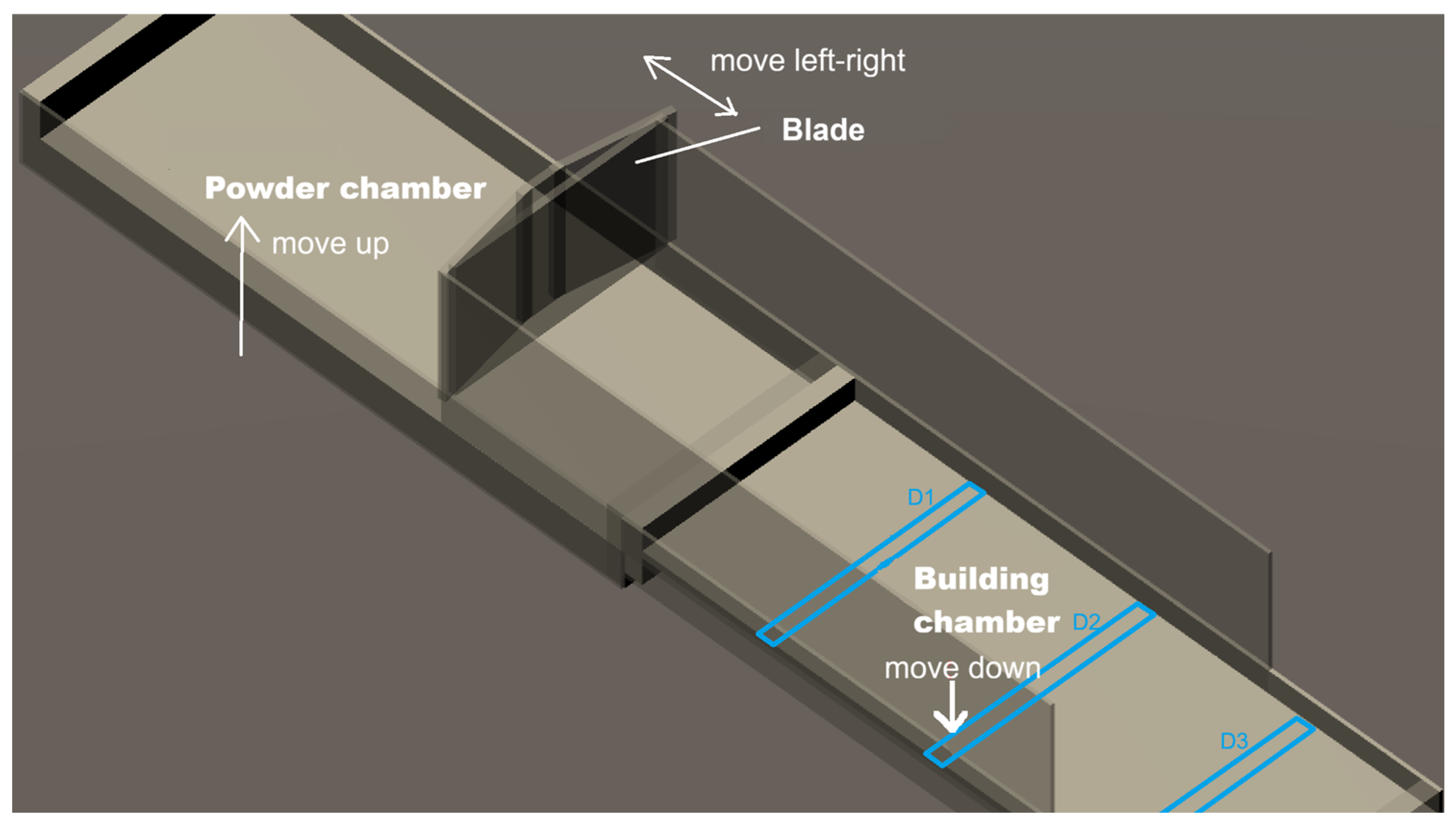
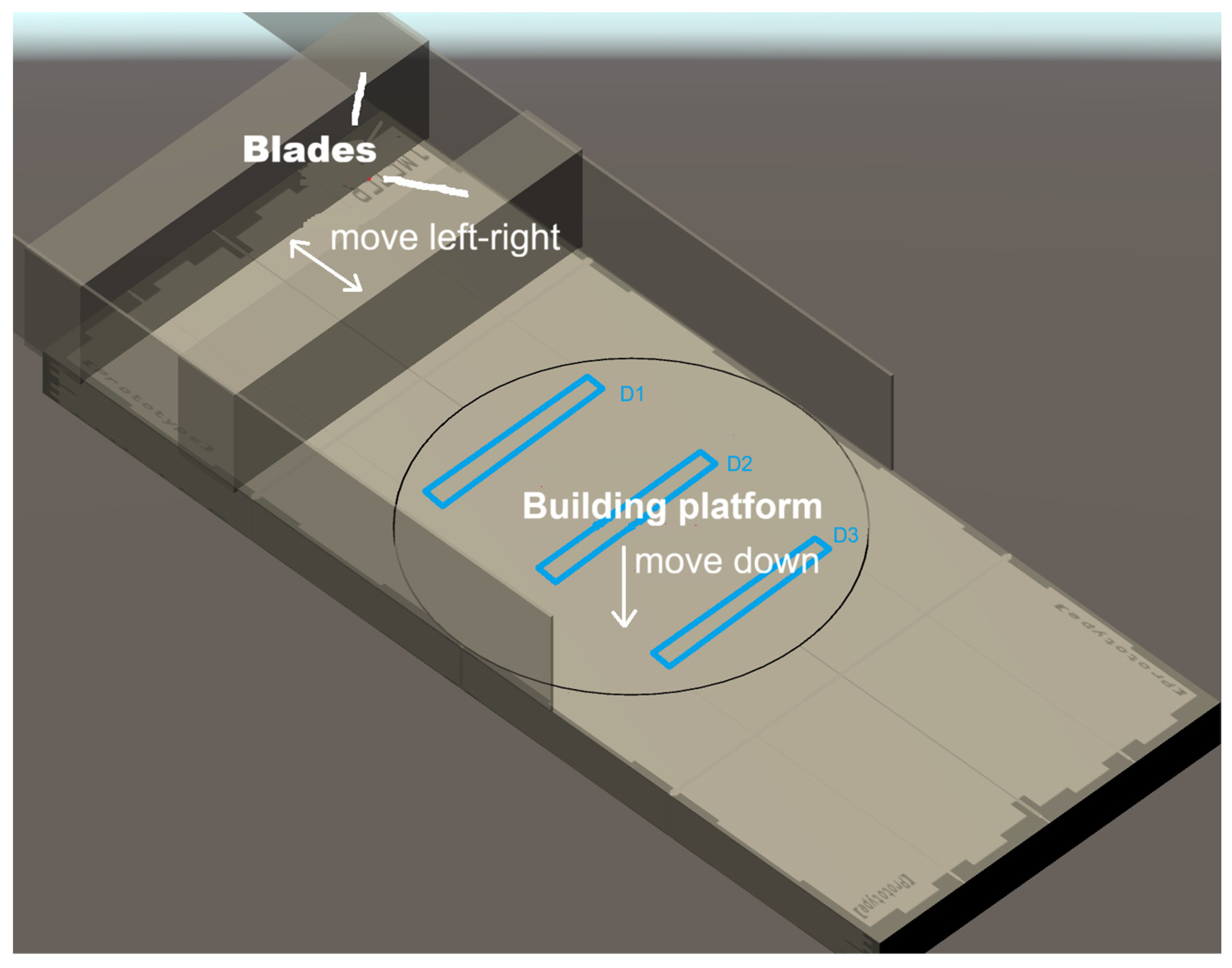
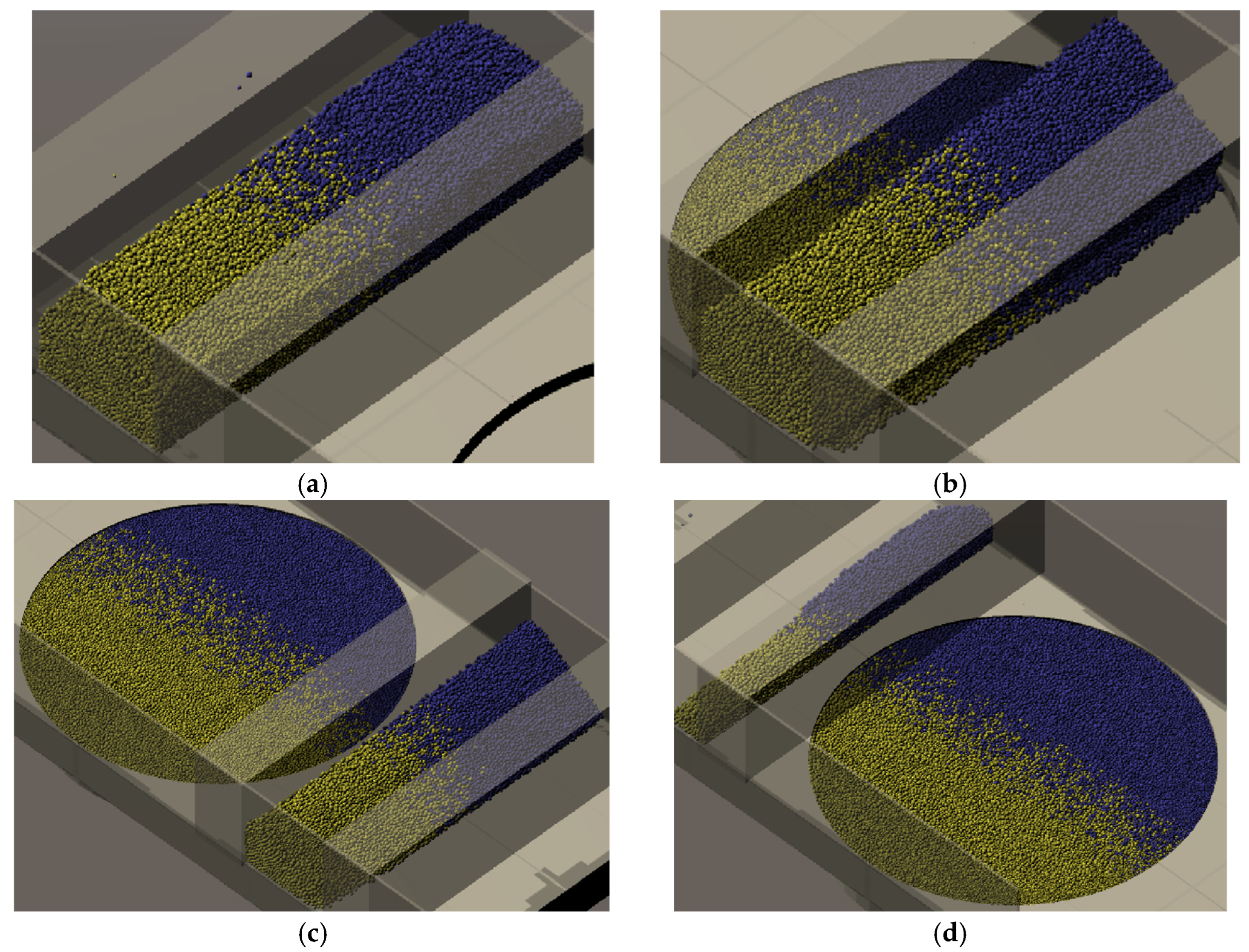
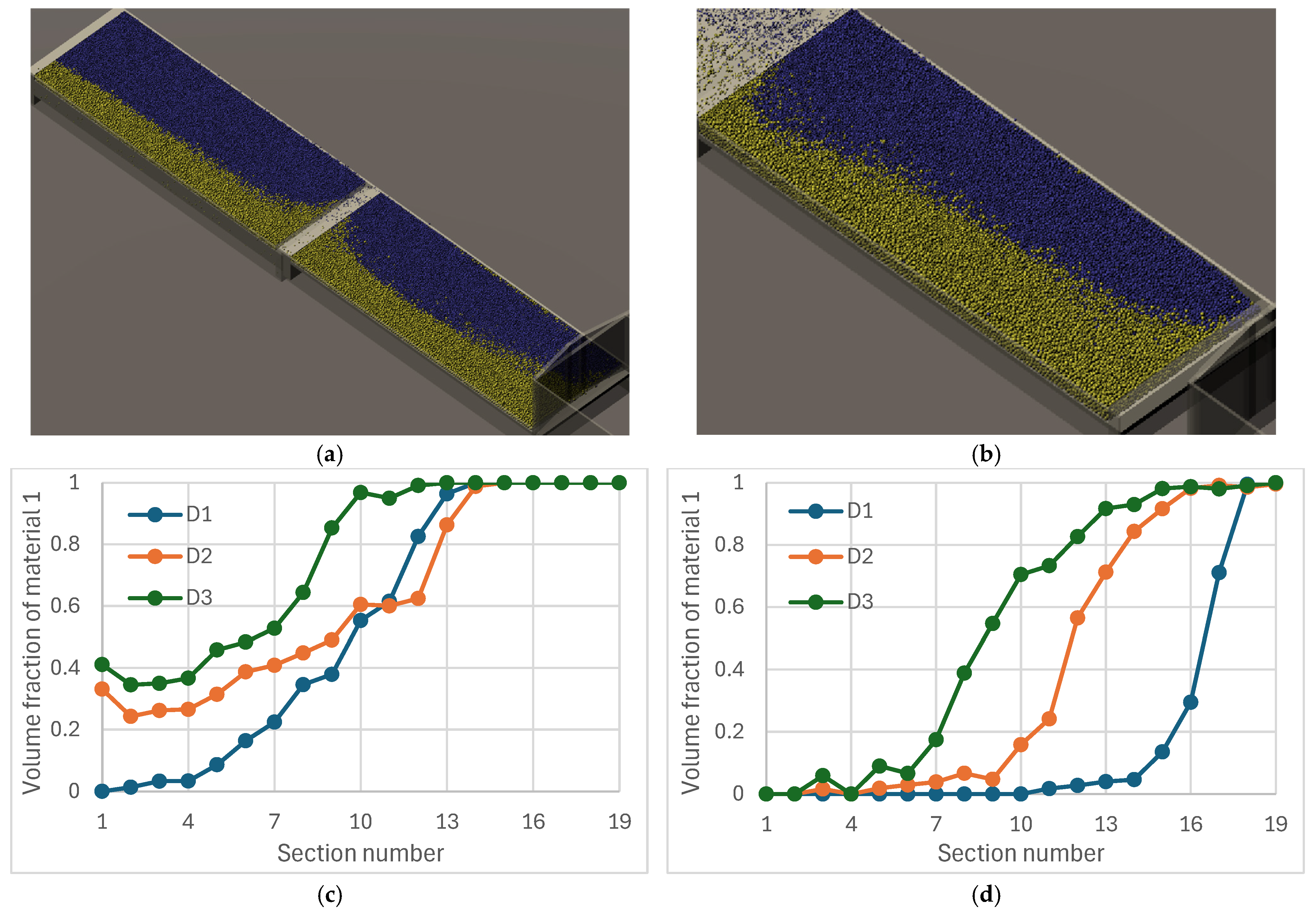
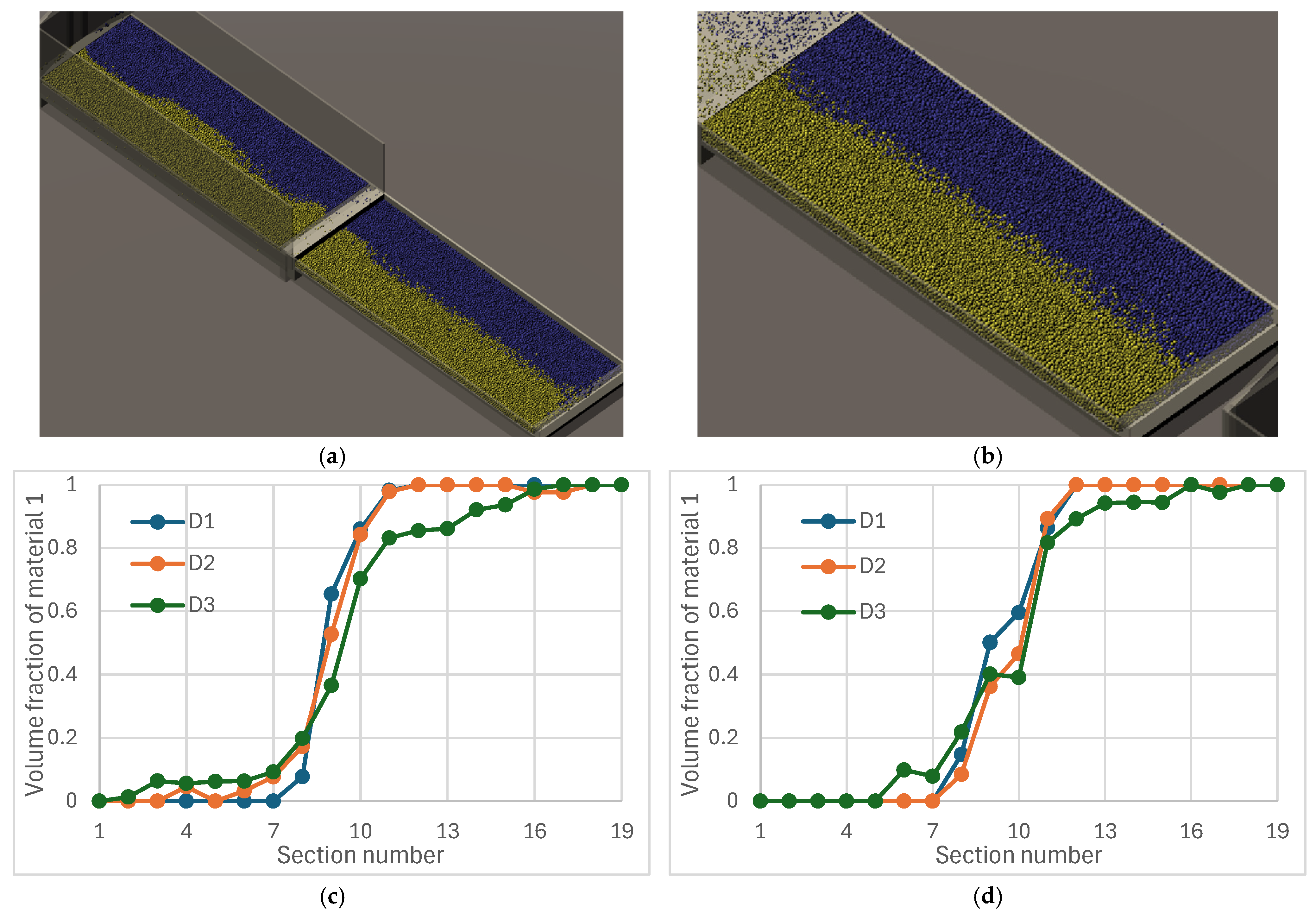
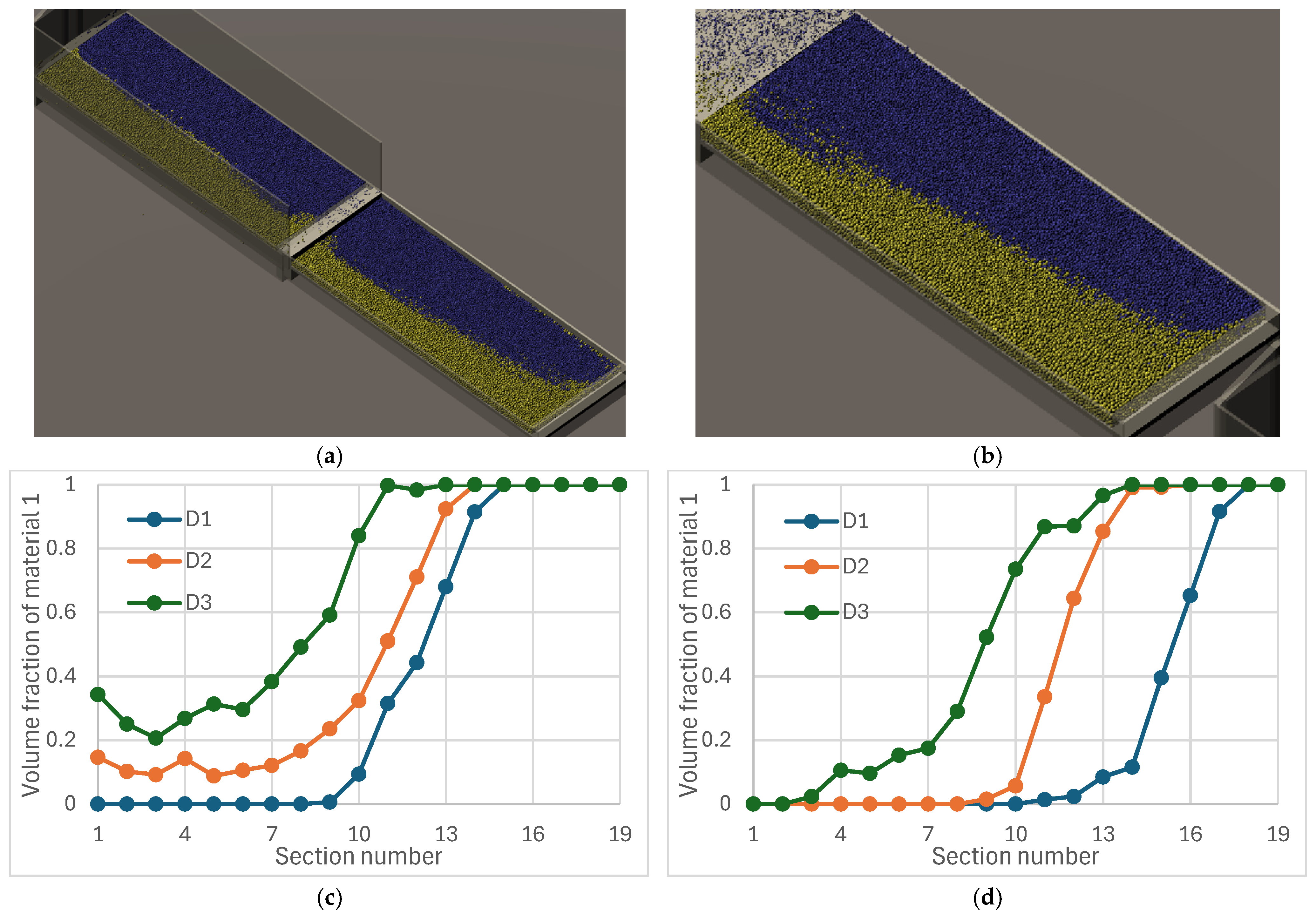
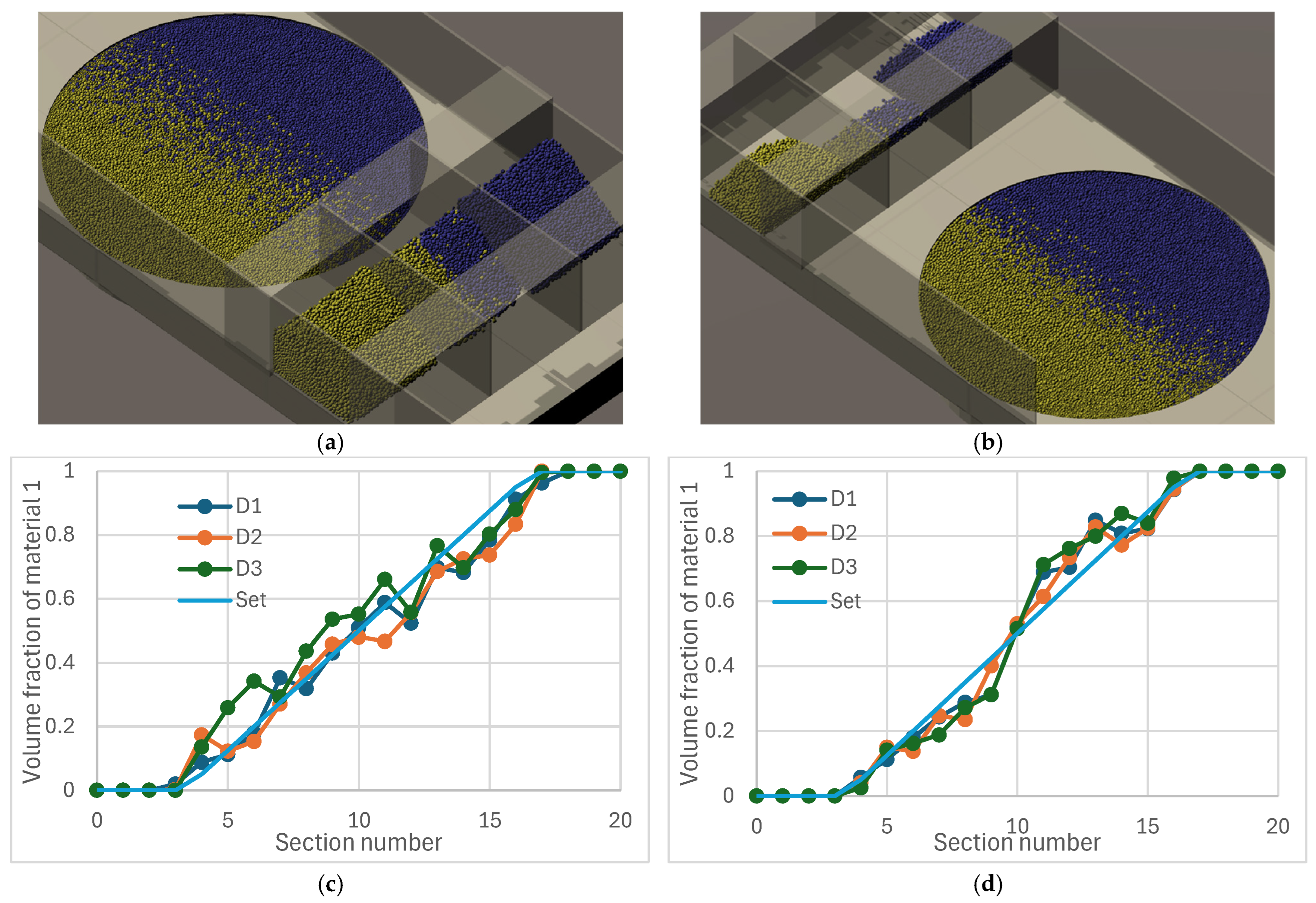
All results presented in this section are shown as snapshots and distribution functions. The first powder material in snapshots is colored blue, and the second is colored yellow. The locations where the distribution functions were calculated are indicated in blue in
Figure 1 and
Figure 2 and D1–D3. The width of D1–D3 in both designs is 9 mm, and the division along length is 3 mm. For the first and second designs, the lengths of D1–D3 are 60 mm and 63 mm, resulting in 20 and 21 sections (classes). D2 is located on the axis of a platform, D1 and D3 at a distance of 60 mm from D2 for the first design and 40 mm for the second. Section numbering starts from the far side of D1–D3 (abscissa on the plots of distribution functions). The volume fraction of the second material (yellow) is shown as the ordinate in the distribution function plots. The mean diameters of the powder particles are 0.78 and 0.6 mm (the ratio is 1.0, 1.3, or 0.77), and the ratio of the material densities is 1.0 or 1.5. The ‘same properties’ of the two materials correspond to both ratios equal to 1.0. ‘Different sizes’ means that the ratio of sizes (yellow to blue) is 1.3, and ‘different densities’ means that the ratio of densities (yellow to blue) is 1.5. The thickness of the layer on the building platform is equal to 4.1–5.3 in particle size.
Half of one layer of particles, depending on the mean size of particles in a ‘two-chambers’ design, contains 95,000 particles of a mean diameter of 0.6 mm and 45,000 particles of a mean diameter of 0.78 mm. Three layers contain 285,000 and 135,000 particles, respectively. In a ‘two-blades’ design, these numbers are 77,000 and 35,000 particles per layer, and a total of 231,000–308,000 and 105,000–140,000 particles. In the measured sections, the number of particles is 80 to 350.
3.1. Two-Chamber Design
This subsection presents the first design with two chambers (with movable platforms) and one blade (
Figure 1 and
Figure 3). Several options were simulated using different methods to separate materials in the powder chamber (
Figure 5) and various particle size cases.
3.1.1. Separation Along the Longitudinal Axis of the Chamber
The same properties of powder materials should not alter the symmetry or significantly change the distribution of materials.
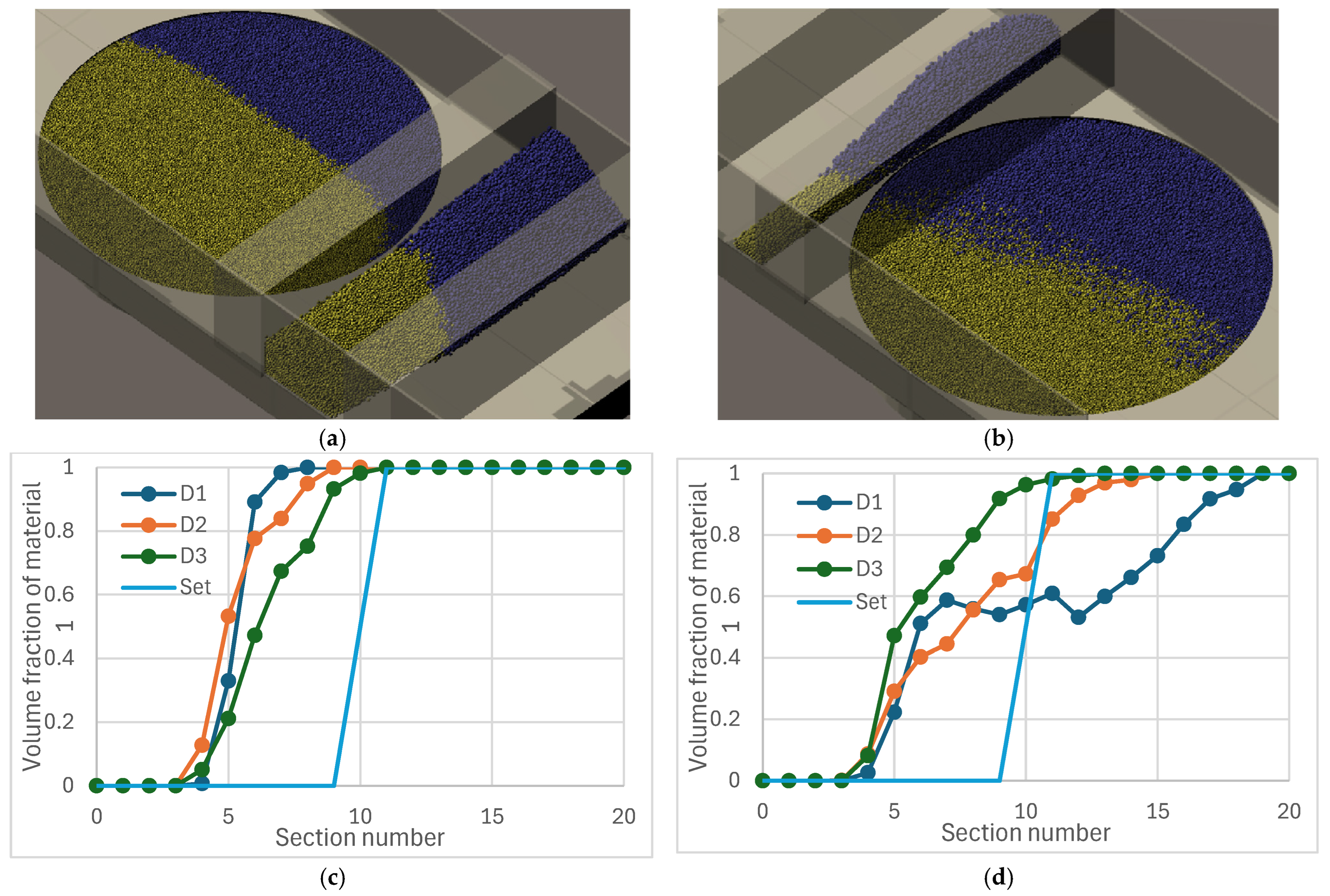
However, when the sizes of the powder particles differ, the initial distribution of the material on the powder platform does not transfer to the building platform (
Figure 6). Furthermore, the upper layer of the powder platform changes (
Figure 6a). The difference in particle sizes has a significant influence on the distribution on the building platform, especially at the end of the first layer (
Figure 6a,c) and completely in the second layer (
Figure 6b,d).
3.1.2. Separation Along the Inclined Line
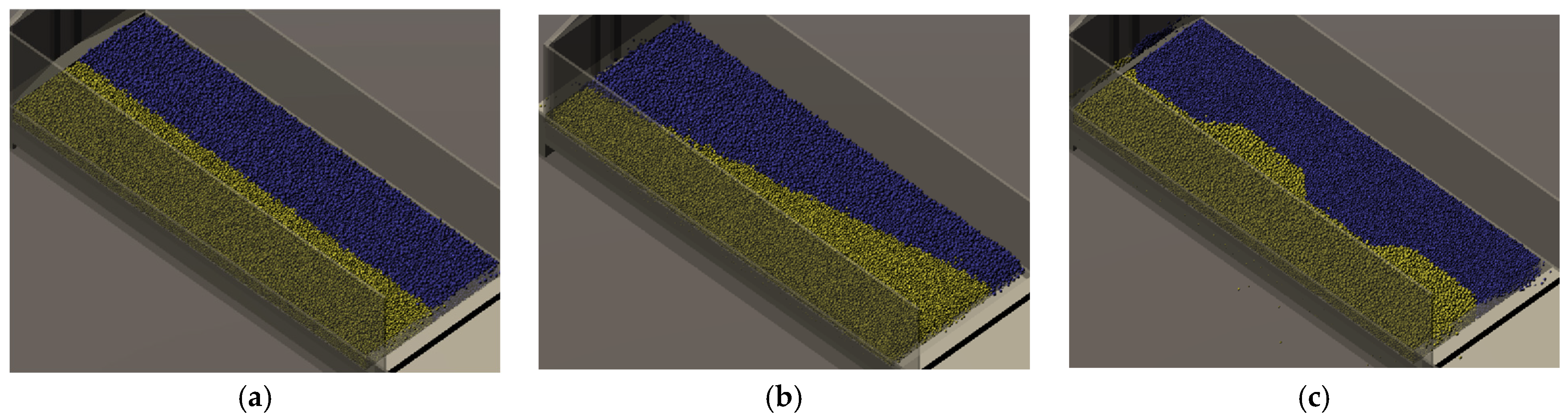
This subsection presents the results of the modeling with an inclined separation line (
Figure 5b). The initial idea was to obtain material on a building platform with a powder material distribution function that is close to linear or, at the very least, an elongated transition zone. The results presented below demonstrate that this assumption was incorrect.
The first simulation was performed for the powder with the same particle parameters: size and density. Results are presented in
Figure 7. Some symmetry (mirror image) can be observed in the distribution of the powder and the building platforms (
Figure 5b and
Figure 7a). The symmetry is better (almost ideal) near the boundary between the platforms; then it is blurred. The powder distribution and platform geometry form an almost perfectly mirrored pattern in the region close to the boundary between the platforms, whereas further away from this boundary the symmetry gradually becomes less distinct due to particle dispersion and trajectory deviations. It appears that the last particles involved in the movement on the powder platform are deposited first in building one. Although they should be pushed further. The farther the blade goes, the more mixed the particles will become. The intended effect was partially achieved; the transition zone became longer, but it is not linear and stable. The zone is formed gradually but tends to move and does not remain unchanged (
Figure 7a,c). The distribution of the powder material on the powder platform after the first movement remains almost the same. The second layer is smoother than the first (
Figure 7b,d).
Two cases with different particle sizes were simulated. The shape of the size distribution function for both powder materials was the same, but the mean values were different. The mean size of the particles of the first material (blue) was reduced in the first case (case 1), and the ratio of mean sizes became 1.3 (second to first or yellow to blue). In the second case (case 2), the size of the particles of the second material was reduced, with a ratio of 0.77 (=1/1.3).
The distribution on the powder platform after the first movement remains the same. The movement of the blade almost does not disturb the distribution of the powder material on the powder platform. The symmetry of the particle distribution on the powder and building platforms is more clearly expressed than in the case of the same particle sizes. The transient zone is shorter and moves more strongly, especially for the second layer. The results for the building platform are similar to those presented in
Figure 6.
The results of case 2 (the blue particles are the larger ones) are presented in
Figure 8. The movement of the blade over the powder platform significantly disrupts the distribution of particles in the remaining upper part of the powder chamber (
Figure 8a), affecting the next layer on the building platform. The first layer on the building platform is symmetric to the upper layer changed on the powder platform. The size of the particles determines the second layer, and it is symmetric with the second layer of case 1 (
Figure 6b and
Figure 8b).
3.1.3. Separation Along the Periodic Line
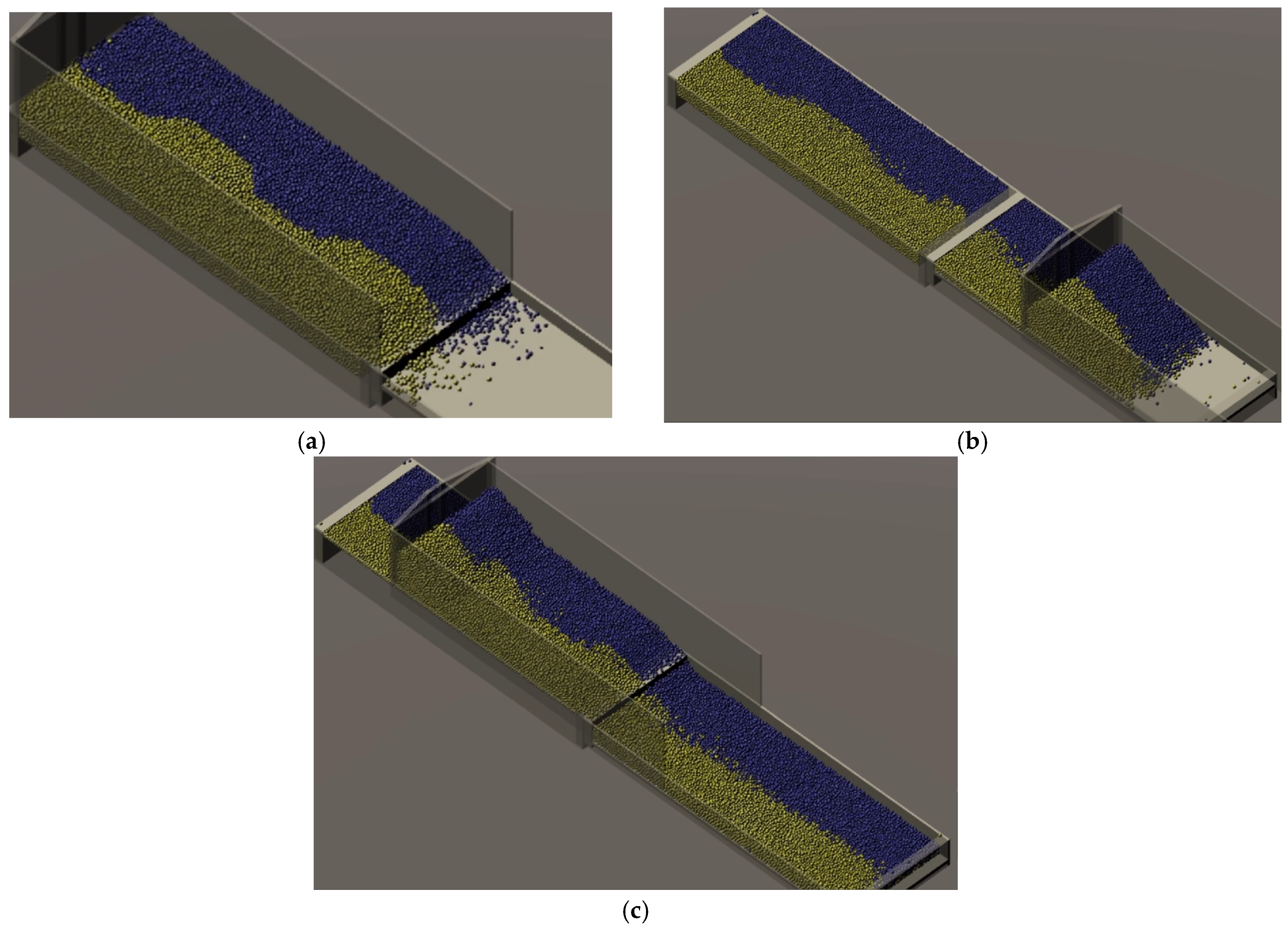
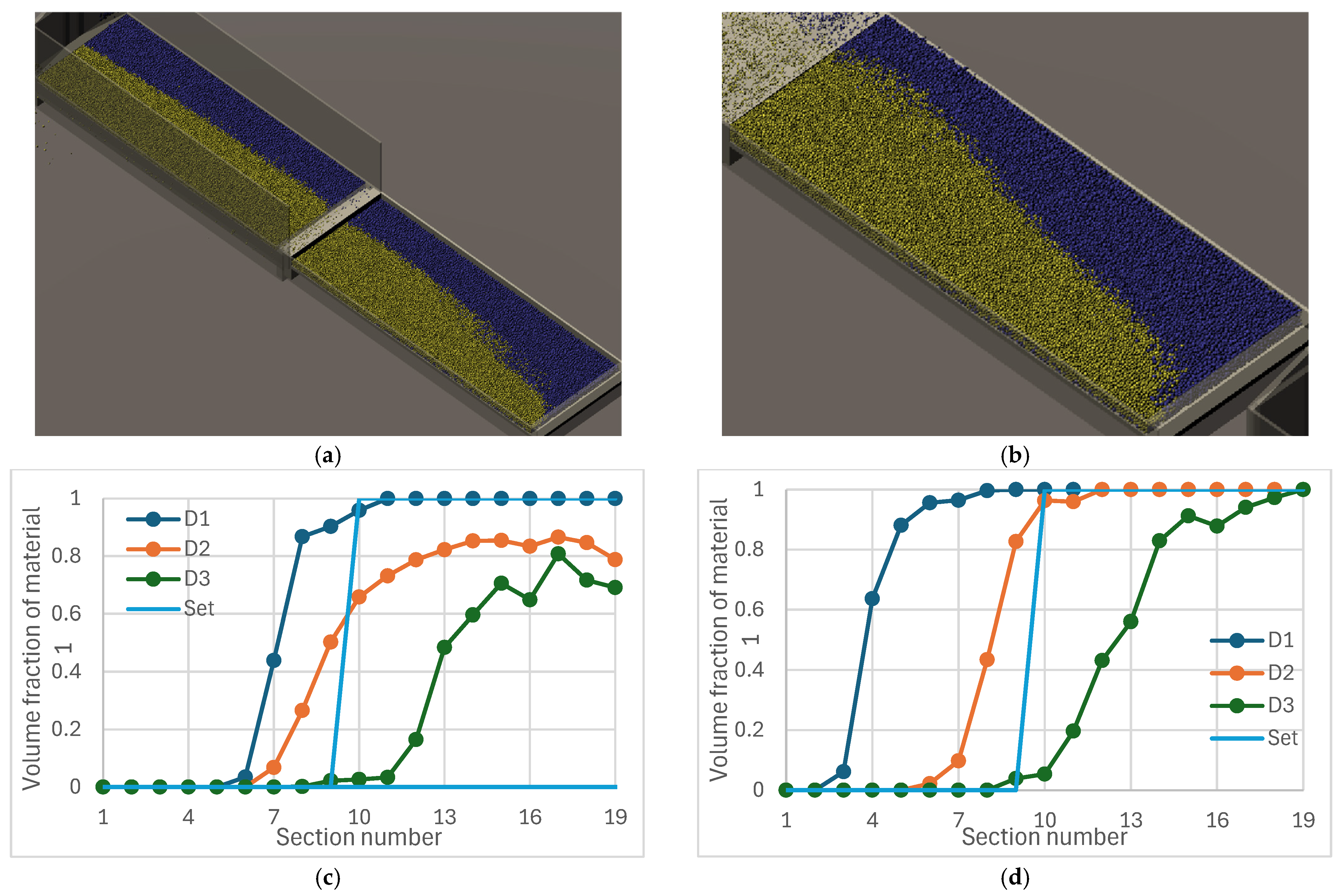
This subsection presents the results of the modeling with a periodic separation line (
Figure 5c). Another idea was to obtain powder material on the building platform with an elongated transition zone.
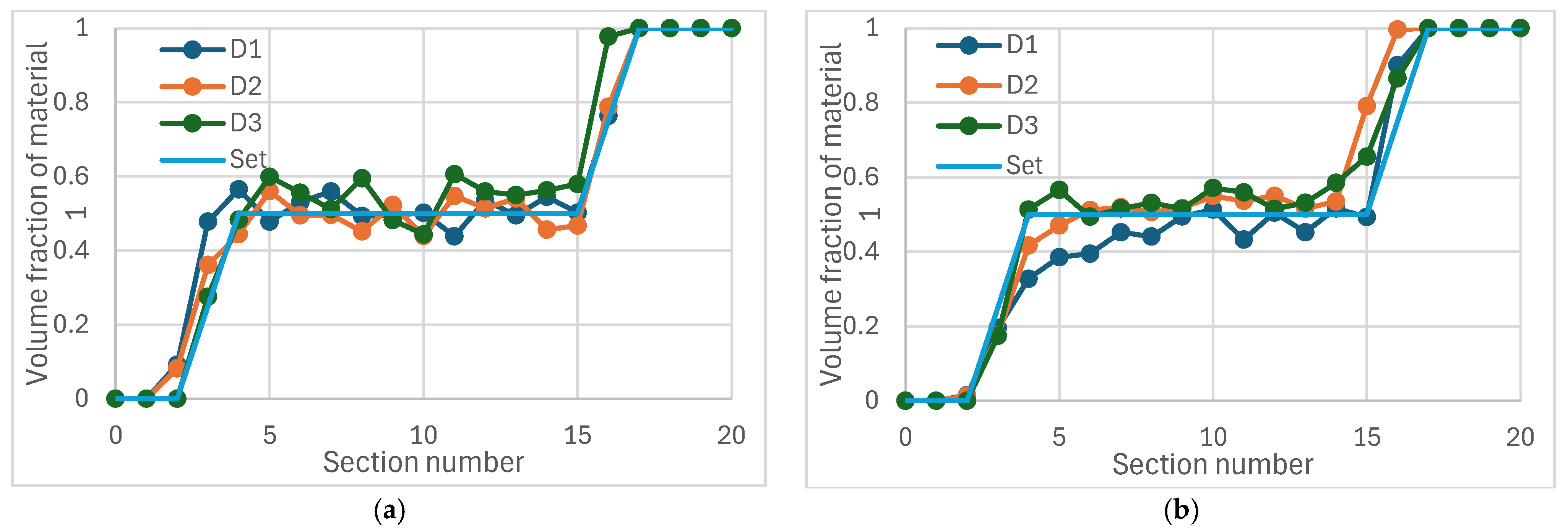
The same properties of materials should not alter symmetry and significantly change the distribution of powders. The results of such simulations are presented in
Figure 9. The initial distribution of the powder material on the powder platform in the next layer is only slightly changed by smearing the sloped sections of the border (
Figure 9a). The initial segment of the border of the first layer on the building platform retains symmetry with that of the powder platform; however, the subsequent segments and layers already have a blurred border (
Figure 9a,b). The same can be observed in the distribution functions of the powder material (
Figure 9c,d). It confirms the assumption that the transition zone for particles of the same properties is elongated, though that can be tested for powders of different properties and for a wider transition zone.
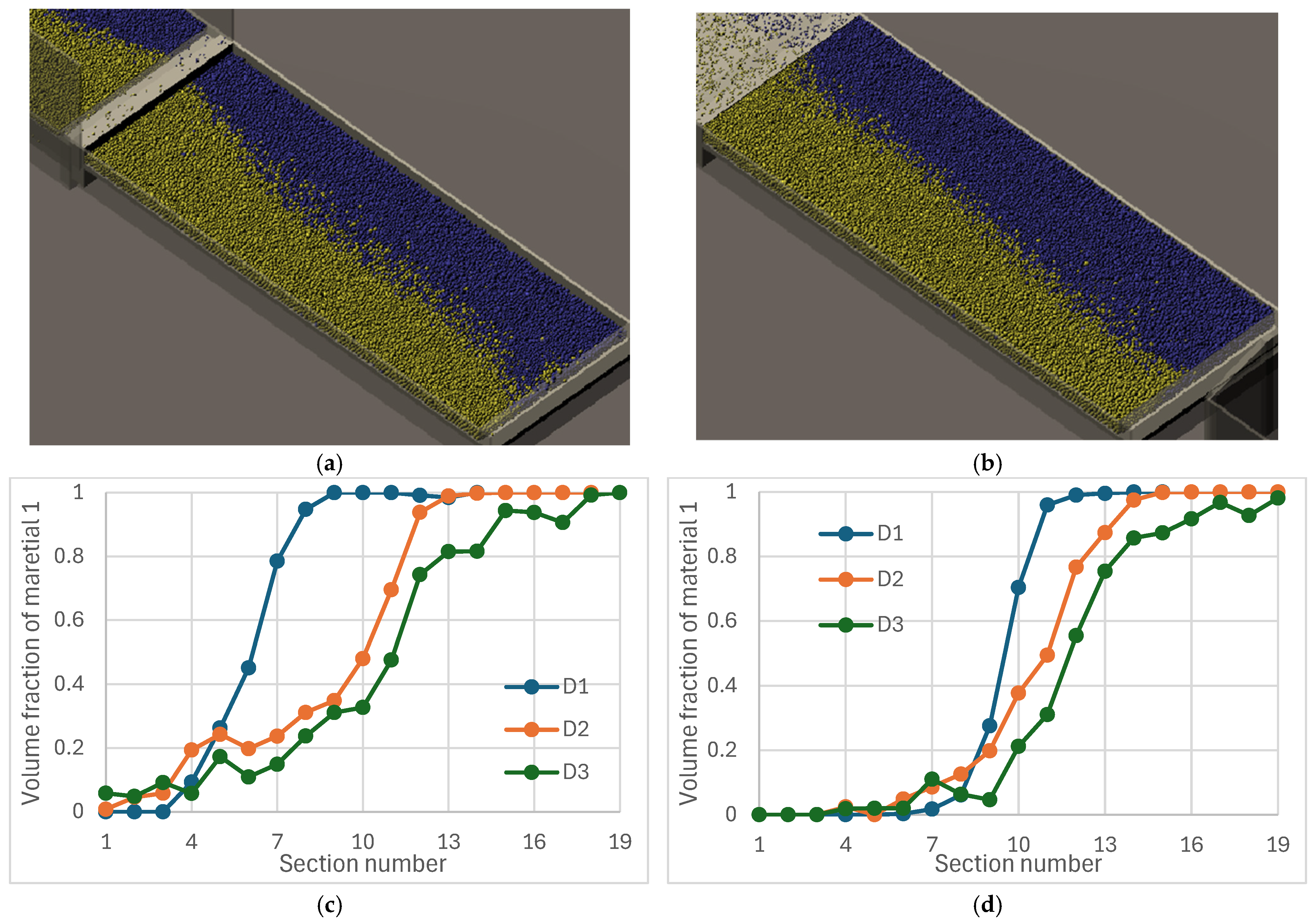
The results of the simulations with the different powder particle sizes are presented in
Figure 10. The results completely destroy the previous conclusion, limiting it to powder materials with the same parameters. In the case of different sizes, even the distribution on the powder platform changes due to size segregation. On the contrary, the distribution on the building platform, as in previous simulations, depends more on the size than the initial distribution in the powder chamber, possibly outside the initial segment (
Figure 10a,b). Some of the largest particles (yellow) reach quite far in the ‘blue’ region, as seen in the snapshot (
Figure 10a) and in the distribution function (
Figure 10c) of the first layer. In the second layer, it is limited (
Figure 10b,d).
3.2. Two-Blade Design
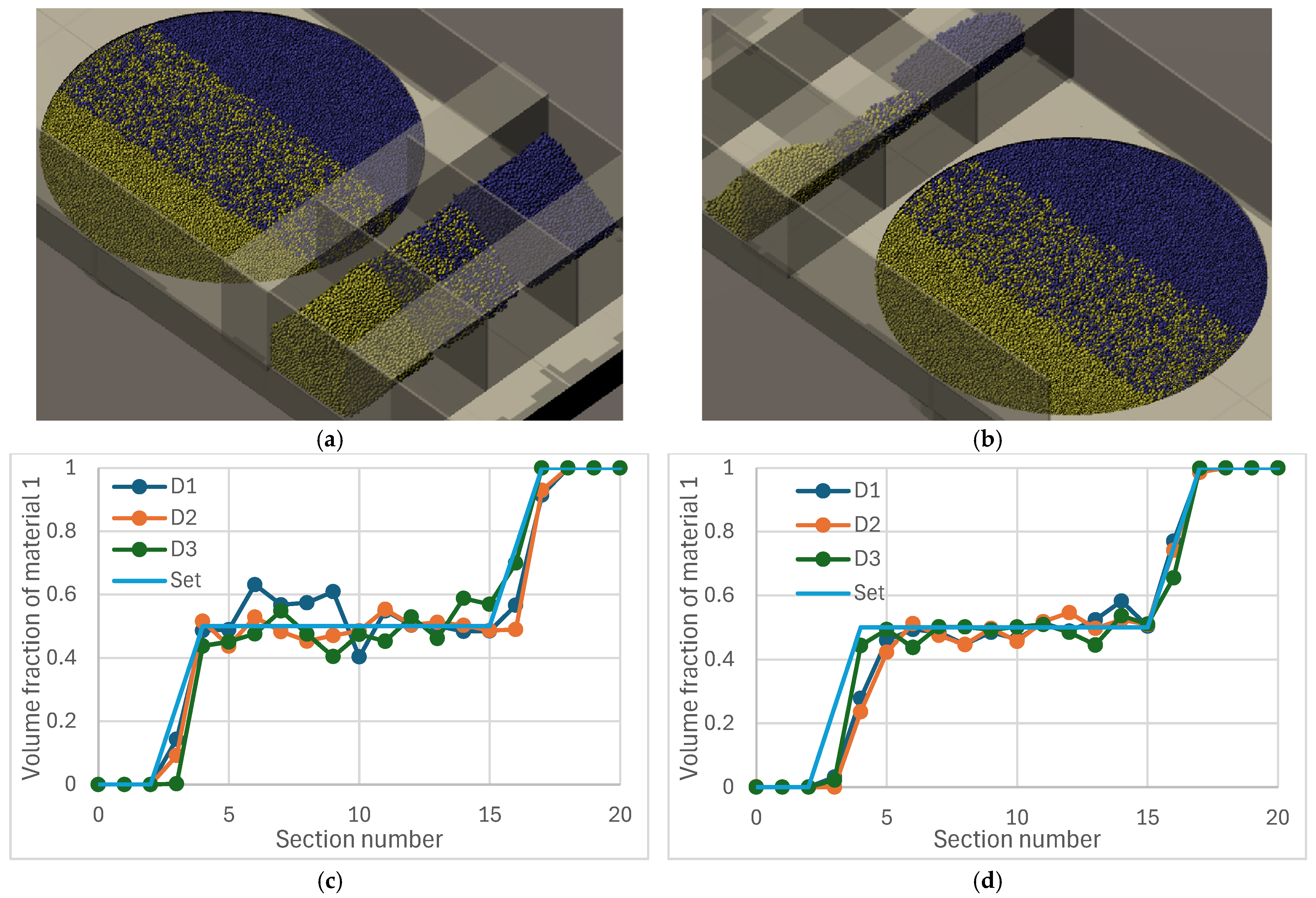
This subsection presents the second design with one movable platform and two blades (
Figure 2 and
Figure 4). The round shape of the building platform causes unequal amounts of powder to be deposited along the blades and across the blade movement. Then, the level of powder before the blade in its center becomes lower than that of the edge, and appropriate forces appear that cause additional movement to the center if that movement is not limited.
The two-blade design allows one to easily introduce additional elements that can help control lateral particle movement. Then, separation walls were proposed. The study of the effect of the separation walls was an additional goal of the simulation presented in this subsection. There are three cases of powder materials simulated with the same three options of separation walls. Here are the simulated cases:
- 1.
The same properties of the two powder materials, the same particle sizes and density;
- 2.
Different particle sizes and the same density;
- 3.
The same particle sizes and different densities.
Here are the options of powder material distribution function and separation walls:
One-step powder material distribution function without a separation wall;
Two-step powder material distribution function with and without separation walls;
Linear powder material distribution function with and without separation walls.
3.2.1. The Same Properties
The same properties of powder materials should not alter symmetry and significantly change material distribution; the simulation results are similar to the results for the two-chamber design. There is no need to use a separation wall, so this option was not modeled.
The cases of a two-step powder material distribution function with and without separation walls were then simulated. The results of the simulation with separation walls that divide the powder into three sections are shown in
Figure 11. It can be seen in
Figure 11a and particularly in
Figure 11b that powder residues in the middle section are significantly smaller than in the outer sections. The walls prevent the powder from leaking inside; it helps to keep the borders in the same places. In a free process (without separation walls), the central zone is narrowed, and the borders move towards the center (this case is not presented).
The results of the simulation of the case with a linear distribution function with separation walls are presented in
Figure 12. Similarly to the previous case, the separation walls prevent the powder from leaking inside, and the borders remain in the same places, but the distribution functions for the second layer have a steeper slope (
Figure 12c). We cannot explain this; it may be a random deviation or an effect of the round platform shape; an additional study is required.
3.2.2. Different Sizes
The different particle sizes of powder materials influence the deposition so that smaller particles tend to move downward, displacing the larger particles to the top. This occurs both in the same material and in different ones. Additional factors in the second design are the limitation of the powder amount between the blades and the uneven powder consumption throughout the width of the circular building platform.
The results of applying the one-step material distribution function without a separation wall are presented in
Figure 13. After the first movement (
Figure 13a), the border between the powder materials is replaced in the direction of the material with the largest particle. At the beginning of the delivery process, the border moves away from the center, then remains at almost the same distance, and finally approaches the center. The border remains quite clear during the first movement of the blades (
Figure 13c). Size segregation occurs during powder movement. The second layer is more blurred, and the distribution of the powder material has the same tendency as that of the two-chamber design, accounting for the opposite direction of movement and the other shape of the building platform.
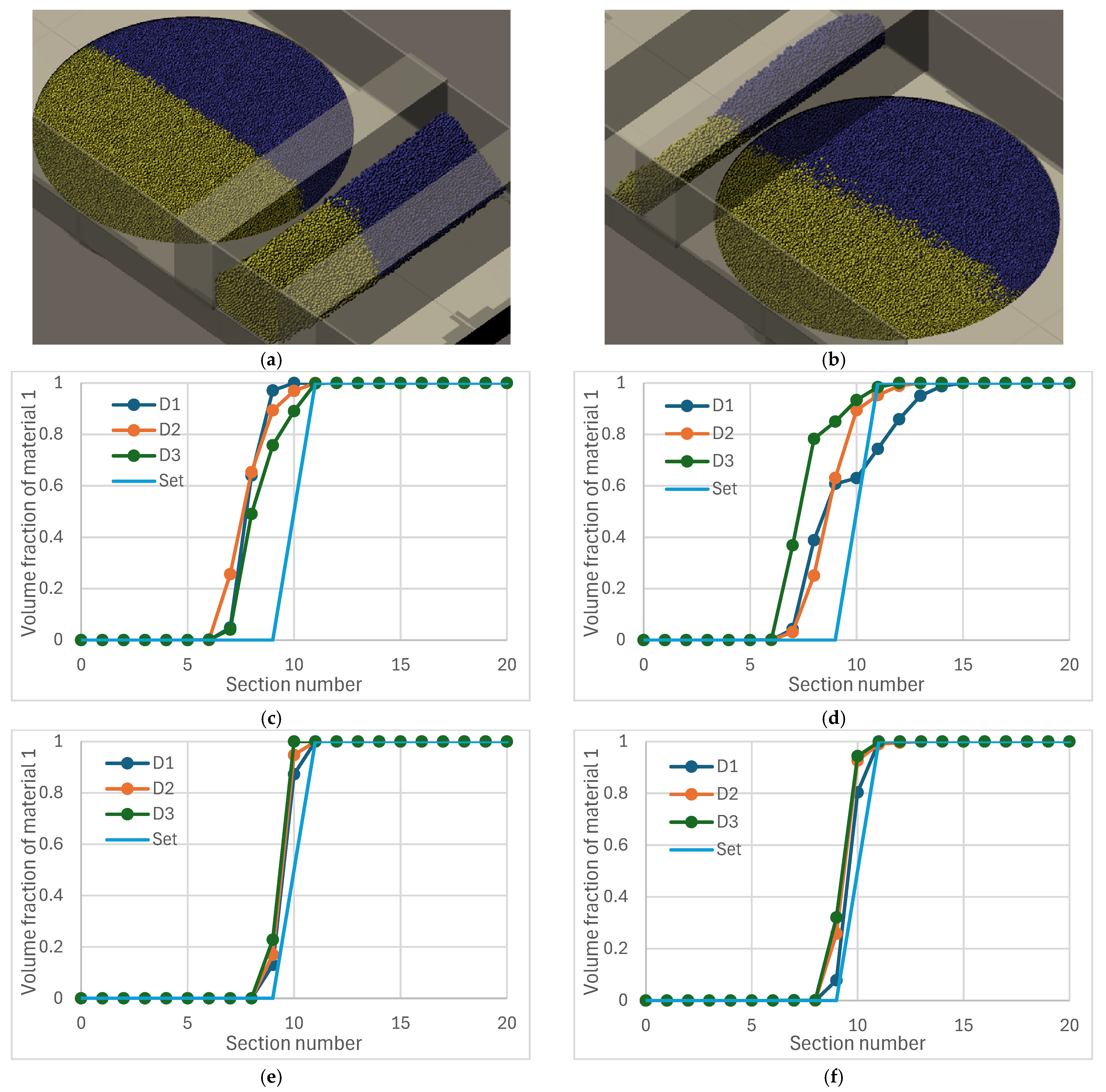
The simulation results for the two-step material distribution function using two separation walls are presented in
Figure 14. Comparing the results with those for particles of the same size (
Figure 11) shows great similarity. The borders remain sharp and maintain the same location. The level of powder remaining in the three sections after the second move is different. The lower level of yellow particles compared to the level of blue particles can be explained by the movement of smaller particles under the separation walls from the ‘yellow’ section toward the central section and from the central section toward the ‘blue’ section.
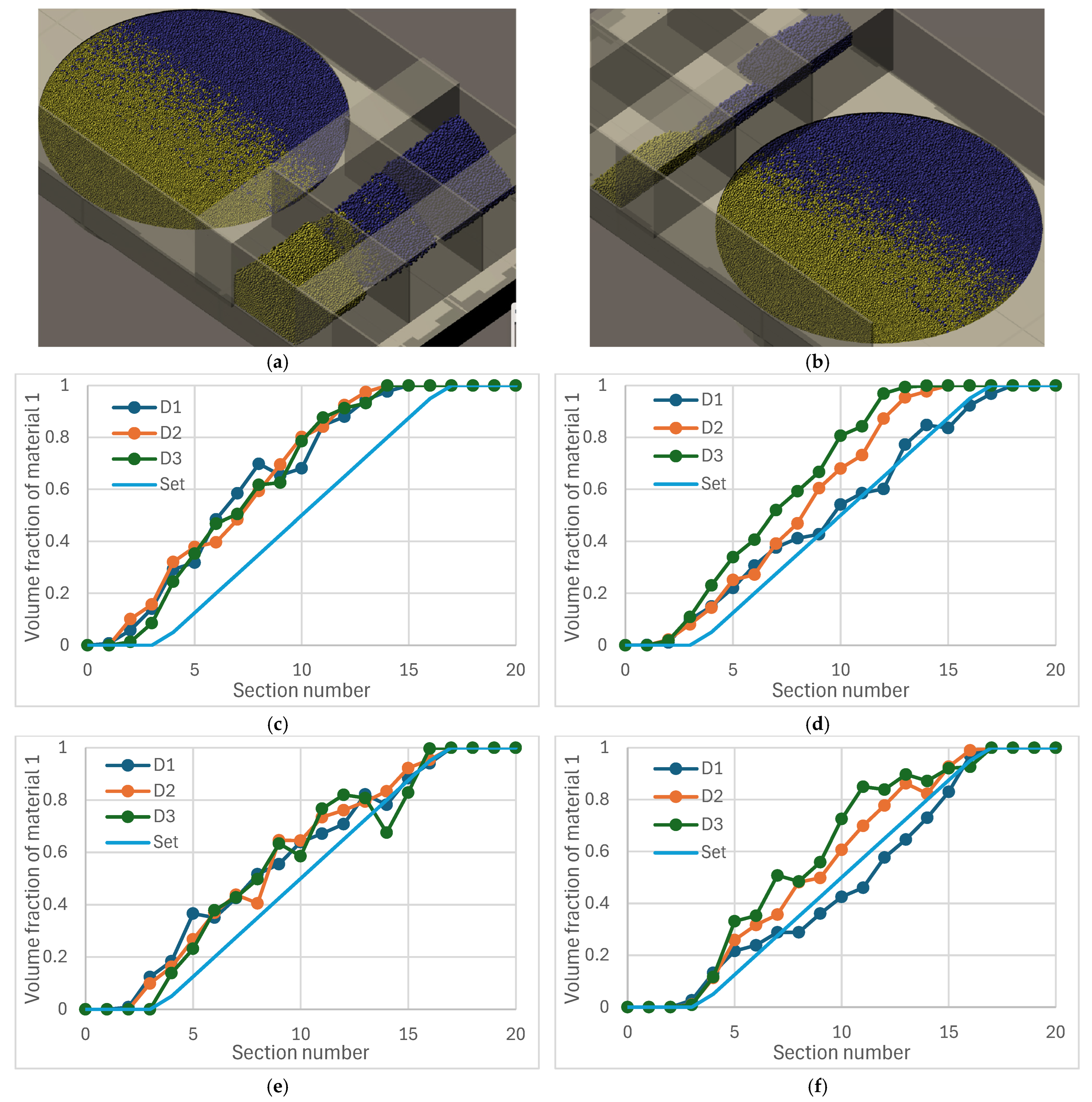
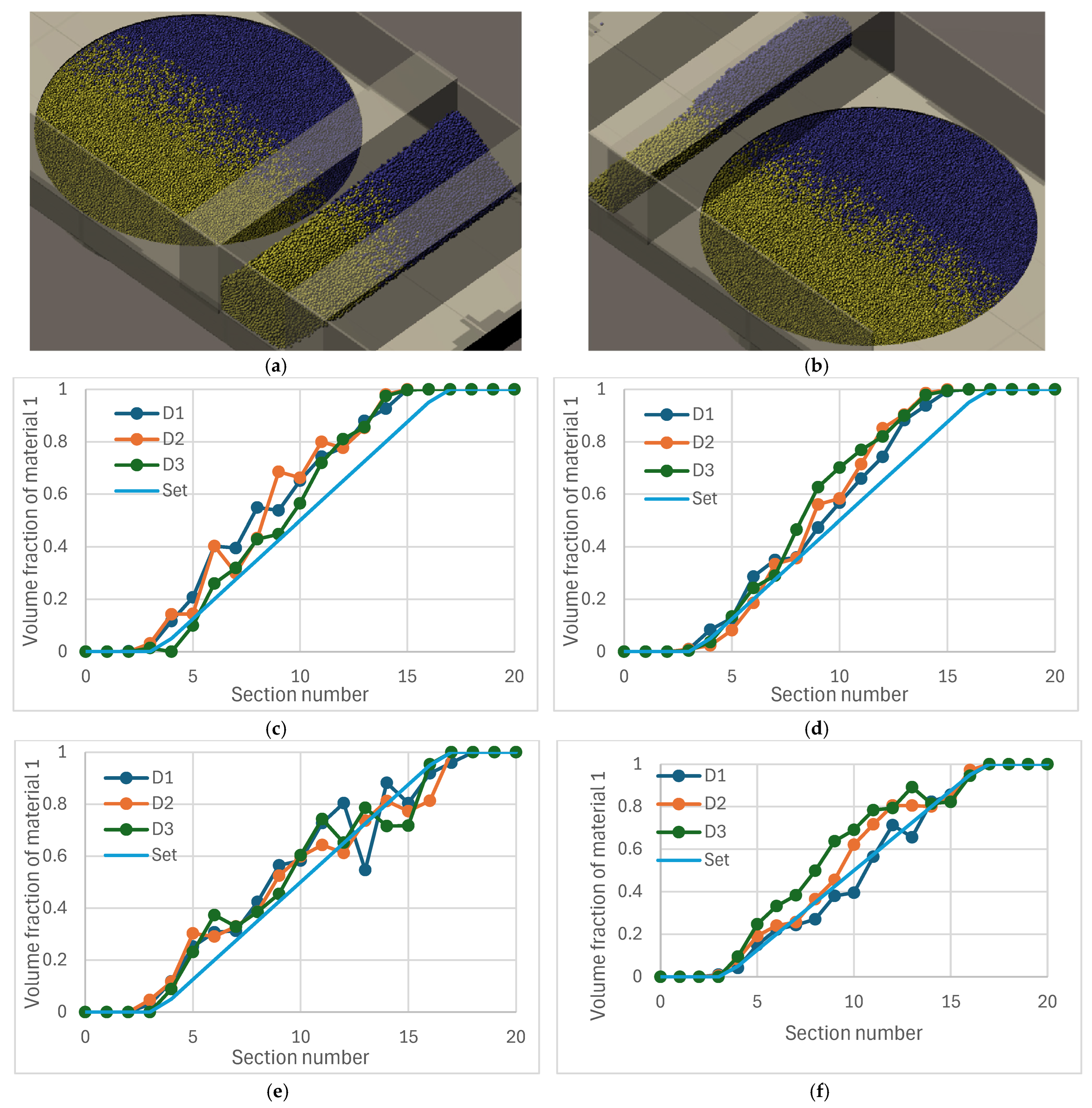
The linear distribution function of the powder material in the powder chamber was modeled for two cases: without and with a separation wall. The results are presented in
Figure 15. The differences are hardly visible and are only in the case with a wall in
Figure 15a,b. However, the largest changes in the distribution in the powder chamber can be observed in the case without the separation wall (
Figure 15c,e). Furthermore, the beginning and end of the changes in the distribution functions are fixed in the second case and changed in the first case (
Figure 15d,f). The distribution itself is also more focused around the given line in the second case, and is observed as good at the second layer (
Figure 15d,f).
3.2.3. Different Density
When different materials are used, it is often possible to select powders with a very close particle size distribution, but the density of the materials can vary significantly. Therefore, an analysis of differences in the materials’ density was performed, similar to that of differences in size. The results of the simulations are presented in
Figure 16 and
Figure 17. Analysis of results with different densities compared to those with the different sizes (
Figure 13,
Figure 14 and
Figure 15) demonstrates a very high similarity, with a significantly greater impact of size than density. A size ratio of 1.3 is more influential than a density ratio of 1.5. All conclusions made for different sizes can be transferred to different densities, just on a smaller scale.
4. Modeling Results Analysis and Comparison with Other Research
The joint mass-size segregation process determines the results of the deposition of two different powder materials. Three options for the ratio of materials are discussed in the article: the same properties, different particle sizes, and different material densities. In the first two options, particle size segregation can be considered only. Small particles tend to move to the bottom due to effects such as the Brazil nut effect (also sometimes called granular convection). As the mixture moves, small particles can fall into gaps that form between larger particles. Larger particles usually move in the opposite direction or stop higher, creating separated layers. When larger particles move slightly upward, they cannot fall back into the spaces now filled by smaller particles. This process is also known as percolation.
Size segregation along the blade movement can be analyzed in cases with equal particle properties of both powder materials in a two-chamber design in all simulated variants, that is, with separation along the axis (
Section 3.1.1), with inclined (
Section 3.1.2) and periodic (
Section 3.1.3) lines. At the same locations D1, D2, and D3 for the first and second layers, the numbers of particles in these sections were calculated. The results are presented in
Table 2. It can be observed in all six cases that the number of particles decreases from the first location D1, through the middle location D2, to the last location D3. It says that the smaller particles are deposited earlier and the coarser ones later. This tendency is more visible for the second layer. This can be explained by the limited volume of powder in the simulations and/or the particle exchange between the layers.
The results obtained are in agreement with the modeling results presented in [
21], which considers experiments and a computational approach using DEM. The results in
Table 2 are similar, at least qualitatively, to
Figure 14 in [
21]. It confirms that the size separation process in the spreading direction is modeled properly in the presented Unity DEM model.
We used two sigmoid-like functions to approximate distribution functions: logistic
L(
x) and error functions (integral of the Gaussian function):
The approximation results with both functions are very similar (the correlation coefficient error function is better at the third significant digit in almost all cases). Moreover, the parameters of the error function are easier to interpret: μ—horizontal shift (center of transition or boundary between materials), σ—width of transition (the larger σ, the smoother the transition). For these reasons, the error function was chosen, and it is presented below.
This analysis was performed only for the initial step distribution function without the use of walls and with one wall. The use of an inclined and periodic partition line reveals that the distribution cannot be controlled with this method; however, the initial linear distribution and the use of two walls require a more sophisticated analysis using two partitions and/or other functions. The results of the studies are presented in
Table 3.
A comparison of results obtained for different sizes (ratio 1.3) and densities (ratio 1.5) demonstrates that the influence of such size differences is more significant than such density differences (approximately twice as high) in both cases, with and without walls. An implementation of separation walls fixes the location of the boundary, reducing its displacement and width (see
Table 3 and
Figure 15,
Figure 16 and
Figure 17) in all cases at least by half.
When the initial state is the powders of different sizes or densities on the sides of the container (chamber), segregation occurs not only vertically, determining a longitudinal distribution, but also horizontally across the movement of the blade, giving a transverse distribution. Actually, the longitudinal and transverse distribution in each layer geometrically represents the segregation process, its beginning, transition, and final state (or interrupted state at a certain stage).
A comparison of different simulations with different sizes or densities shows the similarity of the final and often transient distributions on the building platform. The final distribution depends more often on the particle size than on the initial distribution in the powder chamber. Additionally, the difference in sizes is more influential than the difference in densities, and the segregation process is faster.
The results presented in
Section 3 are compared with the results presented elsewhere [
27,
28,
29]. Two powder materials, SS316L and IN718, with particle sizes ranging from 19 to 46 µm and 18–49 µm, respectively, were manufactured by the LPBF process. The densities of the materials are 8.0 and 8.19 g/cm
3, respectively. Materials were separated on the powder platform along a straight line in the direction of spreading. Results presented in
Figure 5a [
27] demonstrate that even a slight difference in density leads to an inclined boundary between materials in the product. This result is similar to the results presented in
Section 3.2.3.
Two powder materials, 18Ni Maraging 300 steel (density 8.1 g/cm
3) and AISI 316 L stainless steel (density 8.0 g/cm
3), with particle sizes in the range of 15–45 µm, were studied in [
28,
29]. Results in the process with a straight [
29] and inclined [
28] separation lines are similar qualitatively to the results presented in this paper. Quantitative validation is not possible because most information about experiments presented in publications [
27,
28,
29,
30] is not available.
The creation of an elongated transition area between two pure powder materials without separation walls is problematic; it can be achieved only for materials with the same properties (for example, for two grades of steel with a very similar size distribution), but the deposition process is weakly controlled. The introduction of separation walls allows the borders between areas to limit the transition of particles from one segment to another.
The two-blade design is more useful for introducing separation walls than the two-chamber design. Separation walls can be easily implemented between blades, while the two-chamber design requires additional constructive solutions.
5. Conclusions
This paper presents the first preliminary stage of the study, which includes the development of a model based on the discrete element method, simulations of several powder delivery cases, and an analysis of the obtained results. The results of the three-dimensional simulations demonstrate the potential of the model and the possibility of applying it to design a powder delivery system for the LPBF process with effective gradient control in the manufactured FGM.
Two designs, namely two-chamber and two-blade designs, were analyzed. Three cases of powder material properties were simulated: with the same properties, with different mean particle sizes and the same densities of materials, and with distinct densities of materials. Only the same properties allow for some limited control of the material distribution in both designs. Different properties activate the size and/or mass separation process (percolation) that defines the distribution of the powder material on the building platform. Moreover, the separation process is more important and relevant closer to the end of the deposition process than the initial distribution of the powder material in the powder chamber, which plays only a limited role at the beginning of the process. Modeling demonstrates that the main factors are the difference in the size of powder particles and material density (different masses of particles of the same size). Other factors determined in this study should be analyzed further, such as the shape and size of the building platform, the length of the spreading path, the presence of separating walls, the gap between the wall and the deposited surface, and the level of the powder in different sections.
This paper also proposes the implementation of separation walls that allow one to fix the boundaries between areas, limiting the particle transition from one segment to another. This proposal was simulated in the two-blade design and showed acceptable efficiency. Separation walls can be easily added between blades to increase the controllability of the gradient in the transition area between two pure materials.
The results presented in the paper can be treated as qualitative, which require verification and validation in further experimental studies that allow for calibrating the model, especially in the question of the speed, pace, and scale of the separation (percolation) process. The purpose of the next stages of the project is to design an LPBF technological process with effective gradient control in FGMs. These stages involve experimental studies, the development of recommendations, the design of a new process, the preparation and production of prototypes and elements necessary for implementation, and their testing in experimental LPBF processes of FGMs.