Article

Application of Environmental Lactic Acid Bacteria in the Production of Mechanically Separated Poultry Meat Against Coagulase-Positive Staphylococci


Department of Meat and Fat Technology, Prof. Waclaw Dabrowski Institute of Agricultural and Food Biotechnology—State Research Institute, 36 Rakowiecka St., 02-532 Warsaw, Poland
*
Author to whom correspondence should be addressed.
Appl. Sci. 2025, 15(24), 13032; https://doi.org/10.3390/app152413032
Submission received: 14 November 2025 / Revised: 5 December 2025 / Accepted: 9 December 2025 / Published: 10 December 2025
(This article belongs to the Special Issue Quality, Safety, and Functional Properties of Meat and Meat Products)

Abstract

The study aimed to assess the effect of applying selected strains of lactic acid bacteria (LAB) to the surface of poultry bones before mechanical deboning on the microbiological quality and selected physicochemical characteristics of the mechanically separated poultry meat (MSPM) obtained. Three selected LAB strains—Lactiplantibacillus plantarum SCH1, Limosilactobacillus fermentum S8, and Pediococcus pentosaceus KL14—were applied to chicken bones (carcasses) and subjected to cold storage for 3 days, and then the meat was mechanically deboned using high-pressure separation. The obtained product (MSPM) was tested after 1, 3, and 5 days of refrigerated storage. A comprehensive set of physicochemical analyses was performed, including pH and redox potential, TBARS, fatty acid profile, and colour assessment. The following microbiological determinations were also carried out: total viable count, mesophilic lactic acid bacteria, Escherichia coli count, Enterobacteriaceae count, and coagulase-positive staphylococci count. The strains used, especially L. plantarum SCH1, reduced the number of coagulase-positive staphylococci in MSPM, providing protection compared to the control samples (p < 0.05). No inhibitory effect of the LAB used was observed on Enterobacteriaceae and E. coli. The total number of microorganisms and the number of lactic acid bacteria were similar in all treatments. Significant effects of adding selected strains of LAB on lowering the pH and changing the redox potential of MSPM were observed (p < 0.05). The L* parameter (lightness) of the MSPM colour increased, while the proportion of red colour (a*) decreased (p < 0.05). However, the bacteria used did not protect against oxidation processes, which proceeded faster in MSPM samples containing bacterial strains, as demonstrated by the TBARS test and fatty acid profile. The research conducted is promising, particularly in terms of reducing coagulase-positive staphylococci in MSPM production. However, further research on the impact of selected LAB on oxidative processes in MSPM is necessary.

1. Introduction

The meat industry is facing several challenges, including growing consumption and demand, as well as sustainability trends. The contemporary consumer is becoming increasingly conscious of their purchasing choices, placing not only a premium on quality, but also on sustainability. This encompasses considerations such as production technology and the effective management of raw materials and by-products. It is important to note that food waste has been increasing in recent years [1].
Mechanically separated poultry meat (MSPM) is produced from bones or bone fragments (hard tissue) with adjacent soft tissue, mainly consisting of lean meat, fat, and connective tissue fragments. It is derived from bones that have been mechanically separated during the deboning process, resulting in the loss or modification of the muscle fibre structure [2]. In accordance with Regulation (EC) No 853/2004 [3], raw material (poultry bones) used for the production of mechanically separated meat may not be stored for more than three days.
In industrial practice, MSPM is obtained using methods that disrupt bone structure (high-pressure methods) and methods that do not alter the structure of the bones (low-pressure methods). MSPM produced by the high-pressure method, in particular, exhibits a higher lipid content comprising phospholipids, cholesterol, calcium, phosphorus, iron and heme pigments than hand-cut meat. The process of mechanically separating meat from bone leads to significant fragmentation of the raw material and disappearance of tissue structure. This can ultimately lead to the formation of microhabitats that promote bacterial colonisation and growth [4].
The microflora of the raw material (bones) used for the production of MSPM may include saprophytic bacteria such as Pseudomonas, as well as potentially dangerous pathogens such as coagulase-positive staphylococci (CoPS), including Staphylococcus aureus, due to its versatility as a pathogen in humans and animals, and also because it is one of the causes of food poisoning. The presence of the coagulase enzyme and the ability to coagulate plasma are used to classify staphylococci as either coagulase-negative (CoNS) or coagulase-positive (CoPS) [5]. From a public health perspective, the production of coagulase is an important indicator of Staphylococcus spp. being pathogenic and resistant to antimicrobials. Other species in the coagulase-positive group are also potentially pathogenic because they can produce more than 22 different heat-stable enterotoxins, known as staphylococcal enterotoxins (SEs). Significant safety concerns are raised due to the presence of coagulase-positive staphylococci in meat products, as enterotoxin genes are carried by 70–90% of isolates, and widespread antibiotic resistance is exhibited, with 94.6% of isolates being resistant to multiple antibiotics [6].
Many studies point to problems related to the microbiological quality of MSPM in industrial plants in terms of contamination with coagulase-positive staphylococci. Pomykała and Michalski [4] showed that coagulase-positive staphylococci were present in 35 out of 46 batches of MSPM (representing 76%) from industrial plants tested at 0.1 g. In the study by Josefowitz et al. [7], it was shown that in 63% of mechanically separated turkey meat samples, the number of coagulase-positive staphylococci exceeded 2.7 log CFU/g, while in 20% of the samples, values above 3.7 log CFU/g were detected. The obtained results [4,7] indicate an insufficient level of hygiene during the separation process and confirm the need to improve microbiological conditions in the production of mechanically separated poultry meat.
Poultry meat and products are among the foods most commonly associated with staphylococcal food poisoning. This emphasizes the importance of microbiological monitoring in the food industry, particularly in the processing and production of poultry meat, and the need to find new, effective methods of combating microbiological hazards [5].
In industrial practice, mechanically separated meat is most often preserved by curing or freezing. However, these methods have limitations. The freezing process causes deterioration in the sensory and technological characteristics of the raw material. The use of curing may be insufficient due to changes in the reduction in nitrite use in food production [8,9,10].
A particularly noteworthy area of research pertains to the utilization of environmental lactic acid bacteria (LAB) in the stabilization of the microbiology of MSPM and products comprising it. These bacteria have the potential to function as an effective bioprotection tool, given their capacity to naturally predominate the microbiota of meat during the processing and storage of this product [11]. The antimicrobial activity exhibited by these organisms is attributable to the production of a range of metabolites, including organic acids, hydrogen peroxide, diacetyl, carbon dioxide and protein substances that possess bactericidal properties, known as bacteriocins [12].
The studies by Raccach and Baker [13] demonstrated the inhibitory effect of Lactiplantibacillus plantarum and Pediococcus cerevisiae strains individually and their mixture on Staphylococcus aureus in cooked poultry meat. Hecer and Sözen [14] used lactic acid, acetic acid and sodium lactate on mechanically separated poultry meat to reduce the microbial load. As a result of their research, the most effective reduction in the number of mesophilic aerobic bacteria was observed in the group to which 2% sodium lactate was added, where a decrease of almost 15% was recorded.
In our previous research [15], the Lactiplantibacillus plantarum SCH1 strain, isolated from organic raw fermented pork roast, has the capacity to enhance the microbiological quality of MSPM cured with reduced sodium nitrite content by decreasing the number of E. coli. Earlier research [16] had previously confirmed the efficacy of this strain in reducing the number of bacteria belonging to the Enterobacteriaceae family and E. coli in uncured MSPM.
In industrial practice, poultry bones are stored under refrigerated conditions before deboning. However, even within the permitted storage period of three days, there is a risk of the development of undesirable microflora. High levels of microbial contamination of the bones directly affect the microbiological quality of the MSPM obtained [14].
The use of lactic acid bacteria (LAB) as bioprotective cultures in meat is well documented—these bacteria lower the pH and competitively displace pathogenic and spoilage microorganisms [15]. In most studies to date, LAB inoculation has been carried out directly on the final product (e.g., raw minced meat, fermented products, or ready-to-eat cold cuts), meaning their antibacterial effect only begins during storage or maturation [16]. Our work proposes using selected LAB strains before the mechanical deboning of poultry. The LAB are applied directly to the bone surface and stored under refrigerated conditions prior to the mechanical separation process. Our research hypothesis is that selected LAB strains can limit the growth of undesirable microflora, including coagulase-positive staphylococci, in the raw material obtained after deboning. Therefore, the study aimed to evaluate the effect of LAB inoculation prior to deboning on the microbiological quality and selected physicochemical characteristics of MSPM obtained after production and cold storage. The early application of LAB could allow for better colonisation of the meat tissue, earlier competition with undesirable microflora, and long-term microbiological control. This could potentially increase the effectiveness of bioprotection and product stability from the initial stage of processing.

2. Materials and Methods

2.1. Preparation of Lactic Acid Bacteria Strains and the Solution for Application to Bones

Three different strains of LAB were selected based on the research of Rzepkowska et al. [11,17] and the research of Łaszkiewicz et al. [15,16,18]. Strains were isolated from organic fermented pork roast (Lactiplantibacillus plantarum SCH1; Genbank accession KX014848), organic acid whey (Limosilactobacillus fermentum S8; Genbank accession KY363557), and organic fermented pork sausage (Pediococcus pentosaceus KL14; Genbank accession KX021364). Lactic acid bacteria cultures were stored in MRS broth (Oxoid, Basingstoke, UK) with the addition of 20% glycerol at −80 °C. The strains were activated through incubation at 37 °C for 18 h in MRS broth. In the second passage, the culture was re-incubated in sterile MRS broth under the same conditions (at 37 °C for 16–18 h), reaching a final concentration of approximately 109 CFU/mL. The bacterial suspension was subjected to centrifugation at 6000 rpm (RCF 3341× g) for 10 min (MPW Med Instruments, Warsaw, Poland) at 4 °C. The centrifuged biomass was suspended in 2 litres of sterile saline solution (0.9% (w/w) NaCl, Pol-Aura, Dywity, Poland) with 100 g of glucose (Pol-Aura, Dywity, Poland). The bacterial suspension was prepared and applied to 100 kg of bones by spraying with an atomiser. As a result, a bacterial concentration of approximately 107 CFU/g and 0.1% glucose was obtained in relation to the raw material (bones).

2.2. Raw Material and Experiment Design

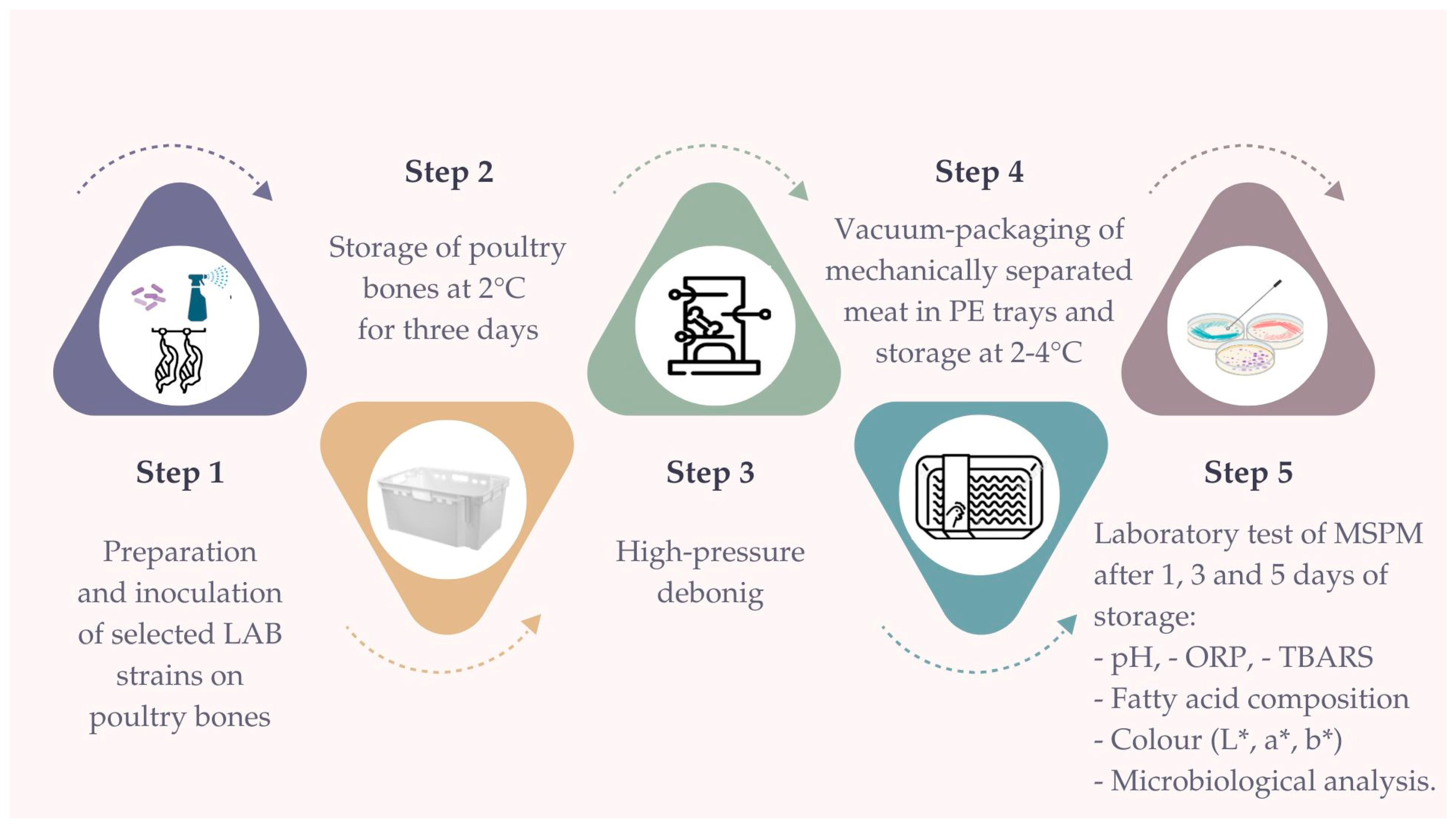
The experimental design is shown in Figure 1. The poultry carcasses used in the study came from 35-day-old Ross 308 commercial broiler chickens (Gallus gallus domesticus), which are commonly used in industrial production. The 500 kg of bones (carcasses) of chicken obtained from industrial cutting were divided into 5 separate treatments of 100 kg each:
  • C1: control—only bones;
  • C2: control—bones treated with a 2.0% saline solution and 0.1% glucose;
  • L1—bones treated with a 2.0% saline solution and L. plantarum SCH1 (≈107 CFU/g) and 0.1% glucose;
  • L2—bones treated with a 2.0% saline solution and L. fermentum S8 (≈107 CFU/g) and 0.1% glucose;
  • L3—bones treated with 2.0% saline solution and P. pentosaceus KL14 (≈107 CFU/g) and 0.1% glucose.
Depending on the treatment, the bones (carcasses) were sprayed with either a saline solution containing dissolved glucose (C2) or a saline solution containing a suspension of bacterial cells and glucose (L1–L3). The bones were then stored under refrigerated conditions (2 °C) in containers for a period of 3 days. Following this step, the bones were deboned using a method that destroys the bone structure on a NOWICKI Hercules SNV-180 separator (Metalbud, Rawa Mazowiecka, Poland) with a 1 mm sieve. The product (MSPM) was vacuum-packed on polyethylene (PE) trays to avoid contamination, then sent for testing on days 1, 3, and 5 of cold storage (2–4 °C). The production of MSPM was performed in three replications.

2.3. Determination of pH Value and ORP

The pH value and oxidation-reduction potential (ORP) were determined according to procedures described in Łaszkiewicz et al. [16]. The oxidation-reduction potential was presented as millivolts (mV).

2.4. Lipid Oxidation Indicator

The Thiobarbituric Acid Reactive Substances (TBARS) Index was performed according to Pikul et al. [19]. To prepare the sample, 10 g of MSPM was combined with 35 mL of 4% cold perchloric acid (Sigma-Aldrich, St. Louis, MO, USA) to create a mixture. Additionally, 750 µL of a 0.01% ethanolic solution of butylated hydroxytoluene (BHT) from Sigma-Aldrich (St. Louis, MO, USA) was added to prevent oxidation during processing. The mixture was then homogenised for one minute using a Bamix M200 blender (ESGE AG, Hauptstrasse 21, CH-9517 Mettlen/Schweiz, Switzerland) to ensure uniform consistency. The homogenate was then filtered through Whatman filter paper (Grade 1 Qualitative) to separate the liquid phase from the solid residues. Following filtration, 1 mL of the resulting filtrate was combined with 1 mL of 0.02 M aqueous 2-thiobarbituric acid (Sigma-Aldrich, St. Louis, MO, USA). This mixture was then incubated at 100 °C for 60 min. After cooling to room temperature, the absorbance was measured at a wavelength of 532 nm using a U-2900 spectrophotometer (Hitachi, Tokyo, Japan). For calibration purposes, a reference sample was prepared by mixing 1 mL of 4% cold perchloric acid with 1 mL of 0.02 M aqueous 2-thiobarbituric acid to account for any background absorbance. The results of the spectrophotometric analysis were expressed as milligrams of malondialdehyde (MDA) per kilogram of MSPM, providing a quantitative measure of the extent of lipid peroxidation. All reagents were freshly prepared before each analysis to ensure the accuracy and reliability of the results, and all procedures were performed under limited light conditions.

2.5. Fatty Acid Profile Determination

Fatty acid composition was determined using the gas chromatography method (HP 6890 II with a flame ionisation detector, Hewlett-Packard, Palo Alto, CA, USA), in accordance with ISO 12966-1:2015-01 [20], with the method detailed in Okoń et al. [21].

2.6. Colour Determination

Colour parameters (L*, a*, b*) were determined according to procedures described in Łaszkiewicz et al. [16]. The hue angle (h°) and saturation (saturation index) (C*) were calculated using Formulas (1) and (2), where a* and b* are data from instrumental colour measurement [22]. Analyses were conducted three times during the storage period (1, 3 and 5 days).
h ° = t a n 1 b * a *
C * = a * 2 + b * 2

2.7. Microbiological Analyses

A microbiological evaluation was performed using the plate method. Total viable counts (TVC) were determined using nutrient agar (PP 1503, Biomaxima, Lublin, Poland) according to ISO 4833-1:2013 [23]. The plates were incubated at 30 °C for 72 h. The number of mesophilic lactic acid bacteria (LAB) was determined using MRS agar (PP 0136, De Man, Rogosa and Sharpe agar, Biomaxima, Lublin, Poland), according to ISO 15214:1998 [24]. The plates were incubated at 30 °C for 72 h. The number of Escherichia coli (Ec) was determined using E. coli Chromogenic Medium (PP 0050, Biomaxima, Lublin, Poland) according to ISO 16649-1:2018 [25]. The plates were then incubated at 44 °C for 20–24 h, after which the Enterobacteriaceae (EB) were enumerated on MacConkey agar (PP 1017, Biomaxima, Lublin, Poland) in accordance with ISO 21528-2:2017 [26]. The plates were then incubated at 37 °C for 24 h, after which the enumeration of coagulase-positive staphylococci (CoPS) (including Staphylococcus aureus and other species) was performed on Baird-Parker agar (PP 1320, Biomaxima, Lublin, Poland), in accordance with ISO 6888-1:2021 [27]. The plates were then incubated at 3–38 °C for 24–48 h.

2.8. Statistical Analysis

The experiment consisted of three independent repetitions (n = 3) and was conducted using a completely randomised design. The results are presented as mean values with standard deviations (SD). Statistical analysis was performed using Statistica 13 (TIBCO Software Inc., Palo Alto, CA, USA). To assess the effects of the experimental factors, a two-way ANOVA with interaction was used to evaluate the main effects of treatment (T), storage time (S) and their interaction (T × S). When significant differences were detected, Tukey’s post hoc test was performed. Differences were considered highly significant at p < 0.01. If no differences were found at this level, significance at the p < 0.05 level was also evaluated.

3. Results and Discussion

3.1. Changes in pH and ORP

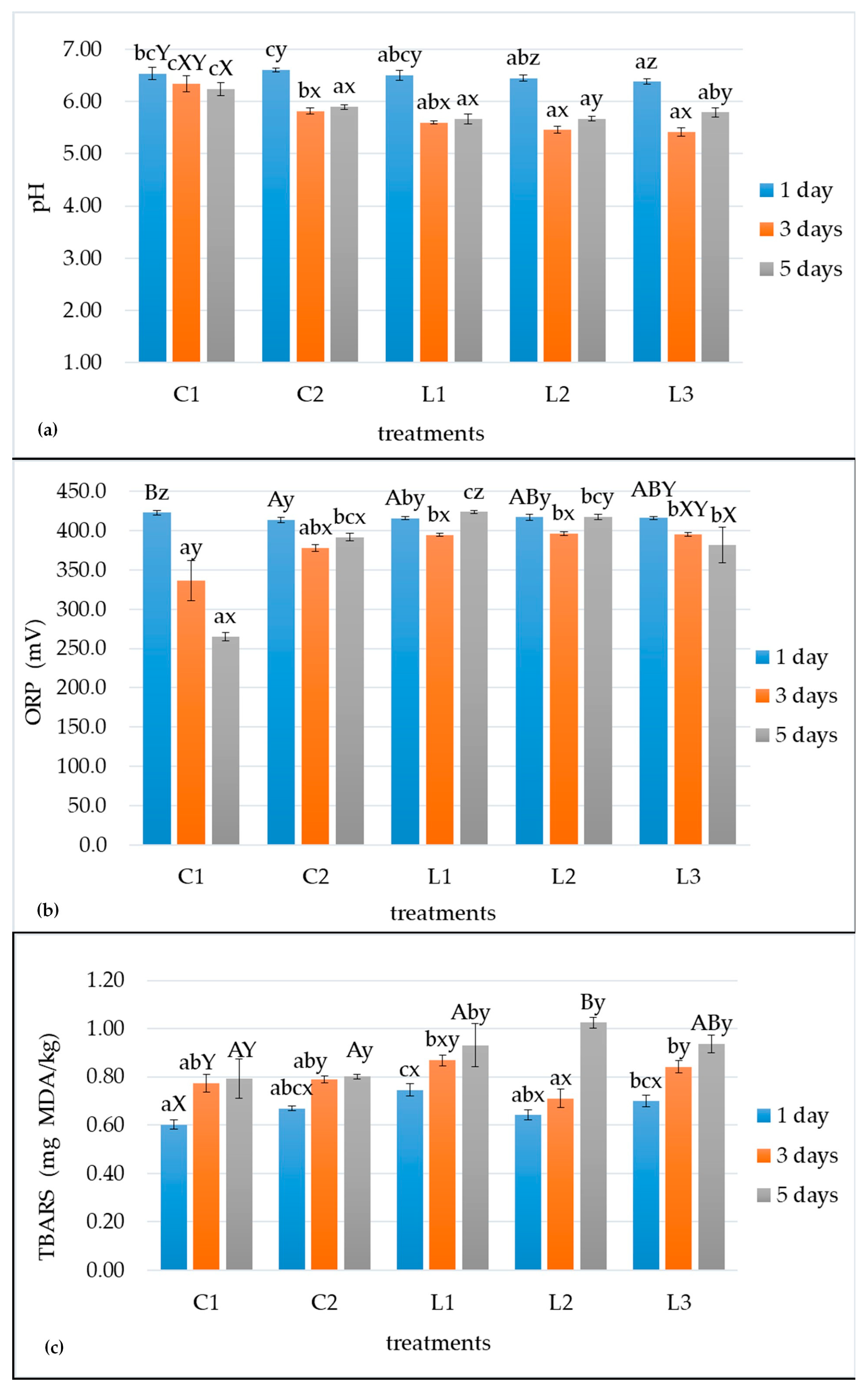
The pH measurement results in the experiment showed a significant (p < 0.01) effect of the treatment and the effect of time. Interactions between the main factors were also observed (p < 0.001). A significant decrease in pH was observed in all samples after storage, and in samples with LAB addition, pH values were significantly lower (Table 1). Research by Rzepkowska et al. [11,17] demonstrated the acidification capacity of these strains. Similarly, Łaszkiewicz et al. [15], by adding Lactobacillus plantarum SCH1, Lactobacillus brevis KL5, and Lactobacillus plantarum S21 strains to uncured mechanically separated poultry meat (MSPM), observed a decrease in pH during refrigerated storage. The lactic fermentation process, conducted by bacteria, results in the formation of lactic acid and other organic acids, as evidenced by the observed decrease in pH. This phenomenon is likely a consequence of the metabolic activity of the added LAB or autochthonous bacterial cultures present in MSPM [28,29]. After five days of storage, a significant (p < 0.01) increase in pH was observed in samples L2 and L3. The increase in pH probably results from the degradation of proteins by proteases and the production of peptides, amino acids, amines and organic acids. Wang et al. [30] demonstrated that LAB metabolism and acid production affect the structure of other microorganisms, thereby inhibiting the growth of spoilage bacteria and reducing the impact of spoilage bacteria metabolism.
The results of the oxidation-reduction potential indicated a significant (p < 0.05) effect of treatment and time of storage, and a significant (p < 0.001) interaction between these factors was also observed (Figure 2). In the control samples (C1 and C2), without LAB addition, the ORP gradually decreased, which may be due to natural reduction processes occurring in meat, such as oxygen consumption and endogenous microflora activity [31]. In the experimental treatments L1 (Lactipantibacillus plantarum SCH1) and L2 (Limosilactobacillus fermentum S8), the ORP initially decreased after 3 days and then increased significantly (p < 0.01), reaching its highest (p < 0.01) value in the L1 samples after 5 days. In contrast, in sample L3 (Pediococcus pentosaceus KL14), a gradual decrease in ORP was observed during storage (p < 0.05). The increase in ORP in treatments L1 and L2 may be related to a reduction in LAB metabolic activity in the later storage period, caused by the depletion of easily digestible energy substrates such as glucose. Reduced fermentation activity leads to decreased production of reducing compounds (e.g., NADH and lactic acid), which were responsible for maintaining a low oxidation–reduction potential at an earlier stage. As the activity of LAB antioxidant enzymes (e.g., NADH peroxidase, superoxide dismutase and catalase) decreases, reactive oxygen species (e.g., hydrogen peroxide) may accumulate in the environment. This promotes the oxidation of lipids and muscle pigments (e.g., the conversion of myoglobin to metmyoglobin), increasing ORP [32]. Some lactic acid bacteria respond to oxygen stress by increasing the synthesis of antioxidant enzymes [33]. In the case of L. plantarum, a manganese-containing pseudocatalase is produced [34]. Another enzyme that catalyses the decomposition of hydrogen peroxide is glutathione peroxidase [35]. Such LAB activity was probably observed in sample L3, where the redox potential gradually decreased throughout the storage period (Figure 2).

3.2. Lipid Oxidation Indicator (TBARS)

The TBARS value was affected by the treatment and storage time, and an interaction between the factors was found (p < 0.001). MDA production is an indicator of lipid peroxidation in meat and indicates its oxidative stability during storage [36]. An upward trend in TBARS values was observed in all test treatments during storage (Figure 2). In samples treated with LAB, a general tendency towards higher mean TBARS values was observed in comparison to the control sample (C1), although statistical significance was not demonstrated in every treatment. Despite the higher TBARS values observed in the samples containing LAB, these remained within the acceptable limits (1–2 mg MDA/kg) as outlined in the literature [37]. The observed increase in the TBARS value in samples containing added lactic acid bacteria could be linked to the activity of LAB flavoprotein oxidases, which leads to the accumulation of hydrogen peroxide (H2O2). Most LAB are microaerophilic or facultatively anaerobic, meaning they tolerate oxygen but do not require it. They can grow in the presence of oxygen thanks to the regulation of gene expression and changes in metabolic pathways. Some LAB have the ability to produce H2O2 in aerobic conditions, which has an antibacterial effect on spoilage flora but increases oxidative stress in their own cells at the same time [38]. In the presence of transition metal ions (Fe2+ and Cu2+), H2O2 initiates lipid peroxidation reactions. The resulting fat oxidation products, such as aldehydes, contribute to an increase in TBARS values and a shift in the redox balance towards higher ORP values, reflecting an increase in the oxidizing potential of the environment [39]. This increase in redox potential in our studies was observed in MSPM with LAB addition, particularly in treatments L1 and L2 between 3 and 5 days of cold storage.
Similar observations were made by Agrawal et al. [40] in chicken meat, where an increase in the TBARS value was observed during storage despite an initial low value. Studies by Cegiełka et al. [41] have shown that the initial TBARS index value of low-pressure, mechanically deboned chicken meat (MDCM) is 0.306 mg MDA/kg in the control treatment. Reitznerová’s [36] research on TBARS in mechanically separated chicken meat found values of MDA concentration to be 0.090 mg/kg in low-pressure MDCM and 0.112 mg/kg in high-pressure MDCM. In our research, this value was 0.60 mg MDA/kg in control sample (C1) at the beginning of the experiment. This can be explained by the fact that the carcasses in our experiment were exposed to oxygen during the initial storage process and were deboned under high pressure, which could have resulted in faster formation of secondary oxidation products.

3.3. Fatty Acid Profile

Significant changes in the fatty acid profile were observed between treatments and over time (p < 0.01), as well as a significant interaction between the main factors (p < 0.001) (Table 1). Polyunsaturated fatty acids (PUFAs), which are the most sensitive to oxidation, decreased in all treatments, which may indicate active oxidation processes, particularly in samples L1, L2, and L3 (p < 0.01). PUFAs are particularly susceptible to oxidation due to the presence of multiple double bonds in their carbon chains. This process leads to PUFA degradation and a relative increase in saturated fatty acids (SFAs) and monounsaturated fatty acids (MUFAs), which are more resistant to oxidation. This was observed in the treatments with LAB addition and may be the result of lipolytic enzymes produced by LAB, leading to the release and further degradation of PUFAs [30]. These data suggest that although LAB can affect lipid stability, they do not always effectively protect the most sensitive fat fractions. MSPM undergoes increased oxidation as a result of exposure to stressors during production, including pressure, heat and aeration. Additionally, the presence of bone marrow and fat content contributes to this oxidation [42]. In an acidic environment (pH below 6), the activity of antioxidant enzymes in meat may have changed, increasing the sensitivity of lipids to oxidation and leading to changes in fatty acids [30]. As previously documented by other researchers, the generation of reactive oxygen species (ROS) leads to oxidative stress, which in turn causes alterations in the composition of fatty acids [30,41,43]. In the context of scientific research, it is important to note that fat molecules, particularly unsaturated fatty acids, are subject to the action of ROS. This process leads to the formation of various oxidation products, including hydroxy fatty acids, ketones, and aldehydes (MDA). It results in alterations to the fatty acid profile, characterised by a decline in polyunsaturated fatty acids (PUFAs) and an increase in saturated fatty acids and their oxidation products [43,44], as evidenced in our studies (see Figure 2).

3.4. Colour

The study revealed significant effects of treatment (p < 0.001) and storage time (p < 0.001) on meat colour parameters, with substantial interaction between these factors (p < 0.001) (Table 2). Samples inoculated with LAB showed significantly (p < 0.01) higher L* values, corresponding to increased lightness, compared with the control sample (C1). At the same time, a* values, which reflect redness, were lower in treatments with LAB throughout the storage period, but statistically significant differences were observed after 3 and 5 days of cold storage (p < 0.01). The b* values, representing yellowness, showed significant differences between the individual treatments after 1 and 3 days (p < 0.01) and after 5 days (p < 0.05) of storage. Variants L1 and L2 differed significantly from control C1 after 1 day of storage (p < 0.01) and variant L2 differed significantly from control C1 after 5 days (p < 0.05). The group with LAB addition also showed a significant decrease in colour saturation (C*) and an increase in colour angle (h°) (p < 0.01). Together, these results indicate a loss of colour saturation and a perceptible shift in the meat hue from vivid red towards yellow-brown tones. This shift reflects a decline in the proportion of the red pigment, myoglobin, in its oxygenated or reduced forms. These changes can be attributed to the accelerated oxidation of myoglobin to metmyoglobin (MetMb), which reduces red intensity and causes a shift in meat colour towards a yellow-brown hue [45,46]. This process is facilitated by interactions between metmyoglobin (MetMb) and lipid peroxides (LDH), resulting in the formation of ferryl myoglobin (Fe4+=O) and haematin [45]. Ferryl-myoglobin and haematin are both strong prooxidants, capable of catalysing lipid peroxidation and exacerbating colour changes, as well as reducing the oxidative stability of meat. Furthermore, the literature suggests that LAB may modulate the microenvironment of meat by producing lactic acid and other metabolites that affect pH and redox potential, thereby accelerating the oxidative changes of myoglobin [37,46]. These findings demonstrate that microbiological interventions and storage time exert a complex, synergistic influence on meat colour stability and lipid oxidation processes. During deboning, the large surface area of meat exposed to oxygen means that oxidative processes occur more quickly, further contributing to a reduction in the a* value.

3.5. Microbiological Quality

The microbiological quality of the product is characterised in Table 3. The results of each microbiological parameter indicated a significant effect of treatment and time, and a significant interaction between the main factors was also observed (p < 0.001). An increase in the total number of microorganisms was observed in all treatments during storage, although significant differences (p < 0.05) were only demonstrated for treatments C2 and L1. After 5 days, the lowest TVC count was observed in treatment L1 (8.26 log CFU/g), while the highest count was observed in treatment C1 (8.76 log CFU/g). The number of LAB ranged from 6 log CFU/g at the initial stage of the experiment to less than 9 log CFU/g on the final day of the study. MSPM is a habitat for LAB that naturally occur in meat. As demonstrated in Table 3, sample L3 exhibited a significantly higher number of E. coli after five days of storage in comparison to day 1 (p < 0.01). A significant increase in the total number of Enterobacteriaceae was also observed during storage in treatments C1 and L3, reaching 8.26 and 8.61 log CFU/g, respectively, after 5 days. The L3 treatment demonstrated a significantly higher number of Enterobacteriaceae in comparison to the other treatments (p < 0.01). The elevated counts of E. coli and Enterobacteriaceae in sample L3 may indicate insufficient inhibition of Gram-negative bacteria, probably due to the weaker antimicrobial activity of the LAB strain used in the environmental conditions specific to this experiment [11]. In a study by Łaszkiewicz et al. [15], the inhibitory effect on E. coli was observed in MSPM stuffing made from uncured meat, which was inoculated with Lactiplantibacillus plantarum SCH1 after the deboning process. In this production process, the application of LAB before deboning did not yield the expected bacteriostatic effect. A significant effect (p < 0.01) in reducing the growth of coagulase-positive staphylococci was observed between days 1 and 5 of storage in the treatment L1. On the final day of the study, a significantly (p < 0.01) lower number of coagulase-positive staphylococci was observed in L1, L2 and L3, suggesting a protective effect of the selected LAB strains in this environment. The reduction in staphylococci, by more than 4 log compared to treatment C1, was particularly remarkable in treatment L1, which used the Lactiplantibacillus plantarum SCH1 strain. It can be hypothesised that this observation is due to the presence of postbiotics produced by lactic acid bacteria, which have well-documented antimicrobial properties against Staphylococcus aureus, thus impeding bacterial growth or inducing cell lysis. The mechanism of action of postbiotics is primarily characterised by the destabilisation of the S. aureus cell membrane, the formation of pores in the cytoplasmic membrane, and the disruption of metabolic processes and cell wall synthesis [46]. Studies by Rzepkowska et al. [11] demonstrated the antimicrobial activity of the L. plantarum SCH1 strain’s whole bacterial culture and cell-free supernatant against selected Gram-positive and Gram-negative bacteria. Whole bacterial culture is the complete material obtained after bacterial incubation. This contains several components, including live and dead bacterial cells, primary and secondary metabolites (e.g., organic acids and bacteriocins), extracellular enzymes and partially used components of the culture medium. The antimicrobial effect results from the presence of live bacteria as well as metabolites. Cell-free supernatant is a cell-free fraction obtained after centrifugation and filtration. It contains soluble components without live bacteria. These components include bacteriocins, organic acids, H2O2, biosurfactants, antibacterial peptides, enzymes, and intercellular signalling molecules [47]. While these studies did not thoroughly examine the components of bacterial cells and their postbiotics, the results suggest that these components exhibit antagonistic activity [11].

4. Conclusions

It has been demonstrated that the application of selected lactic acid bacteria strains (Lactiplantibacillus plantarum SCH1, Limosilactobacillus fermentum S8, and Pediococcus pentosaceus KL14) to poultry bones before mechanical deboning enhances the microbiological safety of the resulting mechanically separated poultry meat, primarily by reducing coagulase-positive staphylococcal counts. The most potent inhibitory effect against undesirable bacteria was exhibited by the Lactiplantibacillus plantarum SCH1 strain. However, LAB-treated samples showed increased susceptibility to oxidative processes. Further research is necessary, with a particular focus on optimising the bacterial inoculation protocol. The application method used in this study (application of bacteria onto the bone surface before mechanically deboning) may be suboptimal, given the exposure of LAB to oxygen and the potential for metabolite formation, which under certain conditions can exert pro-oxidative effects.

Author Contributions

Conceptualization, P.S. and B.Ł.; methodology, B.Ł., A.Ł., A.O. and U.S.; software, B.Ł.; validation, A.O., A.Ł. and B.Ł.; formal analysis, B.Ł.; investigation, B.Ł., A.Ł., A.O. and P.S.; resources, P.S.; data curation, B.Ł., A.Ł., A.O. and U.S.; writing—original draft preparation, B.Ł.; writing—review and editing, B.Ł., A.Ł. and P.S.; visualization, B.Ł.; supervision, P.S.; project administration, P.S. and B.Ł.; funding acquisition, P.S. All authors have read and agreed to the published version of the manuscript.

Funding

This research was funded from the statutory funds of the Prof. Waclaw Dabrowski Institute of Agricultural and Food Biotechnology—State Research Institute (BST—ZMT-133-01).

Institutional Review Board Statement

Not applicable.

Informed Consent Statement

Not applicable.

Data Availability Statement

The data presented in this study are available on request from the corresponding author.

Conflicts of Interest

The authors declare no conflicts of interest.

Abbreviations

The following abbreviations are used in this manuscript:
MSPMMechanically separated poultry meat
LABLactic acid bacteria
CoPSCoagulase-positive staphylococci
CoNSCoagulase-negative staphylococci
ORPOxidation Reduction Potential
CFUColony forming unit
TBARSThiobarbituric Acid Reactive Substances
SFASaturated fatty acid
MUFAMonounsaturated fatty acid
PUFAPolyunsaturated fatty acid
ROSReactive oxygen species
SDStandard deviation

References

  1. UNEP Food Waste Index Report. 2021. Available online: https://www.unep.org/resources/report/unep-food-waste-index-report-2021 (accessed on 3 November 2025).
  2. Łaszkiewicz, B.; Szymański, P.; Kołożyn-Krajewska, D. Quality problems in mechanically separated meat. Med. Weter. 2019, 75, 131–137. [Google Scholar] [CrossRef]
  3. The European Parliament. Regulation (EC) No 853/2004 of the European Parliament and of the Council of 29 April 2004 Laying Down Specific Hygiene Rules for Food of Animal Origin; The Publications Office of the European Union: Luxembourg, 2004. [Google Scholar]
  4. Pomykała, R.; Michalski, M. Microbiological quality of mechanically separated poultry meat. Acta Sci. Pol. Med. Vet. 2008, 7, 43–49. [Google Scholar]
  5. Martins, P.D.; de Almeida, T.T.; Basso, A.P.; de Moura, T.M.; Frazzon, J.; Tondo, E.C.; Frazzon, A.P.G. Coagulase-positive staphylococci isolated from chicken meat: Pathogenic potential and vancomycin resistance. Foodborne Pathog. Dis. 2013, 10, 771–776. [Google Scholar] [CrossRef]
  6. Jørgensen, H.; Mørk, T.; Caugant, D.; Kearns, A.; Rørvik, L. Genetic variation among Staphylococcus aureus strains from Norwegian bulk milk. Appl. Environ. Microbiol. 2005, 71, 8352–8361. [Google Scholar] [CrossRef] [PubMed]
  7. Josefowitz, P. Histological, Microbiological and Chemical Characteristics of the Quality of Mechanically Separated Turkey Meat. Ph.D. Thesis, Institute of Food Hygiene, Faculty of Veterinary Medicine, Free University of Berlin, Berlin, Germany, 2008. [Google Scholar]
  8. Sindelar, J.J.; Milkowski, A.L. Sodium Nitrite in Processed Meat and Poultry Meats: A Review of Curing and Examining the Risk/Benefit of Its Use. Am. Meat Sci. Assoc. White Pap. Ser. 2011, 3, 1–14. [Google Scholar]
  9. The European Commission. Commission Regulation (EU) 2023/2108; EN L Series; Official Journal of the European Union: Luxembourg, 2023; Available online: http://data.europa.eu/eli/reg/2023/2108/oj (accessed on 1 December 2025).
  10. EFSA Panel on Food Additives and Nutrient Sources added to Food (ANS); Mortensen, A.; Aguilar, F.; Crebelli, R.; Di Domenico, A.; Dusemund, B.; Frutos, M.J.; Galtier, P.; Gott, D.; Gundert-Remy, U.; et al. Re-evaluation of potassium nitrite (E 249) and sodium nitrite (E 250) as food additives. EFSA J. 2017, 15, e04786. [Google Scholar] [CrossRef] [PubMed]
  11. Rzepkowska, A.; Zielińska, D.; Ołdak, A.; Kołożyn-Krajewska, D. Safety assessment and antimicrobial properties of the lactic acid bacteria strains isolated from polish raw fermented meat products. Int. J. Food Prop. 2017, 20, 2736–2747. [Google Scholar] [CrossRef]
  12. Hugas, M.; Monfort, J.M. Bacterial starter cultures for meat fermentation. Food Chem. 1997, 59, 547–554. [Google Scholar] [CrossRef]
  13. Raccach, M.; Baker, R.C. Lactic Acid Bacteria as an Antispoilage and Safety Factor in Cooked, Mechanically Deboned Poultry Meat. J. Food Prot. 1978, 41, 703–705. [Google Scholar] [CrossRef]
  14. Hecer, C.; Sözen, B.H.U. Microbiological properties of mechanically deboned poultry meat that applied lactic acid, acetic acid and sodium lactate. Afr. J. Agric. Res. 2011, 6, 3847–3852. [Google Scholar] [CrossRef]
  15. Łaszkiewicz, B.; Szymański, P.; Kołożyn-Krajewska, D. Wpływ wybranych szczepów bakterii kwasu mlekowego na przydatność technologiczną i jakość mikrobiologiczną mięsa drobiowego oddzielonego mechanicznie [Impact of selected lactic acid bacteria strains on technological usability and microbiological quality of mechanically separated poultry meat]. Żywność Nauka Technol. Jakość 2019, 26, 122–134. [Google Scholar]
  16. Łaszkiewicz, B.; Szymański, P.; Kołożyn-Krajewska, D. The effect of selected lactic acid bacterial strains on the technological and microbiological quality of mechanically separated poultry meat cured with a reduced amount of sodium nitrite. Poult. Sci. 2021, 100, 263–272. [Google Scholar] [CrossRef]
  17. Rzepkowska, A.; Zielińska, D.; Ołdak, A.; Kołożyn-Krajewska, D. Organic whey as a source of Lactobacillus strains with selected technological and antimicrobial properties. Int. J. Food Sci. Technol. 2017, 52, 1983–1994. [Google Scholar] [CrossRef]
  18. Łaszkiewicz, B.; Szymański, P.; Zielińska, D.; Kołożyn-Krajewska, D. Application of Lactiplantibacillus plantarum SCH1 for the Bioconservation of Cooked Sausage Made from Mechanically Separated Poultry Meat. Appl. Sci. 2021, 11, 1576. [Google Scholar] [CrossRef]
  19. Pikul, J.; Leszczynski, D.E.; Kummerow, F.A. Evaluation of three modified TBA methods for measuring lipid oxidation in chicken meat. J. Agric. Food Chem. 1989, 37, 1309–1313. [Google Scholar] [CrossRef]
  20. ISO 12966-1:2014; Animal and Vegetable Fats and Oils—Gas Chromatography of Fatty Acid Methyl Esters—Part 1: Guidelines on Modern Gas Chromatography of Fatty Acid Methyl Esters. International Organization for Standardization: Geneva, Switzerland, 2014. Available online: https://www.iso.org/standard/52294.html (accessed on 22 July 2025).
  21. Okoń, A.; Szymański, P.; Zielińska, D.; Szydłowska, A.; Siekierko, U.; Kołożyn-Krajewska, D.; Dolatowski, Z.J. The Influence of Acid Whey on the Lipid Composition and Oxidative Stability of Organic Uncured Fermented Bacon after Production and during Chilling Storage. Antioxidants 2021, 10, 1711. [Google Scholar] [CrossRef]
  22. Hunt, M.C.; King, A.; Barbut, S.; Clause, J.; Cornforth, D.; Hanson, D.; Lindahl, G.; Mancini, R.; Milkowski, A.; Mohan, A. AMSA Meat Color Measurement Guidelines; American Meat Science Association: Kearney, MO, USA, 2012. [Google Scholar]
  23. ISO 4833-1:2013; Microbiology of the Food Chain—Horizontal Method for the Enumeration of Microorganisms. Part 1: Colony Count at 30 °C by the Pour Plate Technique. International Organization for Standardization: Geneva, Switzerland, 2013. Available online: https://www.iso.org/standard/53728.html (accessed on 1 December 2025).
  24. ISO 15214:1998; Microbiology of Food and Animal Feeding Stuffs—Horizontal Method for the Enumeration of Mesophilic Lactic Acid Bacteria—Colony-Count Technique at 30 Degrees C. International Organization for Standardization: Geneva, Switzerland, 1998. Available online: https://www.iso.org/standard/26853.html (accessed on 1 December 2025).
  25. ISO 16649-1:2018; Microbiology of the Food Chain—Horizontal Method for the Enumeration of Beta-Glucuronidase-Positive Escherichia Coli. Part 1: Colony-Count Technique at 44 Degrees C Using Membranes and 5-Bromo-4-Chloro-3-Indolyl Beta-D-Glucuronide. International Organization for Standardization: Geneva, Switzerland, 2018. Available online: https://www.iso.org/standard/64951.html (accessed on 1 December 2025).
  26. ISO 21528-2:2017; Microbiology of the Food Chain—Horizontal Method for the Detection and Enumeration of Enterobacteriaceae. Part 2: Colony-Count Technique. International Organization for Standardization: Geneva, Switzerland, 2017. Available online: https://www.iso.org/standard/63504.html (accessed on 1 December 2025).
  27. ISO 6888-1:2021; Microbiology of the Food Chain—Horizontal Method for the Enumeration of Coagulase-Positive Staphylococci (Staphylococcus aureus and Other Species). Part 1: Method Using Baird-Parker Agar Medium. International Organization for Standardization: Geneva, Switzerland, 2021. Available online: https://www.iso.org/standard/76672.html (accessed on 1 December 2025).
  28. Ha, M.Y.; Kim, S.W.; Lee, Y.W.; Kim, M.J.; Kim, S.J. Kinetics analysis of growth and lactic acid production in pH-controlled batch cultures of Lactobacillus casei KH-1 using yeast extract/corn steep liquor/glucose medium. J. Biosci. Bioeng. 2003, 96, 134–140. [Google Scholar] [CrossRef]
  29. Balciunas, E.M.; Martinez, F.A.C.; Todorov, S.D.; de Melo Franco, B.D.G.; Converti, A.; de Souza Oliveira, R.P. Novel biotechnological applications of bacteriocins: A review. Food Control. 2013, 32, 134–142. [Google Scholar] [CrossRef]
  30. Wang, Y.; Han, J.; Wang, D.; Gao, F.; Zhang, K.; Tian, J.; Jin, Y. Research Update on the Impact of Lactic Acid Bacteria on the Substance Metabolism, Flavor, and Quality Characteristics of Fermented Meat Products. Foods 2022, 11, 2090. [Google Scholar] [CrossRef] [PubMed]
  31. Kondjoyan, A.; Sicard, J.; Cucci, P.; Audonnet, F.; Elhayel, H.; Lebert, A.; Scislowski, V. Predicting the Oxidative Degradation of Raw Beef Meat during Cold Storage Using Numerical Simulations and Sensors-Prospects for Meat and Fish Foods. Foods 2022, 11, 1139. [Google Scholar] [CrossRef] [PubMed]
  32. Sanders, J.W.; Leenhouts, K.J.; Haandrikman, A.J.; Venema, G.; Kok, J. Stress response in Lactococcus lactis: Cloning, expressionanalysis, and mutation of the lactococcal superoxide dismutase gene. J. Bacteriol. 1995, 177, 5254–5260. [Google Scholar] [CrossRef][Green Version]
  33. Maresca, D.; Zotta, T.; Mauriello, G. Adaptation to Aerobic Environment of Lactobacillus johnsonii/gasseri Strains. Front. Microbiol. 2018, 9, 157. [Google Scholar] [CrossRef]
  34. Igarashi, T.; Kono, Y.; Tanaka, K. Molecular cloning of manganese catalase from Lactobacillus plantarum. J. Biol. Chem. 1996, 271, 29521–29524. [Google Scholar] [CrossRef]
  35. Kulikowska-Karpińska, E.; Moniuszko-Jakoniuk, J. The antioxidative barrier in the organism. Pol. J. Environ. Stud. 2004, 13, 5–13. [Google Scholar]
  36. Reitznerová, A.; Šuleková, M.; Nagy, J.; Marcinčák, S.; Semjon, B.; Čertík, M.; Klempová, T. Lipid Peroxidation Process in Meat and Meat Products: A Comparison Study of Malondialdehyde Determination between Modified 2-Thiobarbituric Acid Spectrophotometric Method and Reverse-Phase High-Performance Liquid Chromatography. Molecules 2017, 22, 1988. [Google Scholar] [CrossRef]
  37. Domínguez, R.; Pateiro, M.; Gagaoua, M.; Barba, F.J.; Zhang, W.; Lorenzo, J.M. A Comprehensive Review on Lipid Oxidation in Meat and Meat Products. Antioxidants 2019, 8, 429. [Google Scholar] [CrossRef]
  38. Łepecka, A.; Kołożyn-Krajewska, D. Antioxidant Properties of Food-Derived Lactic Acid Bacteria: A Review. Microb. Biotechnol. 2025, 18, e70229. [Google Scholar] [CrossRef] [PubMed]
  39. Amaral, A.B.; Silva, M.V.D.; Lannes, S.C.D.S. Lipid oxidation in meat: Mechanisms and protective factors—A review. Food Sci. Technol. 2018, 38 (Suppl. S1), 1–15. [Google Scholar] [CrossRef]
  40. Agrawal, N.; Singh, P.K.; Jairath, G.; Ahmad, M.F.; Raposo, A.; Khanam, A.; Alarifi, S.N.; Han, H.; Thakur, N. Physico-chemical changes in developed probiotic chicken meat spread fermented with Lactobacillus acidophilus and malted millet flour. Appl. Food Res. 2024, 4, 100484. [Google Scholar] [CrossRef]
  41. Cegiełka, A.; Hać-Szymańczuk, E.; Piwowarek, K.; Dasiewicz, K.; Słowiński, M.; Wrońska, K. The use of bioactive properties of sage preparations to improve the storage stability of low-pressure mechanically separated meat from chickens. Poult. Sci. 2019, 98, 5045–5053. [Google Scholar] [CrossRef]
  42. Akramzadeh, N.; Ramezani, Z.N.; Ferdousi, R.; Akbari-adergani, B.; Mohammadi, A.; Karimian-khosroshahi, N.; Khalili Famenin, B.; Pilevar, Z.; Hosseini, H. Effect of chicken raw materials on physicochemical and microbiological properties of mechanically deboned chicken meat. Vet. Res. Forum 2020, 11, 153–158. [Google Scholar]
  43. Tao, L. Oxidation of polyunsaturated fatty acids and its impact on food quality and human health. Adv. Food Technol. Nutr. Sci. Open J. 2015, 1, 135–142. [Google Scholar] [CrossRef]
  44. Faustman, C.; Sun, Q.; Mancini, R.; Suman, S.P. Myoglobin and lipid oxidation interactions: Mechanistic bases and control. Meat Sci. 2010, 86, 86–94. [Google Scholar] [CrossRef] [PubMed]
  45. Yang, X.; Luo, X.; Zhang, Y.; Hopkins, D.L.; Liang, R.; Dong, P.; Zhu, L. Effects of microbiota dynamics on the color stability of chilled beef steaks stored in high oxygen and carbon monoxide packaging. Food Res. Int. 2020, 134, 109215. [Google Scholar] [CrossRef] [PubMed]
  46. Charlier, C.; Cretenet, M.; Even, S.; Le Loir, Y. Interactions between Staphylococcus aureus and lactic acid bacteria: An old story with new perspectives. Int. J. Food Microbiol. 2009, 131, 30–39. [Google Scholar] [CrossRef] [PubMed]
  47. Karbowiak, M.; Gałek, M.; Szydłowska, A.; Zielińska, D. The influence of the degree of thermal inactivation of probiotic lactic acid bacteria and their postbiotics on aggregation and adhesion inhibition of selected pathogens. Pathogens 2022, 11, 1260. [Google Scholar] [CrossRef]
Figure 1. Experiment design. LAB: lactic acid bacteria; PE: polyethylene; MSPM: mechanically separated poultry meat.
Applsci 15 13032 g001
Figure 2. Changes in pH (a), oxidation-reduction potential (b) and TBARS index (c) results for experimental MSPM treatments (mean ± SD). For treatment, different lowercase letters (a–c) denote highly significant differences at p < 0.01, whereas different uppercase letters (A,B) indicate significant differences at p < 0.05. For storage time, different lowercase letters (x–z) denote highly significant differences at p < 0.01, while different uppercase letters (X,Y) indicate significant differences at p < 0.05; n = 3; C1—control MSPM, C2—control MSPM with 0.1% glucose, L1—MSPM from bones inoculated with starter Lactiplantibacillus plantarum SCH1 at about 107 CFU/g and 0.1% glucose, L2—MSPM from bones inoculated with starter Limosilactobacillus fermentum S8 at about 107 CFU/g and 0.1% glucose; L3—MSPM from bones inoculated with starter Pediococcus pentosaceus KL14 at about 107 CFU/g and 0.1% glucose.
Applsci 15 13032 g002
Table 1. Changes in fatty acid profile in experimental MSPM treatments (mean ± SD).
ParameterStorage Time (Days)TST × S
15ppp
∑SFA (%)C128.07 ± 0.31 abX28.37 ± 0.78 ABX*********
C227.80 ± 0.21 abX28.00 ± 0.21 AX
L127.57 ± 0.27 ax28.47 ± 0.25 ABy
L228.33 ± 0.17 bx29.17 ± 0.23 By
L327.83 ± 0.21 abx28.50 ± 0.00 ABy
∑MUFA (%)C142.97 ± 0.44 abX43.37 ± 0.48 aX*********
C243.17 ± 0.35 bcX43.67 ± 0.48 abX
L142.53 ± 0.44 ax43.60 ± 0.37 aby
L244.20 ± 0.32 dx45.33 ± 0.12 cy
L343.60 ± 0.35 cdx44.57 ± 0.38 bcy
∑PUFA (%)C128.77 ± 0.48 bX28.07 ± 1.15 bX*********
C228.93 ± 0.27 bY28.03 ± 0.35 bX
L129.70 ± 0.37 cy27.67 ± 0.29 bx
L227.33 ± 0.17 ay25.37 ± 0.23 ax
L328.40 ± 0.27 by26.83 ± 0.17 abx
∑n3 (%)C12.77 ± 0.15 ABX2.63 ± 0.15 abX*********
C22.97 ± 0.06 By2.73 ± 0.06 bx
L12.93 ± 0.06 ABy2.60 ± 0.00 abx
L22.73 ± 0.06 Ay2.37 ± 0.06 ax
L32.87 ± 0.06 ABy2.53 ± 0.06 abx
∑n6 (%)C10.67 ± 0.06 AX0.73 ± 0.16 BX***
C20.60 ± 0.00 AX0.63 ± 0.06 ABX
L10.73 ± 0.06 AX0.63 ± 0.06 ABX
L20.63 ± 0.06 AY0.50 ± 0.00 AX
L30.67 ± 0.06 AX0.60 ± 0.00 ABX
Superscript letters indicate statistically significant differences. For treatment, different lowercase letters (a–d) denote highly significant differences at p < 0.01, whereas different uppercase letters (A,B) indicate significant differences at p < 0.05. For storage time, different lowercase letters (x,y) denote highly significant differences at p < 0.01, while different uppercase letters (X,Y) indicate significant differences at p < 0.05; n = 3; p: significance of effects; Treatment (T); Storage time (S); T × S: Treatment—Storage time interaction; * p < 0.05; *** p < 0.001; C1—control MSPM, C2—control MSPM with 0.1% glucose, L1—MSPM from bones inoculated with starter Lactiplantibacillus plantarum SCH1 at about 107 CFU/g and 0.1% glucose, L2—MSPM from bones inoculated with starter Limosilactobacillus fermentum S8 at about 107 CFU/g and 0.1% glucose; L3—MSPM from bones inoculated with starter Pediococcus pentosaceus KL14 at about 107 CFU/g and 0.1% glucose.
Table 2. The L*, a*, b*, h°, C* values of MSPM (mean ± SD).
ParameterStorage Time (Days)TST × S
135ppp
L*C150.36 ± 1.72 ay51.41 ± 1.20 az49.28 ± 0.98 ax*********
C250.33 ± 1.31 ax53.05 ± 1.07 by53.17 ± 1.10 by
L152.25 ± 1.11 bx54.12 ± 0.76 cy55.30 ± 0.71 cz
L251.76 ± 0.97 bx55.05 ± 0.98 dy56.36 ± 1.01 dz
L351.76 ± 1.02 bx53.66 ± 0.90 bcy55.39 ± 0.94 cz
a*C117.25 ± 1.63 Ax18.83 ± 1.36 cy16.19 ± 1.73 cx*********
C217.42 ± 1.71 Ay17.40 ± 1.17 by15.17 ± 1.19 bx
L116.58 ± 1.38 Ay16.51 ± 1.21 aby13.12 ± 0.94 ax
L216.74 ± 1.71 Az15.50 ± 1.15 ay13.08 ± 0.74 ax
L316.74 ± 1.30 Ay16.38 ± 1.32 aby13.62 ± 0.76 ax
b*C114.59 ± 1.41 ax16.06 ± 1.32 by14.36 ± 1.12 Ax*********
C215.29 ± 1.07 abXY15.70 ± 1.72 aY15.05 ± 1.72 BCX
L116.22 ± 0.81 cy15.79 ± 0.90 aby14.88 ± 0.87 ABCx
L215.61 ± 1.16 bcX15.11 ± 1.14 aX15.10 ± 0.73 CX
L315.12 ± 0.97 abxy15.38 ± 1.09 aby14.43 ± 0.84 ABx
h°C140.24 ± 2.06 aX40.45 ± 1.55 aX41.66 ± 2.13 aY*********
C241.35 ± 1.99 abx42.08 ± 1.22 bx44.81 ± 1.82 by
L144.44 ± 1.88 dx43.74 ± 1.37 cx48.61 ± 1.98 dy
L243.06 ± 2.27 cdx44.27 ± 1.57 cx49.11 ± 1.57 dy
L342.11 ± 1.13 bcx43.22 ± 1.34 bcx46.63 ± 2.01 cy
C*C122.60 ± 2.01 Ax24.76 ± 1.78 cy21.65 ± 1.91 cx*********
C223.19 ± 1.85 Ay23.44 ± 1.37 by21.39 ± 1.30 bcx
L123.21 ± 1.41 Ay22.85 ± 1.41 aby19.85 ± 0.87 ax
L222.91 ± 1.86 Az21.66 ± 1.57 ay19.99 ± 0.88 ax
L322.56 ± 1.56 Ay22.47 ± 1.63 aby19.85 ± 0.90 abx
Superscript letters indicate statistically significant differences. For treatment, different lowercase letters (a–d) denote highly significant differences at p < 0.01, whereas different uppercase letters (A–C) indicate significant differences at p < 0.05. For storage time, different lowercase letters (x–z) denote highly significant differences at p < 0.01, while different uppercase letters (X,Y) indicate significant differences at p < 0.05; n = 3; p: significance of effects; Treatment (T); Storage time (S); T × S: Treatment—Storage time interaction; *** p < 0.001; C1—control MSPM, C2—control MSPM with 0.1% glucose, L1—MSPM from bones inoculated with starter Lactiplantibacillus plantarum SCH1 at about 107 CFU/g and 0.1% glucose, L2—MSPM from bones inoculated with starter Limosilactobacillus fermentum S8 at about 107 CFU/g and 0.1% glucose; L3—MSPM from bones inoculated with starter Pediococcus pentosaceus KL14 at about 107 CFU/g and 0.1% glucose.
Table 3. Microbiological quality of experimental treatments of MSPM (mean ± SD).
ParameterStorage Time (Days)TST × S
135ppp
TVC, (log CFU/g)C17.58 ± 0.24 Ax9.08 ± 0.44 By8.76 ± 0.15 Ay*****
C27.35 ± 0.20 Ax8.42 ± 0.26 ABy8.60 ± 0.17 Ay
L17.55 ± 0.14 Ax8.29 ± 0.12 ABy8.26 ± 0.13 Ay
L27.54 ± 0.25 AX8.45 ± 0.13 ABY8.34 ± 0.35 AY
L37.82 ± 0.48 AX8.19 ± 0.37 AX8.46 ± 0.36 AX
LAB, (log CFU/g)C16.86 ± 0.08 ABx7.58 ± 0.07 Ay8.24 ± 0.15 abz********
C26.34 ± 0.45 Ax7.82 ± 0.20 Ay7.72 ± 0.06 ay
L16.36 ± 0.38 Ax7.62 ± 0.28 Axy8.49 ± 0.43 aby
L26.87 ± 0.12 ABx7.90 ± 0.09 Ay8.84 ± 0.18 bz
L37.30 ± 0.10 Bx7.97 ± 0.23 Ay7.89 ± 0.09 ay
Ec, (log CFU/g)C15.08 ± 0.13 Ax6.41 ± 0.17 Ay6.47 ± 0.40 aby******
C25.11 ± 0.12 Ax6.32 ± 0.28 Ay6.43 ± 0.38 aby
L15.48 ± 0.18 AX6.36 ± 0.39 AY6.45 ± 0.35 abY
L24.95 ± 0.35 Ax6.59 ± 0.16 Ay5.59 ± 0.16 ax
L35.44 ± 0.28 Ax6.52 ± 0.07 Ay6.91 ± 0.27 by
EB, (log CFU/g)C16.41 ± 0.10 ax7.44 ± 0.28 Ay8.26 ± 0.24 bcz*********
C26.82 ± 0.07 aX7.77 ± 0.67 AXY7.99 ± 0.13 abcY
L17.40 ± 0.26 bX7.84 ± 0.31 AX7.54 ± 0.32 abX
L26.91 ± 0.11 abX7.15 ± 0.20 AX7.25 ± 0.30 aX
L37.41 ± 0.10 bx7.81 ± 0.22 Ax8.61 ± 0.14 cy
CoPS, (log CFU/g)C14.59 ± 0.47 Ax6.25 ± 0.19 Ay6.75 ± 0.26 cy********
C24.86 ± 0.88 AX5.73 ± 0.75 AXY6.63 ± 0.31 cY
L14.79 ± 0.20 Ay5.33 ± 0.26 Ay2.30 ± 0.18 ax
L24.82 ± 0.07 Ax5.43 ± 0.17 Ay5.10 ± 0.17 bxy
L34.59 ± 0.11 AX5.64 ± 0.41 AY5.23 ± 0.29 bXY
Superscript letters indicate statistically significant differences. For treatment, different lowercase letters (a–c) denote highly significant differences at p < 0.01, whereas different uppercase letters (A,B) indicate significant differences at p < 0.05. For storage time, different lowercase letters (x–z) denote highly significant differences at p < 0.01, while different uppercase letters (X,Y) indicate significant differences at p < 0.05; n = 3; p: significance of effects; Treatment (T); Storage time (S); T × S: Treatment—Storage time interaction; * p < 0.05; ** p < 0.01; *** p < 0.001; C1—control MSPM, C2—control MSPM with 0.1% glucose, L1—MSPM from bones inoculated with starter Lactiplantibacillus plantarum SCH1 at about 107 CFU/g and 0.1% glucose, L2—MSPM from bones inoculated with starter Limosilactobacillus fermentum S8 at about 107 CFU/g and 0.1% glucose; L3—MSPM from bones inoculated with starter Pediococcus pentosaceus KL14 at about 107 CFU/g and 0.1% glucose; TVC—total viable bacteria count; LAB—mesophilic lactic acid bacteria; Ec—Escherichia coli; EB—Enterobacteriaceae; CoPS—coagulase-positive staphylococci.
Disclaimer/Publisher’s Note: The statements, opinions and data contained in all publications are solely those of the individual author(s) and contributor(s) and not of MDPI and/or the editor(s). MDPI and/or the editor(s) disclaim responsibility for any injury to people or property resulting from any ideas, methods, instructions or products referred to in the content.