3.1. Horizontal Velocity Fields of the Unloaded Grinding Gas Flow
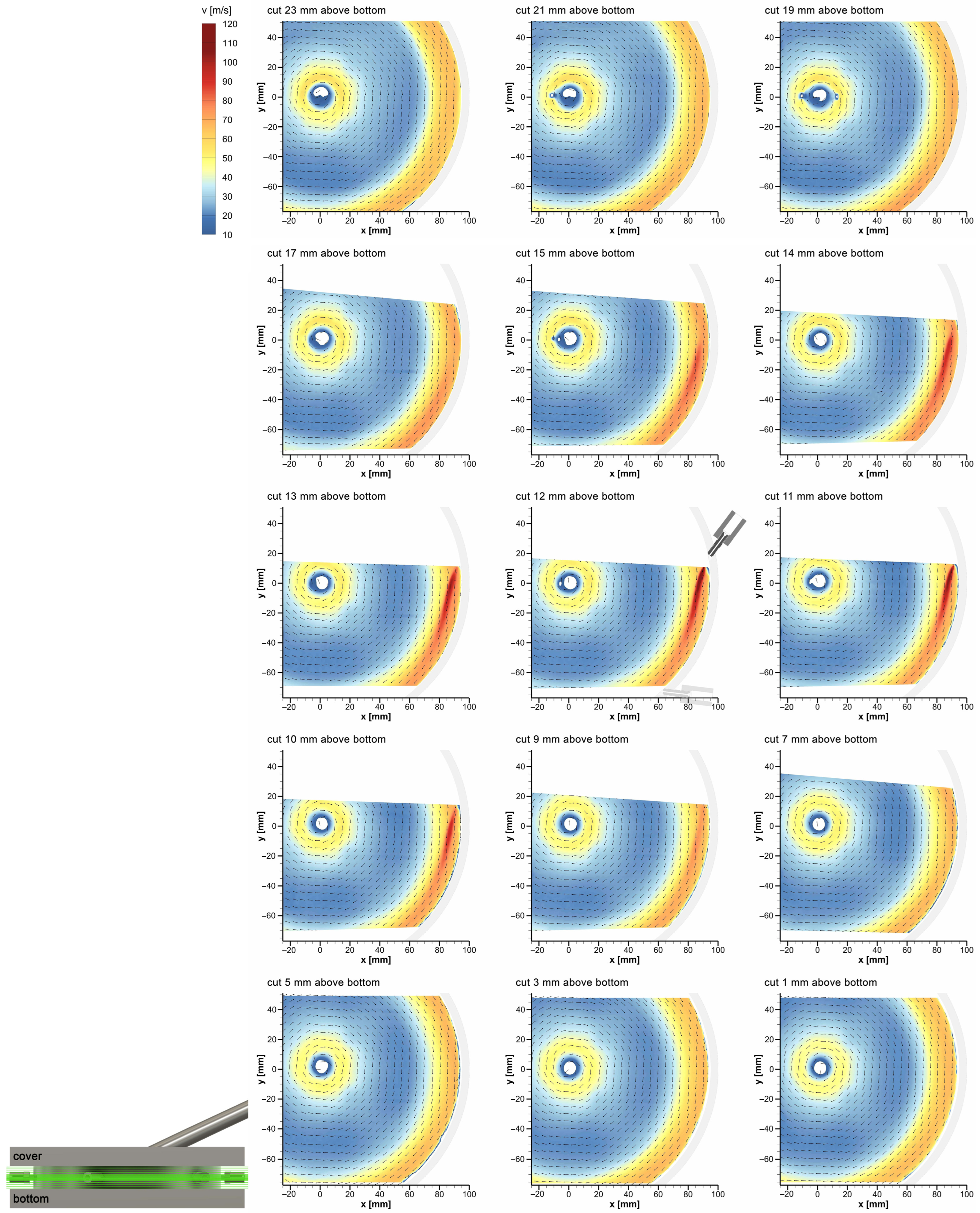
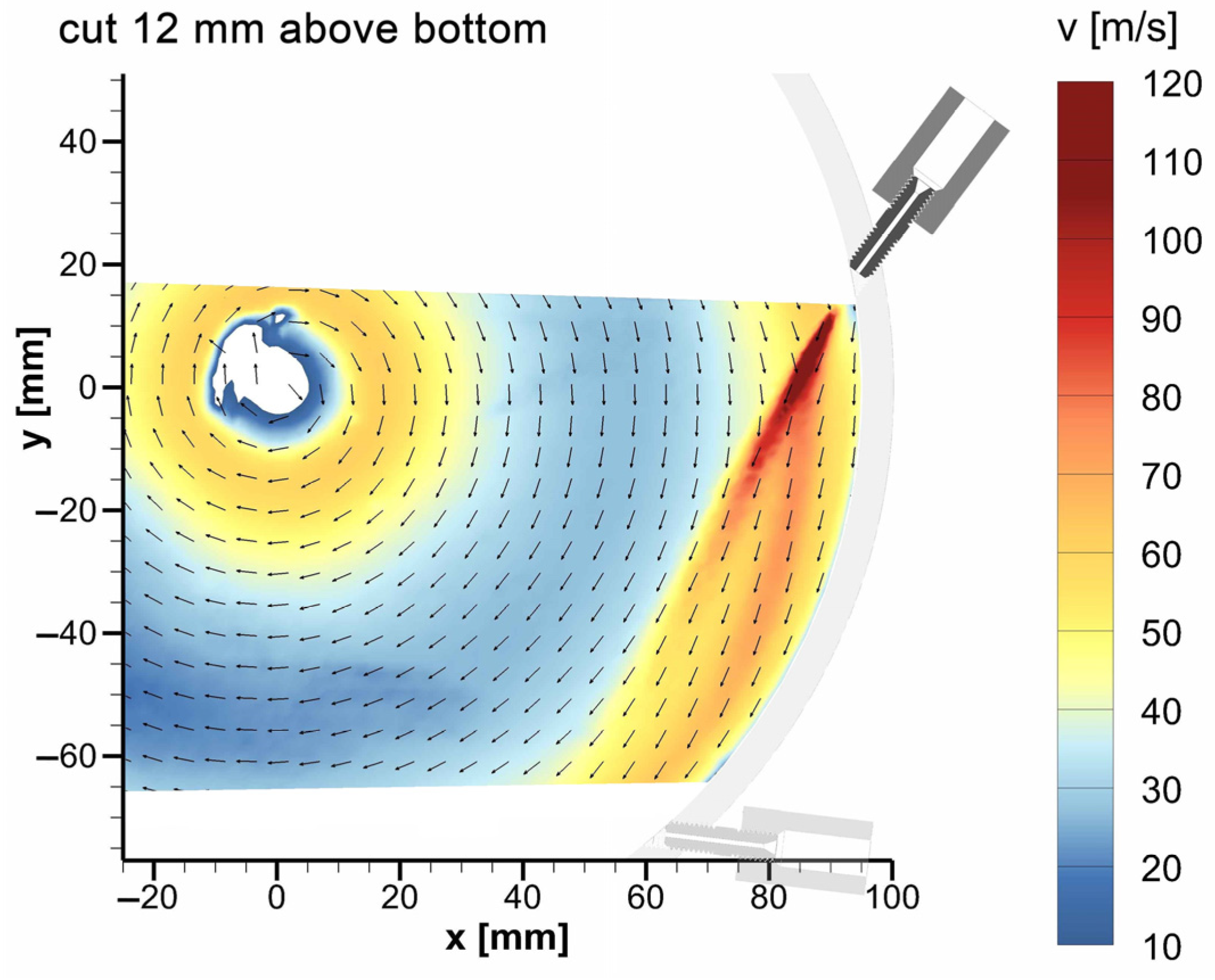
Figure 3 shows the two-dimensional velocity fields of the unloaded grinding gas flow obtained by PIV measurements at various horizontal levels within the grinding chamber. The coordinate system (
x,
y) is positioned in such a manner that the center of the spiral jet mill is located at point (0, 0). Each velocity field reveals the typical basic spiral vortex flow and the two regions with increased flow velocity in the comminution zone for
r ≥ 70 mm and the classification zone for
r ≤ 30 mm. With the exception of the nozzle jet superimposing the basic flow in the comminution zone, no substantial disparities between the various heights can be discerned in the flow fields. Only in the classification zone located within the inner region of the spiral jet mill, the velocity exhibits an increase with decreasing distance from the cover, which is particularly apparent when comparing the levels immediately below the cover and directly above the bottom. This phenomenon is attributable to the proximity to the product outlet, which necessitates that the flow of the entire grinding gas passes through the outlet cross-section. Consequently, the velocity has to increase in accordance with the continuity equation.
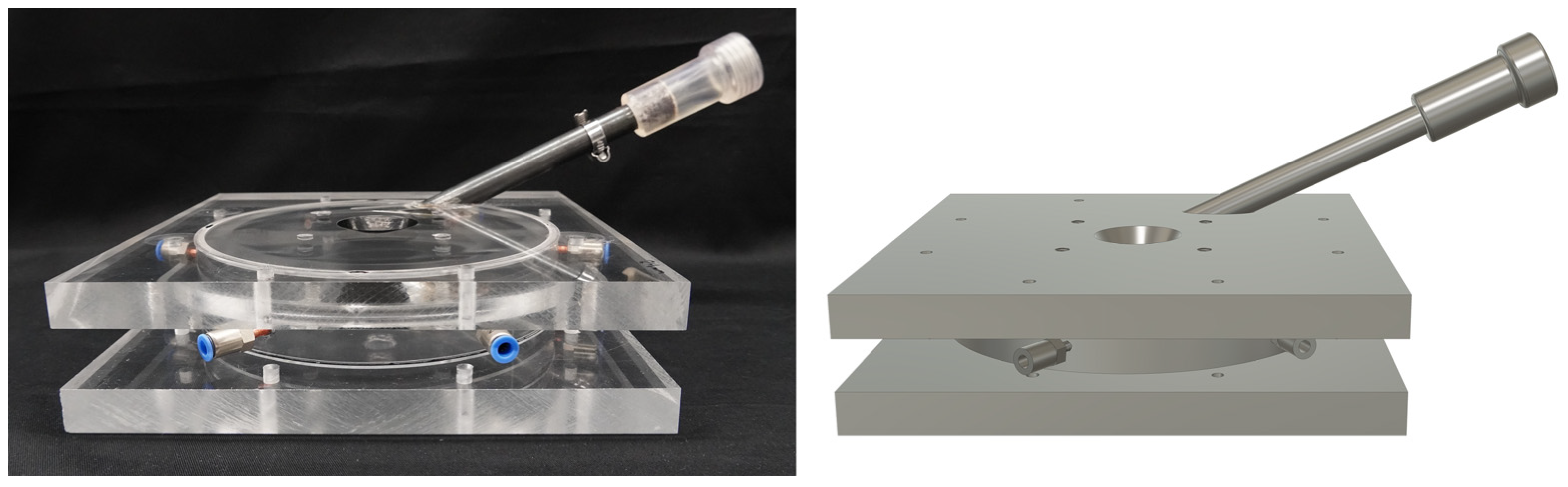
The restriction of the optical accessibility of the grinding chamber, indicated by the white-covered areas within the flow fields, commences 7 mm above the bottom and concludes 7 mm below the cover. This limitation is caused by the shadow cast by the laser light behind the nozzles (cf.
Figure 2). Therefore, the flow can only be partially examined in the region between the two nozzles.
As anticipated, the most intense nozzle jet with the highest velocities is recorded directly at the nozzle outlet in the flow field 12 mm above the bottom, thus precisely at the medium height of the grinding chamber. Since the unloaded grinding gas flow without particles is analyzed here, the nozzle jet experiences significant deflection by the basic spiral vortex flow upon its entry into the grinding chamber. As the distance from the horizontal nozzle level at medium height increases, the nozzle jet core undergoes a further shift in the direction of the flow, accompanied by a decrease in intensity. This phenomenon is evident in the flow fields located in the immediate surroundings of the nozzle level between 10 and 14 mm above the bottom. However, the direct impact of the nozzle jet due to its expansion still remains discernible 3 mm below and above the nozzle outlet at the levels between 9 and 15 mm above the bottom.
A qualitative comparison of the experimental results obtained in this study (cf.
Figure 3) with the numerical velocity fields of the grinding gas flow calculated by CFD simulation for a similar nozzle angle of 45° presented in the work of Bna et al. [
27] shows a good agreement of the data at the nozzle level, especially in the comminution zone and the region of the nozzle jets. However, in the classification zone, the numerical data differ significantly due to the completely different geometry of the product outlet being equipped with two classifier rims. In contrast, the numerical results of Kushimoto et al. [
13] obtained by CFD simulation for the same nozzle angle of 45° show a relatively good agreement with the experimental results in the inner region of the mill, but deviate clearly from the numerical data of Bna et al. [
27] and the experimental data in the comminution zone, especially in the region of the nozzle jets. A quantitative comparison of the results is not presented, as both the geometric and operating parameters differ significantly from each other.
3.2. Development of the 3D Model
The two-dimensional velocity data obtained by PIV measurements, being available on 15 horizontal levels, is used to generate a three-dimensional model of the unloaded grinding gas flow in the spiral jet mill that almost completely reproduces the flow conditions in the grinding chamber.
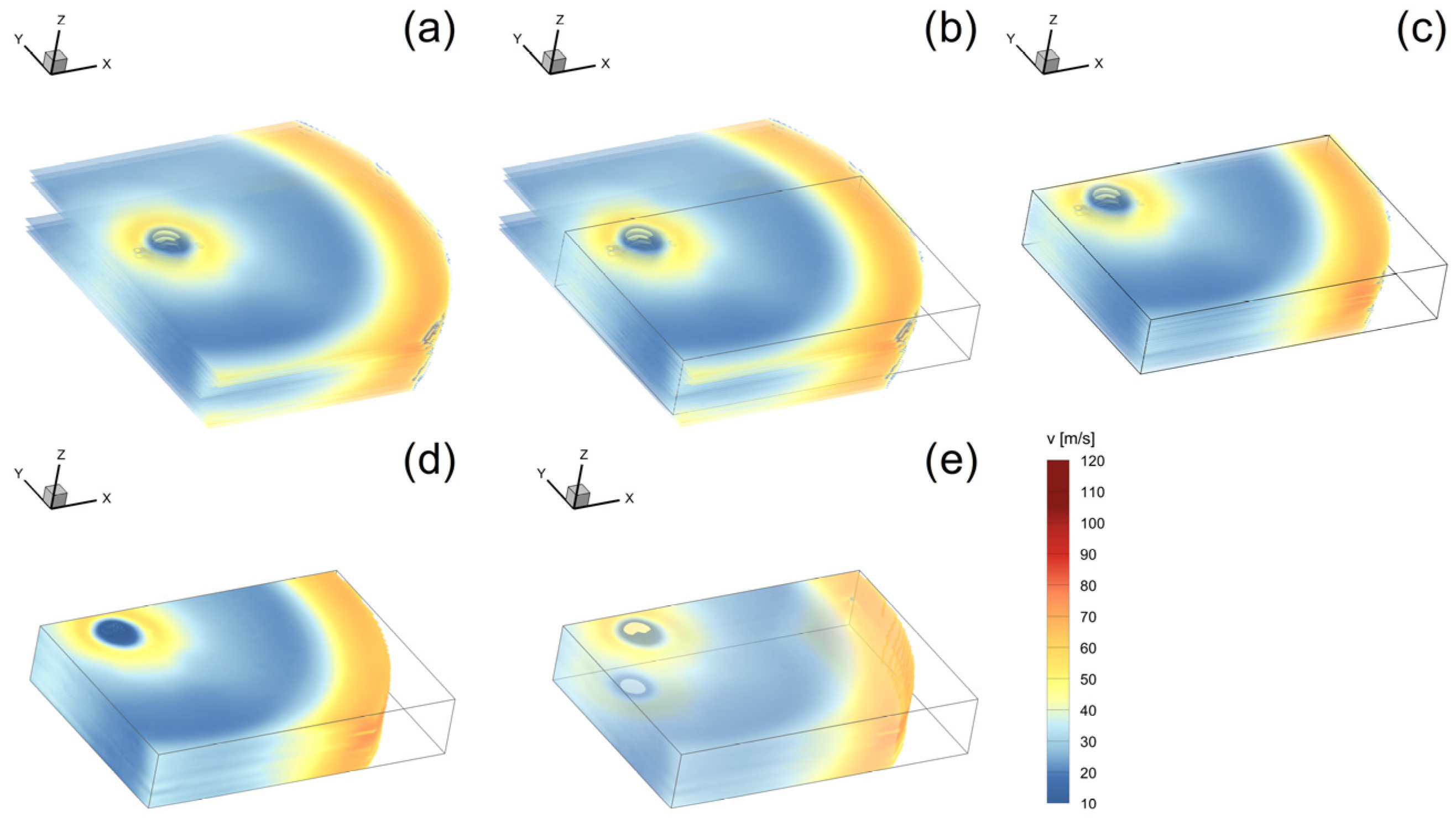
For this purpose, the z-coordinate, defined as the height of the corresponding level, is initially incorporated into the two-dimensional data sets so that the velocity fields from
Figure 3 can be represented in three-dimensional space, as illustrated in
Figure 4a. Subsequently, the bounding box is determined (see
Figure 4b), which encompasses the maximum area of the grinding chamber cross-section in the x- and y-direction, for which meaningful velocity data is available on all levels under consideration. The data outside the confines of the bounding box is deemed unsuitable for the generation of the 3D model due to its incompleteness. Consequently, this data is concealed, as shown in
Figure 4c. The flow immediately at the bottom and cover of the grinding chamber (
z < 1 mm and
z > 23 mm) cannot be experimentally measured or covered by interpolation. In addition, the flow dynamics in this region are already influenced by the specific conditions of the walls, therefore, extrapolating beyond the data sets is not useful. For these reasons, the flow in the region proximate to the walls cannot be taken into account in this study. After defining the dimensions of the bounding box, a corresponding solid body is generated in which the flow velocities between the discrete horizontal levels are completely calculated using the inverse distance interpolation method.
Figure 4d,e illustrates the 3D model of the unloaded grinding gas flow created by interpolating between the experimentally examined flow fields. The region for
r > 95 mm is concealed within the bounding box, as it is located outside the grinding chamber.
In the context of the 3D model analysis, it is imperative to take into account that the data under consideration exclusively encompasses the flow components in the x- and y-direction. The component in the z-direction, which is relevant for the discharge of the grinding gas and the particles from the spiral jet mill, cannot be represented. However, since the components in the x- and y-direction are significantly larger than the z-component, due to the spiral vortex flow within the grinding chamber and the associated high tangential component of the flow, the calculated 3D model still represents a very good approximation of the actual flow conditions.
3.3. Vertical Velocity Fields and Profiles of the Unloaded Grinding Gas Flow
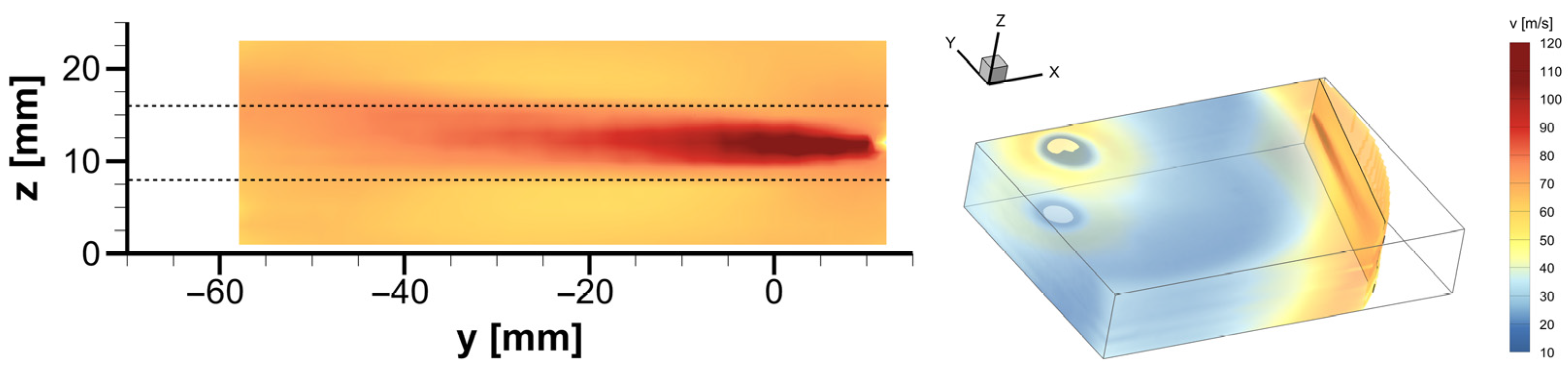
In order to describe the three-dimensional flow in the spiral jet mill more precisely, a vertical velocity section at
y = 0 mm is extracted from the experimental 3D model in
Figure 4, as illustrated in
Figure 5. The section reveals an almost rotationally symmetric cylindrical classification zone, whose maximum flow velocity, as previously mentioned, increases with decreasing distance from the product outlet of the mill due to the consequences of the continuity equation. Moreover, a closer inspection of the flow discloses a slight enlargement of the classification zone with increasing proximity to the cover, attributable to the same underlying reasons. Within the classification zone, a channel is formed through which the grinding gas flows towards the product outlet, subsequently exiting the mill. As previously explained, the flow in the z-direction cannot be represented in this study, signifying that the velocity in this channel is close to zero in the 3D model.
The inner region of the classification zone, characterized by increased flow velocities, verges on the ring-shaped flow-calmed region that represents a clear delimitation from the comminution zone in the outer area of the mill due to its low flow velocities.
A closer look at the velocity field depicted in
Figure 5 reveals that the similarly ring-shaped comminution zone exhibits a slightly concave boundary that extends to the flow-calmed region. Concurrently, the velocity increases as the distance from the peripheral grinding chamber wall decreases. The nozzle jet appears as a local circular increase in velocity at the medium height of the spiral jet mill, with the maximum flow velocity being attained at its center. However, a thorough examination of the nozzle jet shape indicates that the contour of the back of the jet oriented to the peripheral grinding chamber wall is not circular, but has a slightly kidney-shaped form, whereas the maximum velocity is located further towards the front of the nozzle jet.
The concave boundary between the comminution zone and the flow-calmed region is created by two flow phenomena that occur as a result of the nozzle jet entering the grinding chamber. On the one hand, a stagnation zone arises on the front of the nozzle jet due to the deceleration of the basic spiral vortex flow while encountering the nozzle jet. Consequently, the velocities at the medium height of the spiral jet mill in the region of the nozzle jet are slightly reduced compared to those towards the bottom and cover of the mill, where the basic flow can develop without disruption. In addition, the stagnation zone contributes to the positioning of the maximum velocity in the nozzle jet core, which is located further towards the front. On the other hand, the nozzle jet entering the grinding chamber with a very high velocity induces a substantial suction effect, which aspirates grinding gas from the entire surrounding region. Therefore, the velocity vectors of the horizontal flow field under consideration, oriented along the basic tangential flow and the nozzle jet, are to a certain extent compensated by the flow vectors of the grinding gas aspirated from the surrounding region, thereby resulting in a slight reduction in the flow velocity in this region. Due to the stagnation zone and the suction effect of the nozzle jet, the boundary between the comminution zone and the flow-calmed region is thus slightly distorted, causing it to transition into a concave shape.
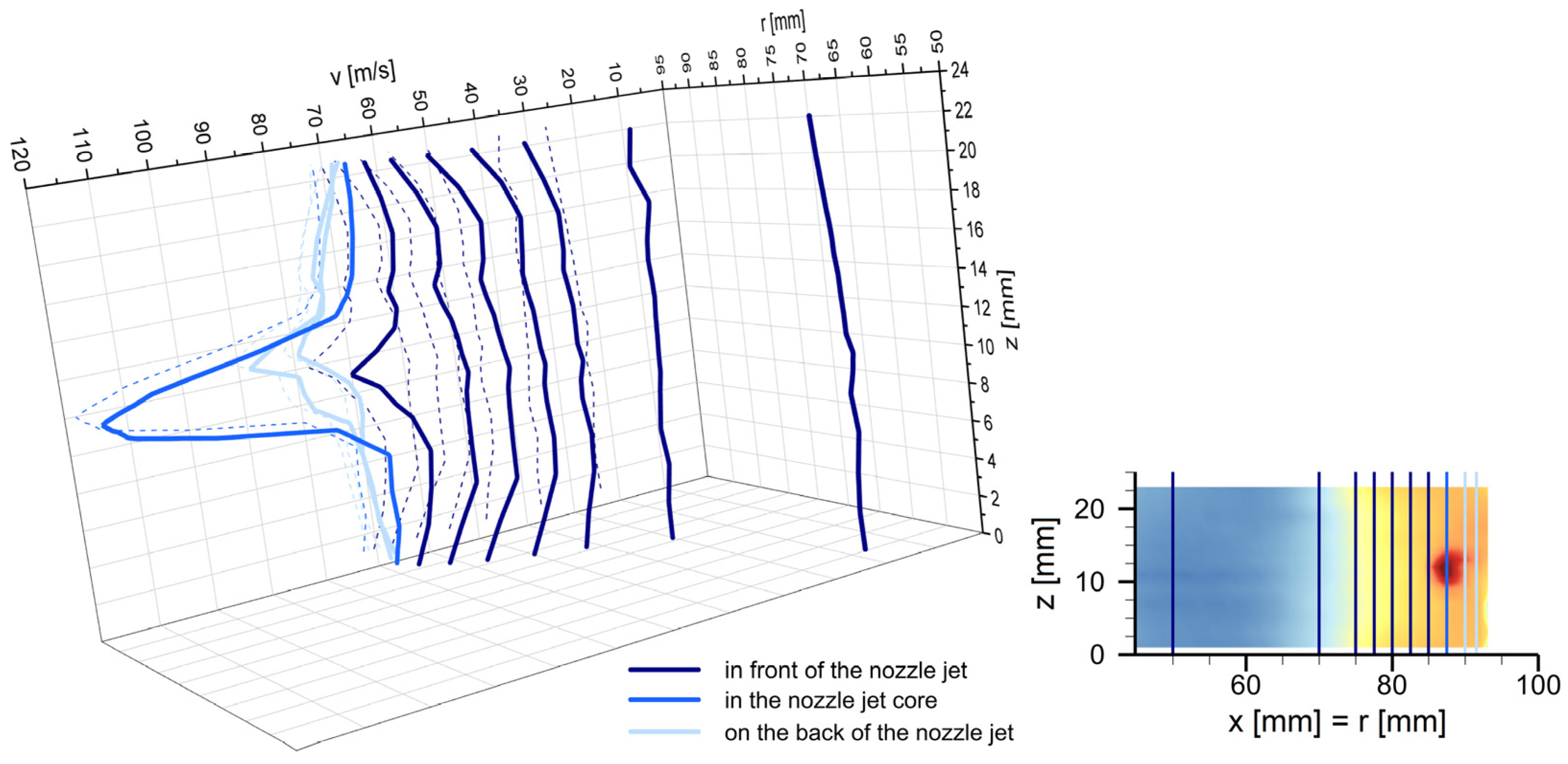
This phenomenon is also reflected in the height-dependent velocity profiles shown in
Figure 6 at selected radial positions within the grinding chamber, which have been extracted from the vertical velocity field at
y = 0 mm in
Figure 5. In the flow-calmed region for a radius of
r ≤ 70 mm, the flow velocity remains almost constant regardless of the height-dependent position
z. In front of the nozzle jet, at a radius of
r ≥ 75 mm, the nearly constant profile is distorted, with the flow velocity increasing equally toward the bottom and cover of the spiral jet mill. The velocity difference between the grinding chamber walls and the nozzle height increases as the distance from the nozzle jet decreases. Conversely, at the radial position of the nozzle jet core, as well as on the back of the nozzle jet, at a radius of
r ≥ 87.5 mm, the immediate increase in velocity and the acceleration of the entire flow in the outer region of the comminution zone due to the nozzle jets predominate as a result of the relatively large radial nozzle angle of 40° considered in this study. Consequently, the velocity profile toward the bottom and cover of the spiral jet mill remains nearly constant or decreases slightly.
3.4. Grinding Gas Flow in the Nozzle Jet Region
As the flow in the region of the nozzle jet primarily influences the comminution process in the spiral jet mill, the increased velocities of the nozzle jet and its three-dimensionality, as previously established in
Figure 3 and
Figure 5, will be examined more precisely in the following sections.
For this purpose, an oblique vertical velocity section in the core of the nozzle jet in the flow direction is extracted from the experimental 3D model in
Figure 4, as illustrated in
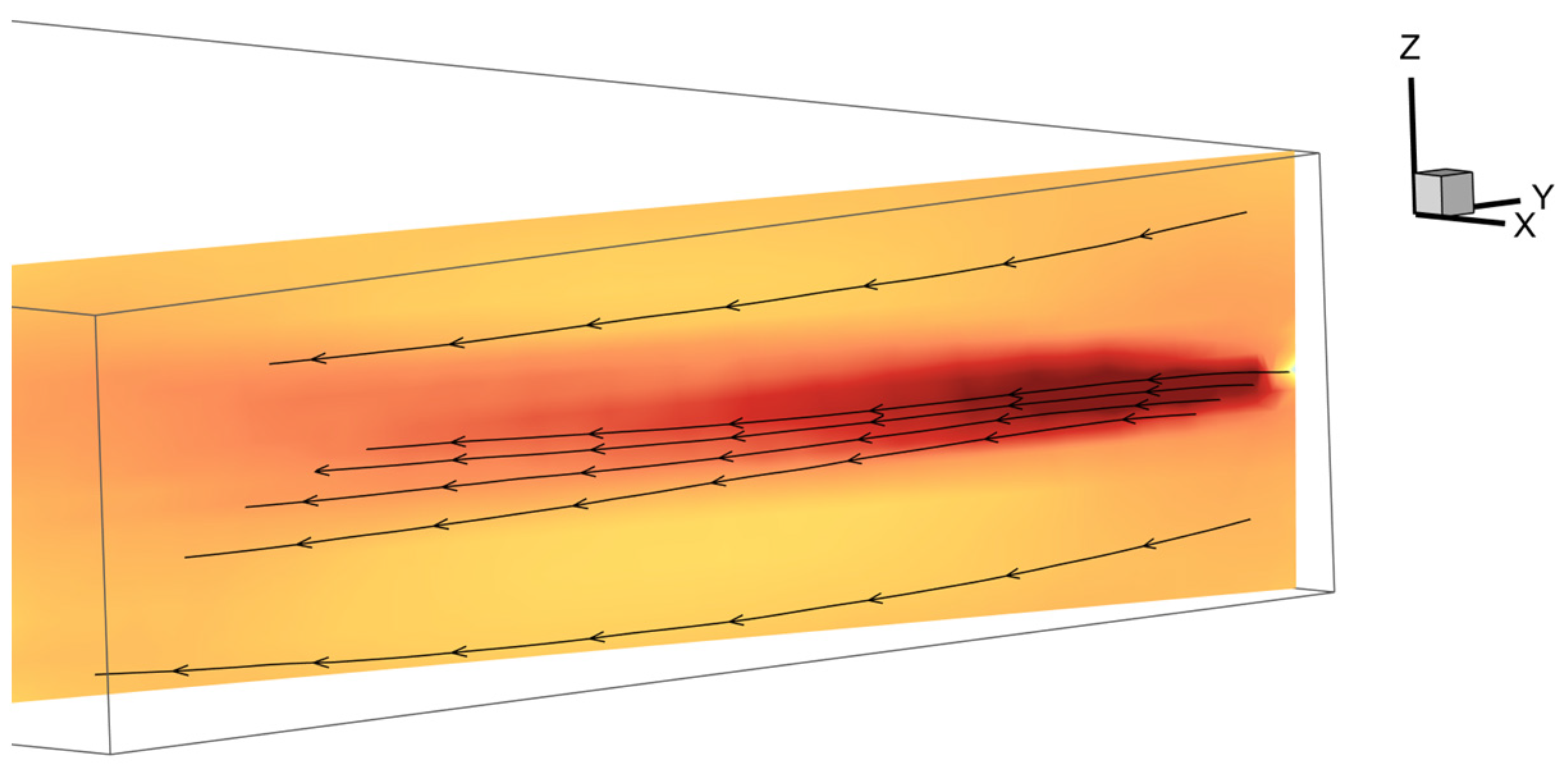
Figure 7. The flow field reveals that the nozzle jet expands immediately after entering the grinding chamber, thereby increasing its flow cross-section as well as its velocity. However, as the distance from the nozzle outlet increases further, the flow velocity decreases again until the jet eventually merges with the basic spiral vortex flow of the comminution zone.
The evident expansion of the nozzle jet is attributable to the fact that the flow behind the nozzle outlet is supercritical due to the high nozzle inlet pressure. Consequently, the pressure in the jet at the outlet of the nozzle is greater than the ambient pressure within the grinding chamber, resulting in a local pressure gradient. Therefore, when the grinding gas flow exits the nozzle into the grinding chamber, components of the flow deviating from the direction of the outflow axis emerge. These components lead to a bursting of the nozzle jet and subsequent oscillations, thereby giving rise to unsteady flow conditions [
41]. The pressure in the nozzle jet equalizes with the ambient pressure in the grinding chamber and the flow expands. By reason of the unsteady conditions, an increased energy loss occurs due to friction, causing the flow velocity to decrease sharply with increasing distance from the nozzle outlet, so that the nozzle jet finally merges with the basic spiral vortex flow. However, the jet oscillations are not visible in the experimental flow fields in
Figure 3 and
Figure 7, as they probably arise irregularly and, consequently, cannot be represented in the averaged steady-state velocity fields. The visibility of such unsteady flow conditions in the PIV results depends strongly on the time and spatial resolution of the measurement, as well as on the position and orientation of the considered level, rendering their detection particularly challenging.
Figure 8 presents a selection of streamlines at different heights within the grinding chamber, illustrated in front of the velocity field in the nozzle jet core shown in
Figure 7. The streamlines were extracted from the 3D model by tracking the paths of massless tracer particles placed in the flow, provided that the velocity vector field fulfills the steady-state condition. In order to emphasize the nature of the flow, the streamlines are located at four positions in the immediate surroundings of the nozzle jet and two positions towards the cover and the bottom, where the flow is not directly influenced by the nozzle jet. The expansion of the nozzle jet is discernible by the increasing distance in the flow direction between the four streamlines at the medium height of the spiral jet mill. Additionally, the suction effect of the nozzle jet, through which the grinding gas is aspirated from the surrounding region, can be suspected from the lowest of the four streamlines, as it originates in the region below the nozzle jet. The two streamlines above and below the nozzle jet, close to the bottom and cover of the mill, however, completely follow the tangential basic spiral vortex flow in the comminution zone. The nozzle jet’s region of influence is thus confined to a specific location above and below the nozzle outlet and extends to approximately 10 times the nozzle diameter with respect to the grinding chamber height (
z = 8–16 mm) in the considered case, as indicated in
Figure 7.
The velocity field of the unloaded grinding gas flow at nozzle level 12 mm above the bottom, shown in
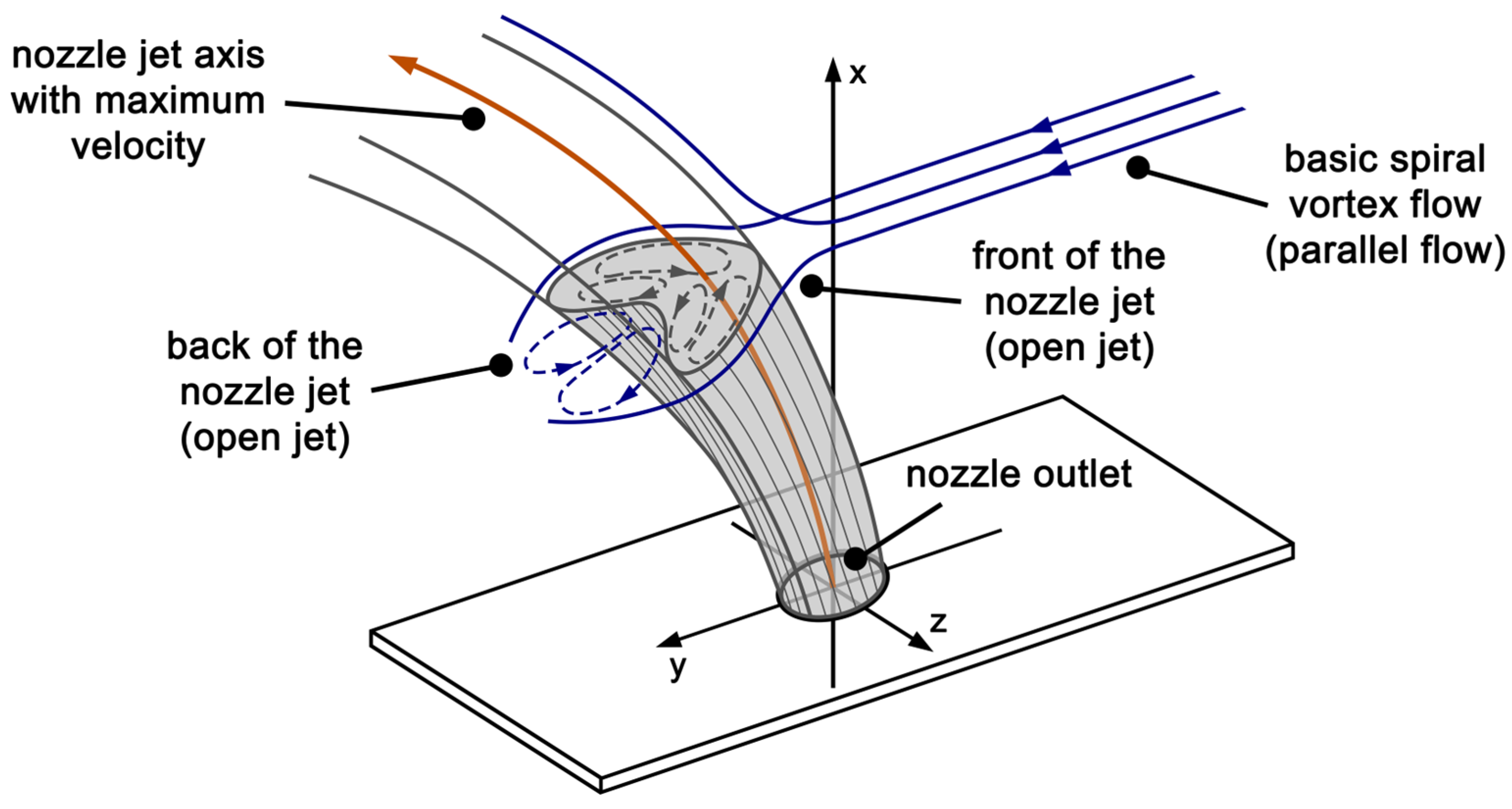
Figure 3, clearly reveals that the nozzle jet is deflected almost immediately by the basic spiral vortex flow as soon as it enters the grinding chamber. This phenomenon can be qualitatively described by Abramovich’s model of the encountered and deflected open jet [
38]. According to Bauer [
8], the deflection of the nozzle jet depends on the mass-related momentum of the nozzle jet in relation to that of the basic spiral vortex flow:
In the literature, various approaches exist for calculating the nozzle jet axis of an air jet that enters a lateral parallel flow at a certain angle
from a circular nozzle with a diameter of
dn. According to Abramovich [
38], Shandorov (Equation (2)) and Ivanov (Equation (3)) determined the following empirical equations based on experiments in order to describe the deflection of a jet emerging from a nozzle at the point (
x′,
y′ = 0, 0):
Conversely, Abramovich [
38] established a balance of forces between the aerodynamic drag force and the centrifugal force on a volume element of the nozzle jet leading to the following theoretical analytical equation, after assuming certain boundary conditions:
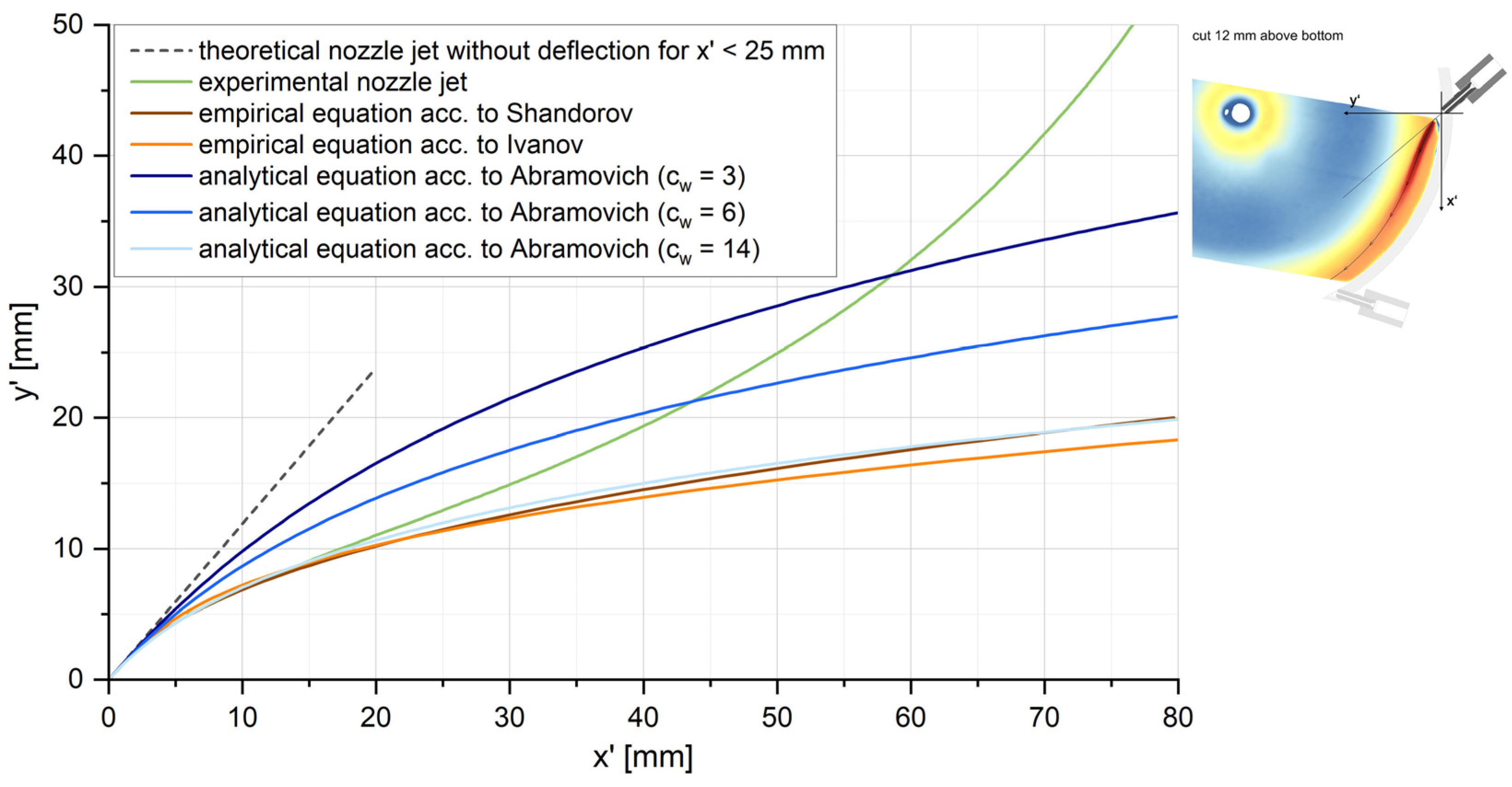
Figure 9 shows the results of these three approaches describing the deflection of the nozzle jet axis in comparison to the experimental data obtained by PIV measurements. The experimental curve corresponds to the streamline located in the core of the nozzle jet after the coordinate system has been shifted accordingly to the literature. Due to the limited optical accessibility of the grinding chamber at the nozzle outlet, the experimental data is only available for
x′ > 6 mm.
Since the flow at the outlet of the nozzle is supercritical (the actual pressure ratio
pm/
pn′ is less than the critical pressure ratio
pcrit,s/
pn′), the velocity reaches a maximum equal to the sonic velocity that can be calculated as follows, assuming an ideal gas and an isentropic adiabatic change in state [
41]:
With
= 1.41 [
41,
42],
Ri = 287.12 J/(kg K) [
42], and a temperature at the nozzle inlet of
Tin = 20 °C, the sonic velocity is
vcrit = 313.8 m/s. If friction losses are taken into account according to a polytropic change in state described by Bohl and Elmendorf [
41] the velocity at the outlet of the nozzle is reduced to
vn = 301.8 m/s with a corresponding density of
n = 3.99 kg/m
3. The velocity of the basic flow of
vf = 75 m/s, simplified and assumed to be constant, is extracted from the velocity field at the nozzle level immediately before reaching the nozzle jet, while the density of
f = 1.37 kg/m
3 is estimated based on the ideal gas law, considering a pressure in the grinding chamber of
pm = 1.16 bar and a temperature of
Tm = 20 °C. Taking these values into account, the nozzle jet axis can be calculated according to Equations (2)–(4), whereby a drag coefficient of
cw = 3 is assumed for the analytical function based on the results of Abramovich [
38]. In order to adjust the analytically determined data to the experimental and empirical data, the drag coefficient is increased up to
cw = 14.
The comparison of the curves in
Figure 9 indicates that the experimental nozzle jet axis can be described with a high degree of accuracy by the empirical equations of Shandorov and Ivanov for
x′ < 20 mm. Conversely, the analytical function, according to Abramovich, only exhibits a similarity to these curves for a very large drag coefficient of
cw = 14. This discrepancy arises because the derivation of the analytical equation based on force balance neglects the fact that the velocity and density of the nozzle jet decrease with increasing distance from the nozzle outlet. Consequently, the nozzle jet is deflected to a greater extent than predicted by the calculated values. In contrast to the initial deflection of the nozzle jet immediately after entering the grinding chamber, the course of the jet axis for
x′ > 20 mm is no longer described by the equations from the literature, since the surrounding circular wall of the grinding chamber determines the further flow of the nozzle jet and its transition into the basic spiral vortex flow. The empirical and analytical equations, however, are based on a rectangular flow chamber and a parallel base flow, so that the calculated nozzle jet axis does not experience any further deflection.
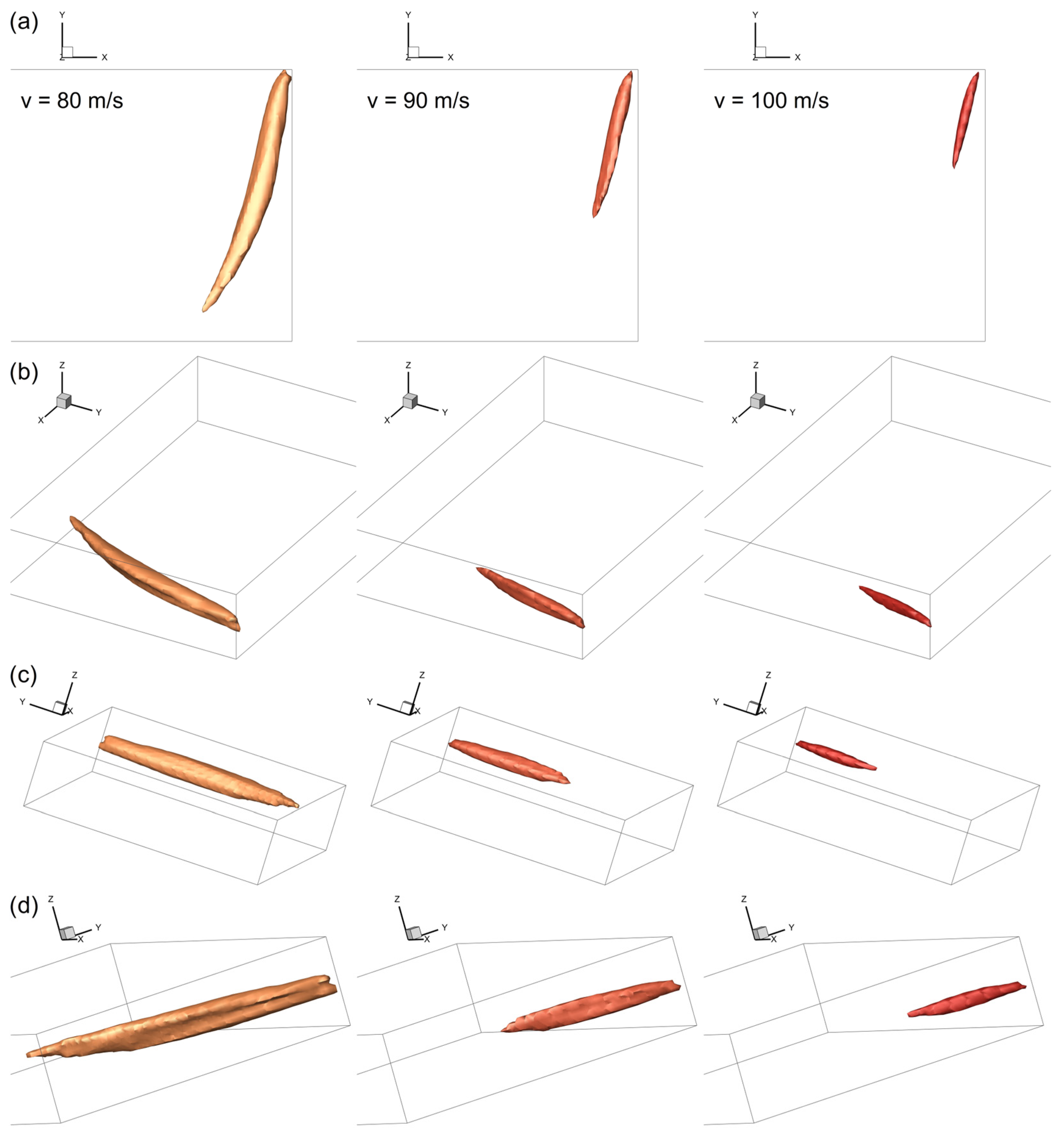
In order to provide a more precise description of the nozzle jet’s shape, a series of iso-surfaces for a velocity limit of
v = 80, 90, and 100 m/s is generated from the experimental 3D model, as illustrated in
Figure 10 from various perspectives. As the velocity limit increases, the size of the iso-surface decreases according to the established flow pattern, while the shape of the nozzle jet concurrently undergoes a significant change.
At a velocity limit of v = 100 m/s, the nozzle jet exhibits an almost circular flow cross-section in the direction of the jet, whose size initially increases after entering the grinding chamber due to the expansion before decreasing again due to frictional energy loss and the associated deceleration of the flow.
In contrast, at a velocity of
v = 80 m/s, the flow of the nozzle jet deforms into a kidney shape, while the size of the flow cross-section shows a similar correlation as previously described for a velocity of
v = 100 m/s. The observation of a kidney-shaped flow cross-section is in complete agreement with the description of the flow in the nozzle jet region of a spiral jet mill by Kürten and Rumpf [
4], which is based on Abramovich’s model of the encountered and deflected open jet [
38].
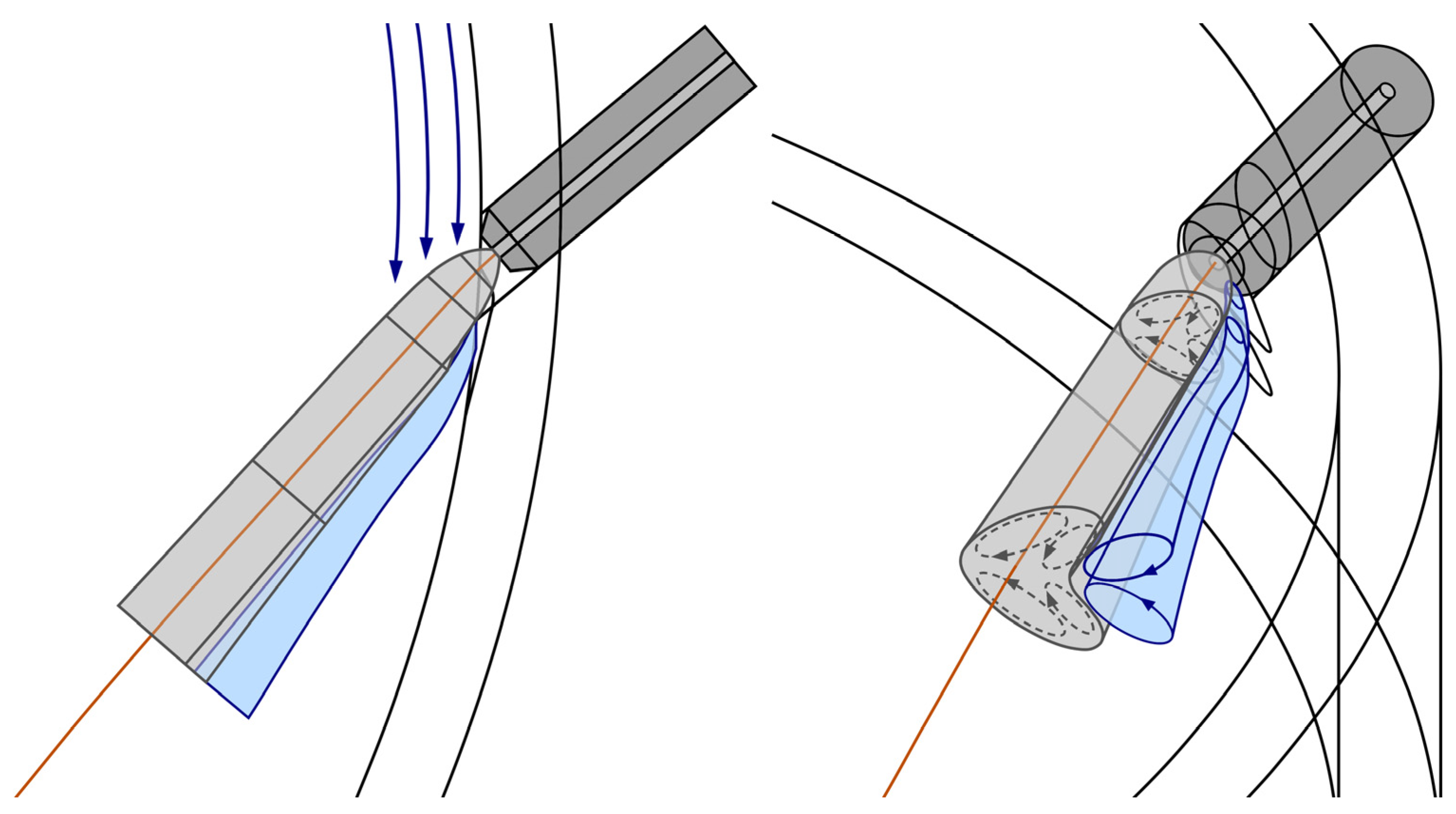
The round front of the nozzle jet visible in the iso-surface is caused by the deceleration of the encountered basic spiral vortex flow and the resulting formation of a stagnation zone (overpressure region). Subsequent to the redirection in the surroundings of the nozzle jet, the basic flow separates on the back of the nozzle jet, giving rise to a wake zone (region of negative pressure) with two counter-rotating vortices that are carried along by the nozzle jet. The kidney-shaped deformation of the jet, induced by the pressure forces on its front and back and the lateral shear forces, is particularly evident in the iso-surface due to the notch on the back of the nozzle jet, where the vortex-pair rotates. These findings thus provide the first experimental confirmation of the assumption of Kürten and Rumpf [
4], based solely on theoretical considerations, that the flow in the nozzle jet region of a spiral jet mill can be described by Abramovich’s nozzle jet model [
38].
At a velocity limit of v = 90 m/s, the iso-surface continues to exhibit the kidney-shaped flow cross-section. However, this deformation of the cross-section is considerably less pronounced compared to its manifestation at the lower velocity of v = 80 m/s, whereas the shape of the nozzle jet in the flow direction already resembles the shape observed at a velocity of v = 100 m/s.
Based on Abramovich’s nozzle jet model [
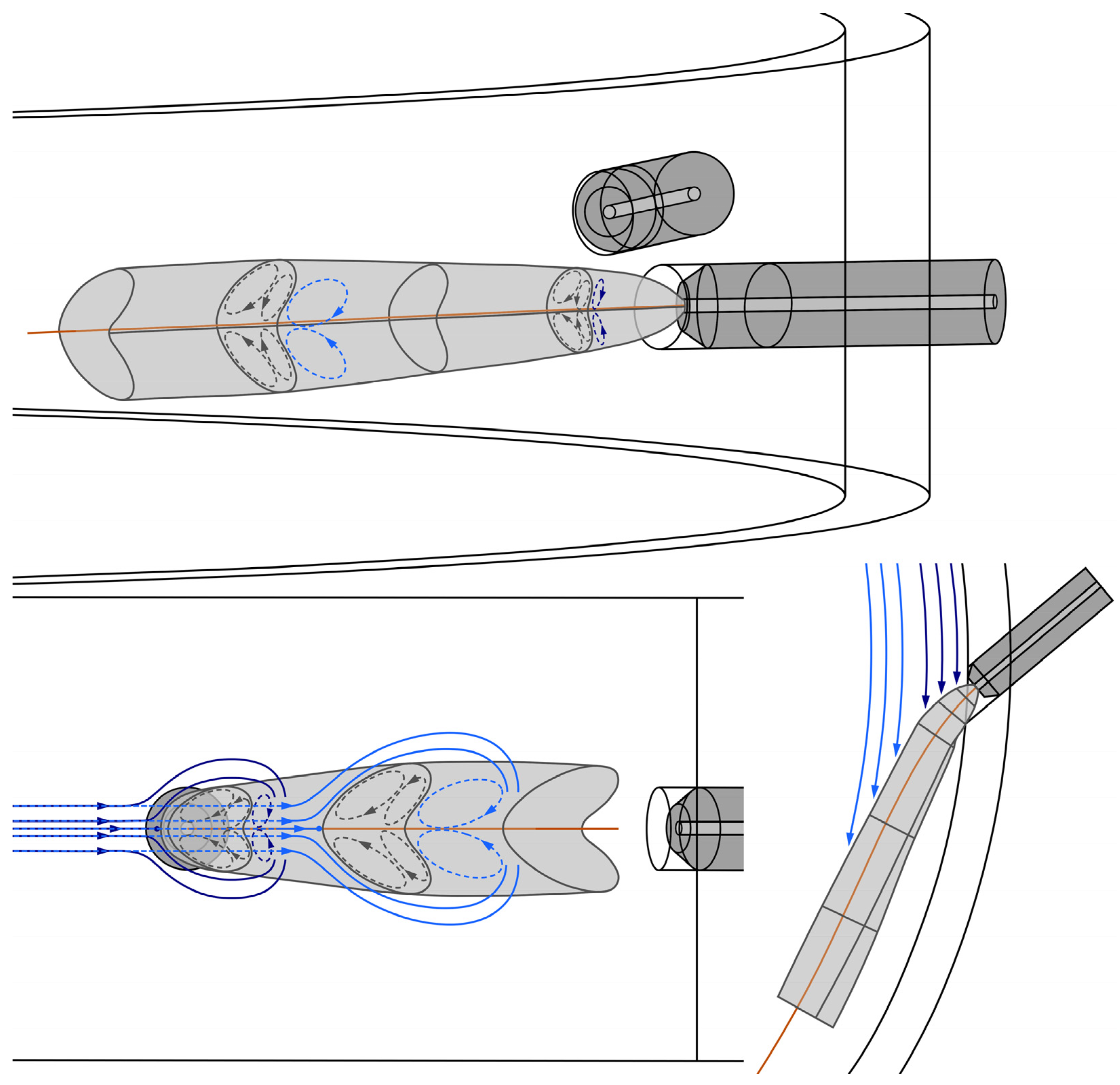
38] and the experimental findings regarding the aerodynamics obtained in the course of this work, a model of the deflected and deformed nozzle jet of the unloaded grinding gas flow in a spiral jet mill is created, as illustrated in
Figure 11. After exiting the nozzle outlet and entering the grinding chamber, the nozzle jet initially expands with a circular flow cross-section. As soon as the jet is encountered and deflected by the basic spiral vortex flow, the vortex-pair forms on its back, resulting almost directly in a deformation of the nozzle jet that intensifies with increasing distance from the nozzle outlet. Due to the restriction of the optical accessibility of the grinding chamber by the nozzle borehole in the grinding ring, the circular flow cross-section cannot be captured experimentally (cf.
Figure 10), as it rapidly transitions into the kidney-shaped cross-section.
In contrast to Abramovich’s nozzle jet model, this one accounts for the fact that the nozzle jets enter the spiral vortex flow at an oblique angle, rather than perpendicularly. Moreover, the basic flow in this model is characterized by a tangential flow with an increasing velocity in the direction of the peripheral grinding ring, as opposed to the parallel flow with constant velocity as presumed in Abramovich’s model. Additionally, the fixed wall boundaries of the grinding chamber are taken into account, thereby ensuring that the vortex pair on the back of the nozzle jet cannot expand unimpeded.
3.5. Influence of Particle Loading on the Grinding Gas Flow in the Nozzle Jet Region
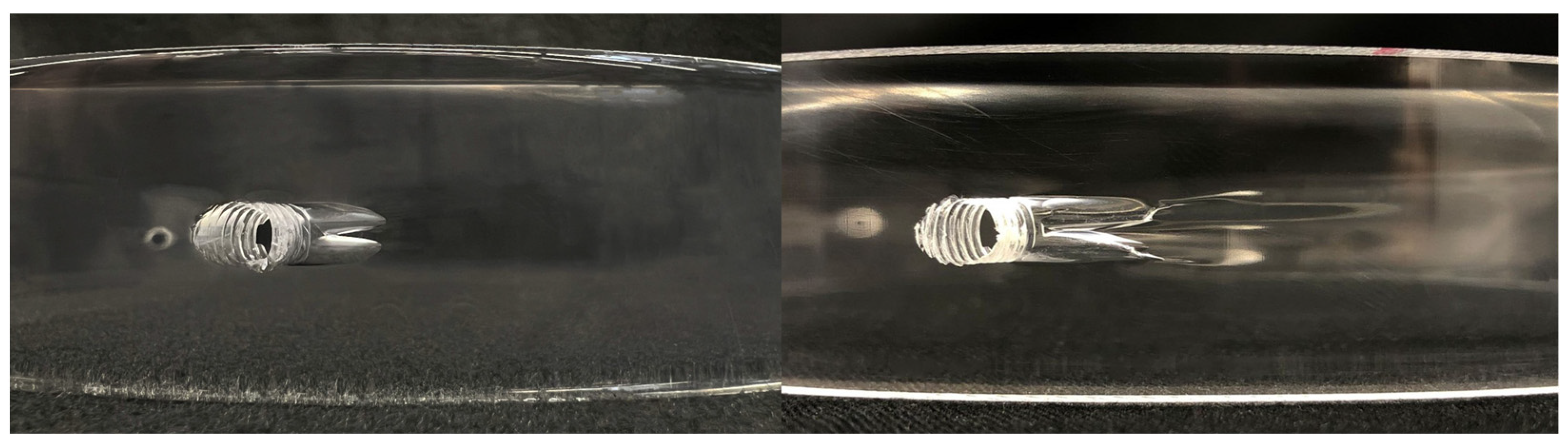
The existence of the vortex pair on the back of the nozzle jet can be confirmed not only through the experimental 3D model of the unloaded grinding gas flow, but also through the observed abrasion on the inner wall of the grinding chamber subsequent to conventional grinding experiments with particle loading, as depicted in
Figure 12. Two symmetrical notches are formed behind the nozzle outlet in the direction of flow, whose intensity increases with increasing grinding duration. However, in the mid-range of the nozzle jet at the medium height of the mill, there is negligible abrasion, resulting in the formation of a material bridge that remains even after a long grinding duration. The two notches in the grinding ring each measure approximately 3 to 4 times the height of the nozzle diameter in the case under consideration. A very similar abrasion behavior has also been observed in industrial spiral jet mills made of metallic materials.
The formation of the two notches through abrasion can be most adequately explained by the two-dimensional velocity field of the particle-loaded grinding gas flow obtained by PIV measurements at the nozzle level, as shown in
Figure 13, and the corresponding model of the deflected and deformed nozzle jet, as illustrated in
Figure 14.
The velocity field in
Figure 13 reveals that, unlike the unloaded grinding gas flow, the nozzle jet of the loaded flow is barely affected by the basic spiral vortex flow, but protrudes far into the grinding chamber according to the nozzle angle, with only slight deflection occurring. This results from the strong acceleration of the solid grinding material particles by the nozzle gas flow due to their significantly higher inertia. However, the flow velocity in the outer region of the grinding chamber decreases due to the deceleration of the basic spiral vortex flow as a result of the forced redirected flow around the nozzle jet.
A qualitative comparison of the experimental data obtained in this study (cf.
Figure 13) with the numerical results concerning the particle flow calculated by CFD-DEM simulation for a slightly different nozzle angle of 50°, presented in the work of Scott et al. [
30] shows a good agreement of the data at the nozzle level, at least in the comminution zone and the region of the nozzle jets. However, in the classification zone, no numerical data is available for the average particle velocity. Similar to the grinding gas flow, a quantitative comparison of the particle flow results is not presented, as both the geometric and the operating parameters differ significantly from each other.
The model of the deflected and deformed nozzle jet of the unloaded grinding gas flow depicted in
Figure 11 can be completely transferred to the particle-loaded flow except for the adjusted nozzle jet axis due to the reduced deflection of the nozzle jet, as illustrated in
Figure 14. The protruding nozzle jet causes an increase in the free space between the grinding chamber wall and the back of the nozzle jet, facilitating the formation of the vortex-pair in this region. Similar to the nozzle jet, the cross-section of the two vortices carried along by the nozzle jet increases with increasing distance from the nozzle outlet due to the expansion of the grinding gas. The two notches in the grinding ring, caused by material abrasion, occur precisely in the region where the vortex-pair is formed on the back of the nozzle jet. However, as the two vortices are carried along by the nozzle jet, the abrasion only occurs immediately behind the nozzle outlet.