Article

Quantifying the Multidimensional Benefits of Sustainable Shale Gas Development: A Copula–Monte Carlo Integrated Framework


1
Natural Gas Economic Research Institute, Southwest Oil & Gas Field Company, PetroChina, Chengdu 610051, China
2
College of Mathematical Sciences, Chengdu University of Technology, Chengdu 610059, China
3
Geomathematics Key Laboratory of Sichuan Province, Chengdu University of Technology, Chengdu 610059, China
4
School of Management Science, Chengdu University of Technology, Chengdu 610059, China
*
Authors to whom correspondence should be addressed.
Appl. Sci. 2025, 15(24), 13013; https://doi.org/10.3390/app152413013
Submission received: 9 November 2025 / Revised: 6 December 2025 / Accepted: 8 December 2025 / Published: 10 December 2025

Abstract

Although shale gas is an important energy source in the energy transition, its development faces multidimensional challenges across economic, environmental, social and technological domains. Traditional evaluation methods struggle to quantify interdependencies among indicators or capture their overall benefits. To address this, we propose a sustainable development evaluation framework for shale gas that integrates 25 indicators across four dimensions: economic, environmental, social and technical. Entropy weighting is used to determine indicator weights, and principal component analysis (PCA) is applied to reduce dimensionality, Gaussian copula functions are then used to model inter-indicator dependencies, and Monte Carlo simulation (10,000 iterations) is used to quantify the distribution of comprehensive benefits under uncertainty. The key findings are as follows: (1) the environmental and technological dimensions carry the highest weights at 29% and 28%, respectively; (2) the PCA–Monte Carlo (PMC) development model achieves a comprehensive benefit score of 0.567, and 22% higher than the traditional model’s score of 0.467 with a 90% confidence interval of [2%, 46%]; and (3) sensitivity analysis identifies the most influential drivers as the hazardous waste compliance rate (impact coefficient 0.92), the community conflict resolution rate (0.367), and community satisfaction (0.26). The marginal benefits of environmental compliance and social governance substantially exceed those of traditional economic indicators, offering scientific guidance for the green transformation of the shale gas industry. The integrated PCA–copula–Monte Carlo framework also provides a methodological reference for the sustainable assessment of other unconventional resources.

1. Introduction

In the context of the global energy transition and dual carbon goals, shale gas, as a relatively clean fossil fuel, plays a pivotal bridging role in the transition from high-carbon to low-carbon energy systems. China possesses abundant shale gas resources, ranking among the world’s largest in recoverable reserves. However, its development faces major technical, economic, environmental, and social challenges. Achieving sustainable green development while ensuring energy security has, therefore, become a major concern for both academia and industry. Shale gas development is a complex, multidimensional, multi-indicator systems engineering task. Conventional evaluation methods often focus on simple weighted scoring techniques, which struggle to capture nonlinear relationships and interdependencies among indicators. Their ability to quantify the distribution overall benefits under uncertainty is even more limited. Establishing a comprehensive evaluation framework that addresses multidimensional indicator correlations, quantifies uncertainty, and supports scientific assessment of green transition benefits is thus of significant theoretical and practical value.
The large-scale development of shale gas has transformed global energy structures. Cooper et al. [1] conducted a comprehensive review of shale gas’s economic, environmental, and social sustainability, revealing its disruptive impact on global energy markets and geopolitics, while highlighting numerous challenges to its development. In China, shale gas is regarded as a strategic resource for energy diversification and national energy security. Wei et al. [2] explored the potential for shale gas to serve as a new clean energy source, concluding that its prospects depend on balancing development potential with environmental protection. Gao et al. [3] summarized China’s shale gas development from 2005 to 2019, highlighting progress in exploration, production, and policy support. Unlike North America, however, China’s shale gas is largely located in deep, structurally complex formations, presenting unique barriers to sustainable development. Ma et al. [4] analyzed the geological characteristics of China’s deep shale gas and proposed development strategies tailored to national conditions, highlighting the central role of technological innovation in overcoming geological challenges.

2. Related Works

The economic viability of shale gas development centers on return on investment (ROI) and its contribution to regional growth. Kinnaman [5] reviewed research on the economic impacts of shale gas extraction and found substantial uncertainty in its macroeconomic benefits, calling for more comprehensive cost–benefit analyses. Munasib and Rickman [6] used synthetic control methods to examine the regional economic impacts of the shale gas and tight oil boom, revealing positive effects on employment and income growth in specific regions. For China, Mei et al. [7] examined the economic effects of shale gas development in the Fuling region, providing localized empirical evidence. At the micro level, investment optimization has become central to green development. Liu et al. [8] developed an investment decision model incorporating uncertainties in markets, technology, and the environment, underscoring the need for risk management. For specific processes, Li et al. [9] conducted economic and environmental assessments of dehydration technologies, revealing that cleaner production and cost control can be simultaneously achieved through technological optimization. Cooper et al. [10] analyzed the economic feasibility of UK shale gas and its implications for the 2030 energy market, providing detailed cost and market scenario analyses. Grecu et al. [11] quantified the economic, social, and environmental impacts of Romanian shale gas using cost–benefit analysis, demonstrating the necessity of multidimensional evaluation.
The environmental dimension is central to assessing shale gas sustainability, with particular focus on climate impacts, water consumption, and pollution. Greenhouse gas emissions remain a contentious issue. Burnham et al. [12] conducted a life-cycle assessment (LCA) comparing emissions from shale gas, conventional natural gas, coal, and oil, providing a quantitative basis for evaluating shale gas’s role in the energy transition. Conversely, Howarth et al. [13] examined methane leakage during shale gas development, highlighting that high leakage rates could significantly undermine its climate advantages, a conclusion that sparked extensive debate. Li et al. [14] compiled a detailed life-cycle greenhouse gas emissions inventory for China’s shale gas, providing foundational data for formulating emission reduction policies. Wang et al. [15] used a hybrid LCA approach to evaluate environmental impacts across all development stages, highlighting variations across phases. Furthermore, Wang et al. [16] studied regional and geological constraints, revealing higher environmental burdens in deep and complex geological formations. On water management, Bartholomew and Mauter [17] proposed a multi-objective optimization model to minimize both costs and environmental impacts in water and wastewater management. Tagliaferri [18] provided LCA data for UK shale gas, enriching the international case library. Al-Jaraden et al. [19] explored renewable-energy-based in situ shale oil extraction in Jordan, offering forward-looking solutions for reducing environmental footprints. Social impacts—such as public health, community well-being, and social acceptance—are also critical.
Cooper et al. [20] evaluated the social sustainability of UK shale gas, identifying public concerns, community equity, and regulatory transparency as major social risk factors. Thomas et al. [21] revealed the critical influence of cultural and institutional contexts on public attitudes by comparing US and UK perceptions of hydraulic fracturing risks, benefits, and social impacts. Focusing on health and environmental quality, Hays et al. [22] examined potential public health impacts of noise pollution from unconventional oil and gas development, identifying it as a significant and often overlooked social health hazard. Werner et al. [23] reviewed environmental health impacts related to unconventional natural gas, assessed the reliability of existing evidence, and called for more rigorous epidemiological studies. Habib et al. [24] discussed the broader societal impacts of unconventional oil and gas development, emphasizing its complexity across culture, governance, and community well-being. Wang et al. [25] examined shale gas’s contribution to regional sustainable development in China and found that economic growth and social well-being do not always align, highlighting the unique importance of social governance indicators.
The technological dimension serves as the foundation and safeguard for sustainable shale gas development. China’s shale gas industry faces significant challenges due to deep formations, high pressures, and complex geological structures. He et al. [26] detailed recent progress and technical challenges in deep shale gas development in the southern Sichuan Basin. Lei et al. [27] compared shale oil and gas extraction technologies in China and the United States, proposing development strategies tailored to China and emphasizing the adaptability of horizontal well and large-scale fracturing. Focusing on key technologies, Lei et al. [28] summarized progress and future directions in shale oil reservoir enhancement at CNPC, demonstrating how technological advancements improve recovery while reducing costs. Within the broader context of oil and gas industry optimization, Kaplin et al. [29] explored optimization methods for improving technological decision-making, while Perov et al. [30] analyzed the geological characteristics of oil shale, providing a basis for effective unconventional resource development. Policy and regulatory optimization is also crucial. Hu et al. [31] examined how green financial regulation impacts shale gas resource management, showing that technological innovation and compliance have become key factors to obtain financial support.
Based on this multidimensional analysis, the academic community has increasingly recognized the limitations of single-indicator assessments and begun exploring integrated, systematic evaluation methods. Liang et al. [32] conducted a techno-economic and sensitivity analysis of shale gas development using life-cycle assessment (LCA), linking environmental impacts with economic costs. Niu et al. [33] proposed an integrated technology–economics assessment model using ensemble learning, enhancing evaluation accuracy and efficiency. Regarding methodological frameworks, Wang and Li [34] combined the Wuli–Shili–Renli (WSR) methodology with fuzzy extension models to address uncertainty, while Wang and Zhan [35] introduced a DPSIRM-RAGA-PP (Drivers–Pressures–State–Impacts–Responses–Management) framework to assess shale gas sustainability in Sichuan and Chongqing. Wang and Yang [36] further employed a multi-level DPSIR framework with PPFCI technology to evaluate China’s shale gas development potential. International comparative studies provide additional insights. Li et al. [37] developed a sustainability index to compare the shale gas development in China, the UK, and the USA, revealing that national differences in policy, geology, and technology lead to distinct development pathways and environmental performance.
Yang et al. [38] compared the comprehensive value of shale gas in the US and China, highlighting China’s greater challenges in environmental regulation and social governance. Research has also increasingly focused on investment optimization and multi-objective decision-making. Liu and Zhang [39] emphasized balancing economic and environmental objectives, while Cherepovitsyn et al. [40] proposed a multidimensional indicator system covering environmental, socioeconomic, and innovation dimensions. Yang et al. [41] integrated energy system optimization, environmental co-benefits, and methane risk into a unified assessment model for China’s shale gas resources. Cooper’s life-cycle sustainability assessment of UK shale gas broadened the international perspective [42]. Collectively, these studies demonstrate that sustainability assessment has evolved from simple performance measurement to complex optimization and decision-support tools.
Despite these continuous developments, fundamental methodological limitations persist in addressing the inherent “complexity” and “uncertainty” of shale gas systems. Current models often rely on subjective or simple entropy weighting, which cannot adequately resolve multicollinearity, eliminate redundant information or reveal nonlinear relationships among indicators. Furthermore, in quantifying benefits, most studies focus on status quo analysis or scenario forecasting, and lack methods for translating uncertainties—such as geological, market, and policy risks—into probability distributions of comprehensive benefits. Existing studies also rarely quantify the degree of benefit improvement under PMC development models, and key drivers are often identified solely through indicator weights rather than sensitivity analysis.
This study develops an integrated PCA–copula–Monte Carlo evaluation framework to quantify the multidimensional benefits of green and sustainable shale gas development. Its main innovations are as follows:
(1)
PCA-based dimensionality reduction, copula dependency modeling, and Monte Carlo simulation are integrated into a unified framework capable of capturing high-dimensional correlations and uncertainties.
(2)
A comprehensive evaluation system of 25 indicators across four dimensions—economic, environmental, social, and technological—was established, with indicator weights determined objectively using entropy weighting.
(3)
The framework quantitatively estimates the improvement of PMC development models over traditional models (22.11%) and provides a corresponding confidence interval.
(4)
Sensitivity analysis shows that the marginal benefits of environmental compliance and social governance indicators far exceed their theoretical weights, offering a scientific basis for policy design.

3. Research Methodology

3.1. Development of the Indicator System

Based on sustainable development theory and the characteristics of shale gas development, this study established an evaluation system consisting of four primary indicators and 25 secondary indicators, as shown in Table 1.

3.2. Feature Scaling

Because the copula and Monte Carlo models are sensitive to data distributions, failing to eliminate scale effects would cause variables with larger values to dominate the training while with smaller values receive insufficient weighting. Consequently, before inputting the full dataset into the model, feature scaling is essential. This process accelerates training and enhances model accuracy. Common scaling methods include Min–Max normalization and Z-score normalization [44]. In this study, Min–Max normalization is used to rescale all variables into the range [0, 1], as shown in Equation (1).
x n e w = x m i n ( x ) max x m i n ( x )

3.3. Entropy Weighting Method

3.3.1. Entropy Rights Method Process

The application of machine-learning and ensemble-learning techniques has transformed drilling-cost prediction, providing higher accuracy and robustness than traditional methods.
The Entropy Weighting Method is an objective weighting approach based on information entropy. It determines indicator weights by evaluating the dispersion (variability) of the data. The procedure is as follows.
Step 1: Data Standardization. To eliminate the effects of differing units, raw data are normalized to the (0, 1) interval.
For positive indicators (larger values are better):
x i j = x i j min ( x j ) max ( x j ) min ( x j )
For negative indicators (smaller values are better):
x i j = max ( x j ) x i j max ( x j ) min ( x j )
where x i j is the raw value of sample for i for indicator j and min ( x j ) and max ( x j ) are the minimum and maximum values of indicator j across all samples, respectively. X i j represents the standardized value.
Step 2: Calculate the proportion p i j sample i under indicator j.
p i j = x i j i = 1 n x i j
Step 3: Calculate information entropy. The information entropy e i of the j -th indicator is
e j = k j = 1 n p i j ln ( p i j )
where k = 1 / l n ( n ) and n is the total number of samples. By convention 0 l n 0 = 0 .
Step 4: Compute redundancy (difference coefficient), A lower entropy corresponds to greater variability across samples and, therefore, a higher information value.
d j = 1 e j
Step 5: Determine the entropy weight for indicator j.
w j = d j i = 1 p d j

3.3.2. Interpretation and Thresholds for Weights

To assess the significance of the entropy-derived weights, each weight is compared with a baseline threshold. The baseline threshold wBase-line is defined as 1/p, where p is the number of indicators in the category. Weights greater than this threshold (w > 1/p) are considered significant, indicating above-average influence on overall benefits, whereas weights at or below the threshold indicate minimal impact. The baseline thresholds for each indicator category are shown in Table 2.

3.4. PCA–Copula Modeling

3.4.1. Principal Component Analysis (PCA)

To address the “small sample size and high dimensionality” problem, 13 observations for 25 indicators, PCA (principal component analysis) was applied for dimensionality reduction:
(1)
Compute the correlation matrix of the standardized data.
(2)
Solve for eigenvalues and eigenvectors.
(3)
Select principal components with eigenvalues greater than 1 (Kaiser’s criterion).
(4)
Compute the principal component scores.

3.4.2. Copula Function Modeling

The copula function separates a joint distribution into its marginal distributions and dependence structures:
Step 1: Marginal-distribution fitting. For each principal component, fit an appropriate marginal distribution and select the optimal one using the KS test and AIC.
Step 2: Probability integration transformation. Transform each principal component score to a uniform variable on [0, 1]:
U i = F i X i
Step 3: Gaussian copula Fitting. The Gaussian Copula function is defined as
C u 1 , , u n = Φ Φ 1 u , , Φ 1 u n
where Φ is the multivariate normal CDF with correlation matrix , Φ 1 is the inverse standard normal CDF, and each u i follows a uniform distribution on [0, 1].

3.5. Monte Carlo Simulation

Monte Carlo Simulation Based on the PCA–Copula Model:
Step 1: Generate random samples. Draw 10,000 sets of uniformly distributed random numbers ( u 1 , u 2 , u 3 ) from the fitted copula model.
Step 2: Inverse transformation. Use the inverse function of the marginal distribution to map the uniform variables back to principal component scores.
Step 3: Reconstruct original variables. Apply the PCA inverse transformation to convert the principal component scores back into the 25 original indicator values.
Step 4: Compute comprehensive benefits. Comprehensive benefits are calculated using a weighted scoring method.
C o m p r e h e n s i v e   B e n e f i t s = i = 1 4 w i j = 1 n i w i j N o r m a l i z e ( x i j )
where w i is the weight of the i-th primary indicator, w i j denotes the weight of the j-th indicator within that dimension, and x i j is the standardized value of the indicator.
Step 5: Scenario comparison traditional model. All simulated samples are included. PMC Development Model: only samples whose overall performance ranks in the top 50% are selected.

3.6. Sensitivity Quantification Method

Several studies have examined the economic aspects of drilling operations and explored methods for optimizing costs using different analytical and modeling techniques. To identify the key drivers of overall benefits, a local sensitivity analysis is applied to quantify the marginal impact of each indicator on the comprehensive benefit score. The sensitivity of indicator x j is defined as
S e n s i t i v i t y   C o e f f i c i e n t = ( C o m p r e h e n s i v e   B e n e f i t s ) x j · σ j σ C o m p r e h e n s i v   e B e n e f i t s
where ( C o m p r e h e n s i v e   B e n e f i t s ) x j is the partial derivative representing the marginal effect of indicator x j , σ j is the standard deviation of input variable x j , and σ C o m p r e h e n s i v e   B e n e f i t s is the standard deviation of the total benefit score.

4. Data Sources and Preprocessing

4.1. Data Sources

This study uses annual data on China’s shale gas development from 2011 to 2023, covering 13 years of observations. Data sources include annual reports from PetroChina and Sinopec, statistics from the National Energy Administration, publicly released information from shale gas demonstration zones, and relevant academic literature, as shown in Table 3.

4.2. Data Preprocessing

The dataset is complete with no missing values. To identify potential outliers, a reasonableness assessment was conducted, based on industry context and development patterns. All outliers were ultimately retained because they reflect real-world conditions. In the economic dimension, the high full cost of shale gas in 2011 (CNY 6442.65/1000 m3), which accurately reflects early-stage challenges, including weak technical capacity, dependence on imported equipment, and limited economies of scale.
The troughs in reserve replacement rates in 2015 and 2020 correspond to external shocks—the international oil price collapse and the COVID-19 pandemic—and represent justifiable fluctuations. Environmental indicators show steady improvement across all metrics, with no statistical anomalies detected. In the social dimension, the sharp decline in employment contribution per unit of production in 2019 reflects the industry’s transition toward larger-scale automation. In the technological dimension, the exceptionally high value of newly proven recoverable reserves in 2013 is attributed to major exploration breakthroughs in the Fuling shale gas field, serving as a key marker of industry progress. All potential anomalies have clear empirical and industry-based explanations and were therefore retained in the analysis.

4.3. Descriptive Statistics and Correlation Analysis

4.3.1. Descriptive Statistics

Table 4 shows the results of the descriptive statistical analysis for the 25 indicators.

4.3.2. Correlation Analysis

To assess the independence and interrelationships among the 25 selected features, a correlation analysis and corresponding heatmap are generated, as shown in Figure 1. The heatmap visually illustrates the strength of associations between features, aiding interpretation. If strong correlations are present, they may reduce the model’s interpretability. In such cases, dimensionality reduction techniques are recommended to reduce feature complexity.

4.4. Trend Analysis

4.4.1. Development Trajectory in the Economic Dimension

The single-well investment return rate jumped from 0.017 in 2012 to 0.468 in 2013 and subsequently fluctuated between 0.1 and 0.4. Total costs declined sharply from CNY 6442.65/1000 m3 in 2011 to CNY 984.74/1000 m3 in 2014, driven by (1) rapid adoption of horizontal drilling and staged fracturing technologies; (2) reduced cost from domestic equipment manufacturing; (3) emerging economies of scale; and (4) national subsidies of CNY 0.4/m3. Cumulative net cash flow turned from negative to positive in 2016, signaling the transition into the investment-recovery and profitability stage and providing a financial basis for green development.

4.4.2. Environmental Conditions Continue to Improve

The reuse rate of fracturing flowback fluid increased from 50% to 98%, significantly reducing risks associated with freshwater withdrawal and wastewater discharge. Unit production carbon emissions, full-chain carbon intensity, and methane leakage all declined steadily, driven by (1) improved equipment energy efficiency; (2) process optimization; (3) deployment of leak-detection and repair technologies; and (4) policy incentives linked to carbon-peaking and carbon-neutrality goals. Hazardous waste disposal compliance consistently exceeded 92%, while land reclamation rates rose from 65% to 96%. Ecological diversity indices also increased, reflecting the principle of “protecting while developing, and developing while protecting.”.

4.4.3. Reconstruction of Social Dimensions and Relationships

Community satisfaction rose from 70% to 96%, and the conflict resolution rate increased from 78% to 97%, reflecting a shift from “development over communication” to building mutually beneficial relationships. The annual safety incident count declined from 15 to 3, while the accident rate per million man-hours fell from 0.8 to 0.07, reaching world-class standards.

4.4.4. Technology-Driven Innovation

Drilling time decreased from 108 days per well to 26 days, a 76% reduction—directly lowering costs and increasing profits. Natural gas production rose from 13.73 billion m3 to 45 billion m3, a 228% increase. R&D investment intensity doubled, the localization rate of core technologies climbed from 55% to 88%, and digital system coverage reached a high level.

5. Results

5.1. Determination of Indicator Weights

The weights for each indicator were calculated using the entropy weight method, as shown in Table 5.
The indicator weight analysis obtained using the entropy weight method yields the following key findings. The environmental (29.3%) and technological (28.4%) dimensions have significantly higher weights than the other dimensions, indicating that these two areas exhibit the greatest variability and information content. Consequently, they play the most influential roles in differentiating project performance within the comprehensive benefit evaluation system for shale gas development. In contrast, the economic (22.5%) and social (19.8%) dimensions show relatively lower weights, suggesting more uniform or least-dispersed indicator distributions.
At the secondary indicator level, the weights for tax contribution per unit of production capacity (39.8% > 20%), natural gas output (25.4% > 14%), and employment generated per unit of production capacity (27% > 25%) are the highest. This indicates that economic output, technical scale, and employment are the most informative micro-level indicators in the current framework.

5.2. PCA Dimension Reduction Results

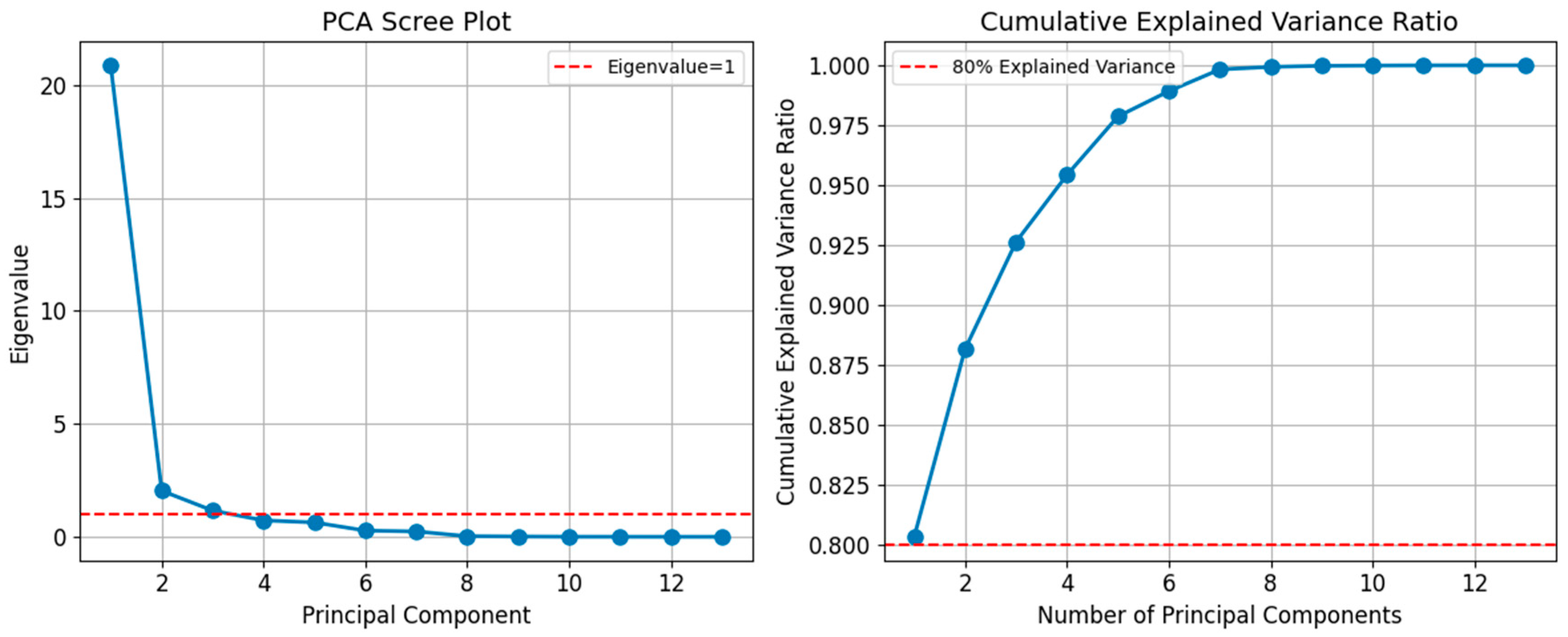
Principal component analysis (PCA) transforms high-dimensional raw data into a set of new, mutually uncorrelated variables (principal components) through linear combinations, while retaining as much of the original data’s variance as possible. In this study, the first three principal components were selected according to Kaiser’s criterion (eigenvalues > 1) and verified using the scree plot (Figure 2).
As shown in Table 6, these three components explain 92.6% of the total variance. This means that more than 92% of the information contained in the original dataset is preserved using only three composite variables. This cumulative explained variance far exceeds the commonly accepted thresholds of 80–85%, demonstrating that the PCA reduction is both effective and efficient. It compresses a system with potentially dozens of indicators into three core dimensions, substantially simplifying subsequent copula modeling and simulation while limiting information loss to just 7.37%.
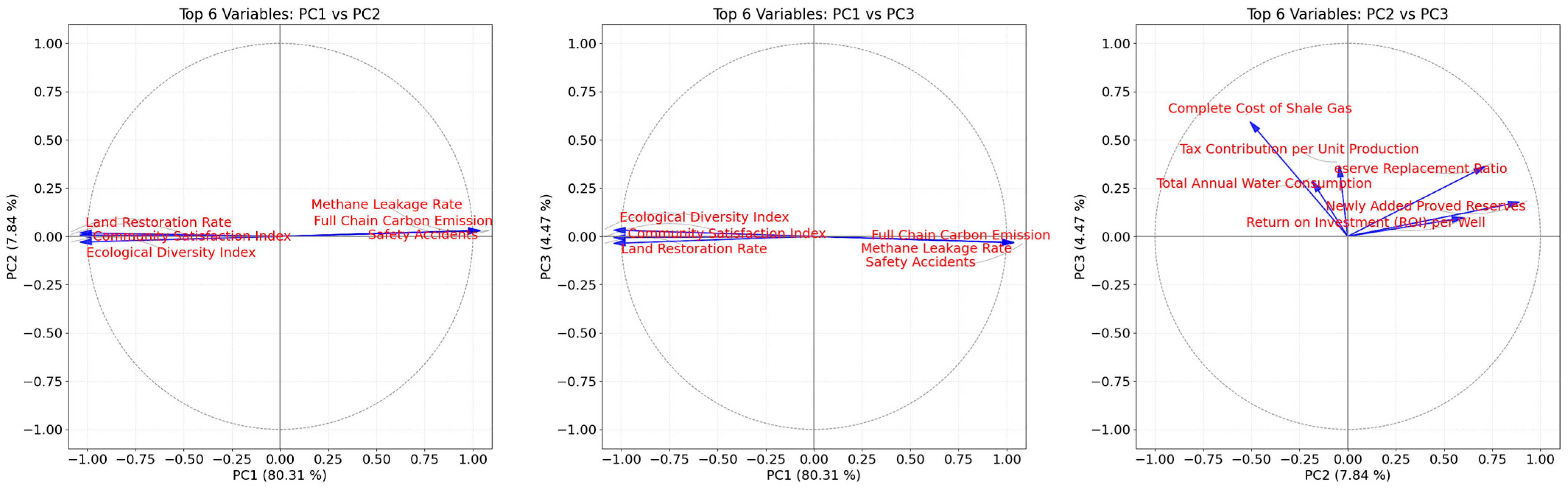
Figure 3 shows that the first principal component (PC1), which explains 80.3% of the variance, is the core dimension. Its highly loaded indicators exhibit a clear dichotomy: environmental and social risk indicators (e.g., carbon emissions per unit output, methane leakage rate, safety incidents) have very high positive loadings (>0.99), whereas sustainable governance and social performance indicators (e.g., land reclamation rate, ecological diversity index, community satisfaction) have very high negative loadings (<−1.03). This indicates that the primary differentiation in the system arises from the tension between high environmental and social risk versus high sustainable governance. The second and third principal components (PC2 and PC3) form a secondary “economic and resource” dimension together. PC2 is driven mainly by resource succession indicators (e.g., reserve replacement rate, newly added proven reserves), while its negative direction corresponds to total costs. PC3 further distinguishes cost structures. Some technical and economic indicators show relatively low absolute loadings on PC1, suggesting that their behavior is largely independent of the core sustainability dimension.

5.3. Copula Model Fitting

After reducing the original high-dimensional dataset to three principal components using (PCA), the next step in constructing the PCA–copula model is to accurately characterize the dependency structure among these three components. The strength of copula theory lies in its ability to model marginal distributions separately from their dependence structure. Accordingly, the fitting process involves two principal tasks: fitting the marginal distributions and fitting the copula function.

5.3.1. Edge-Distribution Selection

For marginal-distribution selection, several continuous probability distributions, including the normal, t, gamma, beta, and uniform distributions, were initially considered. To identify the optimal model, we used the Kolmogorov–Smirnov (KS) test and the Akaike information criterion (AIC) as evaluation metrics. The KS test examines the null hypothesis that the sample follows this specified distribution; a p-value greater than 0.05 indicates that the null hypothesis cannot be rejected and that the fit is acceptable. The AIC balances model complexity and goodness-of-fit, with smaller values indicating better performance. Accordingly, the final selection prioritized the distribution with the lowest AIC and a KS test p-value above 0.05 for each principal component (Table 7).
(1)
PC1: The KS test p-value is 1.000, well above the 0.05 significance threshold, and its AIC value is comparatively low, indicating that the uniform distribution provides an excellent fit for PC1.
(2)
PC2 and PC3: Both are best described by a four-parameter beta distribution (including the location parameter loc and scale parameters). Their KS test p-values, 0.560 and 0.654, respectively, are well above 0.05, meaning the null hypothesis cannot be rejected and the fitted beta distributions adequately represent the data.
All three principal components passed the KS test (p-value > 0.05), confirming that the marginal distributions selected for them are appropriate and provide a solid basis for constructing the subsequent copula model.

5.3.2. Gaussian Copula Goodness-of-Fit

After determining the marginal distributions of each principal component, we transform the observations into uniformly distributed variables on [0, 1], using their respective cumulative distribution functions (CDFs), thereby obtaining the input data for copula modeling. On this basis, a Gaussian copula (normal copula) is selected to characterize the dependence structure among the transformed variables.
To evaluate the Gaussian copula’s ability to capture the true dependency structure, a goodness-of-fit analysis is conducted by comparing the empirical copula with the theoretical Gaussian copula [45]. Three metrics are used: mean squared error (MSE) and root mean squared error (RMSE), which quantify average fitting deviations (lower values indicate better fit), and Jensen–Shannon (JS) divergence, which measures distributional similarity from an information-theoretic perspective (lower values indicate closer agreement). The results (Table 8) show consistently low values across all principal component pairs, demonstrating that the Gaussian copula model effectively captures their dependency.
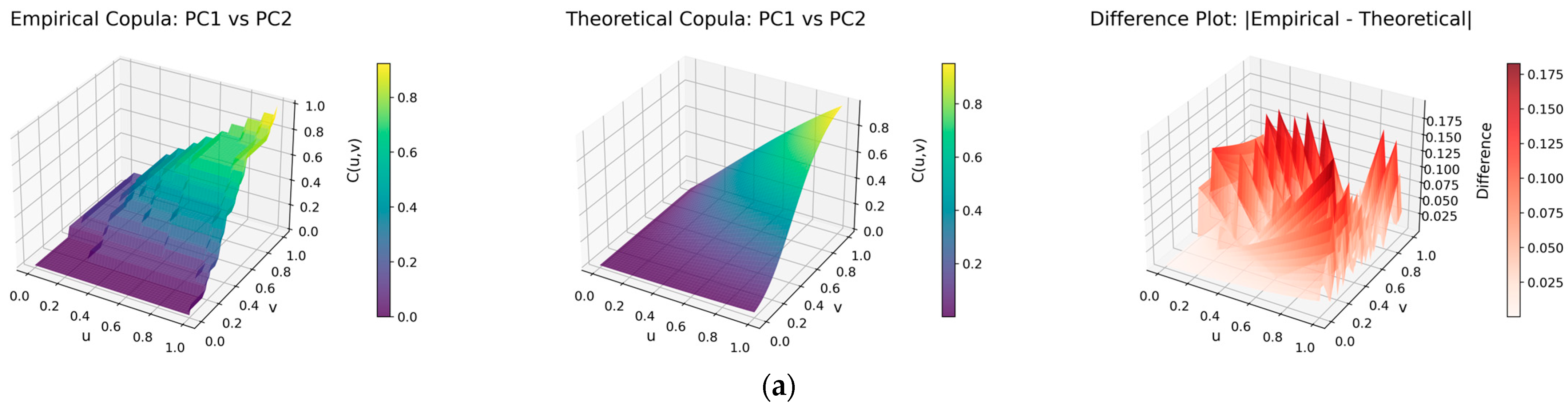
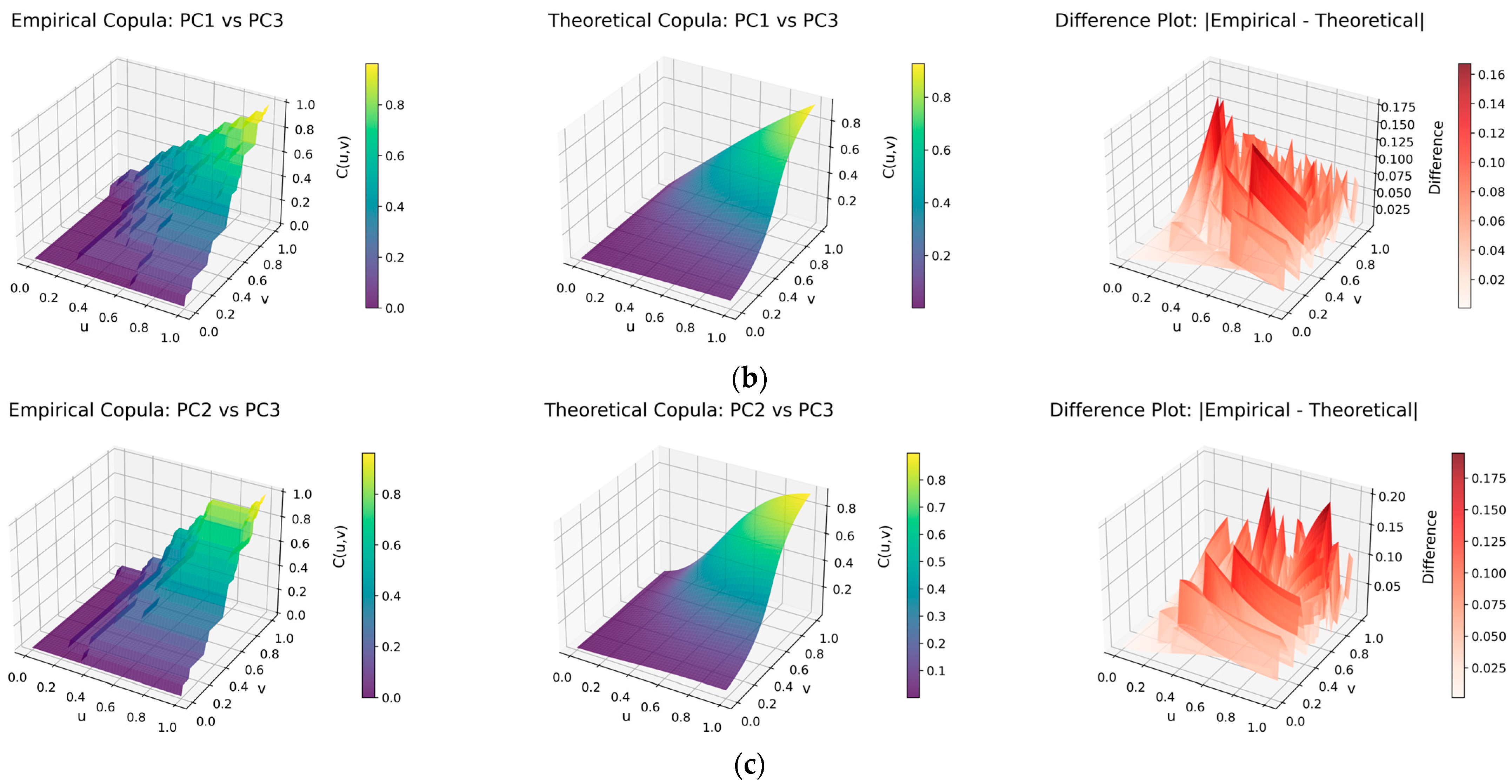
The MSE and RMSE values for all principal component pairs are extremely small (MSE < 0.005; RMSE < 0.07), and the JS divergence remains consistently below 0.02. These very low error metrics indicate strong agreement between the theoretical Gaussian copula and the empirical copula derived from the data. A three-dimensional comparison of the two copulas, Figure 4, further confirms this: both surfaces exhibit nearly identical shapes, kurtosis, and tail behaviors, with absolute deviations not exceeding 0.2 across the entire domain. This provides clear visual evidence supporting the numerical results. Taken together, the quantitative metrics and visual inspection demonstrate that the Gaussian copula effectively captures both linear and nonlinear dependency structures among the principal components after dimensionality reduction.

5.3.3. Model Validation

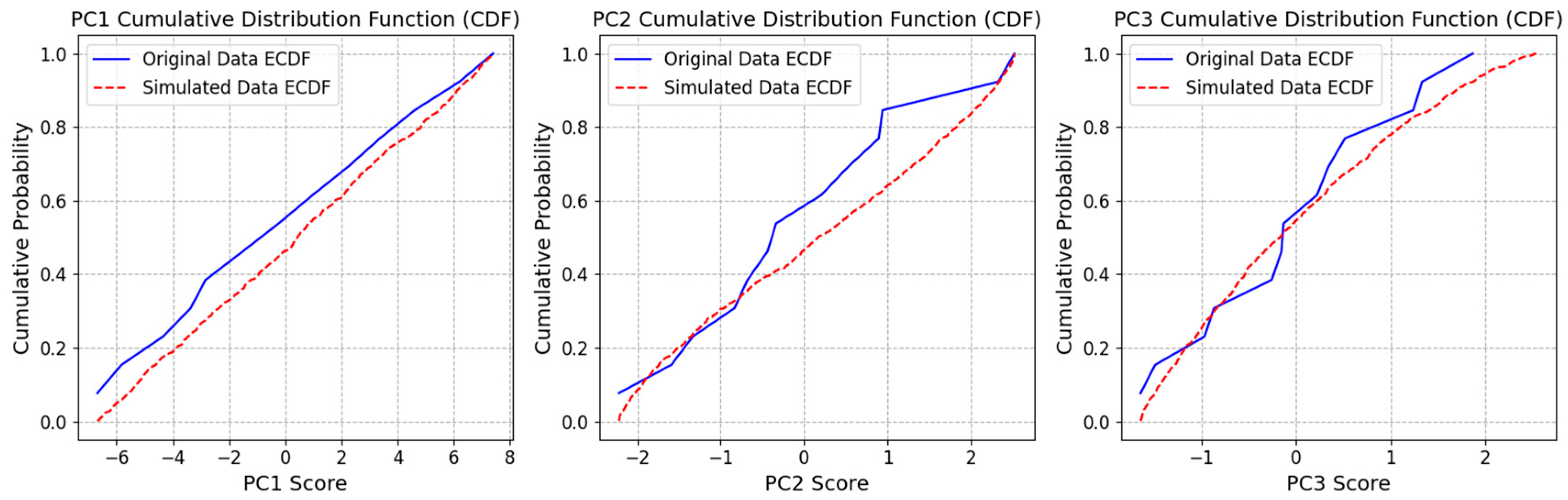
To validate the effectiveness of the full PCA–copula framework, we compared the statistical properties of the original principal components with those of simulated data generated from the copula model. The validation steps were as follows: (1) using the fitted Gaussian copula, we generated a large set of simulated uniform variables that preserve the dependency structure of the original components; (2) these uniform variables were then transformed using the inverse cumulative distribution functions (ICDFs) identified in Section 5.3.1 to obtain simulated principal component values; (3) finally, model performance was evaluated by visually comparing the cumulative distribution functions (CDFs) of the original and simulated principal components on the same plot.
As shown in Figure 5, the CDF curves of the original and simulated data nearly overlap for all three principal components (PC1, PC2, PC3). This close agreement indicates that the model not only captures the dependency structure among components (via the copula) but also accurately reconstructs the marginal distributions of each component. Overall, the PCA–copula workflow—from dimensionality reduction and marginal fitting to copula modeling—performs robustly and reproduces the joint probabilistic behavior of the original data. Through marginal-distribution tests, copula goodness-of-fit evaluations, and final model validation, we demonstrate that the PCA–copula model is reliable and suitable for downstream applications such as risk analysis and Monte Carlo simulations.
Notwithstanding the model’s overall performance, its ability to accurately reproduce the original data in detail is limited by two factors. First, the sample size of 13 observations is too small to ensure reliable model accuracy. Second, the large number of variables makes outcome prediction more difficult. The simulation generated 1000 samples—more than the original 13—which caused the starting point of the simulated cumulative distribution function (CDF) to approach 0 at the minimum observed value. In contrast, the cumulative probability at the first point of the empirical CDF is 0.077. For PC1, the simulated CDF consistently lies below the empirical CDF, indicating that the simulated distribution contains values that are too small relative to the original data, which broadly spans the range [0.05–1] rather than [0, 1]. PC2 shows a similar issue: the empirical CDF tends toward a uniform distribution but with a heavier upper tail. For PC3, some simulated values exceed 2, whereas the empirical maximum is below 2. These discrepancies suggest that further exploration of alternative or refined modeling methods may be necessary.

5.4. Monte Carlo Simulation Results

To comprehensively evaluate and compare the overall benefit performance of different development models, this study generated 10,000 simulated samples using the PCA–copula model and calculated the benefit scores for each scenario. This large-scale simulation captures the full probability distribution of benefit outcomes under the interaction of multiple risk factors, moving beyond single-point estimates and providing more robust support for decision-making.

5.4.1. Comparison of Traditional Models and Green Development Models

Table 9 presents the comparative statistics of the comprehensive benefits of the two development models.
(1)
The PMC development model achieves an average benefit score of 0.567, an absolute increase of 0.102 over the traditional model’s 0.465, representing a 22% relative improvement. This difference is statistically significant, indicating that adopting the PMC development model yields substantial gains in overall performance.
(2)
The 90% confidence interval for the PMC model’s improvement over the traditional model is [2%, 46%]. The interval lies entirely above zero, and even its lower bound (2%) suggests a clear positive effect. This confirms the robustness of the simulation results and indicates that the PMC model’s advantage is not due to random variation.
(3)
The PMC model exhibits a smaller standard deviation in benefit scores (0.065 vs. 0.082) and a markedly higher minimum value (0.365 vs. 0.216). This shows that the PMC model not only improves average benefits but also significantly reduces volatility and downside risk, resulting in more stable and predictable performance.

5.4.2. Analysis of Benefit Distribution Characteristics

The benefit scores of the traditional model display a wider distribution range, with noticeable right skewness and fat tails. Some simulated samples fall below 0.3, indicating extreme underperformance when adverse factors accumulate. This reflects the model’s high uncertainty and significant downside risk. In contrast, the benefit score distribution of the PMC development model is more concentrated and approximates a normal distribution. By optimizing key indicators across dimensions to the top 50% of their historical levels, this model effectively truncates the left tail of the distribution and eliminates worst-case scenarios. This demonstrates that the systematic optimization embedded in the PMC framework not only increases overall benefits but also, more importantly, establishes a stronger “benefit floor”, thereby enhancing project resilience and resistance.

5.5. Sensitivity Analysis

To identify the key leverage factors driving changes in overall benefits, we conducted a local sensitivity analysis to quantify the marginal impact of each input indicator on the overall benefit score.

5.5.1. Key Metrics Influence Ranking

Table 10 provides a comprehensive ranking of the indicators by their degree of impact on the comprehensive benefits, along with their corresponding impact coefficients.
(1)
The impact coefficient of the hazardous waste compliance disposal rate (0.92) far exceeds its entropy weight method (0.11), demonstrating a clear “leveraging effect.” This indicates that even minor improvements in this indicator can generate disproportionately large gains in overall benefits. The reason is that environmental compliance serves as the “bottom line” and operational license for the project; non-compliance can trigger systemic risks such as work stoppages, hefty fines, or even project shutdowns, severely damaging profitability.
(2)
The actual impact coefficients for the Community Conflict Resolution Rate and Community Satisfaction Index (0.356 and 0.26) significantly exceed their theoretical weights. This shows that a “social license to operate” is not a soft requirement but a fundamental constraint that determines whether a projects can proceed smoothly and avoid delays and conflict-related costs.
(3)
Traditional financial indicator—such as return on investment (ROI) per well (impact coefficient 0.044) and cumulative net cash flow (0.032)—rank near the bottom. This aligns with the PMC development framework; these indicators function primarily as outcome variables that naturally improve when environmental, social, and technical dimensions perform well, rather than serving as dominant drivers themselves.
(4)
Within the technical dimension, the Domestic Manufacturing Rate of Core Technologies (0.192) has a stronger influence than natural gas output (0.125). This suggests that under current conditions, technological self-reliance and supply-chain security contribute more to overall benefits than simply expanding production.

5.5.2. Analysis of Impact at the Dimensional Level

Conducting a macro-level analysis from a dimensional perspective provides more strategic insights, as presented in Table 11.
(1)
The environmental dimension shows the highest average impact coefficient (0.227), closely matching its maximum assigned weight (0.293). This confirms its central role in the comprehensive benefit assessment of shale gas development.
(2)
The average impact of the social dimension (0.161) exceeds what its weight (0.198) would suggest, indicating that its actual marginal contribution is underestimated. This highlights the need for greater managerial emphasis on social factors.
(3)
The economic dimension has a notably low average impact coefficient (0.043) that is below its weight (0.235). This suggests that, within a framework aimed at maximizing comprehensive benefits, overemphasis on short-term financial returns yields diminishing strategic value. Resources should instead be more heavily directed towards environmental and social domains.

5.5.3. Weight–Influence Relationship Analysis

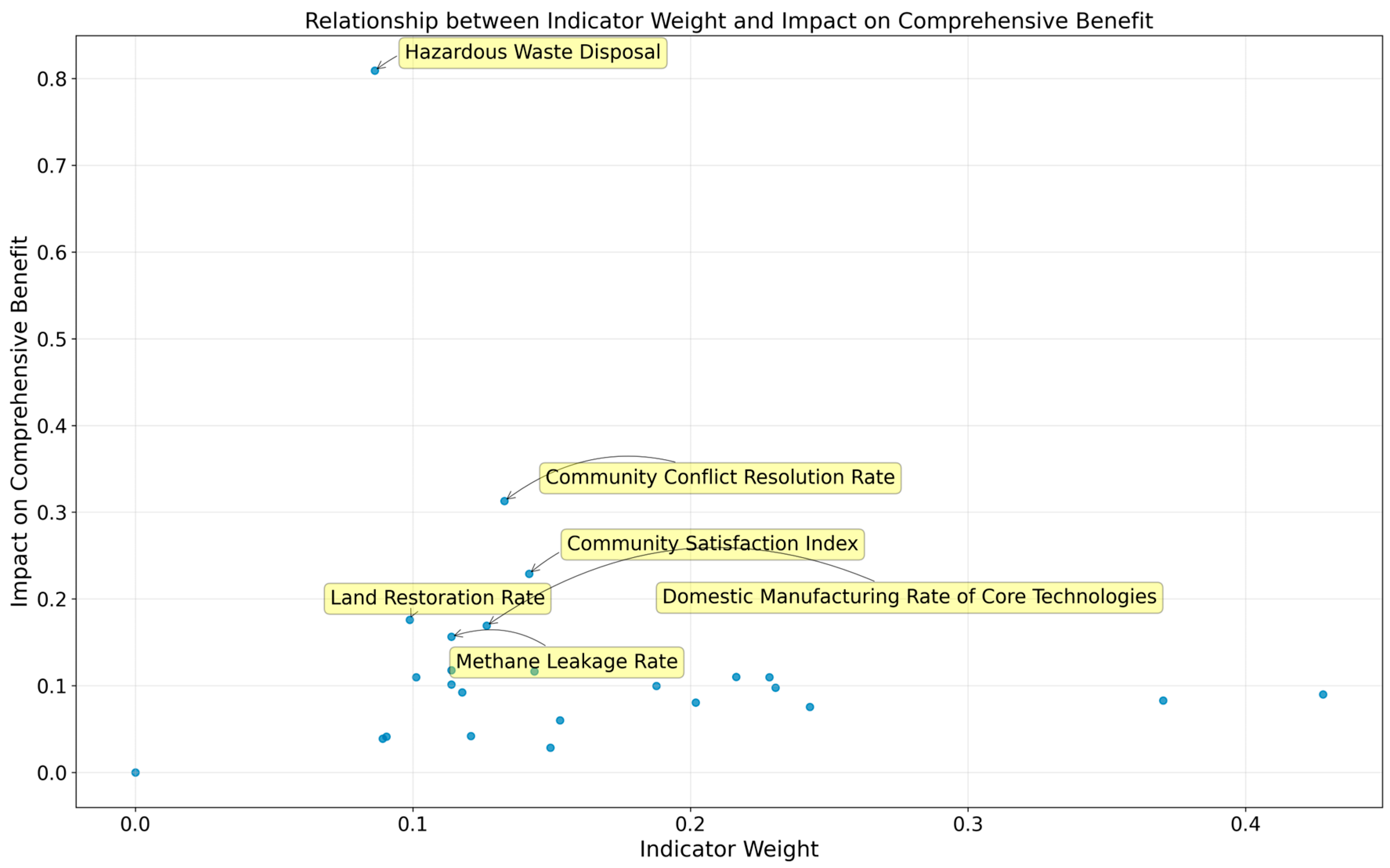
Following this, scatter plots of the “weight-impact coefficient” for each indicator were generated (Figure 6). No significant linear correlation was observed between the two (R2 = 0.12). This result highlights the limitations of traditional weighting methods and suggests several important management implications.
The results show that a high weight does not necessarily imply a high impact. For instance, natural gas production has the highest weight (0.254), yet its marginal impact coefficient on overall benefits is only 0.125, ranking eighth. Conversely, a low weight does not necessarily equate to a low impact; the hazardous waste compliance rate has a mid-to-low weight of 0.105, but its impact coefficient reaches 0.920, ranking first. Although the entropy method effectively reflects differences in information content across indicators, it cannot directly reveal an indicator’s marginal contribution to the overall benefit. Thus, equating weight with importance can be misleading. Sensitivity analysis, an essential complement, helps identify indicators with true strategic leverage, providing managers with a more accurate scientific basis for optimizing resource allocation and prioritizing control measurement.

6. Discussion

6.1. Benefit Mechanism of Green Development Models

This study uses quantitative methods to show that the PMC development model achieves a 22% improvement in comprehensive benefits. This improvement does not result from a breakthrough in any single dimension, but from synergistic optimization across multiple dimensions.

6.1.1. Environmental–Economic Positive Feedback

The process is characterized by a positive feedback loop between environmental investment and economic benefit. The reuse rate of fracturing flowback fluid has risen to 98%, substantially reducing water consumption and wastewater discharge, while lowering costs for freshwater procurement and external treatment. Notably, the deployment of real-time methane monitoring systems has reduced leakage rates by 60%, preventing product losses and avoiding potential carbon-trading costs from venting. These practices eloquently demonstrate that effective environmental management not only fulfills social responsibilities but also delivers tangible economic gains through resource conservation and risk reduction, achieving a win–win outcome for both the environment and the economy.

6.1.2. Social–Operational Synergy

Significant improvements in community satisfaction and conflict resolution rates have been achieved substantially reducing “non-technical risks.” Historical data show that project delays caused by community conflicts can lead to annual losses of tens of millions of yuan. Through the establishment of benefit-sharing mechanisms and transparent communication channels, enterprises have secured a stable “social license to operate,”, thereby providing the societal foundation for green development.

6.1.3. Technology-Sustainable Empowerment

The localization rate of core technologies has increased from 55% to 88%, and its deep integration with digitalization has generated significant synergistic benefits across four dimensions: cost, environmental protection, safety, and efficiency. In terms of cost, the widespread adoption of domestically produced equipment has reduced procurement costs by 30–50% relative to imported alternatives, while maintenance costs have failed by 40%, achieving substantial “cost reductions.” In environmental protection, the independently developed intelligent fracturing system enables precise fluid control, lowering water consumption by 10%, while real-time methane monitoring has reduced leakage rates by 60%, delivering strong environmental gains. For safety, the digital monitoring platform provides continuous 24/7 alerts, enabling potential incidents to be identified and mitigated up to 72 h in advance, thereby forming a robust safety barrier. Regarding efficiency, drilling cycles have been shortened dramatically—from 108 days to 26 days—resulting in a 40% reduction in per-well costs and a threefold increase in capital turnover, representing a “major leap” in operational 18/21 efficiency. Overall, these results demonstrate that technological self-reliance combined with and digital transformation are the key pathways to advancing stronger environmental performance of shale gas and enhanced safety.

6.1.4. Digitalization Drives Intelligent Leap in Systems

Once digital coverage surpassed 85%, the system underwent a major shift from local optimization to system-level intelligent management. This transformation was reflected across four core areas: (i) intelligent scheduling improved equipment utilization by 20% by optimizing global asset allocation through algorithms. (ii) Predictive maintenance reduced failure rates by 35% and maintenance costs by 25% by issuing data-driven early warnings regarding equipment health. (iii) Energy management dynamically monitored and optimized energy use throughout the production process, reducing energy consumption per unit of output by 18% while cutting carbon emissions. (iv) Big-data decision-making integrated geological and historical production data to intelligently optimize well placement plans, increasing estimated ultimate recovery (EUR) per well by 12%. The coordinated operation of these four systems demonstrates that the operational model has progressed beyond isolated improvements into a new stage of fully integrated, intelligent decision-making.

6.1.5. Key Drivers of the Green Transition

A sensitivity analysis shows that the key drivers of green transformation do not stem from traditional economic or technical indicators, but from three strategic pillars: environmental compliance, social governance, and technological innovation. First, corporate strategy must shift fundamentally from “pursuing highlights” to “protecting the bottom line”. Achieving full environmental compliance—such as 100% hazardous waste disposal—produces comprehensive benefits several times greater than conventional optimizations like increasing output. Second, the “social license to operate” must be treated as a core intangible asset. Investments in community relations is no longer a cost but a high-return input that safeguards project continuity and minimizes conflict-induced losses. Third, technological innovation should follow a “precision targeting” approach, focusing resources on overcoming “bottleneck” issues such as the localization of core technologies. The marginal benefits of such concentrated efforts far exceed those of broad, diffuse technology deployments. Together, these three pillars form the new novel strategic framework for green shale gas development.

6.2. Research Limitations

The conclusions of this study are largely based on shale gas development practices in the Sichuan Basin. However, their generalizability to regions with markedly different geological or policy contexts requires further verification. This limitation stems from three main factors: Firstly, the sample consists of only 13 annual observations. Although the PCA–copula–Monte Carlo framework helps to partially offset this constraint, statistical power remains limited. Future research should expand existing datasets to include enterprise- or region-level panel data. Secondly, while the current 25-indicator framework is reasonably comprehensive, it may still overlook finer dimensions, such as species-level biodiversity data or community health impacts, necessitating further refinement of indicator completeness. Third, at the methodological level, the study focuses on correlation and sensitivity analyses. Although key associations, (e.g., improved hazardous waste compliance increasing overall benefits) are identified, strict causality cannot be established. Unobserved confounders may exist, highlighting the need for future use of quasi-experimental designs, such as difference-in-differences, to strengthen causal inference.
With respect to the model developed by the research institute, although the PCA–copula–Monte Carlo framework proposed here effectively captures multidimensional nonlinear dependencies and performs well with small sample sizes, further optimization is possible. In view of the marginal-distribution fitting challenges discussed in Section 5.3.3, we propose incorporating time-dependent structures into the simulation process. This study preliminarily examines whether applying Sequential Gaussian Simulation (SGS) after Gaussian deformation could improve accuracy. Specifically, after Gaussian deformation of the principal component scores (the copula fitting step), the current unconditional Monte Carlo sampling could be replaced with SGS. SGS models the temporal autocorrelation of principal component scores through variograms, enabling more accurate conditional simulation. This approach would simulate trajectories with stronger temporal continuity and greater credibility for long-term policy scenario analyses.

7. Conclusions

This study develops an integrated PCA–copula–Monte Carlo evaluation framework to quantify the multidimensional benefits of green and sustainable shale gas development. Four main conclusions regarding the environmental sustainability of shale gas emerge: First, PMC development models significantly improve overall performance, achieving a score of 0.567, which is 22% higher than traditional models (0.467). The 90% confidence interval [2%, 46%] indicates substantial synergistic gains across economic, environmental, social, and technological dimensions. Second, the environmental and social dimensions act as strategic levers for transition. Sensitivity analysis shows that compliance and social governance indicators, such as the hazardous waste compliance disposal rate (impact coefficient 0.92) and the community conflict resolution rate (0.367), have marginal effects far exceeding traditional economic metrics. This highlights the importance of “bottom-line management” and the “social license to operate.”. Third, a marked discrepancy exists between indicator weights and actual impact (R2 = 0.12). Entropy-based weights capture only data dispersion and fail to identify true leverage indicators, highlighting the need for sensitivity analysis as a complementary approach. Finally, China’s shale gas industry has achieved a “three-stage leap”: from technological and economic feasibility to scaled profitability, and now to high-quality green development. The continuous improvement of indicators across all dimensions demonstrates that green development has evolved from a concept into a measurable and assessable systemic practice.
In view of this study’s findings and limitations, future research can be expanded in three directions. First, at the causal mechanism level, quasi-experimental designs such as difference-in-differences can be used to more precisely identify the causal effects of green policies on comprehensive benefits and analyze their underlying transmission pathways. Second, at the dynamic modeling level, system dynamics or dynamic panel models should be incorporated to capture feedback mechanisms among environmental, social, economic, and technological dimensions and to simulate long-term trajectories under different policy scenarios. Third, at the regional comparison level, research should extend to firm-level and cross-regional panel data to examine how geological conditions, policy environments, and technological pathways differentially affect green development benefits. This will strengthen both the generalizability and policy relevance of the conclusions.

Author Contributions

Conceptualization, T.Y.; methodology, Y.L., and Y.G.; software, F.W.; validation, T.Y. and F.W.; formal analysis, F.W.; investigation, Y.G.; resources, T.Y.; data curation, F.W.; writing—original draft preparation, Y.L. and F.W.; writing—review and editing, T.Y., Y.L., F.W. and Y.G.; visualization, F.W.; supervision, T.Y.; project administration, T.Y. All authors have read and agreed to the published version of the manuscript.

Funding

This paper was financed by 2024 Natural Science Foundation of Sichuan Province (2024NSFSC0091) and State Key Laboratory of Oil and Gas Reservoir Geology and Exploitation Special Open Fund—Sichuan Province Geothermal Resources Development and Comprehensive Utilization Industry-Education Integration Demonstration Project (No. CDUT-PLC2025017CJRH), and the AI Research Foundation of Chengdu University of Technology (Grant No. 2025AI032).

Institutional Review Board Statement

Not applicable.

Informed Consent Statement

Not applicable.

Data Availability Statement

The original contributions presented in this study are included in the article. Further inquiries can be directed to the corresponding author.

Conflicts of Interest

Author Tianxiang Yang was employed by the company Natural Gas Economic Research Institute, Southwest Oil & Gas Field Company, PetroChina. The remaining authors declare that the research was conducted in the absence of any commercial or financial relationships that could be construed as a potential conflict of interest.

Abbreviations

CNPCChina National Petroleum Corporation
DPSIRDriving Forces–Pressures–State–Impacts–Responses, used to assess and manage environmental problems
PPFCIProjection pursuit fuzzy clustering model
RAGAReal coded accelerated genetic algorithm
WSRWuli–Shili–Renli
PCAPrincipal component analysis
PMCPCA–Monte Carlo-based development model
ROIReturn on investment
LCALife-cycle assessment
DPSIRMDrivers–Pressures–State–Impacts–Responses–Management

References

  1. Cooper, J.; Stamford, L.; Azapagic, A. Shale Gas: A Review of the Economic, Environmental, and Social Sustainability. Energy Technol. 2016, 4, 772–792. [Google Scholar] [CrossRef]
  2. Wei, J.; Duan, H.; Yan, Q. Shale gas: Will it become a new type of clean energy in China?—A perspective of development potential. J. Clean. Prod. 2021, 294, 126257. [Google Scholar] [CrossRef]
  3. Gao, S.; Dong, D.; Tao, K.; Guo, W.; Li, X.; Zhang, S. Experiences and lessons learned from China’s shale gas development: 2005–2019. J. Nat. Gas Sci. Eng. 2021, 85, 103648. [Google Scholar] [CrossRef]
  4. Ma, X.; Wang, H.; Zhou, S.; Shi, Z.; Zhang, L. Deep shale gas in China: Geological characteristics and development strategies. Energy Rep. 2021, 7, 1903–1914. [Google Scholar] [CrossRef]
  5. Kinnaman, T.C. The economic impact of shale gas extraction: A review of existing studies. Ecol. Econ. 2011, 70, 1243–1249. [Google Scholar] [CrossRef]
  6. Munasib, A.; Rickman, D.S. Regional economic impacts of the shale gas and tight oil boom: A synthetic control analysis. Reg. Sci. Urban Econ. 2015, 50, 1–17. [Google Scholar] [CrossRef]
  7. Mei, Y.; Liu, W.; Wang, J.; Bentley, Y. Shale gas development and regional economic growth: Evidence from Fuling, China. Energy 2022, 239, 122254. [Google Scholar] [CrossRef]
  8. Liu, H.; Zhang, Z.; Zhang, T. Shale gas investment decision-making: Green and efficient development under market, technology and environment uncertainties. Appl. Energy 2022, 306, 118002. [Google Scholar] [CrossRef]
  9. Li, W.; Zhuang, Y.; Zhang, L.; Liu, L.; Du, J. Economic evaluation and environmental assessment of shale gas dehydration process. J. Clean. Prod. 2019, 232, 487–498. [Google Scholar] [CrossRef]
  10. Cooper, J.; Stamford, L.; Azapagic, A. Economic viability of UK shale gas and potential impacts on the energy market up to 2030. Appl. Energy 2018, 215, 577–590. [Google Scholar] [CrossRef]
  11. Grecu, E.; Aceleanu, M.I.; Albulescu, C.T. The economic, social and environmental impact of shale gas exploitation in Romania: A cost-benefit analysis. Renew. Sustain. Energy Rev. 2018, 93, 691–700. [Google Scholar] [CrossRef]
  12. Burnham, A.; Han, J.; Clark, C.E.; Wang, M.; Dunn, J.B.; Palou-Rivera, I. Life-Cycle Greenhouse Gas Emissions of Shale Gas, Natural Gas, Coal, and Petroleum. Environ. Sci. Technol. 2012, 46, 619–627. [Google Scholar] [CrossRef]
  13. Howarth, R.W.; Santoro, R.; Ingraffea, A. Venting and leaking of methane from shale gas development: Response to Cathles et al. Clim. Change 2012, 113, 537–549. [Google Scholar] [CrossRef]
  14. Li, X.; Mao, H.; Ma, Y.; Wang, B.; Liu, W.; Xu, W. Life cycle greenhouse gas emissions of China shale gas. Resour. Conserv. Recycl. 2020, 152, 104518. [Google Scholar] [CrossRef]
  15. Wang, J.; Liu, M.; McLellan, B.C.; Tang, X.; Feng, L. Environmental impacts of shale gas development in China: A hybrid life cycle analysis. Resour. Conserv. Recycl. 2017, 120, 38–45. [Google Scholar] [CrossRef]
  16. Wang, S.; Tang, X.; Wang, J.; Zhang, B.; Sun, W.; Höök, M. Environmental impacts from conventional and shale gas and oil development in China considering regional differences and well depth. Resour. Conserv. Recycl. 2021, 167, 105368. [Google Scholar] [CrossRef]
  17. Bartholomew, T.V.; Mauter, M.S. Multiobjective Optimization Model for Minimizing Cost and Environmental Impact in Shale Gas Water and Wastewater Management. ACS Sustain. Chem. Eng. 2016, 4, 3728–3735. [Google Scholar] [CrossRef]
  18. Tagliaferri, C.; Lettieri, P.; Chapman, C. Life Cycle Assessment of Shale Gas in the UK. Energy Procedia 2015, 75, 2706–2712. [Google Scholar] [CrossRef]
  19. Al-Jaraden, T.; Ayadi, O.; Alahmer, A. Towards sustainable shale oil recovery in Jordan: An evaluation of renewable energy sources for in-situ extraction. Int. J. Thermofluids 2023, 20, 100446. [Google Scholar] [CrossRef]
  20. Cooper, J.; Stamford, L.; Azapagic, A. Social sustainability assessment of shale gas in the UK. Sustain. Prod. Consum. 2018, 14, 1–20. [Google Scholar] [CrossRef]
  21. Thomas, M.; Partridge, T.; Harthorn, B.H.; Pidgeon, N. Deliberating the perceived risks, benefits, and societal implications of shale gas and oil extraction by hydraulic fracturing in the US and UK. Nat. Energy 2017, 2, 17054. [Google Scholar] [CrossRef]
  22. Hays, J.; McCawley, M.; Shonkoff, S.B. Public health implications of environmental noise associated with unconventional oil and gas development. Sci. Total Environ. 2017, 580, 448–456. [Google Scholar] [CrossRef] [PubMed]
  23. Werner, A.K.; Vink, S.; Watt, K.; Jagals, P. Environmental health impacts of unconventional natural gas development: A review of the current strength of evidence. Sci. Total Environ. 2015, 505, 1127–1141. [Google Scholar] [CrossRef]
  24. Habib, S.; Hinojosa, M.S.; Hinojosa, R. Societal Implications of Unconventional Oil and Gas Development. In Advances in Chemical Pollution, Environmental Management and Protection; Elsevier: Amsterdam, The Netherlands, 2017; Volume 1. [Google Scholar] [CrossRef]
  25. Wang, J.; Xue, M.; Fan, J.; Bentley, Y.; Wang, X. Does shale gas exploitation contribute to regional sustainable development? Evidence from China. Sustain. Prod. Consum. 2023, 40, 169–181. [Google Scholar] [CrossRef]
  26. He, X.; Chen, G.; Wu, J.; Liu, Y.; Wu, S.; Zhang, J.; Zhang, X. Deep shale gas exploration and development in the southern Sichuan Basin: New progress and challenges. Nat. Gas Ind. B 2023, 10, 32–43. [Google Scholar] [CrossRef]
  27. Lei, Q.; Weng, D.; Guan, B.; Shi, J.; Cai, B.; He, C.; Sun, Q.; Huang, R. Shale oil and gas exploitation in China: Technical comparison with US and development suggestions. Pet. Explor. Dev. 2023, 50, 944–954. [Google Scholar] [CrossRef]
  28. Lei, Q.; Weng, D.; Xiong, S.; Liu, H.; Guan, B.; Deng, Q.; Yan, X.; Liang, H.; Ma, Z. Progress and development directions of shale oil reservoir stimulation technology of China National Petroleum Corporation. Pet. Explor. Dev. 2021, 48, 1198–1207. [Google Scholar] [CrossRef]
  29. Kaplin, M.; Bilan, T.; Makarov, V.; Novoseltsev, O.; Zaporozhets, A. Optimization of Technological Development of the Oil and Gas Industry. In Geomining: Systems and Decision-Oriented Perspective; Shukurov, A., Vovk, O., Zaporozhets, A., Zuievska, N., Eds.; Springer Nature: Cham, Switzerland, 2024. [Google Scholar] [CrossRef]
  30. Perov, M.; Makarov, V.; Kaplin, M.; Novoseltsev, O.; Zaporozhets, A. Geological Features and Type of Oil Shale Booth. In Geomining: Systems and Decision-Oriented Perspective; Shukurov, A., Vovk, O., Zaporozhets, A., Zuievska, N., Eds.; Springer Nature: Cham, Switzerland, 2024. [Google Scholar] [CrossRef]
  31. Hu, H.; Xiong, S.; Wang, Z.; Wang, Z.; Zhou, X. Green financial regulation and shale gas resources management. Resour. Policy 2023, 85, 103926. [Google Scholar] [CrossRef]
  32. Liang, H.-B.; Zhang, L.-H.; Zhao, Y.-L.; He, X.; Wu, J.-F.; Zhang, J.; Yang, J. Techno-economic and sensitivity analysis of shale gas development based on life cycle assessment. J. Nat. Gas Sci. Eng. 2021, 95, 104183. [Google Scholar] [CrossRef]
  33. Niu, W.; Lu, J.; Sun, Y.; Zhang, X.; Li, Q.; Cao, X.; Liang, P.; Zhan, H. Techno-economic integration evaluation in shale gas development based on ensemble learning. Appl. Energy 2023, 357, 122486. [Google Scholar] [CrossRef]
  34. Wang, Q.; Li, S. Shale gas industry sustainability assessment based on WSR methodology and fuzzy matter-element extension model: The case study of China. J. Clean. Prod. 2019, 226, 336–348. [Google Scholar] [CrossRef]
  35. Wang, Q.; Zhan, L. Assessing the sustainability of the shale gas industry by combining DPSIRM model and RAGA-PP techniques: An empirical analysis of Sichuan and Chongqing, China. Energy 2019, 176, 353–364. [Google Scholar] [CrossRef]
  36. Wang, Q.; Yang, X. Evaluating the potential for sustainable development of China’s shale gas industry by combining multi-level DPSIR framework, PPFCI technique and RAGA algorithm. Sci. Total Environ. 2021, 780, 146525. [Google Scholar] [CrossRef]
  37. Li, L.; Wu, F.; Cao, Y.; Cheng, F.; Wang, D.; Li, H.; Yu, Z.; You, J. Sustainable development index of shale gas exploitation in China, the UK, and the US. Environ. Sci. Ecotechnol. 2022, 12, 100202. [Google Scholar] [CrossRef]
  38. Yang, Y.; Wang, L.; Fang, Y.; Mou, C. Integrated value of shale gas development: A comparative analysis in the United States and China. Renew. Sustain. Energy Rev. 2017, 76, 1465–1478. [Google Scholar] [CrossRef]
  39. Liu, H.; Zhang, T. How to optimize the investment decision of shale gas multi-objective green development for energy sustainable development? J. Pet. Explor. Prod. Technol. 2025, 15, 192. [Google Scholar] [CrossRef]
  40. Cherepovitsyn, A.; Rutenko, E.; Solovyova, V. Sustainable Development of Oil and Gas Resources: A System of Environmental, Socio-Economic, and Innovation Indicators. J. Mar. Sci. Eng. 2021, 9, 1307. [Google Scholar] [CrossRef]
  41. Yang, X.; Gu, A.; Jiang, F.; Xie, W.; Wu, Q. Integrated Assessment Modeling of China’s Shale Gas Resource: Energy System Optimization, Environmental Cobenefits, and Methane Risk. Energies 2020, 14, 53. [Google Scholar] [CrossRef]
  42. Cooper, J. Life Cycle Sustainability Assessment of Shale Gas in the UK. Ph.D. Thesis, The University of Manchester, Manchester, UK, 2017. [Google Scholar]
  43. Patro, S.G.K.; Sahu, K.K. Normalization: A preprocessing stage. Int. Adv. Res. J. Sci. Eng. Technol. 2016, 2, 20–22. [Google Scholar] [CrossRef]
  44. Murphy, D.J.; Hall, C.A.S. Year in review—EROI or energy return on (energy) invested. Ann. N. Y. Acad. Sci. 2010, 1185, 102–118. [Google Scholar] [CrossRef]
  45. Linsel, A.; Wiesler, S.; Haas, J.; Bär, K.; Hinderer, M. Accounting for Local Geological Variability in Sequential Simulations—Concept and Application. ISPRS Int. J. Geo Inf. 2020, 9, 409. [Google Scholar] [CrossRef]
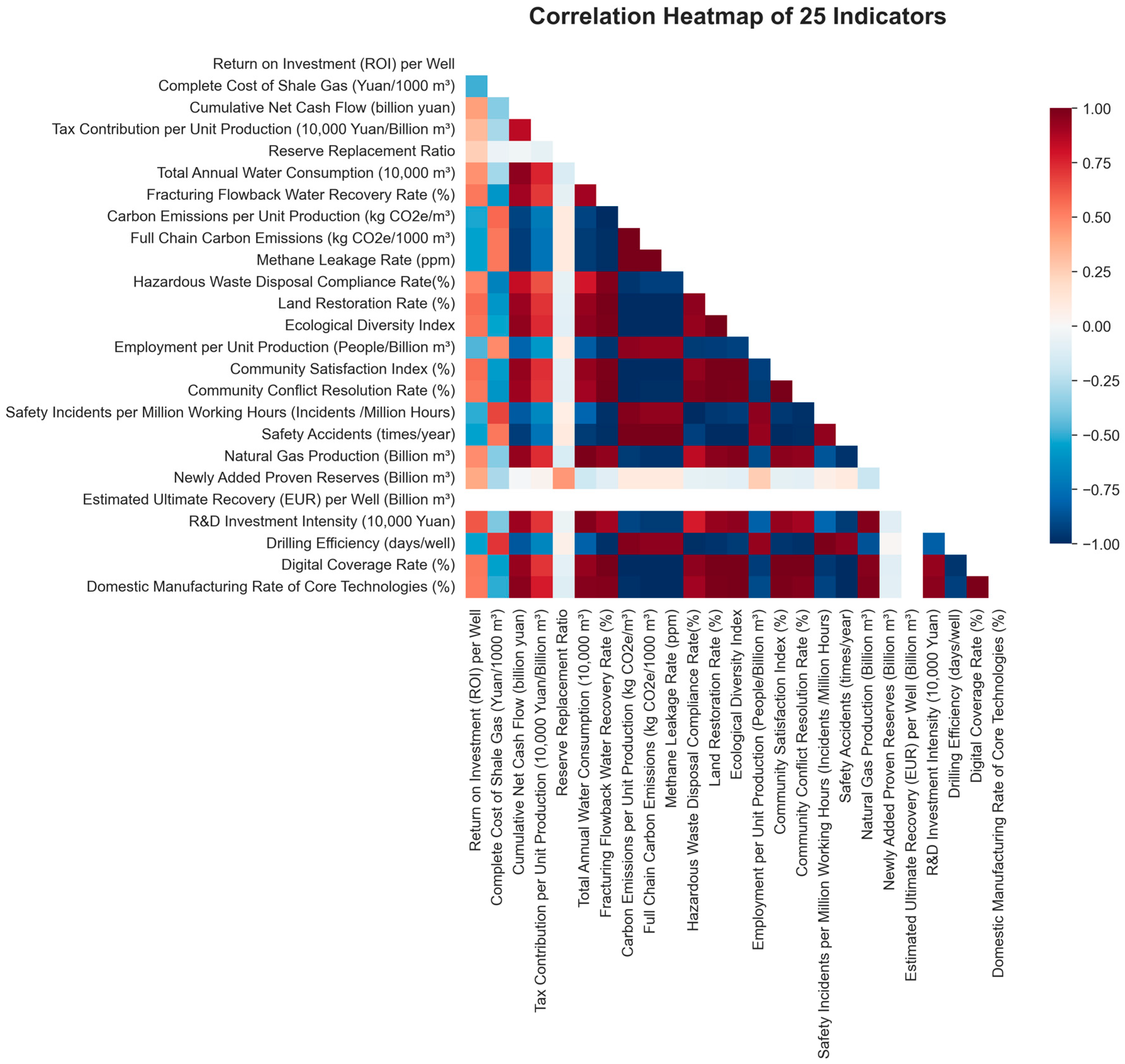
Figure 1. Correlation heatmap.
Applsci 15 13013 g001
Figure 2. Gravel diagram and cumulative explained variance chart.
Applsci 15 13013 g002
Figure 3. Displays the top six variables’ factor map (circular plot) for each principal component.
Applsci 15 13013 g003
Figure 4. Three-dimensional plots of empirical copulas and theoretical copulas (a) for the PC1–PC2 pair; (b) for the PC1–PC3 pair; and (c) for the PC2–PC3 pair.
Applsci 15 13013 g004aApplsci 15 13013 g004b
Figure 5. Cumulative distribution function of principal component raw data and simulated data.
Applsci 15 13013 g005
Figure 6. The relationship between indicator weight and the degree of impact on overall effectiveness.
Applsci 15 13013 g006
Table 1. Evaluation index system for sustainable shale gas development.
Primary IndicatorSecondary IndicatorUnitImpact Direction
Economic DimensionReturn on Investment (ROI) per Well [43]-Positive
Complete Cost of Shale Gas CNY/1000 m3Negative
Cumulative Net Cash Flow Billion YuanPositive
Tax Contribution per Unit Production CNY 10,000/Billion m3Positive
Reserve Replacement Ratio-Positive
Environmental DimensionTotal Annual Water Consumption 10,000 m3Negative
Fracturing Flowback Water Recovery Rate %Positive
Carbon Emissions per Unit Production kg CO2e/m3Negative
Full-Chain Carbon Emissionskg CO2e/1000 m3Negative
Methane Leakage Rate ppmNegative
Hazardous Waste Disposal Compliance Rate%Positive
Land Restoration Rate %Positive
Ecological Diversity Index-Positive
Social DimensionEmployment per Unit Production People/Billion m3Positive
Community Satisfaction Index %Positive
Community Conflict Resolution Rate%Positive
Safety Incidents per Million Working Hours Incidents/Million HoursNegative
Safety AccidentsTimes/YearNegative
Technical DimensionNatural Gas ProductionBillion m3Positive
Newly Added Proven Reserves Billion m3Positive
Estimated Ultimate Recovery (EUR) per WellBillion m3Positive
R&D Investment Intensity (CNY 10,000)Positive
Drilling EfficiencyDays/WellNegative
Digital Coverage Rate%Positive
Domestic Manufacturing Rate of
Core Technologies
%Positive
Table 2. Thresholds for each indicator dimension.
LevelDimensionNumber of Indicators (p) w B a s e l i n e ( 1 / p )
PrimaryAll Dimensions40.25
SecondaryEconomy50.2
SecondaryEnvironment80.125
SecondarySocial50.25
SecondaryTechnique70.14
Table 3. Raw data for 25 indicators.
Indicator2011201220132014201520162017201820192020202120222023
Return on Investment (ROI) per Well 0.06680.0170.46810.39260.22350.11030.16740.33510.3720.31790.350.380.4
Complete Cost of Shale Gas (CNY/1000 m3)6442.652440.091819.49984.74988.721211.25932.921101.541212.71259.17130013501400
Cumulative Net Cash Flow (Billion Yuan)−2.67−12.77−8.496.491.4336.8136.6737.6436.5435.7865.0490.9393.3
Tax Contribution per Unit Production (CNY 10,000/Billion m3)0.00580.00530.00680.00430.0080.01850.01730.01660.02510.00430.01210.03410.036
Reserve Replacement Ratio3.8393.4974.457.5351.184.6073.9043.3215.631.9556.1953.8962.567
Total Annual Water Consumption (10,000 m3)142.06131.52126.08137.26154.84190.06210.25226.33268.65318.19354.18420.28450
Fracturing Flowback Water Recovery Rate (%)50556065707580859092949698
Carbon Emissions per Unit Production (kg CO2e/m3)45.242.54038353229.5272523.52220.519
Full-Chain Carbon Emissions (kg CO2e/1000 m3)1201151101051009590858075706560
Methane Leakage Rate (ppm)1501451401351301251201151101051009590
Hazardous Waste Disposal Compliance Rate (%)92939495969798999999999999
Land Restoration Rate (%)65687275788082858890929496
Ecological Diversity Index11.11.21.31.41.51.61.71.81.922.12.2
Employment per Unit Production (People/Billion m3)159.5174.6163.6142120.1110.2100.482.248.741.4586365
Community Satisfaction Index (%)70727578808284868890929496
Community Conflict Resolution Rate (%)78808284868890929394959697
Safety Incidents per Million Working Hours (Incidents/Million Hours)0.80.70.60.50.40.30.20.10.10.10.10.080.07
Safety Accidents (Times/Year)1514131211109876543
Natural Gas Production (Billion m3)142.06151.82137.26154.84190.06210.25226.33268.65318.19354.18383.35420.28450
Newly Added Proven Reserves (Billion m3)545.38599.632406.851731.02875.722075.76751.631512.54621.98194.271493.461078.921200
Estimated Ultimate Recovery (EUR) per Well (Billion m3)0.80.80.80.80.80.80.80.80.80.80.80.80.8
R&D Investment Intensity (CNY 10,000)233.46246.06300.47348.29317.88282.59349.16394.29471.09522.3580.5649.38713.41
Drilling Efficiency (Days/Well)108958070605045403532302826
Digital Coverage Rate (%)40455055606570758085909295
Domestic Manufacturing Rate of Core Technologies (%)55586062656870727577808588
Table 4. Descriptive statistics for the 25 indicators.
IndicatorMeanStandard
Deviation
Minimum ValueMaximum Value
Return on Investment (ROI) per Well 0.28 0.14 0.02 0.47
Complete Cost of Shale Gas (CNY/1000 m3)1726.41 1473.46 932.92 6442.65
Cumulative Net Cash Flow (Billion Yuan)32.05 35.20 −12.7793.30
Tax Contribution per Unit Production (CNY 10,000/Billion m3)0.01 0.01 0.00 0.04
Reserve Replacement Ratio4.04 1.72 1.18 7.54
Total Annual Water Consumption (10,000 m3)240.75 112.65 126.08 450.00
Fracturing Flowback Water Recovery Rate (%)77.69 16.46 50.00 98.00
Carbon Emissions per Unit Production (kg CO2e/m3)30.71 8.78 19.00 45.20
Full-Chain Carbon Emissions (kg CO2e/1000 m3)90.00 19.47 60.00 120.00
Methane Leakage Rate (ppm)120.00 19.47 90.00 150.00
Hazardous Waste Disposal Compliance Rate(%)96.85 2.58 92.00 99.00
Land Restoration Rate (%)81.92 10.01 65.00 96.00
Ecological Diversity Index1.60 0.39 1.00 2.20
Employment per Unit Production (People/Billion m3)102.21 46.64 41.40 174.60
Community Satisfaction Index (%)83.62 8.36 70.00 96.00
Community Conflict Resolution Rate (%)88.85 6.36 78.00 97.00
Safety Incidents per Million Working Hours (Incidents/Million Hours)0.31 0.26 0.07 0.80
Safety Accidents (Times/Year)9.00 3.89 3.00 15.00
Natural Gas Production (Billion m3)262.10 111.62 137.26 450.00
Newly Added Proven Reserves (Billion m3)1160.55 653.48 194.27 2406.85
Estimated Ultimate Recovery (EUR) per Well (Billion m3)0.80 0.00 0.80 0.80
R&D Investment Intensity (CNY 10,000)416.07 157.27 233.46 713.41
Drilling Efficiency (Days/Well)53.77 26.99 26.00 108.00
Digital Coverage Rate (%)69.38 18.55 40.00 95.00
Domestic Manufacturing Rate of Core Technologies (%)70.38 10.36 55.00 88.00
CNY 1 = USD 0.1406.
Table 5. Weighting results for each indicator.
Primary
Indicator
Weight of Primary
Indicators
w B a s e l i n e of Primary
Indicators
Secondary IndicatorWeight of
Secondary
Indicators
Weight Within
Category
w B a s e l i n e of Secondary
Indicators
Economic Dimension0.2250.25Return on Investment (ROI) per Well0.0330.1460.2
Complete Cost of Shale Gas (CNY/1000 m3)0.0140.063
Cumulative Net Cash Flow (Billion Yuan)0.0550.245
Tax Contribution per Unit Production (CNY 10,000/Billion m3)0.0900.398
Reserve Replacement Ratio0.0330.148
Environmental Dimension0.293Total Annual Water Consumption (10,000 m3)0.0320.1090.125
Fracturing Flowback Water Recovery Rate (%)0.0360.123
Carbon Emissions per Unit Production (kg CO2e/m3)0.0370.126
Full-Chain Carbon Emissions (kg CO2e/1000 m3)0.0410.139
Methane Leakage Rate (ppm)0.0410.139
Hazardous Waste Disposal Compliance Rate (%)0.0310.105
Land Restoration Rate (%)0.0350.121
Ecological Diversity Index0.0410.139
Social Dimension0.198Employment per Unit Production (People/Billion m3)0.0540.2710.25
Community Satisfaction Index (%)0.0380.190
Community Conflict Resolution Rate (%)0.0350.178
Safety Incidents per Million Working Hours (Incidents/Million Hours)0.0310.157
Safety Accidents (Times/Year)0.0410.205
Technical Dimension0.284Natural Gas Production (Billion m3)0.0720.2540.14
Newly Added Proven Reserves (Billion m3)0.0400.142
Estimated Ultimate Recovery (EUR) per Well (Billion m3)0.0000.000
R&D Investment Intensity (CNY 10,000)0.0630.220
Drilling Efficiency (Days/Well)0.0270.097
Digital Coverage Rate (%)0.0390.138
Domestic Manufacturing Rate of Core Technologies (%)0.0420.149
Table 6. Variance explained by each principal component.
Principal ComponentEigenvalueProportion of Variance ExplainedCumulative Proportion of Explained Variance
PC120.8810.8030.803
PC22.0390.0780.882
PC31.1630.0450.926
Table 7. Marginal-distribution fitting results for principal components.
Principal ComponentOptimal DistributionDistributed ParametersKS Statisticp-ValueAIC
PC1Uniforma = −6.677, b = 14.0700.0871.00072.745
PC2Betaα = 0.704, β = 0.712, loc = −2.218, scale = 4.7430.2080.56027.382
PC3Betaα = 0.846, β = 1.425, loc = −1.644, scale = 4.1920.1920.65432.537
Table 8. Copula goodness-of-fit evaluation.
Analysis ObjectMSERMSEJS Divergence
PC1–PC2 pair0.00470.06830.0178
PC1–PC3 pair0.00340.05820.0199
PC2–PC3 pair0.00440.06610.0187
Global Fitting0.00410.0643-
Table 9. Comparative analysis of comprehensive benefits between two models.
ModeAverage ScoreStandard
Deviation
Minimum ValueMaximum Value90% Confidence Interval
Traditional Model0.4650.0820.2160.723[0.329, 0.600]
Green Development Model0.5670.0650.3650.785[0.457, 0.678]
Increase+22%---[2%, 46%]
Table 10. Degree of influence of each indicator on comprehensive benefits.
Indicator
Dimension
Indicator NameImpact on
Comprehensive Benefit (%)
Impact Direction
Environmental DimensionHazardous Waste Disposal Compliance Rate (%)0.1050.920
Social DimensionCommunity Conflict Resolution Rate (%)0.1780.356
Social DimensionCommunity Satisfaction Index (%)0.1900.260
Environmental DimensionLand Restoration Rate (%)0.1200.199
Technical DimensionDomestic Manufacturing Rate of
Core Technologies (%)
0.1490.192
Environmental DimensionMethane Leakage Rate (ppm)0.1390.179
Environmental DimensionFull-Chain Carbon Emissions (kg CO2e/1000 m3)0.1390.135
Technical DimensionNatural Gas Production (Billion m3)0.2540.125
Environmental DimensionFracturing Flowback Water Recovery Rate (%)0.1230.124
Environmental DimensionEcological Diversity Index0.1390.115
Technical DimensionR&D Investment Intensity (CNY 10,000)0.2200.113
Technical DimensionDigital Coverage Rate (%)0.1380.105
Environmental DimensionCarbon Emissions per Unit Production (kg CO2e/m3)0.1260.096
Social DimensionEmployment per Unit Production (People/Billion m3)0.2700.092
Economic DimensionTax Contribution per Unit Production (CNY 10,000/Billion m3)0.3980.085
Social DimensionSafety Accidents (Times/Year)0.2050.069
Environmental DimensionTotal Annual Water Consumption (10,000 m3)0.1090.048
Technical DimensionNewly Added Proven Reserves (Billion m3)0.1420.047
Economic DimensionReserve Replacement Ratio0.1480.046
Economic DimensionReturn on Investment (ROI) per Well 0.1460.044
Technical DimensionDrilling Efficiency (Days/Well)0.0970.040
Economic DimensionCumulative Net Cash Flow (Billion Yuan)0.2450.032
Social DimensionSafety Incidents per Million Working Hours (Incidents/Million Hours)0.1570.030
Economic DimensionComplete Cost of Shale Gas (CNY/1000 m3)0.0630.009
Technical DimensionEstimated Ultimate Recovery (EUR) per Well
(Billion m3)
00
Table 11. Average impact of each dimension on overall benefits.
DimensionAverage Impact (%)Key IndicatorMaximum Impact (%)
Environmental Dimension0.227Compliance Rate for Hazardous Waste Disposal (%)0.920
Social Dimension0.161Community Conflict Resolution Rate (%)0.356
Technical Dimension0.089Domestic Production Rate of Core Technology (%)0.192
Economic Dimension0.043Tax Contribution per Unit Production (CNY 10,000/Billion m3)0.085
Disclaimer/Publisher’s Note: The statements, opinions and data contained in all publications are solely those of the individual author(s) and contributor(s) and not of MDPI and/or the editor(s). MDPI and/or the editor(s) disclaim responsibility for any injury to people or property resulting from any ideas, methods, instructions or products referred to in the content.