You are currently viewing a new version of our website. To view the old version click .
Applied Sciences
  • Article
  • Open Access

10 December 2025

High-Temperature Deformation in the Tan-Lu Fault Zone: Constraints on an Early Cretaceous Transtensional Regime


and
1
Mining Engineering and Geology College, Xinjiang Institute of Engineering, Urumqi 830023, China
2
School of Resources and Environmental Engineering, Hefei University of Technology, Hefei 230009, China
*
Author to whom correspondence should be addressed.
Appl. Sci.2025, 15(24), 12994;https://doi.org/10.3390/app152412994 
(registering DOI)

Abstract

How continental lithosphere stretches and ruptures is a fundamental question in Earth sciences; however, effective constraints on the physical conditions deep within the crust where deformation is concentrated remain elusive. This study offers new insights into this process through a detailed dissection of the Tan-Lu Fault Zone, one of the most extensive fault systems in East Asia. A critical controlling factor for crustal rheological properties is deformation temperature, a challenge we address by employing a thermometer based on the fractal dimension (D-value) of dynamically recrystallized quartz grain boundaries. Analyzing 62 mylonite samples from the Feidong segment, we reveal that left-lateral strike-slip shearing along this fault zone occurred under high temperatures (~450–700 °C). This conclusion is not only derived quantitatively from a quartz D-value thermometer but is also visually corroborated by classic high-temperature microstructures (e.g., extensive grain boundary migration), corresponding to conditions from the upper greenschist to amphibolite facies. Existing geochronological data constrain this high-temperature shearing event to the Early Cretaceous. Such elevated temperature conditions, combined with field and microstructural evidence indicating extension, provide quantitative confirmation that the fault zone operated within a transtensional tectonic regime during that period. Our findings offer a rigorously thermally constrained dynamic model for the deformation behavior of large continental faults during large-scale lithospheric thinning and craton destruction, providing a valuable framework for interpreting crustal rheology and continental dynamics.

1. Introduction

The destruction and modification of cratons represent an emblematic case of a complex adaptive system in which multiple forcing factors interact to generate emerging and non-linear behaviors [1]. Whether driven by mantle plume activity or oceanic plate subduction, these deep-seated processes often lead to lithospheric extension, elevated heat flow, and intense magmatism. Strain typically concentrates in pre-existing lithosphere-scale fault zones, making these crucial windows for dissecting continental deformation mechanisms. However, a complete understanding of the mechanical behavior of these fault zones requires knowledge of a key unknown parameter: their deep physicochemical conditions during activity, especially temperature, as it directly governs rock rheological strength and deformation style.
The North China Craton in East Asia is a classic example of craton destruction [2], having undergone dramatic lithospheric thinning, the development of high-grade metamorphic core complexes, and extensive magmatic eruptions during the Mesozoic [3]. The lithosphere-scale Tan-Lu Fault Zone, which traverses this region, is widely considered to have played a vital role in this process [3,4]. Nevertheless, its tectonic nature during peak activity has been a long-standing subject of debate: was it merely an independent strike-slip shear boundary [5], or was it intrinsically linked to a regional extensional environment [6]? Answering this question is key to comprehending the evolution of the Mesozoic East Asian continental tectonic framework. In recent years, research on the connection between North China Craton destruction and Tan-Lu Fault Zone activity has continued to deepen, emphasizing the controlling influence of deep mantle processes on surface tectonic deformation [7,8,9].
This paper focuses on the Feidong segment, located in the southern part of the Tan-Lu Fault Zone, where systematically recorded ductile deformation in mylonites provides an ideal natural laboratory. This study integrates detailed field structural mapping, systematic microfabric analysis, and existing high-precision geochronological data. Crucially, we systematically apply the fractal dimension (D-value) of recrystallized quartz grain boundaries as a quantitative geothermometer, aiming to precisely constrain the temperature conditions experienced by the fault zone during ductile deformation. By quantitatively constraining its thermal structure, our objective is to demonstrate that the fault zone was active within a “hot” transtensional regime during the Early Cretaceous, thereby establishing a direct dynamic link between independent strike-slip fault activity and the regional lithospheric extensional setting.

2. Regional Geological Background and Research Methods

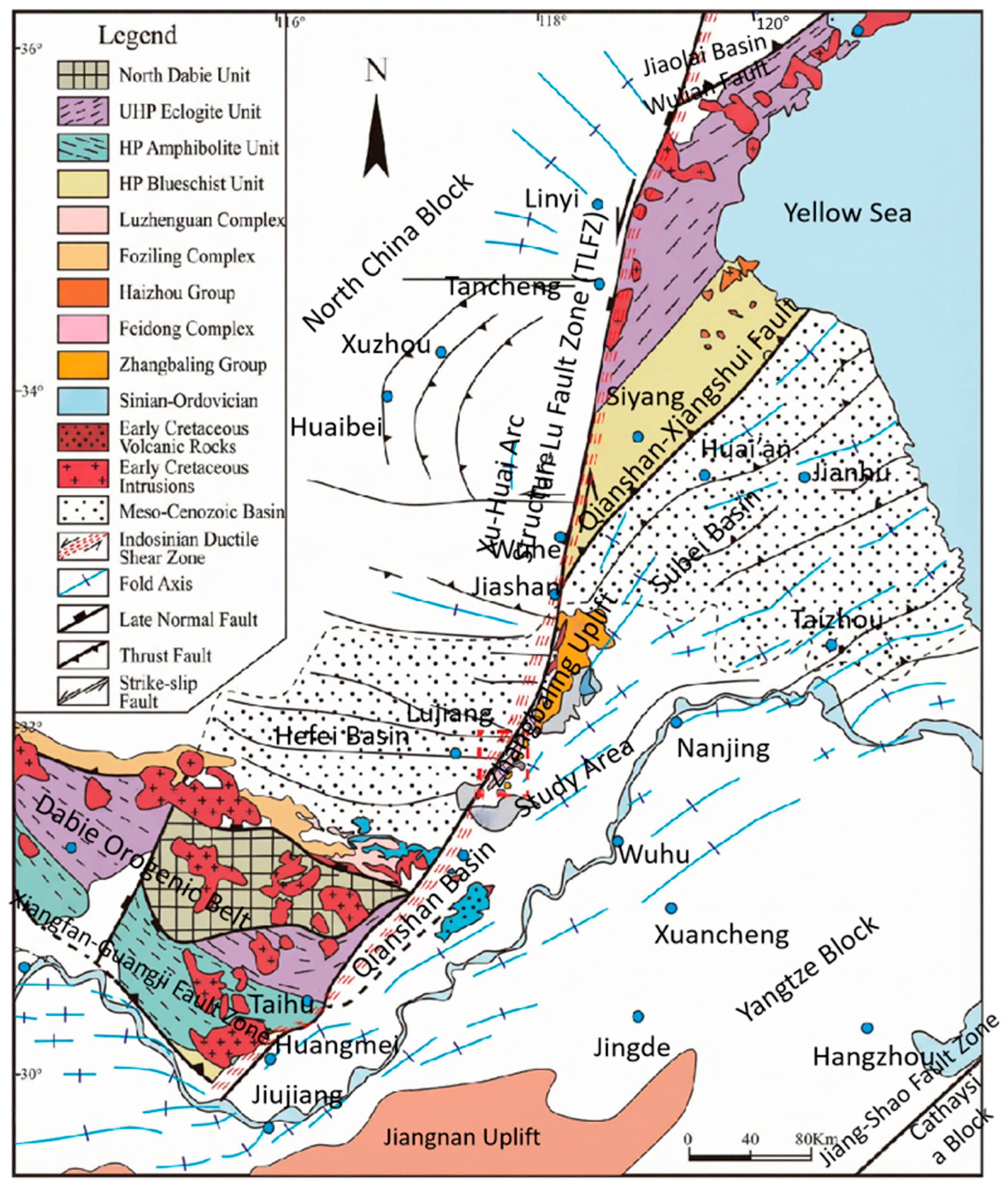
The study area is located in the Feidong segment, which constitutes the southern part of the extensive Tan-Lu Fault Zone, a major lithospheric-scale strike-slip system in East Asia [4]. As shown in the regional geological map (Figure 1), this segment is situated at the critical tectonic junction between the southeastern margin of the North China Craton (NCC) and the Dabie-Sulu Orogenic Belt. The fault zone was significantly reactivated during the Mesozoic destruction of the NCC [10]. The main geological units exposed in the region (Figure 1) include the Neoproterozoic Zhangbaling Group, the Early Cretaceous Feidong complex, and minor Cretaceous sedimentary cover. The Zhangbaling Group consists of a suite of low-to-medium grade metamorphic rocks, primarily metapelites and metapsammites (e.g., feldspathic quartz sandstone, phyllite, schist) [11]. These rocks are characterized by mineral assemblages typical of the greenschist facies, such as sericite, chlorite, epidote, and albite in the phyllites, defining a clear foliation. This indicates that the protoliths underwent a phase of low-grade regional metamorphism prior to the ductile deformation event discussed herein. The Feidong complex comprises a suite of calc-alkaline to alkaline intrusive rocks, predominantly granodiorite, quartz monzonite, and syenite. Zircon U-Pb dating indicates their emplacement ages cluster between 143–125 Ma [10], coeval with the peak regional tectono-thermal event. These rock units were collectively involved in the ductile shear deformation of the Tan-Lu Fault Zone, forming a several-kilometer-wide NNE-trending mylonite belt. Recent studies on Cretaceous extension-related magmatism in the South China Craton also indicate a regional extensional tectonic setting during this period [12,13].
Figure 1. Simplified geological map of the southern-central segment of the Tan-Lu Fault Zone (TLFZ) and adjacent areas.
To systematically decipher the deformation and metamorphic processes within this ductile shear zone, this study integrates multi-scale analytical methods.

2.1. Field Structural Analysis and Sample Collection

Building upon regional geological surveys, we conducted detailed field structural mapping along five key transects within the study area (Wenji, Yantoushan, Jiulong-Wangtie, Xiwei, Qiaotouji). We systematically measured the attitudes of structural elements such as mylonitic foliation and stretching lineation, and meticulously recorded macroscopic kinematic indicators including S-C fabrics, rotated porphyroclasts, and asymmetric folds. Based on deformation zonation and rock types, over 100 fresh, oriented samples were collected for subsequent analysis.

2.2. Microstructural Observations

Representative samples were prepared into standard thin sections (30 μm) and subjected to systematic microstructural and fabric analysis under a petrographic microscope with crossed-polarized light. Observations primarily included: mineral assemblages, type and extent of dynamic recrystallization, micro-kinematic indicators (e.g., mica fish, σ/δ-type porphyroclasts), and critical microstructures for determining deformation mechanisms (e.g., ribbon quartz, grain boundary morphology).

2.3. Quartz Grain Fractal Dimension (D-Value) Quantitative Thermometer

To provide quantitative physical constraints for the formation environment of the shear zone, we systematically employed the fractal dimension (D-value) thermometer, which is based on the geometry of dynamically recrystallized quartz grain boundaries. This microstructural method, first proposed as a geothermometer [14], was subsequently developed with experimental calibrations [15] and has been recently re-validated and recalibrated in leading geoscience journals [16,17].
Methodological Principle: The fundamental principle of this method is that during the plastic deformation of rocks, the boundaries of mineral grains (especially quartz) are not random but are a direct product of the physical conditions experienced (particularly temperature) and the dominant deformation mechanism. At relatively lower temperatures (<450–500 °C), dynamic recrystallization of quartz is primarily dominated by subgrain rotation (SGR) mechanisms, where atomic diffusion is weak, tending to form complex, serrated, and highly irregular grain boundaries. Conversely, at higher temperatures (>500 °C), atomic diffusion drastically increases, and grain boundary migration (GBM) becomes the dominant mechanism. Under this mechanism, the system drives grain boundaries to become smoother and more regular (e.g., lobate) through migration to reduce total interfacial energy. This well-established empirical negative correlation between the fractal dimension (D-value) of recrystallized quartz grain boundaries and formation temperature—that is, higher temperatures lead to smoother grain boundaries and smaller D-values—is a foundational concept confirmed from the method’s inception to the latest studies [14,17]. This complexity of geometric morphology can be quantitatively characterized by the fractal dimension (D-value). For a two-dimensional object with fractal characteristics, its perimeter (P) and area (A) follow the following scaling law:
P A D / 2
where D is the fractal dimension. A higher D-value indicates more complex and irregular grain boundaries; conversely, a lower D-value signifies smoother, simpler boundaries. Therefore, the D-value of recrystallized quartz grains acts like a geological thermometer ‘frozen’ into the rock, effectively recording the peak temperature during deformation.
Measurement and Calculation Procedure: To solve for the D-value from measured data, we applied a logarithmic transformation to the power-law relationship described above, yielding a linear equation:
log ( P ) = S   log ( A ) + C
where C is a constant, and the relationship between the slope S and the fractal dimension D is defined by the equation S = D / 2 .
We photographed microstructures that clearly displayed recrystallized quartz grain boundaries under crossed-polarized light in 62 mylonite samples with uniform deformation. Photomicrographs were taken at a resolution of 300 DPI using 10× or 20× objective lenses. Using image analysis software (ImageJ, 1.54p), these photos were converted into binary images, and automatic measurements of perimeter (P) and area (A) were performed on thousands of individual, fully recrystallized quartz grains. Subsequently, linear regression analysis of Log(P) versus Log(A) data was carried out in a double-logarithmic coordinate system for each sample. Representative LogP-LogA plots for various regions can be found in Supplementary Figures S1 and S2. The linear regression correlation coefficients (R2) for all samples were greater than 0.93, indicating a strong power-law relationship characteristic of the grain boundaries, which is a prerequisite for this analysis [15]. Based on the fitted slope of the line, the fractal dimension for each sample was precisely calculated using the relationship above-mentioned.
Data Integration and Calibration for the Study Area: The applicability of the D-value method is strongly supported by a robust body of literature, including calibrations from both experimental deformation studies [15,16] and detailed analyses of natural shear zones [14,17]. This study aimed to construct a comprehensive and unified deformation temperature field for the Feidong segment of the Tan-Lu Fault Zone. To achieve this, we integrated D-value data from a total of 62 mylonite samples from five sub-regions within the Feidong segment (Wenji, Yantoushan-Taoyuan, Jiulong-Wangtie, Xiwei, Qiaotouji). It should be noted that the D-value calculations and temperature estimations for the Wenji area (14 samples) reference our previously published detailed work [18], while data for the Yantoushan-Taoyuan area (18 samples) originated from another specialized study [19]. One of the core contributions of this research is the extension of the D-value thermometer to newly collected samples from three important areas: Jiulong-Wangtie (15 samples), Xiwei (9 samples), and Qiaotouji (6 samples). The goal through this integration of new and previously published data was to obtain a more comprehensive and representative thermal structure image for the entire Feidong segment.

3. Structural Deformation Characteristics of the Ductile Shear Zone

3.1. Macroscopic and Field Deformation

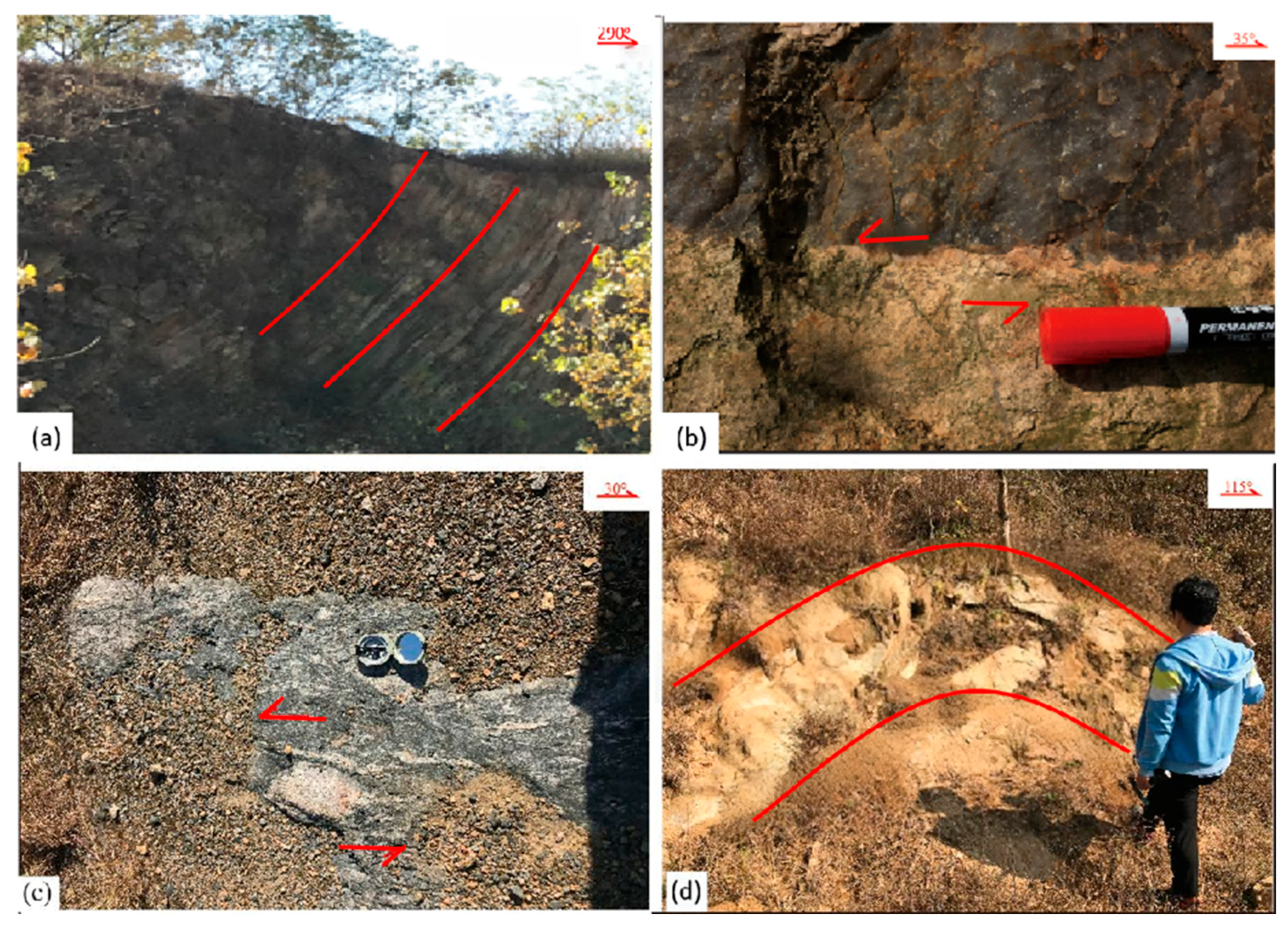
Field investigations systematically revealed the geometric and kinematic characteristics of the shear zone (Figure 2). The shear zone generally trends NNE (strike 020—35°), exhibiting a suite of strongly developed, continuous, and penetrative, steeply dipping (dip angle greater than 70°) mylonitic foliations (S-surface) (Figure 2a). This mylonitic foliation (S-surface), formed by the preferred orientation and flattening of mineral grains, represents the principal fabric developed within the high-strain zone and often lies subparallel to the shear (C-surface) planes. Its near-vertical, steep dip is a typical indicator of large strike-slip faults. Ubiquitously developed on the foliation are strip-like mineral stretching lineations, composed of elongated quartz, feldspar, and other mineral aggregates, with very gentle plunges (less than 20°), typically sub-horizontal. This combination of “steep foliation + gentle lineation” unequivocally indicates that material transport during shearing was predominantly horizontal, jointly defining the strike-slip nature of the fault’s movement.
Figure 2. Field structural characteristics of the ductile shear zone in the Feidong segment of the Tan-Lu Fault Zone. (a) Steeply dipping mylonitic foliation in the Xiwei area (red lines outline foliation). (b) Close-up view of an asymmetric porphyroclast (mica fish) with a fine-grained recrystallized tail from the Wangtie area, indicating left-lateral (top-to-the-left) shear sense. Permanent marker for scale. (c) Stretched and boudinaged or lenticular feldspar-rich quartz veins in the Xiwei area, indicating an extensional component during shearing, compass indicates lineation attitude. (d) Outcrop-scale Z-type asymmetric folds (outlined by red lines) developed in the Wangtie area, indicating left-lateral kinematics.
Abundant and clear kinematic indicators within the shear zone consistently point to left-lateral shear movement, suggesting a stable, singular kinematic history for the shear zone [20,21]. These indicators include outcrop-scale, asymmetric porphyroclasts and mica fish (Figure 2b), asymmetric Z-type folds (Figure 2d), and localized S-C fabrics. All these features reflect the relative displacement direction of material during shearing, providing reliable macroscopic evidence for left-lateral strike-slip.
Notably, field observations also revealed structures indicating an extensional component, directly corroborating the regional tensile stress regime, which aligns with the regional tectonic transition from compression to extension in the South China Block during the Mesozoic [22]. For instance, localized stretched and boudinaged or “sausage-shaped” veins (Figure 2c), as well as small normal faults and extensional quartz veins (tensile fractures), were observed. These characteristics provide direct evidence for an extensional component perpendicular to the shear direction during shearing, highlighting the compound deformation pattern of simultaneous tension accompanying strike-slip movement within the fault zone.

3.2. Microstructural Characteristics

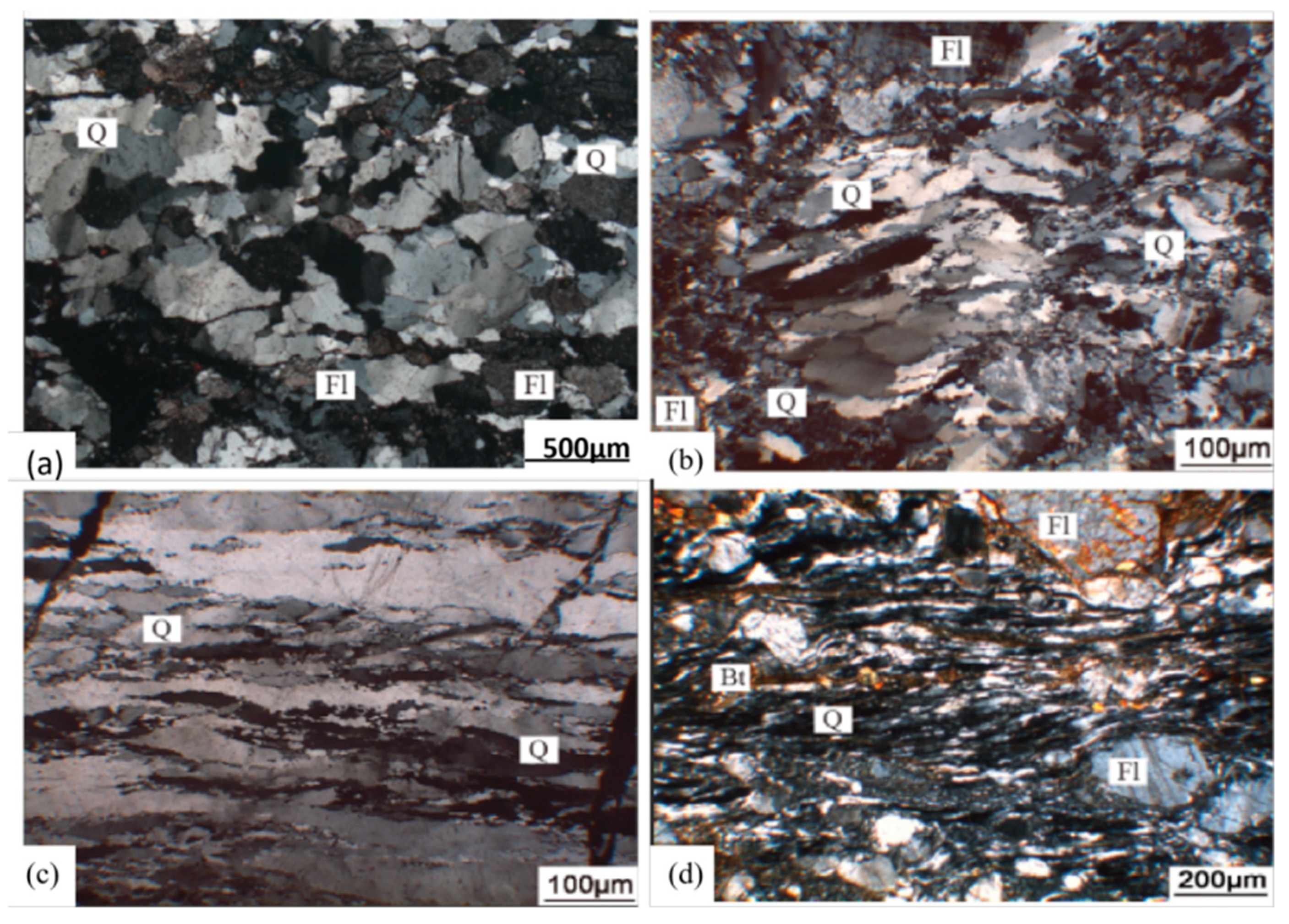
Systematic microstructural observations revealed the deformation mechanisms and physical conditions within the shear zone (Figure 3). The rocks are primarily composed of quartz, feldspar, biotite ± amphibole, exhibiting typical mylonitic textures characterized by intense grain size reduction and a strong preferred mineral orientation. Abundant micro-scale kinematic indicators are consistent with macroscopic structures, both indicating left-lateral shear. A classic example is the well-developed σ-type feldspar porphyroclast with a recrystallized quartz tail, which unequivocally indicates a top-to-the-left shear sense (Figure 3b).
Figure 3. Representative microstructures of mylonites from the Feidong segment of the Tan-Lu Fault Zone. Shear sense is top-to-the-left in all images. All photos are under crossed-polarized light (XPL). (a) Fully recrystallized quartz and feldspar aggregates showing foam-like texture with straight grain boundaries and ~120° triple junctions, indicative of high-temperature grain boundary migration (GBM). (b) A classic σ-type feldspar porphyroclast with a recrystallized quartz tail, indicating a top-to-the-left ductile shear sense. (c) Elongated quartz ribbons formed by intense plastic deformation, providing further evidence for high-temperature ductile flow. (d) Well-developed mylonitic foliation defined by the preferred orientation of mica (biotite) wrapping around feldspar porphyroclasts, characteristic of intense ductile shear.
The deformation behavior of quartz provides crucial constraints on the deformation temperature. Quartz universally experienced intense dynamic recrystallization. On the one hand, fully recrystallized quartz and feldspar aggregates exhibit a foam-like texture, characterized by straight grain boundaries and ~120° triple junctions (Figure 3a). This microstructure is indicative of high-temperature grain boundary migration (GBM), constraining the deformation temperature to >550 °C [23]. On the other hand, intense plastic deformation led to the formation of elongated quartz ribbons (Figure 3c), providing further evidence for high-temperature ductile flow.
The mylonitic foliation is well-developed and is primarily defined by the strong preferred orientation of fine-grained mica (biotite), which wraps around more rigid feldspar porphyroclasts (Figure 3d). This texture is characteristic of intense ductile shear. The overall mineral assemblage, combined with the definitive high-temperature microstructures observed in quartz (Figure 3a,c), indicates that the deformation environment reached upper greenschist to amphibolite facies conditions. This conclusion is quantitatively tested in Section 4.

4. Deformation Physical Conditions and Geochronology

4.1. Quantitative Results of Deformation Temperature

We systematically analyzed and integrated quartz grain fractal dimension (D-value) data from all five sub-regions of the Feidong segment, encompassing a total of 62 mylonite samples, to obtain quantitative data on the deformation temperature of the shear zone. The perimeter (P) and area (A) of recrystallized quartz grains in all samples exhibited excellent linear relationships on double-logarithmic plots (correlation coefficient R2 > 0.93) (see Supplementary Figures S1 and S2 for representative plots), confirming the fractal characteristics of their grain boundaries and validating the applicability of the method.
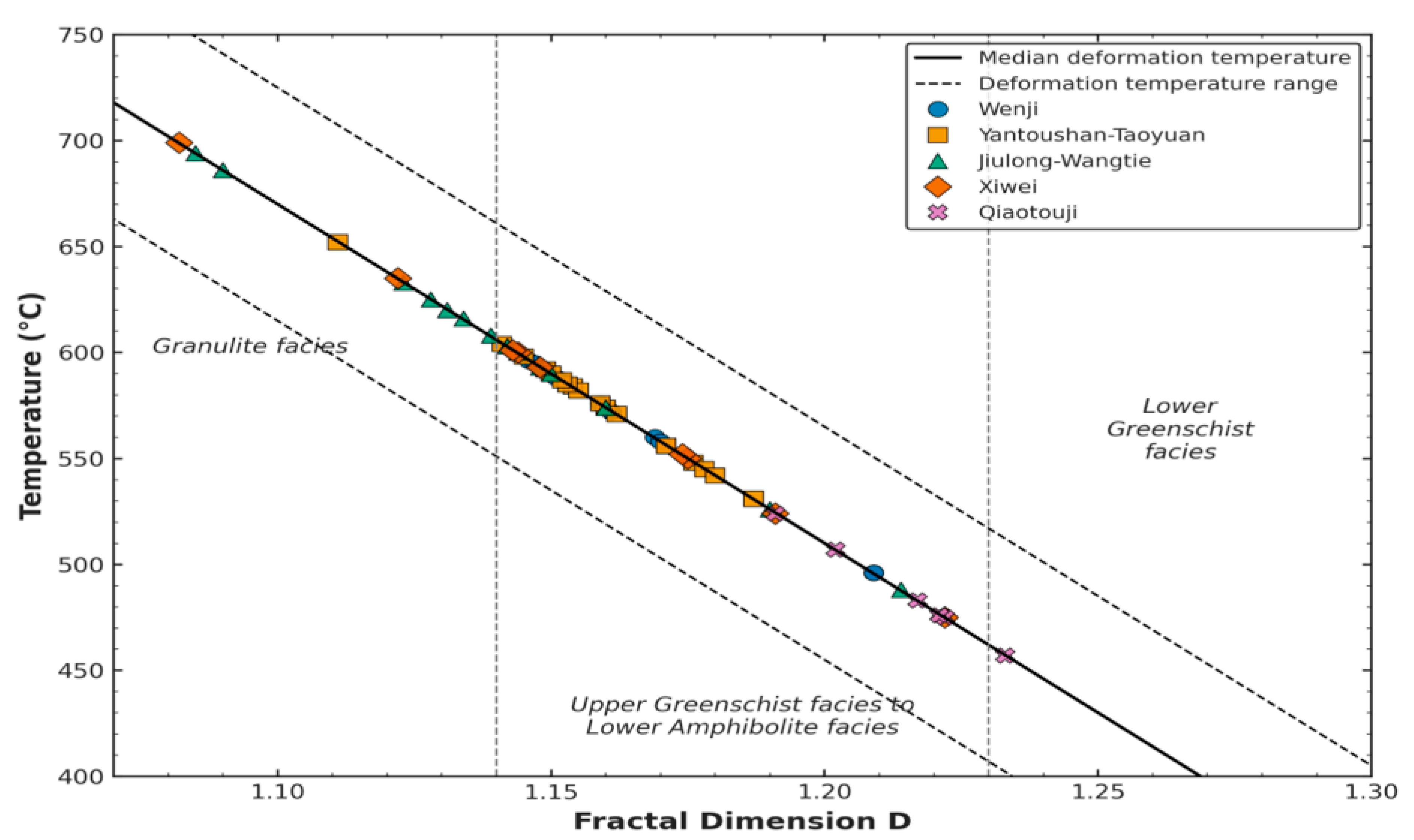
The calculated D-values for all samples ranged from 1.111 to 1.233. Lower D-values (approaching 1.0) indicate higher deformation temperatures, while higher D-values correspond to lower deformation temperatures. These D-value data were projected onto a D-value–temperature relationship diagram (Figure 4).
Figure 4. Relationship between quartz grain boundary fractal dimension (D) and deformation temperature (t) for various study areas within the Feidong segment of the Tan-Lu Fault Zone (solid line represents median, dashed lines represent error range).
Figure 4 comprehensively displays the quartz D-values and their inverted temperatures for all 62 mylonite samples from five areas within the Feidong segment: Wenji, Yantoushan-Taoyuan, Jiulong-Wangtie, Xiwei, and Qiaotouji. Different symbols and colors represent data points from different study areas, visually reflecting the temperature distribution characteristics of each area, with superimposed metamorphic facies.
The final quantitative results indicate that the ductile shear deformation in the Feidong segment of the Tan-Lu Fault Zone primarily occurred within a temperature range of ~450–700 °C. The summarized calculation results for each area (including sample count, D-value range, average D-value, and temperature range) are compiled in Table 1.
Table 1. Quartz grain boundary fractal dimension (D-value) and deformation temperature calculation results for each study area.
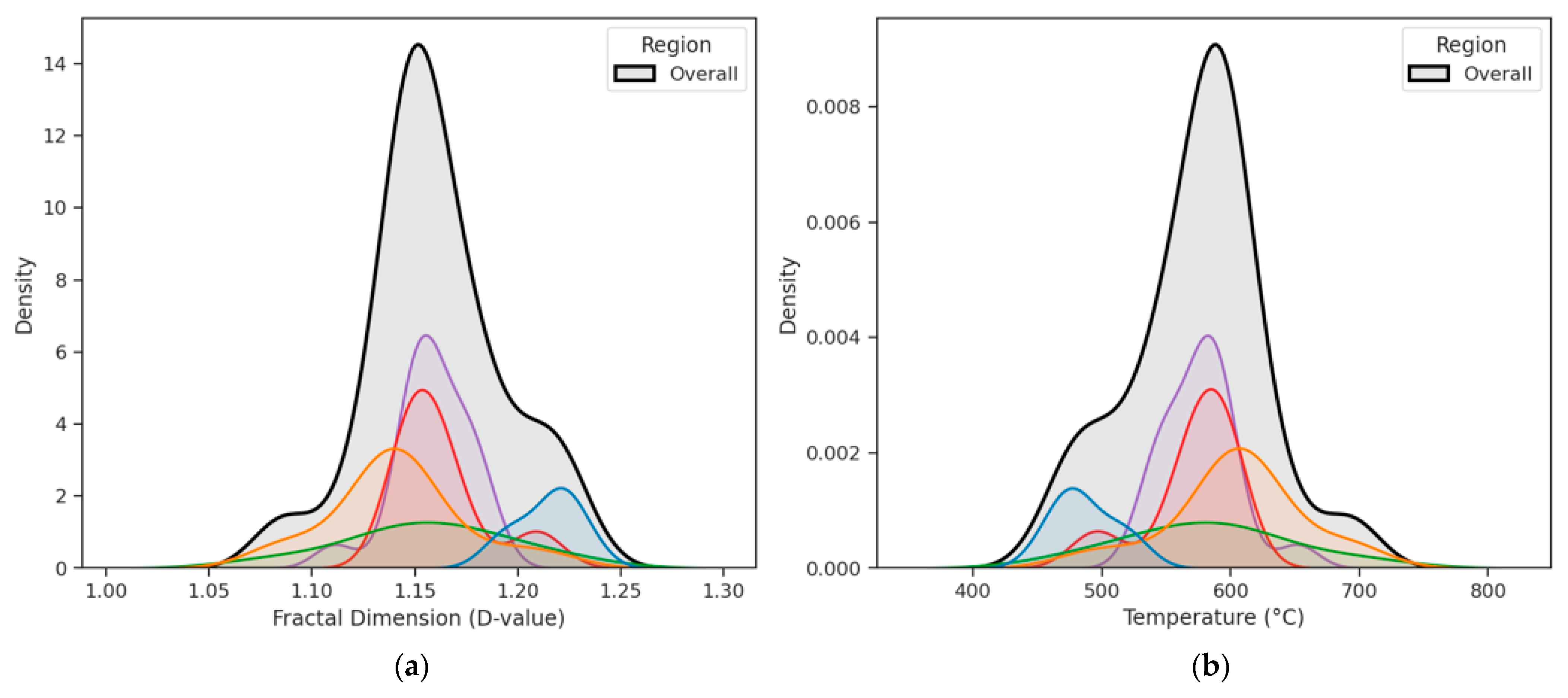
To more intuitively illustrate the deformation temperature distribution characteristics and variations across different regions and the entire Feidong segment, we plotted the probability density distribution of D-values and inverted temperatures for all samples (Figure 5). Significant differences in temperature distribution patterns were observed across regions: the Qiaotouji area’s temperatures primarily concentrated in the relatively lower temperature range of 450–525 °C, while areas like Jiulong-Wangtie and Xiwei not only showed clear peaks in the 550–630 °C range but also contained high-temperature samples extending to nearly 700 °C, vividly revealing the thermal heterogeneity within the shear zone.
Figure 5. Probability density distribution plots for (a) quartz grain boundary fractal dimension (D-value) and (b) calculated deformation temperature for all mylonite samples (n = 62) from the Feidong segment of the Tan-Lu Fault Zone.
The thick black line represents the overall distribution for all samples, while different colored thin lines represent the distributions for the five sub-regions (Wenji, Yantoushan-Taoyuan, Jiulong-Wangtie, Xiwei, Qiaotouji), demonstrating significant thermal heterogeneity within the shear zone.
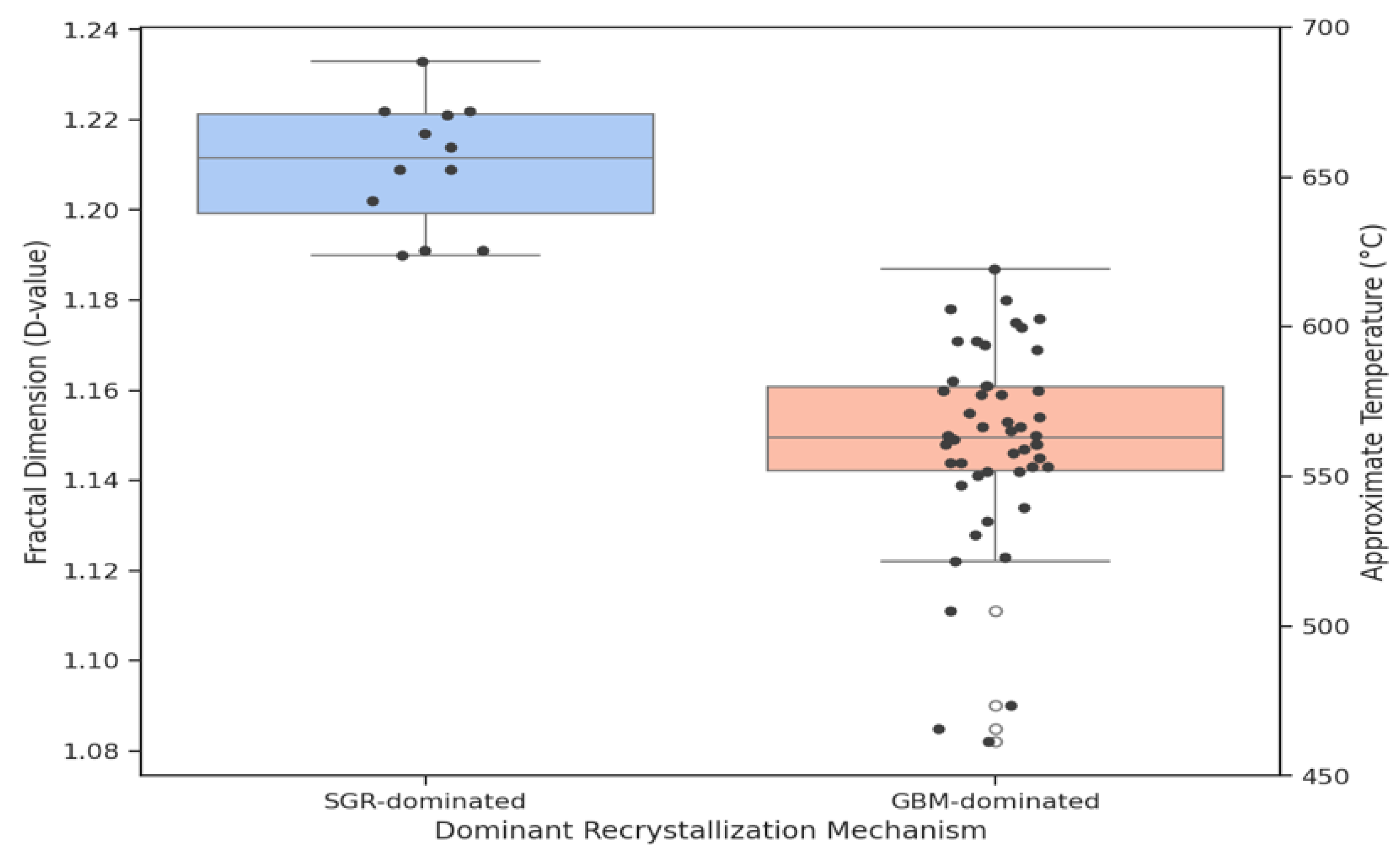
These quantitative temperature results show good consistency with microstructural observations. As shown in Figure 6, samples were divided into two groups based on whether the deformation temperature was above 530 °C (typical temperature where GBM mechanisms begin to dominate). It can be observed that samples dominated by grain boundary migration recrystallization (GBM) systematically corresponded to lower D-values (i.e., higher temperatures), while samples dominated by subgrain rotation recrystallization (SGR) corresponded to higher D-values. This clear correlation provides strong microstructural support for the applicability of the D-value thermometer in this study area.
Figure 6. Box plot of D-values versus dominant quartz dynamic recrystallization mechanisms.
Samples were divided into two groups based on calculated temperature: SGR-dominated (<530 °C) and GBM-dominated (>530 °C). The figure clearly shows that GBM-dominated samples had systematically lower D-values (corresponding to higher temperatures), validating the consistency between the D-value thermometer and microstructural observations. The right-hand Y-axis showed approximate deformation temperatures.
This high-temperature range is highly consistent with the qualitative assessment of widespread high-temperature deformation mechanisms, such as grain boundary migration recrystallization (GBM), observed in microstructures, providing solid quantitative evidence for the “hot” nature of the shear zone.
To ensure research transparency and data reproducibility, detailed quantitative results for all samples, including fractal dimension (D), linear regression correlation coefficient R, number of grains (N), and calculated temperature, for the Qiaotouji, Jiulong-Wangtie, and Xiwei areas are presented in Table 2, Table 3 and Table 4, respectively. Detailed data for all samples from the Wenji and Yantoushan-Taoyuan areas can be found in Supplementary Tables S1 and S2.
Table 2. Quartz grain boundary fractal dimension (D) and deformation temperature calculation results for mylonite samples from the Qiaotouji area.
Table 3. Quartz grain boundary fractal dimension (D) and deformation temperature calculation results for mylonite samples from the Jiulong-Wangtie area.
Table 4. Quartz grain boundary fractal dimension (D) and deformation temperature calculation results for mylonite samples from the Xiwei area.
Fractal Dimension (D) is directly derived from the slope (D = 2 m) of the linear regression on the LogP-LogA plot. Deformation temperatures were calculated from D-values based on the experimental calibration curve shown in Figure 6 of the main text.

4.2. Geochronological Framework

Precisely dating this high-temperature ductile deformation event is fundamental to discussing its dynamic background. To this end, we systematically reviewed previously published high-precision geochronological data from the region, constructing a chronological framework that fully records the entire process of this tectono-thermal event, from its initiation to peak and final cooling.
The upper age limit for the initiation of ductile deformation is constrained by the syn-tectonic intrusive Feidong complex. Numerous zircon U-Pb geochronological studies constrain its magmatic emplacement ages to 143–125 Ma [24]. Since zircons crystallize in high-temperature magmatic environments, this age represents the earliest time at which ductile shearing could have occurred.
Precise constraint on the peak deformation timing comes from 40Ar/39Ar thermochronological data from amphibole in the mylonites. Amphibole plateau ages cluster around ~134 Ma [24]. This age records the moment rocks cooled through the closure temperature of the amphibole Ar isotope system (~500–550 °C). Crucially, this closure temperature range aligns perfectly with the lower bound of the ductile deformation temperature range (~450–700 °C) that was independently calculated using our quartz D-value thermometer, and is consistent with our widespread microstructural observations of grain boundary migration (GBM), a process that becomes dominant above ~530 °C. This powerful synergy, where microstructurally derived temperature estimates are locked in time by thermochronology, provides a robust anchor for our tectonic model. It reveals a vital geological process: after experiencing peak high-temperature deformation, the rocks did not remain at high temperatures for long but were immediately followed by a rapid tectonic uplift and cooling process [25,26]. This rapid cooling significantly reduced the time gap between peak deformation and the closure of the amphibole isotopic system. Therefore, the ~134 Ma amphibole cooling age can be considered a high-fidelity proxy that closely approximates the actual peak deformation age.
40Ar/39Ar age data from biotite in the mylonites provide a lower age limit for the final cooling of the entire tectono-thermal event. Ages ranging from 135–125 Ma record a later stage of the rock’s cooling history, specifically the time it passed through the lower closure temperature of biotite (~300–350 °C), marking the effective end of thermal perturbation in this region. Comprehensive analysis of Tan-Lu Fault Zone thermochronological data also confirms a rapid Early Cretaceous cooling event [27].
In summary, this complete chain of evidence—comprising zircon U-Pb ages (upper limit), amphibole 40Ar/39Ar ages (peak), and biotite 40Ar/39Ar ages (lower limit)—collectively points to a clear and rigorous conclusion: the high-temperature ductile shear event in the Feidong segment of the Tan-Lu Fault Zone primarily occurred during the Early Cretaceous, between 143–125 Ma, with its peak deformation precisely anchored around ~134 Ma.

5. Discussion: A Unified Early Cretaceous Transtensional Dynamic Model

5.1. A Thermally Constrained Transtensional Regime

The most critical finding of this study is that the left-lateral strike-slip shearing in the Feidong segment of the Tan-Lu Fault Zone during the Early Cretaceous did not occur within a conventional or cold lithospheric setting but was rather a “hot” event intimately coupled with high-temperature metamorphism and extensive magmatic activity. The deformation temperatures of ~450–700 °C quantitatively obtained through the quartz D-value thermometer, combined with typical continental crustal deformation depths (approx. 15–20 km) and average surface temperatures (approx. 0–20 °C), allow us to infer an elevated geothermal gradient (>30–35 °C/km) in this region during deformation. In the absence of contemporaneous evidence for crustal thickening, such high heat flow cannot be explained by simple tectonic burial. Furthermore, while shear heating can lead to localized temperature increases in certain extreme cases, driving such widespread and sustained high-temperature ductile deformation typically requires extremely high strain rates and shear stresses, and is difficult to maintain over long periods, which is inconsistent with the regional geological context and continuous activity characteristics of this fault zone.
Therefore, the only reasonable explanation is regional lithospheric extensional thinning, which induced the upwelling of underlying asthenospheric mantle and large-scale magmatic underplating and heating. This constructs a clear dynamic causal chain: regional extension created conditions and pathways for mantle heat input; massive mantle heat input led to an abnormally high geothermal gradient; and the fault zone then underwent intense ductile shear deformation within this high-temperature environment [28,29]. This logical chain fully demonstrates that strike-slip movement and extension were two inseparable aspects of the same dynamic system within the Early Cretaceous Tan-Lu Fault Zone. Its active regime was a typical transtensional regime, and its characteristic high-temperature ductile shearing was the inevitable result of highly concentrated heat flow and strain within a regional extensional setting [30].

5.2. Thermal Heterogeneity Within the Shear Zone and Local Controlling Factors

Having established the left-lateral kinematics of the shear zone from structural evidence, we now turn to its thermal regime. The calculated temperatures not only provide the physical conditions for this deformation but also reveal a complex thermal landscape, which is crucial for understanding the underlying geodynamic drivers. Although the Feidong segment of the Tan-Lu Fault Zone as a whole exhibits a high-temperature transtensional regime, this is clearly evident from the differentiated statistical results for each region (Table 1) and the temperature distribution patterns (Figure 4). For instance, the average D-value for the Qiaotouji area (~1.215) is significantly higher than that for Jiulong-Wangtie (~1.155) and Yantoushan-Taoyuan (~1.159) areas (Table 1), indicating relatively lower deformation temperatures. Such regional variability likely reflects local differences in geological conditions within the fault zone during the Late Mesozoic transtensional process.
This thermal heterogeneity could be controlled by a combination of factors:
Differential Exhumation Depth: Areas with lower D-values (higher temperatures), such as Jiulong-Wangtie, might represent deeper deformation levels exposed by later uplift and exhumation. Conversely, areas with higher D-values (lower temperatures), such as Qiaotouji, could correspond to shallower exhumed portions. This differential exhumation pattern might be related to local bends, splay faults, or strain partitioning within the fault zone leading to differential uplift.
Degree of Strain Concentration: Within a transtensional regime, strain is not uniformly distributed throughout the fault zone. Enhanced heat generation effects in areas of localized strain concentration (e.g., due to frictional heating or increased viscous dissipation) could lead to elevated temperatures, forming “hot spots” with lower D-values. For example, in pull-apart basins or en echelon structures within the fault zone, extensional stresses might lead to more intense strain localization, thereby inducing higher heat flow.
Local Heat Flow Input or Magmatic Activity: Higher temperatures in localized areas (e.g., Jiulong-Wangtie) might be associated with closer proximity to or larger scale of contemporaneous (Early Cretaceous) magmatic intrusion. Magmatic underplating or intrusion can significantly elevate the local geothermal gradient, providing an additional heat source for high-temperature deformation in that part of the fault zone. Coupled with the widespread distribution of the Feidong complex in the Feidong segment, such local thermal perturbations are a plausible explanation.
Protolith Properties or Fluid Activity: While this study primarily focused on mylonites, subtle differences in protolith or localized activity of fluids (especially aqueous fluids) during deformation could also influence quartz recrystallization behavior and D-values. However, considering that the D-value thermometer primarily reflects temperature effects, these factors are usually secondary.
Collectively, these regional variations in thermal structure provide new clues for a deeper understanding of the internal dynamic partitioning and thermal evolution processes of the Tan-Lu Fault Zone within a Late Mesozoic transtensional setting. Future research could further constrain the origins of these local differences through more detailed geochemical, isotopic geochronological, and thermal modeling to construct a more refined thermal structure model of the fault zone.
The significant temperature range observed within a single area, such as the Xiwei area (~475–699 °C), can be explained by these same controlling factors operating at a more localized scale. For instance, the highest temperatures (~699 °C) may represent samples collected from the core of a highly strained shear band or from locations immediately adjacent to a syn-tectonic magmatic dike, where both strain heating and magmatic heat were most intense. Conversely, the lower temperatures (~475 °C) could reflect samples from the margins of the shear zone or from blocks that experienced less strain and were further from heat sources, thus preserving a cooler thermal signature. This intra-regional thermal variability underscores the complex and localized nature of heat and strain distribution even within a single segment of the fault zone. Crucially, the timing of this high-temperature event, constrained by regional geochronology to the Early Cretaceous, allows us to place this complex thermal-kinematic framework into the larger context of Paleo-Pacific plate subduction, which will be discussed next.

5.3. Dynamic Background: Paleo-Pacific Plate Subduction and Rollback

As established above, the Tan-Lu fault zone experienced high-temperature, left-lateral shearing during the Early Cretaceous. The Early Cretaceous tectonic evolution of East Asia was entirely controlled by the subduction of the Paleo-Pacific (or Izanagi) plate. We propose that the transtensional regime revealed in this study is a direct manifestation of the “dual effect” of this plate subduction process in the continental interior [24].
On the one hand, the oblique subduction of the Paleo-Pacific plate beneath the Eurasian continent generated a significant shear stress component within the continental interior. This reactivated the Tan-Lu Fault Zone, a pre-existing lithospheric weak zone, leading to intense left-lateral strike-slip movement. This explains all kinematic evidence observed at both macroscopic and microscopic scales [31]. On the other hand, the rollback of the subducting plate itself triggered strong extension in the back-arc region of the continental margin. This extension resulted in lithospheric thinning and asthenospheric upwelling, providing the fundamental driving force for the high-temperature deformation and large-scale contemporaneous magmatic activity we observed [12,13].Therefore, the strike-slip and extensional activities of the Tan-Lu Fault Zone are not merely a coincidental superposition of two independent mechanisms but rather a product of the synergistic effects of oblique subduction and slab rollback of the Paleo-Pacific plate, tightly coupling the regional tectonic stress field and heat flow background in space and time. This ultimately formed the “hot” transtensional regime and associated high-temperature ductile shear zone that we have revealed. It is not only a critical evolutionary history of the Tan-Lu Fault Zone itself but also one of the core tectonic expressions of the major geological event of Early Cretaceous lithospheric destruction and craton modification in eastern China [24].

5.4. Broader Implications for Continental Tectonics Research

Beyond revealing the regional evolution of the Tan-Lu Fault Zone, the findings of this study have broader implications for understanding continental tectonic deformation.
Firstly, this research demonstrates the immense potential of the quartz D-value thermometer as a powerful tool for deciphering the thermal structure of ancient fault zones. This quantitative analysis, based on micro-geometric morphology, provides a more universal and reliable approach to obtaining temperature information from ductile shear zones, capable of offering solid data for testing and refining crustal rheological models and thermomechanical simulations [28,30].
Secondly, the “hot” transtensional model confirmed in this paper may represent a common mode of intracontinental deformation in extensional settings. In many continental rifts or extensional provinces globally, large strike-slip fault systems also play a crucial role in accommodating regional strain. Our results suggest that these major faults are not isolated structures but should be viewed as integral components of the entire extensional system, likely serving as preferential conduits for the upward migration of deep heat flow and magmatic material.
Finally, this study provides direct evidence for establishing connections between shallow crustal tectonics and deep Earth processes. The deformation temperatures of ~450–700 °C recorded within the fault zone are direct “imprints” of deep mantle–lithosphere interaction at the Earth’s surface. This clearly indicates that through precise analysis of physicochemical records in surface fault zones, we can effectively constrain and invert lithosphere-scale deep geodynamic processes.

6. Conclusions

This study, through a multi-scale, multi-method integrated dissection of the Feidong segment of the Tan-Lu Fault Zone, precisely constrains its Late Mesozoic tectonic deformation patterns and physical conditions, and offers new insights into its dynamic mechanisms. We draw the following key conclusions:
(1)
The Feidong segment of the Tan-Lu Fault Zone experienced intense left-lateral ductile shear deformation during the Early Cretaceous (approx. 140–120 Ma). Macroscopic and microscopic kinematic indicators, such as σ-type rotated porphyroclasts and asymmetric Z-folds, consistently indicate continuous and stable left-lateral shear movement.
(2)
This is a typical “hot” shear zone, with deformation occurring in a high-temperature environment. We systematically applied the quartz grain boundary fractal dimension (D-value) thermometer for the first time to quantitatively estimate the peak temperature of this ductile deformation event at ~450–700 °C, corresponding to high-grade greenschist to amphibolite facies metamorphic conditions. This result is highly consistent with high-temperature deformation mechanisms, such as grain boundary migration recrystallization, observed in microstructures.
(3)
High-temperature deformation, large-scale coeval magmatic activity, and field-identified extensional structures collectively point to a transtensional tectonic regime. This regime is not a simple strike-slip or extensional one but rather a tight spatio-temporal coupling of both, representing a composite deformation mode where the lithosphere undergoes simultaneous tension under left-lateral shear.
(4)
This transtensional regime is a product of the “dual effect” of the Paleo-Pacific plate subduction process. The oblique subduction of the Paleo-Pacific plate provided the left-lateral strike-slip component, while the rollback of the subducting slab induced back-arc extension and mantle thermal upwelling, providing the high-temperature background and extensional component.
(5)
This study carries significant broader implications. The “hot” transtensional model revealed here may represent a common mode of deformation in continental extensional settings, where large strike-slip faults act as primary conduits for strain and heat. Furthermore, our work provides a direct bridge between surface geological records and deep geodynamic processes, demonstrating that quantitative analysis of crustal shear zones can effectively constrain lithosphere-scale tectonics and craton destruction.
(6)
The current geochronological framework is based on regional data, and the thermal model awaits quantitative numerical validation. Future research should therefore focus on: (a) conducting in situ dating on the mylonites to precisely constrain the timing of deformation; (b) performing thermomechanical modeling to test the physical viability of the “hot” transtensional model; and (c) applying complementary geothermometers to construct a more robust 3D thermal model of the fault zone.

Supplementary Materials

The following supporting information can be downloaded at: https://www.mdpi.com/article/10.3390/app152412994/s1, Figure S1: LogP-LogA plots for quartz grains from the Wenji and Yantoushan-Taoyuan areas; Figure S2: LogP-LogA plots for quartz grains from the Qiaotouji, Jiulong-Wangtie, and Xiwei areas; Table S1: Fractal dimension (D) and estimated deformation temperatures for samples from the Wenji area; Table S2: Fractal dimension (D) and estimated deformation temperatures for samples from the Yantoushan-Taoyuan areas.

Author Contributions

Conceptualization, F.Y. and C.S.; methodology, F.Y. and C.S.; validation, F.Y. and C.S.; formal analysis, F.Y.; investigation, F.Y. and C.S.; data curation, F.Y.; writing—original draft preparation, F.Y.; writing—review and editing, C.S. and F.Y.; supervision, C.S.; funding acquisition, F.Y. and C.S. All authors have read and agreed to the published version of the manuscript.

Funding

1. The Key Talent Project of Xinjiang Talent Development Fund—Tianchi Talent Introduction Program (2023XGYTCYC03) from Fang Yuan. 2. The Xinjiang Institute of Engineering doctoral start-up funding (2023XGYBQJ07) from Fang Yuan. 3. The National Natural Science Foundation of China (41272222) from Chuanzhong Song. 4. The Welfare Geological Projects in Anhui Province (2016-g-4) from Chuanzhong Song.

Institutional Review Board Statement

Not applicable.

Data Availability Statement

The original data of this study can be obtained from the corresponding author upon reasonable request.

Conflicts of Interest

The authors declare no conflicts of interest.

References

  1. Tomassi, A.; Falegnami, A.; Romano, E. Unveiling simplexity: A new paradigm for understanding complex adaptive systems and driving technological innovation. Innovation 2025, 6, 100954. [Google Scholar] [CrossRef]
  2. Zhu, R.X.; Zheng, T.Y. Destruction of the North China Craton. Sci. China Earth Sci. 2009, 52, 129–149. [Google Scholar] [CrossRef]
  3. Zhu, R.; Chen, L.; Wu, F.; Liu, J. Timing, scale and mechanism of the destruction of the North China Craton. Sci. China Earth Sci. 2011, 54, 789–797. [Google Scholar] [CrossRef]
  4. Zhang, Y. Mesozoic tectonic evolution history of the Tan-Lu fault zone, China: Advances and new understanding. Geol. Bull. China 2008, 27, 1371, (In Chinese with English Abstract). [Google Scholar]
  5. Zhu, G.; Wang, Y.; Liu, G.; Niu, M.; Xie, C.; Li, C. 40Ar/39Ar dating of strike-slip motion on the Tan-Lu fault zone, East China. J. Struct. Geol. 2005, 27, 1379–1398. [Google Scholar] [CrossRef]
  6. Zhu, G.; Niu, M.; Xie, C.; Wang, Y. Sinistral to normal faulting along the Tan-Lu fault zone: Evidence for geodynamic switching of the East China continental margin. J. Geol. 2010, 118, 277–293. [Google Scholar] [CrossRef]
  7. Zhou, N.N.; Song, M.C.; Wang, Y.B.; Chen, W.Y. Electromagnetic Insights into the New Structural-fluid Joint Controlling Model for gold Deposits in North China Craton. Appl. Geophys. 2025, 1–15. [Google Scholar] [CrossRef]
  8. Hu, B.; Zhang, D.; Zhang, X.; Zhang, Z.; Wang, S.; Hu, J. Identification of Baihesi aluminous A-type granite: Magmatic response to the onset of Cretaceous extension in eastern Jiangnan Massif, South China. Front. Earth Sci. 2023, 11, 1085767. [Google Scholar] [CrossRef]
  9. Li, W.; Meng, M.; Zhang, T.; Chen, X.; Liu, Y.; Wang, D.; Niu, C. New Insights into the Distribution and Evolution of WNW-Directed Faults in the Liaodong Bay Subbasin of the Bohai Bay Basin, Eastern China. Front. Earth Sci. 2022, 9, 763050. [Google Scholar] [CrossRef]
  10. Chen, S.; Li, J.; Yuan, F.; Deng, Y.; Zhang, D.; Li, X.; Jiang, R. Deformation history of the feidong segment of the tan–lu fault zone in the early cretaceous: Implications for the tectonic evolution in Eastern China. Geol. J. 2022, 57, 3668–3685. [Google Scholar] [CrossRef]
  11. Yuan, X.; Niu, M.; Cai, Q.; Zhu, G.; Wu, Q.; Li, X.; Li, C. The implication of two episodic Precambrian supercontinents convergence events from enriched mantle beneath the Yangtze Block: Constraints from the Zhangbaling mafic rocks. Precambrian Res. 2022, 371, 106561. [Google Scholar] [CrossRef]
  12. Wei, W.; Lin, W.; Chen, Y.; Faure, M.; Ji, W.; Hou, Q.; Wang, Q. Tectonic controls on magmatic tempo in an active continental margin: Insights from the Early Cretaceous syn–tectonic magmatism in the Changle–Nan’ao Belt, South China. J. Geophys. Res. Solid Earth 2023, 128, e2022JB025973. [Google Scholar] [CrossRef]
  13. Cao, X.; Flament, N.; Li, S.; Müller, R.D. Spatio-temporal evolution and dynamic origin of Jurassic-Cretaceous magmatism in the South China Block. Earth-Sci. Rev. 2021, 217, 103605. [Google Scholar] [CrossRef]
  14. Kruhl, J.H.; Nega, M. The fractal shape of sutured quartz grain boundaries: Application as a geothermometer. Geol. Rundsch. 1996, 85, 38–43. [Google Scholar] [CrossRef]
  15. Takahashi, M.; Nagahama, H.; Masuda, T.; Fujimura, A. Fractal analysis of experimentally, dynamically recrystallized quartz grains and its possible application as a strain rate meter. J. Struct. Geol. 1998, 20, 269–275. [Google Scholar] [CrossRef]
  16. Johnson, S.E.; Song, W.J.; Anderson, E.K.; Gerbi, C.C.; Vel, S.S.; Prior, D.J.; Stipp, M. EBSD–based calibration of differential stress from experimentally deformed Black Hills quartzite using the perimeter–area fractal dimension. J. Geophys. Res. Solid Earth 2025, 130, e2024JB030866. [Google Scholar] [CrossRef]
  17. Anderson, E.K.; Song, W.J.; Johnson, S.E.; Gerbi, C.C. Strain rates recorded in the perimeter-area relationship of recrystallized quartz aggregates from the Sandhill Corner shear zone, Maine, USA. J. Struct. Geol. 2025, 191, 105330. [Google Scholar] [CrossRef]
  18. Yuan, F.; Song, C.Z.; Lin, S.F.; Shi, Y.H.; Li, J.H.; Li, Z.W.; Wang, W.; Wang, Y.Y. Analysis of the tectonite types and tectonic deformations of Wenji area in the northern Feidong part of the Tan-Lu Fault Zone. Acta Petrol. Sin. 2020, 36, 601–620. (In Chinese) [Google Scholar] [CrossRef]
  19. Yuan, F.; Song, C.; Lin, S.; Li, J.; Li, Z.; Wang, Y.; Li, Z.; Chen, S. Study on the structural deformation characteristics of Yantou Mountain and Taoyuan area in Feidong section of Tanlu fault zone. Chin. J. Geol. 2020, 55, 109–121. (In Chinese) [Google Scholar] [CrossRef]
  20. Zheng, Y.D.; Zhang, J.J.; Zhang, B. Two pillar theories of structural geology in the new century: The MEM criterion and the deformation partitioning. J. Geomech. 2022, 28, 319–337. [Google Scholar] [CrossRef]
  21. Liu, M.; Zhang, B.; Li, H.; Ma, X. Structural Characteristics of E–W-Trending Shear Belts in the Northern Qilian Orogenic Belt, NW China. Minerals 2021, 14, 1205. [Google Scholar] [CrossRef]
  22. Yang, F.; Song, C.; Ren, S.; Ji, M. The mesozoic tectonic transition from compression to extension in the South China block: Insight from structural deformation of the lushan massif, SE China. Minerals 2022, 12, 1531. [Google Scholar] [CrossRef]
  23. Hirth, G.; Tullis, J.A.N. Dislocation creep regimes in quartz aggregates. J. Struct. Geol. 1992, 14, 145–159. [Google Scholar] [CrossRef]
  24. Zhu, G.; Liu, C.; Gu, C.C.; Zhang, S.; Li, Y.J.; Su, N.; Xiao, S.Y. Oceanic plate subduction history in the western Pacific Ocean: Constraint from late Mesozoic evolution of the Tan-Lu Fault Zone. Sci. China Earth Sci. 2018, 61, 386–405. (In Chinese) [Google Scholar] [CrossRef]
  25. Liu, C.; Li, G.; Liu, F. Early Cretaceous–Cenozoic Exhumation history of Luxi Terrane and adjacent areas, Eastern North China Craton. Geol. J. 2022, 57, 2735–2748. [Google Scholar] [CrossRef]
  26. Chen, B.; Deng, J.; Ji, X. Time Limit of Gold Mineralization in Muping–Rushan Belt, Eastern Jiaodong Peninsula, China: Evidence from Muscovite Ar–Ar Dating. Minerals 2022, 12, 278. [Google Scholar] [CrossRef]
  27. Qiu, E.; Zhang, Y.; Larson, K.P.; Li, B. Dating strike–slip ductile shear through combined zircon–, titanite–and apatite U–pb geochronology along the Southern tan–lu fault zone, East China. Tectonics 2023, 42, e2022TC007734. [Google Scholar] [CrossRef]
  28. Hou, J.; Pan, J.; Li, Y.; Li, H. Crustal S-wave velocity structure in the western and central North China Craton and its geological significance. Chin. J. Geophys. 2023, 66, 1960–1975. [Google Scholar] [CrossRef]
  29. Chen, A.L.; Chen, X. Origin of the Bohai Sea Basin, North China Craton, and implications for bidirectional back-arc extension in the East Asian continental margin. Solid Earth 2025, 16, 63–80. [Google Scholar] [CrossRef]
  30. Dong, S.; Zhang, Y.; Li, H.; Chen, X. The Yanshan Orogeny and Late Mesozoic Multi-plate Convergence in East Asia—Commemorating 90th Years of the “Yanshan Orogeny”. Sci. China Earth Sci. 2018, 61, 1888–1909. [Google Scholar] [CrossRef]
  31. Zhao, Q.; Fan, X.; He, Y.; Zheng, L.; Sun, Y. Upper mantle velocity and its dynamic significance in the middle-southern segment of the Tan-Lu fault zone. Tectonophysics 2021, 804, 228771. [Google Scholar] [CrossRef]
Disclaimer/Publisher’s Note: The statements, opinions and data contained in all publications are solely those of the individual author(s) and contributor(s) and not of MDPI and/or the editor(s). MDPI and/or the editor(s) disclaim responsibility for any injury to people or property resulting from any ideas, methods, instructions or products referred to in the content.

Article Metrics

Citations

Article Access Statistics

Article metric data becomes available approximately 24 hours after publication online.