1. Introduction
In recent years, there has been a rise in chemical accidents, necessitating effective risk assessments and informed decision-making by personnel in affected areas to reduce losses. Dynamic simulations of toxic gas dispersion and predictions of their spread are vital for assessing the risks associated with gas leaks.
Accurate information regarding the location and intensity of gas sources is essential for forecasting the dispersion patterns of hazardous gases. The precision of gas sensors has significantly improved in recent years, leading most research to rely on these advanced sensors. Gas source localization methods using these sensors can be divided into two categories: static sensor networks for source estimation and mobile sensors for source tracking. Static sensor networks involve strategically placing multiple sensors in a predetermined arrangement, while mobile sensors typically include robots or drones equipped with gas sensors. This paper specifically examines gas source localization algorithms that utilize static sensor networks.
Researchers are increasingly applying machine learning and deep learning techniques for gas source localization within static sensor networks. The machine-learning and deep-learning approaches for source localization (e.g., SVDD, DNN, CNN-LSTM) have demonstrated remarkable accuracy in specific, well-defined scenarios. Their primary strength lies in their ability to learn complex, non-linear dispersion patterns directly from data. However, as we now emphasize more clearly, their major limitations are a strong dependence on extensive prior data for training and significant computational demands that can hinder time-critical decision-making in emergency scenarios. These approaches may struggle to generalize in situations not represented in their training sets, which is a critical shortcoming for real-world leak incidents where conditions are highly variable and data is scarce. In 2016, Mahfouz et al. [
1] integrated machine learning algorithms into gas source localization using the Support Vector Data Description (SVDD) method, achieving a localization error of 0.32 in a scenario with 1% noise. In 2018, Cho et al. [
2] utilized Deep Neural Networks (DNN) and Random Forest (RF) for gas source localization, reaching maximum test accuracies of 75.53% and 86.33%, respectively. That same year, Bilgera et al. [
3] conducted outdoor gas source tracing experiments with ethanol and 30 sensors, processing the data with four different neural network architectures, where CNN-LSTM achieved a prediction accuracy of 95.0%, LSTM 85.0%, CNN-DNN 90.0%, and DNN 91.1%. In 2019, Hyunseung Kim et al. [
4] simulated a factory chemical leak scenario using data from virtual sensors, with LSTM-RNN achieving a test accuracy of 97.08%. In 2020, Zhang et al. [
5] proposed a joint estimation algorithm based on variational Bayesian inference methods to address the joint distribution estimation of gas distribution states and unknown source parameters in complex environments with nonlinear gas dispersion. In 2023, Oliveira, AM et al. [
6] proposed the solution in this article uses an odor source identification strategy, employing a gas distribution mapping approach in a three-dimensional environment. In 2024, Zhao, Z.J., et al. [
7] presents a comprehensive review of the application of coupled CFD-DEM methods in fluidized beds and identifies the issues that need to be addressed. The detailed analysis is summarized mainly from the definition of particle flow system, DEM modeling theory (particle-fluid interaction and integration scheme of particle motion information, etc.), CFD modeling theory (discussion of turbulence model) and CFD-DEM coupled mapping methods (including Unresolved CFD-DEM and Resolved CFD-DEM).
However, it is crucial to recognize that these machine learning and deep learning approaches may not be effective in scenarios with limited prior data and where urgent decision-making is required. In such cases, swarm intelligence algorithms present a promising alternative, and many experts have conducted extensive research in this field. The physics-based and swarm-intelligence optimization methods (e.g., Genetic Algorithms, Particle Swarm Optimization, Grey Wolf Optimization) do not require pre-training. They work by directly minimizing the difference between sensor measurements and the predictions of a physical dispersion model (like the Gaussian puff model). Their main advantage is adaptability to real-time sensor inputs. However, their limitations, which we have more explicitly outlined, include a tendency to get trapped in local optima, dependence on the selection of initial values, and typically poorer performance in higher-dimensional search spaces (e.g., 3D environments).
In 2007, Allen et al. [
8] utilized a genetic algorithm based on the Gaussian plume dispersion model to forecast surface wind direction, two-dimensional gas source location, and source intensity, achieving good results when the sensor array covered at least an 8 × 8 area. In 2014, Cao et al. [
9] introduced a distributed least-squares estimation technique for gas source localization using a gas turbulent dispersion model, which simulation tests indicated could effectively mitigate local negative interference. In 2018, Ma et al. [
10] evaluated particle swarm optimization, ant colony optimization, and the firefly algorithm, presenting a new model called Concentration Matching Correlation Distribution (CMCD) to enhance computational efficiency when only positional parameters were required. That same year, Ma et al. [
11] developed a gas source localization method based on Optimal Concentration Matching Correlation Distribution (OCMCD) to lessen the effects of source intensity information and environmental noise, performing well with noise levels below 30%. In 2019, Ma et al. [
12] proposed an active group generation strategy and introduced a new Active Firefly Algorithm (AFA), which improved computational efficiency by over 10 times and achieved greater accuracy compared to the Fireworks Algorithm (FA) and Particle Swarm Optimization (PSO) when the number of effective sensors exceeded 20. In 2022, Liu et al. [
13] integrated the Grey Wolf Optimization algorithm into gas source localization and adjusted the Gaussian plume dispersion model, resulting in low errors in the X, Y, and Q directions. In 2024, Wang, Y et al. [
14] adopts role-oriented modeling paradigm to make up for the defects of binary grey wolf optimizer such as premature, declining diversity, and insufficient convergence, then comes up with novel V-shaped linear transfer functions. In 2025, Wang, YF; Yin, YM, et al. [
15] propose a novel feature selection algorithm called grey wolf optimizer with self-repulsion strategy (GWO-SRS). In GWO-SRS, the hierarchical structure of the wolf pack is flattened to enable rapid transmission of commands from the alpha wolf to each member, thereby accelerating convergence.
However, these algorithms each have specific applicability, leading to certain limitations; some depend on the selection of initial values, while others may become trapped in local optima [
16,
17,
18,
19]. Furthermore, they typically assume that the gas source is located on the ground. Thus, there is a need for an algorithm that is suitable for higher-dimensional computations and possesses enhanced capabilities for both global and local searches.
This paper presents an enhanced version of the Fireworks Optimization Algorithm (GWOFA), which integrates the Grey Wolf Optimization Algorithm (GWO) [
20] with the Fireworks Optimization Algorithm (FA). The proposed GWOFA-based approach is therefore motivated by the need for an algorithm that functions effectively in scenarios with limited prior data (overcoming a key ML limitation) while possessing enhanced global and local search capabilities to avoid local optima and achieve high accuracy in 3D space, addressing the weaknesses of classic swarm intelligence algorithms. The study examines key accuracy parameters and the minimum acceptable fitness parameter within the algorithm, providing their computational formulas.
To evaluate the effectiveness of GWOFA, the algorithm’s performance is tested in noisy conditions and with different sensor array setups. The experimental findings reveal that GWOFA demonstrates a level of robustness against interference and can produce effective results with fewer sensors.
To emphasize the advantages of GWOFA in gas source localization, a comparison is made with the GWO and Particle Swarm Optimization (PSO) algorithms. The results show that GWOFA surpasses both GWO and PSO in performance.
2. The Improved Gas Dispersion Models
2.1. Modeling of the Multi Gas Diffusion
The Gaussian puff model is utilized to illustrate the diffusion process of a stable point source that continuously releases substances. It breaks down the continuous release from the point source into a series of instantaneous releases, ultimately representing the diffusion process as a combination of Gaussian puffs. This can be interpreted as a diffusion process where several gas sources release substances simultaneously at different times from the same location. In other words, the diffusion process of multiple gas sources can be modeled as a superposition of Gaussian puffs. If we consider M gas sources, each leaking at a constant and steady rate, the diffusion model can be formulated as follows:
In Equation (1), the concentration at time t (x, y, z) is represented, and the diffusion process continues until the m-th gas source at time t. Assuming the observation period is from 0 to T, a Gaussian smoke cloud is emitted every second after each gas source begins to leak. The m-th gas source starts leaking at time t
ms and stops at time t
me. The diffusion process for the m-th gas source can be depicted as the superposition of Gaussian puffs released during the diffusion period, excluding the Gaussian puffs that have already been combined during the non-leakage intervals. That is:
Cm (x,y,z,t)—The concentration of the m-th Gaussian puff model diffusing to (x, y, z) at time t, in kg/m3
—The concentration at i seconds (x, y, z) after the diffusion of Gaussian puff released by the m-th gas source
Qm—The gas source strength of the m-th gas source
(xm, ym, zm)—Location of the m-th gas source
(, )—On the plane zm, the position of the m-th gas source on the new coordinate
, , —The diffusion coefficient in the x, y, and z directions
H—The height of gas source
, u—The wind direction angle and the wind speed magnitude
Let us consider N sensors within the dispersion range that measure effective gas concentrations. The measurement value
from the nth sensor indicates the concentration detected at that specific sensor’s location. The predictive value
for the nth sensor represents the concentration estimated by the Gaussian plume dispersion model at the same location. A smaller difference between the modeled and measured values indicates a better match, suggesting that the gas source location and strength used in the model are closer to the actual values. If Z = (x,y,H,Q) represents a set of solutions for the gas source location and strength, then f(Z) corresponds to the fitness of that set. Consequently, the objective optimization function can be formulated as (3):
2.2. The Fireworks Algorithm
The Fireworks Algorithm, introduced by Professor Ying Tan from Peking University in 2010, is widely applied across various domains such as network localization, Job Scheduling Problems (JSP), portfolio optimization, clustering, and others. Its basic framework consists of five key elements: determining the number of fireworks, setting the explosion radius, generating sparks, managing boundary conditions, and selecting strategies.
In this algorithm, effective fireworks produce a greater number of explosion sparks, while ineffective ones produce fewer. In cases where the goal is to minimize a value, fireworks with lower fitness values should create more sparks, whereas those with higher fitness values should generate fewer.
Assuming there are M fireworks explosions, the number of sparks produced by the i-th firework can be expressed as
In Equation (4), The
Si denotes the quantity of explosion sparks produced by the ith firework; the parameter m regulates the overall number of explosion sparks created by M fireworks, usually set to m = 50 [
13]; the
fmax represents the highest fitness value among the M fireworks; the Z
i indicates the position data of the ith firework; the
f(Zi) signifies the fitness level of the i-th firework; and the
is a small constant used in computing. To minimize computational complexity and prevent major effects from a firework producing either an excessive or insufficient number of explosion sparks, we establish a limit on the number of generated explosion sparks:
In (5), the “round” function indicates rounding to the closest whole number, with a and b being constant parameters usually assigned values of a = 0.04 and b = 0.8 [
13]. Unlike the design of the fireworks, where higher quality fireworks produce more sparks, the superior fireworks have smaller explosion radii, whereas the inferior ones have larger explosion radii. Consequently, the explosion radius can be defined as
In (6), the A
i explosion radius of the ith firework is indicated; the
maximum explosion magnitude is also noted; and the
fmin minimum fitness among the M fireworks is represented. Once the explosion radius is established, new sparks are produced. Assuming that the fireworks explode in random directions, the position of the sparks created by the ith firework can be expressed as
In (7), the Z
new denotes the updated location of the created spark; the Z
i indicates the location of the i-th firework, and only d dimensions are utilized for spark generation, with D being the total number of dimensions in the solution. The “rand” function performs a random operation. To increase solution diversity and enhance the algorithm’s global search ability, Gaussian mutated sparks can be represented by the spark’s position as follows:
In (8), the Z
new_gaussian new location of the Gaussian mutated spark is indicated; likewise, the Z
i position of the i-th firework is represented, with only d dimensions being relevant for spark creation. The function performs a random operation based on a Gaussian distribution. The newly created spark positions might go beyond the specified upper and lower limits, necessitating boundary management in these situations.
In (9), Z denotes the location of the newly created regular or Gaussian sparks; the lower bound indicates the minimum limit of the solution space, while the upper bound indicates the maximum limit. To choose the new original fireworks, the algorithm keeps the firework with the best fitness score and merges the original fireworks with the newly created sparks to create a candidate set. A selection method, like the roulette wheel selection strategy, is employed to pick the new original fireworks. The likelihood of selecting the i-th firework from the candidate set is given by (10)
In (10), the R(Zi) total distance from the i-th firework to all other fireworks in the candidate set is indicated; K denotes the collection of all fireworks within this candidate set; the d(Zi,Zj) signifies the distance between two fireworks. The probability P(Zi) of the i-th firework being chosen as a new original firework is represented by this notation.
3. The Improved Fireworks Algorithm
The Fireworks Optimization Algorithm, which is a type of population-based intelligence algorithm, has several limitations similar to other algorithms in this category. It exhibits a high degree of randomness, its optimization outcomes are influenced by the choice of initial values, and it is prone to becoming stuck in local optima. Furthermore, the selection of the explosion radius is reliant on the fitness function, which requires extensive computation, leading to slower performance and reduced convergence accuracy. The strategy for selection also involves considerable computation to leverage population information, making it time-intensive. To address these issues, this paper suggests enhancements in four key areas:
(1) Implementing Tent chaotic mapping for selecting initial values to ensure a more uniform distribution within the solution space.
(2) Dividing the algorithm into two distinct phases: the exploration phase and the development phase. The exploration phase incorporates the Grey Wolf Algorithm and the Levy Flight Algorithm to boost global search capabilities and avoid local optima, while the development phase focuses on local search using the Fireworks Optimization Algorithm.
(3) Refining the fireworks explosion radius operator to make it easier to compute under boundary conditions, thereby improving both accuracy and efficiency.
(4) Adopting a more straightforward selection strategy to enhance computational efficiency without sacrificing optimization results.
3.1. Initialization of Fireworks Using the Tent Chaotic Mapping
The core concept of chaotic sequences involves creating them via a mapping relationship within the range of [0, 1], which are then converted into the search space of the population. There are several techniques available for generating chaotic sequences. The formula for calculating Tent chaotic mapping is as follows:
In (11), the i-th sequence produced by the Tent mapping is indicated, with i representing the original fireworks and taking values of 1, 2, 3, …, M. For i = 1, a random number is selected from the range [0, 1]; another random number
is chosen from the range [0, 2], where a higher value enhances chaotic effects, usually set to =2. The initial fireworks are generated using the sequences created by the Tent chaotic mapping:
3.2. The Fused Global Exploration
3.2.1. Obtaining New Firework Positions
In the exploration phase of the algorithm, we combine the Grey Wolf Optimization Algorithm and Levy Flight Algorithm in the global search process, it can be represented as:
In Equation (15), the Zbest represents the location of the current firework with the highest fitness; the Zrand is a firework position that has been randomly generated within the solution space; the Zi denotes the position of the i-th firework; indicates the position of the firework from the Grey Wolf Optimization Algorithm; represents the position of the firework after it has undergone Levy Flight; the A1, A2, A3, and the C1, C3, C3 are produced by and respectively, where r1 and r2 are random values ranging from [0, 1], and which decrease within the interval [0, 2]; t signifies the current iteration while T indicates the maximum number of iterations; the is a control parameter for the step size, typically set to 1.
represents the Levy Flight’s random search path. It can be approximated as
In 1994, Mantegna developed a method for normal distribution to produce random numbers that adhere to the Levy distribution. This is expressed as
A normal distribution
has a mean of 0 and a variance of
and
, while another normal distribution V~N(0,1) has a mean of 0 and a variance of 1. The
value of is usually set to 1.5 [
13], and
represents the gamma function
.
3.2.2. Selecting the New Positions of Firework
Once the updated firework positions are determined at each stage, they are evaluated against the initial firework positions, and the more successful fireworks are chosen to move on to the subsequent iteration. This selection process is illustrated as
In (18), Zi(t) denotes the i-th firework during the t-th iteration; indicates the position of the firework created from the i-th original firework after applying the Grey Wolf Optimization Algorithm and Levy Flight Algorithm in the t-th iteration.
3.3. Improved Local Exploitation
3.3.1. Obtaining the Explosion Radius
During the exploitation development stage, we utilize an enhanced firework optimization algorithm. The choice of explosion radius and its ultimate outcome greatly influences the algorithm’s efficiency and convergence, highlighting the importance of designing the explosion radius operator. Taking boundary information into account, let us say we are addressing an optimization problem with D dimensions, where the lower bounds lower
D and upper bounds upper
D are defined. The selection of the explosion radius can then be expressed as
In (19), the denotes the position of the i-th firework within a D-dimensional solution space; the lowerD indicates the lower limit for each dimension in this space; the upperD signifies the upper limit for each dimension in the D-dimensional solution space; is the precision factor, which ranges from 0 to 1. A value closer to 0 results in higher precision but requires more time, while a value nearer to 1 leads to lower precision but is quicker; is a function that evaluates each latitude of n D-dimensional data to identify the minimum value; the Ai represents the explosion radius of the ith firework.
3.3.2. Selection Strategies
The fireworks optimization algorithm employs a roulette wheel selection method, which can be resource-heavy. In this case, we adopt a more straightforward selection method. The candidates in the set K are arranged based on their fitness, and the best M fireworks are chosen directly. This modification is intended to enhance the algorithm’s efficiency.
3.4. Optimization
During the algorithm’s development phase, the emphasis is placed on its capacity to explore and optimize within small local areas. The introduction of Gaussian mutation fireworks in the fireworks optimization algorithm aims to enhance the diversity of the fireworks, thereby improving the algorithm’s global search abilities. Consequently, this paper proposes the removal of Gaussian mutation fireworks to boost computational efficiency.
The quantity of fireworks significantly influences the algorithm’s performance. Generally, a higher number of fireworks leads to improved convergence but increases computation time, while a lower number may result in poorer convergence but quicker computation. To strike a balance between convergence accuracy and computation time, we utilize an adaptive method for determining the number of fireworks. This method can be expressed as
In (20), M signifies the total number of fireworks, round() indicates the rounding function, the m
min represents the minimum number of fireworks, the m
max represents the maximum number of fireworks, t denotes the current iteration count, and T is the total number of iterations. We split the optimization process into two phases: the exploration phase and the exploitation phase. A key consideration is determining when to shift from the exploration phase to the exploitation phase. Based on the empirical results in reference [
16], this transition from global exploration to local exploitation happens at the halfway point of the maximum number of iterations, specifically when t equals T/2.
4. Experiments and Simulation
4.1. The Leakage Diffusion of Gas Based Improved Gaussian Puffs Model
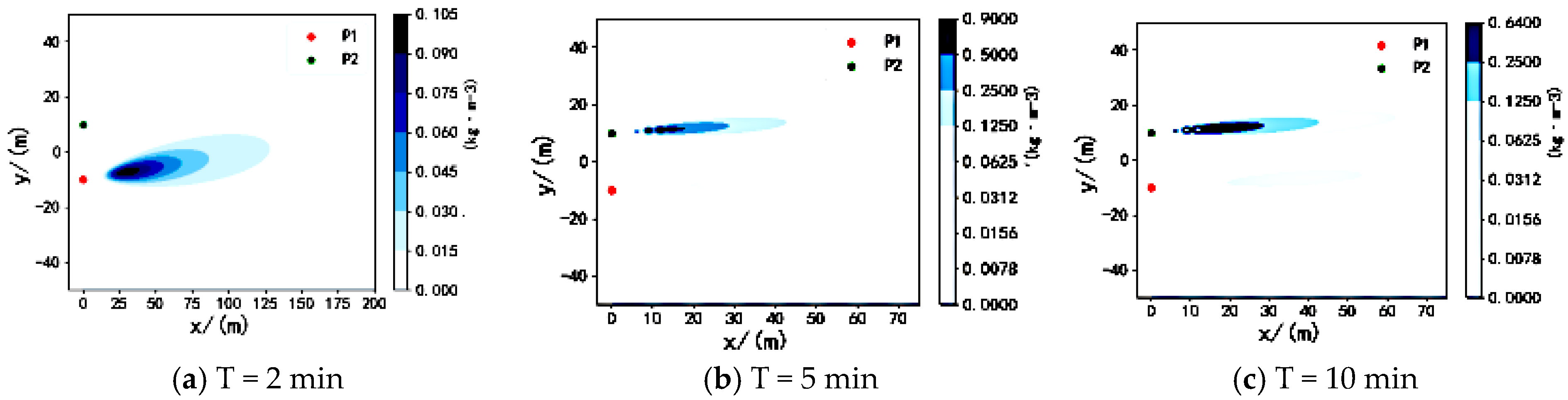
This study focuses on chlorine gas to examine the effects of multiple gas leaks. The research area is defined as 2500 m by 1200 m and 3 m high, situated in an open, flat region. Two chlorine gas storage cylinders, P1 and P2, are positioned at coordinates (0, −40) and (0, 10), respectively. P1 begins leaking at time zero, and after 120 s, P2 starts to leak and continues until the end of the observation. Two minutes after the leak from P1, the hazardous zones are outlined in
Figure 1a; five minutes after the leak, the hazardous areas are depicted in
Figure 1b; and ten minutes after the leak, the designated hazardous zones are illustrated in
Figure 1c.
A fireworks algorithm fusion (GWOFA) is employed to tackle the issue of gas source localization in a space measuring 50 m × 50 m × 15 m. The strength of the gas source, or gas release rate, is estimated to be up to 200, with the assumption that it releases gas continuously at a steady rate. The wind speed is maintained at 3, blowing from west to east at an angle of 10 degrees, and this wind speed remains unchanged during the gas diffusion process. The atmospheric stability is classified as D-grade, and the gas diffusion follows the Gaussian puff model.
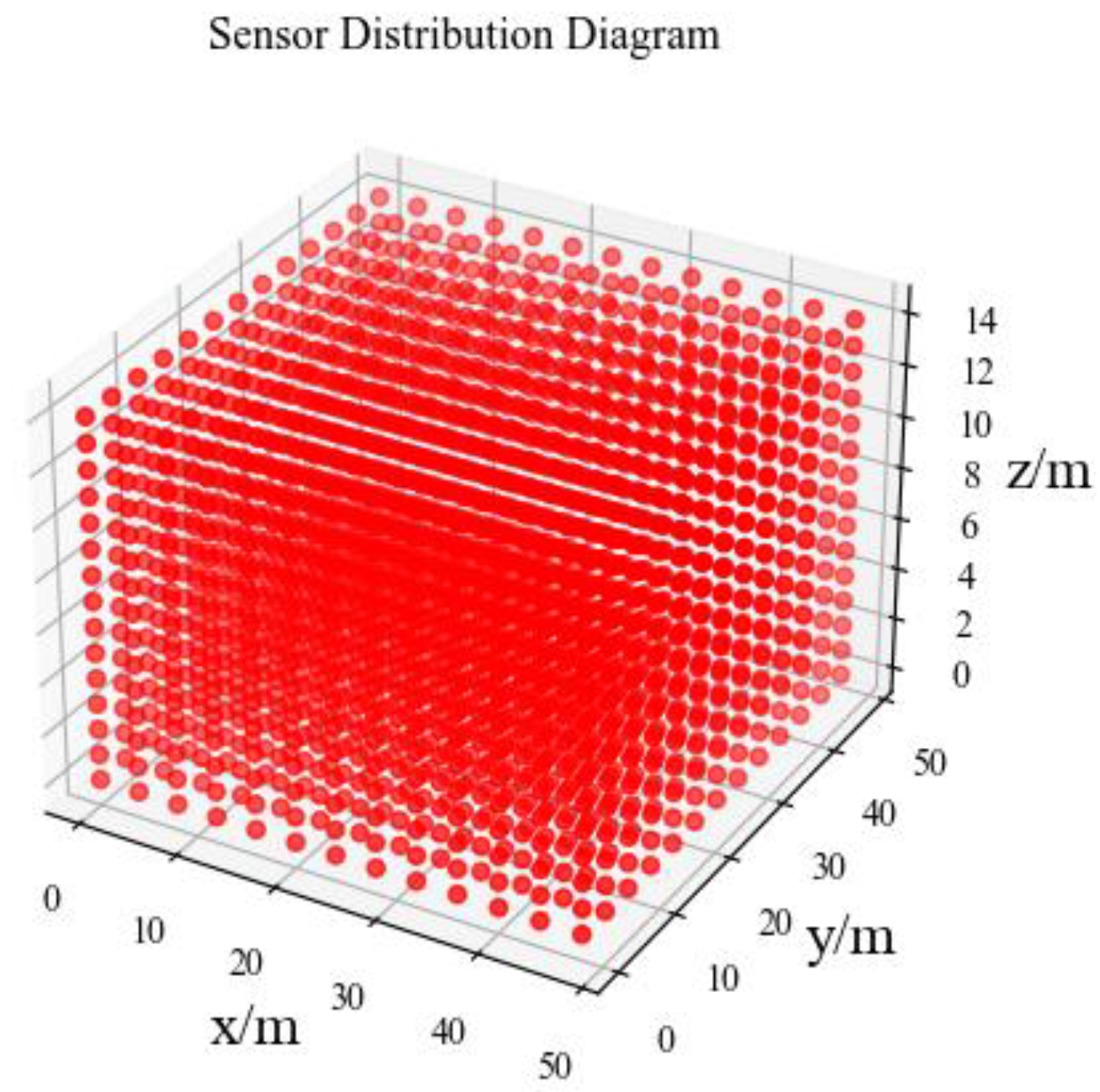
We have arranged a sensor array measuring 4 m × 4 m × 1 m in the designated area. The sensors are calibrated to a sensitivity of 0.0001, allowing them to accurately detect gas concentration readings to four decimal places. The layout of the sensors is illustrated in
Figure 2.
Gas source locations are chosen at intervals of 10 m within the 10 m to 30 m range for both the X and Y axes, and at intervals of 2 m within the 2 m to 8 m range for the Z axis. Additionally, we select gas source intensities at intervals of 10 within the range of 50 to 140. This results in a total of 360 unique gas source configurations, each representing an independent experiment where both the position and intensity of the gas source are predicted.
Experimental results indicate that the fusion fireworks algorithm is effective when the minimum number of fireworks is set to 4, the maximum to 8, and the number of iterations to 600. Therefore, we choose the parameters as follows: 8 fireworks and T = 600 iterations.
4.2. The Assessment Index
We have chosen some evaluation index for regression evaluation in this paper. The main selections include:
- (1)
Mean Squared Error (MSE).
- (2)
Root Mean Squared Error (RMSE).
- (3)
Mean Absolute Error (MAE).
- (4)
Mean Absolute Percentage Error (MAPE).
- (5)
Symmetric Mean Absolute Percentage Error (SMAPE).
- (6)
Coefficient of Determination (R-squared or R2).
Among these metrics, the MSE, RMSE, MAE, MAPE, and SMAPE all tend to approach 0 for improved performance. The R2 value varies between 0 and 1, where values nearer to 1 signify better performance, while those closer to 0 indicate worse performance. In the k-th experiment, if we denote the predicted value
for the i-th experiment as well as the actual value
for the i-th experiment and the average of the true values
, the MSE can be defined as
the RMSE can be expressed as
the MAE can be expressed as
The MAPE can be expressed as
the SMAPE can be expressed as
the Coefficient of Determination can be expressed as
4.3. Determine the Accuracy γ
In (19), a key parameter
influences the effectiveness of the firework algorithm by determining the search radius (or search step) for the fireworks. Typically, the search step affects the number of iterations needed for the algorithm. A smaller search step requires more iterations to locate the optimal firework. To keep the newly generated fireworks within the defined constraints, the search step is set between 0 and 1. We chose four distinct values for independent experiments: 0.001, 0.01, 0.1, and 1, as detailed in
Table 1. The results of the experiments meet our expectations, showing that the algorithm generally excels at predicting gas source locations with low error and a strong correlation between predicted and actual values. However, the predictions regarding gas source strength are not as accurate. Overall, the algorithm’s performance is less affected as the precision value decreases from 1 to 0, and the effect becomes minimal when moving from 0.01 to 0.001. It is expected that as the value decreases, the algorithm’s convergence becomes more stable. Consequently, we select a precision value of 0.001.
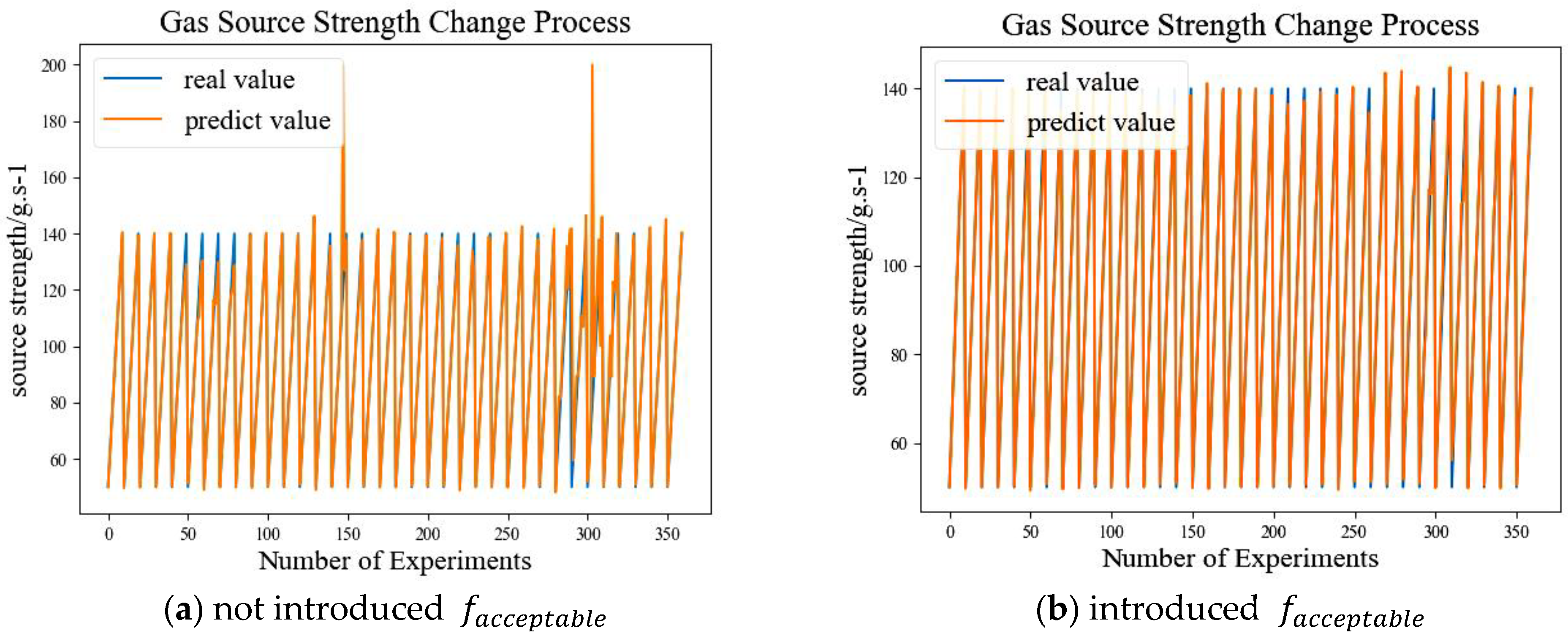
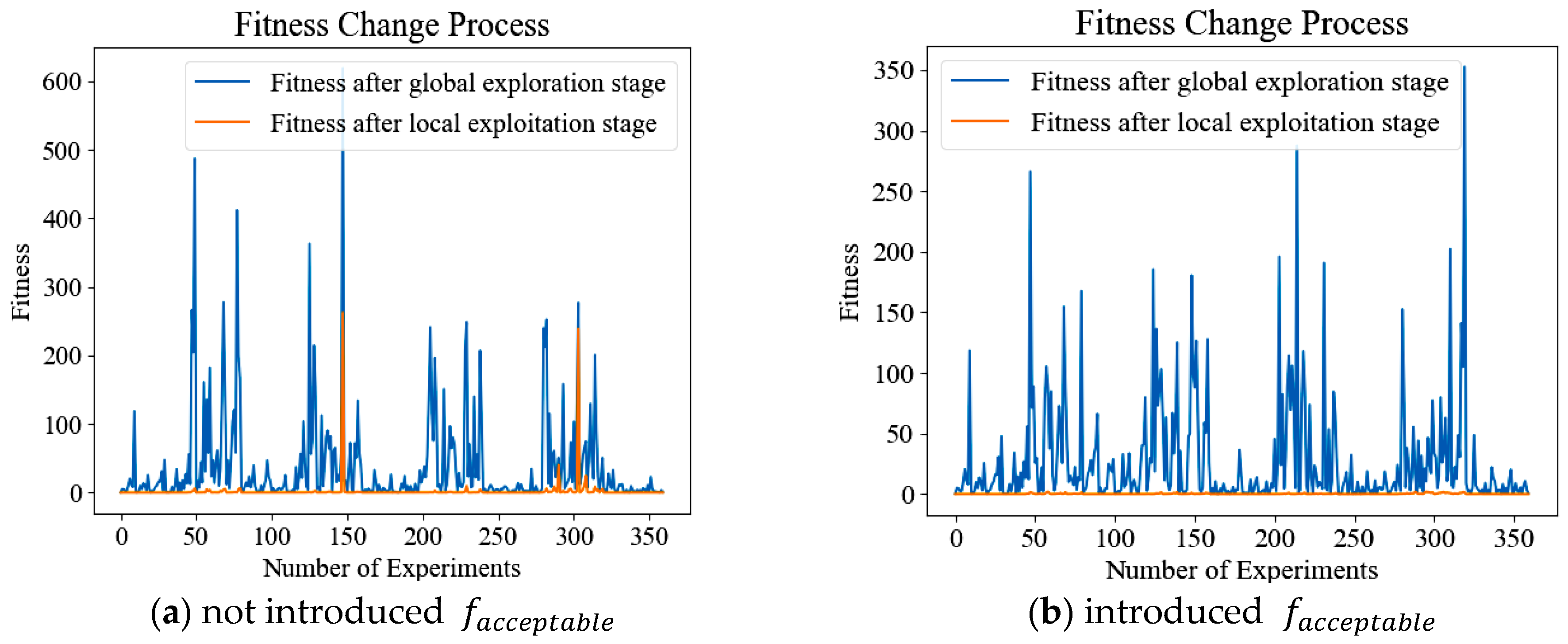
To explore the reasons behind the unsatisfactory predictions of gas source strength, we set a precision value of 0.001. The experiment involved tracking changes in gas source strength across 360 data points, with the findings illustrated in
Figure 3a. Additionally, we monitored the fitness levels at the conclusion of the global exploration phase and after the algorithm’s completion, as shown in
Figure 4a.
The overall average prediction error for gas source strength is relatively high due to inaccurate predictions for a small number of gas sources. Local exploitation significantly influences the outcomes of global exploration, and the integrated firework optimization algorithm produces commendable results. However, its inherent randomness and the unpredictable timing of the transition from global exploration to local development phases hinder its performance. The experimental results from the global exploration phase indicate that the algorithm can generate reasonably good initial firework positions for the local development phase, but it still retains some randomness.
To tackle this challenge, this paper proposes a minimum acceptable fitness threshold. We compare the fitness of each predicted gas source against this threshold. If the fitness is below the threshold, it is deemed a successful prediction; otherwise, it is classified as a failure. In the gas source prediction experiments, 292 trials yielded fitness values below 0.1 post-prediction, indicating that the algorithm performs well when the fitness of the predictions is under 0.1. Thus, we have established 0.1 as the threshold.
In subsequent experiments, we examined the fluctuations in gas source strength and the fitness of the prediction results across 360 data points. The outcomes are presented in
Figure 3b and
Figure 4b. The results demonstrate that the newly introduced fused firework algorithm, along with the threshold, has produced very positive results.
4.4. Validate the Effects of the Different Errors
In gas dispersion processes, several factors like gas turbulence, primary gas reactions, and settling effects influence dispersion patterns, making it difficult for the Gaussian plume gas dispersion model to accurately represent these trends. Consequently, discrepancies arise between the model predictions and actual measurements. To better reflect real environmental conditions, we introduce Gaussian noise with a mean of zero.
To evaluate the algorithm’s performance in the presence of noise, we conduct three separate experiments, each incorporating Gaussian noise with standard deviations of 0.10, 0.20, and 0.40. The results indicate that as the level of Gaussian noise increases, the accuracy of gas source predictions declines. The fitness value rises, eventually surpassing the minimum acceptable threshold. To tackle this problem, we implement an adaptive fitness approach, which can be calculated as follows:
In Equation (27), the represents the minimum acceptable fitness under the prediction has failed in i-th.
The results of the experiments using adaptive fitness are presented in
Table 2 and
Table 3. The algorithm demonstrates strong performance in predicting gas source information. Even with Gaussian noise at a standard deviation of 0.40, the predictions remain highly accurate, showing almost no discrepancy between the measured and predicted values, with a similarity rate exceeding 97%. However, as the Gaussian noise level rises, the prediction accuracy declines.
With Gaussian noise at a standard deviation of 0.10, the average time taken to predict gas source information is 39.06 s. When the standard deviation increases to 0.40, the average prediction time rises to 96.27 s. In conclusion, while the algorithm is effective in a noisy environment, it results in longer computation times.
4.5. Validate the Effects of Different Sensor Arrays
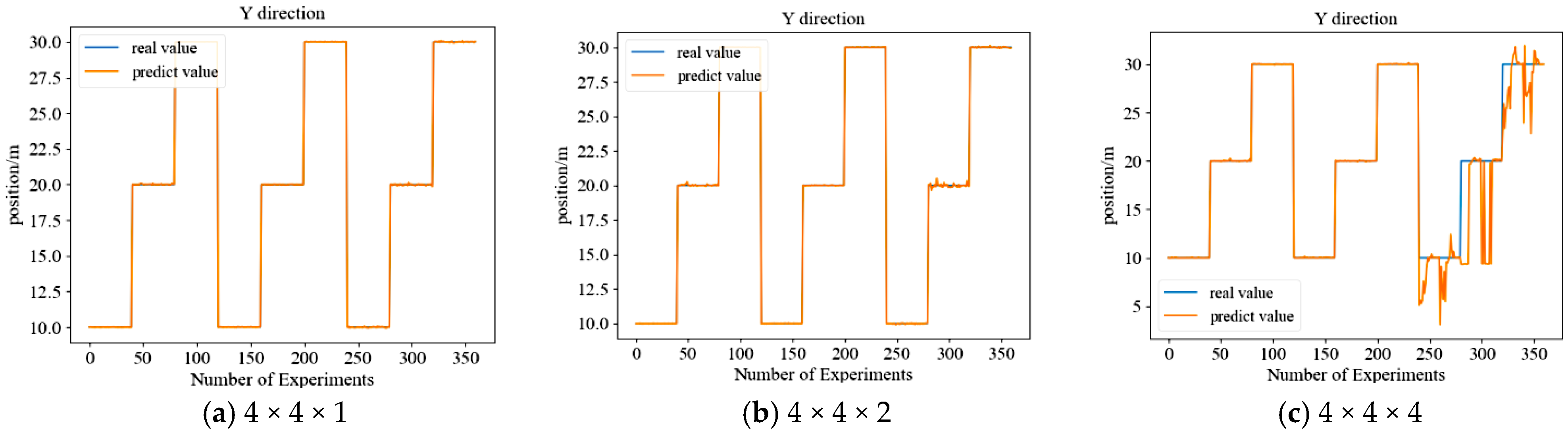
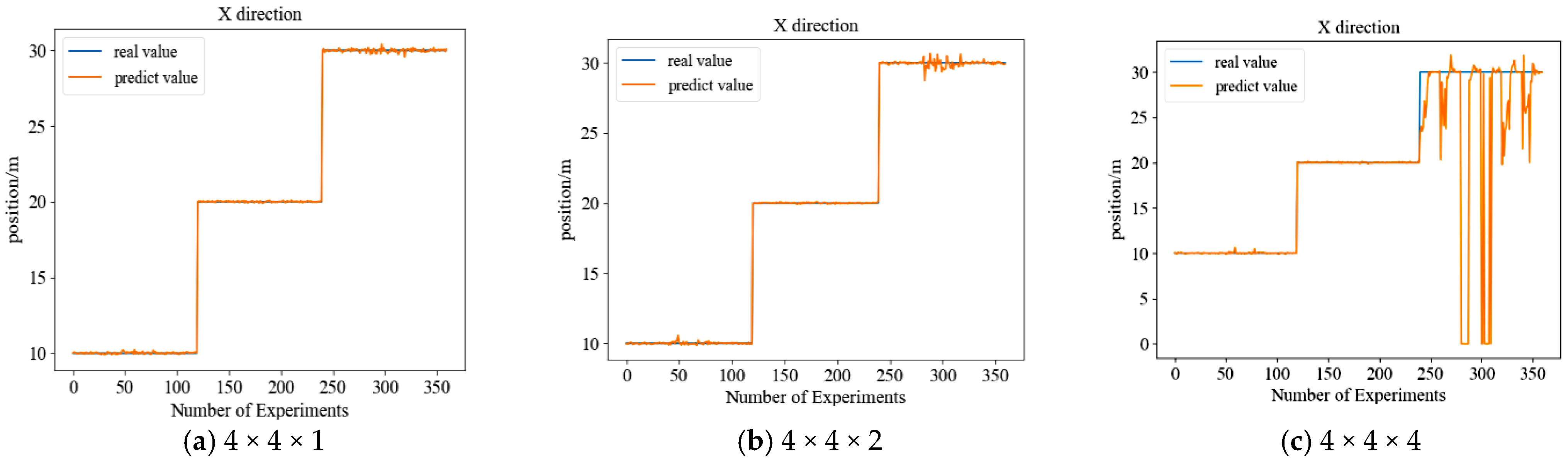
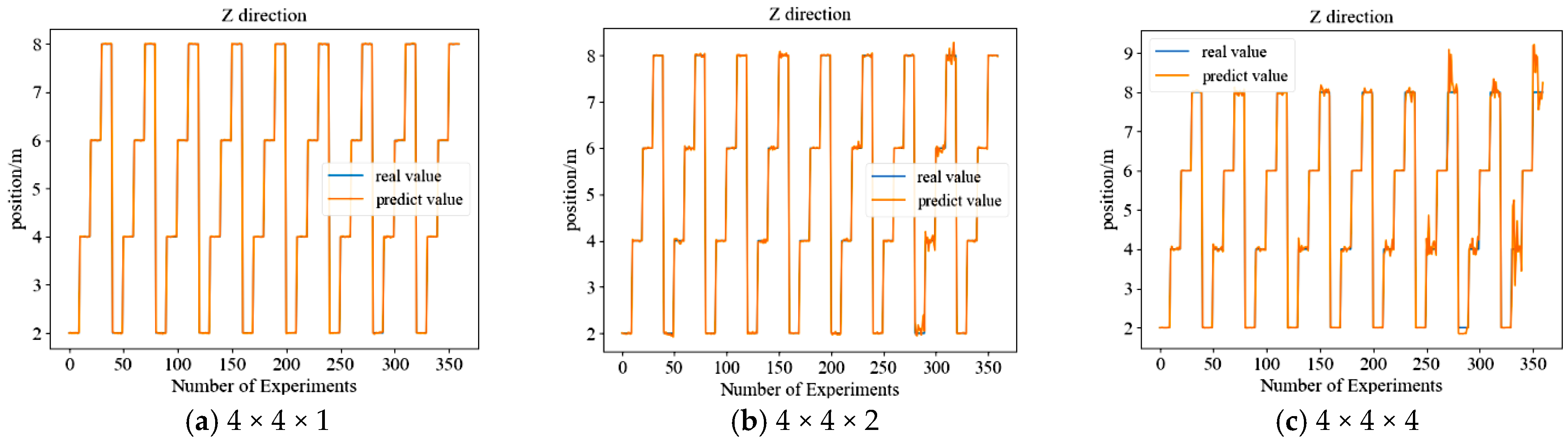
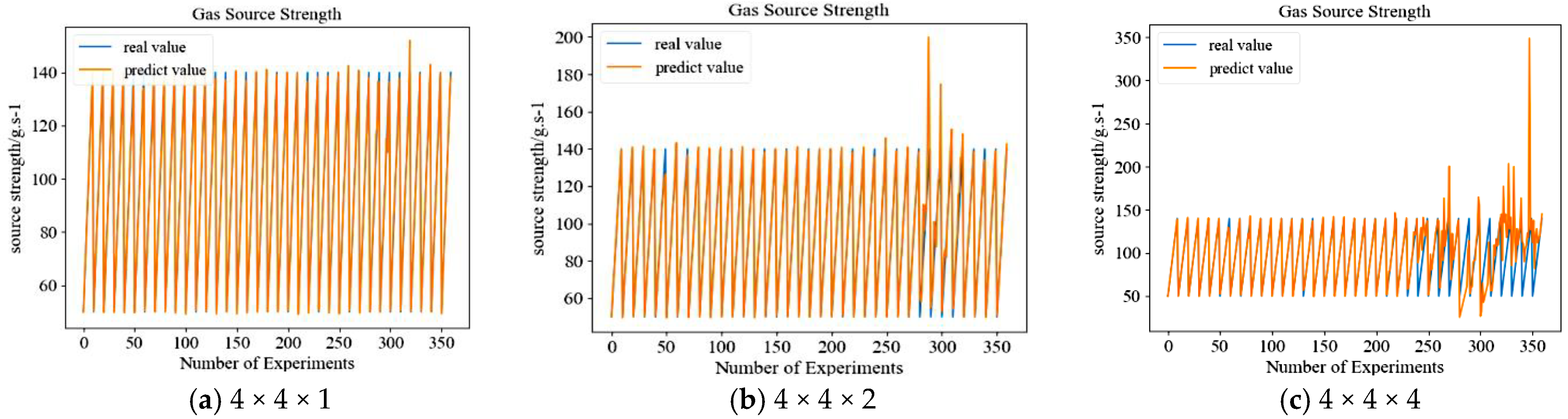
To examine how different sensor array configurations influence prediction outcomes, three specific sensor distribution patterns—4 × 4 × 1, 4 × 4 × 2, and 4 × 4 × 4—were chosen. The findings from these experiments are presented in
Figure 5,
Figure 6,
Figure 7 and
Figure 8.
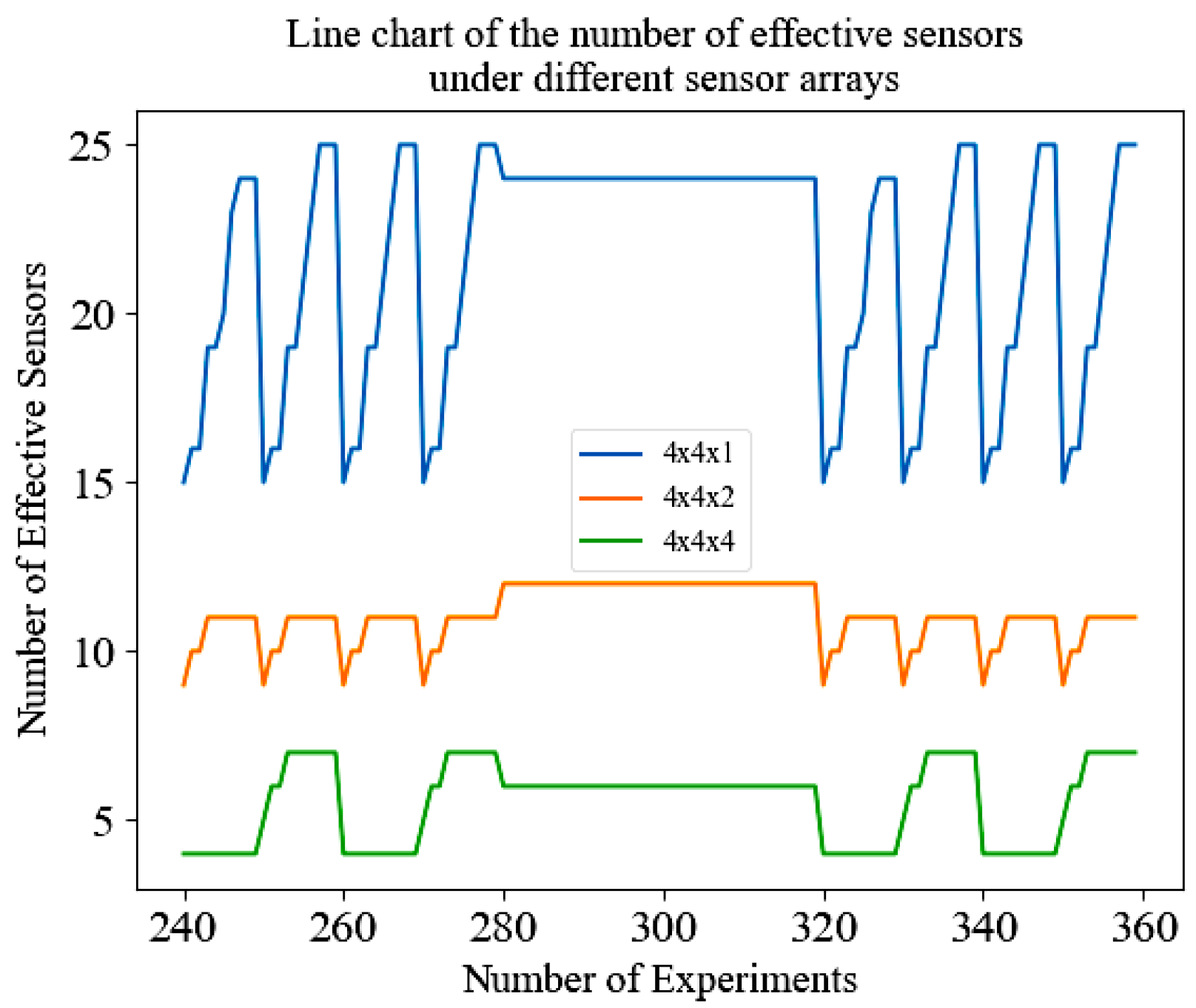
It is evident that as the sensor distribution becomes less dense, the accuracy of predictions regarding gas source information declines, leading to an increase in the discrepancies between actual and predicted values. After the 240th prediction of gas source information, the actual gas source location approaches the right edge of the experimental area. In this scenario, the number of effective sensors monitoring gas concentration is significantly reduced.
Figure 9 shows the number of effective sensors throughout the experiment. In many instances, there are fewer than five effective sensors, which is inadequate for accurately predicting the location and strength of the gas source. Consequently, there is no longer a correlation between the actual and predicted values.
In conclusion, the configuration of sensors impacts the number of effective sensors available for subsequent prediction calculations. A higher number of effective sensors leads to more accurate predictions from the algorithm. When there are nine or more effective sensors, the algorithm consistently yields good performance.
4.6. The Result of Comparison with Other Algorithms
Four swarm intelligence algorithms—Particle Swarm Optimization (PSO), Genetic Algorithm (GA), Ant Colony Optimization (ACO), and Grey Wolf Optimization (GWO)—have been utilized to tackle gas source localization challenges. Liu [
11] performed 100 predictions regarding gas source data in a scenario featuring a population size of 500 and a maximum of 1000 iterations. The findings suggest that Grey Wolf Optimization (GWO) and Particle Swarm Optimization (PSO) demonstrate superior accuracy and performance compared to the other algorithms in addressing gas source localization issues.
In this study, we focus on gas source information with a strength of 60 g/s, positioned at two locations: (10 m, 10 m, 2 m) in the lower-left corner and (30 m, 30 m, 8 m) in the upper-right corner of the experimental area. We then evaluate the performance of the Improved Fused Firework Algorithm, Grey Wolf Optimization Algorithm, and Particle Swarm Algorithm under two conditions: one with a high number of effective sensors (115 sensors) and another with a low number (16 sensors).
We set the maximum iteration count to 1000 for all three algorithms, conducting 100 prediction experiments for the gas source information. The population size for both the Particle Swarm Algorithm and Grey Wolf Optimization Algorithm is established at 500, while other parameters align with those in reference [
11]. The precision is set to 0.0001, with a maximum population size of 8 and a minimum of 4. The results of the experiments are detailed in
Table 4 and
Table 5.
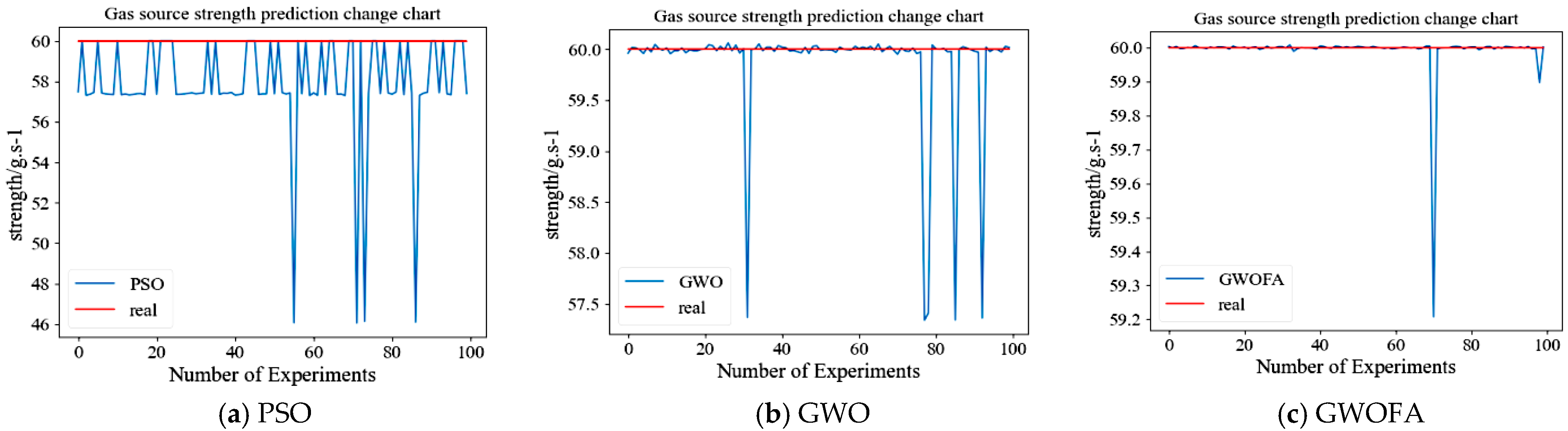
In summary, whether employing the Experimental Fusion Firework Algorithm, Grey Wolf Optimization Algorithm, or Particle Swarm Algorithm, all three can provide accurate predictions of gas source information over 100 trials. The Particle Swarm Algorithm shows particularly high accuracy when there is a substantial amount of effective sensor data. However, similar to the Grey Wolf Optimization Algorithm, it requires nearly ten times more computational time than the algorithm we proposed.
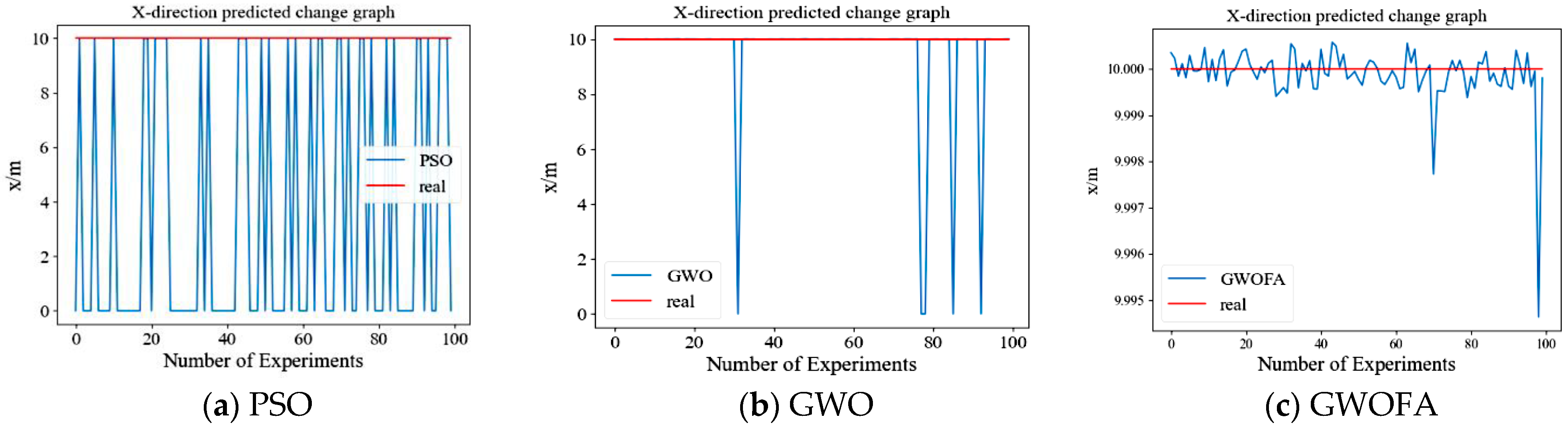
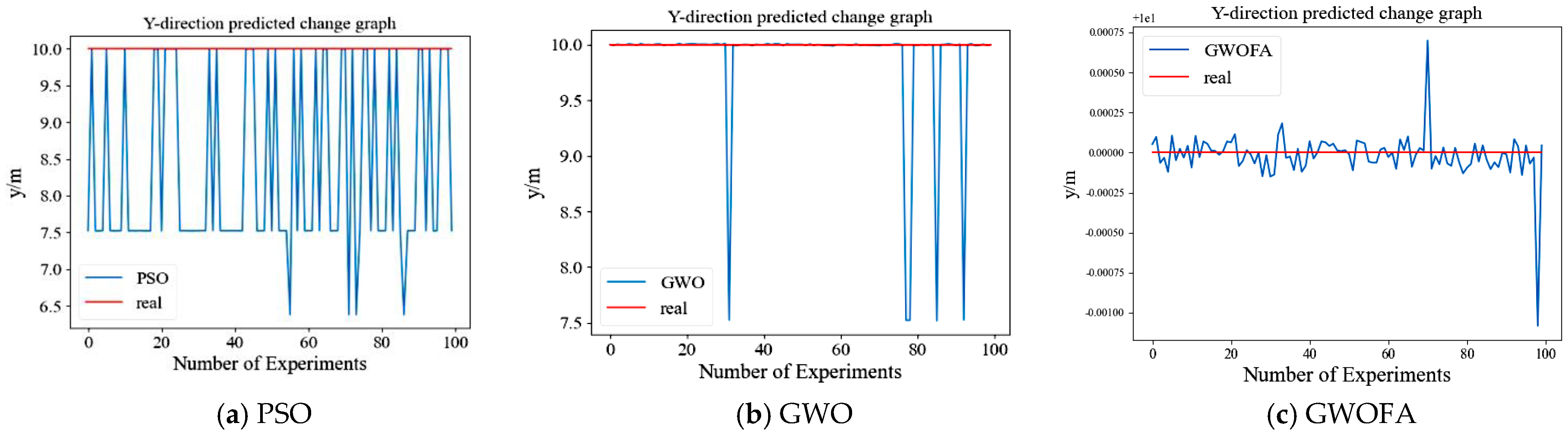
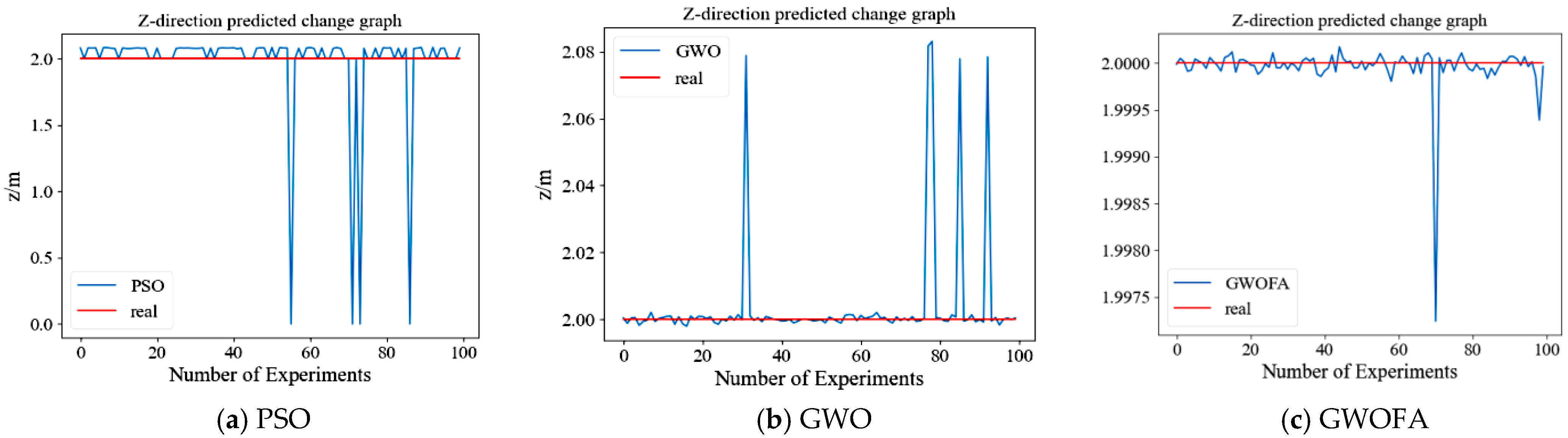
Figure 10,
Figure 11,
Figure 12 and
Figure 13 display the trends in predicted values for the x-direction, y-direction, z-direction, and gas source strength across the three algorithms over 100 predictions. It is evident that the Particle Swarm Algorithm is quite unstable and demonstrates significant randomness, with few experimental results aligning closely with the actual values. Its prediction accuracy is heavily dependent on a large number of trials. In contrast, our proposed algorithm is more stable, with most predictions showing minimal variation and clustering around the actual values. This algorithm also achieves higher accuracy compared to the Grey Wolf Optimization Algorithm, especially as the amount of effective sensor information decreases, while the accuracy of the Grey Wolf Optimization Algorithm significantly drops with fewer effective sensors. Furthermore, our proposed algorithm surpasses the other two in terms of accuracy, as indicated in
Table 5, which shows it has the lowest relative error.
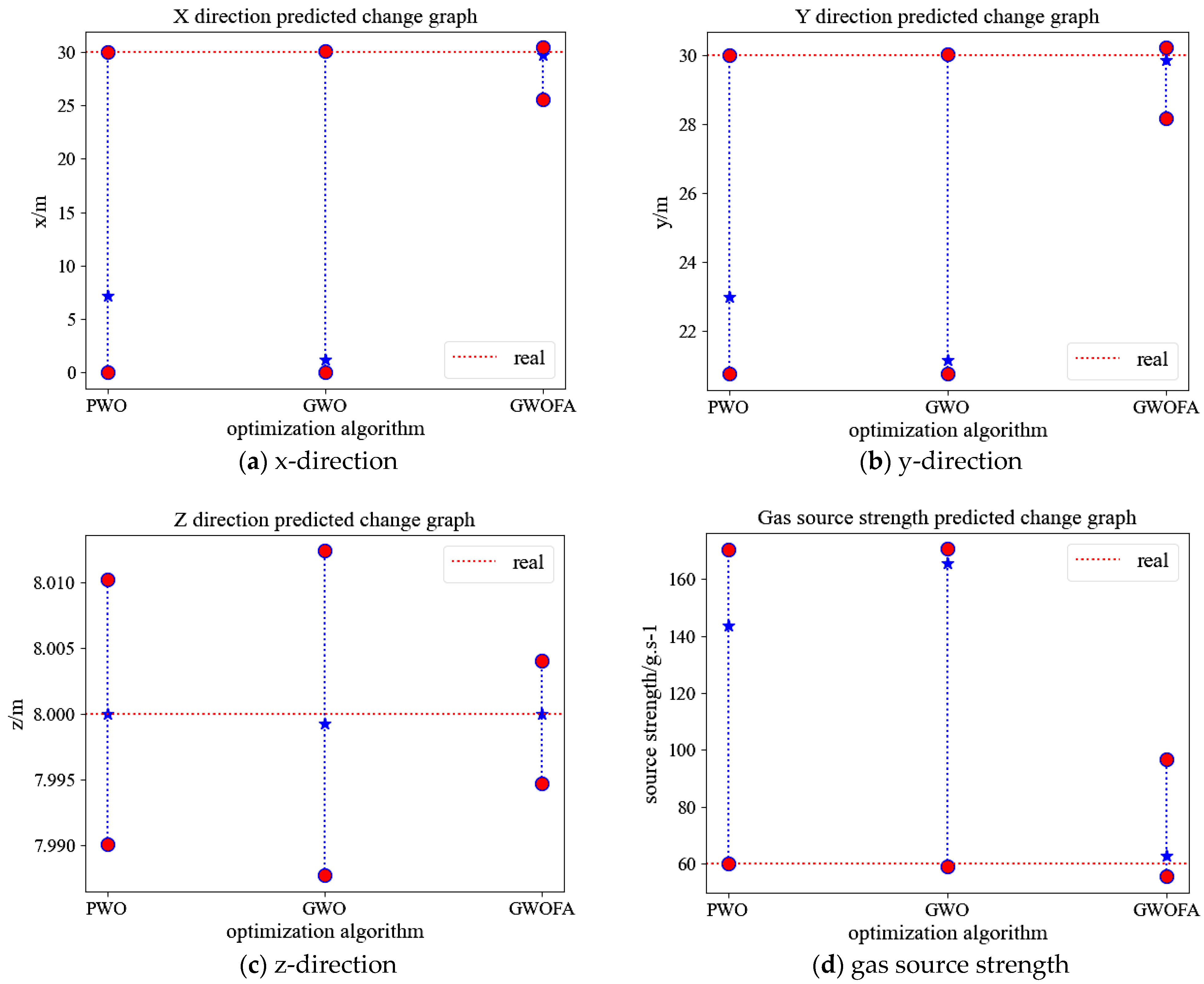
Figure 14 presents the predicted maximum, minimum, and mean values. In this graph, the horizontal dashed line indicates the actual gas source parameter values. The red dots at the upper and lower ends represent the maximum and minimum predicted values for each algorithm across 100 experiments, respectively, while the blue star symbols indicate the average predicted values for each algorithm over the same number of trials. The predictions from our algorithm show less variation and are more closely grouped around the actual values, with the average results from 100 predictions being nearer to the true values and exhibiting smaller average errors.
5. Conclusions
The paper begins by modeling the leakage diffusion of gas sources as a superimposed process of multiple Gaussian puffs. It then addresses the gas source estimation problem in a three-dimensional space using optimization algorithms. This approach integrates the Grey Wolf Optimization Algorithm with the Firework Algorithm, incorporating various enhancements related to initial value selection, explosion radius calculation, and final selection strategy. Subsequent experiments focus on key precision parameters of the algorithm, determining their calculation formulas, and examining the algorithm’s performance in the presence of noise interference. The experimental findings indicate that, given adequate computation time, the algorithm performs effectively under Gaussian white noise interference with a mean of 0 and a variance of 0.4, achieving a minimum matching degree of 97% between predicted and actual measurements.
The influence of sensor arrays on the algorithm is also analyzed, revealing that when the number of effective sensor inputs exceeds 9, the algorithm demonstrates improved estimation accuracy and computational efficiency. Additionally, a comparison is made between the original Grey Wolf Optimization Algorithm and the Particle Swarm Algorithm, showing that the proposed algorithm in this paper provides greater stability, enhanced computational efficiency, and increased reliability, requiring fewer effective sensor inputs while achieving higher accuracy in scenarios with limited sensor information.
Due to difficulties in obtaining real gas diffusion datasets, the research relies on simulated experiments. While predicting diffusion trends based on models may not perfectly align with real-world situations, real-world experiments can be conducted when possible. We outline that future validation should include controlled field tests with tracer gases, wind-tunnel experiments to isolate specific physical effects, and comparison against standard benchmark datasets if available, to thoroughly evaluate the algorithm under realistic and complex conditions.