Energy-Saving Method for Nearby Wireless Battery-Powered Trackers Based on Their Cooperation

 ,
,  , , and
Featured Application
Abstract
1. Introduction
1.1. Background
1.2. Problem and Purpose of the Study
1.3. Related Work
1.4. Aim and Principal Conclusions
- An energy-saving method for multiple co-located wireless tracking devices based on the cooperation of these trackers. In contrast to existing energy-saving techniques and methods, the proposed method reduces energy usage by employing the Bluetooth Low Energy (BLE) protocol-based short-range wireless discovery mechanism combined with a lightweight cooperation and leader node election algorithm, enabling fully decentralized, coordinator-less operation, which is resistant to neighbor changes. This approach reduces the average energy consumption of all cooperating nodes, by minimizing long-range communications and distributing energy consumption among the cooperating nodes.
- An experimental evaluation of the proposed method, by measuring the energy consumption of the different phases of operation of tracking devices. The experiments were carried out using ESP32 microcontrollers with an integrated BLE radio module, the NEO-M8N GNSS (global navigation satellite system) module and the SIM7000E communication module.
- The energy consumption measurements and analysis of each hardware module, including GNSS, mobile communication, CPU, and BLE radio. These findings enable future researchers to assess the real-world energy efficiency of their proposed methods.
2. Materials and Methods
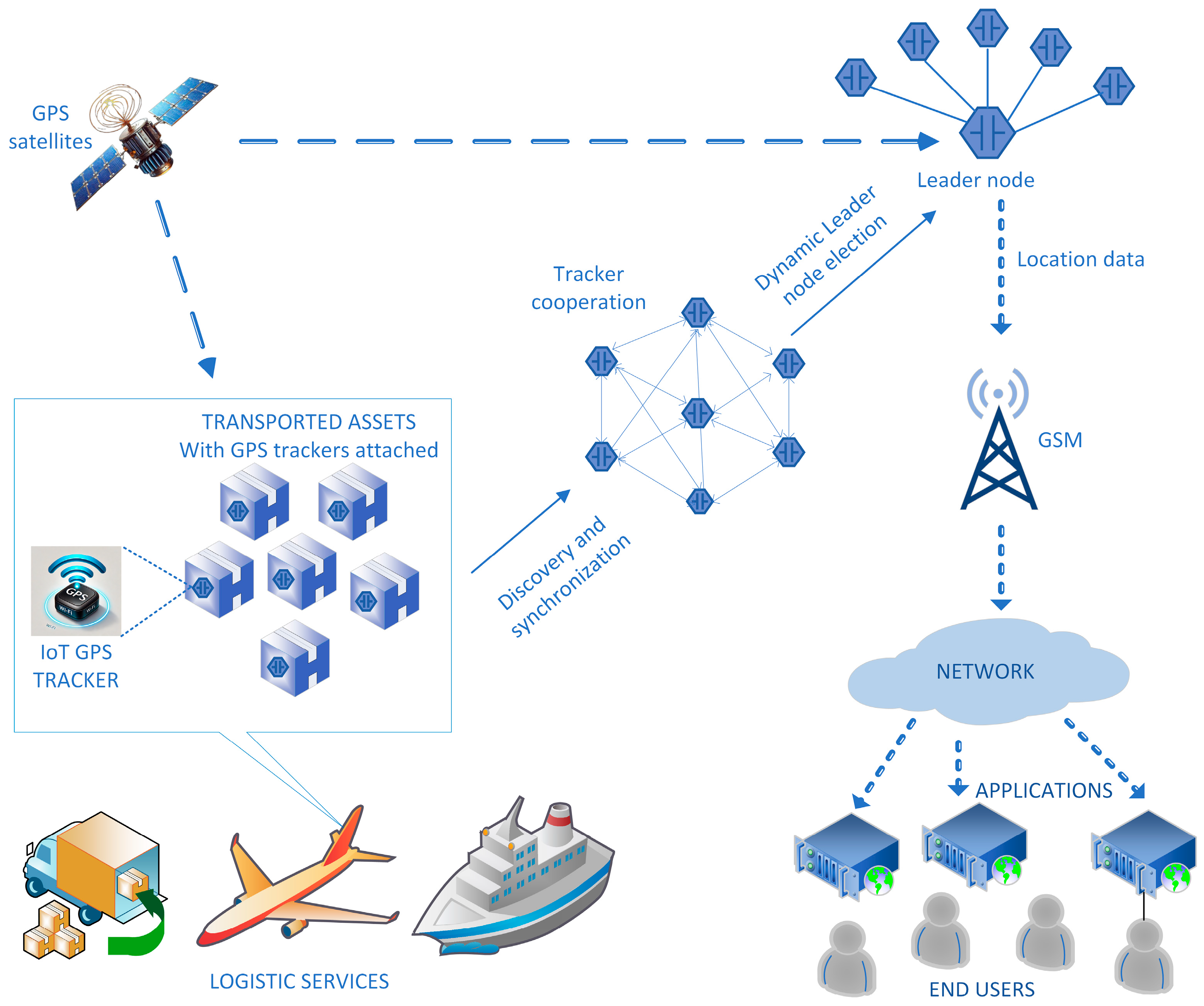
2.1. Background and the Proposed Cooperation Model
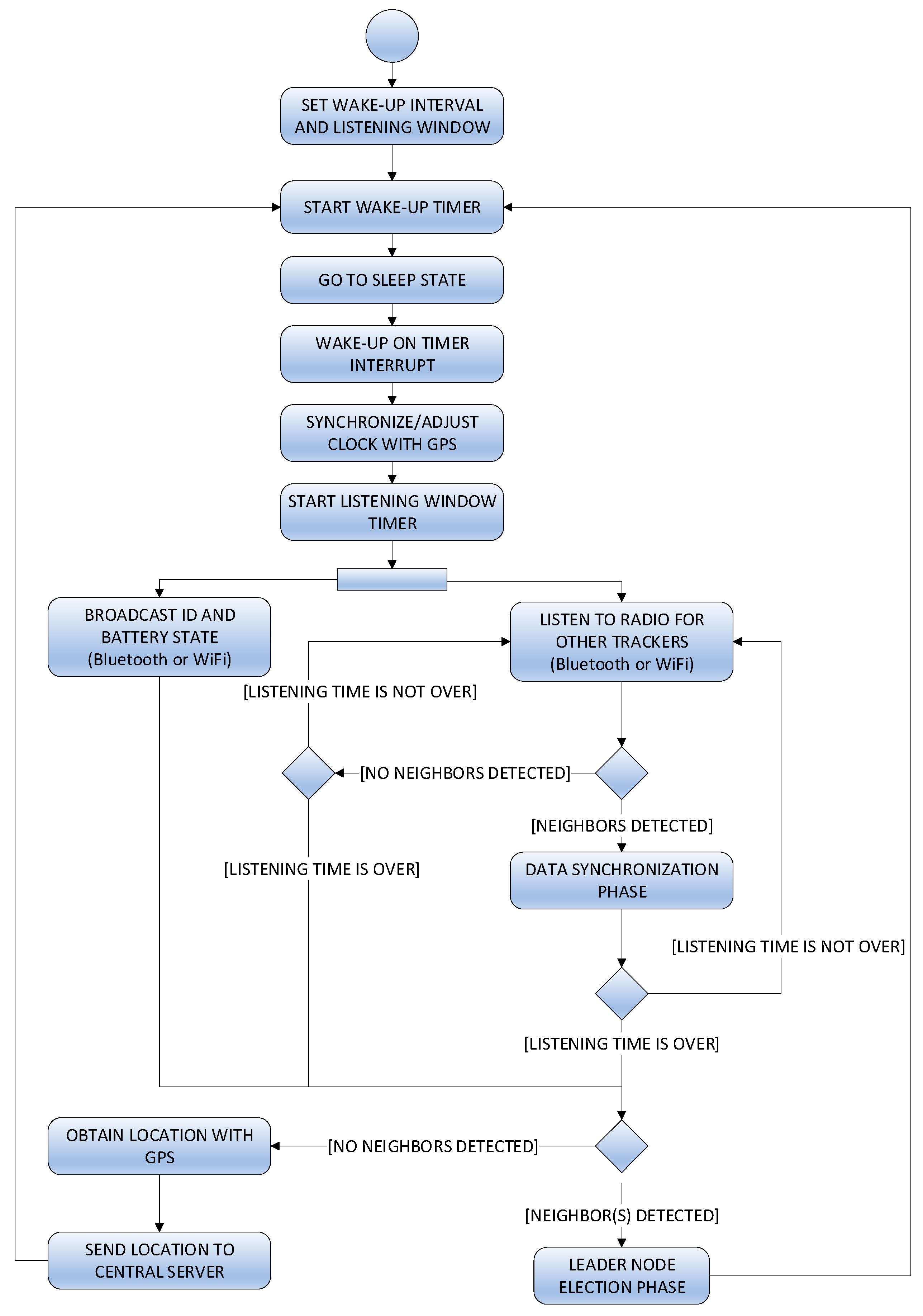
2.2. Neigbor Discovery, Data Synchronization, and Leader Node Election Algorithms
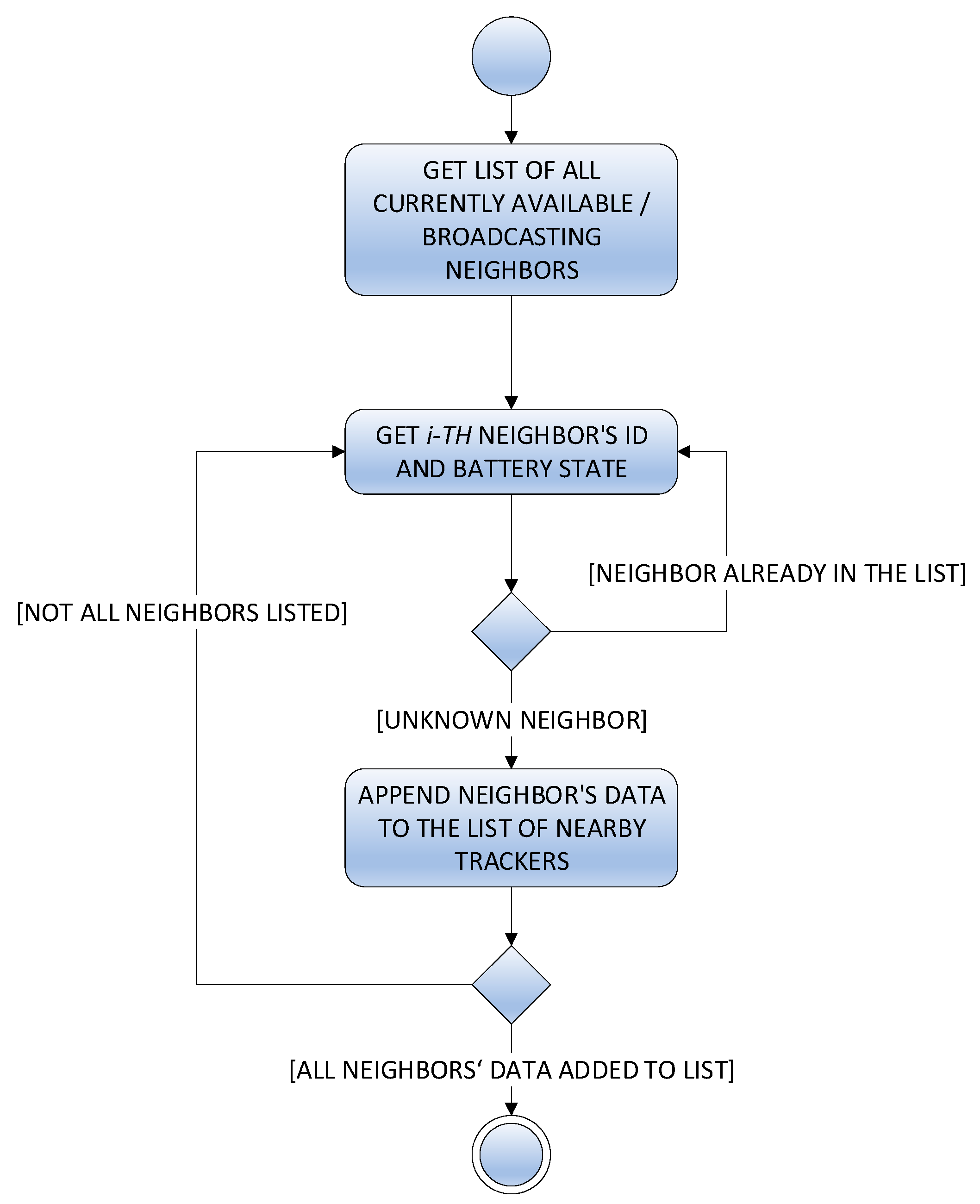
2.2.1. Neighbor Discovery Algorithm
2.2.2. Data Synchronization Algorithm
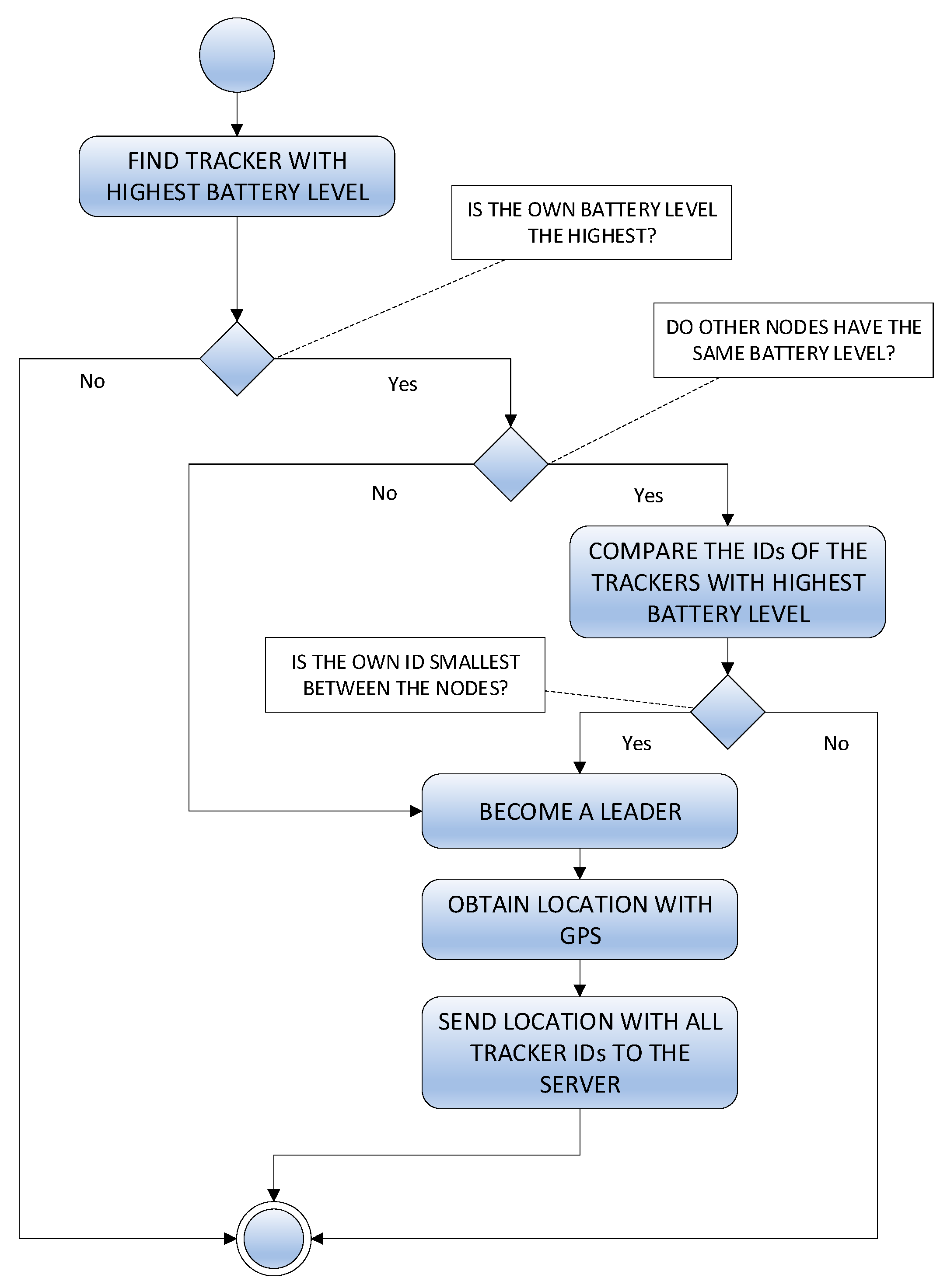
2.2.3. Leader Node Election Algorithm
2.3. Performance Evaluation Methodology
- CPU running the code and managing all the communications;
- BLE radio module, used for the detection of other cooperating devices;
- GNSS module used for location services;
- Mobile communication module that is used to report location data to the central server.
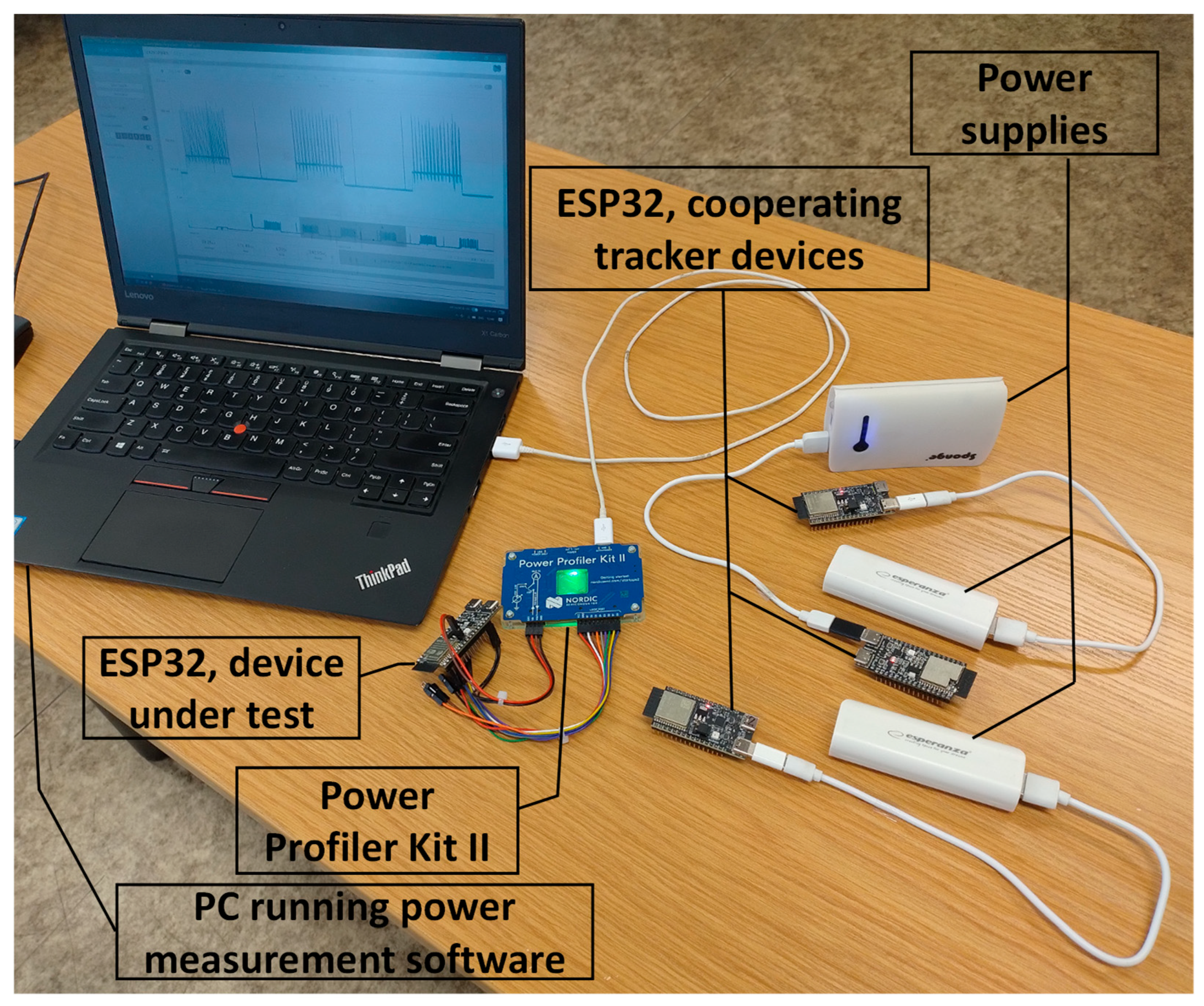
2.4. Experimental Setup
3. Results
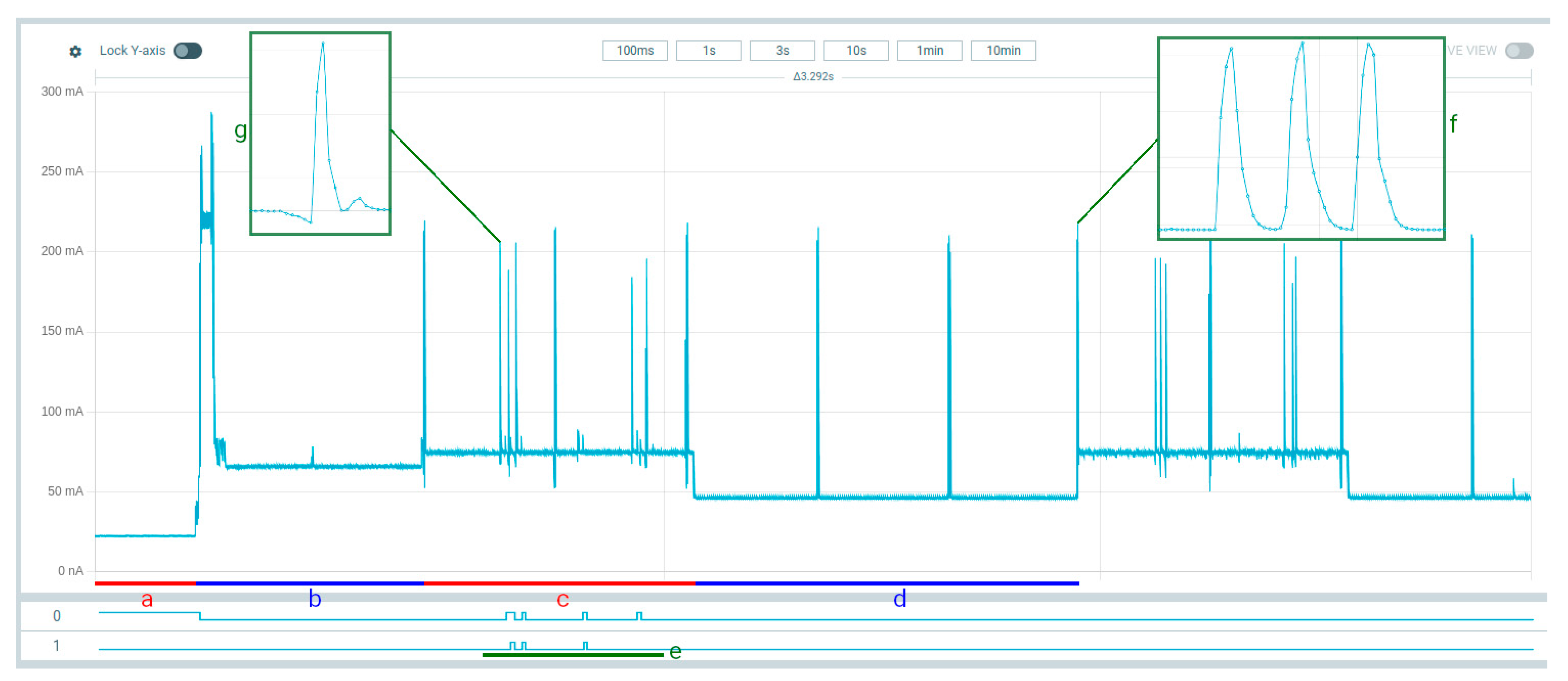
3.1. Energy Requirements for the Discovery of Neighbors (BLE Module)
3.2. Energy Requirements for Location Acquisition (GNSS Module)
3.3. Energy Requirements for Data Transmission (Mobile Communications Module)
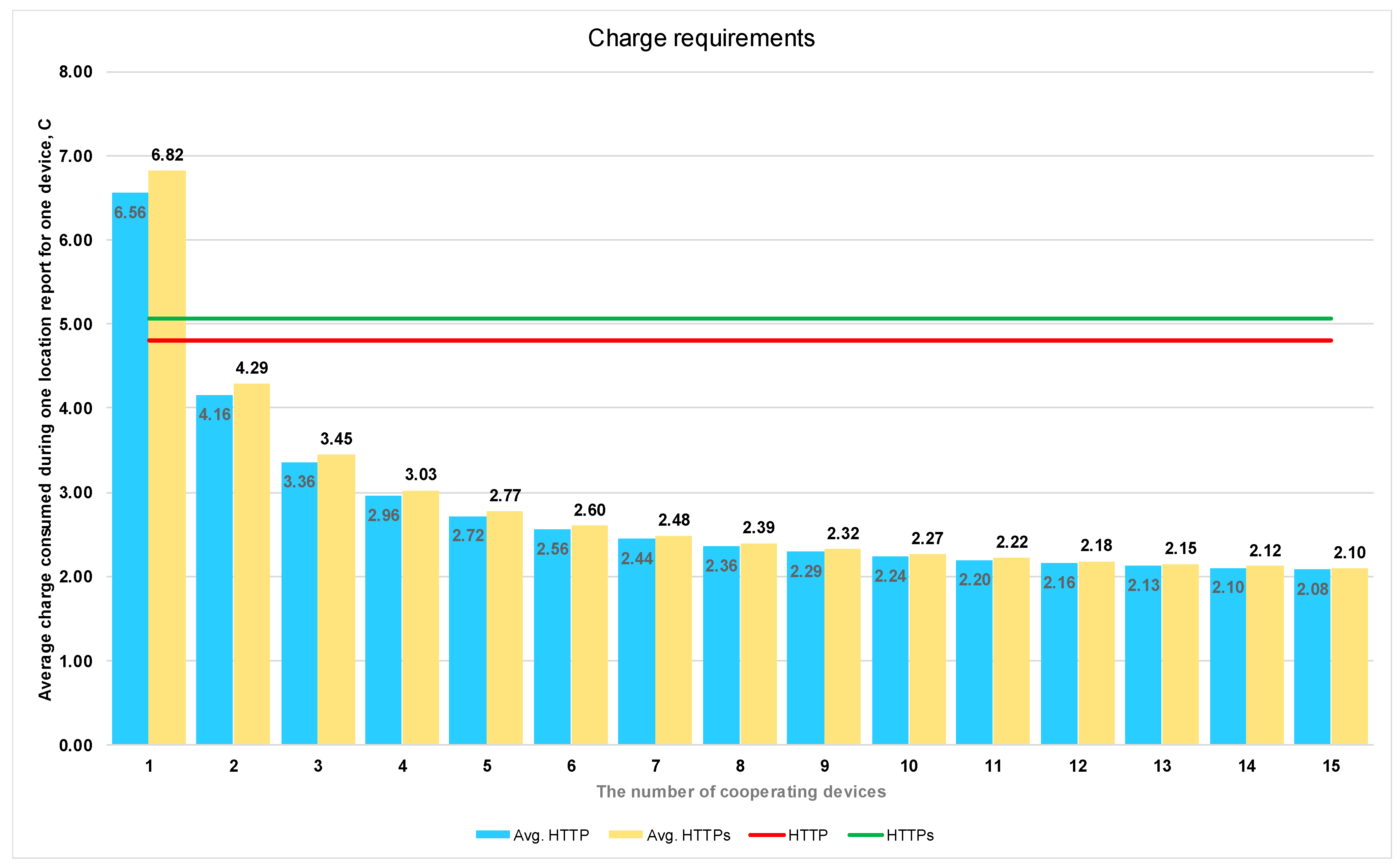
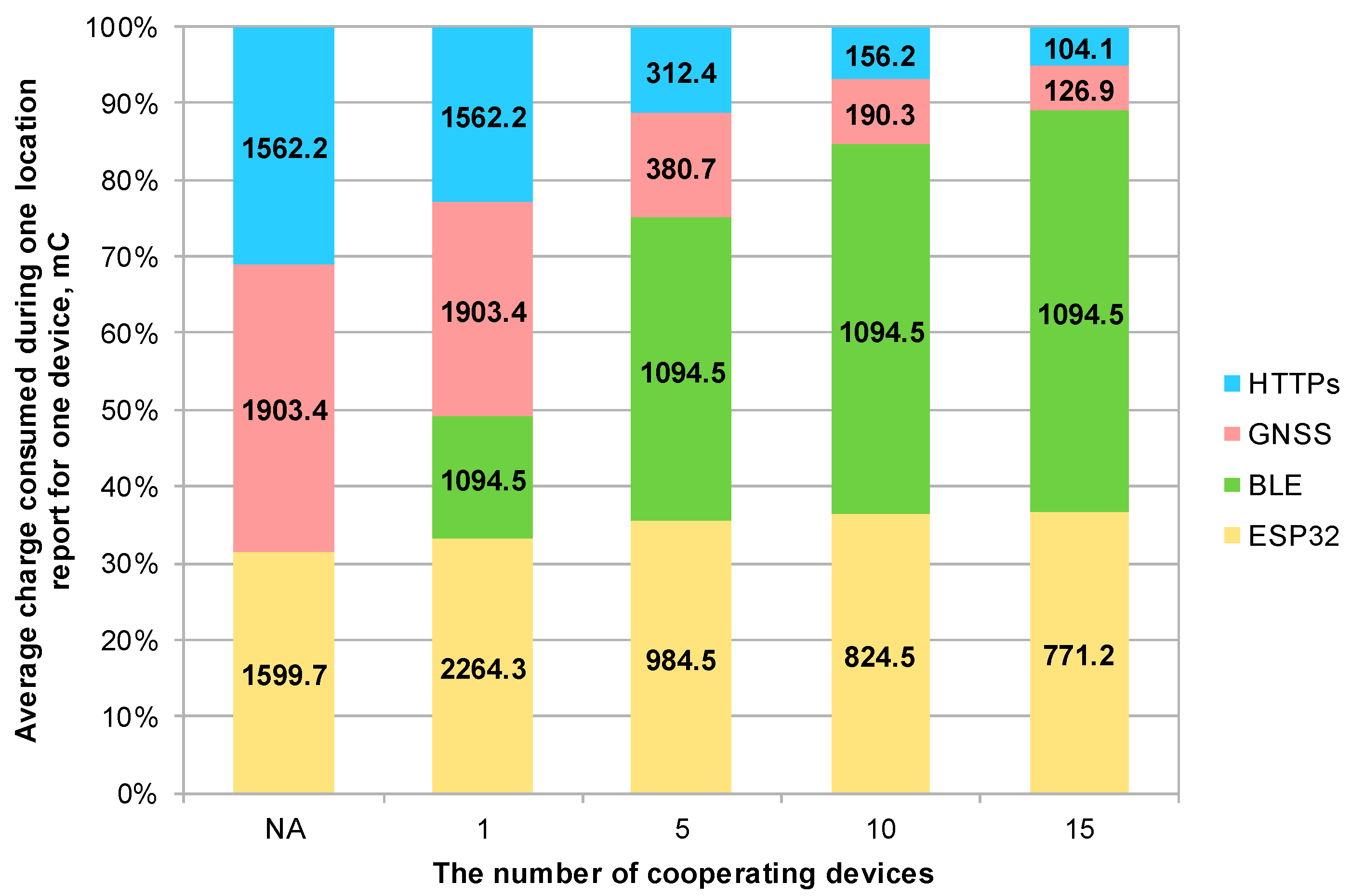
3.4. Dependence of Energy Requirements on the Number of Cooperating Devices
4. Discussion
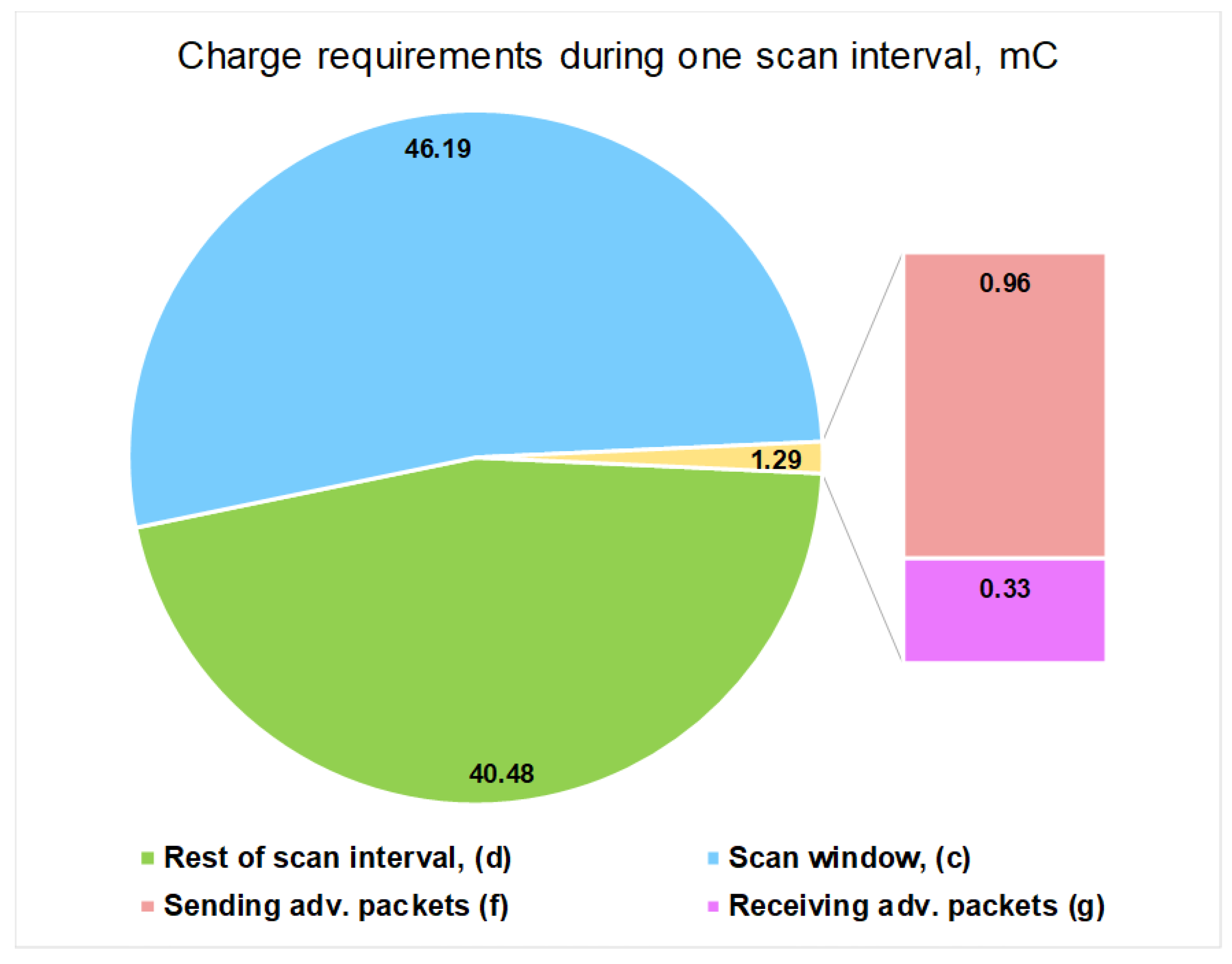
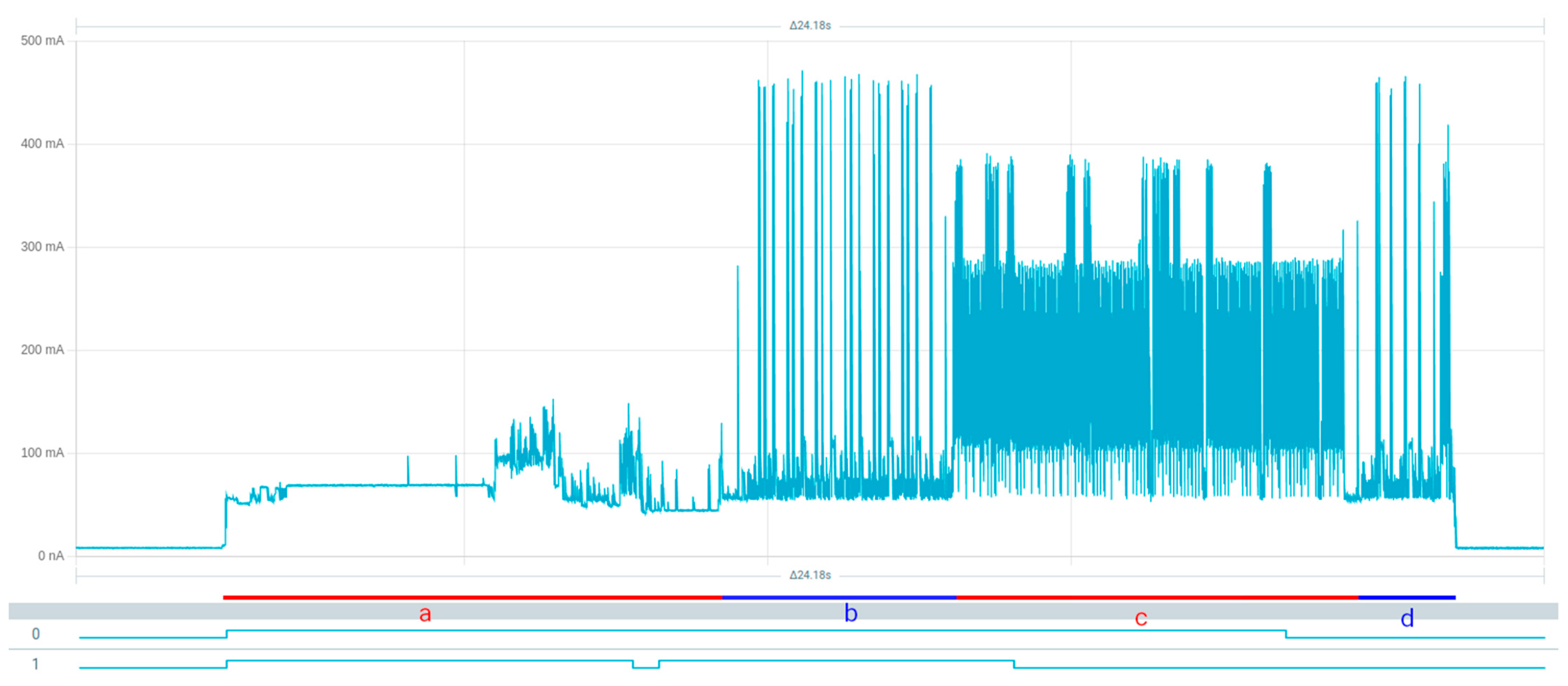
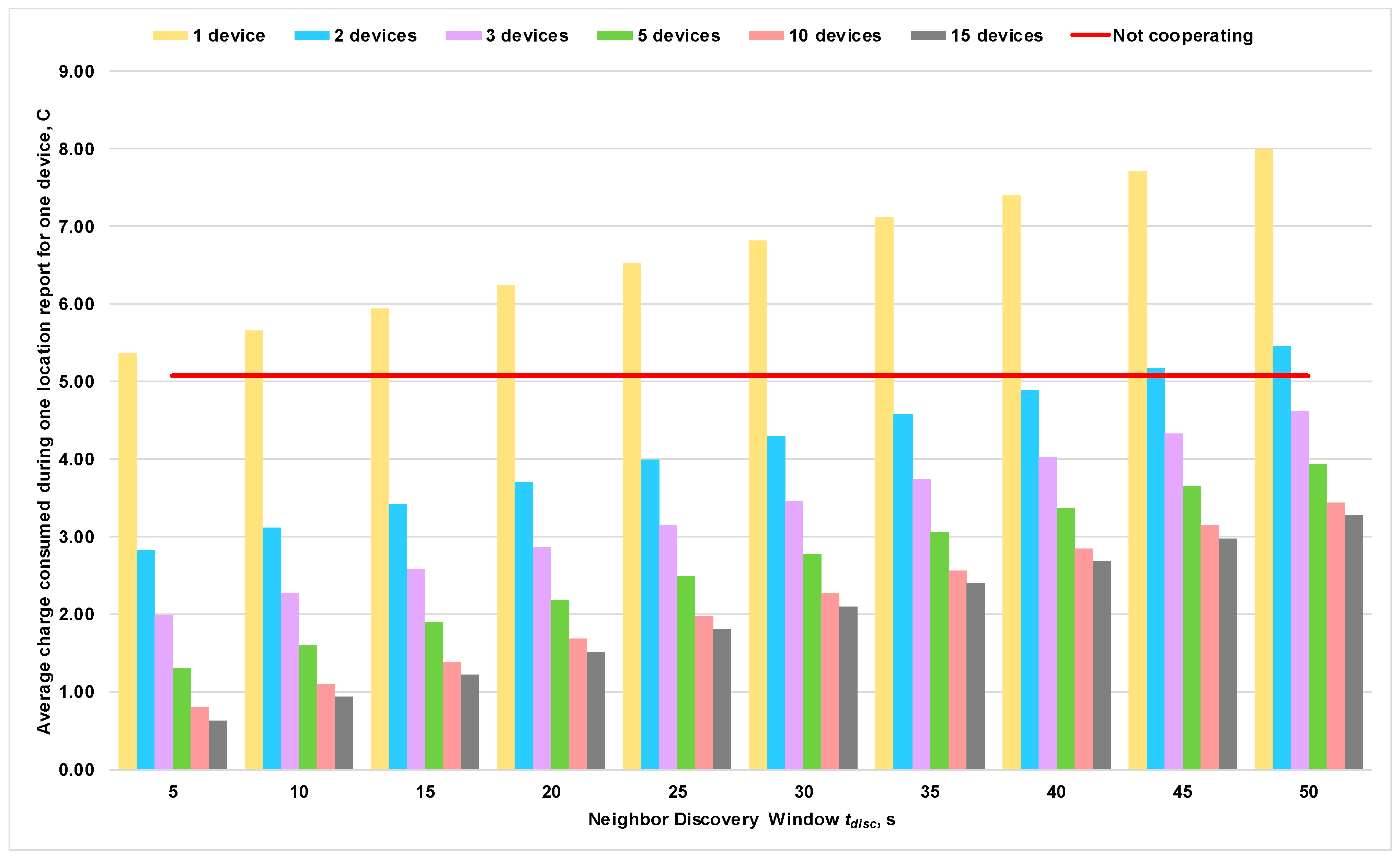
- The microcontroller with an active BLE radio subsystem uses significantly more current than while running code and performing calculations (58.7 mA vs. 22.1 mA). To reduce total energy requirements, the BLE radio could be used less. But this leads to the potential risk that tracking devices will not be able to discover each other when their clocks are not synchronized. A 30 s discovery time window starting at the predefined time (i.e., at the beginning of each hour) should be sufficient to compensate for the clock drifts in the cooperating devices. If further energy savings are required, one can try to reduce the time window duration even further and try to compensate for the time drift by synchronizing the time of all cooperating devices. In this case, a slight modification of the BLE-based communication protocol is required, which could be an interesting topic for further research.
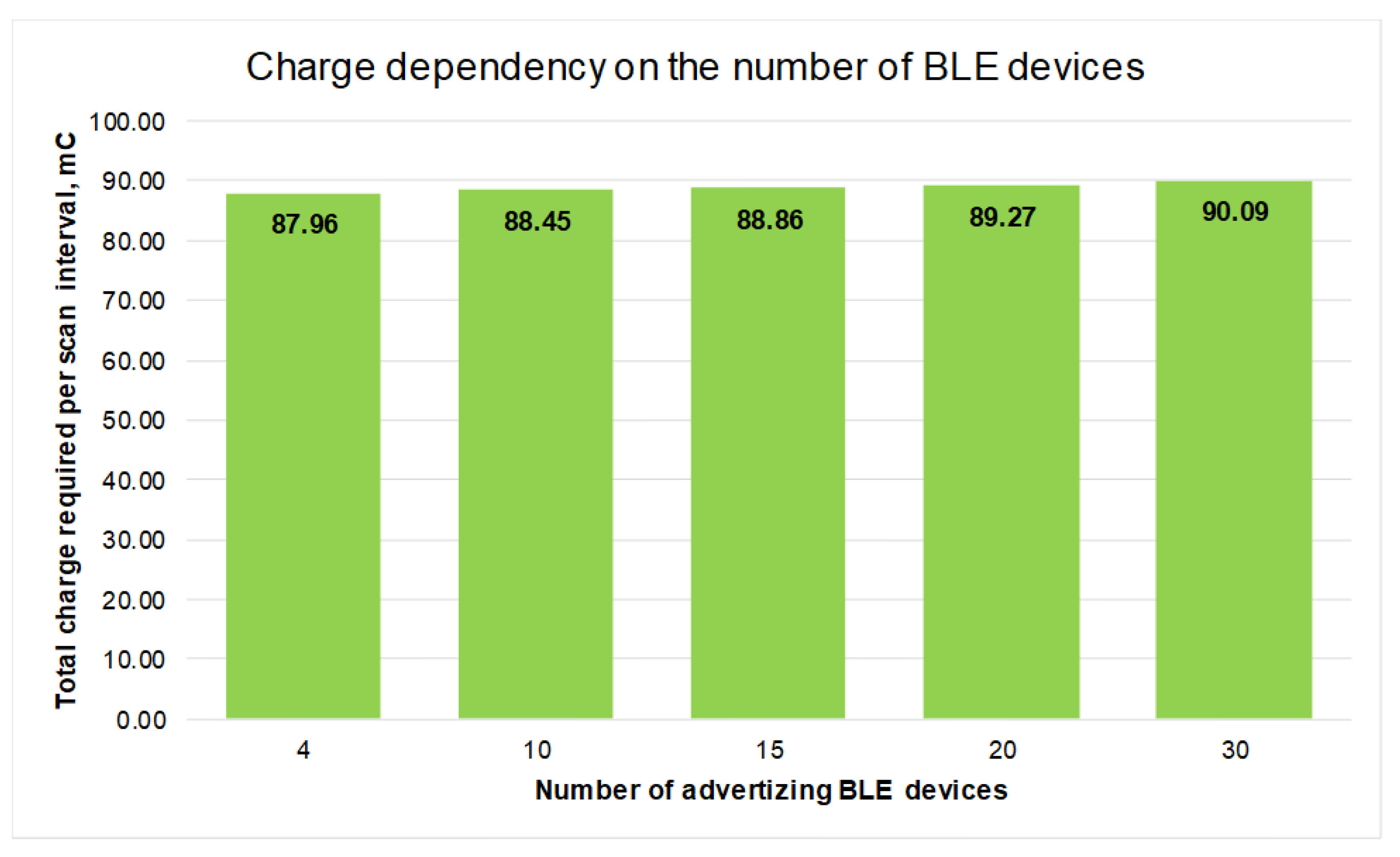
- Experimental evaluation shows that there is only a slight dependency of the energy requirements on the number of nearby BLE devices (including all discoverable devices, not necessarily trackers). Energy requirements may increase by up to 3% when the number of BLE devices increases from 1 to 30 or more. This dependency does not differ according to the type of device, as all nearby BLE devices add some additional energy losses. This means that even in environments with many active random BLE devices, the proposed method should be sufficiently efficient.
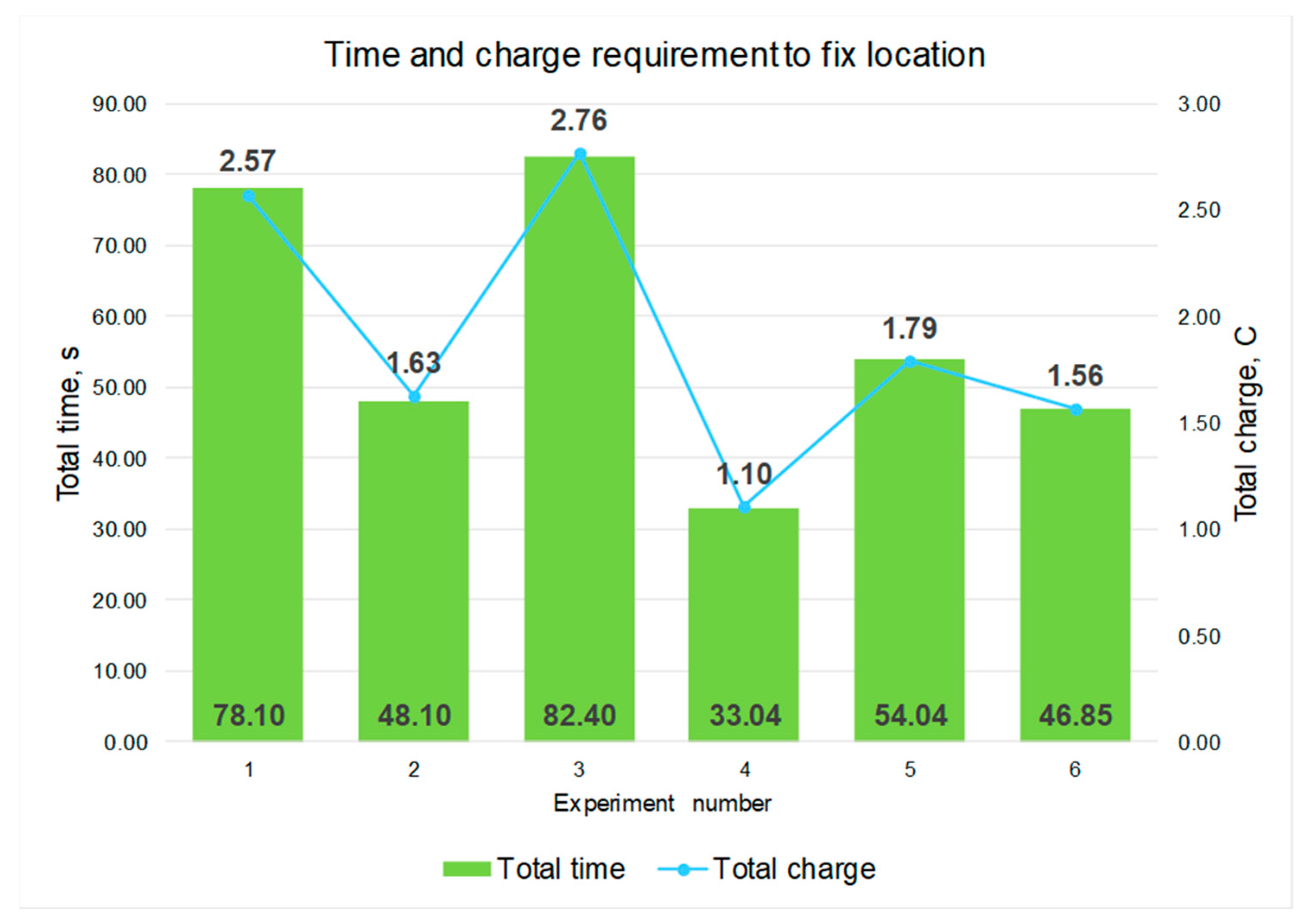
- Experimental evaluation of the GNSS module shows that its energy requirements are not as high as was expected, and they are comparable with those of the active BLE radio, which performs scanning/advertising (33.4 mA average current for the GNSS module vs. 36.6 mA for the BLE radio subsystem alone). The only problem is the stability of the time interval required to acquire the current position. This time interval depends on many external factors, such as physical location of the device, orientation of the antenna, radio interference, etc. The measurements presented in this study were performed under good conditions and represent the “best case scenario” with respect to GNNS energy requirements. If conditions are worse and location fix time is increased, then the efficiency of the proposed method should also be more beneficial compared to the traditional tracking approach. Research revealing dependencies on the efficiency of the proposed algorithm when tracking devices are under more ungrateful conditions (i.e., inside the metal shipping container) could be performed in the future.
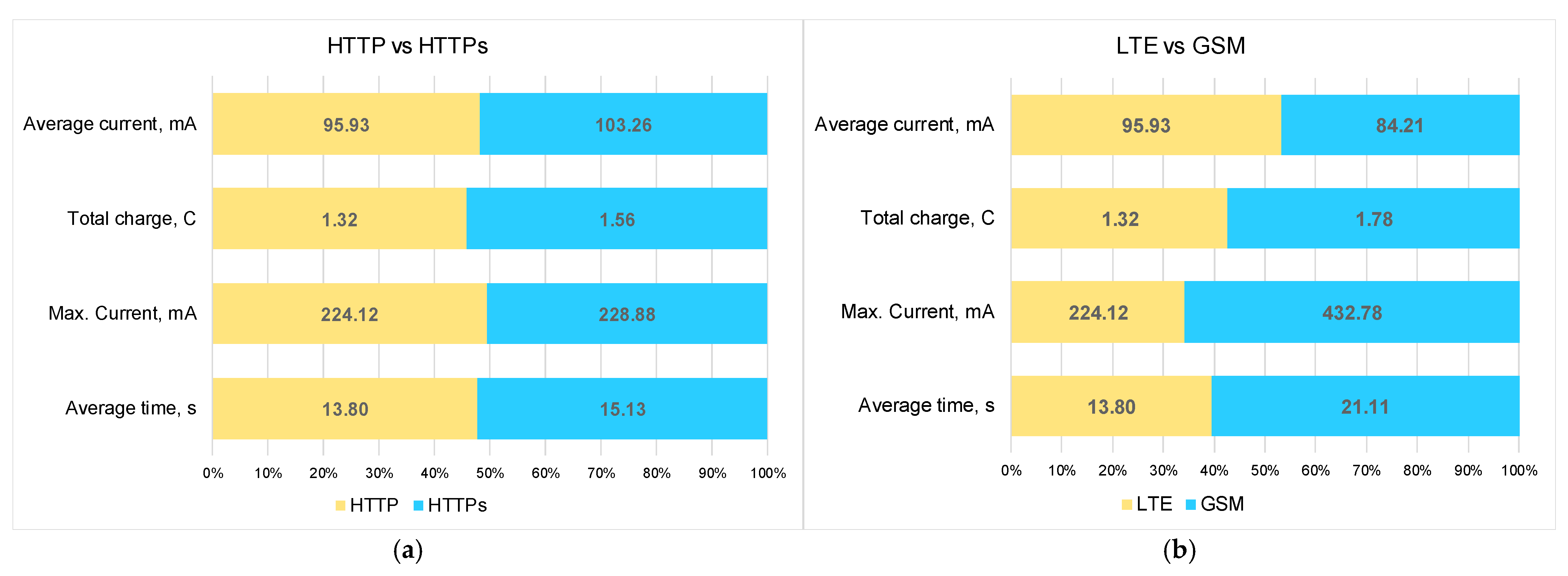
- Evaluation of the mobile communications module shows that there is no significant difference if TLS (Transport Layer Security) based HTTPS or plain HTTP protocols are used, which means that there is no reason to not use the secure protocol. Selecting the secure protocol is best practice. Additionally, the LTE-based communication protocol ensures better energy efficiency compared to legacy GSM, so this protocol should only be used in situations where LTE is not available.
5. Conclusions
Author Contributions
Funding
Data Availability Statement
Conflicts of Interest
References
- Capua, M.D.; Ciaramella, A.; De Prisco, A. Machine Learning and Computer Vision for the Automation of Processes in Advanced Logistics: The Integrated Logistic Platform (ILP) 4.0. Procedia Comput. Sci. 2023, 217, 326–338. [Google Scholar] [CrossRef]
- Charles, P.; Tamgole, P.; Dugane, A.; Sagar, V. A Literature Survey on Automated Cargo Tracking System. Int. J. Res. Appl. Sci. Eng. Technol. 2022, 10, 1300–1302. [Google Scholar] [CrossRef]
- Mu, X.; Antwi-Afari, M.F. The Applications of Internet of Things (IoT) in Industrial Management: A Science Mapping Review. Int. J. Prod. Res. 2024, 62, 1928–1952. [Google Scholar] [CrossRef]
- Udeh, E.O.; Amajuoyi, P.; Adeusi, K.B.; Scott, A.O. The Role of IoT in Boosting Supply Chain Transparency and Efficiency. Magna Sci. Adv. Res. Rev. 2024, 12, 178–197. [Google Scholar] [CrossRef]
- Ding, Y.; Jin, M.; Li, S.; Feng, D. Smart Logistics Based on the Internet of Things Technology: An Overview. Int. J. Logist. Res. Appl. 2021, 24, 323–345. [Google Scholar] [CrossRef]
- Song, Y.; Yu, F.R.; Zhou, L.; Yang, X.; He, Z. Applications of the Internet of Things (IoT) in Smart Logistics: A Comprehensive Survey. IEEE Internet Things J. 2021, 8, 4250–4274. [Google Scholar] [CrossRef]
- Ravi Chandra, B.; Kumar, K.; Roy, A.; Chandra, I.S. Overview of Internet of Things-Based Smart Logistics Systems. In Communication Technologies and Security Challenges in IoT; Prasad, A., Singh, T.P., Dwivedi Sharma, S., Eds.; Internet of Things; Springer Nature Singapore: Singapore, 2024; pp. 241–259. ISBN 978-981-97-0051-6. [Google Scholar]
- Alzahrani, B.A.; Irshad, A. An Improved IoT/RFID-Enabled Object Tracking and Authentication Scheme for Smart Logistics. Wirel. Pers. Commun 2023, 129, 399–422. [Google Scholar] [CrossRef]
- Kalkha, H.; Khiat, A.; Bahnasse, A.; Ouajji, H. The Rising Trends of Smart E-Commerce Logistics. IEEE Access 2023, 11, 33839–33857. [Google Scholar] [CrossRef]
- Lagorio, A.; Cimini, C.; Pinto, R.; Cavalieri, S. 5G in Logistics 4.0: Potential Applications and Challenges. Procedia Comput. Sci. 2023, 217, 650–659. [Google Scholar] [CrossRef]
- Singh, J.; Kaur, R.; Singh, D. A Survey and Taxonomy on Energy Management Schemes in Wireless Sensor Networks. J. Syst. Archit. 2020, 111, 101782. [Google Scholar] [CrossRef]
- Hassan, M.F.; Al-Musawi, B.; Al-Janabi, A.K. Innovative Fitness Functions for Robust Energy Management in WSNs. J. Netw. Syst. Manag. 2023, 31, 76. [Google Scholar] [CrossRef]
- Poornima, G.; Parthasarathy, C.; Umapathy, K.; Dinesh Kumar, T.; Archana, M.A.; Kumar, N.A. GPS Based Smart Vehicle Tracking and Monitoring System. In Proceedings of the 2024 Second International Conference on Intelligent Cyber Physical Systems and Internet of Things (ICoICI), Coimbatore, India, 28–30 August 2024; IEEE: Piscataway, NJ, USA, 2024; pp. 506–511. [Google Scholar]
- Degadwala, S.; Upadhyay, R.; Upadhyay, S.; Dave, S.S.; Mahida, D.; Vyas, D. Enhancing Fleet Management with ESP8266-Based IoT Sensors for Weight and Location Tracking. In Proceedings of the 2023 3rd International Conference on Innovative Mechanisms for Industry Applications (ICIMIA), Bengaluru, India, 21–23 December 2023; IEEE: Piscataway, NJ, USA, 2023; pp. 13–17. [Google Scholar]
- Jacob, R.O.; Alyaan, S.M.; Nikitha, K.; Niranjana Murthy, H.S. IoT Based GPS Tracking System with SOS Capabilities. In Proceedings of the 2022 International Mobile and Embedded Technology Conference (MECON), Noida, India, 10–11 March 2022; IEEE: Piscataway, NJ, USA, 2022; pp. 72–75. [Google Scholar]
- Hagargund, A.G.; Shreya, P.; Spandana, N.; Varsha, D.; Vishrutha, V.S. Implementation of Global Ship Tracking and Monitor System. In Proceedings of the 2022 IEEE North Karnataka Subsection Flagship International Conference (NKCon), Vijaypur, India, 20–21 November 2022; IEEE: Piscataway, NJ, USA, 2022; pp. 1–6. [Google Scholar]
- Qadir, A.M.; Cooper, P. GPS-Based Mobile Cross-Platform Cargo Tracking System with Web-Based Application. In Proceedings of the 2020 8th International Symposium on Digital Forensics and Security (ISDFS), Beirut, Lebanon, 1–2 June 2020; IEEE: Piscataway, NJ, USA, 2020; pp. 1–7. [Google Scholar]
- Sahana, B.; Jayanthi, P.N.; Muktha, V.N.; Natasha, D.A. UAV Tracking Using 5G. In Proceedings of the 2024 8th International Conference on Computational System and Information Technology for Sustainable Solutions (CSITSS), Bengaluru, India, 7–9 November 2024; IEEE: Piscataway, NJ, USA, 2024; pp. 1–3. [Google Scholar]
- Kaiser, J.; Hernández, M.P.; Kaupe, V.; Kurrek, P.; McFarlane, D. An Agent-Based Approach for Energy-Efficient Sensor Networks in Logistics. Eng. Appl. Artif. Intell. 2024, 127, 107198. [Google Scholar] [CrossRef]
- Zhang, C.; Fei, S. Energy Efficient Target Tracking Algorithm Using Cooperative Sensors. J. Syst. Eng. Electron. 2012, 23, 640–648. [Google Scholar] [CrossRef]
- Liu, W.; He, Y.; Zhang, X.; Jiang, F.; Gao, K.; Xiao, J. Energy-Efficient Node Scheduling Method for Cooperative Target Tracking in Wireless Sensor Networks. Math. Probl. Eng. 2015, 2015, 627479. [Google Scholar] [CrossRef]
- Dev, J.; Mishra, J. Energy-Efficient Object Detection and Tracking Framework for Wireless Sensor Network. Sensors 2023, 23, 746. [Google Scholar] [CrossRef] [PubMed]
- Kumar, V.; Bergmann, N.W.; Ahmad, I.; Jurdak, R.; Kusy, B. Cluster-Based Position Tracking of Mobile Sensors. In Proceedings of the 2016 IEEE Conference on Wireless Sensors (ICWiSE), Langkawi, Malaysia, 10–12 October 2016; pp. 7–14. [Google Scholar]
- Anitha, C.; Karthik, G.M.; Uma Maheswari, M.; Kumar, L.V.; Sasikala, G.; Jayanthi, S. A Robust Design of Cooperative Model to Enhance Energy Efficiency over Heterogeneous 5G Wireless Sensor Network Paradigm. In Proceedings of the 2024 Asia Pacific Conference on Innovation in Technology (APCIT), Mysore, India, 26–27 July 2024; pp. 1–6. [Google Scholar]
- Zheng, K.; Luo, R.; Liu, X.; Qiu, J.; Liu, J. Distributed DDPG-Based Resource Allocation for Age of Information Minimization in Mobile Wireless-Powered Internet of Things. IEEE Internet Things J. 2024, 11, 29102–29115. [Google Scholar] [CrossRef]
- Espressif Systems. ESP32-C6 Esp-Dev-Kits Documentation. Available online: https://docs.espressif.com/projects/esp-dev-kits/en/latest/esp32c6/esp-dev-kits-en-master-esp32c6.pdf (accessed on 15 November 2025).
- Ublox NEO-8M GPS Modulis. Available online: https://www.duino.lt/gps/16339-arduino-ublox-neo-8m-gps-modulis.html (accessed on 15 November 2025).
- u-Blox AG. NEO-M8 u-Blox M8 Concurrent GNSS Modules Data Sheet. Available online: https://www.u-blox.com/sites/default/files/NEO-M8-FW3_DataSheet_UBX-15031086.pdf (accessed on 15 November 2025).
- Waveshare. SIM7000E NB-IOT HAT. Available online: https://files.waveshare.com/upload/7/76/SIM7000E-NB-IoT-HAT-Manual-EN.pdf (accessed on 15 November 2025).
- SIMCom Wireless Solutions Co., Ltd. SIM7000E eMTC/NB-IoT/EDGE Module. Available online: https://simcom.ee/documents/SIM7000E/SIM7000E_SPEC_2017-9-21.pdf (accessed on 15 November 2025).
- Nordic Semiconductor ASA. Power Profiler Kit II. Available online: https://nsscprodmedia.blob.core.windows.net/prod/software-and-other-downloads/product-briefs/power-profiler-kit-ii-pbv10.pdf (accessed on 15 November 2025).
- Espressif Systems. ESP-IDF Programming Guide. Available online: https://docs.espressif.com/projects/esp-idf/en/v3.3.2/index.html (accessed on 15 November 2025).
- Botletics, LLC. BotleticsSIM7000 Library. Available online: https://github.com/botletics/SIM7000-LTE-Shield/wiki/Library-Functions (accessed on 15 November 2025).
- Tosi, J.; Taffoni, F.; Santacatterina, M.; Sannino, R.; Formica, D. Performance Evaluation of Bluetooth Low Energy: A Systematic Review. Sensors 2017, 17, 2898. [Google Scholar] [CrossRef] [PubMed]







| Article | Principal Goal and Problem Domain | Technologies and Methods Used | Localization Method | Energy Saving Strategy | Sensor Mobility | HW Testbed |
|---|---|---|---|---|---|---|
| [13] | Provide real-time GPS-based tracking and monitoring, ensuring safety in transportation | Raspberry Pi-based embedded system, web interface, email notification, cloud data storage | GPS | None | Mobile | Yes |
| [14] | Enhance fleet management using IoT-based monitoring | ESP8266 IoT sensing; Wi-Fi data transmission; cloud dashboard; alerting | GPS | None | Mobile | Yes |
| [15] | Provide portable GPS tracking with SOS alert capability for Personal safety, emergency notification, location sharing | Microcontroller, GPS, GSM/SMS, cloud server (NodeJS/MongoDB), web dashboard | GPS | None | Mobile | Yes |
| [16] | Create an IoT-based global ship tracking, obstacle detection, and automated rescue system for maritime navigation safety and accident prevention | Ultrasonic sensing, IR sensing, image processing (MATLAB), Arduino control, Wi-Fi data reporting | GPS | None | Mobile | Yes |
| [17] | Develop a cross-platform cargo tracking and information management system | Mobile app (Flutter), Firebase cloud storage, Node.js backend, Google Maps API | GPS | None | Mobile | No |
| [18] | Achieve high-accuracy real-time UAV tracking using 5G PRS-based positioning instead of GPS | 5G PRS signals, TDOA multilateration, Kalman filtering, multi-object tracking, MATLAB simulation | Hybrid 5G multilateration | None | Mobile | No |
| [19] | Reduce redundant communication in large-scale container logistics | Agent-based decision-making, clustering, utility evaluation | GPS | Context-based activation | Mobile/Static | No |
| [20] | Reduce energy via dispatcher-based scheduling in WSN-based moving target tracking | Cooperative dispatchers, dynamic wake-up scheduling, trilateration, probabilistic tracker selection | Trilateration (distance-based) | Selective activation, sleep mode, minimal sensor set, limited communication | Static | No |
| [21] | Track a moving target using optimized node scheduling | Kalman-consensus filtering, optimization | Mathematical prediction; no GPS | Dynamic scheduling of active nodes | Static | No |
| [22] | Track objects in WSNs more energy-efficiently without reducing accuracy | Node optimization, mobile node trajectory optimization, node clustering, data reporting optimization and detection optimization | Non-GPS sensing (object detection) | Optimized node use and minimized transmissions | Static | Yes |
| [23] | Tracking of resource-constrained mobile nodes by a cluster-based cooperative tracking algorithm | Cooperative Kalman Filter, Boid Flocking Algorithm, Cluster-based cooperative tracking architecture | GPS | Clustering; Kalman Filter | Mobile | No |
| [24] | Maintain fairness, prevent overload, Improve energy efficiency in heterogeneous overlapping 5G WSNs | Cooperative routing, energy pools, fairness algorithms | Assumes known node locations; no GPS | Energy pooling and fair distribution | Static | No |
| [25] | Minimize the Age of Information (AoI) in mobile wireless-powered IoT networks by optimizing resource allocation | Deep deterministic policy gradient (DDPG)-based distributed multinode resource allocation (DDMRA) algorithm | None | Optimizing transmit power, transmission duration, and node/channel selection through the distributed DDMRA algorithm | Mobile/Static | No |
| Protocol | Avg. Current | Total Charge | Max. Current | Avg. Time |
|---|---|---|---|---|
| HTTP using LTE | 1.495 | 0.033 | 1.789 | 0.200 |
| HTTPs using LTE | 0.136 | 0.017 | 0.595 | 0.150 |
| HTTP using GSM | 2.175 | 0.046 | 15.385 | 0.346 |
Disclaimer/Publisher’s Note: The statements, opinions and data contained in all publications are solely those of the individual author(s) and contributor(s) and not of MDPI and/or the editor(s). MDPI and/or the editor(s) disclaim responsibility for any injury to people or property resulting from any ideas, methods, instructions or products referred to in the content. |
© 2025 by the authors. Licensee MDPI, Basel, Switzerland. This article is an open access article distributed under the terms and conditions of the Creative Commons Attribution (CC BY) license (https://creativecommons.org/licenses/by/4.0/).
Share and Cite
Morkevičius, N.; Liutkevičius, A.; Kižauskienė, L.; Janavičiūtė, A.; Banakh, R. Energy-Saving Method for Nearby Wireless Battery-Powered Trackers Based on Their Cooperation. Appl. Sci. 2025, 15, 12886. https://doi.org/10.3390/app152412886
Morkevičius N, Liutkevičius A, Kižauskienė L, Janavičiūtė A, Banakh R. Energy-Saving Method for Nearby Wireless Battery-Powered Trackers Based on Their Cooperation. Applied Sciences. 2025; 15(24):12886. https://doi.org/10.3390/app152412886
Chicago/Turabian StyleMorkevičius, Nerijus, Agnius Liutkevičius, Laura Kižauskienė, Audronė Janavičiūtė, and Roman Banakh. 2025. "Energy-Saving Method for Nearby Wireless Battery-Powered Trackers Based on Their Cooperation" Applied Sciences 15, no. 24: 12886. https://doi.org/10.3390/app152412886
APA StyleMorkevičius, N., Liutkevičius, A., Kižauskienė, L., Janavičiūtė, A., & Banakh, R. (2025). Energy-Saving Method for Nearby Wireless Battery-Powered Trackers Based on Their Cooperation. Applied Sciences, 15(24), 12886. https://doi.org/10.3390/app152412886