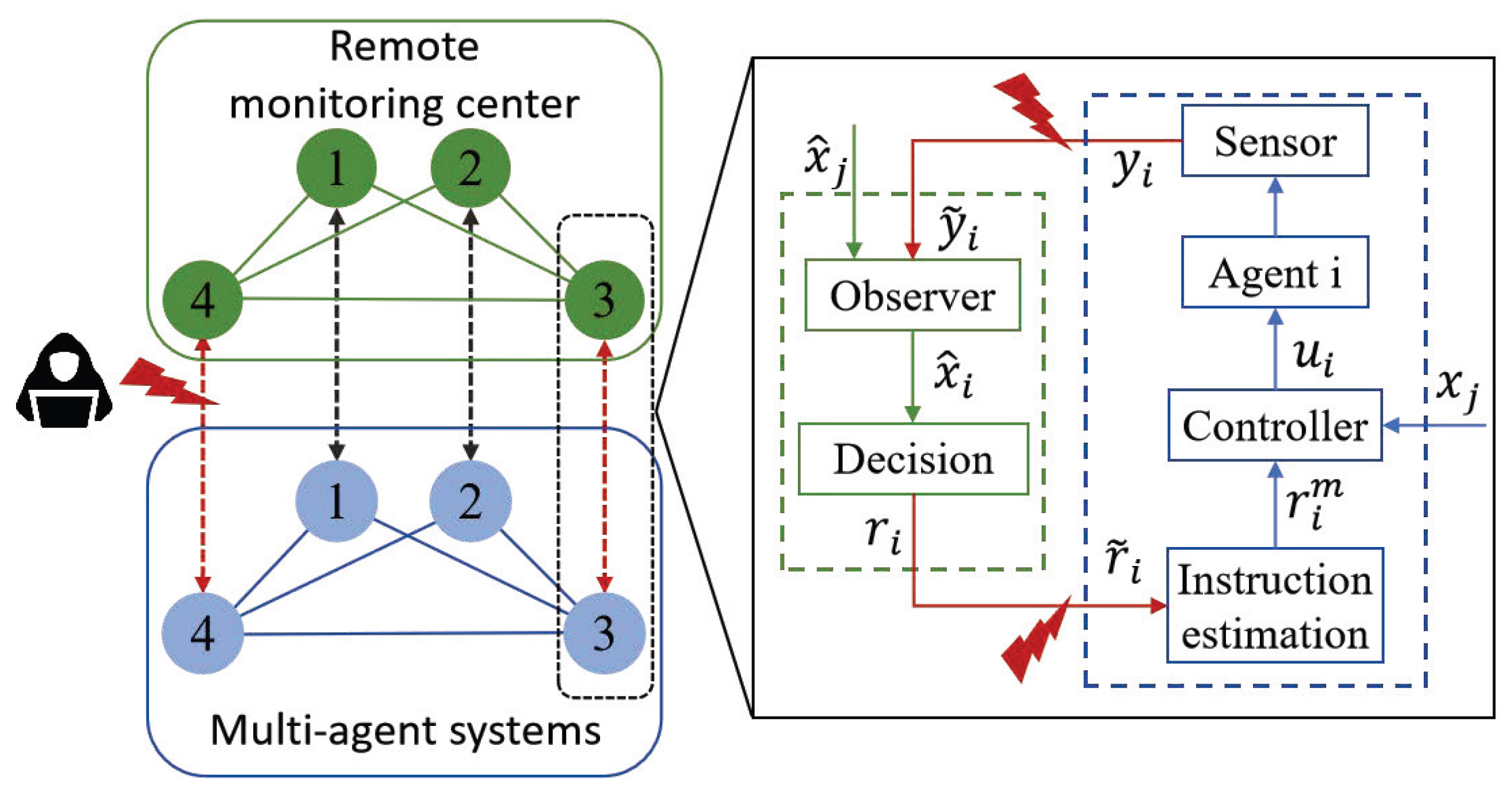
Remote State Estimation and Instruction Adjustment of Multi-Agent Systems Under False Data Injection Attacks


Abstract
1. Introduction
- For dual-channel attacks, an augmented system is constructed to decouple the sensor attacks. Subsequently, a distributed unknown input observer is designed to effectively eliminate the coupling effects of the instruction attacks on the state estimation process. In contrast to [20], where the state estimation remains susceptible to instruction estimation bias, our approach achieves asymptotically unbiased state estimation and enhances robustness against instruction attacks.
- To mitigate instruction channel attacks, a distributed estimation algorithm is developed. This algorithm leverages neighbor-to-neighbor communication and an adaptive saturation function, guaranteeing that all agents’ estimation errors for the reference instruction converge to a bounded region after a finite number of iterations, thereby enhancing system resilience.
2. Preliminaries and Problem Formulation
2.1. Graph Theory
2.2. System Dynamics
2.3. Augmented System Construction
2.4. Problem Statement
3. Design of Distributed Observers Under Dual-Channel Attack
3.1. Distributed Unknown Input Observer for State Estimation
3.2. Distributed Adaptive Saturation Observer for Instruction Estimation
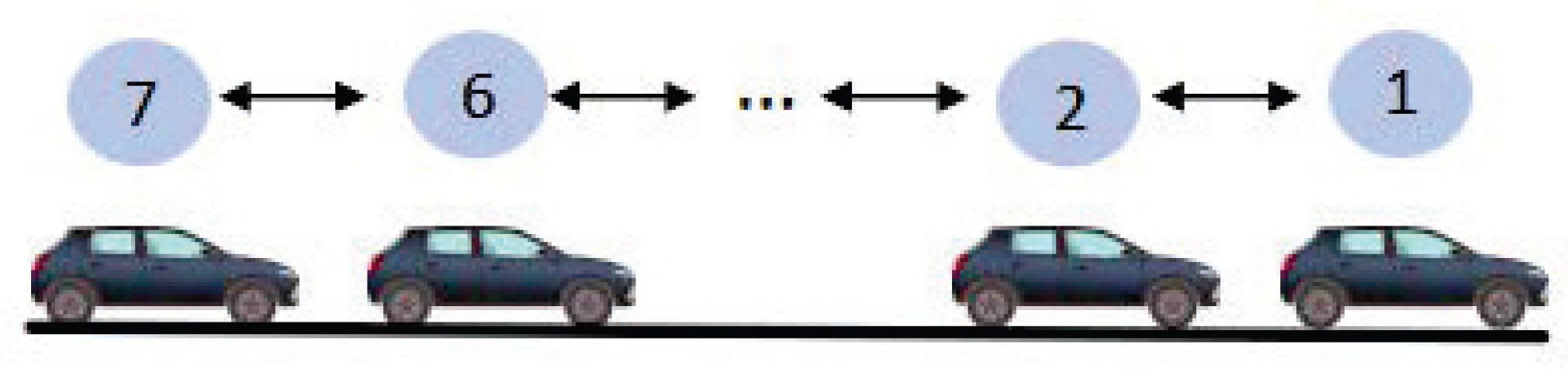
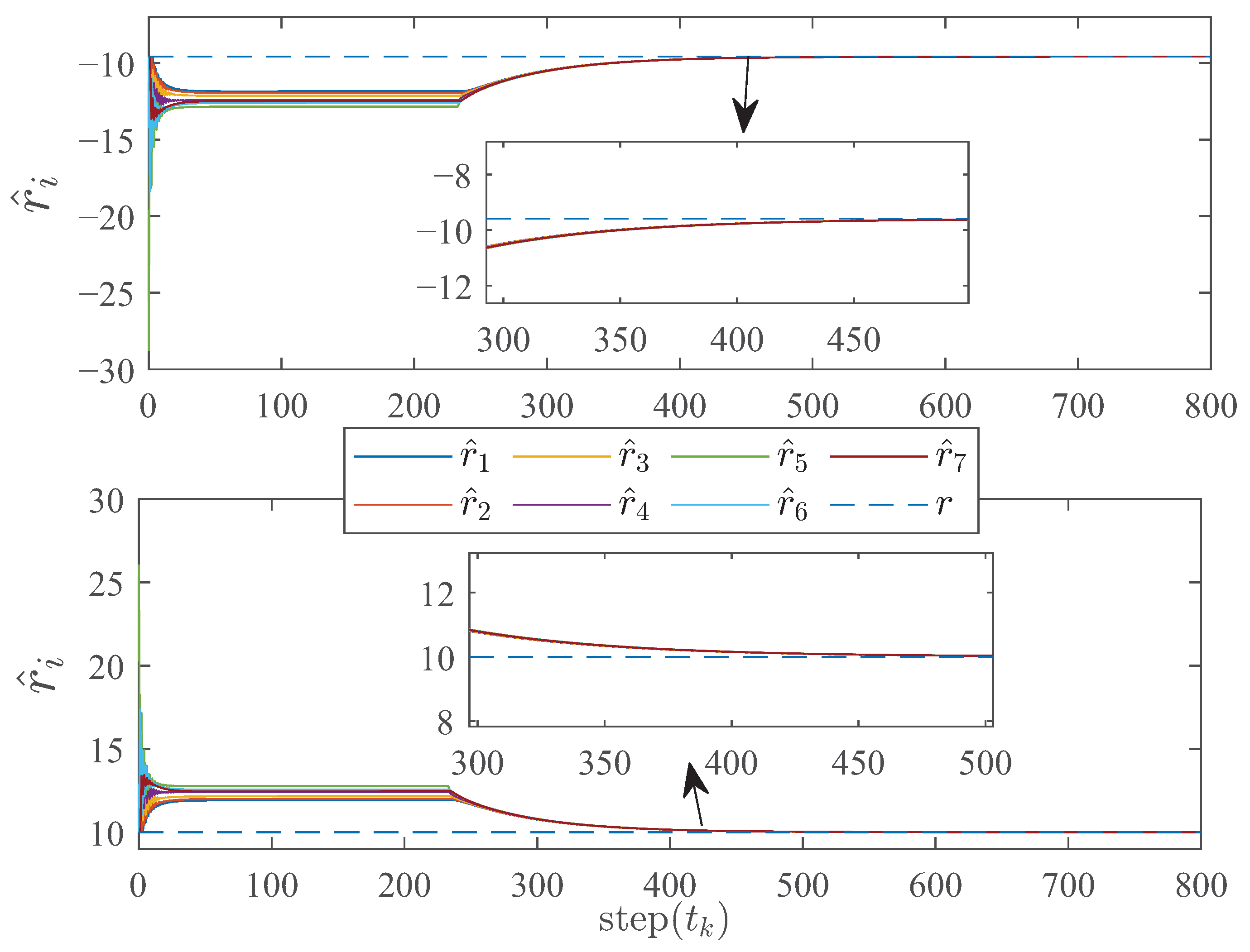
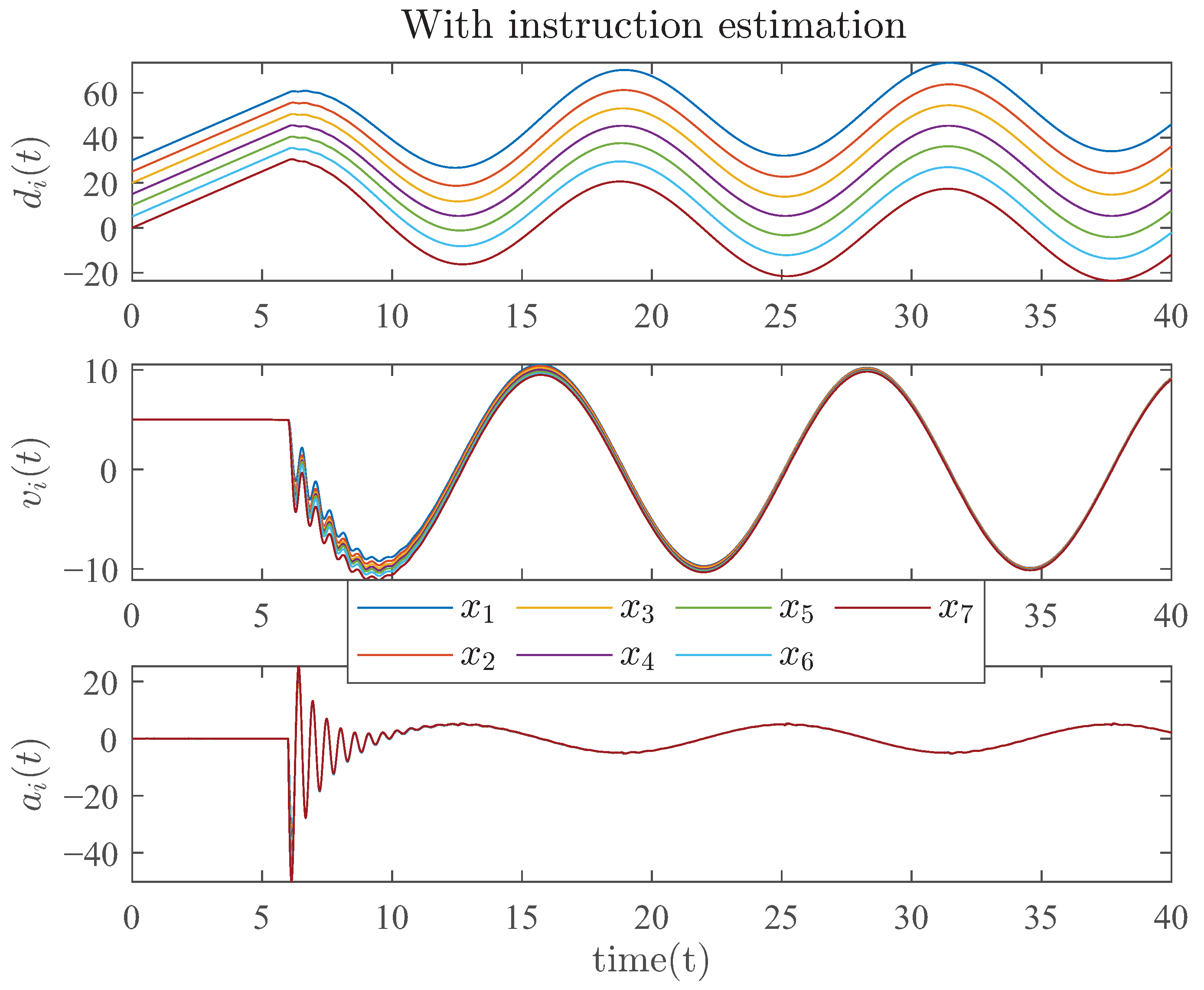
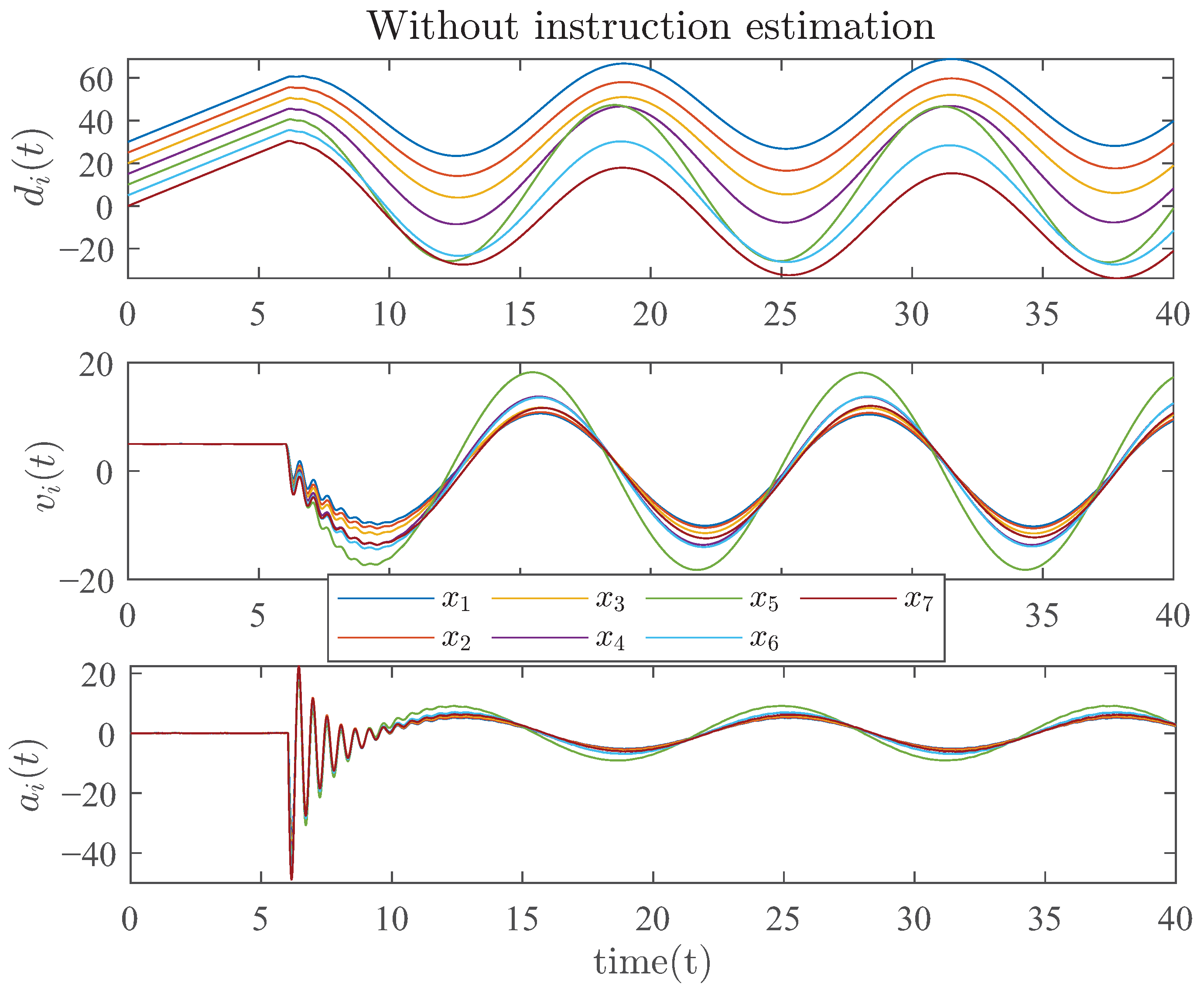
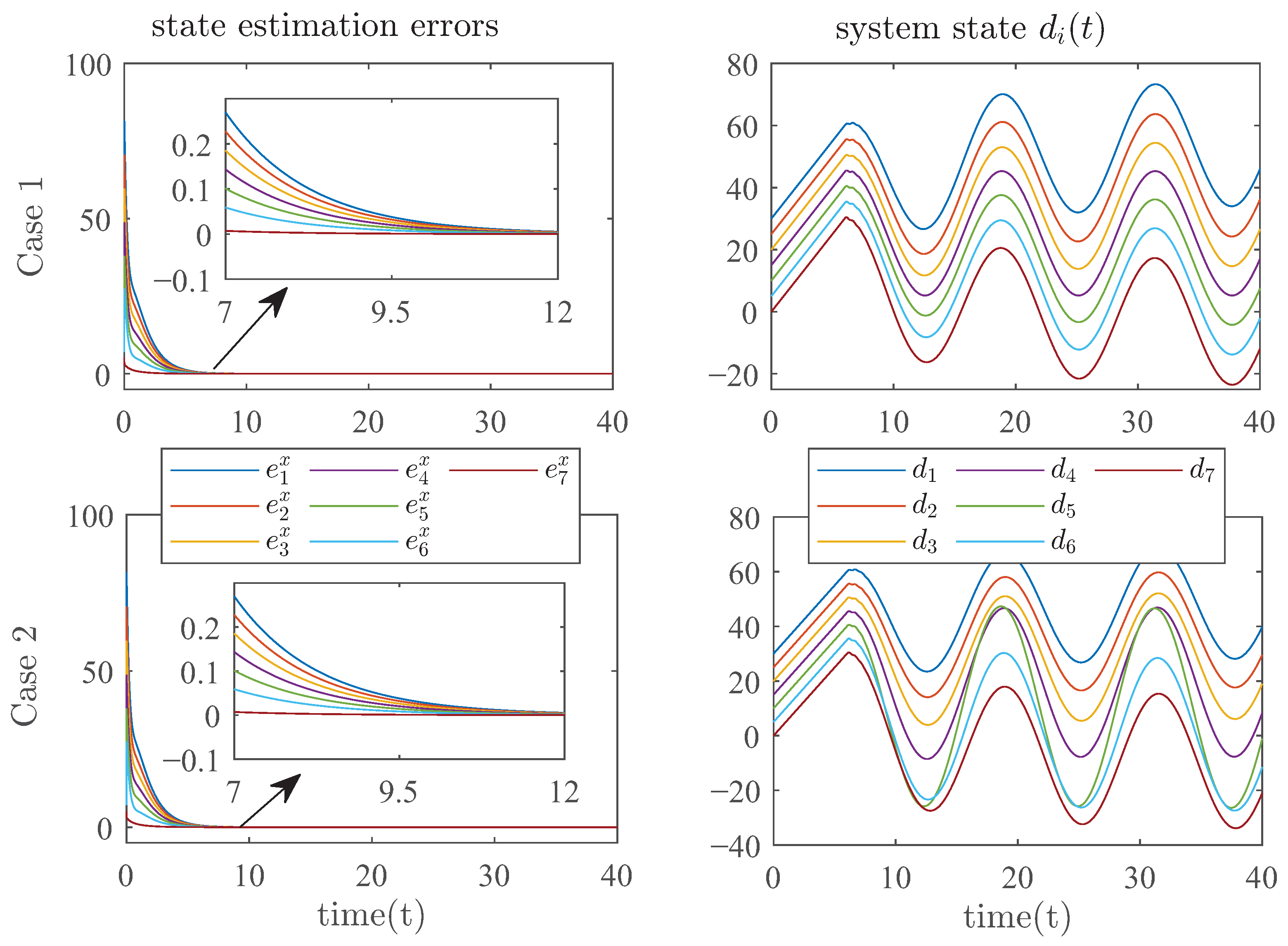
4. Simulation Example
5. Conclusions
Author Contributions
Funding
Institutional Review Board Statement
Informed Consent Statement
Data Availability Statement
Conflicts of Interest
References
- Qin, J.; Ma, Q.; Shi, Y.; Wang, L. Recent advances in consensus of multi-agent systems: A brief survey. IEEE Trans. Ind. Electron. 2017, 64, 4972–4983. [Google Scholar]
- Hou, Y.; Zhao, J.; Zhang, R.; Cheng, X.; Yang, L. UAV swarm cooperative target search: A multi-agent reinforcement Learning Approach. IEEE Trans. Intell. Veh. 2024, 9, 568–578. [Google Scholar]
- Alkhamees, S.N.; Alsaif, S.A.; Bin Salamah, Y. Recent Advances and a Hybrid Framework for Cooperative UAV Formation Control. Appl. Sci. 2025, 15, 9761. [Google Scholar] [CrossRef]
- Nie, Y.; Liu, J.; Liu, X.; Zhao, Y.; Ren, K.; Chen, C. Asynchronous multi-agent reinforcement learning-based framework for Bi-level noncooperative game-theoretic demand response. IEEE Trans. Smart Grid 2024, 15, 5622–5637. [Google Scholar]
- Izmirlioglu, Y.; Pham, L.; Son, T.C.; Pontelli, E. A survey of multi-agent systems for smartgrids. Energies 2024, 17, 3620. [Google Scholar] [CrossRef]
- Duan, Y.; Li, W.; Fu, X.; Luo, Y.; Yang, L. A methodology for reliability of WSN based on software defined network in adaptive industrial environment. IEEE/CAA J. Autom. Sin. 2018, 5, 74–82. [Google Scholar]
- Cavalcante, R.C.; Bittencourt, I.I.; da Silva, A.P.; Silva, M.; Costa, E.; Santos, R. A survey of security in multi-agent systems. Expert Syst. Appl. 2012, 39, 4835–4846. [Google Scholar] [CrossRef]
- He, W.; Xu, W.; Ge, X.; Han, Q.L.; Du, W.; Qian, F. Secure control of multiagent systems against malicious attacks: A brief survey. IEEE Trans. Ind. Inform. 2022, 18, 3595–3608. [Google Scholar] [CrossRef]
- Bijani, S.; Robertson, D. A review of attacks and security approaches in open multi-agent systems. Artif. Intell. Rev. 2014, 42, 607–636. [Google Scholar]
- Wang, Q.; Qian, Y.; Lu, A.Y. Data and model-based switching observer for cyber-physical systems against sparse sensor attacks. Int. J. Syst. Sci. 2025, 1–13. [Google Scholar] [CrossRef]
- Lu, A.Y.; Yang, G.H. A polynomial-time algorithm for the secure state estimation problem under sparse sensor attacks via state decomposition technique. IEEE Trans. Autom. Control 2023, 68, 7451–7465. [Google Scholar]
- Zhang, J.; Ma, Y. Complex dynamic networks for multiple attacks: A jump-like event-triggered controller based on neural network model. IEEE Trans. Netw. Sci. Eng. 2024, 11, 4470–4480. [Google Scholar]
- Wang, J.; Wang, D.; Yan, H.; Shen, H. Composite antidisturbance control for hidden Markov jump systems with multi-sensor against replay attacks. IEEE Trans. Autom. Control 2024, 69, 1760–1766. [Google Scholar]
- Zhang, Y.; Peng, Z.; Wen, G.; Wang, J.; Huang, T. Optimal stealthy linear man-in-the-middle attacks with resource constraints on remote state estimation. IEEE Trans. Syst. Man Cybern. Syst. 2024, 54, 445–456. [Google Scholar]
- Wang, J.; Feng, T. Securing Remote State Estimation against Sequential Logic Attack of Sensor Data. Appl. Sci. 2022, 12, 2259. [Google Scholar] [CrossRef]
- Gong, Z.; Yang, F.; Liu, C.; Ma, Z. Distributed dynamic event-triggered control for multiagent systems under FDI attack via ESN-based adaptive dynamic programming. IEEE Trans. Cybern. 2025, 55, 3663–3674. [Google Scholar] [CrossRef] [PubMed]
- Zhang, S.Q.; Che, W.W.; Deng, C. Observer-based event-triggered control for linear MASs under a directed graph and DoS attacks. J. Control Decis. 2022, 9, 384–396. [Google Scholar]
- Fan, S.; Yue, D.; Wang, B.; Deng, C.; Yan, H. Distributed optimization for uncertain nonlinear MASs under event-triggered communication. Automatica 2025, 177, 112134. [Google Scholar] [CrossRef]
- Zou, L.; Liu, X.; Zhang, X.; Su, H. Resilient consensus for multi-agent systems under distributed denial-of-service attacks: A graph-based approach. J. Control Decis. 2024, 1–13. [Google Scholar] [CrossRef]
- Lei, X.; Wen, G.; Zheng, W.X.; Fu, J. Security strategy against location-varying sparse attack on distributed state monitoring. IEEE Trans. Autom. Control 2024, 69, 2514–2521. [Google Scholar]
- Tabatabaei, H.; Gallo, A.J.; Al-Dabbagh, A.W. Secure state and output estimation for accommodation of false data injection attacks in large-scale systems. Automatica 2025, 180, 112460. [Google Scholar] [CrossRef]
- Shi, M.; Wan, N. Estimate the states of multiagent systems under homologous attacks by optimization Approaches. IEEE Trans. Control Netw. Syst. 2023, 10, 430–440. [Google Scholar] [CrossRef]
- Shi, Y.; Wang, Y. Online secure state estimation of multiagent systems using average consensus. IEEE Trans. Syst. Man Cybern. Syst. 2022, 52, 3174–3186. [Google Scholar] [CrossRef]
- Lu, A.Y.; Yang, G.H. Secure State Estimation Under Sparse Sensor Attacks Via Saturating Adaptive Technique. IEEE Trans. Control Netw. Syst. 2023, 10, 1890–1898. [Google Scholar] [CrossRef]
- Zuo, S.; Wang, Y.; Rajabinezhad, M.; Zhang, Y. Resilient Containment Control of Heterogeneous Multiagent Systems Against Unbounded Attacks on Sensors and Actuators. IEEE Trans. Control Netw. Syst. 2024, 11, 1537–1547. [Google Scholar] [CrossRef]
- Wang, B.Q.; Guo, X.G.; Wang, J.L.; Coutinho, D.; Park, J.H. Unknown-Input-Proportional-Differential Observer-Based Event-Triggered Intrusion-Tolerant Control for Human-in-the-Loop Multi-Agent Systems Against Unconstrained Actuator and Sensor FDIAs. IEEE Trans. Autom. Sci. Eng. 2025, 22, 15701–15712. [Google Scholar] [CrossRef]
- Ding, S.; Ai, H.; Xie, X.; Jing, Y. Distributed Adaptive Platooning Control of Connected Vehicles with Markov Switching Topologies. IEEE Trans. Intell. Transp. Syst. 2024, 25, 18421–18432. [Google Scholar] [CrossRef]
- Halder, K.; Montanaro, U.; Dixit, S.; Dianati, M.; Mouzakitis, A.; Fallah, S. Distributed H∞ Controller Design and Robustness Analysis for Vehicle Platooning Under Random Packet Drop. IEEE Trans. Intell. Transp. Syst. 2022, 23, 4373–4386. [Google Scholar] [CrossRef]



| References | Architecture | Attack Types | Control Input | Disturbance | Stability |
|---|---|---|---|---|---|
| [21] | Distributed | Sensor attacks | unknown | ✗ | asymptotic stability |
| [22,23] | Distributed | Sensor attacks | known | ✗ | asymptotic stability |
| [24] | Centralized | Sensor attacks | known | ✓ | asymptotic stability |
| [20,25] | Distributed | Sensor attacks and instruction attacks | unknown | ✗ | Bounded |
| [26] | Distributed | Sensor attacks and instruction attacks | known | ✓ | Bounded |
| Proposed | Distributed | Sensor attacks and instruction attacks | unknown | ✓ | asymptotic stability |
| Method | RMSE1 | RMSE2 | Convergence Time |
|---|---|---|---|
| Case 1 | 0.0872 | 0.5299 | 25.8 |
| Case 2 | 3.274 | 3.9177 | Periodic oscillation |
Disclaimer/Publisher’s Note: The statements, opinions and data contained in all publications are solely those of the individual author(s) and contributor(s) and not of MDPI and/or the editor(s). MDPI and/or the editor(s) disclaim responsibility for any injury to people or property resulting from any ideas, methods, instructions or products referred to in the content. |
© 2025 by the authors. Licensee MDPI, Basel, Switzerland. This article is an open access article distributed under the terms and conditions of the Creative Commons Attribution (CC BY) license (https://creativecommons.org/licenses/by/4.0/).
Share and Cite
Wang, Q.; Qian, Y.; Lu, A.-Y. Remote State Estimation and Instruction Adjustment of Multi-Agent Systems Under False Data Injection Attacks. Appl. Sci. 2025, 15, 12734. https://doi.org/10.3390/app152312734
Wang Q, Qian Y, Lu A-Y. Remote State Estimation and Instruction Adjustment of Multi-Agent Systems Under False Data Injection Attacks. Applied Sciences. 2025; 15(23):12734. https://doi.org/10.3390/app152312734
Chicago/Turabian StyleWang, Qingjie, Yining Qian, and An-Yang Lu. 2025. "Remote State Estimation and Instruction Adjustment of Multi-Agent Systems Under False Data Injection Attacks" Applied Sciences 15, no. 23: 12734. https://doi.org/10.3390/app152312734
APA StyleWang, Q., Qian, Y., & Lu, A.-Y. (2025). Remote State Estimation and Instruction Adjustment of Multi-Agent Systems Under False Data Injection Attacks. Applied Sciences, 15(23), 12734. https://doi.org/10.3390/app152312734