


Abstract
Categorization of space time block code (STBC) signals has become widely acknowledged as a crucial foundational mechanism for creating intelligent wireless transmissions in both the governmental and business sectors. The use of multiple antennas at a broadcaster complicates a signal categorization task because assumptions about the number and transmission matrix of the sent antennas must be made. STBC categorization has only been investigated in the context of non-relaying environments, and no methods for relaying transmissions have been reported. This work proposes a revolutionary strategy for categorizing STBC signals that can be implemented in amplify-and-forward (AF) relaying networks. Time-domain characteristics of the STBC waveforms provide the basis of the mathematical ingredients used in the offered categorization process. The employed STBC waveform is reflected in the spikes observed in the fast Fourier transform of the second-order lag product of the collected waveforms. This creates the foundation for an effective discriminating feature. Advantages of the described strategy include not requiring any prior awareness of the modulation type, channel conditions, signal-to-noise ratio (SNR), or the block timing synchronization of the STBC waveforms. The indicated strategy has been shown through simulation experiments to be capable of providing appropriate categorization accuracy despite the existence of transmission faults, even at relatively low SNR levels.
1. Introduction
Radio telecommunications are susceptible to fading and fluctuations in signal intensity, which can result in a significant deterioration in system efficacy. Multiple-input multiple-output (MIMO) systems are a group of strategies that have proven effective in practice for dealing with this issue [1,2,3]. The fundamental concept underlying these systems is to take advantage of the scattering environment formed by multiple antennas to maximize the achieved reliability and throughput. The two principal categories of MIMO structures are known as spatial diversity and spatial multiplexing. The former improves the reliability by capitalizing on the fact that copies of the broadcast signal in both time and space arrive at the receiver influenced by distinct fading coefficients. The latter raises throughput by transmitting numerous distinct data streams into MIMO channels. In today’s world, MIMO systems are at the center of a number of cutting-edge communications technologies, including mobile communications, such as High-Speed Packet Access (HSPA) and Long Term Evolution (LTE) [4]. Further, they are essential to the evolution of the area of 5G and beyond [5]. Additionally, the Institute of Electrical and Electronics Engineers (IEEE) has incorporated MIMO approaches for WI-FI systems, such as IEEE802.11n and IEEE802.11ac [6].
A further giant leap forward in the development of wireless communication networks is the appearance of cooperative technologies. Various stations in a network collaborate in cooperative communications by bouncing each other’s data, establishing a virtualized antenna array, and achieving distributed spatial diversity. The enhanced functionality of cooperative communications, such as connection consistency, capacity, broadcasting range, and simplicity of deployment, has caught the attention of researchers and developers across academia and private sectors [7,8]. Two stages are commonly included in the construction of a radio cooperative broadcast. In the first stage, data simultaneously propagate from the source node to the relay and final destination. During the subsequent stage, the source is idle while the relay forwards the data to its intended destination. The relay’s processing of the signal sent by the originating node is a crucial aspect of cooperative transmissions. Multiple handling approaches give rise to relaying protocols, such as amplify-and-forward (AF) and decode-and-forward (DF) [9,10]. The former is one of the fundamental cooperative techniques, such that a relay merely passes a scaled form of the collected signals. The latter is another frequent option, in which the relay detects the incoming signals and re-encodes them before broadcasting them to the endpoint. The destination reaches a judgment by integrating information from the source and relays. Spatial diversity is always possible due to the fact that the destination gets many copies of the signal across several independent pathways.
The process of signal categorization (SC) comprises the gathering of a variety of illustrative properties that can be used to identify the sent signal from a variety of other alternatives [11,12,13]. This is necessary in order to guarantee accurate demodulation of the received waveforms and effective restoration of the sent data. This technology has been used in a variety of contexts, including military, government, and business services [14,15,16].
The military’s use of SC technology stems from the need to identify terrorist transmitters, design obstructing emitters, and recover recorded waveforms as part of electronic warfare and threat assessment [17,18,19]. Modulation style, error-correcting code, and multiple antenna design are just a few of the many transmission characteristics used by modern industrial transmitters to optimize data rate and bandwidth utilization while preserving a targeted level of service quality [20,21]. Each terminal in the broadcast network should be aware of all transmission settings. While the parameters may be dynamically adjusted at the source to accommodate channel conditions, the destination may be unaware of this. As a result, the destination must have signal categorization methods in place to ensure that the information is demodulated securely. SC technology has been integrated into numerous existing wireless technical regulations, including those for mobile phones, wireless local area networks, and microwave schemes [22,23]. Radio surveillance using SC algorithms is also utilized by government entities to verify compliance with spectrum management legislation. This guarantees consistent and reliable connectivity between police officers, fire services, civil aviation, and military services [24,25].
1.1. Related Works
There has been a lot of study into many different aspects of SC, such as the categorization of modulators [24,25,26], error-control encoders [27,28], multi-carrier transmissions [11,12,13], and space-time block coding (STBC) [29,30,31,32,33] broadcasts. Since STBC categorization is the primary emphasis of this research, the accompanying discussion provides a context on recent advances in this field.
In single-carrier broadcast scenarios, the STBC signals Alamouti (AL) and spatial multiplexing (SM) across Nakagami channels were recognized using a collection of techniques that depend on higher-order statistics [29]. These techniques utilized a receiver equipped with a single antenna and depended on the fourth-order moment as the distinguishing characteristic. Signals from two antennas may be analyzed for their cyclostationarity, which allowed for discrimination between several STBC signals under conditions of varied transmission defects [30,31]. It was attainable to distinguish between AL and SM STBC waveforms by making use of the dispersion attributes of multipath wireless channels [32]. It was shown that AL generated peaks at a certain set of time delays in the cross-correlation function of two separate intercepted signals, but SM does not. The maximum likelihood notion and the false alarm rate criterion formed the basis for two suggested identification algorithms. Assuming perfect synchronization on the receiving end, three maximum likelihood procedures, the optimum identifier, the second-order statistic recognizer, and the code parameter estimator were developed for blind identification of STBC signals [34]. It was demonstrated in [35] that with ideal timing alignment and under appropriate conditions of a full rank channel and a number of receive antennas greater than or equal to the number of sent antennas, the Frobenius norms of these statistics possessed non-null qualities whose locations only depend on the STBC used at the sender end. This was utilized to categorize five STBC signals. Intelligent signal categorization of STBC was reported in [36], utilizing a convolutional neural network (CNN) with multi-delay features fusing approach. Two fusion approaches were presented to integrate the characteristics of various time delays, and a residual block was utilized to provide more discriminating characteristics. The challenge of STBC identification for orthogonal frequency division multiplexing (OFDM) systems operating over frequency-selective channels was introduced in [37,38]. A binary hypothesis test for decision-making was designed by taking advantage of the space-time redundancy. Space frequency block code (SFBC) signals are distinguished from one another by analyzing the time-domain correlation functions of signals acquired by a pair of antennas [33]. The reported method consisted of two distinct phases. In the first stage, the cross-correlation function of pairs of signals received from various antennas was estimated, and in the second step, a false-alarm dependent assessment was used for effective decision-making. The challenge of STBC recognition and channel estimation for multi-user asynchronous uplink transmissions in single carrier frequency division multiple access (SC-FDMA) systems was investigated in [39]. Mathematical investigation proved that the space alternating generalized expectation maximization method could be used to provide an iterative solution to the maximum-likelihood problem of STBC identification, channel estimation, and synchronization. An iterative expectation maximization approach was proposed in [40] to create a maximum likelihood classifier that could differentiate between SFBC-OFDM signals utilizing the soft outputs of a channel decoder over unknown wireless channels. Modulation types and STBC formats were simultaneously identified in [41] over undetermined multipath links while waiving the need to have more antenna elements at the recipient than at the sender. Theoretical procedures illustrated that a maximum likelihood solution is derived by an iterative expectation maximization technique that included the complementary process of channel awareness.
1.2. Novelty and Contributions
In previous publications on the categorization of STBCs, only non-relaying emissions were investigated. Nevertheless, relaying communications is increasingly valued in practical settings. The most interesting new aspects and useful contributions of this study are described below.
- We create an STBC categorization approach for use in AF relaying networks.
- The structure of the gathered signals is mathematically employed to produce a collection of second-order correlation functions that serve as the foundation for the categorization technique.
- Keeping this finding characteristic in mind, we design two novel evaluation tests based on the idea of a fast Fourier transform (FFT) process.
- The described solution’s strengths include its independence from channel status information, noise power, modulation schemes, and the beginning of STBC blocks.
- The given strategy is adaptable in that it can recognize many STBC waveforms so long as the correlation functions produce pulses for certain waveforms and not others.
The following provides an overview of the remaining tasks. Section 2 explains the system architecture and problem description. Section 3 discusses the correlation functions of different STBCs waveforms over AF relaying schemes. Section 4 develops the proposed STBC categorization approach. Section 5 describes the simulation outcomes. This research is concluded in Section 6.
2. Signal Architecture and Problem Description
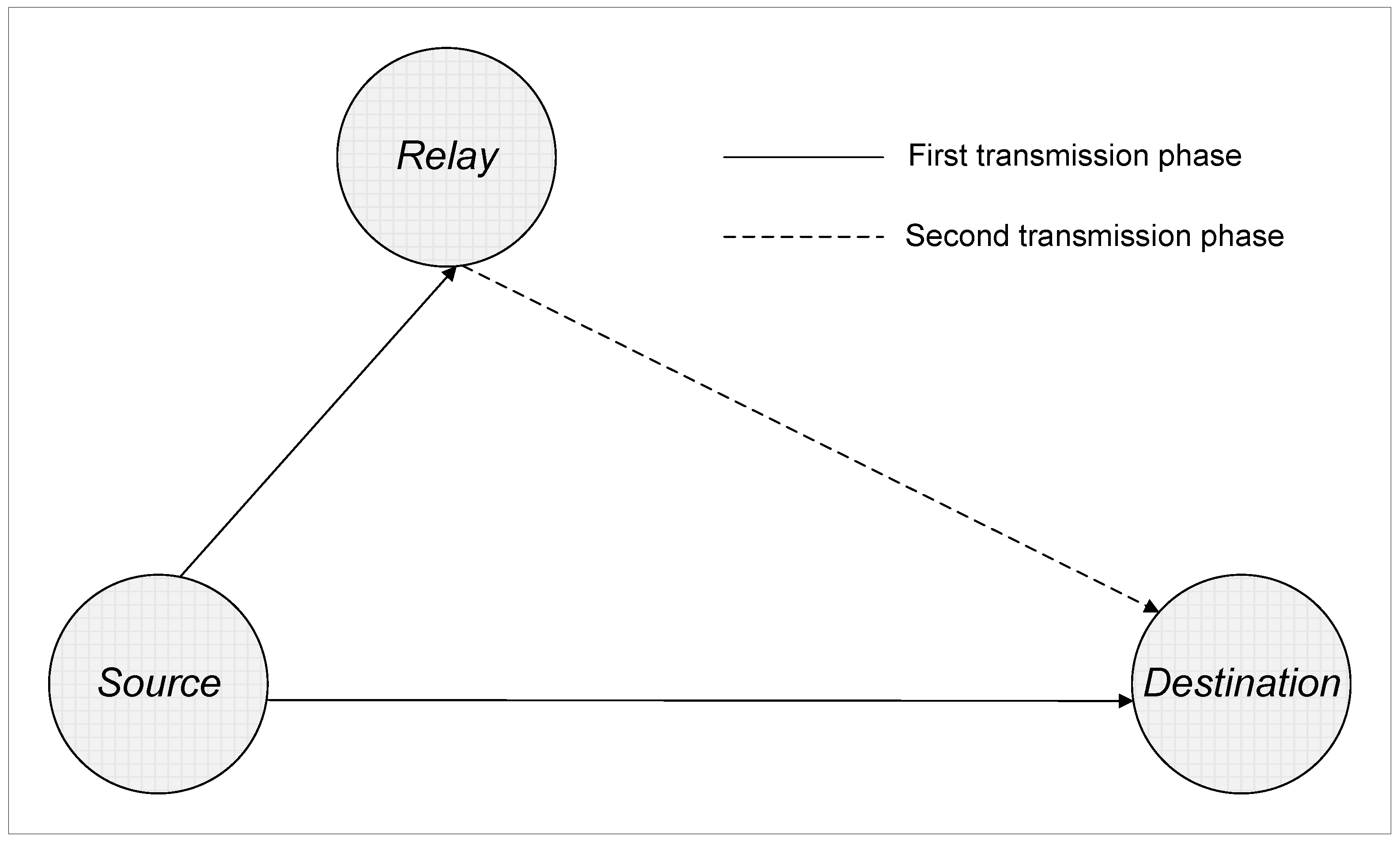
We consider a relaying broadcast scheme with source , relay , and destination terminals, as described in Figure 1. The half-duplex mechanism is used by , such that it sends and receives data at distinct times. An STBC option is selected by from a collection of alternative choices . A packet of transmitted information is divided into portions, each of which is made up of symbols chosen at random from a signal constellation. The bth portion is converted by the encoder of STBC into a sent matrix , which is then transmitted from antennas at time intervals. To illustrate, we assume that where is the ith STBC option, and its transmitted matrix is described as
where is a conjugate of a complex number.

Figure 1.
The relaying scheme under consideration.
- In (1a), the portion , which includes two elements, is sent from a pair of antennas in one time interval, .
- In (1b), the portion , which includes two elements, is sent from a pair of antennas in two time intervals, .
- In (1c), the portion , which includes three elements, is sent from three antennas in four time intervals, .
- In (1d), the portion , which includes four symbols, is sent from four antennas in eight time intervals, .
We create the combination of all STBC portions sent from antenna q, as , where is the ith element of the bth portion sent from antenna q of STBC code . The process of transmitting the vectors consists of two stages that occur in sequence. In the first phase, the terminal sends data to the and terminals, and in the second phase, the terminal sends data to the node.
The collected nth element at the relay, , and the destination, , during the first stage is mathematically represented, respectively, as follows:
where and are the link coefficients between the source antenna q and relay, and between the source antenna q and destination at the time interval t, respectively, is the nth element of vector , and are the noise contributions at the relay and destination nodes, respectively, and is the Kronecker delta function. Since the terminal only receives data in one time slot, the channel coefficient between the source and relay omits the superscript value t. The node, on the other hand, collects data in two time slots. The nth element emitted by the node during the second phase is denoted as , where is the scaling parameter defined as
where is the noise variance. Therefore, the nth element collected by the node during the second stage is expressed as
where is the link coefficient between the and nodes and is the noise component.
3. Properties of Different STBCs Signals
The major purpose here is to determine the STBC option used by the node by using the collected signals and acquired at the endpoint. To that aim, we investigate the properties of correlation functions of and to explore whether we can extract the outstanding properties for STBC categorization. The preceding are the main assumptions used during the research.
- The information symbols provided by the node are unrelated to one another.
- Neither the sent signals nor the noise are statistically independent of one another.
- Neither the nor the nodes’ noise samples are related to one another. The noise samples in the first and second rounds of transmissions are unrelated at the endpoint.
- The channel parameters stay constant during the observational window.
We define a correlation as follows
where is the time lag, and is the statistical mean operator. The accompanying formulations are written for the codes of , and . The analysis is flexible enough to be applied to various coding systems, and these signals are used as descriptors.
3.1. First STBC Option,
3.2. Second STBC Option,
3.3. Third STBC Option,
3.4. Fourth STBC Option,
4. Suggested Categorization Approach
As was formerly demonstrated, the spike positions of the correlation function vary between STBC types. This trend acts as a distinctive characteristic, and a test is used to determine whether has spikes or not. The assessment of the following technical issues is essential to the categorization procedure.
- Considering the realistic limitations of the surveillance range, the issue of how to calculate the correction function, , emerges.
- Accordingly, the presence of non-zero values at positions where should be zeros results from an estimation error of . Because of this, the judgment about the existence of the peaks of is influenced. Therefore, in the event of a non-ideal estimator, even in the absence of background understanding of channel information, the start of STBC blocks, and noise characteristics, a judgment criterion must be constructed.
To counteract these challenges, we provide FFT-based spike detection techniques. A series of samples of length M where , 1, and are taken and analyzed. Here we denote as an unknown propagation delay to emphasize the absence of details regarding the beginning of STBC blocks. It is important to note that the strategy that has been given does not need the knowledge of the unknown propagation delay, as will be detailed further on. Define the sequence
Since the value of a random variable is stated as the summation of its mean and an additional random variable with zero means, can be expressed as
where is a zero-mean random variable that departs from the mean. After digging deep into (8), (10), (12), and (14), we write the sequence as
where
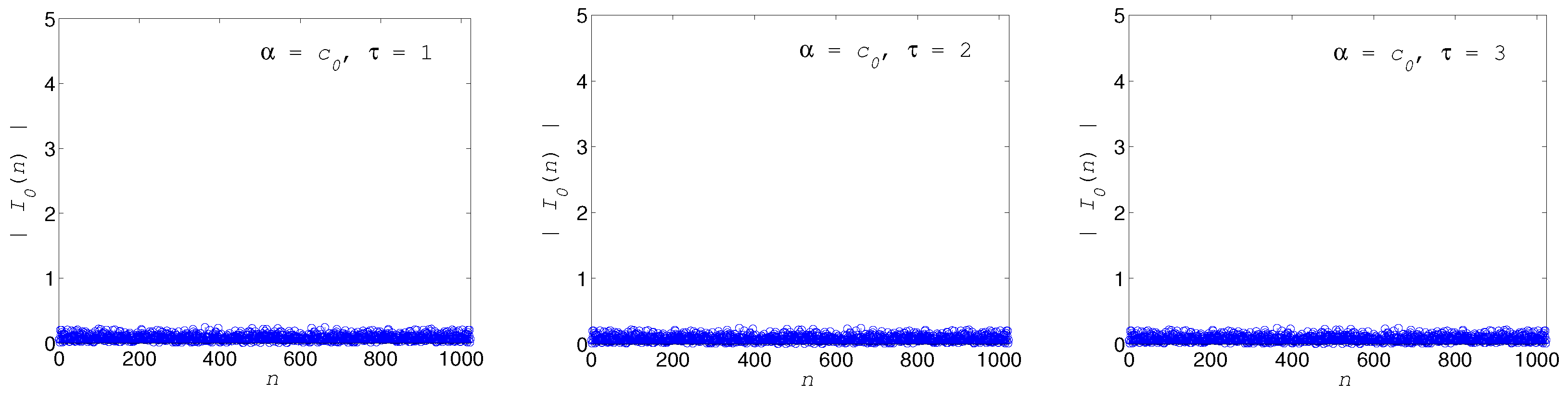
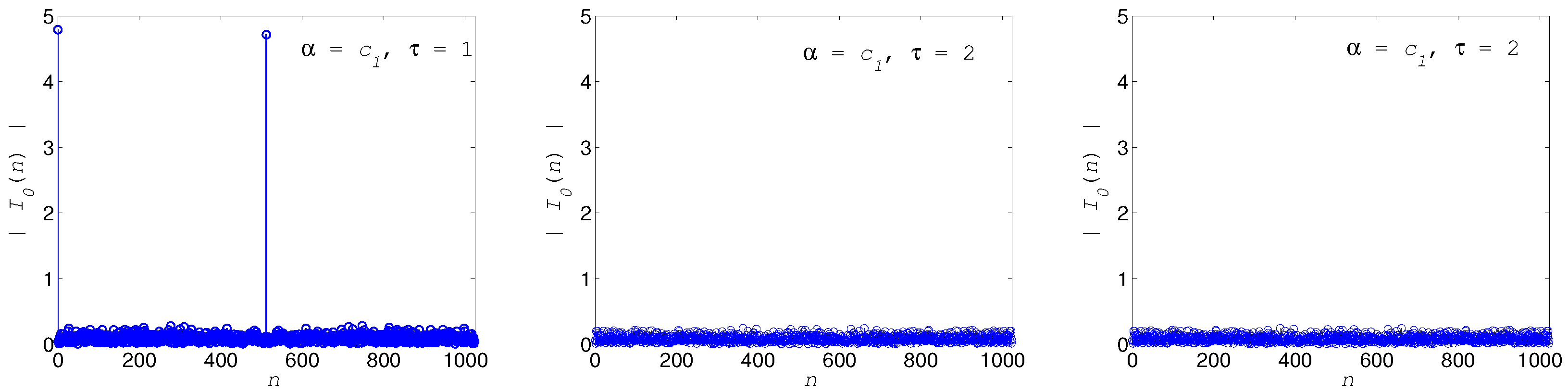
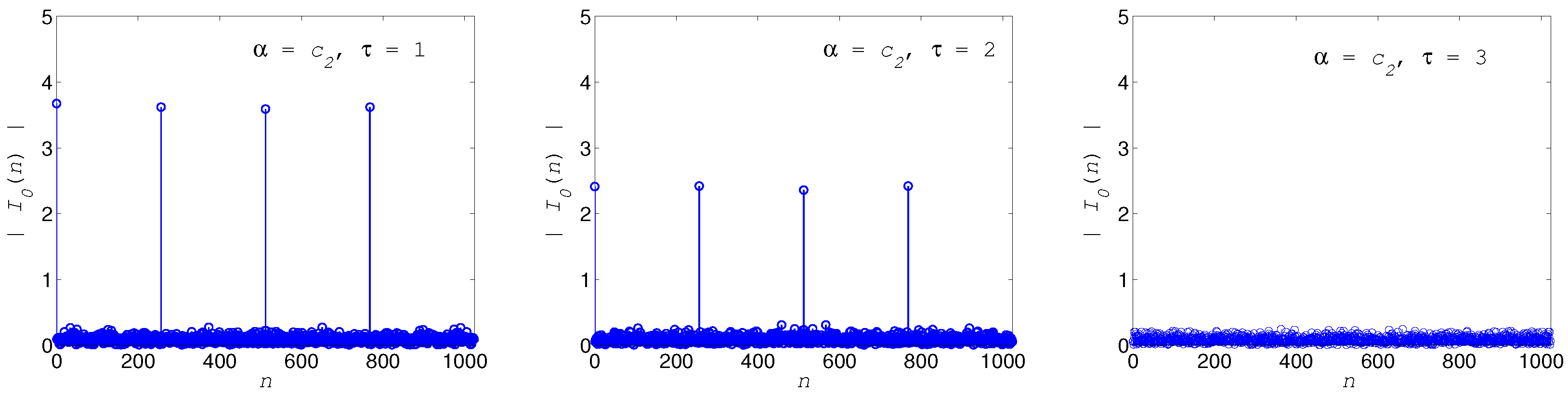
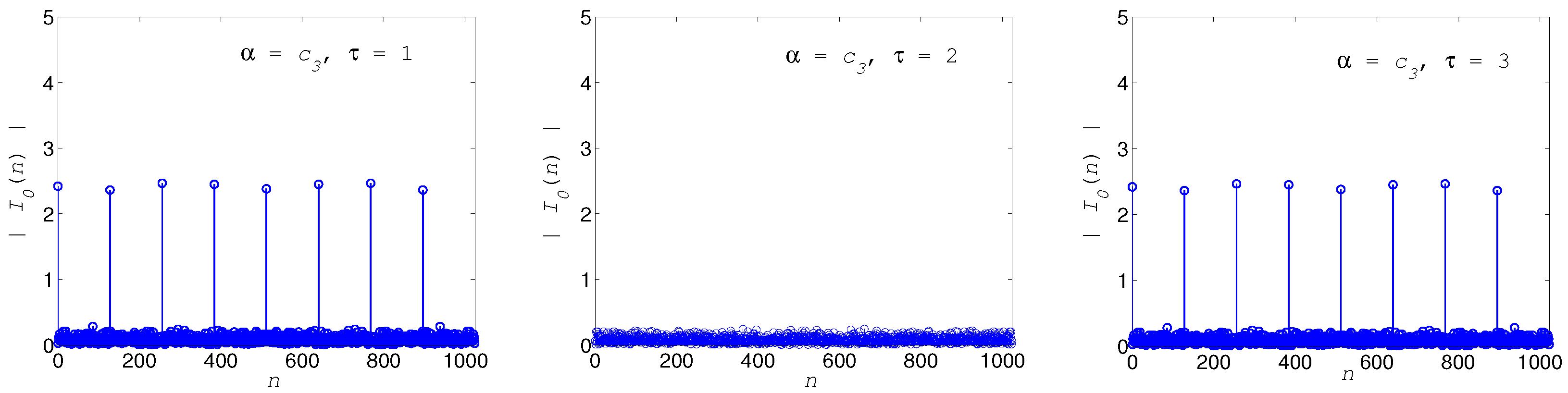
The sequence represents the result of applying the FFT algorithm to the input sequence . Figure 2, Figure 3, Figure 4 and Figure 5 show the absolute value of for STBC at The findings indicate that the STBC does not show spikes, the STBC show spikes when at the FFT bins 0 and , the STBC show spikes when and at the FFT bins 0, , , and , and the STBC show spikes when and at the FFT bins 0, , , , , , , and . We propose two algorithms for categorizing STBC signals relying on these properties of the FFT outputs. We define the following three sequences.
The FFT outputs of these sequences are designated as , and . We define and as the locations of the first two maximum values of sequence The first four greatest values of sequence are identified by the coordinates , , , and , respectively. The first eight greatest values of sequence are identified by their positions ,
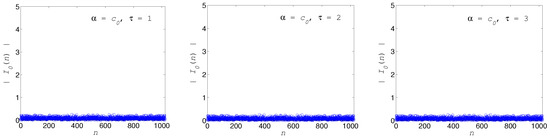
Figure 2.
The absolute value of the FFT output of sequence at different values of for .

Figure 3.
The absolute value of the FFT output of sequence at different values of for .

Figure 4.
The absolute value of the FFT output of sequence at different values of for .
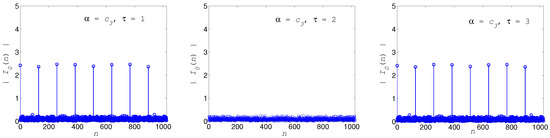
Figure 5.
The absolute value of the FFT output of sequence at different values of for .
5. Simulation Results
Monte Carlo simulations have been used to validate the efficacy of the proposed approach. The average probability of correct categorization, represented by , has been employed as the performance metric where is the cardinality of . Here, describes the probability that a particular code, , was correctly recognized while it was employed by the node. In the absence of any further instructions, the system functions with the following settings.
- The number of observable symbols is
- The utilized modulation style is 64-QAM.
- The channel tap is defined for each broadcast connection as a zero-mean complex-valued Gaussian unexpected quantity.
- The variance of the channel values is , and . Here q is the transmit antenna index, and refers to the time-slot index.
- Each simulation is repeated 2000 times.
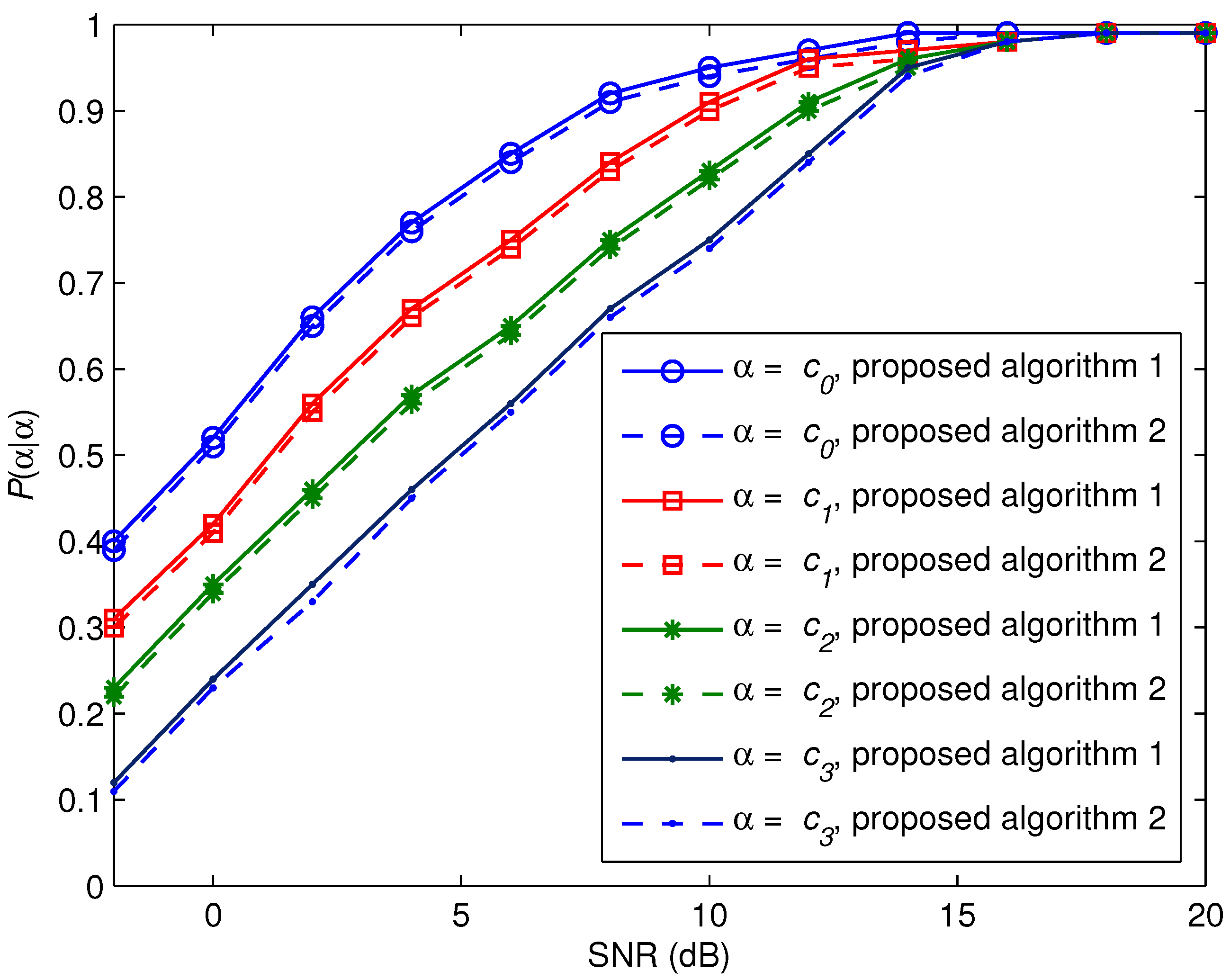
Figure 6 displays the given approach’s accuracy as a function of SNR. When the signal-to-noise ratio (SNR) is increased, both of the proposed algorithms behave much better. For example, if is used at the source, the probability of correctly identifying the adopted STBC at the destination using both offered methods grows from 0.78 to 0.99 as SNR increases from 5 to 15 dB. There is no noticeable increase in the performance of all codes under consideration when SNR has reached 12 dB. In addition, the functionality of the two solutions that are being provided does not vary markedly in any way. This is due to the fact that both of them rely on the same information, which is based on the peaks that are potentially accessible at certain places.
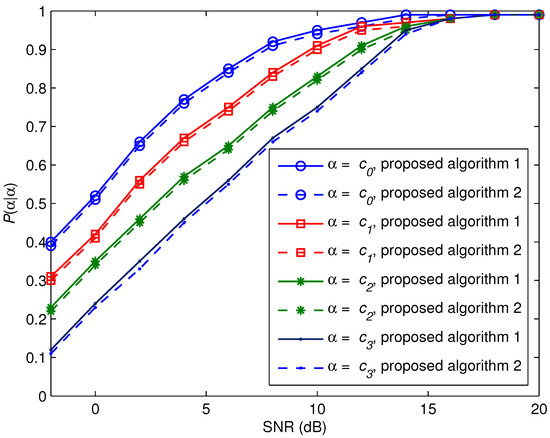
Figure 6.
The categorization efficacy of the proposed solution as a function of SNR.
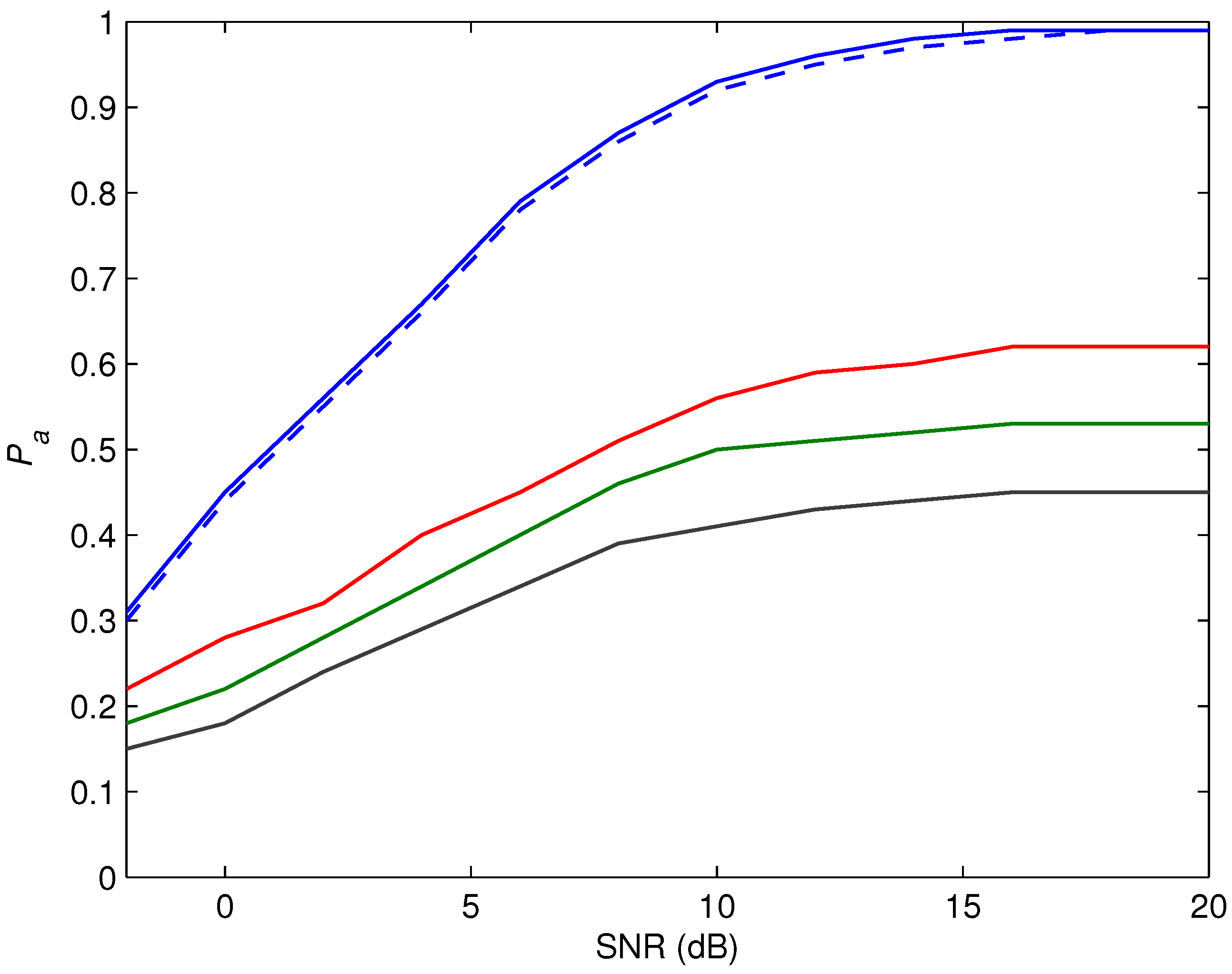
Figure 7 is a representation of the categorization performance that was gained by applying the proposed solutions in addition to that which were disclosed in [29,30,40] for comparison purposes. According to the findings, the proposed strategies perform better than those that have been previously reported. For instance, as SNR reaches 20 dB, the average probability identification of the offered solutions is 0.99, where Ref. [29] gives 0.52, Ref. [30] yields 0.42, and Ref. [40] accomplishes 0.35. The justification for this is that the relay connection utilized in cooperative broadcasts is discarded by the techniques outlined in [29,30,40]. Furthermore, Ref. [29] employs higher-order statistics that necessitate a massive portion of information to offer satisfactory achievement, Ref. [30] implies extra receive antennas, and Ref. [40] requires channel, modulation, and timing synchronization information, whereas the proposed solutions do not.
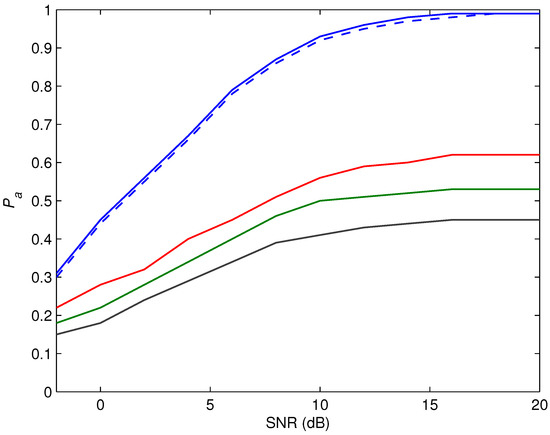
Figure 7.
The efficacy of the proposed strategy in comparison to current solutions. The proposed algorithm 1 is represented by the solid blue line, the proposed algorithm 2 is indicated by the dashed blue line, and the algorithms of [29,30,40] are shown by the solid red, green, and black lines, respectively.
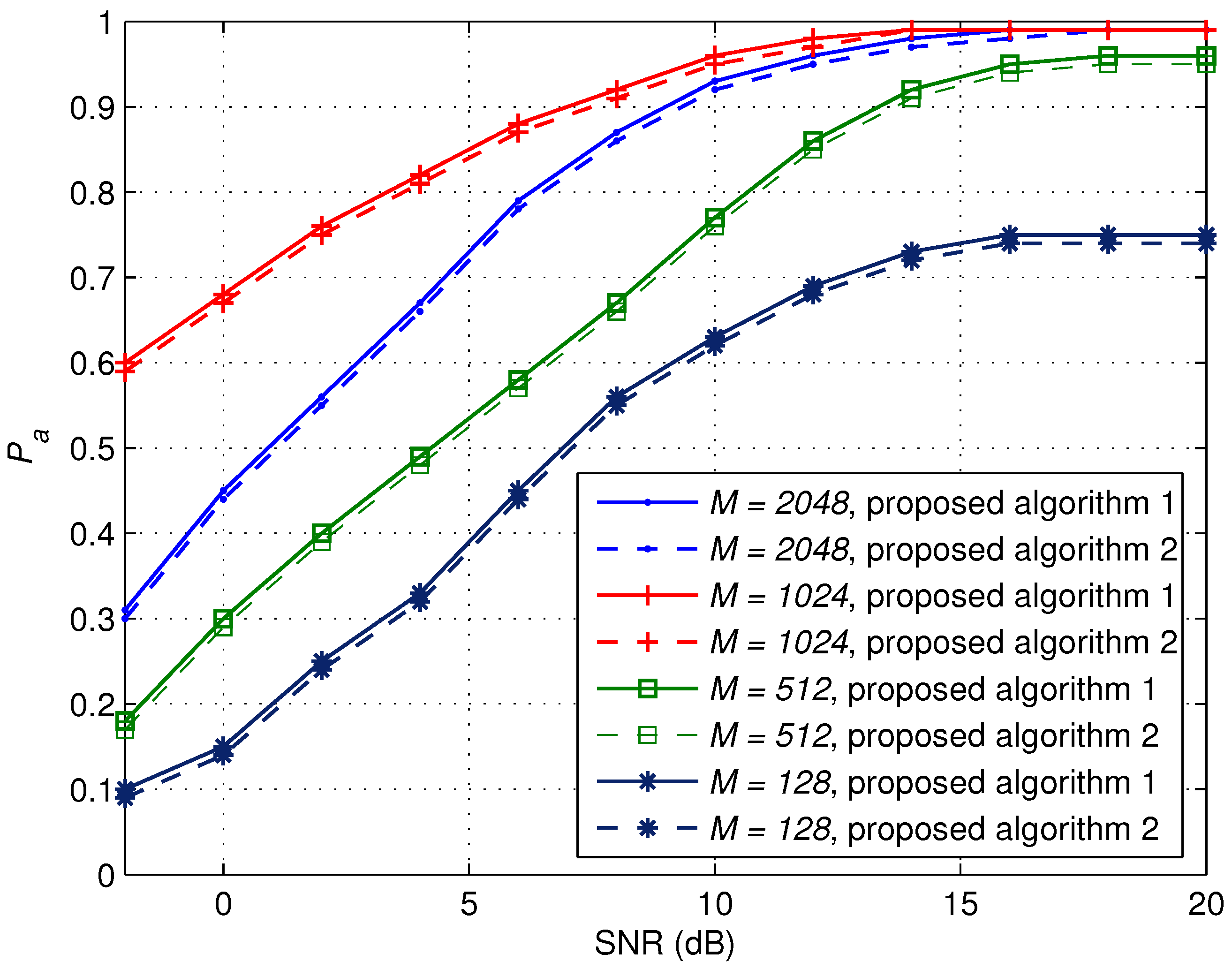
Figure 8 depicts the impact of the number of gathered symbols, M, on the offered solutions. Increasing M results in a significant advancement in the performance of the categorization. For instance, increasing the number of received symbols from 128 to 2048 enhances the average probability of successful recognition from 0.56 to 0.95 when the SNR is 10 dB. Low values of the gathered symbols lead to poor classification accuracy, even when the SNR values are sufficiently high. With SNR being 20 dB, the average likelihood of successful identification is limited to 0.74 when the number of received symbols is 128. According to the findings, gathering more than 1000 symbols resulted in a satisfactory categorization performance. The theoretical conclusions presented in Section 4 are validated by this observation, hence this is a good fit.
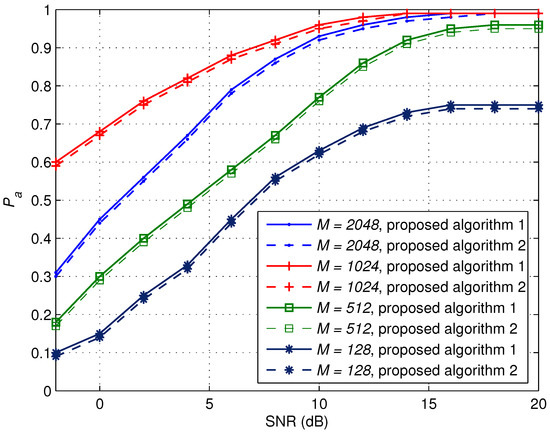
Figure 8.
The impact of the number of collected symbols, M, on the proposed solutions.
Simulation results that are not shown here give an illustration of the performance of the solutions being provided for a number of different modulation possibilities, including QPSK, 16-QAM, and 64-QAM. The results indicate that the aforementioned procedures are not reliant on the particular modulation scheme that the source terminal uses. The theoretical conclusions presented in Section 4 are validated by this observation, hence this is a good fit.
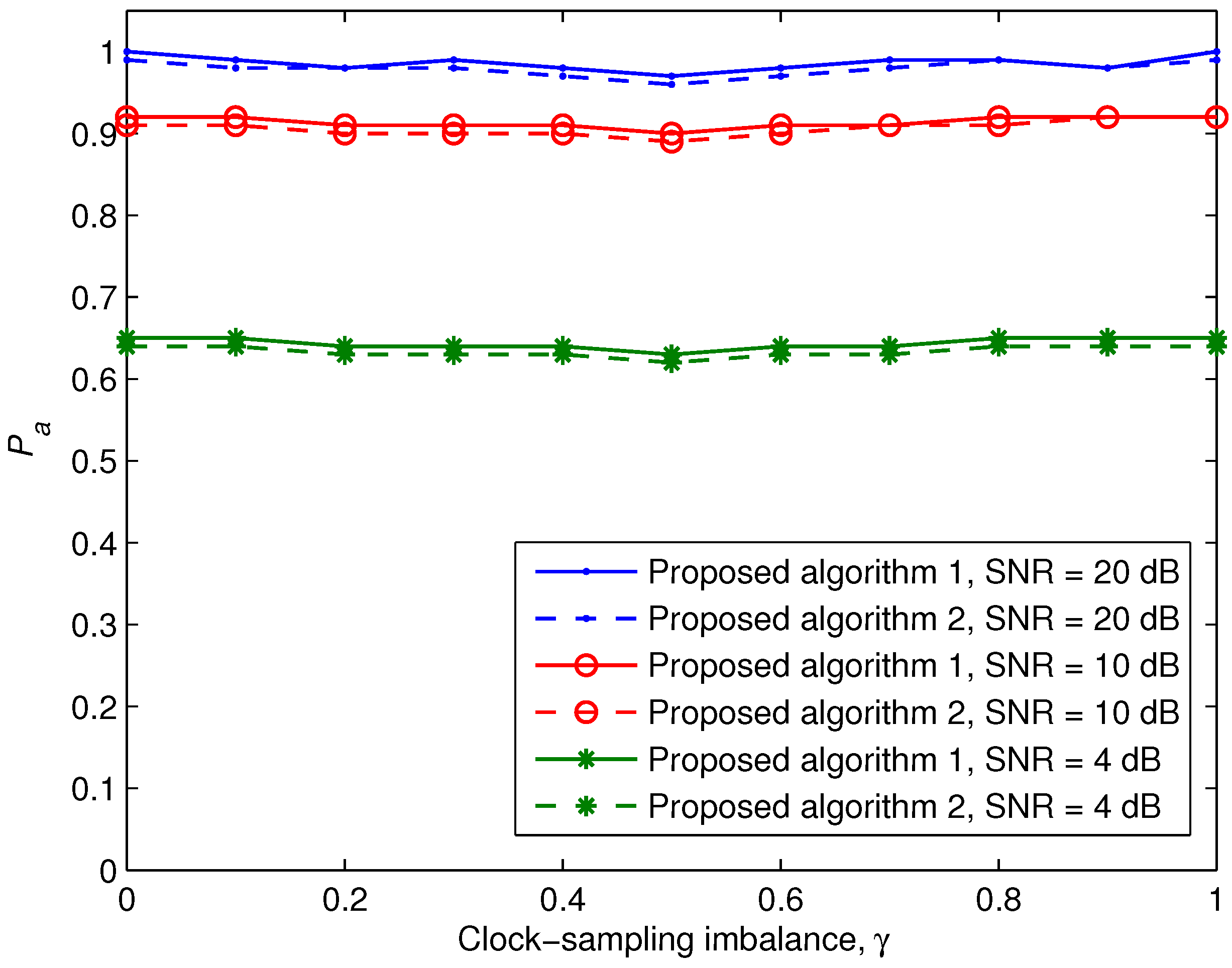
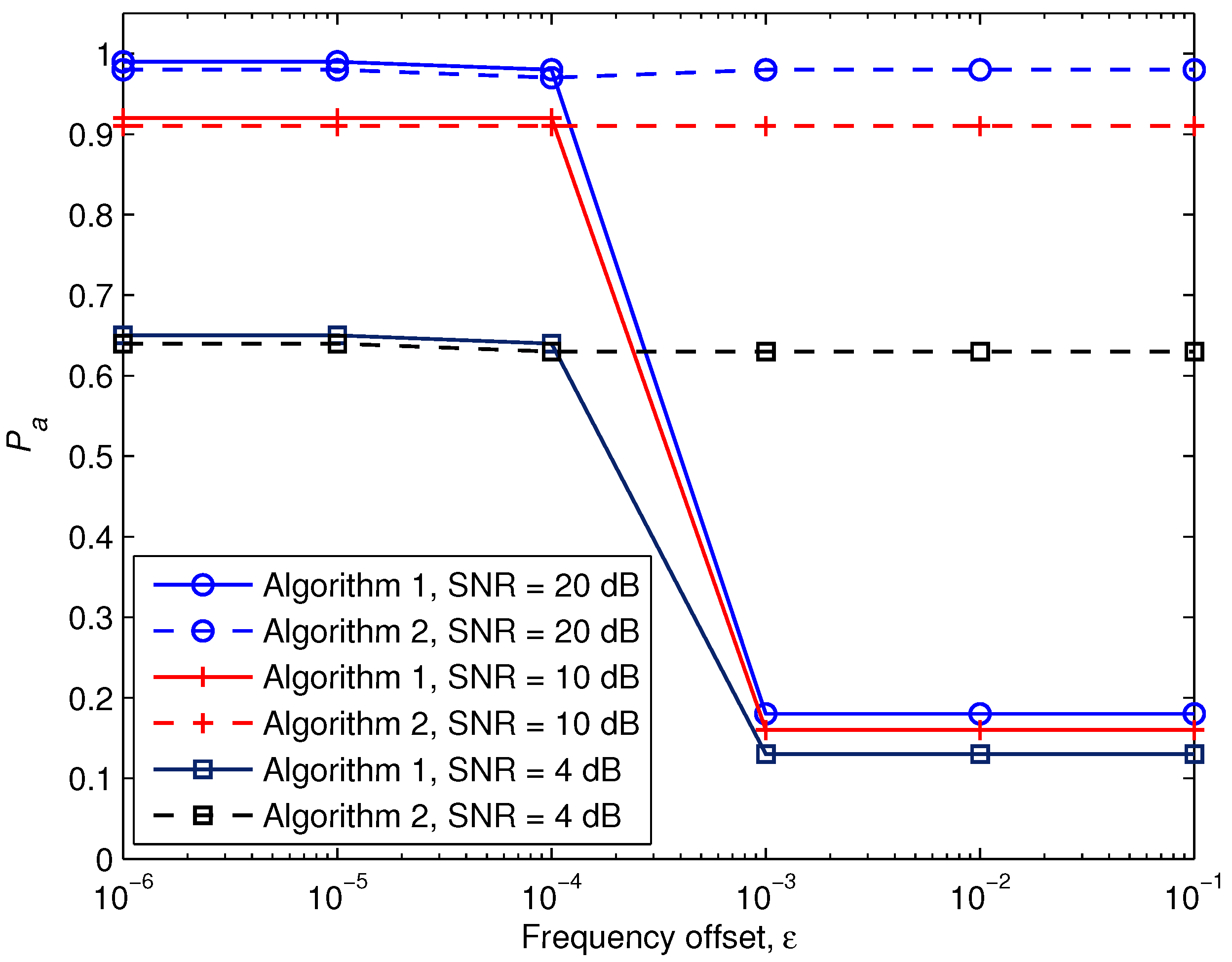
Until now, we have assumed that the destination has ideal estimates and compensating capabilities for clock sampling and frequency imbalances. When a rectangular waveform is maintained, the clock-sampling imbalance, , is recorded as a two-tap linkage at the matched filter’s outcome. Here, is normalized to the data rate. Figure 9 depicts the influence of on the categorization performance. The investigations reveal that does not have a discernible impact on the accuracy of the categorization that is produced. Using an SNR of 10 dB as an example, the average probability of proper identification changes from 0.905 to 0.91 when goes from 0 to 1. Figure 10 displays the influence of the frequency offset, on the categorization performance. Here, is normalized to the bandwidth. The findings demonstrate that has a serious impact on Algorithm 1 while it has no substantial effect on the categorization accuracy achieved by Algorithm 2. For clarification, at SNR = 10 dB, when the frequency offset varies from to , the average probability of correct identification of the second algorithm drops from 0.91 to 0.16. However, the performance of the first algorithm remains fixed at a value of 0.91. This is because, unlike Algorithms 1 and 2 does not need precise knowledge of where the peaks are. In this case, we take into consideration the fact that shifts the positions of the peaks.
| Algorithm 1: The first proposed algorithm. |
If for all then is declared else if for all then is declared else if for all , then is declared else is declared. |
| Algorithm 2: The second proposed algorithm. |
If for all then is declared else if for all then is declared else if then is declared else is declared. |
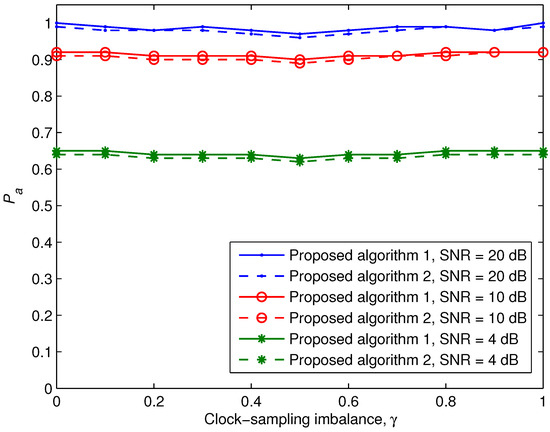
Figure 9.
The effect of the clock-sampling, , on the offered solutions.
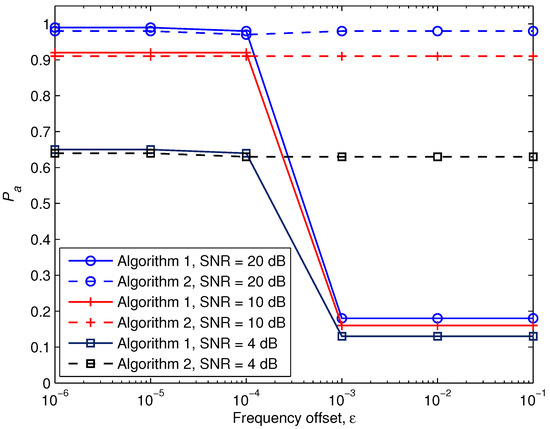
Figure 10.
The impact of the frequency imbalance, , on the offered solutions.
6. Conclusions
In this research, we delved into the question of how to categorize space-time block code (STBC) signals over amplify-and-forward (AF) relaying broadcasts. The mathematical argument was offered, indicating that the second-order statistics of the acquired signals are employed as characteristics to distinguish among STBC waveforms. They released peaks with delays that change according to the kind of STBC signal being employed at the source node. We developed two cutting-edge spike detection algorithms using the fast Fourier transform tool. The first solution included verifying the presence of peaks at certain places. Nevertheless, the second technique relied on determining the locational difference between peaks. The proposed solutions did not need the determination of channel values, modulation choice, noise power, or time synchronization. The simulation results showed remarkable accuracy in categorizing in spite of relatively low signal-to-noise ratios, brief monitoring times, and transmission difficulties.
Author Contributions
Conceptualization, M.M. and H.M.; methodology, M.M. and H.M.; software, M.M. and H.M.; validation, M.M. and H.M.; formal analysis, M.M. and H.M.; investigation, M.M. and H.M.; resources, M.M. and H.M.; data creation, M.M. and H.M.; writing—original draft preparation, M.M. and H.M.; writing—review and editing, M.M. and H.M.; visualization, M.M. and H.M.; supervision, M.M. and H.M.; project administration, M.M. and H.M.; funding acquisition, M.M. and H.M. All authors have read and agreed to the published version of the manuscript.
Funding
Princess Nourah bint Abdulrahman University Researchers Supporting Project number (PNURSP2023R137), Princess Nourah bint Abdulrahman University, Riyadh, Saudi Arabia.
Institutional Review Board Statement
Not Applicable.
Informed Consent Statement
Not Applicable.
Data Availability Statement
Not Applicable.
Acknowledgments
The authors would like to acknowledge the support of Prince Sultan University for paying the Article Processing Charges (APC) of this publication.
Conflicts of Interest
The authors declare no conflict of interest.
References
- Wasim, M.; Khera, S.; Malik, P.K.; Kumari, S.V.; Das, S.; El-Shafai, W.; Aly, M.H. Base Station MIMO Antenna in 1 × 6 Array Configurations with Reflector Design for Sub-6 GHz 5G Applications. Electronics 2023, 12, 669. [Google Scholar] [CrossRef]
- Srikar, D.; Nella, A.; Mamidi, R.; Babu, A.; Das, S.; Lavadiya, S.; Algarni, A.D.; El-Shafai, W. A Novel Integrated UWB Sensing and 8-Element MIMO Communication Cognitive Radio Antenna System. Electronics 2023, 12, 330. [Google Scholar] [CrossRef]
- Suresh, A.C.; Reddy, T.S.; Madhav, B.T.P.; Das, S.; Lavadiya, S.; Algarni, A.D.; El-Shafai, W. Investigations on Stub-Based UWB-MIMO Antennas to Enhance Isolation Using Characteristic Mode Analysis. Micromachines 2022, 13, 2088. [Google Scholar] [CrossRef]
- Nasralla, M.M. A Hybrid Downlink Scheduling Approach for Multi-Traffic Classes in LTE Wireless Systems. IEEE Access 2020, 8, 82173–82186. [Google Scholar] [CrossRef]
- Madi, N.K.M.; Nasralla, M.M.; Hanapi, Z.M. Delay-Based Resource Allocation with Fairness Guarantee and Minimal Loss for eMBB in 5G Heterogeneous Networks. IEEE Access 2022, 10, 75619–75636. [Google Scholar] [CrossRef]
- Yang, Y.J.; Chao, C.M.; Yeh, C.C.; Lin, C.Y. WFID: Driver Identity Recognition Based on Wi-Fi Signals. IEEE Trans. Veh. Technol. 2023, 72, 679–688. [Google Scholar] [CrossRef]
- Dang, S.; Zhou, J.; Shihada, B.; Alouini, M.S. Relay Assisted OFDM with Subcarrier Number Modulation in Multi-Hop Cooperative Networks. IEEE Wirel. Commun. Lett. 2020, 9, 1869–1873. [Google Scholar] [CrossRef]
- Jin, Y.; Li, X.; Lv, G.; Zhao, M.; Jin, Y. Secure Resource Allocation for Cooperative OFDMA System with Untrusted AF Relaying. IEEE Access 2021, 9, 156818–156830. [Google Scholar] [CrossRef]
- Jin, X. Amplify-Quantize-Forward Relay Channel with Quadrature Amplitude Modulation. IEEE Access 2022, 10, 89445–89457. [Google Scholar] [CrossRef]
- Li, G.H.; Yue, D.W.; Jin, S.N.; Hu, Q. Hybrid Double-RIS and DF-Relay for Outdoor-to-Indoor Communication. IEEE Access 2022, 10, 126651–126663. [Google Scholar] [CrossRef]
- Huynh-The, T.; Nguyen, T.V.; Pham, Q.V.; da Costa, D.B.; Kim, D.S. MIMO-OFDM Modulation Classification Using Three-Dimensional Convolutional Network. IEEE Trans. Veh. Technol. 2022, 71, 6738–6743. [Google Scholar] [CrossRef]
- Gupta, R.; Kumar, S.; Majhi, S. Blind Modulation Classification for Asynchronous OFDM Systems over Unknown Signal Parameters and Channel Statistics. IEEE Trans. Veh. Technol. 2020, 69, 5281–5292. [Google Scholar] [CrossRef]
- Pathy, A.K.; Kumar, A.; Gupta, R.; Kumar, S.; Majhi, S. Design and Implementation of Blind Modulation Classification for Asynchronous MIMO-OFDM System. IEEE Trans. Instrum. Meas. 2021, 70, 5504011. [Google Scholar] [CrossRef]
- Liu, M.; Liao, G.; Zhao, N.; Song, H.; Gong, F. Data-Driven Deep Learning for Signal Classification in Industrial Cognitive Radio Networks. IEEE Trans. Ind. Inform. 2021, 17, 3412–3421. [Google Scholar] [CrossRef]
- Liu, M.; Yang, K.; Zhao, N.; Chen, Y.; Song, H.; Gong, F. Intelligent Signal Classification in Industrial Distributed Wireless Sensor Networks Based Industrial Internet of Things. IEEE Trans. Ind. Inform. 2021, 17, 4946–4956. [Google Scholar] [CrossRef]
- Dobre, O.A. Signal Identification for Emerging Intelligent Radios: Classical Problems and New Challenges. IEEE Instrum. Meas. Mag. 2015, 18, 11–18. [Google Scholar] [CrossRef]
- Qiao, J.; Chen, W.; Chen, J.; Ai, B. Blind Modulation Classification under Uncertain Noise Conditions: A Multitask Learning Approach. IEEE Commun. Lett. 2022, 26, 1027–1031. [Google Scholar] [CrossRef]
- Hanna, S.; Dick, C.; Cabric, D. Signal Processing-Based Deep Learning for Blind Symbol Decoding and Modulation Classification. IEEE J. Sel. Areas Commun. 2022, 40, 82–96. [Google Scholar] [CrossRef]
- Gupta, R.; Majhi, S.; Dobre, O.A. Design and Implementation of a Tree-Based Blind Modulation Classification Algorithm for Multiple-Antenna Systems. IEEE Trans. Instrum. Meas. 2019, 68, 3020–3031. [Google Scholar] [CrossRef]
- Marey, M.; Mostafa, H. Turbo Modulation Identification Algorithm for OFDM Software-Defined Radios. IEEE Commun. Lett. 2021, 25, 1707–1711. [Google Scholar] [CrossRef]
- Marey, M.; Mostafa, H. Soft-Information Assisted Modulation Recognition for Reconfigurable Radios. IEEE Wirel. Commun. Lett. 2021, 10, 745–749. [Google Scholar] [CrossRef]
- Liyanaarachchi, S.D.; Riihonen, T.; Barneto, C.B.; Valkama, M. Optimized Waveforms for 5G-6G Communication with Sensing: Theory, Simulations and Experiments. IEEE Trans. Wirel. Commun. 2021, 20, 8301–8315. [Google Scholar] [CrossRef]
- Singh, U.; Dua, A.; Tanwar, S.; Kumar, N.; Alazab, M. A Survey on LTE/LTE-A Radio Resource Allocation Techniques for Machine-to-Machine Communication for B5G Networks. IEEE Access 2021, 9, 107976–107997. [Google Scholar] [CrossRef]
- Marey, M.; Mostafa, H.; Alshebeili, S.A.; Dobre, O.A. Iterative Modulation Classification Algorithm for Two-Path Successive Relaying Systems. IEEE Wirel. Commun. Lett. 2021, 10, 2017–2021. [Google Scholar] [CrossRef]
- Marey, M.; Mostafa, H.; Alshebeili, S.A.; Dobre, O.A. Blind Modulation Identification Algorithm For Two-Path Successive Relaying Systems. IEEE Wirel. Commun. Lett. 2021, 10, 2369–2373. [Google Scholar] [CrossRef]
- Marey, M.; Mostafa, H. Code-Aided Modulation Classification Algorithm for Multiuser Uplink SC-FDMA Systems. IEEE Wirel. Commun. Lett. 2021, 10, 1023–1027. [Google Scholar] [CrossRef]
- Wu, Z.; Zhang, L.; Zhong, Z.; Liu, R. Blind Recognition of LDPC Codes over Candidate Set. IEEE Commun. Lett. 2020, 24, 11–14. [Google Scholar] [CrossRef]
- Liu, P.; Pan, Z.; Lei, J. Parameter Identification of Reed-Solomon Codes Based on Probability Statistics and Galois Field Fourier Transform. IEEE Access 2019, 7, 33619–33630. [Google Scholar] [CrossRef]
- Eldemerdash, Y.A.; Marey, M.; Dobre, O.A.; Karagiannidis, G.K.; Inkol, R. Fourth-Order Statistics for Blind Classification of Spatial Multiplexing and Alamouti Space-Time Block Code Signals. IEEE Trans. Commun. 2013, 61, 2420–2431. [Google Scholar] [CrossRef]
- Marey, M.; Dobre, O.A.; Inkol, R. Classification of Space-Time Block Codes Based on Second-Order Cyclostationarity with Transmission Impairments. IEEE Trans. Wirel. Commun. 2012, 11, 2574–2584. [Google Scholar] [CrossRef]
- Marey, M.; Dobre, O.A.; Inkol, R. Cyclostationarity-Based Blind Classification of STBCs for Cognitive Radio Systems. In Proceedings of the 2012 IEEE International Conference on Communications (ICC), Ottawa, ON, Canada, 10–15 June 2012; pp. 1–6. [Google Scholar]
- Marey, M.; Dobre, O.A.; Liao, B. Classification of STBC Systems over Frequency-Selective Channels. IEEE Trans. Veh. Technol. 2015, 64, 2159–2164. [Google Scholar] [CrossRef]
- Marey, M.; Dobre, O.A. Automatic Identification of Space-Frequency Block Coding for OFDM Systems. IEEE Trans. Wirel. Commun. 2017, 16, 117–128. [Google Scholar] [CrossRef]
- Choqueuse, V.; Marazin, M.; Collin, L.; Yao, K.; Burel, G. Blind Recognition of Linear Space Time Block Codes: A Likelihood-Based Approach. IEEE Trans. Signal Process. 2010, 58, 1290–1299. [Google Scholar] [CrossRef]
- Choqueuse, V.; Yao, K.; Collin, L.; Burel, G. Hierarchical Space-Time Block Code Recognition Using Correlation Matrices. IEEE Trans. Wirel. Commun. 2008, 58, 3526–3534. [Google Scholar] [CrossRef]
- Zhang, Y.; Yan, W.; Zhang, L.; Ma, L. Automatic Space-Time Block Code Recognition Using Convolutional Neural Network with Multi-Delay Features Fusion. IEEE Access 2021, 9, 79994–80005. [Google Scholar] [CrossRef]
- Marey, M.; Dobre, O.A.; Inkol, R. Blind STBC Identification for Multiple Antenna OFDM Systems. IEEE Trans. Commun. 2014, 62, 1554–1567. [Google Scholar] [CrossRef]
- Eldemerdash, Y.A.; Dobre, A.O.; Liao, J.B. Blind Identification of SM and Alamouti STBC-OFDM Signals. IEEE Trans. Wirel. Commun. 2015, 14, 972–982. [Google Scholar] [CrossRef]
- Marey, M.; Mostafa, H. STBC Identification for Multi-User Uplink SC-FDMA Asynchronous Transmissions Exploiting Iterative Soft Information Feedback of Error Correcting Codes. IEEE Access 2022, 10, 21336–21346. [Google Scholar] [CrossRef]
- Marey, M.; Mostafa, H. Power of Error Correcting Codes for SFBC-OFDM Classification over Unknown Channels. IEEE Access 2022, 10, 35643–35652. [Google Scholar] [CrossRef]
- Marey, M.; Dobre, O.A.; Mostafa, H. Cognitive Radios Equipped with Modulation and STBC Recognition over Coded Transmissions. IEEE Wirel. Commun. Lett. 2022, 11, 1513–1517. [Google Scholar] [CrossRef]
Disclaimer/Publisher’s Note: The statements, opinions and data contained in all publications are solely those of the individual author(s) and contributor(s) and not of MDPI and/or the editor(s). MDPI and/or the editor(s) disclaim responsibility for any injury to people or property resulting from any ideas, methods, instructions or products referred to in the content. |
© 2023 by the authors. Licensee MDPI, Basel, Switzerland. This article is an open access article distributed under the terms and conditions of the Creative Commons Attribution (CC BY) license (https://creativecommons.org/licenses/by/4.0/).