


Abstract
Pulsed electric field (PEF) treatment has gained significant attention within the food industry. This study examines the application of PEF combined with wood chips of diverse species to expedite the flavor aging process of Xinomavro red wine. Various wood chip species, including black locust, common juniper, apricot, sweet chestnut, cherry, apple, peach, and European oak, sourced from pruning residues were immersed in the wine prior to subjecting it to PEF treatment. The samples underwent a range of pulse durations and intervals during treatment. Comparative preparations encompassing wine without chips and wine infused with each wood type left at ambient temperature for 5 days were also examined. The sensory attributes and the volatile compounds (VC) were assessed through the utilization of headspace solid-phase microextraction and GC-MS. In the control sample, 12 VCs were identified, whereas in the samples, 22 distinct VCs were identified. Favorable sensory attributes across all PEF conditions were associated with the incorporation of cherry wood chips. These findings highlight the potential of PEF treatment to enhance the quality parameters of the aging process in Xinomavro red wine, capitalizing on the synergistic interaction between PEF and various wood chip species. This innovative approach holds promise for augmenting crucial oenological parameters of red wine, strengthening the use of PEF as an efficient technique to enhance the overall quality.
1. Introduction
Pulsed electric field (PEF) treatment has garnered attention within the food industry over the past two decades for the advancement of mild processing technologies, in order to replace thermal processing [1]. Recognized as one of the emerging technologies, PEF holds great promise for bio and food technology. During PEF treatment, a plant tissue is subjected to short, repetitive pulses of high voltage, inducing the formation of pores, ultimately resulting in enhanced membrane permeability and cell rupture. PEF treatment protects the inherent quality characteristics of food, encompassing sensory attributes and nutritional value since it is a non-thermal treatment. Additionally, it can control the microbial population with minimal or negligible alterations during the processing stages [2]. Beyond its efficacy in inactivating microorganisms through the disruption of cell membranes [2,3], the increased membrane permeability achieved via PEF facilitates the mass transfer of intracellular compounds to the solvent. Furthermore, PEF treatment can also be combined with other supplementary processes, including but not limited to drying, dehydration, extraction [4,5], and freezing [6]. This multifaceted application underscores the versatility and adaptability of PEF in diverse industrial contexts, positioning it as a pivotal technology in food processing and preservation.
Among other topics, there has been an increasing interest in the application of PEF in enology for varied objectives. PEF has been used for the maturation of brandy [7] as well as for the amelioration of the qualitative attributes of red wine [8]. An important topic is the extraction of phenolic compounds from grape skin during maceration–fermentation, which holds considerable promise [9]. To this end, the effect of PEF on the chromatic and phenolic characteristics of Cabernet Sauvignon red wines during their maturation in oak barrels was examined [10]. Additionally, the effect of PEF on the physical, chemical, and sensory properties of red wine has been examined. It was found that PEF fostered the development of color intensity as well as increased the anthocyanin and phenol content during the alcoholic fermentation of Merlot grapes, persisting up to seven months post-bottling [11]. In another study, it was showcased that better qualitative and quantitative parameters are achieved when PEF is applied during the cold maceration step rather than the alcoholic fermentation step of red winemaking [12]. In addition to the above, the effect of PEF on (+)-catechin-acetaldehyde condensation has also been studied. It was observed that condensation of catechin contributes greatly to the wine’s taste during the aging process [13].
In the food and beverage industry, the practice of flavoring with natural compounds has gained prominence, driven by a consistent consumer preference for “natural” food products [14]. Conventionally, the flavoring or aging of wines occurs within oak barrels, bestowing high-quality organoleptic characteristics to red wines [15]. This process significantly influences the final product, impacting color, texture, tannin profile, and flavor [16,17]. However, the aging process in barrels poses substantial financial burdens for winemakers. This is attributable to the prolonged duration for which the wine must remain in the barrels, typically ranging from 6 months to 2 years. Additionally, there is a limitation to the usage of the oak barrels since they can only be utilized for 3–4 cycles (beyond which they cease to contribute beneficial elements to the wine), and there is a limited capacity, usually 225 or 500 L, for each barrel, necessitating many barrels and space. Furthermore, the labor-intensive nature of barrel maintenance, frequent filling, and cleaning contributes significantly to the overall cost of the aging process [16]. A cost-effective alternative to oak barrels is the utilization of wood chips [18]. The cost of chips is substantially lower than that of an oak barrel. Notably, when these chips undergo toasting (burning), the resultant effect approximates that achieved with traditional barrels, particularly when compared to untoasted counterparts. An additional advantage is the larger surface area of chips that comes in direct contact with the wine, a feature surpassing that of barrels [19]. Finally, chips can be introduced directly into the wine tank, providing winemakers with a flexible and cost-efficient option for flavor enhancement and aging.
The objective of this research was to investigate the impact of PEF on the acceleration of the flavoring and aging processes of Xinomavro red wine. Specifically, the study aimed to discern the influence of PEF on the sensory characteristics and aroma profile, employing wood chips sourced from various species. Xinomavro red wine stands as a prominent product derived from one of the main varieties of Greek grapes. Renowned for its robust nature, vibrancy, fertility, and susceptibility to diseases such as oid and botrytis, as well as drought, Xinomavro has historically been a prevalent cultivar in the Amyndeo region of Western Macedonia, Greece. This versatile grape variety serves as the cornerstone for the production of a diverse range of wines, including rose and red varieties in dry, semi-dry, and semi-sweet iterations alongside rose sparkling wines in both dry and semi-sweet renditions. Notably, wines crafted from the Xinomavro grape variety bear the designation of Protected Designation of Origin (PDO), underscoring their geographical and varietal authenticity.
2. Materials and Methods
2.1. Wood Chips
Wood residues from pruning black locust (Robinia pseudoacacia), common juniper (Juniperus communis), Armenian apricot (Prunus armeniaca), sweet chestnut (Castanea sativa), sweet cherry (Prunus avium), apple (Malus domestica) and peach (Prunus persica) trees were used for the production of chips. The wood chips used were small in size (about 8 mm long and 3 mm thick) and were toasted for 2 h at 200 °C. Commercially available, medium-toasted wood chips of European oak (Quercus robur) were used for comparative purposes.
2.2. Wine Sample
Fresh red wine produced from the Xinomavro variety in the region of Amyndeo (Western Macedonia, Greece) was used. The wines were produced from the vintage of 2022. The fermentation process spanned a duration of 16 days. The initial 10 days of fermentation were carried out at 22 °C, followed by a subsequent increase to 26 °C for the final 6 days. Fermentation progress was monitored throughout the process, primarily utilizing density as a key parameter. Regular measurements were taken ensuring a systematic tracking of the fermentation kinetics. The selected yeast strain employed for the fermentation was Saccharomyces cerevisiae, chosen for its well-established ability to contribute to the desired sensory characteristics of the final product. Furthermore, the addition of pectinolytic enzymes derived from Aspergillus niger enriched the vinification process. These enzymes facilitated the breakdown of pectin compounds, enhancing juice clarification and promoting overall wine stability. The chemical characteristics of the wine were: alcohol 12.7% vol; density 0.992 g/mL; residual sugar 1.0 g/L; volatile acidity 0.28 g/L (expressed as acetic acid); total acidity 7.1 g/L (expressed as tartaric acid); active acidity (pH) 3.14; free sulphur 24 mg/L; total sulphur 82 mg/L; malic acid 2.3 g/L and lactic acid 0.0 g/L. For each wood species, four wine samples were prepared. Specifically, one sample of wine was used as a control (without chips), one sample with chips was left for 5 days at ambient temperature, and, finally, a sample with chips was treated with PEF as described in the following section.
2.3. PEF Apparatus and Treatment
The PEF equipment used was a static bench scale system. It was consisted of a high-voltage power generator (Ensco, Delphi, India), a digital oscilloscope (UTD 2062C, ELV Electronic AG, Munich, Germany), a pulse generator (UPG 100, ELV Electronic AG), and a treatment chamber. The PEF generator provided pulses of monopole rectangular shape at a voltage of 5 kV. Signals of voltage, current, frequency, and pulse waveform were monitored using the digital oscilloscope. The treatment chamber (Val-Electronic, Nea Erithrea, Greece) had a positive electrode applied on a copper cylinder (4 mm metal wall, 125 mm in length, 28 mm in diameter). A “U” shaped cylinder (20 mm in diameter and 130 mm in height) into which the liquid was filled was inserted into the copper cylinder. The stainless steel electrode (5 mm in diameter and 120 mm in height) was screwed into the “U”-shaped cylinder and connected to the negative electrode. Electric field strength E was calculated as E = U/d, where “U” is the applied voltage (U = 5 kV) and “d” the distance between the electrode and the copper cylinder (d = 0.65 cm). With the current settings, the E was 7 kV/cm.
In this study, four PEF treatments were applied for the acceleration of wine aging. The pulse durations were set to 10, 10, 20, and 100 ms, and the pulse intervals were set at 100, 25, 100, and 100 μs, respectively. The above combinations were denoted as PEF-1, PEF-2, PEF-3, and PEF-4 treatments, respectively. In all cases, the duration of each treatment was 30 min.
2.4. Sensory Evaluation
The aroma characteristics of both non-PEF- and PEF-treated wine were evaluated by 10 panelists highly experienced in wine sensory analysis. Samples of red wine (20 mL) were presented in standard wine-testing glasses according to standard 3591 [20], covered with a watch-glass to minimize the escape of volatile compounds, and coded with random three-digit numbers. Assessment took place in standard sensory analysis chambers [21] at Department of Food Science and Nutrition (University of Thessaly, Karditsa, Greece), equipped with separate booths, and with a uniform source of lighting, absence of noise and distracting stimuli, and ambient temperature between 19 and 22 °C across the day. The wines were sniffed and tasted. Panelists then generated sensory terms individually. All wine samples were evaluated in duplicate by the panel.
2.5. Volatile Compounds (VCs) Analysis by HS-SPME/GC-MS
The technique of headspace solid-phase microextraction (HS-SPME) used was based on the method described by Hjelmeland et al. [22], with slight modifications (extended equilibration and extraction time). HS-SPME was carried out using a SPME fiber 50/30 μm coated with a layer of divinylbenzene/carboxen/polydimethylsiloxane (DVB/CAR/PDMS) (Supelco, Bellefonte, PA, USA). Before use, the fiber was conditioned (30 min at 270 °C) according to manufacturer’s instructions. For HS-SPME extraction, 10 mL of wine was placed in a 100 mL glass vial, and 3 g of NaCl was added and hermetically sealed with a PTFE/silicone septum. The vial was maintained in a water bath at 40 °C during equilibration (10 min) and extraction (40 min). The fiber was inserted in the head space of the vial above the wine surface. After the extraction, the SPME fiber was withdrawn into the needle, removed from the vial, and inserted into the injector of the GC-MS.
The analysis with GC-MS was carried out according to a modified method described by Hjelmeland et al. [22]. An Agilent Technologies (Santa Clara, CA, USA) Gas Chromatograph model 7890A coupled to a mass selective detector model 5975C and a capillary column Agilent J&W DB-1 (30 m × 320 μm × 0.25 μm) (Santa Clara, CA, USA) was used. The flow rate of the helium carrier gas was 1.5 mL/min. The injector was operated in splitless mode at 240 °C. The column was maintained at 40 °C for 5 min, heated to 140 °C at a rate of 2 °C/min, and then heated to 240 °C at a rate of 10 °C/min for 10 min. The total run time was 75 min. MSD conditions were as follows: source temperature 230 °C; quadrupole temperature 150 °C; acquisition mode electron impact (EI 69.9 eV); and mass range m/z 29–350. The spectra of all chromatogram peaks were evaluated using the MSD Chemstation software (ver. E.02.00.493) from Agilent Technologies (Santa Clara, CA, USA), and they were compared with the electron impact mass spectrum library W8N08 (John Wiley & Sons, Inc., New York, NY, USA). The percentage composition of the samples was computed from the GC peak areas using the normalization method (without correction factors). The component percentages were calculated as mean values from triplicate GC-MS analysis.
2.6. Statistical Analysis
Results represent the average and the standard deviation (SD) of three simultaneous assays. Statistical significance of the differences between mean values was assessed via one-way analysis of variance (ANOVA) using IBM SPSS Statistics (Version 29.0) statistical software (SPSS Inc., Chicago, IL, USA), where p < 0.05 was considered as statistically significant. Statistical analysis was not performed in the case of sensory analysis.
3. Results and Discussion
3.1. Sensory Evaluation
At first, the effect of PEF on the sensory attributes of Xinomavro red wine combined with various wood chips was evaluated. Results of the sensory evaluation are depicted in Table 1. Wine containing black locust wood chips subjected to PEF-1 displayed powerful pungent aromas with an unbalanced acidity, suggesting a potential enhancement in the wine’s aromatic profile but accompanied by a notable acidity imbalance. PEF-4, on the other hand, intensified the aromas while contributing to an astringent, dry finish, indicating a complex interplay between PEF treatment and the inherent characteristics of black locust wood. Peach wood chips, particularly with PEF-2 treatment, showcased a commendable combination of toasty flavors and a long vanilla aftertaste. This result aligns with the hypothesis that the toasting process of wood chips, when synergized with PEF, could impart desirable toasted notes to the wine. The enhancement of the vanilla aftertaste suggests a potential synergistic effect between the wood and PEF, contributing to an extended sensory experience. Juniper wood chips, especially under PEF-2 and PEF-4, demonstrated an intriguing richness in wood tones and spices along with a full mouthfeel and balanced, prolonged aftertaste. This suggests that PEF may have facilitated the extraction of compounds from juniper wood, contributing to the overall complexity of the wine’s sensory attributes.

Table 1.
Sensory evaluation of wines.
Cherry wood chips subjected to PEF-2, PEF-3, and PEF-4 consistently elevated the sensory attributes of the wine, intensifying fruit flavors and prolonging the sweet aftertaste. This aligns with the expectation that PEF treatment could enhance the extraction of fruity compounds from the wood, contributing to an enriched flavor profile. PEF-4, in particular, showcased an impressive combination of blackberry, raspberry notes, and a toasty mouthfeel, suggesting an enhancement due to both wood and PEF influences. The results with apple wood chips were particularly interesting, with PEF-2 and PEF-4 mitigating aggressive notes, resulting in a smoother, more palatable profile. The introduction of grassy and sweet elements implies a potential modulation of undesirable characteristics through PEF, providing a promising avenue for refining the flavor profile of Xinomavro red wine. Common oak wood chips, especially under PEF-3 and PEF-4, displayed a substantial enhancement in rustic and spicy elements, contributing to a more complex flavor profile. The extended aftertaste observed in these treatments suggests that PEF might have facilitated the extraction of compounds contributing to the wine’s sensory attributes. Chestnut wood chips presented a mixed response, with PEF-1 showing improvements in body and a dry finish, while PEF-2 and PEF-3 presented challenges with aggressive and rough elements. This variation highlights the delicate balance required when applying PEF to wines with certain wood types. The aggressive and dry characteristics observed in PEF-3 suggest a potential over-extraction of undesirable compounds, emphasizing the need for careful parameter optimization. Apricot wood chips, particularly under PEF-1, PEF-3, and PEF-4, exhibited a diverse array of flavors, including toasty notes, marmalade, and a well-balanced sweetness. The versatility of PEF in introducing these elements suggests a dynamic interaction between apricot wood and PEF, contributing to a rich and multi-layered sensory profile. Based on the above sensory attributes, the use of cherry wood chips and apple wood chips was found to be the most favorable, and, as such, was further investigated.
Overall, the results emphasize the importance of tailored approaches when implementing PEF in Xinomavro red wine production. The variations observed across wood chip types and PEF treatments underscore the importance of tailoring the wood characteristics, PEF parameters, and the resultant sensory outcomes. The promising enhancements seen in certain treatments, particularly PEF-3 and PEF-4, suggest that application of PEF could expedite the aging process and enrich the flavor profile of Xinomavro red wine. However, there is need for further research to optimize further PEF parameters and wood chip combinations to achieve consistent and desirable sensory outcomes. This comprehensive understanding contributes to the broader discourse on innovative winemaking practices and opens avenues for future investigations in the realm of PEF applications in wine production.
3.2. VCs Analysis
The HS-SPME/GC-MS analysis of Xinomavro red wine (a representative chromatogram of the HS-SPME/GC-MS analysis is given in Figure 1) elucidates a complex interplay between PEF treatment, various wood chip types, and the resulting chemical composition. Table 2 depicts the results as percentage (%) of each VC relative to the total identified VCs. This kind of representation provides a normalized view of the composition, allowing for a direct comparison of the relative contributions of different compounds within the mixture. During the HS-SPME/GC-MS analysis of the wine samples, 22 different VCs were identified. Only 12 of these were identified in the control sample and were also found in some of the other wine samples. The remaining 10 identified VCs were found in specific samples. Many of these VCs are commonly found in wines and are derived from grapes and yeast strain fermentation and the vinification process [23]. The total identified VCs in wine samples varied from 92.07 ± 0.34 to 96.91 ± 0.63%. Ethanol, the predominant VC, exhibited statistically significant (p < 0.05) variations across treatments, with PEF-1 and PEF-4 displaying the lowest concentration in the case of cherry wood chips and PEF-1 and PEF-3 displaying higher concentrations for apple wood chips. The observed variations in ethanol percentage are influenced by changes in the composition of other volatile compounds. Lower ethanol percentages may arise due to an increase in the percentage of other VCs, thereby affecting the overall composition. The increased ethanol percentages could contribute to alterations in the overall sensory profile of the wine, influencing mouthfeel and perceived sweetness. Acetic acid, a compound associated with acidity and volatile acidity in wines, was not detected in most samples, suggesting that the concentrations were below the detection limit. This absence may indicate that neither PEF treatment nor the use of different wood chip types significantly impacted the formation of acetic acid in Xinomavro red wine. The presence of 3-methyl-1-butanol, associated with alcohol and cheese odor (Table 3), exhibited variations across treatments, with PEF-3 showing higher concentrations for cherry wood chips and PEF-4 for apple wood chips. This observation suggests that specific PEF treatments may contribute to the enhanced extraction of this compound, influencing the aromatic profile of the wine. Certain compounds, such as 2-amino-4-methylbenzoic acid, were exclusively detected in apple wood chip samples. Hexanoic acid, a compound associated with fatty and fruity aromas, was not detected in most samples, indicating minimal impact from PEF and wood chip types. This suggests that the particular wood chip types and PEF treatments employed did not significantly influence the formation or extraction of hexanoic acid in Xinomavro red wine. Compounds such as 2-phenylethanol, contributing to floral and rose-like aromas, displayed variations across treatments, with PEF-2 and PEF-4 showing higher concentrations. Azulene and 4-ethylphenol were detected in higher concentrations in PEF-treated samples. These compounds contribute to the complexity of the wine’s aroma profile and may result from the synergistic effects of PEF treatment and wood components. Apple wood chips, after 5 days, gave the higher percentage in 2,3-butanediol (significant at p < 0.05). Additionally, 2-amino-4-methylbenzoic acid was only found in this procedure with the apple chips. After PEF-2 treatment, the higher percentage of VCs was shown using 2-phenylethanol (significant at p < 0.05). High levels of thymol were also found in the PEF-1 and PEF-2 procedures. Without the PEF (blank sample), the ethyl caprylate was detected in similar amounts (not significant at p < 0.05) to the PEF-4 procedure. In summary, the results from the HS-SPME/GC-MS analysis unveil the intricate impact of PEF treatment and different wood chip types on the chemical composition of Xinomavro red wine. The observed variations in specific compounds provide an understanding of how PEF treatments may influence the extraction or formation of key aromas and flavor components, ultimately shaping the sensory profile of the wine. These findings contribute valuable insights for further exploration and optimization of PEF parameters in conjunction with different wood chip types to achieve desired sensory outcomes in wine production.
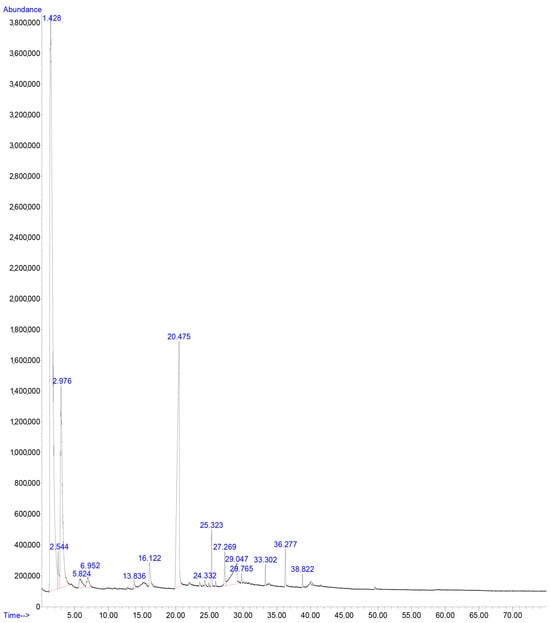
Figure 1.
Chromatogram of the HS-SPME/GC-MS analysis of the sample of Xinomavro red wine with peach wood chips treated with the PEF-1 procedure.
Table 2.
HS-SPME/GC-MS analysis of main wine samples.
Table 3.
Sensory feel of volatile compounds (VCs) identified in samples (references are also given).
4. Conclusions
In conclusion, this study investigated the effects of PEF treatment, various wood chip types, and their combined influence on the chemical composition and sensory characteristics of Xinomavro red wine. The results elucidated the impact of PEF treatment on key compounds, including ethanol, 3-methyl-1-butanol, 2-amino-4-methylbenzoic acid, ethyl caproate, 2-phenylethanol, benzyl acetate, diethyl succinate, γ-terpinene, phenethyl acetate, thymol, triacetin, and decanoic acid. Varied concentrations of these compounds were observed across different PEF treatments, reflecting the potential of PEF to modulate the wine’s sensory attributes. Additionally, the results underscored the importance of wood chip selection in shaping the overall aroma and flavor complexity of Xinomavro red wine. The increased concentration of compounds such as 2-phenylethanol, octanoic acid, phenethyl acetate, thymol, and azulene—known for their contributions to floral, fruity, and phenolic notes—exhibit distinct patterns with specific PEF treatments and wood chip types. The observed rise in 2-phenylethanol concentration suggests a potential enhancement of floral nuances. Phenethyl acetate contributes to the overall bouquet, while octanoic acid variations hint at the modulation of fatty and fruity aromas. All the above could potentially have a higher influence on the aromatic profile of the wines. However, drawing a certain conclusion on the contribution of each VC in the aromatic profile is not possible due to the many VCs and the complexity of the aroma. This study contributes to the scientific understanding of the impact of PEF treatment and wood chip types on Xinomavro red wine. The findings offer valuable insights for winemakers seeking to optimize PEF parameters and wood chip selection to achieve desired sensory outcomes, providing a foundation for future research and advancements in the field of wine production. This potential of PEF technology might support winemakers in producing, in less time and at much lower cost, flavored wines by adding new sensory characteristics derived from several wood species (i.e., pruning wood residues).
Author Contributions
Conceptualization, V.G.D. and S.I.L.; methodology, A.K.T., E.B. and V.A.; software, V.A.; validation, V.A., A.K.T. and E.B.; formal analysis, A.K.T. and V.A.; investigation, V.A. and A.K.T.; resources, G.I.M. and A.K.T.; data curation, V.A. and A.K.T.; writing—original draft preparation, V.A. and E.B.; writing—review and editing, A.K.T., E.B., V.A., T.C., G.I.M., V.G.D. and S.I.L.; visualization, T.C.; supervision, V.G.D. and S.I.L.; project administration, S.I.L.; funding acquisition, S.I.L. All authors have read and agreed to the published version of the manuscript.
Funding
This research received no external funding.
Institutional Review Board Statement
Not applicable.
Informed Consent Statement
Not applicable.
Data Availability Statement
Data are contained within the article.
Conflicts of Interest
The authors declare no conflict of interest.
References
- Janositz, A.; Knorr, D. Microscopic visualization of Pulsed Electric Field induced changes on plant cellular level. Innov. Food Sci. Emerg. Technol. 2010, 11, 592–597. [Google Scholar] [CrossRef]
- Ho, S.; Mittal, G.S. High voltage pulsed electrical field for liquid food pasteurization. Food Rev. Int. 2000, 16, 395–434. [Google Scholar] [CrossRef]
- Wouters, P.C.; Alvarez, I.; Raso, J. Critical factors determining inactivation kinetics by pulsed electric field food processing. Trends Food Sci. Technol. 2001, 12, 112–121. [Google Scholar] [CrossRef]
- Knorr, D.; Angersbach, A. Impact of high-intensity electric field pulses on plant membrane permeabilization. Trends Food Sci. Technol. 1998, 9, 185–191. [Google Scholar] [CrossRef]
- Ade-Omowaye, B.I.O.; Angersbach, A.; Taiwo, K.A.; Knorr, D. Use of pulsed electric field pre-treatment to improve dehydration characteristics of plant based foods. Trends Food Sci. Technol. 2001, 12, 285–295. [Google Scholar] [CrossRef]
- Barba, F.J.; Parniakov, O.; Pereira, S.A.; Wiktor, A.; Grimi, N.; Boussetta, N.; Saraiva, J.A.; Raso, J.; Martin-Belloso, O.; Witrowa-Rajchert, D.; et al. Current applications and new opportunities for the use of pulsed electric fields in food science and industry. Food Res. Int. 2015, 77, 773–798. [Google Scholar] [CrossRef]
- Zhang, B.; Zeng, X.A.; Sun, D.W.; Yu, S.J.; Yang, M.F.; Ma, S. Effect of Electric Field Treatments on Brandy Aging in Oak Barrels. Food Bioprocess Technol. 2013, 6, 1635–1643. [Google Scholar] [CrossRef]
- Puértolas, E.; López, N.; Condón, S.; Álvarez, I.; Raso, J. Potential applications of PEF to improve red wine quality. Trends Food Sci. Technol. 2010, 21, 247–255. [Google Scholar] [CrossRef]
- López, N.; Puértolas, E.; Hernández-Orte, P.; Álvarez, I.; Raso, J. Effect of a pulsed electric field treatment on the anthocyanins composition and other quality parameters of Cabernet Sauvignon freshly fermented model wines obtained after different maceration times. LWT-Food Sci. Technol. 2009, 42, 1225–1231. [Google Scholar] [CrossRef]
- Puértolas, E.; Saldaña, G.; Álvarez, I.; Raso, J. Effect of Pulsed Electric Field Processing of Red Grapes on Wine Chromatic and Phenolic Characteristics during Aging in Oak Barrels. J. Agric. Food Chem. 2010, 58, 2351–2357. [Google Scholar] [CrossRef]
- Delsart, C.; Ghidossi, R.; Poupot, C.; Cholet, C.; Grimi, N.; Vorobiev, E.; Milisic, V.; Peuchot, M.M. Enhanced Extraction of Phenolic Compounds from Merlot Grapes by Pulsed Electric Field Treatment. Am. J. Enol. Vitic. 2012, 63, 205–211. [Google Scholar] [CrossRef]
- El Darra, N.; Rajha, H.N.; Ducasse, M.A.; Turk, M.F.; Grimi, N.; Maroun, R.G.; Louka, N.; Vorobiev, E. Effect of pulsed electric field treatment during cold maceration and alcoholic fermentation on major red wine qualitative and quantitative parameters. Food Chem. 2016, 213, 352–360. [Google Scholar] [CrossRef] [PubMed]
- Zhao, D.; Zeng, X.A.; Sun, D.W.; Liu, D. Effects of pulsed electric field treatment on (+)-catechin-acetaldehyde condensation. Innov. Food Sci. Emerg. Technol. 2013, 20, 100–105. [Google Scholar] [CrossRef]
- Tsapou, E.A.; Ntourtoglou, G.; Drosou, F.; Tataridis, P.; Dourtoglou, T.; Lalas, S.; Dourtoglou, V. In situ Creation of the Natural Phenolic Aromas of Beer: A Pulsed Electric Field Applied to Wort-Enriched Flax Seeds. Front. Bioeng. Biotechnol. 2020, 8, 583617. [Google Scholar] [CrossRef] [PubMed]
- Carpena, M.; Pereira, A.G.; Prieto, M.A.; Simal-Gandara, J. Wine Aging Technology: Fundamental Role of Wood Barrels. Foods 2020, 9, 1160. [Google Scholar] [CrossRef] [PubMed]
- Lv, Y.; Wang, J.N.; Jiang, Y.; Ma, X.M.; Ma, F.L.; Ma, X.L.; Zhang, Y.; Tang, L.H.; Wang, W.X.; Ma, G.M.; et al. Identification of Oak-Barrel and Stainless Steel Tanks with Oak Chips Aged Wines in Ningxia Based on Three-Dimensional Fluorescence Spectroscopy Combined with Chemometrics. Molecules 2023, 28, 3688. [Google Scholar] [CrossRef] [PubMed]
- Garde-Cerdán, T.; Ancín-Azpilicueta, C. Review of quality factors on wine ageing in oak barrels. Trends Food Sci. Technol. 2006, 17, 438–447. [Google Scholar] [CrossRef]
- Jordão, A.M.; Cosme, F. The Application of Wood Species in Enology: Chemical Wood Composition and Effect on Wine Quality. Appl. Sci. 2022, 12, 3179. [Google Scholar] [CrossRef]
- Dumitriu, G.D.; Teodosiu, C.; Gabur, I.; Cotea, V.V.; Peinado, R.A.; de Lerma, N.L. Evaluation of aroma compounds in the process of wine ageing with oak chips. Foods 2019, 8, 662. [Google Scholar] [CrossRef]
- ISO ISO 3591:1977; Sensory Analysis—Apparatus—Wine-Tasting Glass. ISO: Geneva, Switzerland, 1977.
- ISO 8589:2007; Sensory Analysis–General Guidance for the Design of Test Rooms. ISO: Geneva, Switzerland, 2007.
- Hjelmeland, A.K.; King, E.S.; Ebeler, S.E.; Heymann, H. Characterizing the chemical and sensory profiles of United States Cabernet Sauvignon wines and blends. Am. J. Enol. Vitic. 2013, 64, 169–179. [Google Scholar] [CrossRef]
- Jiang, B.; Zhang, Z. Volatile compounds of young wines from cabernet sauvignon, cabernet gernischet and chardonnay varieties grown in the loess plateau region of China. Molecules 2010, 15, 9184–9196. [Google Scholar] [CrossRef]
- Chambers IV, E.; Koppel, K. Associations of volatile compounds with sensory aroma and flavor: The complex nature of flavor. Molecules 2013, 18, 4887–4905. [Google Scholar] [CrossRef]
- Maarse, H. Volatile Compounds in Foods and Beverages; Maarse, H., Ed.; Routledge: New York, NY, USA, 2017; ISBN 9780203734285. [Google Scholar]
- Mast, R. Functions of Glycerine in Cosmetics. In Glycerine; CRC Press: Boca Raton, FL, USA, 2018; pp. 223–275. [Google Scholar]
- Meng, J.; Fang, Y.; Gao, J.; Zhang, A.; Liu, J.; Guo, Z.; Zhang, Z.; Li, H. Changes in aromatic compounds of cabernet sauvignon wines during ageing in stainless steel tanks. Afr. J. Biotechnol. 2011, 10, 11640–11647. [Google Scholar]
- Bosch-Fusté, J.; Riu-Aumatell, M.; Guadayol, J.M.; Caixach, J.; López-Tamames, E.; Buxaderas, S. Volatile profiles of sparkling wines obtained by three extraction methods and gas chromatography-mass spectrometry (GC-MS) analysis. Food Chem. 2007, 105, 428–435. [Google Scholar] [CrossRef]
- Abca, E.E.; Akdemir Evrendilek, G. Processing of Red Wine by Pulsed Electric Fields with Respect to Quality Parameters. J. Food Process. Preserv. 2015, 39, 758–767. [Google Scholar] [CrossRef]
- Jackson, R.S. Chemical constituents of grapes and wine. In Wine Science; Academic Press: Cambridge, MA, USA, 2020; pp. 375–459. [Google Scholar]
- Shoji, T.; Ito, S. The Preparation and Properties of Heteroarylazulenes and Hetero-Fused Azulenes. Adv. Heterocyclic Chem. 2018, 126, 1–54. [Google Scholar]
- Burdock, G.A. Encyclopedia of Food & Color Additives; CRC Press: Boca Raton, FL, USA, 2014; ISBN 9780429157677. [Google Scholar]
- Swiegers, J.H.; Saerens, S.M.G.; Pretorius, I.S. Novel yeast strains as tools for adjusting the flavor of fermented beverages to market specifications. In Biotechnology in Flavor Production; John Wiley & Sons: Hoboken, NJ, USA, 2016; pp. 62–132. [Google Scholar]
- Attokaran, M. Natural Food Flavors and Colorants; John Wiley & Sons: Hoboken, NJ, USA, 2017; ISBN 9781119114796. [Google Scholar]
- Hui, Y.H.; Evranuz, E.Ö.; Arroyo-López, F.N.; Fan, L.; Hansen, Å.S.; Jaramillo-Flores, M.E.; Rakin, M.; Schwan, R.F.; Zhou, W. Handbook of Plant-Based Fermented Food and Beverage Technology, 2nd ed.; CRC Press: Boca Raton, FL, USA, 2012; ISBN 9781439870693. [Google Scholar]
Disclaimer/Publisher’s Note: The statements, opinions and data contained in all publications are solely those of the individual author(s) and contributor(s) and not of MDPI and/or the editor(s). MDPI and/or the editor(s) disclaim responsibility for any injury to people or property resulting from any ideas, methods, instructions or products referred to in the content. |
© 2023 by the authors. Licensee MDPI, Basel, Switzerland. This article is an open access article distributed under the terms and conditions of the Creative Commons Attribution (CC BY) license (https://creativecommons.org/licenses/by/4.0/).