


Abstract
Rosa rugosa Thumb., Rosa davurica Pall., and Rosa acicularis Lindl. contain a large number of target analytes which are bioactive compounds. High performance liquid chromatography (HPLC), in combination with the ion trap (tandem mass spectrometry), was used to identify target analytes in MeOH extracts of R. rugosa, R. davurica, and R. acicularis, originating from the Russian Far East, Trans-Baikal Region, and Western Siberia. The results of initial studies revealed the presence of 146 compounds, of which 115 were identified for the first time in the genus Rosa (family Rosaceae). The newly identified metabolites belonged to 18 classes, including 14 phenolic acids and their conjugates, 18 flavones, 7 flavonols, 2 flavan-3-ols, 2 flavanones, 3 stilbenes, 2 coumarins, 2 lignans, 9 anthocyanins, 3 tannins, 8 terpenoids, 3 sceletium alkaloids, 4 fatty acids, 2 sterols, 2 carotenoids, 3 oxylipins, 3 amino acids, 5 carboxylic acids, etc. The proven richness of the bioactive components of targeted extracts of R. rugosa, R. davurica, and R. acicularis invites extensive biotechnological and pharmaceutical research, which can make a significant contribution both in the field of functional and enriched nutrition, and in the field of cosmetology and pharmacy.
1. Introduction
Plants have been used as medicines since the existence of human civilization [1,2]. More than 35 thousand varieties of plants from different parts of the world are actively used for medical purposes, since they contain numerous phytocomponents that can potentially treat many diseases, including infectious ones [3]. Numerous medical systems of treatment, such as Ayurveda, Unani, homeopathy, naturopathy, Siddha, and others, rely on plants as effective remedies for various life-threatening diseases [4,5]. Due to the presence of secondary metabolites in plants, they have significant potential as antimicrobial agents. The diversity of these natural products offers an endless number of possibilities for the discovery of new drugs for the treatment of various diseases [6,7,8].
In recent years, traditional medicine based on oral herbal preparations has attracted the attention of both consumers and healthcare professionals. However, the use of these medicinal products requires improved knowledge of their composition and stability over time in order to support or validate these therapies in humans. Liquid preparations from medicinal plants, such as tinctures and extracts from plant buds, are typical products that are widely used but still poorly understood. Plant bud extracts are defined as extracts obtained exclusively from fresh buds, shoots, young leaves, and/or roots, which are macerated and extracted with hydro–glycerol and water–alcohol mixtures [9]. Kidney extracts represent a new category of herbal products well known and widely used in gemmotherapy, as well as in homeopathy and herbal medicine [10].
The genus Rosa (family Rosaceae) is represented on the territory of the Trans-Baikal region, Far East (Russian Federation), and Western Siberia by 3 species—Rosa rugosa Thumb., Rosa davurica Pall., and Rosa acicularis Lindl. (Figure 1 and Figure 2). Fresh fruits and leaves contain up to 900 mg% ascorbic acid per dry pulp weight. Fresh petals contain 0.25–0.38% essential oil. Its neutral volatile fraction contains 86.3% phenylethyl alcohol, some linalool, citronellol, geraniol, nerol, etc. Eugenol was found in the phenolic fraction, phenylacetic, benzoic, and other acids in the acid fraction. R. rugosa is a medicinal plant widely used in traditional and folk medicine. Extracts of R. rugosa have been valued for Asian culinary, cosmetic, and aromatherapy purposes, and used in herbal medicines for diabetes mellitus and osteoarthritis [11]. The medicinal effects seem to be involved in the presence of many phytochemicals in R. rugosa extracts, for example flavonoids, phenylpropanoid, tannins, fatty acids, and terpenoids [12].
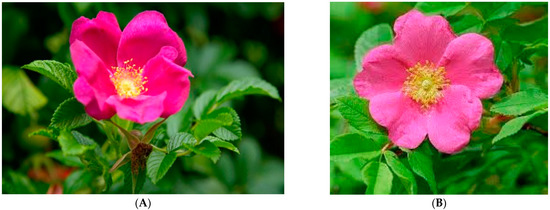
Figure 1.
(A) Rosa rugosa (Far Eastern Russia); (B) Rosa davurica (Trans-Baikal region).
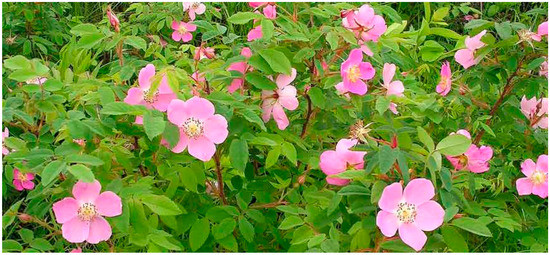
Figure 2.
Rosa acicularis (Western Siberia).
Several studies have reported that some compounds from rose hip extracts exhibit anti-inflammatory activity in vitro. The anti-inflammatory property of the crude hydroalcoholic extract of rose hip has been proven in vivo, suggesting its potential role as one of the main therapies for the treatment of diseases associated with inflammation [13]. In Turkish folk medicine, a decoction of fresh rose hips is prepared and used to treat various stomach disorders [14]. Trans-Tiliroside (Tribuloside) has been found to be one of the main active components of aqueous acetone extracts from fruits and seeds that inhibit weight gain and lower plasma triglyceride levels in mice [15]. Additionally, clinical studies have demonstrated the positive effect of rose hip powder in the treatment of osteoarthritis [16]. Rose hip powder enhances in vitro anti-inflammatory and chondroprotective properties in leukocytes and primary chondrocytes of human peripheral blood [17]. Unfortunately, to date, there are few data providing information on the biological action of extracts of buds and leaves, and it should be noted that these preparations have never been used for preclinical and clinical trials.
The present investigation was designed to carry out a phytochemical study involving detailed metabolomic and comparative analysis of fruits and flowers of Rosa rugosa Thumb., Rosa davurica Pall., and Rosa acicularis Lindl. originating from the Trans-Baikal region, Western Siberia, and Russian Far East.
2. Results
Approximately 300 mass spectra were assessed for each analytical replicate and MS operating condition in this comprehensive approach for a complete screening of phytochemicals (Figure 3).
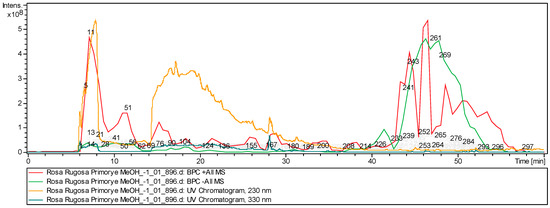
Figure 3.
Representative chemical profiles of the R. rugosa (Primorye, Russia) total ion chromatogram from the MeOH extract.
This procedure allowed a detailed evaluation of the rose MeOH extract fraction and the tentative identification of up to 146 phytochemicals (Table A1 (Appendix A)). The most represented classes of polyphenolic compounds were flavonoids (flavonols, flavones, flavan-3-ols, flavanones) with a total of 68 polyphenols identified for the first time. Some polyphenols were identified for the first time in the genus Rosa (family Rosaceae).
These are the flavones: Chrysoeriol, Hispidulin, 5,7-Dimethoxyluteolin, Cirsimaritin, Cirsiliol, Tricin, Jaceosidin, Nevadensin, Syringetin, Isovitexin, Genistein C-glucoside malonylated, Chrysin 6-C-glucoside-6″-O-deoxyhexoside; flavanols: Dihydrokaempferol, Rhamnetin II, Kaempferol-3-O-α-l-rhamnoside, Taxifolin-O-pentoside, Taxifolin-3-O-hexoside, Isorhamnetin triacetyl hexoside; flavan-3-ols: Epiafzelechin and Gallocatechin; flavanone: Naringenin, Fustin; phenolic acids: Caffeic acid, Citric acid, Hydroxy methoxy dimethylbenzoic acid, Hydroxyferulic acid, Ellagic acid, p-Coumaroylquinic acid, Ginkgoic acid, Salvianolic acid D, Salvianolic acid B; stilbenes: Pinosylvin, Resveratrol, 3-Hydroxyresveratrol; lignans: Pinoresinol, Arctigenin; coumarins: 3,4,5–Trimethoxycoumarin, Fraxin; anthocyanins: Cyanidin 3-O-glucoside, Delphinidin O-pentoside, Pelargonidin 3-O-(6-O-malonyl-β-d-glucoside), Cyanidin 3-(6″-Succinyl-Glucoside), Delphinidin malonyl hexoside, Cyanidin 3-O-dioxayl-glucoside, Delphinidin 3,5-dihexoside, etc.
3. Discussion
A total of 146 compounds were identified in extracts of Rosa rugosa Thumb., Rosa davurica Pall., and Rosa acicularis Lindl. based on their accurate MS, fragment ions, and by searching online databases and the reported literature. A total of 115 compounds were identified for the first time in the genus Rosa (family Rosaceae). The newly identified metabolites belonged to 18 classes, including 14 phenolic acids and their conjugates, 18 flavones, 7 flavonols, 2 flavan-3-ols, 2 flavanones, 3 stilbenes, 2 coumarins, 2 lignans, 9 anthocyanins, 3 tannins, 8 terpenoids, 3 sceletium alkaloids, 4 fatty acids, 2 sterols, 2 carotenoids, 3 oxylipins, 3 amino acids, 5 carboxylic acids, etc. Metabolomic screening of polyphenols from extracts of R. rugosa, R. davurica, and R. acicularis included flavones, flavonols, flavan-3-oles, flavanones, anthocyanins, condensed tannins, phenolic acids, lignans, stilbenes, and coumarins.
3.1. Dimethoxyflavones
The flavones 5,7-Dimethoxyluteolin (compound 5), Cirsimaritin (compound 6), Chrysoeriol methyl ether (compound 7), Cirsiliol (compound 8), Tricin (compound 9), Jaceosidin (compound 10), and Syringetin (compound 13) (Table A1 (Appendix A)) have been already characterized as components of Syzygium aromaticum [18], Ocimum [19], Rosmarinus officinalis [20], Bougainvillea [21], Triticum aestivum [22]; millet grains [23]; Sasa veitchii; Phyllostachys nigra [24], etc. Thus, the flavone Jaceosidin was found in extracts of R. davurica. The flavone 5,7-Dimethoxyluteolin was found in extracts of R. rugosa and R. davurica. The CID-spectrum (collision induced dissociation spectrum) in negative ion modes of Tricin from extracts of R. davurica is shown in Figure 4.
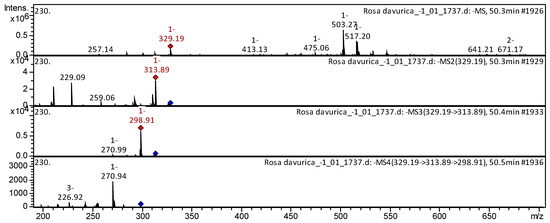
Figure 4.
CID-spectrum of Tricin from extracts of R. davurica, m/z 329.19.
The [M – H]– ion produced three fragment ions at m/z 313, m/z 259, and m/z 229 (Figure 4). The fragment ion with m/z 313 produced two daughter ions at m/z 298 and m/z 271. The fragment ion with m/z 298 yielded two daughter ions at m/z 271 and m/z 227. It was identified in the bibliography in extracts of Triticum aestivum [22]; millet grains [23]; Sasa veitchii; Phyllostachys nigra [24].
3.2. Trimethoxyflavones
The flavones Nevadensin (compound 12) and Pentahydroxy trimethoxy flavone (compound 15) (Table A1 (Appendix A)) have been already characterized as components of Ocimum [19], F. glaucescens; C. edulis [25], Mentha [26], etc. Thus, the flavone Nevadensin was found in extracts of R. acicularis. The CID-spectrum in positive ion modes of Nevadensin from extracts of R. acicularis is shown in Figure 5.

Figure 5.
CID-spectrum of Nevadensin from extracts of R. acicularis, m/z 346.86.
The [M + H]+ ion produced two fragment ions at m/z 330 and m/z 212 (Figure 5). The fragment ion with m/z 330 yielded one daughter ion at m/z 314. The fragment ion with m/z 314 yielded five daughter ions at m/z 312, m/z 286, m/z 259, m/z 182, and m/z 133. It was identified in the bibliography in extracts of Ocimum [19] and Mentha [26].
3.3. Trihydroxyflavones
The flavones Apigenin (compound 2), Chrysoeriol (compound 3), Isovitexin (compound 16), and flavonol Isokaempferide (compound 22) have been already characterized as components of Mentha [26], Hedyotis diffusa [27], Andean blueberry [28], Stevia rebaudiana [29], Rosa rugosa [30], Propolis [31], Rhus coriaria [32], Mexican lupine species [33], etc. Thus, the flavonol Isokaempferide was found in extracts of R. davurica. The CID-spectrum in positive ion modes of Isokaempferide from extracts of R. davurica is shown in Figure 6.
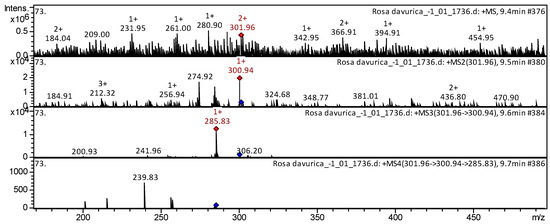
Figure 6.
CID-spectrum of Isokaempferide from extracts of R. davurica, m/z 301.96.
The [M + H]+ ion produced five fragment ions at m/z 300, m/z 274, m/z 256, m/z 212, and m/z 184 (Figure 6). The fragment ion with m/z 300 yielded three daughter ions at m/z 285, m/z 241, and m/z 200. The fragment ion with m/z 285 yielded one daughter ion at m/z 239. It was identified in the bibliography in extracts of Rosa rugosa [30] and Propolis [31].
3.4. Tetrahydroxyflavones
The flavonols Kaempferol (compound 20), Dihydrokaempferol (compound 21), Kaempferol-3-O-α-l-rhamnoside (compound 30), Kaempferol diacetyl hexoside (compound 34), Kaempferol 3-O-rutinoside (compound 35), and Kaempferol 3-O-deoxyhexosylhexoside (compound 36) have been already characterized as components of F. glaucescens [25], Andean blueberry [28], Rhus coriaria (Sumac) [32], Lonicera japonica [34], Potato leaves [35], Rapeseed petals [36], Echinops lanceolatus [37], Camellia kucha [38]. Thus, the flavonol Kaempferol was found in extracts of R. rugosa, R. davurica, and R. acicularis. The CID-spectrum in positive ion modes of luteolin from extracts of D. palmatum is shown in Figure 7.
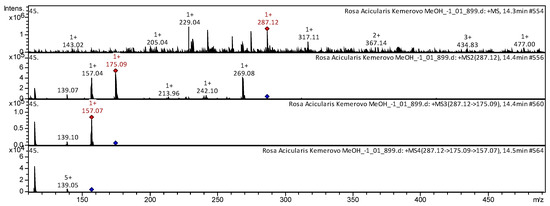
Figure 7.
CID-spectrum of Kaempferol from extracts of R. acicularis, m/z 287.
The [M + H]+ ion produced six fragment ions at m/z 269, m/z 242, m/z 213, m/z 175, m/z 157, and m/z 139 (Figure 7). The fragment ion with m/z 175 yielded two daughter ions at m/z 157 and m/z 139. It was identified in the bibliography in extracts of Andean blueberry [28], Rhus coriaria (Sumac) [32], Lonicera japonica [34], and Potato leaves [35].
3.5. Pentahydroxyflavones
The flavonols Quercetin (compound 23), Morin (compound 24), Rhamnetin I (compound 25), Rhamnetin II (compound 26), Isorhamnetin (compound 27), Avicularin (compound 31), Taxifolin-O-pentoside (compound 32), Taxifolin-3-O-hexoside (compound 33), and Isorhamnetin triacetyl hexoside (compound 37) have been already characterized as components of Bougainvillea [21], Rosa rugosa [30], Propolis [31], Rhus coriaria [32], and Potato leaves [35]. Thus, the flavonol Taxifolin-O-pentoside was found in extracts of R. davurica. The CID-spectrum in negative ion modes of Taxifolin-O-pentoside from extracts of R. davurica is shown in Figure 8.
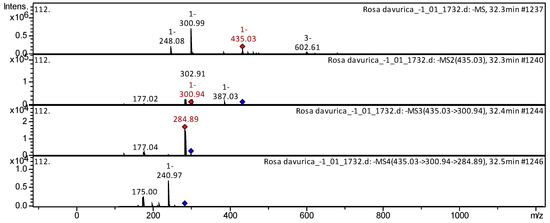
Figure 8.
CID-spectrum of Taxifolin-O-pentoside from extracts of R. davurica, m/z 285.03.
The [M − H]− ion produced three fragment ions at m/z 387, m/z 300, and m/z 177 (Figure 8). The fragment ion with m/z 300 yielded two daughter ions at m/z 284 and m/z 177. The fragment ion with m/z 284 yielded two daughter ions at m/z 240 and m/z 175. It was identified in the bibliography in extracts of millet grains [23] and A. cordifolia [25].
3.6. Flavan-3-ols
The flavan-3-ols Epiafzelechin (compound 38), Catechin (compound 39), (epi)Catechin (compound 40), and Gallocatechin (compound 41) have been characterized as components of millet grains [23], G. linguiforme [25], Camellia kucha [38], strawberry, cherimoya [39], Rosa rugosa [40], Myrtle [41], Radix polygoni multiflori [42], Licania ridigna [43], and Rhodiola rosea [44]. The flavan-3-ol Gallocatechin (compound 41) was found in extract of R. rugosa and R. davurica. The CID-spectrum in negative ion modes of Gallocatechin from R. rugosa is shown in Figure 9.
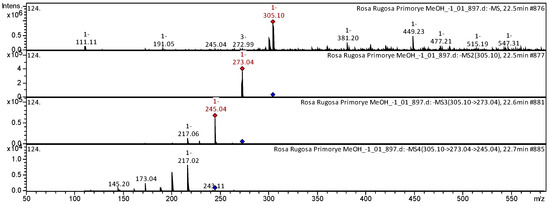
Figure 9.
CID-spectrum of Gallocatechin from R. rugosa, m/z 305.10.
The [M − H]− ion produced one fragment ion at m/z 273 (Figure 9). The fragment ion with m/z 273 yielded two daughter ions at m/z 269 and m/z 217. The fragment ion with m/z 245 yielded four daughter ions at m/z 243, m/z 217, m/z 173, and m/z 145. It was identified in the bibliography in extracts from G. linguiforme [25], Licania ridigna [43], and Rhodiola rosea [44].
3.7. Condensed Tannin
Prodelphinidin A-type (compound 83) and (S)-Flavogallonic acid (compound 84) have been already characterized as components of Vitis vinifera [45], Terminalia arjuna [46], and R. rugosa [47]. CID-spectrum in positive ion modes of (S)-Flavogallonic acid from R. davurica is shown in Figure 10. The [M + H]+ ion produced four fragment ions at m/z 453, m/z 407, m/z 321, m/z 247, and m/z 205 (Figure 10). The fragment ion with m/z 407 yielded three daughter ions at m/z 389, m/z 307, and m/z 205. This compound was identified in the bibliography in extracts from Terminalia arjuna [46] and R. rugosa [47].
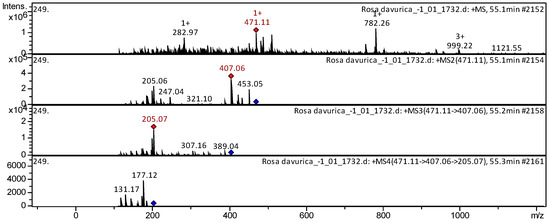
Figure 10.
CID-spectrum of (S)-Flavogallonic acid from extracts of R. davurica, m/z 471.11.
The polyphenol composition distribution table of varieties Rosa rugosa Thumb., Rosa davurica Pall., and Rosa acicularis Lindl. is shown below [Table 1]. The comparison table shows the presence of some polyphenols in three types of the genus Rosa (kaempferol, ellagic acid). Some polyphenols are present in only one variety of the genus Rosa.

Table 1.
The flavonoid composition distribution of varieties R. rugosa Thumb., R. davurica Pall., and R. acicularis Lindl. Blue square—presence in extracts of R. rugosa; red square—in extracts of R. davurica; green square—in extracts of R. acicularis.
The following polyphenols are present in only R. rugosa: Hydroxy-methoxy (iso)flavone, Chrysoeriol, Hispidulin, Cirsiliol, 5,6,4′-Trihydroxy-7,8-dimetoxyflavone, Dihydroxy-tetramethoxy (iso)flavone, Pentahydroxy trimethoxy flavone, Isovitexin, Chrysin 6-C-glucoside-6″-O-deoxyhexoside, Kaempferol-3-O-α-l-rhamnoside, Naringenin, Eriodictyol-7-O-glucoside, trans-Ferulic acid, 3,3,4,4-Tetrahydroxy-5-oxo-cyclohexanecarboxylic acid, Ginkgoic acid, 1-[(Acetyl-l-cysteinyl)oxy]-2,3,4,5-tetrahydroxycyclohexane-1-carboxylic acid, Neochlorogenic acid, Rosmarinic acid, Salvianolic acid D, Pinosylvin, Pinoresinol, 3,4,5-rimethoxy coumarin, Fraxin, Anthocyanidin [cyanidin chloride; Cyanidin], Cyanidin-3-O-dioxayl-glucoside.
The following polyphenols are present in only R. davurica—Chrysoeriol methyl ether, Tricin, Jaceosidin, Syringetin, Genistein C-glucoside malonylated, Diosmin, Dihydrokaempferol, Isokaempferide, Isorhamnetin, Myricetin, Mearnsetin, Taxifolin-O-pentoside, Kaempferol diacetyl hexoside, Kaempferol 3-O-rutinoside, Epiafzelechin, (epi)Catechin, Fustin, Hydroxy methoxy dimethylbenzoic acid, Hydroxyferulic acid, Sinapic acid, p-Coumaroylquinic acid, Salvianolic acid B, Cyanidin-3-O-glucoside, Delphinidin-O-pentoside, Pelargonidin-3-O-(6-O-malonyl-beta-d-glucoside), Delphinidin malonyl hexoside, Delphinidin 3,5-dihexoside, (S)-Flavogallonic acid, Punicalin alpha, Coniferin.
The following polyphenols are present in only R. acicularis—Cirsimaritin, Nevadensin, Morin, Rhamnetin I, Rhamnetin II, Nevadensin, Taxifolin-3-O-hexoside, Kaempferol 3-O-deoxyhexosylhexoside, Isorhamnetin triacetyl hexoside, Eriodictyol, 2,4,6-Trihydroxy-3,5-dimethoxybenzoic acid, Arctigenin, Prodelphinidin A-type, Ethyl gallate, Diphylloside B.
Thus, 146 metabolome compounds were identified in the extracts of R. rugosa, R. davurica, and R. acicularis, many of which are characteristic of the genus Rosa (family Rosaceae). Of these, 115 components were identified for the first time in the genus Rosa. These are flavones: Chrysoeriol, Hispidulin, 5,7-Dimethoxyluteolin, Cirsimaritin, Cirsiliol, Tricin, Jaceosidin, Nevadensin, Syringetin, Isovitexin, Genistein C-glucoside malonylated, Chrysin 6-C-glucoside-6″-O-deoxyhexoside; flavanols: Dihydrokaempferol, Rhamnetin II, Kaempferol-3-O-α-l-rhamnoside, Taxifolin-O-pentoside, Taxifolin-3-O-hexoside, Isorhamnetin triacetyl hexoside; flavan-3-ols: Epiafzelechin and Gallocatechin; flavanones: Naringenin, Fustin; phenolic acids: Caffeic acid, Citric acid, Hydroxy methoxy dimethylbenzoic acid, Hydroxyferulic acid, Ellagic acid, p-Coumaroylquinic acid, Ginkgoic acid, Salvianolic acid D, Salvianolic acid B; stilbenes: Pinosylvin, Resveratrol, 3-Hydroxyresveratrol; lignans: Pinoresinol, Arctigenin; coumarins: 3,4,5–Trimethoxycoumarin, Fraxin; anthocyanins Cyanidin 3-O-glucoside, Delphinidin O-pentoside, Pelargonidin 3-O-(6-O-malonyl-β-d-glucoside), Cyanidin 3-(6″-Succinyl-Glucoside), Delphinidin malonyl hexoside, Cyanidin 3-O-dioxayl-glucoside, Delphinidin 3,5-dihexoside, etc.
4. Materials and Methods
4.1. Materials
Aboveground phyto Rosa rugosa Thumb., Rosa davurica Pall., and Rosa acicularis Lindl. collected during expedition work on the territory of the Russian Far East, Trans-Baikal Region, and Western Siberia during the period of ripening (July–September, 2020). Phyto mass of R. davurica was collected on the territory of Buryatia (N 52°21′97″ E 108°59′84″), in September 2020. Phyto mass of R. rugosa was collected on the territory of Primorsky Krai, Russia (N 42°36′10″ E 131°10′55″), during the period from 10 to 20 August, 2020. Phyto mass of R. acicularis was collected on the territory of Kemerovo, Western Siberia (N 55°21′15′’ E 86°05′23″), in August 2020. All samples were morphologically authenticated according to the current standard of Pharmacopoeia of the Eurasian Economic Union [48].
The results were obtained using the equipment of the Center for Collective Use of Scientific Equipment of TSU named after G.R. Derzhavin.
4.2. Chemicals and Reagents
HPLC-grade acetonitrile was purchased from Fisher Scientific (Southborough, UK), MS-grade formic acid was from Sigma-Aldrich (Steinheim, Germany). Ultra-pure water was prepared from a SIEMENS ULTRA clear (SIEMENS water technologies, Germany), and all other chemicals were analytical grade.
4.3. Fractional Maceration
To obtain highly concentrated extracts, fractional maceration was applied. In this case, the total amount of the extractant (methyl alcohol of reagent grade) is divided into 3 parts and is consistently infused on potato with the first part, then with the second and third. The infusion time of each part of the extractant was 7 days.
4.4. Liquid Chromatography
HPLC was performed using Shimadzu LC-20 Prominence HPLC (Shimadzu, Japan), equipped with an UV-sensor and a Shodex ODP-40 4E reverse phase column to perform the separation of multicomponent mixtures. The gradient elution program was as follows: 0.01–5 min, 100% CH3CN; 5–45 min, 100–25% CH3CN; 45–55 min, 25–0% CH3CN; control washing: 55–60 min, 0% CH3CN. The entire HPLC analysis was conducted with an ESI detector at wavelengths of 230 ηm and 330 ηm; the temperature corresponded to 17 °C. The injection volume was 1 mL.
4.5. Mass Spectrometry
MS analysis was performed on an ion trap amaZon SL (BRUKER DALTONIKS, Germany) equipped with an ESI source in negative and positive ion modes. The optimized parameters were obtained as follows: ionization source temperature: 70 °C, gas flow: 4 L/min, nebulizer gas (atomizer): 7.3 psi, capillary voltage: 4500 V, end plate bend voltage: 1500 V, fragmentary: 280 V, collision energy: 60 eV. A four-stage ion separation mode (MS/MS mode) was implemented.
5. Conclusions
The extracts of Rosa rugosa Thumb., Rosa davurica Pall., and Rosa acicularis Lindl. contain a large number of polyphenolic complexes which are biologically active compounds. For the most complete and safe extraction, the method of maceration with MeOH was used. To identify target analytes in extracts, HPLC was used in combination with the ion trap. The results of a preliminary study showed the presence of 146 bioactive compounds, of which 115 were identified for the first time in the genus Rosa (family Rosaceae). Of these 115 chemical compounds identified for the first time in the genus Rosa, 70 compounds belonged to the polyphenolic group: 18 flavones, 7 flavonols, 3 flavan-3-ols, 2 flavanones, 14 phenolic acids, 3 stilbenes, 2 lignans, 2 coumarins, 9 anthocyanidins, 3 tannins, etc. The proven richness of the bioactive components of targeted extracts of R. rugosa, R. davurica, and R. acicularis invites extensive biotechnological and pharmaceutical research, which can make a significant contribution both in the field of functional and enriched nutrition, and in the field of cosmetology and pharmacy. It should also be noted that the variability of the genus Rosa (family Rosaceae) contributes to the selection of the most drought-resistant species and samples for household, decorative, and forest reclamation needs in the arid climatic zones of Eurasia.
It is important to note that the useful properties of the genus Rosa (family Rosaceae) are: food (R. rugosa, R. acicularis), perfumery (R. acicularis, R. ecae), nectariferous (R. canina, R. cinnamomea), decorative (R. acicularis, R. rugosa), and soil-strengthening (R. acicularis, R. rugosa, R. spinosissima). A wide variety of biologically active polyphenolic compounds opens up rich opportunities for the creation of new drugs, as well as bioactive additives based on extracts from the genus Rosa.
Author Contributions
Conceptualization, B.A.B., A.N.K. and M.P.R.; methodology, Y.Y.Z., A.G.B. and M.P.R.; software, M.P.R.; validation, A.N.K., M.P.R. and K.S.G.; formal analysis, M.P.R. and A.M.Z.; investigation, A.S.S. and S.E.; resources, K.S.G., B.A.B., and Y.Y.Z.; data curation, B.A.B.; writing—original draft preparation—M.P.R. and A.M.Z.; writing—review and editing A.M.Z. and K.S.G.; visualization, M.P.R. and A.M.Z.; supervision, K.S.G.; project administration, B.A.B., K.S.G. and S.E. All authors have read and agreed to the published version of the manuscript.
Funding
The work was carried out with the support of the grant Young Scientists ESSTUM 2022 and according to No. 0662-2019-0003, “Genetic resources of vegetable and melons of the world collection of N.I. Vavilov All-Russian Institute of Plant Genetic Resources: effective ways of expanding diversity, disclosing the patterns of hereditary variability, use of adaptive potential”.
Institutional Review Board Statement
No applicable.
Informed Consent Statement
No applicable.
Data Availability Statement
No applicable.
Acknowledgments
Research work according to No. 0662-2019-0003 “Genetic resources of vegetable and melons of the world collection of N.I. Vavilov All-Russian Institute of Plant Genetic Resources: effective ways of expanding diversity, disclosing the patterns of hereditary variability, use of adaptive potential”.
Conflicts of Interest
The authors declare no conflict of interest.
Appendix A
Table A1.
Compounds identified from the extracts of Rosa rugosa Thumb., Rosa davurica Pall., and Rosa acicularis Lindl. in positive and negative ionization modes by HPLC–ion trap–MS/MS.
Table A1.
Compounds identified from the extracts of Rosa rugosa Thumb., Rosa davurica Pall., and Rosa acicularis Lindl. in positive and negative ionization modes by HPLC–ion trap–MS/MS.
| No. | Class of Compounds | Identified Compounds | Formula | Mass | Molecular Ion [M − H]− | Molecular Ion [M + H]+ | 2 Fragmentation MS/MS | 3 Fragmentation MS/MS | 4 Fragmentation MS/MS | References |
|---|---|---|---|---|---|---|---|---|---|---|
| POLYPHENOLS | ||||||||||
| 1 | Flavone | Hydroxy-methoxy (iso) flavone * | C16H12O4 | 268.2641 | 269 | 252 | 221 | 190 | Propolis [31] | |
| 2 | Flavone | Apigenin [5,7-Dixydroxy-2-(40Hydroxyphenyl)-4H-Chromen-4-One] | C15H10O5 | 270.2369 | 271 | 253 | 224 | Hedyotis diffusa [27]; Andean blueberry [28]; Stevia rebaudiana [29]; Rosa rugosa [30]; Propolis [31] | ||
| 3 | Flavone | Chrysoeriol [Chryseriol] * | C16H12O6 | 300.2629 | 301 | 269; 195 | 241 | Mentha [25]; Propolis [31]; Rhus coriaria [32]; Mexican lupine species [33] | ||
| 4 | Flavone | Hispidulin * | C16H12O6 | 300.2629 | 301 | 269; 241; 197 | 224; 180; 153 | Mentha [25]; Cirsium japonicum [49] | ||
| 5 | Flavone | 5,7-Dimethoxyluteolin * | C17H14O6 | 314.2895 | 313 | 212; 285; 184; 113 | 113; 145; 185 | Syzygium aromaticum [18] | ||
| 6 | Flavone | Cirsimaritin [Scrophulein; 4′,5-Dihydroxy-6,7-Dimethoxyflavone; 7-Methylcapillarisin] * | C17H14O6 | 314.2895 | 315 | 300; 240; 213; 185 | 272; 227; 185; 168; 135 | 185 | Ocimum [19]; Rosmarinus officinalis [20] | |
| 7 | Flavone | Chrysoeriol methyl ether * | C17H14O6 | 314.2895 | 315 | 287; 241; 187 | 187 | 169 | Bougainvillea [21] | |
| 8 | Flavone | Cirsiliol * | C17H14O7 | 330.2889 | 329 | 229 | 211; 127 | 209; 125 | Ocimum [19] | |
| 9 | Flavone | Tricin [5,7,4′-trihydroxy-3′,5′-dimetoxyflavone] * | C17H14O7 | 330.2889 | 329 | 314; 259; 229 | 299; 271 | 271; 227 | Triticum aestivum [22]; millet grains [23]; Sasa veitchii; Phyllostachys nigra [24] | |
| 10 | Flavone | Jaceosidin [5,7,4′-trihydroxy-6′,5′-dimetoxyflavone] * | C17H14O7 | 330.2889 | 331 | 303; 185 | Mentha [26,50] | |||
| 11 | Flavone | 5,6,4′-Trihydroxy-7,8-dimetoxyflavone * | C17H14O7 | 330.2889 | 331 | 299; 179 | 211 | F. glaucescens; F. herrerae [25]; Mentha [26] | ||
| 12 | Flavone | Nevadensin * | C18H16O7 | 344.3154 | 345 | 330 | 315 | 286; 259; 183; 133 | Ocimum [19]; Mentha [26] | |
| 13 | Flavone | Syringetin * | C17H14O8 | 346.2883 | 347 | 317; 218 | 289; 218 | 261; 191 | C. edulis [25] | |
| 14 | Flavone | Dihydroxy-tetramethoxy(iso)flavone * | C19H18O8 | 374.3414 | 375 | 343 | 315 | 225 | Propolis [31] | |
| 15 | Flavone | Pentahydroxy trimethoxy flavone * | C18H16O10 | 392.3136 | 393 | 377; 375; 275; 213 | 357 | 329; 286 | F. glaucescens; C. edulis [25] | |
| 16 | Flavone | Isovitexin [Saponaretin; Homovitexin; Apigenin-6-C-Glucoside] * | C21H20O10 | 432.3775 | 433 | 415; 335; 243; 175 | 261; 243; 191; 155 | 135 | millet grains [23]; Phyllostachys nigra [24]; Rhus coriaria [32] | |
| 17 | Flavone | Genistein C-glucoside malonylated * | C24H22O13 | 518.4237 | 517 | 473; 455 | 455; 413; 339 | 425 | Mexican lupine species [33] | |
| 18 | Flavone | Chrysin 6-C-glucoside-6″-O-deoxyhexoside * | C27H30O13 | 562.5193 | 563 | 400; 363; 305; 239 | 130; 162; 191; 214 | Passiflora incarnata [51] | ||
| 19 | Flavone | Diosmin [Diosmetin-7-O-rutinoside; Barosmin; Diosimin] * | C28H32O15 | 608.5447 | 609 | 591; 429; 355; 269 | 285 | 269 | F. glaucescens [25]; Mentha [26]; Lemon [39]; Grataegi Fructus [52] | |
| 20 | Flavonol | Kaempferol [3,5,7-Trihydroxy-2-(4-hydro- xyphenyl)-4H-chromen-4-one] | C15H10O6 | 286.2363 | 287 | 187; 227 | 189; 125 | Andean blueberry [28]; Rhus coriaria (Sumac) [32]; Lonicera japonica [34]; Potato leaves [35]; Rapeseed petals [36] | ||
| 21 | Flavonol | Dihydrokaempferol [Aromadendrin; Katuranin] * | C15H12O6 | 288.2522 | 287 | 259; 185; 117 | 215 | 197 | F. glaucescens [25]; Andean blueberry [28]; Echinops lanceolatus [37]; Camellia kucha [38] | |
| 22 | Flavonol | Isokaempferide [3-O-Methylkaempferol] | C16H12O6 | 300.2629 | 301 | 300; 274; 257; 212; 184 | 286; 242; 201 | 240 | Rosa rugosa [30]; Propolis [31] | |
| 23 | Flavonol | Quercetin | C15H10O7 | 302.2357 | 303 | 285 | 257 | 201;117 | Bougainvillea [21]; Propolis [31]; Rosa rugosa [30]; Rhus coriaria [32]; Potato leaves [35] | |
| 24 | Flavonol | Morin [Aurantica; Calico Yellow; Toxylon Pomiferum; 2′,3,4′,5,7-Pentahydroxyflavone] | C15H10O7 | 302.2357 | 301 | 283; 265; 221 | 221 | 203; 151; 127 | Rosa rugosa [30]; Red wines [53] | |
| 25 | Flavonol | Rhamnetin I [beta-Rhamnocitrin; Quercetin 7-Methyl ether] | C16H12O7 | 316.2623 | 317 | 299; 269; 233; 185; 165 | 147; 123 | Rosa rugosa [30]; Rhus coriaria L. (Sumac) [32] | ||
| 26 | Flavonol | Rhamnetin II * | C16H12O7 | 316.2623 | 317 | 165;185; 155; 123 | 147; 123 | 119 | Syzygium aromaticum [18]; Propolis [31]; Rhus coriaria L. (Sumac) [32]; Spondias purpurea [54] | |
| 27 | Flavonol | Isorhamnetin [Isorhamnetol; Quercetin 3′-Methyl ether; 3-Methylquercetin] | C16H12O7 | 316.2623 | 317 | 285; 234; 190; 156 | 256; 214 | 229; 201 | Rosmarinus officinalis [20]; Andean blueberry [28]; Rosa rugosa [30]; Propolis [31]; Vaccinium macrocarpon [55]; Embelia [56] | |
| 28 | Flavonol | Myricetin | C15H10O8 | 318.2351 | 319 | 289; 217; 185 | 261; 191 | millet grains [23]; F. glaucescens [25]; Andean blueberry [28]; Rosa rugosa [30]; Propolis [31]; Vaccinium macrocarpon [55] | ||
| 29 | Flavonol | Mearnsetin * | C16H12O8 | 332.2617 | 331 | 287 | 259 | 215; 187; 159 | Eucalyptus [57] | |
| 30 | Flavonol | Kaempferol-3-O-α-l-rhamnoside * | C21H20O10 | 432.3775 | 433 | 415; 313; 241; 195 | 123; 257; 239 | C.edulis; F. glaucescens [25]; Rhus coriaria [32]; Cassia abbreviata [58]; Euphorbia hirta [59] | ||
| 31 | Flavonol | Avicularin (Quercetin 3-Alpha-l-Arabinofuranoside; Avicularoside) | C20H18O11 | 434.3503 | 433 | 301 | 273; 229; 192; 179; 151 | 169; 151 | Propolis [31]; Eucalyptus Globulus [60]; Rosa rugosa [61] | |
| 32 | Flavonol | Taxifolin-O-pentoside [Dihydroquercetin pentoside] * | C20H20O11 | 436.371 | 435 | 301; 177 | 285; 177 | 241; 175 | millet grains [23]; A. cordifolia [25] | |
| 33 | Flavonol | Taxifolin-3-O-hexoside [Dihydroquercetin-3-O-hexoside] * | C21H22O12 | 466.3922 | 467 | 287; 305; 334; 449 | 268; 256; 227; 202 | millet grains [23]; Andean blueberry [28]; Euphorbia hirta [59]; Rubus ulmifolius [62] | ||
| 34 | Flavonol | Kaempferol diacetyl hexoside | C25H24O13 | 532.4503 | 533 | 432; 531; 289 | 415; 295 | 385 | A. cordifolia [25] | |
| 35 | Flavonol | Kaempferol 3-O-rutinoside | C27H30O15 | 594.5181 | 595 | 285; 165 | 165 | Rhus coriaria [32]; Lonicera japonica [34]; Camellia kucha [38]; Strawberry [39] | ||
| 36 | Flavonol | Kaempferol 3-O-deoxyhexosylhexoside | C27H30O15 | 594.5181 | 595 | 287; 263; 165 | 213; 197; 165 | 157; 145 | Stevia rebaudiana [29]; Rosa rugosa [40]; Spondias purpurea [54] | |
| 37 | Flavonol | Isorhamnetin triacetyl hexoside * | C28H28O15 | 604.5129 | 605 | 443; 417; 317; 279 | 329; 311; 255; 211 | A. cordifolia [25] | ||
| 38 | Flavan-3-ol | Epiafzelechin [(epi)Afzelechin] * | C15H14O5 | 274.2687 | 275 | 244; 157 | 157; 215 | 127 | A. cordifolia; F. glaucescens; F. herrerae [25]; Cassia abbreviata [58]; Cassia granidis [63] | |
| 39 | Flavan-3-ol | Catechin [D-Catechol] | C15H14O6 | 290.2681 | 291 | 272; 174 | 245 | 198 | millet grains [23]; C. edulis [25]; Camellia kucha [38]; strawberry, cherimoya [39]; Rosa rugosa [40]; Myrtle [41]; Radix polygoni multiflori [42]; Rosa rugosa [64] | |
| 40 | Flavan-3-ol | (epi)Catechin * | C15H14O6 | 290.2681 | 291 | 273; 117 | 255; 145 | Andean blueberry [28]; C. edulis [25]; Camellia kucha [38]; Radix polygoni multiflori [42] | ||
| 41 | Flavan-3-ol | Gallocatechin [+(-)Gallocatechin] * | C15H14O7 | 306.2675 | 307 | 291 | 263; 189 | 206 | G. linguiforme [25]; Licania ridigna [43]; Rhodiola rosea [44] | |
| 42 | Flavanone | Naringenin [Naringetol; Naringenine] | C15H12O5 | 272.5228 | 273 | 153; 256 | 125 | G. linguiforme [25]; Andean blueberry [28]; Stevia rebaudiana [29]; Rosa rugosa [30]; Mexican lupine species [33]; Rapeseed petals [36]; Punica granatum [65] | ||
| 43 | Flavanone | Fustin [2,3-Dihydrofistein] * | C15H12O6 | 288.2522 | 289 | 269; 140 | 179 | F. glaucescens; F. pottsii [25] | ||
| 44 | Flavanone | Eriodictyol [3′,4′,5,7-tetrahydroxy-flavanone] | C15H12O6 | 288.2522 | 287 | 269; 241; 155; 127 | 267; 251; 223; 183; 155 | 249; 199; 155 | Rosmarinus officinalis [20]; Andean blueberry [28]; Rosa rugosa [30]; Propolis [31]; Embelia [56] | |
| 45 | Flavanone | Eriodictyol-7-O-glucoside [Pyracanthoside; Miscanthoside] * | C21H22O11 | 450.3928 | 449 | 269; 151 | 225 | Impatients glandulifera Royle [66] | ||
| 46 | Hydroxycinnamic acid | Caffeic acid * | C9H8O4 | 180.1574 | 181 | 135 | 119 | Triticum [22]; millet grains [23]; Lonicera japonica [24]; Radix polygoni multiflori [42]; Mentha [50]; Malva sylvestris [67] | ||
| 47 | Phenolic acid | Quinic acid | C7H12O6 | 192.1666 | 193 | 191; 147 | 173; 136 | 131 | Andean blueberry [28]; Stevia rebaudiana [29]; Rhus coriaria [32]; Lonicera japonicum [34]; Camellia kucha [38]; Rosa rugosa [40] | |
| 48 | Phenolic acid | Citric acid [Anhydrous; Citrate] * | C6H8O7 | 192.1235 | 191 | 111; 173 | 111 | Stevia rebaudiana [29]; Potato leaves [35]; Strawberry, Lemon, Cherimoya, Papaya, Passion fruit [39]; Mentha [50]; Punica granatum [65] | ||
| 49 | Phenolic acid | trans-Ferulic acid | C10H10O4 | 194.184 | 195 | 153 | 125 | millet grains [23]; Rosa rugosa [30]; Sanguisorba officinalis [68] | ||
| 50 | Phenolic acid | Hydroxy methoxy dimethylbenzoic acid * | C10H12O4 | 196.1999 | 195 | 129; 177 | F. herrerae; F. glaucescens [25] | |||
| 51 | Phenolic acid | Syringic acid | C9H10O5 | 198.1727 | 199 | 157; 183; 119 | 142 | Bougainvillea [21]; millet grains [29]; A. cordifolia; G. linguiforme; F. glaucescens [25]; Rosa rugosa [30]; Actinidia [69] | ||
| 52 | Phenolic acid | 3,3,4,4-Tetrahydroxy-5-oxo-cyclohexanecarboxylic acid * | C7H10O7 | 206.1501 | 207 | 161; 189 | 143 | 119 | Actinidia [69] | |
| 53 | Phenolic acid | Hydroxyferulic acid * | C10H10O5 | 210.1834 | 211 | 193 | 175 | 133 | Andean blueberry [28] | |
| 54 | Hydroxycinnamic acid | Sinapic acid [trans-Sinapic acid] | C11H12O5 | 224.2100 | 225 | 209 | 139; 192 | millet grains [23]; Andean blueberry [28]; Rosa rugosa [30]; Rapeseed petals [36]; Cherimoya [39] | ||
| 55 | Phenolic acid | 2,4,6-Trihydroxy-3,5-dimethoxybenzoic acid * | C9H10O7 | 230.1715 | 231 | 229; 211; 185; 155 | 168; 143 | 127 | Actinidia [69] | |
| 56 | Hydroxybenzoic acid | Ellagic acid [Benzoaric acid; Elagostasine; Lagistase; Eleagic acid] * | C14H6O8 | 302.1926 | 301 | 256 | 185 | Rhus coriaria [32]; Eucalyptus [57]; Eucalyptus Globulus [60] | ||
| 57 | Phenolic acid | p-Coumaroylquinic acid * | C16H18O8 | 338.3093 | 339 | 191; 320; 252 | 149 | Andean blueberry [28]; F. glaucescens [25]; Eucalyptus Globulus [60]; Actinidia [69] | ||
| 58 | Phenolic acid | Ginkgoic acid [Ginkgolic acid; Romanicardic acid] * | C22H34O3 | 346.5036 | 347 | 301; 130 | 130 | Propolis [31] | ||
| 59 | Phenolic acid | 1-[(Acetyl-l-cysteinyl)oxy]-2,3,4,5-tetrahydroxycyclohexane-1-carboxylic acid * | C12H19O9NS | 353.3456 | 354 | 335 | 192; 286 | 132; 176 | Actinidia [69] | |
| 60 | Phenolic acid | Chlorogenic acid [3-O-Caffeoylquinic acid] * | C16H18O9 | 354.3087 | 353 | 191 | 173 | Bougainvillea [21]; Andean blueberry [28]; Rhus coriaria [32]; Lonicera japonicum [34]; Potato leaves [35]; Rapeseed petals [28]; Vaccinium macrocarpon [55] | ||
| 61 | Phenolic acid | Neochlorogenic acid [5-O-Caffeoylquinic acid] | C16H18O9 | 354.3087 | 353 | 173; 111 | Andean blueberry [28]; Stevia rebaudiana [29]; Rosa rugosa [30]; Lonicera japonicum [34]; Euphorbia hirta [59]; Crataegus monogyna, Sambucus nigra [67] | |||
| 62 | Phenolic acid | Rosmarinic acid | C18H16O8 | 360.3148 | 361 | 343; 327; 301; 253; 19; 161 | 253; 121 | 225; 210; 179 | Rosmarinus officinalis [20]; Mentha [26]; Rosa rugosa [30]; Mentha [70]; Huolisu Oral Liquid [71]; Rosemary [72] | |
| 63 | Phenolic acid | 5-Hydroxy feruloyl hexose * | C16H20O10 | 372.3240 | 373 | 211; 277; 354 | 175 | millet grains [23] | ||
| 64 | Phenolic acid | Salvianolic acid D * | C20H18O10 | 418.3509 | 417 | 373 | 347; 303 | Mentha [70,73]; Salvia multiorrizae [74] | ||
| 65 | Phenolic acid | Salvianolic acid B [Danfensuan B] * | C36H30O16 | 718.6138 | 719 | 521; 199 | 475 | Bougainvillea [21]; Mentha [50]; Huolisu Oral Liquid [71]; Mentha [73]; Salvia miltiorrhiza [74] | ||
| 66 | Stilbene | Pinosylvin [3,5-Stilbenediol; Trans-3,5-Dihydroxystilbene] * | C14H12O2 | 212.2439 | 213 | 195; 171 | 143 | 127 | Pinus resinosa [75]; Pinus sylvestris [76] | |
| 67 | Stilbene | Resveratrol [trans-Resveratrol; 3,4′,5-Trihydroxystilbene; Stilbentriol] * | C14H12O3 | 228.2433 | 229 | 169; 210; 141; 115 | 141 | 113 | A. cordifolia; F. glaucescens; F. herrerae [25]; Radix polygoni multiflori [42]; Embelia [56]; Vine stilbenoids [77] | |
| 68 | Stilbene | 3-Hydroxyresveratrol [Piceatannol] * | C14H12O4 | 244.2427 | 245 | 199; 112 | 112 | G. linguiforme [25]; Vine stilbenoids [77]; Oenocarpus bataua [78] | ||
| 69 | Lignan | Pinoresinol * | C20H22O6 | 358.3851 | 359 | 340; 208 | 322; 196 | 274; 214 | Passiflora incarnata [51]; Punica granatum [65]; Eucommia cortex [79]; Lignans [80] | |
| 70 | Lignan | Arctigenin * | C21H24O6 | 372.4117 | 373 | 354; 336; 283; 252; 211 | 336; 318; 288; 252; 218 | 288; 236; 197 | Lignans [80]; Triticum aestivum [81]; Forsythia [82] | |
| 71 | Coumarin | 3,4,5-Trimethoxycoumarin * | C12H12O5 | 236.2207 | 237 | 192; 206; 178 | 132 | 130; 117 | Propolis [31] | |
| 72 | Coumarin | Fraxin (Fraxetin-8-O-glucoside) * | C16H18O10 | 370.3081 | 371 | 191 | 127 | Vitis vinifera [45]; Actinidia [69]; Solanum tuberosum [83] | ||
| 73 | Anthocyanidin | Anthocyanidin [cyanidin chloride; Cyanidin] * | C15H11O6+ | 287.2442 | 287 | 213; 195; 167 | 196; 163; 125 | F. herrerae [25]; Andean blueberry [28]; Malpighia emarginata [84] | ||
| 74 | Anthocyanidin | Petunidin * | C16H13O7+ | 317.2702 | 318 | 256; 300 | 228; 212; 184 | 212 | A. cordifolia; C. edulis [25] | |
| 75 | Anthocyanidin | Cyanidin-3-O-glucoside [Cyanidin 3-O-beta-d-Glucoside; Kuromarin] * | C21H21O11+ | 449.3848 | 447 | 285; 195 | 255 | Triticum aestivum [22]; Malpighia emarginata [84] | ||
| 76 | Anthocyanidin | Delphinidin O-pentoside * | C20H19O11 | 435.3583 | 435 | 303; 245 | 245; 149 | Andean blueberry [28]; Myrtle [41]; Gaultheria mucronata; Gaultheria antarctica [85] | ||
| 77 | Anthocyanidin | Pelargonidin 3-O-(6-O-malonyl-beta-d-glucoside) * | C24H23O13 | 519.4388 | 519 | 271 | 253 | Gentiana lutea [86]; Wheat [87] | ||
| 78 | Anthocyanidin | Cyanidin 3-(6″-Succinyl-Glucoside) [Cyanidin 3-(6″-O-succinoyl-Beta-d-Glucopyranoside)] * | C25H25O14 | 549.4576 | 549 | 286 | 268 | 240 | Wheat [87] | |
| 79 | Anthocyanidin | Delphinidin malonyl hexoside * | C24H23O15 | 551.4304 | 551 | 465; 425; 287; 198 | 271; 157 | F. glaucescens [25] | ||
| 80 | Anthocyanidin | Cyanidin-3-O-dioxayl-glucoside * | C31H28O12 | 592.5468 | 593 | 287; 165 | 213; 153 | Rubus ulmifolius [62] | ||
| 81 | Anthocyanidin | Delphinidin 3,5-dihexoside * | C27H31O17 | 627.5248 | 627 | 413; 227 | 227; 351 | F. herrerae [25]; Andean blueberry [28]; Berberis microphylla [85] | ||
| 82 | Tannin | Prodelphinidin A-type * | C30H26O13 | 594.5286 | 595 | 406; 287; 245 | 241; 213; 165; 153 | 213 | Vitis vinifera [45] | |
| 83 | Hydrolysable tannin | (S)-Flavogallonic acid | C21H10O13 | 470.2963 | 471 | 407; 321; 247; 205 | 205; 307; 389 | 177; 131 | Terminalia arjuna [46]; Rosa rugosa [47] | |
| 84 | Ellagitannin | Punicalin alpha * | C34H22O22 | 782.5253 | 783 | 721; 449; 599; 535 | 596 | Myrtle [41]; Terminalia arjuna [46]; Punica granatum [65] | ||
| 85 | Phenylpropanoid (cinnamic alcohol glycoside) | Coniferin [Coniferyl Alcohol Beta-d-Glucoside] * | C16H22O8 | 342.3411 | 343 | 240 | 183 | 127 | Hedyotis diffusa [27]; Rhodiola crenulata [88] | |
| 86 | Gallate ester | Ethyl gallate * | C9H10O5 | 198.1727 | 197 | 169; 125 | 124 | Bougainvillea [21]; Terminalia arjuna [46]; Euphorbia hirta [59] | ||
| 87 | Gallate ester | Beta-Glucogallin [1-O-Galloyl-Beta-d-Glucose; Galloyl glucose; Monogalloyl glucose] * | C13H16O10 | 332.2601 | 333 | 273; 227; 169 | 169; 191; 209 | Syzygium aromaticum [18]; Terminalia arjuna [46]; Euphorbia hirta [59]; Cassia granidis [63] | ||
| 88 | Dihydrochalcone | Phloretin [Dihydronaringenin; Phloretol] * | C15H14O5 | 274.2687 | 275 | 257; 229; 215 | 255; 239; 229; 210 | G. linguiforme [25]; Punica granatum [65]; Malus toringoides [89] | ||
| 89 | Flavonoid | Diphylloside B * | C38H48O19 | 808.7763 | 809 | 647; 592; 531; 483; 431; 369; 317 | 533; 484; 419; 369; 269 | 419 | Huolisu Oral Liquid [71] | |
| 90 | Flavonoid | Demethylanhydroicaritin-7-O-glucopyranosyl-3-O-acetylated rhamnopyranosyl-xylopyranoside * | C39H48O20 | 836.7854 | 837 | 675; 603; 541; 503; 403 | 441; 341 | 341; 241 | Huolisu Oral Liquid [71] | |
| OTHERS | ||||||||||
| 91 | Cyclohexenecarboxylic acid | Shikimic acid [L-Schikimic acid] * | C7H10O5 | 174.1513 | 173 | 111 | A. cordifolia [25]; Camellia kucha [38]; Euphorbia hirta [59] | |||
| 92 | Vitamin | L-Ascorbic acid [Vitamin C] | C6H8O6 | 176.1241 | 175 | 127 | Potato leaves [35]; Strawberry, Lemon, Papaya [39] | |||
| 93 | Monoterpenoid | Methyl eugenol * | C11H14O2 | 178.2277 | 179 | 161 | 133 | Ocimum [19]; Olive leaves [90] | ||
| 94 | Omega-hydroxy amino acid | Hydroxy decenoic acid * | C10H18O3 | 186.2481 | 187 | 169; 142 | 141 | F. glaucescens [25] | ||
| 95 | Essential amino acid | L-Tryptophan [Tryptophan; (S)-Tryptophan] * | C11H12N2O2 | 204.2252 | 205 | 186; 158 | 146; 169 | 144; 118 | Rapeseed petals [36]; Camellia kucha [38]; Passiflora incarnata [51]; Euphorbia hirta [59]; Huolisu Oral Liquid [71] | |
| 96 | Sesquiterpenoid | Caryophyllene oxide [Caryophyllene-alpha-oxide] * | C15H24O | 220.3505 | 221 | 161 | 147 | Olive leaves [90] | ||
| 97 | 3,4,5-Trimethoxyphenylacetic acid | C11H14O5 | 226.2259 | 227 | 127; 145; 169; 199 | 145; 117 | 127 | Rosa rugosa [30] | ||
| 98 | Omega-5 fatty acid | Myristoleic acid [Cis-9-Tetradecanoic acid] * | C14H26O2 | 226.3550 | 227 | 209; 127 | 139 | F. glaucescens [25] | ||
| 99 | Quaianolide sesquiterpene lactone | Dehydrocostus Lactone * | C15H18O2 | 230.3022 | 231 | 214 | 168 | Weichang’an Pill [91] | ||
| 100 | Germacranolide | Costunolide * | C15H20O2 | 232.3181 | 233 | 186 | 168; 131 | 155 | Weichang’an Pill [91] | |
| 101 | Biphenyl derivative | Randaiol * | C15H14O3 | 242.2699 | 243 | 225; 211; 182 | 182; 167; 132 | 166 | Magnolia officinalis [92] | |
| 102 | Peptide | 5-Oxo-l-propyl-l-isoleucine * | C11H18N2O4 | 242.2716 | 243 | 197 | 165 | 137 | Potato leaves [35] | |
| 103 | Hydroxy monocarboxylic acid | Hydroxy myristic acid [2S-Hydroxytetradecanoic acid; Alpha-Hydroxy Myristic acid] * | C14H28O3 | 244.3703 | 245 | 229; 222; 211; 201 | 227; 211; 201 | F. pottsii [25] | ||
| 104 | Medium-chain fatty acid | Hydroxy dodecanoic acid * | C12H22O5 | 246.3001 | 247 | 229; 202; 174; 156 | 183; 156; 144 | 156 | F. glaucescens [25] | |
| 105 | Acyclic alcohol nitrile glycoside | Rhodiocyanoside A * | C11H17NO6 | 259.2558 | 260 | 186; 232 | 168 | 141 | Rhodiola rosea [93]; Rhodiola sacra [94] | |
| 106 | Naphthoquinone | Spinochrome A * | C12H8O7 | 264.1877 | 265 | 247 | 219 | Rhus coriaria [32] | ||
| 107 | Aporphine alkaloid | Anonaine * | C17H15NO2 | 265.3065 | 266 | 247; 190; 166 | 166 | Magnolia officinalis [92] | ||
| 108 | Ribonucleoside composite of adenine (purine) | Adenosine * | C10H13N5O4 | 267.2413 | 268 | 136 | Lonicera japonica [34]; Huolisu Oral Liquid [71] | |||
| 109 | 3,4,8,9,10-Penthahydroxydibenzo [b,d]pyran-6-one * | C13H8O7 | 276.1984 | 277 | 175; 231; 259 | 131; 177 | Terminalia arjuna [46] | |||
| 110 | Linoleic acid amide * | C18H33NO | 279.4607 | 280 | 262 | 244; 196; 164; 128 | 226; 196; 164 | Propolis [31]; Rhus coriaria [32] | ||
| 111 | Oleamide * | C18H35NO | 281.4766 | 282 | 247 | 173; 201; 145 | 145 | Propolis [31] | ||
| 112 | Terpenoid | Rugosic acid A | C15H22O5 | 282.3322 | 283 | 239; 265; 167 | 211 | 193; 170 | Rosa rugosa [95] | |
| 113 | Alkaloid | Mesembrenol * | C17H23NO3 | 289.3694 | 290 | 272; 146 | 224; 182 | 164 | Sceletium [96] | |
| 114 | Alkaloid | Mesembranol * | C17H25NO3 | 291.3853 | 292 | 274; 226; 111 | 121 | A. cordifolia [25]; Sceletium [96] | ||
| 115 | Brevifolincarboxylic acid * | C13H8O8 | 292.4131 | 291 | 247 | 219; 203; 191; 175; 147 | 191 | Euphorbia hirta [59] | ||
| 116 | Alkaloid | 3′-Methoxy-4′-O-methyl joubertimine * | C18H25NO3 | 303.3960 | 304 | 257; 195; 153 | 231; 149 | 213 | A. cordifolia [25] | |
| 117 | Diterpenoid | Tanshinone IIB [(S)-6-(Hydroxymethyl)-1,6-Dimethyl-6,7,8,9-Tetrahydrophenanthro [1,2-B]Furan-10,11-Dione] * | C19H18O4 | 310.3438 | 311 | 293; 265; 253; 228; 181 | 264; 192; 159 | Huolisu Oral Liquid [72]; Salviae Miltiorrhizae [97] | ||
| 118 | Oxylipins | 11-Hydroperoxy-octadecatrienoic acid * | C18H30O4 | 310.4284 | 309 | 291; 247; 198; 183 | 181 | Potato leaves [35] | ||
| 119 | Tyramines | N-Feruloyl tyramine * | C18H19NO4 | 313.3478 | 314 | 296; 236; 175 | 222; 206; 178 | 222; 194; 180 | Bougainvillea [21] | |
| 120 | Terpenoid trilactone | Bilobalide [(-)-Bilobalide] * | C15H18O8 | 326.2986 | 325 | 183 | 119; 199 | Malus toringoides [89]; Ginkgo biloba [98,99] | ||
| 121 | Oxylipins | 9,10-Dihydroxy-8-oxooctadec-12-enoic acid [oxo-DHODE; oxo-Dihydroxy-octadecenoic acid] * | C18H32O5 | 328.4437 | 327 | 229; 291 | 211; 125 | 183 | Phyllostachys nigra [24]; Bituminaria bituminosa [100] | |
| 122 | Oxylipins | 13- Trihydroxy-Octadecenoic acid [THODE] * | C18H34O5 | 330.4596 | 329 | 291; 309; 239; 211; 197; 171 | 273; 217; 179 | 255; 228 | Sasa veitchii [24]; Bituminaria bituminosa [100]; Broccoli [101] | |
| 123 | Sceletium alkaloid | O-acetyl mesembrenol * | C19H25NO4 | 331.4061 | 330 | 270; 226; 198 | 226; 209; 166 | 166 | A. cordifolia [25] | |
| 124 | Diterpenoid | Carnosic acid | C20H28O4 | 332.4339 | 331 | 287; 243; 187 | 259 | 215 | Rosmarinus officinalis [20]; Rosemary [72]; Lepechinia [102] | |
| 125 | Dihydroxy eicosatrienoic acid * | C20H34O4 | 338.4816 | 339 | 321; 177 | 303; 274; 233 | 178; 148 | G. linguiforme; A. cordifolia; C. edulis [25] | ||
| 126 | Berberine alkaloid | Palmatine [Berbericinine; Burasaine] * | C21H22NO4 | 352.4037 | 353 | 335; 308; 270; 235; 195 | 317; 243; 215; 160 | Ocotea [103]; Palmatine [104] | ||
| 127 | Unsaturated fatty acid | Dihydroxy docosanoic acid * | C22H44O4 | 372.5824 | 373 | 341 | 327 | A. cordifolia; F. pottsii [25] | ||
| 128 | Unsaturated fatty acid | Pentacosenoic acid * | C25H48O2 | 380.6474 | 381 | 363; 334; 290; 261; 231 | 342; 303; 276 | F. glaucescens [25] | ||
| 129 | Sterol | Campesterol [Dihydrobrassicasterol] * | C28H48O | 400.6801 | 401 | 383; 369; 337; 310; 279 | 350; 321; 285; 249 | 262 | A. cordifolia; C. edulis [25]; Oryza sativa [105] | |
| 130 | Alkaloid | Erysothiopine * | C19H21NO7S | 407.4375 | 408 | 389 | 345; 183 | 299; 161 | Camellia kucha [38] | |
| 131 | Sterol | Stigmasterol [Stigmasterin; Beta-Stigmasterol] * | C29H48O | 412.6908 | 413 | 301 | 188 | A. cordifolia; F. pottsii [25]; Hedyotis diffusa [27]; Olive leaves [90] | ||
| 132 | Iridoid monoterpenoid | Dihydroisovaltrate * | C22H32O8 | 424.4847 | 425 | 365; 281 | 309; 235 | Rhus coriaria [32] | ||
| 133 | Anabolic steroid; Androgen; Androgen ester | Vebonol * | C30H44O3 | 452.6686 | 453 | 435; 336; 226 | 336 | 209 | Rhus coriaria [32]; Hylocereus polyrhizus [106] | |
| 134 | Triterpenoid | Betulonic acid [Betunolic acid; Liquidambaric acid] * | C30H46O3 | 454.6844 | 455 | 437; 357; 245 | 176; 395; 336; 261; 213 | Rhus coriaria [32] | ||
| 135 | Triterpenoid | Pomolic acid * | C30H48O4 | 472.6997 | 473 | 413; 214 | 395; 255 | 241 | Sanguisorba officinalis [68]; Malus domestica [107] | |
| 136 | Thromboxane receptor antagonist | Vapiprost * | C30H39NO4 | 477.6350 | 478 | 337; 263; 218; 173 | 181; 128 | Rhus coriaria [32]; Hylocereus polyrhizus [106] | ||
| 137 | Ursane triterpene | Annurcoic acid * | C30H46O5 | 486.6922 | 485 | 467; 423 | 424; 393; 335 | 413 | Annurca apple [108] | |
| 138 | Pentacyclic triterpenoid | Methyl arjunolate * | C31H50O5 | 502.7257 | 503 | 485; 205 | 397; 197 | G. linguiforme; C. edulis [25] | ||
| 139 | Indole sesquiterpene alkaloid | Sespendole * | C33H45NO4 | 519.7147 | 520 | 185; 502 | 125 | Rhus coriaria [32]; Hylocereus polyrhizus [106] | ||
| 140 | Schisandrin | Benzoylgomisin H * | C30H34O8 | 522.5862 | 523 | 504; 448; 399; 369 | 486; 447; 424; 405; 362 | 424; 350; 290; 252 | Schisandra chinensis [109,110] | |
| 141 | Carotenoid | (all-E)-alpha-Cryptoxanthin | C40H56O | 552.872 | 553 | 535 | 517; 499; 443; 395 | 499; 457; 363; 307 | Carica papaya [111]; Physalis peruviana [112]; Rosa rugosa [113] | |
| 142 | N’,N’,N’’’- Tri-p-coumaroyl spermidine | C34H37N3O6 | 583.6741 | 584 | 565; 467; 438; 387; 335 | 204; 292; 218; 147 | 147 | Rosa rugosa [11]; Propolis [31] | ||
| 143 | N’,N’,N’’’- Di-p-coumaroyl caffeoyl spermidine | C34H37N3O7 | 599.6735 | 600 | 582; 497; 438; 420 | 419; 328; 292; 274 | 147 | Rosa rugosa [11] | ||
| 144 | Cycloartanol [Steroids] | Cyclopassifloic acid glucoside * | C37H62O12 | 698.8810 | 699 | 537; 421; 365 | 520 | Passiflora incarnata [51] | ||
| 145 | Carotenoid | (all-E)-violaxanthin caproate * | 755 | 755 | 719; 645; 566; 425 | 657; 620 | Carotenoids [114] | |||
| 146 | Derivative of Chlorophylle | Pheophytin b * | C55H72N4O6 | 885.1834 | 886 | 607 | 547 | 475; 419 | Physalis peruviana [112,115] |
* Compounds identified for the first time in genus Rosa.
References
- Thomas, E.; Vandebroek, I.; Sanca, S.; van Damme, P. Cultural Significance of Medicinal Plant Families and Species among Quechua Farmers in Apillapampa, Bolivia. J. Ethnopharmacol. 2009, 122, 60–67. [Google Scholar] [CrossRef] [PubMed]
- Sultana, A.; Hossain, M.J.; Kuddus, M.R.; Rashid, M.A.; Zahan, M.S.; Mitra, S.; Roy, A.; Alam, S.; Sarker, M.M.R.; Naina Mohamed, I. Ethnobotanical Uses, Phytochemistry, Toxicology, and Pharmacological Properties of Euphorbia neriifolia Linn. against Infectious Diseases: A Comprehensive Review. Molecules 2022, 27, 4374. [Google Scholar] [CrossRef] [PubMed]
- Abidullah, S.; Rauf, A.; Khan, S.W.; Ayaz, A.; Liaquat, F.; Saqib, S. A Comprehensive Review on Distribution, Paharmacological Uses and Biological Activities of Argyrolobium Roseum (Cambess.). Jaub. Spach. Acta Ecol. Sin. 2021, 42, 198–205. [Google Scholar] [CrossRef]
- Das, R.; Mitra, S.; Tareq, A.M.; Emran, T.B.; Hossain, M.J.; Alqahtani, A.M.; Alghazwani, Y.; Dhama, K.; Simal-Gandara, J. Medicinal plants used against hepatic disorders in Bangladesh: A comprehensive review. J. Ethnopharmacol. 2022, 282, 114588. [Google Scholar] [CrossRef]
- Mitra, S.; Lami, M.S.; Uddin, T.M.; Das, R.; Islam, F.; Anjum, J.; Hossain, M.J.; Emran, T.B. Prospective multifunctional roles and pharmacological potential of dietary flavonoid narirutin. Biomed. Pharmacother. 2022, 150, 112932. [Google Scholar] [CrossRef]
- Demain, A.L.; Fang, A. The Natural Functions of Secondary Metabolites. In History of Modern Biotechnology, I; Springer: Berlin/Heidelberg, Germany, 2000; pp. 1–39. [Google Scholar]
- Wink, M. Modes of Action of Herbal Medicines and Plant Secondary Metabolites. Medicines 2015, 2, 251–286. [Google Scholar] [CrossRef]
- Anjum, J.; Mitra, S.; Das, R.; Alam, R.; Mojumder, A.; Emran, T.B.; Islam, F.; Rauf, A.; Hossain, M.J.; Aljohani, A.S.; et al. A renewed concept on the MAPK signaling pathway in cancers: Polyphenols as a choice of therapeutics. Pharmacol. Res. 2022, 184, 106398. [Google Scholar] [CrossRef]
- Campanini, E. Dizionario di Fitoterapia e Piante Medicinali, 2nd ed.; Tecniche Nuove: Milano, Italy, 2006; pp. 566–571. [Google Scholar]
- Ieri, F.; Innocenti, M.; Possieri, L.; Gallori, S. Phenolic composition of “bud extracts” of Ribes nigrum L., Rosa canina L. and Tilia tomentosa M. J. Pharmaceut. Biomed. Analys. 2015, 115, 1–9. [Google Scholar] [CrossRef]
- Yang, Y.; Zhang, J.-J.; Zhou, Q.; Wang, L.; Huang, W.; Wang, R. Effect of ultrasonic and ball-milling treatment on cell wall, nutrients, and antioxidant capacity of rose (Rosa rugosa) bee pollen, and identification of bioactive components. J. Sci. Food Agric. 2019, 99, 5350–5357. [Google Scholar] [CrossRef]
- Hashidoko, Y. The phytochemistry of Rosa rugosa. Phytochemistry 1996, 43, 535–549. [Google Scholar] [CrossRef]
- Lattanzio, F.; Greco, E.; Carretta, D.; Cervellati, R.; Govoni, P.; Speroni, E. In vivo anti-inflammatory effect of Rosa canina L. extract. J. Ethnopharmacol. 2011, 137, 880–885. [Google Scholar] [CrossRef] [PubMed]
- Gurbuz, I.; Ustun, O.; Yesilada, E.; Sezik, E.; Kutsal, O. Anti-ulcerogenic activity of some plants used as folk remedy in Turkey. Ethnopharmacology 2003, 88, 93–97. [Google Scholar] [CrossRef]
- Ninomiya, K.; Matsuda, H.; Kubo, M.; Morikawa, T.; Nishida, N.; Yoshikawa, M. Potent anti-obese principle from Rosa canina: Structural requirements and mode of action of trans-tiliroside. Bioorganic Med. Chem. Lett. 2007, 17, 3059–3064. [Google Scholar] [CrossRef] [PubMed]
- Chrubasik, C.; Roufogalis, B.D.; Muller-Lander, U.; Chrubasik, S. A Systematic Review on the Rosa canina Effect and Efficacy Profiles. Phytother. Res. 2008, 22, 725–733. [Google Scholar] [CrossRef] [PubMed]
- Schwager, J.; Richard, N.; Schoop, R.; Wolfram, S. A Novel Rose Hip Preparation with Enhanced Anti-Inflammatory and Chondroprotective Effects. Mediat. Inflamm. 2014, 105710. [Google Scholar] [CrossRef] [PubMed]
- Fathoni, A.; Saepudin, E.; Cahyana, A.H.; Rahayu, D.U.C.; Haib, J. Dentification of nonvolatile compounds in clove (Syzygium aromaticum) from Manado. AIP Conf. Proc. 1862, 2017, 030079. [Google Scholar]
- Pandey, R.; Kumar, B. HPLC–QTOF–MS/MS-based rapid screening of phenolics and triterpenic acids in leaf extracts of Ocimum species and their interspecies variation. J. Liq. Chromatogr. Relat. Tech. 2016, 39, 225–238. [Google Scholar] [CrossRef]
- Mena, P.; Cirlini, M.; Tassotti, M.; Herrlinger, K.A.; Dall’Asta, C.; Del Rio, D. Phytochemical Profiling of Flavonoids, Phenolic Acids, Terpenoids, and Volatile Fraction of a Rosemary (Rosmarinus officinalis L.) Extract. Molecules 2016, 21, 1576. [Google Scholar] [CrossRef]
- El-Sayed, M.A.; Abbas, F.A.; Refaat, S.; El-Shafae, A.M.; Fikry, E. UPLC-ESI-MS/MS Profile of The Ethyl Acetate Fraction of Aerial Parts of Bougainvillea ‘Scarlett O’Hara’ Cultivated in Egypt. Egypt. J. Chem. 2021, 64, 22. [Google Scholar] [CrossRef]
- Sharma, M.; Sandhir, R.; Singh, A.; Kumar, P.; Mishra, A.; Jachak, S.; Singh, S.P.; Singh, J.; Roy, J. Comparison analysis of phenolic compound characterization and their biosynthesis genes between two diverse bread wheat (Triticum aestivum) varieties differing for chapatti (unleavened flat bread) quality. Front. Plant. Sci. 2016, 7, 1870. [Google Scholar] [CrossRef]
- Chandrasekara, A.; Shahidi, F. Determination of antioxidant activity in free and hydrolyzed fractions of millet grains and characterization of their phenolic profiles by HPLC-DAD-ESI-MSn. J. Funct. Foods 2011, 3, 144–158. [Google Scholar] [CrossRef]
- Van Hoyweghen, L.; De Bosscher, K.; Haegeman, G.; Deforce, D.; Heyerick, A. In Vitro Inhibition of the Transcription Factor NF-kB and Cyclooxygenase by Bamboo Extracts. Phytother. Res. 2014, 28, 224–230. [Google Scholar] [CrossRef] [PubMed]
- Hamed, A.R.; El-Hawary, S.S.; Ibrahim, R.M.; Abdelmohsen, U.R.; El-Halawany, A.M. Identification of Chemopreventive Components from Halophytes Belonging to Aizoaceae and Cactaceae Through LC/MS –Bioassay Guided Approach. J. Chrom. Sci. 2021, 59, 618–626. [Google Scholar] [CrossRef] [PubMed]
- Xu, L.L.; Xu, J.J.; Zhong, K.R.; Shang, Z.P.; Wang, F.; Wang, R.F.; Liu, B. Analysis of non-volatile chemical constituents of Menthae Haplocalycis herba by ultra-high performance liquid chromatography—High resolution mass spectrometry. Molecules 2017, 22, 1756. [Google Scholar] [CrossRef] [PubMed]
- Chen, X.; Zhu, P.; Liu, B.; Wei, L.; Xu, Y. Simultaneous determination of fourteen compounds of Hedyotis diffusa Willd extract in rats by UHPLC-MS/MS method: Application to pharmacokinetics and tissue distribution study. J. Pharmaceut. Biomed. Analys. 2018, 159, 490–512. [Google Scholar] [CrossRef]
- Aita, S.E.; Capriotti, A.L.; Cavaliere, C.; Cerrato, A.; Giannelli Moneta, B.; Montone, C.M.; Piovesana, S.; Lagana, A. Andean Blueberry of the Genus Disterigma: A High-Resolution Mass Spectrometric Approach for the Comprehensive Characterization of Phenolic Compounds. Separations 2021, 8, 58. [Google Scholar] [CrossRef]
- Lee, S.Y.; Shaari, K. LC–MS metabolomics analysis of Stevia rebaudiana Bertoni leaves cultivated in Malaysia in relation to different developmental stages. Phytochem. Analys. 2021, 33, 249–261. [Google Scholar] [CrossRef]
- Olech, M.; Pietrzak, W.; Nowak, R. Characterization of Free and Bound Phenolic Acids and Flavonoid Aglycones in Rosa rugosa Thunb. Leaves and Achenes Using LC–ESI–MS/MS–MRM Methods. Molecules 2020, 25, 1804. [Google Scholar] [CrossRef]
- Belmehdi, O.; Bouyahya, A.; József, J.E.K.Ő.; Cziáky, Z.; Zengin, G.; Sotkó, G.; Elbaaboua, A.; Senhaji, N.S.; Abrini, J. Synergistic interaction between propolis extract, essential oils, and antibiotics against Staphylococcus epidermidis and methicillin resistant Staphylococcus aureus. Int. J. Second Metab. 2021, 8, 195–213. [Google Scholar] [CrossRef]
- Abu-Reidah, I.M.; Ali-Shtayeh, M.S.; Jamous, R.M.; Arraes-Roman, D.; Segura-Carretero, A. HPLC–DAD–ESI-MS/MS screening of bioactive components from Rhus coriaria L. (Sumac) fruits. Food Chem. 2015, 166, 179–191. [Google Scholar] [CrossRef]
- Wojakowska, A.; Piasecka, A.; Garcia-Lopez, P.M.; Zamora-Natera, F.; Krajewski, P.; Marczak, L.; Kachlicki, P.; Stobiecki, M. Structural analysis and profiling of phenolic secondary metabolites of Mexican lupine species using LC–MS techniques. Phytochemistry 2013, 92, 71–86. [Google Scholar] [CrossRef] [PubMed]
- Cai, Z.; Wang, C.; Zou, L.; Liu, X.; Chen, J.; Tan, M.; Mei, Y.; Wei, L. Comparison of Multiple Bioactive Constituents in the Flower and the Caulis of Lonicera japonica Based on UFLC-QTRAP-MS/MS Combined with Multivariate Statistical Analysis. Molecules 2019, 24, 1936. [Google Scholar] [CrossRef]
- Rodriguez-Perez, C.; Gomez-Caravaca, A.M.; Guerra-Hernandez, E.; Cerretani, L.; Garcia-Villanova, B.; Verardo, V. Comprehensive metabolite profiling of Solanum tuberosum L. (potato) leaves T by HPLC-ESI-QTOF-MS. Molecules 2018, 112, 390–399. [Google Scholar] [CrossRef]
- Yin, N.-W.; Wang, S.-X.; Jia, L.-D.; Zhu, M.-C.; Yang, J.; Zhou, B.-J.; Yin, J.-M.; Lu, K.; Wang, R.; Li, J.-N.; et al. Identification and Characterization of Major Constituents in Different-Colored Rapeseed Petals by UPLC−HESI-MS/MS. Agric. Food Chem. 2019, 67, 11053–11065. [Google Scholar] [CrossRef] [PubMed]
- Seukep, A.J.; Zhang, Y.-L.; Xu, Y.-B.; Guo, M.-Q. In Vitro Antibacterial and Antiproliferative Potential of Echinops lanceolatus Mattf. (Asteraceae) and Identification of Potential Bioactive Compounds. Pharmaceuticals 2020, 13, 59. [Google Scholar] [CrossRef] [PubMed]
- Qin, D.; Wang, Q.; Li, H.; Jiang, X.; Fang, K.; Wang, Q.; Li, B.; Pan, C.; Wu, H. Identification of key metabolites based on non-targeted metabolomics and chemometrics analyses provides insights into bitterness in Kucha [Camellia kucha (Chang et Wang) Chang]. Food Res. Int. 2020, 138, 109789. [Google Scholar] [CrossRef] [PubMed]
- Spinola, V.; Pinto, J.; Castilho, P.C. Identification and quantification of phenolic compounds of selected fruits from Madeira Island by HPLC-DAD-ESI-MSn and screening for their antioxidant activity. Food Chem. 2015, 173, 14–30. [Google Scholar] [CrossRef] [PubMed]
- Nijat, D.; Lu, C.-F.; Lu, J.-J.; Abdulla, R.; Hasan, A.; Aidarhan, N.; Aisa, H.A. Spectrum-effect relationship between UPLC fingerprints and antidiabetic and antioxidant activities of Rosa rugosa. J. Chromatogr. B 2021, 1179, 496–507. [Google Scholar] [CrossRef] [PubMed]
- D’Urso, G.; Sarais, G.; Lai, C.; Pizza, C.; Montoro, P. LC-MS based metabolomics study of different parts of myrtle berry from Sardinia (Italy). J. Berry Res. 2017, 7, 217–229. [Google Scholar] [CrossRef]
- Zhu, Z.-W.; Li, J.; Gao, X.-M.; Amponsem, E.; Kang, L.-Y.; Hu, L.-M.; Zhang, B.-L.; Chang, Y.-X. Simultaneous determination of stilbenes, phenolic acids, flavonoids and anthraquinones in Radix polygoni multiflori by LC–MS/MS. J. Pharmaceut. Biomed. Analys. 2012, 62, 162–166. [Google Scholar] [CrossRef]
- De Freitas, M.A.; Silva Alves, A.I.; Andrade, J.C.; Leite-Andrade, M.C.; Lucas dos Santos, A.T.; de Oliveira, T.F.; dos Santos, F.; Silva Buonafina, M.D. Evaluation of the Antifungal Activity of the Licania Rigida Leaf Ethanolic Extract against Biofilms Formed by Candida Sp. Isolates in Acrylic Resin Discs. Antibiotics 2019, 8, 250. [Google Scholar] [CrossRef]
- Zakharenko, A.M.; Razgonova, M.P.; Pikula, K.S.; Golokhvast, K.S. Simultaneous determination of 78 compounds of Rhodiola rosea extract using supercritical CO2-extraction and HPLC-ESI-MS/MS spectrometry. Biochem. Res. Int. 2021, 2021, 9957490. [Google Scholar] [CrossRef] [PubMed]
- Goufo, P.; Singh, R.K.; Cortez, I. Phytochemical A Reference List of Phenolic Compounds (Including Stilbenes) in Grapevine (Vitis vinifera L.) Roots, Woods, Canes, Stems, and Leaves. Antioxidants. 2020, 9, 398. [Google Scholar] [CrossRef] [PubMed]
- Singh, J.; Kumar, S.; Rathi, B.; Bhrara, K.; Chhikara, B.S. Therapeutic analysis of Terminalia arjuna plant extracts in combinations with different metal nanoparticles. J. Mater. NanoSci. 2015, 2, 1–7. [Google Scholar]
- Gu, D.; Yang, Y.; Bakri, M.; Chen, Q.; Xin, X.; Aisa, H.A. A LC/QTOF–MS/MS Application to Investigate Chemical Compositions in a Fraction with Protein Tyrosine Phosphatase 1B Inhibitory Activity from Rosa Rugosa Flowers. Phytochem. Anal. 2013, 24, 661–670. [Google Scholar] [CrossRef] [PubMed]
- Pharmacopoeia of the Eurasian Economic Union, Approved by Decision of the Board of Eurasian Economic Commission No. 100 Dated 11 August 2020. Available online: http://www.eurasiancommission.org/ru/act/texnreg/deptexreg/LSMI/Documents/Фармакoпея%20Сoюза%2011%2008.pdf (accessed on 1 January 2020).
- Zhang, Z.; Jia, P.; Zhang, X.; Zhang, Q.; Yang, H.; Shi, H.; Zhang, L. LC-MS/MS determination and pharmacokinetic study of seven flavonoids in rat plasma after oral administration of Cirsium japonicum DC. extract. J. Ethnopharmacol. 2014, 158, 66–75. [Google Scholar] [CrossRef]
- Marzouk, M.M.; Hussein, S.R.; Elkhateeb, A.; El-shabrawy, M.; Abdel-Hameed, E.-S.S.; Kawashty, S.A. Comparative study of Mentha species growing wild in Egypt: LC-ESI-MS analysis and chemosystematic significance. J. Appl. Pharm. Sci. 2018, 8, 116–122. [Google Scholar]
- Ozarowski, M.; Piasecka, A.; Paszel-Jaworska, A.; de Chaves, D.S.A.; Romaniuk, A.; Rybczynska, M.; Gryszczynska, A.; Sawikowska, A.; Kachlicki, P.; Mikolajczak, P.L.; et al. Comparison of bioactive compounds content in leaf extracts of Passiflora incarnata, P. caerulea and P. alata and in vitro cytotoxic potential on leukemia cell lines. Braz. J. Pharmacol. 2018, 28, 179–191. [Google Scholar] [CrossRef]
- Huang, Y.; Yao, P.; Leung, K.W.; Wang, H.; Kong, X.P.; Wang, L.; Dong, T.T.X.; Chen, Y.; Tsim, K.W.K. The Yin-Yang Property of Chinese Medicinal Herbs Relates to Chemical Composition but Not Anti-Oxidative Activity: An Illustration Using Spleen-Meridian Herbs. Front. Pharmacol. 2018, 9, 1304. [Google Scholar] [CrossRef]
- Sun, J.; Liang, F.; Bin, Y.; Li, P.; Duan, C. Screening Non-colored Phenolics in Red Wines using Liquid Chromatography/Ultraviolet and Mass Spectrometry/Mass Spectrometry Libraries. Molecules 2007, 12, 679–693. [Google Scholar] [CrossRef]
- Engels, C.; Gräter, D.; Esquivel, P.; Jiménez, V.M.; Gänzle, M.G.; Schieber, A. Characterization of phenolic compounds in jocote (Spondias purpurea L.) peels by ultra-high-performance liquid chromatography/electrospray ionization mass spectrometry. Food Res. Int. 2012, 46, 557–562. [Google Scholar] [CrossRef]
- Rafsanjany, N.; Senker, J.; Brandt, S.; Dobrindt, U.; Hensel, A. In Vivo Consumption of Cranberry Exerts ex Vivo Antiadhesive Activity against FimH-Dominated Uropathogenic Escherichia coli: A Combined in Vivo, ex Vivo, and in Vitro Study of an Extract from Vaccinium macrocarpon. J. Agric. Food Chem. 2015, 63, 8804–8818. [Google Scholar] [CrossRef] [PubMed]
- Vijayan, K.P.R.; Raghu, A.V. Tentative characterization of phenolic compounds in three species of the genus Embelia by liquid chromatography coupled with mass spectrometry analysis. Spectrosc. Lett. 2019, 52, 653–670. [Google Scholar] [CrossRef]
- Santos, S.A.O.; Freire, C.S.R.; Domingues, M.R.M.; Silvestre, A.J.D.; Neto, C.P. Characterization of Phenolic Components in Polar Extracts of Eucalyptus globulus Labill. Bark by High-Performance Liquid Chromatography-Mass Spectrometry. Agric. Food Chem. 2011, 59, 9386–9393. [Google Scholar] [CrossRef] [PubMed]
- Sobeh, M.; Mahmoud, M.F.; Abdelfattah, M.A.O.; Cheng, H.; El-Shazly, A.M.; Wink, M. A proanthocyanidin-rich extract from Cassia abbreviata exhibits antioxidant and hepatoprotective activities in vivo. J. Ethnopharmacol. 2018, 213, 38–47. [Google Scholar] [CrossRef] [PubMed]
- Mekam, P.N.; Martini, S.; Nguefack, J.; Tagliazucchi, D.; Stefani, E. Phenolic compounds profile of water and ethanol extracts of Euphorbia hirta L. leaves showing antioxidant and antifungal properties. South Afr. J. Bot. 2019, 127, 319–332. [Google Scholar] [CrossRef]
- Pan, M.; Lei, Q.; Zang, N.; Zhang, H. A Strategy Based on GC-MS/MS, UPLC-MS/MS and Virtual Molecular Docking for Analysis and Prediction of Bioactive Compounds in Eucalyptus Globulus Leaves. Int. J. Mol. Sci. 2019, 20, 3875. [Google Scholar] [CrossRef]
- Nowak, R.; Olech, M.; Pecio, L.; Oleszek, W.; Los, R.; Malm, A.; Rzymowska, J. Cytotoxic, antioxidant, antimicrobial properties and chemical composition of rose petals. J. Sci. Food Agric. 2014, 94, 560–567. [Google Scholar] [CrossRef]
- Da Silva, L.P.; Pereira, E.; Pires, T.C.S.P.; Alves, M.J.; Pereira, O.R.; Barros, L.; Ferreira, I.C.F.R. Rubus ulmifolius Schott fruits: A detailed study of its nutritional, chemical and bioactive properties. Food Res. Int. 2019, 119, 34–43. [Google Scholar] [CrossRef] [PubMed]
- Marcia Fuentes, J.A.; Lopez-Salas, L.; Borras-Linares, I.; Navarro-Alarcon, M.; Segura-Carretero, A.; Lozano-Sanchez, J. Development of an Innovative Pressurized Liquid Extraction Procedure by Response Surface Methodology to Recover Bioactive Compounds from Carao Tree Seeds. Foods 2021, 10, 398. [Google Scholar] [CrossRef] [PubMed]
- Cendrowski, A.; Scibisz, I.; Kieliszek, M.; Kolniak-Ostek, J.; Mitek, M. UPLC-PDA-Q/TOF-MS Profile of Polyphenolic Compounds of Liqueurs from Rose Petals (Rosa rugosa). Molecules 2017, 22, 1832. [Google Scholar] [CrossRef]
- Mena, P.; Calani, L.; Dall’Asta, C.; Galaverna, G.; Garcia-Viguera, C.; Bruni, R.; Crozier, A.; Del Rio, D. Rapid and Comprehensive Evaluation of (Poly)phenolic Compounds in Pomegranate (Punica granatum L.) Juice by UHPLC-MSn. Molecules 2012, 17, 14821–14840. [Google Scholar] [CrossRef] [PubMed]
- Viera, M.N.; Winterhalter, P.; Jerz, G. Flavonoids from the flowers of Impatients glandulifera Royle isolated by high performance countercurrent chromatography. Phytochem. Anal. 2016, 27, 116–125. [Google Scholar] [CrossRef] [PubMed]
- Barros, L.; Duenas, M.; Carvalho, A.M.; Ferreira, I.C.F.R.; Santos-Buelga, C. Characterization of phenolic compounds in flowers of wild medicinal plants from Northeastern Portugal. Food Chem. Toxicol. 2012, 50, 1576–1582. [Google Scholar] [CrossRef]
- Kim, S.; Oh, S.; Noh, H.B.; Ji, S.; Lee, S.H.; Koo, J.M.; Choi, C.W.; Jhun, H.P. In Vitro Antioxidant and Anti-Propionibacterium acnes Activities of Cold Water, Hot Water, and Methanol Extracts, and Their Respective Ethyl Acetate Fractions, from Sanguisorba officinalis L. Roots. Molecules 2018, 23, 3001. [Google Scholar] [CrossRef]
- Chen, Y.; Cai, X.; Li, G.; He, X.; Yu, X.; Yu, X.; Xiao, Q.; Xiang, Z.; Wang, C. Chemical constituents of radix Actinidia chinensis planch by UPLC–QTOF–MS. Biomedical Chromatography. Biomed. Chromatogr. 2021, 35, e5103. [Google Scholar] [CrossRef]
- Chen, X.; Zhang, S.; Xuan, Z.; Ge, D.; Chen, X.; Zhang, J.; Wang, Q.; Wu, Y.; Liu, B. The Phenolic Fraction of Mentha haplocalyx and Its Constituent Linarin Ameliorate Inflammatory Response through Inactivation of NF-kB and MAPKs in Lipopolysaccharide-Induced RAW264.7 Cells. Molecules 2017, 22, 811. [Google Scholar] [CrossRef]
- Yin, Y.; Zhang, K.; Wei, L.; Chen, D.; Chen, Q.; Jiao, M.; Li, X.; Huang, J.; Gong, Z.; Kang, N.; et al. The Molecular Mechanism of Antioxidation of Huolisu Oral Liquid Based on Serum Analysis and Network Analysis. Front. Pharma. 2021, 12, 710976. [Google Scholar] [CrossRef] [PubMed]
- Romo Vaquero, M.; Garcia Villalba, R.; Larrosa, M.; Yáñez-Gascón, M.J.; Fromentin, E.; Flanagan, J.; Roller, M.; Tomás-Barberán, F.A.; Espín, J.C.; García-Conesa, M.T. Bioavailability of the major bioactive diterpenoids in a rosemary extract: Metabolic profile in the intestine, liver, plasma, and brain of Zucker rats. Mol. Nutr. Food Res. 2013, 57, 1834–1846. [Google Scholar] [CrossRef]
- Cirlini, M.; Mena, P.; Tassotti, M.; Herrlinger, K.A.; Nieman, K.M.; Dall’Asta, C.; Del Rio, D. Phenolic and volatile composition of a dry spearmint (Mentha spicata L.) extract. Molecules 2016, 21, 1007. [Google Scholar] [CrossRef] [PubMed]
- Jiang, R.-W.; Lau, K.-M.; Hon, P.-M.; Mak, T.C.W.; Woo, K.-S.; Fung, K.-P. Chemistry and Biological Activities of Caffeic Acid Derivatives from Salvia miltiorrhiza. Curr. Med. Chem. 2005, 12, 237–246. [Google Scholar] [CrossRef] [PubMed]
- Simard, F.; Legault, J.; Lavoie, S.; Mshvildadze, V.; Pichette, A. Isolation and Identification of Cytotoxic Compounds from the Wood of Pinus resinosa. Phytother. Res. 2008, 22, 919–922. [Google Scholar] [CrossRef] [PubMed]
- Ekeberg, D.; Flate, P.-O.; Eikenes, M.; Fongen, M.; Naess-Andresen, C.F. Qualitative and quantitative determination of extractives in heartwood of Scots pine (Pinus sylvestris L.) by gas chromatography. J. Chromatogr. A 2006, 1109, 267–272. [Google Scholar] [CrossRef] [PubMed]
- Moss, R.; Mao, Q.; Taylor, D.; Saucier, C. Investigation of monomeric and oligomeric wine stilbenoids in red wines by ultra-high-performance liquid chromatography/electrospray ionization quadrupole time-of-flight mass spectrometry. Rapid Commun. Mass Spectrom. 2013, 27, 1815–1827. [Google Scholar] [CrossRef]
- Rezaire, A.; Robinson, J.C.; Bereau, D.; Verbaere, A.; Sommerer, N.; Khan, M.K.; Durand, P.; Prost, E.; Fils-Lycaon, B. Amazonian palm Oenocarpus bataua (‘‘patawa’’): Chemical and biological antioxidant activity—Phytochemical composition. Food Chem. 2014, 149, 62–70. [Google Scholar] [CrossRef]
- Hu, F.; An, J.; Li, W.; Zhang, Z.; Chen, W.; Wang, C.; Wang, Z. UPLC-MS/MS determination and gender-related pharmacokinetic study of five active ingredients in rat plasma after oral administration of Eucommia cortex extract. J. Ethnopharmacol. 2015, 169, 145–155. [Google Scholar] [CrossRef]
- Eklund, P.C.; Backman, M.J.; Kronberg, L.A.; Smeds, A.I.; Sjoholm, R.E. Identification of lignans by liquid chromatography-electrospray ionization ion-trap mass spectrometry. J. Mass Spectr. 2008, 43, 97–107. [Google Scholar] [CrossRef]
- Dinelli, G.; Marotti, I.; Bosi, S.; Benedettelli, S.; Ghiselli, L.; Cortacero-Ramirez, S.; Carrasco-Pancorbo, A.; Segura-Carretero, A.; Fernandez-Gutierrez, A. Lignan profile in seeds of modern and old Italian soft wheat (Triticum aestivum L.) cultivars as revealed by CE-MS analyses. Electrophoresis 2007, 28, 4212–4219. [Google Scholar] [CrossRef]
- Michalak, B.; Filipek, A.; Chomicki, P.; Pyza, M.; Woźniak, M.; Żyżyńska-Granica, B.; Piwowarski, J.P.; Kicel, A.; Olszewska, M.A.; Kiss, A.K. Lignans From Forsythia x Intermedia Leaves and Flowers Attenuate the Pro-inflammatory Function of Leukocytes and Their Interaction With Endothelial Cells. Front. Pharmacol. 2018, 9, 401. [Google Scholar] [CrossRef]
- Oertel, A.; Matros, A.; Hartmann, A.; Arapitsas, P.; Dehmer, K.J.; Martens, S.; Mock, H.P. Metabolite profiling of red and blue potatoes revealed cultivar and tissue specific patterns for anthocyanins and other polyphenols. Planta 2017, 246, 281–297. [Google Scholar] [CrossRef]
- Vera de Rosso, V.; Hillebrand, S.; Cuevas Montilla, E.; Bobbio, F.O.; Winterhalter, P.; Mercadante, A.Z. Determination of anthocyanins from acerola (Malpighia emarginata DC.) and ac-ai (Euterpe oleracea Mart.) by HPLC–PDA–MS/MS. J. Food Composit. Analys. 2008, 21, 291–299. [Google Scholar] [CrossRef]
- Ruiz, A.; Hermosín-Gutiérrez, I.; Vergara, C.; von Baer, D.; Zapata, M.; Hitschfeld, A.; Obando, L.; Mardones, C. Anthocyanin profiles in south Patagonian wild berries by HPLC-DAD-ESI-MS/MS. Food Res. Int. 2013, 51, 706–713. [Google Scholar] [CrossRef]
- Diretto, G.; Jin, X.; Capell, T.; Zhu, C.; Gomez-Gomez, L. Differential accumulation of pelargonidin glycosides in petals at three different developmental stages of the orange-flowered gential (Gentiana lutea L. var. aurantiaca). PLoS ONE 2019, 14, e0212062. [Google Scholar] [CrossRef] [PubMed]
- Garg, M.; Chawla, M.; Chunduri, V.; Kumar, R.; Sharma, S.; Sharma, N.K.; Kaur, N.; Kumar, A.; Mundey, J.K.; Saini, M.K.; et al. Transfer of grain colors to elite wheat cultivars and their characterization. J. Cereal Sci. 2016, 71, 138–144. [Google Scholar] [CrossRef]
- Nakamura, S.; Li, X.; Matsuda, H.; Yoshikawa, M. Bioactive constituents from Chinese natural medicines. XXVIII. Chemical structures of acyclic alcohol glycosides from the roots of Rhodiola crenulata. Chem. Pharm. Bull. 2008, 56, 536–540. [Google Scholar] [CrossRef] [PubMed]
- Fan, Z.; Wang, Y.; Yang, M.; Cao, J.; Khan, A.; Cheng, G. UHPLC-ESI-HRMS/MS analysis on phenolic compositions of different E Se tea extracts and their antioxidant and cytoprotective activities. Food Chem. 2020, 318, 126512. [Google Scholar] [CrossRef]
- Suarez Montenegro, Z.J.; Alvarez-Rivera, G.; Mendiola, J.A.; Ibanez, E.; Cifuentes, A. Extraction and Mass Spectrometric Characterization of Terpenes Recovered from Olive Leaves Using a New Adsorbent-Assisted Supercritical CO2 Process. Foods 2021, 10, 1301. [Google Scholar] [CrossRef]
- Zhang, J.; Gao, W.; Liu, Z.; Zhang, Z. Identification and Simultaneous Determination of Twelve Active Components in the Methanol Extract of Traditional Medicine Weichang’an Pill by HPLC-DAD-ESI-MS/MS. Iran. J. Pharmaceut. Res. 2013, 12, 15–24. [Google Scholar]
- Guo, K.; Tong, C.; Fu, Q.; Xu, J.; Shi, S.; Xiao, Y. Identification of minor lignans, alkaloids, and phenylpropanoid glycosides in Magnolia officinalis by HPLC-DAD-QTOF-MS/MS. J. Pharmaceut. Biomed. Analys. 2019, 170, 153–160. [Google Scholar] [CrossRef]
- Van Diermen, D.; Marston, A.; Bravo, J.; Reist, M.; Carrupt, P.A.; Hostettmann, K. Monoamine oxidase inhibition by Rhodiola rosea L. roots. J. Ethnopharmacol. 2009, 122, 397–401. [Google Scholar] [CrossRef]
- Ohsugi, M.; Fan, W.; Hase, K.; Xiong, Q.; Tezuka, Y.; Komatsu, K.; Namba, T.; Saitoh, T.; Tazawa, K.; Kadota, S. Active-oxygen scavenging activity of traditional nourishing-tonic herbal medicines and active constituents of Rhodiola sacra. J. Ethnopharmacol. 1999, 67, 111–119. [Google Scholar] [CrossRef]
- Kim, K.H.; Park, Y.J.; Jang, H.J.; Lee, S.J.; Lee, S.; Yun, B.S.; Lee, S.W.; Rho, M.C. Rugosic acid A, derived from Rosa rugosa Thunb., is novel inhibitory agent for NF-κB and IL-6/STAT3 axis in acute lung injury model. Phytother. Res. 2020, 34, 3200–3210. [Google Scholar] [CrossRef] [PubMed]
- Patnala, S.; Kanfer, I. Medicinal use of Sceletium: Characterization of Phytochemical Components of Sceletium Plant Species using HPLC with UV and Electrospray Ionization—Tandem Mass Spectroscopy. J. Pharm. Pharm. Sci. 2015, 18, 414–423. [Google Scholar] [CrossRef]
- Yang, S.T.; Wu, X.; Rui, W.; Guo, J.; Feng, Y.F. UPLC/Q-TOF-MS Analysis for Identification of Hydrophilic Phenolics and Lipophilic Diterpenoids from Radix Salviae Miltiorrhizae. Acta Chromatogr. 2015, 27, 711–728. [Google Scholar] [CrossRef]
- Xie, J.; Ding, C.; Ge, Q.; Zhou, Z.; Zhi, X. Simultaneous determination of ginkgolides A, B, C and bilobalide in plasma by LC–MS/MS and its application to the pharmacokinetic study of Ginkgo biloba extract in rats. J. Chromatogr. B 2008, 864, 87–94. [Google Scholar] [CrossRef]
- Xiao, J.; Wang, T.; Li, P.; Liu, R.; Li, Q.; Bi, K. Development of two step liquid–liquid extraction tandem UHPLC–MS/MS method for the simultaneous determination of Ginkgo flavonoids, terpene lactones and nimodipine in rat plasma: Application to the pharmacokinetic study of the combination of Ginkgo biloba dispersible tablets and Nimodipine tablets. J. Chromatogr. B 2016, 1028, 33–41. [Google Scholar]
- Llorent-Martinez, E.J.; Spinola, V.; Gouveia, S.; Castilho, P.C. HPLC-ESI-MSn characterization of phenolic compounds, terpenoid saponins, and other minor compounds in Bituminaria bituminosa. Ind. Crops Prod. 2015, 69, 80–90. [Google Scholar] [CrossRef]
- Park, S.K.; Ha, J.S.; Kim, J.M.; Kang, J.Y.; Lee, D.S.; Guo, T.J.; Lee, U.; Kim, D.-O.; Heo, H.J. Antiamnesic Effect of Broccoli (Brassica oleracea var. italica) Leaves on Amyloid Beta (Aβ)1-42-Induced Learning and Memory Impairment. J. Agric. Food. Chem. 2016, 64, 3353–3361. [Google Scholar] [CrossRef]
- Serrano, C.A.; Villena, G.K.; Rodriguez, E.F. Phytochemical profile and rosmarinic acid purification from two Peruvian Lepechinia Willd. species (Salviinae, Mentheae, Lamiaceae). Sci. Rep. 2021, 11, 7260. [Google Scholar] [CrossRef]
- Ozarowski, M.; Piasecka, A.; Paszel-Jaworska, A.; de Chaves, D.S.A.; Romaniuk, A.; Rybczynska, M.; Gryszczynska, A.; Sawikowska, A.; Kachlicki, P.; Mikolajczak, P.L.; et al. Acetylcholinesterase inhibitory activities and bioguided fractionation of the Ocotea percoriacea extracts: HPLC-DAD-MS/MS characterization and molecular modeling of their alkaloids in the active fraction. Comput. Biol. Chem. 2019, 83, 107129. [Google Scholar]
- Yang, L.; Meng, X.; Yu, X.; Kuang, H. Simultaneous determination of anemoside B4, phellodendrine, berberine, palmatine, obakunone, esculin, esculetin in rat plasma by UPLC–ESI–MS/MS and its application to a comparative pharmacokinetic study in normal and ulcerative colitis rats. J. Pharm. Biomed. Analys. 2017, 134, 43–52. [Google Scholar] [CrossRef] [PubMed]
- Seekhaw, P.; Mahatheeranont, S.; Sookwong, P.; Luangkamin, S.; Na Lampang Neonplab, A.; Puangsombat, P. Phytochemical Constituents of Thai Dark Purple Glutinous Rice Bran Extract [Cultivar Luem Pua (Oryza sativa L.)]. Chiang Mai J. Sci. 2018, 45, 1383–1395. [Google Scholar]
- Wu, Y.; Xu, J.; He, Y.; Shi, M.; Han, X.; Li, W.; Zhang, X.; Wen, X. Metabolic Profiling of Pitaya (Hylocereus polyrhizus) during Fruit Development and Maturation. Molecules 2019, 24, 1114. [Google Scholar] [CrossRef] [PubMed]
- Sut, S.; Zengin, G.; Maggi, F.; Malagoli, M.; Dall’Acqua, S. Triterpene Acid and Phenolics from Ancient Apples of Friuli Venezia Giulia as Nutraceutical Ingredients: LC-MS Study and In Vitro Activities. Molecules 2019, 24, 1109. [Google Scholar] [CrossRef]
- D’Abrosca, B.; Fiorentino, A.; Monaco, P.; Oriano, P.; Pacifico, S. Annurcoic acid: A new antioxidant ursane triterpene from fruits of cv. Annurca apple. Food Chem. 2006, 98, 285–290. [Google Scholar]
- Liu, H.; Lai, H.; Jia, X.; Liu, J.; Zhang, Z.; Oi, Y.; Zhang, J.; Song, J.; Wu, C.; Zhang, B.; et al. Comprehensive chemical analysis of Schisandra chinensis by HPLC-DAD-MS combined with chemometrics. Phytomedicine 2013, 20, 1135–1143. [Google Scholar] [CrossRef] [PubMed]
- Razgonova, M.; Zakharenko, A.; Pikula, K.; Kim, E.; Chernyshev, V.; Ercisli, S.; Cravotto, G.; Golokhvast, K. Rapid Mass Spectrometric Study of a Supercritical CO2-extract from Woody Liana Schisandra chinensis by HPLC-SPD-ESI-MS/MS. Molecules 2020, 25, 2689. [Google Scholar]
- Lara-Abia, S.; Lobo-Rodrigo, G.; Welti-Chanes, J.; Pilar Cano, M. Carotenoid and Carotenoid Ester Profile and Their Deposition in Plastids in Fruits of New Papaya (Carica papaya L.) Varieties from the Canary Islands. Foods 2021, 10, 434. [Google Scholar] [CrossRef]
- Etzbach, L.; Pfeiffer, A.; Weber, F.; Schieber, A. Characterization of carotenoid profiles in goldenberry (Physalis peruviana L.) fruits at various ripening stages and in different plant tissues by HPLC-DADAPCI-MSn. Food Chem. 2018, 245, 508–517. [Google Scholar]
- Al-Yafeai, A.; Malarski, A.; Bohm, V. Characterization of carotenoids and vitamin E in R. rugosa and R. canina: Comparative analysis. Food Chem. 2018, 242, 435–442. [Google Scholar] [PubMed]
- Petry, F.C.; Mercadante, A.Z. Composition by LC-MS/MS of New Carotenoid Esters in Mango and Citrus. J. Agric. Food Chem. 2016, 64, 8207–8224. [Google Scholar] [CrossRef] [PubMed]
- van Breemen, R.B.; Canjura, F.L.; Schwartz, S.J. Identification of Chlorophyll Derivatives by Mass Spectrometry. J. Agric. Food Chem. 1991, 39, 1452–1456. [Google Scholar] [CrossRef]
Publisher’s Note: MDPI stays neutral with regard to jurisdictional claims in published maps and institutional affiliations. |
© 2022 by the authors. Licensee MDPI, Basel, Switzerland. This article is an open access article distributed under the terms and conditions of the Creative Commons Attribution (CC BY) license (https://creativecommons.org/licenses/by/4.0/).