Abstract
Renewable energy sources prevail as a clean energy source and their penetration in the power sector is increasing day by day due to the growing concern for climate action. However, the intermittent nature of the renewable energy based-power generation questions the grid security, especially when the utilized source is solar radiation or wind flow. The intermittency of the renewable generation can be met by the integration of distributed energy resources. The virtual power plant (VPP) is a new concept which aggregates the capacities of various distributed energy resources, handles controllable and uncontrollable loads, integrates storage devices and empowers participation as an individual power plant in the electricity market. The VPP as an energy management system (EMS) should optimally dispatch the power to its consumers. This research work is proposed to analyze the optimal scheduling of generation in VPP for the day-ahead market framework using the beetle antenna search (BAS) algorithm under various scenarios. A case study is considered for this analysis in which the constituting energy resources include a photovoltaic solar panel (PV), micro-turbine (MT), wind turbine (WT), fuel cell (FC), battery energy storage system (BESS) and controllable loads. The real-time hourly load curves are considered in this work. Three different scenarios are considered for the optimal dispatch of generation in the VPP to analyze the performance of the proposed technique. The uncertainties of the solar irradiation and the wind speed are modeled using the beta distribution method and Weibull distribution method, respectively. The performance of the proposed method is compared with other evolutionary algorithms such as particle swarm optimization (PSO) and the genetic algorithm (GA). Among these above-mentioned algorithms, the proposed BAS algorithm shows the best scheduling with the minimum operating cost of generation.
1. Introduction
The scheduling problem of distributed energy resources is a major issue in power systems due to different objectives and procedures, and its limitations. Microgrids and virtual power plants (VPPs) are two eminent solutions for the optimal scheduling problem. Various aspects of VPPs and the microgrid scheduling problem such as solving methods, modeling techniques and uncertainty were discussed in [1]. The VPP integrates various distributed energy resources (DERs), Energy Storage System (ESS), small conventional power plants and controllable loads, so the bidding strategy within the market is necessary to conduct analyses. The strategic bidding equilibrium of virtual power plants in a joint regulation and energy market was analyzed. A bi-level mathematical program was developed for maximizing the profit as well as social welfare maximization of each producer. The bi-level problem was formulated as a mixed-integer linear programming model and the power transmission distribution factors (PTDF) were used for modeling the transmission constraints [2]. The power system can operate most efficiently by optimal energy management. Demand response can play an important role for managing the sources optimally. A detailed review was presented based on the different aggregation technologies of the VPP and developments of demand side resources [3]. The VPP integrates a wide variety of distributed generation resources such as photovoltaic, wind and hydro power plants and can enable the small sources to participate in the wholesale electricity market. The VPP operation can be maximized by optimizing the economic benefits of the system [4]. A fully distributed approach of the VPP was presented for maximizing the economic benefits subjected to line transmission limits, power balance constraints and the local constraints for the distributed energy resources. A distributed VPP dispatch algorithm was developed for this purpose, in which the centralized control system is not needed [5].
The integration of renewable generation such as photovoltaic and wind is highly volatile and leads to the problem of grid security. The control of the generation in a VPP pool leads to reconsidering the dynamic constraints, which makes the system more complex. A time domain simulation was presented for improving the power quality of the VPP, which consists of photovoltaic power, wind power and pumped storage integrated with an islanded grid including a thermal power plant [6]. The VPP aggregates several small-size generators which are situated close to the loads. The quality of power production by the VPP can be improved by optimizing the profit. A VPP model was considered which consists of two Distributed Generator (DGs) loads and a microgrid. The maximization of profit was formulated as a non-linear maximization problem with constraints. GAMS software was used to solve the optimization problem [7]. The VPP can operate with maximum efficiency when its generations are at the utmost condition. The small-scale wind turbine is of great interest in the VPP. To achieve the maximum energy from the wind turbine, two modeless methods were designed such as intelligent and non-linear strategies based on the HCS method. Fuzzy logic control (FLC) was used to implement intelligent Maximum Power Point Tracking (MPPT) due to its ability to cope with the problem related to the conventional methods [8].
The small-scale distributed energy resources can participate in the wholesale electricity market with the VPP concept. The correlated operation of several distributed energy resources implies surplus profit for the VPP. A profit-sharing scheme was developed for the combination of DERs. This scheme can be applied to the VPP dispatching center for reserve markets and energy trading [9].
Although a profit-sharing scheme of distributed energy resources was developed, the authors did not consider the constraints of the DG and energy storage system, which effects the generated power quality. A real-time control strategy was developed for active power dispatch among the units. The optimization problem was solved with the interior-point approach by considering the controllable DG capacity constraints to obtain the balance between demand and generation [10]. The security issues of the future energy supply and the concern about the environment’s health have led the research activities on alternative renewable energy systems. The VPP consists of renewable generation such as solar and wind, which are stochastic in nature. Hence, to maintain the grid security, these sources should be combined with dispatchable generation. An economic operation-based load-dispatching algorithm was developed which consists of a forecasting algorithm by the combination of the cascade-forward neural network, empirical mode decomposition and linear model [11]. The main policy of European energy is to supply green energy in an efficient manner. Therefore, distributed generation technologies such as Renewable Energy Source (RES)-based generation with combined heat and power coupled to district heating (CHP-DH) are largely installed. The optimal bidding strategy was investigated for a VPP that uses CHP-DH for meeting the uncertainties of renewable generation. Two-stage stochastic programming was used for modeling the uncertainties [12]. The efficient operation of the VPP is based on the framework of profit maximization. A bi-level optimization model was developed for maximizing the profit of the VPP. This bi-level method was formulated as a mixed-integer linear programming problem and the operation model was verified with the IEEE-118 bus power system [13].
Even if the optimal energy management was developed in this paper using profit maximization, the market strategies of the VPP operation were not considered. Therefore, a bi-level optimal scheduling model was developed which combines both the real-time and day-ahead markets. The hourly scheduling strategy of the VPP was developed for the day-ahead market in the first stage. The second stage dealt with the real-time market operation, where the cost imbalance was minimized. The particle swarm optimization algorithm and commercial solver were used to solve the two-stage scheduling problem [14]. A day-ahead scheduling framework was presented for a VPP, which consists of a mix of generation units in terms of a wind power plant, synchronous distributed generation and storage facilities such as a small pumped storage plant (PSP) and electric vehicles (EVs). The uncertainties of the EV owner behavior, wind generation and market prices were considered using the point estimate method [15].
An optimal day-ahead schedule was developed using a modified scenario-based decision-making method for thermal and electrical energy sources. The uncertainties of intermittent renewable power generation, electrical demand and the market prices were also considered [16]. Optimal scheduling of DERs was presented for a VPP in many studies [17,18,19,20,21]. All of these contribute to solving the prevailing problem of integration of renewable energy sources along with the cost optimization of the VPP.
The use of hybrid energy resources is increasing day by day due to the intermittency of renewable generation and the present economic condition. The optimal scheduling of electric and gas energy resources was developed for a smart home which was provided with a fuel cell-based micro-CHP system. The real coded genetic algorithm was used for attaining the optimal operational cost of the smart home [22]. A new technical-economic dispatch model of the VPP was presented to maximize the profit. The technical-economic dispatch model was developed as a mixed-integer optimization problem. The model was applied to real data from an irrigation system [23]. The stochastic, interval and robust optimization requires complex calculation. Thus, the deterministic and interval optimizations are combined to solve the VPP’s dispatch problem [24]. Optimal dispatch of power to the consumers and the grid is necessary for the VPP operation. To maintain the optimal operation, the active power dispatch strategy of the VPP component such as a large-scale wind farm should balance the solver reliability and tracking accuracy. The conventional proportional distribution (PD) strategy for a large-scale wind farm is not adequate for balancing the conflict of the regulation flexibility and the tracking facility. A novel hierarchical active power dispatch strategy was proposed for a larger-scale wind farm based on the fuzzy c-means clustering algorithm and model predictive control method. The developed strategy shows the advantages of eliminating dynamic tracking errors, increasing the distribution flexibility of [25].
Stochastic dispatch in the optimization of a gas-electric VPP (GVPP) was developed which consists of photovoltaic power generation, a wind power plant and a gas turbine as the generating plant [26]. To reduce the losses and generation cost, and to improve the voltage profile in an isolated microgrid, a joint active and reactive power dispatch strategy was developed [27]. The demand side management was accomplished with dynamic economic dispatch (DED) which integrates new modeling for the demand, dynamic load dispatch and advanced metering. The big data technology was adopted to store a huge market and plant data [28]. A bi-level multi-time scale scheduling method was presented to solve the optimal scheduling problem of a multiple-operator virtual power plant. The internal electricity price formation-based bidding equilibrium was presented at the upper level, and the lower level consists of the multi-time scale optimal scheduling method. This method can improve the application range of the virtual power plant along with the reduction in the uncertainty on dispatching results [29]. The power forecasting model was established with a neural network and the clustering algorithm [30]. An optimal dispatch strategy was formulated for the unified electricity market using the fruit fly optimization algorithm. The dispatch strategy aims to earn the maximum profit which includes the retail price, load demand and market price [31].
The multi-objective optimization problem was solved with the fruit fly optimization algorithm [32,33]. The environmental economic dispatch problem was solved with the enhanced non-dominated sorting (ESFOA)-based fruit fly optimization algorithm [34]. The improved fruit fly optimization algorithm was used to solve the non-linear complex optimization problem [35,36]. The load uncertainties were considered and investigated in the virtual power plant environment [37,38].
The detailed literature survey on virtual power plant is presented in the Table 1.
Table 1.
Literature survey of Virtual Power Plant.
Many research works are available with optimal scheduling of generation in the VPP network [44,45,46]. The grid integration of the VPP was presented with different approaches [54].
Moreover, a combination of stochastic and robust optimization methods was developed [51] in order to increase the profit of the VPP in the unified electricity market. The authors achieved good results, but the convergence time was long and complex calculation was required for most methods. In addition, the market strategies of VPP operation were not considered in most of the literature. In order to bridge the research gap, the optimal dispatch strategy is presented for the day-ahead market using the beetle antenna search algorithm. This algorithm is based on the searching behavior of the longhorn beetles. It incorporates the function of the antenna of the beetle and random searching behavior of the beetle. It is proved to have good performance in solving optimization problems with the advantages of tuning a few parameters and high speed. This algorithm contains a wide searching range with higher accuracy and can maintain less time complexity for multiple mechanisms. Even though there are several advantages, the algorithm has the shortcomings of low precision and fast reaching in local optimum for solving complex problems. The contribution of the paper is as follows:
- The novelty of this work is the integration of microgrids under the virtual power plant environment and the optimal dispatch of the power to achieve maximum profit.
- The beetle antenna search algorithm is proposed to solve the problem of the optimal dispatch strategy of the virtual power plant in the day-ahead market environment.
- An empirical study of different parameter settings of the BAS algorithm is performed and demonstrates achieving near global optima solutions.
- Three different scenarios are considered to check the effectiveness of the proposed method with other methods available in the literature.
- The proposed method is implemented for the day-ahead market strategy in which some parameters are assumed such as the dynamic pricing of the grid, load on an hourly basis and bids of each generator.
The paper is organized in seven sections. The second section deals with the brief description of the virtual power plant. In the third section, the optimal scheduling problem is formulated for the day-ahead market with three different scenarios. The optimal scheduling problem is solved with the beetle antenna search (BAS) algorithm in the fourth section. The forecasted load data, generation data and the bids of the generator are constituted in the fifth section. The simulation results are discussed in the sixth section, and the overall analysis and conclusions are drawn in the last section.
2. Virtual Power Plant (VPP)
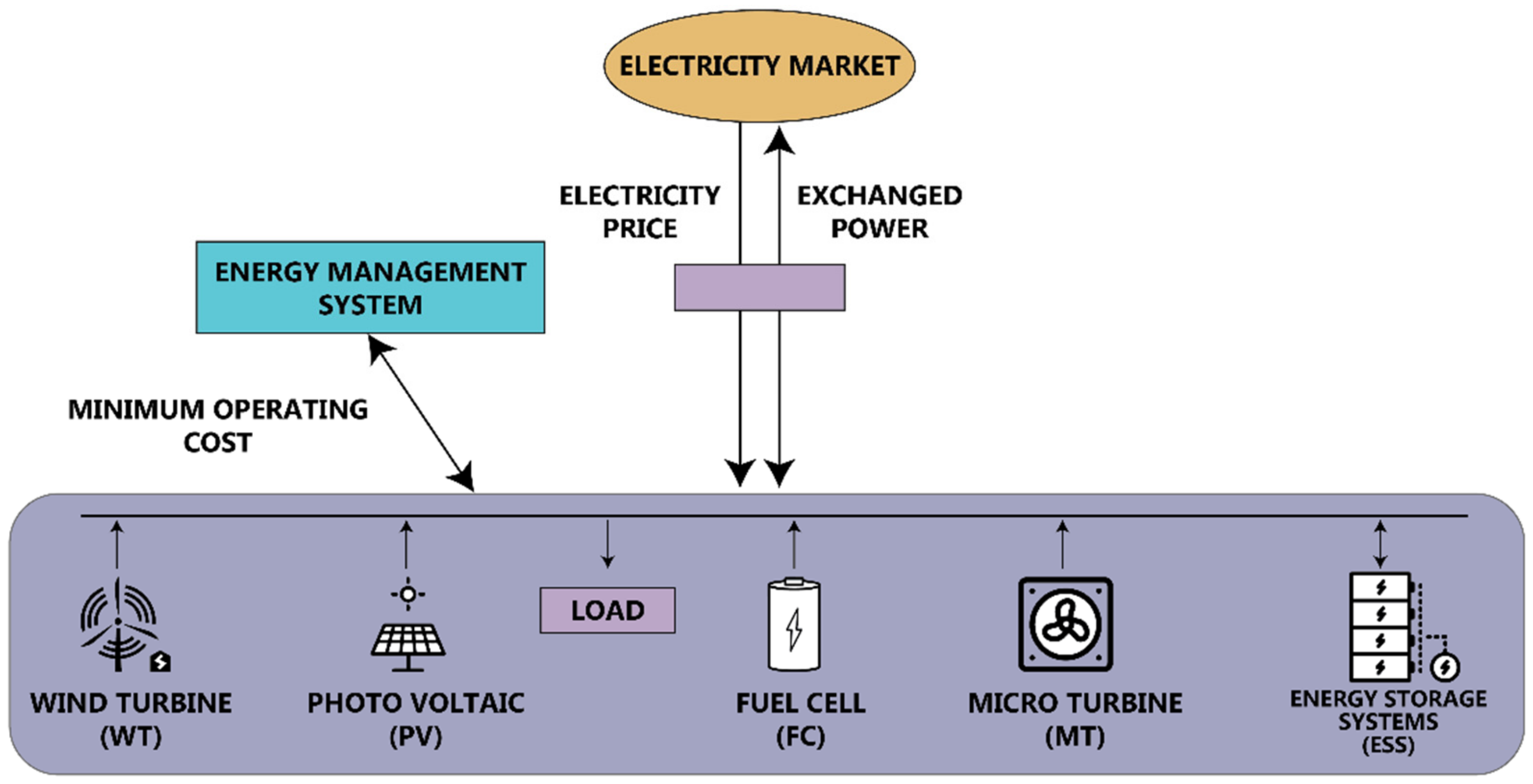
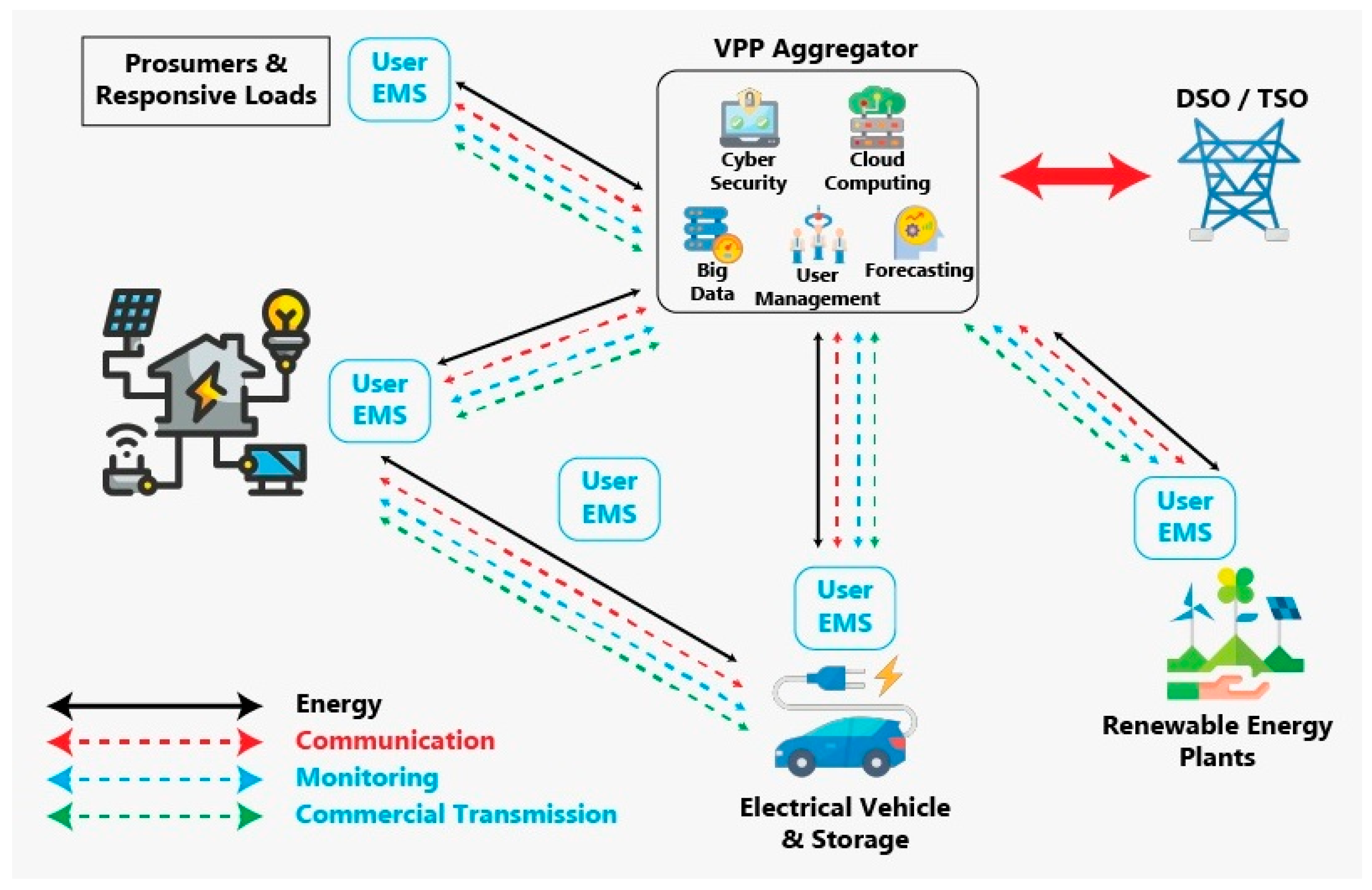
The VPP can participate in the electricity market as an individual energy generation system. It is a combination of energy storage systems, energy generation units and manageable loads. The VPP purchases power from the grid and charges the energy storage system when the electricity price is lower and supplies the loads by discharging the battery when the electricity price is higher in the market.
Generators used in the VPP are based on renewable energy sources such as PV generation and wind turbines. Due to the intermittent nature of renewable generation, the output power is unpredictable. Therefore, the bids and the grid requirements cannot be met by renewable generation. The aggregation of the power generation resources in the VPP should maintain the network security. Each element of the VPP is tied up with an energy management system (EMS). The power flow between DERs is also controlled by an EMS.
The data from controllable loads, all generating units and storage units connected to the VPP are collected by the EMS. Then, the EMS sends the control signals to each element of the VPP according to the available data. With a bidirectional communication system, the EMS can receive the present status and send a control signal to each unit. Three operating modes exist for the EMS, such as the grid export mode, the grid import mode and the no power exchange mode. The excess power generated from the VPP is fed back to the grid in the grid export mode. The power deficiency of the VPP is met by the grid in the grid import mode.
The controllability and visibility of DERs have been limited to the consumers as they need to be connected through the internet [2]. Now, with the VPP concept, all the DERs are controllable and viable to a wide range of customers, ranging from small to medium renewable sources in the electricity market. The schematic diagram of the VPP is shown in Figure 1.
Figure 1.
Schematic diagram of the virtual power plant (VPP).
3. Problem Description
3.1. Market Information and Assumption
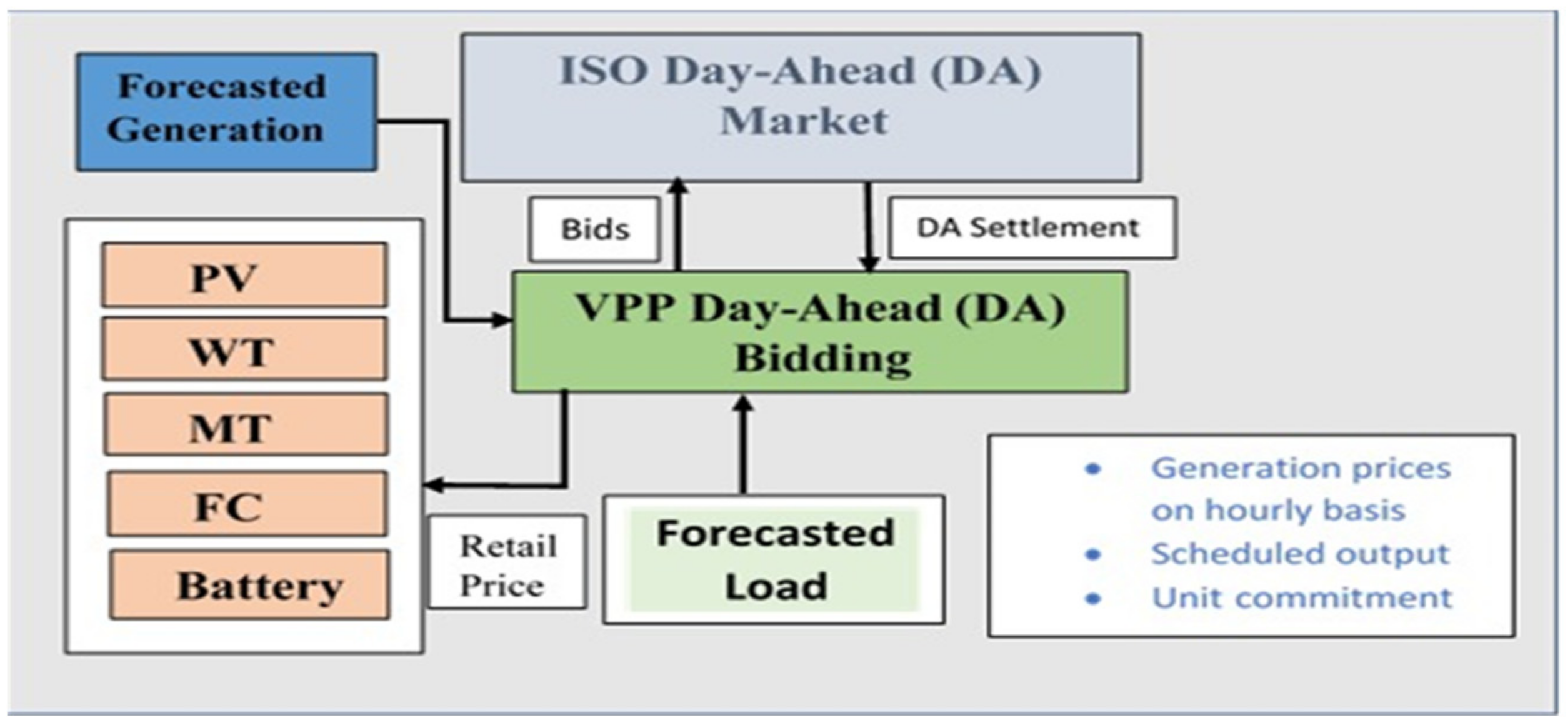
The market structure studied is the day-ahead (DA) electricity market. As shown in Figure 2, the dynamic pricings of the grid, load, PV and WT generation are forecasted on an hourly basis. The power scheduling is proposed by the participants for each hour of the coming day before 12 p.m. The spot price is settled and commitments are made for the participants.
Figure 2.
Day-ahead market strategy of the VPP.
The operation of the VPP in the DA market scenario is based on some assumptions. Based on the dynamic pricing of the grid, the VPP dispatches the power to the grid for profit maximization. The second assumption is that the DERs in the VPP are centrally controlled.
In this paper, energy management for the VPP is developed by optimally scheduling the generation and minimizing the generation cost. Moreover, the multi-step offering method can be used by separately calculating the profit for each generation based on resource availability and generation cost. The risk of the profit variation is considered in the problem formulation by the incorporation of uncertainty modeling of PV and WT generation using the beta distribution and Weibull distribution methods. The power imbalance due to the uncertainties of renewable generation can be taken care of by purchasing the power from the grid [53].
3.2. Problem Formulation
A case study is shown in Figure 3 to reveal the optimal dispatch strategy of the VPP with the grid. It consists of a PV system, wind turbine, fuel cell, micro-turbine and battery energy storage system, which represents the power trading with the grid and electricity market. The control strategies used in the VPP can be categorized into three types such as direct control, distributed control and hierarchical control. The direct control method is based on centralized control where decisions concerning VPP control are made in a centralized way. In the distributed control method, the decisions for VPP control are made in a fully decentralized way, and in the hierarchical control method, which is also the intermediary between direct and distributed control, decisions are made with some extent of the decision-making ability of the VPP. In this paper, the direct control strategy is used for the optimal co-ordination of DERs and to represent them as a single unit for the market, DSOs and TSOs. The VPP control center will take the request from individual VPP units based on the limitations and preferences of the owner [54].
Figure 3.
Power trading with the grid and electricity market.
The cost of generation indicates the sum of the fuel cost of DGs and start-up or shutdown cost [44]. If the power generated by the sources is not enough to meet the demand, the VPP will purchase the power from the grid. The bidding strategy of the VPP with the grid is developed in this paper with the aid of the beetle antenna search (BAS) algorithm using MATLAB. The VPP output depends on the intensity of the solar irradiation and wind speed that depend on environmental factors. These uncertainties create difficulties for energy dispatch. Therefore, the simulation or modeling of the uncertainty is important. The beta distribution and Weibull distribution methods are used in this work for modeling the uncertainties of renewable generation.
3.3. Objective Function
The main aims of this work are to maximize the profit of the VPP for the test system considered which consists of generation such as a PV, WT, FC, MT and battery storage system. The problem of determining the profit of the VPP in the DA market can be formulated as shown below:
where
| Power output from the grid | |
| Cost of grid | |
| ON/OFF state of wind turbine | |
| Power output from wind turbine | |
| Cost of wind turbine | |
| ON/OFF state of photovoltaic solar panel | |
| Power output from fuel cell | |
| Cost of fuel cell | |
| ON/OFF state of micro-turbine | |
| Power output from micro-turbine | |
| ON/OFF state of storage unit | |
| Power output from storage unit |
3.3.1. Equality and Inequality Constraints
Power balance equation for each time interval t, where
The constraint of the wind turbine output power for time period t can be represented as:
The power output constraint for the fuel cell for time period t can be represented as:
The power output constraints for the micro-turbine for time period t can be represented as:
The limitation of the solar cell output power in each time period t can be represented as:
The limitation of the power output for the utility in each time period t can be represented as:
The minimum and maximum limitation of the power exchanged with the grid is expressed in Equation (7) in the revised manuscript. The PGrid Max is calculated on the basis of the total load demand of the microgrid network.
The constraints for storage batteries can be expressed as:
3.3.2. Uncertainty Modeling of Solar Generation
The output power of the PV module can be calculated using the beta pdf method [50]. The output power of a PV module is dependent on the solar irradiance and ambient temperature of the site and module itself. The output power during different states can be easily calculated using beta pdf, once it is generated.
where temperature of the cell in °C for state x; = ambient temperature in °C; = nominal operating temperature of the cell in °C; average solar irradiance of state x; = power output of the PV module.
3.3.3. Uncertainty Modeling of the Wind Generation
The reserve or penalty cost for wind energy conversion system can be obtained by assuming or finding some known probability distribution function for the wind speed [48]. The characterization of the wind speed is needed for economic dispatch with the Wind Energy Conversion System (WECS). The existing literature on uncertainty modeling of wind generation shows that the wind speed profile follows a Weibull distribution over time. The probability distribution function for the Weibull distribution is denoted as
where Weibull distribution for wind speed; wind speed; a = scale for wind speed at given location; shape factor.
After characterizing the uncertain nature of the wind as a random variable, the output power of the WECS can also be modeled as a random variable by transforming from the wind speed to the output power.
where = cut-in speed, rated speed, cut-off speed. output power of the WECS during state w.
3.3.4. Risk Factor in Solar and Wind Generation
Solar generation and wind generation are not reliable power supplies. There is the risk of changes in electricity generation due to a lack of sunshine or snow covering solar panels for long periods of time. Similarly, the wind power generations purely depend on the velocity of the wind. In order to overcome these issues and to provide a reliable power supply to the consumer, the new concept of the virtual power plant is introduced. A virtual power plant works remotely to combine a number of independent renewable energy resources from disparate locations into a network that provides reliable power 24/7. Hence the uncertainty in the nature of solar and wind power generations can be solved using the VPP. The consumer will receive a reliable, good quality of power supply.
4. Beetle Antenna Search Algorithm (BAS Algorithm)
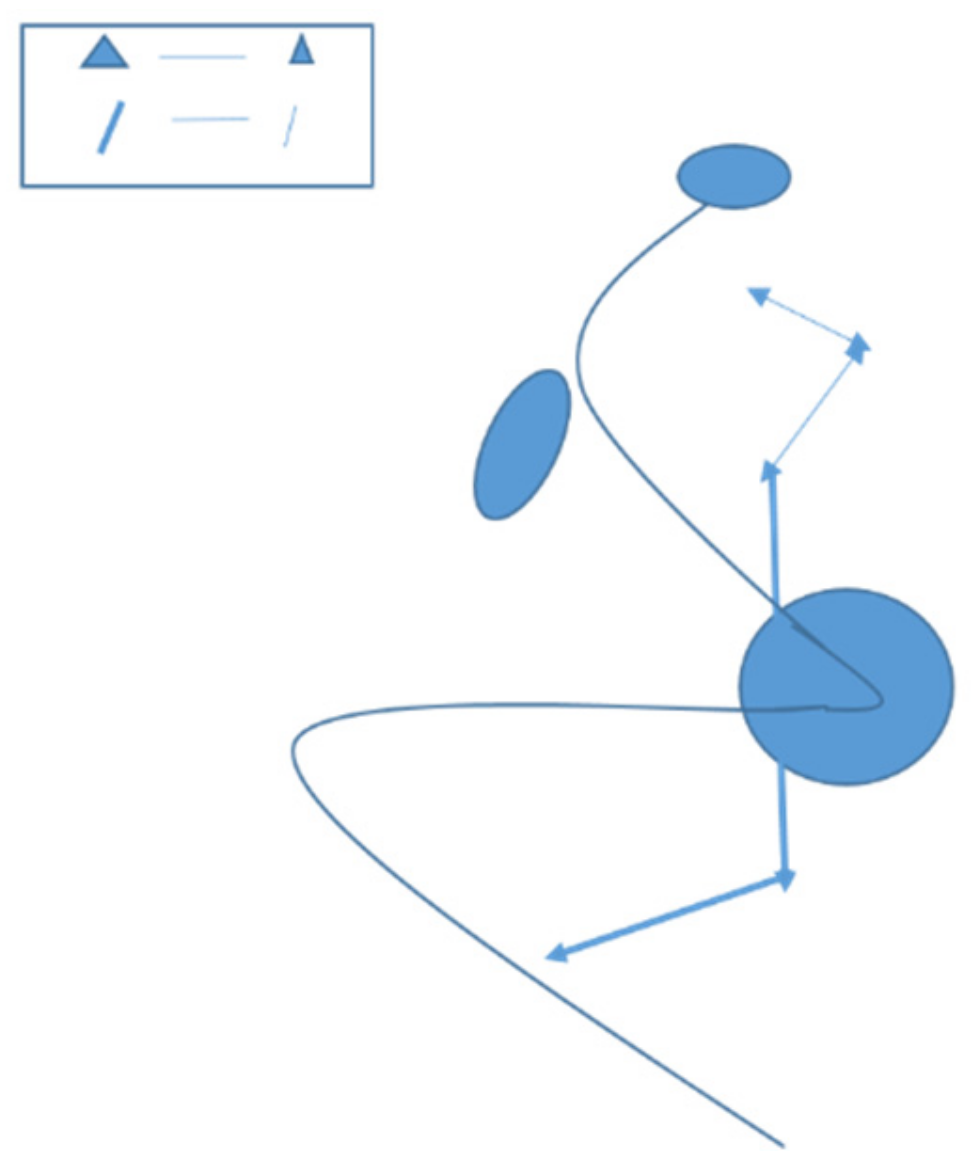
The BAS algorithm is a meta-heuristic search algorithm where the beetle can be compared with a triangle and the antennas of the beetle can be considered as two long sides of the triangle. The line between the triangle is denoted as the movement of the beetles and smell concentration is denoted with blue round shapes. The schematic diagram of the BAS algorithm is shown in Figure 4.
Figure 4.
Schematic diagram of the BAS algorithm.
The beetle will sense the odor by its two antennas. When the distance between the beetle and the food location changes, the concentration of the smell also changes [47]. By continuously moving and searching for the odor concentration, the beetle can finally arrive at the point of the source. The mathematical modeling for the beetle antenna search (BAS) algorithm can be followed as:
- The fitness function is considered here as the can be denoted as:where t denotes the no. of iterations.
- The beetle orientation is randomized as:where denotes the random direction of the beetle, which is the matrix of the (mx1) dimension. is the unit vector.
- The co-ordinates of the two antennas after each iteration are:where = co-ordinates of the right and left antennas, respectively; L = sensing length of the antenna that is decided with step β.where constant which indicates the decay speed of the search step.
- The resultant formula can be achieved by solving the above co-ordinates aswhere is the updated step of the previous step . Where represents the step size of searching. Where sign(.) represents a sign function. represent the fitness values of the left and right sides of , respectively.
The algorithm consists of the main parts of the local fast search algorithm which can improve the path planning of the beetle. The pseudo code of the algorithm is implemented as follows:
|
5. Data Analysis
In the VPP, several local energy sources are connected with others and the utility as well. DGs are extensively used in such network as non-conventional sources (MT, diesel generator, FC) and renewable sources (solar, wind). Storage devices are used to meet the imbalance between generation and demand, in order to reduce the purchase of energy from the grid.
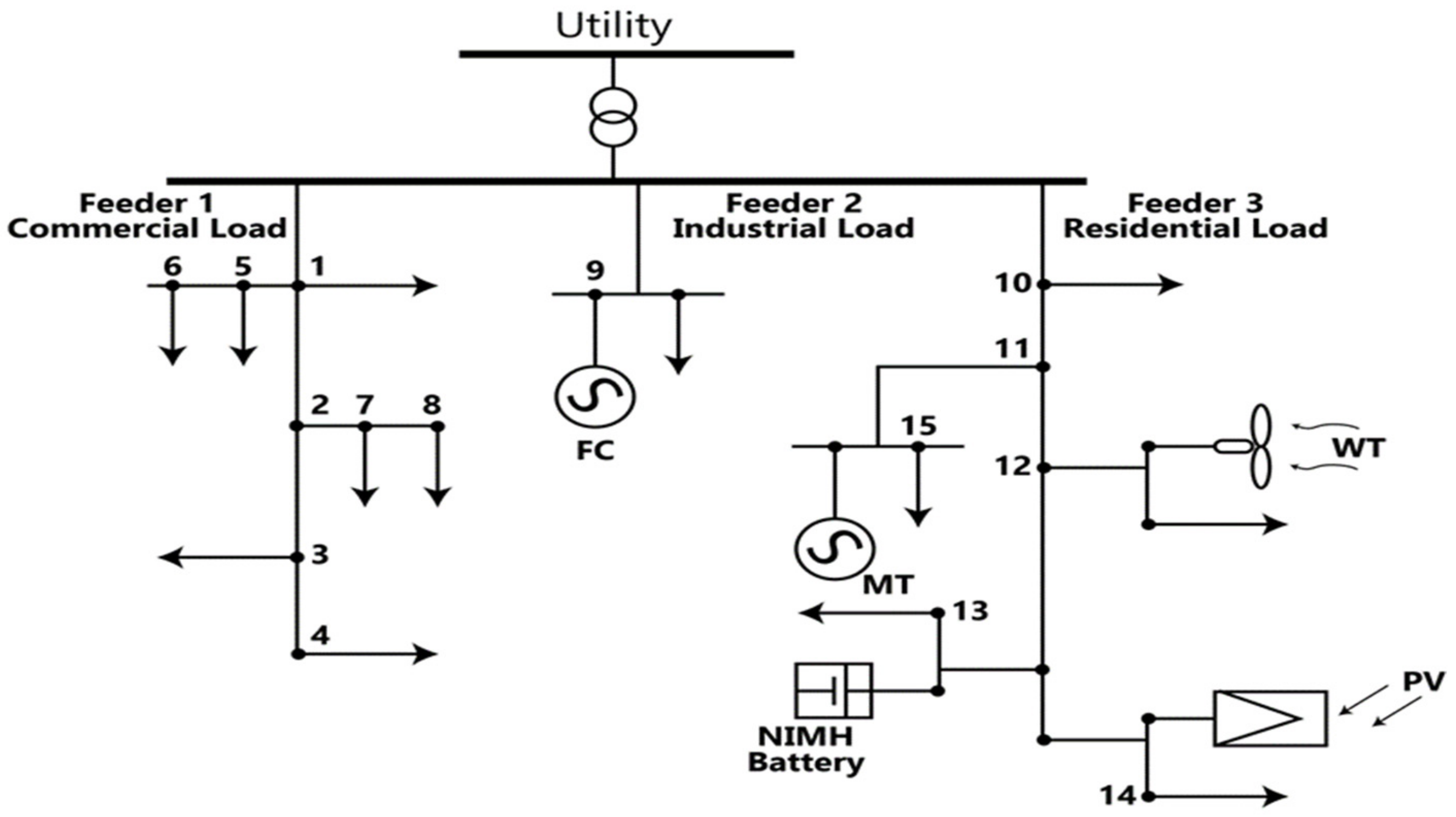
The test system consists of various RESs such as a PV, WT, MT, FC and battery storage system. The single line diagram of the test system is shown in Figure 5. All DG units are assumed to produce only active power at unity p.f. and are to be operated only in electricity mode. The data of the load demand, forecasted generation, maintenance cost, start-up/shut-down cost and market prices are taken from Mohammed Javad Kasaei [44]. The system includes an industrial feeder for supplying the workshop, a commercial feeder for supplying the small office and a residential feeder. A total load of 1695 kW is considered in the literature review for 24 h [44,49], but in this paper, the scheduling is developed only for the commercial loads considered. The optimal scheduling is developed for the test system with the day-ahead market strategy. Three different scenarios are considered for a more detailed explanation of the test system. It is assumed in the first scenario that all the units are in the ON condition and act within their power limitation. In the second scenario, the PV is assumed to be in the OFF condition. The other generations are within their limits. In the third scenario, the MT and FC are assumed to be in the OFF condition. The other generators are working within their limits and the exchange of energy with the utility is also considered in a constrained manner.
Figure 5.
Single line diagram of microgrid.
5.1. Electricity Purchasing Cost
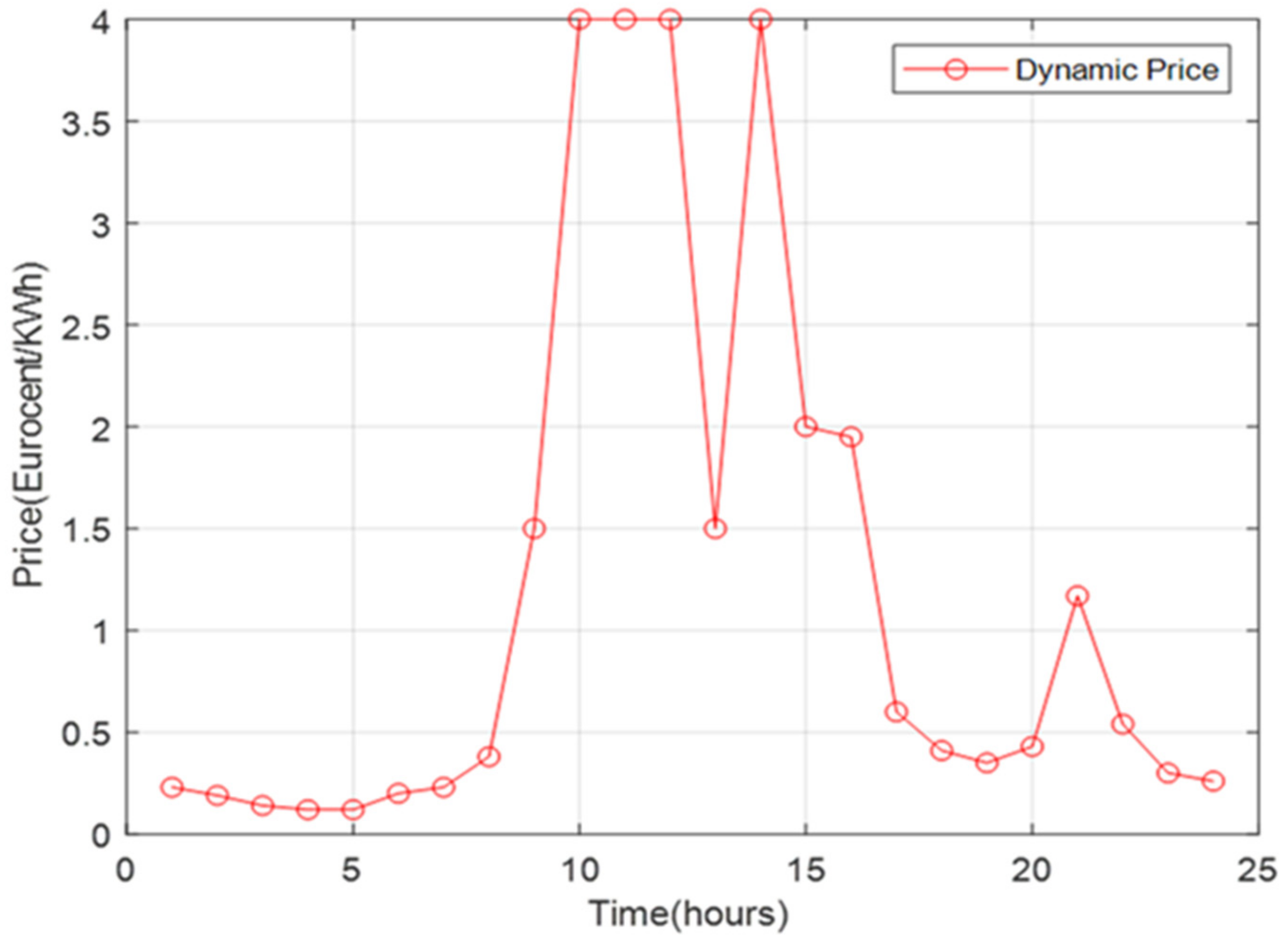
The dynamic pricing of the grid is considered on an hourly basis and is shown in Figure 6. The bidding strategy of the VPP with the grid is dependent on the price rating, that is, when the consumption of energy from the grid is high, the electricity price is less and vice versa.
Figure 6.
Dynamic pricing of the grid on an hourly basis.
5.2. Demand
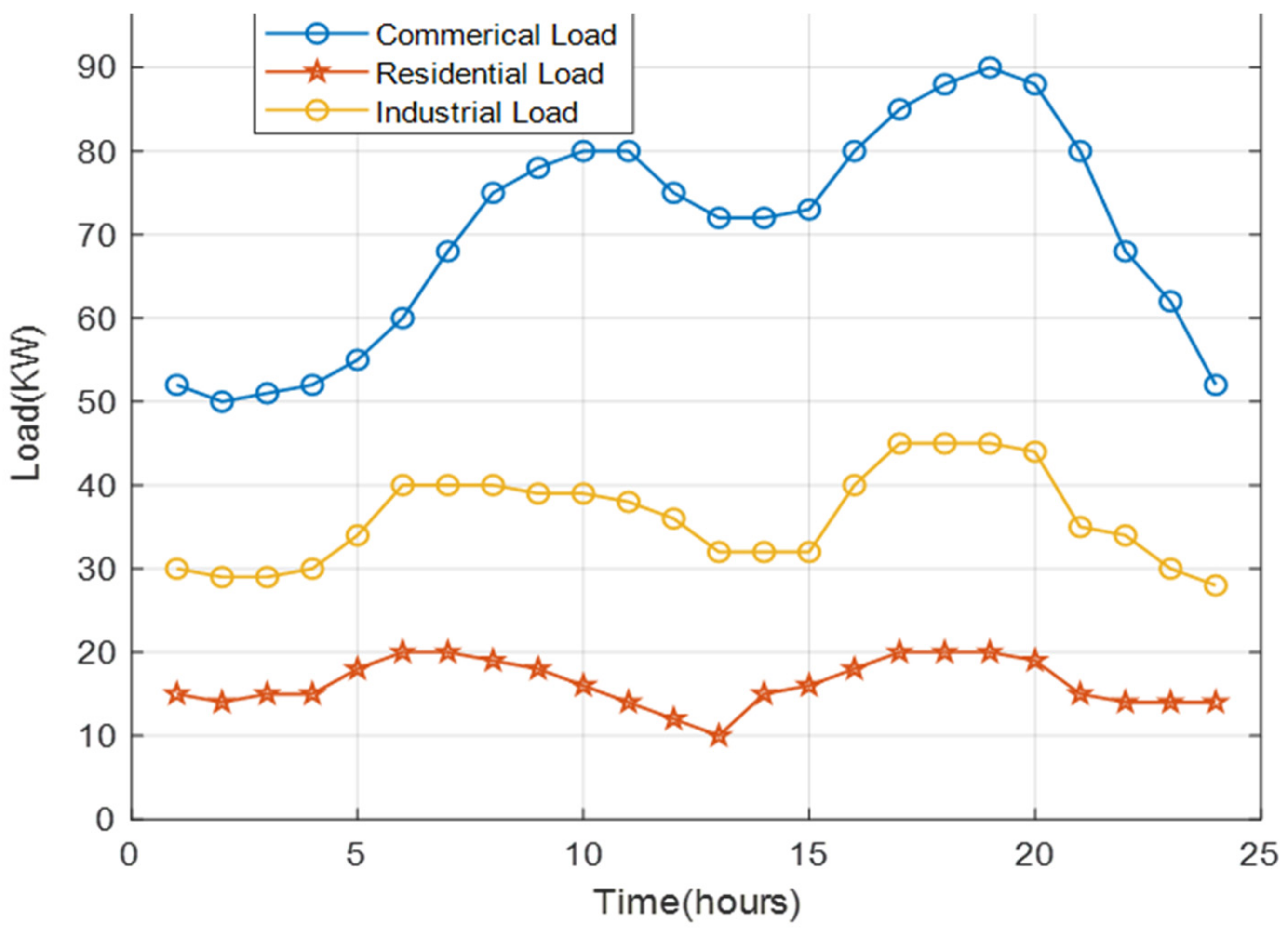
The hourly load curves for commercial, residential and industrial loads are available and are integrated into the VPP dispatch model. The load curves for the three types of load are shown in Figure 7.
Figure 7.
Load curve for three categories of loads.
5.3. Cost of Generation and Power Output
The size of distributed generation placed in the microgrid is selected as tabulated in Table 2. We considered the size of the distributed generation and test system from [49] for the sake of comparison of the proposed method.
Table 2.
Rating of distributed generation.
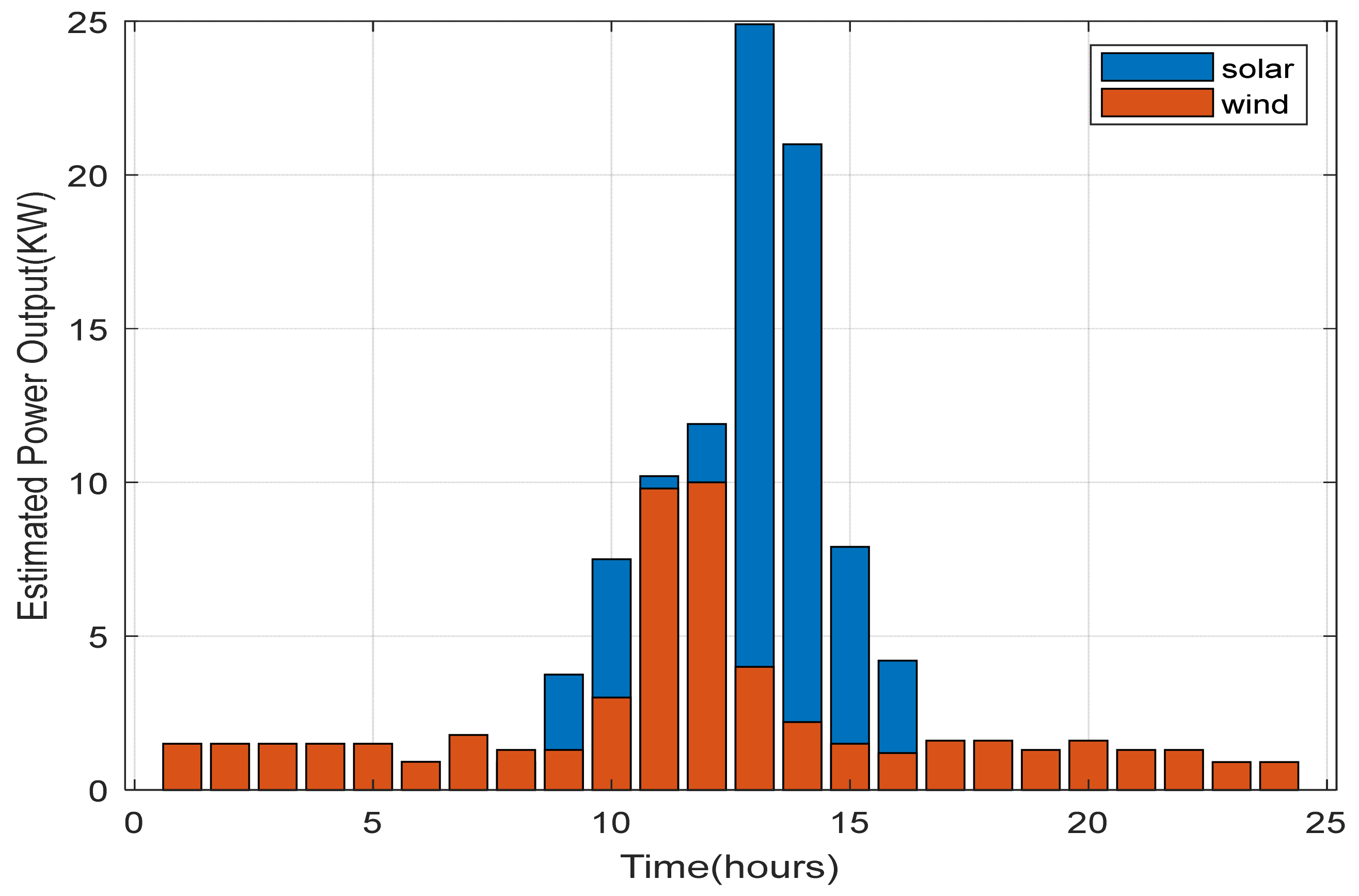
The estimated power output for the PV and WT is taken into account for 24 h. Power generation data of the PV and WT for every scenario are extracted from Figure 8.
Figure 8.
Output power forecast from Photo Voltaic (PV) and wind turbine (WT).
6. Simulation Results
We considered three different scenarios to check the feasibility of the proposed method under different conditions as follows.
| Scenarios | Condition |
| I | All micro-generations are working |
| II | PV is not working, the rest of the generations are working |
| III | FC and battery are not working, the rest of the generations are working |
6.1. Scenario 1
In Scenario 1, it is assumed that all the units generate electricity and the energy exchange with the utility is based on the demand and dynamic pricing of the utility. Every unit including the grid is assumed to operate within their power limits. The scheduling of power generation for all the generators is shown in Table 3. The optimal parameter setting of BAS algorithm is shown in Table 4. The total cost of generation is compared with various algorithms as tabulated in Table 5. The BAS algorithm shows the best result for all the scenarios. The mean simulation time for this is 5.25 s.
Table 3.
Economic dispatch for Scenario 1.
Table 4.
Optimal parameter setting of the BAS algorithm.
Table 5.
Comparison of the cost of generation for various algorithms corresponding to Scenario 1.
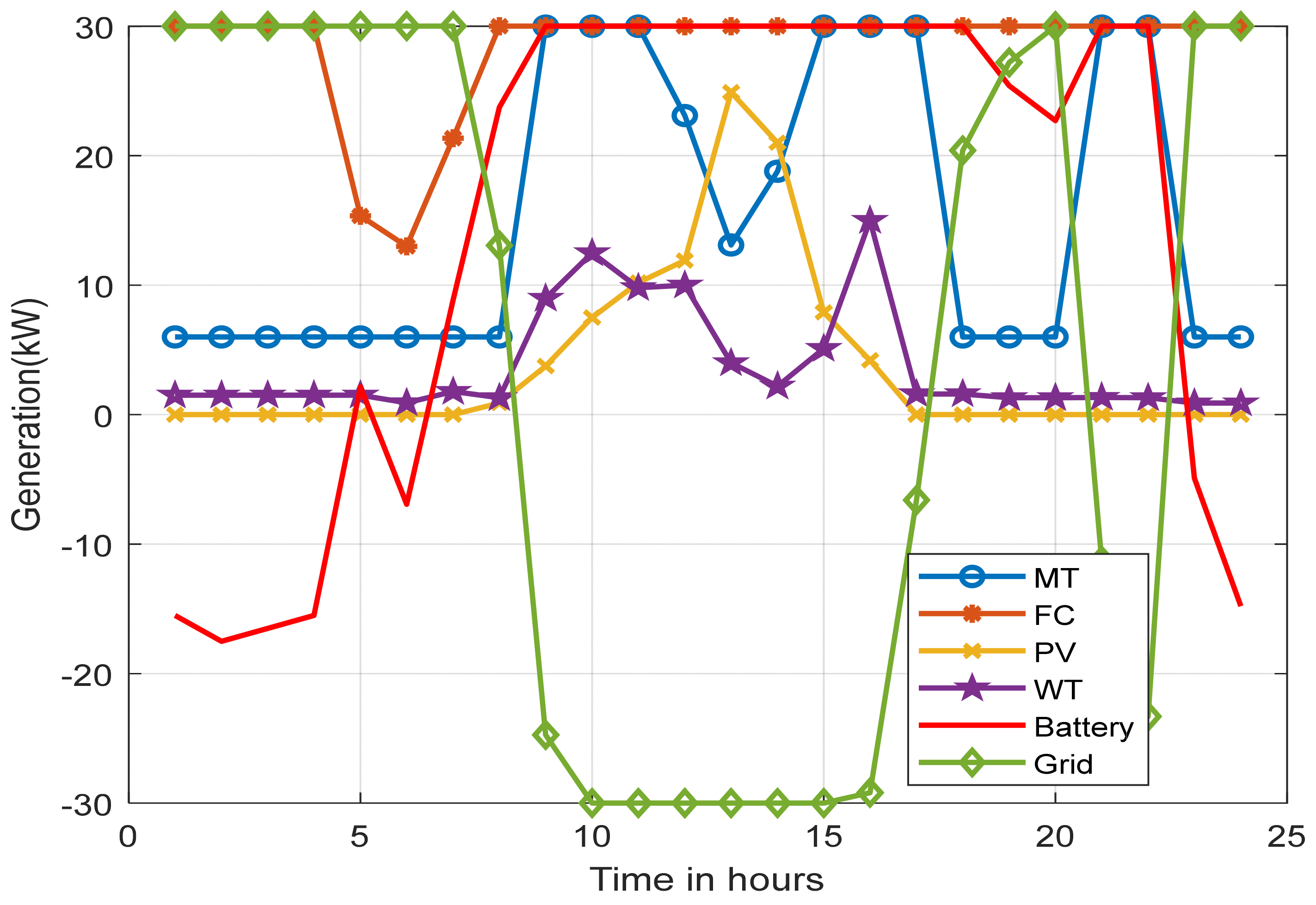
The VPP experiences a low demand and the utility selling price is low for the first 6 h. Therefore, the battery is charged during these hours. From the seventh hour, the demand started to increase, which is also reflected in the selling price. Therefore, the storage battery is discharged during these hours to reduce the utility power generation and to satisfy the load. During the first hours of the day (hours 1–7) and the last 7 h, there is no PV generation as the demand is low, as is the the market price. Therefore, the VPP has taken the right decision by decreasing the PV generation during these hours. The scheduling of generation for Scenario 1 is shown in Figure 9.
Figure 9.
Power generation for Scenario 1.
The control strategy for the BAS algorithm can be analyzed using generation of optimal parameters for the BAS algorithm, so it is necessary to carry out an empirical analysis to fine-tune the BAS algorithm. In case 1, the initialization parameter is varied while keeping the step size as constant. In case II, the step size is varied while the initialization parameter is kept constant. It is noted that the best solutions are obtained when initialization is 2 and the step size is 0.5. The control strategy for the BAS algorithm is solved using an empirical study.
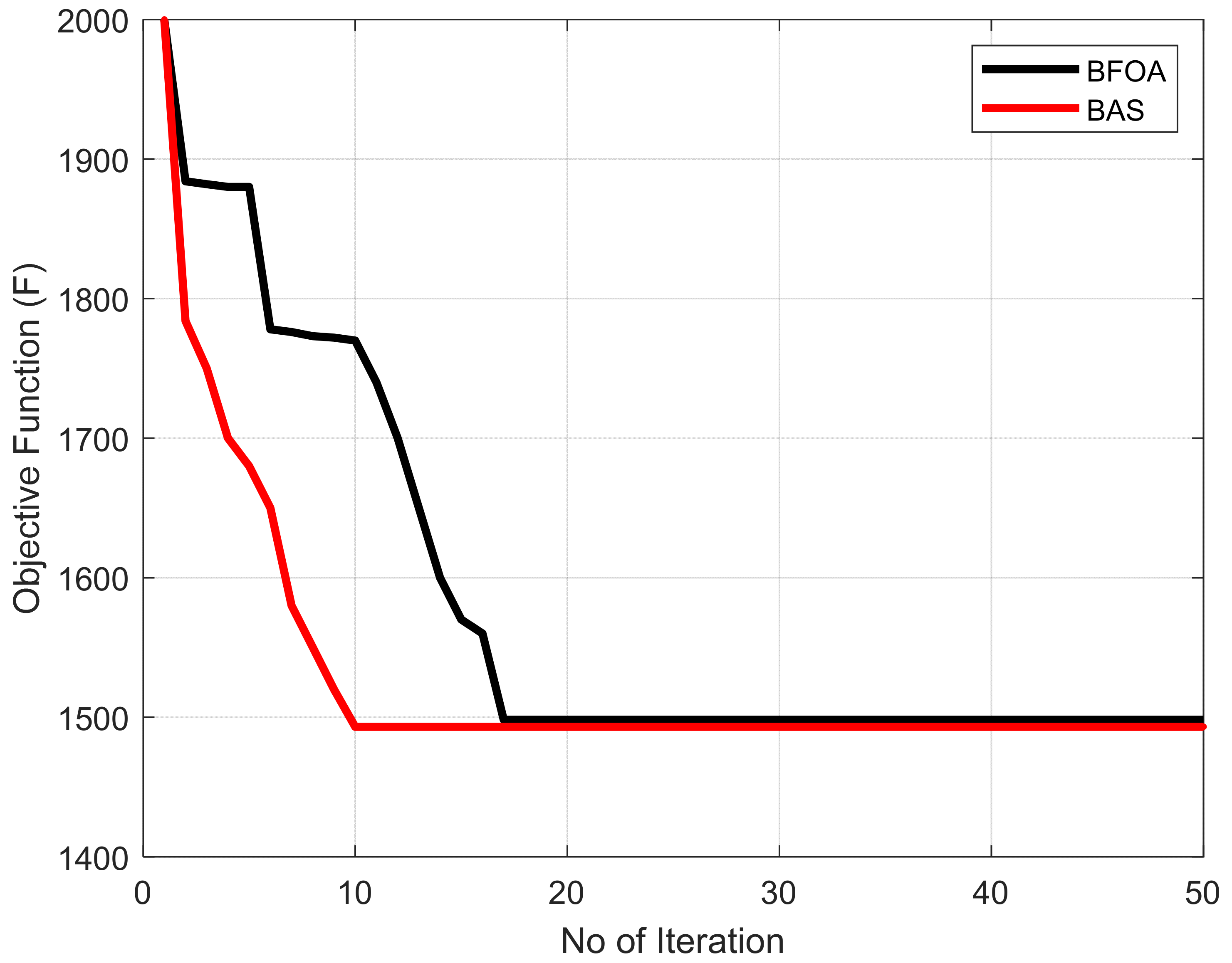
The convergence characteristics of the BAS algorithm are compared with other existing algorithms for the considered test system in the case of Scenario 1, as shown in Figure 10. It is clear from the figure that BAS only takes 10 iterations to converge with the best solution. Moreover, the BAS algorithm indicates a stable first convergence with the global searching ability to find the optimal cost. The computational efficiency regarding the simulation time is not compared as the simulation time for other existing algorithms is not available. The optimal DA scheduling strategy is developed for the VPP in this scenario by considering all the available resources. The energy transaction with the grid is developed based on the power purchasing price from the grid. There are few literature studies available with this scheduling strategy that considers both the market strategy and uncertainties of renewable generation.
Figure 10.
Comparison of convergence characteristics of the objective function with different algorithms.
6.2. Scenario 2
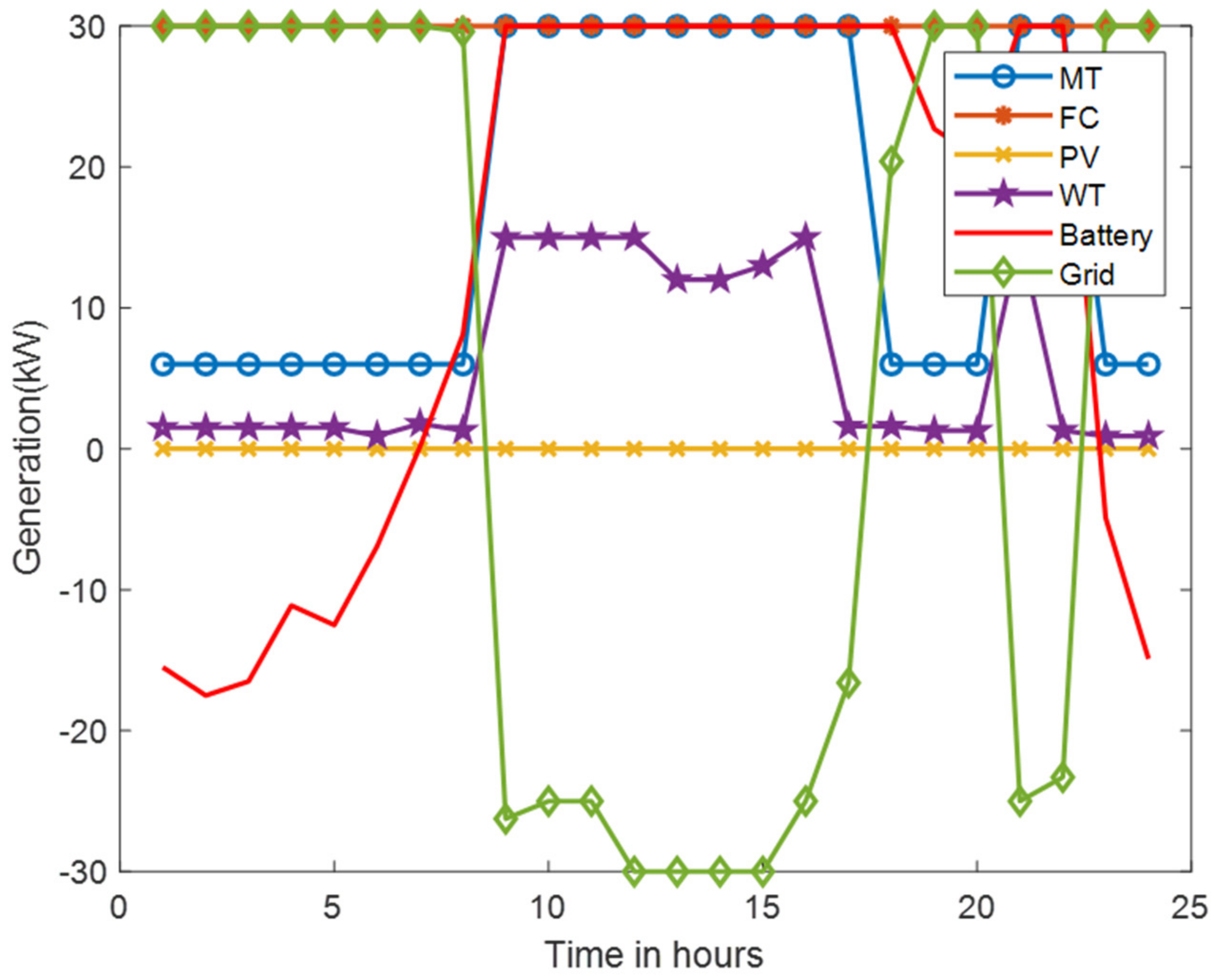
In this scenario, the PV is assumed to be in the OFF mode. Table 6 shows the generator scheduling for Scenario 2. Similar to the first scenario, the best optimal power dispatch obtained by using the BAS algorithm along with other algorithms reported in the various studies is shown in Table 7. The maximum power generation is taken from the FC for 24 h due to the comparatively lower bid of the FC, and also because it holds the maximum power level. In the early morning (1–8 h), the demand load is met by the grid as the market price is comparatively low during these hours. During these 8 h, the battery is in a charging state while it is in a discharging state for the next 16 h.
Table 6.
Economic dispatch for Scenario 2.
Table 7.
Comparison of the cost of generation for various algorithms corresponding to Scenario 2.
The scheduling of power generation for Scenario 2 is shown in Figure 11.
Figure 11.
Power generation for Scenario 2.
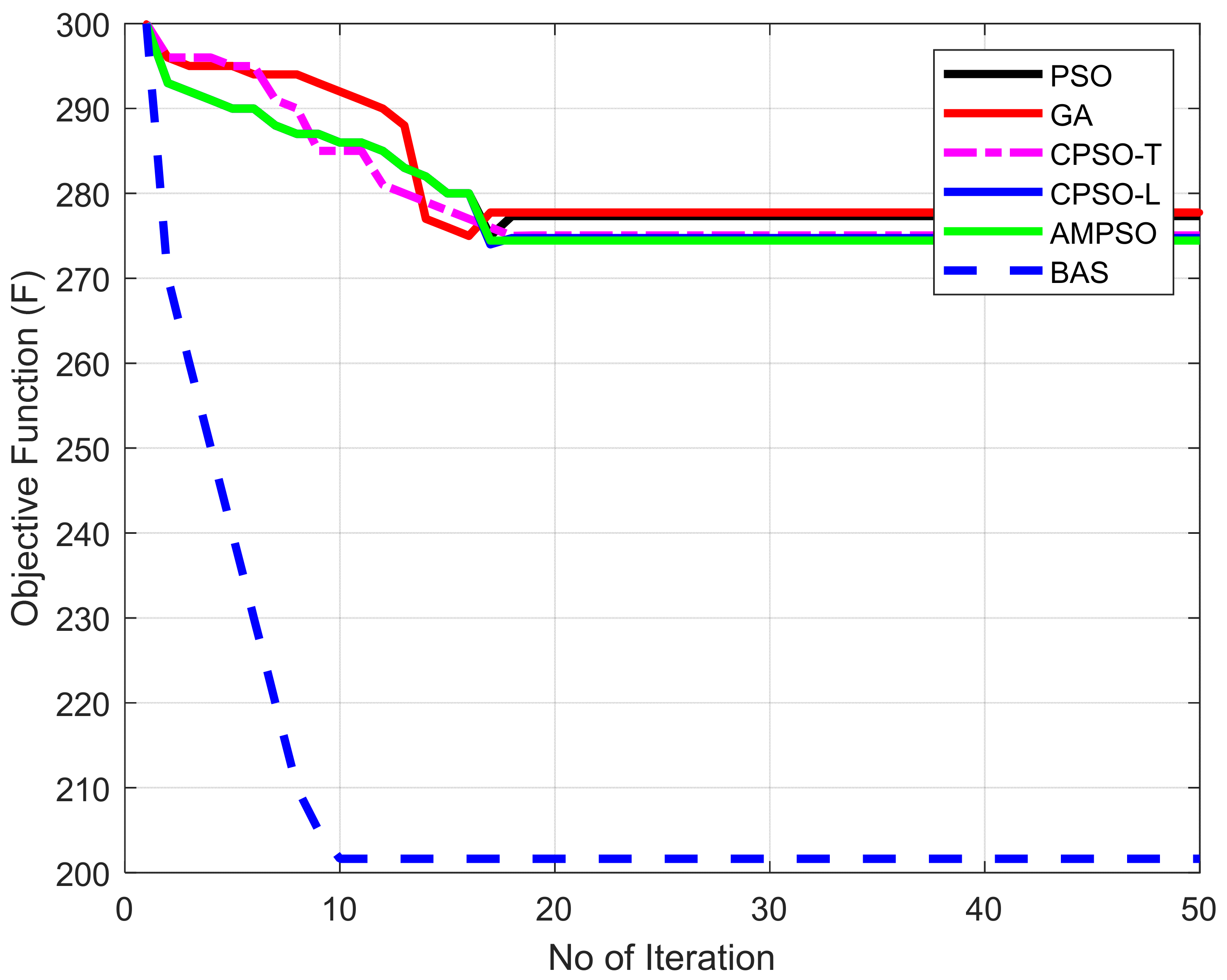
The convergence characteristics of BAS are compared with other existing algorithms for this test system in the case of Scenario 2, as shown in Figure 12. It is clear from the figure that the BAS algorithm only takes 10 iterations to converge with the best solution. Moreover, BAS shows a quick and stable convergence with the global searching ability to find the optimal cost. The computational efficiency regarding the simulation time is not compared as the simulation time is not available for the other algorithms. The optimal DA scheduling strategy is developed for the VPP by considering the unavailability of solar generation. The bidding strategy with the grid is developed based on the power purchasing price from the grid. There are less literature studies with this strategy as it considers both the market strategy and the uncertainty of renewable generation.
Figure 12.
Comparison of convergence characteristics of the objective function with different algorithms.
6.3. Scenario 3
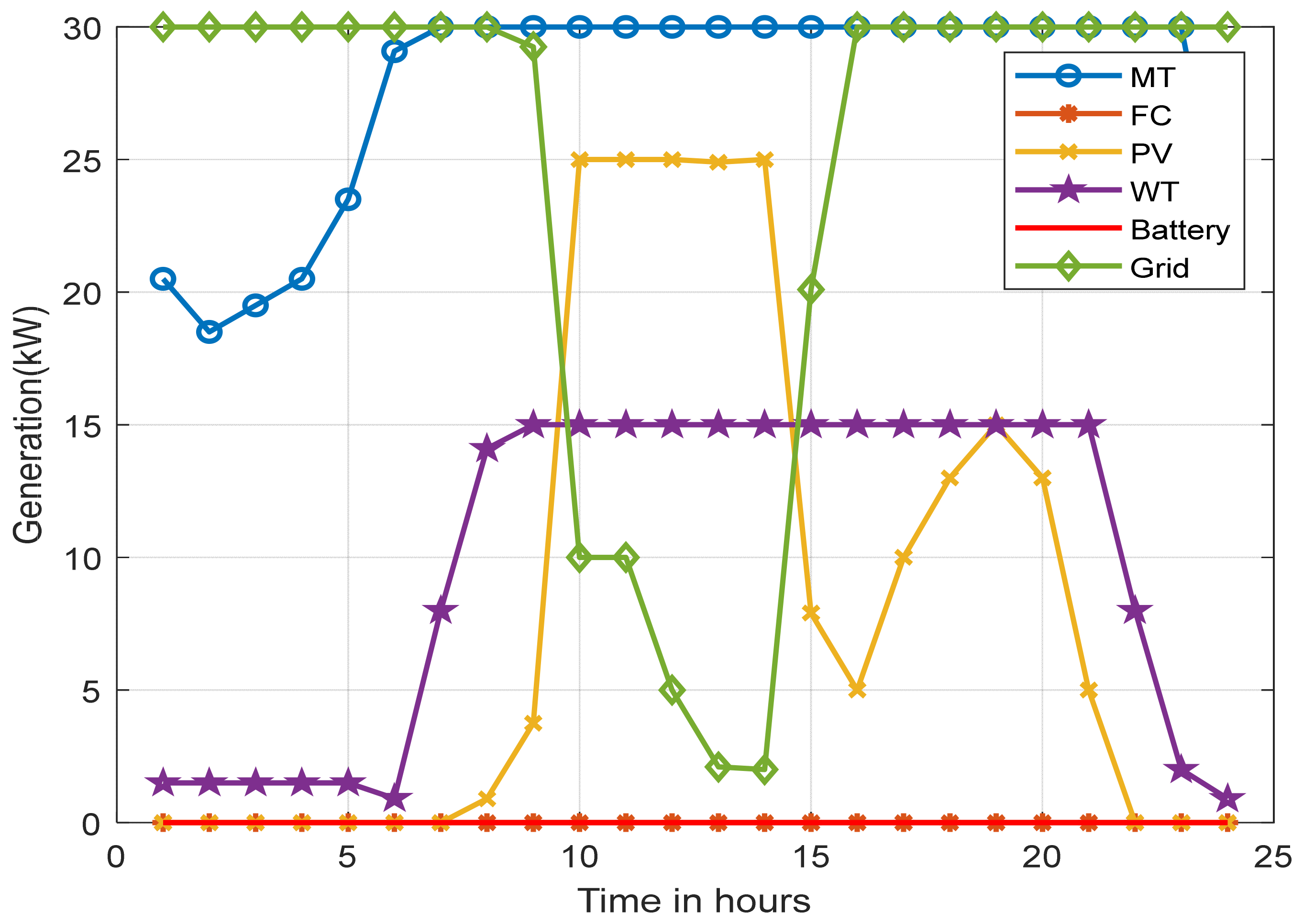
In this scenario, the FC and battery are assumed to be in the OFF mode. The Scenario 3 simulation results are shown in Table 8. The best result of the optimum power dispatch with the beetle antenna search algorithm is presented in Table 9. The generations of all the units are within their limitations and the grid supplies the load for 24 h. For 9–21 h, both the MT and WT are working at their maximum power generation level. Since the bid of these generators is cheaper than the PV, the VPP encountered the load with the MT and WT. In this scenario, the power is purchased from the grid during the first 8 h and the last 9 h when the market price is comparatively low.
Table 8.
Economic dispatch for Scenario 3.
Table 9.
Comparison of the cost of generation between BFOA and the proposed BAS algorithm corresponding to Scenario 3.
The scheduling of power generation for Scenario 3 is shown in Figure 13.
Figure 13.
Power generation for Scenario 3.
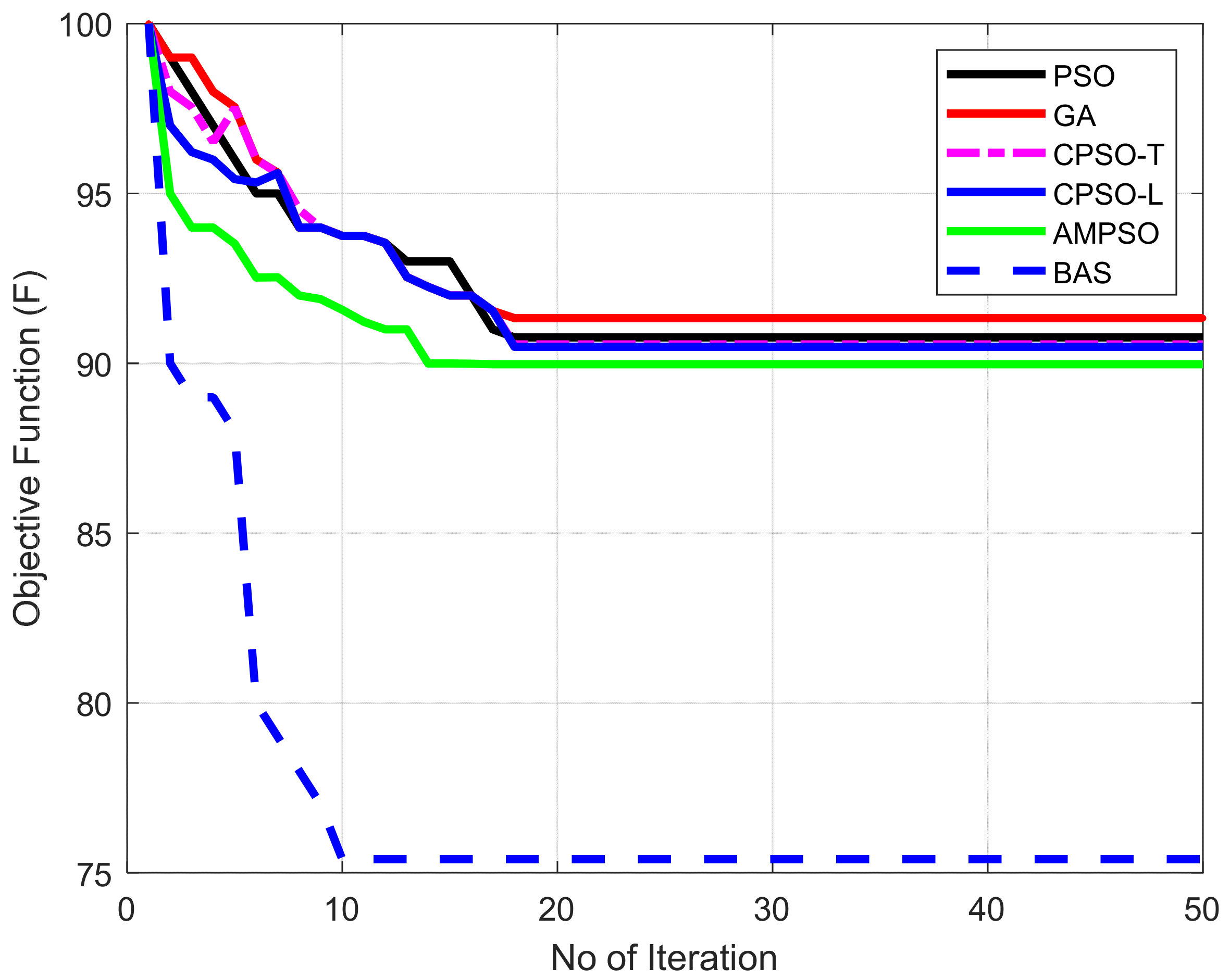
The convergence characteristic of the BAS algorithm is compared with that of the BFOA algorithm for Scenario 3, which is shown in Figure 14. The BAS converges with the best solution in 10 iterations. Moreover, it shows a quick convergence to find the optimal cost. The optimal scheduling strategy for the DA market is shown in this scenario by considering the FC and the battery storage system in the OFF condition. The detailing of the power transaction with the grid is shown by considering the power purchase price from the grid. There is less available literature with this approach.
Figure 14.
Comparison of the convergence characteristic of the objective function with different algorithms
6.4. Effect of Uncertainties on Solar and Wind Generation
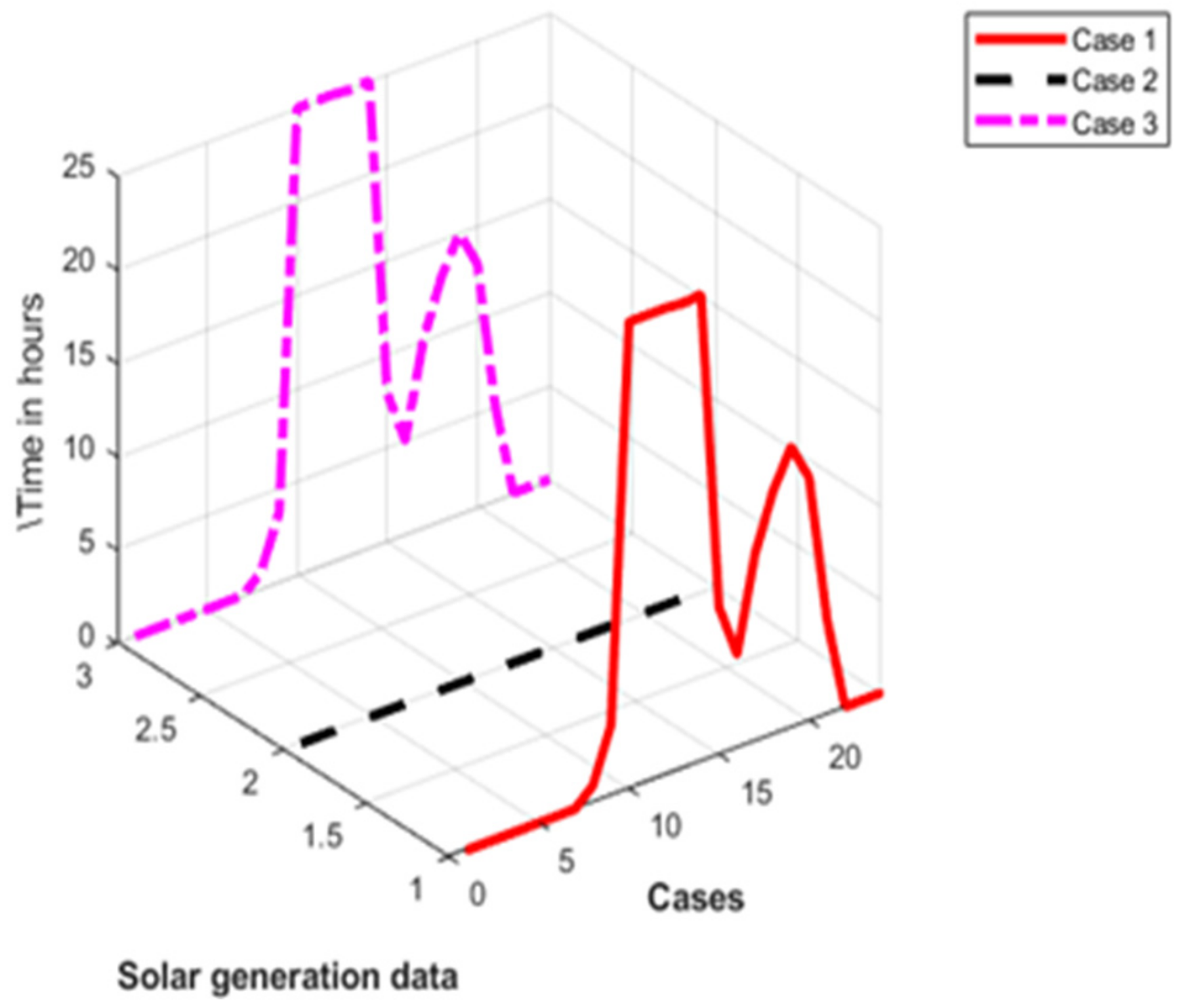
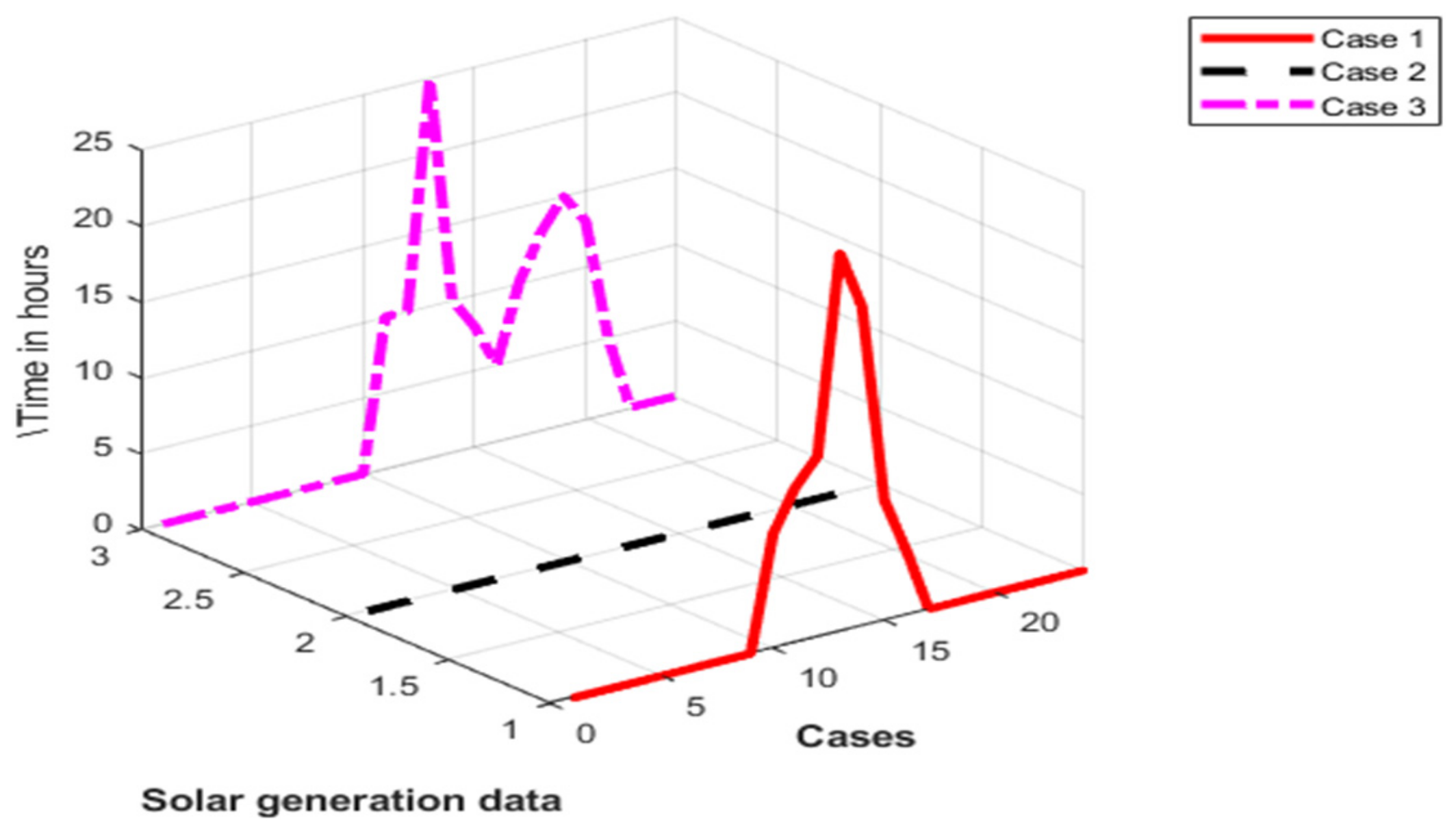
The uncertainties due to the renewable energy sources affect the system security as it makes the gap between generation and demand. Therefore, in this paper, the beta distribution method is used for modeling the uncertainties of solar and wind generation [48,49]. The solar generation data with respect to time and different scenarios are shown in Figure 15. The solar generation data considering uncertainties for three different scenarios are shown in Figure 16.
Figure 15.
Solar generation data for three different cases with time.
Figure 16.
Solar generation data for three different cases considering uncertainties.
It can be summarized from the graph that due to the uncertainties, the scheduled generation from the PV and WT is less and this can be met by purchasing the power from the grid based on the dynamic pricing of the grid or by paying the penalty to the consumers in the real-time market.
The comparison of different optimization approaches with the meta-heuristic BAS algorithm is shown in Table 10.
Table 10.
Comparison of the three scenarios.
The comparison of the proposed method is tested with other existing techniques of the deterministic method, stochastic method, robust method, SARO method and HO method is tabulated in the Table 11. The proposed BAS algorithm yields almost the same profit as the hybrid optimization method. This shows that the proposed method can be applied to a large-scale microgrid.
Table 11.
Comparison of optimization approaches.
7. Conclusions
This paper presented an optimal dispatching schedule of a VPP for the day-ahead electricity market. The VPP integrates different renewable and nonrenewable energy sources as well as battery energy storage devices. In this study, the optimization process was carried out by using the BAS algorithm. The simulation results of the VPP using the proposed algorithm were compared with those obtained by using other optimization algorithms. The simulation results proved the high-performance ability of the proposed algorithm to efficiently solve the dispatching problem. The analysis for the optimal dispatch strategy was carried out for the three scenarios. It was found from the scenarios that the grid supplies the lowest amount of power in Scenario 1 when all the power generation sources are in service. For Scenario 1, the grid supplies the power to satisfy the load demand for the first hours when the market price is low. Therefore, the VPP gets the maximum benefit from this scenario. In Scenario 2, the utility supplies the load during the first (1–8) hours, when the market price is low. Meanwhile, in Scenario 3, the utility supplies the load for 24 h regardless of the high market price, and the benefits of the VPP are the lowest in this scenario.
The paper’s contribution and key findings can be listed as follows:
- The BAS algorithm is used for the optimal energy management of the VPP by reducing the total operating cost of generation. The optimal dispatch results are obtained within the minimum computation time due to its easy and simple computational process.
- The day-ahead market strategy is considered with three distinct scenarios.
- The attained results indicate that the VPP has to purchase the lowest amount of energy from the grid when all the generators are in the operating condition. The storage devices are allowed to charge during off-peak hours when there are less demand and discharge during peaks hours. Hence, the VPP can achieve the maximum profit by selling the energy to the grid.
The development of the competitive electricity market requires an optimum model for integrating the renewable-based power generation. The adopted model assists to optimally dispatch the power among the VPP customers and with the grid. With proper scheduling of power generation from renewable energy sources, the VPP can meet the maximum demand for the day-ahead market by minimizing the power purchased from the grid and by promoting more profit to the aggregator using price-based dispatch of the power to the grid. The power trading with the grid is dependent on the profitability of the aggregator and the demand. In all the above scenarios, the renewable sources dispatched the power optimally.
Author Contributions
Conceptualization, P.P., R.M.E. and D.K.R.; Methodology, P.P., D.K.R. and R.M.E.; Software, S.J.A.; Validation, S.O. and R.M.E.; Formal analysis, P.P. and R.M.E.; Investigation, P.P., D.K.R. and R.M.E.; Resources, P.P.; Data curation, P.A.K. and R.M.E.; Writing—original draft preparation, D.K.R.; Visualization, P.P., D.K.R., H.M.H. and R.M.E.; Supervision, P.A.K. and D.K.R.; Project administration, P.P., P.A.K., S.J.A. and S.O.; Writing—review and editing, U.S., R.M.E. and N.D.; Funding acquisition, N.D. All authors have read and agreed to the published version of the manuscript.
Funding
This Project titled “Optimal Dispatch of Virtual Power Plant using Cyber-Physical Controller for Real-Time EMS” was supported by the Royal Academy of Engineering under the Industry Academia Partnership Programme—17/18 Round 2 Scheme, Grant number IAPP1R2_100069.
Institutional Review Board Statement
Not applicable.
Informed Consent Statement
Not applicable.
Data Availability Statement
Not applicable.
Acknowledgments
The author would like to thank the Royal Academy of Engineering, UK for their support to carry out this project. The authors would like to thank Hindustan Institute of Technology and Science, India, University of Leeds, UK, Clean and Resilient Energy Systems (CARES) Laboratory, Texas A & M University, Galveston, TX, USA for the technical expertise provided.
Conflicts of Interest
The authors declare no conflict of interest.
Nomenclature
| t | Time Interval |
| Cost of grid | |
| Cost of wind turbine | |
| Cost of photovoltaic solar generation | |
| Cost of fuel cell | |
| Cost of micro-turbine | |
| Cost of storage unit | |
| Power output from the grid | |
| Power output from wind turbine | |
| Power output from photovoltaic solar panel | |
| Power output from fuel cell | |
| Power output from micro-turbine | |
| Power output from storage unit | |
| ON/OFF state of wind turbine | |
| ON/OFF state of photovoltaic solar panel | |
| ON/OFF state of fuel cell | |
| ON/OFF state of micro-turbine | |
| ON/OFF state of storage unit |
References
- Nosratabadi, S.M.; Hooshmand, R.-A.; Gholipour, E. A comprehensive review on microgrid and virtual power plant concepts employed for distributed energy resources scheduling in power systems. Renew. Sustain. Energy Rev. 2017, 67, 341–363. [Google Scholar] [CrossRef]
- Shafiekhani, M.; Badri, A.; Shafie-Khah, M.; Catalão, J.P. Strategic bidding of virtual power plant in energy markets: A bi-level multi-objective approach. Int. J. Electr. Power Energy Syst. 2019, 113, 208–219. [Google Scholar] [CrossRef]
- Li, B.; Shen, J.; Wang, X.; Jiang, C. From controllable loads to generalized demand-side resources: A review on developments of demand-side resources. Renew. Sustain. Energy Rev. 2016, 53, 936–944. [Google Scholar] [CrossRef]
- Moreno, B.; Díaz, G. The impact of virtual power plant technology composition on wholesale electricity prices: A comparative study of some European Union electricity markets. Renew. Sustain. Energy Rev. 2019, 99, 100–108. [Google Scholar] [CrossRef]
- Chen, G.; Li, J. A fully distributed ADMM-based dispatch approach for virtual power plant problems. Appl. Math. Model. 2018, 58, 300–312. [Google Scholar] [CrossRef]
- Beguin, A.; Nicolet, C.; Kawkabani, B.; Avellan, F. Virtual power plant with pumped storage power plant for renewable energy integration. In Proceedings of the 2014 International Conference on Electrical Machines (ICEM), Berlin, Germany, 2–5 September 2014. [Google Scholar]
- Salmani, M.A.; Tafreshi, S.M.M.; Salmani, H. Operation optimization for a virtual power plant. In Proceedings of the 2009 IEEE PES/IAS Conference on Sustainable Alternative Energy (SAE), Valencia, Spain, 28–20 September 2009; pp. 1–6. [Google Scholar]
- Yaakoubi, A.; Amhaimar, L.; Attari, K.; Harrak, M.; Halaoui, M.; Asselman, A. Non-linear and intelligent maximum power point tracking strategies for small size wind turbines: Performance analysis and comparison. Energy Rep. 2019, 5, 545–554. [Google Scholar] [CrossRef]
- Rahmani-Dabbagh, S.; Sheikh-El-Eslami, M.K. A profit sharing scheme for distributed energy resources integrated into a virtual power plant. Appl. Energy 2016, 184, 313–328. [Google Scholar] [CrossRef]
- Yuan, Y.; Wei, Z.; Sun, G.; Sun, Y.; Wang, D. A real-time optimal generation cost control method for virtual power plant. Neurocomputing 2014, 143, 322–330. [Google Scholar] [CrossRef]
- Tascikaraoglu, A.; Erdinc, O.; Uzunoglu, M.; Karakas, A. An adaptive load dispatching and forecasting strategy for a virtual power plant including renewable energy conversion units. Appl. Energy 2014, 119, 445–453. [Google Scholar] [CrossRef]
- Riveros, J.Z.; Bruninx, K.; Poncelet, K.; D’Haeseleer, W. Bidding strategies for virtual power plants considering CHPs and intermittent renewables. Energy Convers. Manag. 2015, 103, 408–418. [Google Scholar] [CrossRef]
- Devabalaji, K.R.; Ravi, K.; Kothari, D.P. Optimal location and sizing of capacitor placement in radial distribution system using Bacterial Foraging Optimization Algorithm. Int. J. Electr. Power Energy Syst. 2015, 71, 383–390. [Google Scholar] [CrossRef]
- Qiu, J.; Meng, K.; Zheng, Y.; Dong, Z.Y. Optimal scheduling of distributed energy resources as a virtual power plant in a transactive energy framework. IET Gener. Transm. Distrib. 2017, 11, 3417–3427. [Google Scholar] [CrossRef]
- Shayegan-Rad, A.; Badri, A.; Zangeneh, A. Day-ahead scheduling of virtual power plant in joint energy and regulation reserve markets under uncertainties. Energy 2017, 121, 114–125. [Google Scholar] [CrossRef]
- Zamani, A.G.; Zakariazadeh, A.; Jadid, S.; Kazemi, A. Stochastic operational scheduling of distributed energy resources in a large scale virtual power plant. Int. J. Electr. Power Energy Syst. 2016, 82, 608–620. [Google Scholar] [CrossRef]
- Chen, Y.; Wang, N. Cuckoo search algorithm with explosion operator for modeling proton exchange membrane fuel cells. Int. J. Hydrog. Energy 2019, 44, 3075–3087. [Google Scholar] [CrossRef]
- Meng, T.; Pan, Q.-K. An improved fruit fly optimization algorithm for solving the multidimensional knapsack problem. Appl. Soft Comput. 2017, 50, 79–93. [Google Scholar] [CrossRef]
- Wang, G.; Ma, L.; Chen, J. A bilevel improved fruit fly optimization algorithm for the nonlinear bilevel programming problem. Knowl. -Based Syst. 2017, 138, 113–123. [Google Scholar] [CrossRef]
- Yuan, X.; Dai, X.; Zhao, J.; He, Q. On a novel multi-swarm fruit fly optimization algorithm and its application. Appl. Math. Comput. 2014, 233, 260–271. [Google Scholar] [CrossRef]
- Kasaei, M.J. Optimal integrated scheduling of distributed energy resources in power systems by virtual power plant. ISA Trans. 2017. [Google Scholar] [CrossRef]
- Rafique, M.K.; Haider, Z.M.; Mehmood, K.K.; Saeed Uz Zaman, M.; Irfan, M.; Khan, S.U.; Kim, C.-H. Optimal scheduling of hybrid energy resources for a smart home. Energies 2018, 11, 3201. [Google Scholar] [CrossRef]
- Naval, N.; Sánchez, R.; Yusta, J.M. A virtual power plant optimal dispatch model with large and small-scale distributed renewable generation. Renew. Energy 2020, 151, 57–69. [Google Scholar] [CrossRef]
- Liu, Y.; Li, M.; Lian, H.; Tang, X.; Liu, C.; Jiang, C. Optimal dispatch of virtual power plant using interval and deterministic combined optimization. Int. J. Electr. Power Energy Syst. 2018, 102, 235–244. [Google Scholar] [CrossRef]
- Lin, Z.; Chen, Z.; Qu, C.; Guo, Y.; Liu, J.; Wu, Q. A hierarchical clustering-based optimization strategy for active power dispatch of large-scale wind farm. Int. J. Electr. Power Energy Syst. 2020, 121, 106155. [Google Scholar] [CrossRef]
- Tan, Z.; Fan, W.; Li, H.; De, G.; Ma, J.; Yang, S.; Ju, L.; Tan, Q. Dispatching optimization model of gas-electricity virtual power plant considering uncertainty based on robust stochastic optimization theory. J. Clean. Prod. 2020, 247, 119. [Google Scholar] [CrossRef]
- España, N.; Barco-Jiménez, J.; Pantoja, A.; Quijano, N. Distributed population dynamics for active and reactive power dispatch in islanded microgrids. Int. J. Electr. Power Energy Syst. 2021, 125, 106407. [Google Scholar] [CrossRef]
- Wang, Q.-G.; Yu, M.; Liu, J. An integrated solution for optimal generation operation efficiency through dynamic economic dispatch. Mater. Today Proc. 2021, 38, 639–646. [Google Scholar] [CrossRef]
- Kong, X.; Xiao, J.; Wang, C.; Cui, K.; Jin, Q.; Kong, D. Bi-level multi-time scale scheduling method based on bidding for multi-operator virtual power plant. Appl. Energy 2019, 249, 178–189. [Google Scholar] [CrossRef]
- Hao, Y.; Dong, L.; Liang, J.; Liao, X.; Wang, L.; Shi, L. Power forecasting-based coordination dispatch of PV power generation and electric vehicles charging in microgrid. Renew. Energy 2020, 155, 1191–1210. [Google Scholar] [CrossRef]
- Bai, H.; Miao, S.; Ran, X.; Ye, C. Optimal dispatch strategy of a virtual power plant containing battery switch stations in a unified electricity market. Energies 2015, 8, 2268–2289. [Google Scholar] [CrossRef]
- Li, X.; Sun, L.; Li, J.; Piao, H. An improved fruit fly optimization algorithm and its application in heat exchange fouling ultrasonic detection. Math. Probl. Eng. 2018, 2018, 1–9. [Google Scholar] [CrossRef]
- Iscan, H.; Gunduz, M. A survey on fruit fly optimization algorithm. In Proceedings of the 2015 11th International Conference on Signal-Image Technology & Internet-Based Systems (SITIS), Bangkok, Thailand, 23–27 November 2015; pp. 520–527. [Google Scholar]
- Zheng, X.; Wang, L.; Wang, S. An enhanced non-dominated sorting based fruit fly optimization algorithm for solving environmental economic dispatch problem. In Proceedings of the 2014 IEEE Congress on Evolutionary Computation (CEC), Beijing, China, 6–11 July 2014; pp. 626–633. [Google Scholar]
- Shan, D.; Cao, G.; Dong, H. LGMS-FOA: An improved fruit fly optimization algorithm for solving optimization problems. Math. Probl. Eng. 2013, 2013, 1–9. [Google Scholar] [CrossRef]
- Pan, W.-T. Using modified fruit fly optimisation algorithm to perform the function test and case studies. Connect. Sci. 2013, 25, 151–160. [Google Scholar] [CrossRef]
- Rad, A.S.; Badri, A.; Zangeneh, A.; Kaltschmitt, M. Risk-based optimal energy management of virtual power plant with uncertainties considering responsive loads. Int. J. Energy Res. 2019, 43, 2135–2150. [Google Scholar] [CrossRef]
- Ju, L.; Li, P.; Tan, Z.; Wang, W. A dynamic risk aversion model for virtual energy plant considering uncertainties and demand response. Int. J. Energy Res. 2019, 43, 1272–1293. [Google Scholar] [CrossRef]
- Anand, M.P.; Mohan, V.; Ongsakul, W.; Suresh, M.P.R. Optimal day ahead scheduling of distributed EVs in a smart distribution network. In Proceedings of the 2015 IEEE Innovative Smart Grid Technologies—Asia (ISGT ASIA), Bangkok, Thailand, 3–6 November 2015; pp. 1–5. [Google Scholar]
- Rangu, S.K.; Lolla, P.R.; Dhenuvakonda, K.R.; Singh, A.R. Recent trends in power management strategies for optimal operation of distributed energy resources in microgrids: A comprehensive review. Int. J. Energy Res. 2020, 44, 9889–9911. [Google Scholar] [CrossRef]
- Bahramara, S.; Sheikhahmadi, P.; Lotfi, M.; Catalao, J.P.S.; Santos, S.F.; Shafie-Khah, M. Optimal operation of distribution networks through clearing local day-ahead energy market. In Proceedings of the 2019 IEEE Milan PowerTech, Milan, Italy, 23–27 June 2019; pp. 1–6. [Google Scholar]
- Ramli, M.A.M.; Bouchekara, H.R.E.H. Solving the problem of large-scale optimal scheduling of distributed energy resources in smart grids using an improved variable neighborhood search. IEEE Access 2020, 8, 77321–77335. [Google Scholar] [CrossRef]
- Nosratabadi, S.M.; Hooshmand, R.-A.; Gholipour, E.; Parastegari, M. A new simultaneous placement of distributed generation and demand response resources to determine virtual power plant. Int. Trans. Electr. Energy Syst. 2016, 26, 1103–1120. [Google Scholar] [CrossRef]
- Kasaei, M.J. Energy and operational management of virtual power plant using imperialist competitive algorithm. Int. Trans. Electr. Energy Syst. 2018, 28, e2617. [Google Scholar] [CrossRef]
- Emarati, M.; Keynia, F.; Rashidinejad, M. A two-stage stochastic programming framework for risk-based day-ahead operation of a virtual power plant. Int. Trans. Electr. Energy Syst. 2019, 30. [Google Scholar] [CrossRef]
- Sharma, H.; Mishra, S. Techno-economic analysis of solar grid-based virtual power plant in Indian power sector: A case study. Int. Trans. Electr. Energy Syst. 2020, 30. [Google Scholar] [CrossRef]
- Jiang, X.; Lin, Z.; He, T.; Ma, X.; Ma, S.; Li, S. Optimal path finding with beetle antennae search algorithm by using ant colony optimization initialization and different searching strategies. IEEE Access 2020, 8, 15459–15471. [Google Scholar] [CrossRef]
- Hetzer, J.; Yu, D.C.; Bhattarai, K. An economic dispatch model incorporating wind power. IEEE Trans. Energy Convers. 2008, 23, 603–611. [Google Scholar] [CrossRef]
- Moghaddam, A.A.; Seifi, A.; Niknam, T.; Pahlavani, M.R.A. Multi-objective operation management of a renewable MG (micro-grid) with back-up micro-turbine/fuel cell/battery hybrid power source. Energy 2011, 36, 6490–6507. [Google Scholar] [CrossRef]
- Wang, J.; Dai, H.; Yang, M.; Liu, H. Optimal dispatching of virtual power plant considering the uncertainty of PV. In Proceedings of the 2019 IEEE Sustainable Power and Energy Conference (iSPEC), Beijing, China, 20–24 November 2019; pp. 1381–1385. [Google Scholar]
- Baringo, A.; Baringo, L. A stochastic adaptive robust optimization approach for the offering strategy of a virtual power plant. IEEE Trans. Power Syst. 2016, 32, 3492–3504. [Google Scholar] [CrossRef]
- Alahyari, A.; Ehsan, M.; Pozo, D.; Farrokhifar, M. Hybrid uncertainty-based offering strategy for virtual power plants. IET Renew. Power Gener. 2020, 14, 2359–2366. [Google Scholar] [CrossRef]
- Kardakos, E.G.; Simoglou, C.K.; Bakirtzis, A.G. Optimal offering strategy of a virtual power plant: A stochastic Bi-level approach. IEEE Trans. Smart Grid 2015, 7, 1. [Google Scholar] [CrossRef]
- Raab, A.F.; Ferdowsi, M.; Karfopoulos, E.; Unda, I.G.; Skarvelis-Kazakos, S.; Papadopoulos, P.; Abbasi, E.; Cipcigan, L.; Jenkins, N.; Hatziargyriou, N.; et al. Virtual power plant control concepts with electric vehicles. In Proceedings of the 2011 16th International Conference on Intelligent System Applications to Power Systems, Hersonisso, Greece, 25–28 September 2011; pp. 1–6. [Google Scholar]
Publisher’s Note: MDPI stays neutral with regard to jurisdictional claims in published maps and institutional affiliations. |
© 2021 by the authors. Licensee MDPI, Basel, Switzerland. This article is an open access article distributed under the terms and conditions of the Creative Commons Attribution (CC BY) license (http://creativecommons.org/licenses/by/4.0/).