


Abstract
Transportation planning has been established as a key topic in the literature and social production practices. An increasing number of researchers are studying vehicle routing problems (VRPs) and their variants considering real-life applications and scenarios. Furthermore, with the rapid growth in the processing speed and memory capacity of computers, various algorithms can be used to solve increasingly complex instances of VRPs. In this study, we analyzed recent literature published between 2019 and August of 2021 using a taxonomic framework. We reviewed recent research according to models and solutions, and divided models into three categories of customer-related, vehicle-related, and depot-related models. We classified solution algorithms into exact, heuristic, and meta-heuristic algorithms. The main contribution of our study is a classification table that is available online as Appendix A. This classification table should enable future researchers to find relevant literature easily and provide readers with recent trends and solution methodologies in the field of VRPs and some well-known variants.
1. Introduction
Problems related to the distribution of goods between warehouses and customers are generally considered as vehicle routing problems (VRPs). The VRP was first proposed by Dantzig and Ramser [1] in 1959 to model how a fleet of homogeneous trucks could serve the demand for oil from a number of gas stations from a central hub with a minimum travel distance. Five years later, Clarke and Wright [2] added more practical restrictions to VRPs in which the delivery of goods to each customer must occur within a set of bounds. This type of problem model became known as the VRP with time windows (VRPTW), which is one of the most widely studied topics in the field of operations research [3].
However, current VRP models differ significantly from those introduced by Dantzig and Ramser [1] and Clarke and Wright [2], because they aim to incorporate real-world complexities. Because VRPs are some of the most critical challenges faced by logistics companies, an increasing amount of research is focusing on VRPs. Several surveys and taxonomies for VRPs can be found in [3,4,5,6] ((Eksioglu et al. (2009); Braekers et al. (2016); Elshaer and Awad (2020); Konstantakopoulos et al. (2020)) and in many other books or book chapters [7,8,9,10] ((Cordeau et al. (2007); Golden et al. (2008); Toth and Vigo (2014)); Nalepa (2019)).
Solving VRPs is computationally expensive and categorized as NP-hard [11], because real-world problems involve complex constraints such as time windows, time-dependent travel times (reflecting traffic congestion), multiple depots, and heterogeneous fleets. These features introduce significant complexity and have dramatically evolved the VRP research landscape.
The processing speed and memory capacity of computers has grown rapidly, enabling the processing of increasingly complex instances of VRPs and widespread application of logistics distribution scenarios. The number of VRP solution methods introduced in the academic literature has grown rapidly over the past few decades. According to Eksioglu et al. [4], the VRP represents an evolving field of operations research that has been growing exponentially at a rate of 6% per year, which makes it difficult to keep track of developments in the field and obtain a clear overview of which variants and solution methods are relatively novel.
The VRP family can be considered as two combinatorial senses: (1) the number of possible solutions, which grow exponentially with computer science and algorithm design; and (2) the number of conceivable problem variants, which also grow exponentially with a variety of problem attributes [12]. This survey classifies the academic literature on VRPs from the perspective of solution methodologies, as well as the detailed characteristics of VRPs. Because we base our classification on the taxonomy presented in [4], we restrict our analysis to articles published between 2019 and August of 2021. Therefore, we do not intend to provide an exhaustive overview of VRP literature. To the best of our knowledge, this article provides the first structured classification of recent VRP literature based on solution and problem attributes.
The main contribution of our paper is a classification table that is available online as Appendix A. This classification table should enable future researchers to find relevant literature easily by eliminating or selecting characteristics in the taxonomy, leaving only articles tailored to their interests. The main objective of this work is to provide readers with recent trends and solution methodologies in the field of VRPs and some well-known variants. This survey is expected to help future researchers identify a problem domain and promising topics for research.
2. Scope of the Survey
We analyzed recent literature published between 2019 and August of 2021 using a taxonomic framework. Classification is followed by a survey that uses the taxonomy to evaluate trends in the field and identify which articles contribute to these trends. We restricted the reviewed literature to the following features: only relevant articles published in English-language journals were considered, meaning books, conference proceedings, and dissertations were excluded.
To extract the most relevant literature and keep the number of articles manageable, the following search strategy was applied. First, only articles containing ‘‘vehicle routing” as title words or keywords were selected. Second, the search was limited to articles that were extended by highly cited articles published in any ranked journal (Google Scholar top 20), excluding review papers. For papers published in 2021, which are too recent to have cite ranking, we selected the top five pages from Google Scholar, each of which had 10 cited articles, as well as two review papers written by Moghdani et al. [13] and Asghari and Al-e (2021). Third, the abstracts of selected articles were read to determine their relevance to the subject.
This search strategy resulted in a final set of 88 articles. Although this selection is not exhaustive, it contains the majority of recent articles on VRPs and can be considered as representative of the field.
3. VRP and Its Variants
3.1. VRP
In addition to the classical VRP, several variants have also been studied. Capacitated VRP (CVRP), VRPTW, VRP with heterogeneous fleets (HFVRP), time-dependent VRP (TDVRP), and multi-depot VRP (MDVRP) are some of these variants. The classical VRP can be described as follows. Let be a graph, where , where is the node set representing customers to be served and is the depot. Each customer is characterized by a demand . is the arc set (subscript indicates sequence) linking nodes i and j with a distance . Let denote the vehicle set, where each vehicle has a maximum load capacity , meaning the total load of vehicle m cannot exceed the maximum load capacity . To reflect a real distribution scenario accurately, different features are considered according to the settings of heterogeneous models. The goal of the VRP is to derive optimal vehicle routes such that each customer is visited exactly once by one vehicle and each vehicle starts and ends its route at the depot. The following assumptions are adopted:
- The depot has a demand equal to zero.
- Each customer location is serviced by only one vehicle.
- Each customer’s demand is indivisible.
- Each vehicle shall not exceed its maximum load capacity capm.
- Each vehicle starts and ends its route at the depot.
- Customer demand, distribution distances between customers, and delivery costs are known.

Table 1.
Sets and indices of VRP.
Table 2.
Parameters of VRP.
Table 3.
Decision variable of VRP.
Traditional logistics models focus on minimizing the total cost of a network. This is where the concept of the VRP is best applied. We follow this concept and add the fixed cost of a vehicle, which represents rent cost or operating costs, to the total cost to minimize the total number of vehicles. We also include the variable cost of delivery using each type of vehicle to optimize vehicle scheduling. Additional constraints appear in the target calculation in the form of penalty functions to enforce vehicle limit constraints. The objective of minimizing the total cost is defined as follows:
subject to the following constraints:
Routing:
Demand and capacities:
The objective function in Equation (1) is the total cost, which includes the fixed cost and variable cost. Constraint (2) states that each vehicle should return to the depot, where the subscript is zero. Constraint (3) ensures that each node can only be visited once in a route. Constraint (4) states that, if a vehicle arrives at a node, it must leave that node, thereby ensuring route continuity. Constraints (5) and (6) impose restrictions on the amounts of demand and capacity. Constraint (7) defines the maximum number of available vehicles vehm.
3.2. VRP Variants
Practical requirements and new challenges require extensive definitions and formulations of the VRP. For example, distance, driver working hours, time windows, traffic conditions, and so on can all arise in real-world VRPs and enrich the definition and applications of VRPs. This chapter provides an overview of recent research on different models for vehicle routing. The main goal of this chapter is to present an overview of vehicle routing and scheduling areas while discussing several real-world applications.
Some features of VRPs are summarized in Table 4 based on the research by Eksioglu et al. [4]. Other variants have also been studied beyond the classical VRP. These variants include the influence of time factors, time windows of customers, maximum operating time of vehicles, differing delivery times caused by varying traffic conditions, varying characteristics of vehicles, varying capacities, varying speeds, and new types of electric vehicles. By referring to the taxonomy of [4], we divided models into three main categories: customer-related, vehicle-related, and depot-related models, which is the most important issue to represent the difference in real delivery problems. These categories have representative model features that are sorted in the tables below according to the year as shown in Table 5, Table 6 and Table 7.
Table 4.
Taxonomy of VRP literature (adapted from [4]).
Table 5.
Model categories of VRPs published in 2021.
Table 6.
Model categories of VRPs published in 2020.
Table 7.
Model categories of VRPs published in 2019.
The objectives of VRPs can also be diversified according to different stakeholder requirements. The traditional objective of the standard VRP is to minimize a cost function, which is considered to be the total distance traveled by all vehicles. However, recent studies have focused on various negative externalities of transportation, including carbon emissions and duration. For an objective discussion, we classified single and multiple objectives according to the diversity of objectives and then listed the objectives used in different studies. The papers with the same numbers as those in Table 2, Table 3 and Table 4 are listed in Table 8, Table 9 and Table 10. Additionally, we discussed the test instances used in different studies.
Table 8.
Model objectives of VRPs published in 2021.
Table 9.
Model objectives of VRPs published in 2020.
Table 10.
Model objectives of VRPs published in 2019.
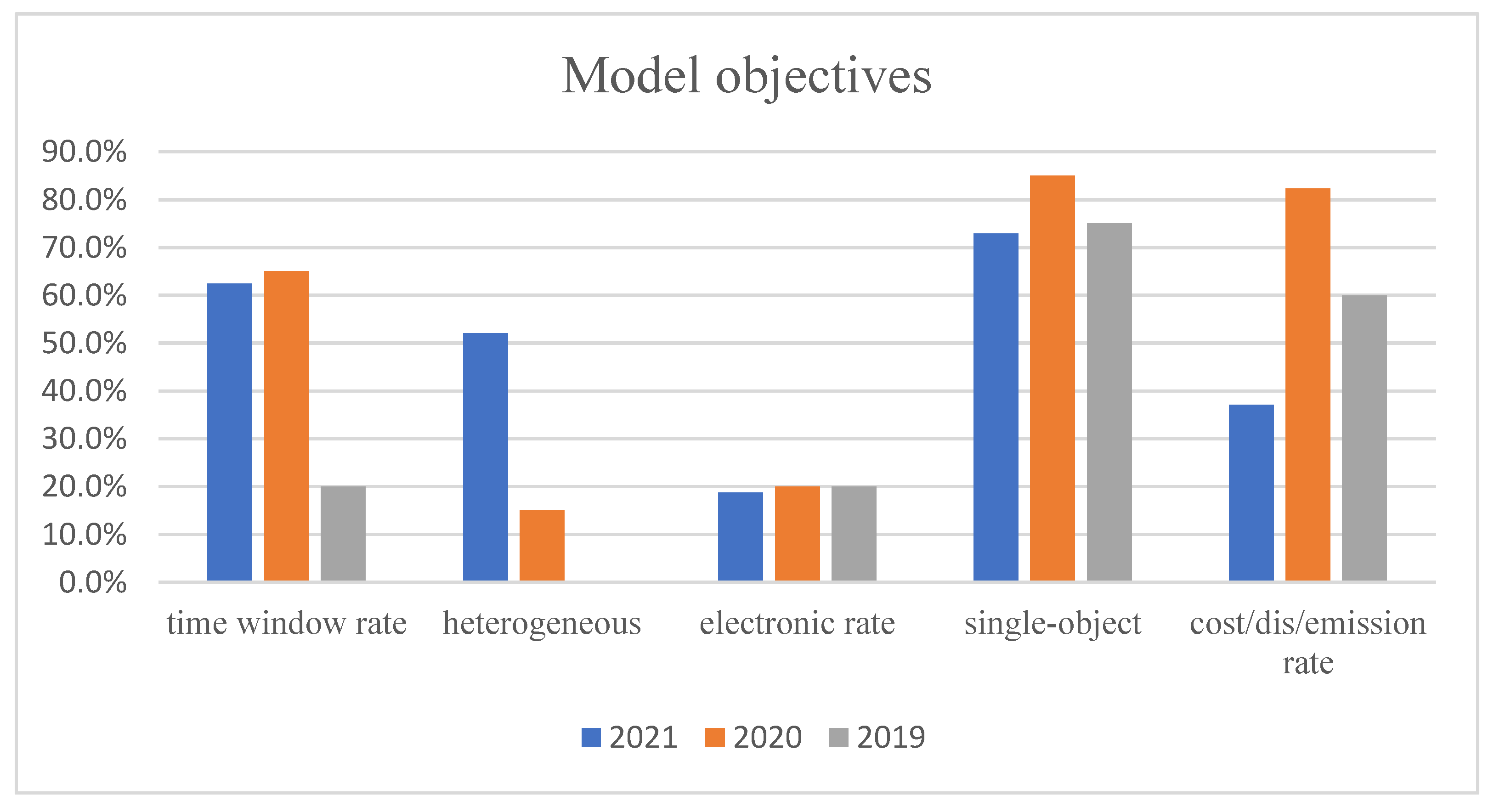
As shown in the tables above, there are different main model objectives for different years. The results are summarized in Figure 1.
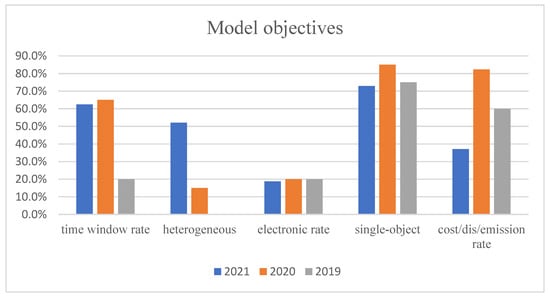
Figure 1.
Different model objectives in different years.
One can see that the time window still occupies a large proportion of model objectives and is the mainstream of current research on the VRP and its variants. This trend is closely related to the concept of the “to C” distribution, where customers focus on service satisfaction. There have been various extensions of the VRP, including the VRPTW and time-dependent problems such as those discussed in [17,24,41,75,89]. Additional research has focused on heterogeneous vehicle problems that are closely related to real-life vehicle applications. With the increasing focus on environmental protection, electric vehicle distribution has also gradually become a mainstream research topic. Relevant research can be found in [49,72,81,89,116]. Single-objective models still occupy a certain research space, where the objective value setting is still largely based on cost metrics (e.g., cost, distance, and CO2 emission). However, unlike cost metrics in past research, the costs in the current single-objective problem research tend to be compound costs representing actual delivery costs.
4. Solutions for VRPs
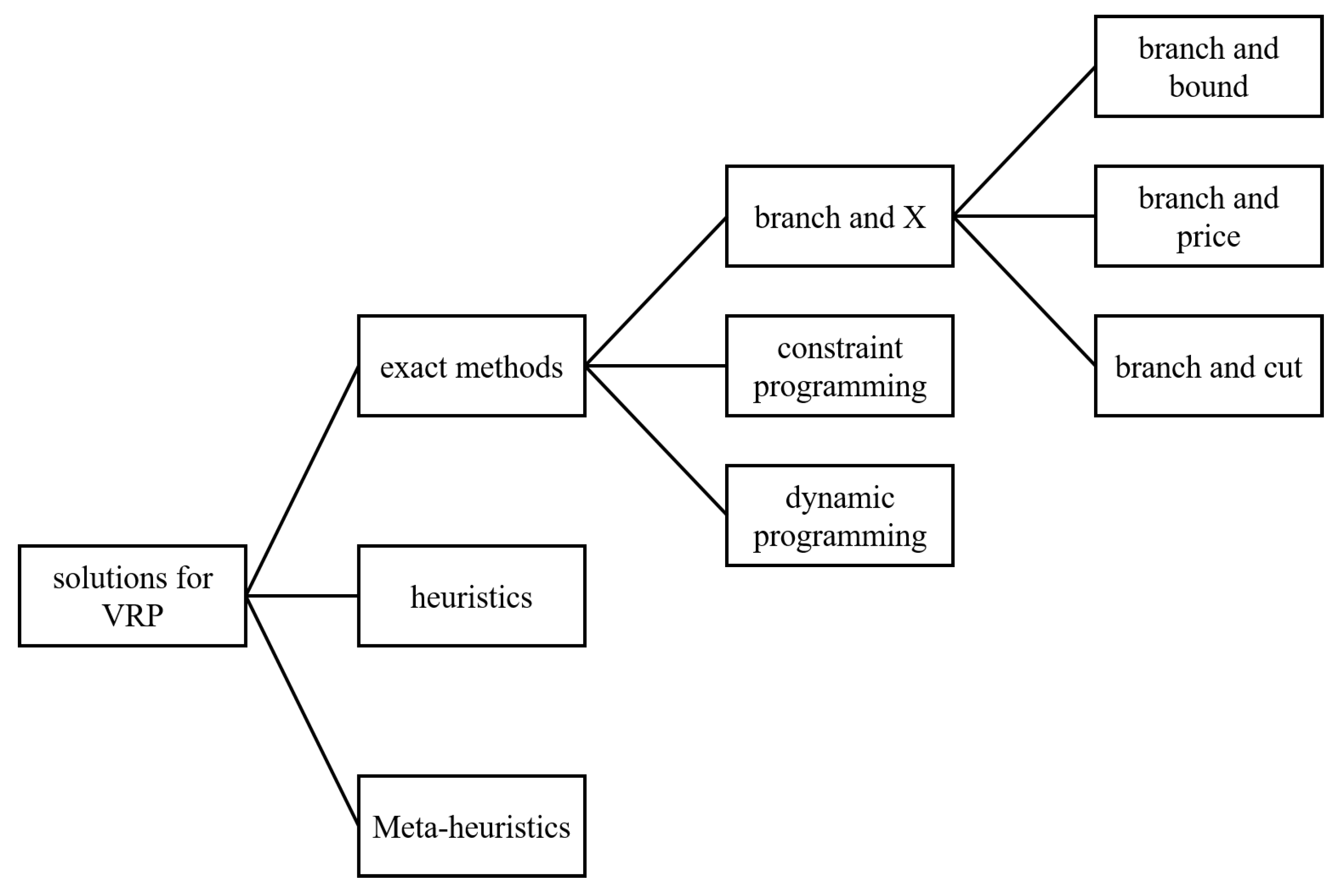
Because real-world problems involve complex constraints, advanced algorithms are required to solve VRPs in complicated and constantly changing environments. The number of customers and vehicle types is increasing and the use of optimization algorithms is a key component of effective customer service and efficient operations. A large variety of VRP solution strategies have been presented in the literature. These strategies range from exact methods to heuristics and meta-heuristics. Exact methods provide optimal solutions, whereas heuristics and meta-heuristics generally yield near-optimal solutions. Exact methods are typically only suitable for small-scale problems (up to 200 customers). Because the VRP and its variants are known to have NP-hard complexity, solving larger instances optimally is very time-consuming. However, there are no bounds on problem size when solving problems using heuristics and meta-heuristics that can efficiently handle large numbers of constraints and still output near-optimal solutions. Figure 2 presents various approaches to solving the VRPs and was adapted from content in [6,149].
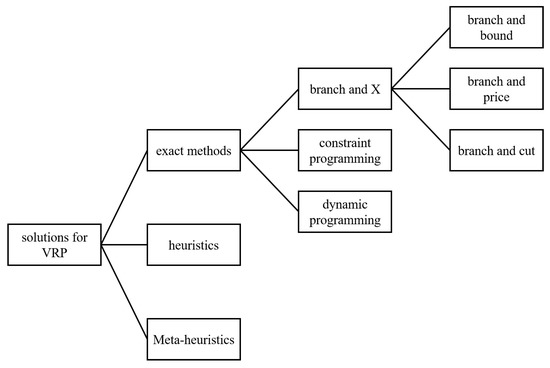
Figure 2.
Solutions for VRPs.
Exact methods include a variety of approaches, mainly branch and X (X: cut, bound, price, and so on) approaches, as well as dynamic programming and column generation methods. In recent years, significant advances in the exact solution of VRPs have been achieved. A major milestone was the branch-and-price algorithm proposed by Pecin et al. [150]. The branch-and-bound (BB) method was developed to explore solution spaces implicitly. Because the performance of BB algorithms depends on the quality of bounds obtained throughout a tree, BB algorithms can be combined with the generation of cutting planes, forming so-called branch-and-cut algorithms, or with column generation, resulting in BAP algorithms [151]. Branch and X remain the dominant VRP approaches [150,152]. While branch and X approaches treat VRPs as integer linear programming (ILP) or mixed ILP (MILP), dynamic programming breaks complex problems into a number of simpler sub-problems. Constraint programming is a model that interrelates different variables using constraints. When the search space is reduced, relatively simple problems can be solved by various search algorithms [149].
Approximate methods called heuristics are designed to solve specific problems. Heuristics focus on systematically finding an acceptable solution within a limited number of iterations. A heuristic yields solutions faster than an exact method. A meta-heuristic may be referred to as an intelligent strategy combining subordinate heuristics for exploration and exploitation.
For solution discussion, we classified exact methods, heuristic algorithms, and meta-heuristic algorithms in papers with the same numbers as those in Table 11, Table 12 and Table 13. The results are presented in the tables below.
Table 11.
Solutions to VRPs published in 2021.
Table 12.
Solutions to VRPs published in 2020.
Table 13.
Solutions to VRPs published in 2019.
As shown in the tables above. Heuristic algorithms and meta-heuristic algorithms are still the mainstream solution methods, although branch and X methods will continue to increase in popularity in 2021. As mentioned previously, with the rapid growth in the processing speed and memory capacity of computers (i.e., operating environments), more complex instances of the VRP can be solved.
5. Observations and Conclusions
Based on the practical importance of VRPs in real life, such problems have attracted significant research attention in recent years. Most work has been devoted to classical cost objectives such as total cost, total travel distance, and CO2 emission. Some studies have considered multiple objectives. In order to solve the problem of greenhouse gas emission, the discussion of trolley distribution has become a research trend. Time windows still account for a large proportion of modern papers and are mainstream in current research on the VRP and its variants. Time windows are closely related to the current mode of “to C” distribution, where customers focus on service satisfaction.
Regarding datasets, different studies make various adjustments to data and many use generated datasets in addition to real data, which makes it difficult to compare algorithms using a unified standard. There is still scope for significant further work in the field. Therefore, researchers should be motivated to develop publicly available datasets, and effective and efficient methods for dealing with VRPs. The gaps in the available literature mentioned above may motivate further work in these directions for researchers in this field.
For solving algorithms, with the development of the processing speed and memory capacity of computers, using the exact way such as branch and X to solve VRPs is rapid growth. However, heuristic algorithms and meta-heuristic algorithms are still the mainstream solution methods, such as SA [14], GA [35,41,45], NSG [28,47], SSO [153], and so on. It is hoped that more exact algorithms can be applied to solve VRPs in the future, and the number of nodes in the dataset that can be solved can be increased as much as possible.
Our research protocol was well defined because it aims at an efficient and thorough review of multiple VRP variants. The main goal of this study was to identify the trends of VRP variants and the algorithms applied to solve them. Additionally, papers that are considered to represent pioneering efforts from the research community were presented. The papers with the most citations were considered to be the most significant and they were discussed in detail in this review.
Author Contributions
Conceptualization, S.-Y.T. and W.-C.Y.; methodology, W.-C.Y.; software, S.-Y.T. and W.-C.Y.; validation, S.-Y.T. and W.-C.Y.; formal analysis, S.-Y.T.; investigation, S.-Y.T.; resources, W.-C.Y.; data curation, S.-Y.T.; writing—original draft preparation, S.-Y.T.; writing—review and editing, W.-C.Y.; visualization, S.-Y.T.; supervision, S.-Y.T.; project administration, S.-Y.T.; funding acquisition, W.-C.Y. All authors have read and agreed to the published version of the manuscript.
Funding
This research received no external funding.
Institutional Review Board Statement
Not applicable.
Informed Consent Statement
Not applicable.
Acknowledgments
We wish to thank the anonymous editor and referees for their constructive comments and recommendations, which significantly improved this paper.
Conflicts of Interest
The authors declare no conflict of interest.
Appendix A
Table A1.
List of abbreviations for vehicle routing problems and its variants.
Table A1.
List of abbreviations for vehicle routing problems and its variants.
| Abbreviations | Definition | Abbreviations | Definition |
|---|---|---|---|
| VRP | Vehicle routing problem | GVRP | Green VRP |
| VRPTW | VRP with time windows | HFVRP | VRP with heterogeneous fleets |
| CVRP | Capacitated VRP | MDVRP | Multi-depot VRP |
| EV | Electric vehicle | TDVRP | Time-dependent VRP |
| ECV | Electric commercial vehicle | TDVRPTW | Time-dependent VRP with time widows |
| EVRP | Electric VRP | TWAVRP | Time window assignment VRP |
| EVRPTW | Electric VRP with time widows | VRPSD-PDC | VRP with stochastic demands and probabilistic duration constraints |
| EVRPTW-SP | EVRPTW at most a single (S) recharge per route, and partial (P) battery recharges are possible | VRP-REP | VRP repository |
Table A2.
List of abbreviations for solution of VRP and its variants.
Table A2.
List of abbreviations for solution of VRP and its variants.
| Abbreviations | Definition | Abbreviations | Definition |
|---|---|---|---|
| ACO | Ant colony optimization | HH-ILS | Hyper-heuristic algorithm based on ILS and VND heuristics |
| ALNS | Adaptive large neighborhood search | HWOA | Hybrid whale optimization algorithm |
| BAP/BP | Branch and price | ILNS | Iterated large neighborhood search |
| BB | Branch and bound | LNS | Large neighborhood search |
| BC | Branch and cut | MCWS-LS | Modified Clarke–Wright saving algorithm (MCWS), and solution improvement by local search (LS) |
| BRIG-LS | Biased-randomized iterated greedy with local search | MP | Mathematical programming |
| CBR | Case base reasoning | NSGA-II | Non-dominated sorting genetic algorithm II |
| CLP | Constraint logic programming | PFIH | Push forward insertion heuristic |
| DE | Differential evolution algorithm | PSO | Particle swarm optimization |
| DTRC | Drone truck route construction | SA | Simulated annealing |
| EVNS | Extended variable neighborhood search method | S-ALNS | Simulated annealing (SA), and adaptive large neighborhood search (ALNS) |
| FA | Firefly algorithm | SSO | Simplified swarm optimization |
| GA | Genetic algorithm | TS | Tabu search |
| GVNS | General variable neighborhood search method | VND | Variable neighborhood descent |
References
- Dantzig, G.B.; Ramser, J.H. The Truck Dispatching Problem. Manag. Sci. 1959, 6, 80–91. [Google Scholar] [CrossRef]
- Clarke, G.; Wright, J.W. Scheduling of Vehicles from a Central Depot to a Number of Delivery Points. Oper. Res. 1964, 12, 568–581. [Google Scholar] [CrossRef]
- Braekers, K.; Ramaekers, K.; Van Nieuwenhuyse, I. The Vehicle Routing Problem: State of the Art Classification and Review. Comput. Ind. Eng. 2016, 99, 300–313. [Google Scholar] [CrossRef]
- Eksioglu, B.; Vural, A.V.; Reisman, A. The Vehicle Routing Problem: A Taxonomic Review. Comput. Ind. Eng. 2009, 57, 1472–1483. [Google Scholar] [CrossRef]
- Elshaer, R.; Awad, H. A Taxonomic Review of Metaheuristic Algorithms for Solving the Vehicle Routing Problem and Its Variants. Comput. Ind. Eng. 2020, 140, 106242. [Google Scholar] [CrossRef]
- Konstantakopoulos, G.D.; Gayialis, S.P.; Kechagias, E.P. Vehicle Routing Problem and Related Algorithms for Logistics Distribution: A Literature Review and Classification. Oper. Res. Int. J. 2020, 1–30. [Google Scholar] [CrossRef]
- Cordeau, J.-F.; Laporte, G.; Savelsbergh, M.W.P.; Vigo, D. Chapter 6 Vehicle Routing. Handb. Oper. Res. Manag. Sci. 2007, 14, 367–428. [Google Scholar]
- Golden, B.L.; Raghavan, S.; Wasil, E.A. The Vehicle Routing Problem: Latest Advances and New Challenges; Springer Science and Business Media: Berlin/Heidelberg, Germany, 2008; Volume 43. [Google Scholar]
- Toth, P.; Vigo, D. Vehicle Routing: Problems, Methods, and Applications; SIAM: Philadelphia, PA, USA, 2014. [Google Scholar]
- Nalepa, J. Smart Delivery Systems: Solving Complex Vehicle Routing Problems; Elsevier: Amsterdam, The Netherlands, 2019. [Google Scholar]
- Lenstra, J.K.; Kan, A.H.G.R. Complexity of Vehicle Routing and Scheduling Problems. Networks 1981, 11, 221–227. [Google Scholar] [CrossRef]
- Vidal, T.; Laporte, G.; Matl, P. A Concise Guide to Existing and Emerging Vehicle Routing Problem Variants. Eur. J. Oper. Res. 2020, 286, 401–416. [Google Scholar] [CrossRef]
- Moghdani, R.; Salimifard, K.; Demir, E.; Benyettou, A. The Green Vehicle Routing Problem: A Systematic Literature Review. J. Cleaner Prod. 2021, 279, 123691. [Google Scholar] [CrossRef]
- Mojtahedi, M.; Fathollahi-Fard, A.M.; Tavakkoli-Moghaddam, R.; Newton, S. Sustainable Vehicle Routing Problem for Coordinated Solid Waste Management. J. Ind. Inf. Integr. 2021, 23, 100220. [Google Scholar]
- Nguyen, M.A.; Dang, G.T.-H.; Hà, M.H.; Pham, M.-T. The min-cost parallel drone scheduling vehicle routing problem. Eur. J. Oper. Res. 2021. In Press. [Google Scholar] [CrossRef]
- Basso, R.; Kulcsár, B.; Sanchez-Diaz, I. Electric Vehicle Routing Problem with Machine Learning for Energy Prediction. Transp. Res. B Methodol. 2021, 145, 24–55. [Google Scholar] [CrossRef]
- Pan, B.; Zhang, Z.; Lim, A. Multi-Trip Time-Dependent Vehicle Routing Problem with Time Windows. Eur. J. Oper. Res. 2021, 291, 218–231. [Google Scholar] [CrossRef]
- Keskin, M.; Çatay, B.; Laporte, G. A Simulation-Based Heuristic for the Electric Vehicle Routing Problem with Time Windows and Stochastic Waiting Times at Recharging Stations. Comput. Oper. Res. 2021, 125, 105060. [Google Scholar] [CrossRef]
- Wang, Y.; Li, Q.; Guan, X.; Xu, M.; Liu, Y.; Wang, H. Two-Echelon Collaborative Multi-Depot Multi-Period Vehicle Routing Problem. Expert Syst. Appl. 2021, 167, 114201. [Google Scholar] [CrossRef]
- Behnke, M.; Kirschstein, T.; Bierwirth, C. A Column Generation Approach for an Emission-Oriented Vehicle Routing Problem on a Multigraph. Eur. J. Oper. Res. 2021, 288, 794–809. [Google Scholar] [CrossRef]
- Anderluh, A.; Nolz, P.C.; Hemmelmayr, V.C.; Crainic, T.G. Multi-Objective Optimization of a Two-Echelon Vehicle Routing Problem with Vehicle Synchronization and “Grey zone”Customers Arising in Urban Logistics. Eur. J. Oper. Res. 2021, 289, 940–958. [Google Scholar] [CrossRef]
- Dewi, S.K.; Utama, D.M. A New Hybrid Whale Optimization Algorithm for Green Vehicle Routing Problem. Syst. Sci. Control. Eng. 2021, 9, 61–72. [Google Scholar] [CrossRef]
- Do, C.; Martins, L.; Hirsch, P.; Juan, A.A. Agile Optimization of a Two-Echelon Vehicle Routing Problem with Pickup and Delivery. Int. Trans. Oper. Res. 2021, 28, 201–221. [Google Scholar]
- Gmira, M.; Gendreau, M.; Lodi, A.; Potvin, J.-Y. Tabu Search for the Time-Dependent Vehicle Routing Problem with Time Windows on a Road Network. Eur. J. Oper. Res. 2021, 288, 129–140. [Google Scholar] [CrossRef]
- Archetti, C.; Guerriero, F.; Macrina, G. The Online Vehicle Routing Problem with Occasional Drivers. Comput. Oper. Res. 2021, 127, 105144. [Google Scholar] [CrossRef]
- Abdirad, M.; Krishnan, K.; Gupta, D. A Two-Stage Metaheuristic Algorithm for the Dynamic Vehicle Routing Problem in Industry 4.0 Approach. J. Manag. Anal. 2021, 8, 69–83. [Google Scholar] [CrossRef]
- Latorre-Biel, J.I.; Ferone, D.; Juan, A.A.; Faulin, J. Combining Simheuristics with Petri Nets for Solving the Stochastic Vehicle Routing Problem with Correlated Demands. Expert Syst. Appl. 2021, 168, 114240. [Google Scholar] [CrossRef]
- Srivastava, G.; Singh, A.; Mallipeddi, R. NSGA-II with Objective-Specific Variation Operators for Multiobjective Vehicle Routing Problem with Time Windows. Expert Syst. Appl. 2021, 176, 114779. [Google Scholar] [CrossRef]
- Altabeeb, A.M.; Mohsen, A.M.; Abualigah, L.; Ghallab, A. Solving Capacitated Vehicle Routing Problem Using Cooperative Firefly Algorithm. Appl. Soft Comput. 2021, 108, 107403. [Google Scholar] [CrossRef]
- Sadati, M.E.H.; Çatay, B. A Hybrid Variable Neighborhood Search Approach for the Multi-Depot Green Vehicle Routing Problem. Transp. Res. E 2021, 149, 102293. [Google Scholar] [CrossRef]
- İlhan, İ. An Improved Simulated Annealing Algorithm with Crossover Operator for Capacitated Vehicle Routing Problem. Swarm Evol. Comput. 2021, 64, 100911. [Google Scholar] [CrossRef]
- Euchi, J.; Sadok, A. Hybrid Genetic-Sweep Algorithm to Solve the Vehicle Routing Problem with Drones. Phys. Commun. 2021, 44, 101236. [Google Scholar] [CrossRef]
- Florio, A.M.; Hartl, R.F.; Minner, S.; Salazar-González, J.-J. A Branch-and-Price Algorithm for the Vehicle Routing Problem with Stochastic Demands and Probabilistic Duration Constraints. Transp. Sci. 2021, 55, 122–138. [Google Scholar] [CrossRef]
- Chaabane, A.; Montecinos, J.; Ouhimmou, M.; Khabou, A. Vehicle Routing Problem for Reverse Logistics of End-of-Life Vehicles (ELVs). Waste Manag. 2021, 120, 209–220. [Google Scholar] [CrossRef] [PubMed]
- Park, H.; Son, D.; Koo, B.; Jeong, B. Waiting Strategy for the Vehicle Routing Problem with Simultaneous Pickup and Delivery Using Genetic Algorithm. Expert Syst. Appl. 2021, 165, 113959. [Google Scholar] [CrossRef]
- Chen, C.; Demir, E.; Huang, Y. An Adaptive Large Neighborhood Search Heuristic for the Vehicle Routing Problem with Time Windows and Delivery Robots. Eur. J. Oper. Res. 2021, 294, 1164–1180. [Google Scholar] [CrossRef]
- Abdullahi, H.; Reyes-Rubiano, L.; Ouelhadj, D.; Faulin, J.; Juan, A.A. Modelling and Multi-Criteria Analysis of the Sustainability Dimensions for the Green Vehicle Routing Problem. Eur. J. Oper. Res. 2021, 292, 143–154. [Google Scholar] [CrossRef]
- Pan, B.; Zhang, Z.; Lim, A. A Hybrid Algorithm for Time-Dependent Vehicle Routing Problem with Time Windows. Comput. Oper. Res. 2021, 128, 105193. [Google Scholar] [CrossRef]
- Lee, C. An Exact Algorithm for the Electric-Vehicle Routing Problem with Nonlinear Charging Time. J. Oper. Res. Soc. 2021, 72, 1461–1485. [Google Scholar] [CrossRef]
- Li, H.; Wang, H.; Chen, J.; Bai, M. Two-Echelon Vehicle Routing Problem with Satellite Bi-Synchronization. Eur. J. Oper. Res. 2021, 288, 775–793. [Google Scholar] [CrossRef]
- Fan, H.; Zhang, Y.; Tian, P.; Lv, Y.; Fan, H. Time-Dependent Multi-Depot Green Vehicle Routing Problem with Time Windows Considering Temporal-Spatial Distance. Comput. Oper. Res. 2021, 129, 105211. [Google Scholar] [CrossRef]
- Quirion-Blais, O.; Chen, L. A Case-Based Reasoning Approach to Solve the Vehicle Routing Problem with Time Windows and Drivers’ Experience. Omega 2021, 102, 102340. [Google Scholar] [CrossRef]
- Mühlbauer, F.; Fontaine, P. A Parallelised Large Neighbourhood Search Heuristic for the Asymmetric Two-Echelon Vehicle Routing Problem with Swap Containers for Cargo-Bicycles. Eur. J. Oper. Res. 2021, 289, 742–757. [Google Scholar] [CrossRef]
- Lin, B.; Ghaddar, B.; Nathwani, J. Deep Reinforcement Learning for the Electric Vehicle Routing Problem with Time Windows. IEEE Trans. Intell. Transp. Syst. 2021. Early Access. [Google Scholar] [CrossRef]
- Wang, Y.; Li, Q.; Guan, X.; Fan, J.; Xu, M.; Wang, H. Collaborative Multi-Depot Pickup and Delivery Vehicle Routing Problem with Split Loads and Time Windows. Knowl. Based Syst. 2021, 231, 107412. [Google Scholar] [CrossRef]
- Mendes, R.S.; Lush, V.; Wanner, E.F.; Martins, F.V.C.; Sarubbi, J.F.M.; Deb, K. Online Clustering Reduction Based on Parametric and Non-Parametric Correlation for a Many-Objective Vehicle Routing Problem with Demand Responsive Transport. Expert Syst. Appl. 2021, 170, 114467. [Google Scholar] [CrossRef]
- Aerts, B.; Cornelissens, T.; Sörensen, K. The Joint Order Batching and Picker Routing Problem: Modelled and Solved as a Clustered Vehicle Routing Problem. Comput. Oper. Res. 2021, 129, 105168. [Google Scholar] [CrossRef]
- Niu, Y.; Kong, D.; Wen, R.; Cao, Z.; Xiao, J. An Improved Learnable Evolution Model for Solving Multi-Objective Vehicle Routing Problem with Stochastic Demand. Knowl. Based Syst. 2021, 230, 107378. [Google Scholar] [CrossRef]
- Jia, Y.H.; Mei, Y.; Zhang, M. A Bilevel Ant Colony Optimization Algorithm for Capacitated Electric Vehicle Routing Problem. IEEE Trans. Cybern. 2021. [Google Scholar] [CrossRef] [PubMed]
- Sitek, P.; Wikarek, J.; Rutczyńska-Wdowiak, K.; Bocewicz, G.; Banaszak, Z. Optimization of Capacitated Vehicle Routing Problem with Alternative Delivery, Pick-Up and Time Windows: A Modified Hybrid Approach. Neurocomputing 2021, 423, 670–678. [Google Scholar] [CrossRef]
- Niu, Y.; Zhang, Y.; Cao, Z.; Gao, K.; Xiao, J.; Song, W.; Zhang, F. MIMOA: A Membrane-Inspired Multi-Objective Algorithm for Green Vehicle Routing Problem with Stochastic Demands. Swarm Evol. Comput. 2021, 60, 100767. [Google Scholar] [CrossRef]
- Casazza, M.; Ceselli, A.; Wolfler Calvo, R.W. A Route Decomposition Approach for the Single Commodity Split Pickup and Split Delivery Vehicle Routing Problem. Eur. J. Oper. Res. 2021, 289, 897–911. [Google Scholar] [CrossRef]
- Grabenschweiger, J.; Doerner, K.F.; Hartl, R.F.; Savelsbergh, M.W.P. The Vehicle Routing Problem with Heterogeneous Locker Boxes. Cent. Eur. J. Oper. Res. 2021, 29, 113–142. [Google Scholar] [CrossRef]
- Afsar, H.M.; Afsar, S.; Palacios, J.J. Vehicle Routing Problem with Zone-Based Pricing. Transp. Res. E 2021, 152, 102383. [Google Scholar] [CrossRef]
- Olgun, B.; Koç, Ç.; Altıparmak, F. A Hyper Heuristic for the Green Vehicle Routing Problem with Simultaneous Pickup and Delivery. Comput. Ind. Eng. 2021, 153, 107010. [Google Scholar] [CrossRef]
- Stellingwerf, H.M.; Groeneveld, L.H.C.; Laporte, G.; Kanellopoulos, A.; Bloemhof, J.M.; Behdani, B. The Quality-Driven Vehicle Routing Problem: Model and Application to a Case of Cooperative Logistics. Int. J. Prod. Econ. 2021, 231, 107849. [Google Scholar] [CrossRef]
- Wang, F.; Liao, F.; Li, Y.; Yan, X.; Chen, X. An Ensemble Learning Based Multi-Objective Evolutionary Algorithm for the Dynamic Vehicle Routing Problem with Time Windows. Comput. Ind. Eng. 2021, 154, 107131. [Google Scholar] [CrossRef]
- Zhang, D.; Li, D.; Sun, H.; Hou, L. A Vehicle Routing Problem with Distribution Uncertainty in Deadlines. Eur. J. Oper. Res. 2021, 292, 311–326. [Google Scholar] [CrossRef]
- Haixiang, G.; Fang, W.; Wenwen, P.; Mingyun, G. Period Sewage Recycling Vehicle Routing Problem Based on Real-Time Data. J. Cleaner Prod. 2021, 288, 125628. [Google Scholar] [CrossRef]
- Dalmeijer, K.; Desaulniers, G. Addressing Orientation Symmetry in the Time Window Assignment Vehicle Routing Problem. INFORMS J. Comput. 2021, 33, 495–510. [Google Scholar]
- Guo, F.; Huang, Z.; Huang, W. Heuristic Approaches for a Vehicle Routing Problem with an Incompatible Loading Constraint and Splitting Deliveries by Order. Comput. Oper. Res. 2021, 134, 105379. [Google Scholar] [CrossRef]
- Pasha, J.; Dulebenets, M.A.; Kavoosi, M.; Abioye, O.F.; Wang, H.; Guo, W. An Optimization Model and Solution Algorithms for the Vehicle Routing Problem with a “Factory-in-a-Box”. IEEE Access 2020, 8, 134743. [Google Scholar] [CrossRef]
- Abbasi, M.; Rafiee, M.; Khosravi, M.R.; Jolfaei, A.; Menon, V.G.; Koushyar, J.M. An Efficient Parallel Genetic Algorithm Solution for Vehicle Routing Problem in Cloud Implementation of the Intelligent Transportation Systems. J. Cloud Comput. 2020, 9, 1–14. [Google Scholar] [CrossRef]
- Kitjacharoenchai, P.; Min, B.-C.; Lee, S. Two Echelon Vehicle Routing Problem with Drones in Last Mile Delivery. Int. J. Prod. Econ. 2020, 225, 107598. [Google Scholar] [CrossRef]
- Raeesi, R.; Zografos, K.G. The Electric Vehicle Routing Problem with Time Windows and Synchronised Mobile Battery Swapping. Transp. Res. B Methodol. 2020, 140, 101–129. [Google Scholar] [CrossRef]
- Zhang, S.; Chen, M.; Zhang, W.; Zhuang, X. Fuzzy Optimization Model for Electric Vehicle Routing Problem with Time Windows and Recharging Stations. Expert Syst. Appl. 2020, 145, 113123. [Google Scholar] [CrossRef]
- Song, M.-x.; Li, J.-q.; Han, Y.-q.; Han, Y.-y.; Liu, L.-l.; Sun, Q. Metaheuristics for Solving the Vehicle Routing Problem with the Time Windows and Energy Consumption in Cold Chain Logistics. Appl. Soft Comput. 2020, 95, 106561. [Google Scholar] [CrossRef]
- Giallanza, A.; Puma, G.L. Fuzzy Green Vehicle Routing Problem for Designing a Three Echelons Supply Chain. J. Cleaner Prod. 2020, 259, 120774. [Google Scholar] [CrossRef]
- Zhang, W.; Chen, Z.; Zhang, S.; Wang, W.; Yang, S.; Cai, Y. Composite Multi-Objective Optimization on a New Collaborative Vehicle Routing Problem with Shared Carriers and Depots. J. Cleaner Prod. 2020, 274, 122593. [Google Scholar] [CrossRef]
- Brandão, J. A Memory-Based Iterated Local Search Algorithm for the Multi-Depot Open Vehicle Routing Problem. Eur. J. Oper. Res. 2020, 284, 559–571. [Google Scholar] [CrossRef]
- Eshtehadi, R.; Demir, E.; Huang, Y. Solving the Vehicle Routing Problem with Multi-Compartment Vehicles for City Logistics. Comput. Oper. Res. 2020, 115, 104859. [Google Scholar] [CrossRef]
- Zhen, L.; Ma, C.; Wang, K.; Xiao, L.; Zhang, W. Multi-Depot Multi-Trip Vehicle Routing Problem with Time Windows and Release Dates. Transp. Res. E 2020, 135, 101866. [Google Scholar] [CrossRef]
- Kancharla, S.R.; Ramadurai, G. Electric Vehicle Routing Problem with Non-Linear Charging and Load-Dependent Discharging. Expert Syst. Appl. 2020, 160, 113714. [Google Scholar] [CrossRef]
- Molina, J.C.; Salmeron, J.L.; Eguia, I. An ACS-Based Memetic Algorithm for the Heterogeneous Vehicle Routing Problem with Time Windows. Expert Syst. Appl. 2020, 157, 113379. [Google Scholar] [CrossRef]
- Mao, H.; Shi, J.; Zhou, Y.; Zhang, G. The Electric Vehicle Routing Problem with Time Windows and Multiple Recharging Options. IEEE Access 2020, 8, 114864–114875. [Google Scholar] [CrossRef]
- Lu, J.; Chen, Y.; Hao, J.-K.; He, R. The Time-Dependent Electric Vehicle Routing Problem: Model and Solution. Expert Syst. Appl. 2020, 161, 113593. [Google Scholar] [CrossRef]
- Fachini, R.F.; Armentano, V.A. Logic-Based Benders Decomposition for the Heterogeneous Fixed Fleet Vehicle Routing Problem with Time Windows. Comput. Ind. Eng. 2020, 148, 106641. [Google Scholar] [CrossRef]
- Shi, Y.; Zhou, Y.; Ye, W.; Zhao, Q.Q. A Relative Robust Optimization for a Vehicle Routing Problem with Time-Window and Synchronized Visits Considering Greenhouse Gas Emissions. J. Cleaner Prod. 2020, 275, 124112. [Google Scholar] [CrossRef]
- Trachanatzi, D.; Rigakis, M.; Marinaki, M.; Marinakis, Y. A Firefly Algorithm for the Environmental Prize-Collecting Vehicle Routing Problem. Swarm Evol. Comput. 2020, 57, 100712. [Google Scholar] [CrossRef]
- Li, H.; Wang, H.; Chen, J.; Bai, M. Two-Echelon Vehicle Routing Problem with Time Windows and Mobile Satellites. Transp. Res. B Methodol. 2020, 138, 179–201. [Google Scholar] [CrossRef]
- Sethanan, K.; Jamrus, T. Hybrid differential evolution algorithm and genetic operator for multi-trip vehicle routing problem with backhauls and heterogeneous fleet in the beverage logistics industry. Comput. Ind. Eng. 2020, 146, 106571. [Google Scholar] [CrossRef]
- Wang, Z.; Sheu, J.-B. Vehicle Routing Problem with Drones. Transp. Res. B Methodol. 2019, 122, 350–364. [Google Scholar] [CrossRef]
- Pelletier, S.; Jabali, O.; Laporte, G. The Electric Vehicle Routing Problem with Energy Consumption Uncertainty. Transp. Res. B Methodol. 2019, 126, 225–255. [Google Scholar] [CrossRef]
- Schermer, D.; Moeini, M.; Wendt, O. A Matheuristic for the Vehicle Routing Problem with Drones and Its Variants. Transp. Res. C 2019, 106, 166–204. [Google Scholar] [CrossRef]
- Bruglieri, M.; Mancini, S.; Pezzella, F.; Pisacane, O. A Path-Based Solution Approach for the Green Vehicle Routing Problem. Comput. Oper. Res. 2019, 103, 109–122. [Google Scholar] [CrossRef]
- Li, Y.; Soleimani, H.; Zohal, M. An Improved Ant Colony Optimization Algorithm for the Multi-Depot Green Vehicle Routing Problem with Multiple Objectives. J. Cleaner Prod. 2019, 227, 1161–1172. [Google Scholar] [CrossRef]
- Basso, R.; Kulcsár, B.; Egardt, B.; Lindroth, P.; Sanchez-Diaz, I. Energy Consumption Estimation Integrated into the Electric Vehicle Routing Problem. Transp. Res. D 2019, 69, 141–167. [Google Scholar] [CrossRef]
- Breunig, U.; Baldacci, R.; Hartl, R.F.; Vidal, T. The Electric Two-Echelon Vehicle Routing Problem. Comput. Oper. Res. 2019, 103, 198–210. [Google Scholar] [CrossRef]
- Zhen, L.; Li, M.; Laporte, G.; Wang, W. A Vehicle Routing Problem Arising in Unmanned Aerial Monitoring. Comput. Oper. Res. 2019, 105, 1–11. [Google Scholar] [CrossRef]
- Stavropoulou, F.; Repoussis, P.P.; Tarantilis, C.D. The Vehicle Routing Problem with Profits and Consistency Constraints. Eur. J. Oper. Res. 2019, 274, 340–356. [Google Scholar] [CrossRef]
- Keskin, M.; Laporte, G.; Çatay, B. Electric Vehicle Routing Problem with Time-Dependent Waiting Times at Recharging Stations. Comput. Oper. Res. 2019, 107, 77–94. [Google Scholar] [CrossRef]
- Huang, Y.-H.; Blazquez, C.A.; Huang, S.-H.; Paredes-Belmar, G.; Latorre-Nuñez, G. Solving the Feeder Vehicle Routing Problem Using Ant Colony Optimization. Comput. Ind. Eng. 2019, 127, 520–535. [Google Scholar] [CrossRef]
- Arnold, F.; Sörensen, K. Knowledge-Guided Local Search for the Vehicle Routing Problem. Comput. Oper. Res. 2019, 105, 32–46. [Google Scholar] [CrossRef]
- Long, J.; Sun, Z.; Pardalos, P.M.; Hong, Y.; Zhang, S.; Li, C. A Hybrid Multi-Objective Genetic Local Search Algorithm for the Prize-Collecting Vehicle Routing Problem. Inf. Sci. 2019, 478, 40–61. [Google Scholar] [CrossRef]
- Sacramento, D.; Pisinger, D.; Ropke, S. An Adaptive Large Neighborhood Search Metaheuristic for the Vehicle Routing Problem with Drones. Transp. Res. C 2019, 102, 289–315. [Google Scholar] [CrossRef]
- Schermer, D.; Moeini, M.; Wendt, O. A Hybrid VNS/Tabu Search Algorithm for Solving the Vehicle Routing Problem with Drones and En Route Operations. Comput. Oper. Res. 2019, 109, 134–158. [Google Scholar] [CrossRef]
- Zhao, P.X.; Luo, W.H.; Han, X. Time-Dependent and Bi-Objective Vehicle Routing Problem with Time Windows. Adv. Produc. Engineer. Manag. 2019, 14, 201–212. [Google Scholar] [CrossRef]
- Froger, A.; Mendoza, J.E.; Jabali, O.; Laporte, G. Improved Formulations and Algorithmic Components for the Electric Vehicle Routing Problem with Nonlinear Charging Functions. Comput. Oper. Res. 2019, 104, 256–294. [Google Scholar] [CrossRef]
- Yu, Y.; Wang, S.; Wang, J.; Huang, M. A Branch-and-Price Algorithm for the Heterogeneous Fleet Green Vehicle Routing Problem with Time Windows. Transp. Res. B Methodol. 2019, 122, 511–527. [Google Scholar] [CrossRef]
- Marinakis, Y.; Marinaki, M.; Migdalas, A. A Multi-Adaptive Particle Swarm Optimization for the Vehicle Routing Problem with Time Windows. Inf. Sci. 2019, 481, 311–329. [Google Scholar] [CrossRef]
- Altabeeb, A.M.; Mohsen, A.M.; Ghallab, A. An Improved Hybrid Firefly Algorithm for Capacitated Vehicle Routing Problem. Appl. Soft Comput. 2019, 84, 105728. [Google Scholar] [CrossRef]
- Dabia, S.; Ropke, S.; Van Woensel, T.; De Kok, T. Branch and Price for the Time-Dependent Vehicle Routing Problem with Time Windows. Transp. Sci. 2013, 47, 380–396. [Google Scholar] [CrossRef]
- Desaulniers, G.; Errico, F.; Irnich, S.; Schneider, M. Exact Algorithms for Electric Vehicle-Routing Problems with Time Windows. Oper. Res. 2016, 64, 1388–1405. [Google Scholar] [CrossRef]
- Anderluh, A.; Hemmelmayr, V.C.; Nolz, P.C. Synchronizing Vans and Cargo Bikes in a City Distribution Network. Cent. Eur. J. Oper. Res. 2017, 25, 345–376. [Google Scholar] [CrossRef]
- Abdulkader, M.M.S.; Gajpal, Y.; ElMekkawy, T.Y. Vehicle Routing Problem in Omni-Channel Retailing Distribution Systems. Int. J. Prod. Econ. 2018, 196, 43–55. [Google Scholar] [CrossRef]
- Ticha, H.B.; Absi, N.; Feillet, D.; Quilliot, A.; Van Woensel, T. A Branchand-Price Algorithm for the Vehicle Routing Problem with Time Windows on a Road Network Graph. Networks 2017, 2017, 401–417. [Google Scholar]
- Solomon, M.M. Algorithms for the Vehicle Routing and Scheduling Problems with Time Window Constraints. Oper. Res. 1987, 35, 254–265. [Google Scholar] [CrossRef]
- Homberger, J.; Gehring, H. A Two-Phase Hybrid Metaheuristic for the Vehicle Routing Problem with Time Windows. Eur. J. Oper. Res. 2005, 162, 220–238. [Google Scholar] [CrossRef]
- Zhou, Y.; Wang, J. A Local Search-Based Multiobjective Optimization Algorithm for Multiobjective Vehicle Routing Problem with Time Windows. IEEE Syst. J. 2014, 9, 1100–1113. [Google Scholar] [CrossRef]
- Castro-Gutierrez, J.; Landa-Silva, D.; Pérez, J.M. Nature of Real-World Multi-Objective Vehicle Routing with Evolutionary Algorithms. In Proceedings of the IEEE International Conference on Systems, Man, and Cybernetics, Anchorage, AK, USA, 9–12 October 2011; Volume 2011. [Google Scholar]
- Augerat, P.; Naddef, D.; Belenguer, J.; Benavent, E.; Corberan, A.; Rinaldi, G. Computational Results with a Branch and Cut Code for the Capacitated Vehicle Routing Problem; ETDEWEB: Online, 1995.
- Christofides, N.; Eilon, S. An Algorithm for the Vehicle-Dispatching Problem. J. Oper. Res. Soc. 1969, 20, 309–318. [Google Scholar] [CrossRef]
- Fisher, M.L. Optimal Solution of Vehicle Routing Problems Using Minimum k-Trees. Oper. Res. 1994, 42, 626–642. [Google Scholar] [CrossRef]
- Christofides, N. The Vehicle Routing Problem. J. Comb. Optim. 1979. [Google Scholar] [CrossRef]
- Erdoğan, S.; Miller-Hooks, E. A Green Vehicle Routing Problem. Transp. Res. E 2012, 48, 100–114. [Google Scholar] [CrossRef]
- Reyes-Rubiano, L.S.; Faulin, J.; Calvet, L.; Juan, A.A. A Simheuristic Approach for Freight Transportation in Smart Cities. In Proceedings of the 2017 Winter Simulation Conference (WSC), Las Vegas, NV, USA, 3–6 December 2017. [Google Scholar]
- Henn, S.; Wäscher, G. Tabu Search Heuristics for the Order Batching Problem in Manual Order Picking Systems. Eur. J. Oper. Res. 2012, 222, 484–494. [Google Scholar] [CrossRef]
- Mavrovouniotis, M.; Menelaou, C.; Timotheou, S.; Panayiotou, C.; Ellinas, G.; Polycarpou, M. Benchmark Set for the IEEE WCCI-2020 Competition on Evolutionary Computation for the Electric Vehicle Routing Problem; KIOS C.O.E.; University of Cyprus: Nicosia, Cyprus, 2020. [Google Scholar]
- Casazza, M.; Ceselli, A.; Chemla, D.; Meunier, F.; Wolfler Calvo, R. The Multiple Vehicle Balancing Problem. Networks 2018, 72, 337–357. [Google Scholar] [CrossRef]
- Mancini, S.; Gansterer, M. Vehicle Routing with Private and Shared Delivery Locations. Comput. Oper. Res. 2021, 133, 105361. [Google Scholar] [CrossRef]
- Christofides, N. Combinatorial Optimization; A Wiley-Interscience Publication: Hoboken, NJ, USA, 1979. [Google Scholar]
- Salhi, S.; Nagy, G. A Cluster Insertion Heuristic for Single and Multiple Depot Vehicle Routing Problems with Backhauling. J. Oper. Res. Soc. 1999, 50, 1034–1042. [Google Scholar] [CrossRef]
- Wang, H.-F.; Chen, Y.-Y. A Genetic Algorithm for the Simultaneous Delivery and Pickup Problems with Time Window. Comput. Ind. Eng. 2012, 62, 84–95. [Google Scholar] [CrossRef]
- Spliet, R.; Gabor, A.F. The Time Window Assignment Vehicle Routing Problem. Transp. Sci. 2015, 49, 721–731. [Google Scholar] [CrossRef]
- Dalmeijer, K.; Spliet, R. A Branch-and-Cut Algorithm for the Time Window Assignment Vehicle Routing Problem. Comput. Oper. Res. 2018, 89, 140–152. [Google Scholar] [CrossRef]
- Mendoza, J.; Hoskins, M.; Guéret, C.; Pillac, V.; Vigo, D. VRP-REP: A Vehicle Routing Community Repository. VeRoLog 2014, 14. Available online: http://okina.univ-angers.fr/publications/ua3268 (accessed on 9 September 2020).
- Rinaldi, G.; Yarrow, L.-A. Optimizing a 48-City Traveling Salesman Problem: A Case Study in Combinatorial Problem Solving; New York University, Graduate School of Business: Administration, The Netherlands, 1985. [Google Scholar]
- Taillard, É. Parallel Iterative Search Methods for Vehicle Routing Problems. Networks 1993, 23, 661–673. [Google Scholar] [CrossRef]
- Schneider, M.; Stenger, A.; Goeke, D. The Electric Vehicle-Routing Problem with Time Windows and Recharging Stations. Transp. Sci. 2014, 48, 500–520. [Google Scholar] [CrossRef]
- Miglietta, P.P.; Micale, R.; Sciortino, R.; Caruso, T.; Giallanza, A.; La Scalia, G. The Sustainability of Olive Orchard Planting Management for Different Harvesting Techniques: An Integrated Methodology. J. Cleaner Prod. 2019, 238, 117989. [Google Scholar] [CrossRef]
- Fernández, E.; Roca-Riu, M.; Speranza, M.G. The Shared Customer Collaboration Vehicle Routing Problem. Eur. J. Oper. Res. 2018, 265, 1078–1093. [Google Scholar] [CrossRef]
- Fisher, M.L. A Polynomial Algorithm for the Degree-Constrained Minimum k-Tree Problem. Oper. Res. 1994, 42, 775–779. [Google Scholar] [CrossRef][Green Version]
- Li, F.; Golden, B.; Wasil, E. The Open Vehicle Routing Problem: Algorithms, Large-Scale Test Problems, and Computational Results. Comput. Oper. Res. 2007, 34, 2918–2930. [Google Scholar] [CrossRef]
- Cordeau, J.F.; Gendreau, M.; Laporte, G. A Tabu Search Heuristic for Periodic and Multi-Depot Vehicle Routing Problems. Networks 1997, 30, 105–119. [Google Scholar] [CrossRef]
- Montoya, A.; Guéret, C.; Mendoza, J.E.; Villegas, J.G. The Electric Vehicle Routing Problem with Nonlinear Charging Function. Transp. Res. B Methodol. 2017, 103, 87–110. [Google Scholar] [CrossRef]
- Lau, H.C.; Sim, M.; Teo, K.M. Vehicle Routing Problem with Time Windows and a Limited Number of Vehicles. Eur. J. Oper. Res. 2003, 148, 559–569. [Google Scholar] [CrossRef]
- Lim, A.; Wang, F. A Smoothed Dynamic Tabu Search Embedded GRASP for m-VRPTW. In Proceedings of the 16th IEEE International Conference on Tools with Artificial Intelligence, Boca Raton, FL, USA, 15–17 November 2004. [Google Scholar]
- Paraskevopoulos, D.C.; Repoussis, P.P.; Tarantilis, C.D.; Ioannou, G.; Prastacos, G.P. A Reactive Variable Neighborhood Tabu Search for the Heterogeneous Fleet Vehicle Routing Problem with Time Windows. J. Heuristics 2008, 14, 425–455. [Google Scholar] [CrossRef]
- Koç, Ç.; Bektaş, T.; Jabali, O.; Laporte, G. A Hybrid Evolutionary Algorithm for Heterogeneous Fleet Vehicle Routing Problems with Time Windows. Comput. Oper. Res. 2015, 64, 11–27. [Google Scholar] [CrossRef]
- Liu, F.-H.; Shen, S.-Y. The Fleet Size and Mix Vehicle Routing Problem with Time Windows. J. Oper. Res. Soc. 1999, 50, 721–732. [Google Scholar] [CrossRef]
- Bredström, D.; Rönnqvist, M. Combined Vehicle Routing and Scheduling with Temporal Precedence and Synchronization Constraints. Eur. J. Oper. Res. 2008, 191, 19–31. [Google Scholar] [CrossRef]
- Jiang, J.; Ng, K.M.; Poh, K.L.; Teo, K.M. Vehicle Routing Problem with a Heterogeneous Fleet and Time Windows. Expert Syst. Appl. 2014, 41, 3748–3760. [Google Scholar] [CrossRef]
- Agatz, N.; Bouman, P.; Schmidt, M. Optimization Approaches for the Traveling Salesman Problem with Drone. Transp. Sci. 2018, 52, 965–981. [Google Scholar] [CrossRef]
- Andelmin, J.; Bartolini, E. An Exact Algorithm for the Green Vehicle Routing Problem. Transp. Sci. 2017, 51, 1288–1303. [Google Scholar] [CrossRef]
- Perboli, G.; Tadei, R.; Vigo, D. The Two-Echelon Capacitated Vehicle Routing Problem: Models and Math-Based Heuristics. Transp. Sci. 2011, 45, 364–380. [Google Scholar] [CrossRef]
- Hemmelmayr, V.C.; Cordeau, J.F.; Crainic, T.G. An Adaptive Large Neighborhood Search Heuristic for Two-Echelon Vehicle Routing Problems Arising in City Logistics. Comput. Oper. Res. 2012, 39, 3215–3228. [Google Scholar] [CrossRef] [PubMed]
- Baldacci, R.; Mingozzi, A.; Roberti, R.; Calvo, R.W. An Exact Algorithm for the Two-Echelon Capacitated Vehicle Routing Problem. Oper. Res. 2013, 61, 298–314. [Google Scholar] [CrossRef]
- Uchoa, E.; Pecin, D.; Pessoa, A.; Poggi, M.; Vidal, T.; Subramanian, A. New Benchmark Instances for the Capacitated Vehicle Routing Problem. Eur. J. Oper. Res. 2017, 257, 845–858. [Google Scholar] [CrossRef]
- Goel, R.; Maini, R. Vehicle Routing Problem and Its Solution Methodologies: A Survey. Int. J. Logist. Syst. Manag. 2017, 28, 419–435. [Google Scholar] [CrossRef]
- Pecin, D.; Contardo, C.; Desaulniers, G.; Uchoa, E. New Enhancements for the Exact Solution of the Vehicle Routing Problem with Time Windows. INFORMS J. Comput. 2017, 29, 489–502. [Google Scholar] [CrossRef]
- Costa, L.; Contardo, C.; Desaulniers, G. Exact Branch-Price-and-Cut Algorithms for Vehicle Routing. Transp. Sci. 2019, 53, 946–985. [Google Scholar] [CrossRef]
- Lysgaard, J.; Letchford, A.N.; Eglese, R.W. A New Branch-and-Cut Algorithm for the Capacitated Vehicle Routing Problem. Math. Program. 2004, 100, 423–445. [Google Scholar] [CrossRef]
- Yeh, W.C.; Tan, S.Y. Simplified Swarm Optimization for the Heterogeneous Fleet Vehicle Routing Problem with Time-Varying Continuous Speed Function. Electronics 2021, 10, 1775. [Google Scholar] [CrossRef]
Publisher’s Note: MDPI stays neutral with regard to jurisdictional claims in published maps and institutional affiliations. |
© 2021 by the authors. Licensee MDPI, Basel, Switzerland. This article is an open access article distributed under the terms and conditions of the Creative Commons Attribution (CC BY) license (https://creativecommons.org/licenses/by/4.0/).