1. Introduction
The article deals with the calculation of transient current density and transient current in a long loop formed by two long parallel solid conductors of arbitrary cross section and a voltage source. The source voltage is assumed to be dependent on time
t. Due to induction, the current density in the conductors is a function of
t too. It is only recently that a method has been published for accurately calculating current density in a group of long parallel conductors [
1]. The method has thus far been applied to the calculation of steady-state current density in a loop connected to a sinusoidal voltage source [
2].
The original contributions of the present article are as follows:
adjustment of the method of current density calculation proposed in [
1] to a form suitable for numerical calculation of transient current density;
presentation of results of the calculation of transient current density and transient current;
analysis of transient current when connecting on and short-circuiting a voltage source;
results of the calculation of the dependences of maximum current density, maximum current and the time of achieving steady state on the distance of circular cross section conductors, the frequency of sinusoidal voltage source and the resistivity of conductors.
In the existing methods for the calculation of transient current in a pair of conductors of circular cross section, the current is not determined by transient current density. Either there is a constant current density in the conductor cross section [
3] or the loop is replaced by a circuit with lumped parameters. The circuit is a series connection of a resistor with the resistance
R and an inductor with the inductance
L. The quantities
R and
L are specified prior to the calculation of transient current, which is problematic [
2]. Using the proposed method, it is therefore possible to solve problems that have been solved in a steady state (e.g., [
4,
5,
6,
7]).
In the calculation of current density, a quasi-stationary process is assumed and the displacement current and leakage current between conductors are neglected. The conductors do not move. The permeability of the conductors and their surroundings equals the vacuum permeability
. In the chosen coordinate system
, the conductors are parallel to the axis
z and their cross sections do not depend on
z.
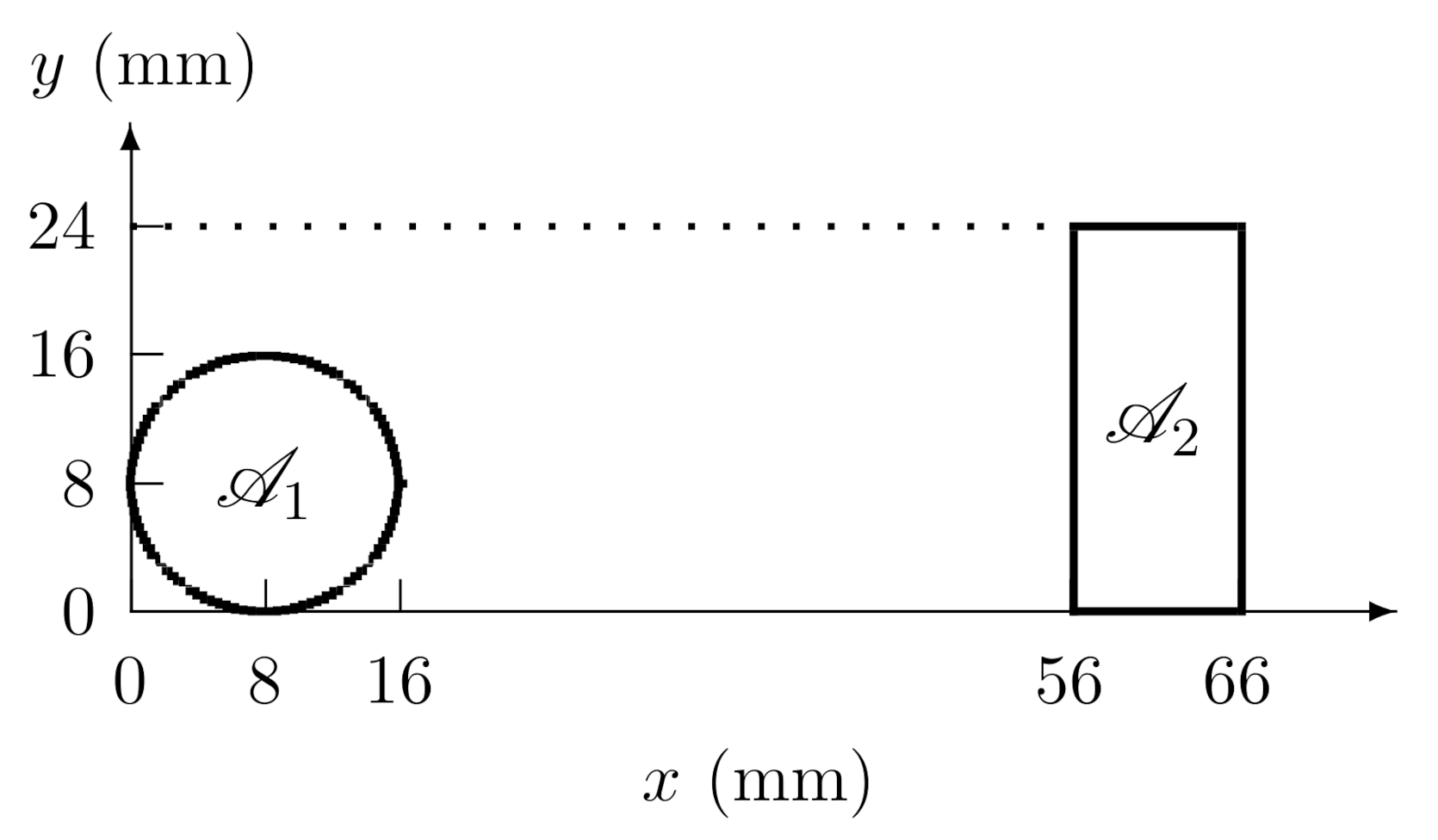
Figure 1 gives an example of the cross sections of the conductors
and
in the plane
, the cross sections are denoted by the same symbols as the conductors. The resistivity of the conductors is a function of
x and
y,
. The voltage source the conductors are connected to produces a potential
between the conductors, while the cross section of each conductor is an equipotential area. When calculating the current density, the voltage
, where
, is assumed to be specified. The current
in the loop is the flux of current density vector
through the cross section of one of the loop conductors.
is the only non-zero component of
.
2. Calculation of Current Density and Current in Conductors
The essence of the method for calculating current density as published in [
1] consists in the conductors being replaced by the partial conductors
. The symbol ∀ means that the quantity after it takes the values
successively. The cross section of each partial conductor
is also denoted by the symbol
. Each cross section
, can be replaced with arbitrary precision by the union
of identical disjunct rectangles that have been formed using the net of parallel lines
where
are integers and
and
are the chosen lengths of the rectangle sides. The rectangles of the net, which are subsets in
, are the cross sections of the partial conductors
.
if
, where
is the centre of the rectangle
. The partial conductors
, which form
and
, must be numbered such that the graph with
N vertices
and
edges is a path graph [
1,
8]. It is assumed that, in the partial conductor
, there is a constant resistivity
and that the current density
does not depend on
x and
y.
According to Coufal [
1], the current densities
, in conductors
and
are a solution to the system of
ordinary differential equations
and one algebraic equation
The differentiation of a function with respect to time
t is denoted by a dot over the symbol of the function. The coefficients
do not depend on
t, and their calculation is described in the Appendix of [
9].
is the contribution of the
kth partial conductor to the magnetic flux through the segment (between the planes
and
) of the loop formed by partial conductors
and
. The value of the coefficient
on the right-hand side of Equation (
1) is given by the relation
Prior to the numerical solution to the system formed by Equations (
1) and (
2), Equation (
2) is substituted by the equation
The system of Equations (
1) and (
4) can after rearrangement be replaced by a single equation
where the matrix
is of the type
, on whose first
rows are the fluxes
, while on the
Nth row are ones (coefficients on the left-hand side of Equation (
4));
; the matrices
,
and
are of the type
.
;
for
.
,
is defined by relation (
3) for
,
. Multiplying Equation (
5) by the inverse matrix
from the left yields the equation
The matrices
and
are of the type
. The rows of the matrix
are linear combinations of the current densities
. The elements of matrix
are numbers. Equation (
6) is a linear inhomogeneous system of ordinary differential equations with constant coefficients. According to Rektorys and Vitasek [
10], there is just one solution
to Equation (
6) in the interval
that satisfies the initial conditions
The results given below for the solution to Equation (
6) were obtained using the Runge–Kutta method [
10,
11,
12]. Equation (
6) can be written in the form
If
, is the current density in the
ith partial conductor at time
t, then
is the current density in the
ith partial conductor at time
, where
h is the integration step,
All the values of transient current
given below were calculated using the transient current density in the conductor
The current in the conductor is .
3. Results and Discussion
3.1. Example 1
The cross sections of the conductors forming the long loop are illustrated in
Figure 1. The temperature of the conductors is 300 K, both conductors are of copper and their resistivity
m [
13]. At time
, the conductors are connected to the sinusoidal voltage source
,
V·m
, the frequency
and the period
.
This example is for
kHz, the same as in [
2], Variant 4; however, in Figure 6 in [
2], the results of the calculation of current density in conductors are only given for the steady state, i.e., for
.
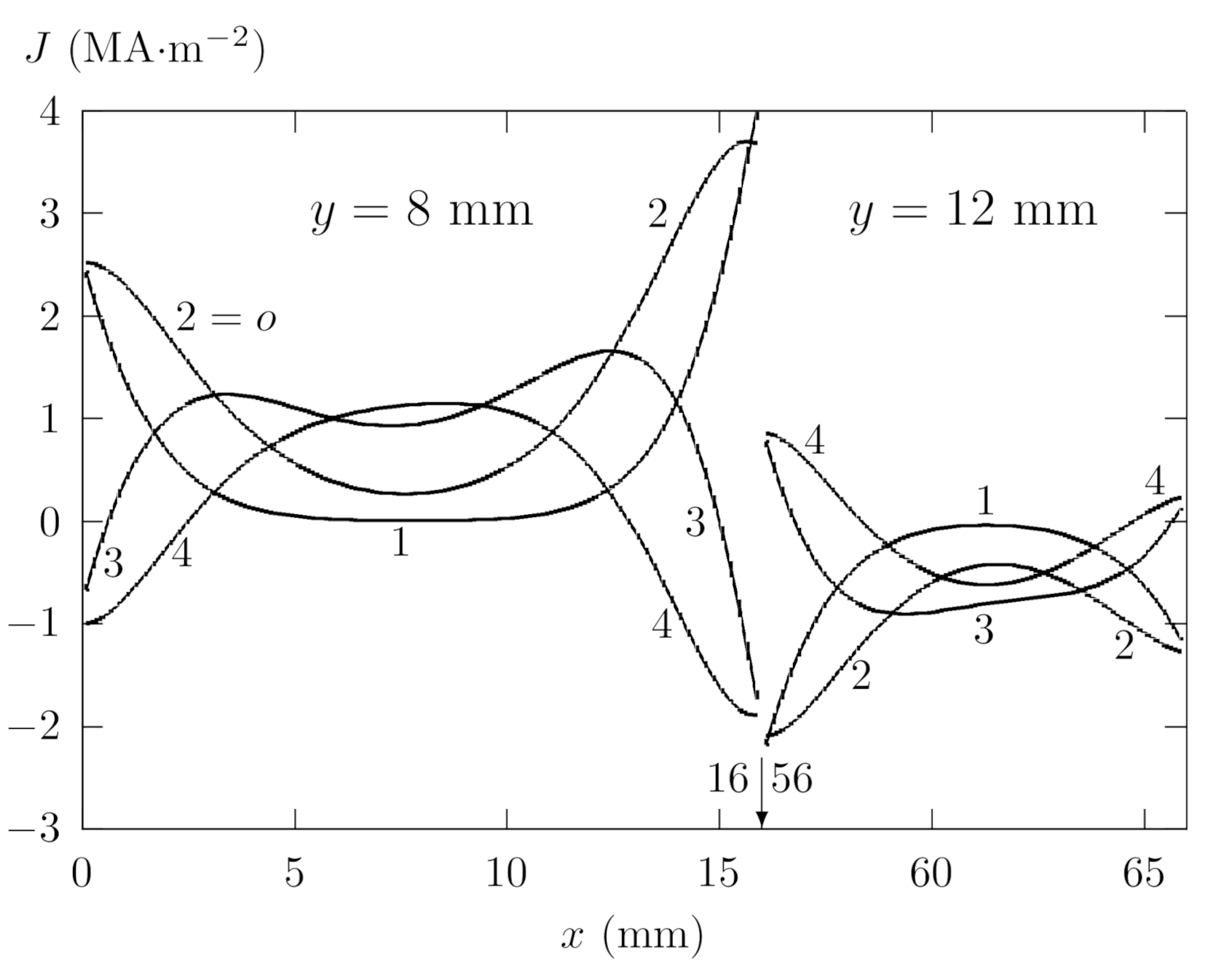
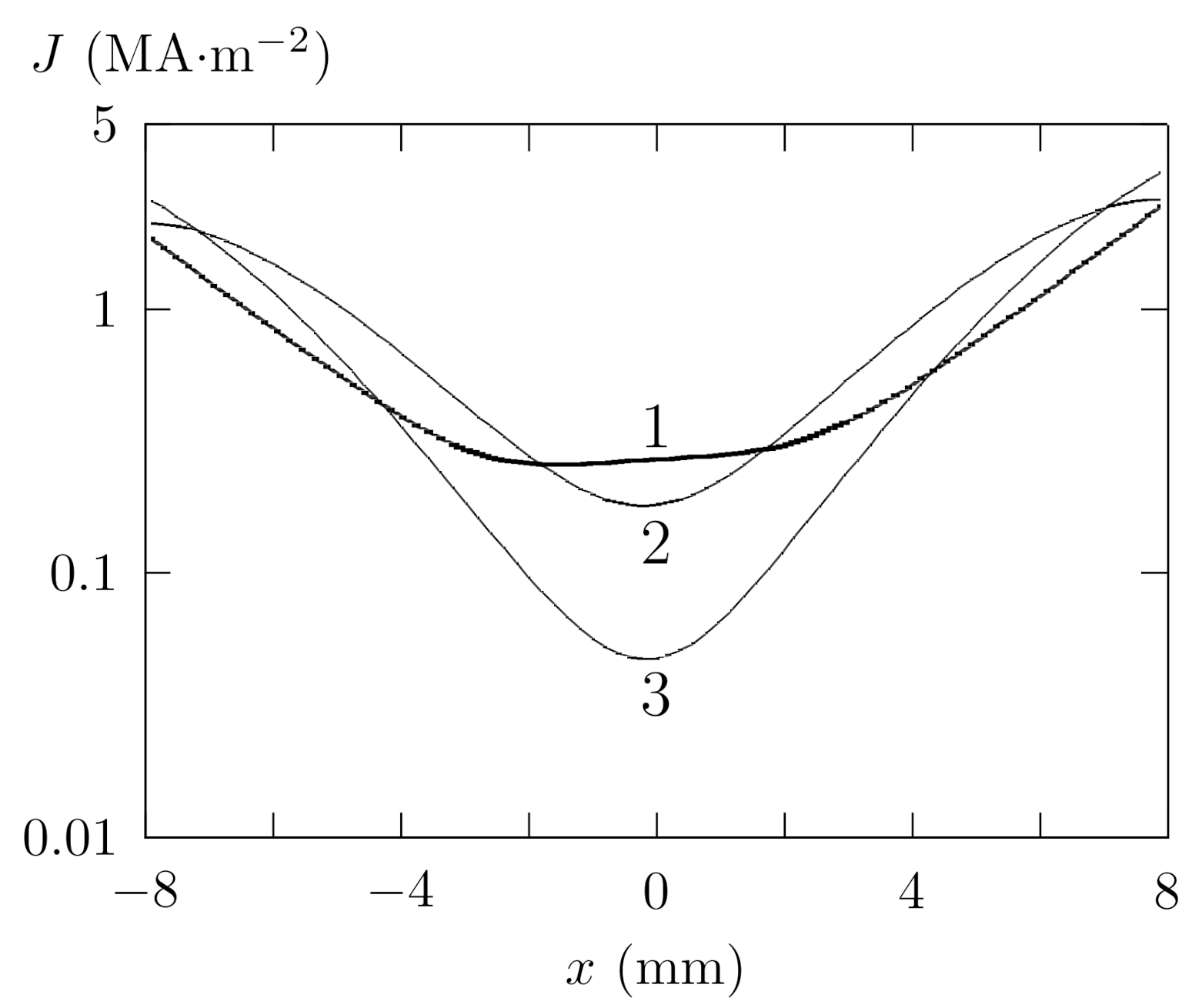
Figure 2 illustrates the dependences of current density on
x and
t for a constant
y in the conductors
and
.
The calculation of transient current density provides a large amount of data that can be displayed in a similar way to
Figure 2. For example, the maximum value of
is equal to
MA·m
in the partial conductor that is down on the left in the conductor
, in the interval
at time
s, for
kHz.
The current densities
, are non-periodic oscillating functions that with increasing
t converge to periodic functions. For
, it can be assumed that for the sinusoidal voltage source
and the cosinusoidal voltage source
the current density in the
ith partial conductor is
and
respectively. Substituting the assumed solutions to (
8) and (
9) into (
1) and (
4) yields the first and second equation systems, respectively. The two systems form a system of
equations for
N unknown amplitudes
and
N unknown initial phases
. Probably the simplest way of finding a solution to the two systems is to multiply the first system by the imaginary unit j and add the second system of equations. This after adjustment yields a system of
N equations for the complex current densities
. Solving this system gives current density phasors in the partial conductors, as stated in [
1].
With increasing
t, the transient current converges to the steady sinusoidal current
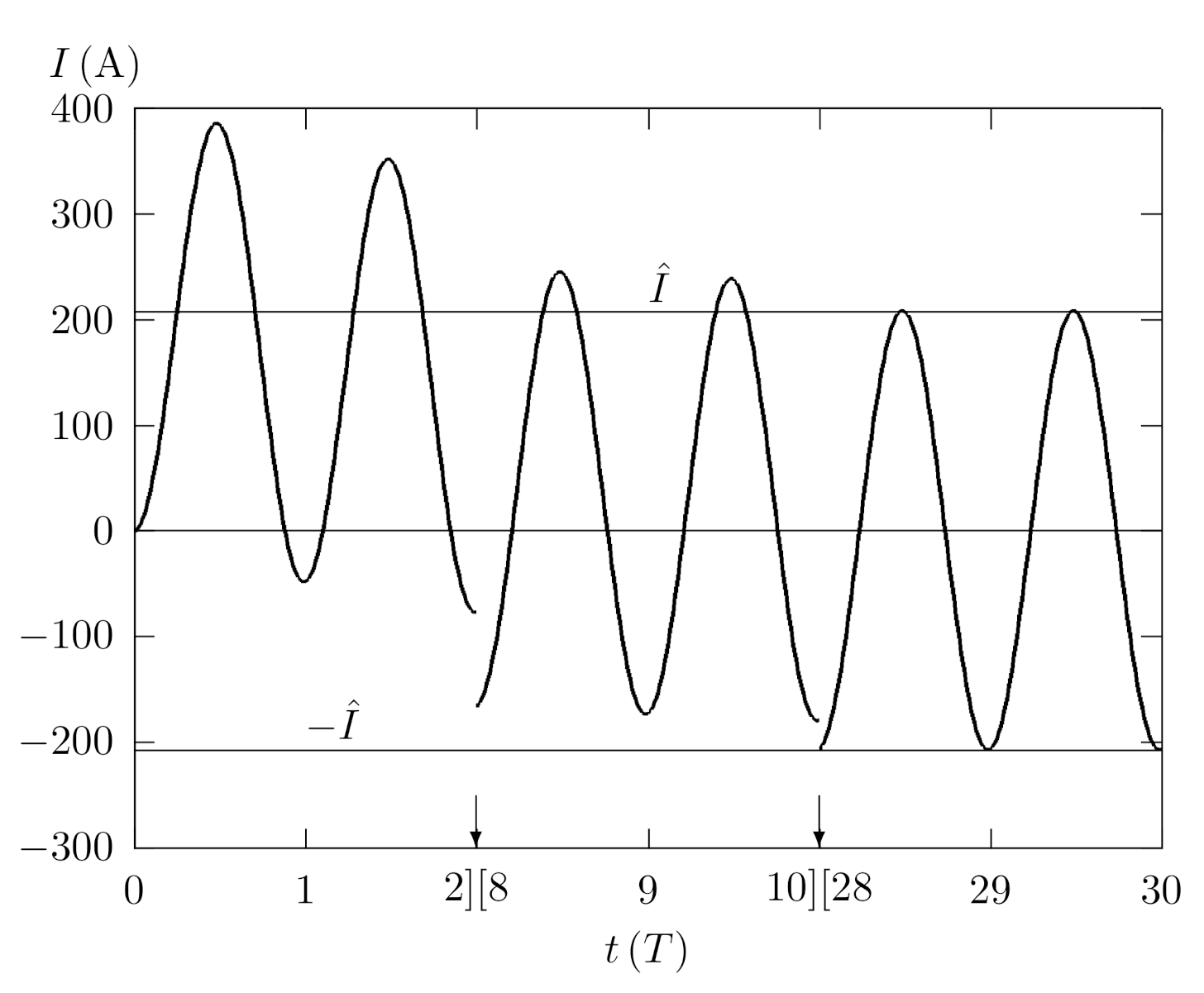
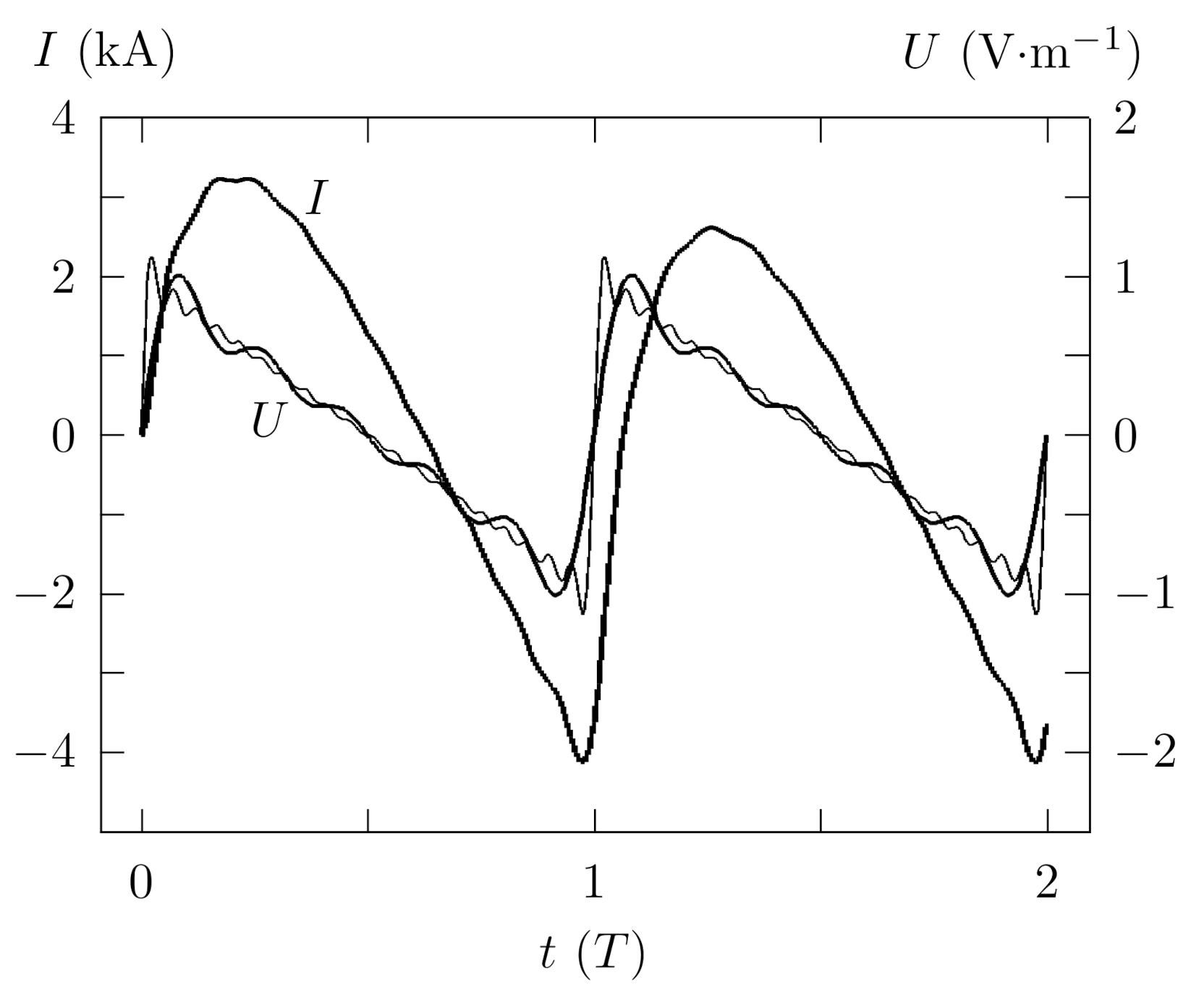
Figure 3 illustrates the current
in three time intervals.
Theoretically speaking, the steady state is achieved after an infinitely long time. In practice, the steady state is reached at time
, where
is determined using the chosen value of the deviation
.
is such a least time that for
it holds
where
is the value of the current at the local maximum or minimum. In Example 1 (
kHz), it holds
for
. For
in Example 1, it holds
s for
Hz. The time
depends substantially on the initial phase
of the voltage source at time
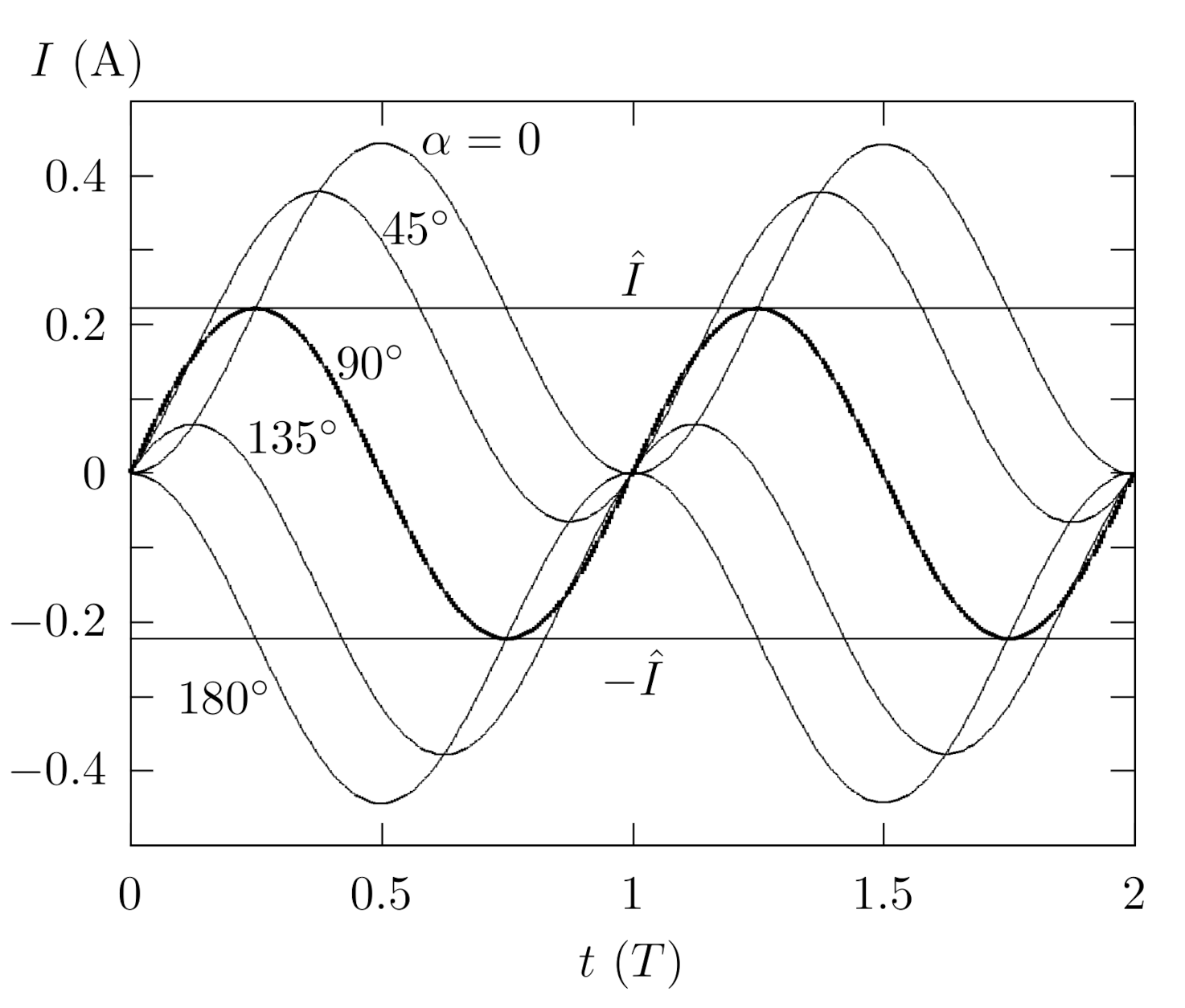
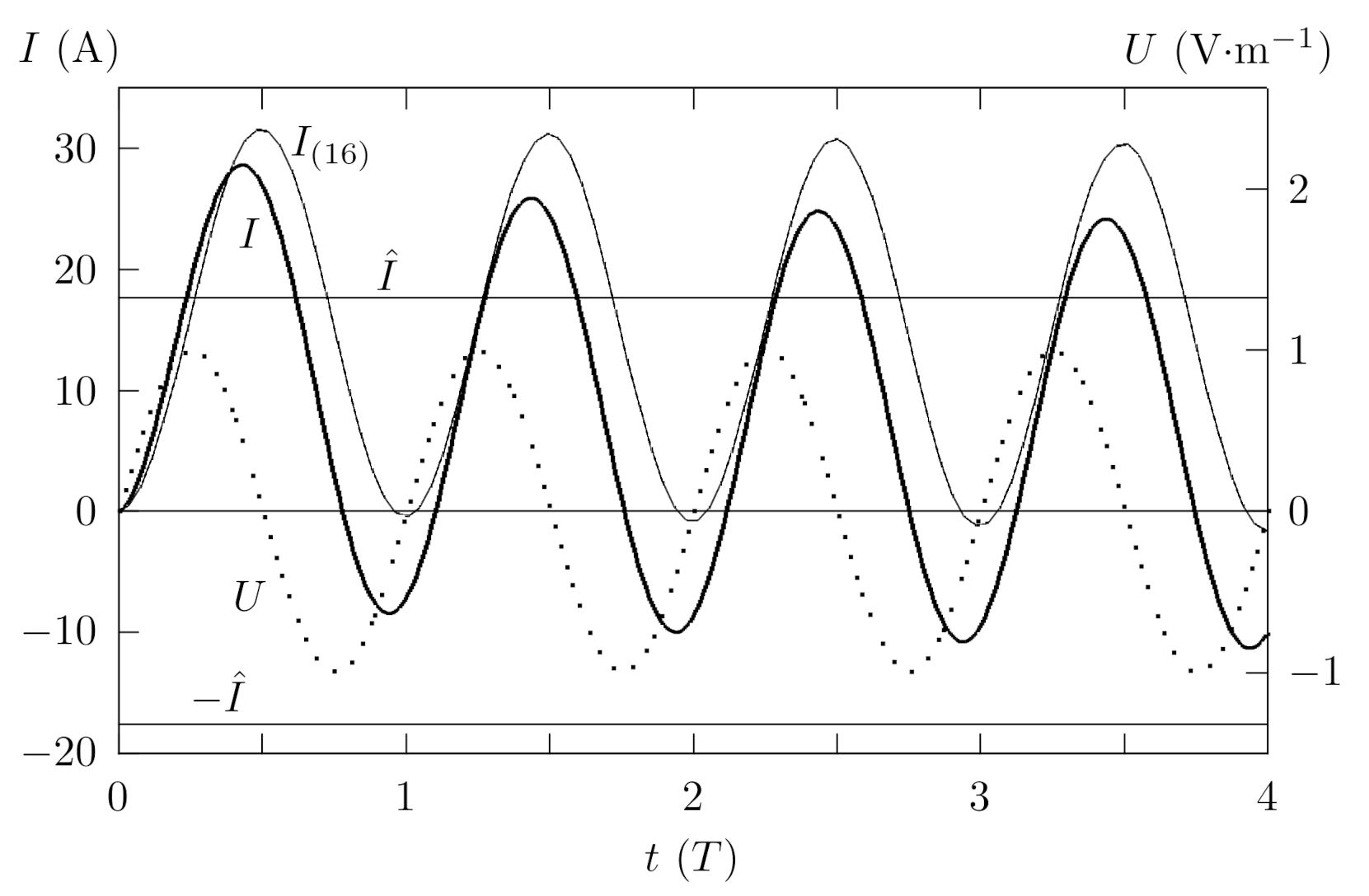
. In
Figure 4, the function
is illustrated for several values
in Example 1 for
MHz. It can be seen in
Figure 4 that the steady state is achieved at the instant
for
. The value
depends on
f. For example, for
Hz,
.
3.2. Example 2
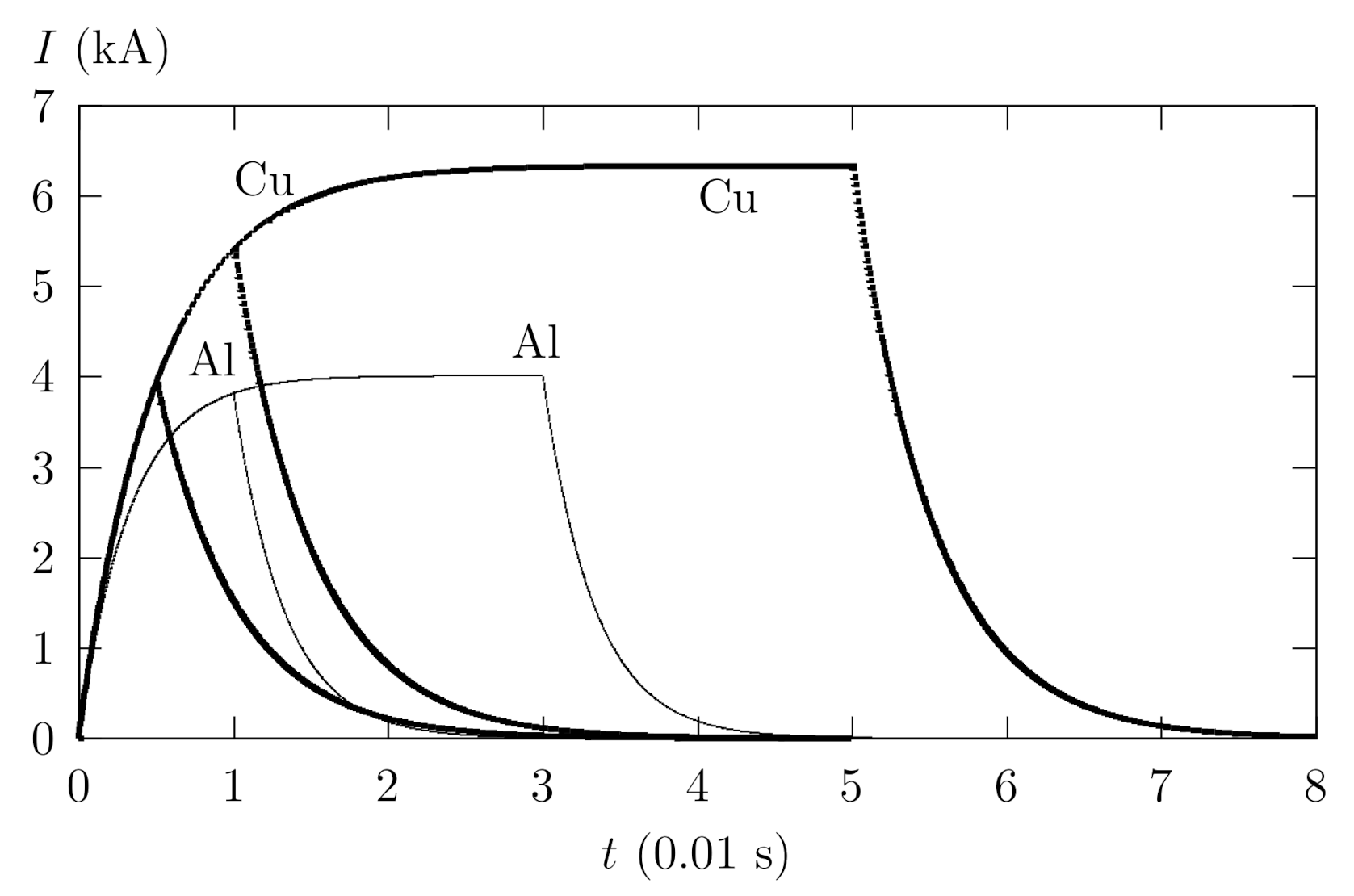
The conductors are the same as in Example 1, but, in contrast to Example 1, they are connected to the constant voltage source V·m at time . The voltage source is being short-circuited at time .
Figure 5 illustrates the function
when the voltage source is being connected and later short-circuited. The graph of the function
has two parts. The first is for
increasing while the second part is decreasing in the interval
.
If
Figure 5 is redrawn in semilogarithmic coordinates, then the second part of the graph of the function
is a straight line. This means that
is a linear function of
t and that the slope
is constant. It follows from the results in
Figure 5 that with increasing conductor resistivity the time
decreases and the slope of the drop in current increases after the short-circuiting of the voltage source.
It would undoubtedly be interesting to investigate the disconnection of the source. However, solving such a problem is beyond the scope of the article. Source disconnection is realised using a switch, in which an electric arc is excited between the switch contacts. To calculate transient current density and transient current when disconnecting the source, it is necessary to replace the source by a physical and mathematical model of the concrete switch.
3.3. Example 3
The cross section of the two conductors is a circle with the radius mm. The cross sections and have their centres at points and , respectively, . Both conductors are of copper and they are connected to a sinusoidal voltage source at time , the same as in Example 1.
The solution to Example 3 allows extending and complementing the results of solving Example 1. With the sinusoidal source connected, the main effect of the transient state is an increase in the maximum value of the current density
and in the maximum value of the current
with respect to the steady state. The maximum values
and
are obtained during the first period
T. The amplitude of the steady current density attains the maximum
at the point
. The point at which the transient current density attains the value
is on the surface of the conductor
(and at the symmetrical point on the surface of the conductor
) and its position depends on
d and
f. The instant at which
is attained differs from the instant at which
is attained (see
Figure 6).
Table 1 gives the values
and
in dependences on
f,
d and
. The resistivity of Al conductors is
m [
13]. Alloy conductors are of an alloy of 75 mass% Cu + 25 mass% Al,
m [
13].
The transient current
can be considered steady for
. The instant
is determined by Formula (
10) and depends on the chosen value
, the distance
d of the axes of conductor cross sections, the voltage source frequency
and the conductor resistivity.
Table 2 gives the values of
for several values of
and
d. The conductors in Example 3 are of copper and the respective data are given in
Table 2, with the exception of the last column, where the data given hold for aluminium conductors (
m [
13]). With increasing conductor resistivity, the time
decreases. This statement is supported by comparing the values in the penultimate and last columns of
Table 2.
3.4. Example 4
The conductors are the same as in Example 3. At time
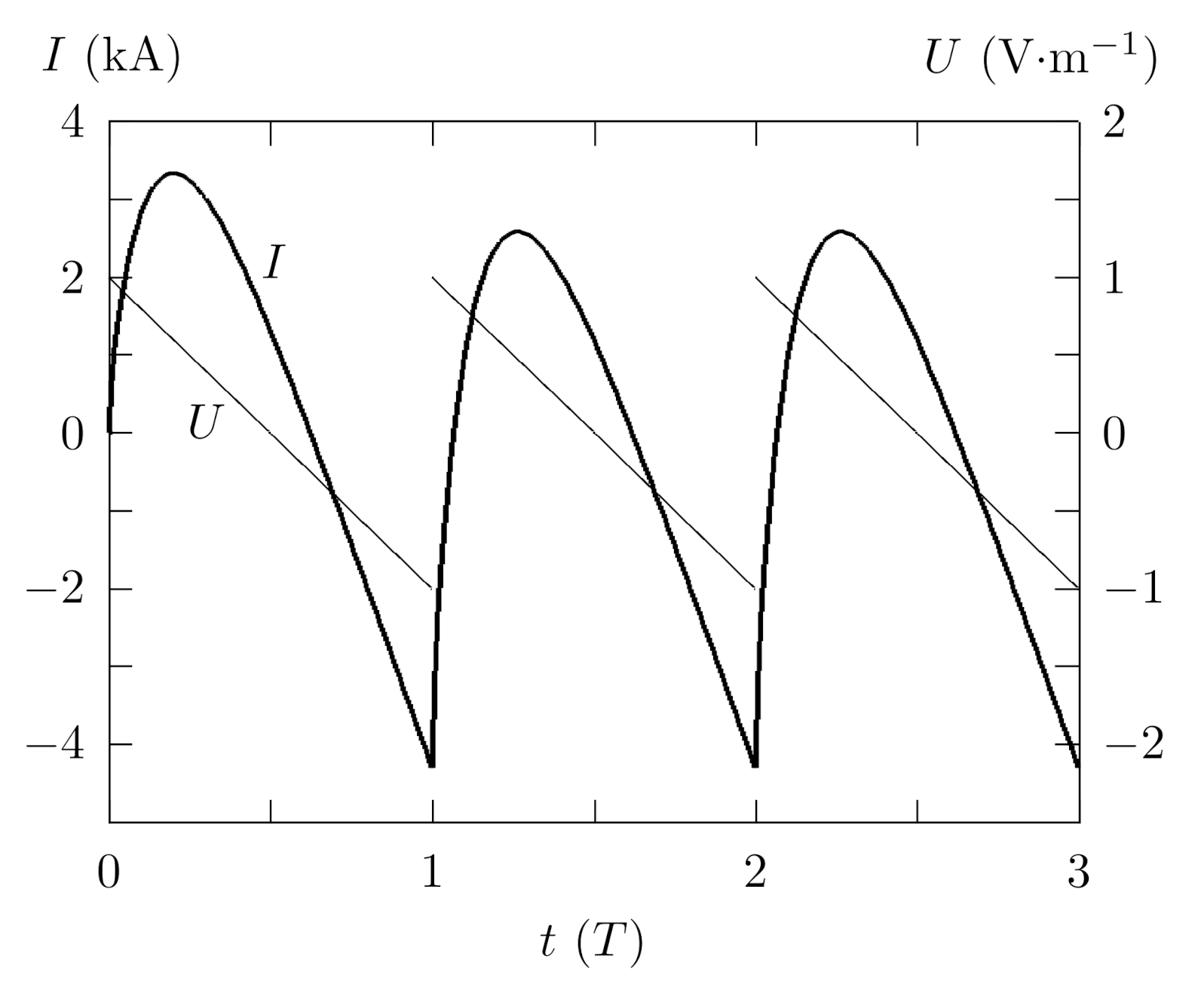
, they are connected to a source of sawtooth voltage (see
Figure 7). The voltage is periodic, in the first period
The solution to Example 4, obtained by solving Equation (
6), is given in
Figure 7. In the interval
, the current
is transient, and for
the current can be considered steady.
In the theory of circuits with lumped parameters, the non-sinusoidal voltage (thus also (
11)) is in the calculation of steady current
approximated by the first
n terms of the Fourier series [
14]. For a source voltage that is equal to the
kth harmonic,
, the current
is then calculated. The principle of superposition is used to obtain the current
An advantage of such a calculation is that it allows the use of phasors. The Fourier series can also be used in the calculation of steady current density, and thus also the steady current, in two parallel long conductors connected to a source of non-sinusoidal voltage via the method published in [
1]. When assessing the suitability of such a procedure, it is necessary to take into account that the Fourier expansion is an infinite series while the calculation can only be performed with a finite number
n of series terms. The finite number of terms only approximates the given voltage course, which also manifests itself in the resultant current. Instead of
n repetitions of the calculation with individual harmonics, a single calculation can be done of transient current density and current with the given voltage. The transient current at time
can be considered steady.
Figure 8 gives the sawtooth voltage in Example 4 and its approximation by
n terms of the Fourier series [
14]
and the transient current calculated with the source voltage approximated by
n terms of the expansion (
12) (an accurate transient current is in
Figure 7).
3.5. Discussion
J.C. Maxwell proposed a method for the calculation of current density in a solitary conductor [
15]. Hundreds of works have since been published (more recently, e.g., [
1,
16,
17,
18,
19,
20,
21,
22,
23,
24]) that deal with the calculation of current density in one or two conductors, and exceptionally in more conductors. The calculation of current density in one conductor is accurate, but it can only be applied to the solitary conductor connected to the ideal current source, which, however, cannot be implemented [
1]. The published methods, with the exception of those in [
1,
3,
24], are approximate, with the current density error unknown. The self-inductance of two conductors cannot be calculated without accurate current density [
2] and thus approximate formulae continue to be used for the calculation of self-inductance of two coaxial conductors and two circular cross section conductors [
2]. According to these formulae, inductance does not depend on conductor resistivity and voltage source frequency, in contrast to the inductance calculated using accurate current density.
The subject of the present article is transient current in two solid long parallel conductors (conductors in the following) connected to the voltage source. A definite contribution of the article is that current is determined using transient current density. In the article, a numerical method is proposed and used for solving a system of differential equations for the calculation of transient current density. The present method of calculating transient current, not only in the conductors considered in the present article, consists in calculating transient current in the circuit
with lumped elements, which is a series connection of a resistor (with resistance
R), an inductor (with inductance
L) and a voltage source (with voltage
U). For the circuit
, Kirchhoff’s voltage law holds
Dividing both sides in (
13) by
L gives the equation
which is an ordinary linear inhomogeneous differential equation. According to Rektorys and Vitasek [
10], there exists just one solution
to Equation (
14) in the interval
that satisfies the given initial condition
where the constant
C is determined by the initial condition.
For the source of sinusoidal voltage
, the transient current is
For the initial condition
, it holds that
Let us consider the Al conductors
and
at a temperature of 300 K,
m [
13]. The cross section of the two conductors is a circle the radius
mm. The cross sections
and
have their centres at points
and
, respectively,
. At the instant
, the conductors are connected to the source of sinusoidal voltage
,
V·m
,
Hz. The inductance
L of the conductor pair can be established using the formula [
2,
15]
According to this formula,
H·m
.
Figure 9 illustrates the voltage
, the transient current
calculated using formula (
16) and the transient current
calculated by the method proposed in the present article for
. As mentioned above, the value of
is not accurate. If the accurate value
H·m
, determined as in [
2], were used in (
16), the difference between the transient currents would be even greater than in
Figure 9.
4. Conclusions
Two long parallel conductors with the voltage source form a long loop. A method for calculating current density in a group of long parallel conductors has recently been published [
1]. This method was derived rigorously from knowledge whose validity cannot be doubted. The derivation of the method is based, in the first place, on Faraday’s law of electromagnetic induction and is an application of the Biot and Savart law, loop current method, Kirchhoff’s voltage law, Ohm’s law, the Jordan measure theory and graph theory. The essence of the method consists in the conductors being replaced by partial conductors of rectangular cross section and constant current density. The partial conductors form partial loops. One metre of each partial loop is replaced by a series resistor-inductor circuit. The interaction of partial loops through magnetic field is considered. To calculate current density in the partial conductors, it is not necessary to specify the inductances of inductors in the partial loops. The transient current in the loop is at each instant equal to the flux of transient current densities in all the partial loops.
The method described in [
1] is extended to a form suitable for numerical calculation of transient current density. The possibilities of the proposed method are demonstrated by solving illustrative examples. The method is used for an accurate calculation of transient current using transient current density. The transient current is analysed when connecting and short-circuiting the sources of sinusoidal, constant and sawtooth voltages. For circular cross section conductors, the dependences of maximum current density, maximum current and the time of achieving steady state on the source frequency, the distance of the conductors and their resistivity when connecting the source of sinusoidal voltage are examined.