Abstract
Saint John’s Baptistery in Florence (Italy), dating back to the XI century, represents one of the most outstanding historical buildings in the city, and has been under the UNESCO patronage as Cultural Heritage since 1982. In recent years, in the frame of a conservation project, detailed studies and mapping of all the tiles covering the Baptistery have been developed. Based on a laser-scan survey, a detailed wireframe model of all the external sides, reporting all the tiles and decor, has been developed. This model was implemented into a 2D-GIS, georeferenced in real scale and spatial position. An in situ survey of all the tiles, ashlars, inlays and columns, made in contradiction by experts in historical ornamental stones, allowed the recognition of several types of marble in place. All these marbles have been analyzed and characterized as geometric, geological and historical data, and the information implemented into a GIS for obtaining a spatial geodatabase representing a “box” to store all information achieved. All these data are manageable by web through smartphone, tablet and PC for querying or updating, thus representing an effective management tool for further conservation of such important historical cultural buildings.
1. Introduction
The Saint John Baptistery in Florence (Italy) represents one of the most outstanding historical buildings in the city and is under the UNESCO patronage as a Cultural Heritage building since 1982. The Baptistery, erected onto Roman and Early Medieval ruins by the wish of the people of Florence, was finished in the XI century [1,2,3,4]. In the early XIII century, the apse was changed from circular to square; the roof was renewed in the XV century. The whole Baptistery is cladded in white and dark green marbles according to the Tuscan Dichromic. Its maintenance is managed by the Opera del Duomo (OPA), a private institution established in 1296 by the people of Florence with the mission to take care of the building. Since 1296, the OPA has provided the management, maintenance and conservation of the Baptistery.
The Saint John Baptistery was built as a holy place for the Catholic Christian religion to be used for baptisms and religious functions. These uses and functions have been active since its consecration and in the last 30 years, it has also become a site for touristic visits, numbering about 3000 people a day. In 2013, the OPA launched a series of integrated multidisciplinary research and studies for updating historical and scientific knowledge, executing well-addressed conservation works and creating a digital archive and a georeferenced system for managing the maintenance of the Baptistery.
This research has been developed in this frame, with the aim to map all the single ashlars, quoins, columns, tiles, inlays, and columns of the external cladding and implement all these data into a 2D content model (GIS) to be used as a tool for managing all the available data and planning future conservation work.
This approach has now passed the research stage and is becoming more and more compulsory for the digital upgrade of the management of cultural heritage conservation [5,6].
2. Materials and Methods
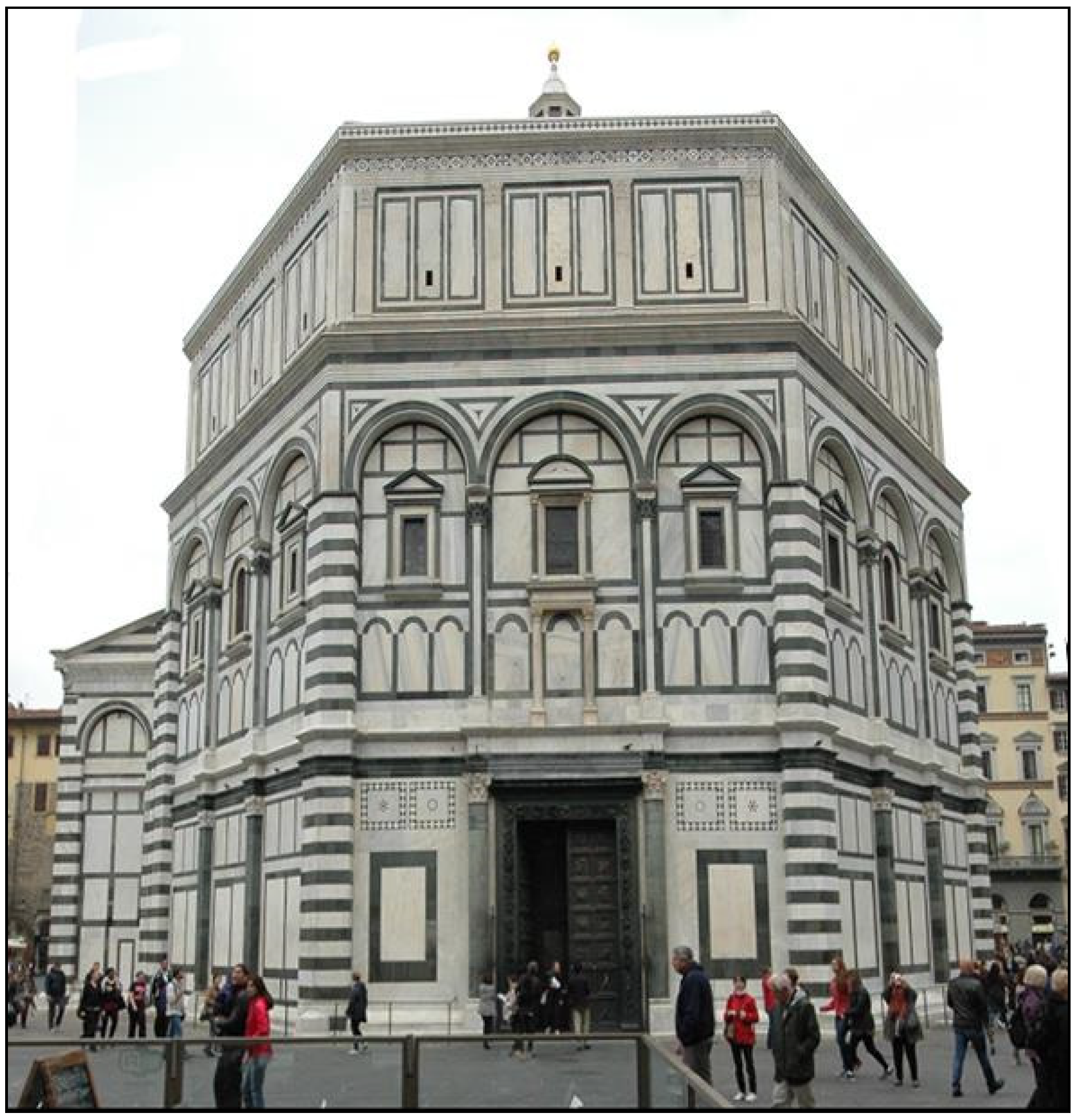
Since its construction in the XI century, the Saint John Baptistery is entirely covered by marbles, put in place in a squared manner alternating white and dark marbles according to the Tuscan Dichromic (Figure 1).
Figure 1.
Saint John Baptistery in Florence (Italy), south façade cladded in white and dark marble according to the Tuscan Dichromic.
Therefore, the main goal for this study was a complete mapping of the marbles cladding of the Saint John Baptistery.
The first step of the job was a full laser-scan survey of the building. This is the base to obtain a CAD wireframe of the façades in 1:1 scale, which, in turn, was imported into a GIS, georeferenced in the real space as datum and relative dimensions.
The second stage of the work consisted of determining the type of marble of all the single stone elements of the cladding: ashlars, quoins, columns, tiles, inlays and columns, which total 22,723.
Three different types of approach for determining the type of stone material can be used [7]; an attribution is reliable if more approaches point towards the same attribution:
- Document analysis: carried out on commercial and historical text archives that show orders, origin and types of stone materials.
- Technical analysis: petrographic, mineralogical, geochemical, and isotopic analyses allowing the sample analyzed to be attributed to a lithotype on the basis of existing databases.
- Organoleptic analysis: carried out by experts on the basis of their knowledge and regarding stone grain-size, texture and warp.
In order to collect all the survey data in a content that can allow for easy management of all the acquired information and for furnishing a tool for planning and recording future conservation work, all the data have been implemented into a 2D-GIS of the façades [6,8,9].
To share the stored data, we developed an App (LastraSurvey) usable on site via web by smartphone, tablet and PC.
3. Results
3.1. Document Analysis
In the case of the Saint John Baptistery, in the archives of the OPA and in the literature, very little news regards the types of marble used for the cladding. Data are available for the conservation works of the early 1990s, for those of the years 1939–1944 [10,11], and, in general, for purchasing white marble from Carrara and dark marble from Prato, the classic Carrara Marble and Verde Prato, respectively, in the XVI to XIX centuries, for substitution of deteriorated tiles (Table 1).
Table 1.
Documented substitutions for the cladding stone elements of the Baptistery.
3.2. Technical Analysis
For technical analysis, the need for samples largely reduces the applicability of this approach. By the permission of the Superintendence, which has in charge of the protection of the cultural heritage buildings, it was possible to collect only 21 samples [7] (Table 2).
Table 2.
Results from the 21 technical analyses performed on the cladding tiles of the Baptistery.
3.3. Organoleptic Analysis
A direct survey of each stone element was made in contradiction by experts of historical ornamental stones, working on the scaffolding in place for the conservation work.
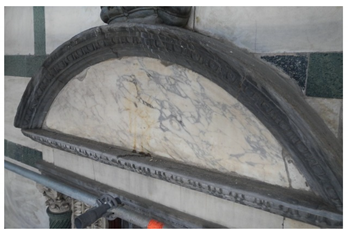
This job allowed the recognition of the types of marble for each one of the 22,723 tiles constituting the external cladding of the Saint John Baptistery (Table 3).
Table 3.
Types of marble in place on the external cladding of the Baptistery.
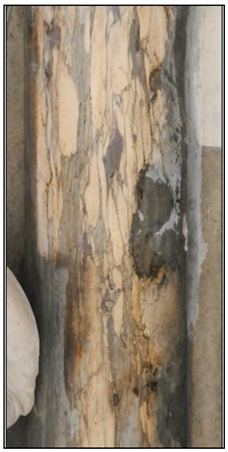
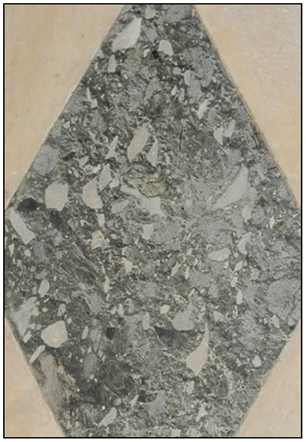
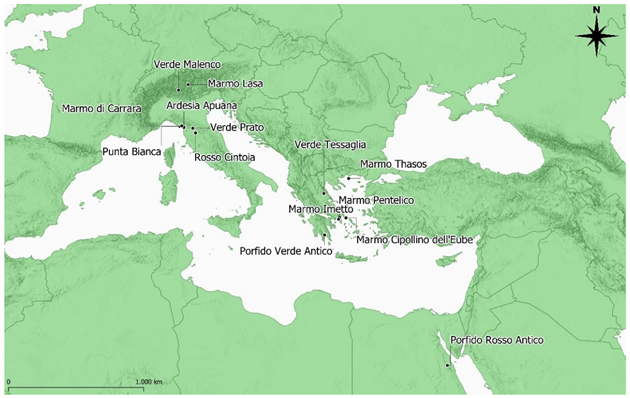
Of course, most of the white marble is from Carrara (Carrara Marble, Punta Bianca Marble). Many tiles are Greek marble (Hymettus, Pentelicum, Cipollino Rubrio from Eubea, Thassos). Trading from Greece was not possible during the X–XI centuries but in those times, Florence conquered and spoiled the near Fiesole, which had been enriched with Greek marble by the Roman Emperors, Claudio and Hadrian. Therefore, we think that those marbles came from spolia of the Fiesole Roman Theatre, Capitolium and Thermae. A few others came from spolia of Roman ruins in Florence or Fiesole (Porfido Verde Antico, Porfido Rosso Antico, Breccia Greca Antica, Syenite).
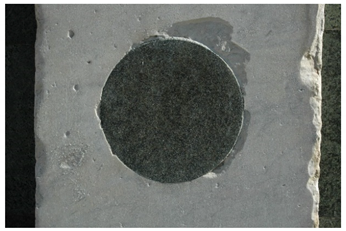
Other marbles are new local stone material from the surroundings of Florence (Verde Prato, Rosso Cintoia, Apuan slate), or recent substitutions (Lasa Marble, Verde Malenco) due to the lack of original marbles (Hymettus, Verde Prato).
Details for each one of the marble types are reported in Appendix A.
3.4. GIS Implementation
The choice of using a Geographic Information System (GIS) applied for the preservation of Cultural Heritage [6,12,13,14,15], and in this case, for the management of the state of knowledge on the external cladding of the Baptistery of San Giovanni, lies above all in the extreme versatility of the GIS platform (ArcMap®ESRI) for the representation and analysis of geometries oriented in space at any scale.
Secondly, this technology gives the possibility of updating and implementing the database that is being built in various stages of development of the activity.
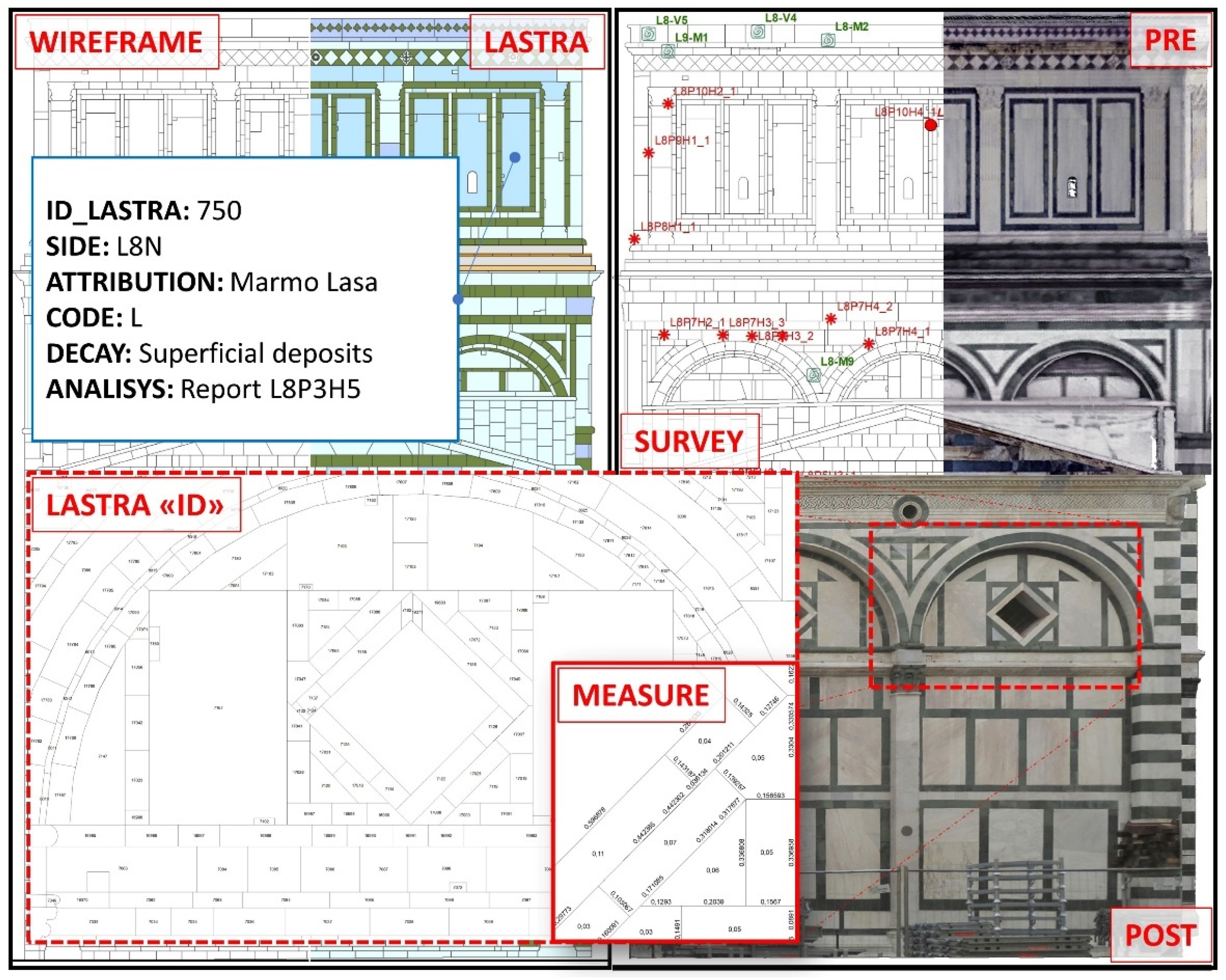
The available data, especially in relation to the complexity and importance of the monument and the conservation actions carried out over the centuries, were very heterogeneous, numerous and characterized by different management and organization methods, formats and codes (PDF, raster, CAD). These documents, even in digital formats, are, in any case, functional to the creation and issue of a paper product or an analysis sheet. Moreover, digital drawings did not have, for example, topological rules or extended information associated with the mere drawing. All the CAD drawings often presented the origins in plane coordinates xy with the x placed at an arbitrary value and the y corresponding to the height relative to the base of the drawing. For this purpose, we take the arbitrary x origin and the y is considered as z, resembling the real height of the monument. Many of the diagnostic and cognitive data were provided with a reference to the scaffolding grid in place at the time of the restoration (Figure 2).
Figure 2.
Composition showing the possibilities of extracting information from the database within a GIS system: Wireframe view, coatings selection (LASTRA), showing ID_LASTRA, SIDE, STTRIBUTION LITHOLOGY, CODE, DECAY, and the existence of a laboratory analysis. From the system, it is also possible to view the dimensions of each single element and the photo planes.
The storage capacity guarantees simple recovery and unitary management of a large amount of data of different nature. The realized system is easy to use and allows for consultation and updating of the database.
Its main use is for visualization through the simple combination of various information levels, or for creating print layouts, consultation and querying of the unified database complete with accessory files as well as graphic ones (laboratory test results, various reports, photographic documentation of details, etc.).
In the transposition into GIS objects [16], geometries were modeled and aimed at achieving a correspondence to the reality present in situ (compilation of attributes, closure of polygons, subdivision of the different elements on distinct layers, decomposition into simple primitives of complex objects such as inlays).
The concept of a geographical reference system [17] in GIS was forced, rotating the plane and using a system composed of plane coordinates xz, with the x set to an arbitrary zero and the z considered as the effective altitude above the sea level generated by the rotation of a normal Cartesian xy plane, where the values of the relevant z component are actually reproduced on y.
All the data were located and digitized at the nominal scale of 1:10, to obtain a graphic error estimated at 0.2/0.3 cm. This value guarantees a high level of precision and accuracy in the measurements that can be carried out in the project and allows high overall quality standards as well as maintaining low tolerance levels in topological checks. Operatively, the tile is the single stone element that constitutes the marble cladding; each one has been identified and its “history” has been reconstructed—any maintenance, cleaning or restoration interventions, problems relating to decay, etc.
As part of the conservation process, it is very important not to lose the historical memory of all the cognitive data collected in the various phases, in order to also keep track of the interventions carried out from time to time and to have all the data actually existing on the monument.
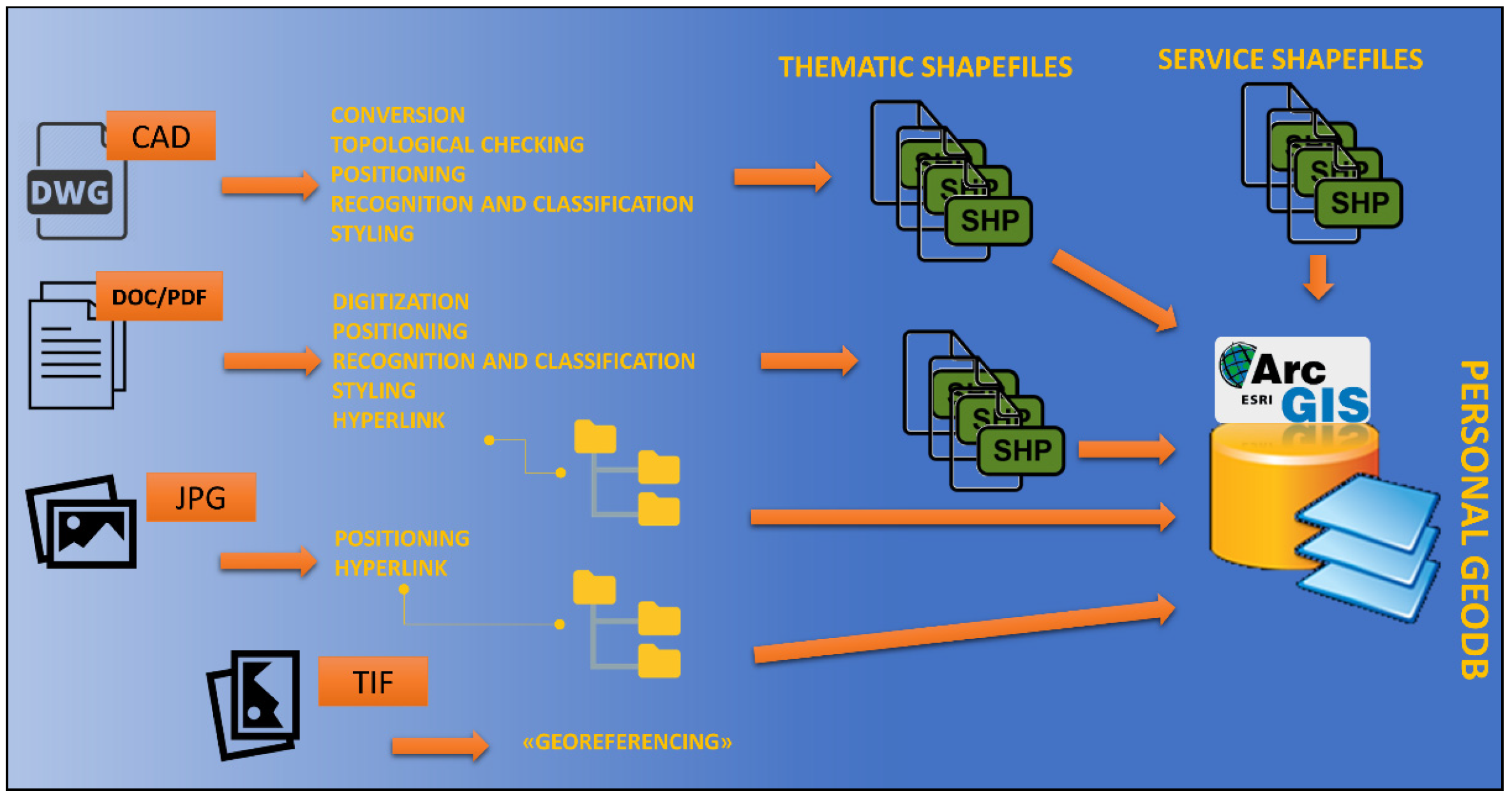
The GIS implementation (Figure 3) has been addressed to permit:
Figure 3.
Conceptual scheme of the database implemented within a personal geodatabase.
- Unitary management of different data for themes, characteristics and forms;
- Management of historical data and information, without having to resort to the examination of paper sources;
- Univocal data storage, thus avoiding errors connected to non-unique encodings or data processing carried out by different operators;
- Ease and speed of simultaneous and integrated consultation of a large amount of data, their functional query to the needs and their comparison (Figure 3);
- Possibility of customization according to specific graphic and document query needs;
- Possibility of elaboration, updating and further implementation in the phases following the design phase;
- Integration of data with results deriving from the monitoring phase.
3.5. The LastraSurvey Web App
As part of the project, a web app (LastraSurvey) was created with the aim of providing a cross-platform mobile tool for updating the database implemented within the GIS system. In particular, a tool was created for the direct on place surveying of some considerations and/or criticalities that emerge during operational inspections.
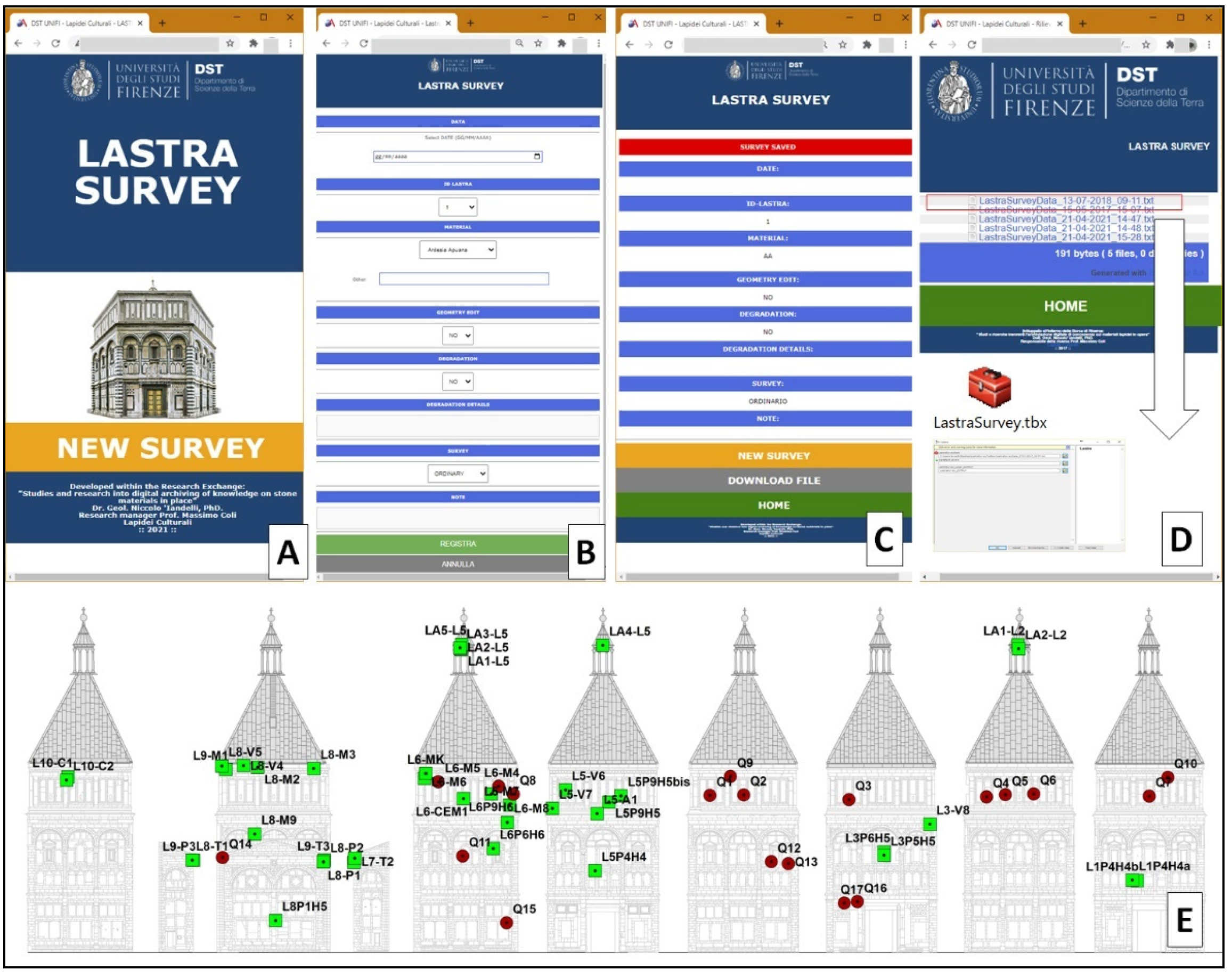
The LastraSurvey is a web application that can be reached via URL on any platform (smartphone, tablet, PC) (Figure 4). The LastraSurvey was developed using web technologies (HTML and PHP) and can be installed on any web space. The survey, which is carried out in situ with the web app, allows one to report points and changes to be made on the database (geometric or attribution changes, etc.).
Figure 4.
LastraSurvey: (A) Home page; (B) Data entry page; (C) Summary page of the survey; (D) Survey Download Page and LastraSurvey Toolbox interface to conversion and styling; (E) Mapped reports.
The survey is then exported and imported into the GIS system through a specially created specific toolbox, which allows one to view the points detected so that the operator can proceed with the modification and updating.
4. Discussion
This paper has addressed the reconnaissance of the type of marble constituting the external cladding of the Saint John Baptistery in Florence (Italy); the study has outlined several items, some of which were previously unknown:
- White marble slabs are about 7 cm thick, which corresponds to a Roman palmo (7.4 cm), and are fixed to the masonry behind by iron clamps.
- Verde Prato is always as quoins about 15–20 cm deep and mortared into the masonry due to its intense micro-fracturing, which does not allow it to be cut into slabs.
- Most of the original with marble is from spolia of Roman monuments, while all the others are from Carrara.
- The concomitance of large restoration works with many tiles’ substitution in the Second World War resulted in the forced use of Lasa Marble from northern Italy, instead of the original Hymettus Marble from Greece.
- It has been possible to define the provenance and the exploitation history of all the marble.
The implementation of all the survey data into a GIS allowed the development of a managing tool for planning future conservation work of the monument, which is highly appreciated by the Opera del Duomo staff.
5. Conclusions
The study of the materials constituting the marble cladding of the Baptistery has highlighted the presence of ornamental stone materials of various origins; most of them can be related to the reuse of spolia of materials in opera in Roman times in Fiesole, an Etruscan-Roman town close to Florence.
The Baptistery is, therefore, confirmed as a stone casket full of history and stories of the stones used for its cladding.
The GIS implementation of all the surveyed and collected archive data allows a single and univocal management of the entire amount of existing data in a relational, dynamic, updatable, immediately available, and interrogable way by the operators engaged in the six-monthly inspections of the monuments of the Opera, optimizing the phases that lead to the identification of priorities for scheduled maintenance interventions.
For this purpose, a specific and user-friendly web app (LastraSurvey) has been developed and is now in use for conservation planning and management.
Author Contributions
Conceptualization, M.C.; methodology, M.C.; CAD, B.A. and A.L.C.; GIS, T.D. and N.I.; validation, M.C. and S.C.; investigation, M.C. and A.B.; resources, S.C.; data curation, A.L.C., T.D. and N.I.; writing, M.C., N.I.; writing—review and editing, A.L.C. and T.D. All authors have read and agreed to the published version of the manuscript.
Funding
This research was funded by Opera del Duomo of Florence, Italy, grant COLI16FABBRICERIAOPERADUOMO and COLI18FABBRICERIAOPERADUOMO.
Institutional Review Board Statement
Not applicable.
Informed Consent Statement
Not applicable.
Data Availability Statement
Archive and library of the Opera del Duomo of Florence (Italy).
Acknowledgments
Our acknowledgement to the Opera del Duomo who promoted and financed the research.
Conflicts of Interest
The authors declare no conflict of interest.
Appendix A
Table A1.
Marble Types and Source.
Table A1.
Marble Types and Source.
| Sites of Provenience of the Marbles in Opera on the Saint John Baptistery | |
![]() | |
Verde Prato
| ![]() |
Carrara Marble
| ![]() |
Hymettus Marble
| ![]() |
Pentelicum Marble
| ![]() |
Lasa Marble
| ![]() |
Punta Bianca Marble
| ![]() |
Thasos Marble
| ![]() |
Verde Malenco
| ![]() |
Porfido Rosso Antico
| ![]() |
Porfido Verde Antico
| ![]() |
Cipollino Rubrio from Eubea
| ![]() |
Breccia Greca Antica
| ![]() |
Apuan slate
| ![]() |
Rosso Cintoia
| ![]() |
Syenite
| ![]() |
References
- Morolli, G. L’architettura del Battistero e l’ordine antico. In Il Battistero di San Giovanni, Mirabilia Italie; Paolucci, A., Ed.; Franco Cosimo Panini: Modena, Italy, 1994; pp. 33–132. [Google Scholar]
- Cardini, M. L’ipotesi tardo antica del Battistero. In Il bel San Giovanni e Santa Maria del Fiore; Cardini, D., Ed.; Le Lettere: Firenze, Italy, 1996; pp. 62–93. [Google Scholar]
- Rocchi Coopmans de Yoldi, G. Il Battistero di San Giovanni: Lo svolgimento della fabbrica. In Santa Maria del Fiore—Piazza, Battistero, Campanile; Rocchi Coopmans de Yoldi, G., Ed.; Università Degli Studi di Firenze, Dipartimento di Architettura, Il Torchio: Firenze, Italy, 1996; pp. 27–72. [Google Scholar]
- Degl’Innocenti, P. Misurare, disegnare, conoscere: Dai rilievi del San Giovanni alle ipotesi styorico-costruttive. In Il Battistero di San Giovanni, Conoscenza, Diagnostica, Conservazione; Gurrieri, F., Ed.; Mandragora: Firenze, Italy, 2017; pp. 87–103. [Google Scholar]
- Barattin, L.; Bertozzi, S.; Moetti, E. Tecnologia GIS per la manutenzione programmata dei beni culturali. La conservazione preventiva e programmata. In Proceedings of the PCC Conference, Monza-Mantova, Italy, 5–9 May 2014; Nardini: Firenze, Italy, 2014; pp. 73–84. [Google Scholar]
- Iandelli, N.; Coli, M.; Donigaglia, T.; Ciuffreda, A.L. An Unconventional Field Mapping Application: A Complete Opensource Workflow Solution Applied to Lithological Mapping of the Coatings of Cultural Heritage. ISPRS Int. J. Geo. Inf. 2021, 10, 357. [Google Scholar] [CrossRef]
- Garzonio, C.A.; Cantisani, E.; Coli, M.; Cuzman, O.; Del Luca, D.; Lubrito, C.; Ricci, M.; Vettori, S.; Sibilia, E. I materiali costitutivi del Battistero. In Il Battistero di San Giovanni, Conoscenza, Diagnostica, Conservazione; Gurrieri, F., Ed.; Mandragora: Firenze, Italy, 2017; pp. 179–191. [Google Scholar]
- Iandelli, N.; Agostini, B.; Coli, M. Strumenti GIS Come Aiuto Nella Gestione, Monitoraggio e Conservazione dei beni Culturali. Conferenza ESRI Italia, Roma. 21 May 2018. Available online: https://www.youtube.com/watch?v=SFZpwJZqZ84&list=PL8TX2bZOHutH-uGDZNa_4cobxpbYGhg6R&index=23&t=0s (accessed on 9 June 2021).
- Coli, M.; Ciuffreda, A.L.; Donigaglia, T. Informative models for the cultural heritage buildings: Applications and case histories. In Proceedings of the VII Convegno Internazionale ReUSO Matera, Patrimonio in Divenire, Matera, Italy, 23–26 October 2019; Conte, A., Guida, A., Eds.; Gangemi Ed. Int.: Rome, Italy, 2019; pp. 421–432, ISBN 9788849238006. [Google Scholar]
- Bianchini, P. I Paramenti esterni. I materiali, i restauri degli anni 1938-1944 e cenni sullo stato di conservazione attuale. In Santa Maria del Fiore—Piazza, Battistero, Campanile; Rocchi Coopmans de Yoldi, G., Ed.; Università Degli Studi di Firenze, Dipartimento di Architettura; Il Torchio: Firenze, Italy, 1996; pp. 97–98. [Google Scholar]
- Nenci, C. E’ il monumento più bello del mondo. Il Battistero di San Giovanni, da mito storiografico-letterario a monumento storico da tutelare. In E L’Informe si fa Forma, Studi Intorno a santa Maria del Fiore in Ricordo di Patrizio Orticesi; Fabbri, L., Giusti, A.M., Eds.; Mandragora: Firenze, Italy, 2012; pp. 191–199. [Google Scholar]
- Agapiou, A.; Lysandrou, V.; Alexakis, D.D.; Themistocleous, K.; Cuca, B.; Argyriou, A.; Sarris, A.; Hadjimitsis, D.G. Cultural heritage management and monitoring using remote sensing data and GIS: The case study of Paphos area, Cyprus. Comput. Environ. Urban. Syst. 2015, 54, 230–239. [Google Scholar] [CrossRef]
- Ortiz, R.; Ortiz, P.; Martín, J.M.; Vázquez, M.A. A new approach to the assessment of flooding and dampness hazards in cultural heritage, applied to the historic centre of Seville (Spain). Sci. Total Environ. 2016, 551, 546–555. [Google Scholar] [CrossRef] [PubMed]
- Lazzeaini, M.; Antonelli, F.; Colombu, S.; Gadducci, R.; Marradi, A.; Miriello, D.; Parosi, L.; Secchiari, L.; Lazzeri, A. Cultural Heritage Documentation and Conservation: Three-Dimensional (3D) Laser Scanning and Geographical Information System (GIS) Techniques for Thematic Mapping of Facade Stonework of St. Nicholas Church (Pisa, Italy). Int. J. Archit. Herit. 2016, 10, 9–19. [Google Scholar] [CrossRef]
- Xiao, W.; Mills, J.; Guidi, G.; Rodrìguez-Gonzálves, P.; Barsanti, S.G.; González-Aguilera, D. Geoinformatics for the conservation and promotion of cultural heritage in support of UN sustainable development goals. ISPRS J. Photogramm. Remote Sens. 2018, 142, 389–406. [Google Scholar] [CrossRef]
- Goodchild, M.F.; Yuan, M.; Cova, T.J. Towards a general theory of geographic representation in GIS. Int. J. Geogr. Inf. Sci. 2007, 21, 239–260. [Google Scholar] [CrossRef] [Green Version]
- Burrough, P.A.; McDonnell, R. Principles of Geographical Information Systems; Oxford University Press: Oxford, UK, 1998. [Google Scholar]
Publisher’s Note: MDPI stays neutral with regard to jurisdictional claims in published maps and institutional affiliations. |
© 2021 by the authors. Licensee MDPI, Basel, Switzerland. This article is an open access article distributed under the terms and conditions of the Creative Commons Attribution (CC BY) license (https://creativecommons.org/licenses/by/4.0/).