


Abstract
This study systematically reviews 53 peer-reviewed articles on public sector innovation published between 2021 and 2025 to synthesize knowledge on how innovation is conceptualized, triggered, enacted, and constrained. Findings reveal that innovation is framed across technological, organizational, governance, and social dimensions, reflecting substantial conceptual and theoretical diversity. Key triggers include digital transformation, leadership, inter-organizational collaboration, fiscal pressures, and workforce capabilities, with emphasis shifting toward technology, human capital, and collaboration in recent years. Innovation produces both positive outcomes, such as improved service quality, efficiency, and citizen engagement, and negative or unintended consequences, including implementation failures, equity concerns, and employee resistance. Persistent barriers, such as bureaucratic rigidity, risk-averse culture, accountability pressures, and political interference, operate as structural conditions rather than isolated obstacles. Theoretical foundations remain fragmented, with New Public Management, New Public Governance, institutional theory, and public value theory applied inconsistently. These findings underscore the need for integrative, context-sensitive approaches that combine institutional, human, and technological perspectives to guide innovation effectively. The review offers actionable insights for public managers and policymakers, emphasizing alignment with organizational capacity, leadership, and regulatory design, and highlights directions for future research to advance theory, practice, and policy in public sector innovation.
1. Introduction
Innovation has emerged as a critical priority in public service management, as governments worldwide face increasing pressure to deliver high-quality services amid fiscal constraints, complex societal challenges, and rising citizen expectations (Clausen et al., 2020). Unlike the private sector, innovation in the public sector unfolds within highly institutionalized, politically sensitive, and risk-averse environments, where regulatory frameworks, public accountability mechanisms, and social objectives fundamentally shape innovation processes and outcomes (Lewis et al., 2017). These challenges have been further intensified by the emergence of volatile, uncertain, complex, and ambiguous (VUCA) conditions, the legacy of New Public Management (NPM) reforms, and the rapid diffusion of generative artificial intelligence, particularly during and in the aftermath of the COVID-19 pandemic (Loukis et al., 2017). Together, these developments have compelled public organizations to rethink traditional modes of service delivery and adopt more innovative practices to maintain effectiveness and legitimacy (Hamblin et al., 2024). Consequently, public sector innovation has attracted growing scholarly attention across public administration, management, and policy studies.
Despite the expanding interest, the literature on public sector innovation remains fragmented. Studies employ diverse definitions, theoretical lenses, and methodological approaches, producing inconsistent and sometimes ambiguous conceptualizations of innovation in public service contexts (Arundel et al., 2019). Furthermore, evidence on the antecedents, outcomes, and constraints of innovation is often context-specific, limiting generalizability and impeding the accumulation of coherent knowledge (Fuglsang et al., 2021). This fragmentation reduces the utility of research for guiding policymakers and practitioners seeking to enhance public service performance.
Systematic literature reviews offer a rigorous mechanism for synthesizing dispersed knowledge, identifying dominant themes, theoretical underpinnings, and methodological trends, and revealing gaps that warrant further exploration (Gough et al., 2017). Although prior reviews have examined specific dimensions of public sector innovation, such as digital innovation, collaborative governance, or citizen engagement, few have integrated conceptualizations, drivers, outcomes, challenges, and theoretical perspectives within a single analytical framework (Wipulanusat et al., 2019).
Accordingly, this study conducts a systematic literature review of innovation in public service management with the aim of consolidating extant knowledge and providing a structured and integrative overview of the field. The review deliberately focuses on the period following the COVID-19 pandemic, as the crisis has been widely recognized as a critical turning point that reshaped innovation practices across both public and private sector functions (Scognamiglio et al., 2023). The pandemic not only accelerated digital transformation but also altered governance arrangements, service delivery models, and organizational capabilities, making the post-COVID period particularly salient for understanding contemporary public sector innovation.
The review covers peer-reviewed journal articles published between 2021 and 2025 and indexed in four major academic databases: Scopus, EBSCOhost, ProQuest, and Web of Science. Following a systematic screening and eligibility assessment, a total of 53 articles met the inclusion criteria and were subjected to critical analysis. The Preferred Reporting Items for Systematic Reviews and Meta-Analyses (PRISMA) framework was employed to ensure transparency, rigor, and replicability throughout the review process.
Guided by this framework, the review aims to address the following research questions (RQs):
- RQ1: How is public sector innovation conceptualized in the recent literature?
- RQ2: What triggers and antecedents drive innovation in public service contexts?
- RQ3: What outcomes—positive, mixed, or unintended—are associated with public sector innovation?
- RQ4: What challenges and barriers constrain innovation in the public sector?
- RQ5: Which theoretical frameworks are used to study public sector innovation, and what are potentials?
Taken together, these questions provide an integrated analytical structure for systematically synthesizing a fragmented body of research and for advancing a more coherent understanding of innovation in public service management.
By critically analyzing prior research, the review clarifies how innovation is conceptualized and studied in public sector contexts, synthesizes evidence on its antecedents and consequences, identifies key constraints shaping innovation practices, and maps the theoretical foundations employed in the literature. Through this comprehensive approach, the study contributes to building a more coherent and cumulative understanding of public sector innovation.
2. Scope of the Review
To develop a coherent and cumulative body of knowledge on public sector innovation, it is essential to structure the review around key thematic dimensions that reflect the core elements of scholarly inquiry. Systematic literature reviews in management and public administration routinely organize investigation around conceptual boundaries, antecedents (triggers), outcomes, barriers, and theoretical foundations to ensure comprehensiveness and analytical clarity (De Vries et al., 2016). First, clarifying conceptualizations establishes a definitional boundary for the subject, which is crucial because inconsistent usage of innovation constructs undermines comparability across studies (Cinar et al., 2019). Second, identifying triggers and antecedents helps explain why innovation emerges by synthesizing evidence on motivating forces, a common step in reviews that explore causal processes (De Vries et al., 2018). Third, examining outcomes and impacts aligns with calls in SLR practice to assess not just if phenomena occur, but with what consequences (Mu & Wang, 2022). Fourth, reviewing barriers and challenges highlights conditions that inhibit innovation, an area often under-synthesized without systematic thematic approaches (Lopes & Farias, 2022). Finally, mapping theoretical foundations enables understanding of underlying cause–effect logic and identifies theoretical gaps, consistent with the SLR goal of advancing theory development (Okoli, 2015). Together, these five areas provide a structured and comprehensive lens to integrate a diverse and fragmented literature on public sector innovation.
Temporal Scope of the Review
Although innovation in public services has deep historical roots, particularly in reforms associated with NPM in the 1990s, this study focuses specifically on articles published between 2021 and 2025. It is understandable that many of these studies use data originating from the pre-COVID period, which means that pre-pandemic triggers, challenges, and theoretical frameworks, such as NPM or the resource-based views, remain evident in the literature. Researchers argue that the COVID-19 pandemic acted as a structural shock, accelerating digitalization, normalizing crisis-driven experimentation, expanding the use of AI and data-intensive tools, and reshaping governance arrangements around agility, resilience, and cross-sector collaboration (Criado et al., 2025). Conducting a systematic review spanning a longer period, such as from the 1990s, could dilute the focus on post-COVID developments by mixing long-term historical trends with contemporary innovations. Therefore, this study deliberately restricts its scope to the 2021–2025 period to capture the most recent and relevant post-pandemic insights in public sector innovation.
3. Methodology
This study adopts a systematic narrative literature review methodology guided by the PRISMA (Preferred Reporting Items for Systematic Reviews and Meta-Analyses) framework, as proposed by Moher et al. (2010). PRISMA provides a transparent and replicable approach to identifying, screening, and synthesizing scholarly literature and has been widely applied in public administration and management research (Gough et al., 2017). Given the fragmented and multidisciplinary nature of public sector innovation research, especially in the post COVID-19 period, a narrative synthesis approach was deemed most appropriate. Rather than estimating effect sizes, this review aims to systematically identify, categorize, and interpret thematic patterns, theoretical perspectives, and empirical insights across studies, thereby enabling critical comparison and integrative understanding.
3.1. Eligibility Criteria
Clear inclusion and exclusion criteria were established prior to the literature search to ensure transparency and replicability. Studies were eligible for inclusion if they met the following conditions. First, the article had to focus explicitly on innovation in the public sector, including public services, government organizations, or public administration contexts. Innovation was conceptualized as a mechanism for improving efficiency, effectiveness, public value, or service quality, rather than as a purely technical output or environmental condition.
Second, only peer-reviewed journal articles published in English were included to ensure academic rigor and accessibility. The review covered publications from 2021 to 2025, reflecting a deliberate focus on the post COVID-19 period, during which innovation practices and governance arrangements underwent significant transformation. Third, studies were required to be indexed in Scopus, Web of Science, EBSCOhost, or ProQuest, ensuring international coverage and quality control. Although science-focused databases such as PubMed, IEEE Xplore, ACM Digital Library, and ScienceDirect host valuable innovation research, they are not primary publishers of public administration/public management scholarship. Therefore, the search strategy prioritized Scopus, Web of Science (Social Science Citation Index), EBSCOhost, and ProQuest to ensure comprehensive coverage of the journals most relevant to public sector innovation.
Studies were excluded if they focused exclusively on private-sector innovation, engineering or medical innovation, or technological development without clear relevance to public management or public service outcomes. Articles that merely measured innovation levels or innovation climates without linking innovation to public sector outcomes were also excluded.
3.2. Information Sources and Search Strategy
A systematic literature search was conducted across four major academic databases: Scopus, Web of Science, EBSCOhost, and ProQuest. These databases were selected due to their extensive coverage of public administration, management, and interdisciplinary social science research. Search strings were developed iteratively and applied consistently across databases using Boolean operators (AND, OR). Searches were conducted within titles, abstracts, and keywords to maximize relevance while maintaining precision. Key search combinations included:
- (“public sector” OR “public service” OR “government”) AND (innovation OR “innovative practices” OR “service innovation”);
- (“public administration” OR “public management”) AND (triggers OR drivers OR antecedents OR enablers);
- (“public sector innovation”) AND (outcomes OR impact OR “public value” OR performance);
- (“innovation in public service”) AND (challenges OR barriers OR resistance OR limitations);
- (“public sector innovation”) AND (theory OR “conceptual framework” OR model OR paradigm).
All records retrieved from the databases were exported into a single dataset for further processing and screening.
3.3. Screening and Study Selection
The screening and selection process followed the PRISMA-guided multi-stage procedure. In the first stage, duplicate records were identified and removed. In the second stage, titles and abstracts were screened to exclude studies that did not focus on public sector innovation or that conceptualized innovation solely as a technological or environmental phenomenon.
In the third stage, full-text screening was conducted to assess each article’s alignment with the predefined eligibility criteria, with particular attention to the role of innovation as a mechanism for improving public sector outcomes. Only studies meeting all inclusion criteria were retained.
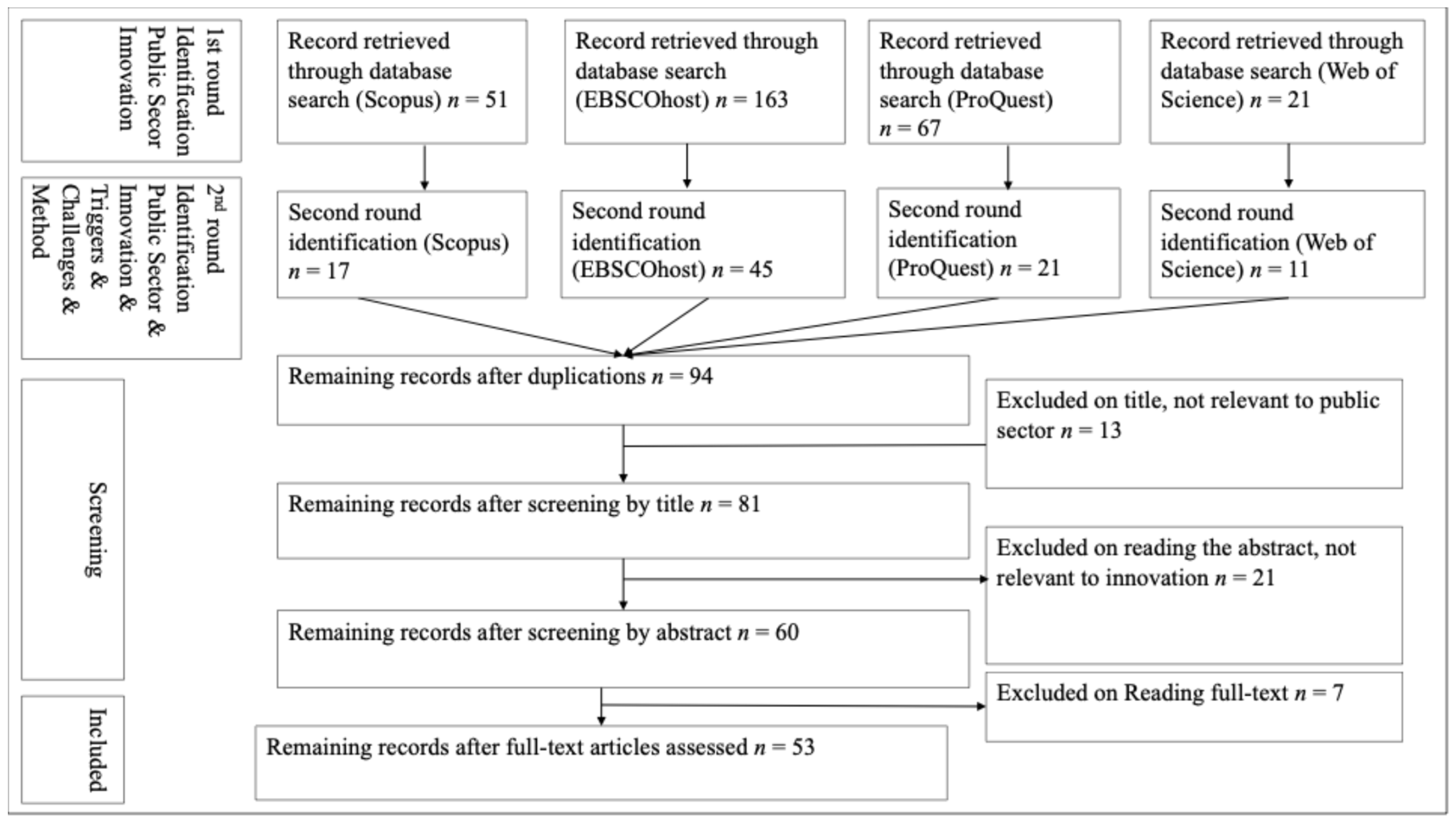
Following this process, a final sample of 53 peer-reviewed journal articles published between 2021 and 2025 was included in the review. Figure 1 presents the PRISMA flow diagram illustrating the identification, screening, eligibility, and inclusion stages.
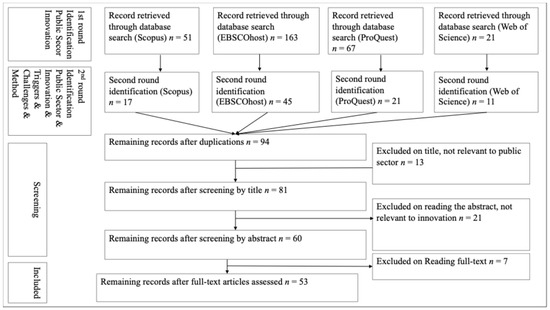
Figure 1.
Flow diagram of the article identification process.
3.4. Data Extraction and Data Items
Data was systematically extracted from the included studies using a structured review matrix. Extracted information included publication year, journal outlet, database source, research context, methodological approach, theoretical framework, innovation focus, and reported outcomes. This process enabled consistent comparison across studies and supported thematic synthesis.
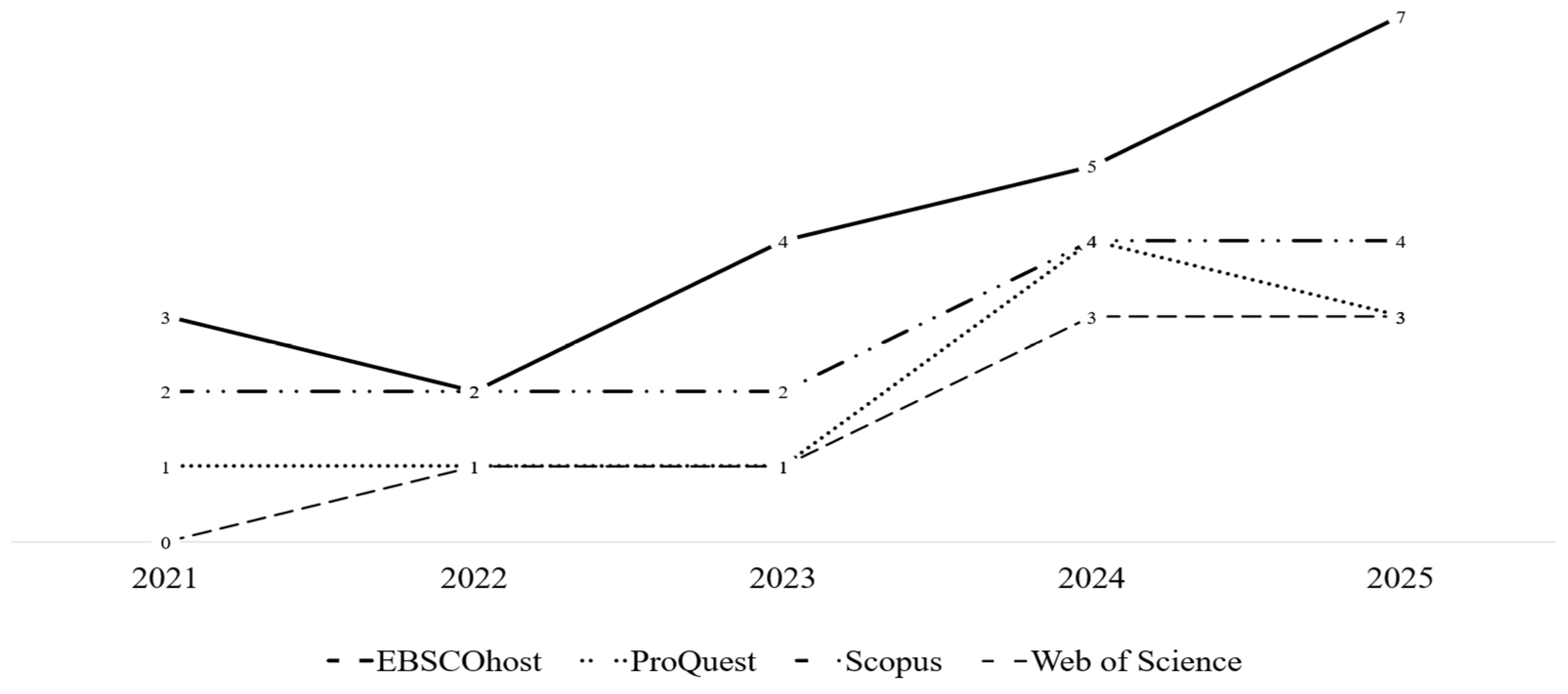
Figure 2 presents the yearly distribution of articles across the four databases included in this review, EBSCOhost, ProQuest, Scopus, and Web of Science, covering the period from 2021 to 2025. The distribution reveals a marked increase in publications after 2023, indicating a surge in scholarly attention to public sector innovation in the post-COVID-19 period.
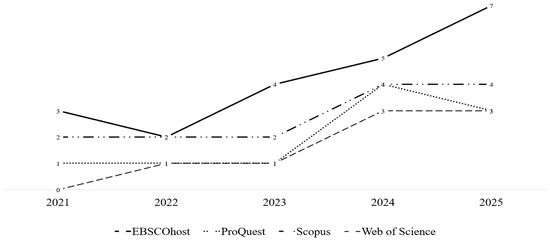
Figure 2.
Yearly Publication of Articles across Databases. Source: Author’s compilation based on database searches conducted on 2 and 4 December 2025; records retrieved 5–9 December 2025.
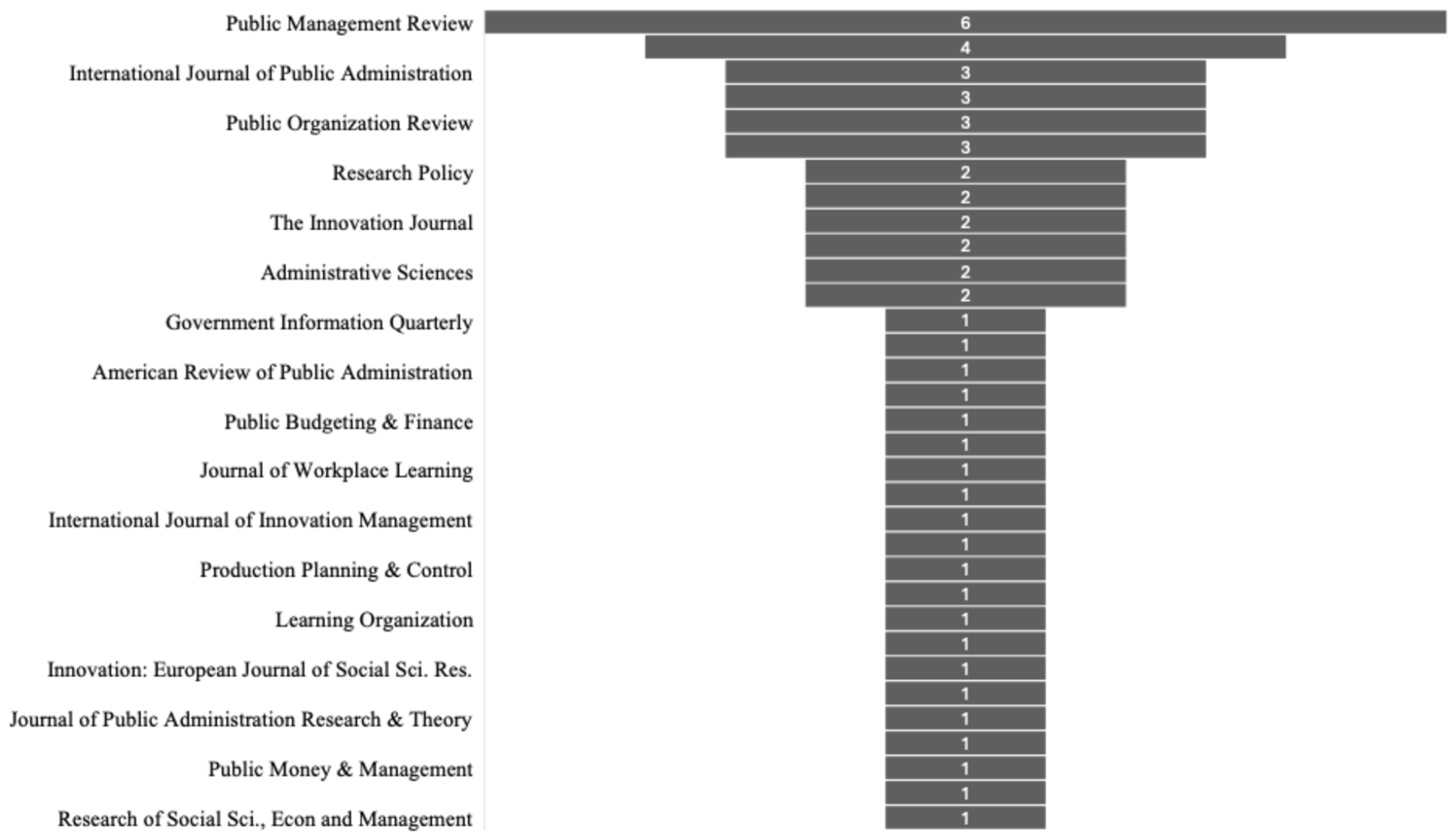
To assess the disciplinary and outlet concentration of public sector innovation research, Figure 3 reports the frequency distribution of articles by journal. The findings indicate that the literature is dispersed across a wide range of journals, with a strong concentration in public administration and public management outlets.
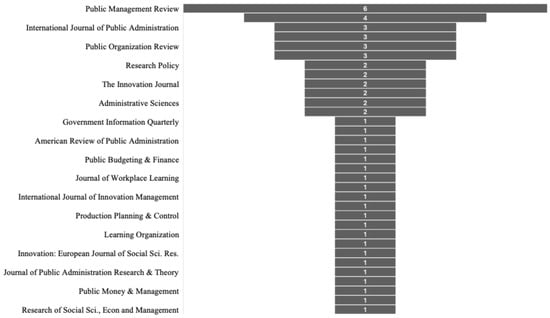
Figure 3.
Frequency Distribution of Articles by Journal. Source: Author’s analysis derived from systematic searches (initial search: 2 December 2025; database search date: 4 December 2025; article retrieval 5–9 December 2025).
3.5. Reporting and Transparency
To enhance transparency, the review reports the yearly distribution of publications across databases (Figure 2) and the distribution of articles by journal outlet (Figure 3), providing insight into disciplinary concentration and publication trends. The systematic documentation of search strategies, eligibility criteria, screening procedures, and synthesis methods ensures the replicability of the review process.
4. Synthesis of Findings
Given the conceptual and methodological heterogeneity of the included studies, a narrative synthesis approach was employed. This involved organizing findings into thematic categories, identifying recurring patterns and divergences, and critically interpreting theoretical and empirical contributions. Rather than assessing individual study quality through formal risk-of-bias tools, the review emphasized conceptual coherence, contextual relevance, and analytical contribution, consistent with established guidance for narrative systematic reviews. The findings of this review are organized according to the five research questions outlined above. Each subsection synthesizes the evidence from the 53 included studies, providing a structured narrative analysis consistent with PRISMA-guided systematic review principles.
4.1. Findings for Rq1: Conceptualizations of Public Sector Innovation
A central theme in the literature on public sector innovation is the absence of a universally accepted definition, resulting in significant conceptual fragmentation (Singler, 2023; Petter, 2021; Nadal & Vasconcellos Sobrinho, 2025). Public sector innovation has been variously conceptualized as technological innovation, including digitalization, e-government, and AI-enabled service delivery (Patterson & Agarwal, 2023; Zaato, 2024), process redesign such as lean management and administrative simplification (Demircioglu, 2024; Trein & Vagionaki, 2024), service delivery reform (Suchitwarasan et al., 2024), policy and governance innovation (Aladwan & Alrababah, 2025; Criado et al., 2025), and citizen-centric or co-creation initiatives (Eseonu, 2022). While this diversity reflects the inherent complexity and heterogeneity of public service environments, it simultaneously generates ambiguity regarding what constitutes innovation and how it differs from incremental administrative change.
A notable tension in the literature lies in the dual framing of innovation around efficiency and effectiveness. One stream emphasizes innovation primarily as a mechanism for cost reduction, productivity improvement, and fiscal efficiency, a perspective strongly influenced by NPM principles (Petter, 2021; Fred & Mukhtar-Landgren, 2024). Studies adopting this lens often focus on managerial and financial outcomes, utilizing frameworks rooted in accounting, budgeting, and performance management (Md & Tareque, 2023). Innovations under this framing are evaluated largely on quantifiable indicators, including cost savings, reduced processing times, and output measures.
Conversely, another body of research conceptualizes innovation as a means to enhance service effectiveness, public value, and citizen outcomes, drawing on New Public Governance (NPG) and public value theory (Patterson & Agarwal, 2023; Cingolani & Salazar-Morales, 2024). Here, innovation is framed less as doing more with less and more as doing better for citizens, emphasizing service quality, accessibility, inclusiveness, responsiveness, and citizen satisfaction. Studies in this tradition highlight relational, participatory, and outcome-oriented processes rather than purely efficiency-driven measures.
Despite these insights, the literature rarely reconciles efficiency- and effectiveness-oriented perspectives coherently. Many studies implicitly privilege one perspective over the other, neglecting the trade-offs inherent in pursuing dual objectives. Consequently, innovation is sometimes portrayed as an unambiguously positive phenomenon, overlooking instances where efficiency-focused initiatives may compromise service quality or equity, or where citizen-centered innovations may increase costs and administrative complexity (Singler & Guenduez, 2025; Zaato, 2024). This conceptual imbalance constrains the analytical depth of the literature and limits its practical utility for public managers navigating competing performance demands. Overall, different streams of the literature conceptualize innovation, illustrating the fragmentation, efficiency–effectiveness tension, and measurement divergence (see Table 1 for details).

Table 1.
Conceptualizations of Innovation in the Public Sector (N = 53).
4.2. Findings for Rq2: Triggers and Antecedents
The literature on public sector innovation highlights a wide array of triggers and antecedents that stimulate innovative practices, encompassing political leadership, regulatory and institutional reforms, fiscal pressures, crises, digital transformation, and inter-organizational collaboration (Singler, 2023; Nadal & Vasconcellos Sobrinho, 2025; Bendary & Rajadurai, 2024). Innovation in public services is rarely the outcome of a single factor; rather, it emerges from the complex interaction of structural, political, and technological conditions, which vary significantly across organizational and national contexts (Suchitwarasan et al., 2024; Aladwan & Alrababah, 2025).
A frequently cited antecedent is fiscal pressure, particularly cost-reduction mandates imposed by central governments (Raudla et al., 2025; Patterson & Agarwal, 2023). Budget constraints, austerity measures, and performance-based funding regimes have often driven public organizations to innovate for efficiency gains. While some studies argue that fiscal pressures act as catalysts for efficiency-enhancing innovation, promoting lean processes, service integration, and resource reallocation (Lidman et al., 2022; De Matteis et al., 2025), others suggest that excessive cost-cutting may limit innovation capacity by reducing slack resources, increasing risk aversion, and constraining investment in experimentation (Petter, 2021; Nagel, 2025). This dual effect indicates that fiscal constraints can simultaneously enable and inhibit innovation, contingent on organizational capabilities, leadership support, and institutional flexibility.
Closely associated with fiscal pressures is the influence of neo-liberalization and NPM reforms. Market-oriented reforms—such as outsourcing, competitive tendering, performance measurement, and managerial autonomy—have reshaped the innovation landscape in public services (Singler & Guenduez, 2025; Md & Tareque, 2023). Some studies credit these reforms with fostering managerial flexibility and introducing innovation incentives, whereas others highlight unintended consequences, including short-termism, fragmentation, and prioritization of efficiency over public value (Cinar et al., 2024b; Suchitwarasan et al., 2024). This ongoing debate underscores an unresolved question in the literature: whether innovation driven by neo-liberal logics genuinely enhances public service outcomes or primarily represents a rebranding of efficiency-driven reforms.
Digital transformation has emerged as a particularly salient trigger of innovation, encompassing the adoption of artificial intelligence (AI), automation, and data analytics (You et al., 2024; Lee & Yeo, 2025; Zhang & Eimicke, 2024). Digital technologies are frequently portrayed as enablers of innovation through process automation, predictive decision-making, and personalized service delivery. AI and automation are associated with efficiency gains, cost reduction, and scalability across welfare, healthcare, and regulatory domains (Criado et al., 2025). Nonetheless, challenges such as ethical concerns, algorithmic bias, transparency deficits, and skill gaps among public servants remain significant (Bendary & Rajadurai, 2024; AlMunthiri et al., 2024). The literature demonstrates that technological adoption alone does not ensure meaningful innovation; organizational readiness, institutional alignment, and governance capacity are critical mediating factors (Patrucco et al., 2025; Demircioglu, 2024).
Lean management practices also function as recurring antecedents, especially in efficiency-driven reform agendas. Lean principles, including waste reduction, process standardization, and continuous improvement, have been applied to streamline operations and improve service delivery (Lidman et al., 2023; de O. Carneiro et al., 2024). While empirical studies report gains in operational efficiency and service responsiveness, critics argue that lean approaches risk oversimplifying complex public service processes and marginalizing professional discretion (Cingolani & Salazar-Morales, 2024). Furthermore, lean-driven innovations tend to be incremental rather than transformative, questioning their ability to address systemic public sector challenges (De Matteis et al., 2025; Trein & Vagionaki, 2024).
Crises, including economic shocks, pandemics, and natural disasters, are widely recognized as powerful triggers of innovation (Nadal & Vasconcellos Sobrinho, 2025; Zaato, 2024). Crises temporarily relax institutional constraints, accelerate decision-making, and legitimize experimentation. However, crisis-induced innovations are often reactive and may not be sustained beyond emergency conditions, highlighting the importance of institutionalizing innovation processes (Cinar et al., 2024b; Fernandes et al., 2023).
Inter-organizational collaboration also plays a critical role in facilitating innovation, particularly in complex policy domains that cut across organizational boundaries (Suchitwarasan et al., 2024; Cingolani & Salazar-Morales, 2024). Collaborative arrangements support knowledge sharing, resource pooling, and co-creation with non-state actors. Nevertheless, coordination costs, accountability ambiguities, and power asymmetries can limit the effectiveness of collaboration, suggesting that innovation outcomes depend on governance structures and relational capacities (Ayubayeva et al., 2025).
In summary, while the literature identifies multiple triggers of public sector innovation, the findings are fragmented and context-dependent (Singler, 2023). Many studies adopt linear or deterministic assumptions, underestimating the complex interplay between fiscal pressures, technological change, institutional logics, and managerial agency. There is a clear need for integrative, theory-driven research that examines not only what triggers innovation, but also how, when, and under what conditions these triggers produce sustainable, value-enhancing outcomes (Palumbo et al., 2023; Nagel, 2025). Table 2 presents a clear temporal shift in the emphasis placed on innovation triggers in public sector innovation research between 2021 and 2025. Early in the period, market-oriented drivers associated with NPM, such as fiscal pressure and efficiency-driven reforms, feature prominently. However, the salience of these market-oriented triggers declines steadily over time. By 2024 and 2025, references to NPM reforms virtually disappear.
Table 2.
Temporal distribution of innovation triggers in public sector innovation research (N = 53).
4.3. Findings for Rq3: Outcomes of Innovation
Public sector innovation has been widely associated with a variety of positive organizational and societal outcomes, including enhanced service quality, improved operational efficiency, greater transparency and accountability, higher citizen satisfaction, and the creation of public value (Singler, 2023; Patterson & Agarwal, 2023; Suchitwarasan et al., 2024). Empirical evidence suggests that initiatives such as digital service platforms, process reengineering, and collaborative governance arrangements enable public organizations to deliver services more responsively and cost-effectively (Zaato, 2024; Bendary & Rajadurai, 2024). In this regard, innovation is frequently framed as a mechanism to address enduring challenges related to bureaucratic rigidity and resource constraints (Hjelmar, 2021; Petter, 2021).
However, the relationship between innovation and performance outcomes is not uniform. While some studies report measurable efficiency gains or improvements in service accessibility, others indicate modest or context-dependent effects (Zhang & Eimicke, 2024; Natsir et al., 2023). Outcomes appear to vary according to sector (e.g., health, local government, social services), level of government, and institutional capacity (Demircioglu, 2024; Trein & Vagionaki, 2024). These findings underscore that innovation does not automatically translate into enhanced performance; rather, its success depends on organizational readiness, leadership support, and alignment with existing administrative structures (Knox & Marin-Cadavid, 2023; Lidman et al., 2022).
The literature also highlights mixed or negative outcomes of innovation. Several studies document implementation failures, cost overruns, and delays, particularly in large-scale digital or technology-driven initiatives (You et al., 2024; Criado et al., 2025). Unintended consequences, such as increased inequality, have been reported where digitally enabled innovations disproportionately benefit citizens while marginalizing those with limited access to technology or digital literacy (Cingolani & Salazar-Morales, 2024; Md & Tareque, 2023). These findings challenge overly optimistic narratives regarding innovation and emphasize the distributive implications of public service reform (Randini & Muslim, 2024; Nagel, 2025).
Employee-related outcomes constitute another critical area. While some innovations enhance job autonomy and skills development, resistance from public employees, work intensification, role ambiguity, and stress are frequently observed (Lidman et al., 2023; Knox & Marin-Cadavid, 2023). Such resistance is often linked to top–down implementation strategies, insufficient training, or perceptions that efficiency is prioritized over professional values and public service ethos (AlSaied & Alkhoraif, 2024; De Matteis et al., 2025). This highlights that innovation outcomes are influenced not only by technical design but also by human and organizational cultural factors (Raudla et al., 2025; Bendary & Rajadurai, 2024).
Taken together, the evidence indicates that the outcomes of public sector innovation are inherently complex and context dependent. Positive impacts are more likely when initiatives are accompanied by inclusive stakeholder engagement, adequate resourcing, and adaptive leadership, whereas poorly designed or imposed innovations may erode trust, legitimacy, and equity (Fernandes et al., 2023; Singler & Guenduez, 2025). This underscores a key gap in the literature: a focus on intended benefits often neglects long-term consequences and trade-offs.
In conclusion, evaluations of public sector innovation should extend beyond efficiency or performance metrics to encompass social equity, employee well-being, and public value (Petter, 2021; Suchitwarasan et al., 2024). Future research would benefit from longitudinal studies and multi-dimensional assessment frameworks capable of capturing both the positive and adverse outcomes of innovation over time (Criado et al., 2025; Raudla et al., 2024). Table 3 shows the frequency with which different outcome categories are discussed across the reviewed studies. While positive organizational and efficiency-related outcomes dominate the literature, a substantial proportion of studies also report mixed, negative, equity-related, and employee-level consequences, highlighting the non-linear and context-dependent nature of public sector innovation.
Table 3.
Outcomes of Public Sector Innovation Reported in the Literature (N = 53).
4.4. Findings for Rq4: Challenges and Barriers
The literature demonstrates a broad consensus that innovation in the public sector is constrained by a complex interplay of structural, cultural, and institutional barriers (Nagel, 2025; Bendary & Rajadurai, 2024). Frequently cited challenges include rigid bureaucratic structures, risk-averse organizational cultures, stringent accountability and compliance requirements, political interference, limited managerial discretion, and capability constraints among public servants (AlSaied & Alkhoraif, 2024; Patrucco et al., 2025; Fred & Mukhtar-Landgren, 2024). While these barriers are well documented, they are often treated in isolation rather than as interconnected elements embedded within broader governance systems (Criado et al., 2025; De Matteis et al., 2025).
A dominant theme is the constraining role of bureaucratic structures. Hierarchical decision-making processes, formalized rules, and procedural rigidity are widely portrayed as antithetical to experimentation and innovation (Petter, 2021; Hjelmar, 2021). However, the literature also cautions against viewing bureaucracy as inherently antithetical to innovation. When applied flexibly, bureaucratic arrangements can provide legitimacy, coordination, and stability, particularly in complex service environments (Cinar et al., 2024b; de O. Carneiro et al., 2024). Innovation is most constrained when control mechanisms are applied uniformly without scope for discretion or learning, highlighting an enduring tension between accountability and flexibility (Aladwan & Alrababah, 2025; Singler & Guenduez, 2025).
Organizational culture constitutes a closely related barrier, especially through pervasive risk aversion in public sector institutions. Fear of failure, reputational damage, and political repercussions discourages managers from pursuing innovative initiatives, particularly those involving uncertainty or experimentation (Muluk & Pratama, 2021; Knox & Marin-Cadavid, 2023). This risk aversion is reinforced by performance management and audit systems that prioritize compliance and error avoidance over learning (Patterson & Agarwal, 2023; Suchitwarasan et al., 2024).
Accountability pressures from multiple stakeholders further complicate innovation processes. High levels of scrutiny from citizens, media, regulators, and political actors increase the visibility and perceived risk of innovation initiatives (Raudla et al., 2025; Fernandes et al., 2023). While transparency is fundamental to democratic governance, it can paradoxically inhibit innovation by amplifying the consequences of failure, particularly in high-salience sectors such as healthcare and education (Zhang & Eimicke, 2024). Political interference and short-termism intensify these pressures, as electoral cycles and shifting priorities undermine continuity and reduce incentives for long-term investment in innovation (Nadal & Vasconcellos Sobrinho, 2025; Nagel, 2025).
Finally, capability constraints among public servants represent a significant but unevenly addressed challenge. Skills gaps in digital technologies, data analytics, and innovation management are widely acknowledged (AlMunthiri et al., 2024; Mahula et al., 2025), yet fewer studies examine how organizational learning systems, leadership development, and structural autonomy shape the effective use of these capabilities (Lee & Yeo, 2025; Demircioglu, 2024). Overall, the literature suggests that barriers to public sector innovation are deeply embedded within institutional logics and governance arrangements (see Table 4), underscoring the need for integrative, theory-driven research that examines how organizations navigate trade-offs between innovation, accountability, and legitimacy over time.
Table 4.
Challenges and Barriers to Innovation in the Public Sector.
4.5. Findings for Rq5: Theoretical Foundations
Public sector innovation research is underpinned by a diverse but uneven set of theoretical frameworks. Prominent among these are NPM and NPG, which reflect distinct assumptions about how innovation emerges and is governed in public service contexts. Early studies, particularly those aligned with the NPM paradigm, conceptualize innovation primarily as a tool to enhance efficiency, performance measurement, and managerial control, often implicitly borrowing from private-sector logics of competition and cost-effectiveness (Petter, 2021; Patterson & Agarwal, 2023). While NPM-based perspectives have contributed to understanding process and technological innovation, they have been critiqued for underestimating the collaborative and public value-oriented dimensions of innovation in public services (Singler, 2023; Aladwan & Alrababah, 2025).
More recent literature increasingly draws on NPG, emphasizing networks, co-production, and multi-actor collaboration (Suchitwarasan et al., 2024; Knox & Marin-Cadavid, 2023). Studies grounded in NPG conceptualize innovation as a relational process involving public agencies, private actors, non-profit organizations, and citizens. Although this perspective better captures the systemic and participatory nature of public sector innovation, the review finds that many studies invoke NPG rhetorically, without fully theorizing how governance arrangements influence innovation outcomes or account for power asymmetries among actors (Cinar et al., 2024b; Trein & Vagionaki, 2024).
Institutional theory is another frequently employed framework, particularly in explaining why innovation in public organizations is often incremental rather than radical (Hjelmar, 2021; Demircioglu, 2024). Institutional perspectives highlight the influence of regulatory pressures, cultural norms, legitimacy concerns, and path dependency on innovation behaviors. While these studies provide strong explanatory power regarding resistance to change and isomorphic tendencies, they often overemphasize constraints relative to agency, offering limited insight into how public managers and employees actively navigate or reshape institutional environments to foster innovation (Criado et al., 2025; Nagel, 2025).
In contrast, public value theory frames innovation as a mechanism for creating societal value rather than solely improving efficiency or outputs (Ayubayeva et al., 2025). Research adopting this lens focuses on citizen outcomes, trust, legitimacy, and long-term societal benefits. However, public value theory is often applied normatively, with limited empirical operationalization of what constitutes “public value” or how innovation contributes to it in measurable terms, restricting its practical utility for evaluating performance across diverse public sector contexts (De Matteis et al., 2025; Singler & Guenduez, 2025).
A smaller but growing body of research applies resource-based and knowledge-based views (RBV/KBV) to explain innovation capacity in public organizations. These perspectives conceptualize innovation as emerging from organizational resources, capabilities, and critically knowledge creation, sharing, and integration. Studies emphasize the role of professional expertise, organizational learning, data analytics, and digital knowledge systems in enabling innovation (AlMunthiri et al., 2024). Despite their relevance, these theories remain underutilized, particularly in explaining how human capital, digital capabilities, and cross-boundary knowledge flows support sustained innovation under bureaucratic constraints.
Innovation diffusion theory is also frequently applied to examine the spread of practices, technologies, and policies across public organizations (Zhang & Eimicke, 2024; You et al., 2024). While diffusion models offer insights into adoption patterns, they often neglect contextual adaptation, political dynamics, and frontline implementation challenges central to public service innovation. Similarly, complexity and systems theories, highly relevant for understanding interdependent public service ecosystems, are rarely applied systematically and remain peripheral in the literature (Cingolani & Salazar-Morales, 2024; de O. Carneiro et al., 2024).
Overall, three key theoretical gaps emerge from this review. First, public sector innovation research remains theoretically fragmented, with limited integration across governance, institutional, and knowledge-based perspectives. Second, theory application is frequently implicit or descriptive, rather than analytically embedded in research design and hypothesis development. Third, there is a notable lack of micro-level theorization that explains how individual actors, such as public managers and frontline employees, translate institutional pressures and governance structures into innovative practices. Addressing these gaps is critical for advancing coherent and contextually grounded theory in public sector innovation research.
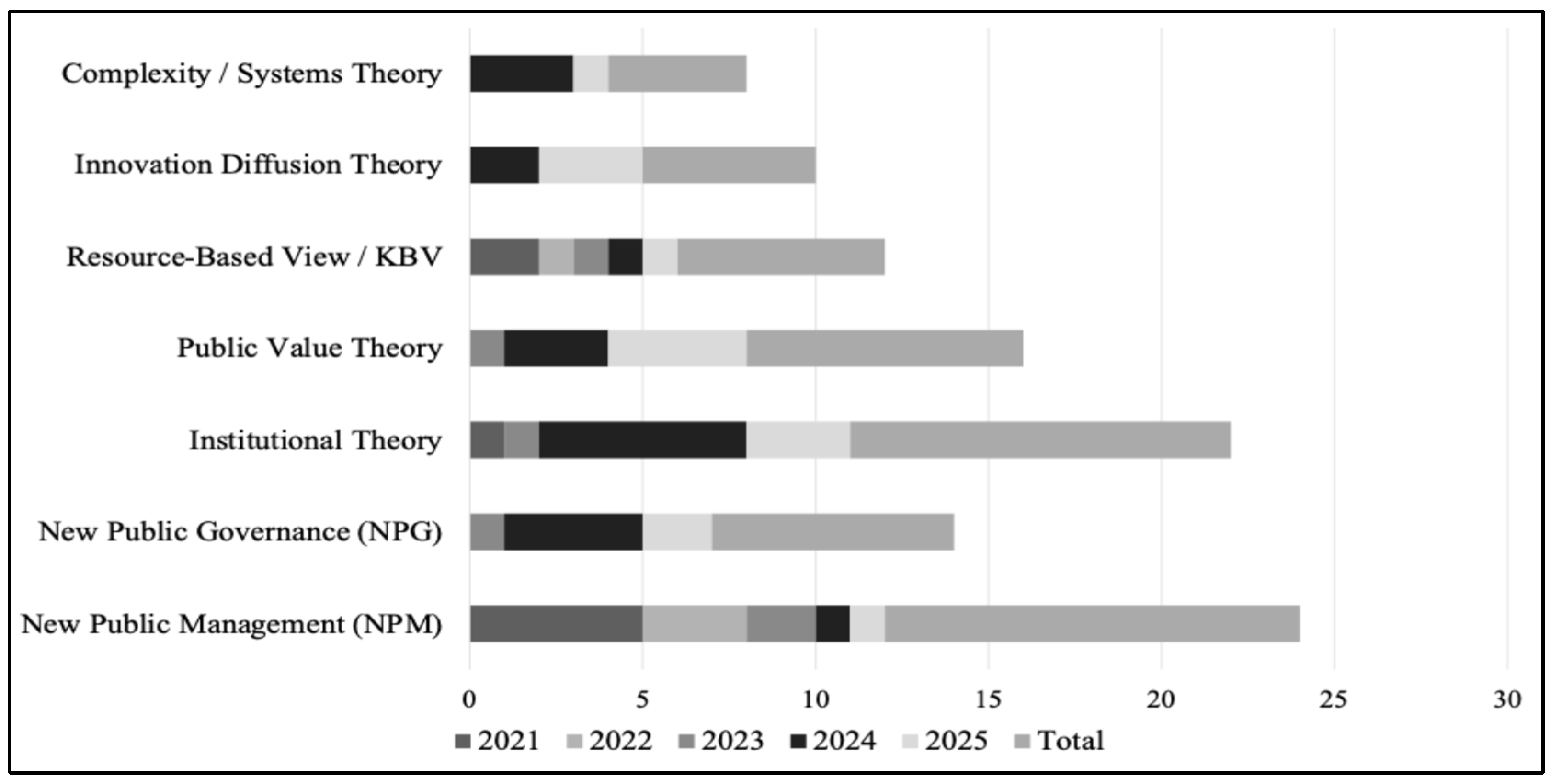
Figure 4 summarizes the theoretical foundations employed in public sector innovation research. The chart highlights the predominance of NPM and Resource-Based View during 2021, while Institutional Theory, Diffusion, and Complexity perspectives are more frequently applied during 2024–2025.
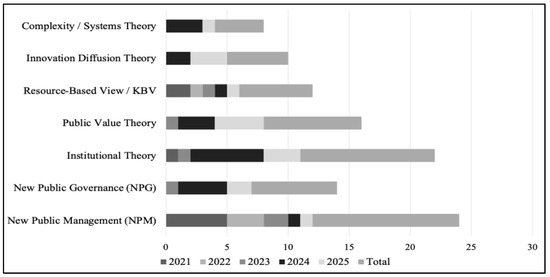
Figure 4.
Frequency of theoretical frameworks applied in public sector innovation research. Source: Author’s synthesis developed during manuscript preparation (20–23 December 2025), based on studies retrieved between 5 and 9 December 2025. Notes: Some articles have used multiple theories but were assigned to their primary theoretical focus.
5. Discussion
This systematic literature review sought to synthesize and critically evaluate how innovation in public service management is conceptualized, triggered, enacted, and constrained in recent scholarships. The findings reveal a literature that is expansive yet fragmented, characterized by conceptual plurality, uneven theoretical engagement, and strong contextual dependence. These patterns echo concerns raised in earlier systematic reviews (De Vries et al., 2016; Cinar et al., 2019; Buchheim et al., 2020), but the post-COVID literature reviewed here suggests that these long-standing challenges have become more pronounced amid heightened uncertainty, rapid digitalization, and fiscal and societal pressures (Singler, 2023; Criado et al., 2025; Patterson & Agarwal, 2023). The discussion is organized around five key insights that advance understanding of contemporary public service innovation.
5.1. Conceptual Fragmentation and the Efficiency–Effectiveness Tension
A central finding of this review is the continued lack of a shared and coherent conceptualization of public sector innovation. Recent studies variously define innovation as technological adoption, digital transformation, process redesign, service reform, governance change, or citizen co-creation (Suchitwarasan et al., 2024; Demircioglu, 2024). While this diversity reflects the complexity of public services, it perpetuates conceptual ambiguity and constrains cumulative knowledge development (Singler & Guenduez, 2025; Petter, 2021).
Earlier systematic reviews similarly documented definitional fragmentation and inconsistent operationalization of innovation (De Vries et al., 2016; Buchheim et al., 2020). However, post-COVID research indicates that conceptual tensions have intensified, particularly between efficiency-oriented and effectiveness-oriented logics. Efficiency-driven perspectives, influenced by NPM, emphasize cost reduction, productivity, and performance metrics (Md & Tareque, 2023; Aladwan & Alrababah, 2025). In contrast, effectiveness-oriented approaches, grounded in NPG and public value theory, prioritize service quality, inclusiveness, responsiveness, and citizen outcomes (Ayubayeva et al., 2025; Suchitwarasan et al., 2024).
These perspectives are rarely integrated, despite evidence that public managers must simultaneously pursue fiscal discipline and public value creation, especially in post-crisis contexts. This reinforces earlier calls for more integrative conceptual approaches (Criado et al., 2025; De Vries et al., 2016) while highlighting the need to theorize innovation as a multidimensional and tension-laden process.
5.2. Innovation as a Contextual and Contingent Process
The review underscores that innovation in public services is fundamentally contextual and contingent. Recent studies identify multiple interacting triggers, including fiscal pressure, digital transformation, governance reforms, crises, and inter-organizational collaboration (Raudla et al., 2025; You et al., 2024; Cinar et al., 2024a). These triggers do not operate uniformly across contexts.
For instance, fiscal pressure may stimulate efficiency-oriented innovation but can also constrain experimentation by reducing organizational slack and increasing risk aversion (AlSaied & Alkhoraif, 2024; Bendary & Rajadurai, 2024). Similarly, digital technologies are frequently positioned as key enablers of innovation, yet their effectiveness depends heavily on institutional readiness, managerial capability, ethical governance, and data infrastructures (Patterson & Agarwal, 2023; Zhang & Eimicke, 2024).
These findings extend earlier diffusion and adoption-focused reviews (De Vries et al., 2018) and governance-oriented syntheses (Lopes & Farias, 2022) by demonstrating that post-COVID innovation trajectories are increasingly shaped by the interaction between crisis conditions and pre-existing institutional capacities. This challenges linear or deterministic models of innovation and reinforces the importance of context-sensitive and theory-driven research designs (Demircioglu, 2024; Lidman et al., 2023).
5.3. Mixed Outcomes and the Importance of Human and Social Dimensions
Consistent with prior scholarship, innovation is not uniformly associated with positive outcomes. While recent studies report efficiency gains, service improvements, and enhanced responsiveness, these benefits are frequently accompanied by implementation failures, cost overruns, workforce strain, and equity concerns, particularly in technology-driven initiatives (Md & Tareque, 2023; Zaato, 2024; Muluk & Pratama, 2021).
Earlier systematic reviews cautioned against overly optimistic narratives of public sector innovation, highlighting unintended consequences and partial success (De Vries et al., 2016; Cinar et al., 2019). The post-COVID literature builds on this insight by placing stronger emphasis on human and social dimensions. Employee responses, professional identities, organizational culture, and stakeholder engagement emerge as critical determinants of whether innovation generates public value or exacerbates inequality and resistance (Knox & Marin-Cadavid, 2023; Lidman et al., 2023; Vassallo et al., 2023).
These findings reinforce governance-oriented perspectives that emphasize collaboration and co-creation (Lopes & Farias, 2022) while extending them by highlighting the risks of innovation that prioritizes efficiency over employee well-being and citizen equity. Innovation outcomes, therefore, must be assessed through broader evaluative lenses that include trust, legitimacy, and social value (Ayubayeva et al., 2025; You et al., 2024).
5.4. Barriers as Structural Conditions Rather than Isolated Obstacles
The review reframes barriers to innovation as enduring structural conditions rather than discrete or episodic obstacles. Recent studies continue to identify bureaucracy, accountability regimes, political pressures, and risk aversion as major constraints (Petter, 2021; Singler & Guenduez, 2025). These findings align with earlier systematic reviews that documented similar barriers across contexts (Cinar et al., 2019; De Vries et al., 2016).
However, post-COVID research offers a more nuanced interpretation by recognizing that these same structures can also enable innovation by providing legitimacy, coordination, and protection for experimentation when applied flexibly (Demircioglu, 2024; Aladwan & Alrababah, 2025). Risk aversion and compliance pressures are increasingly understood as rational responses to heightened public scrutiny and political accountability rather than purely organizational pathologies (Nadal & Vasconcellos Sobrinho, 2025; Hjelmar, 2021).
Despite this conceptual advancement, limited attention is paid to how public organizations strategically navigate and leverage these constraints over time. This gap suggests the need for longitudinal and process-oriented research that examines innovation as an adaptive and negotiated practice within institutional boundaries.
5.5. Theoretical Fragmentation and the Need for Integration
The review reveals substantial theoretical diversity alongside persistent fragmentation in public sector innovation research. Recent studies draw on NPM, NPG, institutional theory, public value theory, and resource and knowledge-based perspectives, often applied implicitly or in isolation (Singler, 2023; Criado et al., 2025; Fred & Mukhtar-Landgren, 2024). This pattern closely mirrors observations from pre-COVID systematic reviews (De Vries et al., 2016; Buchheim et al., 2020), indicating that despite a growing volume of research, theoretical consolidation has remained limited over time.
This lack of integrative theorizing constrains both explanatory depth and generalizability. Few studies explicitly connect macro-level governance arrangements, meso-level organizational capabilities, and micro-level behaviors of public actors, despite repeated calls for multi-level analytical approaches. Greater integration of institutional theory with public value and resource- or knowledge-based perspectives could provide richer explanations of how innovation emerges, is sustained, and diffuses within bureaucratic systems, particularly under conditions of regulatory constraint and resource scarcity (AlSaied & Alkhoraif, 2024; Mahula et al., 2025).
The findings further indicate a declining emphasis on NPM-oriented explanations relative to NPG and public value frameworks in recent publications (see Figure 4). Nevertheless, NPM remains relevant, as many public sector organizations, especially in emerging and transitioning economies, continue to operate within hybrid governance arrangements shaped by both managerial and collaborative logics (Waheduzzaman, 2019). While governance and value-oriented perspectives increasingly dominate post-COVID innovation research (Patterson & Agarwal, 2023; Md & Tareque, 2023), these approaches often carry normative assumptions that may not be universally applicable. Explicit recognition of contextual variation and theoretical boundary conditions would therefore strengthen theoretical pluralism and enhance the relevance of public sector innovation research across diverse administrative and institutional settings.
Based on the above discussion the research gap in the existing literature and the future direction for research on public sector innovation are presented in Table 5.
Table 5.
Key Research Gaps and Future Directions.
6. Conclusions
This systematic literature review synthesizes the evolving body of research on innovation in public service management by examining how innovation is conceptualized, what triggers it, the outcomes it produces, and the challenges that constrain its implementation. The review reveals that public sector innovation is a multidimensional and context-dependent phenomenon, encompassing technological, organizational, policy, and governance-related changes rather than a single, uniform construct. While this conceptual diversity reflects the complexity of public service environments, it has also contributed to fragmentation in the literature.
The findings further indicate that innovation in public services is driven by a combination of internal and external factors, including leadership, institutional pressures, fiscal constraints, digital transformation, and inter-organizational collaboration. However, these drivers are rarely examined holistically, limiting our understanding of how multiple triggers interact across different administrative and national contexts. Similarly, although innovation is often associated with improved efficiency, service quality, transparency, and public value, the evidence on outcomes remains mixed, with several studies highlighting unintended consequences and implementation challenges.
Finally, the review shows that public sector innovation is constrained by entrenched bureaucratic structures, accountability regimes, political dynamics, and capability limitations. Theoretical perspectives underpinning this literature are diverse but unevenly applied, with a notable reliance on NPM and emerging shifts toward public value and governance-oriented frameworks. Overall, this review provides an integrative understanding of public sector innovation and identifies important conceptual, empirical, and theoretical gaps that warrant further scholarly attention.
6.1. Theoretical Implications
This review reinforces and extends insights from earlier systematic reviews that identified conceptual ambiguity and fragmented use of theory in public sector innovation research (De Vries et al., 2016; Cinar et al., 2019; Buchheim et al., 2020). While these challenges persist, the present review shows that they remain evident even in more recent, post-COVID scholarship, despite growing empirical and methodological sophistication. Multiple theoretical lenses continue to be applied implicitly or in isolation, limiting cumulative theory building. Accordingly, this review contributes by emphasizing the need for more explicit and integrative theorizing that combines institutional theory, public value theory, and innovation diffusion perspectives to better explain how innovation is shaped by governance arrangements, stakeholder pressures, and institutional constraints. Moving beyond single-theory approaches is essential for capturing the multi-level, context-dependent nature of public sector innovation.
6.2. Practical Implications
For public managers and policymakers, this review confirms and extends prior evidence that public sector innovation is not inherently beneficial and must be aligned with organizational capacity, professional norms, and accountability frameworks (De Vries et al., 2016; Cinar et al., 2019). Consistent with both earlier and more recent studies, leadership commitment, collaborative governance arrangements, and sustained investment in employee skills and digital capabilities emerge as critical enablers of successful innovation. At the same time, the findings highlight persistent risks identified in the literature, including employee resistance, implementation fatigue, and equity concerns, particularly when innovation is driven by efficiency or technological imperatives rather than public value considerations. Public managers should therefore approach innovation as a strategic, context-sensitive process that balances performance objectives with workforce well-being, legitimacy, and inclusive service outcomes.
6.3. Policy Implications
At the policy level, the review reinforces existing evidence that innovation in the public sector depends on regulatory environments that balance flexibility with accountability, enabling experimentation while safeguarding public trust (De Vries et al., 2018; Lopes & Farias, 2022). Both earlier and more recent studies indicate that rigid compliance regimes can inhibit learning and adaptation, whereas proportionate oversight and adaptive governance frameworks are more conducive to sustained innovation. The findings therefore caution against one-size-fits-all innovation agendas and support the adoption of context-sensitive policy approaches that account for sectoral, organizational, and institutional diversity within public services. Policymakers should design innovation policies that allow discretion, encourage cross-sector collaboration, and align reform objectives with local capacities and public value priorities.
6.4. Limitations and Future Research
Despite its contributions, this study has several limitations. First, as with all systematic reviews, the findings are constrained by the scope of databases, keywords, and inclusion criteria used, which may have excluded relevant studies published outside indexed journals or in non-English languages. Second, while this review follows core PRISMA principles, such as transparent search strategy development, database selection, multi-stage screening, and structured reporting via a PRISMA flow diagram, it does not implement a formal quality appraisal or risk-of-bias assessment, as the conceptual and methodological heterogeneity of the included studies precludes the application of standardized appraisal tools. The purpose of using PRISMA in this context is therefore to enhance transparency and replicability in the identification and screening process, rather than to imply a full meta-analytic synthesis. Another limitation of this review is its focus on the 2021–2025 period, which may overlook continuities with earlier innovation cycles dating back to the 2000s. Future research could extend the timeframe to systematically compare pre- and post-pandemic innovation patterns, enabling clearer identification of which characteristics of public sector innovation are genuinely novel and which represent longer-term evolutionary trajectories. Finally, future studies should more explicitly engage with theory, develop integrative frameworks, and examine the micro-level mechanisms, such as employee behavior and organizational learning, through which innovation unfolds in public service organizations.
Funding
This research received no external funding.
Institutional Review Board Statement
Not applicable.
Informed Consent Statement
Not applicable.
Data Availability Statement
The original contributions presented in this study are included in the article. Further inquiries can be directed to the corresponding author.
Conflicts of Interest
The author declares no conflict of interest.
References
- Aladwan, S. A., & Alrababah, A. (2025). Government innovation management: Challenges and opportunities. TQM Journal, 37(6), 1473–1496. [Google Scholar] [CrossRef]
- Aladwan, S. A., & Alshami, S. I. (2021). The impact of service excellence and service innovation on organisational reputation: Quantitative evidence from Jordanian public sector. TQM Journal, 33(6), 1544–1560. [Google Scholar] [CrossRef]
- AlMunthiri, O., Bani-Melhem, S., Mohd-Shamsudin, F., & Raziq, M. M. (2024). Fostering innovative behaviours of public sector employees: The potency of innovation-based HR practices, risk propensity and error tolerance. International Journal of Public Sector Management, 37(2), 159–182. [Google Scholar] [CrossRef]
- AlSaied, M. K., & Alkhoraif, A. A. (2024). The role of organizational learning and innovative organizational culture for ambidextrous innovation. The Learning Organization, 31(2), 205–226. [Google Scholar] [CrossRef]
- Arundel, A., Bloch, C., & Ferguson, B. (2019). Advancing innovation in the public sector: Aligning innovation measurement with policy goals. Research Policy, 48(3), 789–798. [Google Scholar] [CrossRef]
- Ayubayeva, S., Kussainova, L., Ibrayeva, A., Baimukhanov, T., & Kussainov, K. (2025). Strategic reputation management as a driver of public sector innovation. The Innovation Journal, 30(1), 1–18. [Google Scholar]
- Baniamin, H. M., Jamil, I., Paudel, N. R., & Dhakal, P. B. (2025). How public service motivation, red tape, and job satisfaction shape innovation: Evidence from the Nepalese civil service. Public Organization Review, 1(1), 1–18. [Google Scholar] [CrossRef]
- Bendary, M. G., & Rajadurai, J. (2024). Emerging technologies and public innovation in the Saudi public sector: An analysis of adoption and challenges amidst Vision 2030. The Innovation Journal, 29(1), 1–42. [Google Scholar]
- Buchheim, L., Krieger, A., & Arndt, S. (2020). Innovation types in public sector organizations: A systematic review of the literature. Manag Management Review Quarterly, 70(4), 509–533. [Google Scholar] [CrossRef]
- Cinar, E., Demircioglu, M. A., Acik, A. C., & Simms, C. (2024a). Public sector innovation in a city state: Exploring innovation types and national context in Singapore. Research Policy, 53(2), 104915. [Google Scholar] [CrossRef]
- Cinar, E., Simms, C., Trott, P., & Demircioglu, M. A. (2024b). Public sector innovation in context: A comparative study of innovation types. Public Management Review, 26(1), 265–292. [Google Scholar] [CrossRef]
- Cinar, E., Trott, P., & Simms, C. (2019). A systematic review of barriers to public sector innovation process. Public Management Review, 21(2), 264–290. [Google Scholar] [CrossRef]
- Cingolani, L., & Salazar-Morales, D. (2024). The role of public workforce diversity and the administrative ecosystem in advancing digital public service innovation. Public Management Review, 26(10), 2966–2991. [Google Scholar] [CrossRef]
- Clausen, T. H., Demircioglu, M. A., & Alsos, G. A. (2020). Intensity of innovation in public sector organizations: The role of push and pull factors. Public Administration, 98(1), 159–176. [Google Scholar] [CrossRef]
- Criado, J. I., Alcaide-Muñoz, L., & Liarte, I. (2025). Two decades of public sector innovation: Building an analytical framework from a systematic literature review of types, strategies, conditions, and results. Public Management Review, 27(3), 623–652. [Google Scholar] [CrossRef]
- De Matteis, F., Angelelli, M., Striani, F., & Corallo, A. (2025). Managerial implications of blockchains in the public sector: Elements for the development of a conceptual framework for innovation. Journal of Management and Governance, 29(3), 777–813. [Google Scholar] [CrossRef]
- Demircioglu, M. A. (2024). Public sector innovation: Sources, benefits, and leadership. International Public Management Journal, 27(2), 190–220. [Google Scholar] [CrossRef]
- de O. Carneiro, D. K., Isidro Filho, A., & Criado, J. I. (2024). Public sector innovation ecosystems: A proposition for theoretical-conceptual integration. International Journal of Public Administration, 47(14), 937–950. [Google Scholar] [CrossRef]
- De Vries, H., Bekkers, V., & Tummers, L. (2016). Innovation in the public sector: A systematic review and future research agenda. Public Administration, 94(1), 146–166. [Google Scholar] [CrossRef]
- De Vries, H., Tummers, L., & Bekkers, V. (2018). The diffusion and adoption of public sector innovations: A meta-synthesis of the literature. Perspectives on Public Management and Governance, 1(3), 159–176. [Google Scholar] [CrossRef]
- Eseonu, T. (2022). Co-creation as social innovation: Including “hard-to-reach” groups in public service delivery. Public Money & Management, 42(5), 306–313. [Google Scholar] [CrossRef]
- Fernandes, O. L. D. C., Paiva Junior, F. G. D., Fernandes, N. C. M., & Costa, M. F. D. (2023). The political logic of e-government and the discourses of innovation in the public sector in Cape Verde. Public Organization Review, 23(3), 1127–1141. [Google Scholar] [CrossRef]
- Fred, M., & Mukhtar-Landgren, D. (2024). Promoting public sector innovation: Who does what, when and how? Public Policy and Administration. Advanced online publication. [Google Scholar] [CrossRef]
- Fuglsang, L., Hansen, A. V., Mergel, I., & Røhnebæk, M. T. (2021). Living labs for public sector innovation: An integrative literature review. Administrative Sciences, 11(2), 58. [Google Scholar] [CrossRef]
- Gough, D., Oliver, S., & Thomas, J. (2017). An introduction to systematic reviews (2nd ed.). SAGE. [Google Scholar]
- Hamblin, R., Plimmer, G., Badar, K., & Lasthuizen, K. (2024). Organizational ambidexterity: A bibliometric review and framework for future public administration research. Public Performance & Management Review, 47(5), 1073–1109. [Google Scholar] [CrossRef]
- Hjelmar, U. (2021). The institutionalization of public sector innovation. Public Management Review, 23(1), 53–69. [Google Scholar] [CrossRef]
- Hong, S., Kim, S. H., & Kwon, M. (2022). Determinants of digital innovation in the public sector. Government Information Quarterly, 39(4), 101723. [Google Scholar] [CrossRef]
- Knox, S., & Marin-Cadavid, C. (2023). A practice approach to fostering employee engagement in innovation initiatives in public service organisations. Public Management Review, 25(11), 2027–2052. [Google Scholar] [CrossRef]
- Kousina, E., Deligianni, I., & Voudouris, I. (2025). Entrepreneurial leadership and innovation in the public sector: The role of causal-and effectual-logic processes. Public Administration, 103(1), 313–334. [Google Scholar] [CrossRef]
- Lee, K., & Yeo, J. (2025). Information and communication technology adoption, administrative discretion, and innovative mindsets in public organizations. Public Personnel Management, 54(1), 72–98. [Google Scholar] [CrossRef]
- Lewis, J. M., Ricard, L. M., & Klijn, E. H. (2017). How innovation drivers, networking and leadership shape public sector innovation capacity. International Review of Administrative Sciences, 84(2), 288–307. [Google Scholar] [CrossRef]
- Lidman, L., Gustavsson, M., & Fogelberg Eriksson, A. (2022). Innovation support in Swedish municipalities—Challenges on the way to increased innovation capacity in public organisations. Scandinavian Journal of Public Administration, 26(3), 25–44. [Google Scholar] [CrossRef]
- Lidman, L., Gustavsson, M., & Fogelberg Eriksson, A. (2023). Learning and employee-driven innovation in the public sector: The interplay between employee engagement and organisational conditions. Journal of Workplace Learning, 35(9), 86–100. [Google Scholar] [CrossRef]
- Lipp, B., Baudrin, M., Cuevas-Garcia, C., Pepponi, F., Rozwadowska, M., & Tsui, S. (2023). Co-creating end-user roles. Understanding the new variety of user involvement in public sector innovation. Science and Public Policy, 50(1), 146–159. [Google Scholar] [CrossRef]
- Lopes, A. V., & Farias, J. S. (2022). How can governance support collaborative innovation in the public sector? A systematic review of the literature. International Review of Administrative Sciences, 88(1), 114–130. [Google Scholar] [CrossRef]
- Loukis, E., Charalabidis, Y., & Androutsopoulou, A. (2017). Promoting open innovation in the public sector through social media monitoring. Government Information Quarterly, 34(1), 99–109. [Google Scholar] [CrossRef]
- Mahula, S., Tan, E., Crompvoets, J., & Timmers, P. (2025). What motivates public sector organisations to use blockchain? International Journal of Public Sector Management, 38(1), 118–138. [Google Scholar] [CrossRef]
- Md, M. I., & Tareque, M. (2023). Public sector innovation outcome-driven sustainable development in Bangladesh: Applying the dynamic autoregressive distributed lag simulations and kernel-based regularised least square machine learning algorithm approaches. Journal of Public Policy, 43(2), 326–357. [Google Scholar] [CrossRef]
- Moher, D., Liberati, A., Tetzlaff, J., Altman, D. G., & Prisma Group. (2010). Preferred reporting items for systematic reviews and meta-analyses: The PRISMA statement. International Journal of Surgery, 8(5), 336–341. [Google Scholar] [CrossRef]
- Mu, R., & Wang, H. (2022). A systematic literature review of open innovation in the public sector: Comparing barriers and governance strategies of digital and non-digital open innovation. Public Management Review, 24(4), 489–511. [Google Scholar] [CrossRef]
- Muluk, M. R. K., & Pratama, M. R. (2021). Public sector innovation in a developing country: Progress and challenges of public service innovation competition in Indonesian government. Public Policy and Administration, 20(4), 452–465. [Google Scholar] [CrossRef]
- Nadal, J. J., & Vasconcellos Sobrinho, M. (2025). Explorative and exploitative innovation and the organizational environment in the public sector. International Journal of Organizational Analysis, 33(9), 3183. [Google Scholar] [CrossRef]
- Nagel, M. L. (2025). The challenge of balancing innovation and tradition in the public sector: The role of street-level bureaucrats in digital transformation. Administration & Society, 57(1), 154–181. [Google Scholar] [CrossRef]
- Natsir, N., Halim, R., & Tahili, M. H. (2023). The effect of dynamic governance on public service innovation through the recruitment of managers of public organizations. Public Policy & Administration, 22(4), 405–417. [Google Scholar] [CrossRef]
- Okoli, C. (2015). A guide to conducting a standalone systematic literature review. Communications of the Association for Information Systems, 37, 43–77. [Google Scholar] [CrossRef]
- Palumbo, R., Casprini, E., & Fakhar Manesh, M. (2023). Unleashing open innovation in the public sector: A bibliometric and interpretive literature review. Management Decision, 61(13), 103–171. [Google Scholar] [CrossRef]
- Patrucco, A. S., Dimand, A. M., Agasisti, T., Benedetti, M., Gaeta, M., & Tangi, L. (2025). Managing public sector innovation for a better society: The case of public procurement of innovation. Production Planning & Control, 1–19. [Google Scholar] [CrossRef]
- Patterson, E., & Agarwal, R. (2023). Reducing the gap between rhetoric and reality: Use of digital service standards for public service innovation through digital transformation in Australia. Australian Journal of Public Administration, 82(4), 557–589. [Google Scholar] [CrossRef]
- Petter, G. (2021). Do all roads lead to innovativeness? A study of public sector organizations’ innovation capabilities. American Review of Public Administration, 51(7), 509–525. [Google Scholar] [CrossRef]
- Randini, H. P., & Muslim, M. A. (2024). Public service innovation: Drawing inspiration from the success of developed countries to improve public services in Indonesia. Journal Research of Social Science, Economics, and Management, 3(8), 1682–1686. [Google Scholar] [CrossRef]
- Raudla, R., Mohr, Z., & Douglas, J. W. (2024). Which managerial reforms facilitate public sector innovation? Public Administration, 102(2), 771–788. [Google Scholar] [CrossRef]
- Raudla, R., Sarapuu, K., Douglas, J. W., Vallistu, J., & Harbuzova, N. (2025). Budgeting for innovation: How funding strategies enable or constrain public sector experimentation. Public Budgeting & Finance, 45, 28–40. [Google Scholar] [CrossRef]
- Scognamiglio, F., Sancino, A., Caló, F., Jacklin-Jarvis, C., & Rees, J. (2023). The public sector and co-creation in turbulent times: A systematic literature review on robust governance in the COVID-19 emergency. Public Administration, 101(1), 53–70. [Google Scholar] [CrossRef]
- Singler, S. (2023). A measurement framework for public sector innovation: Advancing the Oslo manual for public sector. International Journal of Innovation Management, 27(1), 2350005. [Google Scholar] [CrossRef]
- Singler, S., & Guenduez, A. A. (2025). Barriers to public sector innovation in Switzerland: A phase-based investigation. Australian Journal of Public Administration, 84(2), 381–402. [Google Scholar] [CrossRef]
- Suchitwarasan, C., Cinar, E., Simms, C., & Kim, J.-Y. (2024). Public sector innovation for sustainable development goals: A comparative study of innovation types in Thailand and Korea. Australian Journal of Public Administration, 83(4), 603–624. [Google Scholar] [CrossRef]
- Tan, H., Yang, L., Fan, Z., & Gao, Y. (2025). Beyond singularity and fragmentation: A dynamic and integrative model for explaining public sector innovation. Public Administration and Development, 45(5), 529–539. [Google Scholar] [CrossRef]
- Thøgersen, D. (2022). Managing innovation on the public frontline: Three approaches to innovation leadership. International Journal of Public Sector Management, 35(2), 150–171. [Google Scholar] [CrossRef]
- Trein, P., & Vagionaki, T. (2024). Why policy failure is a prerequisite for innovation in the public sector. Policy & Politics, 52(4), 586–605. [Google Scholar] [CrossRef]
- van Hout, M. A., Braams, R. B., Meijer, P., & Meijer, A. J. (2024). Designing an instrument for scaling public sector innovations. Science and Public Policy, 51(4), 654–668. [Google Scholar] [CrossRef]
- Vassallo, J. P., Banerjee, S., Zaman, H., & Prabhu, J. C. (2023). Design thinking and public sector innovation: The divergent effects of risk-taking, cognitive empathy and emotional empathy on individual performance. Research Policy, 52(6), 104768. [Google Scholar] [CrossRef]
- Waheduzzaman, W. (2019). Challenges in transitioning from new public management to new public governance in a developing country context. International Journal of Public Sector Management, 32(7), 689–705. [Google Scholar] [CrossRef]
- Wipulanusat, W., Panuwatwanich, K., Stewart, R. A., & Sunkpho, J. (2019). Drivers and barriers to innovation in the Australian public service: A qualitative thematic analysis. Engineering Management in Production and Services, 11(1), 7–22. [Google Scholar] [CrossRef]
- Wirtz, B. W., Langer, P. F., & Fenner, C. (2021). Artificial intelligence in the public sector—A research agenda. International Journal of Public Administration, 44(13), 1103–1128. [Google Scholar] [CrossRef]
- You, C., Shoukat, I. K., & Ahmad, M. (2024). Capturing the asymmetrical effect of macroeconomic factors on public-sector innovation in Chinese local government: A dynamic technology forecasting approach. Sage Open, 14(4). [Google Scholar] [CrossRef]
- Zaato, J. J. (2024). Pockets of innovation in the public sector: Digitalization as a driver of change and innovation in Ghana’s public sector. Ghana Social Science Journal, 21(1), 58–74. [Google Scholar]
- Zambrano-Gutiérrez, J. C., & Puppim de Oliveira, J. A. (2022). The dynamics of sources of knowledge on the nature of innovation in the public sector: Understanding incremental and transformative innovations in local governments. Journal of Public Administration Research and Theory, 32(4), 656–670. [Google Scholar] [CrossRef]
- Zhang, H., & Eimicke, W. B. (2024). In the pursuit of the balance between efficiency and responsiveness: A case study on the innovation of the administrative service organization in Chinese local government. Public Organization Review, 24(1), 201–216. [Google Scholar] [CrossRef]
Disclaimer/Publisher’s Note: The statements, opinions and data contained in all publications are solely those of the individual author(s) and contributor(s) and not of MDPI and/or the editor(s). MDPI and/or the editor(s) disclaim responsibility for any injury to people or property resulting from any ideas, methods, instructions or products referred to in the content. |
© 2026 by the author. Licensee MDPI, Basel, Switzerland. This article is an open access article distributed under the terms and conditions of the Creative Commons Attribution (CC BY) license.