Article

Professional Appraisal for Social Workers: A Multidimensional Model


by
Horia Mihai Raboca
Department of Public Administration and Management, Faculty of Political, Administrative and Communication Sciences, Babeș-Bolyai University, 400132 Cluj-Napoca, Romania
Adm. Sci. 2026, 16(2), 89; https://doi.org/10.3390/admsci16020089
Submission received: 2 December 2025 / Revised: 29 January 2026 / Accepted: 2 February 2026 / Published: 9 February 2026
(This article belongs to the Section Organizational Behavior)

Abstract

One of the most important priorities of the most recent research work regarding the professional appraisal (PA) process is to understand different aspects of the social workers’ satisfaction with this particular type of professional evaluation. In this sense, this study addresses the imperative to comprehensively understand social workers’ satisfaction with PA, a pivotal yet sensitive human resource instrument within public administration. Drawing on a sociological survey of social workers in Romania’s North-West Development Region, the research empirically validated a multidimensional theoretical model of PA satisfaction (PAS) through rigorous exploratory and confirmatory factor analysis. The findings definitively establish that PAS is not a unidimensional construct, but rather a complex phenomenon underpinned by three distinct dimensions: (1) satisfaction with the most recent performance rating; (2) satisfaction with the appraisal system; and (3) satisfaction with the rater. This validated model significantly advances the conceptualization of satisfaction regarding PA, providing a precise diagnostic instrument for identifying systemic inefficiencies. Consequently, it offers a strategic framework for targeted organizational interventions and informs the development of more equitable and growth-oriented public policies. The study highlights that holistic measurement across these identified dimensions is crucial for cultivating employee motivation, reinforcing organizational justice, and fostering sustainable professional development within the public sector.

1. Introduction

Performance appraisal (PA) is a fundamental component of the development function within public personnel management (Klingner & Nalbandian, 1993) and is widely considered to be the most critical human resource (HR) system within an organization (Judge & Ferris, 1993). In that sense, performance appraisal (PA) serves as a foundational component of Human Resource Management (HRM) theory, transforming theoretical objectives into actionable strategies for employee development, motivation, and alignment with organizational goals. It acts as a bridge between individual performance and strategic, data-driven HR decisions, including compensation, training, and promotion (A. DeNisi & Murphy, 2017).
In the specific context of the social work profession, the PA process is particularly nuanced due to the high-stakes, emotionally demanding nature of the job tasks and job environment. In that sense, the job environment is very corrosive in the sense that on many occasions this environment leaves a negative mark on the physical and mental health of social workers (Hülsheger & Schewe, 2011; Tham & Meagher, 2009; Giménez-Bertomeu et al., 2024). On the other hand, social workers, in general, operate within a complex institutional frameworkwhere the appraisal system often follows a rigid, bureaucratic structure. This system typically involves annual evaluations based on standardized criteria that may not always capture the qualitative and relational complexities of social case management. Given the high risk of burnout and the chronic resource constraints in this sector, the current appraisal mechanism is frequently perceived as a formal administrative requirement rather than a supportive tool for professional growth. Understanding how these professionals navigate and perceive such systems is crucial for developing more empathetic and effective evaluation models. Therefore, for social workers, the PA process is particularly vital, as they often navigate a challenging combination of emotional and physical exhaustion, restrictive bureaucratic systems, and insufficient resources. In this context, a very robust PA system serves as a crucial tool not only for transforming these obstacles into opportunities for professional growth, but also for providing clear feedback that helps practitioners feel more valued and supported (Judge & Ferris, 1993). Analyzing the multidimensional nature of performance appraisal satisfaction (PAS) is therefore essential, as it reflects the inherent complexity of social work—a field that integrates professional skills with intricate ethical, emotional, and relational dimensions.
Despite its significance, the current literature exhibits critical limitations that the present study seeks to address. Traditionally, scholarly work has approached PAS either as a unidimensional construct, relying on global satisfaction measures (Kuvaas, 2006; Speer et al., 2020; Dodu & Raboca, 2025), or has focused in isolation on specific components—such as procedural fairness or feedback quality—without integrating these elements into a coherent structural model. This atomized perspective has hindered the identification of the root causes of employee dissatisfaction, resulting in a deficit of empirical evidence regarding the multidimensional latent structure of satisfaction. This gap is especially salient within the social work sector of public administrations (especially in Eastern Europe), where appraisal is frequently perceived as a rigid, unitary administrative procedure (Iancu, 2012; Tavares & Vaz, 2025), and organizations face unique structural challenges that distort perceptions of Human Resource Management (HRM) instruments.
The present research fills these gaps by proposing, testing and validating a multidimensional model of PAS through a robust methodology combining Exploratory Factor Analysis (EFA) and Confirmatory Factor Analysis (CFA). Accordingly, the purpose of this study is to develop and empirically validate a multidimensional measurement model of performance appraisal satisfaction among social workers in public administration In that sens, the primary contribution of this work lies in the transition from a purely descriptive approach toward a precise diagnostic instrument capable of delineating three fundamental dimensions: satisfaction with the rating, satisfaction with the appraisal system, and satisfaction with the rater. By moving beyond the mere measurement of technical ‘accuracy’ (Levy & Williams, 2004) and integrating these dimensions into a unified framework, the study provides a scientific basis for evidence-based public policies. The findings from the validation of the proposed theoretical model clarify and provide evidence that, at least for social workers, PAS should not be perceived or reduced to a one-dimensional conceptual framework based solely on one dimension (aspect), but rather is a multidimensional construct that encompasses at least three dimensions: (1) satisfaction with the most recent performance rating; (2) satisfaction with the appraisal system; and (3) satisfaction with the rater. Ultimately, this research facilitates the optimization of appraisal processes within social work institutions, specifically by enhancing practitioners’ satisfaction with their professional evaluation. By aligning evaluative mechanisms with the complex realities of the field, the study promotes not only organizational efficiency but also the perceived justice and professional growth essential for maintaining a motivated and sustainable public service workforce.

2. Theoretical Framework and Literature Review

2.1. Performance Appraisal Definition, Purposes and Goals

From certain perspectives, PA is undoubtedly one of the most controversial yet indispensable tools in human resources (HR) that has captured the attention of both researchers and practitioners. Within contemporary Human Resource Management (HRM) theory, PA represents a core component of broader performance management systems and HRM practice bundles. From a certain point of view, there is a consensus on the purpose of PA, namely: administrative goals, development goals, role definition goals, and strategic goals (Aguinis, 2009; Lameque et al., 2023). In this context, PA is not just a control tool, but a strategic function with multiple roles for HRM: professional alignment with organizational goals (Bayo-Moriones et al., 2020), employee motivation and professional development (Dangol, 2021; Manzoor et al., 2021), employee’s achievement (Ushakov, 2021; Ugoani, 2020), strategic human resource management (Chen & Huang, 2009; Canet-Giner et al., 2020), performance management (A. S. DeNisi & Pritchard, 2006; Tahiri et al., 2020), salary and reward administration (Dasanayaka et al., 2021; Etalong & Chikeleze, 2022).
From another perspective, Lameque et al. (2023) consider PA to be the foundation on which the decision-making process in other human resources (HR) policies is based, such as salary increases, identifying training needs or separating low-performing employees, while Lyu et al. (2023) define PA as a powerful tool for HRM and an important driving force for organizations to achieve sustainability.
Consequently, employees’ satisfaction with PA processes can be understood as a key indicator of how effectively HRM systems are perceived and experienced at the individual level (Lira, 2014; Rodrigues et al., 2026).Against this theoretical background, the present study focuses specifically on performance appraisal satisfaction as a sensitive and diagnostically valuable component of HRM systems in public social service organizations.
Generally, PA is a formal process through which employees’ work is assessed and measured at specific intervals (Fakhimi & Raisy, 2013).In this study, PA refers to the formal evaluative process through which employee performance is assessed, whereas PAS represents employees’ attitudinal and cognitive response to this process, its outcomes, and its relational context.
On one hand, some research has provided evidence regarding the influence and impact of the satisfaction with PA primarily on job and employee satisfaction (Kampkötter, 2017; Karimi et al., 2011; Palaiologos et al., 2011; Khan et al., 2020) counterproductive behaviors (Aleassa, 2014), career development (Ismail & Rishani, 2018; Nagi et al., 2024; Jaffu, 2023), job motivation (Subekti, 2021) work performance (Subekti, 2021; Warokka et al., 2012; Ali et al., 2022; Loga & Chand, 2020; Rodrigues et al., 2023), organizational commitment (Kuvaas, 2006; Jawahar, 2007). Additionally, it affects the trust relationship between employees and also the relationship of trust that characterizes the employee–supervisor, or appraisee–appraiser (Naji et al., 2015).
On the other hand, for several reasons, the significance of PAS lies in its ability to encompass other constructions, such as fairness and utility. The perceived fairness and utility of the PA system are critical factors that influence PAS (Dusterhoff et al., 2014; Rubin & Edwards, 2018; Ozigi & Onyeukwu, 2022). This may explain why PAS is often viewed as a response from employees regarding PA. Consequently, employees’ reactions to PA can be considered one of the essential measures for understanding how the PA system and process may satisfy employees (Brown et al., 2010). From this perspective, PAS can be defined as a response to the appraisal process, appraisal interviews, and appraisal outcomes (Keeping & Levy, 2000).
The theoretical framework of this research is centered on a multidimensional conceptualization of PAS. In this study, PA is approached as a formal and systematic process designed to identify, observe, measure, and develop human resources within public organizations. Regarding the research design, this paper adopts an exploratory–confirmatory framework. Rather than being guided by predefined directional hypotheses, the study’s objective is to empirically evaluate how twelve observed variables (items) converge into a theoretically consistent and parsimonious latent structure. By utilizing this design, we allow the empirical data to reveal the underlying dimensions of satisfaction—specifically regarding the rating, the system, and the rater—without the constraints of a priori assumptions, thereby ensuring a robust validation of the construct within the specific institutional environment of social work in Romania.

2.2. The Multidimensional Performance Appraisal of Social Workers

In the context of modern Human Resource Management (HRM), performance appraisal (PA) is no longer viewed merely as a bureaucratic tool but as a critical psychological contract between the organization and the employee. Recent studies (Brown et al., 2010; Kim & Holzer, 2014) emphasize that satisfaction with PA is deeply rooted in Organizational Justice Theory. Specifically, satisfaction with the rating reflects distributive justice, satisfaction with the system relates to procedural justice, and satisfaction with the rater aligns with interactional justice.
The PA of social workers is a complex process that cannot be reduced to mere quantitative indicators or simplistic administrative procedures. The multidimensional face of PA systems for social workers typically encompasses (1) task performance, which includes achieving professional objectives, accuracy in documentation, compliance with procedures and professional standards (Baird, 2011; K. O’Donoghue, 2015); (2) contextual performance, which involves teamwork skills, effective communication, adaptability, and fostering a positive climate in the organization (Organ, 1988; Selden & Sowa, 2011) (3) emotional or relational competencies, which encompass empathy, ethical conduct, relationships with beneficiaries, and the ability to build trust and provide emotional support (Ruch, 2005; Kadushin & Harkness, 2014).
Other dimensions of PA for the social worker should include (1) ethical competence and professional values, ethical case audits, and supervisor assessments (Reamer, 2015); (2) client outcomes and intervention effectiveness: a critical measure of a social worker’s performance is their impact on clients. In this regard, quantitative metrics, such as case closure rates and client satisfaction surveys, are useful but should be complemented by qualitative assessments of long-term client well-being; (3) administrative and organizational skills: documentation, case management efficiency, and compliance with institutional policies are essential for accountability. However, overemphasizing administrative tasks may detract from client-centered practice.
These multidimensional aspects of PA reflect both the technical and human elements of the social work profession. Evaluating these dimensions together ensures a more accurate and comprehensive understanding of a social worker’s overall contributions.

2.3. Satisfaction Regarding the Performance Appraisal of Social Workers

PAs are a critical component of professional development in social work; however, their effectiveness largely depends on how practitioners perceive them. Recent studies suggest that satisfaction with PA is not uniform but is instead shaped by various interrelated factors (Greenberg, 2011; Kuvaas, 2006). Unlike traditional corporate models, social work appraisals must consider the profession’s ethical, relational, and contextual complexities (K. O’Donoghue & Tsui, 2015). Dissatisfaction with appraisal systems can lead to burnout, decreased motivation, and high turnover rates (Memon et al., 2021; Kim & Holzer, 2014). Conversely, research indicates that social workers’ satisfaction with appraisal systems is influenced by multiple factors, including fairness, the quality of feedback, alignment with professional values, and perceived utility (Elsayed et al., 2021; Geisler et al., 2019). When evaluations are perceived as meaningful and equitable, they can enhance motivation, job engagement, and retention. In contrast, poorly designed appraisal systems may contribute to burnout and increased turnover.
Regarding the multidimensions of PAS, one core dimension is perceived fairness, which is often conceptualized through the lens of procedural and distributive justice. Employees assess whether the procedures used to assess performance are consistent, unbiased, and ethical (Colquitt et al., 2001). In the context of social assistance, satisfaction with PA is influenced by the perception that procedures are applied correctly, impartially, and with the possibility of being corrected.
Other aspects related to procedural justice include transparency (Colvin, 2017), consistency (Zoghbi-Manrique de Lara & Verano-Tacoronte, 2007), and the right to express opinions and participate (A. DeNisi & Smith, 2014). In social work settings, perceptions of fairness are particularly crucial due to the subjective and often non-quantifiable nature of their tasks. Social workers frequently face high caseloads with limited rewards, making distributive justice especially relevant. Uneven caseload allocations can create perceptions of injustice. Social workers with excessive responsibilities but no additional compensation report lower appraisal satisfaction. Some studies reveal that social workers’ satisfaction with appraisals is strongly linked to their perception of fairness in the evaluation process (Thurston & McNall, 2020). Other research has shown that when appraisals are perceived as arbitrary or biased, dissatisfaction increases, potentially leading to disengagement and burnout (Travis et al., 2016). Simultaneously, when appraisals result in unequal benefits, dissatisfaction may ensue. In this context, some studies indicate that social workers who perceive appraisal outcomes as equitable report higher job satisfaction (A. DeNisi & Smith, 2014). Conversely, those who feel undercompensated for their efforts experience frustration.
The nature of feedback significantly impacts PAS, particularly regarding the quality of feedback provided during appraisals. Effective feedback should be specific, constructive, and oriented toward development rather than punitive measures. According to London and Smither (2002), feedback that supports learning and goal setting is more likely to enhance employee satisfaction. In the field of social work, where feedback may address sensitive interpersonal competencies, the tone and clarity of communication are especially important (Banks, 2012). Other studies show that social workers prefer feedback that emphasizes growth rather than criticism.
Other dimensions of PAS for social workers may include opportunities for professional development. Satisfaction tends to increase when appraisals are perceived as beneficial for career growth rather than as mere administrative formalities. Appraisals that are linked to meaningful opportunities for training, skill enhancement, and career advancement positively contribute to overall satisfaction (Aguinis, 2009; Cooper & Lesser, 2017; K. B. O’Donoghue, 2019).
From certain perspectives, organizational support and trust in supervisors can also be viewed as key dimensions of PAS, particularly concerning the relational aspects of performance evaluation. In this context, some studies indicate that social workers’ PA satisfaction is influenced by their perception of supervisor support and the trustworthiness of evaluators (Erdogan, 2002). A trusting relationship enhances the acceptance of constructive feedback and fosters a sense of belonging within the organization. Conversely, appraisals that overlook values such as social justice, empowerment, and employee self-determination may be perceived as irrelevant or demoralizing (Yun et al., 2024; Thibault-Landry et al., 2018).
In social care institutions, particularly in contemporary contexts or regions with bureaucratic constraints, the effectiveness of the PA system can be hindered by rigid structures and a lack of resources. Social workers in these settings may perceive the appraisal process as formalistic or disconnected from their daily realities (Carey, 2008). Additionally, cultural attitudes towards authority, feedback, and performance significantly influence satisfaction with PA systems.

3. Research Design and Data Analysis

Methodology

As previously mentioned, the purpose of this research is to demonstrate and emphasize the multidimensional nature of the PAS concept for social workers by testing a theoretical model related to PAS. It is important to note that the research was conducted through a sociological survey involving a sample of 120 social workers employed by four County General Directorates of Social Assistance and Child Protection (CGDSACP) in the North-West Development Region of Romania (from the counties of Cluj, Bistrița-Năsăud, Satu Mare, and Bihor).Due to institutional access constraints, a non-probabilistic sampling strategy based on accessibility was used. Although a total of 300 questionnaires were sent to CGDSACP, the number of questionnaires considered in the analysis was 120. Therefore, the results should be interpreted as context-specific rather than nationally representative.
The adequacy of the sample size was assessed in line with established methodological recommendations for exploratory and confirmatory factor analyses. For EFA, prior research suggests that a minimum sample size of 100 cases or a respondent-to-item ratio of at least 5:1 to 10:1 is sufficient to obtain stable factor solutions (Hair et al., 2010; Costello & Osborne, 2005). Given that the measurement instrument consisted of 12 observed items, the sample of 120 respondents satisfies the commonly recommended 10:1 ratio, ensuring the reliability of the extracted factors. With respect to CFA, although larger samples are generally preferred for complex models, methodological evidence indicates that models with a simple structure, high factor loadings, and strong model fit indices can be reliably estimated with samples of approximately 100–150 cases (Wolf et al., 2013). Therefore, considering the specific structure of our model and the robustness of the resulting fit indices, the sample size employed in this study is methodologically acceptable for both EFA and CFA. This approach ensures a balance between statistical requirements and the specific characteristics of the professional group under investigation.
For data collection, we utilized a self-administered anonymous questionnaire consisting of 12 items divided into three sections. Each section contained four items and addressed the following aspects (see Table 1). In that sense, the research instrument employed in this study is a structured questionnaire comprising 12 observed variables (items), designed as reflective indicators of performance appraisal satisfaction. These items operationalize the theoretically distinct latent dimensions of the construct: (1) satisfaction with the most recent performance appraisal rating, (2) satisfaction with the performance appraisal system, and (3) satisfaction with the rater. Each latent dimension is measured using four items adapted from previously validated scales in the literature on performance appraisal and organizational justice. The items were contextually adjusted to reflect the institutional and regulatory framework governing performance appraisal in Romanian public administration, thereby ensuring the contextual relevance and applicability of the measurement instrument. All questionnaire items were assessed using a five-point Likert-type scale ranging from 1 (“strongly disagree”) to 5 (“strongly agree”), with higher scores indicating higher levels of perceived satisfaction with the performance appraisal process.
It is important to note that, the process of the performance appraisal and organizational justice (Culbertson et al., 2013; Keeping & Levy, 2000; Iqbal et al., 2019; Rodrigues et al., 2023; McClendon et al., 2020; Rosales Padilla et al., 2024) and were adapted to reflect the institutional and legal framework governing performance appraisal in Romanian public administration (as established by Government Decision No. 611/2008, which approves the Approval of the Rules Regarding the Organization and Career Development of Civil Servants).
From a socio-demographic perspective, 72.5% of the respondents were women, with 85.9% of them being public employees at the operational level.
From a methodological perspective, the empirical testing of the theoretical PAS model was carried out using multivariate statistical techniques in two successive stages: (1) exploratory factor analysis for dimensionality reduction and (2) confirmatory factor analysis to validate the latent factor structure of the model. In this context, the sequential use of exploratory and confirmatory factor analysis is not intended to test directional assumptions, but to establish construct dimensionality and measurement stability within a professional domain where appraisal satisfaction has remained empirically under-specified.
On the one hand, this approach sought to identify the underlying dimensions that accurately reflect the multidimensional nature of performance appraisal satisfaction within the specific professional context of social work. By eschewing a priori assumptions, the study allowed for a data-driven validation of the construct, ensuring that the emergent model—comprising satisfaction with the rating, the system, and the rater—possesses both statistical integrity and conceptual relevance for public administration research.
On the other hand, it should be noted that this study does not formulate a priori research hypotheses. This methodological choice is deliberate and consistent with the exploratory–confirmatory logic underlying scale development and construct validation. In contexts where the latent structure of a concept has not been previously established or empirically validated, the primary objective is not hypothesis testing but the identification, refinement, and confirmation of construct dimensionality. Accordingly, the present research follows a data-driven approach in which Exploratory Factor Analysis is employed to uncover the underlying factorial structure without imposing restrictive theoretical assumptions, while Confirmatory Factor Analysis is subsequently used to assess the stability, coherence, and empirical adequacy of the resulting measurement model.
Data analysis was conducted in two successive stages. Exploratory factor analysis (EFA) was performed using IBM SPSSvs.29 Statistics to examine the underlying dimensional structure of the measurement instrument. Confirmatory factor analysis (CFA), including model specification and goodness-of-fit assessment, was subsequently conducted using AMOSvs. 26 in order to validate the factorial structure identified in the exploratory phase.

4. Analysis and Interpretation of Data

4.1. Exploratory Factor Analysis (Dimensional Reduction Analysis)

The purpose of the method was to analyze and highlight the variability among observed, correlated variables in terms of a potentially smaller number of unobserved variables, known as factors (latent variables). In other words, the aim was to determine whether the variations in the 12 observed variables could primarily be explained by variations in a few underlying (unobserved) factors.
Thus, we employed this statistical method to uncover the underlying structure of a relatively large set of variables, aiming to identify a group of latent constructs underlying a battery of observed variables. Without any a priori hypotheses regarding the factors or patterns among the measured variables, our objective was to determine whether the 12 observable variables could be reduced to a smaller number of latent variables (which, in fact, represent the dimensions of the latent construct).
The estimation of factor loadings and unique variances in the model—interpreted as the regression coefficients between items and factors, reflecting the influence of a common factor on a measured variable—was conducted using the Principal Component Analysis (PCA) method. The choice of PCA over other methods is motivated by its ability to maximize explained variance and its superior mathematical stability, providing a faithful synthesis of the data by utilizing all available variance without imposing rigid theoretical assumptions. Although PCA was used strictly as an extraction method for dimensionality reduction, the analytical logic and interpretation followed the established procedures of EFA specific to scale development, thus ensuring a unique, parsimonious, and easily interpretable solution.
The extraction of factor loadings was based on the eigenvalue-greater-than-one rule, and a Varimax rotation method with Kaiser normalization was applied (see Table 2 and Table 3). In fact, to determine the optimal number of factors in exploratory factor analysis, researchers typically analyze the eigenvalues derived from the correlation matrix. According to Kaiser’s criterion, only factors with eigenvalues greater than 1 should be retained, as they explain more variance than an individual observed variable (Braeken & Van Assen, 2017). This approach is widely adopted in social sciences due to its simplicity and interpretability.
Thus, to determine the optimal number of factors to retain in the exploratory factor analysis, we calculated the eigenvalues of the correlation matrix and extracted three factors (with eigenvalues greater than 1). Essentially, these three latent factors can be regarded as the optimal dimensions of the conceptual construct of satisfaction with professional appraisal.

4.2. Confirmatory Factor Analysis (Confirmatory Analysis of the Model of Latent Factors)

In exploratory factor analysis, we aim to explore and provide information about the number of factors (latent) required to explain the observable variables. In contrast, confirmatory factor analysis (CFA) involves testing a hypothesized measurement model that we have constructed, which specifies the number and structure of the latent factors. In other words, this analysis allows us to assess the extent to which our theoretical model of latent factors aligns with and is supported or rejected by the survey data.
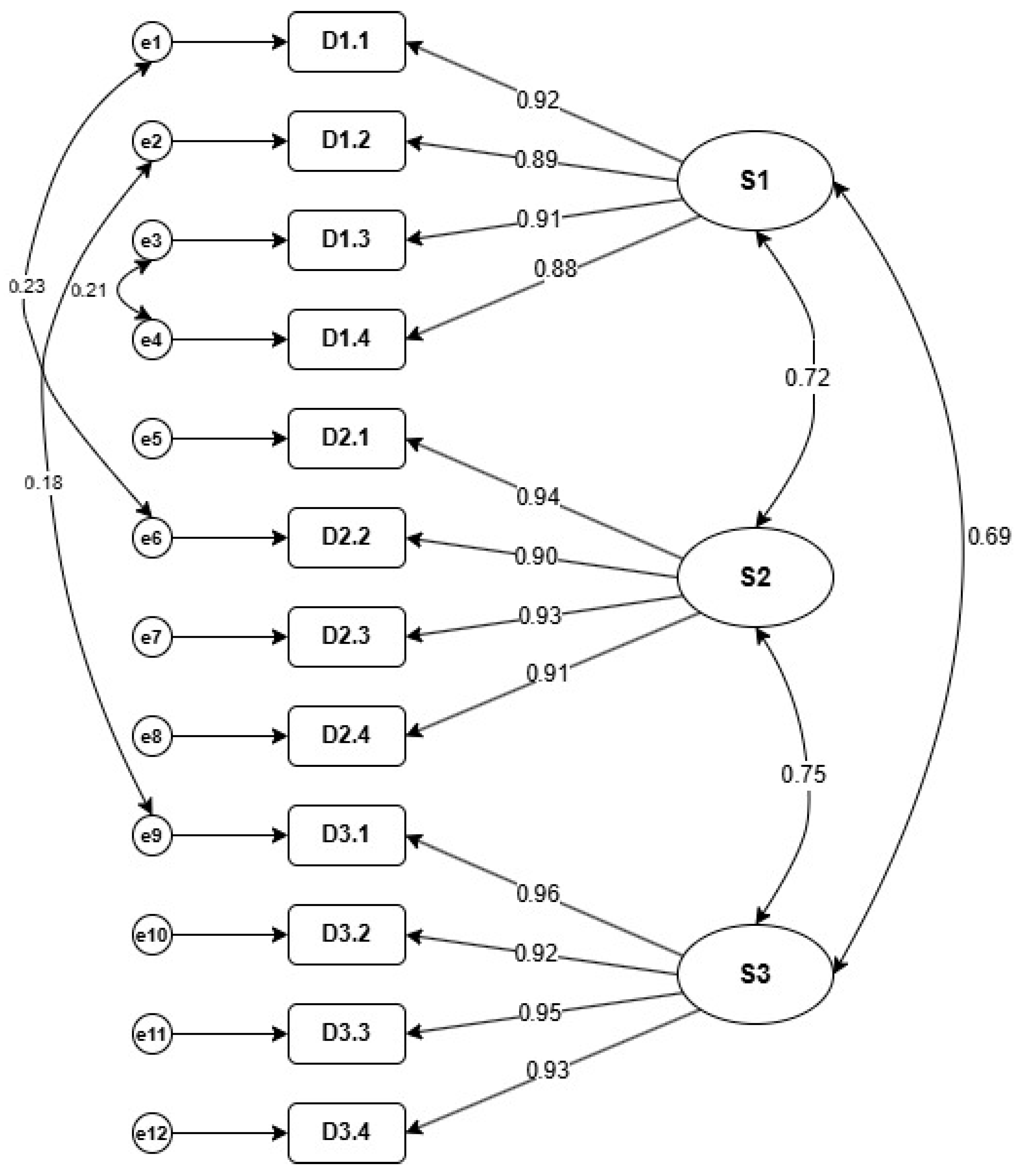
To evaluate the exploratory factor solution, we conducted a confirmatory factor analysis. The theoretical model we tested (path diagram—Figure 1) is a hypothetical representation of the factorial structures derived from a set of 12 observable variables related to satisfaction. This model considers the results of the exploratory factorial analysis presented earlier. Specifically, the theoretical model assumes that the 12 observed variables can be reduced to a number of 3 latent factors (unobservable factors).
To test the theoretical model built by us, we rely on several statistical tests to determine the adequacy of model fit to the data—“goodness of fit” test. More specifically, acceptance or rejection of the model was based on the interpretation of the index values of the following goodness-of-fit tests: RMR, GFI, TLI, and RMEA (Table 4).Thus, considering the values of the goodness of fit tests indexes (Table 4) and the critical values requirements for this kind of tests (RMSEA < 0.06, GFI > 0.90, CFI > 0.90, TLI ≥ 0.95, RMR < 0.08—Hair et al., 2010; Schreiber et al., 2006) the model meets the requirement of goodness-of-fit since the values of these indexes meet their respective cut-off critical values requirements.
While Table 4 reports numerical goodness-of-fit indices, Figure 1 (path diagram) complements these results by visually illustrating the connection of measurement structure of o the latent constructs. In that sense, Figure 1 provides a graphical representation of the confirmatory factor analysis (CFA) measurement model and illustrates the strength of the relationships between the latent dimensions of performance appraisal satisfaction and their observed indicators.
All standardized factor loadings (standardized regression weights) are substantial and exceed recommended thresholds, indicating that each item contributes meaningfully to its respective latent construction.
As illustrated in Figure 1, the standardized regression weights between the latent constructs and their indicators range from approximately 0.79 to 0.94, confirming strong convergent validity. The positive and significant correlations among the latent variables (R1–R3) indicate that S1, S2, and S3 are interrelated yet empirically distinct dimensions, while the inclusion of theoretically justified correlated error terms reflects shared item-specific variance without compromising the factorial structure.
Conversely, we evaluated the reliability and validity of our proposed factorial model. Specifically, we assessed the reliability and validity of the measurement model by considering: (1) unidimensionality, (2) composite reliability, and (3) convergent validity.
In this sense, the value of factor loading (standardized regression weights) was used to assess the unidimensionality of the model. In accordance with the factor loading values obtained (Table 5), unidimensionality was achieved (since the value of factor loadings meets the cut-off point value of above 0.6—Hair et al., 2010). Composite and convergent validity were assessed through Average Variance Extracted (AVE) and Composite Reliability (CR). We must note that the required levels of AVE and CR should be equal to or more than 0.5 and 0.6, respectively (Hair et al., 2010).
As can be seen (Table 5), dimension S3 has the highest AVEA and CR values, even if the differences are small. Therefore, dimension S3, compared to dimensions S1 and S2, presents the highest internal coherence and the strongest relationship with its indicators.
In conclusion, we can state that our proposed factorial model (measurement model) is deemed acceptable. All standardized factor loadings (standardized regression weights) are substantial and exceed recommended thresholds, indicating strong convergent validity. The correlations between latent factors suggest that, while conceptually distinct, satisfaction with the performance rating, the appraisal system, and the rater are interrelated components of a broader evaluative experience. In other words, we can regard the model as a solid theoretical explanation of the assumed factorial structure.

5. Discussion and Practical Implications

5.1. Discussion

The principal finding strongly suggests that PAS is not a unidimensional construct, but rather a multidimensional one, characterized by at least three fundamental dimensions: (1) satisfaction with the most recent performance rating; (2) satisfaction with the appraisal system; and (3) satisfaction with the rater. In that sense, the latent factor satisfaction with the most recent performance rating (S1) is strongly reflected by items capturing perceived fairness, accuracy, and correspondence between the rating and actual work performance, supporting the distributive justice perspective. Satisfaction with the performance appraisal system (S2) demonstrates high loadings on items related to clarity of objectives, evaluation procedures, and perceived usefulness, reinforcing the role of procedural justice and system utility emphasized in HRM literature. Satisfaction with the rater (S3) is strongly associated with items capturing supervisory support, interest in professional difficulties, and seriousness in conducting appraisal interviews, highlighting the relational and interactional dimension of performance appraisal (interpersonal/interactional justice).
The correlations between the three latent factors indicate that, although conceptually distinct, the dimensions of performance appraisal satisfaction are interrelated. This pattern supports the theoretical assumption that appraisal outcomes, system characteristics, and rater behavior jointly shape employees’ overall appraisal satisfaction rather than operating independently. Although the three latent dimensions are conceptually distinct and equally valid, the exploratory and confirmatory analyses indicate that satisfaction with the rater (S3) emerges as the most structurally central dimension exhibiting the highest measurement robustness. This conclusions also align with recent research (Bernardin et al., 2016; Embi & Choon, 2014; Odetunde, 2022), which suggests recognizing the importance of the “rater-rated” relationship (interactional justice) and rater’s defining role as a critical mediator: the individual who transforms the technical and standardized architecture of the appraisal system into a phenomenological experience of interactional justice. However, unlike studies conducted in corporate settings, where distributive justice and appraisal outcomes tend to dominate employees’ reactions, the present results suggest that, in social work, interactional and procedural dimensions play a comparatively stronger role. Indeed, our results indicate that social workers place higher value not only on distributive justice but also on the perceived fairness of the process. This discrepancy can be explained by the altruistic nature of social work, where qualitative feedback and professional development are valued over purely quantitative metrics (Banks, 2012; Kadushin & Harkness, 2014). While modern public management systems tend to prioritize efficiency and quantifiable performance indicators, the professional identity of social workers remains anchored in an ‘ethics of care’ and a commitment to the continuous development of relational competencies—processes that inherently elude rigid numerical measurements (Healy, 2005; Horwath & Morrison, 1999). On the other hand, the multidimensional nature of the PA implies that HRM departments in public social services should shift their focus from refining rating scales to training supervisors in providing empathetic and constructive feedback. This pattern aligns with previous research emphasizing the relational and value-driven nature of human service professions (Kadushin & Harkness, 2014; K. O’Donoghue, 2015) and highlights the contextual specificity of appraisal satisfaction mechanisms within public social services. By validating a multidimensional model, this study fills a gap in the literature regarding how these dimensions interact within the specific, high-stress environment of social work.

5.2. Practical Implications

The validated multidimensional model significantly enhances our understanding of PAS among social workers by elucidating its intricate dimensional framework. The direct applicability of these findings can be outlined as follows:
First, the identification of PAS as a multidimensional construct (encompassing satisfaction with the recent rating, the appraisal system, and the evaluator) necessitates that any initiative aimed at developing or improving PAS must consider these multiple dimensions. Limiting measurements to a single dimension would be insufficient to achieve a comprehensive understanding of employee satisfaction. Second, the validated model provides a more precise diagnostic tool for identifying specific inefficiencies or inconsistencies within current appraisal systems. This precision enables organizations to implement targeted organizational interventions, fostering the creation of more equitable, relevant, and development-oriented PAS. For instance, if social workers report low satisfaction with the ‘rater’ dimension, specific training for supervisors on providing constructive feedback and demonstrating interest in professional difficulties could be implemented. Thirdly, the research findings offer a practical instrument for public administration policymakers who seek to design fairer and more effective evaluation systems for social workers. Consistent measurement of the three identified dimensions is critical for ensuring a sustainable and complete PA process, maintaining a high level of motivation, and supporting the professional development of public servants. This contributes to better resource allocation and policy adjustments aligned with the actual needs and perceptions of social workers. Last but not least, by recognizing the distinct influence of each dimension, organizations can provide clearer and more specific feedback, thereby fostering professional growth and enhancing the social workers’ sense of being valued. The emphasis on the quality of feedback and linking appraisals to professional development opportunities can directly contribute to increased satisfaction.
On the other hand, the proposed and validated multidimensional model of PAS is crucial for various reasons, challenging existing simplified approaches and offering a robust framework for practical implementation. In this sense, the model tested directly challenges the sufficiency of simplified or unidimensional methodologies for assessing professional attitude satisfaction. A unidimensional approach is inherently limited and fails to provide an exhaustive or clear understanding of a complex concept like satisfaction with EP. The study’s empirical validation, via both EFA and CFA, substantiates the necessity of a multifaceted view. Understanding that satisfaction is influenced by factors such as perceived fairness (procedural and distributive justice), quality of feedback, and trust in evaluators allows organizations to address these aspects directly. When performance evaluations are perceived as meaningful and equitable, they can significantly enhance motivation, job engagement, and employee retention. Conversely, poorly designed or perceived unfair appraisal systems can contribute to burnout, decreased motivation, and increased turnover rates among social workers. Ultimately, comprehending these multiple facets of satisfaction is crucial for fostering employee motivation, organizational justice, and professional development, which are integral to both individual professional performance and overall organizational performance. The model offers a solid foundation for public social care institutions aimed at improving the sustainability and relevance of performance appraisal processes, concurrently supporting long-term professional development within the public sector.
From a practical perspective, this validated multidimensional model offers concrete implications for public social service organizations. By distinguishing between satisfaction with the performance rating, the appraisal system, and the rater, managers can identify specific sources of dissatisfaction and implement targeted interventions. For social workers, improvements in rater behavior, feedback quality, and procedural transparency may enhance perceived organizational support, professional motivation, and trust in appraisal processes, thereby contributing to reduced burnout and improved retention in a sector facing chronic staffing challenges.
Beyond supporting existing perspectives on PAS, the validated model delineates clear analytical boundaries between outcome-related, system-related, and relational components, thereby reducing conceptual overlap and enabling more precise organizational diagnostics in public social service settings

6. Conclusions

This research successfully addressed the need for a context-specific validation of the PAS scale within the Romanian social work sector. The main theoretical contribution of this study lies in the empirical operationalization and validation of a justice-based, multidimensional model of PAS within the underexplored context of public social services.
In that sense, the objective of this research was to explore and delineate the multifaceted nature of PAS among social workers within the context of local public administration in Romania. The findings of this study are consistent with prior research indicating that PAS is a multidimensional construct rather than a unitary attitude (Kuvaas, 2006; Dusterhoff et al., 2014; Bayo-Moriones et al., 2020; Rodrigues et al., 2023).Additionally, the study aimed to test and validate a theoretical model pertaining to this concept with potentially sensitive ramifications for social workers and social care organizations alike. Gaining insight into the determinants that influence social workers’ satisfaction with PA is crucial not only for enhancing individual motivation but also for the development of effective PA systems. Furthermore, this understanding bears significant implications for organizational justice and the overall efficacy of institutions.
In essence, the multidimensional model not only refines the academic understanding of PAS but also provides a clear and actionable guide for optimizing HR practices in public administration, particularly within the challenging and complex field of social work. Overall, this study provides a theoretically grounded and empirically robust validation of a multidimensional, justice-based model of PAS within the specific context of public social services. By integrating EFA and CFA approaches, the findings demonstrate both the structural coherence and contextual relevance of the proposed dimensions. Taken together, these results strengthen the generalizability of organizational justice theory to human service professions while offering a parsimonious and practically applicable measurement framework for public administration research.

Limitations and Future Research

This study has several limitations that should be acknowledged. The relatively small sample size may limit the robustness of CFA results, and the focus on a single development region restricts generalizability. Additionally, reliance on self-reported data raises the possibility of common method bias. Future research should replicate the proposed model using larger and more diverse samples, explore longitudinal designs, and examine how PAS dimensions relate to outcomes such as performance, well-being, and retention over time.

Funding

This research received no external funding.

Institutional Review Board Statement

Ethical review and approval were waived for this study due to The article involves a survey applied to social workers, with anonymous responses and a prior accord for participation manifested by the respondents. The social workers who responded to the questionnaire had been informed previously regarding their anonymity, the fact that their responses will be used only the this research only, and the fact that no identity associated with their person will be included in the article. In this sense we investigate in our article human’s perspective on a subject related to performance evaluation/human’s opinion, and not medical/data associated directly with the identity of a person. In this sense, according to the Babes Bolyai University Code of Ethics (available here: https://www.ubbcluj.ro/en/despre/organizare/comisia_de_etica, accessed on 1 February 2026) no Ethical Committee is required (it is applicable only for research that involves medical research on humans).

Informed Consent Statement

Informed consent was obtained from all subjects involved in the study.

Data Availability Statement

The data that support the findings of this study are available on request from the corresponding author Raboca Horia Mihai. Final data interpretations are also available in the article.

Conflicts of Interest

The authors declare no conflict of interest.

References

  1. Aguinis, H. (2009). Performance management (2nd ed.). Prentice Hall/Pearson Education. [Google Scholar]
  2. Aleassa, H. M. (2014). Performance appraisal satisfaction and counterproductive behaviors: Direct and moderating effects. International Journal of Business Administration, 5(1), 76–89. [Google Scholar] [CrossRef]
  3. Ali, M., Sami, I., & Hassan, M. (2022). Relationship of organizational justice, performance appraisal with employee work performance & organizational commitment: Evidence from microfinance banks. Journal of Social & Organizational Matters, 1(2), 69–86. [Google Scholar]
  4. Baird, B. N. (2011). The internship, practicum, and field placement handbook: A guide for helping professions. Pearson. [Google Scholar]
  5. Banks, S. (2012). Ethics and values in social work (4th ed.). Palgrave Macmillan. [Google Scholar]
  6. Bayo-Moriones, A., Galdon-Sanchez, J. E., & Martinez-de-Morentin, S. (2020). Performance appraisal: Dimensions and determinants. The International Journal of Human Resource Management, 31(15), 1984–2015. [Google Scholar] [CrossRef]
  7. Bernardin, H. J., Thomason, S., Buckley, R. M., & Kane, J. S. (2016). Rater rating-level bias and accuracy in performance appraisals: The impact of rater personality, performance management competence, and rater accountability. Human Resource Management, 55(2), 321–340. [Google Scholar] [CrossRef]
  8. Braeken, J., & Van Assen, M. A. (2017). An empirical Kaiser criterion. Psychological Methods, 22(3), 450–466. [Google Scholar] [CrossRef]
  9. Brown, M., Douglas, H., & Benson, J. (2010). Consequences of the performance appraisal experience. Personnel Review, 39(3), 375–396. [Google Scholar] [CrossRef]
  10. Canet-Giner, T., Redondo-Cano, A., Saorín-Iborra, C., & Escribá-Carda, N. (2020). Impact of the perception of performance appraisal practices on individual innovative behavior. European Journal of Management and Business Economics, 29(3), 277–296. [Google Scholar]
  11. Carey, M. (2008). Everything must go? The privatization of state social work. The British Journal of Social Work, 38(5), 918–935. [Google Scholar] [CrossRef]
  12. Chen, C. J., & Huang, J. W. (2009). Strategic human resource practices and innovation performance: The mediating role of knowledge management capacity. Journal of Business Research, 62(1), 104–114. [Google Scholar] [CrossRef]
  13. Colquitt, J. A., Conlon, D. E., Wesson, M. J., Porter, C. O., & Ng, K. Y. (2001). Justice at the millennium: A meta-analytic review of 25 years of organizational justice research. Journal of Applied Psychology, 86(3), 425–445. [Google Scholar] [CrossRef]
  14. Colvin, A. J. (2017). Conflict resolution and procedural justice in the workplace. Oxford University Press. [Google Scholar]
  15. Cooper, M. G., & Lesser, J. G. (2017). Clinical social work practice: An integrated approach. Pearson. [Google Scholar]
  16. Costello, A. B., & Osborne, J. W. (2005). Best practices in exploratory factor analysis: Four recommendations for getting the most from your analysis. Practical Assessment, Research & Evaluation, 10(7), 1–9. [Google Scholar]
  17. Culbertson, S. S., Henning, J. B., & Payne, S. C. (2013). Performance appraisal satisfaction: The role of feedback and goal orientation. Journal of Personnel Psychology, 12(4), 189–195. [Google Scholar] [CrossRef]
  18. Dangol, P. (2021). Role of performance appraisal system and its impact on employees motivation. Quantitative Economics and Management Studies, 2(1), 13–26. [Google Scholar] [CrossRef]
  19. Dasanayaka, C. H., Abeykoon, C., Ranaweera, R. A., & Koswatte, I. (2021). The impact of the performance appraisal process on job satisfaction of the academic staff in higher educational institutions. Education Sciences, 11(10), 623. [Google Scholar] [CrossRef]
  20. DeNisi, A., & Murphy, K. R. (2017). Performance appraisal and performance management: 100 years of progress? Journal of Applied Psychology, 102(3), 421–433. [Google Scholar] [CrossRef] [PubMed]
  21. DeNisi, A., & Smith, C. E. (2014). Performance appraisal, performance management, and firm-level performance: A review and research agenda. Academy of Management Annals, 8(1), 127–179. [Google Scholar] [CrossRef]
  22. DeNisi, A. S., & Pritchard, R. D. (2006). Performance appraisal, performance management and improving individual performance: A motivational framework. Management and Organization Review, 2(2), 253–277. [Google Scholar] [CrossRef]
  23. Dodu, M., & Raboca, H. (2025). Evaluareaperformanțelorindividualeînsectorul public din România—O analiză a modelului multidimensional de apreciereprofesională. RevistaTransilvană de Științe Administrative, 1(55), 70–84. [Google Scholar]
  24. Dusterhoff, C., Cunningham, J. B., & MacGregor, J. N. (2014). The effects of performance rating, leader–member exchange, perceived utility, and organizational justice on performance appraisal satisfaction: Applying a moral judgment perspective. Journal of Business Ethics, 119(2), 265–273. [Google Scholar] [CrossRef]
  25. Elsayed, W., Baskiewicz, N., Yousif, N. B. A., & Borisov, V. (2021). Job satisfaction of public social workers. Administrațiesi Management Public, 36, 134–148. [Google Scholar] [CrossRef]
  26. Embi, M. A., & Choon, L. K. (2014). Rater’s intention towards appraising accurately. Jurnal Studi Pemerintahan, 5(2), 152–168. [Google Scholar] [CrossRef][Green Version]
  27. Erdogan, B. (2002). Antecedents and consequences of justice perceptions in performance appraisals. Human Resource Management Review, 12(4), 555–578. [Google Scholar] [CrossRef]
  28. Etalong, T. A., & Chikeleze, F. O. (2022). The impact of a performance appraisal and reward system on employee workload delivery. Global Journal of Human Resource Management, 10(3), 51–58. [Google Scholar] [CrossRef]
  29. Fakhimi, F., & Raisy, A. (2013). Satisfaction with performance appraisal from the employees’ perspective and its behavioral outcomes (Case study of headquarters offices of Bank Refah). European Online Journal of Natural and Social Sciences, 2(3), 296–305. [Google Scholar]
  30. Geisler, M., Berthelsen, H., & Muhonen, T. (2019). Retaining social workers: The role of quality of work and psychosocial safety climate for work engagement, job satisfaction, and organizational commitment. Human Service Organizations: Management, Leadership & Governance, 43(1), 1–15. [Google Scholar] [CrossRef]
  31. Giménez-Bertomeu, V. M., Caravaca-Sánchez, F., de Alfonseti-Hartmann, N., & Ricoy-Cano, A. J. (2024). Burnout among social workers in social services: A systematic review and meta-analysis of prevalence. Journal of Social Service Research, 50(4), 664–683. [Google Scholar] [CrossRef]
  32. Greenberg, J. (2011). Organizational justice: The dynamics of fairness in the workplace. In S. Zedeck (Ed.), APA handbook of industrial and organizational psychology (Vol. 3, pp. 271–327). American Psychological Association. [Google Scholar]
  33. Hair, J., Black, W. C., Babin, B. J., & Anderson, R. E. (2010). Multivariate data analysis (7th ed.). Pearson Prentice Hall. [Google Scholar]
  34. Healy, K. (2005). Social work theories in context: Creating frameworks for practice. Palgrave Macmillan. [Google Scholar]
  35. Horwath, J., & Morrison, T. (1999). Effective staff training in social care: From theory to practice (1st ed.). Routledge. [Google Scholar] [CrossRef]
  36. Hülsheger, U. R., & Schewe, A. F. (2011). On the costs and benefits of emotional labor: A meta-analysis of three decades of research. Journal of Occupational Health Psychology, 16(3), 361–389. [Google Scholar] [CrossRef]
  37. Iancu, D. C. (2012). Re(de)-forming public administration: An expert outlook on reform planning in Romania. Theoretical and Applied Economics, 8(573), 96–117. [Google Scholar]
  38. Iqbal, M. Z., Akbar, S., Budhwar, P., & Shah, S. Z. A. (2019). Effectiveness of performance appraisal: Evidence on the utilization criteria. Journal of Business Research, 101, 285–299. [Google Scholar] [CrossRef]
  39. Ismail, H. N., & Rishani, M. (2018). The relationships among performance appraisal satisfaction, career development and creative behavior. The Journal of Developing Areas, 52(3), 109–124. [Google Scholar] [CrossRef]
  40. Jaffu, R. (2023). Performance appraisal, career development and employee performance: Implications from procurement professionals. Business Management Review, 26(2), 93–111. [Google Scholar] [CrossRef]
  41. Jawahar, I. M. (2007). The influence of perceptions of fairness on performance appraisal reactions. Journal of Labor Research, 28(4), 735–754. [Google Scholar] [CrossRef]
  42. Judge, T. A., & Ferris, G. R. (1993). Social context of the performance evaluation decisions. Academy of Management Journal, 36(1), 80–105. [Google Scholar] [CrossRef]
  43. Kadushin, A., & Harkness, D. (2014). Supervision in social work (5th ed.). Columbia University Press. [Google Scholar]
  44. Kampkötter, P. (2017). Performance appraisals and job satisfaction. The International Journal of Human Resource Management, 28(5), 750–774. [Google Scholar] [CrossRef]
  45. Karimi, R., Malik, M. I., & Hussain, S. (2011). Examining the relationship of performance appraisal system and employee satisfaction. International Journal of Business and Social Science, 2(22), 243–247. [Google Scholar]
  46. Keeping, L. M., & Levy, P. E. (2000). Performance appraisal reactions: Measurement, modeling, and method bias. Journal of Applied Psychology, 85(5), 708–723. [Google Scholar] [CrossRef]
  47. Khan, M. H., Hussain, A., & Khan, M. A. (2020). The importance of organizational justice, appraisal purposes and employee satisfaction in performance appraisal system in academic sector of Pakistan. Journal of Accounting and Finance in Emerging Economies, 6(1), 191–200. [Google Scholar] [CrossRef]
  48. Kim, T., & Holzer, M. (2014). Public employees and performance appraisal: A study of antecedents to employees’ perception of the process. Review of Public Personnel Administration, 36(1), 31–56. [Google Scholar] [CrossRef]
  49. Klingner, D. E., & Nalbandian, J. (1993). Public personnel management: Context and strategies. Prentice Hall. [Google Scholar]
  50. Kuvaas, B. (2006). Performance appraisal satisfaction and employee outcomes: Mediating and moderating roles of work motivation. The International Journal of Human Resource Management, 17(3), 504–522. [Google Scholar] [CrossRef]
  51. Lameque, I. d. C., Velez, M. J. P., & Botelho, C. M. D. A. (2023). Purposes of performance appraisal: A systematic review and agenda for future research. International Journal of Professional Business Review, 8(7), e02274. [Google Scholar] [CrossRef]
  52. Levy, P. E., & Williams, J. R. (2004). The social context of performance appraisal: A review and framework for the future. Journal of Management, 30(6), 881–905. [Google Scholar] [CrossRef]
  53. Lira, M. (2014). Satisfaction with a performance appraisal system in the Portuguese public sector: The importance of perceptions of justice and accuracy. Tékhne, 12(1), 30–37. [Google Scholar] [CrossRef]
  54. Loga, P., & Chand, A. (2020). Performance appraisal systems and public sector efficiency in small island developing states: The case of Fiji. Personnel Review, 49(4), 974–992. [Google Scholar] [CrossRef]
  55. London, M., & Smither, J. W. (2002). Feedback orientation, feedback culture, and the longitudinal performance management process. Human Resource Management Review, 12(1), 81–100. [Google Scholar] [CrossRef]
  56. Lyu, B., Su, W., Qi, Q., & Xiao, F. (2023). The influence of performance appraisal justice on employee job performance: A dual path model. Sage Open, 13(3), 1–15. [Google Scholar] [CrossRef]
  57. Manzoor, F., Wei, L., & Asif, M. (2021). Intrinsic rewards and employee’s performance with the mediating mechanism of employee’s motivation. Frontiers in Psychology, 12, 563070. [Google Scholar] [CrossRef] [PubMed]
  58. McClendon, J. A., Deckop, J. R., Han, S., & Petrucci, T. (2020). A study of system execution of performance appraisal. International Journal of Selection and Assessment, 28(3), 322–336. [Google Scholar] [CrossRef]
  59. Memon, M. A., Salleh, R., Mirza, M. Z., Cheah, J.-H., Ting, H., Ahmad, M. S., & Tariq, A. (2021). Satisfaction matters: The relationships between HRM practices, work engagement and turnover intention. International Journal of Manpower, 42(1), 21–50. [Google Scholar] [CrossRef]
  60. Nagi, S., Ishaq, H. M., & Malik, S. A. (2024). Performance appraisal satisfaction outcomes in the FMCS sector in Pakistan. Kashf Journal of Multidisciplinary Research, 1(11), 15–27. [Google Scholar]
  61. Naji, A., Mansour, J. B., & Leclerc, A. (2015). Performance appraisal system and employee satisfaction: The role of trust towards supervisors. Journal of Human Resources Management and Labor Studies, 3(1), 40–53. [Google Scholar] [CrossRef][Green Version]
  62. Odetunde, O. (2022). Revisiting performance appraisal measurement: Construction and validation of Rater Bias Scale. Organizational Psychology, 12(4), 123–143. [Google Scholar] [CrossRef]
  63. O’Donoghue, K. (2015). Issues and challenges facing social work supervision in the twenty-first century. China Journal of Social Work, 8(2), 136–149. [Google Scholar] [CrossRef]
  64. O’Donoghue, K., & Tsui, M. (2015). Social work supervision research (1970–2010): The way we were and the way ahead. British Journal of Social Work, 45(2), 616–633. [Google Scholar] [CrossRef]
  65. O’Donoghue, K. B. (2019). Registered social workerswho are supervisors: A nationalsurvey. Aotearoa New Zealand Social Work, 31(3), 97–115. [Google Scholar] [CrossRef]
  66. Organ, D. W. (1988). Organizational citizenship behavior: The good soldier syndrome. Lexington Books. [Google Scholar]
  67. Ozigi, O. A., & Onyeukwu, P. E. (2022). Performance appraisal fairness on employee’s performance in the Nigeria Television Authority (NTA), Abuja, Nigeria. Journal of International Business Research and Marketing, 7(3), 22–35. [Google Scholar] [CrossRef]
  68. Palaiologos, A., Papazekos, P., & Panayotopoulou, L. (2011). Organizational justice and employee satisfaction in performance appraisal. Journal of European Industrial Training, 35(8), 826–840. [Google Scholar] [CrossRef]
  69. Reamer, F. G. (2015). Social work values and ethics (4th ed.). Columbia University Press. [Google Scholar]
  70. Rodrigues, R. I., Gomes, C., & Junça-Silva, A. (2023). The role of satisfaction with the performance appraisal: A comparative study between the public and private sectors. Revista Brasileira de Gestão de Negócios, 25(1), 72–87. [Google Scholar]
  71. Rodrigues, R. I., Silva, A. J., & Lopes, C. (2026). Development and validation of a Satisfaction Questionnaire for Performance Appraisal Evaluation (SQPAE): A measurement instrument. Psicologia: Reflexão e Crítica, 39(2), 1–10. [Google Scholar] [CrossRef]
  72. Rosales Padilla, N. V., Carlos Ornelas, C. E., & Gómez García, M. T. (2024). Evaluación de desempeño e Intención de mejora en empleados de empresas manufactureras. Vértice Universitario, 26(95). [Google Scholar] [CrossRef]
  73. Rubin, E. V., & Edwards, A. (2018). The performance of performance appraisal systems: Understanding the linkage between appraisal structure and appraisal discrimination complaints. The International Journal of Human Resource Management, 31(15), 1938–1957. [Google Scholar] [CrossRef]
  74. Ruch, G. (2005). Relationship-based practice and reflective practice: Holistic approaches to contemporary childcare social work. Child & Family Social Work, 10(2), 111–123. [Google Scholar]
  75. Schreiber, J. B., Nora, A., Stage, F. K., Barlow, E. A., & King, J. (2006). Reporting structural equation modeling and confirmatory factor analysis results: A review. The Journal of Educational Research, 99(6), 323–338. [Google Scholar] [CrossRef]
  76. Selden, S., & Sowa, J. E. (2011). Performance management and appraisal in human service organizations: Management and staff perspectives. Public Personnel Management, 40(3), 251–264. [Google Scholar] [CrossRef]
  77. Speer, A. B., Tenbrink, A. P., & Schwendeman, M. G. (2020). Creation and validation of the Performance Appraisal Motivation Scale (PAMS). Human Performance, 33(2–3), 214–240. [Google Scholar] [CrossRef]
  78. Subekti, A. (2021). The influence of performance appraisal system towards job satisfaction, motivation, as well as employee performance. International Journal of Economics, Business and Accounting Research (IJEBAR), 5(2), 104–114. [Google Scholar]
  79. Tahiri, A., Kovaçi, I., & Krasniqi, A. (2020). Human resource management, performance management and employee performance appraisal by SME managers in Kosovo. International Journal of Economics and Business Administration, 8(4), 288–298. [Google Scholar] [CrossRef]
  80. Tavares, M. C., & Vaz, M. (2025). Rethinking performance evaluation: Strategic alignment in the service sector through a case-based framework. Administrative Sciences, 15(10), 390. [Google Scholar] [CrossRef]
  81. Tham, P., & Meagher, G. (2009). Working in human services: How do experiences and working conditions in child welfare social work compare? British Journal of Social Work, 39(5), 807–827. [Google Scholar] [CrossRef]
  82. Thibault-Landry, A., Egan, R., Crevier-Braud, L., Manganelli, L., & Forest, J. (2018). An empirical investigation of the employee work passion appraisal model using self-determination theory. Advances in Developing Human Resources, 20(2), 148–168. [Google Scholar] [CrossRef]
  83. Thurston, P. W., & McNall, L. (2020). Justice perceptions of performance appraisal practices. Journal of Managerial Psychology, 35(4), 246–260. [Google Scholar] [CrossRef]
  84. Travis, D. J., Lizano, E. L., & Mor Barak, M. E. (2016). ‘I’m so stressed!’: A longitudinal model of stress, burnout and engagement among social workers in child welfare settings. British Journal of Social Work, 46(4), 1076–1095. [Google Scholar] [CrossRef] [PubMed]
  85. Ugoani, J. (2020). Performance appraisal and its effect on employees’ productivity in charitable organizations. Business, Management and Economics Research, 6(12), 166–175. [Google Scholar] [CrossRef]
  86. Ushakov, D. (2021). The role of equity and justice in mediating the relationship between performance appraisal and employee performance: Evidence from Lebanon. The Journal of Asian Finance, Economics and Business, 8(8), 625–635. [Google Scholar]
  87. Warokka, A., Gallato, C., Thamendren, & Moorthy. (2012). Organizational justice in performance appraisal system and work performance: Evidence from an emerging market. Journal of Human Resources Management Research, 2012, 159467. [Google Scholar] [CrossRef][Green Version]
  88. Wolf, E. J., Harrington, K. M., Clark, S. L., & Miller, M. W. (2013). Sample size requirements for structural equation models: An evaluation of power, bias, and solution propriety. Educational and Psychological Measurement, 73(6), 913–934. [Google Scholar] [CrossRef]
  89. Yun, L., Mohsin, A., & Tayyab, A. (2024). Role of performance appraisal justice on employee performance: Mediating role of work engagement. Journal of Business and Management Studies, 6(5), 106–112. [Google Scholar] [CrossRef]
  90. Zoghbi-Manrique de Lara, P., & Verano-Tacoronte, D. (2007). Investigating the effects of procedural justice on workplace deviance. Do employees’ perceptions of conflicting guidance call the tune? International Journal of Manpower, 28(8), 715–729. [Google Scholar] [CrossRef]
Figure 1. Graphical representation of cause-and-effect relationships of the factorial model. (Path diagram of the measurement model—standardized regression weights). Note: S1 = Satisfaction with the most recent performance rating (latent factor); S2 = Satisfaction with the performance appraisal system (latent factor); S3 = Satisfaction with the rater (latent factor). Observed variables (D1.1–D3.4) correspond to questionnaire items. Single-headed arrows represent standardized regression weights from latent variables to observed indicators, while double-headed curved arrows represent correlations between latent factors.
Admsci 16 00089 g001
Table 1. Structure of the Questionnaire (no.of items).
1. Satisfaction with the most recent performance rating
1.1I am satisfied with the performance rating I received for the whole last year’s work.
1.2My recent job performance rating was fair.
1.3My recent job performance rating reflects what I really did on the job.
1.4My recent job performance rating was accurate.
2. Satisfaction with the performance appraisal system
2.1Overall, I am satisfied with the performance appraisal system.
2.2I am satisfied with the way the performance appraisal system is used to set my professional objectives for each rating period
2.3I am satisfied with the way the performance appraisal system is used to evaluate and rate my performance.
2.4I am satisfied with the way the performance appraisal system helps me improve my job performance.
3. Satisfaction with the rater
3.1I am satisfied with the way my rater shows interest to discuss/takes interest in discussing my professional difficulties in each performance appraisal interview session.
3.2I am satisfied with the amount of support and guidance from my rater.
3.3Overall, I am satisfied with the quality of supervision I receive at work from my rater.
3.4My rater takes the performance appraisal process seriously.
Table 2. Factor loadings (rotated component matrix).
Observable VariableComponent
123
1.1. I am satisfied with the performance rating I received for the whole of last year’s workD1.10.2290.2160.892
1.2. My recent job performance rating was fairD1.20.2140.1960.907
1.3. My recent job performance rating reflects what I really did on the
JobD1.3
0.2140.2740.788
1.4. My recent job performance rating was accurateD1.40.1640.1780.900
2.1. Overall, I am satisfied with the performance appraisal systemD2.10.0950.9030.232
2.2. I am satisfied with the way the performance appraisal system is used to set my professional objectives for each rating periodD2.20.0510.9330.191
2.3. I am satisfied with the way the performance appraisal system is used to evaluate and rate my performanceD2.30.0660.9170.250
2.4. I am satisfied with the way the performance appraisal system helps me improve my job performanceD2.40.0880.7980.126
3.1. I am satisfied with the way my rater shows interest to discuss/takes interest in discussing my professional difficulties in each performance appraisal interview sessionD3.10.8750.0950.172
3.2. I am satisfied with the amount of support and guidance from my raterD3.20.9360.0430.197
3.3. Overall, I am satisfied with the quality of supervision I receive at work from my raterD3.30.8840.0800.267
3.4. My rater takes the performance appraisal process seriouslyD3.40.9180.0890.133
Table 3. Parameters of the Exploratory Factor Analysis Model.
Kaiser–Meyer–Olkin Measure of Sampling Adequacy0.879
Bartlett’s Test of SphericityApprox. Chi-Square2579.927
df66
Sig.0.000
Extraction Method:Principal Component Analysis (based on Eigenvalue 1)
Rotation Method:Varimax (with Kaiser Normalization)
Table 4. Fit results for goodness of fit tests.
Goodness of Fit TestsRMSAGFICFITLIRMR
values0.0240.9620.9980.9970.022
Table 5. Reliability and validity of the model items.
ItemsFactor Loading
(Standardized Regression Weights)
p-ValueAverage Variance Extracted
AVE
Composite
Reliability
(CR)
S1 0.79830.940
D1.10.95***
D1.20.96***
D1.30.77***
D1.40.88***
S2 0.79340.938
D2.10.919***
D2.20.958***
D2.30.957***
D2.40.704***
S3 0.81540.946
D3.10.842***
D3.20.963***
D3.30.908***
D3.40.895***
*** p-value: 0.000.
Disclaimer/Publisher’s Note: The statements, opinions and data contained in all publications are solely those of the individual author(s) and contributor(s) and not of MDPI and/or the editor(s). MDPI and/or the editor(s) disclaim responsibility for any injury to people or property resulting from any ideas, methods, instructions or products referred to in the content.