


Abstract
Government managers should understand the determinants of work commitment, a people analytics metric. This study focuses on training, involvement, clarity of organisational goals, and performance feedback. According to Social Exchange Theory (SET), these predictors are salient, and the literature review suggests that there is little or no existing literature related to the South African government department. This study was conducted to expand the body of knowledge of SET, using a quantitative approach and a cross-sectional case study design within the South African government department. Subsequently, 260 respondents were selected, who completed a validated closed-ended questionnaire. The data were analysed in SMART PLS 4, using structural equation modelling for analysis. The key findings determined that training predicted involvement most strongly (β = 0.377, t = 6.171, p < 0.05), and involvement mediated the relationship between training and clarity on organisational goals (β = 0.096, t = 2.716, p < 0.05). Moreover, it found that clarity on organisational goals was a significant predictor of work commitment (β = 0.257, t = 3.638, p < 0.05). The priority–performance map analysis (IPMA) ranked priority highest but performance lowest, revealing insights into the organisation’s aims. The managerial implication is that the government department must strengthen the clarity of organisational goals across all levels.
1. Introduction
Research on work commitment, also known as organisational commitment, is current and of interest to academicians and people analytics practitioners (Maleka et al., 2022). The latter insight, developed from surveys or focus groups, can help generate viable strategies that could optimise employee commitment. This is vital, because we are aware that committed employees are loyal and perform optimally. On the other hand, academics have also developed theoretical frameworks on work commitment. In this study, social exchange theory (SET) was deemed appropriate, as it posits that employees expect their managers to be trained to clarify organisational goals and offer objective performance feedback. Additionally, employees expect to be involved in departmental decision-making processes, and if they are not, they may exhibit lower commitment levels.
In the context of South Africa, public sector institutions are in a difficult situation that is characterised by resource constraints, bureaucratic challenges, and efforts to improve organisations that are historically disadvantaged and affected by inequalities. Most government departments have consistent issues, such as a lack of skills, poor talent management, limited career prospects and progression, high workload, and a decision-making process which is slow and limited (K. Lee & Duffy, 2019; Mokoena et al., 2022). Such issues compound and reduce employee commitment. Furthermore, expected service delivery pressures government employees, who also do not have corresponding organisational support, particularly with low remuneration (C. Lee, 2024). Additionally, leadership capacity, inconsistent policies and organisational culture compound frustration, hence increasing staff disengagement in government employees. Increasingly, performance reviews are said to be weak, with perceptions of unfair progression, promotions, and rewards (Maleka et al., 2022; Skosana et al., 2021). The environment of work commitment in government departments within the above issues cannot be assumed, but makes a strong case for further investigation, with the focus on the predictors that undermine or sustain work commitments. The government departments’ effectiveness heavily relies on dedicated and motivated employees; hence, understanding this study within this context is very crucial, as studying work commitment at this stage remains relevant, timely, and necessary (Zainib & Sheikh, 2025; Triantafillidou & Koutroukis, 2022).
Whereas there is evidence of similar research measuring the relationship between involvement or participation and work commitment, the South African study (Skosana et al., 2021) did not measure the mediators of training and clarity regarding organisational goals or goal setting. Knowing how to set annual goals enables government departments to conduct effective strategic planning and manage performance contracts. Essentially, the quality of service depends on how government managers clarify, share, and agree with employees on annual performance goals. However, research shows that managers in the government department lack the skills to effectively provide performance feedback (Philip et al., 2025). Hence, research established that 64% are less committed, as their performance feedback is not linked to goals that were contracted, but is based on subjectivity and nepotism (Murray, 2025).
One contributing factor that leads to government managers having low commitment levels is that they are not trained to involve employees in decision-making and conducting effective performance feedback. A study performed in a government department in Zambia found that managers who were not trained in conducting performance appraisals rated employees unfairly, and not according to the contracted goal (Makombo et al., 2024). Another study conducted in Kenya’s government department found that trained managers could not give constructive feedback. The same study also revealed that their rating scores were not based on agreed-upon targets (Mwangangi, 2025).
Moreover, the literature suggests that establishing a calibration committee is another strategy to mitigate unfair performance feedback or outcomes (Grabner et al., 2020). The literature noted that this committee is mainly implemented in the private sector; therefore, its effectiveness was not measured in a government setup up such as in South Africa. Its primary function was discussing, comparing, and, in some instances, adjusting the results where the supervisor was biased and inconsistent in rating their subordinates (Bol et al., 2025).
Instead of leading to affective outcomes like low organisational commitment, poorly conducted performance appraisals might lead to organisational attrition and low levels of job satisfaction (Philip et al., 2025). In addition, an African study showed that government employees who did not put effort into their work performed dismally, and had a propensity for absenteeism, while 66% of them were disciplined for various misconducts (Hokororo & Kaijage, 2023).
The above discussion motivated the researchers conducting the current study to proceed with further exploration, as it was established that similar studies are limited in the South African government department context. Additionally, most studies mentioned above focused on work commitment without providing the interaction between work commitment and other key variables, such as clarity of goals, involvement, performance reviews, goal setting, and training, which this study seeks to cover. Hence, this study was conducted in a South African government department to contribute to the SET body of knowledge. Accordingly, when government officials are not committed, they provide poor service to communities. This leads to community members being dejected and venting their frustrations with protests (Gegana & Phahlane, 2024). This study aimed to measure work commitment within the government department. Its objectives were as follows:
- To determine how training influences goal setting.
- To establish the mediating role of involvement and performance reviews on the relationship between training and goal setting.
- To ascertain how goal setting relates to work organisation.
In the next section, the literature review and methodology are elucidated, followed by the study results. The paper concludes with a discussion section, managerial implications, recommendations for managers, and suggestions for future research.
2. Literature Review and Theoretical Framework
2.1. Social Exchange Theory (SET)
SET is a theory that affirms that voluntary actions by one party are likely to lead to reciprocal actions by another, fostering a good relationship scaffolded by mutual trust, commitment, and loyalty over time (Ahmad et al., 2023; P. Blau, 2017). The definition aligns with the understanding of employee behaviour of employees and government departments. The key aspects of this theory, as they relate to this study, are training, clear goals, performance feedback, involvement, work attitude, and work commitment.
The theory was proposed by Homans in 1958 as a foundational theory that posited that social behaviours happen when there is an exchange of material and non-material goods and services (Homans, 1958). Then, in 1964, Peter Blau expanded on Homans’ views by focusing on economic perspectives, examining the role of social exchange in power dynamics and other social structures (P. Blau, 2017; Emerson, 1976; Homans, 1958). Additionally, the third author came forward to explore the role of trust and social norms when considering a long-term relationship. Moreover, the theory aligns with this study, as we focus on work commitment in government departments. SET emphasises the reciprocal relationship between the government departments and the employees (Zhao et al., 2020). According to SET principles, the employees always assess the benefits they receive, such as training, support, and recognition, versus the employee’s contribution to the government department. The principles indicate that when the government departments invest in their employees, a sense of loyalty and obligation arises, which tends to motivate reciprocity with more commitment (Silverstein et al., 2025). The next step is to identify key study constructs to develop a conceptual framework.
2.2. Study Constructs: Leading to a Conceptual Framework
2.2.1. Training Effect of Clarity on Organisational Goals
One of the key constructs of the study is training. It is also a fundamental organisational setup that empowers employees (Homans, 1958). Additionally, when employees receive skilling opportunities, they feel more empowered and valued. Moreover, training is an investment that does not improve the competence of employees alone, but it also inspires loyalty on the part of all employees. Thus, there is high employee commitment when they perceive that the organisation is committed to their professional growth and, therefore, more likely to exhibit a higher level of work commitment, as they desire to contribute to the government department (Mokoena et al., 2022).
Previous research that used SET as a theoretical framework established the effect of goal clarity (P. Blau, 2017; Homans, 1958). It further stated that clarity about goals is regarded as the transparency with which goals are stated and defined, to the level where everyone understands the work expectations and how employees can fit into the larger picture for contribution purposes (Febri & Sodirin, 2025). More specifically, when government managers and supervisors are trained in strategic planning, they are made aware of how to set clear and achievable goals (Zhao et al., 2020). In such a government department, employees gain a clear understanding of annual performance targets. Furthermore, during the midterms, the trained government managers are empowered to review the goals and establish areas where employees can be supported to achieve goals (Ahmad et al., 2023). Based on this discussion, the following was hypothesised:
H1.
Training affects the clarity of organisational goals.
2.2.2. The Effect of Training on Employee Involvement
Previous research using the SET lens has also established that government managers should be trained to involve employees in decision-making processes (Emerson, 1976; Zhao et al., 2020). In this study, involvement, also known as participation, entails employees being consistently involved in decision-making, rather than merely following orders (Triantafillidou & Koutroukis, 2022). In this study, employees contributed their ideas, knowledge, expertise, and experiences to help the government department function and enhance decision-making processes. When government employees are involved in the planning, they are most likely to support managers’ decisions. Thus, involvement in decision-making processes strengthens the employee–employer relationship, as established by SET principles (P. Blau, 2017; Homans, 1958). Moreover, government employees feel respected and valued when they are involved in discussions about factors that affect their job in the workplace (Mokoena et al., 2022). Therefore, employee commitment is higher when they feel a sense of inclusion and, thus, become emotionally attached to the organisation’s success. Training is also one of the key components that causes employees to feel valued and appreciated within the workplace. Hence, if managers are trained in the government departments, they, in turn, manage and know how to involve employees in decision-making. Therefore, the following hypothesis is provided:
H2.
Training has a direct effect on employee involvement.
2.2.3. The Effect of Training on Clarity on Performance Feedback
Research using the SET lens indicated that performance feedback is significant in reinforcing the relationship between the government department and employees (Adams & Ama, 2024). Performance feedback is defined as the provision of information distributed to employees regarding work performance, which helps them improve and align with the government department’s goals (Su & Jiang, 2023). When the managers in these departments are trained, they will be able to provide effective feedback to their subordinates. Thus, constructive feedback helps the organisation and employees to find a common ground and strengthen and identify areas of improvement, which can foster a growth mindset in employees (Eng & Kohsuwan, 2025). This enables employees to feel recognised and motivated to improve their performance when they receive regular and meaningful feedback in the workplace. When employees feel recognised, they enhance their contribution in acknowledgement of their work, which cultivates a reciprocal relationship. The following is hypothesised:
H3.
Training significantly influences performance feedback.
2.2.4. Other Predictors of Clarity About Organisational Goals
In this study, clarity of organisational goals entails government departmental direction, purpose, and strategic directional objectives, which are clearly defined, understood, and fully communicated to all departmental employees (Bellamkonda et al., 2021). SET research revealed that clarity of organisational goals has other predictors besides training (K. Lee & Duffy, 2019). In this study, such predictors are involvement and performance feedback. In terms of the latter, when government managers interact with employees during the review session, they also clarify employees’ goals to be achieved in the subsequent financial year. If there are performance gaps identified during the review session, government employees are sent to a training intervention (Maleka et al., 2020). Regarding participation, the government manager at the beginning of the financial year informs employees of the performance targets, and they sign a performance contract (Kithinji et al., 2025; Zainib & Sheikh, 2025). This engagement ensures that ambiguity is reduced, and employees are clear on which task they should invest more effort (C. Lee, 2024). The following hypotheses are proposed:
H4.
Involvement has a positive influence on the clarity of organisational goals.
H5.
Performance feedback has a direct influence on the clarity of organisational goals.
Work commitment seamlessly aligns with SET on the basis that relationships are based on reciprocal exchanges, in which employees assess the benefits they perceive to receive against their work contributions (Triantafillidou & Koutroukis, 2022). Work commitment is defined as an employee’s full attachment and dedication to the job and to the organisation where they are employed (Setsena et al., 2021). According to previous studies, this may include job satisfaction, emotional connection, obligation, and individual commitment to the government department’s mission, vision, and goals (C. Lee, 2024). Hence, employees always evaluate the organisational support and resources provided in their workplace, such as training, feedback, and recognition, as discussed above. Using the SET lens, employees feel valued and are more likely to reciprocate with increased work commitment when the company demonstrates its dedication to employee well-being and development (Bellamkonda et al., 2021). Such commitment can foster attachments between an employee and the organisation. Moreover, employees who perceive that their contribution is rewarded and recognised have more engagement and commitment to their work responsibilities (Cropanzano & Mitchell, 2005). This principle is enshrined in SET, as it illustrates that a supportive organisational environment can enhance workforce commitment and dedication, thereby fostering a beneficial relationship that pushes overall work performance. The following hypothesis is suggested:
H6.
Clarity of organisational goals positively influences work commitment.
2.2.5. Study Mediators
A mediator is a third variable that influences the relationship between two variables (Hair et al., 2022). Earlier, it was suggested and hypothesised that training influences clarity regarding organisational goals. In this study, it is further hypothesised and argued that this relationship is influenced by two mediators, viz. involvement and performance feedback. Moreover, this hypothetical relationship is based on the argument made in the introduction that similar research in the South African context is sparse. An international study conducted in the education sector of Oman recommended that the mediation role of the involvement be measured. The rationale for such a recommendation is that when involvement is measured as the mediator between training and goal clarity, such exchange leads to creativity and buy-in. In terms of creativity, managers and employees agree on the optimised way to achieve goals. When there is buy-in to goal setting, employees are more likely to support managers to achieve their goals (Balushi et al., 2024). With regard to performance feedback, it is important to support the relationship between government department managers and their employees. This adds a layer of transparency by sharing how the employees are performing in their jobs (Eng & Kohsuwan, 2025). Essentially, performance feedback provides constructive discussion between a manager and an employee, identifies areas of improvement, and earmarks employees for training. Hence, the following hypotheses are stated:
H7.
Involvement mediates the relationship between training and clarity of organisational goals.
H8.
Performance feedback mediates the relationship between training and clarity of organisational goals.
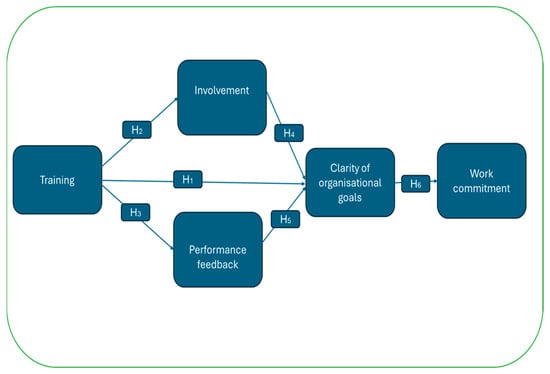
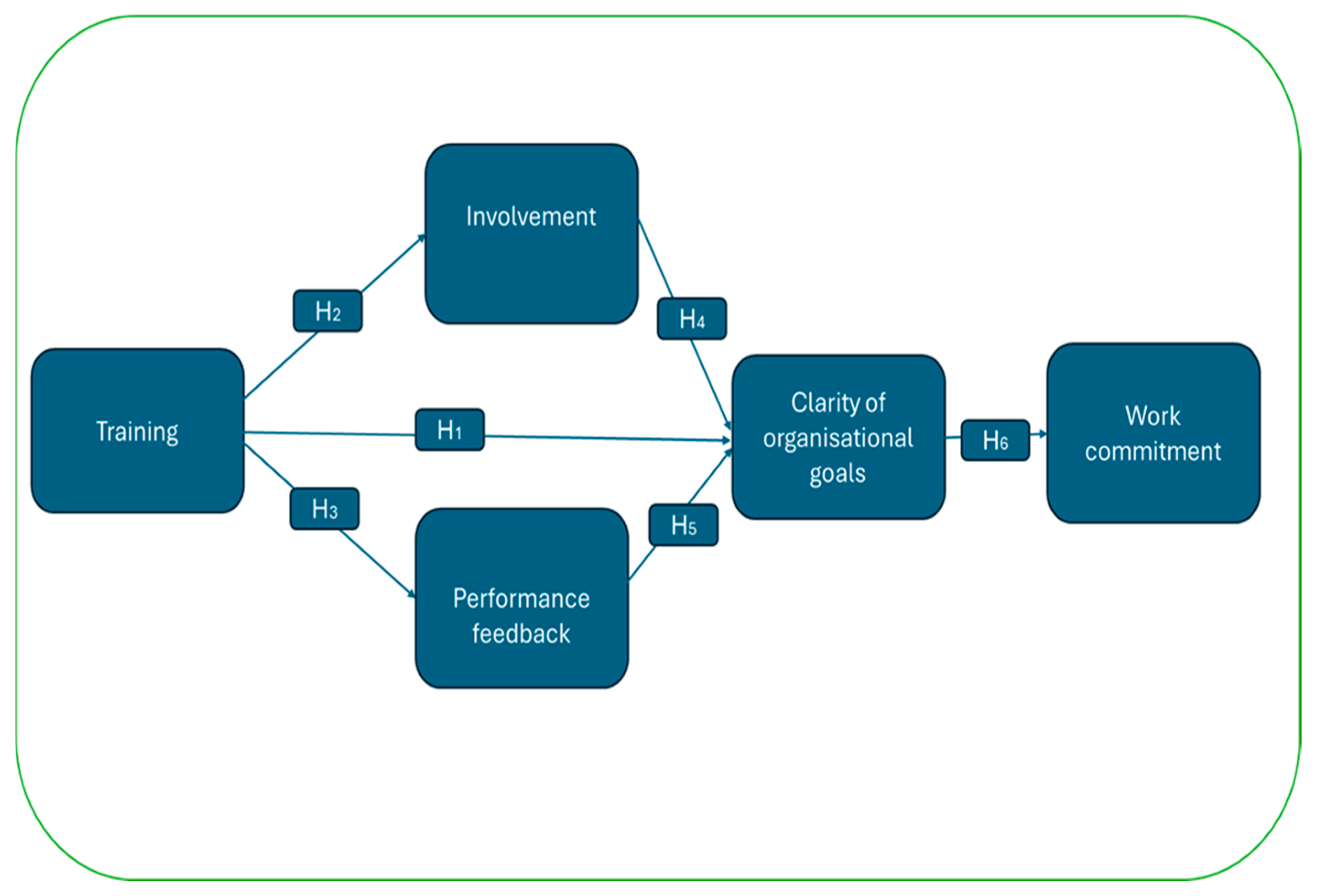
In summary, the rationale for this study was to focus on the work commitment at a selected South African government department. Using SET to support the study, the theory states that voluntary actions by one party are likely to lead to reciprocal actions by another, thereby fostering a good relationship scaffolded by mutual trust, commitment, and loyalty over time. The conceptual framework is shown in Figure 1. The key study predictors measured include training, clarity on organisational goals, involvement, performance feedback, and work commitment. Additionally, the study looked at the mediators of the relationship between training and clarity of goals, which are involvement and performance feedback. These predicators reflect the fact that the relationship between managers and employees in government departments in South Africa is mutually beneficial. In short, when employees trust their managers, they put forth their best effort at work.
Figure 1.
Conceptual framework. Source: adapted by Patterson et al. (2005), Herscovitch and Meyer (2002).
3. Research Methodology
3.1. Approach, Paradigm, and Design
The study approach utilised a quantitative approach, using numbers to address the study objectives. Since it used numbers, it was influenced by positivism because this research paradigm states that the researchers generate new information by testing the hypotheses (Saunders et al., 2019). In addition, the researchers were objective when analysing the data; they focused on the data and not respondents’ subjective views or emotions. This study was cross-sectional rather than longitudinal, because it was conducted at once, which is cheap, quick, and efficient, and it allowed the researchers to align the results with the study objectives on work commitment (Bless et al., 2013). However, the researcher noted the weakness of the cross-sectional study, and no causality or bias impacted this study. It was also descriptive (see next section), as the researchers described the sample distribution. It can also be inferred that the study was exploratory, since it was the first time it had been conducted at the government department. Lastly, the research design was correlational, as the researchers tested the relationship between the study constructs shown in Figure 1. Correctional design is important, as it helps the authors to identify and measure the relationships of key variables, their weaknesses, and their strengths in the work commitment of government employees.
3.2. Population and Sampling
Leedy and Ormrod (2015) opined that the population is the total number of respondents eligible to participate in the study. In the department where the study was conducted, the population size was 800. Convenience sampling techniques were used to select respondents, as the researchers lacked a sampling framework or an employee list. Using the Abraxas size generator tool, at a population of 800, an error margin of 5%, and a confidence interval (CI) of 95%, 260 were printed, and the respondents were given hard copies; 199 were completed and placed at the designated box at the government department. Since 199 respondents participated in the study, the response rate was 77%. The response rate of 77% was higher than the 5% response rate recommended by Bless et al. (2013). There were 130 females, as compared to 69 males in the sample. A total of 164 of the respondents were employed permanently, while 134 of the respondents had a degree and post-graduate qualifications. Moreover, 153 of the respondents had a tenure of four years or above, while the ages of 196 respondents ranged from 25 to 54 years.
3.3. Data Collection
The data were collected using a closed-ended questionnaire, which comprised two sections. The first section of the questionnaire comprised the biographical variables described in the previous section. The second section presented the constructs/variables shown in Figure 1—they were originally developed by Patterson et al. (2005) and Herscovitch and Meyer (2002). Each construct had approximately five items, and they were measured on a 4-point Likert scale ranging from strongly disagree to strongly agree. Examples of adapted training and performance feedback items were, “I am given training to do my job”, and “Employees receive feedback on the quality of the work he/she has done.” Examples of adapted involvement and clarity on organisation goals items were “I have a say in decisions that affect my work” and “The vision of the department is clearly communicated to everyone.” The adapted item of work commitment was, “Employees are passionate about their work.” The rationale of using a 4-point Likert scale was to remove the neutral option and encourage the respondents to choose a side and to prevent tendency bias (Josh et al., 2015). Before the actual study, after acquiring ethical clearance, it was piloted on 20 respondents.
The data were collected from 1 to 31 October 2020, within the headquarters of a government department in Tshwane, after obtaining the gatekeeper’s permission. The second author was responsible for the data collection, as she was based near the research site. The questionnaire was accompanied by informed consent; employees received an informed consent form explaining the purpose of the study, confidentiality, and the voluntary nature of participation. They were delivered at the end of October. The gatekeeper informed employees that they could complete the questionnaire during their break times, to avoid disrupting work activities. Respondents completed the surveys individually and unsupervised, ensuring privacy and reducing potential response bias.
3.4. Data Analysis
3.4.1. Preliminary Analysis
The dataset was analysed using SmartPLS 4, due to its suitability for handling non-normally distributed data and its flexibility in estimating both reflective and formative constructs. Preliminary analysis included descriptive statistics, such as means and standard deviations, to summarise the data. Additionally, confirmatory tetrad analysis (CTA) was conducted to determine the nature of the indicators (reflective or formative) and ensure proper specification of the measurement model.
3.4.2. Measurement Model Assessment
The measurement model was evaluated to ensure the reliability and validity of the constructs. Significance levels were set at 5%. Convergent validity was assessed by examining indicator loadings, following the guidelines of Pratiwi et al. (2024), with items having loadings below 0.70 removed. The average variance extracted (AVE) threshold was set at 0.50. Cronbach’s alpha and composite reliability (CR) were also calculated, with a minimum acceptable threshold of 0.70.
Discriminant validity was evaluated using the Fornell–Larcker criterion and the heterotrait–monotrait ratio (HTMT). For the Fornell–Larcker criterion, the square root of each construct’s AVE was required to exceed its correlations with other constructs (Henseler et al., 2016). HTMT values below 0.90 indicated adequate discriminant validity. Variance inflation factor (VIF) values were inspected to identify multicollinearity; indicators with VIF > 5 were removed to prevent inflated correlations and AVE values falling below 0.50 (Pratiwi et al., 2024). These statistical techniques are in line with the reflective model (As it can be observed in Section 4, these statistical techniques are in the line with the reflective model).
3.4.3. Structural Model Assessment
The study’s dependent variable was work commitment, while the independent variables included training and clarity of organisational goals. The mediating variables were employee involvement and performance feedback, which were included to examine the indirect effects of the explanatory variables on work commitment. Path coefficients (β), t-values, and p-values were examined to test the proposed hypotheses. In addition to traditional path analysis, Importance–Performance Map Analysis (IPMA) was conducted. IPMA is a statistical technique that visually reflects both the importance (total effect of a construct on the target variable) and performance (average scores of the latent variable) of each construct, providing actionable insights for prioritising management strategies (Hair et al., 2022).
3.4.4. Overall Model Fit
Overall model fit was assessed using the standardized root mean square residual (SRMR) and the normed fit index (NFI). SRMR values below 0.08 and NFI values between 0.80 and 0.90 were considered indicative of a good model fit (Hair et al., 2022). R-squared (R2) values were calculated to determine the proportion of variance in endogenous constructs explained by the predictor variables. Following Hair et al. (2022), R2 values of 0.26, 0.13, and 0.02 were interpreted as substantial, moderate, and weak, respectively. Q2 and root mean square error (RMSE) were also calculated to assess the model’s predictive relevance, with positive values indicating adequate predictive power..
3.5. Ethical Considerations
Before the data collection, the researcher applied for ethical clearance. The clearance process entailed presenting the research instrument to the ethics committee which evaluated the instrument. The researchers were provided with the ethical certificate. The application also included the letter from the gatekeeper at the government department. At the research site, the respondents were given the consent form to complete, and participants were also informed about their rights. Those rights included the right not to answer the items that they were not comfortable with, and they were informed that their participation was voluntary. These showed that they were not coerced into participating in the study. Also, the items were framed in such a way that they were not degrading; as a result, they were not harmful to them. To enhance their anonymity and confidentiality, the respondents were advised not to include information that could be linked to them. Also, the completed questionnaires were dropped in a designated box, which only the security guard could open.
4. Results
The items’ means and standard deviations are shown in Table 1. Means ranged from 3.87 to 4.12, with standard deviations ranging from 0.72 to 0.95, indicating moderate variability across the constructs. In addition, the table shows the Cramér–von Mises normality test (Stephens, 1974). Its hypothesis states that
Table 1.
Descriptive statistics.
- (H0): the data come from a normal distribution
- (H1): the data do not come from a normal distribution
The results cannot be interpreted as normal, since the Cramér–von Mises test statistic (1.63–2.95) was less than 5%.
A confirmatory tetrad analysis (CTA) was conducted to determine whether the indicators were reflective and formative. The literature suggests that when the scores are significant, the indicators should be formative. When the indicators include zero or non-significant scores, the indicators should be reflective. Reflective indicators are the ones with arrows pointing away from the latent variables, while a formative model has indicators facing towards the latent construct (Hair et al., 2022). The CTA is shown in Table 2; none of the results were significant, hence a reflective model was conducted in this study.
Table 2.
CTA results.
The statistical techniques discussed in the section are the ones suggested by Hair et al. (2022) to measure construct and discriminant validity.
4.1. Measurement Model Assessment
The construct validity results are shown in Table 3, Table 4 and Table 5. As can be observed in Table 3, all the variables’ relating to Cronbach’s alphas and composite reliability scores were above the 0.07 threshold. This can be interpreted as the results being reliable. The AVE scores were above the 0.5 threshold. Overall, it can be adumbrated that the results demonstrated that convergent validity was achieved.
Table 3.
Reliability and Convergent validity.
Table 4.
HTML.
Table 5.
Fornell–Lacker Criterion.
Discriminant validity was measured using HTML and the Fornell–Larcker test. The former scores shown in Table 3 were all below 0.9, suggesting no discriminant validity issues.
The Fornell–Lacker results shown in Table 5 indicated discriminant validity issues, as the diagonal bolded scores were higher than the other scores.
None of the values were above 5, suggesting that there were no multicollinearity issues.
4.2. SEM Model Assessment
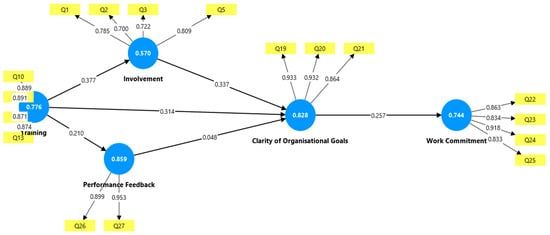
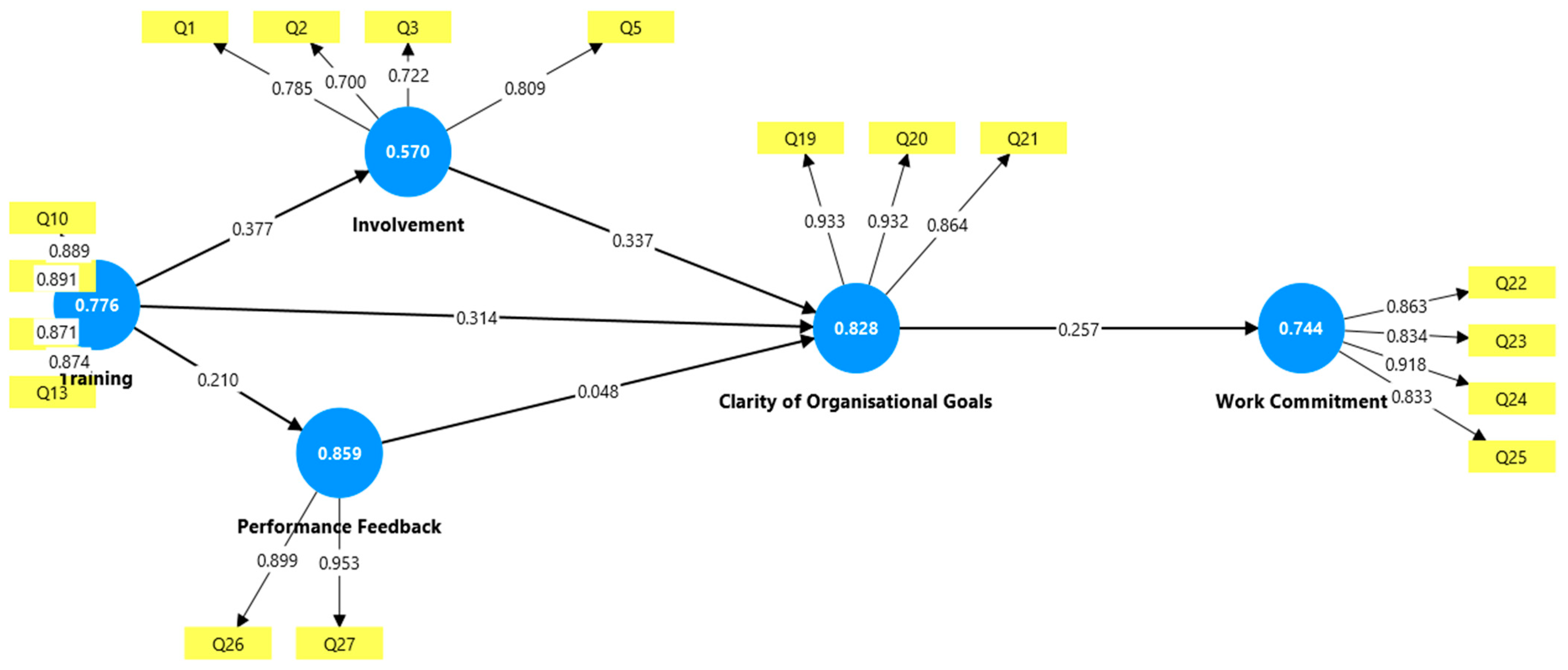
To run the SEM, bootstrapping was conducted on 5000 samples. The confidence interval was a percentage bootstrap, and the level of significance was set at 5%. The results are shown in Table 6. The structural relationships and hypothesis testing results are illustrated in Figure 2, which presents the standardised path coefficients (β) and significance levels for all hypothesised paths. The figure visually highlights the strength and direction of relationships among constructs.
Table 6.
Direct effect.
Figure 2.
SEM of Work Commitment.
The significance of hypothesised paths was assessed using path coefficients (β), T-statistics, and p-values. A path was considered significant at p < 0.05. The results are summarised in Table 6. Thus, H1 is supported, indicating that training improves employees’ understanding of organisational goals. H2 is supported, demonstrating that training significantly increases employee involvement. Also, H3 was supported, suggesting that training enhances the effectiveness of performance feedback. Furthermore, H4 was supported, showing that higher employee involvement enhances understanding of organisational goals. However, H5 was not supported, suggesting that performance feedback alone does not significantly affect goal clarity. Lastly, H6 was supported. This indicates that greater clarity of organisational goals positively influences work commitment.
The mediation results are shown in Table 7. Mediation was assessed to examine whether indirect pathways were significant. H7 was supported, indicating that involvement partially mediates the effect of training on clarity of organisational goals. Concerning H8, it was not supported, suggesting that this sequential mediation pathway is not significant.
Table 7.
Indirect effects.
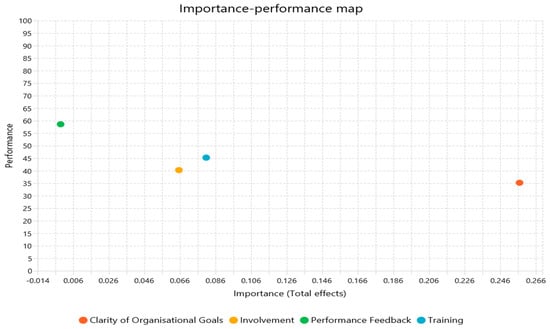
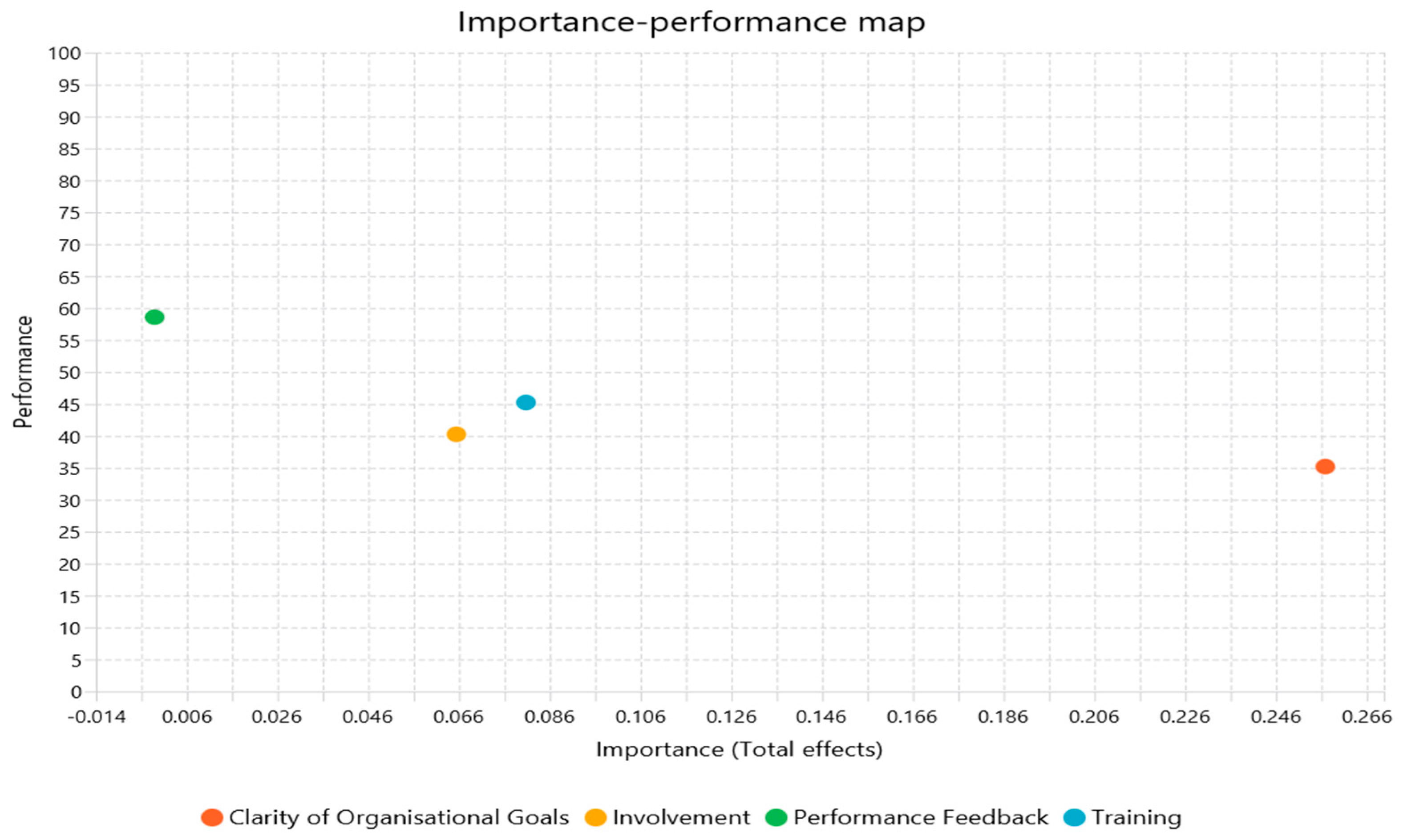
IPMA is a statistical technique that visually reflects importance and performance graphically (refer to Figure 3). The former, shown on the x-axis, indicates how much each factor contributes to the target construct (total effects). The performance, which is shown on the y-axis, illustrates how well the organisation performs on each factor (scaled 0–100) (Hair et al., 2018). The results indicate that Clarity of Organisational Goals, shown with the orange dot, has an importance of 0.26 and a performance of 35. The results can be interpreted to show that that clarity of organisational goals has high importance, but low performance, and this is the critical area to improve. Involvement, shown with the yellow dot, has an importance of 0.06 and a performance of 40. The results can be interpreted as moderate on both importance and performance. Performance Feedback, shown with a green dot, has an importance of 0.00 and a performance of 60. The results can be interpreted as low importance, but good performance. Lastly, shown with a blue dot, training has an importance of 0.08 and a performance of 45. The results can be interpreted as being of moderate importance and slightly below average in performance.
Figure 3.
IMPA results.
4.3. Overall Model Fit
Shown in Table 8 are the comprehensive metrics of the structural model. The R2 values indicate that the model explains 4.4% to 15.4% of the variance in the endogenous constructs, reflecting weak to moderate explanatory power. Adjusted R2 values are slightly lower, accounting for the number of predictors. Positive Q2 predict values suggest that the model possesses predictive relevance. RMSE and MAE values further confirm prediction accuracy. SRMR and NFI indicate an acceptable model fit for both saturated and estimated models
Table 8.
Comprehensive Structural Model Metrics for Endogenous Constructs.
5. Discussion
This study investigated work commitment in a government department and the motivation for conducting this study. Similar studies are limited in the South African context. SET was used to provide theoretical grounding for the current study, and the rationale for deeming it appropriate was that managers must be trained to give appropriate performance reviews and involve employees who reach organisational goals, thereby creating work commitment. Eight hypotheses were tested, and the first one was supported. From a SET perspective, these findings suggest that when government supervisors or managers are trained and exchange with their subordinates, they are empowered to articulate the goals set as part of the annual performance plan (Ahmad et al., 2023). Previous research on SET also showed that such government managers are trained to have excellent interpersonal skills and may involve employees in the decision-making (Mokoena et al., 2022). This was tested in this study using a hypothesis, with the results being positive and significant.
Previous research using SET as the theoretical framework also established that trained government managers were able to provide constructive feedback during the review rendezvous (Eng & Kohsuwan, 2025). This was tested in the study through Hypothesis 3. The findings were positive and significant. The positive spin-off of such an exchange is high levels of job satisfaction, employee engagement, and organisational commitment (Maleka et al., 2022). Similar to other studies that used SET (see Kithinji et al., 2025; Zainib & Sheikh, 2025; C. Lee, 2024), this study tested the direct effects of involvement and performance feedback on goal setting. It was found that only involvement significantly and positively influenced goal setting. This seems to suggest that through healthy interactions, employee gaps are identified and government employees are recommended to attend an intervention to equip them with the skills to offer excellent service delivery (Adams & Ama, 2024). In addition, the results suggest that, since the exchange is cordial and non-confrontational, government managers can clearly set goals to be achieved in the next financial year (C. Lee, 2024).
From the SET perspective, when goals are clearly established, without ambiguity, government employees are most likely to be committed to such goals (Bellamkonda et al., 2021). Hypothesis 6 was used to test this direct relationship, and the results were positive and significant. Moreover, previous research revealed that such a commitment leads to employees’ loyalty and accountability in achieving goals (Cropanzano & Mitchell, 2005).
Earlier in the article, it was posited that previous research established that the mediation role of involvement and performance between training and organisational goals is limited in the South African context. It was also mentioned that previous research also recommended testing it in the Global South; hence, the mediators’ role was examined to contribute to the body of knowledge using the SET theoretical lens. Through testing Hypothesis 7, this study found that involvement mediated the relationship between training and organisation. Such a healthy and positive exchange leads to creativity and buy-in. Furthermore, government managers have discovered that creative employees assist them in achieving goals, and also buy into goal-setting. This leads government employees to support their managers in achieving goals (Balushi et al., 2024).
Regarding testing Hypothesis 8, the study results were not significant. However, this did not come as a surprise, as the relationship between performance feedback and clarity of organisational goals was also not significant. This finding differs from previous studies that used SET as a theoretical framework and found that performance feedback mediated the relationship between training and organisational goal setting (Eng & Kohsuwan, 2025). Additionally, this study provides evidence on work commitment in the context of South African government departments. The study tried to address the identified gap of the lack of interaction of work commitment and other key variables, such as work performance reviews, clarity of goals, involvement, performance feedback, and training.
This study made a significant theoretical contribution by extending SET to the context of government departments in South Africa, by demonstrating that reciprocal exchanges between management and employees—through training, clarity of goals, involvement, and performance feedback—enhance work commitment. By including mediating mechanisms and employing PLS-SEM with IPMA, the study provides novel insights into the pathways and relative importance of these factors. These findings enrich SET-based models by clarifying how organisational support translates into employee commitment in a government department.
5.1. Managerial Implications
The management implications of this study are grounded in SET, which posits that employees reciprocate favourable treatment from their organisation with positive attitudes and behaviours (P. M. Blau, 1964). For example, the IPMA results revealed that the clarity of organisational goals is of the highest importance, with the lowest performance score among the measured dimensions. This difference indicates that employees consider clarity of goals to be a critical driver of organisational success, but that the current communication and implementation strategies are insufficient. Therefore, government managers must give priority to interventions that improve transparency, align individual tasks with strategic objectives, and ensure a consistent message at the hierarchical level. Thus, an improvement in this area is likely to yield significant performance gains and strengthen the government’s commitment to annual performance plans.
The involvement aspect shows the relative importance and low performance of participation, which suggests that, despite employees recognising its value, the opportunities for active participation in decision-making may be limited. Management should, therefore, implement participatory practices, such as team consultation, a suggestion system, and shared governance mechanisms. These initiatives can promote ownership and contribute to a more collaborative organisational culture. Accordingly, by increasing employee participation, government managers and supervisors can indirectly stimulate motivation and enhance buy-in to annual performance goals. On the other hand, performance feedback scores are low in importance but relatively high in performance, indicating that employees are generally satisfied with the existing feedback system. However, this does not negate its strategic value; through structured feedback and recognition programmes, continuous improvements can sustain motivation and strengthen the desired behaviours. Government managers should, therefore, maintain current practices while ensuring that feedback remains constructive, timely, and development-oriented. This approach helps maintain a high level of job satisfaction without diverting excessive resources from the most important areas. According to SET (P. M. Blau, 1964), when employees perceive that the organisation provides meaningful opportunities for participation as well as consistent, constructive feedback, they are likely to reciprocate with increased commitment, motivation, engagement, and reinforcement of desired behaviours, thereby enhancing overall organisational performance.
Finally, training is of moderate importance and moderate performance, reflecting a stable but improbable area of capability development. Although the existing training programme is quite effective, managers should see training as a continuous strategic investment that evolves in line with government needs. The integration of learning opportunities with performance management systems can enhance employee competence and government adaptability. Structured and continuous training strategies promote a learning and resilience culture, thereby equipping the workforce to deal effectively with confronting future challenges. From the perspective of SET, when organisations invest in employee development through continuous and meaningful training opportunities, employees are likely to reciprocate with increased commitment, effort, and engagement (Cropanzano & Mitchell, 2005).
5.2. Conclusions
This study aimed to investigate the commitment to work in a government department in South Africa. It was motivated by a lack of a similar mediating effect of involvement and performance feedback on the relationship between training and the clarity of target setting. The reason for using SET as a theoretical framework is clarified in the Section 2. In the same section, eight hypotheses and concepts of frameworks were developed, and, since it used these hypotheses to generate new knowledge, it was influenced by the positivist paradigm. The government department used a case study, and since the study tested the hypotheses, it can be assumed that the study was related. The descriptive dimension of the study required the elimination of sample distribution; the sampling strategy used convenience sampling, as the researchers had no sampling framework. Overall, 260 employees participated in the survey, and a consent form and a paper questionnaire were given to them to complete and submit to a designated location. Data were analysed using SMART PLS 4.
Out of the eight hypotheses developed, six were supported by the data. The other two, which were not supported by the data, were Hypotheses 5 and 8. Based on the study results, it can be concluded that performance feedback does not significantly influence the clarity of goal setting. In addition, it cannot be concluded that performance feedback mediated the relationship between training and goal setting. Instead, it can be determined that training significantly influenced the clarity of goal setting, involvement, and performance feedback. Furthermore, it can be concluded that involvement influences goal setting, while the latter influences work commitment. Lastly, it can be stated that involvement mediated the relationship between training and clarity on goal setting.
Author Contributions
Conceptualization, methodology, results, introduction, literature and conclusion. M.J.M. Editing, discussion, and managerial implications. F.R. All authors have read and agreed to the published version of the manuscript.
Funding
This research received no external funding.
Institutional Review Board Statement
The study was conducted in accordance with the Declaration of Helsinki, and approved by the Faculty of Management Sciences Research Ethics Committee (protocol code FCRE:2018/FR/04/020 – MS(2) and 7 September 2018).
Informed Consent Statement
Patient consent was waived due to before the data collection, the researcher applied for ethical clearance (FCRE:2018/FR/04/020—MS(2)). The clearance process entailed presenting the research instrument plus the informed consent form to the ethics committee, which evaluated them. At the research site, the respondents were given the research instrument and in-formed consent to complete and drop it in a box with a locker.
Data Availability Statement
Herewith is the dataset used in this article: https://github.com/Malekam/Dataset, accessed on 26 December 2025.
Conflicts of Interest
The authors declare no conflicts of interest.
References
- Adams, E., & Ama, N. O. (2024). Effect of feedback and rewards on employee performance: City of Johannesburg Municipality’s case. Africa’s Public Service Delivery and Performance Review, 12(1), a798. [Google Scholar] [CrossRef] [Scilit]
- Ahmad, R., Nawaz, M. R., Ishaq, M. I., Khan, M. M., & Ashraf, H. A. (2023). Social exchange theory: Systematic review and future directions. Frontiers in Psychology, 13, 1015921. [Google Scholar] [CrossRef] [Scilit]
- Balushi, T. A., Muslim, N. A., & Khudari, M. (2024). THE effect of employee involvement participation in directive decision making and its impact on employees’ creativity: A case study of higher education in Oman. Revista de Gestão Social e Ambiental, 18(9), 1–17. [Google Scholar] [CrossRef] [Scilit]
- Bellamkonda, N., Santhanam, N., & Pattusamy, M. (2021). Goal clarity, trust in management and intention to stay: The mediating role of work engagement. South Asian Journal of Human Resources Management, 8(1), 9–28. [Google Scholar] [CrossRef] [Scilit]
- Blau, P. (2017). Exchange and power in social life (2nd ed.). Taylor and Francis. [Google Scholar]
- Blau, P. M. (1964). Exchange and power in social life (1st ed.). John Wiley & Sons. [Google Scholar]
- Bless, C., Higson-Smith, C., & Sithole, S. L. (2013). Fundamentals of social research methods: An African perspective (5th ed.). Juta. [Google Scholar]
- Bol, J. C., De Aguiar, A. B., & Lill, J. B. (2025). Calibration in the performance evaluation process. Human Resource Management, 64, 1141–1159. [Google Scholar] [CrossRef] [Scilit]
- Cropanzano, R., & Mitchell, M. S. (2005). Social exchange theory: An interdisciplinary review. Journal of Management, 31(6), 874–900. [Google Scholar] [CrossRef] [Scilit]
- Emerson, R. M. (1976). Social exchange theory. Annual Review of Sociology, 2(1), 335–362. [Google Scholar] [CrossRef] [Scilit]
- Eng, K., & Kohsuwan, P. (2025). The influence of DEI and organizational justice on employee engagement: A comparative study between Gen Y and Z. Human Behavior, Development and Society, 26(2), 221–233. [Google Scholar] [CrossRef] [Scilit]
- Febri, W., & Sodirin, S. (2025). The influence of career development and work motivation on the performance of employees of the regional development planning agency of South Lampung district. Social Sciences Journal, 1(3), 83–90. [Google Scholar] [CrossRef] [Scilit]
- Gegana, S., & Phahlane, M. (2024). Techniques for effective government service delivery. South African Journal of Information Management, 26(1), a1782. [Google Scholar] [CrossRef] [Scilit]
- Grabner, I., Kunneke, J., & Moers, F. (2020). How calibration committees can mitigate performance evaluation bias: An analysis of implicit incentives. American Accounting Association, 95(6), 213–233. [Google Scholar] [CrossRef] [Scilit]
- Hair, J. F., Hult, J. R., Ringle, C. M., & Sarstedt, M. (2022). A primer on partial least squares structural equation model-ling (PLS-SEM) (3rd ed.). Sage Publishers. [Google Scholar]
- Hair, J. F., Sardsdedt, M., Ringe, C. M., & Guderman, S. P. (2018). Advanced issues in partial least squares structural equation modelling. Sage Publication, Inc. [Google Scholar]
- Henseler, J., Hubona, G., & Ray, P. A. (2016). Using PLS path modeling in new technology research: Updated guidelines. Industrial Management & Data Systems, 116(1), 2–20. [Google Scholar] [CrossRef] [Scilit]
- Herscovitch, L., & Meyer, J. P. (2002). Commitment to organizational change: Extension of a three-component model. Journal of Applied Psychology, 87(3), 474–487. [Google Scholar] [CrossRef] [Scilit] [PubMed]
- Hokororo, E. A., & Kaijage, J. M. (2023). Factors influencing commitment to work among public servants: The case study of secondary school teachers in Morogoro Municipality. East African Journal of Education Studies, 6(3), 95–106. [Google Scholar] [CrossRef] [Scilit]
- Homans, G. C. (1958). Social behavior as exchange. American Journal of Sociology, 63(6), 597–606. [Google Scholar] [CrossRef] [Scilit]
- Josh, A., Kale, S., Chandel, S., & Pal, D. K. (2015). Likert scale: Explored and explained. British Journal of Applied Science & Technology, 7(4), 396–403. [Google Scholar] [CrossRef] [Scilit]
- Kithinji, I. M., Muinde, M. N., & Mungania, A. (2025). Contract management and performance of roads construction projects in Kenya urban roads authority. International Journal of Supply Chain and Logistics, 9(8), 39–55. [Google Scholar] [CrossRef] [Scilit]
- Lee, C. (2024). Employment Satisfaction Survey (ESS) in measuring and evaluating employee management expectations [Dataset]. Mendeley Data. [Google Scholar] [CrossRef]
- Lee, K., & Duffy, M. K. (2019). A functional model of workplace envy and job performance: When do employees capitalize on envy by learning from envied targets? Academy of Management Journal, 62(4), 1085–1110. [Google Scholar] [CrossRef] [Scilit]
- Leedy, P. D., & Ormrod, J. E. (2015). Practical research. Planning and design (11th ed.). Pearson Education. [Google Scholar]
- Makombo, O., Mubemba, B. N., & Thelma, C. C. (2024). The effect of performance appraisal system on employee performance in the education sector: A case of selected schools in Mwense district of Luapula Province, Zambia. International Journal of Novel Research in Humanity and Social Sciences, 11(4), 16–31. [Google Scholar]
- Maleka, M. J., Meyer, I., Mpofu, M., & Hlatywayo, C. K. (2022). Moderated mediation effect on the relationship between job satisfaction, employee engagement and commitment in organisations operating in three Southern African Development Community Countries. Journal of Contemporary Management, 19(2), 1–23. [Google Scholar] [CrossRef] [Scilit]
- Maleka, M. J., Paul-Dachapalli, L.-A., Ragadu, S. C., Schultz, C. M., & Van Hoek, L. (2020). Performance management, vigour, and training and development as predictors of job satisfaction in low-income workers. SA Journal of Human Resource Management/SA Tydskrif vir Menslikehulpbronbestuur, 18, a1257. [Google Scholar] [CrossRef] [Scilit]
- Mokoena, W., Schultz, C. M., & Paul Dachapalli, L.-A. (2022). A talent management, organisational commitment and employee turnover intention framework for a government department in South Africa. SA Journal of Human Resource Management, 20, a1920. [Google Scholar] [CrossRef] [Scilit]
- Murray, D. (2025). 3 reasons why 64% of employees find performance reviews useless. Available online: https://www.confirm.com/blog/3-reasons-why-64-percent-of-employees-find-performance-reviews-useless (accessed on 26 December 2025).
- Mwangangi, I. L. (2025). Implementation of teacher performance appraisal development tool and its implications on history and government learning outcomes in selected secondary schools in Kwale County, Kenya [Doctoral dissertation, Kenyatta University]. [Google Scholar]
- Patterson, M. G., West, M. A., Shackleton, V. J., Dawson, J. F., Lawthom, R., Maitlis, S., Robinson, D. L., & Wallace, A. M. (2005). Validating the organizational climate measure: Links to managerial practices, productivity and innovation. Journal of Organizational Behavior, 26(4), 379–408. [Google Scholar] [CrossRef] [Scilit]
- Philip, I. B., Akujuru, C. A., & Amadi, E. I. (2025). Public personnel management and employee productivity in rivers state local government service commission, 2014–2024. International Journal of Social Sciences and Management Research, 11(4), 206–234. [Google Scholar]
- Pratiwi, R., Sanusi, A., & Hasibua, S. A. (2024, 23–24 October). Teacher performance analysis using Smart PLS. International Conference. Proceeding International Conference on Information Technology and Business (ICITB), Medan, Indonesia, ISSN 2460-7223. [Google Scholar]
- Saunders, M., Lewis, P., & Thornhill, A. (2019). Research methods for business students (8th ed.). Pearson. [Google Scholar]
- Setsena, L. N., Botha, C. T., & Paul-Dachapalli, L.-A. (2021). Relationship between organisational commitment and effectiveness of human resource management practices in a South African information technology company. SA Journal of Human Resource Management, 19, 11. [Google Scholar] [CrossRef] [Scilit]
- Silverstein, M., Lakomý, M., Lee, S., Jian, B., Zhang, W., & Gans, D. (2025). Social exchange in intergenerational relationships over the family life course: Reciprocity dynamics in support to older mothers. The Journals of Gerontology, Series B: Psychological Sciences and Social Sciences, 80(9), gbaf133. [Google Scholar] [CrossRef] [Scilit] [PubMed]
- Skosana, T. B., Maleka, M. J., & Ngonyama-Ndou, T. L. (2021). Predictors of affective commitment at municipalities in the Nkangala district, Mpumalanga. SA Journal of Human Resource Management/SA Tydskrif vir Menslikehulpbronbestuur, 19, a1567. [Google Scholar] [CrossRef] [Scilit]
- Stephens, M. A. (1974). EDF statistics for goodness of fit and some comparisons. Journal of the American Statistical Association, 69(347), 730–737. [Google Scholar] [CrossRef]
- Su, W., & Jiang, S. (2023). Positive feedback, feedback seeking and performance: Feedback orientation as a moderator. South African Journal of Business Management, 54(1), a3910. [Google Scholar] [CrossRef] [Scilit]
- Triantafillidou, E., & Koutroukis, T. (2022). Employee involvement and participation as a function of labor relations and human resource management: Evidence from Greek subsidiaries of multinational companies in the pharmaceutical industry. Administrative Sciences, 12(1), 41. [Google Scholar] [CrossRef] [Scilit]
- Zainib, L., & Sheikh, Z. (2025). Impact of work pressure on employee’s performance and psychological contract breach in Haripur Hazara. Research Journal for Social Affairs, 3(4), 273–281. [Google Scholar] [CrossRef] [Scilit]
- Zhao, P., Xu, X., Peng, Y., & Matthews, R. A. (2020). Justice, support, commitment, and time are intertwined: A social exchange perspective. Journal of Vocational Behavior, 120, 103432. [Google Scholar] [CrossRef] [Scilit]

Disclaimer/Publisher’s Note: The statements, opinions and data contained in all publications are solely those of the individual author(s) and contributor(s) and not of MDPI and/or the editor(s). MDPI and/or the editor(s) disclaim responsibility for any injury to people or property resulting from any ideas, methods, instructions or products referred to in the content. |
© 2025 by the authors. Licensee MDPI, Basel, Switzerland. This article is an open access article distributed under the terms and conditions of the Creative Commons Attribution (CC BY) license.