
The Latvian Experience in Assessing the Potential of Agricultural Decarbonization Measures

Abstract
1. Introduction
2. Materials and Methods
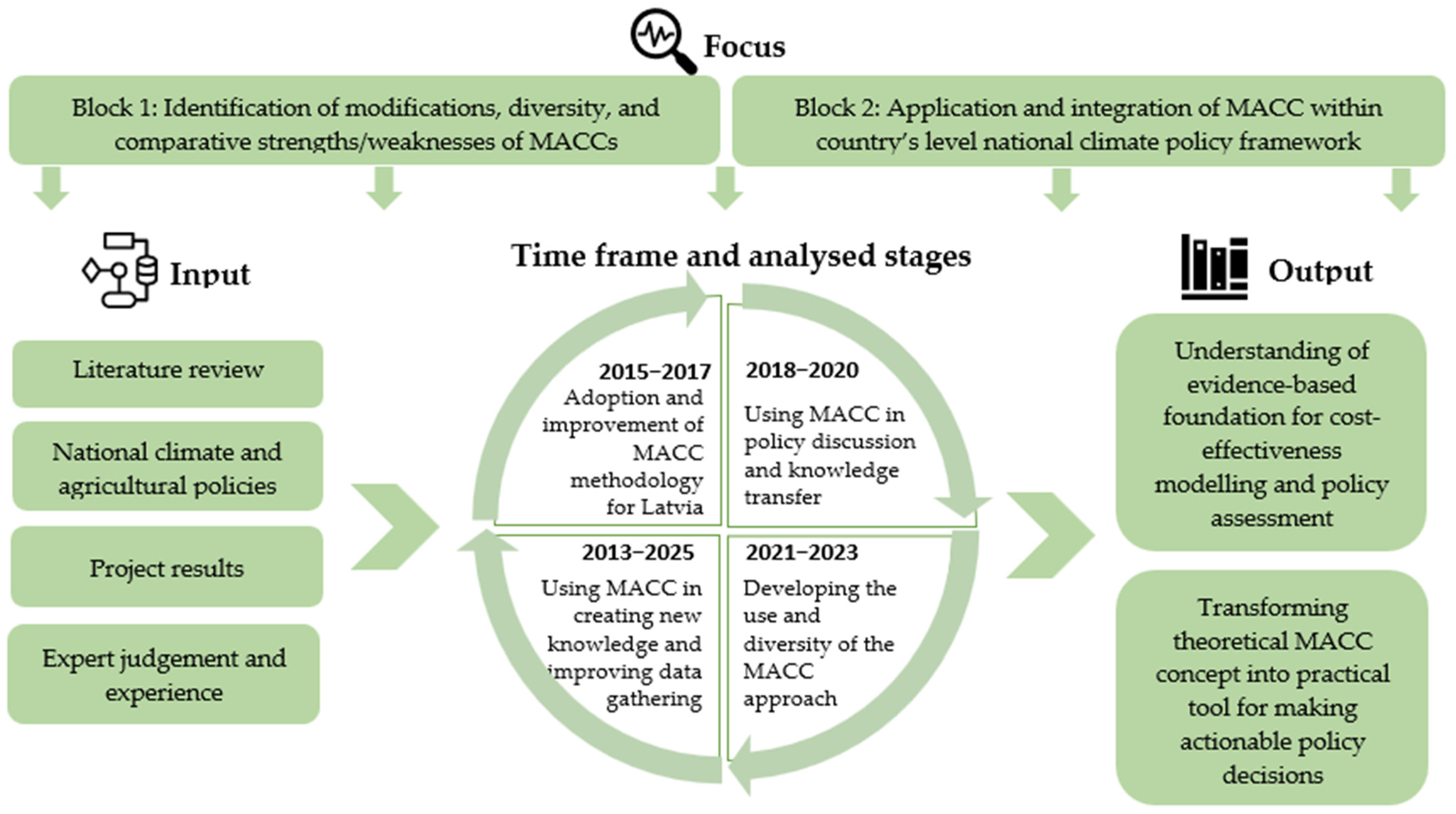
- Block 1: MACC theoretical and historical analysis starting from early 1990s summarizes, describes and reveals the modifications and diversity of MACCs;
- Block 2: MACC case study application focuses on a case study illustrating different uses and levels of integration of MACC into national climate policymaking processes, serving as a demonstration of a full-cycle approach towards carbon neutrality.
- The paper must present a marginal abatement cost curve (either measure-explicit or model-derived) and must focus on GHG abatement.
- The paper must provide clear description of the modelling methodology.
3. Results
3.1. Modifications and Diversity of Marginal Abatement Cost Curves
3.2. Historical Insights into Experience of a Full-Cycle Approach to Carbon Neutrality
3.2.1. Adoption and Improvement of MACC Methodology for Latvia
3.2.2. Developing the Use and Diversity of the MACC Approach
3.2.3. Using MACC in Policy Discussions and Knowledge Transfer
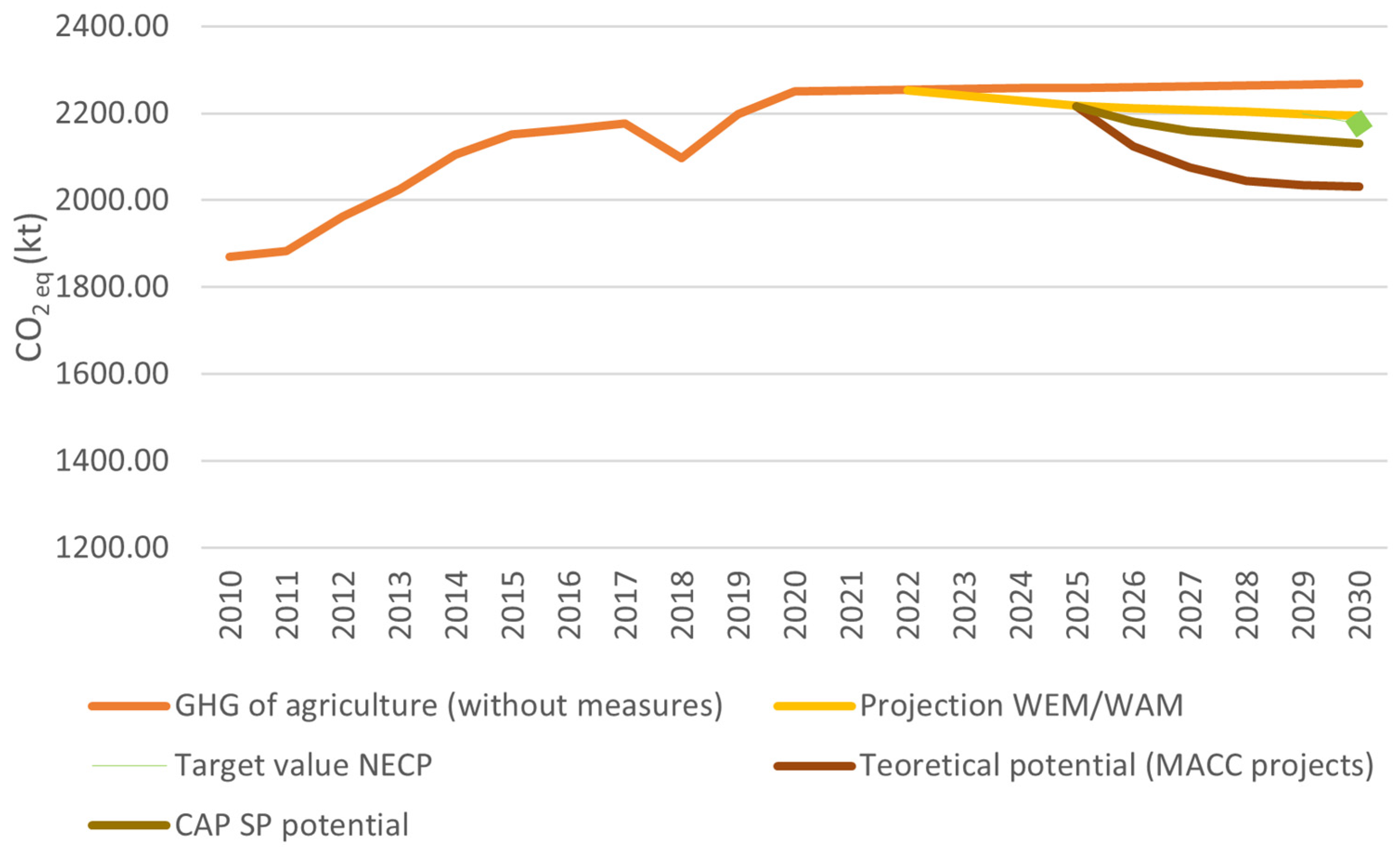
3.2.4. Using MACC for Creating New Knowledge and Improving Data Gathering
- To identify, for each measure, the type of land management/biome/ecosystem to which it relates;
- To understand which services of the relevant ecosystem are affected by the measure if it is introduced (assuming that the impact is positive);
- To find the value of the ecosystem service(s) to be linked to the relevant ecosystem.
- The climate change mitigation potential of cost-negative measures may be overestimated without paying sufficient attention to measures that are less cost-effective;
- Negative cost measures are adequately assessed as the most cost-effective or income-generating, but their mutual ranking may not be correct due to the peculiarities of the mathematical algorithm in the method.
4. Discussion
5. Conclusions
- By recognizing the unique characteristics of different farm types (e.g., intensive, extensive, organic, etc.), the principle of targeted and equitable distribution of support should be implemented when developing climate-related policies and frameworks for support measures.
- Comprehensive assessment of GHG mitigation measures—considering their economic, environmental and social impacts, as well as understanding their multiple benefits—and robust data collection and analysis can serve as the background for data-driven policymaking.
- Facilitation of knowledge sharing, such as knowledge exchange between scientists, policymakers, farmers and other stakeholders, and capacity building, such as training and technical assistance to farmers to implement climate-friendly practices, can result in a more rapid transition to carbon neutrality.
Author Contributions
Funding
Data Availability Statement
Conflicts of Interest
References
- Statistical Database. Use of Mineral Fertilizers on Agricultural Crops. Available online: https://data.stat.gov.lv/pxweb/en/OSP_PUB/START__ENV__AV__AVZ/LAV020/ (accessed on 6 October 2025).
- United Nations Department of Economic and Social Affairs. World Economic Situation and Prospects 2024; United Nations Department of Economic and Social Affairs: New York, NY, USA, 2024; 196p, Available online: https://www.un.org/development/desa/dpad/wp-content/uploads/sites/45/WESP_2024_Web.pdf (accessed on 6 October 2025).
- Fukase, E.; Will, M. Economic growth, convergence, and world food demand and supply. World Dev. 2020, 132, 104954. [Google Scholar] [CrossRef]
- Turk, J. Meeting projected food demands by 2050: Understanding and enhancing the role of grazing ruminants. Anim. Sci. 2016, 94, 53–62. [Google Scholar] [CrossRef]
- Warner, K.; Hamza, M.; Oliver-Smith, A.; Renaud, F.; Julca, A. Climate change, environmental degradation and migration. Nat. Hazards 2009, 55, 689–715. [Google Scholar] [CrossRef]
- Pro Oxygen. Latest Daily CO2. 2024. Available online: https://www.co2.earth/daily-co2 (accessed on 6 October 2025).
- Hatfield-Dodds, S.; Schandl, H.; Newth, D.; Obersteiner, M.; Cai, Y.; Baynes, T.; West, J.; Havlik, P. Assessing global resource use and greenhouse emissions to 2050, with ambitious resource efficiency and climate mitigation policies. Clean. Prod. 2017, 144, 403–414. [Google Scholar] [CrossRef]
- Komarek, A.M.; Dunston, S.; Enahoro, D.; Charles, J.; Godfray, H.; Herrero, M.; Mason-D’Croz, D.; Rich, M.K.; Scarborough, P.; Springmann, M.; et al. Income, consumer preferences, and the future of livestock-derived food demand. Glob. Environ. Change 2021, 70, 102343. [Google Scholar] [CrossRef]
- Maximillian, J.; Brusseau, M.L.; Glenn, E.P.; Matthias, A.D. Pollution and environmental perturbations in the global system. In Environmental and Pollution Science, 3rd ed.; Academic Press: Cambridge, MA, USA, 2019; pp. 457–476. [Google Scholar] [CrossRef]
- Mora, C.; Rollins, R.L.; Taladay, K.; Kantar, M.B.; Chock, M.; Shimada, M.; Franklin, E.C. Bitcoin emissions alone could push global warming above 2 °C. Nat. Clim. Change 2018, 8, 931–933. [Google Scholar] [CrossRef]
- United Nations. The Paris Agreement; United Nations: New York, NY, USA, 2015; 27p, Available online: https://unfccc.int/files/essential_background/convention/application/pdf/english_paris_agreement.pdf (accessed on 30 October 2025).
- Chen, L.; Msigwa, G.; Yang, M.; Osman, I.A.; Fawzy, S.; Rooney, W.D.; Yap, P.S. Strategies to achieve a carbon neutral society: A review. Environ. Chem. Lett. 2022, 20, 2277–2310. [Google Scholar] [CrossRef] [PubMed]
- Wei, Y.M.; Chen, K.; Kang, J.N.; Chen, W.; Wang, X.Y.; Zhang, X. Policy and Management of Carbon Peaking and Carbon Neutrality: A Literature Review. Engineering 2022, 14, 52–63. [Google Scholar] [CrossRef]
- Usman, I.M.T.; Ho, Y.C.; Baloo, L.; Lam, M.K.; Sujarwo, W. A comprehensive review on the advances of bioproducts from biomass towards meeting net zero carbon emissions (NZCE). Bioresour. Technol. 2022, 366, 128167. [Google Scholar] [CrossRef] [PubMed]
- European Union. Clean Planet for all A European Strategic Long-Term Vision for a Prosperous, Modern, Competitive and Climate Neutral Economy. COM/2018/773. 2018. Available online: https://eur-lex.europa.eu/legal-content/EN/TXT/?uri=CELEX:52018DC0773 (accessed on 24 September 2025).
- Climate Action Tracker. CAT Net Zero Target Evaluation. 2023. Available online: https://climateactiontracker.org/global/cat-net-zero-target-evaluations/ (accessed on 24 September 2025).
- Allen, M.; Frame, D.; Huntingford, C.; Huntingford, C.; Jones, C.D.; Lowe, J.A.; Meinshausen, M.; Meinshausen, N. Warming caused by cumulative carbon emissions towards the trillionth tonne. Nature 2009, 458, 1163–1166. [Google Scholar] [CrossRef]
- Hale, T.; Smith, S.M.; Black, R.; Cullen, K.; Fay, B.; Lang, J.; Mahmood, S. Assessing the rapidly-emerging landscape of net zero targets. Clim. Policy 2021, 22, 18–29. [Google Scholar] [CrossRef]
- IPCC Climate Change 2014: Synthesis Report. In Contribution of Working Groups I, II and III to the Fifth Assessment Report of the Intergovernmental Panel on Climate Change; Core Writing Team, Pachauri, R.K., Meyer, L.A., Eds.; IPCC: Geneva, Switzerland, 2014; 151p, Available online: https://www.ipcc.ch/site/assets/uploads/2018/05/SYR_AR5_FINAL_full_wcover.pdf (accessed on 24 September 2025).
- Levin, K.; Rich, D.; Ross, K.; Fransen, T.; Elliott, C. Designing and Communicating Net-Zero Targets; Working Paper: Washington DC, USA, 2020; 30p, Available online: https://www.wri.org/research/designing-and-communicating-net-zero-targets (accessed on 25 September 2025).
- Lēnerts, A.; Popluga, D.; Naglis-Liepa, K.; Rivža, P. Fertilizer use efficiency impact on GHG emissions in the Latvian crop sector. Agron. Res. 2016, 14, 123–133. Available online: https://agronomy.emu.ee/wp-content/uploads/2016/05/Vol14-_nr1_Lenerts.pdf (accessed on 10 September 2025).
- Naglis-Liepa, K.; Popluga, D.; Rivža, P. Typology of Latvian Agricultural Farms in the Context of Mitigation of Agricultural GHG Emissions. In Proceedings of the 15th International Multidisciplinary Scientific Geoconference SGEM 2015 “Ecology, Economics, Education and Legislation”, Albena, Bulgaria, 18–24 June 2015; Volume II, pp. 513–520. [Google Scholar]
- Popluga, D.; Naglis-Liepa, K.; Lenerts, A.; Rivza, P. Marginal abatement cost curve for assessing mitigation potential of Latvian agricultural greenhouse gas emissions: Case study of crop sector. In Proceedings of the 17th International Multidisciplinary Scientific GeoConference SGEM 2017, Albena, Bulgaria, 29 June–5 July 2017; Volume 17, pp. 511–518. [Google Scholar]
- Kreišmane Dz Aplociņa, E.; Naglis-Liepa, K.; Bērziņa, L.; Frolova, O.; Lēnerts, A. Diet optimization for dairy cows to reduce ammonia emissions. Res. Rural Dev. 2021, 36, 36–43. [Google Scholar] [CrossRef]
- Popluga, D. Pārskats par Projektu “Latvijas Lauksaimniecības Siltumnīcefekta Gāzu Emisiju Robežsamazinājuma Izmaksu Līkņu (MACC) Sasaiste ar Oglekļa Piesaisti un tā Uzkrāšanu Aramzemēs, Ilggadīgajos Zālājos un Mitrājos”. 2018. Available online: https://www.lbtu.lv/sites/default/files/files/projects/P%C4%93t%C4%ABjuma%20p%C4%81rskats_S330_Atskaite%202018.pdf (accessed on 29 September 2025). (In Latvian).
- Naglis-Liepa, K. Pārskats Par Projektu “Latvijas Lauksaimniecības Siltumnīcefekta Gāzu un Amonjaka Emisijas, kā arī CO2 Piesaistes (Aramzemēs un Zālājos) Robežsamazinājuma Izmaksu Līkņu (MACC) Pielāgošana Izmantošanai Lauksaimniecības, Vides un Klimata Politikas Veidošanā”. 2021. Available online: https://www.lbtu.lv/sites/default/files/files/projects/20-00-SOINV05-000013_LLU_K_Naglis-Liepa_0.pdf (accessed on 29 September 2025). (In Latvian).
- Kesicki, F.; Strachan, N. Marginal abatement cost (MAC) curves: Confronting theory and practice. Environ. Sci. Policy 2011, 14, 1195–1204. [Google Scholar] [CrossRef]
- Bockel, L.; Sutter, P.; Jonsson, M. Using Marginal Abatement Cost Curves to Realize the Economic Appraisal of Climate Smart Agriculture Policy Options. The EX Ante Carbon-Balance Tool. 2012. Available online: https://openknowledge.fao.org/server/api/core/bitstreams/33830c17-609f-4f0f-a034-b471818ecb59/content (accessed on 22 July 2025).
- Meier, A.K. Supply Curves of Conserved Energy, Lawrence Berkeley Laboratory, University of California. Available online: https://escholarship.org/content/qt20b1j10d/qt20b1j10d_noSplash_d9c1759a15cb0579ffb9871dacdad972.pdf (accessed on 22 July 2025).
- Blumstein, C.; Stoft, S.E. Technical efficiency, production functions and conservation supply curves. Energy Policy 1995, 23, 765–768. [Google Scholar] [CrossRef]
- Difiglio, C.; Duleep, K.G.; Greene, D.L. Cost Effectiveness of Future Fuel Economy Improvements. Energy J. 1990, 11, 65–87. [Google Scholar] [CrossRef]
- Rosenfeld, A.; Atkinson, C.; Koomey, J.; Meier, A.; Mowris, R.J.; Price, L. Conserved energy supply curves for U.S. Build. Contemp. Econ. Policy 1993, 11, 45–68. [Google Scholar] [CrossRef]
- Rentz, O.; Haasis, H.-D.; Jattke, A.; Ruβ, P.; Wietschel, M.; Amann, M. Influence of energy-supply structure on emission-reduction costs. Energy 1994, 19, 641–651. [Google Scholar] [CrossRef]
- Jackson, T. Least-cost greenhouse planning supply curves for global warming abatement. Energy Policy 1991, 19, 35–46. [Google Scholar] [CrossRef]
- Mills, E.; Wilson, D.; Johansson, T.B. Getting started: No-regrets strategies for reducing greenhouse gas emissions. Energy Policy 1991, 19, 526–542. [Google Scholar] [CrossRef]
- Sitnicki, S.; Budzinski, K.; Juda, J.; Michna, J.; Szpilewicz, A. Opportunities for carbon emissions control in Poland. Energy Policy 1991, 19, 995–1002. [Google Scholar] [CrossRef]
- Kesicki, F.; Ekins, P. Marginal abatement cost curves: A call for caution. Clim. Policy 2012, 12, 219–236. [Google Scholar] [CrossRef]
- Blok, K.; Worrell, E.; Cuelenaere, R.; Turkenburg, W. The cost effectiveness of CO2 emission reduction achieved by energy conservation. Energy Policy 1993, 21, 656–667. [Google Scholar] [CrossRef]
- Haoqi, Q.; Libo, W.; Weiqi, T. “Lock-in” effect of emission standard and its impact on the choice of market based instruments. Energy Econ. 2017, 63, 41–50. [Google Scholar] [CrossRef]
- Bauman, Y.; Lee, M.; Seeley, K. Does Technological Innovation Really Reduce Marginal Abatement Costs? Some Theory, Algebraic Evidence, and Policy Implications. Environ. Resour. Econ. 2007, 40, 507–527. [Google Scholar] [CrossRef]
- Downing, P.B.; White, L.J. Innovation in pollution control. J. Environ. Econ. Manag. 1986, 13, 18–29. [Google Scholar] [CrossRef]
- Moran, D.; Macleod, M.; Wall, E.; Eory, V.; Mcvittie, A.; Barnes, A.; Rees, B.; Pajot, G.; Matthews, R.; Smith, P.; et al. Marginal abatement cost curves for UK agriculture, forestry, land-use and land-use change sector out to 2022. IOP Conf. Ser. Earth Environ. Sci. 2009, 6, 242002. [Google Scholar] [CrossRef]
- Moran, D.; MacLeod, M.; Wall, E.; Eory, V.; McVittie, A.; Barnes, A.; Rees, R.M.; Topp, C.F.E.; Pajot, G.; Matthews, R.; et al. Developing carbon budgets for UK agriculture, land-use, land-use change and forestry out to 2022. Clim. Change 2010, 105, 529–553. [Google Scholar] [CrossRef]
- O’Brien, D.; Shalloo, L.; Crosson, P.; Donnellan, T.; Farrelly, N.; Finnan, J.; Hanrahan, K.; Lalor, S.; Lanigan, G.; Thorne, F.; et al. An evaluation of the effect of greenhouse gas accounting methods on a marginal abatement cost curve for Irish agricultural greenhouse gas emissions. Environ. Sci. Policy 2014, 39, 107–118. [Google Scholar] [CrossRef]
- Pellerin, S.; Bamière, L.; Angers, D.; Béline, F.; Benoit, M.; Butault, J.-P.; Chenu, C.; Colnenne-David, C.; De Cara, S.; Delame, N.; et al. Identifying cost-competitive greenhouse gas mitigation potential of French agriculture. Environ. Sci. Policy 2017, 77, 130–139. [Google Scholar] [CrossRef]
- Ikkatai, S. Emission reductions policy mix: Industrial sector greenhouse gas emission reductions. In Climate Change and Global Sustainability; United Nations: New York, NY, USA, 2013; pp. 164–177. [Google Scholar] [CrossRef]
- Wang, W.; Koslowski, F.; Nayak, D.R.; Smith, P.; Saetnan, E.; Ju, X.; Guo, L.; Han, G.; de Perthuis, C.; Lin, E.; et al. Greenhouse gas mitigation in Chinese agriculture: Distinguishing technical and economic potentials. Glob. Environ. Change 2014, 26, 53–62. [Google Scholar] [CrossRef]
- McGetrick, J.A.; Bubela, T.; Hik, D.S. Automated content analysis as a tool for research and practice: A case illustration from the Prairie Creek and Nico environmental assessments in the Northwest Territories, Canada. Impact Assess. Proj. Apprais. 2016, 35, 139–147. [Google Scholar] [CrossRef]
- Eory, V.; Pellerin, S.; Carmona Garcia, G.; Lehtonen, H.; Licite, I.; Mattila, H.; Lund-Sørensen, T.; Muldowney, J.; Popluga, D.; Strandmark, L.; et al. Marginal abatement cost curves for agricultural climate policy: State-of-the art, lessons learnt and future potential. J. Clean. Prod. 2018, 182, 705–716. [Google Scholar] [CrossRef]
- De Cara, S.; Jayet, P.-A. Marginal abatement costs of greenhouse gas emissions from European agriculture, cost effectiveness, and the EU non-ETS burden sharing agreement. Ecol. Econ. 2011, 70, 1680–1690. [Google Scholar] [CrossRef]
- De Cara, S.; Houzé, M.; Jayet, P.-A. Methane and Nitrous Oxide Emissions from Agriculture in the EU: A Spatial Assessment of Sources and Abatement Costs. Environ. Resour. Econ. 2005, 32, 551–583. [Google Scholar] [CrossRef]
- Hediger, W. Modeling GHG emissions and carbon sequestration in Swiss agriculture: An integrated economic approach. Int. Congr. Ser. 2006, 1293, 86–95. [Google Scholar] [CrossRef]
- Golub, A.; Hertel, T.; Lee, H.-L.; Rose, S.; Sohngen, B. The opportunity cost of land use and the global potential for greenhouse gas mitigation in agriculture and forestry. Resour. Energy Econ. 2009, 31, 299–319. [Google Scholar] [CrossRef]
- Pérez Dominguez, I.; Britz, W.; Holm-Müller, K. Trading schemes for greenhouse gas emissions from European agriculture: A comparative analysis based on different implementation options. Rev. D’études Agric. Environ. 2009, 90, 287–308. [Google Scholar] [CrossRef]
- Schneider, U.A.; McCarl, B.A.; Schmid, E. Agricultural sector analysis on greenhouse gas mitigation in US agriculture and forestry. Agric. Syst. 2007, 94, 128–140. [Google Scholar] [CrossRef]
- Beach, R.H.; DeAngelo, B.J.; Rose, S.; Li, C.; Salas, W.; DelGrosso, S.J. Mitigation potential and costs for global agricultural greenhouse gas emissions. Agric. Econ. 2008, 38, 109–115. [Google Scholar] [CrossRef]
- Höglund-Isaksson, L.; Winiwarter, W.; Purohit, P.; Rafaj, P.; Schöpp, W.; Klimont, Z. EU low carbon roadmap 2050: Potentials and costs for mitigation of non-CO2 greenhouse gas emissions. Energy Strategy Rev. 2012, 1, 97–108. [Google Scholar] [CrossRef]
- Ekins, P.; Kesicki, F.; Smith, A.Z.P. Marginal Abatement Cost Curves: A Call for Caution. 2011. [A Report from the UCL Energy Institute to, and Commissioned by, Greenpeace UK]. Available online: https://www.homepages.ucl.ac.uk/~ucft347/MACCCritGPUKFin.pdf (accessed on 25 July 2025).
- Levihn, F.; Nuur, C.; Laestadius, S. Marginal abatement cost curves and abatement strategies: Taking option interdependency and investments unrelated to climate change into account. Energy 2014, 76, 336–344. [Google Scholar] [CrossRef]
- Ponz-Tienda, J.L.; Prada-Hernández, A.V.; Salcedo-Bernal, A.; Balsalobre-Lorente, D. Marginal Abatement Cost Curves (MACC): Unsolved Issues, Anomalies, and Alternative Proposals. In Carbon Footprint and the Industrial Life Cycle; Fernández, R.Á., Zubelzu, S., Martínez, R., Eds.; Springer International Publishing: Cham, Switzerland, 2017; pp. 269–288. [Google Scholar] [CrossRef]
- Taylor, S. The ranking of negative-cost emissions reduction measures. Energy Policy 2012, 48, 430–438. [Google Scholar] [CrossRef]
- Ward, D.J. The failure of marginal abatement cost curves in optimising a transition to a low carbon energy supply. Energy Policy 2014, 73, 820–822. [Google Scholar] [CrossRef]
- Latvia. 2024 Biennial Transparency Report (BTR). BTR1. Available online: https://unfccc.int/documents/645013 (accessed on 15 December 2025).
- Moran, D.; Macleod, M.; Wall, E.; Eory, V.; McVittie, A.; Barnes, A.; Rees, R.; Topp, C.F.E.; Moxey, A. Marginal Abatement Cost Curves for UK Agricultural Greenhouse Gas Emissions. J. Agric. Econ. 2011, 62, 93–118. [Google Scholar] [CrossRef]
- Sánchez, A.; Iglesias, A.; McVittie, J.; Álvaro-Fuentes, J.; Ingram, J.; Mills, J.P.; Lesschen, P.J.; Kuikman, J. Management of agricultural soils for greenhouse gas mitigation: Learning from a case study in NE Spain. J. Environ. Manag. 2016, 170, 37–49. [Google Scholar] [CrossRef]
- Bamière, L.; Bellassen, V.; Angers, D.; Cardinael, R.; Ceschia, R.; Chenu, C.; Constantin, J.; Delame, N.; Diallo, A.; Graux, A.-I.; et al. A marginal abatement cost curve for climate change mitigation by additional carbon storage in French agricultural land. J. Clean. Prod. 2023, 383, 135423. [Google Scholar] [CrossRef]
- Tang, K.; Hailu, A.; Yang, Y. Agricultural chemical oxygen demand mitigation under various policies in China: A scenario analysis. J. Clean. Prod. 2020, 250, 119513. [Google Scholar] [CrossRef]
- Macleod, M.; Moran, D. Integrating livestock health measures into marginal abatement cost curves. Rev. Sci. Tech. 2017, 36, 97–104. [Google Scholar] [CrossRef] [PubMed]
- Valujeva, K.; Freed, E.K.; Nipers, A.; Jauhiainen, J.; Schulte, R.P.O. Pathways for governance opportunities: Social network analysis to create targeted and effective policies for agricultural and environmental development. J. Environ. Manag. 2023, 325, 116563. [Google Scholar] [CrossRef]
- Teagasc. Explainer: What Is and Why Is a New MACC Needed? Teagasc: Carlow, Ireland, 2023; Available online: https://teagasc.ie/news--events/daily/explainer-what-is-and-why-is-a-new-macc-needed/#:~:text=The%20third%20iteration%20of%20the,the%20most%20cost%20effective%20measures.%E2%80%9D (accessed on 23 November 2025).
- Latvia Air pollution Action Plan 2020–2030. Regulation of Minister Cabinet of Republic of Latvia. Nr.197. Available online: https://likumi.lv/ta/id/314078-par-gaisa-piesarnojuma-samazinasanas-ricibas-planu-2020-2030-gadam (accessed on 29 September 2025).
- Hannus, V.; Venus, T.J.; Sauer, J. Acceptance of sustainability standards by farmers—Empirical evidence from Germany. J. Environ. Manag. 2020, 267, 110617. [Google Scholar] [CrossRef] [PubMed]
- Julian Ramirez-Villegas, J.; Challinor, A. Assessing relevant climate data for agricultural applications. Agric. For. Meteorol. 2012, 161, 26–45. [Google Scholar] [CrossRef]
- Ministry of Agriculture of Republic of Latvia. Various Agricultural Data Will Be Linked into a Single System—Entrepreneurs Will Not Have to Enter It Repeatedly. Available online: https://www.zm.gov.lv/lv/jaunums/dazadi-lauksaimniecibas-dati-bus-saistiti-vienota-sistema-uznemejiem-tie-nebus-jaievada-atkartoti (accessed on 30 September 2025).
- Lefèvre, J. Integrated assessment models and input–output analysis: Bridging fields for advancing sustainability scenarios research. Econ. Syst. Res. 2023, 36, 675–698. [Google Scholar] [CrossRef]



| Thematic Block of Study | Methods | Approach | Focus | Output |
|---|---|---|---|---|
| Block 1: MACC theoretical and historical analysis | Literature review analysis and synthesis | Comprehensive evaluation of MACC development over time (from 1990 to 2018) from the scientific literature using SCOPUS and Web of Science databases | Identification of modifications, diversity and comparative strengths/weaknesses of MACCs | Understanding of evidence-based foundation for cost-effectiveness modelling and policy assessment |
| Block 2: MACC case study application | Expert judgement and experience from previously conducted projects | Utilize project results from Latvian climate policy initiatives | Focus on how MACCs are integrated and applied within Latvia’s national climate policy frameworks for actionable insights | Transforms theoretical MACC concepts into actionable policy decisions |
| Analyzed Aspect | Expert Judgement-Based MACCs | Model-Derived MACCs |
|---|---|---|
| Strengths | Extensive technological detail Possibility of considering technology-specific market distortions Easy understanding of technology-specific abatement curves | Bottom-up Model explicitly maps energy technologies in detail Top-down Macroeconomic feedback and costs considered Both Interactions between measures include the following: Consistent baseline emission pathway Intertemporal interactions incorporated Possibility of representing uncertainty Incorporation of behavioural factors Comparably quick generation |
| Weaknesses | Lack of integration of behavioural factors Absence of interactions and dependencies between mitigation measures Potential for inconsistent baseline emissions No representation of intertemporal interactions Limited representation of uncertainty Sometimes restricted to a single economic sector, without the ability to combine abatement curves across sectors No representation of macroeconomic feedback Simplified technological cost structure | Bottom-up No macroeconomic feedback Direct cost in the energy sector Risk of penny-switching No reflection of indirect rebound effect Top-down Model lacks technological detail Possible unrealistic physical implications Both No technological detail in representation of MAC curve Assumption of a rational agent, disregarding most market distortions |
| Emission Reduction Measures | Included in CAP SP 2024–2027 | Included in NECP 2021–2030 | Included in Air Pollution Action Plan 2020–2030 |
|---|---|---|---|
| GHG emission reduction measures | 12 | 8 | 5 |
| GHG emission reduction from agricultural soils | 6 | 4 | 3 |
| Minimum tillage (direct sowing) | √ | - | - |
| Fertilization planning | √ | √ | √ |
| Precision application of mineral fertilizers | √ | √ | √ |
| Nitrification inhibitors | - | - | - |
| Permanent grasslands in organic soils | - | - | - |
| Nitrogen fixation (legumes) | √ | √ | √ |
| Green manure crop cultivation | √ | - | - |
| Maintenance of drainage systems | √ | √ | - |
| Reducing GHG emissions from enteric fermentation processes in farm animals | 4 | 3 | 1 |
| Feed ration planning | √ | √ | - |
| Improving feed quality | √ | √ | - |
| Extended grazing (min. 160 days) | √ | - | - |
| Enriching feed with fats | - | - | - |
| Intensive (rotational) grazing | - | - | - |
| Promoting organic dairy farming | √ | √ | √ |
| Reducing GHG emissions from manure management | 2 | 1 | 1 |
| Separation of liquid manure | - | - | - |
| Direct application of liquid manure (injector) | √ | - | - |
| Biogas production | √ | √ | √ |
| Ammonia emission reduction measures | 9 | 7 | 14 |
| Reducing ammonia emissions from agricultural soils | 3 | 3 | 3 |
| Precise use of mineral fertilizers | √ | √ | √ |
| Nitrogen fixation by including legumes in the rotation | √ | √ | √ |
| Fertilization planning | √ | √ | √ |
| Reducing ammonia emissions from the enteral fermentation processes of farm animals | 1 | 1 | 1 |
| Promoting organic dairy farming | √ | √ | √ |
| Reduction of ammonia emissions from manure management | 5 | 3 | 10 |
| Direct application of liquid manure to soil (option 1—with a pipeline spreading system) and (option 2—with a direct application spreader) | √ | √ | √ |
| Direct application of liquid manure to soil (options 3 + 4) | √ | √ | √ |
| Reduced application time of poultry manure (up to 4 h) | - | - | - |
| Reduced application time of liquid manure (4 h) | - | - | √ |
| Reduced application time of littered manure (12 h) | - | - | √ |
| Covering of liquid manure storages (concrete) | - | - | √ |
| Covering of liquid manure storages (film) | - | - | √ |
| Covering of liquid manure storages (expanded clay) | - | - | √ |
| Liquid manure covering of storage facilities (tent-type) | √ | - | √ |
| Construction of new cylindrical storage facilities | √ | - | √ |
| Biogas production | √ | √ | √ |
| Period | Stage | Action | Importance and Practical Use |
|---|---|---|---|
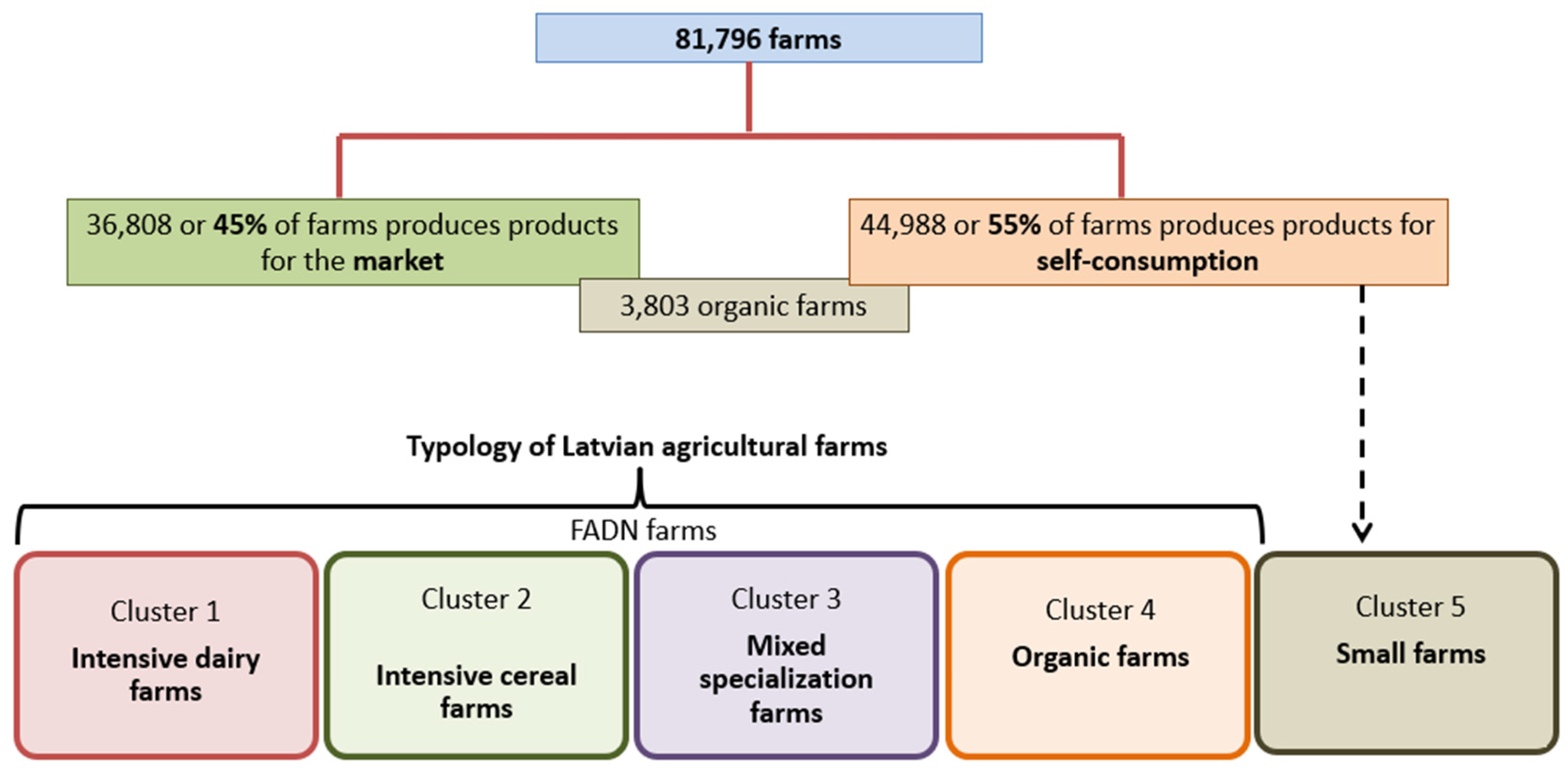
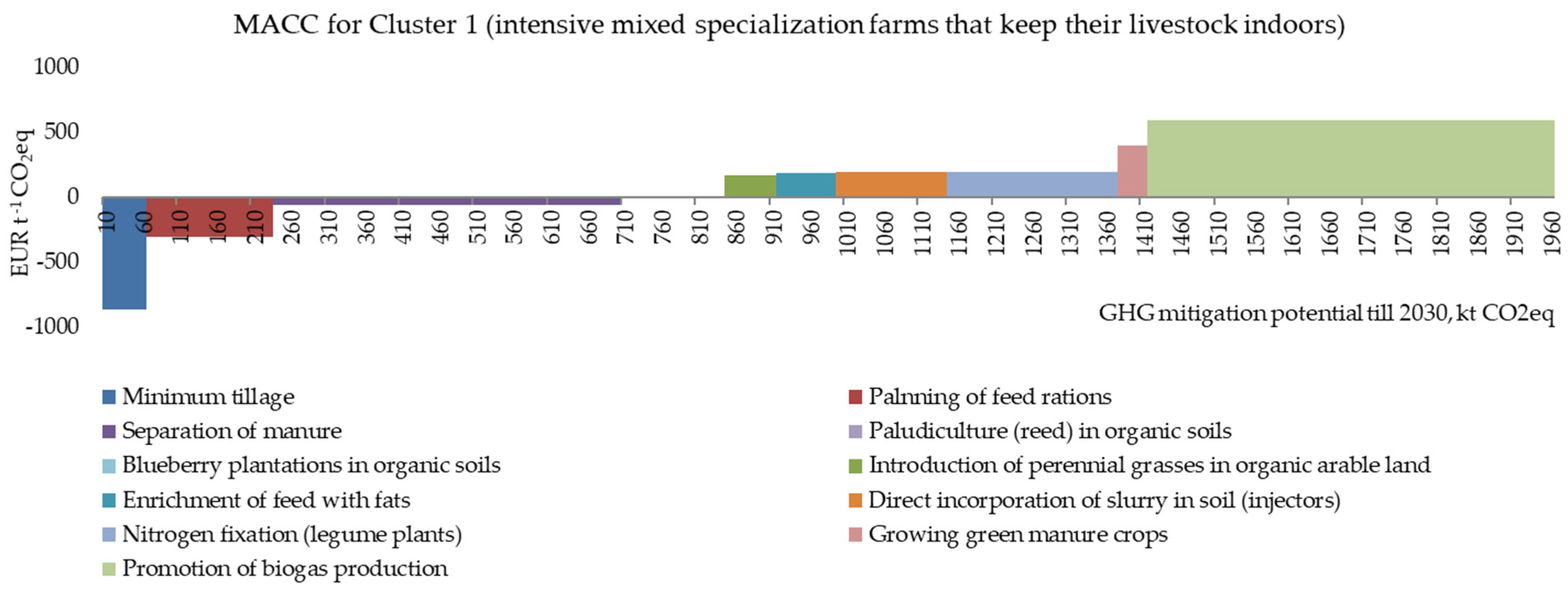
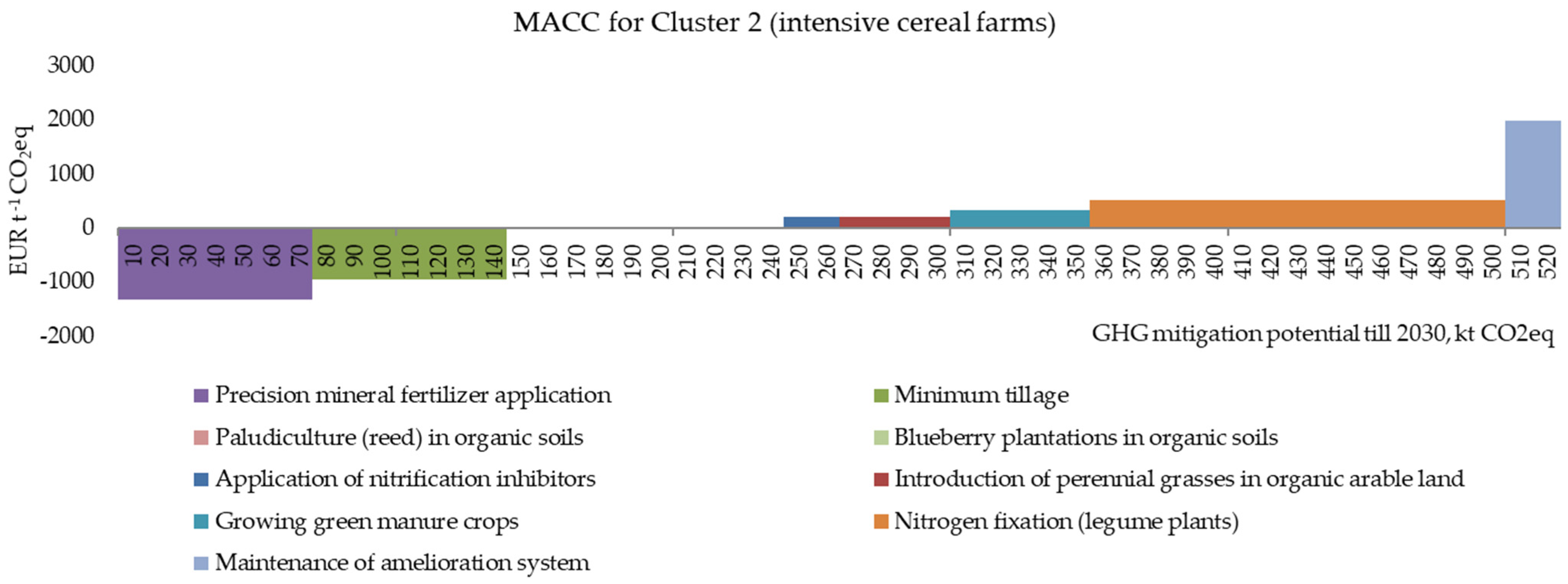
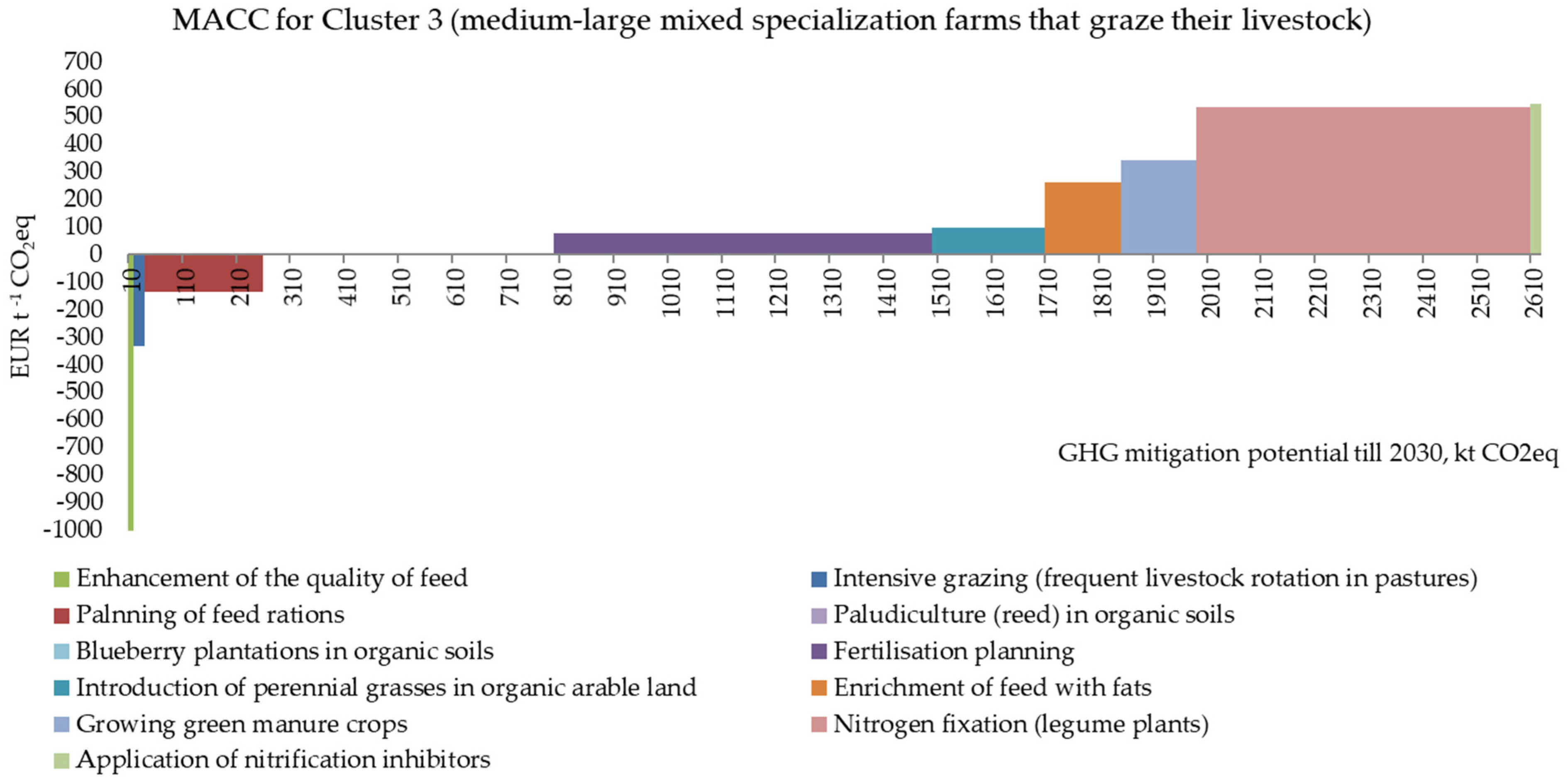
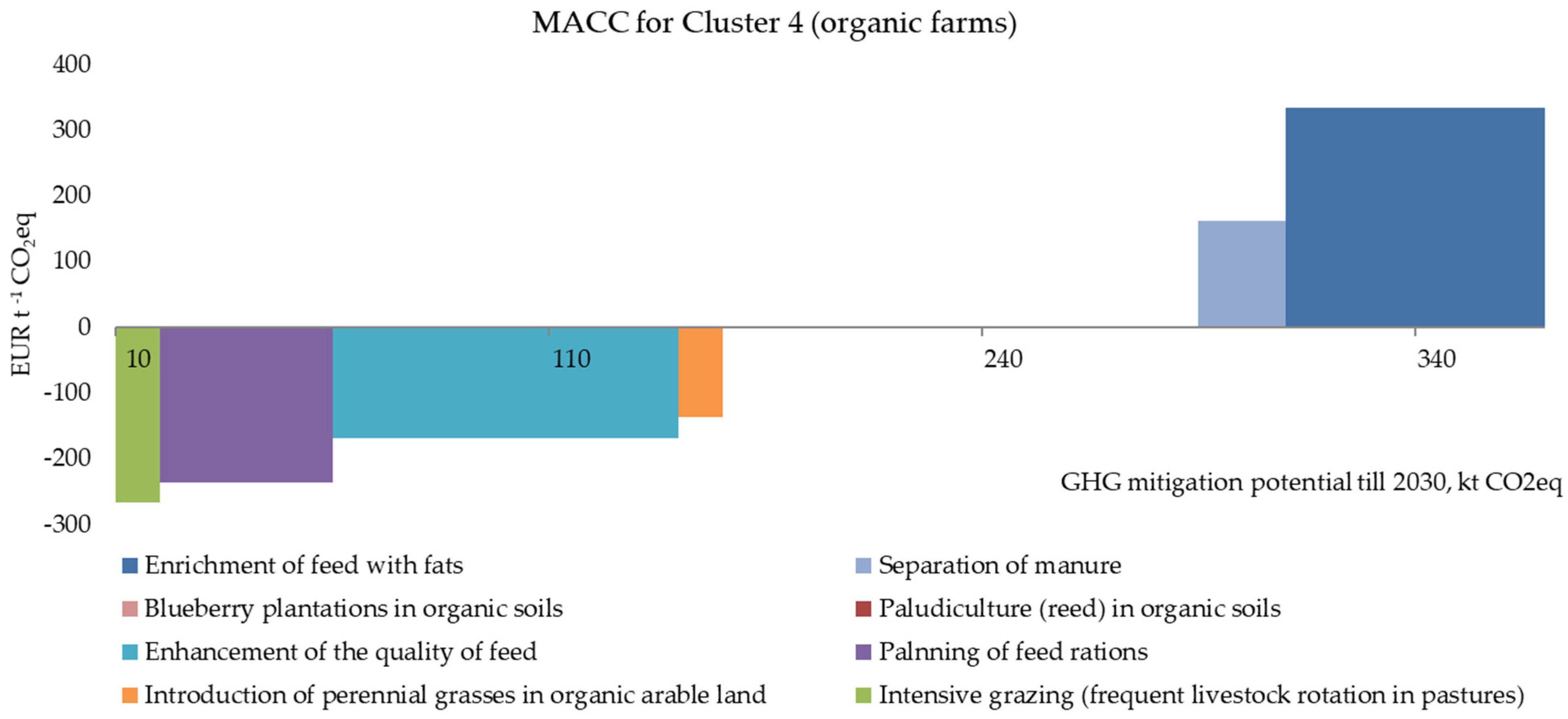
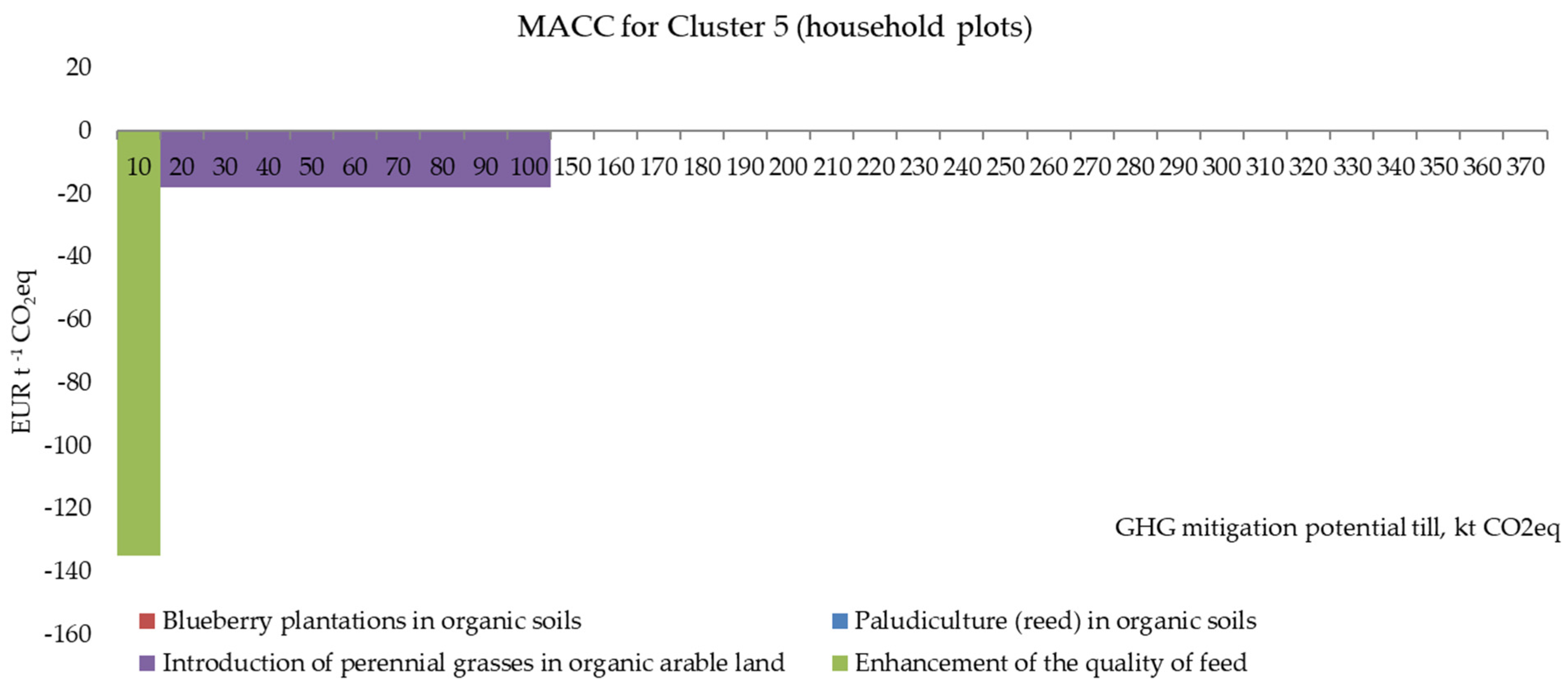
| 2015–2017 | Adopting and improving of MACC methodology for Latvia | Developed MACC for five typical farm clusters | Created a methodology suitable for Latvia using the cluster method. Prepared necessary methodology (scientific monograph) for use of MACC approach. Analyzed several-dozen GHG mitigation measures; 17 were selected for deeper analysis and practical implementation. |
| 2018–2020 | Developing the use and diversity of the MACC approach | Developed MACC with C capture measures and analyzed LULUCF and agriculture interaction | Estimated the overlap effect of multiple sectors (agricultural and LULUCF). Evaluated new C capture measures. Used MACC for policymaking. Identified new research directions. |
| 2021–2023 | Using MACC in policy discussion and knowledge transfer | Developed MACC for ammonia emissions reduction measures and organized a set of discussion events with farmers | Transferred knowledge to non-governmental organizations and farmers. Prepared information for the improvement of climate and agricultural policy. Prepared information for improvement of air quality policy. |
| 2023–2025 | Using MACCs to create new knowledge and improve data gathering | Developed MACCs for CAP GHG reduction measures | Evaluated new GHG emissions reduction measures in agriculture. Developed recommendations for the accounting of agricultural data for the evaluation of the reducing effects of GHG and ammonia emissions. |
| Developed MACCs including ecosystem services evaluation | Developed a methodology for incorporating the value of ecosystem services into the MACC. Developed additional variations of the MACCs for evaluating the cost effectiveness of GHG and ammonia emission reduction measures, reflecting different rates of implementation stages of the measures. |
Disclaimer/Publisher’s Note: The statements, opinions and data contained in all publications are solely those of the individual author(s) and contributor(s) and not of MDPI and/or the editor(s). MDPI and/or the editor(s) disclaim responsibility for any injury to people or property resulting from any ideas, methods, instructions or products referred to in the content. |
© 2025 by the authors. Licensee MDPI, Basel, Switzerland. This article is an open access article distributed under the terms and conditions of the Creative Commons Attribution (CC BY) license.
Share and Cite
Popluga, D.; Naglis-Liepa, K.; Lenerts, A.; Furmanova, K. The Latvian Experience in Assessing the Potential of Agricultural Decarbonization Measures. Environments 2026, 13, 2. https://doi.org/10.3390/environments13010002
Popluga D, Naglis-Liepa K, Lenerts A, Furmanova K. The Latvian Experience in Assessing the Potential of Agricultural Decarbonization Measures. Environments. 2026; 13(1):2. https://doi.org/10.3390/environments13010002
Chicago/Turabian StylePopluga, Dina, Kaspars Naglis-Liepa, Arnis Lenerts, and Ksenija Furmanova. 2026. "The Latvian Experience in Assessing the Potential of Agricultural Decarbonization Measures" Environments 13, no. 1: 2. https://doi.org/10.3390/environments13010002
APA StylePopluga, D., Naglis-Liepa, K., Lenerts, A., & Furmanova, K. (2026). The Latvian Experience in Assessing the Potential of Agricultural Decarbonization Measures. Environments, 13(1), 2. https://doi.org/10.3390/environments13010002