Article

Automated μFTIR Imaging Demonstrates Variability in Microplastic Ingestion by Aquatic Insects in a Remote Taiwanese Mountain Stream


1
Department of Entomology, National Chung Hsing University, Taichung 402, Taiwan
2
National Institute of Environmental Health Sciences, National Health Research Institutes, Miaoli 350, Taiwan
3
Department of Environmental Science, Policy & Management, University of California Berkeley, Berkeley, CA 94720, USA
*
Author to whom correspondence should be addressed.
Environments 2026, 13(1), 3; https://doi.org/10.3390/environments13010003
Submission received: 31 October 2025 / Revised: 12 December 2025 / Accepted: 17 December 2025 / Published: 19 December 2025
(This article belongs to the Special Issue Ecotoxicity of Microplastics)

Abstract

The use of focal plane array micro-Fourier transform infrared spectroscopy (FPA-μFTIR) enables high-resolution characterization of microplastics (MPs) in a wide variety of matrices, including both biotic and abiotic samples. However, this technique has not yet been applied to study MP ingestion in organisms in areas with low MP pollution (e.g., national parks or protected areas). In this study, FPA-μFTIR was used to quantify MPs in the bodies of aquatic insects collected from a high-altitude stream (~2000 m) in Taiwan. Results showed that MP ingestion occurred in nearly all examined taxa, except for caddisfly (Trichoptera: Stenopsychidae) and dragonfly (Odonata: Gomphidae). The majority of MPs were smaller than 500 μm, and the dominant MP polymers identified were polyethylene (65%) and polypropylene (30%), which occurred mainly as fragments (83%) and, to a lesser extent, as fibers (17%). The highest number of MP particles was in the scraper functional-feeding group (FFG), while MPs were not detectable in collector–filterer FFG. The highest MP concentration (particles/individuals) was found in the waterpenny beetle Ectopria sp., followed by the mayflies Paraleptophlebia sp. and Epeorus erratus, and Chironomidae in the subfamily Tanypodinae. We suggest that using high-resolution FPA-μFTIR can be effectively applied to study and monitor MP ingestion in remote, pristine ecosystems.

1. Introduction

Microplastic pollution (MP) presents a threat to environmental resources worldwide, affecting marine, freshwater, and terrestrial ecosystems [1,2,3] as well as human health [4]. Although initial research efforts on MP primarily concentrated on marine environments, a growing body of evidence indicates that freshwater ecosystems are also highly affected [5].
Streams and rivers represent the entry point of MP pollution into coastal systems and eventually seas and oceans [6,7]. MPs result from plastic debris released into the environment that undergoes fragmentation and weathering. MPs generated can persist for centuries [8]. MPs alter the environment through their inherent components and their capacity to interact with other pollutants (e.g., heavy metals, organic compounds) via mechanisms that include hydrophobic and electrostatic forces [9].
Several common MP components and additives have environmental and public health consequences. For example, phthalates that are used to increase the flexibility of materials are endocrine disruptors and suspected reproductive toxicants in animals [10]. Bisphenol A (BPA) is a known endocrine disruptor and has been shown to inhibit the metabolic activity of microbial communities by suppressing methane production in sewage sludge [11]. Brominated flame retardants (BFRs) are persistent additives that can be transferred from ingested MPs to marine organisms [12,13], where they have been linked to toxic effects on liver metabolism and the immune system in fish [14].
MP contamination also occurs in environments once considered pristine, such as high-mountain lakes [15,16] and Arctic regions [17,18]. Distribution in these remote areas is largely attributed to the long-range atmospheric transport of MPs, along with other pollutants, over long distances by winds [19,20]. This process, often referred to as “global distillation” or the “atmospheric deposition” [20,21], explains how substances reach remote areas. For example, persistent organic pollutants (POPs) can be detected in high-altitude mountains, far from their source of use [22]. These remote areas also face the risk of contamination from substances such as heavy metals [23] and pesticides [24] that can be transported through air and water. Because MPs can interact with coexisting waterborne toxicants, this can potentially increase their toxicity and bioavailability to aquatic organisms [25,26]. This combination highlights a complex, cascading effect where human activities in one location can cause significant environmental changes in seemingly disconnected remote ecosystems.
Accurate characterization of MPs in remote environments presents unique challenges. First, overall MP concentrations in presumably pristine areas are typically lower than those in urban or coastal regions. Consequently, samples often contain only trace amounts of very small particles that approach the detection limits using visual identification. Moreover, traditional visual analysis methods are prone to high error rates and human bias that can result in transparent, translucent, or very small particles being overlooked [27]. Second, complex matrices such as biological tissues make the isolation and identification of MPs technically difficult.
Automated methods such as micro-Fourier transform infrared spectroscopy (μFTIR) can detect the smallest size classes of MPs [28], which commonly occur [29]. Primpke et al. [30] reported that 52% of detected MPs belonged to the smallest size class and were nearly invisible during manual analysis. These undetectable particles may be particularly critical in remote ecosystems, where mainly tiny fragments or fibers transported over long distances are expected to occur [31].
The primary advantage of μFTIR lies in its ability to provide a light spectrum for the target material and to distinguish polymers from natural materials [32]. The development of focal plane array (FPA) detectors for μFTIR microscopy has been a critical advancement that enabled automated chemical imaging of large sample areas in a relatively short time, even for those with complex analytes [33]. This automated feature is key to detecting MPs in the smallest size classes, which are often invisible to human analysts. This advantage ensures the systematic identification of particles. Therefore, FPA-μFTIR is a crucial step towards generating more accurate and representative data, which is essential for understanding the true scale and impact of MP contamination [30,34].
This study used FPA-μFTIR to evaluate MP contamination in aquatic insects occurring in a pristine and remote stream environment. FPA-μFTIR has been rarely applied in MP ingestion by biological organisms, with only two published articles, both of which examined MP ingestion by aquatic insects [35,36]. However, both studies occurred in areas strongly influenced by human activities. In the present study, we applied FPA-μFTIR to provide high-resolution examination of MP ingestion and polymer composition in aquatic insects from a remote mountain stream in Taiwan.

2. Materials and Methods

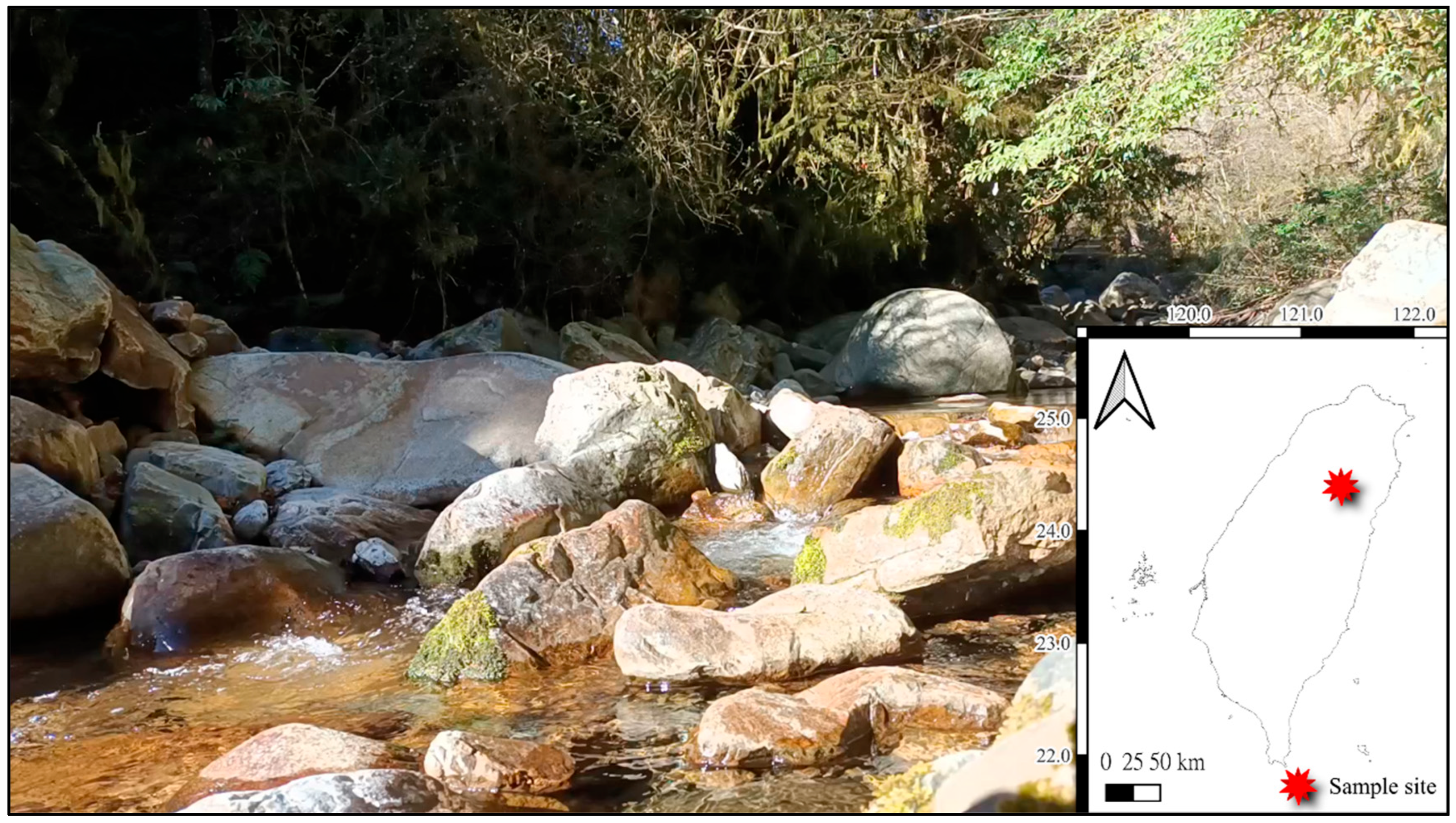
Aquatic insects were collected using a Surber sampler (30.48 cm × 30.48 cm, mesh size 250 μm) in a Taiwanese mountain stream, Louyewei Creek, located in Yilan County (Figure 1).
The creek originates in the Xue Mountain Range. Sampling was conducted in July 2024 at an elevation of 1980 m, with coordinates provided in decimal degrees (24.394° N, 121.351° E). All collected insect specimens were preserved in 75% ethanol for subsequent analysis. In the laboratory, aquatic insects were manually separated from the substrate and identified under a dissecting microscope. Taxonomic identification was conducted using a laboratory-compiled identification key [37,38,39], and aquatic insects were assigned to functional feeding groups (FFGs).
FFGs are a classification system based on the organisms’ mechanisms of food acquisition [39]. The major FFGs of aquatic insects include shredders that chew coarse particulate organic matter (CPOM); collectors, comprising gatherers and filterers that consume fine particulate organic matter (FPOM); scrapers that graze on periphyton-attached algae; and predators that feed on living animal tissue [39]. In addition, microscopic images were captured to measure insect body length. Dry weight estimates were subsequently calculated using the length–mass conversion formula proposed by Benke et al. [40].
Following the methods established by Lin et al. [41], Lin et al. [42], and Claessens et al. [43], this study used a systematic procedure for extracting MPs. First, aquatic insect samples were placed in a 150 mL beaker, to which at least 60 mL of a saturated sodium chloride (NaCl) solution at 24 °C was added. The beaker was then sealed with aluminum foil to minimize contamination from external sources. Next, the beaker was positioned on a magnetic stirrer (420D, Corning, New York, USA) equipped with a stirring bar, set to 25 °C and 100 rpm for 30 min to facilitate the removal of MPs adhering to the surfaces of the insects. After stirring, the solution was allowed to settle for 30 min before carefully removing the NaCl solution. This step eliminated MPs attached to the insect’s exoskeletons, thereby preventing potential analytical errors in subsequent processes. The insect samples were subsequently transferred to a 50 mL beaker, to which 15 mL of 30% hydrogen peroxide (H2O2) and 15 mL of 20% potassium hydroxide (KOH) were added. The digestion process took four days at room temperature. After digestion, the sample solution was filtered through a stainless-steel mesh, 1.0 × 1.0 cm, pore size 25 μm. The filter was subsequently transferred to a clean Petri dish, dried, and sealed with parafilm for later FPA-μFTIR examination. All experimental procedures were conducted in a stainless-steel fume hood to prevent external contamination. Additionally, all equipment was rinsed with reverse osmosis water before use, and a blank control test was performed to assess potential secondary contamination during the experimental process.
In using FPA-μFTIR for detecting MPs, all insect bodies post-identification were fully digested and filtered onto different stainless steel meshes for analysis. Based on the methods applied by Chen et al. [44], an FPA-μFTIR spectroscopy device (Nicolet iN10, Thermo Fisher Scientific, Waltham, USA) equipped with a liquid nitrogen-cooled MCT detector was used to identify polymer types of MPs that measured 25 μm or larger (referring to the shortest axis based on the detection limit. This size threshold reflects the detection capabilities limited by optical resolution and signal intensity. Samples were scanned 64 times across the mid-infrared range of 680 to 3180 cm−1 at a spectral resolution of 8 cm−1. A complete mapping of the entire filter (stainless-steel mesh, 1.0 × 1.0 cm) was conducted using a point-by-point mapping strategy by a focal plane array with an aperture dimension of 50 × 50 μm, requiring approximately 1.5 h per sample. Spectral data were collected in reflection mode. Calibration procedures were performed in advance to minimize background interference from environmental carbon dioxide and moisture. The analysis of the spectra was done using OMNIC 9 software along with the OMNIC spectral library [45]. Identification of plastic polymers was accepted when confidence values exceeded 60%, allowing for the classification of plastic polymers. Fibers and fragments were identified using a minimum aspect ratio of 1:3 [46].
To assess the linear relationship between MP particle size and insect body size, Pearson’s correlation analysis was conducted using R [47]. The Pearson correlation coefficient was calculated with the “cor” function, which also provided a 95% confidence interval and p-value to assess the significance of the association. All statistical analyses were performed using R 4.4.3 [47] within the RStudio 2023.12.0 [48] environment. Data visualization was conducted using the “ggplot2” package [49].

3. Results

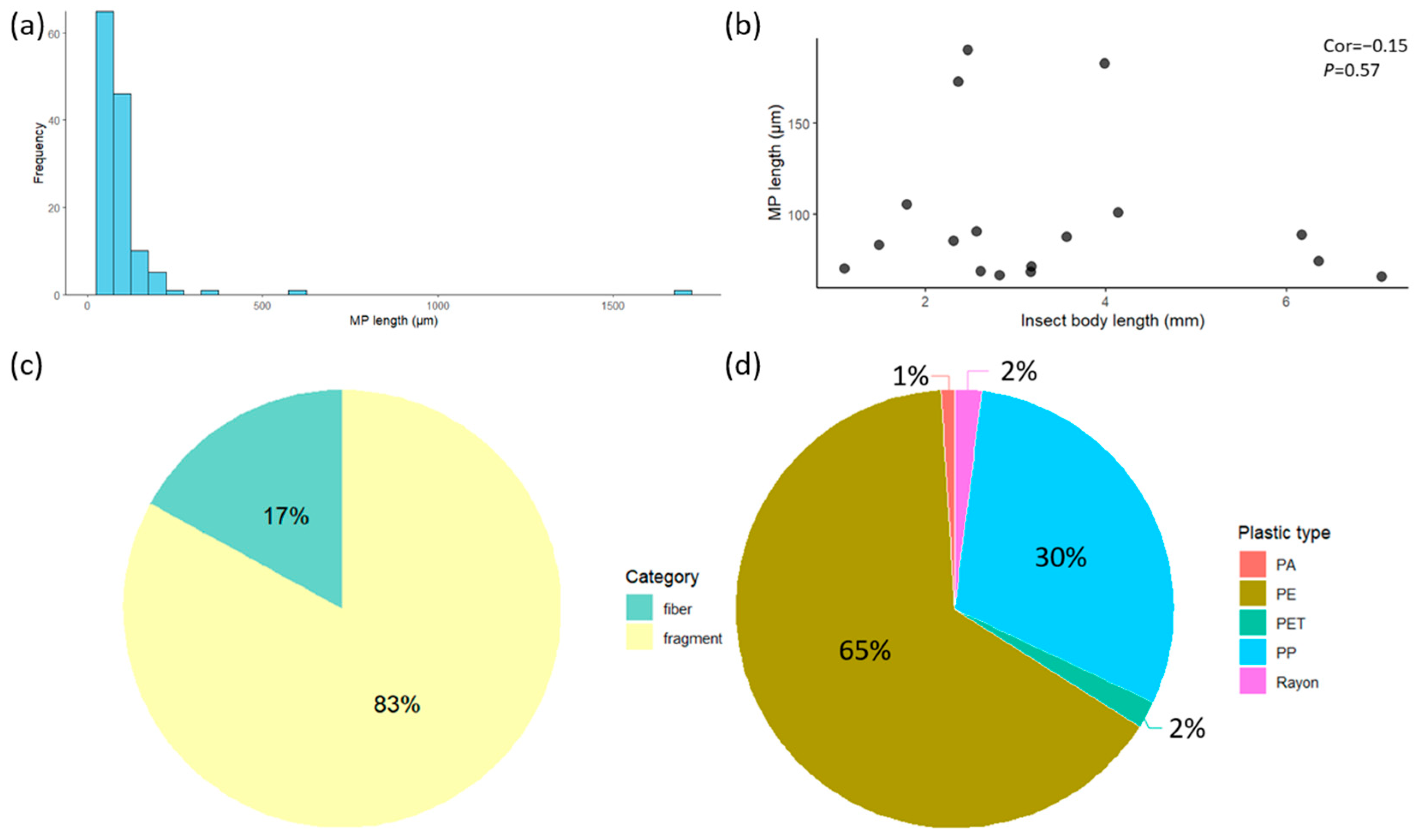
A total of 130 MP particles were detected among the 19 taxa and 64 individuals of aquatic insects examined using FPA-μFTIR. Characterization of MP composition using FPA-μFTIR spectroscopy identified polyethylene (PE) and polypropylene (PP) as the predominant polymer types present in the samples (Figure 2c). Morphologically, MPs were primarily fragments, followed by fibers (Figure 2d). The majority of MPs were <500 μm, ranging from 25 μm to 1699 μm in size (Figure 2a). The relationship between insect body size and MP particle size showed no significant correlation (r = −0.15, p = 0.566), indicating that the size of ingested MPs is not dependent on the organism’s body length (Figure 2b).
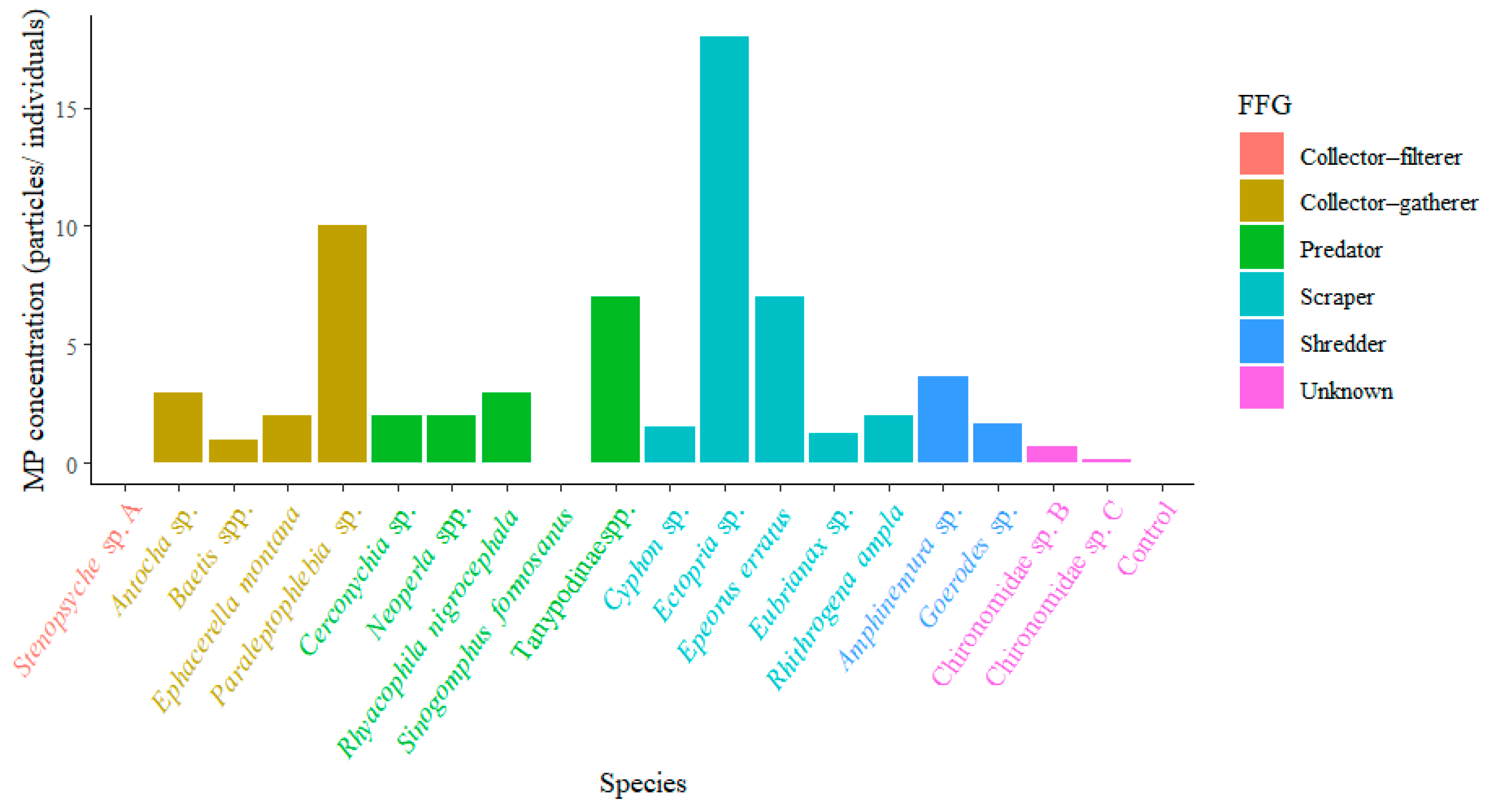
Patterns of microplastic (MP) ingestion varied among taxa and FFGs. MP ingestion was observed in 17 taxa examined, but was absent in the dragonfly nymph Sinogomphus formosanus and the caddisfly larva Stenopsyche sp. A (Figure 3). Among the taxa that did ingest MPs, polyethylene (PE) was the most common. The stonefly nymph Neoperla sp. was an exception in that it exclusively ingested polypropylene (PP) (Table 1). Rayon was detected only in the mayflies Rhithrogena ampla, the stonefly Cerconychia sp., and the chironomid we designated as Chironomidae sp. B. Polyethylene terephthalate (PET) was found in the caddisfly Rhyacophila nigrocephala, the stonefly Amphinemura sp., and the waterpenny beetle Ectopria sp. (Table 1). Among the FFGs, the number of MP particles decreased in the following order: scrapers > collector–gatherers > predators > shredders, whereas collector–filterers had no detectable MPs (Table 1). Chironomidae sp. B and sp. C were excluded from the analysis because their FFGs remain unknown. The waterpenny beetle Ectopria sp. exhibited the highest MP concentration (particles/individuals), followed by the mayfly Paraleptophlebia sp., then the mayfly Epeorus erratus, and the chironomid Tanypodinae spp. (Figure 3).

4. Discussion

This study showed that there were differences in the MP in the aquatic insects collected in Louyewei Creek in terms of the lengths of MP, the number of MP particles in different FFGs, the physicochemical properties of MP, and the amounts and types of MP ingested. The analysis revealed that the majority of ingested MPs were fragments, accounting for 83% of the total, with fibers comprising the remaining 17%. This finding is similar to that of Pan et al. [36], who reported approximately 60% of fragments in aquatic insects in an urbanized river. The absence of laundry and textile factories in the area surrounding Louyewei Creek may contribute to the low number of MP fibers, as washing and drying processes release MP emissions into the water column and air [50,51].
Most particles ingested by the aquatic insects were <500 μm. This morphological predominance of fragments is a key finding, indicating that the microplastics found in this remote stream are predominantly secondary MPs that were not intentionally manufactured at a small size but result from the physical, chemical, and biological degradation of larger plastic items.
In terms of polymer composition, polyethylene (PE) and polypropylene (PP) were identified as the predominant types, constituting 65% and 30% of the total, respectively. This finding aligns with global plastic production and usage patterns. For example, PE and PP are among the most commonly produced polymers [52] and are widely used in single-use plastics and packaging [53]. The results of the prevalence study on polymer types detected are consistent with expectations, given that PE and PP together account for approximately 62% of global plastic production [1]. Similarly, Geyer et al. [54] reported that PE (36%) and PP (21%) are the dominant contributors to MP fiber production.
Two of the examined taxa, the dragonfly Sinogomphus formosanus, which is endemic to Taiwan, and the caddisfly Stenopsyche sp. A did not have ingested MPs, in contrast to the ingestion observed by other taxa occurring in this stream. Although the filter-feeding Stenopsyche sp. A builds specialized silk nets to capture and consume small suspended particles [39], the retention rate of small MPs in larger-bodied organisms may be comparatively low. The low retention is plausible because larger MPs are more likely to accumulate in the gut [55], and larger-bodied organisms are expected to egest MPs more effectively due to their wider gut openings [56]. However, other studies conducted in urbanized areas and regions with high anthropogenic pressures have reported ingested MPs in dragonfly and caddisfly larvae [57,58]. Moreover, caddisflies even build cases with MPs [59], suggesting that non-ingestion may be unique to this specific species population, potentially as a result of local environmental conditions.
In our mountain stream, MP ingestion by aquatic insects was generally lower than that reported in the only two available studies conducted using FPA-μFTIR, both of which were carried out in urbanized lowland rivers in Europe [35,36]. For example, the MP concentration in Chironomidae in our study was 0.1 particles per individual, whereas Chironomidae from Italy and the Netherlands contained 5.8 and 9.6 particles per individual, respectively. This substantial discrepancy likely reflects differences in ambient environmental MP levels [60]. Alternatively, beyond environmental conditions, factors such as body size, FFGs, and other external traits also vary substantially even within an insect order and can strongly influence MP ingestion [61,62]. Neither European study presents all aquatic insects at a taxonomic level finer than the order (e.g., genus or species). Therefore, for instance, our MP concentration in Ephemeroptera (i.e., 3.2 particles per individual) was comparable to that reported from the Netherlands (i.e., 2.5 particles per individual). Especially, consistently small individuals (i.e., 2.2 mm) of Ephemeroptera from Italy were selected and exhibited a lower MP concentration (0.5 particles per individual) than those in our stream and in the Netherlands.
There was no significant correlation between insect body size and the size of ingested MPs. This finding challenges the assumption that larger organisms necessarily consume larger particles. Smaller MP particles are more readily consumed by aquatic insects, possibly because of their greater environmental availability or ease of ingestion [63]. Given that smaller MPs may be more harmful to organisms, the ability to identify minute particles is critical [64]. Predators had a lower number of MP particles among the FFGs studied, perhaps suggesting an absence of biomagnification of MPs in aquatic insects. This finding aligns with Akindele et al. [65], who reported the lowest MP concentrations in predaceous odonates’ larvae. Similarly, Bertoli et al. [66] observed higher MP levels in collector–gatherers compared to predators and other groups.
We believe that the FPA-μFTIR technique can be an important tool for identifying MP in pristine areas because this technique can detect smaller and fewer microplastic particles that typically occur in sites with minimal human activity [67]. In addition, biological traits, such as FFGs, likely play a crucial role in the ingestion of MPs in different aquatic insects in remote regions. Based on our study, a standardized framework for evaluating MP contamination in aquatic insects inhabiting remote and pristine ecosystems could be a valuable addition to monitoring programs.

Author Contributions

Conceptualization, Y.-C.W., M.-C.C. and M.-H.K.; methodology, Y.-C.W. and Y.-C.C.; validation, M.-H.K.; formal analysis, Y.-C.W. and C.-H.W.; investigation, Y.-C.W. and C.-H.W.; resources, M.-H.K.; data curation, Y.-C.W.; writing—original draft preparation, Y.-C.W.; writing—review and editing, M.-C.C. and V.H.R.; visualization, Y.-C.W.; supervision, M.-H.K.; project administration, M.-H.K. All authors have read and agreed to the published version of the manuscript.

Funding

This research was supported by funding from Shei-Pa National Park, Taiwan.

Institutional Review Board Statement

Institutional Review Board (IRB) approval was not required for this study, in accordance with Taiwan’s institutional guidelines and relevant laws and regulations.

Data Availability Statement

The original contributions presented in this study are included in the article. Further inquiries can be directed to the corresponding author.

Acknowledgments

We thank Bo-Kai Chen and Zhao-Ru Chen for their support of our work.

Conflicts of Interest

The authors declare no conflicts of interest.

References

  1. Andrady, A.L. Microplastics in the marine environment. Mar. Pollut. Bull. 2011, 62, 1596–1605. [Google Scholar] [CrossRef]
  2. Rillig, M.C.; Lehmann, A. Microplastic in terrestrial ecosystems. Science 2020, 368, 1430–1431. [Google Scholar] [CrossRef] [PubMed]
  3. Li, J.; Liu, H.; Chen, J.P. Microplastics in freshwater systems: A review on occurrence, environmental effects, and methods for microplastics detection. Water Res. 2018, 137, 362–374. [Google Scholar] [CrossRef]
  4. Winiarska, E.; Jutel, M.; Zemelka-Wiacek, M. The potential impact of nano-and microplastics on human health: Understanding human health risks. Environ. Res. 2024, 251, 118535. [Google Scholar] [CrossRef] [PubMed]
  5. Gao, C.; Xu, B.; Li, Z.; Wang, Z.; Huang, S.; Jiang, Z.; Gong, X.; Yang, H. From plankton to fish: The multifaceted threat of microplastics in freshwater environments. Aquat. Toxicol. 2025, 279, 107242. [Google Scholar] [CrossRef] [PubMed]
  6. Li, S.; Wang, H.; Liang, D.; Li, Y.; Shen, Z. How the Yangtze River transports microplastic to the east China sea. Chemosphere 2022, 307, 136112. [Google Scholar] [CrossRef]
  7. Siegfried, M.; Koelmans, A.A.; Besseling, E.; Kroeze, C. Export of microplastics from land to sea. A modelling approach. Water Res. 2017, 127, 249–257. [Google Scholar] [CrossRef]
  8. Rai, M.; Pant, G.; Pant, K.; Aloo, B.N.; Kumar, G.; Singh, H.B.; Tripathi, V. Microplastic Pollution in Terrestrial Ecosystems and Its Interaction with Other Soil Pollutants: A Potential Threat to Soil Ecosystem Sustainability. Resources 2023, 12, 67. [Google Scholar] [CrossRef]
  9. Joo, S.H.; Liang, Y.; Kim, M.; Byun, J.; Choi, H. Microplastics with adsorbed contaminants: Mechanisms and treatment. Environ. Chall. 2021, 3, 100042. [Google Scholar] [CrossRef]
  10. Campanale, C.; Massarelli, C.; Savino, I.; Locaputo, V.; Uricchio, V.F. A detailed review study on potential effects of microplastics and additives of concern on human health. Int. J. Environ. Res. Public Health 2020, 17, 1212. [Google Scholar] [CrossRef]
  11. Wei, W.; Huang, Q.-S.; Sun, J.; Wang, J.-Y.; Wu, S.-L.; Ni, B.-J. Polyvinyl chloride microplastics affect methane production from the anaerobic digestion of waste activated sludge through leaching toxic bisphenol-A. Environ. Sci. Technol. 2019, 53, 2509–2517. [Google Scholar] [CrossRef]
  12. Chua, E.M.; Shimeta, J.; Nugegoda, D.; Morrison, P.D.; Clarke, B.O. Assimilation of polybrominated diphenyl ethers from microplastics by the marine amphipod, Allorchestes compressa. Environ. Sci. Technol. 2014, 48, 8127–8134. [Google Scholar] [CrossRef]
  13. Rochman, C.M.; Lewison, R.L.; Eriksen, M.; Allen, H.; Cook, A.-M.; Teh, S.J. Polybrominated diphenyl ethers (PBDEs) in fish tissue may be an indicator of plastic contamination in marine habitats. Sci. Total Environ. 2014, 476, 622–633. [Google Scholar] [CrossRef]
  14. Granby, K.; Rainieri, S.; Rasmussen, R.R.; Kotterman, M.J.; Sloth, J.J.; Cederberg, T.L.; Barranco, A.; Marques, A.; Larsen, B.K. The influence of microplastics and halogenated contaminants in feed on toxicokinetics and gene expression in European seabass (Dicentrarchus labrax). Environ. Res. 2018, 164, 430–443. [Google Scholar] [CrossRef] [PubMed]
  15. Feng, S.; Lu, H.; Yao, T.; Xue, Y.; Yin, C.; Tang, M. Spatial characteristics of microplastics in the high-altitude area on the Tibetan Plateau. J. Hazard. Mater. 2021, 417, 126034. [Google Scholar] [CrossRef]
  16. Jain, Y.; Govindasamy, H.; Kaur, G.; Ajith, N.; Ramasamy, K.; RS, R.; Ramachandran, P. Microplastic pollution in high-altitude Nainital lake, Uttarakhand, India. Environ. Pollut. 2024, 346, 123598. [Google Scholar] [CrossRef] [PubMed]
  17. Bergmann, M.; Mützel, S.; Primpke, S.; Tekman, M.B.; Trachsel, J.; Gerdts, G. White and wonderful? Microplastics prevail in snow from the Alps to the Arctic. Sci. Adv. 2019, 5, eaax1157. [Google Scholar] [CrossRef] [PubMed]
  18. Lusher, A.L.; Tirelli, V.; O’Connor, I.; Officer, R. Microplastics in Arctic polar waters: The first reported values of particles in surface and sub-surface samples. Sci. Rep. 2015, 5, 14947. [Google Scholar] [CrossRef]
  19. Hee, Y.Y.; Hanif, N.M.; Weston, K.; Latif, M.T.; Suratman, S.; Rusli, M.U.; Mayes, A.G. Atmospheric microplastic transport and deposition to urban and pristine tropical locations in Southeast Asia. Sci. Total Environ. 2023, 902, 166153. [Google Scholar] [CrossRef]
  20. Allen, S.; Allen, D.; Phoenix, V.R.; Le Roux, G.; Durántez Jiménez, P.; Simonneau, A.; Binet, S.; Galop, D. Atmospheric transport and deposition of microplastics in a remote mountain catchment. Nat. Geosci. 2019, 12, 339–344. [Google Scholar] [CrossRef]
  21. Goldberg, E. Synthetic organohalides in the sea. Proc. R. Soc. London. Ser. B. Biol. Sci. 1975, 189, 277–289. [Google Scholar] [CrossRef]
  22. Fernández, P.; Grimalt, J.O. On the global distribution of persistent organic pollutants. Chimia 2003, 57, 514. [Google Scholar] [CrossRef]
  23. Hadzi, G.Y.; Essumang, D.K.; Adjei, J.K. Distribution and risk assessment of heavy metals in surface water from pristine environments and major mining areas in Ghana. J. Health Pollut. 2015, 5, 86–99. [Google Scholar] [CrossRef]
  24. Unsworth, J.; Wauchope, R.; Klein, A.; Dorn, E.; Zeeh, B.; Yeh, S.; Akerblom, M.; Racke, K.; Rubin, B. Significance of the long range transport of pesticides in the atmosphere. Pure Appl. Chem. 1999, 71, 1359–1383. [Google Scholar] [CrossRef]
  25. Wang, Y.; Yang, Y.; Liu, X.; Zhao, J.; Liu, R.; Xing, B. Interaction of microplastics with antibiotics in aquatic environment: Distribution, adsorption, and toxicity. Environ. Sci. Technol. 2021, 55, 15579–15595. [Google Scholar] [CrossRef]
  26. Ho, W.-K.; Leung, K.S.-Y. The crucial role of heavy metals on the interaction of engineered nanoparticles with polystyrene microplastics. Water Res. 2021, 201, 117317. [Google Scholar] [CrossRef]
  27. Löder, M.G.; Gerdts, G. Methodology used for the detection and identification of microplastics—A critical appraisal. In Marine Anthropogenic Litter; Springer: Cham, Switzerland, 2015; pp. 201–227. [Google Scholar]
  28. Song, Y.K.; Hong, S.H.; Eo, S.; Shim, W.J. A comparison of spectroscopic analysis methods for microplastics: Manual, semi-automated, and automated Fourier transform infrared and Raman techniques. Mar. Pollut. Bull. 2021, 173, 113101. [Google Scholar] [CrossRef] [PubMed]
  29. Leusch, F.D.; Lu, H.-C.; Perera, K.; Neale, P.A.; Ziajahromi, S. Analysis of the literature shows a remarkably consistent relationship between size and abundance of microplastics across different environmental matrices. Environ. Pollut. 2023, 319, 120984. [Google Scholar] [CrossRef] [PubMed]
  30. Primpke, S.; Lorenz, C.; Rascher-Friesenhausen, R.; Gerdts, G. An automated approach for microplastics analysis using focal plane array (FPA) FTIR microscopy and image analysis. Anal. Methods 2017, 9, 1499–1511. [Google Scholar] [CrossRef]
  31. Wright, S.L.; Ulke, J.; Font, A.; Chan, K.L.A.; Kelly, F.J. Atmospheric microplastic deposition in an urban environment and an evaluation of transport. Environ. Int. 2020, 136, 105411. [Google Scholar] [CrossRef]
  32. Veerasingam, S.; Ranjani, M.; Venkatachalapathy, R.; Bagaev, A.; Mukhanov, V.; Litvinyuk, D.; Mugilarasan, M.; Gurumoorthi, K.; Guganathan, L.; Aboobacker, V. Contributions of Fourier transform infrared spectroscopy in microplastic pollution research: A review. Crit. Rev. Environ. Sci. Technol. 2021, 51, 2681–2743. [Google Scholar] [CrossRef]
  33. Lewis, E.N.; Treado, P.J.; Reeder, R.C.; Story, G.M.; Dowrey, A.E.; Marcott, C.; Levin, I.W. Fourier transform spectroscopic imaging using an infrared focal-plane array detector. Anal. Chem. 1995, 67, 3377–3381. [Google Scholar] [CrossRef] [PubMed]
  34. Rathore, C.; Saha, M.; Gupta, P.; Kumar, M.; Naik, A.; de Boer, J. Standardization of micro-FTIR methods and applicability for the detection and identification of microplastics in environmental matrices. Sci. Total Environ. 2023, 888, 164157. [Google Scholar] [CrossRef]
  35. Di Lorenzo, T.; Cabigliera, S.B.; Martellini, T.; Laurati, M.; Chelazzi, D.; Galassi, D.M.P.; Cincinelli, A. Ingestion of microplastics and textile cellulose particles by some meiofaunal taxa of an urban stream. Chemosphere 2023, 310, 136830. [Google Scholar] [CrossRef]
  36. Pan, C.-G.; Mintenig, S.M.; Redondo-Hasselerharm, P.E.; Neijenhuis, P.H.; Yu, K.-F.; Wang, Y.-H.; Koelmans, A.A. Automated μFTIR imaging demonstrates taxon-specific and selective uptake of microplastic by freshwater invertebrates. Environ. Sci. Technol. 2021, 55, 9916–9925. [Google Scholar] [CrossRef]
  37. Kang, S. Ephemeroptera of Taiwan (Excluding Baetidae); National Chung Hsing University: Taichung, Taiwan, 1993. [Google Scholar]
  38. Kawai, T.; Tanida, K. Aquatic Insects of Japan: Manual with Keys and Illustrations; Tokai University Press: Yoyogi, Tokyo, 2005. [Google Scholar]
  39. Merritt, R.W.; Cummins, K.W.; Berg, M.B. (Eds.) An Introduction to the Aquatic Insects of North America, 5th ed.; Kendall Hunt Publishing Company: Dubuque, IA, USA, 2019. [Google Scholar]
  40. Benke, A.C.; Huryn, A.D.; Smock, L.A.; Wallace, J.B. Length-mass relationships for freshwater macroinvertebrates in North America with particular reference to the southeastern United States. J. North Am. Benthol. Soc. 1999, 18, 308–343. [Google Scholar] [CrossRef]
  41. Lin, C.-T.; Chiu, M.-C.; Kuo, M.-H. Effects of anthropogenic activities on microplastics in deposit-feeders (Diptera: Chironomidae) in an urban river of Taiwan. Sci. Rep. 2021, 11, 400. [Google Scholar] [CrossRef] [PubMed]
  42. Lin, C.-T.; Chiu, M.-C.; Kuo, M.-H. Seasonality can override the effects of anthropogenic activities on microplastic presence in invertebrate deposit feeders in an urban river system. J. Hazard. Mater. 2023, 443, 130272. [Google Scholar] [CrossRef]
  43. Claessens, M.; Van Cauwenberghe, L.; Vandegehuchte, M.B.; Janssen, C.R. New techniques for the detection of microplastics in sediments and field collected organisms. Mar. Pollut. Bull. 2013, 70, 227–233. [Google Scholar] [CrossRef]
  44. Chen, Y.-C.; Wei, C.-H.; Hsu, W.-T.; Proborini, W.D.; Hsiao, T.-C.; Liu, Z.-S.; Chou, H.-C.; Soo, J.-C.; Dong, G.-C.; Chen, J.-K. Impact of seasonal changes and environmental conditions on suspended and inhalable microplastics in urban air. Environ. Pollut. 2024, 362, 124994. [Google Scholar] [CrossRef]
  45. Mecozzi, M.; Pietroletti, M.; Monakhova, Y.B. FTIR spectroscopy supported by statistical techniques for the structural characterization of plastic debris in the marine environment: Application to monitoring studies. Mar. Pollut. Bull. 2016, 106, 155–161. [Google Scholar] [CrossRef]
  46. Cole, M. A novel method for preparing microplastic fibers. Sci. Rep. 2016, 6, 34519. [Google Scholar] [CrossRef]
  47. R Core Team. R: A Language and Environment for Statistical Computing; R Foundation for Statistical Computing: Vienna, Austria, 2025. [Google Scholar]
  48. Posit Team. Posit Software, 2023, RStudio: Integrated Development Environment for R; PBC: Boston, MA, USA, 2023.
  49. Wickham, H. ggplot2: Elegant Graphics for Data Analysis; Springer: New York, NY, USA, 2016. [Google Scholar]
  50. Wang, C.; Song, J.; Nunes, L.M.; Zhao, H.; Wang, P.; Liang, Z.; Arp, H.P.H.; Li, G.; Xing, B. Global microplastic fiber pollution from domestic laundry. J. Hazard. Mater. 2024, 477, 135290. [Google Scholar] [CrossRef]
  51. O’Brien, S.; Okoffo, E.D.; O’Brien, J.W.; Ribeiro, F.; Wang, X.; Wright, S.L.; Samanipour, S.; Rauert, C.; Toapanta, T.Y.A.; Albarracin, R. Airborne emissions of microplastic fibres from domestic laundry dryers. Sci. Total Environ. 2020, 747, 141175. [Google Scholar] [CrossRef]
  52. Plastics Europe. Plastics—The Fast Facts 2024. 2024. Available online: https://plasticseurope.org/knowledge-hub/plastics-the-fast-facts-2024/ (accessed on 17 October 2025).
  53. Emblem, A. Plastics properties for packaging materials. In Packaging Technology; Elsevier: Amsterdam, The Netherlands, 2012; pp. 287–309. [Google Scholar]
  54. Geyer, R.; Jambeck, J.R.; Law, K.L. Production, use, and fate of all plastics ever made. Sci. Adv. 2017, 3, e1700782. [Google Scholar] [CrossRef] [PubMed]
  55. Wang, M.; Wang, W.-X. Accumulation kinetics and gut microenvironment responses to environmentally relevant doses of micro/nanoplastics by zooplankton Daphnia magna. Environ. Sci. Technol. 2023, 57, 5611–5620. [Google Scholar] [CrossRef]
  56. Welden, N.A.; Cowie, P.R. Environment and gut morphology influence microplastic retention in langoustine, Nephrops norvegicus. Environ. Pollut. 2016, 214, 859–865. [Google Scholar] [CrossRef] [PubMed]
  57. Álvarez Troncoso, M.R.; Gutierrez Rial, D.; Villar Comesaña, I.; Ehlers, S.M.; Soto González, B.; Mato de la Iglesia, S.; Garrido González, J. Microplastics in water, sediments and macroinvertebrates in a small river of NW Spain. Limnetica 2024, 43, 199–212. [Google Scholar] [CrossRef]
  58. Ossa-Yepes, M.; Ríos-Pulgarín, M.I.; Villabona-González, S.L.; Zapata-Vahos, I.C.; Martínez, F.A.; Barletta, M. Microplastics and other anthropogenic particles contamination and their potential trophic transfer in a tropical Andean reservoir, Colombia. Hydrobiologia 2025. [Google Scholar] [CrossRef]
  59. Hiemstra, A.-F.; van der Velden, I.; Ciliberti, P.; D’Alba, L.; Gravendeel, B.; Schilthuizen, M. Half a century of caddisfly casings (Trichoptera) with microplastic from natural history collections. Sci. Total Environ. 2025, 974, 178947. [Google Scholar] [CrossRef]
  60. Nel, H.A.; Dalu, T.; Wasserman, R.J. Sinks and sources: Assessing microplastic abundance in river sediment and deposit feeders in an Austral temperate urban river system. Sci. Total Environ. 2018, 612, 950–956. [Google Scholar] [CrossRef]
  61. Porter, A.; Godbold, J.A.; Lewis, C.N.; Savage, G.; Solan, M.; Galloway, T.S. Microplastic burden in marine benthic invertebrates depends on species traits and feeding ecology within biogeographical provinces. Nat. Commun. 2023, 14, 8023. [Google Scholar] [CrossRef] [PubMed]
  62. Wardlaw, C.M.; Corcoran, P.L.; Neff, B.D. Factors influencing the variation of microplastic uptake in demersal fishes from the upper Thames River Ontario. Environ. Pollut. 2022, 313, 120095. [Google Scholar] [CrossRef]
  63. Gad, A.K.; Midway, S.R. Relationship of microplastics to body size for two estuarine fishes. Microplastics 2022, 1, 211–220. [Google Scholar] [CrossRef]
  64. Wright, S.L.; Thompson, R.C.; Galloway, T.S. The physical impacts of microplastics on marine organisms: A review. Environ. Pollut. 2013, 178, 483–492. [Google Scholar] [CrossRef]
  65. Akindele, E.O.; Ehlers, S.M.; Koop, J.H. Freshwater insects of different feeding guilds ingest microplastics in two Gulf of Guinea tributaries in Nigeria. Environ. Sci. Pollut. Res. 2020, 27, 33373–33379. [Google Scholar] [CrossRef] [PubMed]
  66. Bertoli, M.; Pastorino, P.; Lesa, D.; Renzi, M.; Anselmi, S.; Prearo, M.; Pizzul, E. Microplastics accumulation in functional feeding guilds and functional habit groups of freshwater macrobenthic invertebrates: Novel insights in a riverine ecosystem. Sci. Total Environ. 2022, 804, 150207. [Google Scholar] [CrossRef]
  67. Feng, S.; Lu, H.; Tian, P.; Xue, Y.; Lu, J.; Tang, M.; Feng, W. Analysis of microplastics in a remote region of the Tibetan Plateau: Implications for natural environmental response to human activities. Sci. Total Environ. 2020, 739, 140087. [Google Scholar] [CrossRef] [PubMed]
Figure 1. Location and photograph of Louyewei Creek. Coordinates are provided in decimal degrees (24.394° N, 121.351° E) with an elevation of 1980 m.
Environments 13 00003 g001
Figure 2. (a) MP length (μm); (b) correlation between MP size and insect body size. Each dot represents the average insect body length plotted against the average MP length; (c) MP shape composition; (d) MP chemical composition in aquatic insects examined in Louyewei Creek.
Environments 13 00003 g002
Figure 3. MP concentration in aquatic insects and their functional feeding groups (FFGs). The x-axis represents insect taxa (grouped by FFG) in Louyewei Creek. Colors correspond to different FFGs.
Environments 13 00003 g003
Table 1. Functional feeding groups (FFGs), total dry weight of all individuals (mg), the number of individuals, and MP particles in aquatic insects in Louyewei Creek.
TaxonFFGTotal Dry Weight (mg)Number of InsectsNumber of MP ParticlesMP Chemical Composition
Paraleptophlebia sp.Collector–gatherer0.03220PE, PP
Rhithrogena amplaScraper0.1512PE, Rayon
Epeorus erratusScraper0.0517PE, PP
Baetis spp.Collector–gatherer2.1177PE
Ephacerella montanaCollector–gatherer0.0112PE, PP
Goerodes sp.Shredder4.06610PE, PP
Stenopsyche sp. ACollector–filterer249.3810-
Rhyacophila nigrocephalaPredator0.3013PE, PET
Cerconychia sp.Predator8.37510PE, PP, Rayon
Amphinemura sp.Shredder0.12311PE, PET, PP
Neoperla sp.Predator15.7736PP
Cyphon sp.Scraper3.1269PE
Eubrianax sp.Scraper15.6745PE
Ectopria sp.Scraper0.20118PE, PET, PP
Antocha sp.Collector–gatherer0.1026PA, PE, PP
Tanypodinae spp.Predator0.0217PE, PP
Chironomidae sp. BUnknown0.1675PP, Rayon
Chironomidae sp. CUnknown0.50112PE
Sinogomphus formosanusPredator2.2110-
Disclaimer/Publisher’s Note: The statements, opinions and data contained in all publications are solely those of the individual author(s) and contributor(s) and not of MDPI and/or the editor(s). MDPI and/or the editor(s) disclaim responsibility for any injury to people or property resulting from any ideas, methods, instructions or products referred to in the content.