


Abstract
The water sustainability in Chihuahua City is challenged by rapid urbanization, population growth, industrial expansion, and climate variability. This study examines how these factors impact water demand by analyzing six decades of local precipitation, extreme temperature, demographic, and water consumption data. Statistical methods (time series and gamma distribution with R-package) and spatial analysis using Landsat and Spot satellite imagery were employed. Chihuahua’s urban area grew at an average annual rate of 7.4% from 1992 to 2020. Minimum and maximum temperatures have increased by 0.07 °C and 0.05 °C per year, respectively, leading to more frequent heatwaves over the past 30 years. Since the 1990s, there has been a noticeable trend towards more frequent extreme precipitation events coinciding with a sustained rise in extreme temperatures. Urban expansion and rising temperatures have increased water consumption by approximately 40% per °C over the past 30 years, accelerating the depletion of groundwater reserves in the city’s three main aquifers. These trends highlight the urgent need for integrated urban planning and climate-adaptation measures to reduce vulnerability and ensure long-term water security for Chihuahua.
1. Introduction
Water scarcity is a critical global issue affecting regions where water demand exceeds availability [1,2]. In urban regions, factors such as population growth, urbanization, overexploitation of aquifers, and climate variability are the primary causes of water stress [3]. Since the mid-20th century, the global population has increased dramatically, and this trend is expected to continue, with projections estimating 9.7 billion people by 2050 and a potential peak of around 10.4 billion by the 2080s [4]. Population growth contributes to poverty, resource scarcity, unsustainable production standards, and the ever-increasing consumption of resources, particularly in environmentally vulnerable areas [5].
Rapid industrialization and urbanization have led to the expansion of urban areas, which are home to over half of the world’s population and contribute over 80% of gross domestic product (GDP). However, cities encounter obstacles that jeopardize the well-being and livelihoods of individuals. Population growth, human-driven pressures, and climate-related events, such as variable rainfall and extreme temperatures, exacerbate urban vulnerability and water stress. The replacement of natural landscapes has intensified heat retention, resulting in urban heat islands, increased water demand, energy use, and Greenhouse Gas (GHG) emissions, while infrastructure and governance struggle to keep pace [6,7]. These factors are also responsible for the overexploitation of natural resources such as water and the adverse impact on sustainable development.
The United Nations 2030 Agenda recognizes the three critical guiding axes for sustainable development: economic growth, social inclusion, and environmental protection [4]. Climate variability comprises quasi-periodic fluctuations occurring on interannual to multi-decadal or longer time scales and is therefore a key driver affecting both water supply and water demand [8,9]. Understanding how climate variability interacts with past and present climate change is essential for effective adaptation [10]. Socioeconomic studies of climate change have often underestimated climate uncertainty and overlooked broader urban impacts such as land subsidence, seawater intrusion, freshwater depletion, and water quality deterioration [11]. While climate research has traditionally emphasized extreme events at broad regional scales, local-scale processes remain underrepresented, even though internal climate variability may dominate climate responses over the next several decades [12]. Improving the reliability of local projections requires integrating process-based knowledge of local dynamics with rigorous statistical characterization of internal variability.
Climate change significantly impacts water availability in Mexico by altering temperature (increases of up to 5 °C) and precipitation patterns (20.3% less potential rainfall) [13]. The North, West, and Bajío regions in Mexico are particularly affected, facing severe soil moisture deficits and increased water stress, leading to anticipated moderate to extreme droughts. Studies on maar lakes in central Mexico reveal they are losing more water to evaporation than they gain from precipitation, further exacerbated by reduced groundwater inflow [14]. Additionally, the rising frequency and intensity of heat waves threaten urban areas in Northern Mexico, increasing public health risks and disrupting water services [15]. Despite these challenges, urban planning often overlooks the implications of extreme temperatures, especially in vulnerable settlements.
Over 90% of Chihuahua City’s water supply is sourced from the overexploited Chihuahua-Sacramento aquifer, where unsustainable groundwater withdrawals have led to significant declines in water levels [16]. Between 1986 and 2010, continuous groundwater abstraction led to a decline in water levels of 32 to 92 m, exacerbating water scarcity in this city [17] and increasing potential secondary effects such as land subsidence, loss of streamflow, and water-quality degradation. Improving the understanding and implementation of urban adaptation requires the analysis of historical information to enable medium- and long-term transformative actions. Adaptive management is essential for water security, as it involves iterative planning, recognizing uncertainties, and adjusting responses through stakeholder engagement [18]. To accurately assess practical policy decisions that affect further governance and infrastructure development, it is essential to utilize scientifically feasible climate variability analysis and understand how this variability impacts urban systems [19], such as heat waves and precipitation regimes that require innovative urban adaptive solutions [20]. This study is the first step needed to assess the combined effects of climate variability and population–urban growth on water demand in Chihuahua City. Through the integration of statistical and spatial analyses of historical precipitation and extreme temperature trends with demographic and water consumption data, the study identifies key climate drivers of water stress in an arid urban context. These dynamics underscore the importance of advancing Conjunctive Water Management approaches that integrate water use, land-use change, and climate variability, ensuring that both supply and demand pressures are addressed within a coherent sustainability framework [21]. Follow-up studies that explore more causational relations through process-based modeling will also benefit from these analyses and data as observations needed to further quantify these changes.
2. Materials and Methods
To conduct this study, trends and variabilities in precipitation and extreme temperatures, including maximum (Tmax) and minimum (Tmin) temperatures, and temperature differences, plus water consumption and extraction, were analyzed over a six-decade period (1960–2020). Likewise, water consumption and extraction were incorporated into this analysis.
2.1. Study Area
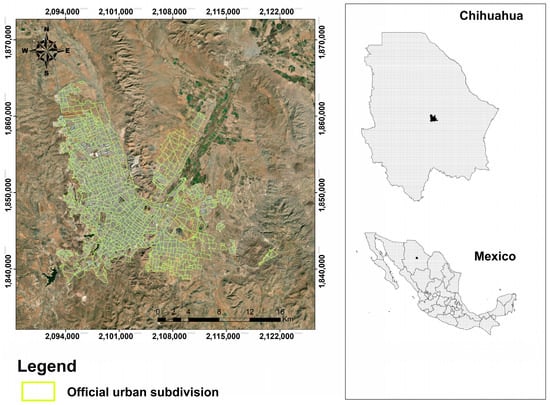
The study area covers Chihuahua City, located between the geographic coordinates 106.083 W and 28.674 N, at an elevation of around 1420 m a.s.l. (above sea level); see Figure 1. The central municipality, Chihuahua City, has 937,674 inhabitants according to the 2020 population census [22]. Currently, the metropolitan zone of Chihuahua includes three municipalities: Chihuahua, Aldama, and Santa Eulalia. With 988,065 inhabitants, it is the eighteenth-largest conurbation in Mexico. Diverse topographical features, including flat valleys, slopes, and hills, characterize this region. These are surrounded by several mountain ranges, including Sacramento, Santa Eulalia, and Pastorías [23]. The region’s semiarid-arid climate has an annual average temperature, evaporation, and precipitation of 18.4 °C, 1954 mm, and 420 mm [24,25], respectively. The primary source of water for human consumption in Chihuahua is groundwater, with an annual concessioned extraction of approximately 150.2 Mm3 and an average pumping rate of 4.70 m3/s from the Chihuahua-Sacramento, Sauz-Encinillas, and Tabalaopa-Aldama aquifers [25,26,27]. These three hydrogeological systems are officially classified as overexploited, with reported annual deficits of –65.9, –58.14, and –4.2 hm3, respectively. The main economic activities in this region are the manufacturing industry and commerce.
Figure 1.
Geographic location of the study area. Chihuahua City is situated in the central region of the state of Chihuahua (highlighted in black), in northern Mexico.
2.2. Data Information: Land Use, Climate Variables, and Population Water Consumption
The study area comprises the urban population and the urbanization of Chihuahua City in 2020, identified and evaluated as adaptation priorities to climate variability. The urban population limit was obtained from the urban cadastral office of the municipality of Chihuahua, while the urbanization growth was calculated from the Chihuahua municipality polygon to 2018, 29,140 ha.
2.2.1. Historical Data on Population Land Use
Historical population information for the city of Chihuahua was obtained from censuses conducted by the National Institute of Statistics and Geography [22] for the period from 1900 to 2020. Population censuses in Mexico are conducted every 10 years [22], with additional monitoring in specific five-year periods, specifically in 1995 and 2005.
The available vector datasets from the Land Use and Vegetation Series I (1992), III (2005), and VII (2018), at a 1:250,000 scale, were used to assess transitions, degradation, gains, and losses in vegetation and agricultural land associated with the city’s geodemographic expansion [28,29,30]. Land-use information from these series, derived from Landsat TM, Landsat OLI-8, and SPOT imagery, was processed through thematic mapping and digital analysis of Geomedian multispectral composites. This interpretation was supported by field verification to ensure accuracy and consistency across the temporal datasets. Finally, the Pontius methodology was applied to quantify those changes in land use over the 1992–2018 period [31]. The calculations in the Pontius matrices were performed by comparing land-use maps from different years on a pixel-by-pixel basis. The class transitions were organized into a matrix in which gains, losses, and persistence for each category were quantified, allowing for an assessment of the magnitude and direction of land-use changes [32].
2.2.2. Climate Variability
Extreme temperatures, maximum temperature (Tmax) and minimum temperature (Tmin), and precipitation data were used to analyze the variability of climate factors from 1961 to 2021 and identify the study area’s coldest and warmest zones. All that data was compiled from the historical CLICOM database of the National Meteorological Service of Mexico (SMN), which was collected from 27 climatological stations surrounding Chihuahua City [33]; Figure A1 (Appendix A) shows the location of climate stations. Due to the variation in precipitation patterns and temperatures across different seasons each year, this study calculated actual evapotranspiration (ETR) using historical data on precipitation and average temperatures. The calculation was performed using the Turc equation, incorporating a corrected temperature factor (Tc) based on monthly precipitation and temperature data [34]; equations are described in Appendix A.2. In this study, the annual accumulated precipitation values ≥ 1σ (34.1%) and ≤1σ (34.1%), derived from the statistical analysis of the historical data, were considered to define the wet and dry periods. The same criteria used to define wet and dry periods were applied to identify heat waves (≥1σ) and cold waves (≤1σ).
Finally, the spatial distribution maps of temperature were generated using raster layers developed in ArcGIS 10.3® [35], linked to the database of the analyzed variables. Ordinary Kriging was applied as the interpolation method to estimate values in areas without direct observations and to delineate the spatial patterns of the temperature fields.
2.2.3. Water Requirements
The population growth was used to estimate the residential water requirements of Chihuahua City from 1900 to 2020. This approach considered the groundwater extraction data, concessions, and census from three aquifers: Chihuahua-Sacramento, Tabalaopa-Aldama, and Sauz-Encinillas, which cover the water consumption requirements of the Chihuahua municipality. This information was obtained from the National Water Commission [25,26,27] and the Central Water and Sanitation Board in Chihuahua (JCAS; State agency). In addition, the per capita water consumption (L/p/d) was based on the city’s water requirements during the same period (1960–2020). Water demand data were obtained from the water balance evaluation given by [36], where it was reported as 100 L/p/d between 1900 and 1960, increasing from 1970 (170 L/p/d) to 1995 (450 L/p/d). According to the Municipal Water and Sanitation Board in Chihuahua (JMAS; municipality agency), the water supply for use and consumption is 370 L/p/d from 2000 to 2020 [37], increasing by 30% for the summer season (June–July–August).
2.3. Data Analysis
Statistical Analysis
A basic statistical and time series analysis of historical data on precipitation and temperature extremes was conducted to assess variability and trends. The trends for maximum and minimum temperatures were determined using linear regression. Adjustments were made using generalized models that incorporate autoregressive conditional heteroskedasticity (ARCH-GARCH) and the Auto-Regressive Integrated Moving Average (ARIMA) approach to calculate the mean and variance (p value ≤ 0.05) of the time series [38,39,40], see Appendix A.3. In addition, the cumulative departure method was applied to evaluate long-term variability in annual precipitation and extreme temperature series. Departures were calculated as differences from the long-term mean and cumulatively summed to identify sustained above- or below-average periods. The same procedure was performed using the median to better characterize extremes. Additionally, mean–median differences were computed to assess distribution asymmetry, providing insight into shifts potentially driven by local factors such as urbanization or land-surface change [9,41,42]. These analyses serve as a sensitive and integrative indicator of climatic variability, potential urban heat island (UHI) effects, and prolonged warming or drying phases. Indirectly, these persistent departures also help contextualize rising water-demand pressures, since prolonged warm or dry periods typically increase residential and urban water use even when socioeconomic records are limited. A Gamma distribution analysis was conducted to assess the probability of monthly precipitation, which involved obtaining the maximum likelihood estimators of α and β parameters [43]; see Appendix A.4. The empirical total expected monthly precipitation was also calculated using the quantile method alongside simulated data generated with a mixed Gamma distribution for various probability levels [44]. Statistical analyses were conducted using R version 4.3.3 (29 February 2024 ucrt), utilizing the TSA packages [38] and RUGARCH [45], both of which are available on the R-Project website at www.r-project.org (accessed on 16 May 2024).
3. Results
Climate variability significantly impacts cities, leading to changes in weather patterns, temperature fluctuations, and precipitation levels. Together with population growth and urban expansion, these changes intensify pressures on urban systems and water consumption.
3.1. Population Growth and Land Use Evolution
In Chihuahua City, the absolute population growth exhibited a consistent upward trend throughout the 1900s, with a marked acceleration starting in the 1950s. The most pronounced growth occurred during the periods from 1940–1950 and 1960–1970, representing the peak levels of population expansion. After 1980, although the total population continued to rise, the increments in decadal growth showed a clear declining trend, indicating a gradual decrease in relative growth rates (Figure A2, Appendix B).
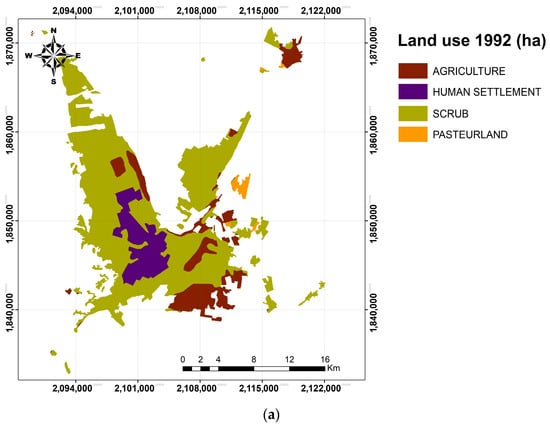
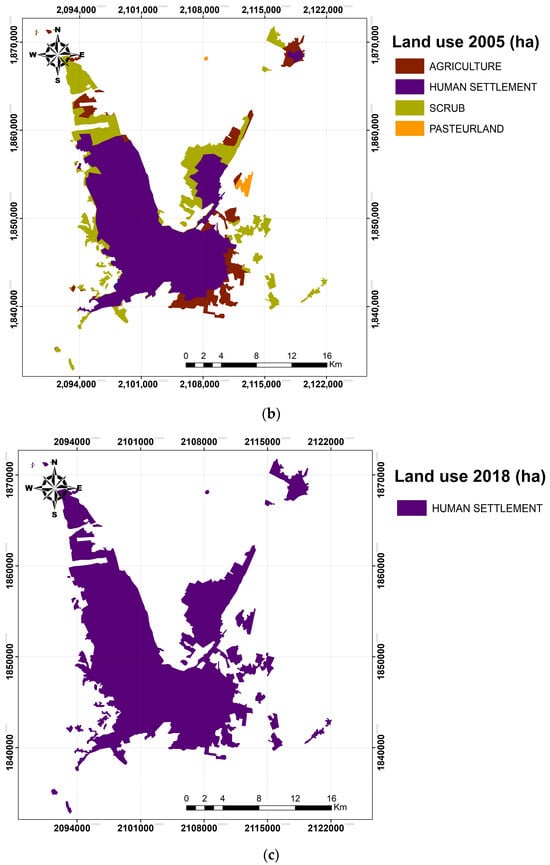
Table 1 presents the various land uses and their corresponding area changes from 1992 to 2018. This analysis showed that human settlements have overgrown undeveloped parts of the basin, increasing by one order of magnitude in 30 years (Figure 2).
Table 1.
Land uses area and percentages for three time periods.
Figure 2.
Changes in urbanization area (ha) over 26 years: (a) Land use in 1992, (b) land use in 2005, and (c) land use in 2018.
Chihuahua has experienced a significant transformation in land use over the past decades, characterized by a notable reduction in both agricultural and scrubland areas. Between 1992 and 2005, the agricultural land decreased by approximately 56%, while scrubland suffered a substantial loss of 63% of its original area. By 2018, both land-cover categories had been completely eradicated. This decline is closely linked to the rapid expansion of the urban area, which grew from 10,980 hectares in 1992 to 29,141 hectares in 2018.
In Appendix B.2, Table A1 presents the results obtained from the Pontius methodology, which shows the changes in land use from 1992 to 2018. By 2005, 13,321 hectares of scrubland and 2225 hectares of agricultural land were transformed for urban use. From 2005 to 2018, all remaining areas designated for various land uses were transitioned to urbanization. Additionally, Figure 2 illustrates the trend of population growth within the evaluated polygon.
3.2. Climatic Variability in the Urban Environment
The results of the basic statistical analysis for the historical series of average temperatures (Tm), extreme temperatures (Tmax and Tmin), summer (Tmax_s) and winter extreme (Tmin_w) temperatures, accumulated precipitation (accum_P), summer accumulated precipitation (s_accum_P), and actual evapotranspiration (ETR) are shown in Table A2 (Appendix B.3). Additional extreme temperature information on monthly basic statistics can be found in Table A3.
Extreme Tmax values range from 20 to 41 °C, with the highest temperatures occurring in May, June, and July, reaching between 39.8 and 41 °C. Trend analysis indicates an increase in the average monthly Tmax, reflecting an annual rise of 0.05 °C (p-value = 0.001). Additionally, the extreme Tmin has been recorded between −16 and 18.6 °C, with the coldest months being December, January, and February. The monthly average of extreme Tmin also exhibited an increasing trend of 0.07 °C per year (p-value = 0.001). These results show an overall increase of about 4 °C for Tmin, 2.8 °C for Tmax, and 27.7 °C for the difference average of temperature (Tmax-Tmin) over 60 years of record.
The observed values for the extreme Tmax fit the ARIMA model (2,0,2) more closely, predicting an average Tmax between 35 and 36.8 °C (±2 °C) for May, June, July, and August. Conversely, extreme Tmin is better represented by the GARCH (1,1) + ARIMA (1,0,1) model, which indicates that the variance of the data is not constant during the evaluated period. Tmin is expected to range from −5 to 18 °C; however, due to the heteroscedasticity of variance, Tmin values may experience significant fluctuations in short periods.
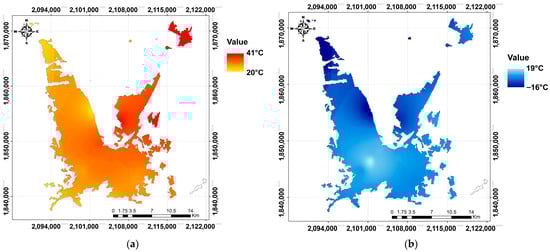
Figure 3 shows the spatial distribution of extreme maximum and minimum temperatures in the urban area of Chihuahua.
Figure 3.
Spatial distribution of extreme temperatures in the urban area from 1980–2000 and 2000–2018 for: (a) Tmax and (b) Tmin.
Based on the spatial distribution of extreme temperatures, the highest extreme temperatures (Tmax and Tmin) were found in the central sector of Chihuahua (the oldest urbanized area). This pattern suggests that higher impervious surfaces, greater building mass, and less vegetated cover can intensify daytime warming in this zone. In addition, high extreme Tmax were found in the northeastern sector, whereas the lowest extreme maximum and minimum temperatures tended to occur in the north, west, and south peripheral zones.
The monthly precipitation pattern exhibits annual seasonality, with peak rainfall occurring during the summer months of July, August, and September during the traditional Monsoon rainy season. Table A4 (Appendix B.3) shows the results of the basic statistical analysis for the historical precipitation series. The trend of this data series is oscillatory, as evidenced by the residual configuration.
The months with the highest rainfall are July, August, and September. The monthly averages’ coefficient of variation (CV) is very high, indicating a significant dispersion in the precipitation data. Monthly observed precipitation values tend to be lower than the average (Ca > 0, indicating positive asymmetry), but they are very close to it (Ck > 0, showing a leptokurtic distribution). The maximum precipitation values of 40 mm or more occurred in at least one year from 1961 to 2021 for these months. In contrast, the months from January to June and October to December have experienced over five years without recorded precipitation.
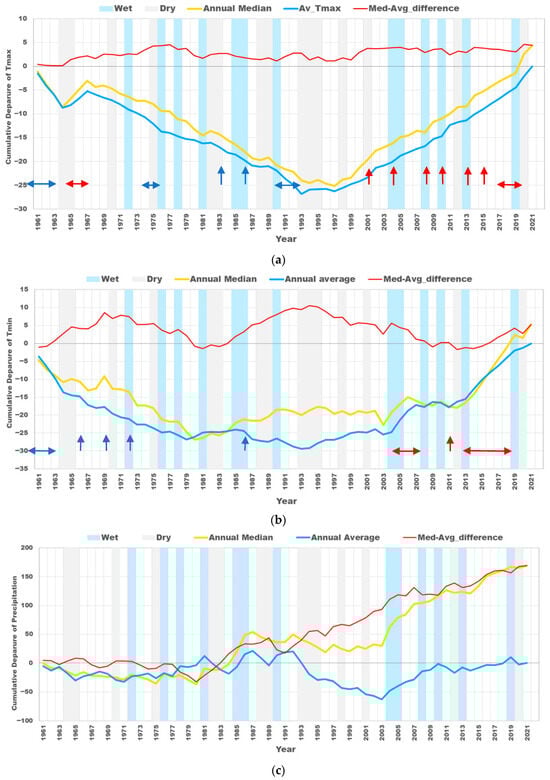
According to the assumption for dry and wet periods (Section 2.2.2 Climate Variability, Section 2 Materials and Methods), Figure 4 shows the annual cumulative departure (average and median) for extreme temperatures and precipitation.
Figure 4.
Annual cumulative departure of extreme temperatures and precipitation regime according to wet and dry periods: (a) Tmax, (b) Tmin, and (c) precipitation. Blue arrows indicate the cold waves (≤1σ) and red arrows indicate heat waves (≥1σ).
Cumulative departures of the annual average (blue line) and median (yellow line) for extreme Tmax showed similar trends. This temperature decreased in the first 30 years but increased from 1993 onwards. The cumulative departure of the Tmax average tended to be sensitive to lower values of Tmax. In addition, the difference between these two metrics has tended to increase over the evaluated period.
The extreme Tmin exhibited a significant variability over the evaluated period. This extreme temperature decreased during the initial 20 years and increased from the early 90s. Additionally, two distinct periods were identified with significant differences between average and median values.
For extreme Tmax, the annual heat waves (≥33 °C) were observed during the periods of 1966–1967, 2002, 2005, 2009, 2011, 2014, 2016, 2018, and 2020–2021. Additionally, inter-month heat waves (with extreme Tmax exceeding ≥1σ of the historical average for each month) occurred during 1965–1967 from August to February (fall to winter seasons), and since 1994 to 2021 in most months. The annual cold waves (extreme Tmin ≤ 1σ) in Chihuahua City have been recorded during 1961–1964, 1967, 1970, 1973, and 1987 (Figure 4b). The winter cold waves (December-February) with extreme Tmin below −7 °C (−1σ) were noted during 1962–1964, 1967, 1978, 2001, and 2011, being the lowest extreme Tmin values in 1962 and 2011, reaching temperatures as low as −21 °C (thermal sensation of −27 °C), during January and February, respectively.
The cumulative departure of the mean and median precipitation exhibits notable differences over the analyzed time series. Precipitation exhibits a consistent trend over the first 20 years, with the annual average value slightly higher than the median. This trend changed in 1983, when low precipitation values influenced the annual average trend. In years characterized by high evapotranspiration rates, the median trend increases (Table A2), where the highest levels of accumulated precipitation exceed 491 mm/year (≥1σ). The median and average differences have been enhanced since 1993. The estimated actual ETR ranged from 150 to 610 mm, where from June to October this parameter presented the highest values (60–95%) in the last six decades. From Equation A1 (Appendix A.1), the actual ETR depends on precipitation and average temperature, indicating that the actual ETR exhibits a multimodal distribution, which suggests a mixed population from changes in source drivers of precipitation and changes in land use.
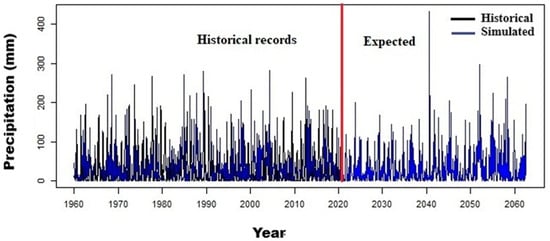
On the other hand, the gamma distribution function is the most commonly used distribution for calculating the probable monthly and annual precipitation due to its flexibility using only shape and scale parameters [46,47]. Table A5 (Appendix B.3) shows the expected monthly total percentiles (in mm), along with empirical values (calculated using the quantile method) and simulated values (based on a mixed Gamma distribution) for various probabilities. The results obtained from both methodologies are similar. Precipitation is expected to occur, with amounts exceeding 80 mm during July and August at a 50% probability, which reflects Monsoon weather conditions. Likewise, Figure 5 shows the adjustment and probable precipitation of the monthly estimates obtained through the gamma distribution.
Figure 5.
Simulated monthly precipitation, historical and future, for 100 years. The red line separates the historical precipitation data from the expected precipitation values.
3.3. Urban Water Consumption
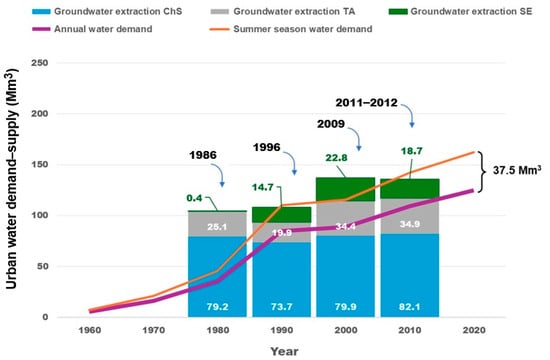
Chihuahua City has experienced significant population growth from 1900 to 2020, increasing from 150,430 to 925,762 inhabitants, see Figure A1. This population surge plays a crucial role in urban expansion and resource consumption. The current per capita water consumption in Chihuahua is 375 L per day, rising to 450 L per day during the summer months [37]; it represents a 10% increase in per capita demand for every degree Celsius increase in the summer season. Figure 6 illustrates the evolution of population-based water demand in the urban area, along with groundwater extraction from three aquifers to meet these demands, based on water extraction censuses conducted in 1986, 1996, 2009, and 2011–2012.
Figure 6.
Evolution of population-based water demand and groundwater extraction in the period from 1900 to 2020; the extraction of groundwater (Mm3) is for Public-urban use from the Chihuahua-Sacramento (ChS), Tabalaopa-Aldama (TA), and Sauz-Encinillas (SE) aquifers. Public–urban water use in Mexico refers to the provision of potable water to population centers through public and municipal distribution infrastructure.
Historically, the population growth in Chihuahua City has been rising but has slowed since the 1970s (Figure SM4). Overall, the supply of water for urban use and consumption increased from 1986 to 2012 [25,26,27], although there was a decrease in water supply during the decade from 1990 to 2000. Since 1970, the summer water supply deficit has averaged approximately 5 Mm3 per decade, reaching a total deficit of 37.5 Mm3 by 2020, except for the decade from 1990 to 2000. Additionally, water extraction to meet the needs of urbanization has risen across all three aquifers.
3.4. Comparative Analysis of Climatic and Urban Dynamics
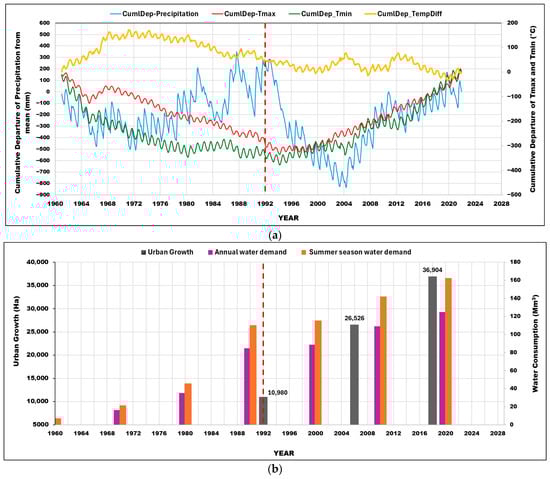
Figure 7 shows the cumulative departure from long-term mean values of key climate variables, together with trends in population-driven water demand and urban expansion over the period 1960–2024. Similarly to the climate analysis completed on the nearby Rio Conchos [9,41], extreme temperatures and precipitation variables exhibit distinct patterns of climate variability from 1960 to 2021 (Figure 7a). Two contrasting sub-periods were identified. The first period (1960–1990) is characterized by a wide thermal amplitude, particularly during the first 20 years, as reflected in the larger difference between extreme maximum and minimum temperatures (yellow line), along with oscillatory precipitation behavior and relatively small differences between average and median cumulative departures. The second period (1990–2021) shows a marked downward trend of cumulative departure of precipitation, reaching a pronounced deficit in the early 2000s, followed by increasing trends in both thermal and precipitation variables. During this latter period, a larger divergence between average and median precipitation regimes was observed, indicating an increase in extreme precipitation events. In addition, a persistent long-term reduction in temperature difference from 1970–2022 was shown, with brief increases in 2004 and 2011 associated with sharp temperature drops in those years.
Figure 7.
Climatic trends and socioenvironmental drivers of water demand during 1960–2021: (a) long-term trends in cumulative departures of precipitation (CumlDep-Precipitation), extreme maximum temperature (CumlDep-Tmax), extreme minimum temperature (CumlDep-Tmin), and the difference between extreme temperatures (CumlDep-TempDiff); and (b) water demand (for population consumption-use) and urban expansion. The red dashed line denotes the contrasts observed in the analyzed time series for climatic variables and urban-population growth.
The population-driven water demand during both summer and annual periods (Figure 7b) is aligned, particularly over the 1992–2020 interval, with the observed changes in climatic cumulative departures trend (Figure 7a). This pattern is noteworthy and may be linked to land-use changes characterized by substantial urban expansion, potentially indicating the development of an emerging urban heat island effect, as reflected in the progressive reduction in temperature differences. In addition, urban expansion (black bars) and population-based water demand (purple and orange bars) exhibit clear and sustained upward trends throughout the entire evaluation period (Figure 7b).
4. Discussion
The loss of natural vegetation due to the increase in urban areas leads to significant ecological impacts, including habitat fragmentation, reduced biodiversity, soil degradation, enhanced temperatures, and disruptions in local and regional hydrological cycles [48]. Chihuahua City experienced significant population growth from 1920 to 1960, driven by Mexico’s thriving oil economy (Figure A1). However, during the 1970s, economic challenges such as high inflation, rising debt, currency devaluation, and stagnant GDP slowed this growth [49]. The situation deteriorated further in the early 1980s due to falling oil prices [22], resulting in a migration from rural areas to the city, which led to smaller family sizes and slower population growth until 2020. Consequently, urbanization transformed the landscape, introduced new social dynamics, and strained natural resources and infrastructure.
From 1992 and 2020, Chihuahua developed 25,924 hectares of urban land, primarily from agricultural, shrubland, and grassland areas, with an average annual growth rate of 7.4% (Table 1); that trend has remained consistent since 1970, according to results published by Rodríguez Pineda, 2000 [50], where the average for annual urban growth was estimated at 6%. In 1992, the urban area encompassed approximately 11,000 hectares within the territory of the Chihuahua-Sacramento aquifer. In 2005, urbanization primarily extended toward the northwest and, to a lesser extent, to the southeast (Figure 2). According to [51], the urban area increased by 11,913 hectares from 2000 to 2010, with a growth rate of 7.2%. In Chihuahua, this urban sprawl has primarily occurred in regions adjacent to surface water bodies and in mountain ranges, making these locations more susceptible to environmental risks (heavy rains and flooding). This rapid urbanization is the result of unplanned urban development [52], which shows a dispersed city model [53], generating serious problems in the distribution of water to meet the needs of the population of Chihuahua.
According to the ARIMA (2,0,2) model, extreme Tmax recorded in a given year/period does not exhibit a statistically significant influence on subsequent periods. Extreme Tmax have increased since the early 1990s (Figure 4a), indicating that these trends are likely driven by local factors, such as urbanization increase and specific climatic events [54,55,56,57,58]. Since 1990, the urban area has experienced significant growth, where scrubland has declined by approximately 68% (Figure 2). Moreover, the high extreme Tmax are shown in the oldest Chihuahua city (Figure 3a), where high population density and major economic units (or commercial establishments) are placed [59]. Conversely, extreme Tmin, analyzed by GARCH (1,1) + ARIMA (1,0,1) model, demonstrated a strong dependence on past observations. However, the variation in extreme Tmin showed significant magnitude fluctuations over short timescales (Figure 4b). This temporal variability of extreme Tmin may reflect the sensitivity to synoptic-scale processes affecting Chihuahua City, including cold-front activity and fluctuations in moisture transport linked to the North American Monsoon System (NAMS), as well as large-scale climate drivers such as the Pacific Decadal Oscillation (PDO) and the Atlantic Multidecadal Oscillation (AMO), and Global Warming [9,60,61]. Nevertheless, the spatial variability of extreme Tmin shows that high values are in the oldest part of Chihuahua (Figure 3b), similar to the extreme Tmax distribution. Both extreme temperatures began to rise in the early 1990s, coinciding with the absence of wet periods between 1993 and 2003, and the occurrence of critical dry years from 1993 to 1995 [9,62]. The estimated average increase in extreme temperatures over the last 60 years is 2.8 °C for Tmax and 4 °C for Tmin, compared to the monthly average in the urban area (see Figure 3).
The peripheral areas of the city with less developed urban infrastructure experience the lowest extreme temperatures compared to the oldest city area (Figure 2a). This pattern is similar to observations in other rapidly expanding desert metropolitan regions such as Phoenix, Arizona, where accelerated urban growth has contributed to the development of emerging heat-island effects [63,64]. Thus, the increase in extreme temperatures can be attributed to rapid population growth, urban infrastructure development, changes in urban and peri-urban land, and altitude [65,66], which contribute to the generation of heat islands [67].
The analysis of extreme temperatures in Chihuahua City reveals significant trends in both cold and heat waves over the past several decades. Notably, annual cold waves have not been registered since 1987. Conversely, the extreme Tmin has risen between 1993–2021 (Figure 4b); this increase has led to extreme Tmin warm waves, increasing their average from 5.7 to 7 °C (≥1σ) since 2005.
Additionally, no year has recorded average extreme temperatures below 30.6 °C since 1994. As a result, the heat waves have become more frequent in the last 30 years (Figure 4a). The extreme Tmax recorded from May to August has a significant impact on the annual extreme Tmax, affecting 90% of the data (p-value ≤ 0.05). Consequently, these heat waves increase the demand for drinking water and water use in cities [68].
In Chihuahua state, approximately 80% of annual rainfall occurs during the summer monsoon [69], and winter precipitation depends on intermittent frontal systems [70], resulting in a strong seasonal asymmetry in this region. The dry months tend to occur more frequently in Chihuahua City (Table A4), being March (in 16 years) > February/April (in 13 years) > November (in 10 years) > January (in 8 years) > December (in 6 years) > May (in 4 years) with absence of rain. Conversely, maximum precipitation has been recorded from 40 mm in February (1973) to 267 mm in September (1978).
Moreover, cumulative departure revealed slightly consistent average precipitation over the entire period (Figure 4c), while the median showed a gradual increase, indicating a shift in the distribution’s symmetry. These deviations imply a non-stationarity in the precipitation regime. Together, these results suggest that while the average precipitation regime may appear constant, there may be underlying changes in the distribution, specifically in the frequency and intensity of precipitation events, reflecting a broader shift in the climatic regime. Moreover, it has been observed that precipitation occurs more frequently in intense and short-lived events rather than in prolonged periods of sustained precipitation over several days. This trend of more extreme events may be linked to the occurrence of hurricanes near Mexico from both the Pacific and Atlantic oceans between 1950 and 2022, with a marked increase in the frequency of Pacific storms since 1990 [41]. Furthermore, the higher accumulated precipitation tended to occur at ETR > 511 mm/year (Table A2). The highest wet years have been in 1978, 1981, 1985, 1986, 1990, 2004, 2008, 2010, and 2019 (Figure 4c), when PDO and ENSO (El Niño) climate cycles are generally in phase with each other. Conversely, the lowest rainfall events were in 1993 and 1994. It suggests that precipitation regimes are strongly influenced by atmospheric dynamics and seasonal variability, increasing precipitation in certain areas due to climate change [71,72,73,74]. Previous studies in Chihuahua state have shown that precipitation variations are related to patterns such as PDO and AMO, with a minor influence from El Niño/La Niña [9,41].
From the gamma statistical analysis, the mean monthly precipitation during July and August may range between 85 and 87 mm (Table A5). Under extreme conditions (≥90th percentile), precipitation is expected to reach 168 mm in July and 178 mm in August, likely in short-duration and high-intensity rainfall events rather than extended wet periods, as shown in Figure 4c. Consequently, the amplification of the occurrence of these intense rainfall events can alter the infiltration dynamics, reducing the effective aquifer recharge, and increasing surface flow and erosion risks. In addition, projected precipitation at the 10th percentile for the summer months remains above the historical minimum recorded over the past six decades. This result aligns with regional projections for northern Mexico, indicating an expected ~10% increase in rainfall during the wet season [75], though the hydrological benefit for groundwater systems will depend on the adaptation of hydrological infrastructure that can enhance recharge from extreme wet events.
Given the arid conditions in Chihuahua, surface water availability is minimal. Therefore, there has been an intensified extraction of groundwater for covering drinking and other uses. As the urban area has expanded (Figure 2), public and urban water uses have also risen. In the 1986 census for groundwater extraction, urban water needs were primarily covered by the Chihuahua-Sacramento aquifer (79.2 Mm3) and the Tabalaopa-Aldama aquifer (25.1 Mm3), with a minor contribution from the Sauz-Encinillas aquifer (Figure 6). Nevertheless, records indicate that 2.6 Mm3 were previously extracted from the Tabalaopa-Aldama aquifer for Chihuahua urban use in the 1970s [26].
The increase in urban area from 1992 to 2005 (70%) led to a heightened demand for water (Figure 2). To cover this demand, the city implemented an intermittent water distribution system, supplying water to residents for specific hours each day [76]. Despite this measure, water extraction remained high, driven by hotter and drier conditions. As water demand increased, pressure shifted to adjacent aquifers. Consequently, extraction from the TA aquifer increased 39% to meet the growing municipal needs in the expanding peripheral zones from 1992–2005. Similarly, the SE aquifer, which was almost unused in 1986, experienced a significant increase, reaching 22.8 million cubic meters (Mm3) in 2009 to supply the water needs of the growing northern areas of this city.
The increase in groundwater extraction is aligned with climate-related triggers, as well as consumption patterns and urban growth (Figure 7). According to extreme Tmax, annual water consumption increased from approximately 2.7 to 3.8 Mm3 per °C between 1990 and 2020 to meet the water demand of Chihuahua’s population. The local water regulatory and distribution authority in Chihuahua has reported a 30% to 50% increase in water demand during the summer [37]. It is attributed to the increment of extreme Tmax from June to August, which is 3 to 7 °C higher than the historical annual average. This increase is leading to a notable rise in drinking water, garden irrigation, and cooling in commercial, government, educational, industrial, and residential buildings [77,78]. Consequently, a deficit of 37.5 Mm3 is observed for covering the population’s needs (Figure 6), increasing the concessions granted for these purposes. This trend has been documented in New Mexico, USA, with comparable environmental conditions [79]. Some estimations indicate that for every 1 °C increase in air temperature, water consumption rises by approximately 1–7% during the spring and summer months, depending on regional climatic and socioeconomic conditions [79,80], and may reach up to 20% in some cases [81]. In Chihuahua, analyses of extreme Tmax indicate that water demand for the population increases by an average of about 16% per 1 °C during the summer season.
The observed increase in Tmax and Tmin cumulative departures after 1990 reflects a persistent warming tendency. The inversion of these departures in 2016 marks a critical inflection in the regional thermal regime (Figure 7), most likely driven by the combined influence of a potential Urban Heat Island (UHI) signal (or a tendency toward such a phenomenon) and broader climatic forcing; although specific UHI metrics were not computed, this spatial configuration is consistent with early expressions of heat accumulation linked to urbanization [63,64]. Further analyses incorporating land-surface temperature products and UHI indicators would allow a more explicit confirmation of this tendency. These climatic shifts coincide with an accelerated urban expansion, where the built-up area nearly tripled between 1992 and 2018, replacing agricultural and native-vegetation zones with low-permeability substrates (paved streets). This transformation reduces infiltration and potential recharge, directly contributing to aquifer depletion and compromises the long-term sustainability of groundwater reserves. Simultaneously, the rise in per capita groundwater demand reveals a critical transition toward hydro-territorial vulnerability in Chihuahua City.
The analysis of co-variability between long-term climatic deviations and population-driven water demand is constrained by differences in temporal resolution. These constraints preclude causal inference or direct statistical comparison. Still, the observed rise in extraction aligns with climate-related triggers, consumption patterns, and urban growth, suggesting potential interactions that warrant further study. Nevertheless, these findings underscore the need to anticipate risks to long-term water availability and sustainability. The results can support targeted adaptation strategies by identifying periods of rising temperature-driven water demand and reduced summer precipitation, helping decision-makers anticipate seasonal pressure on groundwater extraction. The observed link between urban expansion and warming trends supports the development of heat-mitigation policies such as increasing urban vegetation, revising zoning densities, and incorporating reflective or permeable materials to reduce temperature extremes and moderate water demand. Likewise, recognizing the long-term decline in aquifer reserves highlights the importance of strengthening conjunctive water management, optimizing pumping schedules, and expanding reuse and stormwater-capture programs. These findings can also inform vulnerability assessments by identifying neighborhoods likely to face intensified heat and water scarcity, improving prioritization for infrastructure investment and climate-resilient urban planning.
Further research should integrate hydrogeological modeling, including groundwater flow dynamics and recharge–discharge interactions. Coupling these models with high-resolution climate projections would enhance understanding of aquifer vulnerability and resilience under future stressors. Socio-hydrological frameworks are also needed to examine the interaction between water governance, population growth, and climate-driven variability on water demand. These integrative efforts are relevant under climate change scenarios marked by higher temperature extremes, shifting precipitation regimes, and increasing water demand. Such integrative approaches will be crucial for developing adaptive water management strategies and reducing hydrological risk in urbanizing and climate-sensitive regions. Understanding these interconnected processes is key to ensuring the resilience of semi-arid cities.
5. Conclusions
This study demonstrates that the interplay between climate variability and urban expansion significantly influences the hydrological functioning of Chihuahua City, intensifying stress on groundwater availability.
Urban growth has significantly transformed land use in Chihuahua City, with an annual increase of up to 10% from 1992 to 2019. While extreme maximum temperatures (Tmax) in this urban area are primarily influenced by local factors, such as increased urbanization, extreme minimum temperatures (Tmin) tend to be linked to historical patterns associated with regional and large-scale atmospheric circulation. Consequently, both local influences and larger-scale drivers have contributed to a narrowing gap between cumulative maximum and minimum temperatures over the past 30 years. This trend shows that both maximum and minimum temperatures are consistently rising, indicating an increased frequency of heatwaves, which may suggest the presence of urban heat island effects. This temperature increase drives higher water demand to meet the needs of the population and, given the environmental conditions of Chihuahua City, results in greater reliance on groundwater extraction.
In addition, there has been a progressive decline in prolonged precipitation in summer seasons. This shift is especially pronounced during the 1990–2021 period. Likewise, broader precipitation trends indicate a transition from relatively stable seasonal regimes to heightened temporal variability, marked by an increase in extreme events. These conditions reduce the duration and effectiveness of natural infiltration processes, resulting in lower groundwater recharge and further stressing the already overexploited aquifers.
In the context of these results, the combined effects of increasing climatic variability, more frequent extreme precipitation events, rising temperatures, prolonged dry periods, and greater urban water demand present a significant challenge to maintaining the long-term supply capacity of aquifers.
These findings highlight the need to anticipate rising pressure on water availability. Increasing temperatures, reduced summer precipitation, and continued urban expansion will intensify seasonal demand and groundwater extraction. The results support targeted adaptation measures, including heat-mitigation strategies, improved land-use planning, optimized groundwater management, and expanded reuse and stormwater-capture programs. They also emphasize the urgency of integrating climate modeling, regular monitoring of groundwater and land-use changes, and recharge-enhancement efforts. Long-term sustainability will depend on aligning urban growth with hydrological resilience and environmentally sound water-resource management.
Author Contributions
Conceptualization, M.R.-V. and J.A.D.-G.; methodology, M.R.-V., J.A.D.-G., and A.M.-M.; software, M.R.-V., J.A.D.-G., and A.M.-M.; validation, M.R.-V., J.A.D.-G., and D.B.J.; formal analysis, M.R.-V., J.A.D.-G., A.M.-M., and D.B.J.; investigation, M.R.-V.; resources, M.R.-V. and A.M.-M.; data curation, M.R.-V., J.A.D.-G., and A.M.-M.; writing—original draft preparation, M.R.-V. and D.B.J.; writing—review and editing, M.R.-V. and D.B.J.; visualization, M.R.-V.; supervision, M.R.-V., J.A.D.-G., and D.B.J. All authors have read and agreed to the published version of the manuscript.
Funding
This research received no external funding.
Data Availability Statement
The original data presented in the study are openly available in https://smn.conagua.gob.mx/es/ (accessed on 11 January 2024); https://sinav30.conagua.gob.mx:8080/SINA/ (accessed on 9 February 2024); http://www.conabio.gob.mx/informacion/gis/(accessed on 15 January 2024); https://www.inegi.org.mx/servicios/wsinfogeo/default.html (accessed on 2 April 2024).
Acknowledgments
The authors would like to thank the National Meteorological Service (SMN) and the National Water Commission (CONAGUA), both federal agencies of the Government of Mexico, as well as the Municipal Water and Sanitation Board of Chihuahua City (JMAS) for providing access to climate and hydrological data essential to this study. The authors gratefully acknowledge Randall Hanson for his valuable feedback and availability.
Conflicts of Interest
The authors declare no conflicts of interest.
Appendix A
Appendix A.1. Climatological Stations and Aquifers
Figure A1.
Location of climatological stations and aquifers. Some stations appear overlapped on the map due to their close spatial proximity. The network comprises 27 stations, with clusters in the central area (most climatological stations), the western sector (stations 5, 15, and 26), and the northeastern sector (stations 8, 10, 19, 21, and 22) of the study region.

Appendix A.2. Evapotranspiration Methodology
In this work, the widely used empirical method of Turc was applied to estimate the actual Evapotranspiration, using Equation (A1)
where ETR is the actual evapotranspiration (mm), P is the accumulated annual precipitation (mm/year), and L is a thermal indicator, obtained by Equation (A2)
T is the average annual temperature.
However, due to temperature and precipitation are different through the months, the temperature factor (T) has been replaced by the corrected temperature parameter (Tc), considering the annual distribution of precipitation over the course of air temperature [34], Equation (A3).
where T1, T2, … T12 and P1, P2, … P12 are the average temperature and precipitation per month.
Appendix A.3. Extreme Temperature Adjustment Model: Arima and ARCH-GARCH
- Trend Analysis of Extreme Temperatures
The linear trend of the Tmax and Tmin series was analyzed through the following linear regression model (Equation (A4)).
Tmax = b0 + b1 Time + ε
Coefficients:
| Estimate | Std. Error | t Value | Pr(>|t|) | |
| b0 | 3.034 × 101 | 3.333 × 10⁻¹ | 91.038 | <2 × 10⁻¹⁶ *** |
| b1 | 3.950 × 10⁻³ | 7.878 × 10⁻⁴ | 5.014 | 6.69 × 10⁻⁷ *** |
| code: 0 ***. |
- ARIMA Model Tuning (p,d,q) for Extreme Tmax
Several models with delay (ARIMA) and without delay (ARMA) were fitted, from which the following model was selected based on the Akaike Information Criterion (Equation (A5)):
ARIMA(3,0,2)
Yt = µ + φ1 Yt-1 + φ2 Yt-2 + φ3 Yt-3 + et − θ1 et-1 − θ2 et-2
Coefficients:
| φ1 | φ2 | φ3 | θ1 | θ2 | µ | |
| 2.1339 | −1.6963 | 0.4022 | −1.7152 | 0.9999 | 31.7862 | |
| s.e. | 0.0342 | 0.0592 | 0.0342 | 0.0094 | 0.0108 | 0.1215 |
- Fit the ARIMA Model (P,d,q) for Extreme Tmin
Several models with delay (ARIMA) and without delay (ARMA) were fitted, from which the following model was selected based on the Akaike Information Criterion (Equation (A6)):
ARMA(2,0,2)
Yt = µ + φ1 Yt-1 + φ2 Yt-2 + et − θ1 et-1 − θ2 et-2
Coefficients:
| φ1 | φ2 | θ1 | θ2 | µ | |
| 1.7319 | −0.9999 | −1.7019 | 0.9843 | 4.1113 | |
| s.e. | 0.0003 | 0.0001 | 0.0085 | 0.0096 | 0.1139 |
Because the variance of extreme Tmin is not constant over time, an adjustment was made with a general ARCH-GARCH model. A GARCH model was fitted for variance and an ARIMA model for the mean. Several GARCH (q,p) + ARIMA (u,d,v) models were tested for different combinations of q,p and u,d,v values. It selected GARCH(1,1) + ARIMA(1,0,1) as the best model. The fit of this model is expressed in Equation (A7):
Yt = µ + φ1 Yt-1 + et − θ1et-1
et = σ2t|t-1 εt
σ2t|t-1 = ω + α1e2t-1 + β1σ2t-1|t-2
Appendix A.4. Gamma Distribution for Precipitation Analysis
The parameters of the Gamma distribution that best describe precipitation are the shape (α > 0) and scale (β > 0) parameters. These parameters allow for modeling the variability and patterns of precipitation in a specific region. The probability density function is defined as (Equation (A8)):
f_X (x) = 1/(Γ[α] βα) x(α-1) exp(−x/β), x ϵ (0,∞)
The shape parameter (α) determines the distribution’s form (e.g., skewness or symmetry), while the scale parameter (β) affects the mean and standard deviation of the distribution.
Appendix B
Appendix B.1. Population Growth and Urban Area Evolution
Figure A2.
Population growth in the city of Chihuahua and its decadal rate.

Appendix B.2. Land Use Evolution by Period
Table A1.
Pontius matrix for land use and change from 1992–2005 and 2005–2018 [31].
Appendix B.3. Statistical Results of Climate Variables
This section presents the results of the basic statistical analysis for the historical series of climate variables.
Table A2.
Basic statistics of annual climate variables for 1961–2021.
Table A3.
Basic statistics of extreme monthly maximum and minimum temperatures (°C) for 1961–2021.
Table A4.
Basic statistics of the historical monthly precipitation series.
Table A5.
Total monthly precipitation percentiles (in mm) expected for different probabilities: empirical (quantile method) and simulated (mixed Gamma distribution).
References
- Gleeson, T.; Wada, Y.; Bierkens, M.F.P.; van Beek, L.P.H. Water balance of global aquifers revealed by groundwater footprint. Nature 2012, 488, 197–200. [Google Scholar] [CrossRef] [Scilit] [PubMed]
- Vörösmarty, C.J.; Green, P.; Salisbury, J.; Lammers, R.B. Global Water Resources: Vulnerability from Climate Change and Population Growth. Science 2000, 289, 284. [Google Scholar] [CrossRef] [Scilit] [PubMed]
- Chaminé, H.I.; Afonso, M.J.; Barbieri, M. Advances in Urban Groundwater and Sustainable Water Resources Management and Planning: Insights for Improved Designs with Nature, Hazards, and Society. Water 2022, 14, 3347. [Google Scholar] [CrossRef] [Scilit]
- United Nations. World Social Report 2024. Social Development in Times of Converging Crises: A Call for Global Action; Department of Economic and Social Affairs: New York, NY, USA, 2024; pp. pp 1–102. [Google Scholar]
- United Nations. World Population Prospects 2024, Online Edition; Department of Economic and Social Affairs, Population Division: New York, NY, USA, 2024. [Google Scholar]
- Amparo-Salcedo, M.; Pérez-Gimeno, A.; Navarro-Pedreño, J. Water Security Under Climate Change: Challenges and Solutions Across 43 Countries. Water 2025, 17, 633. [Google Scholar] [CrossRef] [Scilit]
- Beckers, V.; Poelmans, L.; Van Rompaey, A.; Dendoncker, N. The impact of urbanization on agricultural dynamics: A case study in Belgium. J. Land Use Sci. 2020, 15, 626–643. [Google Scholar] [CrossRef] [Scilit]
- Veldkamp, T.I.E.; Eisner, S.; Wada, Y.; Aerts, J.C.J.H.; Ward, P.J. Sensitivity of water scarcity events to ENSO-driven climate variability at the global scale. Hydrol. Earth Syst. Sci. 2015, 19, 4081–4098. [Google Scholar] [CrossRef] [Scilit]
- Renteria-Villalobos, M.; Hanson, R.T.; Eastoe, C. Evaluation of climate variability on sustainability for transboundary water supply in Chihuahua, Mexico. J. Hydrol. Reg. Stud. 2022, 44, 101207. [Google Scholar] [CrossRef] [Scilit]
- Pisor, A.C.; Touma, D.; Singh, D.; Jones, J.H. To understand climate change adaptation, we must characterize climate variability: Here’s how. One Earth 2023, 6, 1665–1676. [Google Scholar] [CrossRef] [Scilit]
- Langridge, R.; Van Schmidt, N.D. Groundwater and Drought Resilience in the SGMA Era. Soc. Nat. Resour. 2020, 33, 1530–1541. [Google Scholar] [CrossRef] [Scilit]
- Schwarzwald, K.; Lenssen, N. The importance of internal climate variability in climate impact projections. Proc. Natl. Acad. Sci. USA 2022, 119, e2208095119. [Google Scholar] [CrossRef] [Scilit]
- Ulises, R.S.H.; Lucia, F.M.A.; Delia, O.B.A.; Odila, D.l.T.V. Impacts of Climate Change on the Water Sector in Mexico. Asian J. Environ. Ecol. 2022, 17, 37–57. [Google Scholar] [CrossRef] [Scilit]
- Silva-Aguilera, R.A.; Escolero, O.; Alcocer, J.; Correa Metrio, A.; Vilaclara, G.; Lozano García, S. Long-term responses of maar lakes water level to climate and groundwater variability in central Mexico. J. S. Am. Earth Sci. 2024, 139, 104861. [Google Scholar] [CrossRef] [Scilit]
- Muñoz-Pizza, D.M.; Sanchez-Rodriguez, R.A.; Gonzalez-Manzano, E. Linking climate change to urban planning through vulnerability assessment: The case of two cities at the Mexico-US border. Urban Clim. 2023, 51, 101674. [Google Scholar] [CrossRef] [Scilit]
- Núñez, J.; Herrera, E.; Navarro, C.J. Chihuahua-Sacramento and Tabalaopa-Aldama aquifers of Chihuahua state, Mexico: Linkage and importance of geostatistical and hydrogeochemical analysis. Water Pract. Technol. 2021, 17, 645–660. [Google Scholar] [CrossRef] [Scilit]
- Sánchez, D.H.; Navarro-Gómez, C.J.; Rentería, M.; Rose, J.F.; Sánchez-Navarro, J.R. Evolution of the groundwater system in the Chihuahua-Sacramento aquifer due to climatic and anthropogenic factors. J. Water Clim. Change 2021, 13, 645–663. [Google Scholar] [CrossRef] [Scilit]
- Scott, C.A.; Meza, F.J.; Varady, R.G.; Tiessen, H.; McEvoy, J.; Garfin, G.M.; Wilder, M.; Farfán, L.M.; Pablos, N.P.; Montaña, E. Water Security and Adaptive Management in the Arid Americas. Ann. Assoc. Am. Geogr. 2013, 103, 280–289. [Google Scholar] [CrossRef] [Scilit]
- Palmer, M.D.; Rogelj, J.; von Schuckmann, K.; Trewin, B.; Allen, M.; Andrew, R.; Betts, R.A.; Borger, A.; Boyer, T.; Broersma, J.A.; et al. Indicators of Global Climate Change 2023: Annual update of key indicators of the state of the climate system and human influence. Earth Syst. Sci. Data 2024, 16, 2625–2658. [Google Scholar] [CrossRef] [Scilit]
- Joshi, K.; Khan, A.; Anand, P.; Sen, J. Understanding the synergy between heat waves and the built environment: A three-decade systematic review informing policies for mitigating urban heat island in cities. Sustain. Earth Rev. 2024, 7, 25. [Google Scholar] [CrossRef] [Scilit]
- Evans, R.S.; Hanson, R.T. Conjunctive Water Management; The Groundwater Project: Guelph, ON, Canada, 2025. Available online: https://gw-project.org/books/conjunctive-water-management/ (accessed on 28 October 2025).
- INEGI. Censos y Conteos de Población y Vivienda 2020; Instituto Nacional de Estadística, Geografía e Informática: Aguascalientes, Mexico, 2020. [Google Scholar]
- Goodell, P.C. Chihuahua city uranium province, Chihuahua, Mexico. In Proceedings of the Technical Committee Meeting on Uranium Deposits in Volcanic Rocks, El Paso, TX, USA, 2–5 April 1984; IAEA: Vienna, Austria, 1985; pp. 97–124. [Google Scholar]
- INEGI. Compendio de Información Geográfica Municipal de los Estados Unidos Mexicanos. Chihuahua, Chihuahua, Clave Geoestadística 08019; Instituto Nacional de Estadística y Geografía: Aguascalientes, Mexico, 2010. [Google Scholar]
- Conagua. Actualización de la Disponibilidad Media Anual de Agua en el Acuífero Chihuahua-Sacramento (0830), Estado de Chihuahua; Conagua: Mexico City, Mexico, 2024; pp. 1–31. Available online: https://sigagis.conagua.gob.mx/gas1/Edos_Acuiferos_18/chihuahua/DR_0830.pdf (accessed on 28 October 2025).
- Conagua. Actualización de la Disponibilidad Media Anual de Agua en el Acuífero Tabalaopa-Aldama (0835), Estado de Chihuahua; Conagua: Mexico City, Mexico, 2024; Available online: https://sigagis.conagua.gob.mx/gas1/Edos_Acuiferos_18/chihuahua/DR_0835.pdf (accessed on 28 October 2025).
- Conagua. Actualización de la Disponibilidad Media Anual de Agua en el Acuífero El Sauz-Encinillas (0807), Estado de Chihuahua; Conagua: Mexico City, Mexico, 2024; Available online: https://sigagis.conagua.gob.mx/gas1/Edos_Acuiferos_18/chihuahua/DR_0807.pdf (accessed on 28 October 2025).
- INEGI. Conjunto Nacional de Uso de Suelo y Vegetación a Escala 1:250,000, Serie VII; DGG-INEGI: Aguascalientes, Mexico, 2018. [Google Scholar]
- INEGI. Conjunto Nacional de Uso de Suelo y Vegetación a Escala 1:250,000, Serie III; DGG-INEGI: Aguascalientes, Mexico, 2005. [Google Scholar]
- INEGI. Conjunto Nacional de Uso de Suelo y Vegetación a Escala 1:250,000, Serie I; DGG-INEGI: Aguascalientes, Mexico, 1992. [Google Scholar]
- Pontius, R.G.; Shusas, E.; McEachern, M. Detecting important categorical land changes while accounting for persistence. Agric. Ecosyst. Environ. 2004, 101, 251–268. [Google Scholar] [CrossRef] [Scilit]
- Paegelow, M.; Mas, J.-F.; Gallardo, M.; Camacho Olmedo, M.T.; García-Álvarez, D. Pontius Jr. Methods Based on a Cross-Tabulation Matrix to Validate Land Use Cover Maps. In Land Use Cover Datasets and Validation Tools: Validation Practices with QGIS; García-Álvarez, D., Camacho Olmedo, M.T., Paegelow, M., Mas, J.F., Eds.; Springer International Publishing: Cham, Switzerland, 2022; pp. 153–187. [Google Scholar]
- SMN-Conagua. Normales Climatológicas por Estado; Nacional, S.M., Ed.; Comisión Nacional del Agua: Coyoacán, Mexico, 2023. [Google Scholar]
- Gudulas, K.; Voudouris, K.; Soulios, G.; Dimopoulos, G. Comparison of different methods to estimate actual evapotranspiration and hydrologic balance. Desalination Water Treat. 2013, 51, 2945–2954. [Google Scholar] [CrossRef] [Scilit]
- ESRI. ArcGIS 10.3. 1; Environmental Systems Research Institute Redlands: Redlands, CA, USA, 2014. [Google Scholar]
- Rodríguez Pineda, J.A. A Geophysical, Geochemical and Remote Sensing Investigation of the Water Resources at the City of Chihuahua, Mexico. Doctoral Dissertation, University of Texas at El Paso, El Paso, TX, USA, 2000. [Google Scholar]
- Silva, M.A. Consumen Chihuahuenses 370 Litros de Agua al día, in Diario de Chihuahua; Diario de Chihuahua: Chihuahua, Mexico, 2023; Available online: https://diario.mx/estado/2023/feb/10/consumen-chihuahuenses-370-litros-de-agua-al-dia-928916.html (accessed on 28 October 2025).
- Cryer, J.D.; Chan, K.S. Time Series Analysis with Applications in R; Springer: New York, NY, USA, 2008. [Google Scholar]
- Modarres, R.; Ouarda, T.B.M.J. Modeling the relationship between climate oscillations and drought by a multivariate GARCH model. Water Resour. Res. 2014, 50, 601–618. [Google Scholar] [CrossRef] [Scilit]
- Romilly, P. Time series modelling of global mean temperature for managerial decision-making. J. Environ. Manag. 2005, 76, 61–70. [Google Scholar] [CrossRef] [Scilit] [PubMed]
- Renteria-Villalobos, M.; Hanson, R.T. Capturing wetness for sustainability from climate variability and change in the Rio Conchos, Chihuahua, Mexico. J. Hydrol. Reg. Stud. 2025, 58, 102256. [Google Scholar] [CrossRef] [Scilit]
- Hanson, R.T.; Dettinger, M.D.; Newhouse, M.W. Relations between climatic variability and hydrologic time series from four alluvial basins across the southwestern United States. Hydrogeol. J. 2006, 14, 1122–1146. [Google Scholar] [CrossRef] [Scilit]
- Husak, G.J.; Michaelsen, J.; Funk, C. Use of the gamma distribution to represent monthly rainfall in Africa for drought monitoring applications. Int. J. Climatol. 2007, 27, 935–944. [Google Scholar] [CrossRef] [Scilit]
- Cangela, G.L.C.d.; Silva, M.V.d.; Araújo Júnior, G.d.N.; Silva, J.R.I.d.; França e Silva, Ê.F.d.; Pandorfi, H.; Morales, K.R.M.; Vasconcelos, C.; Massinga, A.P.; Mabasso, G.A.; et al. Temporal dynamics of rainfall using the gamma distribution for the municipality of Chimoio, Mozambique. Rev. Bras. Geogr. Física 2023, 16, 1072–1087. [Google Scholar] [CrossRef] [Scilit]
- Galanos, A. Univariate GARCH Models. Package ‘rugarch’, Version 1.5-4; CRAN_R Package: New Zealand, 2025; Available online: https://cran.r-project.org/web/packages/rugarch/rugarch.pdf (accessed on 28 October 2025).
- Amburn, S.A.; Lang, A.S.I.D.; Buonaiuto, M.A. Precipitation Forecasting with Gamma Distribution Models for Gridded Precipitation Events in Eastern Oklahoma and Northwestern Arkansas. Weather. Forecast. 2015, 30, 349–367. [Google Scholar] [CrossRef] [Scilit]
- Zuo, D.-D.; Hou, W.; Zhang, Q.; Yan, P.-C. Sensitivity analysis of standardized precipitation index to climate state selection in China. Adv. Clim. Change Res. 2022, 13, 42–50. [Google Scholar] [CrossRef] [Scilit]
- Qu, X.; Li, X.; Bardgett, R.D.; Kuzyakov, Y.; Revillini, D.; Sonne, C.; Xia, C.; Ruan, H.; Liu, Y.; Cao, F.; et al. Deforestation impacts soil biodiversity and ecosystem services worldwide. Proc. Natl. Acad. Sci. USA 2024, 121, e2318475121. [Google Scholar] [CrossRef] [Scilit]
- Torres, B. La política exterior de México durante el gobierno de Luis Echeverría (1970–1976): El renovado activismo global. Foro Int. 2022, 62, 677–734. [Google Scholar] [CrossRef] [Scilit]
- Rodríguez-Huerta, E.; Rosas-Casals, M.; Hernández-Terrones, L.M. A water balance model to estimate climate change impact on groundwater recharge in Yucatan Peninsula, Mexico. Hydrol. Sci. J. 2020, 65, 470–486. [Google Scholar] [CrossRef] [Scilit]
- Dávila, R.A.; Corona, E.A.Z.; Pinedo, A.A.; Jiménez, G.R.; Pinedo, C.A.; Rojas, R.I.C.; Ranfla, A.G. Marginación y cambio de cobertura y uso del suelo de la zona metropolitana de Chihuahua. Investig. Cienc. Univ. Autónoma Aguascalientes 2016, 67, 38–45. [Google Scholar] [CrossRef] [Scilit]
- Biney, E.; Mintah, B.A.; Ankomah, E.; Agbenorhevi, A.E.; Yankey, D.B.; Annan, E. Sustainability assessment of groundwater in south-eastern parts of the western region of Ghana for water supply. Clean. Water 2024, 1, 100007. [Google Scholar] [CrossRef] [Scilit]
- Dávila Rodríguez, A.; Alatorre Cejudo, L.C.; Bravo-Peña, L.C. Análisis de la evolución espacio-temporal del uso de suelo urbano en la metrópolis de Chihuahua. Econ. Soc. Territ. 2021, 21, 1–27. [Google Scholar] [CrossRef] [Scilit]
- Cheng, L.; Abraham, J.; Trenberth, K.E.; Boyer, T.; Mann, M.E.; Zhu, J.; Wang, F.; Yu, F.; Locarnini, R.; Fasullo, J.; et al. New Record Ocean Temperatures and Related Climate Indicators in 2023. Adv. Atmos. Sci. 2024, 41, 1068–1082. [Google Scholar] [CrossRef] [Scilit]
- La Sorte, F.A.; Johnston, A.; Ault, T.R. Global trends in the frequency and duration of temperature extremes. Clim. Change 2021, 166, 1. [Google Scholar] [CrossRef] [Scilit]
- Dong, T.; Liu, J.; Liu, D.; He, P.; Li, Z.; Shi, M.; Xu, J. Spatiotemporal variability characteristics of extreme climate events in Xinjiang during 1960–2019. Environ. Sci. Pollut. Res. Int. 2023, 30, 57316–57330. [Google Scholar] [CrossRef] [Scilit]
- López-Bueno, J.A.; Díaz, J.; Follos, F.; Vellón, J.M.; Navas, M.A.; Culqui, D.; Luna, M.Y.; Sánchez-Martínez, G.; Linares, C. Evolution of the threshold temperature definition of a heat wave vs. evolution of the minimum mortality temperature: A case study in Spain during the 1983–2018 period. Environ. Sci. Eur. 2021, 33, 101. [Google Scholar] [CrossRef] [Scilit]
- Zhang, L.; Risser, M.D.; Wehner, M.F.; O’Brien, T.A. Leveraging Extremal Dependence to Better Characterize the 2021 Pacific Northwest Heatwave. J. Agric. Biol. Environ. Stat. 2024. [Google Scholar] [CrossRef] [Scilit]
- IMPLAN. Fifth Update of the Urban Development Plan for the City of Chihuahua, Vision 2040 (PDU2040); Instituto Municipal de Planeación: Chihuahua, Mexico, 2016. [Google Scholar]
- Bücher, A.; Jennessen, T. Statistics for heteroscedastic time series extremes. Bernoulli 2024, 30, 26, 46–71. [Google Scholar] [CrossRef] [Scilit]
- Xin, J.; Zhan, M.; Xu, B.; Li, H.; Zhan, L. Variations of Extreme Temperature Event Indices in Six Temperature Zones in China from 1961 to 2020. Sustainability 2023, 15, 11536. [Google Scholar] [CrossRef] [Scilit]
- Cerano-Paredes, J.; Villanueva-Díaz, J.; Fulé, P.Z.; Arreola-Ávila, I.; Valdez-Cepeda, R.D. Reconstrucción de 350 años de precipitación para el suroeste de Chihuahua, México. Madera Y Bosques 2009, 15, 27–44. [Google Scholar] [CrossRef] [Scilit]
- Brazel, A.; Gober, P.; Lee, S.; Grossman-Clarke, S.; Zehnder, J.; Hedquist, B.; Comparri, E. Determinants of changes in the regional urban heat island in metropolitan Phoenix (Arizona, USA) between 1990 and 2004. Clim. Res. 2007, 33, 171–182. [Google Scholar] [CrossRef] [Scilit]
- Grossman-Clarke, S.; Zehnder, J.A.; Loridan, T.; Grimmond, C.S.B. Contribution of Land Use Changes to Near-Surface Air Temperatures during Recent Summer Extreme Heat Events in the Phoenix Metropolitan Area. J. Appl. Meteorol. Climatol. 2010, 49, 1649–1664. [Google Scholar] [CrossRef] [Scilit]
- Martínez Ortíz, A.I. Indicadores Base de Adaptación al Cambio Climático en la Ciudad de Chihuahua. Master’s Thesis, Universidad Autonoma de Chihuahua, Chihuahua, Mexico, 2022. [Google Scholar]
- Luo, S.; Gu, X.; Lv, N.; Guan, Y.; Kong, D.; Liu, J.; Zhang, X. Elevated increases in human-perceived winter temperature in urban areas over China: Acceleration by urbanization. Urban Clim. 2024, 55, 101979. [Google Scholar] [CrossRef] [Scilit]
- IPCC. Global Warming of 1.5°C: IPCC Special Report on Impacts of Global Warming of 1.5°C above Pre-industrial Levels in Context of Strengthening Response to Climate Change, Sustainable Development, and Efforts to Eradicate Poverty; Cambridge University Press: Cambridge, UK, 2022. [Google Scholar]
- Zubaidi, S.L.; Ortega-Martorell, S.; Al-Bugharbee, H.; Olier, I.; Hashim, K.S.; Gharghan, S.K.; Kot, P.; Al-Khaddar, R. Urban Water Demand Prediction for a City That Suffers from Climate Change and Population Growth: Gauteng Province Case Study. Water 2020, 12, 1885. [Google Scholar] [CrossRef] [Scilit]
- Reyes, S.; Douglas, M.W.; Maddox, R.A. El monzón del suroeste de Norteamérica (TRAVASON/SWAMP). Atmósfera 1994, 7, 117–137. [Google Scholar]
- Pascale, S.; Bordoni, S.; Kapnick, S.B.; Vecchi, G.A.; Jia, L.; Delworth, T.L.; Underwood, S.; Anderson, W. The Impact of Horizontal Resolution on North American Monsoon Gulf of California Moisture Surges in a Suite of Coupled Global Climate Models. J. Clim. 2016, 29, 7911–7936. [Google Scholar] [CrossRef] [Scilit]
- Dixit, S.; Pandey, K.K. Spatiotemporal variability identification and analysis for non-stationary climatic trends for a tropical river basin of India. J. Environ. Manag. 2024, 365, 121692. [Google Scholar] [CrossRef] [Scilit]
- Tabari, H. Statistical Analysis and Stochastic Modelling of Hydrological Extremes. Water 2019, 11, 1861. [Google Scholar] [CrossRef] [Scilit]
- Adler, R.F.; Gu, G. Global Precipitation for the Year 2023 and How It Relates to Longer Term Variations and Trends. Atmosphere 2024, 15, 535. [Google Scholar] [CrossRef] [Scilit]
- Gu, L.; Yin, J.; Gentine, P.; Wang, H.-M.; Slater, L.J.; Sullivan, S.C.; Chen, J.; Zscheischler, J.; Guo, S. Large anomalies in future extreme precipitation sensitivity driven by atmospheric dynamics. Nat. Commun. 2023, 14, 3197. [Google Scholar] [CrossRef] [Scilit] [PubMed]
- Nazarian, R.H.; Brizuela, N.G.; Matijevic, B.J.; Vizzard, J.V.; Agostino, C.P.; Lutsko, N.J. Projected Changes in Mean and Extreme Precipitation over Northern Mexico. J. Clim. 2024, 37, 2405–2422. [Google Scholar] [CrossRef] [Scilit]
- Sánchez, D.H.; Navarro-Gómez, C.J.; Rentería, M.; Sánchez-Navarro, J.R. Saving water by returning to a constant water supply in Chihuahua. Water Int. 2023, 48, 87–97. [Google Scholar] [CrossRef] [Scilit]
- Muyambo, F.; Belle, J.; Nyam, Y.S.; Orimoloye, I.R. Climate-Change-Induced Weather Events and Implications for Urban Water Resource Management in the Free State Province of South Africa. Environ. Manag. 2023, 71, 40–54. [Google Scholar] [CrossRef] [Scilit]
- Rasifaghihi, N.; Li, S.S.; Haghighat, F. Forecast of urban water consumption under the impact of climate change. Sustain. Cities Soc. 2020, 52, 101848. [Google Scholar] [CrossRef] [Scilit]
- Dimkić, D. Temperature Impact on Drinking Water Consumption. Environ. Sci. Proc. 2020, 2, 31. [Google Scholar]
- Zarrin, Z.; Hamidi, O.; Amini, P.; Maryanaji, Z. Predicting the pulse of urban water demand: A machine learning approach to deciphering meteorological influences. BMC Res. Notes 2024, 17, 221. [Google Scholar] [CrossRef] [Scilit]
- Zapata, O. The relationship between climate conditions and consumption of bottled water: A potential link between climate change and plastic pollution. Ecol. Econ. 2021, 187, 107090. [Google Scholar] [CrossRef] [Scilit]









Disclaimer/Publisher’s Note: The statements, opinions and data contained in all publications are solely those of the individual author(s) and contributor(s) and not of MDPI and/or the editor(s). MDPI and/or the editor(s) disclaim responsibility for any injury to people or property resulting from any ideas, methods, instructions or products referred to in the content. |
© 2025 by the authors. Licensee MDPI, Basel, Switzerland. This article is an open access article distributed under the terms and conditions of the Creative Commons Attribution (CC BY) license.