


Abstract
Exploratory listening encompasses the various ways, contexts, and levels of attention with which listeners engage with their sonic environment. This paper presents findings from qualitative research conducted with audience members during the Stardew Valley: Festival of Seasons concert tour. During these events, attendees encountered music from the widely successful indie video game, reorchestrated in a new context. Just as the game encourages exploration through open-ended gameplay, the concerts prompt listeners to explore how the rearranged music refers to and diverges from its use in the game. Findings suggest that attendees deployed their attention to divergent aspects of the music. While some attendees focused on specific musical aspects like recognizable melodies and instrumentation, others focused on the broader audiovisual and community aspects of the performance. Results also indicate that highly immersed listeners experience diverse thoughts, including those not directly about the immediate musical content. Positioning music-evoked imaginings as a way listeners become immersed in musical experiences, we report on how exploratory listening shapes the dynamics of attention, immersion, and enjoyment within musical and audiovisual contexts.
Keywords:
music; exploratory listening; multimedia; immersion; presence; musical imaginings; live concerts; video games 1. Introduction
Defined as ‘the psychological experience of being engrossed in the media world’ (Tukachinsky, 2014, p. 4), psychological immersion describes states of engaged attention, in both live and technologically mediated contexts. Foundational work by Witmer and Singer (1998) conceptualize this state of engagement as ‘a psychological state characterized by perceiving oneself to be enveloped by, included in, and interaction with an environment that provides a continuous stream of stimuli and experiences’ (p. 227). In media environments, states of immersion involve temporal and spatial dissociation with the real world (Curran, 2018; Haywood & Cairns, 2006; Jennett et al., 2008).
Music plays a significant role in shaping immersion in mediated contexts like film (Lehman, 2013; Cohen, 2015), television (Tan et al., 2013), music videos (Vernallis, 2013; Korsgaard, 2017), and other multimedia formats (Cook, 2004). Recent work in multimedia concert research (Hunt, 2024; Greenfield-Casas, 2023) explores how multimedia concerts gamify live performance, reshaping audience engagement. Taking music from media to the concert hall, ‘cine-concerts, or live-to-picture events, feature a live performance of an underscore (and on occasion source music) accompanying a screening of a motion’ (Okazaki, 2020, p. 3). Similarly, live concerts of video games often ‘feature large screens upon which game footage is projected to accompany the music’ (Hunt, 2024, p. 649). These concerts rearrange music from their initial media context for orchestral or chamber groups (Greenfield-Casas, 2023) and often embed gamified elements that include audience members as performers (Hunt, 2024). Blurring the boundaries between live performance and digital media, these concerts guide listeners’ musical attention in novel ways (Okazaki, 2020; Sekar, 2022), requiring them to negotiate familiar music in new performance environments.
Live concerts encourage audiences to employ exploratory listening behaviors as they ‘manage their attentional focus and levels of processing in search of meaningful carriers of meaning’ (Reybrouck et al., 2024, p. 7). Drawing on predictive frameworks, listeners use exploratory listening behaviors to become immersed in the concert experience (Pianzola et al., 2021). Through highly attentive modes of listening (Weining et al., 2025; Weining, 2022; Wald-Fuhrmann et al., 2021), audience members bring the prior audiovisual contexts, memories, and emotions they have come to associate with the music to the immersive experience of live performance. In these ways, live concerts promote deep engagement with music, encouraging attendees to become highly immersed in the experience.
This paper reports on a survey study of attendees at several Stardew Valley: Festival of Seasons concerts in 2024. Best known for being ‘a humble, intimate farming adventure about the monotony of domestic life,’ (White, 2018), the farming simulation video game Stardew Valley (ConcernedApe, 2016) transports players into the game world in an immersive role-playing experience. Given the game’s flexible structure, the cognitive load involved in the gameplay is likely lower than many other game genres (e.g., puzzle, strategy, and action games). Reflecting a growing trend for live performances to feature music from multimedia franchises (Greenfield-Casas, 2023; Hunt, 2024), the Festival of Seasons concert series adapted music from Stardew Valley (ConcernedApe, 2016) for the concert hall by arranging the electronic soundtrack for a 12-piece chamber ensemble. Marketed as an ‘intimate, immersive live concert featuring fresh arrangements of the most cherished songs from the game’s mesmerizing soundtrack’, (SOHO Live, 2024) the tour sold out 63 concerts across 13 countries worldwide (Brandt, 2024).
Survey responses indicate that listeners became highly immersed in the experience, engaging in exploratory listening behavior to make sense of Stardew Valley’s soundtrack in its new concert context. These results are indicative of the way multimedia concerts encourage exploratory listening behaviors, underscoring the significant impact that distinct levels of attention and modes of listening shape listening experiences in live concert settings (Weining et al., 2025; Swarbrick et al., 2024; Kreuzer et al., 2025). Extending Reybrouck et al. (2024), this paper examines how exploratory listening behaviors shape listeners’ musical interpretations and broader patterns of thought.
2. Materials and Methods
2.1. Participants
All data collection procedures in the study were assessed and approved by the Princeton Institutional Review Board. Participants were 163 concertgoers (mean age = 28.7, SD of 7.6; 92 women, 52 men, 18 nonbinary and multiple gender identities, 1 prefer not to respond) who responded to surveys distributed at five performances of Stardew Valley: Festival of Seasons in Atlanta (n = 57), Austin (n = 91) and Philadelphia (n = 15) in 2024. Of the 163 respondents, 85 reported some level of disagreement with the statement ‘I am an experienced musician’, while 78 reported some level of agreement (1–6 scale).
2.2. Materials
The questionnaire was hosted on Qualtrics and distributed at the concerts via flyers that featured a QR code link to the full survey. All participation was voluntary and no compensation was provided. After completing an IRB-approved consent form that confirmed they were over 18 years of age, respondents completed the four sections of the survey. The first assessed their degree of immersion with 11 questions excerpted from the engagement subscale of the Sense of Presence Inventory (Lessiter et al., 2001). The second section asked listeners to assess if the concert performance felt more similar or different from the initial in-game music (1–6 scale). Listeners were then asked to describe the perceived similarities or differences. The third section asked listeners to report on the type of thoughts they sustained while listening, by checking as many boxes as they wanted from a list of 10 of the thought types shown in Table 1, adapted slightly from Jakubowski et al. (2024). If they checked the box for thoughts about the music, memories, or fictional scenes, they were additional asked to provide a free text description of what they experienced. The full survey is available in Supplementary Materials.

Table 1.
Response options for thoughts experienced during the concert, adapted from Jakubowski et al. (2024).
3. Results
3.1. Musical Familiarity
Overall, most respondents indicated high levels of familiarity with the music of Stardew Valley prior to attending Festival of Seasons concerts, with 94% of participants indicating that they had been at least somewhat familiar with the music before attending. To better assess how listeners developed this high level of familiarity with the music, we asked respondents to select all the different ways they engaged with the music prior to the concert. Figure 1 summarizes the distributions of these engagements.
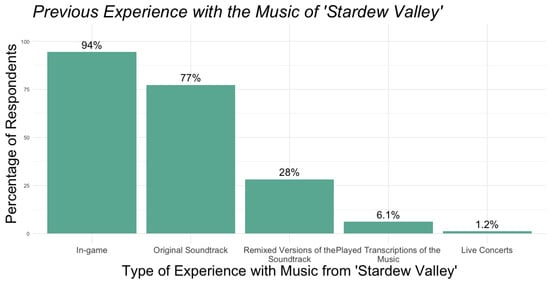
Figure 1.
Respondents’ engagement with the music of Stardew Valley prior to the concerts.
3.2. Immersion
Overall, respondents indicated very high rates of enjoyment, engagement, and immersion as gauged through the ITC-Sense of Presence Inventory (Lessiter et al., 2001). The mean immersion score was 4.3 (SD = 0.5, IQR = [4.1, 5]) on a five-point scale. Throughout the survey, attendees frequently commented on how concert elements affected their degree of immersion in the experience. Table 2 highlights representative examples.
Table 2.
Representative free-text descriptions from respondents, describing their degree of immersion.
3.3. Comparing Musical Interpretations
Even though most respondents were familiar with the music prior to the concert, they differed substantially when asked to rate how similar the concert music felt to their prior experiences with the music of Stardew Valley, on a scale from 1 (completely different) to 6 (completely the same). Almost half of the respondents, 43%, felt that the music was more different than similar and the remaining 57% felt that the music felt more similar than different. These responses highlight the broad range of similarity judgments, despite participants’ overwhelming familiarity with the music.
Directly following the Likert similarity judgment, participants were asked to describe the perceived musical similarities or differences. Respondents who rated the music as being more different than similar (1–3 on the scale) were asked to describe differences. Respondents who rated the music as being more similar than different (4–6 on the scale) were asked to describe similarities. To better understand what musical features listeners focused on, we used natural language processing to analyze trends in their text descriptions. Responses were grouped into two categories: difference descriptions and similarity descriptions. We did not omit any complete responses that discussed both similarities and differences as manual inspection revealed that less than 10% of the responses described both similarities and differences. All responses were lemmatized and stop words were removed including ‘which’, ‘this’, ‘I’m’, and ‘their’, as well as task-related words like ‘different’, ‘similar’, ‘familiar’, and ‘stardew’.
The most common words for both groups are displayed in Figure 2. The group of respondents who highlighted similarities employed many music-specific words like ‘melody’, ‘instrument’, ‘theme’, ‘sound’, and ‘soundtrack’. They seemed to focus on ‘recognizable’ and specific musical content that was shared between the two contexts. In comparison, descriptions of musical differences emphasized the ‘live’ and experiential nature on the concert, focusing on the performers and setting rather than on the specific musical material.
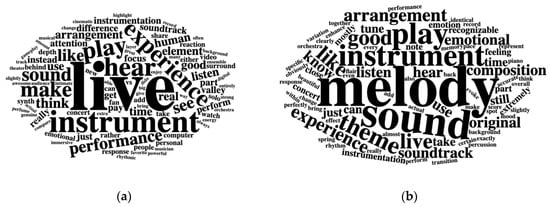
Figure 2.
(a) Word cloud for descriptions of musical differences across in-game and concert experience. (b) Word cloud for descriptions of musical similarities between the contexts. In both word clouds, all words were lemmatized, stop words were removed, and only words with more than one occurrence are visualized.
After this visual inspection of word clouds, we used the tidytext package in R (Silge & Robinson, 2016) to calculate term frequency–inverse document frequency (TF-IDF) values for each word in the corpus of responses. Adding nuance to the frequency counts used to create Figure 2 (the above word clouds), this technique identifies the most prominent terms used for both groups of responses, allowing us to assess which musical features listeners prioritized when making their comparisons. We treated each group (different and similar) as entire documents when generating the TF-IDF values for each lemmatized word. Rather than focusing on individual responses, we focused on the group level to uncover broader patterns in word usage across these two groups.
Through this technique, we found striking differences in word usage between the two response groups. Figure 3 summarizes the words with the highest TF-IDF values for each category. People who felt the music was markedly different from the in-game context more often used words like ‘human’, ‘attention’, ‘watch’, ‘video’, and ‘people’ to explain the perceived differences. The prominence of these words may suggest that listeners’ musical attention was often pulled to audiovisual and community aspects of the performance. However, people who felt the music was more similar to the in-game music more frequently emphasized the ‘melodies’, ‘notes’, ‘emotions’, and ‘recognizable’ aspects of the music. While it may not be surprising that listeners prioritized melodic information in their similarity assessments, these findings may suggest that listeners’ attention may have been more directly focused on specific musical material, musical motives, and emotional associations with the music. Table 3 and Table 4 consider the broader context of the terms with the largest value TF-IDF values, highlighting representative quotes that contain top terms for differences and similarities.
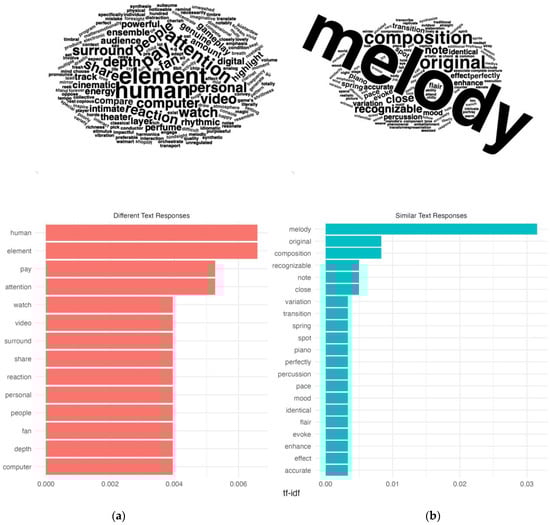
Figure 3.
(a) Word cloud for all words in descriptions of differences with non-zero TF-IDF values, with corresponding bar chart for words with highest TF-IDF values. (b) Word cloud for all words in descriptions of similarities with non-zero TF-IDF values, with corresponding bar chart for words with highest TF-IDF values.
Table 3.
Representative difference responses using words with the five largest TF-IDF values.
Table 4.
Representative similarity responses using words with the five largest TF-IDF values.
3.4. Patterns of Thought
Trends in thought types experienced by audience members resemble larger trends of music-evoked imaginings (Jakubowski et al., 2024). Participants at this live concert event experienced a wide range of thought types with a substantial increase in thoughts about future or personal plans (29.4% of respondents) when compared to Jakubowski et al. (2024), which differed from the present study in modality (headphones), familiarity (unfamiliar music), and genre (classical, electronic, popular). The distribution of reported thoughts is summarized in Figure 4, shown in order from most prevalent to least prevalent type of thought. Together with the high level of reported immersion, this broad spread of thought types shows a clear comingling of high immersion with diversity of thought types. Notably, our data show a high volume of thoughts that were not directly about the music, including fictional stories, autobiographical memories, and thoughts about the future.
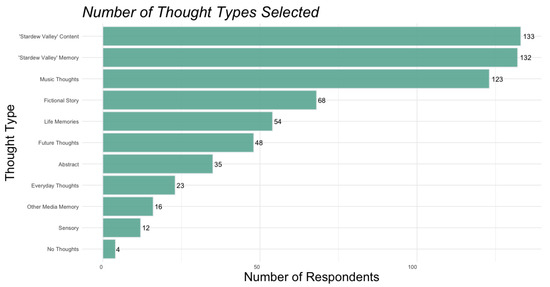
Figure 4.
Distribution of thought types selected by respondents.
3.5. Relation of Immersion and Number of Thought Types
We conducted a Spearman rank-order correlation to assess the relationship between the number of thought types reported and immersion score, as shown in Figure 5. There was a significant positive correlation between the two variables (ρ = 0.22, p = 0.004), indicating that participants who reported a greater variety of thoughts tended to report a higher degree of immersion.
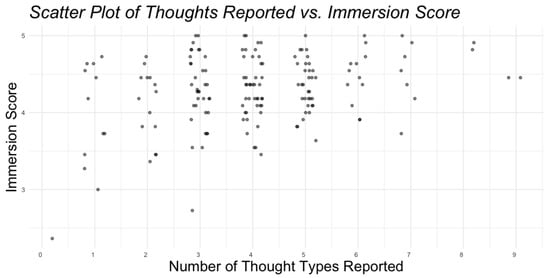
Figure 5.
Relationship between the number of thought types reported and immersion score, with each dot representing a single respondent.
3.6. Correlation Between Different Thought Types
Figure 6 summarizes the degree to which individual thought types co-occurred for concertgoers, calculated by performing Pearson’s correlations on pairs of binary variables. All significant correlations are summarized in Table 5. The strongest correlation (φ = 0.5, p < 0.001) occurred between life memories associated with Stardew Valley and specific thoughts about content from the game, indicating that participants who experienced one of these thought types also often experienced the other. Recalling life memories was correlated with future thoughts (φ = 0.17, p = 0.03), potentially suggesting a clustering of autobiographical thoughts cued by the game’s music. The positive correlation between thoughts about the music and Stardew Valley memories (φ = 0.2, p = 0.01) supports this interpretation.
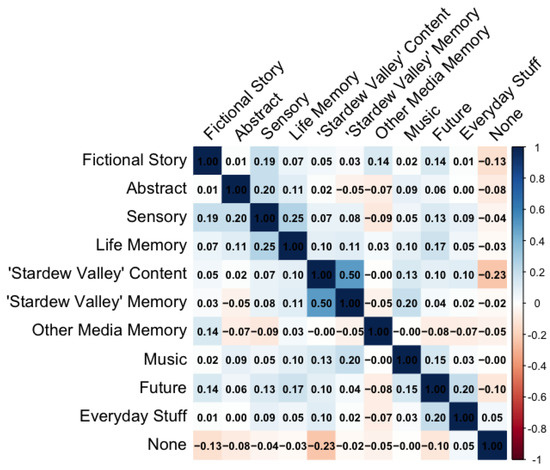
Figure 6.
Correlation matrix of co-occurring thought types during the concert.
Table 5.
Significant Pearson’s correlations between co-occurring thought types.
3.7. Relation of Immersion and Specific Thought Types
Figure 7 explores the relationship between the presence of different thought types and the listener’s degree of immersion (split into four levels based on quartiles). It suggests that concertgoers experiencing an increased degree of immersion were also experiencing more life memories and fictional imaginings. Levels of musical training and fandom engagement did not coincide significantly with patterns of thought types.
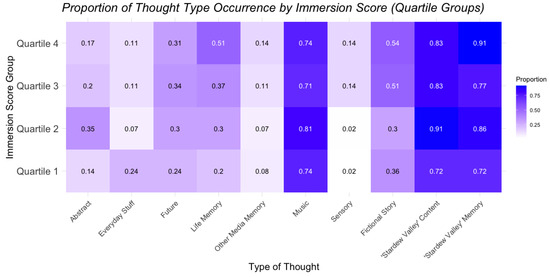
Figure 7.
Proportion of thought type occurrence across immersion quartile groups.
Throughout their responses, participants reported a high degree of immersion, varied musical descriptions, and diverse patterns of thoughts. Although many were highly familiar with the music prior to the concert, listeners’ musical attention varied widely. Some respondents focused on the live and community aspect of the performance, while others allocated their attention toward specific musical features. Thought patterns were similarly varied, with a high prevalence of autobiographical memories and imagined fictional narratives. Notably, the degree of immersion correlated with the number of thought types. These findings also suggest that the nature of thought experiences may be shaped by the co-occurrence of multiple thought types and by individual differences in immersion.
4. Discussion
These findings prompt further critical examination of how immersion and engagement are defined, especially for musical experiences. While these concepts are often described as states of focused attention, our results indicate that highly immersed listeners actually experience diverse thoughts, including those not directly about the immediate musical content. Responses show that the highest immersion coincided with the greatest number of thought types, especially fictional imaginings and autobiographical memories. These findings suggest that immersive experiences may not necessarily lead to a singularly focused engagement with music but might prompt listeners instead to become immersed in the thoughtscape that is triggered by the music.
This necessitates a shift in understanding how music facilitates immersion. Rather than only promoting engaged attention on the sound itself, music can cue absorbing internal imaginings like fictional stories, autobiographical memories, and memories of related media. Previous research has shown that music-evoked imaginings are closely tied to sound (Margulis et al., 2022a, 2022b; McAuley et al., 2021), shaped by cultural contexts (Margulis et al., 2022b) and prevalent in many genres of music (Jakubowski et al., 2024; van der Walle et al., in press). Extending this body of research, our findings suggest that these diverse patterns of thought occur in live concert contexts for listeners highly familiar with the musical material, and they coincide with high degrees of immersion in the concert experience. These findings align with multidimensional approaches to musical absorption, emphasizing how absorbed states relate to other experiential dimensions such as concurrent visual imagery (Vroegh, 2024) and mind wandering (Swarbrick et al., 2024).
These results indicate that imaginings cued by live concert contexts with relatively lengthy musical pieces may differ from imaginings studied in most behavioral research, in contexts such as listening to recordings of brief musical excerpts over headphones. For example, 48 (29.4%) of respondents at the Festival of Seasons concerts reported that they thought about future plans during the concert, while the recorded cues in van der Walle et al. (in press) rarely generated any reports of thoughts about the future. Moreover, our data showed almost exclusively positive correlations between different thought types while correlations between thought types in van der Walle et al. (in press) were much more varied, including significant negative correlations between fictional imaginings and music-related thoughts and fictional imaginings and autobiographical memories. These differences may suggest that specific listening contexts may engender different degrees of immersion by prompting different patterns of music-evoked imaginings.
A key implication from this study is that immersed states may not depend on attending exclusively to the music itself, but can also include attending closely to an imagining or memory cued by the music. These findings support a fluid and multidimensional approach to immersion and engagement, creating space to consider how dynamic changes in attention shape the listening experience. In this view, immersion might involve dynamic shifts between attentional modes—alternating between present-moment engagement with the sound and internally generated imagery or memory. Frameworks like Pianzola et al.’s (2021) nested approach to levels of presence and immersion and Omigie and Mencke’s (2024) time-varying model of musical engagement may be especially helpful in examining the fluidity of immersive states and their relation to music-evoked imaginings. Future work should explore the relationship between imagined scenes and musical immersion more directly.
This study’s limitations point to the importance of future research. The use of a self-selected participant sample introduces the potential for sampling bias, which may have influenced the frequency and types of thoughts reported. As such, the results may not fully generalize to broader or more diverse concert audiences. Additionally, the concert series focused exclusively on music from a single video game soundtrack. While this offered a consistent musical framework, it constrains the generalizability of the findings. Future research should investigate a wider variety of multimedia concerts—spanning media formats, franchises, performance structures, and audience demographics—to better understand how musical familiarity, visual context, and gameplay complexity interact to shape immersion and musical thought. Expanding the scope in this way will help clarify how diverse multimedia contexts structure audience engagement and musical attention.
Together, these findings underscore how listeners engaged in ‘open-minded and active process’ (Reybrouck et al., 2024, p. 1) as they explored the concerts’ sonic landscape. By experiencing familiar music in a novel concert environment, concertgoers drew on highly attentive modes of listening (Wald-Fuhrmann et al., 2021; Weining et al., 2025). Referencing their prior experiences with the music, they drew on predictive frameworks to make sense of the remediated musical content. Deploying their attention to different attributes of the experience, some attendees focused more on the live, human quality of the performances while other listeners focused on specific musical material and melodies. Our findings indicate significant overlap between the processes of exploratory listening, immersion, and thought patterns, suggesting that each play a crucial role in shaping listeners’ aesthetic judgements and emotional-affective outcomes. As one respondent summarizes, ‘I can hear people’s lives getting better after every song’.
Supplementary Materials
The following supporting information can be downloaded at: https://www.mdpi.com/article/10.3390/bs15050667/s1, The following supporting information includes the set of survey questions reported on in this paper.
Author Contributions
Conceptualization, N.P.M. and E.H.M.; methodology, N.P.M. and E.H.M.; software, N.P.M.; validation, N.P.M. and E.H.M.; formal analysis, N.P.M.; investigation, N.P.M.; resources, N.P.M. and E.H.M.; data curation, N.P.M.; writing—original draft preparation, N.P.M. and E.H.M.; writing—review and editing, N.P.M. and E.H.M.; visualization, N.P.M.; supervision, E.H.M.; project administration, N.P.M.; All authors have read and agreed to the published version of the manuscript.
Funding
This research received no external funding.
Institutional Review Board Statement
The study was conducted in accordance with the Declaration of Helsinki and approved by the Institutional Review Board of Princeton University (protocol # 14944, 18 November 2022).
Informed Consent Statement
Informed consent was obtained from all subjects involved in the study.
Data Availability Statement
The raw data supporting the conclusions of this article will be made available by the authors on request.
Acknowledgments
We would like to thank the production team at SOHO Live for their collaboration with this research, especially Gaetano Fazio, Hector Contreras, and Jeffrey Smith. We would also like to thank Marcos Acevedo Arús, Grace Gollmar, and Lauren Shepherd for their support in data collection.
Conflicts of Interest
The authors declare no conflicts of interest.
References
- Brandt, J. (2024, November 21). Dates announced for second “Stardew Valley” concert tour, Symphony of Seasons. CBS Philadelphia. Available online: https://www.cbsnews.com/philadelphia/news/stardew-valley-concert-tour-symphony-of-seasons/ (accessed on 1 February 2025).
- Cohen, A. J. (2015). Congruence-association model and experiments in film music: Toward interdisciplinary collaboration. Music and the Moving Image, 8(2), 5–24. [Google Scholar] [CrossRef]
- ConcernedApe. (2016). Stardew Valley (v.1.6.15). ConcernedApe.
- Cook, N. (2004). Analysing musical multimedia. Oxford University Press. [Google Scholar]
- Curran, N. (2018). Factors of immersion. In The Wiley handbook of human computer interaction (pp. 239–254). John Wiley & Sons, Ltd. [Google Scholar] [CrossRef]
- Greenfield-Casas, S. (2023). From the screen (to the screen) to the Concert Hall: Arrangement as a world-building and world-bridging device in the Kingdom Hearts series. In R. Banagale (Ed.), The Oxford handbook of arrangement studies. Oxford University Press. [Google Scholar] [CrossRef]
- Haywood, N., & Cairns, P. (2006). Engagement with an interactive museum exhibit. In T. McEwan, J. Gulliksen, & D. Benyon (Eds.), People and computers XIX—The bigger picture (pp. 113–129). Springer. [Google Scholar] [CrossRef]
- Hunt, E. (2024). Video games live and the gamification of the orchestral concert experience. In W. Gibbons, & M. Grimshaw-Aagaard (Eds.), The Oxford handbook of video game music and sound (pp. 648–661). Oxford University Press. [Google Scholar] [CrossRef]
- Jakubowski, K., Margulis, E. H., & Taruffi, L. (2024). Music-evoked thoughts. Music Perception: An Interdisciplinary Journal, 42(1), 3–18. [Google Scholar] [CrossRef]
- Jennett, C., Cox, A. L., Cairns, P., Dhoparee, S., Epps, A., Tijs, T., & Walton, A. (2008). Measuring and defining the experience of immersion in games. International Journal of Human-Computer Studies, 66(9), 641–661. [Google Scholar] [CrossRef]
- Korsgaard, M. B. (2017). Music video after MTV: Audiovisual studies, new media, and popular music (1st ed.). Routledge. [Google Scholar] [CrossRef]
- Kreuzer, M., Wald-Fuhrmann, M., Weining, C., Tröndle, M., & Egermann, H. (2025). Western classical music concerts are more immersive, intellectually stimulating, and social, when experienced live rather than in a digital stream. An ecologically valid concert study on different modes of liveness. Music & Science, 8, 1–13. [Google Scholar] [CrossRef]
- Lehman, F. (2013). Hollywood cadences: Music and the structure of cinematic expectation. Music Theory Online, 19(4). Available online: https://www.mtosmt.org/issues/mto.13.19.4/mto.13.19.4.lehman.html (accessed on 1 February 2025).
- Lessiter, J., Freeman, J., Keogh, E., & Davidoff, J. (2001). A cross-media presence questionnaire: The ITC-sense of presence inventory. PRESENCE: Teleoperators & Virtual Environments, 10(3), 282–297. [Google Scholar] [CrossRef]
- Margulis, E. H., Miller, N., Mitchell, N., Windholz, M. O., Williams, J., & McAuley, J. D. (2022a). Intersubjectivity and shared dynamic structure in narrative imaginings to music. Music Theory Online, 28(4). Available online: https://mtosmt.org/issues/mto.22.28.4/mto.22.28.4.margulis.html (accessed on 1 February 2025). [CrossRef]
- Margulis, E. H., Wong, P. C. M., Turnbull, C., Kubit, B. M., & McAuley, J. D. (2022b). Narratives imagined in response to instrumental music reveal culture-bounded intersubjectivity. Proceedings of the National Academy of Sciences, 119(4), e2110406119. [Google Scholar] [CrossRef] [PubMed]
- McAuley, J. D., Wong, P. C. M., Bellaiche, L., & Margulis, E. H. (2021). What drives narrative engagement with music? Music Perception, 38(5), 509–521. [Google Scholar] [CrossRef]
- Okazaki, B. M. (2020). Liveness, music, media: The case of the cine-concert. Music and the Moving Image, 13(2), 3–24. [Google Scholar]
- Omigie, D., & Mencke, I. (2024). A model of time-varying music engagement. Philosophical Transactions of the Royal Society B: Biological Sciences, 379(1895), 20220421. [Google Scholar] [CrossRef]
- Pianzola, F., Riva, G., Kukkonen, K., & Mantovani, F. (2021). Presence, flow, and narrative absorption: An interdisciplinary theoretical exploration with a new spatiotemporal integrated model based on predictive processing. Open Research Europe, 1, 28. [Google Scholar] [CrossRef] [PubMed]
- Reybrouck, M., Podlipniak, P., & Welch, D. (2024). Music listening as exploratory behavior: From dispositional reactions to epistemic interactions with the Sonic World. Behavioral Sciences, 14(9), 825. [Google Scholar] [CrossRef]
- Sekar, S. (2022). Film-with-Live-Orchestra concerts: A new hope. [in]Transition, 9(1), 1. [Google Scholar] [CrossRef]
- Silge, J., & Robinson, D. (2016). Tidytext: Text mining and analysis using tidy data principles in R. Journal of Open Source Software, 1(3), 37. [Google Scholar] [CrossRef]
- SOHO Live. (2024). Stardew valley: Festival of seasons [Concert tour]. Available online: https://www.stardewvalleyconcert.com/festival-of-seasons (accessed on 28 February 2025).
- Swarbrick, D., Martin, R., Høffding, S., Nielsen, N., & Vuoskoski, J. K. (2024). Audience musical absorption: Exploring attention and affect in the live concert setting. Music & Science, 7, 1–19. [Google Scholar] [CrossRef]
- Tan, S.-L., Cohen, A. J., Lipscomb, S. D., & Kendall, R. A. (Eds.). (2013). The psychology of music in multimedia. Oxford University Press. [Google Scholar]
- Tukachinsky, R. (2014). Experimental manipulation of psychological involvement with media. Communication Methods and Measures, 8(1), 1–33. [Google Scholar] [CrossRef]
- van der Walle, H., Wu, W., Margulis, E. H., & Jakubowski, K. (in press). Thoughtscapes in music: An examination of thought types occurring during music listening across 17 genres. Music Psychology. [Google Scholar]
- Vernallis, C. (2013). Unruly media: YouTube, music video, and the new digital cinema. Oxford University Press. [Google Scholar]
- Vroegh, T. (2024). Visual imagery in the listener’s mind: A network analysis of absorbed consciousness. Psychology of Consciousness: Theory, Research, and Practice, 11(1), 46–70. [Google Scholar] [CrossRef]
- Wald-Fuhrmann, M., Egermann, H., Czepiel, A., O’Neill, K., Weining, C., Meier, D., Tschacher, W., Uhde, F., Toelle, J., & Tröndle, M. (2021). Music listening in classical concerts: Theory, literature review, and research program. Frontiers in Psychology, 12, 638783. [Google Scholar] [CrossRef]
- Weining, C. (2022). Listening modes in concerts. Music Perception, 40(2), 112–134. [Google Scholar] [CrossRef]
- Weining, C., Meier, D., Wald-Fuhrmann, M., & Tröndle, M. (2025). From structural listening to daydreaming: Listening modes influence the individual experience in live concerts. Psychology of Music, 1–19. [Google Scholar] [CrossRef]
- White, S. (2018, March 20). Valley forged: How one man made the indie video game sensation Stardew Valley. GQ. Available online: https://www.gq.com/story/stardew-valley-eric-barone-profile (accessed on 1 February 2025).
- Witmer, B. G., & Singer, M. J. (1998). Measuring presence in virtual environments: A presence questionnaire. Presence: Teleoperators and Virtual Environments, 7(3), 225–240. [Google Scholar] [CrossRef]
Disclaimer/Publisher’s Note: The statements, opinions and data contained in all publications are solely those of the individual author(s) and contributor(s) and not of MDPI and/or the editor(s). MDPI and/or the editor(s) disclaim responsibility for any injury to people or property resulting from any ideas, methods, instructions or products referred to in the content. |
© 2025 by the authors. Licensee MDPI, Basel, Switzerland. This article is an open access article distributed under the terms and conditions of the Creative Commons Attribution (CC BY) license (https://creativecommons.org/licenses/by/4.0/).