
Mediterranean Alcohol-Drinking Pattern and Alcohol-Related Cancer Incidence in the “Seguimiento Universidad de Navarra” (SUN) Cohort

 , ,
, ,  , , , and
Abstract
1. Introduction
2. Materials and Methods
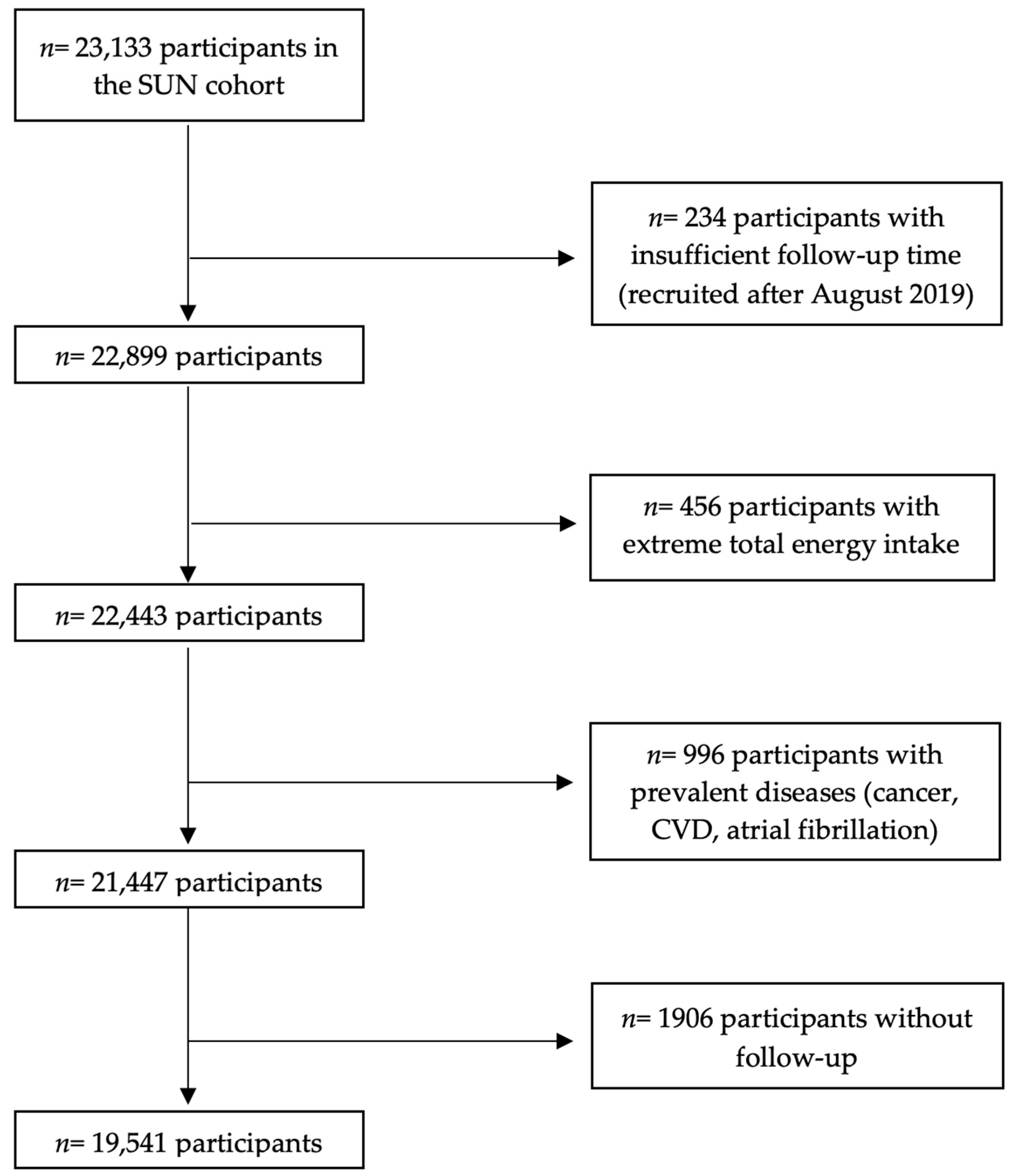
2.1. Study Population
2.2. Mediterranean Alcohol-Drinking Pattern (MADP)
2.3. Outcome Assessment
2.4. Covariate Assessment
2.5. Statistical Analysis
3. Results
4. Discussion
5. Conclusions
Author Contributions
Funding
Institutional Review Board Statement
Informed Consent Statement
Data Availability Statement
Acknowledgments
Conflicts of Interest
Abbreviations
| IARC | International Agency for Research on Cancer |
| GBD | Global Burden of Disease |
| NIH | National Institutes of Health |
| WCRF | World Cancer Research Fund |
| MADP | Mediterranean Alcohol-Drinking Pattern |
| CVD | Cardiovascular Disease |
| SUN | “Seguimiento Universidad de Navarra” |
| FFQ | Food Frequency Questionnaire |
| INE | “Instituto Nacional de Estadística” |
| MDS | Mediterranean Diet Score |
| IPW | Inverse Probability Weighting |
| SD | Standard Deviation |
| HR | Hazard Ratio |
| BMI | Body Mass Index |
| CI | Confidence Interval |
References
- World Health Organization. Global Status Report on Alcohol and Health 2018; World Health Organization: Geneva, Switzerland, 2018. [Google Scholar]
- Rumgay, H.; Shield, K.; Charvat, H.; Ferrari, P.; Sornpaisarn, B.; Obot, I.; Islami, F.; Lemmens, V.E.P.P.; Rehm, J.; Soerjomataram, I. Global burden of cancer in 2020 attributable to alcohol consumption: A population-based study. Lancet Oncol. 2021, 22, 1071–1080. [Google Scholar] [CrossRef]
- Rumgay, H.; Murphy, N.; Ferrari, P.; Soerjomataram, I. Alcohol and Cancer: Epidemiology and Biological Mechanisms. Nutrients 2021, 13, 3173. [Google Scholar] [CrossRef] [PubMed]
- Druesne-Pecollo, N.; Keita, Y.; Touvier, M.; Chan, D.S.; Norat, T.; Hercberg, S.; Latino-Martel, P. Alcohol drinking and second primary cancer risk in patients with upper aerodigestive tract cancers: A systematic review and meta-analysis of observational studies. Cancer Epidemiol. Biomark. Prev. 2014, 23, 324–331. [Google Scholar] [CrossRef]
- Fedirko, V.; Lukanova, A.; Bamia, C.; Wang, Q.; Gago-Dominguez, M.; Castelao, J.E.; Carracedo, A.; Garzón, V.M.; Bojesen, S.E.; Nordestgaard, B.G.; et al. Alcohol consumption and survival after breast cancer: A meta-analysis of epidemiological studies. Breast Cancer Res. Treat. 2014, 143, 279–288. [Google Scholar]
- Bray, F.; Laversanne, M.; Sung, H.; Ferlay, J.; Siegel, R.L.; Soerjomataram, I.; Jemal, A. Global cancer statistics 2022: GLOBOCAN estimates of incidence and mortality worldwide for 36 cancers in 185 countries. CA Cancer J. Clin. 2024, 74, 229–263. [Google Scholar] [CrossRef]
- World Cancer Research Fund/American Institute for Cancer Research. Continuous Update Project Expert Report 2018. Alcoholic Drinks and the Risk of Cancer. Available online: https://dietandcancerreport.org (accessed on 2 October 2025).
- Jin, M.; Cai, S.; Guo, J.; Zhu, Y.; Li, M.; Yu, Y.; Zhang, S.; Chen, K. Alcohol drinking and all cancer mortality: A meta-analysis. Ann. Oncol. 2013, 24, 807–816. [Google Scholar] [CrossRef]
- Kim, M.K.; Ko, M.J.; Han, J. Alcohol consumption and mortality from all-cause and cancers among 1.34 million Koreans: The results from the Korea national health insurance corporation’s health examinee cohort in 2000. Cancer Causes Control 2010, 21, 2295–2302. [Google Scholar] [CrossRef]
- Allen, N.E.; Balkwill, A.; Beral, V.; Green, J.; Reeves, G. Million Women Study Collaborators. Fluid intake and incidence of renal cell carcinoma in UK women. Br. J. Cancer 2011, 104, 1487–1492. [Google Scholar] [CrossRef]
- Wozniak, M.B.; Brennan, P.; Brenner, D.R.; Overvad, K.; Olsen, A.; Tjønneland, A.; Boutron-Ruault, M.C.; Clavel-Chapelon, F.; Fagherazzi, G.; Katzke, V.; et al. Alcohol consumption and the risk of renal cancers in the European prospective investigation into cancer and nutrition (EPIC). Int. J. Cancer 2015, 137, 1953–1966. [Google Scholar] [CrossRef] [PubMed]
- Tramacere, I.; Pelucchi, C.; Bonifazi, M.; Bagnardi, V.; Rota, M.; Bellocco, R.; Scotti, L.; Islami, F.; Corrao, G.; Boffetta, P.; et al. Alcohol drinking and non-Hodgkin lymphoma risk: A systematic review and a meta-analysis. Ann. Oncol. 2012, 23, 2791–2798. [Google Scholar] [CrossRef] [PubMed]
- Bagnardi, V.; Rota, M.; Botteri, E.; Tramacere, I.; Islami, F.; Fedirko, V.; Scotti, L.; Jenab, M.; Turati, F.; Pasquali, E.; et al. Alcohol consumption and site-specific cancer risk: A comprehensive dose-response meta-analysis. Br. J. Cancer 2015, 112, 580–593. [Google Scholar] [CrossRef]
- GBD 2020 Alcohol Collaborators. Population-level risks of alcohol consumption by amount, geography, age, sex, and year: A systematic analysis for the Global Burden of Disease Study 2020. Lancet 2022, 400, 185–235, Correction in Lancet 2022, 400, 358. https://doi.org/10.1016/S0140-6736(22)01389-7. [Google Scholar] [CrossRef]
- GBD 2016 Alcohol Collaborators. Alcohol use and burden for 195 countries and territories, 1990–2016: A systematic analysis for the Global Burden of Disease Study 2016. Lancet 2018, 392, 1015–1035, Correction in Lancet 2019, 393, e44. https://doi.org/10.1016/S0140-6736(19)31050-5. [Google Scholar] [CrossRef]
- Petrick, J.L.; Campbell, P.T.; Koshiol, J.; Thistle, J.E.; Andreotti, G.; Beane-Freeman, L.E.; Buring, J.E.; Chan, A.T.; Chong, D.Q.; Doody, M.M.; et al. Tobacco, alcohol use and risk of hepatocellular carcinoma and intrahepatic cholangiocarcinoma: The Liver Cancer Pooling Project. Br. J. Cancer 2018, 118, 1005–1012. [Google Scholar] [CrossRef]
- Cao, Y.; Willett, W.C.; Rimm, E.B.; Stampfer, M.J.; Giovannucci, E.L. Light to moderate intake of alcohol, drinking patterns, and risk of cancer: Results from two prospective US cohort studies. BMJ 2015, 351, h4238. [Google Scholar] [CrossRef] [PubMed]
- Im, P.K.; Millwood, I.Y.; Kartsonaki, C.; Chen, Y.; Guo, Y.; Du, H.; Bian, Z.; Lan, J.; Feng, S.; Yu, C.; et al. Alcohol drinking and risks of total and site-specific cancers in China: A 10-year prospective study of 0.5 million adults. Int. J. Cancer 2021, 149, 522–534. [Google Scholar] [CrossRef] [PubMed]
- White, A.J.; DeRoo, L.A.; Weinberg, C.R.; Sandler, D.P. Lifetime Alcohol Intake, Binge Drinking Behaviors, and Breast Cancer Risk. Am. J. Epidemiol. 2017, 186, 541–549. [Google Scholar] [CrossRef]
- Chen, W.Y.; Rosner, B.; Hankinson, S.E.; Colditz, G.A.; Willett, W.C. Moderate alcohol consumption during adult life, drinking patterns, and breast cancer risk. JAMA 2011, 306, 1884–1890. [Google Scholar] [CrossRef]
- Gea, A.; Bes-Rastrollo, M.; Toledo, E.; Garcia-Lopez, M.; Beunza, J.J.; Estruch, R.; Martinez-Gonzalez, M.A. Mediterranean alcohol-drinking pattern and mortality in the SUN (Seguimiento Universidad de Navarra) Project: A prospective cohort study. Br. J. Nutr. 2014, 111, 1871–1880. [Google Scholar] [CrossRef]
- Barbería-Latasa, M.; Bes-Rastrollo, M.; Pérez-Araluce, R.; Martínez-González, M.Á.; Gea, A. Mediterranean Alcohol-Drinking Patterns and All-Cause Mortality in Women More Than 55 Years Old and Men More Than 50 Years Old in the “Seguimiento Universidad de Navarra” (SUN) Cohort. Nutrients 2022, 14, 5310. [Google Scholar] [CrossRef]
- Mukamal, K.J.; Conigrave, K.M.; Mittleman, M.A.; Camargo, C.A., Jr.; Stampfer, M.J.; Willett, W.C.; Rimm, E.B. Roles of drinking pattern and type of alcohol consumed in coronary heart disease in men. N. Engl. J. Med. 2003, 348, 109–118. [Google Scholar] [CrossRef]
- Schrieks, I.C.; Heil, A.L.; Hendriks, H.F.; Mukamal, K.J.; Beulens, J.W. The effect of alcohol consumption on insulin sensitivity and glycemic status: A systematic review and meta-analysis of intervention studies. Diabetes Care 2015, 38, 723–732. [Google Scholar] [CrossRef]
- Li, Y.; Pan, A.; Wang, D.D.; Liu, X.; Dhana, K.; Franco, O.H.; Kaptoge, S.; Di Angelantonio, E.; Stampfer, M.; Willett, W.C.; et al. Impact of Healthy Lifestyle Factors on Life Expectancies in the US Population. Circulation 2018, 138, 345–355, Erratum in Circulation 2018, 138, e75. https://doi.org/10.1161/CIR.0000000000000587. [Google Scholar] [CrossRef]
- McKenzie, F.; Biessy, C.; Ferrari, P.; Freisling, H.; Rinaldi, S.; Chajès, V.; Dahm, C.C.; Overvad, K.; Dossus, L.; Lagiou, P.; et al. Healthy Lifestyle and Risk of Cancer in the European Prospective Investigation Into Cancer and Nutrition Cohort Study. Medicine 2016, 95, e2850. [Google Scholar] [CrossRef] [PubMed]
- Crockett, S.D.; Long, M.D.; Dellon, E.S.; Martin, C.F.; Galanko, J.A.; Sandler, R.S. Inverse relationship between moderate alcohol intake and rectal cancer: Analysis of the North Carolina Colon Cancer Study. Dis. Colon Rectum 2011, 54, 887–894. [Google Scholar] [CrossRef]
- Farinetti, A.; Zurlo, V.; Manenti, A.; Coppi, F.; Mattioli, A.V. Mediterranean diet and colorectal cancer: A systematic review. Nutrition 2017, 43–44, 83–88. [Google Scholar] [CrossRef]
- Kontou, N.; Psaltopoulou, T.; Soupos, N.; Polychronopoulos, E.; Xinopoulos, D.; Linos, A.; Panagiotakos, D. Alcohol consumption and colorectal cancer in a Mediterranean population: A case-control study. Dis. Colon Rectum 2012, 55, 703–710. [Google Scholar] [CrossRef]
- Dal Maso, L.; La Vecchia, C.; Polesel, J.; Talamini, R.; Levi, F.; Conti, E.; Zambon, P.; Negri, E.; Franceschi, S. Alcohol drinking outside meals and cancers of the upper aero-digestive tract. Int. J. Cancer 2002, 102, 435–437. [Google Scholar] [CrossRef] [PubMed]
- Arranz, S.; Chiva-Blanch, G.; Valderas-Martínez, P.; Medina-Remón, A.; Lamuela-Raventós, R.M.; Estruch, R. Wine, beer, alcohol and polyphenols on cardiovascular disease and cancer. Nutrients 2012, 4, 759–781. [Google Scholar] [CrossRef]
- Boban, M.; Stockley, C.; Teissedre, P.L.; Restani, P.; Fradera, U.; Stein-Hammer, C.; Ruf, J.C. Drinking pattern of wine and effects on human health: Why should we drink moderately and with meals? Food Funct. 2016, 7, 2937–2942. [Google Scholar] [CrossRef] [PubMed]
- Ma, H.; Li, X.; Zhou, T.; Sun, D.; Shai, I.; Heianza, Y.; Rimm, E.B.; Manson, J.E.; Qi, L. Alcohol Consumption Levels as Compared with Drinking Habits in Predicting All-Cause Mortality and Cause-Specific Mortality in Current Drinkers. Mayo Clin. Proc. 2021, 96, 1758–1769. [Google Scholar] [CrossRef]
- Carlos, S.; De La Fuente-Arrillaga, C.; Bes-Rastrollo, M.; Razquin, C.; Rico-Campà, A.; Martínez-González, M.A.; Ruiz-Canela, M. Mediterranean Diet and Health Outcomes in the SUN Cohort. Nutrients 2018, 10, 439. [Google Scholar] [CrossRef]
- de la Fuente-Arrillaga, C.; Carlos, S.; Toledo, E.; Barbería-Latasa, M.; Razquin, C.; Ruiz-Canela, M.; Gea, A.; Martínez-González, M.A.; Bes-Rastrollo, M. Cohort Profile Update: The ‘Seguimiento Universidad de Navarra’ (SUN) study after 24 years of follow-up. Int. J. Epidemiol. 2025, 54, dyaf149. [Google Scholar] [CrossRef]
- Zazpe, I.; Santiago, S.; Toledo, E.; Bes-Rastrollo, M.; de la Fuente-Arrillaga, C.; Martínez-González, M.Á. Diet Quality Indices in the SUN Cohort: Observed Changes and Predictors of Changes in Scores over a 10-Year Period. J. Acad. Nutr. Diet. 2021, 121, 1948–1960.e7. [Google Scholar] [CrossRef]
- Martin-Moreno, J.M.; Boyle, P.; Gorgojo, L.; Maisonneuve, P.; Fernandez-Rodriguez, J.C.; Salvini, S.; Willett, W.C. Development and validation of a food frequency questionnaire in Spain. Int. J. Epidemiol. 1993, 22, 512–551. [Google Scholar] [CrossRef]
- Willett, W.C.; Sacks, F.; Trichopoulou, A.; Drescher, G.; Ferro-Luzzi, A.; Helsing, E.; Trichopoulos, D. Mediterranean diet pyramid: A cultural model for healthy eating. Am. J. Clin. Nutr. 1995, 61, 1402S–1406S. [Google Scholar] [CrossRef] [PubMed]
- Bes-Rastrollo, M.; Pérez Valdivieso, J.R.; Sánchez-Villegas, A.; Alonso, Á.; Martínez-González, M.Á. Validation of self-reported weight and body mass index of the participants of a cohort of university graduates. Rev. Esp. Obes. 2005, 3, 183–189. [Google Scholar]
- Martínez-González, M.A.; López-Fontana, C.; Varo, J.J.; Sánchez-Villegas, A.; Martinez, J.A. Validation of the Spanish version of the physical activity questionnaire used in the Nurses’ Health Study and the Health Professionals’ Follow-up Study. Public Health Nutr. 2005, 8, 920–927. [Google Scholar] [CrossRef] [PubMed]
- De la Fuente-Arrillaga, C.; Ruiz, Z.V.; Bes-Rastrollo, M.; Sampson, L.; Martinez-González, M.A. Reproducibility of an FFQ validated in Spain. Public Health Nutr. 2010, 13, 1364–1372. [Google Scholar] [CrossRef]
- Trichopoulou, A.; Costacou, T.; Bamia, C.; Trichopoulos, D. Adherence to a Mediterranean diet and survival in a Greek population. N. Engl. J. Med. 2003, 348, 2599–2608. [Google Scholar] [CrossRef]
- Baglietto, L.; English, D.R.; Hopper, J.L.; Powles, J.; Giles, G.G. Average volume of alcohol consumed, type of beverage, drinking pattern and the risk of death from all causes. Alcohol Alcohol. 2006, 41, 664–671. [Google Scholar] [CrossRef] [PubMed]
- Giacosa, A.; Barale, R.; Bavaresco, L.; Faliva, M.A.; Gerbi, V.; La Vecchia, C.; Negri, E.; Opizzi, A.; Perna, S.; Pezzotti, M.; et al. Mediterranean Way of Drinking and Longevity. Crit. Rev. Food Sci. Nutr. 2016, 56, 635–640. [Google Scholar] [CrossRef]
- World Health Organization: WHO. Alcohol is One of the Biggest Risk Factors for Breast Cancer. Available online: https://www.who.int/europe/news/item/20-10-2021-alcohol-is-one-of-the-biggest-risk-factors-for-breast-cancer (accessed on 7 August 2025).
- Allen, N.E.; Beral, V.; Casabonne, D.; Kan, S.W.; Reeves, G.K.; Brown, A.; Green, J.; Million Women Study Collaborators. Moderate alcohol intake and cancer incidence in women. J. Natl. Cancer Inst. 2009, 101, 296–305. [Google Scholar] [CrossRef] [PubMed]
- Hu, F.B. Dietary pattern analysis: A new direction in nutritional epidemiology. Curr Opin. Lipidol. 2002, 13, 3–9. [Google Scholar] [CrossRef] [PubMed]
- Meng, T.; Xiao, D.; Muhammed, A.; Deng, J.; Chen, L.; He, J. Anti-Inflammatory Action and Mechanisms of Resveratrol. Molecules 2021, 26, 229. [Google Scholar] [CrossRef]
- Grosso, G.; Godos, J.; Currenti, W.; Micek, A.; Falzone, L.; Libra, M.; Giampieri, F.; Forbes-Hernández, T.Y.; Quiles, J.L.; Battino, M.; et al. The Effect of Dietary Polyphenols on Vascular Health and Hypertension: Current Evidence and Mechanisms of Action. Nutrients 2022, 14, 545. [Google Scholar] [CrossRef]
- Teng, H.; Chen, L. Polyphenols and bioavailability: An update. Crit. Rev. Food Sci. Nutr. 2019, 59, 2040–2051. [Google Scholar] [CrossRef]
- Di Lorenzo, C.; Colombo, F.; Biella, S.; Stockley, C.; Restani, P. Polyphenols and Human Health: The Role of Bioavailability. Nutrients 2021, 13, 273. [Google Scholar] [CrossRef]
- Serino, A.; Salazar, G. Protective Role of Polyphenols against Vascular Inflammation, Aging and Cardiovascular Disease. Nutrients 2018, 11, 53. [Google Scholar] [CrossRef]
- Fernandes, I.; Pérez-Gregorio, R.; Soares, S.; Mateus, N.; de Freitas, V. Wine Flavonoids in Health and Disease Prevention. Molecules 2017, 22, 292. [Google Scholar] [CrossRef]
- Bessaoud, F.; Daurès, J.P. Patterns of alcohol (especially wine) consumption and breast cancer risk: A case-control study among a population in Southern France. Ann. Epidemiol. 2008, 18, 467–475. [Google Scholar] [CrossRef] [PubMed]


| MEN | Mediterranean Alcohol-Drinking Pattern | |||
|---|---|---|---|---|
| Abstainers | Low (0–3) | Moderate (4–6) | High (7–9) | |
| N | 613 | 1633 | 3416 | 1433 |
| Alcohol intake (g/d) | 0 | 17.2 (24.9) | 13.5 (13.5) | 12.3 (7.6) |
| Total energy (kcal/d) | 2498.9 (852.8) | 2595.9 (826.5) | 2537.8 (775.1) | 2474.7 (763.9) |
| Body-mass index (kg/m2) | 25.2 (3.4) | 25.8 (3.3) | 25.6 (3.2) | 25.3 (2.8) |
| Smoking habit | ||||
| Never smokers (%) | 61.1 | 40.3 | 42.5 | 44.3 |
| Former smokers (%) | 25.3 | 35.5 | 34.6 | 36.3 |
| Current smokers and <20 PackYear (%) | 8.5 | 17.1 | 17.4 | 15.3 |
| Current smokers and ≥20 PackYear (%) | 5.1 | 7.2 | 5.5 | 4.1 |
| Mediterranean Diet Score (Trichopoulou, 0 to 8) | ||||
| <3 points (%) | 28.1 | 22.7 | 20.2 | 23.3 |
| 3–5 points (%) | 50.5 | 58.2 | 59.6 | 57.2 |
| >6 points (%) | 21.4 | 19.1 | 20.3 | 19.6 |
| Depression (%) | 10.0 | 9.9 | 9.1 | 10.4 |
| Chronic diseases (%) 1 | 35.6 | 39.6 | 37.0 | 36.5 |
| Having undergone a colonoscopy (%) | 11.1 | 12.6 | 11.1 | 13.3 |
| Family history of colon cancer (%) | 6.0 | 5.7 | 5.7 | 6.4 |
| Family history of breast cancer (%) | 7.9 | 9.6 | 10.1 | 8.2 |
| Physical activity (MET-h/week) | ||||
| Tertile 1 (%) | 30.1 | 29.3 | 26.3 | 23.7 |
| Tertile 2 (%) | 32.2 | 32.7 | 32.8 | 34.5 |
| Tertile 3 (%) | 37.8 | 38.0 | 40.9 | 41.7 |
| Marital status: married (%) | 58.1 | 58.5 | 63.1 | 63.4 |
| University education (years) | 5.4 (1.8) | 5.3 (1.6) | 5.4 (1.7) | 5.7 (1.9) |
| WOMEN | Mediterranean Alcohol-Drinking Pattern | |||
| Abstainers | Low (0–3) | Moderate (4–6) | High (7–9) | |
| N | 2586 | 2704 | 4432 | 1258 |
| Alcohol intake (g/d) | 0 | 5.2 (8.2) | 6.2 (6.7) | 6.2 (3.7) |
| Total energy (kcal/d) | 2266.5 (598.8) | 2289.8 (569.6) | 2300.5 (562.7) | 2317.0 (565.5) |
| Body-mass index (kg/m2) | 22.4 (3.4) | 22.3 (3.3) | 22.1 (3.0) | 21.9 (2.8) |
| Smoking habit | ||||
| Never smokers (%) | 67.7 | 42.5 | 46.6 | 53.6 |
| Former smokers (%) | 18.2 | 28.4 | 27.5 | 30.6 |
| Current smokers and <20 PackYear (%) | 12.1 | 26.2 | 23.6 | 14.4 |
| Current smokers and ≥20 PackYear (%) | 2.1 | 2.9 | 2.3 | 1.4 |
| Mediterranean Diet Score (Trichopoulou, 0 to 8) | ||||
| <3 points (%) | 23.2 | 21.3 | 21.2 | 23.8 |
| 3–5 points (%) | 58.5 | 60.8 | 58.6 | 56.1 |
| >6 points (%) | 18.3 | 17.9 | 20.2 | 20.1 |
| Depression (%) | 14.8 | 13.8 | 11.4 | 13.7 |
| Chronic diseases (%) 1 | 18.7 | 17.0 | 17.5 | 20.1 |
| Having undergone a colonoscopy (%) | 5.4 | 4.2 | 4.6 | 5.2 |
| Having undergone a mammography (%) | 33.0 | 36.3 | 35.5 | 39.1 |
| Obstetric history | ||||
| Age < 25 y and nulliparous (%) | 48.77 | 48.54 | 53.61 | 43.70 |
| Age ≥ 25 y and nulliparous (%) | 3.38 | 4.23 | 4.26 | 4.47 |
| First pregnancy ≤ 25 y and <30 y (%) | 13.11 | 13.42 | 16.10 | 16.56 |
| First pregnancy ≥ 30 y (%) | 14.74 | 12.99 | 15.39 | 14.27 |
| Family history of colon cancer (%) | 3.5 | 4.4 | 4.1 | 3.2 |
| Family history of breast cancer (%) | 10.7 | 9.2 | 11.1 | 11.8 |
| Physical activity (MET-h/week) | ||||
| Tertile 1 (%) | 39.9 | 39.5 | 35.8 | 35.0 |
| Tertile 2 (%) | 31.8 | 33.2 | 34.9 | 36.2 |
| Tertile 3 (%) | 28.2 | 27.3 | 29.4 | 28.8 |
| Marital status: married (%) | 46.1 | 39.6 | 41.0 | 48.9 |
| University education (years) | 4.7 (1.3) | 4.8 (1.3) | 4.9 (1.3) | 5.0 (1.5) |
| Mediterranean Alcohol-Drinking Pattern | Only Among Drinkers | ||||
|---|---|---|---|---|---|
| MEN | Abstainers | Low (0–3) | Moderate (4–6) | High (7–9) | Two-Point Increment |
| Cases/person-years | 5/8457 | 15/21,844 | 31/48,253 | 15/21,144 | |
| Crude | 0.60 (0.22–1.65) | 1 (ref.) | 0.57 (0.30–1.05) | 0.41 (0.20–0.84) | 0.72 (0.54–0.95) |
| p | 0.318 | 0.071 | 0.015 | 0.022 | |
| Age adjusted model | 0.59 (0.21–1.64) | 1 (ref.) | 0.57 (0.31–1.06) | 0.41 (0.20–0.84) | 0.72 (0.54–0.95) |
| p | 0.312 | 0.075 | 0.015 | 0.022 | |
| Multiple-adjusted model, * | 0.64 (0.23–1.79) | 1(ref.) | 0.56 (0.30–1.06) | 0.44 (0.21–0.92) | 0.76 (0.57–1.02) |
| p | 0.394 | 0.073 | 0.029 | 0.064 | |
| WOMEN | |||||
| Cases/person-years | 45/35,755 | 30/37,855 | 92/61,708 | 35/18,397 | |
| Crude | 1.06 (0.66–1.70) | 1 (ref.) | 1.18 (0.77–1.79) | 1.07 (0.64–1.77) | 1.03 (0.86–1.24) |
| p | 0.801 | 0.446 | 0.800 | 0.734 | |
| Age adjusted model | 1.06 (0.66–1.69) | 1 (ref.) | 1.18 (0.77–1.79) | 1.07 (0.64–1.77) | 1.03 (0.86–1.24) |
| p | 0.807 | 0.450 | 0.804 | 0.746 | |
| Multiple-adjusted model * | 1.12 (0.70–1.79) | 1 (ref.) | 1.19 (0.78–1.81) | 1.13 (0.68–1.87) | 1.04 (0.86–1.25) |
| p | 0.649 | 0.421 | 0.649 | 0.678 | |
| MEN | Cases/Person-Years | High (7–9) vs. Low (0–3) |
|---|---|---|
| Main analysis | 66/99,698 | 0.44 (0.21–0.92) |
| Energy limits suggested by Willett | 66/94,564 | 0.46 (0.22–0.95) |
| Including alcohol in the Mediterranean Diet Score | 66/99,698 | 0.43 (0.20–0.91) |
| Excluding if prevalent metabolic conditions (hypercholesterolemia, hypertriglyceridemia, diabetes, hypertension) | 24/64,129 | 0.43 (0.12–1.49) |
| Excluding cancers diagnosed during the first 2 years | 61/84,788 | 0.44 (0.20–0.98) |
| Excluding former and current smokers | 15/44,844 | 0.49 (0.08–2.90) |
| Excluding never smokers | 51/54,853 | 0.37 (0.16–0.89) |
| Including only participants > 50 years at baseline | 43/25,870 | 0.46 (0.18–1.18) |
| WOMEN | Cases/Person-Years | High (7–9) vs. Low (0–3) |
| Main analysis | 202/153,715 | 1.13 (0.68–1.87) |
| Excluding breast cancer | 24/152,242 | 1.02 (0.21–4.83) |
| Energy limits suggested by Willett | 185/139,711 | 0.94 (0.54–1.64) |
| Including alcohol in MDS | 185/139,711 | 1.14 (0.68–1.89) |
| Excluding if prevalent metabolic conditions (hypercholesterolemia, hypertriglyceridemia, diabetes, hypertension) | 168/127,607 | 1.08 (0.62–1.89) |
| Excluding cancers diagnosed during the first 2 years | 185/129,609 | 1.03 (0.61–1.75) |
| Excluding former and current smokers | 78/79,088 | 0.73 (0.34–1.58) |
| Excluding never smokers | 124/74,627 | 1.56 (0.78–3.10) |
| Including only participants > 50 years at baseline | 35/15,205 | 2.88 (0.36–23.34) |
Disclaimer/Publisher’s Note: The statements, opinions and data contained in all publications are solely those of the individual author(s) and contributor(s) and not of MDPI and/or the editor(s). MDPI and/or the editor(s) disclaim responsibility for any injury to people or property resulting from any ideas, methods, instructions or products referred to in the content. |
© 2025 by the authors. Licensee MDPI, Basel, Switzerland. This article is an open access article distributed under the terms and conditions of the Creative Commons Attribution (CC BY) license.
Share and Cite
Barbería-Latasa, M.; Toledo, E.; Bes-Rastrollo, M.; Olmedo, M.; Pérez-Araluce, R.; Gea, A.; Martínez-González, M.Á. Mediterranean Alcohol-Drinking Pattern and Alcohol-Related Cancer Incidence in the “Seguimiento Universidad de Navarra” (SUN) Cohort. Med. Sci. 2026, 14, 20. https://doi.org/10.3390/medsci14010020
Barbería-Latasa M, Toledo E, Bes-Rastrollo M, Olmedo M, Pérez-Araluce R, Gea A, Martínez-González MÁ. Mediterranean Alcohol-Drinking Pattern and Alcohol-Related Cancer Incidence in the “Seguimiento Universidad de Navarra” (SUN) Cohort. Medical Sciences. 2026; 14(1):20. https://doi.org/10.3390/medsci14010020
Chicago/Turabian StyleBarbería-Latasa, María, Estefanía Toledo, Maira Bes-Rastrollo, María Olmedo, Rafael Pérez-Araluce, Alfredo Gea, and Miguel Ángel Martínez-González. 2026. "Mediterranean Alcohol-Drinking Pattern and Alcohol-Related Cancer Incidence in the “Seguimiento Universidad de Navarra” (SUN) Cohort" Medical Sciences 14, no. 1: 20. https://doi.org/10.3390/medsci14010020
APA StyleBarbería-Latasa, M., Toledo, E., Bes-Rastrollo, M., Olmedo, M., Pérez-Araluce, R., Gea, A., & Martínez-González, M. Á. (2026). Mediterranean Alcohol-Drinking Pattern and Alcohol-Related Cancer Incidence in the “Seguimiento Universidad de Navarra” (SUN) Cohort. Medical Sciences, 14(1), 20. https://doi.org/10.3390/medsci14010020