Abstract
The Ordos Basin hosts significant shale gas resources in China, yet its marine-continental transitional sedimentary setting causes intense reservoir heterogeneity that severely hinders accurate sweet spot identification in the Permian Shanxi Formation. This study aims to reveal the synergistic controls of lithofacies, mineralogy, and organic matter on shale gas sweet spot formation in the southern Yishan Slope of the eastern Ordos Basin. A multi-dimensional characterization approach was adopted, integrating drilling/logging data and systematic core analyses including X-ray diffraction (XRD), organic geochemical testing, porosity/permeability measurement, and on-site gas content desorption, to quantify reservoir heterogeneity across lithofacies, mineralogy, organic geochemistry, and petrophysical properties. The results show that three lithofacies associations are identified in the target interval: mud-wrapped sand, sand-mud interbedding, and sand-wrapped mud, among which sand-mud interbedding and mud-wrapped sand associations exhibit higher total organic carbon (TOC) contents and strong inter/intra-well heterogeneity. The organic matter in the reservoir is dominated by Type III kerogen, with TOC values ranging from 0.04% to 12.15%, and the Shan 2 Member shows significantly higher average TOC (2.55%) than the Shan 1 Member (1.36%). The reservoir is characterized by ultra-low porosity (average of 0.77%) and low permeability (average of 0.26 × 10⁻³ μm2), with mesopores and macropores contributing over 99% of the total pore volume and showing a significant positive correlation with gas content. Quartz (average of 34.86%) and clay minerals present strong vertical heterogeneity, with the Shan 2 Member being more heterogeneous than the Shan 1 Member due to differences in sedimentary environment evolution. A TOC threshold of 1.5% is determined for sweet spot identification in the study area, and shale gas sweet spots are synergistically controlled by high TOC abundance, moderate brittle mineral content, and 0.1–3 m thick sandy interbeds. This study enriches the theoretical understanding of marine-continental transitional shale reservoirs and provides a scientific basis for sweet spot prediction and development optimization in similar heterogeneous shale gas systems worldwide.
1. Introduction
The global energy transition toward low-carbon sources has elevated unconventional hydrocarbons, particularly shale gas, to a strategically critical role in ensuring national energy security [1]. As the only country outside North America achieving large-scale commercial shale gas production, China possesses abundant marine-continental transitional shale resources, with the Permian Shanxi Formation in the Ordos Basin emerging as a key exploration target [2,3]. However, unlike marine shales with relatively stable depositional conditions (e.g., the Silurian Longmaxi Formation in the Sichuan Basin) [4], marine-continental transitional shales are characterized by intense lithological heterogeneity, complex mineralogical compositions, and uneven organic matter enrichment, which severely restrict accurate sweet spot identification and efficient development [5,6].
The Ordos Basin, a large cratonic superimposed basin in the western North China Craton, hosts well-preserved Permian Shanxi Formation shales in the southern Yishan Slope, i.e., a tectonically stable zone with gentle monocline structures, sparse faults, and weak magmatic activity, providing favorable conditions for shale gas reservoir preservation [3,6]. Previous studies on the Shanxi Formation have focused on individual aspects such as sedimentary facies classification [7], organic geochemical characteristics [8], and petrophysical property evaluation [9], but systematic investigations into the synergistic controls of lithofacies, mineralogy, and organic matter on shale gas sweet spots remain limited. Key unsolved issues include: (1) the vertical and lateral heterogeneity of multi-dimensional reservoir parameters (lithology, minerals, organic matter, physical properties) and their genetic mechanisms; (2) the interactive effects of lithofacies associations, brittle mineral content, and TOC abundance on gas generation, storage, and migration; (3) the critical parameter thresholds for sweet spot delineation in marine-continental transitional shales.
To address these gaps, this study targets the Shan 1 and Shan 2 Members of the Permian Shanxi Formation in the southern Yishan Slope. A multi-dimensional characterization approach was adopted, integrating drilling/logging data and systematic core analyses to quantify reservoir heterogeneity and reveal the synergistic mechanisms controlling shale gas sweet spots. The specific objectives are to: (1) identify lithofacies associations and quantify their heterogeneity in the study area; (2) analyze the spatial variation characteristics of mineralogy, organic geochemistry, and petrophysical properties; (3) reveal the synergistic interaction mechanism of lithofacies-mineralogy-organic matter on sweet spot distribution; (4) establish a practical sweet spot identification standard for marine-continental transitional shale gas reservoirs.
2. Geological Setting
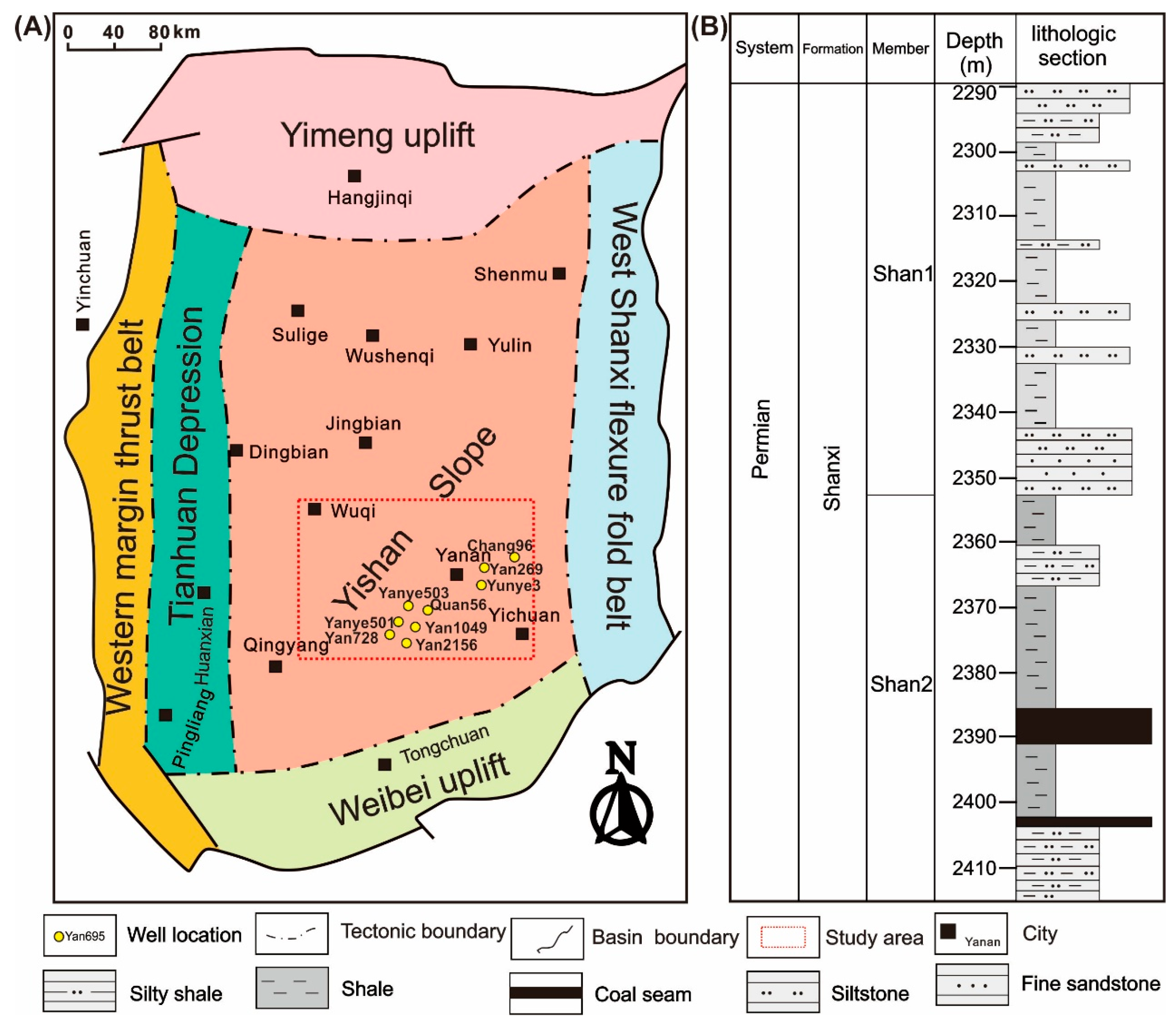
The Ordos Basin, located in the western North China Craton, is a large-scale cratonic superimposed basin with a multi-cycle tectonic and sedimentary evolution history [1,2]. The basin’s tectonic framework is dominated by six major first-order tectonic units: the Yimeng Uplift, Western Margin Thrust Belt, Tianhuan Depression, Yishan Slope, Jinxi Flexure Belt, and Weibei Uplift. The study area is situated in the southern part of the Yishan Slope, i.e., the largest and most stable tectonic unit in the basin, characterized by a gentle monocline structure (dip angle of 0.5–1°), minimal tectonic disturbance, sparse faults, and weak magmatic activity (Figure 1A). This stable tectonic environment effectively preserves the primary reservoir properties of the shale and provides favorable conditions for shale gas accumulation [6].
Figure 1.
(A) Tectonic framework of the Ordos Basin and location of the study area, showing major tectonic units and well locations; (B) Lithostratigraphic column of the Permian Shanxi Formation in the study area, displaying depth intervals and corresponding lithologies.
The Permian Shanxi Formation in the southern Yishan Slope belongs to a typical marine-continental transitional sedimentary system, with its sedimentary processes controlled by the interaction of sea-level fluctuations, provenance supply, and basin subsidence [10,11]. The Shanxi Formation is vertically divided into two members: the Shan 1 Member and the Shan 2 Member, with a total thickness of 80–120 m in the study area. During the deposition of the Shan 2 Member, the study area was dominated by a semi-enclosed shallow water environment (shallow lacustrine-interdistributary bay facies) with weak hydrodynamic conditions, which facilitated the accumulation of fine-grained muddy sediments and the preservation of organic matter. The widespread development of interdistributary bays resulted in thin, discontinuous sandstone layers interbedded with thick mudstone [3]. In contrast, the Shan 1 Member deposition was characterized by intensified terrigenous clastic input from the northern Ordos Massif and southern Qinling Orogen, leading to the progradation of delta plain systems. The subaqueous distributary channel microfacies replaced interdistributary bays as the dominant type, resulting in more frequent sand-mud interbedding, thinner single shale layers, and increased lateral lithological variability [5,6].
Overall, the lithological composition of the Shanxi Formation is dominated by fine-grained sediments (mudstone, carbonaceous shale), accounting for 60–80% of the total thickness, with sandstone (fine sandstone, siltstone) and coal seams as secondary components (Figure 1B), forming a typical “shale-dominated, sandstone-coal interbedded” lithological pattern [12,13]. The sedimentary environment evolution from the Shan 2 to the Shan 1 Member is the fundamental cause of the strong multi-dimensional heterogeneity of the shale reservoir in the study area.
3. Samples and Methods
Core samples were collected from 10 key wells (Wells Chang 96, Yan 2156, Yanye 501, Yanye 503, Quan 56, Yan 728, Yan 299, Yan 1049, Yunye 3, and Yan 269) covering the entire Shanxi Formation in the study area (Figure 1A). A total of 47 representative shale core samples (23 from the Shan 1 Member and 24 from the Shan 2 Member) were selected for systematic laboratory analysis, ensuring coverage of different lithofacies associations, sedimentary facies belts, and depth intervals. All samples were trimmed to remove weathered surfaces and drilling contaminants, then stored in sealed containers at low temperature to preserve their original geochemical and mineralogical characteristics.
Lithological characterization was conducted by integrating drilling, logging, and core observation data. Core samples were visually inspected for color, texture, sedimentary structure, and interbedding features, and detailed lithological columns were constructed for key wells (Wells Chang 96 and Yan 2156). Logging curves (gamma ray (GR), acoustic time (Δt), bulk density (DEN), and resistivity (RT)) were used to supplement lithological identification and correlate core observations with downhole strata.
Lithofacies associations were classified based on the thickness ratio of mudstone to sandstone (sandy mudstone interbeds were counted as sandstone), and three types were defined: (1) mud-wrapped sand (mudstone accounting for >70% of the total thickness); (2) sand-mud interbedding (mudstone and sandstone thickness ratio ~1:1); (3) sand-wrapped mud (sandstone accounting for >70% of the total thickness). For lithology nomenclature, we define two terms to avoid ambiguity: (1) silty shale: fine-grained rock with >50% clay mineral content and interbedded silt laminae; (2) argillaceous siltstone: fine-grained rock with >50% silt content and a clay matrix. Vertical heterogeneity was evaluated by analyzing lithological variation rates and the number of lithological transitions within narrow depth intervals; lateral heterogeneity was quantified using the variation coefficient (CV = standard deviation/mean value) of key reservoir parameters.
Whole-rock mineral and clay mineral compositions were determined using X-ray diffraction (XRD) analysis with a Bruker D8 Advance diffractometer (Cu Kα radiation, 40 kV, 40 mA, Billerica, MA, USA). Core samples were ground into 200-mesh powder and dried at 60 °C for 24 h to remove moisture. For whole-rock mineral analysis, samples were scanned from 5° to 70° 2θ at a step size of 0.02° and a scanning speed of 4°/min, and mineral contents were quantified using the Rietveld refinement method with TOPAS 4.2 software. For clay mineral analysis, oriented clay slides were prepared via the sedimentation method; air-dried, ethylene glycol-solvated, and heated (550 °C for 2 h) slides were scanned from 2° to 30° 2θ to identify clay mineral types (illite–smectite (I/S) mixed layers, illite, kaolinite, and chlorite), and relative contents were calculated using the peak area normalization method. The experimental precision was verified by repeated analysis of representative sample Q5-06, with a relative standard deviation (RSD) of 1.3%.
Kerogen type was determined via microscopic component analysis using a Leica DM4500P polarizing microscope (Wetzlar, Germany). Core samples were ground into thin sections of 30 μm in thickness and observed under transmitted and reflected light. Microcomponents were classified into amorphous + exinite, vitrinite, and inertinite, and their relative contents were counted (≥500 points per sample) following the Chinese National Standard. The T-index was calculated using the formula: T = (100A + 50B − 75C − 100D)/100, where A = amorphous + exinite content (%), B = exinite content (%), C = vitrinite content (%), and D = inertinite content (%). Kerogen type was classified based on T-index values (Type III for T < 0).
TOC content was determined using a LECO CS230 carbon-sulfur analyzer (St. Joseph, MI, USA). Samples were ground into 200-mesh powder, and carbonate minerals were removed by treating with 10% hydrochloric acid (HCl) at 60 °C for 4 h. After neutralization and drying, samples were combusted at 1350 °C, and TOC content was measured by detecting CO2 release. Each sample was analyzed in triplicate, with an average relative standard deviation (RSD) < 2%.
Continuous TOC profiles were constructed using the ΔlogR method to supplement discrete core data. The method utilizes resistivity (R) and acoustic time (Δt) logging curves, with the formula: ΔlogR = log(R/Rbase) + 0.02(Δt − Δtbase) and TOC = ΔlogR × 10(0.018LOM−0.074) + ΔTOC, where Rbase = baseline resistivity value of non-source rock intervals (Ω·m), Δtbase = baseline acoustic time value of non-source rock intervals (μs/m), LOM = level of organic metamorphism (determined by vitrinite reflectance, LOM = 9–10 in the study area), and ΔTOC = background TOC content of non-source rock intervals (%). The method was validated by correlating calculated TOC values with measured data from Well Chang 96 (R2 = 0.716).
Porosity was measured using the helium expansion method with a Micromeritics AccuPyc II 1340 pycnometer (Norcross, GA, USA). Samples were cut into cylindrical plugs (25 mm length × 10 mm diameter), dried at 105 °C for 24 h, and degassed under vacuum for 4 h. Helium was used as the displacement gas to measure skeletal volume, and porosity was calculated as the ratio of pore volume to bulk volume. Each sample was measured 3–5 times, with an average RSD < 3% for porosity measurements.
Permeability was determined using the steady—state degassing method with a custom—built core flooding system. The system was maintained at ambient temperature and 5 MPa confining pressure, and helium gas was injected at a constant flow rate. Permeability was calculated using Darcy’s law based on pressure differences across the sample. Each sample was measured in triplicate, with an average RSD < 2% for permeability measurements.
Pore size distribution was analyzed using a Micromeritics ASAP 2460 (Norcross, GA, USA) surface area and porosity analyzer. Samples were degassed at 105 °C for 12 h, and nitrogen adsorption—desorption experiments were conducted at 77 K. Pores were classified into micropores (<2 nm), mesopores (2–50 nm), and macropores (>50 nm) following the IUPAC classification. Fracture characterization was performed via core scanning and thin-section observation; fracture density was counted as the number of fractures per meter of core, and fracture porosity was calculated based on fracture width, density, and dip angle.
Gas content data were obtained from on-site core desorption tests following the Chinese National Standard. Desorbed gas was collected using the water displacement method, and total gas content was calculated as the sum of desorbed gas, residual gas (measured via sample crushing), and lost gas (estimated via linear extrapolation of early desorption data). Statistical analysis was performed using SPSS 26.0 software to evaluate correlations between TOC content, mineral composition, petrophysical properties, and gas content. Pearson’s correlation coefficients (r), coefficient of determination (R2), and two-tailed p-values were calculated to quantify the strength and statistical significance of correlations, with p < 0.05 defined as statistically significant. TOC threshold sensitivity analysis was conducted using data from all 10 wells to verify the robustness of the sweet spot identification threshold.
4. Results
4.1. Vertical Lithological Characteristics and Heterogeneity
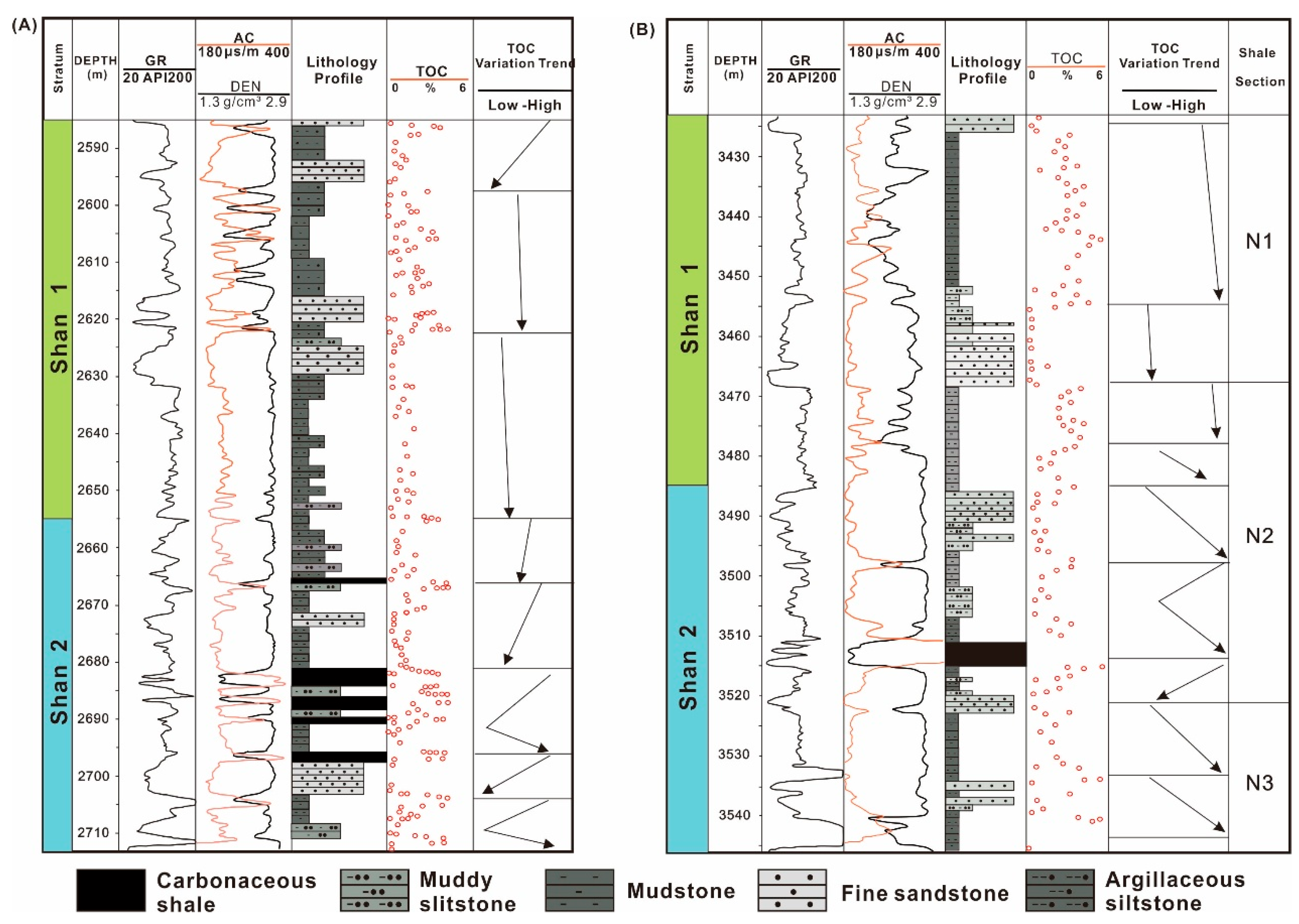
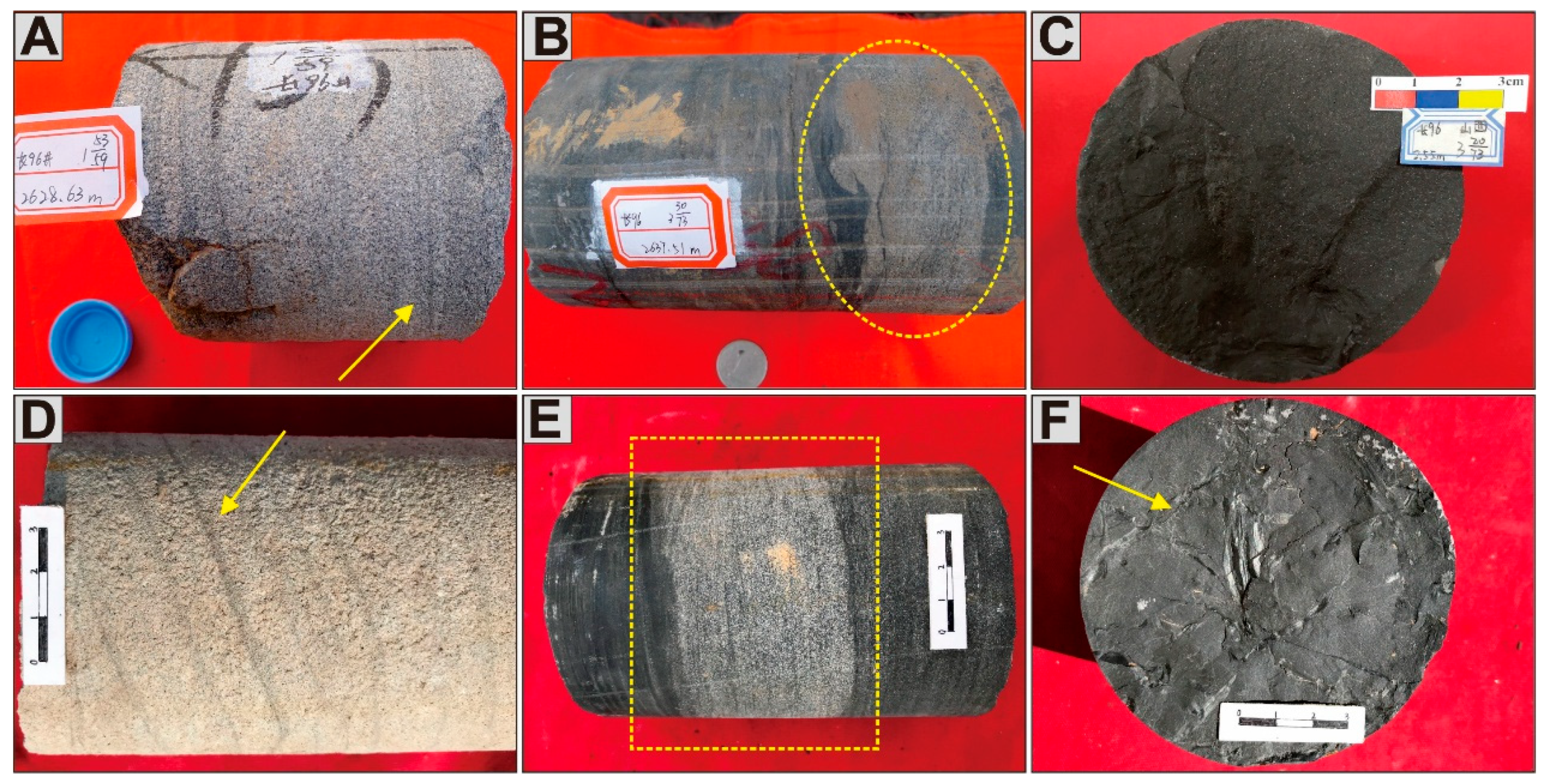
The Shanxi Formation exhibits distinct vertical lithological variations in color, composition, and texture with depth, featuring irregular changes, uneven rock thickness distribution, and strong intra/inter-member heterogeneity (Figure 2). For Well Chang 96 (Figure 2A), the upper part of the Shan 1 Member is dominated by thick black carbonaceous shale and grayish-black mudstone, interbedded with 3–4 m thick light gray fine sandstone; the lower part of the Shan 1 Member consists of silty shale, argillaceous siltstone, fine sandstone (Figure 3A), and mudstone, with rapid color and lithological changes indicating strong heterogeneity (Figure 3B). The upper part of the Shan 2 Member is composed of carbonaceous shale, mudstone, argillaceous siltstone, and fine sandstone, intercalated with thin coal seams, showing significant vertical variations in color and composition; the lower part of the Shan 2 Member is dominated by thick black carbonaceous shale, grayish-black mudstone, and coal seams, with minimal lithological changes with depth (Figure 3C).
Figure 2.
Logging and TOC variation profiles of the Shanxi Formation (Shan 1 and Shan 2 Members) in wells of Chang 96 (A) and Yanye 501 (B).
Figure 3.
Core photographs showing lithologies of the Shanxi Formation. (A) Dark gray argillaceous siltstone at 2628.63 m in Well Chang 96, showing well-developed horizontal argillaceous laminae (arrow indicates laminae); (B) Silty mudstone at 2637.51 m in Well Chang 96, with tear-shaped interweaving of siltstone and mudstone (dashed circle outlines the interwoven zone); (C) Pure mudstone at 2636.24 m in Well Chang 96, massive structure with no obvious bedding, dense texture, and visible plant fossils (scale bar indicates 0–3 cm); (D) Light gray fine sandstone at 3063.15 m in Well Yanye 501, with argillaceous streaks (arrow indicates streaks), typically occurring in sandstone intervals ~1 m thick; (E) Dark mudstone interbedded with thin siltstone layers at 3100.4 m in Well Yanye 501, with laminated structure (dashed rectangle outlines the siltstone layer, <10 cm thick); (F) Mudstone at 3092.8 m in Well Yanye 501, massive structure with no obvious bedding, dense texture, and visible plant debris (arrow indicates debris; scale bar indicates 0–2 cm).
For Well Yanye 501 (Figure 2B), the reservoir is divided into three sections based on lithological heterogeneity: (1) N1 section (3503.01–3541.54 m): dominated by thick dark gray mudstone, interbedded with four 2–5 m thick light gray fine sandstone layers (Figure 3D), showing weak lithological heterogeneity; (2) N2 section (3541.54–3567.78 m): composed of diverse lithologies (mudstone, carbonaceous shale, sandy mudstone, etc.), with rapid lithological and color changes within a narrow interval (Figure 3E); (3) N3 section (3567.78–3601.75 m): characterized by thick dark mudstone and carbonaceous shale, with weaker vertical heterogeneity compared to the N2 section (Figure 3F). All depth values in the manuscript are standardized to 2 decimal places for consistency.
4.2. Lithofacies Association Heterogeneity
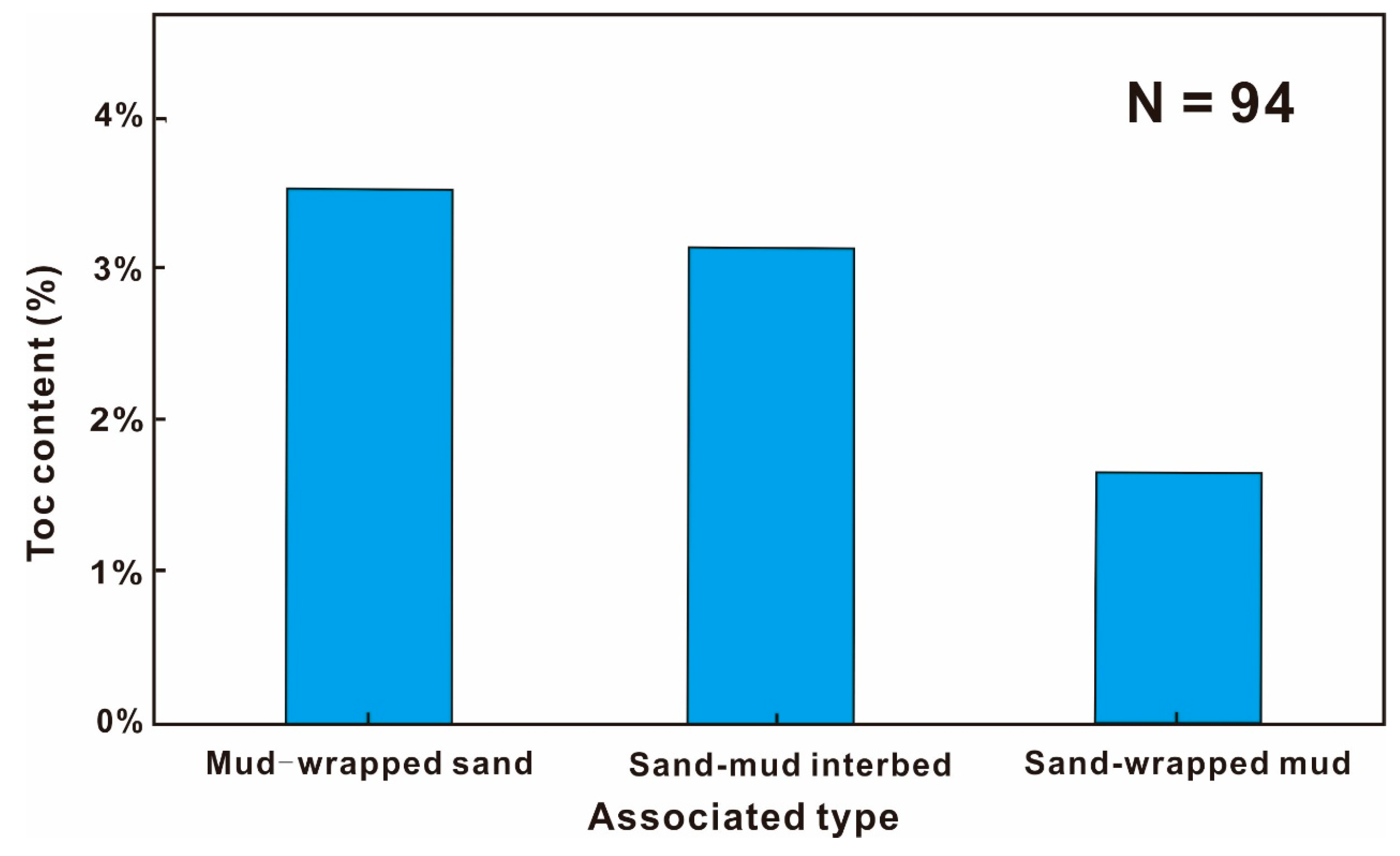
Based on the mudstone-sandstone thickness ratio, three lithofacies associations are identified in the study area: mud-wrapped sand, sand-mud interbedding, and sand-wrapped mud (Figure 4). Statistical analysis shows that the sand-mud interbedding and mud-wrapped sand associations have relatively high and comparable average TOC contents, while the sand-wrapped mud association has the lowest TOC. N = 94 in Figure 4 includes 47 shale core samples (the main research object, described in Section 3 and 47 corresponding sandy interbed samples from the same depth intervals, to comprehensively compare the TOC differences between shale and sandy interbeds across the three lithofacies associations. The lithofacies associations exhibit strong inter/intra-well TOC heterogeneity: for the sand-mud interbedding association across different wells (Yan 728, Yan 299, Yan 1049, Yunye 3), TOC ranges from 1.8% to 13.53%; for the mud-wrapped sand interval of Well Yan 299, TOC varies between 1.03% and 8.98%. Intra-well heterogeneity is also significant: in Well Yan 728, the TOC of the sand-mud interbedding interval is 13.53%, while that of the mud-wrapped sand interval is only 2.71%. Lateral heterogeneity quantification shows that the lithofacies associations have a CV of 0.62 for TOC content, indicating strong lateral heterogeneity related to differential sedimentary microfacies evolution.
Figure 4.
Bar chart illustrating the Total Organic Carbon (TOC) content distribution across three lithofacies association types of the Shanxi Formation in the study area.
4.3. Mineralogical Heterogeneity
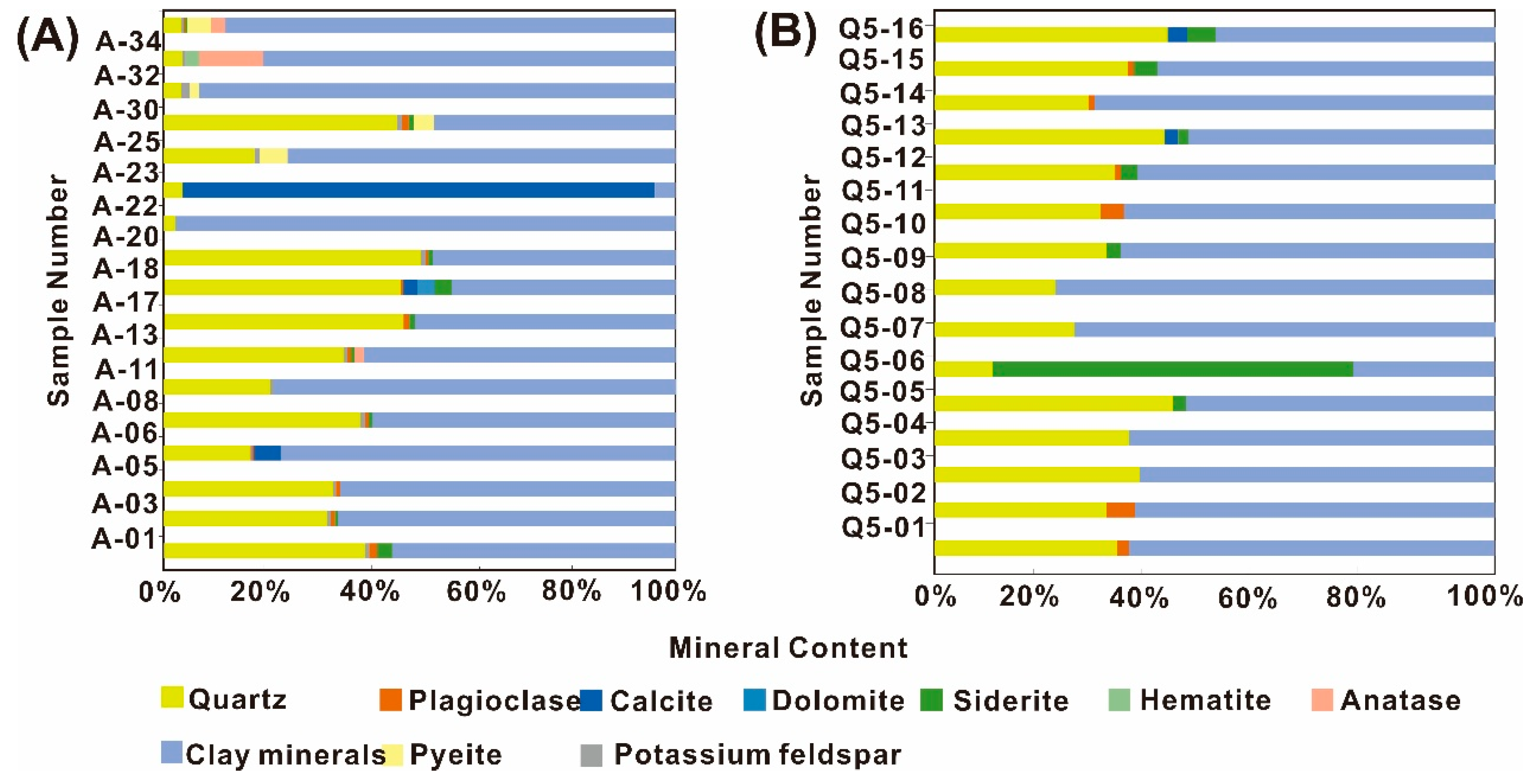
Whole-Rock mineral heterogeneity. The Shanxi Formation shale exhibits significant vertical variations in mineral types and contents, indicating strong whole-rock mineral heterogeneity (Figure 5). Quartz and clay minerals are the dominant components, with quartz content ranging from 15.2% to 58.6% (average of 34.86%) and clay mineral content ranging from 25.3% to 59.6% (average of 42.3%). The two show an obvious inverse vertical variation trend: in the Shan 1 Member, quartz content exhibits a cyclic decrease-increase trend upward, while clay mineral content fluctuates conversely; in the Shan 2 Member, quartz content first increases then decreases upward, and clay mineral content undergoes intense fluctuations.
Figure 5.
Stacked bar charts of whole-rock mineral composition for shale samples from the Permian Shanxi Formation. (A) Well Yanye 503: Samples A-01 to A-20 are from the Shan 1 Member (3425.00–3485.00 m, arranged from shallow to deep along the x-axis), and Samples A-22 to A-34 are from the Shan 2 Member (3485.00–3545.00 m, arranged from shallow to deep along the x-axis); (B) Well Quan 56: Samples Q5-01 to Q5-08 are from the Shan 1 Member (3380.00–3435.00 m, arranged from shallow to deep along the x-axis), and Samples Q5-09 to Q5-16 are from the Shan 2 Member (3435.00–3490.00 m, arranged from shallow to deep along the x-axis). The blank interval between sample groups marks the stratigraphic boundary between the Shan 1 and Shan 2 Members.
Notably, the Shan 2 Member has stronger mineralogical heterogeneity than the Shan 1 Member: the mineral content curves of the Shan 1 Member are relatively gentle, while those of the Shan 2 Member are more tortuous, with significant content changes even within the same layer over small depth intervals. This difference is attributed to the shallow lacustrine sedimentary environment of the Shan 2 Member, with variable hydrodynamic conditions leading to uneven provenance input and mineral accumulation. Lateral heterogeneity analysis shows that quartz content has a CV of 0.42, indicating moderate lateral heterogeneity consistent with relatively stable provenance supply.
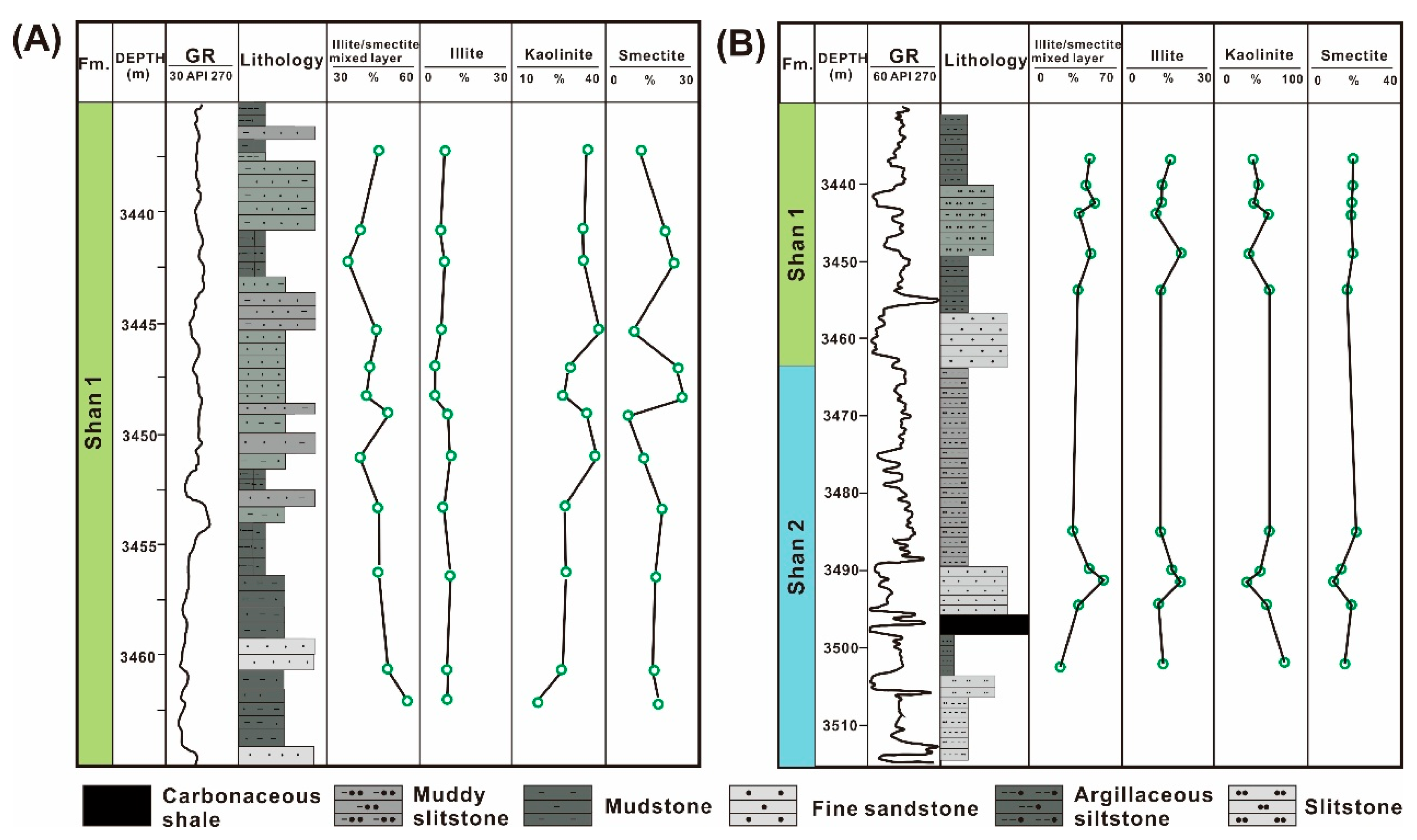
Clay Mineral Heterogeneity: Clay minerals (illite–smectite (I/S) mixed layers, illite, kaolinite, chlorite) exhibit strong vertical heterogeneity, while illite content remains relatively stable (Figure 6). For Wells Yanye 501 and Yanye 503, kaolinite is the dominant clay mineral in the Shan 2 Member, with a fluctuation trend of increase-decrease-increase-decrease, and illite content varies synchronously with kaolinite to a certain extent. The Shan 2 Member exhibits more pronounced clay mineral heterogeneity than the Shan 1 Member in both composition and content. The significant vertical variations in kaolinite and chlorite contents are attributed to their mutual transformation during diagenesis, as well as the transformation of illite to kaolinite under acidic diagenetic conditions.
Figure 6.
Comprehensive profiles showing vertical variations in clay mineral compositions of the Shanxi Formation of Well Yanye 501 (A) and Well Yanye 503 (B).
4.4. Organic Geochemical Heterogeneity
Organic Matter Type And Maturity: Microscopic component analysis of shale samples from Well Yan 2156 shows that all T-index values are negative (ranging from −60.5 to −16), indicating Type III kerogen (humic type) (Table 1). The average contents of amorphous + exinite, vitrinite, and inertinite are 38.6%, 47.5%, and 13.9%, respectively, with little variation across different well areas. The high proportion of vitrinite and amorphous + exinite is attributed to the marine-continental transitional sedimentary environment, where organic matter is primarily derived from higher terrestrial plants. Vitrinite reflectance (Ro) data show that the study area has a thermal maturity range of 1.2–1.8% (average 1.5%), corresponding to the high-maturity gas generation stage, with the Shan 2 Member having a slightly higher average Ro (1.58%) than the Shan 1 Member (1.42%) due to deeper burial depth.
Table 1.
Organic maceral compositions, T-index, and kerogen type of shale samples from the Shanxi Formation in Well Yan 2156.
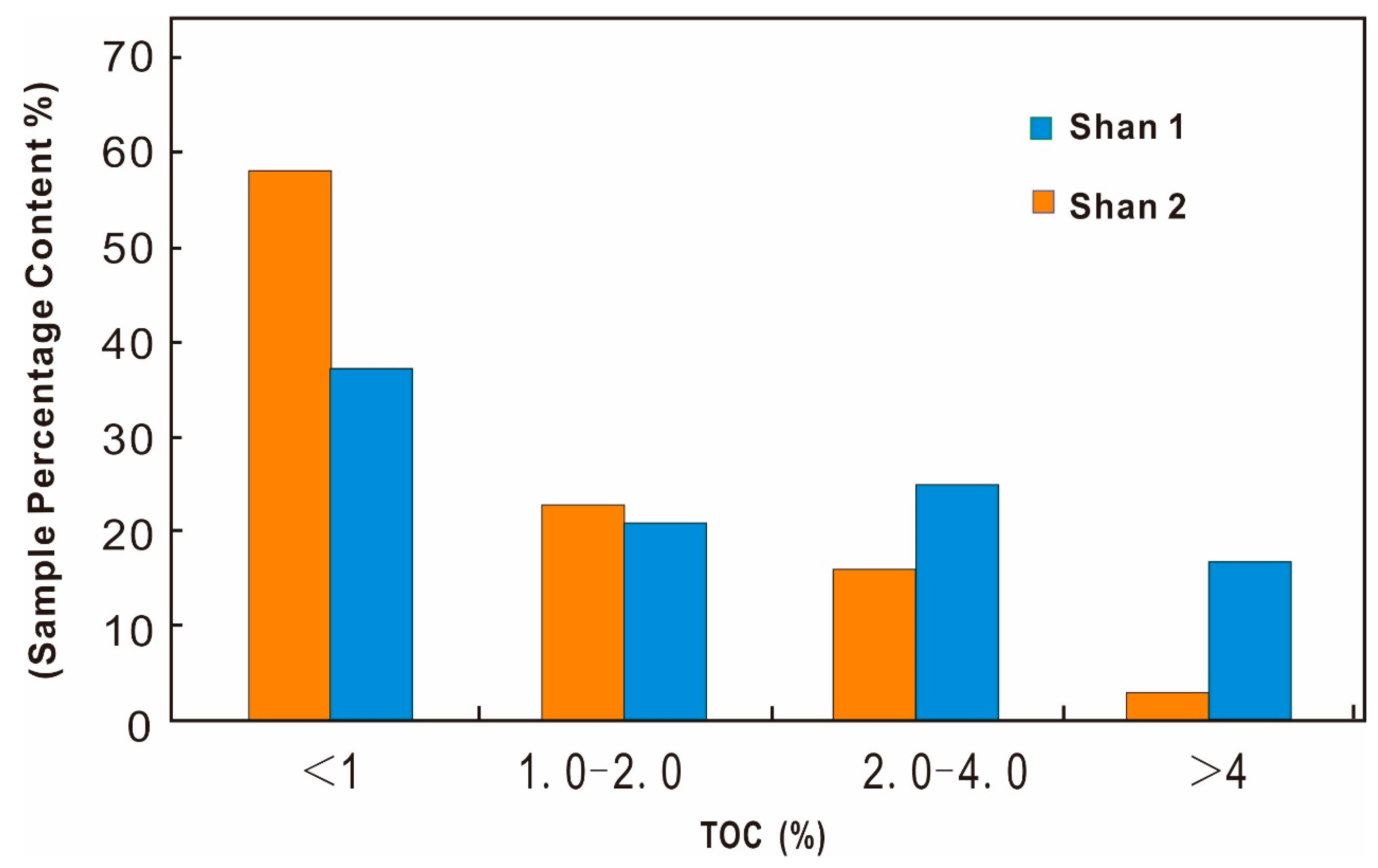
Organic Matter Abundance And Vertical Heterogeneity: TOC contents of the Shanxi Formation range from 0.04% to 12.15%, with significant differences between the Shan 1 and Shan 2 Members (Figure 7). The Shan 2 Member has a TOC range of 0.05–12.15% (average of 2.55%), with 62.5% of samples classified as medium-high to ultrahigh quality source rocks (TOC > 1%); in contrast, the Shan 1 Member has a TOC range of 0.04–7.57% (average 1.36%), with only 41.94% of samples meeting the medium-high to ultrahigh quality standard and 58.06% being low-quality source rocks (TOC < 1%). TOC vertical variation curves are categorized into abrupt change (strong heterogeneity) and relative stability (weak heterogeneity) (Figure 2). For Well Chang 96, the Shan 1 Member is divided into three segments, with TOC decreasing abruptly in Segment 1 and stabilizing in Segment 2; the Shan 2 Member is divided into five segments, all showing abrupt TOC decreases (with two segments exhibiting decrease-increase fluctuations), indicating stronger heterogeneity than the Shan 1 Member despite similar average TOC values. Lateral heterogeneity analysis shows that TOC content has a CV of 0.68, indicating strong lateral heterogeneity significantly higher than that of quartz content (0.42). The shallow lacustrine facies has the lowest lateral TOC variability (CV = 0.45), making it the most favorable facies belt for organic matter enrichment.
Figure 7.
Histogram of sample percentage distribution across Total Organic Carbon (TOC) content intervals for the Shan 1 and Shan 2 Members of the Shanxi Formation.
4.5. Physical Property Heterogeneity
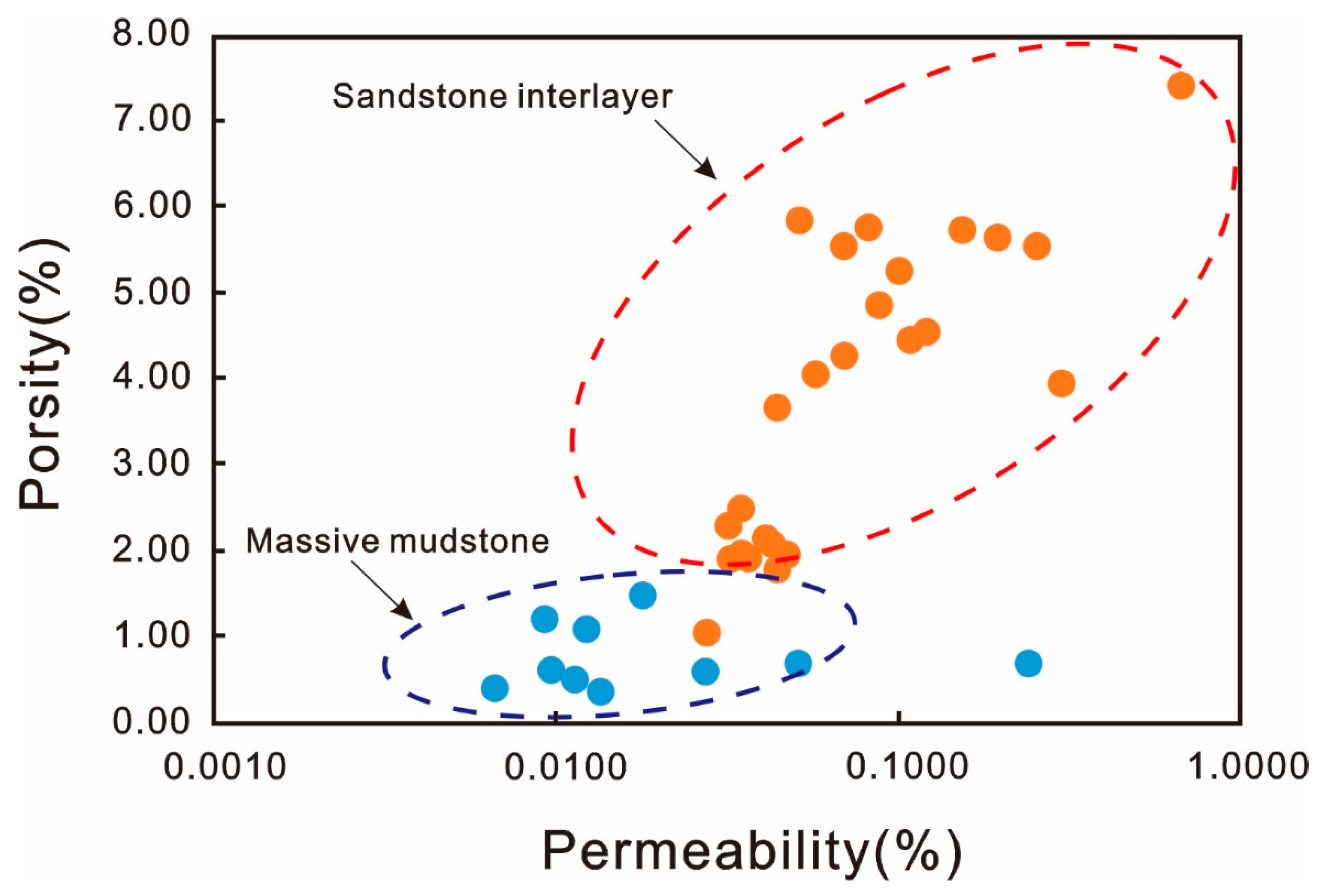
The porosity of the Shanxi Formation shale ranges from 0.1% to 5.86% (average 0.77%), with approximately 70% of samples having porosity between 0.1% and 2%; permeability varies from 0.0014 × 10⁻³ μm2 to 1.86 × 10⁻³ μm2 (average of 0.26 × 10⁻³ μm2) (Figure 8). The reservoir is characterized by ultra-low porosity, low permeability, and strong petrophysical heterogeneity. Notably, no significant correlation is observed between porosity and permeability (r = 0.12, p = 0.42 > 0.05), indicating a decoupling of these two parameters, a typical feature of marine-continental transitional shale reservoirs.
Figure 8.
Scatter plot showing the correlation between porosity and permeability for massive mudstone and sandstone interlayer in the Shanxi Formation.
Lithofacies-specific petrophysical properties show significant differences: sand-mud interbedding has the highest average porosity (1.23%) and permeability (0.42 × 10⁻³ μm2), followed by mud-wrapped sand (0.85%, 0.21 × 10⁻³ μm2) and sand-wrapped mud (0.48%, 0.15 × 10⁻³ μm2). Sandy interbeds have significantly better petrophysical properties than massive mudstone, with an average porosity of 3.37% and an average permeability of 0.12 × 10⁻³ μm2. Fracture density ranges from 0.5 to 2.0 fractures/m (average 1.2 fractures/m), and fracture density exhibits a strong positive correlation with permeability (r = 0.82, p < 0.001), indicating that fractures are the key factor controlling reservoir permeability.
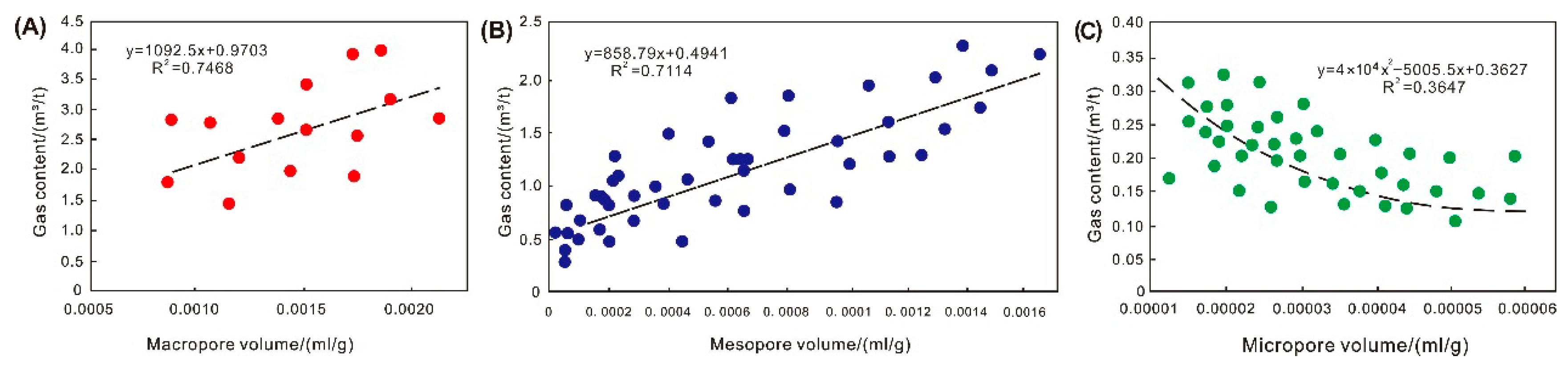
Pore size distribution is dominated by mesopores (2–50 nm), which account for over 75% of the total pore count distribution in the study area. In terms of pore volume, the pore volume of micropores, mesopores, and macropores is 0.000126 mL/g, 0.0078 mL/g, and 0.00663 mL/g, respectively, with mesopores and macropores contributing over 99% of the total pore volume and micropores making a negligible contribution. Correlation analysis shows that mesopore volume exhibits a significant positive correlation with gas content (r = 0.74, p < 0.001, R2 = 0.7468), and macropore volume also shows a significant positive correlation with gas content (r = 0.71, p < 0.001, R2 = 0.7114) (Figure 9A,B). In contrast, micropore volume has no significant correlation with gas content (r = 0.36, p = 0.12 > 0.05, R2 = 0.1330), with the quadratic fit different equation (Figure 9C).
Figure 9.
Scatter plots of the correlation between gas content and pore volume of different pore sizes in the Shanxi Formation shale. (A) Gas content vs. macropore volume; (B) Gas content vs. mesopore volume; (C) Gas content vs. micropore volume.
4.6. TOC–Gas Content Correlation and Threshold Verification
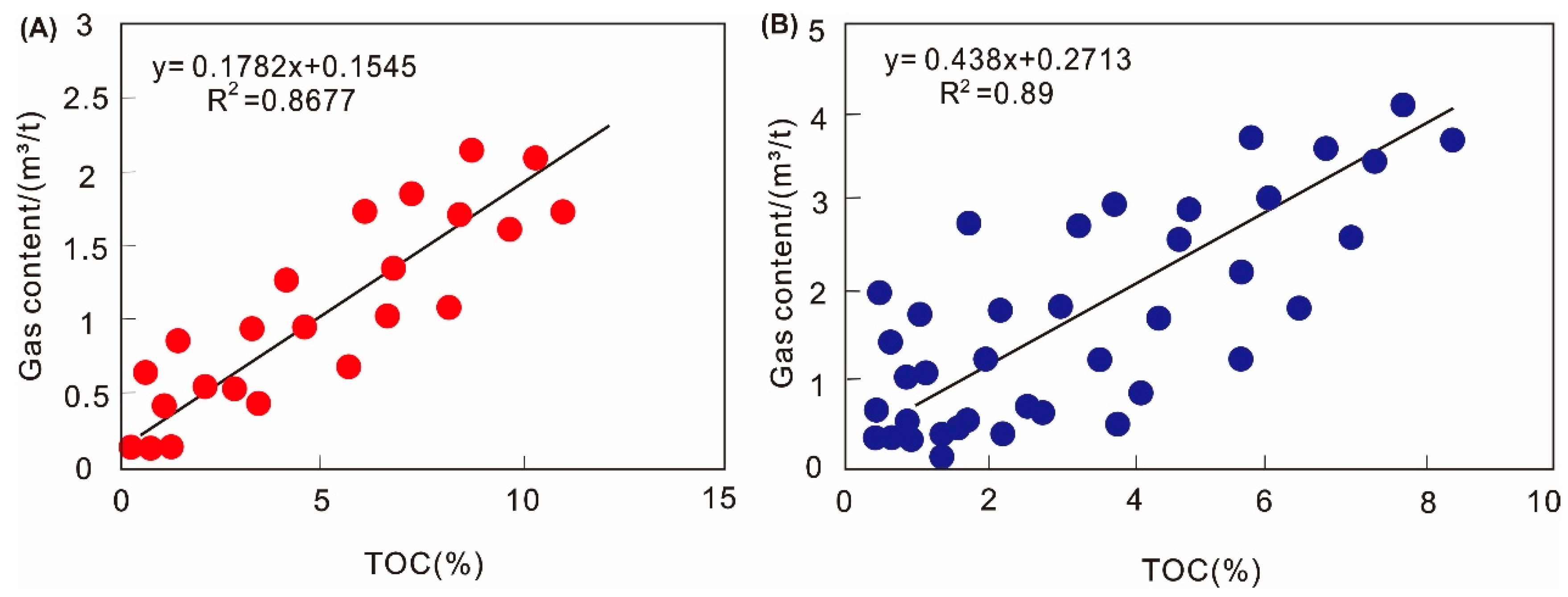
Correlation analysis between TOC content and shale gas content for all 10 wells in the study area yields an overall correlation coefficient of R2 = 0.872 (p < 0.001), indicating a strong positive correlation. Figure 10 shows the representative correlations for the two most cored wells (Chang 96 and Yan 2156), with R2 values of 0.8677 and 0.89, respectively. The rationale for only displaying these two wells is: (1) they are the most systematically cored benchmark wells in the study area, with complete coverage of all lithofacies associations and full stratigraphic intervals; (2) the correlation law and TOC threshold shown in these two wells are completely consistent with the full 10-well dataset; (3) multi-well data superposition would cause overcrowding of the figure and reduce readability.
Figure 10.
Scatter plots illustrating the correlation between gas content and Total Organic Carbon (TOC, %) for shale samples from the well Chang 96 (A) and well Yan 2156 (B) of the Shanxi Formation.
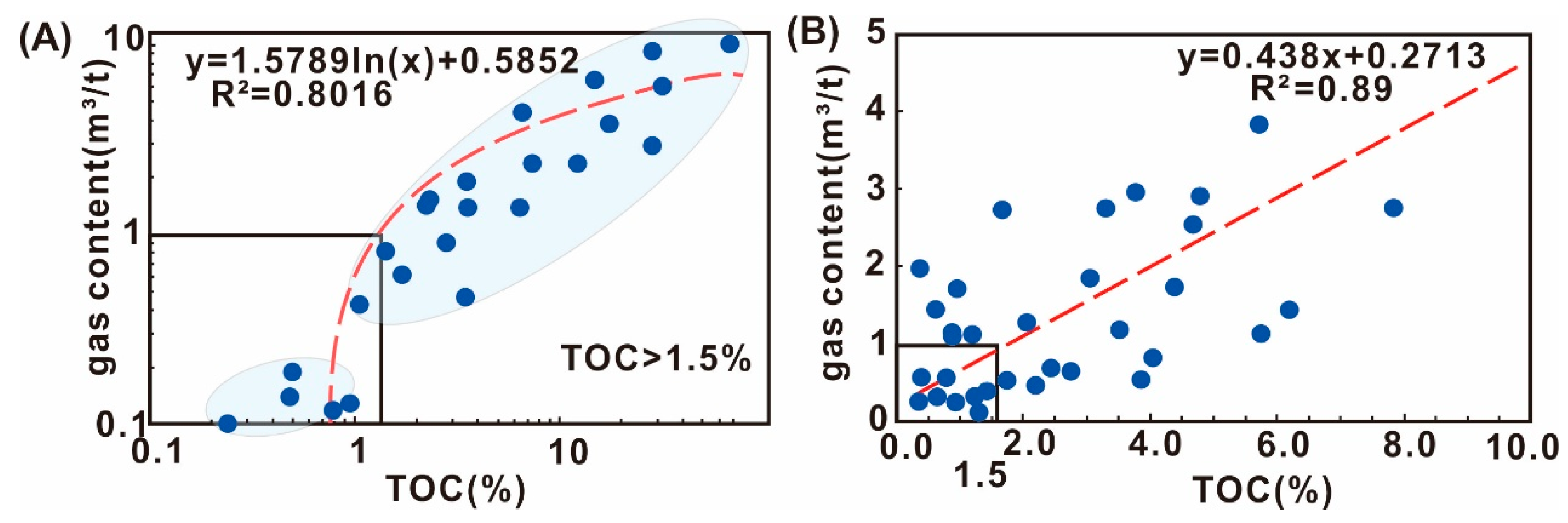
Sensitivity analysis of the TOC threshold was conducted using data from all 10 wells to verify the robustness of the 1.5% threshold. The results show that when TOC > 1.5%, 92% of the samples have gas content >1 m3/t (commercial threshold) across all wells; when TOC < 1.5%, only 12% of the samples meet the commercial gas content standard. The false positive rate of the 1.5% threshold is only 8% across the full dataset, which is significantly more robust than the 1.0% threshold (35% false positive rate) and 2.0% threshold (58% missing rate of sweet spots). This confirms that 1.5% is the optimal TOC threshold for sweet spot identification in the entire study area.
5. Discussion
5.1. Effects of Lithofacies Combinations on Shale Gas Sweet Spot Distribution
Vertical Classification of Multiple Lithofacies Combinations: The Shanxi Fm. shale exhibits strong vertical lithological heterogeneity with distinct zoning characteristics [2], laying the foundation for the formation of diverse lithofacies combinations. The Shan 2 Member features thicker single layers of homogeneous lithology, while the Shan 1 Member is characterized by rapid sand-mud deposition changes, thin single layers, and frequent color alternations. This vertical heterogeneity is closely related to the evolution of the sedimentary environment from the Shan 2 to the Shan 1 Member [7]. During the deposition of the Shan 2 Member, the shallow lacustrine facies were widely distributed in an east–west zonal pattern from Zhangjiawan to Zhiluo, Fuxian, and Yichuan, with well-developed interdistributary bay microfacies and generally thin sand bodies [3,12]. In the Shan 1 Member deposition period, the shallow lacustrine shrank southwestward, and two major north–south provenances converged. The subaqueous distributary channel microfacies replaced interdistributary bays as the dominant type, leading to reduced interdistributary bay scale, thicker sand bodies, and expanded distribution [6]. Overall, significant changes in sedimentary water conditions and microfacies during the transition from the Shan 2 to Shan 1 Member drove rapid lithological alternations, ultimately forming multiple vertical lithofacies combinations in the formation. Vertically, the lithofacies combinations of the Shanxi Formation are mainly classified into three types: mud-wrapped sand, sand-mud interbedding, and sand-wrapped mud (Figure 4). Statistical analysis of single wells shows that the mud-wrapped sand combination is dominated by mudstone, accounting for the majority of the total thickness, with thin and sparse sandstone layers whose cumulative thickness only accounts for a small proportion. In the sand-mud interbedding combination, the thickness ratio of sandstone interbeds to mudstone is approximately 1:1, with both layers being thin and interbedded alternately (Figure 4).
Sandy Interbeds (laminae) Influences: Studies on shale interbeds (laminae) have become a research hotspot in recent years, focusing on classification, genesis, characterization, and their relationship with hydrocarbon accumulation [14,15]. The marine-continental transitional shales of the Shanxi Formation also develop abundant interbeds (laminae) [3,16], which are critical for sweet spot selection [2]. Thin sand layers or sandy laminae interbedded in shale-dominated strata have relatively superior physical properties [17], serving as effective migration channels and free gas reservoirs. The widely developed 0.1~3 m thin sandstone interbeds in the Shanxi Formation are “high-quality endmembers” of physical property heterogeneity, with an average porosity of 3.37% (1.06~7.41%) and average permeability of 0.12 × 10⁻³ μm2 (0.01~2.5 × 10⁻³ μm2), significantly better than pure shale (i.e., porosity of 0.4~1.8% with average value 0.87% and average permeability of 0.08 × 10⁻³ μm2) (Figure 2 and Figure 8). These interbeds not only provide additional reservoir space for natural gas (increasing free gas proportion) but also act as migration channels to transport gas generated in shale to interbeds for enrichment over short distances [16].
5.2. High-TOC Shale Contributing to Sweet Spot Targets
Geochemical Characteristics of the Shanxi Formation: Compared with typical domestic and foreign shales, the Shanxi Formation shale generally exhibits low-TOC characteristics controlled by sedimentary processes [2,8,18]. The Shanxi Formation was deposited during the key marine regression stage of the late Paleozoic basin, transitioning from the shallow marine shelf facies of the Taiyuan Formation to the marine–continental transitional facies, mainly developing deltaic, estuarine bay, and interfluvial swamp sedimentary systems [10]. This environment restricts organic matter enrichment through three key features: first, complex hydrodynamic conditions with the frequent migration of subaqueous distributary channels in the delta front result in poorly sorted, thin, and laterally discontinuous muddy sediments [4,12,13], failing to form stable organic matter preservation carriers; second, unbalanced sedimentation rates, where mismatched terrigenous clastic input and organic matter deposition lead to organic matter dilution in rapid sedimentation areas and oxidation damage in slow sedimentation areas [19,20]; third, significant sedimentary facies differentiation, where only restricted reducing environments such as enclosed lagoons and bays can form local high-TOC zones [21], while extensively distributed delta plain and front facies are unfavorable for organic matter enrichment [11].
The Yanchang exploration area of the Shanxi Formation belongs to a marine–continental transitional sedimentary environment, with TOC contents ranging from 0.04% to 11.5% and strong heterogeneity (Figure 2). This heterogeneity affects shale gas content in two ways: vertically uneven organic matter distribution directly influences the generation and distribution of shale gas and controls the adsorption gas capacity of shales [22].
Local High-TOC Sections as Priority Sweet Spot Targets: Despite the generally low-TOC characteristics of the Shanxi Formation, the development of coal seams is accompanied by adjacent high-TOC shales, which are bound to form effective accumulation after high-maturity evolution [23]. Shale gas reservoir formation results from the large-scale retention of natural gas in source rocks [24], which first requires sufficient gas generation from source rocks, with high-TOC source rocks being a necessary condition [25]. Additionally, organic matter content is closely related to the adsorbed gas content of shale, so sweet spots must be dominated by high-TOC mudshale sections. The systematic coring and on-site desorption of continental shale gas indicate that sweet spots are not universally developed in all shale sections; instead, sweet spots of the Shanxi Formation are mainly distributed in the middle–lower high-gas-content intervals. Among core samples from the upper Shanxi Formation of Wells Yan 2156 and Chang 96, 84.8% have a gas content below 1 m3/t, while only 42.9% of samples from the middle–lower section of Well Yan 2156 have a gas content below 1 m3/t, confirming the primary distribution of sweet spots in the middle-lower part of the Shanxi Formation. Correlation analysis between the TOC content and shale gas content of Wells Chang 96 and Yan 2156 in the Yanchang exploration area yields correlation coefficients of 0.8677 and 0.89, respectively (Figure 10), indicating a strong positive correlation. This is consistent with previous research results, confirming that areas with high total TOC content tend to have higher shale gas production [8,9].
5.3. Effective Thickness and the Lower Limit of Lithofacies Combinations
Continental strata exhibit strong heterogeneity and rapid lithological changes, with frequent transitions from carbonaceous mudstone to blackish-gray mudstone, light gray mudstone, and light gray siltstone, forming numerous thin interbeds. Absolute continuous thick mudstone is rarely observed, and even relatively homogeneous single-layer mudstone typically has a thickness of less than 15 m [26]. However, excluding low-TOC muddy or sandy interbeds, the cumulative thickness of continuous shale is often substantial, with the maximum continuous shale section reaching 60 m and an average of 26.6 m. Five commercially developed gas-bearing shale systems in the United States have organic carbon contents ranging from 0.5% to 25%, with the high single-well production Barnett Shale system having organic carbon contents of 2.0% to 7.0%, and core production areas in Canada having shale organic carbon contents of 3.0% to 10% [8,27]. The lower limit of organic carbon content for the Lower Paleozoic Longmaxi Formation shale in the southern Sichuan Basin is 1.0% [28]. Referring to the TOC lower limits of typical domestic and foreign shales [29], correlation analysis between the TOC and gas content of Wells Chang 96 and Yan 2156 shows that when the TOC content of the Shanxi Formation shale exceeds 1.5%, the corresponding gas content exceeds 1 m3/t (Figure 2A, Figure 9 and Figure 10). Based on this lower limit standard, continuous shale sections with dominant TOC > 1.5% in densely sampled cored intervals can be classified as sweet spots (Figure 11). In continental strata, except for a few single thick coal seams, interbedded coal and carbonaceous mudstone can be regarded as high-carbon shale, which is favorable for natural gas generation and occurrence [30]. Hence, when the average total organic carbon content (TOC) of shale in a section exceeds 1.5%, it can be defined as an effective shale section with industrial exploitation value, i.e., a key sweet spot in shale gas exploration and development.
Figure 11.
Relationship between TOC and gas content with an identification of TOC threshold of 1.5% for shale gas enrichment in the Shanxi Formation from wells Chang 96 (A) and Yan 2156 (B).
5.4. Effects of Lithology–Physical Properties–Organic Matter
The Yanchang exploration area of the Shanxi Formation develops a delta front and shallow lacustrine subfacies [7,31]. The Shan 2 Member has extensively distributed shallow lacustrine subfacies with thick mudstone development, while the Shan 1 Member has shrinking shallow lacustrine subfacies and thicker sand bodies. Due to changes in the sedimentary environment, the Shanxi Formation not only develops thick mudstone but also sandy thin interbeds such as siltstone and fine sandstone. These sandy interbeds are characterized by abundant pores [32], increasing total pore volume and facilitating free gas enrichment.
The type and content of brittle minerals influence shale reservoir pores, microfractures, gas-bearing characteristics, and reservoir stimulation methods [9,33]. The Shanxi Formation has a relatively high average quartz content of 34.86%, but with significant vertical variations ranging from 0.7% to 57.5% and obvious heterogeneity (Figure 5), resulting in varying fracturing capabilities across different layers.
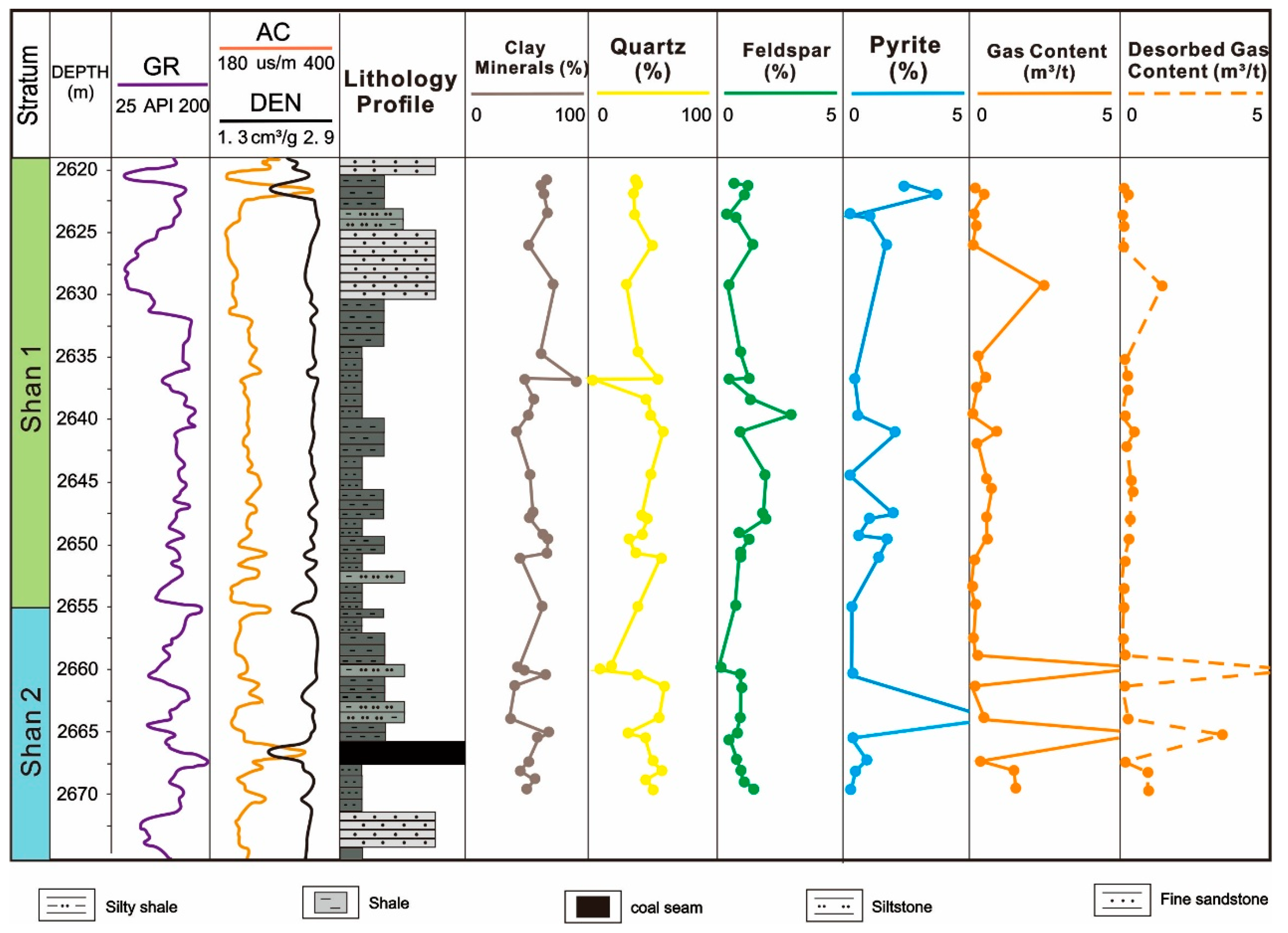
Vertical correlation analysis of whole-rock mineral content, TOC, and gas content in the Shan 1 and Shan 2 Members of Well Chang 96 reveals that due to rapid vertical lithological changes in the Shanxi Formation, the contents of quartz, clay minerals, feldspar, and pyrite in some intervals of both members exhibit large and rapid fluctuations with tortuous curves (Figure 12). For instance, in the Shan 1 Member of Well Chang 96 (2636.71–2638.38 m), quartz content changes extremely rapidly (sharply decreasing then increasing), while clay mineral content shows the opposite trend; TOC also undergoes significant reduction, but gas content remains relatively stable. Between 2647.65 m and 2654.96 m, quartz content first decreases, then increases, and then decreases again, with clay mineral content showing the opposite trend; TOC content follows the same variation trend as clay minerals, while gas content decreases. In the Shan 2 Member (2659.9–2669.49 m), quartz content increases, decreases, and increases again, with clay mineral content showing the opposite trend; TOC and gas content exhibit significant changes within this depth range, possibly related to the heterogeneity of pore distribution and quantity within mineral particles.
Figure 12.
Comprehensive profile of lithology, mineral composition, and gas content for the Shan 1 and Shan 2 Members of the well Chang 96 from the Shanxi Formation.
Previous studies on the three major lithofacies combinations of the Shanxi Formation indicate that differences in mudstone thickness, sandstone interbed thickness, and TOC content across combinations affect shale gas content. The sand–mud interbedding section has an average TOC of 3.56%, the mud-wrapped sand section has an average TOC of 3.15%, and the sand-wrapped mud combination has an average TOC of 1.66% (Figure 4). The sand–mud interbedding and mud-wrapped sand combinations have relatively high TOC contents, favoring shale hydrocarbon generation and expulsion, and thereby influencing shale gas content. Sandy interbeds in these two combinations affect the occurrence state of shale gas. Domestic and foreign studies have shown that sandy interbeds in shale have significantly better physical properties than adjacent shale, with abundant pores increasing total pore volume and facilitating free gas enrichment [34,35,36]. Sandy interbeds in mud-wrapped sand not only provide a reservoir space for free gas but also serve as migration channels during shale gas formation. Additionally, the high brittle mineral content in siltstone and argillaceous siltstone facilitates fracture formation, so thicker and denser sandy interbeds correspond to better shale gas productivity [37]. Previous studies reveal that the middle section of the Shanxi Formation has thicker and more continuous sandy interbeds, which are more favorable for shale gas storage and migration, followed by the upper and lower sections. Meanwhile, shale strata frequently interbed with coal seams and tight sandstone, with rapid vertical and lateral changes, easily leading to the close superposition of multiple natural gas reservoir types, such as shale gas, coalbed methane, and tight sandstone gas.
Vertically, the Shan 1 Member has slightly superior physical parameters but poorer gas-bearing properties compared to the Shan 2 Member, primarily due to the “physical property–gas source” adaptability difference. The Shan 1 Member has higher porosity and permeability (0.15 × 10⁻³ μm2), providing better reservoir space and migration channels, but its low TOC content (average < 2%) results in insufficient gas supply, preventing superior physical properties from translating into high gas-bearing capacity. The Shan 2 Member has slightly lower porosity (0.6–0.8%) and permeability (0.08 × 10⁻³ μm2), but these values fall within a “moderate range” that balances adsorption and preservation. Adjacent to coal seams with a TOC as high as 6.19%, the Shan 2 Member has sufficient gas supply, and enriched adsorbed gas compensates for the insufficient physical properties, resulting in better gas-bearing potential [23,25].
5.5. Synergistic Interaction Mechanism of Lithofacies–Mineralogy–Organic Matter
Based on the results, a synergistic reservoir-controlling mechanism of lithofacies–mineralogy–organic matter is proposed, with lithofacies as the foundation, minerals as the bridge, and organic matter as the core. Firstly, lithofacies controls the initial distribution of organic matter and minerals. The sedimentary environment evolution from the Shan 2 to the Shan 1 Member directly controls lithofacies’ differentiation and the spatial distribution of organic matter and minerals. The Shan 2 Member, dominated by shallow lacustrine–interdistributary bay facies, has weak hydrodynamic conditions and anoxic environments, favoring the preservation of organic matter (high TOC) and the accumulation of clay minerals (illite + kaolinite > 40%). In contrast, the Shan 1 Member, dominated by delta plain subaqueous distributary channels, has strong hydrodynamic energy, leading to the dilution of organic matter (low TOC) and the enrichment of quartz sand (high brittle mineral content). Lithofacies thus determine the basic geological framework for sweet spot formation. Secondly, mineral regulation mediates physical properties and gas migration. Quartz, as the dominant brittle mineral, enhances the brittleness of the reservoir, promoting the development of natural fractures and improving fracturing effectiveness. High quartz content (>30%) in sand–mud interbedding and mud-wrapped sand provides effective migration channels for gas generated by high-TOC organic matter. Clay minerals play a dual role: illite enhances mesopore development, which is favorable for gas storage, while illite–smectite (I/S) mixed layers cause water sensitivity, reducing free gas mobility. Carbonate minerals (calcite, dolomite) have a negative impact on reservoir quality by filling pores and fractures. Thirdly, organic matter provides a gas source and enhances pore space. TOC content is the key factor controlling gas generation capacity. When Ro > 1.3%, TOC > 1.5% ensures sufficient gas supply. Additionally, the decomposition of organic matter during thermal evolution promotes the development of mesopores and macropores, with a strong positive correlation between TOC and mesopore volume (r = 0.78). These pores serve as the main storage space for shale gas, further enhancing the gas-bearing capacity of the reservoir.
6. Conclusions
- (1)
- The Permian Shanxi Formation in the southern Yishan Slope exhibits strong multi-dimensional heterogeneity (lithological, mineralogical, organic geochemical, and physical properties), with the Shan 2 Member being more heterogeneous than the Shan 1 Member. Three lithofacies associations are identified, among which sand–mud interbedding and mud-wrapped sand have higher TOC contents.
- (2)
- Shale gas sweet spots are synergistically controlled by key factors: TOC > 1.5% (strongly correlated with gas content) ensures gas supply, quartz (average of 34.86%) enhances fracturing effectiveness, and 0.1–3 m sandy interbeds act as migration channels and free gas reservoirs.
- (3)
- The reservoir has ultra-low porosity (average 0.77%) and low permeability (average of 0.26 × 10⁻³ μm2), with mesopores/macropores largely contributing to the total pore volume and correlating positively with gas content.
- (4)
- The Shan 2 Member has better gas-bearing potential due to its stable shallow lacustrine deposition, high TOC (average of 2.55%), and balanced adsorption–preservation conditions, providing a reliable basis for sweet spot prediction and development optimization in similar transitional reservoirs.
Author Contributions
Conceptualization, K.W. and C.L.; methodology, C.L.; software, W.Z.; validation, K.W., J.Z., Y.L. and Z.Y.; formal analysis, C.L.; investigation, K.W.; resources, K.W.; data curation, C.L.; writing—original draft preparation, K.W.; writing—review and editing, C.L.; visualization, C.L.; supervision, K.W.; project administration, K.W.; funding acquisition, K.W. All authors have read and agreed to the published version of the manuscript.
Funding
This study is funded by the Science and Technology Project of CNPC Oil, Gas & New Energy Company (Grant Number 2023YQXNCS001-05).
Data Availability Statement
The data that support the findings of this study are available from the corresponding author upon reasonable request.
Acknowledgments
The authors thank the staff of the Changqing Oilfield Company for their assistance in sample collection and field tests.
Conflicts of Interest
Author Jianwu Zhang, Yang Liu and Ziyu Yuan was employed by the company changqing oilfield. The remaining authors declare that the research was conducted in the absence of any commercial or financial relationships that could be construed as a potential conflict of interest.
References
- Zou, C.N.; Yang, Z.Q.; Hou, L.G. Characteristics and exploration potential of marine-continental transitional shale gas in China. Pet. Explor. Dev. 2019, 46, 1–12. [Google Scholar]
- Xue, Y.K.; Dang, W.; Zhang, Q. TOC threshold optimization for sweet spot prediction in marine-continental transitional shale gas reservoirs: A case study from the Shanxi Formation, Ordos Basin. Energies 2024, 17, 4210. [Google Scholar] [CrossRef]
- Zhang, Q.; Xiong, W.; Li, X.T. Lithofacies heterogeneity and its control on shale gas enrichment in the Permian Shanxi Formation, Ordos Basin. Energies 2023, 16, 5890. [Google Scholar] [CrossRef]
- Yang, X.R.; Yin, H.C.; Yang, L.C. Evolution of black shale sedimentary environment and its impact on organic matter content and mineral composition: A case study from Wufeng-Longmaxi Formation in Southern and Eastern Sichuan Basin. Front. Environ. Sci. 2024, 12, 1391445. [Google Scholar] [CrossRef]
- Gu, Y.F.; Li, X.T.; Qi, L. Sedimentology and geochemistry of the lower Permian Shanxi Formation Shan 23 submember transitional shale, eastern Ordos Basin, North China. Front. Earth Sci. 2022, 10, 859845. [Google Scholar] [CrossRef]
- Zhao, Z.F.; Zou, C.N.; Dai, S.F. Weathering-induced organic matter enrichment in marine-continental transitional shale: A case study on the early Permian Taiyuan Formation in the Ordos Basin, China. Int. J. Coal Geol. 2025, 291, 104562. [Google Scholar] [CrossRef]
- Li, Y.; Fan, A.P.; Yang, R.C. Sedimentary facies control on sandstone reservoir properties: A case study from the Permian Shanxi Formation in the southern Ordos Basin, central China. Mar. Pet. Geol. 2021, 129, 105083. [Google Scholar] [CrossRef]
- Curtis, J.B. Fractured shale-gas systems. AAPG Bull. 2002, 86, 1921–1938. [Google Scholar] [CrossRef]
- Jarvie, D.M.; Hill, R.J.; Ruble, T.E. Unconventional shale-gas systems: The Mississippian Barnett Shale of north-central Texas as one model for thermogenic shale-gas assessment. AAPG Bull. 2007, 91, 475–499. [Google Scholar] [CrossRef]
- Moodley, L.; Middelburg, J.J.; Herman, P.M.J. Oxygenation and organic-matter preservation in marine sediments: Direct experimental evidence from ancient organic carbon-rich deposits. Geology 2005, 33, 889–892. [Google Scholar] [CrossRef]
- Zhao, B.S.; Li, R.X.; Qin, X.L. Geochemical characteristics and mechanism of organic matter accumulation of marine-continental transitional shale of the lower permian Shanxi Formation, southeastern Ordos Basin, north China. J. Pet. Sci. Eng. 2021, 205, 108815. [Google Scholar] [CrossRef]
- Chen, Y.H.; Wang, Y.B.; Guo, M.Q. Differential enrichment mechanism of organic matters in the marine-continental transitional shale in northeastern Ordos Basin, China: Control of sedimentary environments. J. Nat. Gas Sci. Eng. 2020, 83, 103625. [Google Scholar] [CrossRef]
- He, Z.; Yang, M.F.; Wang, L. Enrichment mechanism of organic matter in the marine-continental transitional shale of the Taiyuan Formation in Ordos Basin, China: Control of the paleoenvironment. ACS Omega 2025, 10, 21674–21692. [Google Scholar] [CrossRef]
- Guo, X.S.; Wang, R.Y.; Shen, B.J.; Wang, G.; Wan, C.; Wang, Q. Geological characteristics, resource potential, and development direction of shale gas in China. Pet. Explor. Dev. 2025, 52, 17–32. [Google Scholar] [CrossRef]
- Clarkson, C.R.; Bustin, R.M.; Menpes, P.J. Characterization of gas shale pore systems by porosimetry, pycnometry, surface area, and field emission scanning electron microscopy/transmission electron microscopy image analyses: Examples from the Barnett, Woodford, Haynesville, Marcellus, and Doig shales. AAPG Bull. 2011, 95, 2017–2030. [Google Scholar]
- Huang, H.; Zhang, T.S.; Zhang, X.; Liu, Y.; Gao, L.; Zhang, J. The sedimentary record of marine-continental transitional shales in the Upper Triassic of Xujiahe formation, Southeast Sichuan basin, China. J. Mar. Sci. Eng. 2025, 13, 646. [Google Scholar] [CrossRef]
- Chen, S.J.; Zhou, T.; Wei, X.L.; Li, A.; Zhang, J.; Wang, H.; Li, N. Differentiation and quantification of pore-fracture structures in marine and transitional shales. Phys. Fluids 2025, 37, 052022. [Google Scholar] [CrossRef]
- Sun, S.S.; Huang, S.W.; Cheng, F.; Bai, W.; Shao, Z. Geological characteristics and challenges of marine shale gas in the Southern Sichuan Basin. Energies 2023, 16, 5796. [Google Scholar] [CrossRef]
- Zhang, M.T.; Hu, M.Y.; Cai, Q.S.; Deng, Q.; Wei, S.; Wang, K.; Li, Y.; Han, Y. Controlling factors of organic matter enrichment in marine-continental transitional shale: A case study of the Upper Permian Longtan Formation, Northern Guizhou, China. Minerals 2024, 14, 540. [Google Scholar] [CrossRef]
- Babakhani, P.; Dale, A.W.; Woulds, C.; Moore, O.W.; Xiao, K.-Q.; Curti, L.; Peacock, C.L. Preservation of organic carbon in marine sediments sustained by sorption and transformation processes. Nat. Geosci. 2025, 18, 103. [Google Scholar] [CrossRef]
- Tan, J.Q.; Ma, X.Y.; Hua, S.H.; Ma, X.; Wang, B.; Zhang, B.; Tian, W.; Jiang, S.; Hu, R.; Liu, S.; et al. SInfluence of sedimentary environments on organic matter enrichment in marine-continental transitional shale: A case study of the upper permian longtan formation in the central hunan depression, China. Energy Fuels 2024, 38, 14262–14277. [Google Scholar] [CrossRef]
- Wang, Y.; Liu, L.F.; Cheng, H.F. Gas adsorption characterization of pore structure of organic-rich shale: Insights into contribution of organic matter to shale pore network. Nat. Resour. Res. 2021, 30, 2377–2395. [Google Scholar] [CrossRef]
- Fan, C.H.; Li, H.; Qin, Q.R.; He, S.; Zhong, C. Geological conditions and exploration potential of shale gas reservoir in wufeng and longmaxi formation of southeastern Sichuan basin, China. J. Pet. Sci. Eng. 2020, 191, 107138. [Google Scholar] [CrossRef]
- Zhang, J.C.; Xu, B.; Nie, H.K.; Wang, Z.Y.; Lin, T. Exploration potential of shale gas resources in china. Nat. Gas Ind. 2008, 28, 136–140. [Google Scholar]
- Sohail, G.M.; Radwan, A.E.; Mahmoud, M. A review of pakistani shales for shale gas exploration and comparison to north american shale plays. Energy Rep. 2022, 8, 6423–6442. [Google Scholar] [CrossRef]
- Xiao, F.S.; Wei, T.Q.; Wang, X.J.; Guan, X.; Wu, C.J.; Hong, H.T. Research on the sequence stratigraphy of the Shaximiao Formation in Chuanzhong-Chuanxi area, Sichuan Basin. Nat. Gas Geosci. 2020, 31, 1216–1224. [Google Scholar] [CrossRef]
- Kim, G.; Lee, H.; Chen, Z.H.; Athichanagorn, S.; Shin, H. Effect of reservoir characteristics on the productivity and production forecasting of the Montney shale gas in Canada. J. Pet. Sci. Eng. 2019, 182, 106276. [Google Scholar] [CrossRef]
- Zhu, B.Y.; Meng, J.H.; Pan, R.F.; Hu, H.; Song, C.; Zhu, Z.; Jin, J. New insights into the evaluation criteria for high-quality deep marine shale gas reservoirs in the Longmaxi formation: Evidence from organic matter pore development characteristics. Front. Ecol. Evol. 2023, 11, 1138991. [Google Scholar] [CrossRef]
- Nie, H.K.; Dang, W.; Zhang, Q.; Zhang, J.; Li, P.; Zhang, S.; Ding, J.; Chen, Q.; Feng, Y.; Zhang, X. Evaluation of gas content in organic-rich shale: A review of the history, current status, and future directions. Geosci. Front. 2024, 15, 101921. [Google Scholar] [CrossRef]
- Gao, Z.D.; Wang, Y.D.; Gu, X.Y.; Cheng, H.; Puppe, N. Characteristics and gas-bearing properties of Yanchang formation shale reservoirs in the southern Ordos basin. Geofluids 2023, 2023, 5894458. [Google Scholar] [CrossRef]
- Liu, M.C.; Wu, S.H.; Yue, D.L.; Xu, Z.H.; Wan, X.L.; Wu, H.L.; Chen, Z.H.; Li, Z. Palaeogeomorphological control on the depositional architecture of lacustrine gravity-flow deposits in a depression lacustrine basin: A case study of the Triassic Yanchang Formation, southern Ordos Basin, China. J. Palaeogeogr. 2025, 14, 476–500. [Google Scholar] [CrossRef]
- Zheng, Y.J.; Liao, Y.H.; Wang, J.; Xiong, Y.; Wang, Y.; Peng, P.A. Factors controlling the heterogeneity of shale pore structure and shale gas production of the Wufeng-Longmaxi shales in the Dingshan plunging anticline of the Sichuan Basin, China. Int. J. Coal Geol. 2024, 282, 104434. [Google Scholar] [CrossRef]
- Li, X.; Wu, K.Y.; Wang, J.G.; Yang, S.; Zhang, Q.; Zhang, Q. Impact of lithologic heterogeneity on brittleness of cenozoic unconventional reservoirs (fine-grained) in western Qaidam Basin. Minerals 2022, 12, 1443. [Google Scholar] [CrossRef]
- Xiong, M.; Chen, L.; Chen, X.; Ji, Y.; Wu, P.; Hu, Y.; Wang, G.; Peng, H. Characteristics, genetic mechanism of marine shale laminae and its significance of shale gas accumulation. J. Cent. South Univ. (Sci. Technol.) 2022, 53, 3490–3508. [Google Scholar]
- Wu, P.; Gao, L.J.; Li, Y.; Wu, J.G.; Shi, X.F.; Kang, H.N.; Kong, W.; Wu, X. An evaluation method for shale gas potential of marine-continent transitional facies with frequent interbedded lithology: A case study on the Lower Permian Shanxi Formation in Linxing Block of the Ordos Basin. Nat. Gas Ind. 2022, 42, 28–39. [Google Scholar]
- Jiu, K.; Ding, W.L.; Huang, W.H.; Li, C. Analysis of geological condition of the formation of Shahejie shale gas in Jiyang Depression in Bohai Bay Basin. J. Daqing Pet. Inst. 2012, 36, 65–70. [Google Scholar]
- Pu, B.L.; Wang, F.Q.; Wang, K.; Sun, J.B.; Li, Y.X.; Shi, B.H.; Zhao, W.W.; Guo, X.B. The enrichment conditions and model of shale gas reservoir in the chang 7 member of mesozoic yanchang formation in yan’an, ordos basin. Geol. China 2023, 50, 1285–1298. [Google Scholar]
Disclaimer/Publisher’s Note: The statements, opinions and data contained in all publications are solely those of the individual author(s) and contributor(s) and not of MDPI and/or the editor(s). MDPI and/or the editor(s) disclaim responsibility for any injury to people or property resulting from any ideas, methods, instructions or products referred to in the content. |
© 2026 by the authors. Licensee MDPI, Basel, Switzerland. This article is an open access article distributed under the terms and conditions of the Creative Commons Attribution (CC BY) license.