
Skip to Content
GeosciencesGeosciences
  • Article
  • Open Access

3 March 2026

Rare-Earth Element Geochemistry for the Characterization of Sedimentary Environment and Provenance: A Case Study of the Eocene Liushagang Formation, Weixi’nan Sag, Beibuwan Basin, China

,
and
1
College of Earth Science and Engineering, Shandong Institute of Petroleum and Chemical Technology, Dongying 257061, China
2
Shandong Key Laboratory of Shale Oil Exploration and Development in Continental Faulted Basin, Dongying 257015, China
*
Author to whom correspondence should be addressed.

Abstract

This study investigates the rare-earth element (REE) geochemistry of twenty-nine clastic rock samples from the Paleogene Liushagang Formation in the Weixi’nan Sag. The primary objectives were to quantitatively evaluate the depositional paleoenvironment, determine the provenance lithology, and constrain the tectonic setting of the source area. Results reveal distinct chondrite-normalized REE distribution patterns characterized by light REE (LREE) enrichment, relatively flat heavy REE (HREE) segments, and pronounced negative Eu anomalies. The cerium anomaly index (Ceanom, normalized to the North American Shale Composite) ranges from −0.06 to 0.00, implying broadly suboxic to anoxic-reducing conditions in the water column during deposition. The chondrite-normalized (La/Yb)N ratio, utilized as a proxy for relative depositional residence time, decreases stratigraphically from member 3 to member 1, reflecting a transition to shorter residence times and higher relative sedimentation rates. Laterally, (La/Yb)N increases toward the basin center, accurately recording progressively lower sedimentation rates basinward. Provenance analysis indicates that the sediments were predominantly derived from felsic igneous rocks of the upper continental crust. Spatially, the northern steep-slope belt reflects a uniform source, whereas the southern gentle-slope belt and the Weixi’nan low-uplift periphery record multisource mixed inputs. Finally, tectonic discrimination reveals an “active continental margin” affinity. This geochemical signature represents the inherited tectonic environment of the Mesozoic parent rocks in the surrounding source uplifts, rather than the Cenozoic extensional rift setting of the Weixi’nan Sag itself.

1. Introduction

Rare-earth elements (REEs) are robust tracers of sedimentary provenance, tectonic setting, and paleoenvironmental conditions owing to their coherent geochemical behavior and low mobility during weathering, transport, and diagenesis [1,2,3,4]. Fine-grained sedimentary rocks, such as mudstones, are particularly reliable archives of these primary signatures because they are less affected by sorting and burial diagenesis compared to coarser clastics [3,5]. Various REE parameters, including total REE abundance (ΣREE), ΣLREE/ΣHREE ratios, chondrite-normalized patterns, and specific anomalies (e.g., δEu, δCe, and (La/Yb)N), are widely utilized to constrain source-rock lithology, evaluate paleoredox conditions, and estimate relative sedimentation rates [6,7,8,9].
The Paleogene Liushagang Formation in the Weixi’nan Sag is a prolific hydrocarbon-bearing sequence and a primary focus of exploration in the Beibuwan Basin. While previous studies have established the structural framework, sequence stratigraphy, and sand-body distribution [10,11,12,13,14,15,16,17], the basin-scale tectono-sedimentary setting and provenance characteristics remain poorly constrained. Crucially, the systematic application of REE geochemistry to decode the specific depositional environments and source-area properties of this formation has not yet been reported, which hinders a comprehensive understanding of the basin’s “source-to-sink” system.
To address this gap, this study presents a quantitative REE geochemical analysis of mudstones from the Liushagang Formation in the Weixi’nan Sag. By integrating REE distribution patterns and diagnostic geochemical indices, we aim to (1) determine the paleoenvironmental conditions and relative sedimentation rates; (2) discriminate the provenance lithology; and (3) clarify the tectonic setting of the source area. These findings will provide essential geological constraints for understanding the evolutionary history of the Weixi’nan Sag.

2. Geological Setting

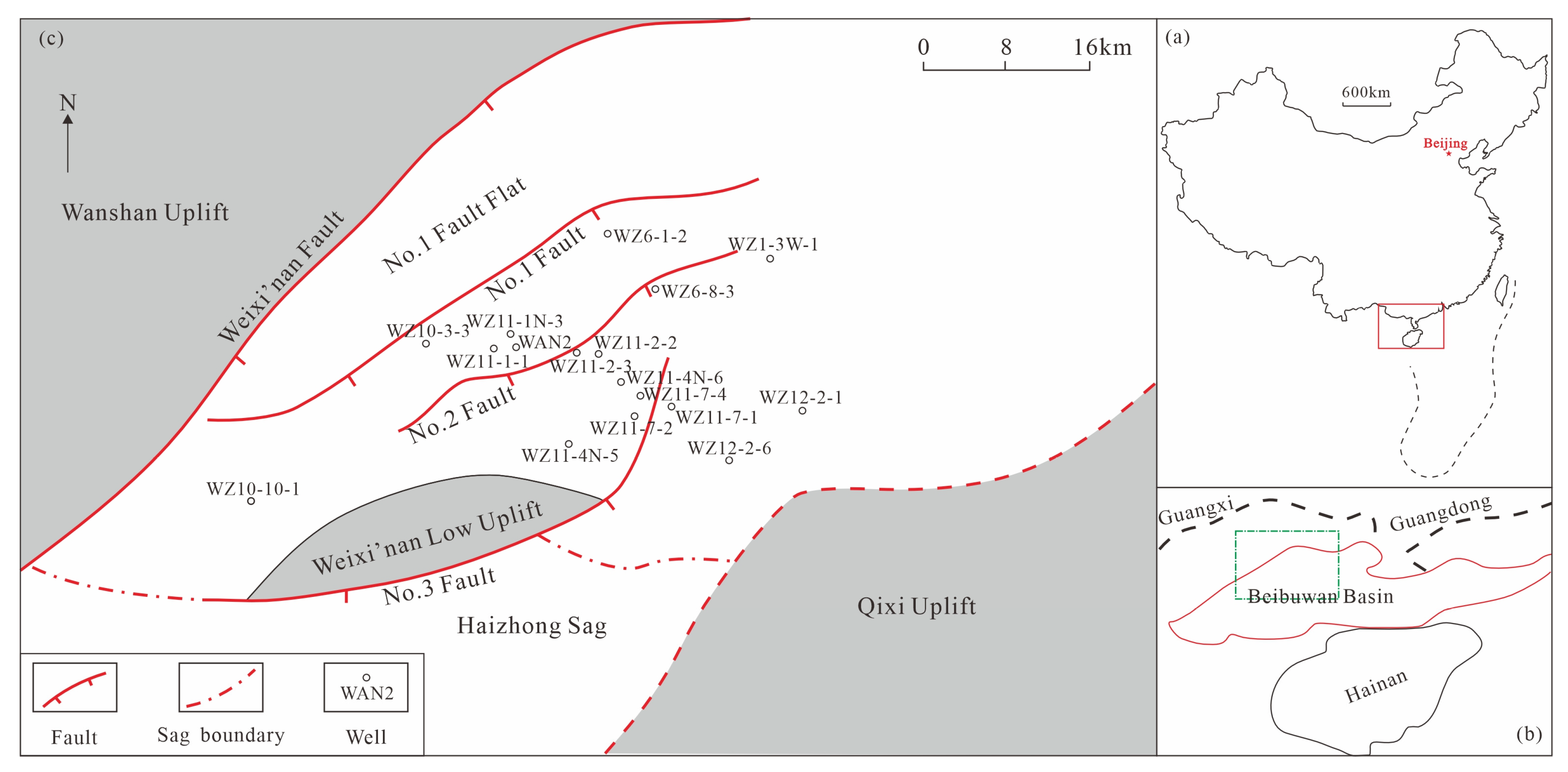
The Weixi’nan Sag lies within the northern depression of the Beibuwan Basin. Its northwestern margin is bounded by the Weixi’nan fault, the southeastern margin adjoins the Qixi uplift, and its southwestern side connects to the Haizhong Sag, separated by the Weixi’nan low uplift. The exploration area of the study region is about 2.3 × 10³ km2. Three approximately NE–SW-trending normal faults (No. 1 Fault to No. 3 Fault in Figure 1) are developed within the sag; their activity governs the overall structural framework and gives rise to a characteristic half-graben geometry, with a steep northwestern slope and a gentle southeastern slope.
Figure 1. Tectonic setting, structural belts, and distribution of sampling wells in the Weixi’nan Sag. (a) Outline map of China, where the red solid rectangle indicates the location of (b). (b) Location map of the Beibuwan Basin, where the green dashed rectangle denotes the study area. (c) Map of the Weixi’nan Sag. The map highlights the distribution of the seventeen sampled wells across the diverse structural belts (northern steep-slope, southern gentle-slope, and Weixi’nan low-uplift periphery) to ensure basin-wide representativeness.
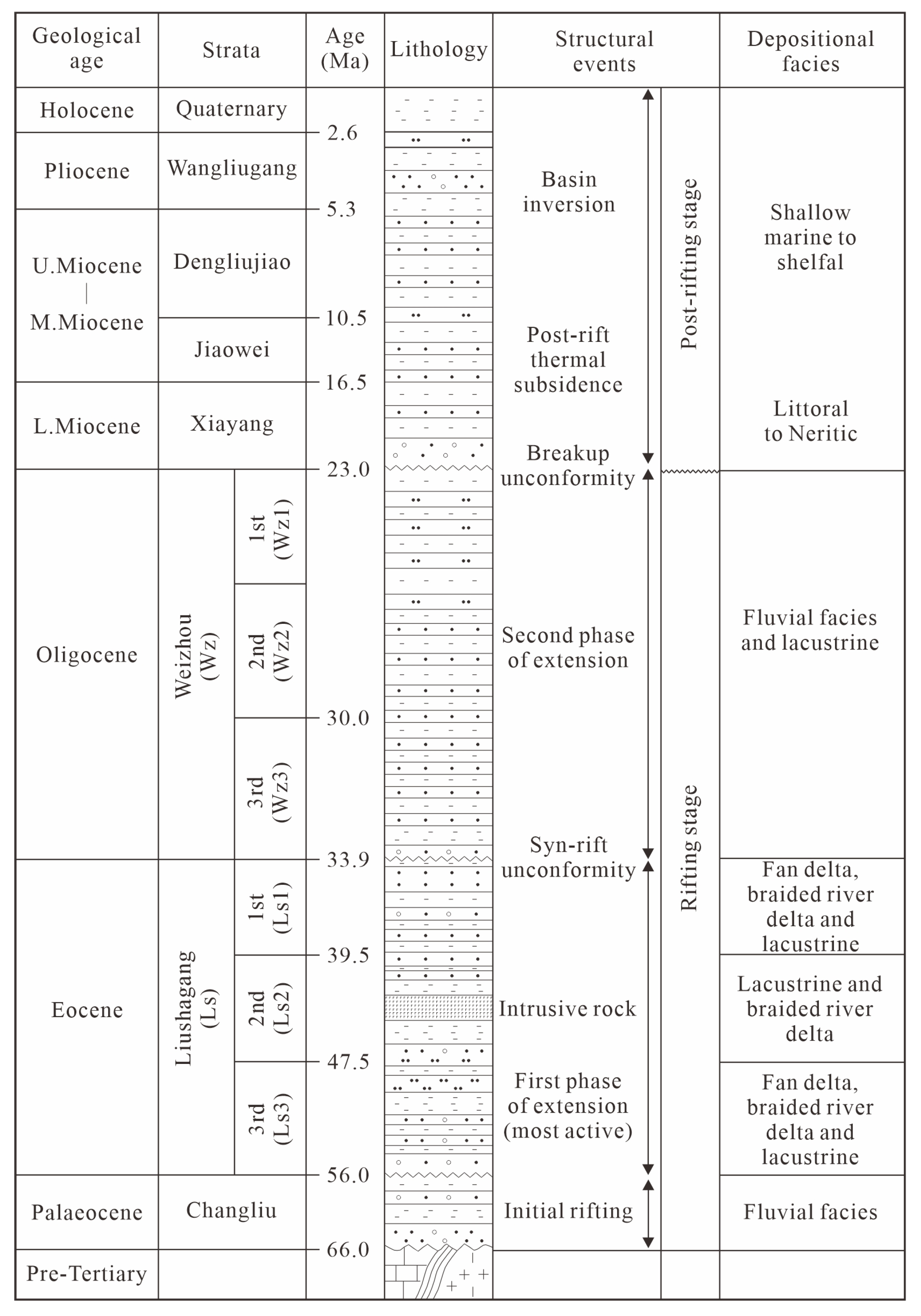
The Weixi’nan Sag exhibits a two-tier structural architecture (i.e., rift beneath and a sag above), with Cenozoic evolution partitioned into a rifting stage and a post-rifting stage [18,19]. The rifting stage comprises an initial rift phase, a peak rift phase, and a waning phase, during which the Changliu, Liushagang, and Weizhou Formations were deposited successively. The post-rifting stage is characterized by regional subsidence, during which the Xiayang, Jiaowei, Dengloujiao, and Wanglougang Formations accumulated (Figure 2). During deposition of the Liushagang Formation, the basin was in the second Eocene rifting episode and underwent expansion, peak rifting, and subsequent waning [20,21]. From base to top, the Liushagang Formation is divided into member 3 (El3), member 2 (El2), and member 1 (El1). El3 corresponds to the initial expansion of the lacustrine basin and is dominated by fan-delta deposits in shore-shallow-lake to middle-deep-lake settings. El2 represents peak rifting and comprises very thick middle-deep-lake mudstone and oil shale; it forms the principal source-rock interval of the Weixi’nan Sag. During El1 time, the lake progressively shrank, and deposition was characterized by shore-shallow-lake mudstone interbedded with fan-delta sandstone.
Figure 2. Generalized stratigraphic column and sedimentary sequence of the Weixi’nan Sag. The column illustrates the regional lithology, major tectonic events, and the specific stratigraphic positions of the targeted Eocene Liushagang Formation. Modified after Cao et al. [21].

3. Materials and Methods

For the present study, twenty-nine samples were collected from seventeen wells in the Weixi’nan Sag to allow us to characterize the geochemical properties of the Liushagang Formation (Table S1 in the Supplementary Material). The sampled lithologies consist of mudstone, silty mudstone, and muddy siltstone. Due to the limited availability of continuous cores, these samples were strategically distributed across multiple wells to maximize regional representativeness. This strategy ensures comprehensive coverage across diverse structural belts (i.e., the northern steep-slope, southern gentle-slope, and low-uplift periphery) and stratigraphic members (El1–El3), thereby minimizing sampling bias and providing a reliable, basin-wide three-dimensional perspective of the geochemical variations.
All analyses were conducted at the State Key Laboratory of Geological Processes and Mineral Resources, China University of Geosciences (Wuhan). Prior to analysis, all samples were crushed and ground to 200 mesh and stored in sealed bags. The digestion and measurement procedures were as follows: samples were oven-dried at 105 °C for 12 h; 50 ± 1 mg of powdered material was weighed into Teflon crucibles, moistened with 1–2 drops of high-purity water, and then 1.5 mL high-purity HNO3 and 1.5 mL high-purity HF were added sequentially. The Teflon crucibles were placed in steel jackets, sealed, and heated at 190 ± 5 °C for >48 h. After cooling, lids were removed and the solutions were evaporated to dryness on a hotplate at 140 °C; 1 mL HNO3 was added and again evaporated to dryness (ensuring no residual liquid on the crucible walls). Next, 3 mL of 30% HNO3 was added, the crucibles were resealed in steel jackets and heated at 190 ± 5 °C for >12 h. The resulting solutions were transferred to polyethylene bottles and diluted with 2% HNO3 to a final mass of 100 g (overall dilution factor 2000), then analyzed by ICP–MS. Certified reference materials (AGV-2, BHVO-2, BCR-2, GSP-2, and RGM-2) and procedural blanks showed good linearity for REEs. Relative analytical uncertainty was generally <3% and only rarely exceeded 10%, indicating reliable results. Analytical data are reported in Table S1 of the Supplementary Material.

4. Results

4.1. REE Concentrations and Characteristics

Analytical results (Table S2 in the Supplementary Material) show that the total REE abundances (∑REE) of the Liushagang samples from the Weixi’nan Sag range from 52.74 to 328.54 μg·g−1, with a mean of 200.51 μg·g−1. By subarea, the northern steep-slope belt yielded 52.74~328.54 μg·g−1 (mean 202.80 μg·g−1); the southern gentle-slope belt yielded 96.87~266.13 μg·g−1 (mean 193.88 μg·g−1); and samples from the periphery of the Weixi’nan low uplift yielded 108.49~312.04 μg·g−1 (mean 200.15 μg·g−1). Overall, the total REE content of the Liushagang samples is clearly higher than the average value for the continental crust (146.4 μg·g−1) and slightly higher than for the North American Shale Composite (NASC: 173.21 μg·g−1) [22,23].
The ratios ∑LREE/∑HREE and (La/Yb)N quantify the degree of REE fractionation and, to some extent, inform on provenance [24]. For a given lithology, larger values indicate stronger LREE–HREE fractionation, i.e., relative enrichment of LREEs and depletion of HREEs. Here, ∑LREE/∑HREE is the ratio of total LREE to total HREE concentrations. For the Liushagang samples from the Weixi’nan Sag, ∑LREE/∑HREE ranges from 3.95 to 10.13 (mean 7.58). By subarea, the northern steep-slope belt yielded 3.95~10.13 (mean 7.65); the southern gentle-slope belt, 5.75~8.46 (mean 7.64); and the periphery of the Weixi’nan low uplift, 4.57~9.38 (mean 7.45). Overall, inter-belt differences are small, and values are comparable to the North American Shale Composite (NASC) average (7.50; from Haskin et al. [22]), indicating relative LREE enrichment and HREE depletion. (La/Yb)N denotes the La/Yb ratio normalized to NASC. For the Liushagang Formation, (La/Yb)N spans 0.61~1.68 (mean 1.14). By subarea, the northern steep-slope belt shows 0.61~1.68 (mean 1.15); the southern gentle-slope belt, 1.07~1.26 (mean 1.17); and the periphery of the Weixi’nan low uplift, 0.07~1.50 (mean 1.10). On the whole, (La/Yb)N values are slightly higher than the NASC benchmark (1.00), consistent with modest LREE enrichment [22].
(La/Sm)N and (Gd/Yb)N are key parameters that characterize intra-group fractionation among LREEs and HREEs, respectively; larger ratios indicate more pronounced fractionation among LREEs (or HREEs) during transfer from the source area to the depositional basin [25,26]. For the Liushagang Formation in the Weixi’nan Sag, (La/Sm)N ranges from 0.76 to 1.21 (mean 1.03), indicating minimal fractionation within the LREEs. (Gd/Yb)N ranges from 0.77 to 1.70 (mean 1.11), likewise implying weak fractionation among the HREEs.
Post-Archean Australian Shale (PAAS) and the average upper continental crust (UCC) are characterized by LREE enrichment, relatively uniform HREE content, and a negative Eu anomaly, and are commonly used to represent upper-crustal REE signatures [27]. For the Liushagang Formation in the Weixi’nan Sag, δEu ranges from 0.56 to 1.18 with a mean of 0.79. By subarea, the northern steep-slope belt recorded 0.70~1.18 (mean 0.82); the southern gentle-slope belt, 0.71~0.86 (mean 0.82); and the periphery of the Weixi’nan low uplift, 0.56~0.84 (mean 0.72). Overall, aside from a few samples with δEu slightly >1.00 or ≈1.00, most values are clearly below the North American Shale Composite benchmark (δEu = 1.00) and slightly higher than PAAS and UCC (δEu ≈ 0.72 and 0.66, respectively), indicating an overall negative Eu anomaly across the study area.
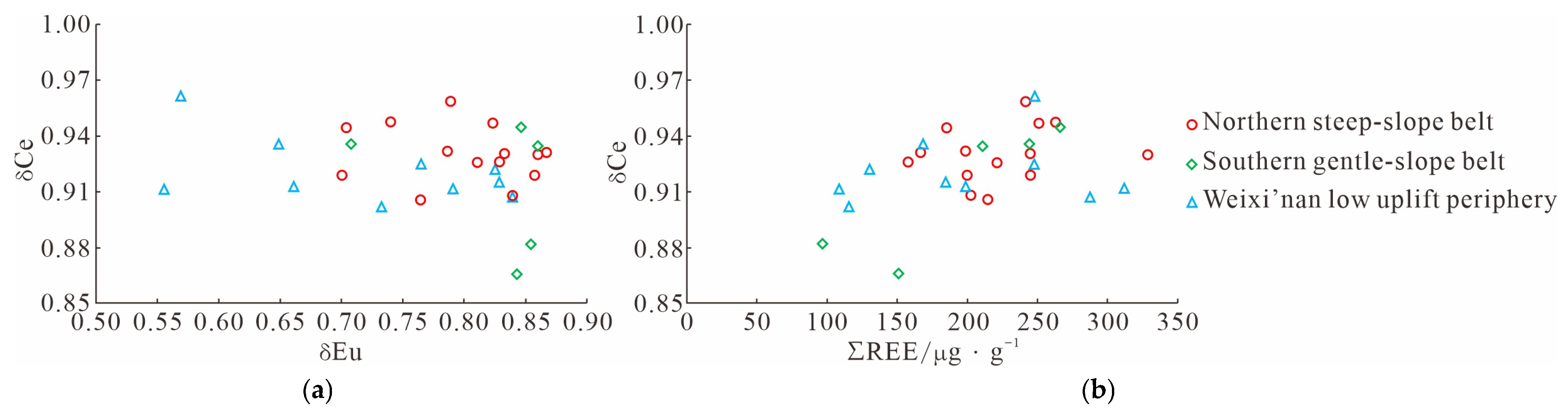
Diagenetic overprinting can remobilize and redistribute REEs, thereby modifying primary geochemical signatures [28]. Under intense diagenesis, REE concentrations may become enriched and ΣREE can increase markedly; this, coupled with the effects on the mobility of Ce and Eu, may attenuate the Ce anomaly—reducing or even reversing a negative anomaly—and/or producing a pronounced negative Eu anomaly. Correlation analysis among REE parameters (e.g., δCe, δEu, and ΣREE) provides a means to assess the extent to which diagenesis has altered the primary signal. Weak or absent correlations indicate limited diagenetic influence and, hence, infers that REE-based paleoenvironmental inferences remain robust. As shown in Figure 3, Liushagang samples from the Weixi’nan Sag exhibit no obvious correlations between δCe and δEu or between δCe and ΣREE, implying only minor diagenetic modification.
Figure 3. Cross-plots of REE parameters used to evaluate diagenetic modification in the Liushagang Formation. (a) Binary relationship of δCe versus δEu; (b) binary relationship of δCe versus ΣREE. Both plots exhibit no obvious correlations, indicating that the REE compositions were not significantly altered by post-depositional diagenesis and reliably preserve the primary paleoenvironmental and provenance signals.

4.2. REE Distribution Patterns

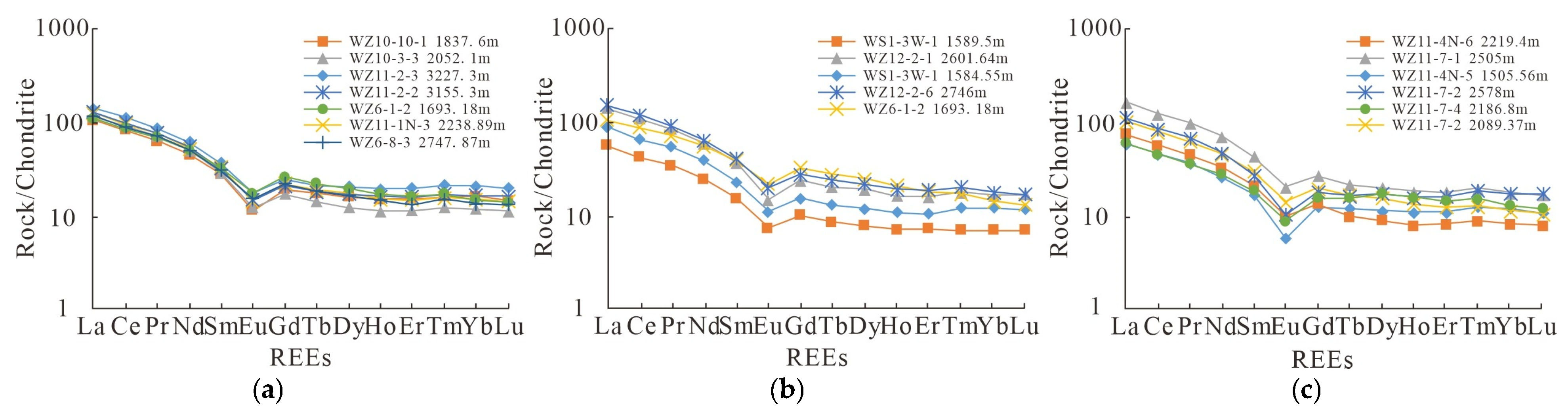
REE distribution patterns provide an intuitive view of REE geochemical characteristics [29]. Using the chondrite normalization values of Taylor et al. [27], Liushagang samples from the Weixi’nan Sag were normalized and plotted separately for the northern steep-slope belt, the southern gentle-slope belt, and the periphery of the Weixi’nan low uplift. The patterns exhibit three consistent features: (1) The three subareas show broadly similar patterns: curves have a steep LREE segment (right-inclined) and a relatively flat HREE segment, indicating pronounced LREE enrichment and HREE depletion. (2) A distinct “V-shaped” feature at Eu is present, with Eu displaying an overall negative anomaly. (3) Curves are quasi-parallel across subareas, implying broadly synchronous variation in REE abundances and suggesting internally consistent provenance characteristics within the study area (Figure 4).
Figure 4. Chondrite-normalized rare-earth element (REE) distribution patterns for samples from the Liushagang Formation, Weixi’nan Sag. (a) Samples from the northern steep-slope belt, showing highly parallel patterns indicative of a uniform source; (b) samples from the southern gentle-slope belt; and (c) samples from the Weixi’nan low-uplift periphery. Both (b) and (c) display more dispersed patterns, reflecting mixed-source inputs. The overall light REE (LREE) enrichment, flat heavy REE (HREE) segments, and distinct negative Eu anomalies consistently point to a predominantly felsic upper-crustal provenance.

5. Discussion

Rare-earth elements (REEs), owing to their distinctive geochemical properties and systematic fractionation under varying redox conditions, have become indispensable geochemical tracers in paleo-depositional environment analysis.

5.1. Depositional Environment Analysis

Cerium (Ce) is the only REE that undergoes valence change under surficial redox conditions (Ce3+ ↔ Ce4+). In oxidizing waters, soluble Ce3+ is readily oxidized to the sparingly soluble Ce4+ and scavenged onto Mn/Fe oxyhydroxide particles, removing Ce from the solution and generating a deficit relative to neighboring REEs in the water column and in chemically precipitated sediments (negative Ce anomaly, Ce/Ce* < 1). Conversely, in reducing waters, Ce occurs mainly as soluble Ce3+, is less efficiently removed, and may even be locally enriched, yielding a positive anomaly (Ce/Ce* > 1). Accordingly, the Ce anomaly is a sensitive indicator of the paleo-redox state [30,31,32].
The cerium anomaly index (Ceanom) quantifies the magnitude of the anomaly using North American Shale Composite (NASC)–normalized values and is calculated as (from Elderfield and Greaves [33]):
C e a n o m = l g ( 3 C e N 2 L a N + N d N )
Using NASC as the reference, Ceanom < −0.10 denotes Ce depletion and indicates oxic conditions, whereas Ceanom > −0.10 denotes Ce enrichment and indicates anoxic-reducing conditions [32]. For the study area, NASC-normalized values yield Ceanom = −0.06 to 0.00 (mean −0.03; Table 1), indicating slight Ce enrichment, which may reflect a suboxic to weakly reducing environment, or fluctuating redox conditions during deposition of the Liushagang Formation in the Weixi’nan Sag. Furthermore, in bulk-rock clastic sediments, the primary authigenic Ce anomaly from the water column can be partially masked by the uniform REE patterns of terrigenous detrital inputs [34]. Therefore, in the absence of independent redox-sensitive trace metal proxies (such as Mo, U, and V enrichments) or Fe speciation data, an interpretation of the precise redox state based solely on Ce anomalies carries some uncertainty. Based on the current REE parameters, we conservatively interpret the depositional environment of the Liushagang Formation as a suboxic to weakly reducing setting rather than a strictly anoxic one.
Table 1. Statistical summary of key rare-earth element (REE) parameters for the Liushagang Formation samples across different structural belts in the Weixi’nan Sag.

5.2. Relative Depositional Residence Time and Sedimentation Rate

As depositional conditions fluctuate, REEs undergo varying degrees of fractionation, particularly between light and heavy REEs (LREEs and HREEs) [3,8,26]. In lacustrine systems, clay-sized detritus and other suspended particles serve as primary carriers for both REEs and organic matter [35]. The extent of REE fractionation is closely coupled to the settling dynamics of these particles. Consequently, the chondrite-normalized (La/Yb)N ratio, which defines the slope of the REE distribution pattern, acts as a reliable indicator of the residence time of suspended particles in the water column [7,33]. When the residence time is short (i.e., rapid deposition), the interaction between REEs, ambient pore waters, and clay minerals is restricted. This limited interaction prevents extensive fractionation, resulting in (La/Yb)N values closer to 1 and relatively flat REE patterns. Conversely, prolonged suspension allows for extensive adsorption onto clays and complexation with organic matter, driving strong fractionation characterized by LREE enrichment and HREE depletion. Under such slow settling conditions, the (La/Yb)N ratio increases significantly above 1, producing a steeper, right-inclined distribution pattern.
Although the (La/Yb)N ratio has been widely utilized to evaluate sedimentation rates [21], it is critical to emphasize that this parameter is not exclusively controlled by depositional speed. The fractionation between LREEs and HREEs can also be substantially modified by competing factors, including provenance composition, grain-size sorting, clay mineralogy, and sediment recycling. Therefore, rather than representing absolute sedimentation rates, the (La/Yb)N values in this study are more accurately interpreted as reflections of relative depositional residence times and hydrodynamic energy conditions. Given that the provenance of the Liushagang Formation remained relatively stable throughout the depositional period (as established in Section 5.3), the observed variations in (La/Yb)N primarily record fluctuations in the water-column residence time prior to final burial. In this context, a lower (La/Yb)N value indicates a shorter residence time, corresponding to a higher relative sedimentation rate or higher-energy hydrodynamic conditions, which restricts the prolonged fractionation of REEs.
Spatial and stratigraphic analyses of the twenty-nine samples reveal distinct (La/Yb)N trends across the Weixi’nan Sag. In both the northern steep-slope and southern gentle-slope belts, (La/Yb)N values generally decrease upward from member El3 to El1. During El3 deposition, (La/Yb)N values reached up to 1.68 (mean: 1.23), whereas during El1, they ranged from 0.61 to 1.50 (mean: 1.09). This upward decrease in (La/Yb)N signifies a reduction in residence time, coinciding with the stratigraphic transition from El3 fan-delta systems to El1 gravity-flow deposits, as the latter are inherently characterized by much more rapid, episodic accumulation [13]. Interestingly, an opposite temporal trend is observed around the periphery of the Weixi’nan low uplift, where El3 values are generally lower than those of El1. Laterally across the basin, (La/Yb)N values exhibit a consistent increasing trend from the basin margins toward the depocenter. This spatial distribution perfectly captures the progressive basinward deceleration of sediment transport and the corresponding decline in relative sedimentation rates.

5.3. Provenance Characteristics

REEs are highly immobile under normal depositional and diagenetic conditions, making their distribution patterns (e.g., ∑LREE/∑HREE ratios and δEu) robust geochemical fingerprints of sediment provenance [1,2,4,36].
Chondrite-normalized REE distribution patterns of the Liushagang Formation samples (Figure 4) exhibit LREE enrichment, flat HREE segments, and negative Eu anomalies, closely mirroring the upper continental crust (UCC) [1,36]. High ∑LREE/∑HREE ratios (mean 7.62 and range 3.95–10.13) and pronounced negative δEu values (mean 0.78 and range 0.56–0.87) further point to a chiefly felsic source, as plagioclase fractionation typically produces Eu depletion in evolved magmas [1,8]. While relying solely on δEu carries uncertainty, our geochemical inferences are highly consistent with the regional geology. Borehole data confirm that the primary sediment source areas for the Weixi’nan Sag (e.g., the Weixi’nan low uplift and Qixi uplift) consist extensively of Mesozoic granitic, intermediate-acidic volcanic, and metamorphic rocks. Thus, the negative δEu signature effectively corroborates the felsic nature of this regional “source-to-sink” supply.
Spatially, samples from the northern steep-slope belt display highly parallel REE curves with tightly clustered LREE content, indicating a stable, homogeneous provenance. Conversely, the southern gentle-slope belt and the Weixi’nan low-uplift periphery exhibit dispersed LREE content and lower inter-sample similarity, suggesting mixed-source inputs.
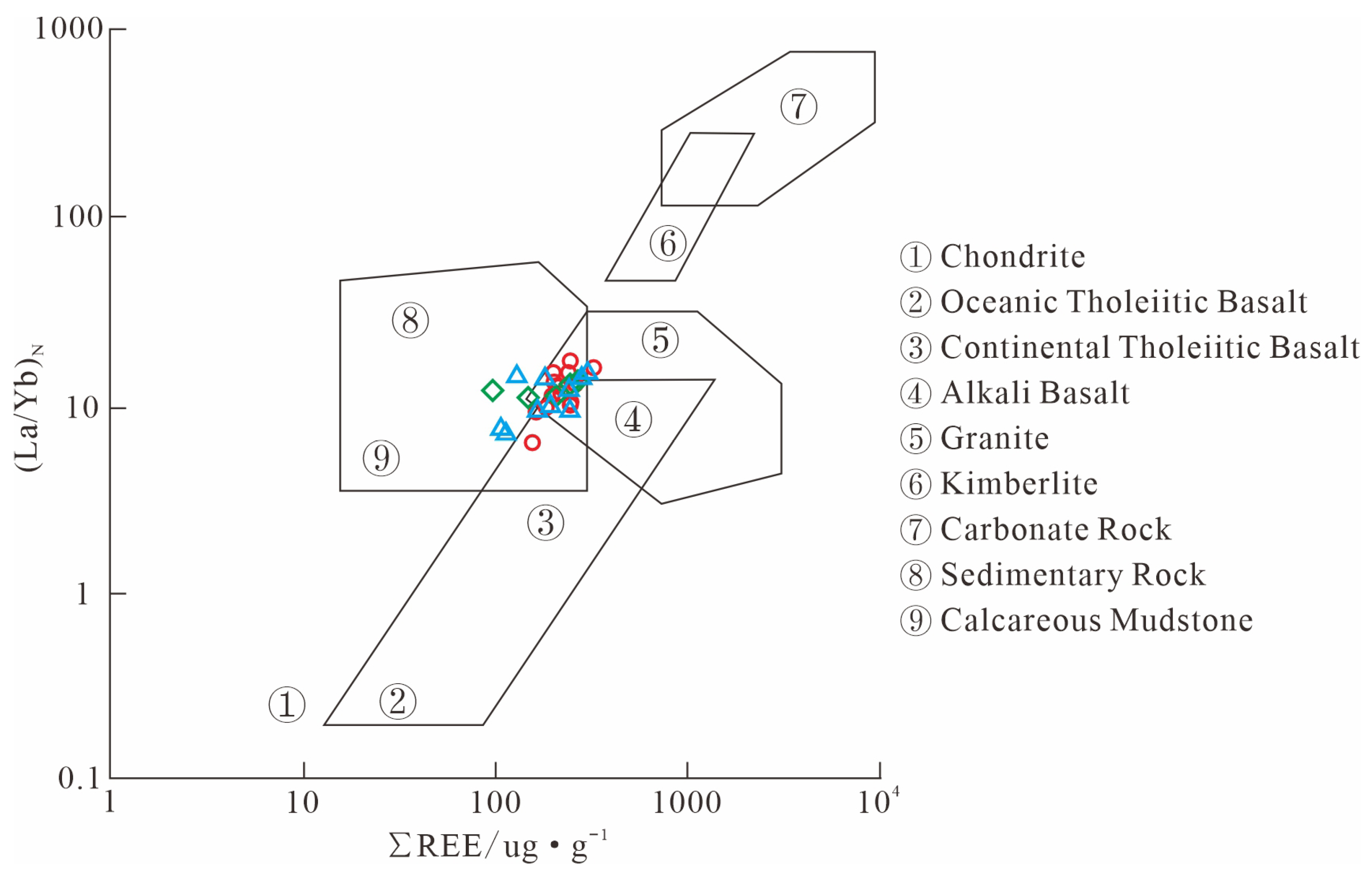
The La/Yb–∑REE diagram (Figure 5) supports this spatial variation. Northern steep-slope data points concentrate mainly in the alkaline basalt–granite–sedimentary and granite–sedimentary fields, implying a uniform source dominated by igneous rocks. In contrast, samples from the southern gentle-slope and low-uplift periphery are scattered across multiple fields (including sedimentary- and calcareous-mudstone), confirming multisource input. This mixed-source signal at the low-uplift periphery aligns perfectly with its stratigraphic context. Most samples here belong to El1 gravity-flow deposits. During the earlier El2 deposition, intense activity on the No. 3 Fault and lake-level rise submerged the low uplift; by El1 time, it was re-exposed to erosion. Consequently, these El1 deposits record a mixture of autochthonous materials eroded from the uplift itself and allochthonous sediments transported from adjacent regions.
Figure 5. The ΣREE versus (La/Yb)N provenance discrimination diagram for the Liushagang Formation samples. Data points from the northern steep-slope belt concentrate mainly in the igneous/granite sedimentary fields (implying a uniform source), whereas samples from the southern gentle-slope and low-uplift periphery scatter across multiple fields, confirming multisource mixed inputs. Base diagram after Allègre and Minster [37]. Sample symbols are the same as in Figure 3. Red circle represents sample from the northern steep-slope belt, green diamond represents sample from the southern gentle-slope belt, and blue triangle represents sample from the Weixi’nan low-uplift periphery.

5.4. Tectonic Setting of the Provenance Area

Because REEs are relatively stable during weathering, erosion, transport, and deposition, they effectively preserve the geochemical fingerprints of their source rocks. Provenance formed in different tectonic settings—such as oceanic island arcs, continental island arcs, active continental margins, and passive continental margins—displays distinctive REE compositions, total abundances, and chondrite-normalized distribution patterns. By comparing sedimentary REE patterns with these archetypal signatures, one can infer the tectonic position of the basin and the attributes of its source area [38].
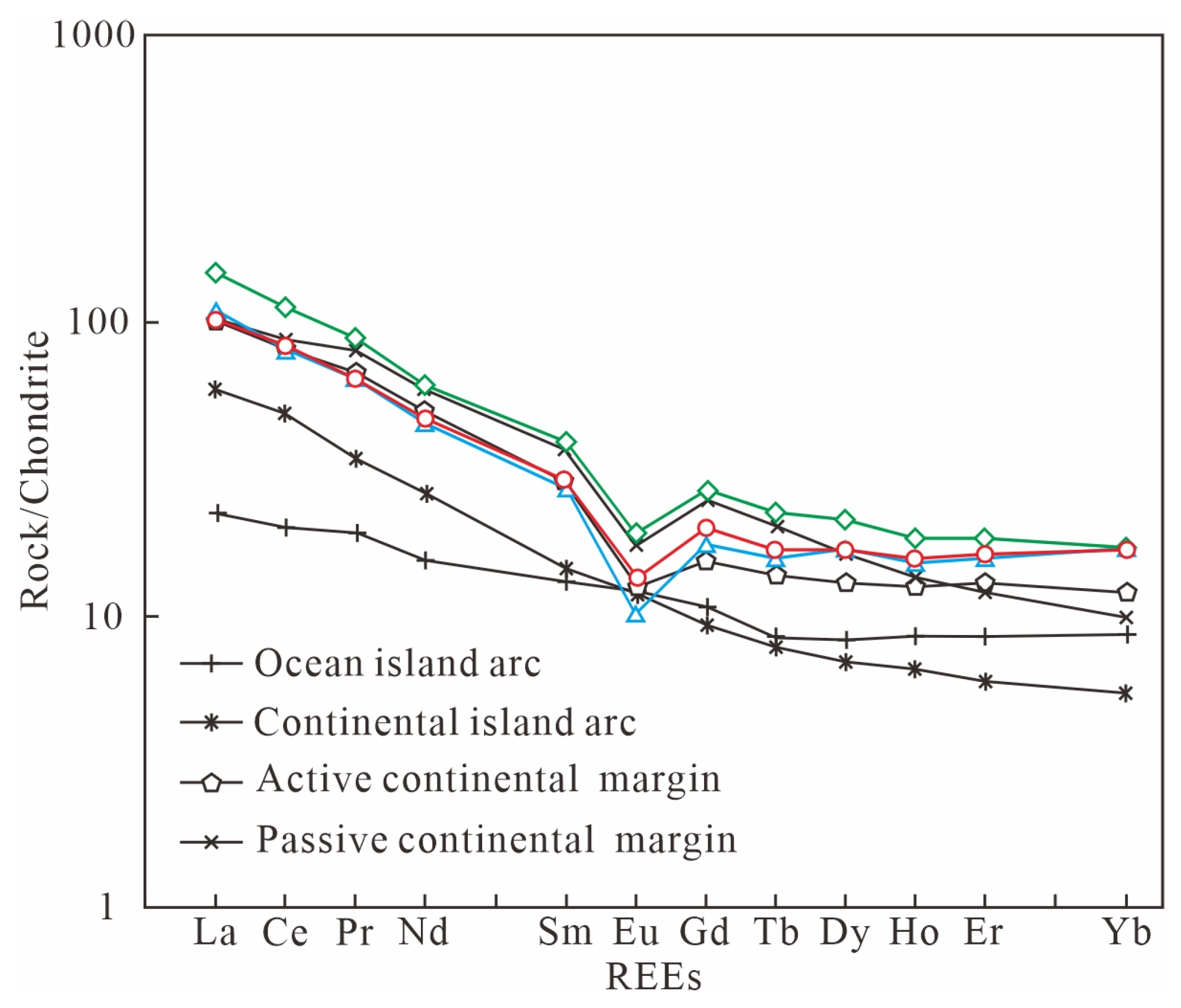
REE parameters of greywacke from contrasting tectonic settings provide a comparative yardstick for diagnosing provenance. Because mudstone typically has ΣREE values ~20% higher than coeval greywacke within the same tectonic regime due to the concentration of REEs in the clay fraction [4], the REE parameters for mudstone samples were recalculated by dividing ΣREE by 1.2. This normalization allows for an unbiased cross-comparison with the greywacke-based reference fields in the tectonic discrimination diagrams (Table 2; Figure 6). Pattern comparison shows that REE curves from the study area resemble those of active continental margins, indicating that the provenance of the Liushagang Formation in the Weixi’nan Sag is most consistent with an active-margin tectonic setting.
Table 2. REE data for greywacke from different tectonic settings (from Bhatia [4]).
Figure 6. Chondrite-normalized REE distribution patterns of graywackes from various tectonic settings (reference models after Bhatia [4]) compared with the study area. The REE signatures of the Liushagang Formation samples most closely match the “active continental margin” pattern. This inherited signature reflects the original tectonic environment of the Mesozoic parent rocks in the provenance area (surrounding uplifts) rather than the Cenozoic extensional rift setting of the Weixi’nan Sag itself. Sample symbols are the same as in Figure 3. Red circle represents sample from the northern steep-slope belt, green diamond represents sample from the southern gentle-slope belt, and blue triangle represents sample from the Weixi’nan low-uplift periphery.
Ce anomalies are commonly linked to basin-scale tectonic settings. Prior studies indicate that near spreading ridges Ce shows a pronounced negative anomaly (δCe ≈ 0.29); in open-ocean basins δCe indicates a moderate negative anomaly (≈0.55); whereas along continental margins the negative anomaly diminishes or even becomes positive, with δCe typically ranging from ~0.90 to 1.30 [39]. For the Liushagang Formation in the Weixi’nan Sag, δCe spans 0.87~0.96 with a mean of 0.92, consistent with the continental-margin affinity of the provenance.
Integrating La, Ce, La/Yb, ∑REE, ∑LREE/∑HREE, and δEu, we infer that the northern steep-slope belt reflects an active continental-margin provenance, whereas the southern gentle-slope belt and the periphery of the Weixi’nan low uplift record the mixed signatures of a continental island arc and an active continental margin—consistent with a heterogeneous (mixed-lithology) source.
When interpreting these geochemical signals, it is crucial to explicitly distinguish between the original tectonic setting of the source area (provenance) and the tectonic regime of the depositional basin itself. Geologically, the Beibuwan Basin is a Cenozoic extensional rift basin, specifically characterized as a dextral pull-apart basin controlled by pre-existing NE-trending large-scale strike-slip faults in the South China Block. During the deposition of the Paleogene Liushagang Formation, the basin experienced intense rifting. Controlled by fault activities, the surrounding uplifts, such as the Weixi’nan low uplift and the Qixi uplift, were rapidly uplifted and exposed, serving as the primary provenance areas within a typical “source-to-sink” system.
However, the REE tectonic discrimination diagrams (e.g., [4]) primarily indicate the tectonic setting in which the parent rocks were originally formed, rather than the subsequent basinal environment. Regional geological evidence shows that the basement and these surrounding uplifts are extensively composed of pre-Cenozoic metamorphic and magmatic rocks (mainly Mesozoic granitic and intermediate-acidic volcanic rocks). These ancient parent rocks were generated under an active continental margin setting associated with the subduction of the Paleo-Pacific plate beneath the South China Block during the Mesozoic. Therefore, the “active continental margin” geochemical signature observed in the Liushagang Formation clastic rocks is an inherited chemical memory from the eroded Mesozoic basement rocks in the provenance area, which perfectly reconciles the REE signals with the Cenozoic extensional rifting history of the Weixi’nan Sag.

6. Conclusions

Based on the geochemical analysis of rare-earth elements (REEs) in the samples of the Paleogene Liushagang Formation in the Weixi’nan Sag, the following key conclusions are drawn:
(1)
The clastic rocks exhibit pronounced light REE (LREE) enrichment, relatively flat heavy REE (HREE) segments, and distinct negative Eu anomalies. These geochemical signatures closely mirror the upper continental crust (UCC), indicating that the sediments were predominantly derived from felsic to intermediate-acidic igneous parent rocks.
(2)
The cerium anomalies (Ceanom) are generally normal to slightly negative, indicating that the depositional water column during the Liushagang Formation period was primarily a suboxic to anoxic-reducing environment.
(3)
The chondrite-normalized (La/Yb)N ratio effectively tracks the relative depositional residence time. Vertically, (La/Yb)N values decrease from member El3 upward to El1, reflecting a transition to shorter residence times and higher relative sedimentation rates (driven by El1 gravity flows). Laterally, (La/Yb)N values increase from the basin margins toward the center, accurately recording progressively lower sedimentation rates basinward.
(4)
Spatial mapping of REE parameters reveals distinct sediment routing. The northern steep-slope belt reflects a uniform, stable provenance dominated by igneous rocks. Conversely, the southern gentle-slope belt and the Weixi’nan low-uplift periphery record multisource mixed inputs, heavily influenced by localized fault activities and topographic variations.
(5)
While REE discrimination diagrams point to an “active continental margin” affinity, this represents an inherited geochemical memory. It reflects the original tectonic environment of the Mesozoic parent rocks in the surrounding source areas (e.g., the Weixi’nan low uplift), rather than the Cenozoic extensional rift setting of the Weixi’nan Sag depositional basin itself.

Supplementary Materials

The following supporting information can be downloaded at: https://www.mdpi.com/article/10.3390/geosciences16030105/s1, Table S1: Rare-earth element contents of samples in the Weixi’nan Sag (μg·g−1). Table S2: Geochemical parameters of rare-earth elements of the Liushagang Formation, Weixi’nan Sag.

Author Contributions

Conceptualization, J.W.; methodology, J.C.; data curation, Y.S.; writing—original draft preparation, Y.S.; writing—review and editing, Y.S.; visualization, J.C.; supervision, J.W.; and funding acquisition, Y.S. All authors have read and agreed to the published version of the manuscript.

Funding

This work was supported by the Science Development Fund Project of Dongying (Grant No. DJB2022012).

Data Availability Statement

All data generated or analyzed during this study are included in this published article.

Acknowledgments

The authors would like to express their sincere gratitude to CNOOC China Limited Zhanjiang Branch for generously providing the valuable core samples and essential well data from the Weixi’nan Sag that made this research possible. We also thank the staff of the State Key Laboratory of Geological Processes and Mineral Resources, China University of Geosciences (Wuhan), for their analytical support. We also thank the anonymous reviewers and the handling editor for their highly constructive comments, which have significantly improved the quality of this manuscript.

Conflicts of Interest

The authors declare no conflicts of interest.

References

  1. Taylor, S.R.; McLennan, S.M. The Continental Crust: Its Composition and Evolution; Blackwell Scientific Publication: Hoboken, NJ, USA, 1985. [Google Scholar]
  2. Bau, M. Rare-earth element mobility during hydrothermal and metamorphic fluid-rock interaction and the significance of the oxidation state of europium. Chem. Geol. 1991, 93, 219–230. [Google Scholar] [CrossRef]
  3. Chen, J.; Algeo, T.J.; Zhao, L.; Chen, Z.Q.; Cao, L.; Zhang, L.; Li, Y. Diagenetic uptake of rare earth elements by bioapatite, with an example from Lower Triassic conodonts of South China. Earth Sci. Rev. 2015, 149, 181–202. [Google Scholar] [CrossRef]
  4. Bhatia, M.R. Rare earth element geochemistry of Australian Paleozoic graywackes and mudrocks: Provenance and tectonic control. Sediment. Geol. 1985, 45, 97–113. [Google Scholar] [CrossRef]
  5. Maravelis, A.; Zelilidis, A. Petrography and geochemistry of the late Eocene–early Oligocene submarine fans and shelf deposits on Lemnos Island, NE Greece. Implications for provenance and tectonic setting. Geol. J. 2010, 45, 412–433. [Google Scholar] [CrossRef]
  6. Savoy, L.E.; Stevenson, R.K.; Mountjoy, E.W. Provenance of Upper Devonian-Lower Carboniferous Miogeoclinal Strata, Southeastern Canadian Cordillera: Link Between Tectonics and Sedimentation. J. Sediment. Res. 2000, 70, 181–193. [Google Scholar] [CrossRef]
  7. Shen, Y.L.; Jiang, B.; Xie, G.L.; Zhang, G.S.; Chang, M.H.; Wei, Z.H. Distribution characteristic of rare earth elements of mudstone of Hebei plain area. J. China Coal Soc. 2016, 41, 2813–2821, (In Chinese with English abstract). [Google Scholar]
  8. Hu, J.; Li, Q.; Fang, N. REE geochemical characteristics and geological significance of sedimentary rocks of the Lower Permian Zhanjin Formation in central uplift zone of Qiangtang Basin, northern Tibet Plateau. J. Palaeogeogr. 2014, 16, 926–934, (In Chinese with English abstract). [Google Scholar]
  9. Cao, J.; Wu, M.; Chen, Y.; Hu, K.; Bian, L.; Wang, L.; Zhang, Y. Trace and rare earth element geochemistry of Jurassic mudstones in the northern Qaidam Basin, northwest China. Geochemistry 2012, 72, 245–252. [Google Scholar] [CrossRef]
  10. Wang, J.; Cao, Y.; Li, J. Sequence structure and non-structural traps of the Paleogene in the Weixi’nan Sag, Beibuwan Basin. Pet. Explor. Dev. 2012, 39, 325–334. [Google Scholar] [CrossRef]
  11. Hu, C.; Ren, J.; Tong, D.; Xu, Y.; Wang, Z. Multiphase growth and basin control of main faults on Northern sub-basin, Beibuwan basin, Northwestern South China sea. Mar. Pet. Geol. 2024, 169, 107052. [Google Scholar] [CrossRef]
  12. Fyhn, M.B.W.; Cuong, T.D.; Hoang, B.H.; Hovikoski, J.; Olivarius, M.; Tuan, N.Q.; Tung, N.T.; Huyen, N.T.; Cuong, T.X.; Nytoft, H.P.; et al. Linking Paleogene Rifting and Inversion in the Northern Song Hong and Beibuwan Basins, Vietnam, with Left-Lateral Motion on the Ailao Shan-Red River Shear Zone. Tectonics 2018, 37, 2559–2585. [Google Scholar] [CrossRef]
  13. Zhao, Y.; Wang, H.; Yan, D.; Jiang, P.; Chen, S.; Zhou, J.; Ma, J.; Qin, C.; He, J.; Zhao, Y. Sedimentary characteristics and model of gravity flows in the eocene Liushagang Formation in Weixi’nan depression, South China Sea. J. Pet. Sci. Eng. 2020, 190, 107082. [Google Scholar] [CrossRef]
  14. Xu, J.-J.; Jin, Q.; Xu, X.-D.; Cheng, F.-Q.; Hu, C.-H.; Wang, B.; Chen, T. Factors controlling organic-rich shale development in the Liushagang Formation, Weixinan Sag, Beibu Gulf Basin: Implications of structural activity and the depositional environment. Pet. Sci. 2021, 18, 1011–1020. [Google Scholar] [CrossRef]
  15. Zhao, J.; Hong, Q.; Dong, W. Analysis on material sources and palaeogeographic landscapes of Weixinan Sag. Pet. Explor. Dev. 2001, 28, 25–28, (In Chinese with English abstract). [Google Scholar]
  16. Gong, Y.; Pease, V.; Wang, H.; Gan, H.; Liu, E.; Ma, Q.; Zhao, S.; He, J. Insights into evolution of a rift basin: Provenance of the middle Eocene-lower Oligocene strata of the Beibuwan Basin, South China Sea from detrital zircon. Sediment. Geol. 2021, 419, 105908. [Google Scholar] [CrossRef]
  17. Liu, E.; Wang, H.; Li, Y.; Zhou, W.; Leonard, N.D.; Lin, Z.; Ma, Q. Sedimentary characteristics and tectonic setting of sublacustrine fans in a half-graben rift depression, Beibuwan Basin, South China Sea. Mar. Pet. Geol. 2014, 52, 9–21. [Google Scholar] [CrossRef]
  18. Liu, Y.; Wu, Z.; Du, Q.; Wang, M. Late Eocene tectonic-geomorphic transition and its dynamic mechanism: Case study of the Beibuwan Basin, northern South China Sea. Geomorphology 2024, 467, 109458. [Google Scholar] [CrossRef]
  19. Liu, Y.; Wu, Z.; Liu, L.; Yan, S.; Hu, L.; Ping, M.; Zhang, M. Cenozoic structure and tectonics of North subbasins in Beibu Gulf Basin, northern South China Sea. Tectonophysics 2021, 812, 228912. [Google Scholar] [CrossRef]
  20. Zhao, L.; Liu, B.; Wen, Z.; Hu, Z. Astronomical forcing of lake-level changes along the low-latitude Asian continental margin and the global sea level responses during the early-middle Eocene. J. Asian Earth Sci. 2025, 280, 106470. [Google Scholar] [CrossRef]
  21. Cao, L.; Zhang, Z.; Li, H.; Zhong, N.; Xiao, L.; Jin, X.; Li, H. Mechanism for the enrichment of organic matter in the Liushagang Formation of the Weixinan Sag, Beibuwan Basin, China. Mar. Pet. Geol. 2020, 122, 104649. [Google Scholar] [CrossRef]
  22. Haskin, L.A.; Haskin, M.A.; Frey, F.A.; Wildeman, T.R. Relative and Absolute Terrestrial Abundances of the Rare Earths. In Origin and Distribution of the Elements; Ahrens, L.H., Ed.; Pergamon: Oxford, UK, 1968; pp. 889–912. [Google Scholar]
  23. Gromet, L.P.; Haskin, L.A.; Korotev, R.L.; Dymek, R.F. The “North American shale composite”: Its compilation, major and trace element characteristics. Geochim. Cosmochim. Acta 1984, 48, 2469–2482. [Google Scholar] [CrossRef]
  24. Lei, C.; Yin, S.; Shi, S.; Meng, L. Depositional environment and sediment provenance of the third member of the Palaeogene Shahejie Formation in the Nanpu Sag of the Bohai Bay Basin, eastern China: Evidence from trace and rare earth element geochemistry. Geol. J. 2021, 56, 5780–5791. [Google Scholar] [CrossRef]
  25. Liu, H.; Guo, H.; Pourret, O.; Wang, Z.; Sun, Z.; Zhang, W.; Liu, M. Distribution of rare earth elements in sediments of the North China Plain: A probe of sedimentation process. Appl. Geochem. 2021, 134, 105089. [Google Scholar] [CrossRef]
  26. Li, S.J.; Xi, K.H.; Wo, Y.J.; Lo, S.X.; Cao, L.G. REE geochemical characteristics and their geological signification in Silurian, West of Hunan Province and North of Guizhou Province. Geoscience 2008, 22, 273–280, (In Chinese with English abstract). [Google Scholar]
  27. Taylor, S.R.; McLennan, S.M.; McCulloch, M.T. Geochemistry of loess, continental crustal composition and crustal model ages. Geochim. Cosmochim. Acta 1983, 47, 1897–1905. [Google Scholar] [CrossRef]
  28. Shields, G.; Stille, P. Diagenetic constraints on the use of cerium anomalies as palaeoseawater redox proxies: An isotopic and REE study of Cambrian phosphorites. Chem. Geol. 2001, 175, 29–48. [Google Scholar] [CrossRef]
  29. McLennan, S.M. Rare earth elements in sedimentary rocks; influence of provenance and sedimentary processes. Rev. Mineral. Geochem. 1989, 21, 169–200. [Google Scholar]
  30. Zhang, K.; Shields, G.A. Sedimentary Ce anomalies: Secular change and implications for paleoenvironmental evolution. Earth-Sci. Rev. 2022, 229, 104015. [Google Scholar] [CrossRef]
  31. Lawrence, M.G.; Greig, A.; Collerson, K.D.; Kamber, B.S. Rare Earth Element and Yttrium Variability in South East Queensland Waterways. Aquat. Geochem. 2006, 12, 39–72. [Google Scholar] [CrossRef]
  32. Wright, J.; Schrader, H.; Holser, W.T. Paleoredox variations in ancient oceans recorded by rare earth elements in fossil apatite. Geochim. Cosmochim. Acta 1987, 51, 631–644. [Google Scholar] [CrossRef]
  33. Elderfield, H.; Greaves, M.J. The rare earth elements in seawater. Nature 1982, 296, 214–219. [Google Scholar] [CrossRef]
  34. Tribovillard, N.; Algeo, T.J.; Lyons, T.; Riboulleau, A. Trace metals as paleoredox and paleoproductivity proxies: An update. Chem. Geol. 2006, 232, 12–32. [Google Scholar] [CrossRef]
  35. Lučić, M.; Vdović, N.; Bačić, N.; Mikac, N.; Dinis, P. Disentangling the influence of lithology and non-provenance factors on the geochemistry of rare earth elements: A study of fine-grained sediments from the Sava River headwaters (Slovenia, Croatia). J. Soils Sediments 2021, 21, 3704–3716. [Google Scholar] [CrossRef]
  36. Kim, J.-H.; Torres, M.E.; Haley, B.A.; Kastner, M.; Pohlman, J.W.; Riedel, M.; Lee, Y.-J. The effect of diagenesis and fluid migration on rare earth element distribution in pore fluids of the northern Cascadia accretionary margin. Chem. Geol. 2012, 291, 152–165. [Google Scholar] [CrossRef]
  37. Allègre, C.J.; Minster, J.F. Quantitative models of trace element behavior in magmatic processes. Earth Planet. Sci. Lett. 1978, 38, 1–25. [Google Scholar] [CrossRef]
  38. Fouquet, Y.; von Stackelberg, U.; Charlou, J.L.; Erzinger, J.P.; Herzig, P.M.; Mühe, R.; Wiedicke, M. Metallogenesis in back-arc environments; the Lau Basin example. Econ. Geol. 1993, 88, 2154–2181. [Google Scholar] [CrossRef]
  39. Murray, R.W.; Buchholtz ten Brink, M.R.; Jones, D.L.; Gerlach, D.C.; Russ, G.P., III. Rare earth elements as indicators of different marine depositional environments in chert and shale. Geology 1990, 18, 268–271. [Google Scholar] [CrossRef]
Disclaimer/Publisher’s Note: The statements, opinions and data contained in all publications are solely those of the individual author(s) and contributor(s) and not of MDPI and/or the editor(s). MDPI and/or the editor(s) disclaim responsibility for any injury to people or property resulting from any ideas, methods, instructions or products referred to in the content.

Article Metrics

Citations

Article Access Statistics

Multiple requests from the same IP address are counted as one view.